The nuclear receptor (NR) superfamily consists of
important ligand-inducible transcription factors that are involved
in various physiological processes, including cell differentiation,
embryonic development and metabolism (1,2). NR
signaling serves important roles in a number of diseases including
cancer, diabetes and metabolic diseases (1–3). Liver X
receptors (LXRs) are important members of the NR family that were
originally identified as major sensors of dietary cholesterol
(4). Two LXRs, LXRα (NR1H3) and LXRβ
(NR1H2), were initially identified in a human liver cDNA library
screen as orphan receptors (5–7). LXRs are
involved in cholesterol synthesis and transport, glucose
homeostasis, and the modulation of inflammatory and immune
responses (8–10). LXRs exhibit the typical structure of
the NR superfamily. LXRα and LXRβ harbor four distinct domains: i)
An N-terminal activation domain (AF-1); ii) a DNA-binding domain
with two zinc fingers; iii) a hinge domain that binds co-repressors
in the absence of ligand; and iv) a C-terminal domain that contains
a hydrophobic ligand-binding domain and a transactivation domain
(11,12).
LXRs were initially identified as orphan receptors.
However, later studies identified oxysterols, or oxidized
metabolites of cholesterol, as the endogenous ligands of LXRα and
LXRβ (13,14). Furthermore,
22(R)-hydroxycholesterol, 20(S)-hydroxycholesterol,
24-hydroxycholesterol, 7α-hydroxycholesterol and
27-hydroxycholesterol also activate LXRs (13,15).
Additionally, microbial and plant-derived sitosterol, sitostanol
and acanthoic acid from Rollinia function as LXR agonists
(16,17). Since the initial identification of
endogenous LXR ligands, synthetic ligands have been developed by
numerous pharmaceutical companies. T0901317 was the first synthetic
LXR agonist to be developed, and is the most widely used in basic
research. However, this compound may also activate two other NRs:
Farnesoid X receptor and pregnane X receptor (18,19). A
more selective synthetic agonist, GW3965, was identified in a
screen of GlaxoSmithKline (Brentford, UK) compounds (20). However, neither of these agonists is
used therapeutically owing to their temporary hypertriglyceridemic
effects (20,21). More recently, promising synthetic
ligands including 22(E)-ergost-22-ene-1α, 2β-diol and
N,N-dimethyl-3β-hydroxycholenamide have been developed with
fewer side effects and greater potential for use in clinical
testing (22,23).
In the absence of a ligand, LXRs form obligate
heterodimers with the retinoid X receptor. These heterodimers bind
to target gene promoters harboring the conserved LXR-response
element, which consists of two direct repeats of AGGTCA separated
by four nucleotides or one nucleotide. The heterodimer forms a
complex with NR co-repressor (NCoR) to block transcription
(24). Upon ligand binding to the
heterodimer, NCoR is released from the complex and co-activators
are recruited, leading to chromatin remodeling and target gene
transcription (12).
Liao and colleagues were the first to report that
the LXR agonist T0901317 inhibits the proliferation of human
prostate LNCaP cells (30). T0901317
decreases the number of cells in S-phase and increases the
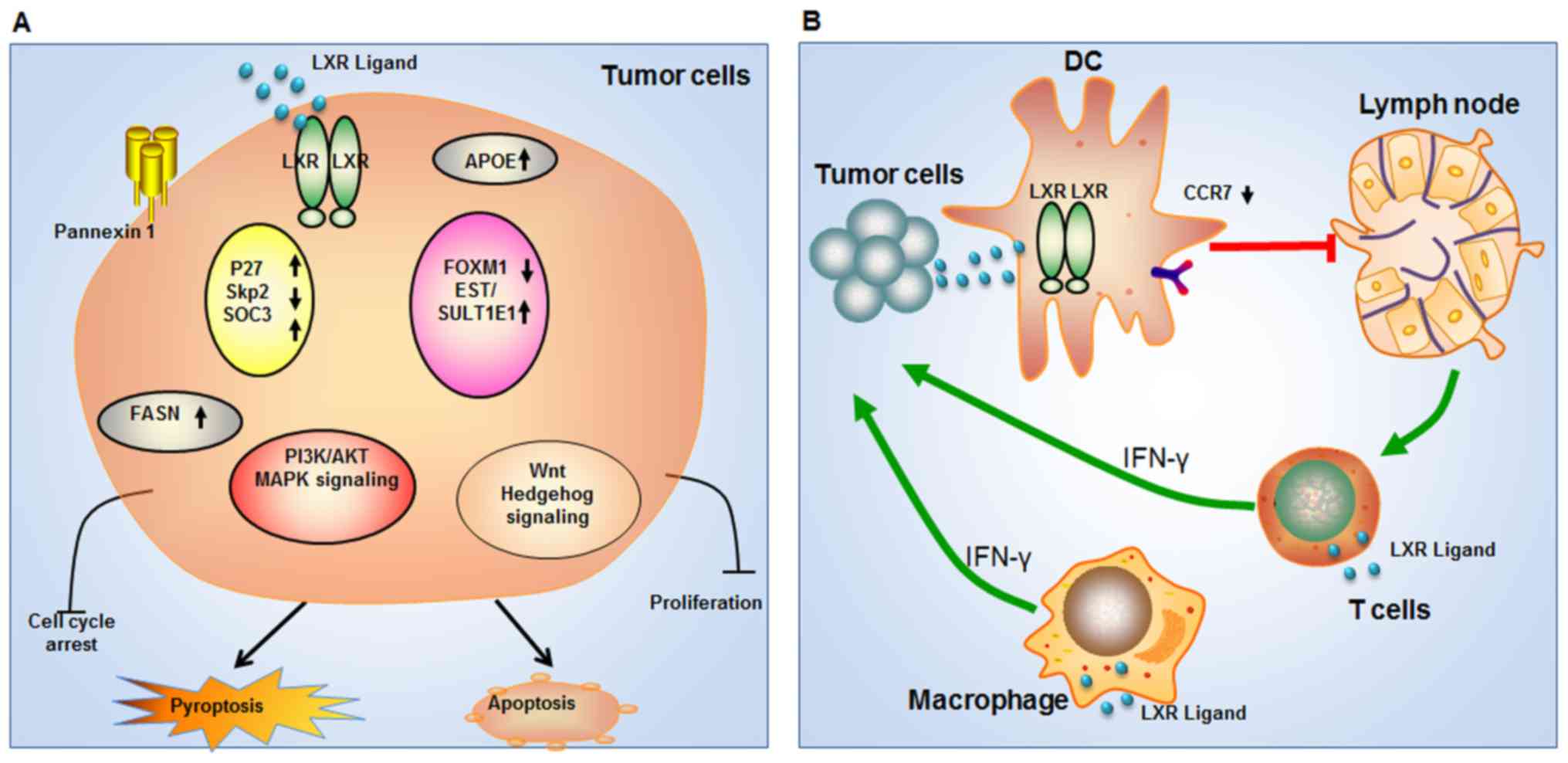
expression of the cyclindependent kinase inhibitor p27 (Fig. 1A). LXRα expression levels are
associated with the sensitivity to T0901317-mediated growth
inhibition. Additionally, T0901317-treated nude mice exhibited
decreased growth of xenograft LNCaP tumors. Additional studies
revealed that protein kinase B survival signaling is downregulated
following T0901317 treatment, and that T0901317 induces the
apoptosis of LNCaP cells in a lipid raft-dependent manner in
vitro and in vivo (31).
LXR agonists were demonstrated to inhibit cell proliferation and
induce G1/S arrest through lipogenic activity (32). Furthermore, a prior study identified
cross-talk between the androgen receptor and LXR, and determined
that this interaction influences cellular cholesterol levels
(33). The suppressor of cytokine
signaling 3 pathway is also involved in LXR agonist-mediated
prostate carcinogenesis (34)
(Table I). Taken together, these
results suggest that LXRs may be promising pharmacological targets
for the treatment of prostate cancer.
Estrogen metabolism serves an important role in
breast cancer and LXR controls estrogen homeostasis (35) (Table I).
Estrogen sulfotransferase (EST) is a transcriptional target of LXR.
In in vitro and in vivo breast cancer models, LXR
inhibits estrogen-dependent cancer cell proliferation by regulating
the hepatic expression of EST. These results suggest that LXR
inhibits breast cancer growth through a novel mechanism involving
the regulation of estrogen homeostasis (35). However, LXR agonists were demonstrated
to decrease the proliferation of several breast cancer cell lines
independent of lipid biosynthesis (36). LXR agonists decrease the proliferation
of cells in S-phase and induce G1 arrest and apoptosis
in MCF-7 cells (37,38). Microarray analysis of gene expression
revealed that LXR ligands target a set of common responsive genes,
including those regulated by E2 factor family members (39).
Pancreatic cancer is one of the most fatal types of
cancer; the 5-year survival rate of patients with pancreatic ductal
adenocarcinoma (PDAC) is only 5%. LXR agonists inhibit cell
proliferation, cell-cycle arrest and colony formation in pancreatic
cancer cell lines and regulate multiple gene networks involved in
cell-cycle arrest and growth factor signaling (40) (Fig. 1A).
However, LXR agonists do not induce apoptosis in PDAC cells
(40). Further study is required to
clarify the types of cell death induced by LXR agonists. Notably, a
prior study revealed that the LXR agonist
22(R)-dihydroxycholesterol (Oxy16) inhibits pancreatic
cancer cell-induced paracrine Hedgehog signaling (Table I). However, this inhibition is
independent of LXR activation (41).
It has been reported that LXRs are involved in
innate and adaptive immune responses in various diseases (42,43).
LXRαβ(−/−) mice are highly susceptible to intracellular bacterial
infection, suggesting that LXR-dependent gene expression serves an
important role in innate immunity (42). A-Gonzalez et al (44) revealed that LXR signaling promotes
apoptotic cell clearance by macrophages and the maintenance of
immune tolerance. LXR signaling is also involved in the regulation
of other types of immune cell (Fig.
1B). LXR activation inhibits lymphocyte proliferation, and loss
of LXR expression confers a proliferative advantage on lymphocytes
(45). LXR agonists induce
interferon-γ expression in macrophages and T-cells, and increase
the survival rate and the tumor-free population of mice inoculated
with tumor cells (46,47). However, further studies are required
to clarify whether these effects are conserved in other model
systems. In Th17 cells, ectopic expression of LXR negatively
regulates differentiation, whereas loss of LXR expression promotes
differentiation (48). The role of
LXR in dendritic cells (DCs) and tumor immunity is controversial.
Villablanca et al (49)
reported that LXR ligands released from tumor cells inhibit C-C
chemokine receptor type 7 (CCR7) expression on maturing DCs. In
mice, abrogating LXR agonist release from tumor cells controls
tumor growth by recovering DC migration to the tumor area (49). However, another study revealed that
treatment with LXR agonists increased CCR7 mRNA expression in an
immature DC line (50). Additional
investigations are required to determine the underlying molecular
mechanism of the potentially opposing roles of LXR.
The antitumor effects of LXR agonists are also
evident in the tumor microenvironment. LXR agonists impair the
compartmentation of vascular endothelial growth factor receptor-2
in lipid rafts and decrease tumor growth by inhibiting angiogenesis
(51). Furthermore, LXRβ agonist
treatment induces apolipoprotein E secretion by stromal and tumor
cells and blocks tumor growth, angiogenesis and metastasis
(52). However, further studies are
required in order to investigate whether other types of cell in the
tumor microenvironment are influenced by LXRβ agonists.
LXR ligands have been developed to treat various
diseases, including diabetes, Alzheimer's disease, atherosclerosis
and cancer. In spite of progress, a number of fundamental questions
remain with respect to cancer therapeutics. A number of natural and
synthetic LXR ligands have been identified. T0901317 and GW3965 are
the most widely used agonists for mechanistic and functional
studies of LXR activity. However, T0901317 has been reported to
increase triacylglycerol levels in the plasma and liver and was
therefore suggested to be a poor candidate for clinical application
(29). New synthetic agonists,
including LXR-623, were developed to minimize the side effects on
plasma triacylglycerol levels for clinical testing. The development
of novel agonists, particularly for cancer treatment, may
accelerate basic and clinical applications. The expression profiles
of the two LXRs in clinical samples are unknown, and whether these
expression profiles are associated with disease subtype,
pathological parameters or disease outcomes requires clarification.
Endogenous ligands in tumor and stromal cells must also be
identified. Taken together, these results suggest that LXRs may be
potential targets for cancer therapeutics.
The present review was supported by the National
Natural Science Foundation of China (grant nos. 81502088, 81502621
and 81300287), Special Postdoctoral Science Foundation of China
(no. 2017T100335), the Natural Science Foundation of Jiangsu
Province (grant no. BK20140539) and the Start-Up Research Funding
of Jiangsu University for Distinguished Scholars (grant nos.
14JDG065 and 15JDG021).
|
1
|
Gronemeyer H, Gustafsson JA and Laudet V:
Principles for modulation of the nuclear receptor superfamily. Nat
Rev Drug Discov. 3:950–964. 2004. View
Article : Google Scholar : PubMed/NCBI
|
|
2
|
Nuclear Receptors Nomenclature Committee,
. A unified nomenclature system for the nuclear receptor
superfamily. Cell. 97:161–163. 1999. View Article : Google Scholar : PubMed/NCBI
|
|
3
|
Evans RM and Mangelsdorf DJ: Nuclear
receptors, RXR, and the big bang. Cell. 157:255–266. 2014.
View Article : Google Scholar : PubMed/NCBI
|
|
4
|
Peet DJ, Turley SD, Ma W, Janowski BA,
Lobaccaro JM, Hammer RE and Mangelsdorf DJ: Cholesterol and bile
acid metabolism are impaired in mice lacking the nuclear oxysterol
receptor LXR alpha. Cell. 93:693–704. 1998. View Article : Google Scholar : PubMed/NCBI
|
|
5
|
Apfel R, Benbrook D, Lernhardt E, Ortiz
MA, Salbert G and Pfahl M: A novel orphan receptor specific for a
subset of thyroid hormone-responsive elements and its interaction
with the retinoid/thyroid hormone receptor subfamily. Mol Cell
Biol. 14:7025–7035. 1994. View Article : Google Scholar : PubMed/NCBI
|
|
6
|
Willy PJ, Umesono K, Ong ES, Evans RM,
Heyman RA and Mangelsdorf DJ: LXR, a nuclear receptor that defines
a distinct retinoid response pathway. Genes Dev. 9:1033–1045. 1995.
View Article : Google Scholar : PubMed/NCBI
|
|
7
|
Shinar DM, Endo N, Rutledge SJ, Vogel R,
Rodan GA and Schmidt A: NER, a new member of the gene family
encoding the human steroid hormone nuclear receptor. Gene.
147:273–276. 1994. View Article : Google Scholar : PubMed/NCBI
|
|
8
|
Wang Y, Rogers PM, Stayrook KR, Su C,
Varga G, Shen Q, Nagpal S and Burris TP: The selective Alzheimer's
disease indicator-1 gene (Seladin-1/DHCR24) is a liver X receptor
target gene. Mol Pharmacol. 74:1716–1721. 2008. View Article : Google Scholar : PubMed/NCBI
|
|
9
|
Cha JY and Repa JJ: The liver X receptor
(LXR) and hepatic lipogenesis. The carbohydrate-response
element-binding protein is a target gene of LXR. J Biol Chem.
282:743–751. 2007. View Article : Google Scholar : PubMed/NCBI
|
|
10
|
Zelcer N and Tontonoz P: Liver X receptors
as integrators of metabolic and inflammatory signaling. J Clin
Invest. 116:607–614. 2006. View
Article : Google Scholar : PubMed/NCBI
|
|
11
|
Viennois E, Pommier AJ, Mouzat K,
Oumeddour A, El Hajjaji FZ, Dufour J, Caira F, Volle DH, Baron S
and Lobaccaro JM: Targeting liver X receptors in human health:
Deadlock or promising trail? Expert Opin Ther Targets. 15:219–232.
2011. View Article : Google Scholar : PubMed/NCBI
|
|
12
|
Viennois E, Mouzat K, Dufour J, Morel L,
Lobaccaro JM and Baron S: Selective liver X receptor modulators
(SLiMs): What use in human health? Mol Cell Endocrinol.
351:129–141. 2012. View Article : Google Scholar : PubMed/NCBI
|
|
13
|
Janowski BA, Willy PJ, Devi TR, Falck JR
and Mangelsdorf DJ: An oxysterol signalling pathway mediated by the
nuclear receptor LXR alpha. Nature. 383:728–731. 1996. View Article : Google Scholar : PubMed/NCBI
|
|
14
|
Janowski BA, Grogan MJ, Jones SA, Wisely
GB, Kliewer SA, Corey EJ and Mangelsdorf DJ: Structural
requirements of ligands for the oxysterol liver X receptors
LXRalpha and LXRbeta. Proc Natl Acad Sci USA. 96:pp. 266–271. 1999;
View Article : Google Scholar : PubMed/NCBI
|
|
15
|
Lehmann JM, Kliewer SA, Moore LB,
Smith-Oliver TA, Oliver BB, Su JL, Sundseth SS, Winegar DA,
Blanchard DE, Spencer TA and Willson TM: Activation of the nuclear
receptor LXR by oxysterols defines a new hormone response pathway.
J Biol Chem. 272:3137–3140. 1997. View Article : Google Scholar : PubMed/NCBI
|
|
16
|
Plat J, Nichols JA and Mensink RP: Plant
sterols and stanols: Effects on mixed micellar composition and LXR
(target gene) activation. J Lipid Res. 46:2468–2476. 2005.
View Article : Google Scholar : PubMed/NCBI
|
|
17
|
Jayasuriya H, Herath KB, Ondeyka JG, Guan
Z, Borris RP, Tiwari S, de Jong W, Chavez F, Moss J, Stevenson DW,
et al: Diterpenoid, steroid, and triterpenoid agonists of liver X
receptors from diversified terrestrial plants and marine sources. J
Nat Prod. 68:1247–1252. 2005. View Article : Google Scholar : PubMed/NCBI
|
|
18
|
Schultz JR, Tu H, Luk A, Repa JJ, Medina
JC, Li L, Schwendner S, Wang S, Thoolen M, Mangelsdorf DJ, et al:
Role of LXRs in control of lipogenesis. Genes Dev. 14:2831–2838.
2000. View Article : Google Scholar : PubMed/NCBI
|
|
19
|
Houck KA, Borchert KM, Hepler CD, Thomas
JS, Bramlett KS, Michael LF and Burris TP: T0901317 is a dual
LXR/FXR agonist. Mol Genet Metab. 83:184–187. 2004. View Article : Google Scholar : PubMed/NCBI
|
|
20
|
Collins JL, Fivush AM, Watson MA, Galardi
CM, Lewis MC, Moore LB, Parks DJ, Wilson JG, Tippin TK, Binz JG, et
al: Identification of a nonsteroidal liver X receptor agonist
through parallel array synthesis of tertiary amines. J Med Chem.
45:1963–1966. 2002. View Article : Google Scholar : PubMed/NCBI
|
|
21
|
Joseph SB, McKilligin E, Pei L, Watson MA,
Collins AR, Laffitte BA, Chen M, Noh G, Goodman J, Hagger GN, et
al: Synthetic LXR ligand inhibits the development of
atherosclerosis in mice. Proc Natl Acad Sci USA. 99:pp. 7604–7609.
2002; View Article : Google Scholar : PubMed/NCBI
|
|
22
|
Kaneko E, Matsuda M, Yamada Y, Tachibana
Y, Shimomura I and Makishima M: Induction of intestinal ATP-binding
cassette transporters by a phytosterol-derived liver X receptor
agonist. J Biol Chem. 278:36091–36098. 2003. View Article : Google Scholar : PubMed/NCBI
|
|
23
|
Quinet EM, Savio DA, Halpern AR, Chen L,
Miller CP and Nambi P: Gene-selective modulation by a synthetic
oxysterol ligand of the liver X receptor. J Lipid Res.
45:1929–1942. 2004. View Article : Google Scholar : PubMed/NCBI
|
|
24
|
Hu X, Li S, Wu J, Xia C and Lala DS: Liver
X receptors interact with corepressors to regulate gene expression.
Mol Endocrinol. 17:1019–1026. 2003. View Article : Google Scholar : PubMed/NCBI
|
|
25
|
Uno S, Endo K, Jeong Y, Kawana K, Miyachi
H, Hashimoto Y and Makishima M: Suppression of beta-catenin
signaling by liver X receptor ligands. Biochem Pharmacol.
77:186–195. 2009. View Article : Google Scholar : PubMed/NCBI
|
|
26
|
Derangère V, Chevriaux A, Courtaut F,
Bruchard M, Berger H, Chalmin F, Causse SZ, Limagne E, Végran F,
Ladoire S, et al: Liver X receptor β activation induces pyroptosis
of human and murine colon cancer cells. Cell Death Differ.
21:1914–1924. 2014. View Article : Google Scholar : PubMed/NCBI
|
|
27
|
Courtaut F, Derangère V, Chevriaux A,
Ladoire S, Cotte AK, Arnould L, Boidot R, Rialland M, Ghiringhelli
F and Rébé C: Liver X receptor ligand cytotoxicity in colon cancer
cells and not in normal colon epithelial cells depends on LXRβ
subcellular localization. Oncotarget. 6:26651–26662. 2015.
View Article : Google Scholar : PubMed/NCBI
|
|
28
|
Vedin LL, Gustafsson JA and Steffensen KR:
The oxysterol receptors LXRα and LXRβ suppress proliferation in the
colon. Mol Carcinog. 52:835–844. 2013. View
Article : Google Scholar : PubMed/NCBI
|
|
29
|
Chuu CP: Modulation of liver X receptor
signaling as a prevention and therapy for colon cancer. Med
Hypotheses. 76:697–699. 2011. View Article : Google Scholar : PubMed/NCBI
|
|
30
|
Fukuchi J, Kokontis JM, Hiipakka RA, Chuu
CP and Liao S: Antiproliferative effect of liver X receptor
agonists on LNCaP human prostate cancer cells. Cancer Res.
64:7686–7689. 2004. View Article : Google Scholar : PubMed/NCBI
|
|
31
|
Pommier AJ, Alves G, Viennois E, Bernard
S, Communal Y, Sion B, Marceau G, Damon C, Mouzat K, Caira F, et
al: Liver X Receptor activation downregulates AKT survival
signaling in lipid rafts and induces apoptosis of prostate cancer
cells. Oncogene. 29:2712–2723. 2010. View Article : Google Scholar : PubMed/NCBI
|
|
32
|
Kim KH, Lee GY, Kim JI, Ham M, Won Lee J
and Kim JB: Inhibitory effect of LXR activation on cell
proliferation and cell cycle progression through lipogenic
activity. J Lipid Res. 51:3425–3433. 2010. View Article : Google Scholar : PubMed/NCBI
|
|
33
|
Krycer JR and Brown AJ: Cross-talk between
the androgen receptor and the liver X receptor: Implications for
cholesterol homeostasis. J Biol Chem. 286:20637–20647. 2011.
View Article : Google Scholar : PubMed/NCBI
|
|
34
|
Fu W, Yao J, Huang Y, Li Q, Li W, Chen Z,
He F, Zhou Z and Yan J: LXR agonist regulates the carcinogenesis of
PCa via the SOCS3 pathway. Cell Physiol Biochem. 33:195–204. 2014.
View Article : Google Scholar : PubMed/NCBI
|
|
35
|
Gong H, Guo P, Zhai Y, Zhou J, Uppal H,
Jarzynka MJ, Song WC, Cheng SY and Xie W: Estrogen deprivation and
inhibition of breast cancer growth in vivo through activation of
the orphan nuclear receptor liver X receptor. Mol Endocrinol.
21:1781–1790. 2007. View Article : Google Scholar : PubMed/NCBI
|
|
36
|
Vedin LL, Lewandowski SA, Parini P,
Gustafsson JA and Steffensen KR: The oxysterol receptor LXR
inhibits proliferation of human breast cancer cells.
Carcinogenesis. 30:575–579. 2009. View Article : Google Scholar : PubMed/NCBI
|
|
37
|
Chuu CP and Lin HP: Antiproliferative
effect of LXR agonists T0901317 and 22(R)-hydroxycholesterol on
multiple human cancer cell lines. Anticancer Res. 30:3643–3648.
2010.PubMed/NCBI
|
|
38
|
El Roz A, Bard JM, Huvelin JM and Nazih H:
LXR agonists and ABCG1-dependent cholesterol efflux in MCF-7 breast
cancer cells: Relation to proliferation and apoptosis. Anticancer
Res. 32:3007–3013. 2012.PubMed/NCBI
|
|
39
|
Nguyen-Vu T, Vedin LL, Liu K, Jonsson P,
Lin JZ, Candelaria NR, Candelaria LP, Addanki S, Williams C,
Gustafsson JÅ, et al: Liver × receptor ligands disrupt breast
cancer cell proliferation through an E2F-mediated mechanism. Breast
Cancer Res. 15:R512013. View
Article : Google Scholar : PubMed/NCBI
|
|
40
|
Candelaria NR, Addanki S, Zheng J,
Nguyen-Vu T, Karaboga H, Dey P, Gabbi C, Vedin LL, Liu K, Wu W, et
al: Antiproliferative effects and mechanisms of liver X receptor
ligands in pancreatic ductal adenocarcinoma cells. PLoS One.
9:e1062892014. View Article : Google Scholar : PubMed/NCBI
|
|
41
|
Wang F, Stappenbeck F, Matsui W and
Parhami F: Inhibition of pancreatic cancer cell-induced paracrine
hedgehog signaling by liver X receptor agonists and Oxy16, a
naturally occurring oxysterol. J Cell Biochem. 118:499–509. 2017.
View Article : Google Scholar : PubMed/NCBI
|
|
42
|
Joseph SB, Bradley MN, Castrillo A, Bruhn
KW, Mak PA, Pei L, Hogenesch J, O'connell RM, Cheng G, Saez E, et
al: LXR-dependent gene expression is important for macrophage
survival and the innate immune response. Cell. 119:299–309. 2004.
View Article : Google Scholar : PubMed/NCBI
|
|
43
|
Joseph SB, Castrillo A, Laffitte BA,
Mangelsdorf DJ and Tontonoz P: Reciprocal regulation of
inflammation and lipid metabolism by liver X receptors. Nat Med.
9:213–219. 2003. View
Article : Google Scholar : PubMed/NCBI
|
|
44
|
A-Gonzalez N, Bensinger SJ, Hong C,
Beceiro S, Bradley MN, Zelcer N, Deniz J, Ramirez C, Díaz M,
Gallardo G, et al: Apoptotic cells promote their own clearance and
immune tolerance through activation of the nuclear receptor LXR.
Immunity. 31:245–258. 2009. View Article : Google Scholar : PubMed/NCBI
|
|
45
|
Bensinger SJ, Bradley MN, Joseph SB,
Zelcer N, Janssen EM, Hausner MA, Shih R, Parks JS, Edwards PA,
Jamieson BD and Tontonoz P: LXR signaling couples sterol metabolism
to proliferation in the acquired immune response. Cell. 134:97–111.
2008. View Article : Google Scholar : PubMed/NCBI
|
|
46
|
Wang Q, Ma X, Chen Y, Zhang L, Jiang M, Li
X, Xiang R, Miao R, Hajjar DP, Duan Y and Han J: Identification of
interferon-γ as a new molecular target of liver X receptor. Biochem
J. 459:345–354. 2014. View Article : Google Scholar : PubMed/NCBI
|
|
47
|
Wang Q, Sun L, Yang X, Ma X, Li Q, Chen Y,
Liu Y, Zhang D, Li X, Xiang R, et al: Activation of liver X
receptor inhibits the development of pulmonary carcinomas induced
by 3-methylcholanthrene and butylated hydroxytoluene in BALB/c
mice. Sci Rep. 6:272952016. View Article : Google Scholar : PubMed/NCBI
|
|
48
|
Cui G, Qin X, Wu L, Zhang Y, Sheng X, Yu
Q, Sheng H, Xi B, Zhang JZ and Zang YQ: Liver X receptor (LXR)
mediates negative regulation of mouse and human Th17
differentiation. J Clin Invest. 121:658–670. 2011. View Article : Google Scholar : PubMed/NCBI
|
|
49
|
Villablanca EJ, Raccosta L, Zhou D,
Fontana R, Maggioni D, Negro A, Sanvito F, Ponzoni M, Valentinis B,
Bregni M, et al: Tumor-mediated liver X receptor-alpha activation
inhibits CC chemokine receptor-7 expression on dendritic cells and
dampens antitumor responses. Nat Med. 16:98–105. 2010. View Article : Google Scholar : PubMed/NCBI
|
|
50
|
Feig JE, Pineda-Torra I, Sanson M, Bradley
MN, Vengrenyuk Y, Bogunovic D, Gautier EL, Rubinstein D, Hong C,
Liu J, et al: LXR promotes the maximal egress of monocyte-derived
cells from mouse aortic plaques during atherosclerosis regression.
J Clin Invest. 120:4415–4424. 2010. View Article : Google Scholar : PubMed/NCBI
|
|
51
|
Noghero A, Perino A, Seano G, Saglio E, Lo
Sasso G, Veglio F, Primo L, Hirsch E, Bussolino F and Morello F:
Liver X receptor activation reduces angiogenesis by impairing lipid
raft localization and signaling of vascular endothelial growth
factor receptor-2. Arterioscler Thromb Vasc Biol. 32:2280–2288.
2012. View Article : Google Scholar : PubMed/NCBI
|
|
52
|
Pencheva N, Buss CG, Posada J, Merghoub T
and Tavazoie SF: Broad-spectrum therapeutic suppression of
metastatic melanoma through nuclear hormone receptor activation.
Cell. 156:986–1001. 2014. View Article : Google Scholar : PubMed/NCBI
|