Introduction
Non-small cell lung cancer (NSCLC) accounts for
80–85% of all lung cancer cases and is the leading cause of
cancer-associated mortality worldwide (1). Despite advancements in the understanding
of the molecular mechanisms and clinical treatment of NSCLC, its
prognosis remains poor and the 5-year overall survival rate of
patients with NSCLC is ~15% (2). The
primary cause of treatment failure and mortality in patients with
NSCLC is the high metastatic potential of the tumor, combined with
a lack of an effective early diagnostic method. Thus, it is
important to identify novel biomarkers for the early diagnosis and
treatment of patients with NSCLC.
Long non-coding RNAs (lncRNAs) are a class of
non-coding RNAs comprised of >200 nucleotides (3,4). Although
lncRNAs were once classified as transcriptional noise (5), subsequent studies have demonstrated that
lncRNAs participate in various biological processes, including
epigenetic control, the regulation of gene expression, RNA
maturation (including splicing and editing) and the maintenance of
chromatin structure (3,4,6). The
abnormal expression of lncRNA has been identified in various types
of cancer, including prostate, breast, colorectal, bladder, lung
and gastric cancer, as well as hepatocellular carcinoma and
melanoma (7–14). Previous studies have demonstrated that
certain lncRNAs may be potential prognostic biomarkers for patients
with cancer. For example, HOTAIR, which is associated with human
HOX loci and cancer metastasis, has been identified as a negative
prognostic biomarker in certain types of cancer (15–17).
Prensner et al (18) revealed
that the expression of prostate cancer-associated transcript 1
(PCAT-1) was significantly upregulated in prostate tumors compared
with normal prostate tissues, thus promoting cancer cell
proliferation. It was also demonstrated that the knockdown of
PCAT-1 expression inhibited the proliferation of prostate cancer
cells, suggesting that PCAT-1 is involved in tumor progression and
may be a potential prognostic biomarker of prostate cancer
(18).
However, the function of lncRNAs in lung cancer
remains largely unknown. Based on microarray analysis, the present
study focused on a lncRNA termed TCONS_00001798 that demonstrated
aberrant downregulation in NSCLC tissues compared with normal lung
tissues. It was subsequently determined whether TCONS_00001798 is a
novel prognostic marker for NSCLC. The expression of TCONS_00001798
in NSCLC and adjacent non-tumor tissues was examined and the
association between the expression of lncRNATCONS_00001798 and the
clinicopathological features and survival rates of patients with
NSCLC was determined.
Materials and methods
Collection of patient tissue and
clinical data
A total of 118 patients with NSCLC (76 males and 42
females) with a mean age of 57.9 years (range, 31–79 years), who
underwent surgical resection between July 2008 and July 2010 at
Tianjin Medical University Cancer Institute and Hospital (Tianjin,
China), were enrolled in the present study. No patient received
adjuvant therapy prior to surgery. Clinical and pathological
features of NSCLC were obtained from patient reports. All resected
NSCLC and adjacent non-tumor tissues (>5 cm from the tumor) were
immediately frozen in liquid nitrogen and stored at −80°C prior to
RNA extraction and reverse-transcription quantitative polymerase
chain reaction (RT-qPCR). Tumors were staged according to the 7th
edition of the tumor node metastasis classification (19). Following surgery, all patients were
followed up every 3 months for the first year, every 6 months for
the second year, and then every year until mortality or the last
follow up. Patients were followed up until September 2016. Routine
follow-up assessments included physical examinations, chest
computed tomography, abdominal and cervical ultrasound, and
laboratory tests. Further investigations included radionuclide bone
scan and magnetic resonance imaging scans of the brain when
patients had the symptoms of bone metastasis or brain metastasis.
Overall survival (OS) was calculated from the date of surgery to
the date of mortality or the last follow-up. Disease-free survival
(DFS) was calculated from the date of surgery to the date of first
recurrence or the last follow-up. The primary adjuvant treatment
that patients underwent following surgery was chemotherapy or
radiotherapy, either alone or in combination. The chemotherapywas a
routine program for NSCLC, consisting of paclitaxel (135
mg/m2), vinorelbine (25 mg/m2 on days 1 and
8), pemetrexed (500 mg/m2) or gemcitabine (1
g/m2 on days 1 and 8) plus cisplatin (75
mg/m2) or carboplatin [target area under the curve, 5
(AUC5)] every 3 weeks for 4–6 cycles. All chemotherapy drugs were
administered intravenously. The present study was approved by the
Ethics Committee of Tianjin Medical University Cancer Institute and
Hospital (Tianjin, China) and written informed consent was obtained
from each patient prior to enrolment.
RNA extraction and RT-qPCR
Total RNA from frozen tissue specimens was extracted
using the TRIzol® reagent (Invitrogen; Thermo Fisher
Scientific, Inc., Waltham, MA, USA) according to the manufacturer's
protocol and reverse transcribed into cDNA using a Reverse
Transcription kit (Takara Biotechnology Co., Ltd., Dalian, China).
The reverse transcription reaction was performed under the
following conditions: 37°C for 30 min; then 85°C for 5 sec; and
holding at 4°C. Subsequently, qPCR was performed using a SYBR
Premix Ex Taq II kit (Takara Biotechnology Co., Ltd.) on a CFX96
Real-Time PCR Detection System (Bio-Rad Laboratories Inc.,
Hercules, CA, USA) to quantify the expression of TCONS_00001798.
The PCR amplification was performed under the following conditions:
95°C for 30 sec, then 40 cycles of denaturation at 95°C for 5 sec,
annealing at 60°C for 60 sec and elongation at 72°C for 30 sec.
Glyceraldehyde-3-phosphate dehydrogenase (GAPDH) was used as an
internal control. All experiments were repeated three times for
accuracy. The primer sequences utilized were as follows:
TCONS_00001798 forward, 5′CAGAAGGCTGCCCTGTAGAA3′ and reverse,
5′GCTTCTTCCACTCCTGCGT3′; GAPDH forward, 5′GGGAAACTGTGGCGTGAT3′ and
reverse, 5′GAGTGGGTGTCGCTGTTGA3′.
Statistical analysis
SPSS 18.0 (SPSS, Inc., Chicago, IL, USA) and
GraphPad Prism 5.0 (GraphPad Software, Inc., La Jolla, CA, USA)
software were utilized for statistical analyses. χ2 and
t-tests were performed to evaluate the association between
TCONS_00001798 expression and patient clinicopathological features.
Overall survival (OS) and disease-free survival (DFS) were
estimated using the Kaplan-Meier method and the statistical
differences between survival curves were calculated using the
log-rank test. Univariate and multivariate analyses using the Cox
proportional hazards regression model were performed to assess
survival. All data are presented as the mean ± standard deviation
and P<0.05 was considered to indicate a statistically
significant difference.
Results
TCONS_00001798 expression is
downregulated in NSCLC tumor tissues
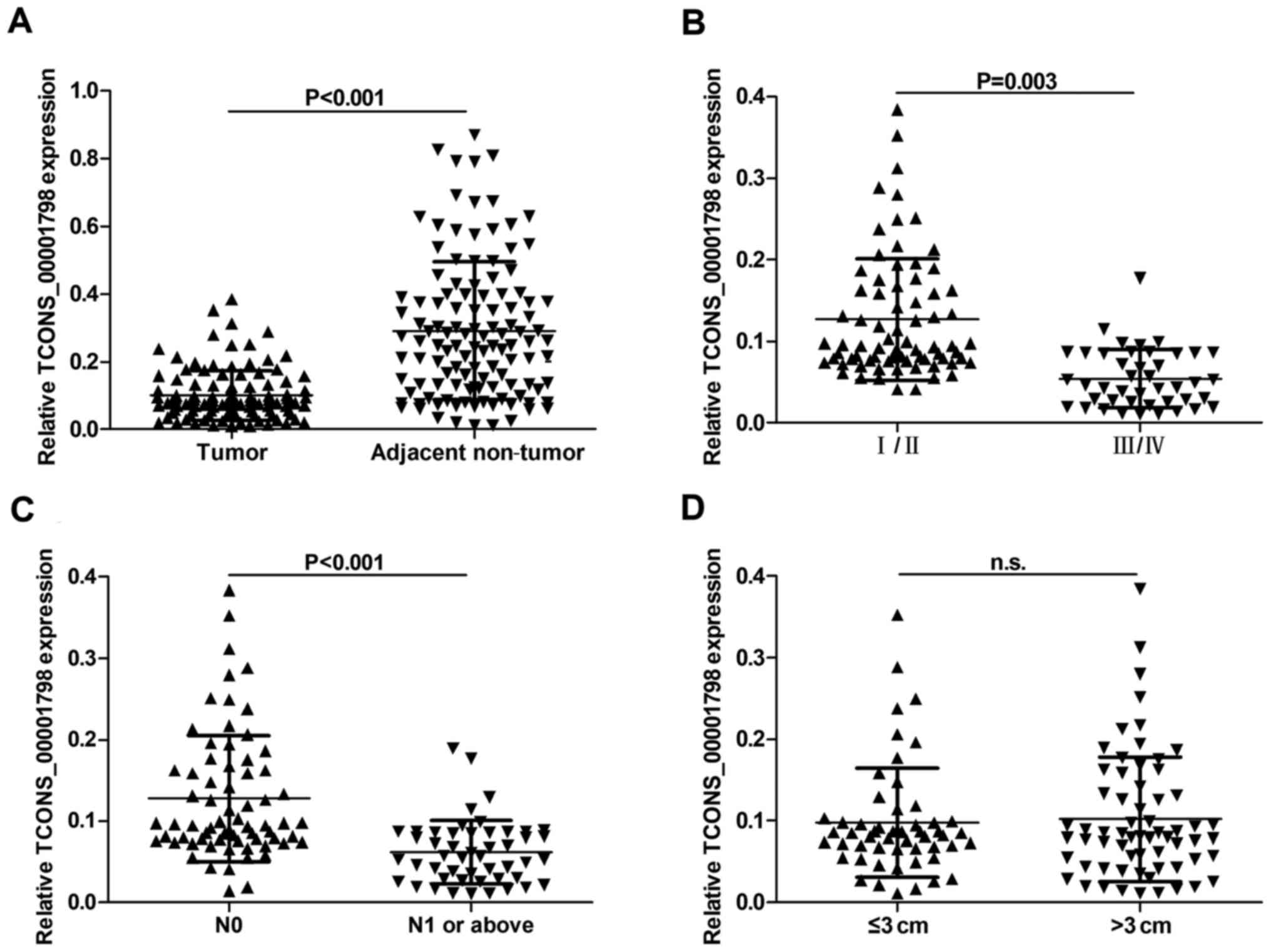
To assess whether TCONS_00001798 was present in
NSCLC tissues, the expression of TCONS_00001798 in NSCLC and
adjacent non-tumor tissues was determined using RT-qPCR. The
results demonstrated that the expression of TCONS_00001798 was
significantly lower in NSCLC tissues compared with adjacent
non-tumor tissues (P<0.001; Fig.
1A).
The association between TCONS_00001798
expression and patient clinicopathological factors
The association between TCONS_00001798 expression
and the clinicopathological characteristics of patients with NSCLC
was assessed and is presented in Fig.
1. According to the median value of TCONS_00001798 expression
(0.084), patients with NSCLC were divided into high (≥median; n=59)
and low (<median; n=59) expression groups. No significant
differences between TCONS_00001798 expression in tumors >3 cm in
diameter and tumors <3 cm in diameter were identified (Fig. 1D). However, a significant negative
association between TCONS_00001798 expression and lymph node
metastasis was identified. Tumors without lymph node metastasis
(N0) were associated with higher TCONS_00001798 expression, whereas
tumors with lymph node metastasis (≥N1) were associated with
significantly lower TCONS_00001798 expression (P<0.001; Fig. 1C). Furthermore, statistical analysis
revealed that low TCONS_00001798 expression was significantly
associated with an advanced pathological stage (P=0.003; Fig. 1B). However, no associations were
identified between TCONS_00001798 expression and other
clinicopathological features, including patient age, sex, smoking
status and histological subtype (Table
I).
 | Table I.Association between the expression of
TCONS_00001798 and clinicopathological characteristics in 118
patients with NSCLC. |
Table I.
Association between the expression of
TCONS_00001798 and clinicopathological characteristics in 118
patients with NSCLC.
|
|
| Number of
patients |
|
|---|
|
|
|
|
|
|---|
| Patient
characteristics | Number of
patients | Low expression | High expression | P-value |
|---|
| Age (years) |
|
|
| 0.261 |
| ≤60 | 70 | 32 | 38 |
|
|
>60 | 48 | 27 | 21 |
|
| Sex |
|
|
| 0.249 |
| Male | 76 | 41 | 35 |
|
|
Female | 42 | 18 | 24 |
|
| Smoking |
|
|
| 0.431 |
| Yes | 80 | 42 | 38 |
|
| No | 38 | 17 | 21 |
|
| Histological
subtype |
|
|
| 0.514 |
| AD | 41 | 21 | 20 |
|
| SCC | 52 | 28 | 24 |
|
|
Others | 25 | 10 | 15 |
|
| Pathological
stage |
|
|
| 0.003a |
| I and
II | 72 | 28 | 44 |
|
| III and
IV | 46 | 31 | 15 |
|
| Lymph node
metastasis (N) |
|
|
|
<0.001a |
| N1 or
above | 49 | 34 | 15 |
|
| N0 | 69 | 25 | 44 |
|
| Tumor size
(cm) |
|
|
| 0.712 |
| ≤3 | 54 | 26 | 28 |
|
|
>3 | 64 | 33 | 31 |
|
Low TCONS_00001798 expression predicts
unfavorable survival in patients with NSCLC
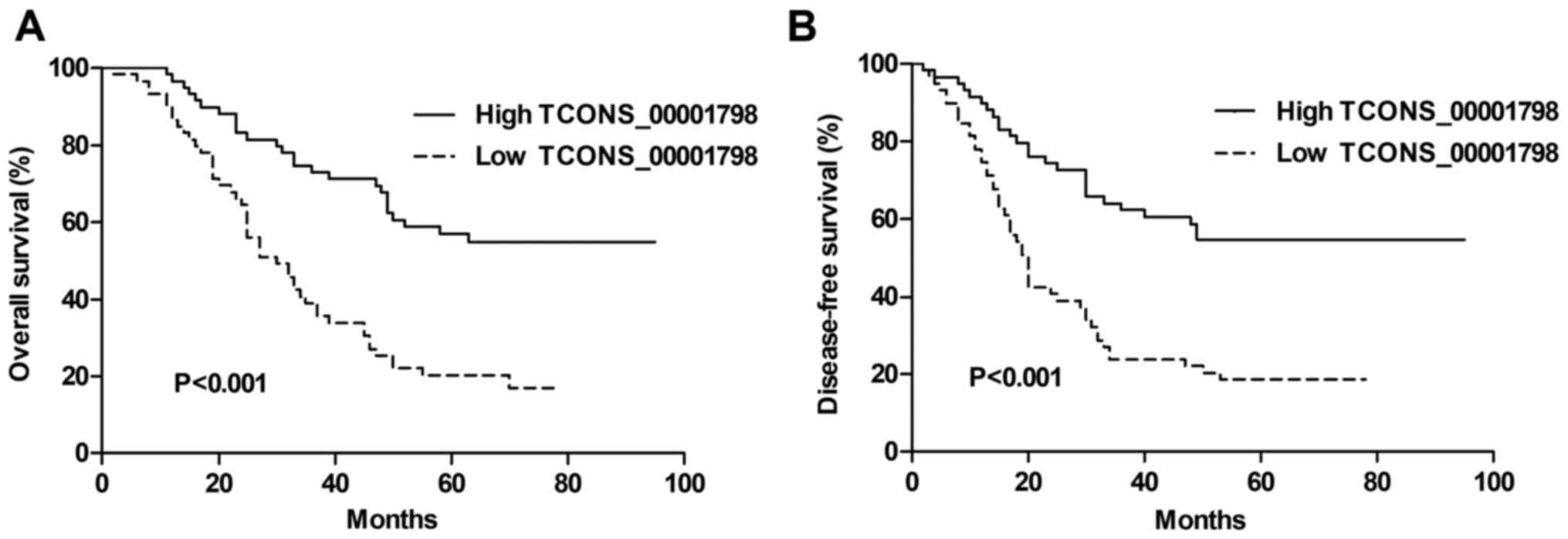
A Kaplan-Meier analysis and a log-rank test were
used to further assess the association between TCONS_00001798
expression and the survival of patients with NSCLC. The results
revealed that decreased TCONS_00001798 levels were significantly
associated with shorter OS and DFS rates (each P<0.001; Fig. 2A and B). Univariate analysis using a
Cox proportional hazards model demonstrated that TCONS_00001798
expression was a significant factor for the prediction of OS and
DFS rates in patients with NSCLC, with a hazard ratio (HR) of 0.345
[P<0.001; 95% confidence interval (CI) 0.213–0.559] and 0.364
(P<0.001; 95% CI, 0.225–0.589), respectively (Tables II and III). In addition, other
clinicopathological factors including lymph node metastasis and
pathological stage were considered to be significant for OS and DFS
(each P<0.001). Multivariate analysis revealed that
TCONS_00001798 expression was significantly associated with OS (HR,
0.424; 95% CI, 0.257–0.699; P=0.001) and DFS (HR, 0.436; 95%
CI,0.264–0.720; P=0.001), as was pathological stage (Tables II and III).
| Table II.Univariate and multivariate analysis
of clincopathological variables for OS rates in 118 patients with
NSCLC. |
Table II.
Univariate and multivariate analysis
of clincopathological variables for OS rates in 118 patients with
NSCLC.
|
| Univariate
analysis | Multivariate
analysis |
|---|
|
|
|
|
|---|
| Variables | HR | P-value | 95% CI | HR | P-value | 95% CI |
|---|
| TCONS_00001798
expression (low, high) | 0.345 |
<0.001a | 0.213–0.559 | 0.424 | 0.001a | 0.257–0.699 |
| Pathological stage
(I/II, II/IV) | 2.894 |
<0.001a | 1.813–4.620 | 2.017 | 0.047a | 1.010–4.029 |
| Lymph node
metastasis (N0, N1 or above) | 0.376 |
<0.001a | 0.235–0.600 | 0.798 | 0.526 | 0.396–1.605 |
| Sex (male,
female) | 0.693 | 0.145 | 0.423–1.134 |
|
|
|
| Age (years) ≤60,
<60) | 0.953 | 0.840 | 0.599–1.517 |
|
|
|
| Smoking (yes,
no) | 0.913 | 0.715 | 0.561–1.486 |
|
|
|
| Histological
subtype (AD, SCC, others) | 1.180 | 0.278 | 0.875–1.592 |
|
|
|
| Tumor size (≤3 cm,
>3 cm) | 0.966 | 0.881 | 0.611–1.526 |
|
|
|
| Table III.Univariate and multivariate analysis
of clinicopathological variables for DFS rates in 118 patients with
NSCLC. |
Table III.
Univariate and multivariate analysis
of clinicopathological variables for DFS rates in 118 patients with
NSCLC.
|
| Univariate
analysis | Multivariate
analysis |
|---|
|
|
|
|
|---|
| Variables | HR | P-value | 95% CI | HR | P-value | 95% CI |
|---|
| TCONS_00001798
expression (low, high) | 0.364 |
<0.001a | 0.225–0.589 | 0.436 | 0.001a | 0.264–0.720 |
| Pathological stage
(I/II, III/IV) | 2.782 |
<0.001a | 1.750–4.423 | 2.403 | 0.044a | 1.025–5.632 |
| Lymph node
metastasis (N0, N1 or above) | 0.405 |
<0.001a | 0.255–0.644 | 1.056 | 0.901 | 0.446–2.498 |
| Sex (male,
female) | 0.720 | 0.192 | 0.440–1.179 |
|
|
|
| Age (years) (≤60,
>60) | 1.045 | 0.854 | 0.657–1.662 |
|
|
|
| Smoking (yes,
no) | 0.968 | 0.897 | 0.595–1.576 |
|
|
|
| Histological
subtype (AD, SCC, others) | 1.174 | 0.287 | 0.874–1.577 |
|
|
|
| Tumor size (≤3 cm,
>3 cm) | 1.031 | 0.894 | 0.653–1.630 |
|
|
|
Discussion
With the rapid development of genome technology, it
has been demonstrated that mammalian genomes encode thousands of
lncRNAs with numerous mechanisms of action, in addition to
protein-coding RNA (20,21). Although lncRNAs were previously
considered to represent transcriptional noise, with no observable
function in cells, it has since been demonstrated that lncRNAs
serve a variety of important roles in biological processes,
including epigenetic control, the regulation of gene expression,
RNA maturation (including splicing and editing) and the maintenance
of chromatin structure (3,4,6). Previous
studies have revealed that lncRNAs are abnormally expressed in
certain tumors, suggesting that they may serve as potential
biomarkers predicting the prognosis of patients with cancer
(15–18,22–25).
Several lncRNAs have been implicated in the
initiation and progression of NSCLC and their expression may be
regulated by transcription factors (26), interactions with microRNA (27) and Wnt/β-catenin signaling (28). Han et al (26) demonstrated that the decreased
expression of the promoter of CDKN1A antisense DNA damage-activated
RNA is negatively associated with NSCLC development and indicates
the unfavorable prognosis of patients as it affects and cellular
apoptosis via Bcl-2. Schmidt et al (29) and Tano et al (30) demonstrated that metastasis associated
lung adenocarcinoma transcript 1 (MALAT-1) expression was
significantly upregulated in NSCLC and is associated with poor
patient prognosis. Additionally, MALAT-1 knockdown inhibited the
migration of NSCLC cells by influencing the expression of
motility-related genes (29,30). Weber et al (25) also revealed that MALAT-1 maybe used as
a complementary blood biomarker in patients with NSCLC. Despite
this, few lncRNAs have been associated with NSCLC oncogenesis.
In the present study, the association between TCONS_
00001798 expression and the prognosis and clinicopathological
features of patients with NSCLC was assessed. To the best of our
knowledge, the present study was the first to demonstrate that
lncRNA TCONS_00001798 is significantly downregulated in NSCLC tumor
tissues compared with adjacent non-tumor tissues. In addition, the
results of the present study revealed that the decreased expression
of TCONS_00001798 is negatively associated with lymph node
metastasis and advanced pathological stage. It was determined that
TCONS_00001798 expression may be a potential independent prognostic
factor for OS and DFS rates, and NSCLC pathological stage. The
present study therefore indicates that lncRNA TCONS_00001798 may
serve an essential role in the development and progression of NSCLC
via invasion and metastasis.
One major limitation of the present study was that
only a small number of patients were enrolled from the same
hospital, potentially leading to inaccurate conclusions. Therefore,
further studies involving cell models, animal models and a greater
number of patients, are required to elucidate the precise molecular
mechanisms that underlie the altered expression of
TCONS_00001798.
In conclusion, to the best of our knowledge, the
present study was the first to demonstrate that the expression of
lncRNA TCONS_00001798 is significantly downregulated in NSCLC tumor
tissues and indicate that it is negatively associated with lymph
node metastasis and an advanced pathological stage. Furthermore, it
was demonstrated that TCONS_00001798 expression may serve as an
independent prognostic factor and potential therapeutic target in
patients with NSCLC. However, further studies are required to
clarify the molecular mechanisms that underlie this.
Acknowledgements
Not applicable.
Funding
The present study was supported by the National
Natural Science Foundation of China (grant no. 81470137) and the
Key Program for Anti-Cancer Research of Tianjin Municipal Science
and Technology Commission (grant no. 12ZCDZSY15400).
Availability of data and materials
The datasets used and/or analyzed during the current
study are available from the corresponding author on reasonable
request.
Authors' contributions
LG performed the experiment and wrote the
manuscript. HZ and BZ were responsible for the design of experiment
and collection of the tumor samples. HZ and BZ analyzed the
experiment data. CW was accountable for designing the experiment,
performing data interpretation and revising the manuscript.
Ethics approval and consent to
participate
The present study was approved by the Ethics
Committee of Tianjin Medical University Cancer Institute and
Hospital (Tianjin, China) and written informed consent was obtained
from each patient prior to enrolment.
Consent for publication
Written informed consent was obtained from each
patient for the publication of their data.
Competing interests
The authors declare that they have no competing
interests.
Glossary
Abbreviations
Abbreviations:
|
lncRNAs
|
long non-coding RNAs
|
|
NSCLC
|
non-small cell lung cancer
|
|
OS
|
overall survival
|
|
DFS
|
disease-free survival
|
|
HR
|
hazard ratio
|
|
CI
|
confidence interval
|
References
|
1
|
Siegel R, Naishadham D and Jemal A: Cancer
statistics, 2013. CA Cancer J Clin. 63:11–30. 2013. View Article : Google Scholar : PubMed/NCBI
|
|
2
|
Pao W and Girard N: New driver mutations
in non-small-cell lung cancer. Lancet Oncol. 12:175–180. 2011.
View Article : Google Scholar : PubMed/NCBI
|
|
3
|
Mercer TR, Dinger ME and Mattick JS: Long
non-coding RNAs: Insights into functions. Nat Rev Genet.
10:155–159. 2009. View
Article : Google Scholar : PubMed/NCBI
|
|
4
|
Ponting CP, Oliver PL and Reik W:
Evolution and functions of long noncoding RNAs. Cell. 136:629–641.
2009. View Article : Google Scholar : PubMed/NCBI
|
|
5
|
Gibb EA, Brown CJ and Lam WL: The
functional role of long non-coding RNA in human carcinomas. Mol
Cancer. 10:382011. View Article : Google Scholar : PubMed/NCBI
|
|
6
|
Knoll M, Lodish HF and Sun L: Long
non-coding RNAs as regulators of the endocrine system. Nat Rev
Endocrinol. 11:151–160. 2015. View Article : Google Scholar : PubMed/NCBI
|
|
7
|
Jin G, Sun J, Isaacs SD, Wiley KE, Kim ST,
Chu LW, Zhang Z, Zhao H, Zheng SL, Isaacs WB and Xu J: Human
polymorphisms at long non-coding RNAs (lncRNAs) and association
with prostate cancer risk. Carcinogenesis. 32:1655–1659. 2011.
View Article : Google Scholar : PubMed/NCBI
|
|
8
|
Tuo YL, Li XM and Luo J: Long noncoding
RNA UCA1 modulates breast cancer cell growth and apoptosis through
decreasing tumor suppressive miR-143. Eur Rev Med Pharmacol Sci.
19:3403–3411. 2015.PubMed/NCBI
|
|
9
|
Guo Q, Zhao Y, Chen J, Hu J, Wang S, Zhang
D and Sun Y: BRAF-activated long non-coding RNA contributes to
colorectal cancer migration by inducing epithelial-mesenchymal
transition. Oncol Lett. 8:869–875. 2014. View Article : Google Scholar : PubMed/NCBI
|
|
10
|
Yang F, Zhang L, Huo XS, Yuan JH, Xu D,
Yuan SX, Zhu N, Zhou WP, Yang GS, Wang YZ, et al: Long noncoding
RNA high expression in hepatocellular carcinoma facilitates tumor
growth through enhancer of zeste homolog 2 in humans. Hepatology.
54:1679–1689. 2011. View Article : Google Scholar : PubMed/NCBI
|
|
11
|
Li R, Zhang L, Jia L, Duan Y, Li Y, Bao L
and Sha N: Long non-coding RNA BANCR promotes proliferation in
malignant melanoma by regulating MAPK pathway activation. PLoS One.
9:e1008932014. View Article : Google Scholar : PubMed/NCBI
|
|
12
|
Wang Y, Chen W, Yang C, Wu W, Wu S, Qin X
and Li X: Long non-coding RNA UCA1a(CUDR) promotes proliferation
and tumorigenesis of bladder cancer. Int J Oncol. 41:276–284.
2012.PubMed/NCBI
|
|
13
|
Zhao W, An Y, Liang Y and Xie XW: Role of
HOTAIR long noncoding RNA in metastatic progression of lung cancer.
Eur Rev Med Pharmacol Sci. 18:1930–1936. 2014.PubMed/NCBI
|
|
14
|
Zhao JH, Sun JX, Song YX, Chen XW, Yang
YC, Ma B, Wang J, Gao P and Wang ZN: A novel long noncoding
RNA-LOWEG is low expressed in gastric cancer and acts as a tumor
suppressor by inhibiting cell invasion. J Cancer Res Clin Oncol.
142:601–609. 2016. View Article : Google Scholar : PubMed/NCBI
|
|
15
|
Gupta RA, Shah N, Wang KC, Kim J, Horlings
HM, Wong DJ, Tsai MC, Hung T, Argani P, Rinn JL, et al: Long
noncoding RNA HOTAIR reprograms chromatin state to promote cancer
metastasis. Nature. 464:1071–1076. 2010. View Article : Google Scholar : PubMed/NCBI
|
|
16
|
Kogo R, Shimamura T, Mimori K, Kawahara K,
Imoto S, Sudo T, Tanaka F, Shibata K, Suzuki A, Komune S, et al:
Long noncoding RNA HOTAIR regulates polycomb-dependent chromatin
modification and is associated with poor prognosis in colorectal
cancers. Cancer Res. 71:6320–6326. 2011. View Article : Google Scholar : PubMed/NCBI
|
|
17
|
Kim K, Jutooru I, Chadalapaka G, Johnson
G, Frank J, Burghardt R, Kim S and Safe S: HOTAIR is a negative
prognostic factor and exhibits pro-oncogenic activity in pancreatic
cancer. Oncogene. 32:1616–1625. 2013. View Article : Google Scholar : PubMed/NCBI
|
|
18
|
Prensner JR, Iyer MK, Balbin OA,
Dhanasekaran SM, Cao Q, Brenner JC, Laxman B, Asangani IA, Grasso
CS, Kominsky HD, et al: Transcriptome sequencing across a prostate
cancer cohort identifies PCAT-1, an unannotated lincRNA implicated
in disease progression. Nat Biotechnol. 29:742–749. 2011.
View Article : Google Scholar : PubMed/NCBI
|
|
19
|
Sobin LH, Gospodarowicz MK and Wittekind
C: International Union Against Cancer (UICC): TNM classification of
malignant tumours. 7th. John Willkey and Sons, Ltd.; UK: 2010
|
|
20
|
Nagano T and Fraser P: No-nonsense
functions for long noncoding RNAs. Cell. 145:178–181. 2011.
View Article : Google Scholar : PubMed/NCBI
|
|
21
|
Guttman M, Amit I, Garber M, French C, Lin
MF, Feldser D, Huarte M, Zuk O, Carey BW, Cassady JP, et al:
Chromatin signature reveals over a thousand highly conserved large
non-coding RNAs in mammals. Nature. 458:223–227. 2009. View Article : Google Scholar : PubMed/NCBI
|
|
22
|
Lin R, Maeda S, Liu C, Karin M and
Edgington TS: A large noncoding RNA is a marker for murine
hepatocellular carcinomas and a spectrum of human carcinomas.
Oncogene. 26:851–858. 2007. View Article : Google Scholar : PubMed/NCBI
|
|
23
|
Nie L, Wu HJ, Hsu JM, Chang SS, Labaff AM,
Li CW, Wang Y, Hsu JL and Hung MC: Long non-coding RNAs: Versatile
master regulators of gene expression and crucial players in cancer.
Am J Transl Res. 4:127–150. 2012.PubMed/NCBI
|
|
24
|
Salagierski M and Schalken JA: Molecular
diagnosis of prostate cancer: PCA3 and TMPRSS2:ERG gene fusion. J
Urol. 187:795–801. 2012. View Article : Google Scholar : PubMed/NCBI
|
|
25
|
Weber DG, Johnen G, Casjens S, Bryk O,
Pesch B, Jöckel KH, Kollmeier J and Brüning T: Evaluation of long
noncoding RNA MALAT1 as a candidate blood-based biomarker for the
diagnosis of non-small cell lung cancer. BMC Res Notes. 6:5182013.
View Article : Google Scholar : PubMed/NCBI
|
|
26
|
Han L, Zhang EB, Yin DD, Kong R, Xu TP,
Chen WM, Xia R, Shu YQ and De W: Low expression of long noncoding
RNA PANDAR predicts a poor prognosis of non-small cell lung cancer
and affects cell apoptosis by regulating Bcl-2. Cell Death Dis.
6:e16652015. View Article : Google Scholar : PubMed/NCBI
|
|
27
|
Nie W, Ge HJ, Yang XQ, Sun X, Huang H, Tao
X, Chen WS and Li B: LncRNA-UCA1 exerts oncogenic functions in
non-small cell lung cancer by targeting miR-193a-3p. Cancer Lett.
371:99–106. 2016. View Article : Google Scholar : PubMed/NCBI
|
|
28
|
Fu X, Li H, Liu C, Hu B, Li T and Wang Y:
Long noncoding RNA AK126698 inhibits proliferation and migration of
non-small cell lung cancer cells by targeting Frizzled-8 and
suppressing Wnt/β-catenin signaling pathway. Onco Targets Ther.
9:3815–3827. 2016. View Article : Google Scholar : PubMed/NCBI
|
|
29
|
Schmidt LH, Spieker T, Koschmieder S,
Schäffers S, Humberg J, Jungen D, Bulk E, Hascher A, Wittmer D,
Marra A, et al: The long noncoding MALAT-1RNA indicates a poor
prognosis in non-small cell lung cancer and induces migration and
tumor growth. J Thorac Oncol. 6:1984–1992. 2011. View Article : Google Scholar : PubMed/NCBI
|
|
30
|
Tano K, Mizuno R, Okada T, Rakwal R,
Shibato J, Masuo Y, Ijiri K and Akimitsu N: MALAT-1 enhances cell
motility of lung adenocarcinoma cells by influencing the expression
of motility-related genes. FEBS Lett. 584:4575–4580. 2010.
View Article : Google Scholar : PubMed/NCBI
|