Introduction
Pancreatic ductal adenocarcinoma (PDAC) is a
life-threatening malignant neoplasm which may invade and
metastasize at an early stage (1).
The deoxycytidine analogue gemcitabine [2′,2′-difluorodeoxycytidine
(dFdC)] remains the standard of care for disseminated PDAC,
prolonging the survival time by >5 weeks in a minority of
patients (2). Gemcitabine-based
combination therapies may offer a survival benefit by decreasing
the progression of PDAC (3). A
previous study has identified that targeted inhibition of the
epidermal growth factor receptor with erlotinib increases the
median survival time by 2 weeks (4).
PDAC exhibits a poor response to chemotherapy; therefore, the
identification of an effective therapy for treating advanced PDAC
is required.
Hyaluronan (HA) is synthesized by three types of HA
synthase (HAS) termed HAS1, HAS2 and HAS3 (5). HA is synthesized in distinct amounts and
sizes, depending on the type of synthase: HAS1 and HAS2 synthesize
low and high (in the range of millions of Da) amounts of
high-molecular-weight HA (HMW-HA), respectively, whereas HAS3
produces high amounts of low-molecular-weight HA (LMW-HA), in the
range of several thousands of Da (6).
The size of HA may vary between 20 kDa and 10 MDa, and, depending
on the size, extracellular HA regulates a number of cellular
biological functions, including cell motility, tumor viability,
migration, metastasis, chemotherapeutic resistance and cytokine
production, via direct interactions with cell-surface receptors
(7–9).
A number of human PDAC cell lines synthesize and secrete HA
(10), and the highest distribution
of HA between the tumor mass and the normal tissue is exhibited in
human primary pancreatic carcinomas, suggesting that HA may promote
tumor invasion and form a barrier for cancer cells against host
immunocompetent cells and anticancer agents (11–14). A
previous study revealed the association between increased
expression of HA and poor prognosis in pancreatic cancer (15). Therefore, inhibiting HA synthesis to
control tumor invasion and drug resistance, and subsequently to
improve prognosis in patients with PDAC is required.
4-Methylumbelliferone (4-MU;
7-hydroxy-4-methylcoumarin) has been identified to be an inhibitor
of HA synthesis in a number of previous studies (16–28). In
particular, the inhibitory effect of 4-MU on HA synthesis
demonstrates anticancer effects through decreasing cell viability,
adhesion, migration and invasion (19,25–28), and
increasing the efficacy of anticancer agents (23). The mechanisms that enable 4-MU to
inhibit HA synthesis remain unclear. It has been hypothesized that
4-MU inhibits HA synthesis via glucuronidation by endogenous
uridine phosphate (UDP)-glucuronosyltransferase (UGT), which
results in the depletion of UDP-glucuronic acid (UDP-GlcUA)
(20), and a decrease in HAS mRNA
levels (24,25). In addition, previous studies have
identified that 4-MU decreases the expression of a number of matrix
metalloproteinases (29,30) and cell-adhesion molecules (31), alters phosphorylation of intracellular
proteins (26,32,33) and
increases levels of UGT1 enzymes, leading to decreased UDP-GlcUA
levels (24).
The present study aimed at investigating whether the
interaction between PDAC cells and fibroblasts may increase HA
production and cell migration. Furthermore, whether 4-MU may
decrease the migration of PDAC cells in co-culture with fibroblasts
was investigated.
Materials and methods
Cell lines and reagents
The Panc-1 cell line was purchased from the American
Type Culture Collection (Manassas, VA, USA). Primary fibroblasts
derived from PDAC tissues were a gift from Kyushu University
(Fukuoka, Japan). All the cell lines were maintained in RPMI-1640
medium supplemented with 10% fetal bovine serum and 1%
penicillin-streptomycin (all from Thermo Fisher Scientific, Inc.,
Waltham, MA, USA) at 37°C in a humidified atmosphere containing 5%
CO2. 4-MU was purchased from Sigma-Aldrich; Merck KGaA
(Darmstadt, Germany).
ELISA determination of HA
concentrations
HA concentrations in cell culture media were
determined according to a previous protocol (15). The quantity of HA was expressed per
ml.
Migration assay
Panc-1 cells (2×10⁵ cells/ml) in 250 µl
serum-free RPMI-1640 medium were seeded to the upper chamber
(24-well insert, 8 µm pore size; BD Biosciences, Franklin Lakes,
NJ, USA). A total of 750 µl serum-free RPMI-1640 medium was added
to the lower chamber as a monoculture. Primary fibroblasts (ike-f3
cells) in 750 µl serum-free RPMI-1640 medium were seeded
(1×10⁵ cells/ml) in the lower chamber as a co-culture
without or with various concentrations (10, 100 and 1,000 µM) of
4-MU for 72 h. Additionally, 7.5×10⁴ cells/ml ike-f3
cells were seeded in serum-free RPMI-1640 medium into the lower
chamber for 72 h as a fibroblast monoculture. The supernatant
fractions of monoculture and co-culture were divided into aliquots
and stored at −80°C until use. Non-migrating cells on the upper
surface of the membrane were removed with a cotton swab. Migrating
cells penetrated onto the lower surface of the membrane and were
fixed with 70% methanol, stained with hematoxylin (at room
temperature for 10 min) and eosin (at room temperature, between
5–10 min) and air-dried. The number of migrating cells was
determined in 6 randomly selected fields at ×400 magnification by
light microscope. Subsequently, the average number of cells per
microscopic field was calculated as the extent of migration.
Co-culture system
Panc-1 cells (2×10⁵ cells/ml) in
serum-free medium were seeded in the upper chamber (High Density,
Translucent PET Membrane 6-well insert, 0.4 µm pore size; BD
Biosciences) and 3 ml serum-free medium was added into the lower
chamber as a monoculture. Ike-f3 cells (1×10⁵ cells/ml)
in 3 ml serum-free medium were seeded in the lower chamber as a
co-culture for 72 h. All samples were used to extract RNA.
Reverse transcription-quantitative
polymerase chain reaction (RT-qPCR)
mRNA expression analysis of HAS1
(Hs00758053_m1), HAS2 (Hs00193435_m1), HAS3
(Hs00193436_m1) and GAPDH (Hs02758991_g1), as a control
(Applied Biosystems; Thermo Fisher Scientific, Inc.), were
performed (monoculture and co-culture), according to a previously
described protocol (34).
Trypan blue dye-exclusion assay
cellular viability test
The effects of 4-MU (10, 100 and 1,000 µM) on cell
viability were analyzed using trypan blue dye-exclusion (TBDE)
assays as cytotoxic measurements. After 72 h at 37°C in a
humidified atmosphere containing 5% CO2, the untreated
and treated cells were harvested and stained with 4% trypan blue at
room temperature and then counted by the LUNA™ automated cell
counter (Logos Biosystems, Annandale, VA, USA) according to the
manufacturer's protocol. Cytotoxicity was determined from the
number of viable cells (no color) in treated samples as a
percentage of the untreated control.
Statistical analysis
Data were expressed as the mean ± standard
deviation. All statistical analyses were performed using SPSS
software (version 21.0; IBM Corp., Armonk, NY, USA). Differences in
HA concentration and HAS1, HAS2 and HAS3 mRNA levels
between monoculture and co-culture were compared using a paired
Student's t-test. Comparisons between HA concentration and the
migrating cell number, in all subgroups with various concentrations
of 4-MU, were made using one-way analysis of variance and Fisher's
least significant difference test. P<0.05 indicated a
statistically significant difference. All P-values were two-tailed
and all investigations were repeated three times independently.
Results
Stimulation of HA production and cell
migration in the co-culture system between human PDAC cells and
fibroblasts
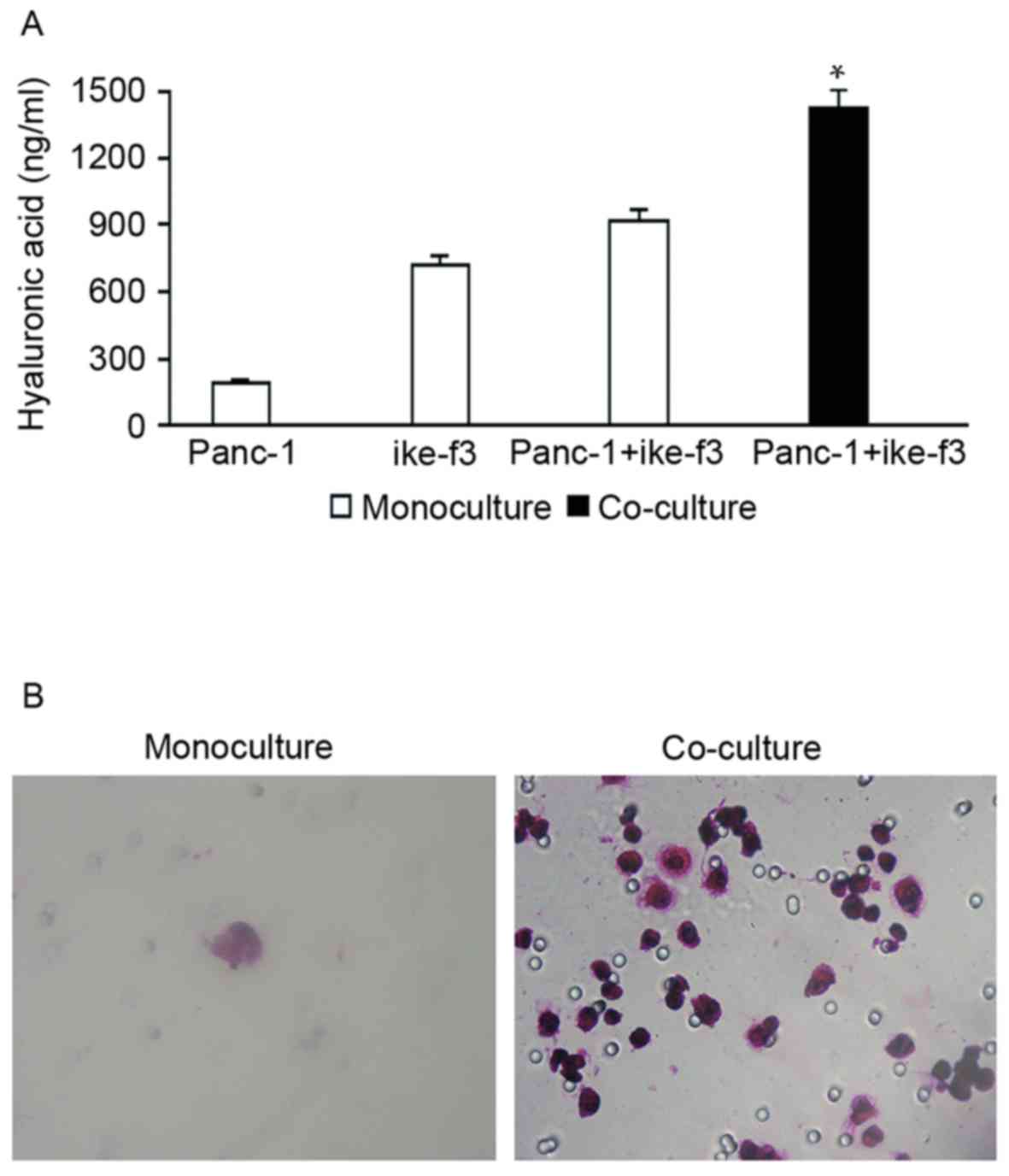
Co-culture of Panc-1 cells with fibroblasts resulted
in a significant increase (P=0.016) in HA production, compared with
those in monocultures (Fig. 1A). In
addition, the Transwell migration assay revealed that co-culture
with fibroblasts significantly increased the migration of Panc-1
cells (Fig. 1B).
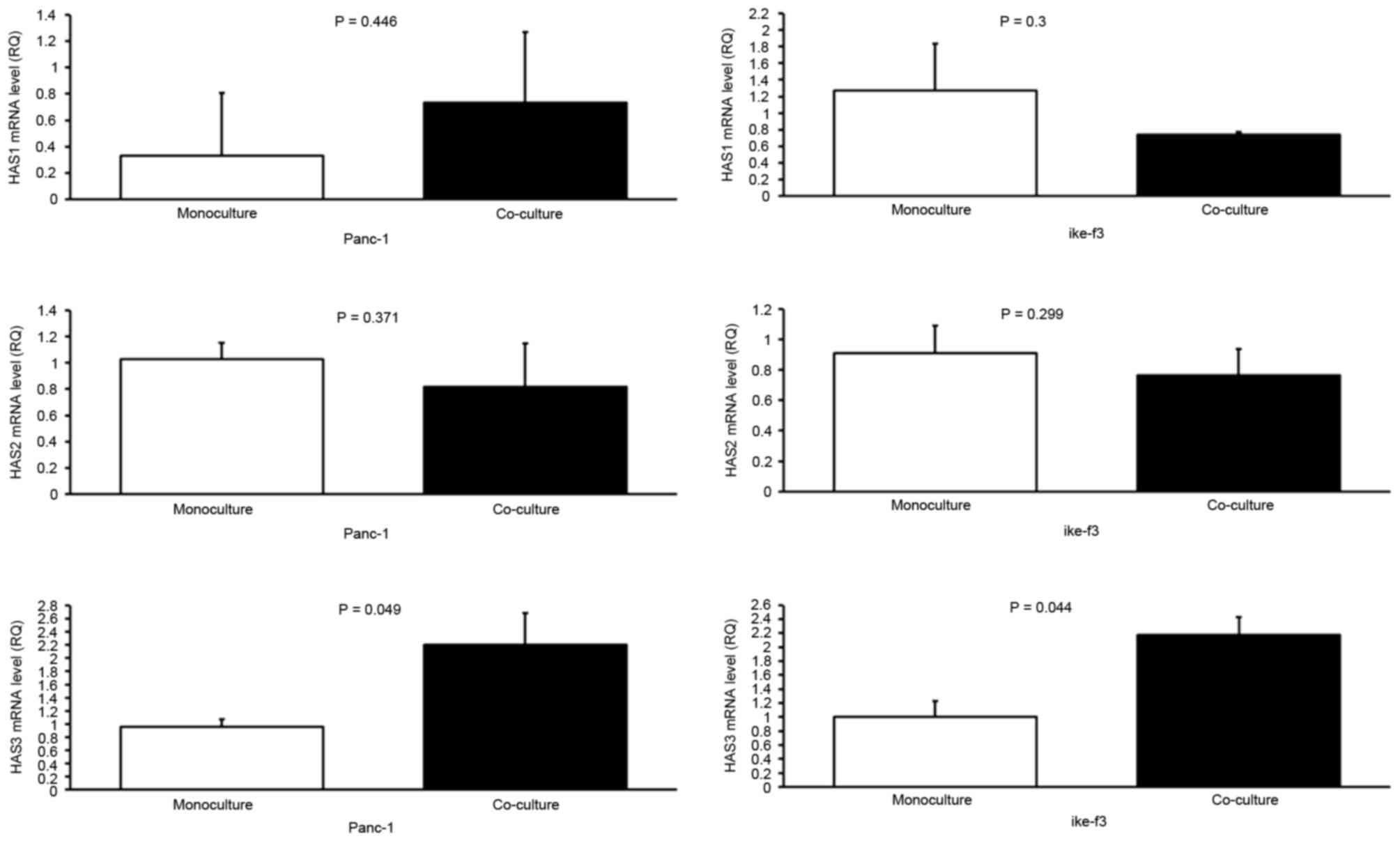
To elucidate the mechanism of enhanced HA production
by co-culture system, the mRNA expression levels of HAS1,
HAS2 and HAS3 in Panc-1 cells and fibroblasts was
investigated using RT-qPCR. The increased HA production was
associated with a significantly increased mRNA expression of
HAS3, but not HAS1 and HAS2 (Fig. 2).
Effects of 4-MU on HA biosynthesis and
cell migration in the co-culture system
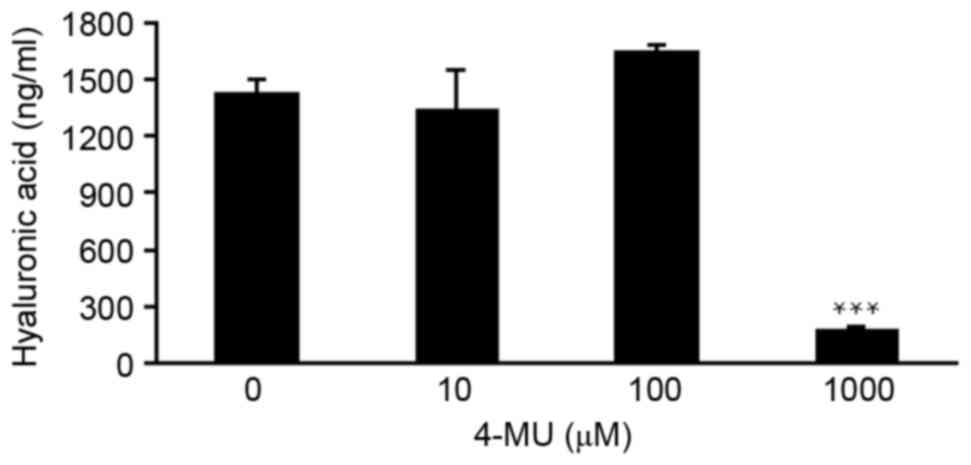
Panc-1 cells in the co-culture system were treated
with various concentrations (10, 100 and 1,000 µM) of 4-MU. The
results demonstrated that no marked effects on the cell viability
were observed following treatment with the aforementioned range of
4-MU concentrations (data not shown). HA synthesis was inhibited by
88%, compared with the control, following treatment with 1,000 µM
4-MU; however, treatment with 10 and 100 µM revealed almost no
alterations in HA production (Fig.
3).
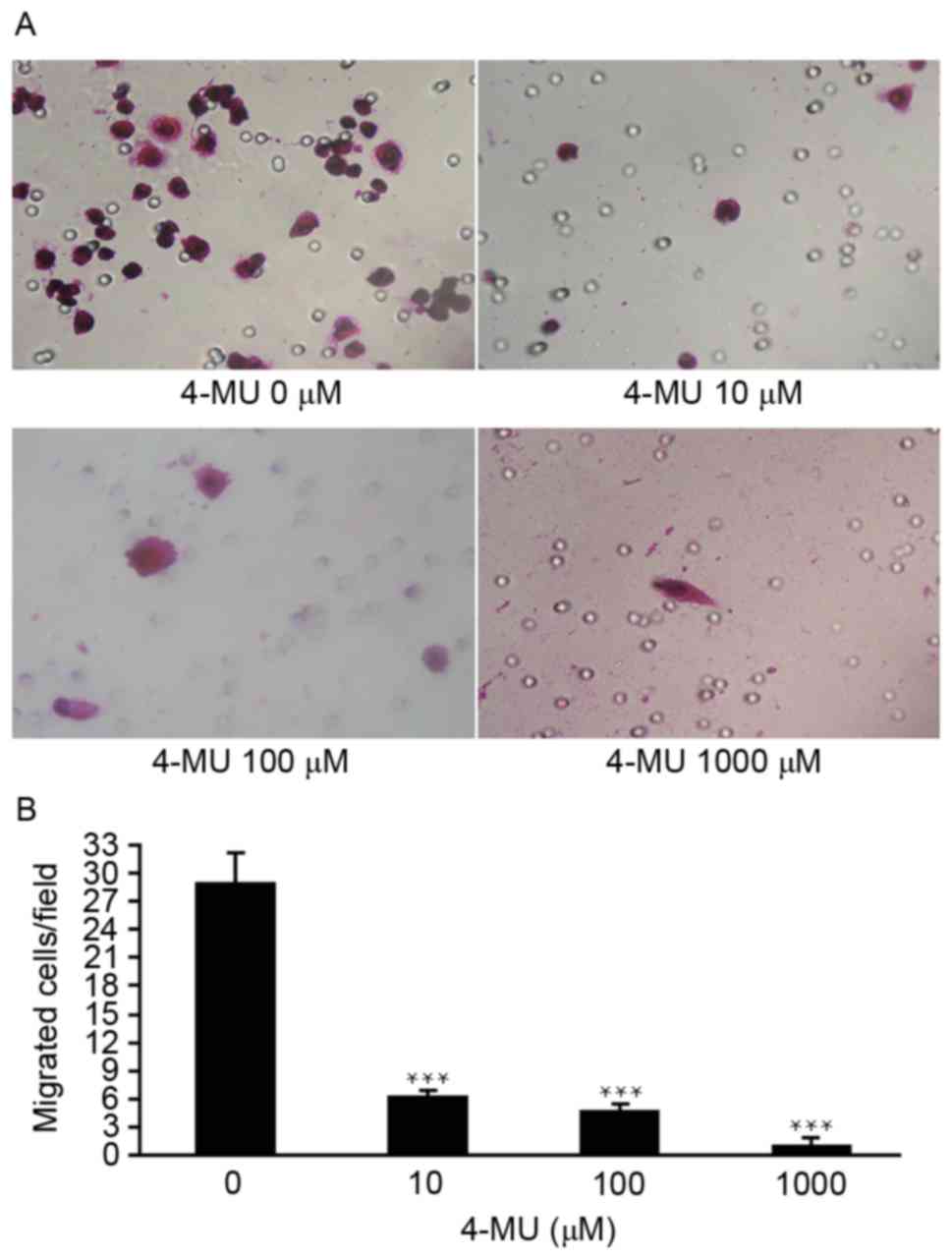
Panc-1 cell migration was evaluated using a
Transwell migration assay (Fig. 4A),
which revealed that 4-MU inhibited Panc-1 cell migration in
co-culture with fibroblasts. Inhibition of cell migration was
observed at 10 µM and maximal inhibition was revealed to be at
1,000 µM (Fig. 4B).
Discussion
A previous study identified interactions between
tumor cells and fibroblasts which stimulated HA synthesis and
identified that HA is increased in tumors (35). In the present study, Panc-1 cells were
co-cultured with fibroblasts which resulted in a marked increase in
HA synthesis. Additionally, HAS3 mRNA expression in Panc-1
cells and fibroblasts was significantly increased in this
co-culture system. The results of the present study suggested that,
for the first time, to the best of our knowledge, the increase in
HA in a PDAC co-culture system was associated with markedly
increased mRNA expression of HAS3. HAS3 may produce
increased amounts of LMW-HA (6) and
this contributes to tumor progression by increasing the motility of
cancer cells (36–38). These interactions may explain why the
co-culture system markedly increased PDAC cell migration.
HA production may be decreased by 4-MU via the
depletion of cellular UDP-GlcUA and the downregulation of HAS2
and/or HAS3, and inhibit cell viability, migration and invasiveness
(25). Therefore, PDAC cells in the
co-culture system were treated with 4-MU. The results revealed a
marked decrease in HA production and PDAC cell migration. This drug
is promising because the safety of 4-MU for humans has already been
confirmed. Oral 4-MU has been used to treat hepatobiliary disease
due to the cholagogic and spasmolytic actions exhibited on the
sphincter of Oddi (39,40). The results of the present study
demonstrated that the interaction between PDAC cells and
fibroblasts stimulated HA production and PDAC cell migration, and
4-MU may inhibit HA synthesis and cell migration.
Acknowledgements
The authors thank Kyushu University for providing
the primary fibroblasts derived from PDAC tissues.
Funding
No funding was received.
Availability of data and materials
All data generated or analyzed during this study are
included in this published article.
Author's contributions
NS, XC and KH conceived the experimental design. XC,
SK and AK performed the experiments. XC analyzed the data. XC, NS
and KH wrote the paper. All authors read and approved the final
manuscript.
Ethics approval and consent to
participate
Not applicable.
Consent for publication
Not applicable.
Competing interests
The authors declare that they have no competing
interests.
Glossary
Abbreviations
Abbreviations:
|
HA
|
hyaluronic acid
|
|
4-MU
|
4-methylumbelliferone
|
|
PDAC
|
pancreatic ductal adenocarcinoma
|
|
HAS
|
hyaluronan synthase
|
|
dFdC
|
2′,2′-difluorodeoxycytidine
|
|
HMW-HA
|
high-molecular-weight hyaluronan
|
|
LMW-HA
|
low-molecular-weight hyaluronan
|
|
UGT
|
uridine
diphosphate-glucuronyltransferase
|
|
UDP-GlcUA
|
uridine diphosphate-glucuronic
acid
|
References
|
1
|
Hidalgo M: Pancreatic cancer. N Engl J
Med. 362:1605–1617. 2010. View Article : Google Scholar : PubMed/NCBI
|
|
2
|
Burris HA III, Moore MJ, Andersen J, Green
MR, Rothenberg ML, Modiano MR, Cripps MC, Portenoy RK, Storniolo
AM, Tarassoff P, et al: Improvements in survival and clinical
benefit with gemcitabine as first-line therapy for patients with
advanced pancreas cancer: A randomized trial. J Clin Oncol.
15:2403–2413. 1997. View Article : Google Scholar : PubMed/NCBI
|
|
3
|
Sultana A, Smith CT, Cunningham D,
Starling N, Neoptolemos JP and Ghaneh P: Meta-analyses of
chemotherapy for locally advanced and metastatic pancreatic cancer.
J Clin Oncol. 25:2607–2615. 2007. View Article : Google Scholar : PubMed/NCBI
|
|
4
|
Moore MJ, Goldstein D, Hamm J, Figer A,
Hecht JR, Gallinger S, Au HJ, Murawa P, Walde D, Wolff RA, et al:
Erlotinib plus gemcitabine compared with gemcitabine alone in
patients with advanced pancreatic cancer: A phase III trial of the
national cancer institute of Canada clinical trials group. J Clin
Oncol. 25:1960–1966. 2007. View Article : Google Scholar : PubMed/NCBI
|
|
5
|
Weigel PH and DeAngelis PL: Hyaluronan
synthases: A decade-plus of novel glycosyltransferases. J Biol
Chem. 282:36777–36781. 2007. View Article : Google Scholar : PubMed/NCBI
|
|
6
|
Tammi RH, Passi AG, Rilla K, Karousou E,
Vigetti D, Makkonen K and Tammi MI: Transcriptional and
post-translational regulation of hyaluronan synthesis. FEBS J.
278:1419–1428. 2011. View Article : Google Scholar : PubMed/NCBI
|
|
7
|
Entwistle J, Hall CL and Turley EA: HA
receptors: Regulators of signalling to the cytoskeleton. J Cell
Biochem. 61:569–577. 1996. View Article : Google Scholar : PubMed/NCBI
|
|
8
|
Adamia S, Maxwell CA and Pilarski LM:
Hyaluronan and hyaluronan synthases: Potential therapeutic targets
in cancer. Curr Drug Targets Cardiovasc Haematol Disord. 5:3–14.
2005. View Article : Google Scholar : PubMed/NCBI
|
|
9
|
Toole BP: Hyaluronan promotes the
malignant phenotype. Glycobiology. 12:37R–42R. 2002. View Article : Google Scholar : PubMed/NCBI
|
|
10
|
Mahlbacher V, Sewing A, Elsässer HP and
Kern HF: Hyaluronan is a secretory product of human pancreatic
adenocarcinoma cells. Eur J Cell Biol. 58:28–34. 1992.PubMed/NCBI
|
|
11
|
Fries H, Elsässer HP, Mahlbacher V,
Neumann K and Kern HF: Localisation of hyaluronate (HA) in primary
tumors and nude mouse xenografts of human pancreatic carcinomas
using a biotinylated HA-binding protein. Virchows Arch. 424:7–12.
1994. View Article : Google Scholar : PubMed/NCBI
|
|
12
|
McBride WH and Bard JB:
Hyaluronidase-sensitive halos around adherent cells. Their role in
blocking lymphocyte-mediated cytolysis. J Exp Med. 149:507–515.
1979. View Article : Google Scholar : PubMed/NCBI
|
|
13
|
Suzuki Y, Nishida Y, Naruse T, Gemba T and
Ishiguro N: Pericellular matrix formation alters the efficiency of
intracellular uptake of oligonucleotides in osteosarcoma cells. J
Surg Res. 152:148–156. 2009. View Article : Google Scholar : PubMed/NCBI
|
|
14
|
Toole BP: Hyaluronan-CD44 interactions in
cancer: Paradoxes and possibilities. Clin Cancer Res. 15:7462–7468.
2009. View Article : Google Scholar : PubMed/NCBI
|
|
15
|
Cheng XB, Sato N, Kohi S and Yamaguchi K:
Prognostic impact of hyaluronan and its regulators in pancreatic
ductal adenocarcinoma. PLoS One. 8:e807652013. View Article : Google Scholar : PubMed/NCBI
|
|
16
|
Nakamura T, Takagaki K, Shibata S, Tanaka
K, Higuchi T and Endo M: Hyaluronic-acid-deficient extracellular
matrix induced by addition of 4-methylumbelliferone to the medium
of cultured human skin fibroblasts. Biochem Biophys Res Commun.
208:470–475. 1995. View Article : Google Scholar : PubMed/NCBI
|
|
17
|
Nakamura T, Funahashi M, Takagaki K,
Munakata H, Tanaka K, Saito Y and Endo M: Effect of
4-methylumbelliferone on cell-free synthesis of hyaluronic acid.
Biochem Mol Biol Int. 43:263–268. 1997.PubMed/NCBI
|
|
18
|
Kakizaki I, Takagaki K, Endo Y, Kudo D,
Ikeya H, Miyoshi T, Baggenstoss BA, Tlapak-Simmons VL, Kumari K,
Nakane A, et al: Inhibition of hyaluronan synthesis in
Streptococcus equi FM100 by 4-methylumbelliferone. Eur J Biochem.
269:5066–5075. 2002. View Article : Google Scholar : PubMed/NCBI
|
|
19
|
Kudo D, Kon A, Yoshihara S, Kakizaki I,
Sasaki M, Endo M and Takagaki K: Effect of a hyaluronan synthase
suppressor, 4-methylumbelliferone, on B16F-10 melanoma cell
adhesion and locomotion. Biochem Biophys Res Commun. 321:783–787.
2004. View Article : Google Scholar : PubMed/NCBI
|
|
20
|
Kakizaki I, Kojima K, Takagaki K, Endo M,
Kannagi R, Ito M, Maruo Y, Sato H, Yasuda T, Mita S, et al: A novel
mechanism for the inhibition of hyaluronan biosynthesis by
4-methylumbelliferone. J Biol Chem. 279:33281–33289. 2004.
View Article : Google Scholar : PubMed/NCBI
|
|
21
|
Yoshihara S, Kon A, Kudo D, Nakazawa H,
Kakizaki I, Sasaki M, Endo M and Takagaki K: A hyaluronan synthase
suppressor, 4-methylumbelliferone, inhibits liver metastasis of
melanoma cells. FEBS Lett. 579:2722–2726. 2005. View Article : Google Scholar : PubMed/NCBI
|
|
22
|
Morohashi H, Kon A, Nakai M, Yamaguchi M,
Kakizaki I, Yoshihara S, Sasaki M and Takagaki K: Study of
hyaluronan synthase inhibitor, 4-methylumbelliferone derivatives on
human pancreatic cancer cell (KP1-NL). Biochem Biophys Res Commun.
345:1454–1459. 2006. View Article : Google Scholar : PubMed/NCBI
|
|
23
|
Nakazawa H, Yoshihara S, Kudo D, Morohashi
H, Kakizaki I, Kon A, Takagaki K and Sasaki M:
4-methylumbelliferone, a hyaluronan synthase suppressor, enhances
the anticancer activity of gemcitabine in human pancreatic cancer
cells. Cancer Chemother Pharmacol. 57:165–170. 2006. View Article : Google Scholar : PubMed/NCBI
|
|
24
|
Vigetti D, Rizzi M, Viola M, Karousou E,
Genasetti A, Clerici M, Bartolini B, Hascall VC, De Luca G and
Passi A: The effects of 4-methylumbelliferone on hyaluronan
synthesis, MMP2 activity, proliferation, and motility of human
aortic smooth muscle cells. Glycobiology. 19:537–546. 2009.
View Article : Google Scholar : PubMed/NCBI
|
|
25
|
Kultti A, Pasonen-Seppänen S, Jauhiainen
M, Rilla KJ, Kärnä R, Pyöriä E, Tammi RH and Tammi MI:
4-Methylumbelliferone inhibits hyaluronan synthesis by depletion of
cellular UDP-glucuronic acid and downregulation of hyaluronan
synthase 2 and 3. Exp Cell Res. 315:1914–1923. 2009. View Article : Google Scholar : PubMed/NCBI
|
|
26
|
Lokeshwar VB, Lopez LE, Munoz D, Chi A,
Shirodkar SP, Lokeshwar SD, Escudero DO, Dhir N and Altman N:
Antitumor activity of hyaluronic acid synthesis inhibitor
4-methylumbelliferone in prostate cancer cells. Cancer Res.
70:2613–2623. 2010. View Article : Google Scholar : PubMed/NCBI
|
|
27
|
Twarock S, Freudenberger T, Poscher E, Dai
G, Jannasch K, Dullin C, Alves F, Prenzel K, Knoefel WT, Stoecklein
NH, et al: Inhibition of oesophageal squamous cell carcinoma
progression by in vivo targeting of hyaluronan synthesis. Mol
Cancer. 10:302011. View Article : Google Scholar : PubMed/NCBI
|
|
28
|
Urakawa H, Nishida Y, Wasa J, Arai E, Zhuo
L, Kimata K, Kozawa E, Futamura N and Ishiguro N: Inhibition of
hyaluronan synthesis in breast cancer cells by
4-methylumbelliferone suppresses tumorigenicity in vitro and
metastatic lesions of bone in vivo. Int J Cancer. 130:454–466.
2012. View Article : Google Scholar : PubMed/NCBI
|
|
29
|
Nakamura R, Kuwabara H, Yoneda M,
Yoshihara S, Ishikawa T, Miura T, Nozaka H, Nanashima N, Sato T and
Nakamura T: Suppression of matrix metalloproteinase-9 by
4-methylumbelliferone. Cell Biol Int. 31:1022–1026. 2007.
View Article : Google Scholar : PubMed/NCBI
|
|
30
|
Nakamura T, Ishikawa T, Nanashima N, Miura
T, Nozaka H, Nakaoka R and Sato T: 4-Methylumbelliferone induces
the expression of membrane type 1-matrix metalloproteinase in
cultured human skin fibroblasts. Biochem Biophys Res Commun.
298:646–650. 2002. View Article : Google Scholar : PubMed/NCBI
|
|
31
|
Kuwabara H, Yoneda M, Hayasaki H, Nakamura
T and Shibayama Y: A hyaluronan synthase suppressor,
4-methylumbelliferone, inhibits the tumor invasion associated with
N-cadherin decreasement. Pathol Int. 61:262–263. 2011. View Article : Google Scholar : PubMed/NCBI
|
|
32
|
Holm Svensson AC, Bengtsson T, Grenegård M
and Lindström EG: Hyaluronic acid influence on platelet-induced
airway smooth muscle cell proliferation. Exp Cell Res. 318:632–640.
2012. View Article : Google Scholar : PubMed/NCBI
|
|
33
|
Twarock S, Tammi MI, Savani RC and Fischer
JW: Hyaluronan stabilizes focal adhesions, filopodia, and the
proliferative phenotype in esophageal squamous carcinoma cells. J
Biol Chem. 285:23276–23284. 2010. View Article : Google Scholar : PubMed/NCBI
|
|
34
|
Cheng XB, Sato N, Kohi S, Koga A and
Hirata K: Receptor for hyaluronic acid-mediated motility is
associated with poor survival in pancreatic ductal adenocarcinoma.
J Cancer. 6:1093–1098. 2015. View Article : Google Scholar : PubMed/NCBI
|
|
35
|
Knudson W, Biswas C and Toole BP:
Interactions between human tumor cells and fibroblasts stimulate
hyaluronate synthesis. Proc Natl Acad Sci USA. 81:6767–6771. 1984.
View Article : Google Scholar : PubMed/NCBI
|
|
36
|
Sugahara KN, Murai T, Nishinakamura H,
Kawashima H, Saya H and Miyasaka M: Hyaluronan oligosaccharides
induce CD44 cleavage and promote cell migration in CD44-expressing
tumor cells. J Biol Chem. 278:32259–32265. 2003. View Article : Google Scholar : PubMed/NCBI
|
|
37
|
Wu M, Cao M, He Y, Liu Y, Yang C, Du Y,
Wang W and Gao F: A novel role of low molecular weight hyaluronan
in breast cancer metastasis. FASEB J. 29:1290–1298. 2015.
View Article : Google Scholar : PubMed/NCBI
|
|
38
|
Schmaus A, Klusmeier S, Rothley M, Dimmler
A, Sipos B, Faller G, Thiele W, Allgayer H, Hohenberger P, Post S
and Sleeman JP: Accumulation of small hyaluronan oligosaccharides
in tumour interstitial fluid correlates with lymphatic invasion and
lymph node metastasis. Br J Cancer. 111:559–567. 2014. View Article : Google Scholar : PubMed/NCBI
|
|
39
|
Fontaine L, Grand M, Molho D and Boschetti
E: Spasmolytic activity of 4-methylumbelliferone on Oddi's
sphincter. Studies on the mode of action of the drug. Therapie.
23:63–74. 1968.(In French). PubMed/NCBI
|
|
40
|
Fontaine L, Grand M, Molho D, Chabert MJ
and Boschetti E: Choleretic, spasmolytic and general pharmacologic
activities of 4-methylumbelliferone. Therapie. 23:51–62. 1968.(In
French). PubMed/NCBI
|