Introduction
Lung cancer remains the leading cause of
cancer-associated mortality (1).
Non-small cell lung cancer (NSCLC) develop as the predominant form,
and approximately accounts for 85% of all lung cancer related
deaths (2), mainly consisting of
three subtypes: adenocarcinoma, large cell cancer, and squamous
cell cancer (3,4). Regardless of great improvements in
surgical techniques and chemotherapy, the prognosis for NSCLC
remains inconclusive, the 5-year survival rate of is approximately
15% (5,6). Therefore, an improved comprehension of
the pathophysiological functions and mechanisms involved in the
NSCLC development appears to be pivotal for blossoming novel and
effective therapeutic approaches.
MicroRNAs (miRNAs) are small non-coding RNAs,
ranging in length from 18 to 24 nucleotides, base binding with
target mRNAs in the 3′-untranslated region (3′-UTR) (7), causing mRNA degradation, cleavage,
translational repression or activation (8, 9). Increasing research
has indicated that miRNAs are regulators in cancer, that might
function either as suppressors or activators of cancer development
by regulating different targets (10). Furthermore, many studies have
indicated that the aberrant expression of various miRNAs could
affect normal biological progress of NSCLC cells that are involved
in tumor invasion and metastasis (11). Moreover, previous studies have
reported that miR-224 facilitated tumor progression to enhanced
invasion and growth in NSCLC and implicated pathogenesis of lung
cancer (12,13). However, the specific functional
molecular mechanisms of miR-224 in the mediation of NSCLC cancer
process are still elusive, and the potential mechanism of miR-506
as a therapeutic target for NSCLC has not been fully evaluated.
The Homeobox D10 (HOXD10) belongs to the homeobox
(HOX) gene family, has been reported to be the main regulator that
can directly affect organogenesis and plays a role in maintaining
the differentiated tissues functions (14), encodes a sequence-specific
transcription factor with a homeobox DNA-binding domain (15,16).
Furthermore, Li et al showed that miR-224 could promote
hepatocellular carcinoma cell invasion and migration by targeting
HOXD10, and HOXD10 was recognized as an essential tumor suppressor
(17). Whether HOXD10 could play an
important function in the mediation of NSCLC needs further
investigation.
In this study, we proved the expression level of
HOXD10 could be regulated by miR-224. miR-224 may play a vital part
in mediation of malignant disease development, especially NSCLC, by
directly targeting HOXD10. These findings may suggest a critical
regulatory mechanism for cancer progress or development of NSCLC
and give a feasible therapeutic option for exploring NSCLC
carcinogenesis.
Materials and methods
Tissue specimen collection
Forty paired samples of the NSCLC and adjacent
non-tumor tissues were obtained at the Department of Respiratory
Medicine, The First Affiliated Hospital of Jiamusi University
(Jiamusi, China). Informed consent was obtained from all patients
and the present study was approved by the Ethics Committee of The
First Affiliated Hospital of Jiamusi University. All tissue
specimens were confirmed by pathological diagnoses and no patients
received radiotherapy or chemotherapy before surgery. The
characteristics of the NSCLC tissues and the corresponding normal
tissues are described in Table I.
 | Table I.Clinicopathological characteristics of
patients with NSCLC. |
Table I.
Clinicopathological characteristics of
patients with NSCLC.
|
|
| miR-224
expression |
|
|---|
|
|
|
|
|
|---|
| Characteristics | Total cases
(n=40) | High | Low | P-value |
|---|
| Age (years) |
|
|
| 0.7356 |
| ≤60 | 25 | 17 | 8 |
|
|
>60 | 15 | 9 | 6 |
|
| Sex |
|
|
| 0.8843 |
| Male | 23 | 13 | 10 |
|
|
Female | 17 | 10 | 7 |
|
| Tumor size (cm) |
|
|
| 0.5628 |
|
<3 | 28 | 19 | 9 |
|
| ≥3 | 12 | 7 | 5 |
|
| Metastasis |
|
|
| 0.0262a |
|
Yes | 21 | 17 | 4 |
|
| No | 19 | 9 | 10 |
|
|
Differentiation |
|
|
| 0.0312a |
|
Well/Moderate | 14 | 6 | 8 |
|
|
Poor | 26 | 20 | 6 |
|
| TNM stage |
|
|
| 0.0281a |
|
I+II | 21 | 15 | 6 |
|
|
III+IV | 19 | 7 | 12 |
|
Cell lines
Three human NSCLC cell lines (H358, 95-D, A549) and
one normal human lung epithelial cell line (BEAS-2B) were purchased
from Shanghai Institute of Cell Biology (Shanghai, China). The H358
cell line has been reported to be possibly identical to the H358M
cell line, of the bronchioloalveolar carcinoma type (http://mct.aacrjournals.org/content/12/5/643). The
cells were maintained in RPMI-1640 medium (Gibco, Grand Island, NY,
USA) supplemented with 10% fetal bovine serum (FBS; Sigma, St.
Louis, MO, USA) at 37°C and 5% CO2.
Cell transfections
Cells were transfected with the negative control
miRNA (NC miRNA) and miRNA mimics/inhibitor (100 µM) using
Lipofectamine 2000 (Invitrogen, Carlsbad, CA, USA) after the
recommended instructions. The miR-224 mimics/inhibitors and NC
miRNA were synthesized with RiboBio (Guangzhou, China).
RNA isolation and RT-qPCR assays
Total RNA were isolated from cultured cells using
the RNA simple Total RNA Extraction kit (Ambion, Carlsbad, CA, USA)
for cDNA synthesis. To perform the quantitative detection of
miR-224 or mRNA expression, quantitative PCR was carried out with
StepOne Plus RT-PCR System. The RT-qPCR data were calculated by the
2−∆∆Cq method and relative to SnRNA U6 or GAPDH.
Luciferase reporter assay
To find the targets of miR-506, we utilized
bioinformatics software (Targetscan, miRanda). The pmirGLO vectors
with wild-type (WT) or mutant type (MUT) miR-224 binding site in
HOXD10 3′-UTR were constructed by GenePharma Co., Ltd. (Shanghai,
China). The miR-224 mimics/inhibitor, and miR-224 NC were
synthesized and purified by RiboBio; siHOXD10 and anti-siHOXD10
were purchased from RiboBio. Then, 50 ng of WT or MUT luciferase
vector and miR-224 mimic/inhibitor or NC miRNA (20 µM) were
co-transfected into H358 or A549 cells. Then luciferase activity
was determined in two days with Dual-Luciferase Reporter Assay
System (Promega, Madison, WI, USA) after transfection.
Western blotting
RIPA lysis buffer was chosen to extract all
proteins, supplemented with a protease inhibitor, and separated by
10% SDS polyacrylamide gels (SDS-PAGE) and were electro-transferred
to polyvinylidene difluoride (PVDF) membranes (Life Technologies,
Grand Island, NY, USA). Subsequently, the membranes were incubated
with a specific primary antibody: rabbit monoclonal anti-HOXD 10
(ab 138508; 1:1,000; Abcam, Cambridge, MA, USA) for 12 h at 4°C,
and then horseradish peroxidase-conjugated (HRP, 1:10,000),
secondary antibody; goat anti-rabbit IgG-HRP (sc-2,004; 1:3,000;
Santa Cruz Biotechnology, Inc. Santa Cruz, CA, USA) was incubated
for 1 h at 25°C. Finally, the proteins of interest were detected by
the enhanced chemiluminescence (ECL) detection system (Sea Biotech,
Shanghai, China).
Migration and invasion assays
Cells were washed using serum-free medium three
times. A total of 5×10⁵ cells (H358), transfected with
the miR-224 mimic/inhibitor and NC, were resuspended in 200 µl
serum-free medium and added into upper chamber with or without 150
mg Matrigel (BD Biosciences, San Jose, CA, USA). The lower chamber
was filled with 600 µl medium containing serum and incubated for 48
h for migration assay and 72 h for invasion assay. Matrix gels were
added into upper chamber of the Transwell. At the end of the
experiment, cells of the lower chamber were stained with crystal
violet for 20 min. Stained cells were visualized and counted under
a CKX41 inverted microscope (SZ61; Olympus, Tokyo, Japan).
Statistical analysis
The statistical analyses of experimental results
were conducted using SPSS 16.0 statistics software package (SPSS,
Inc., Chicago, IL, USA). The results are expressed as the mean ±
SD. The Student's t-test and the Chi-square test were used to
analyze experimental data. The unpaired two group comparison and
multiple comparisons were made with analysis of variance (ANOVA)
with Tukey-Kramer post-hoc test. Correlation between mRNA and miRNA
expression level were estimated using the Spearman's correlation
method. P<0.05 was considered to indicate a statistically
significant difference.
Results
miR-224 is significantly upregulated
in NSCLC
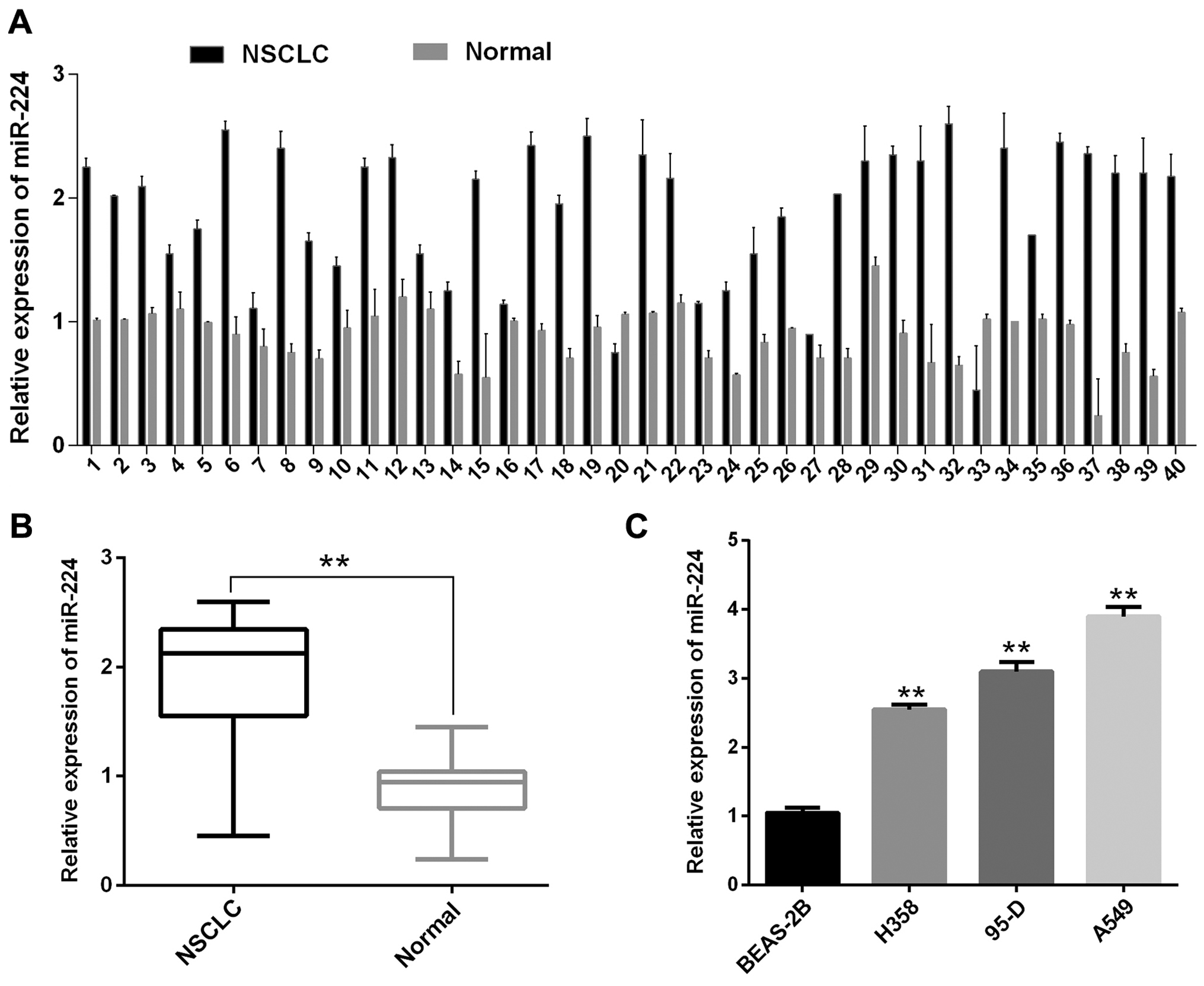
In order to evaluate the expression levels of
miR-224 in NSCLC tissues, the RT-qPCR was used in 40 pairs of
collected NSCLC tissues and their adjacent non-tumor tissues
samples. miR-224 showed a remarkably higher expression in NSCLC
tissues than that in adjacent non-tumor lung tissues (Fig. 1A and B). Moreover, the expression
levels of miR-224 in three NSCLC cell lines (H358, 95-D, A549) were
also higher compared with BEAS-2B (Fig.
1C). These results can help us to understand the correlation
between miR-224 and NSCLC, which is characterized by high
expression.
miR-224 is overexpressed following
transfection with miR-224-mimic
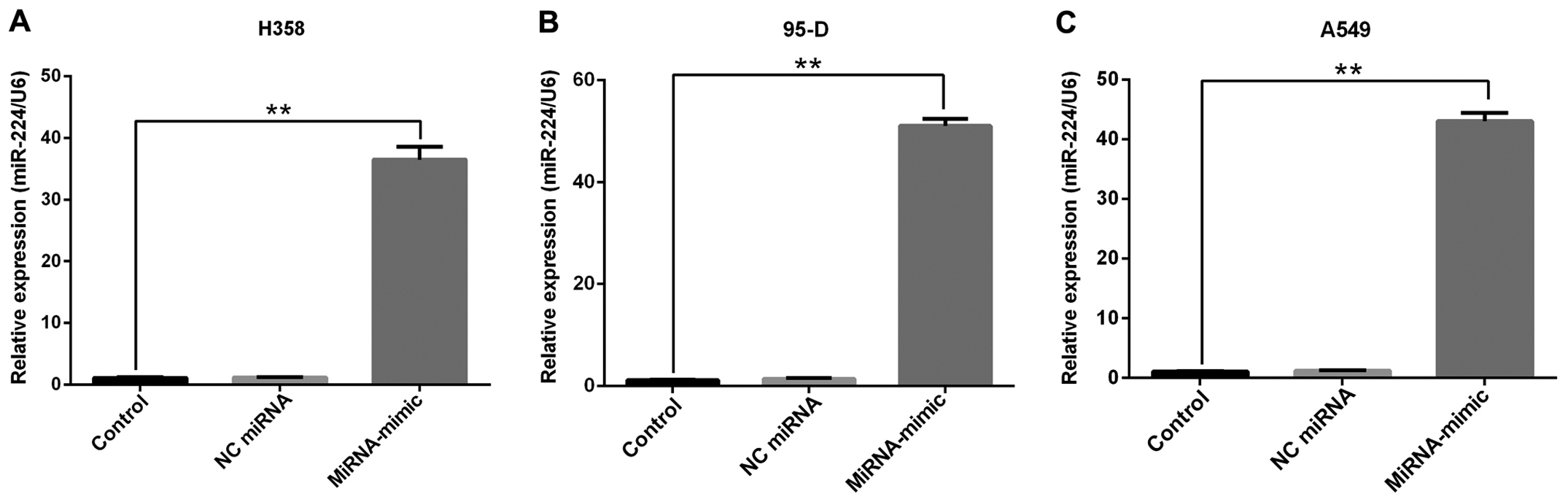
To investigate the causal role of miR-224 in tumor
progression and development, the transfected miR-224 mimics were
transfected into the three different NSCLC cell lines (H358, 95-D,
A549). The results as shown in Fig.
2, after transfection with miR-224 mimics, miR-224 showed an
average of 35±3-fold expression in H358 cells (Fig. 2A), 50±2-fold expression in A549 cells
(Fig. 2B), and 42±2-fold expression
in 95-D cells (Fig. 2C), suggested
that the expression level of miR-224 was markedly increased with
miR-224 mimics compared with NC miR-224 and the control group.
HOXD10 acts as an oncogene and
inversely correlates with miR-224
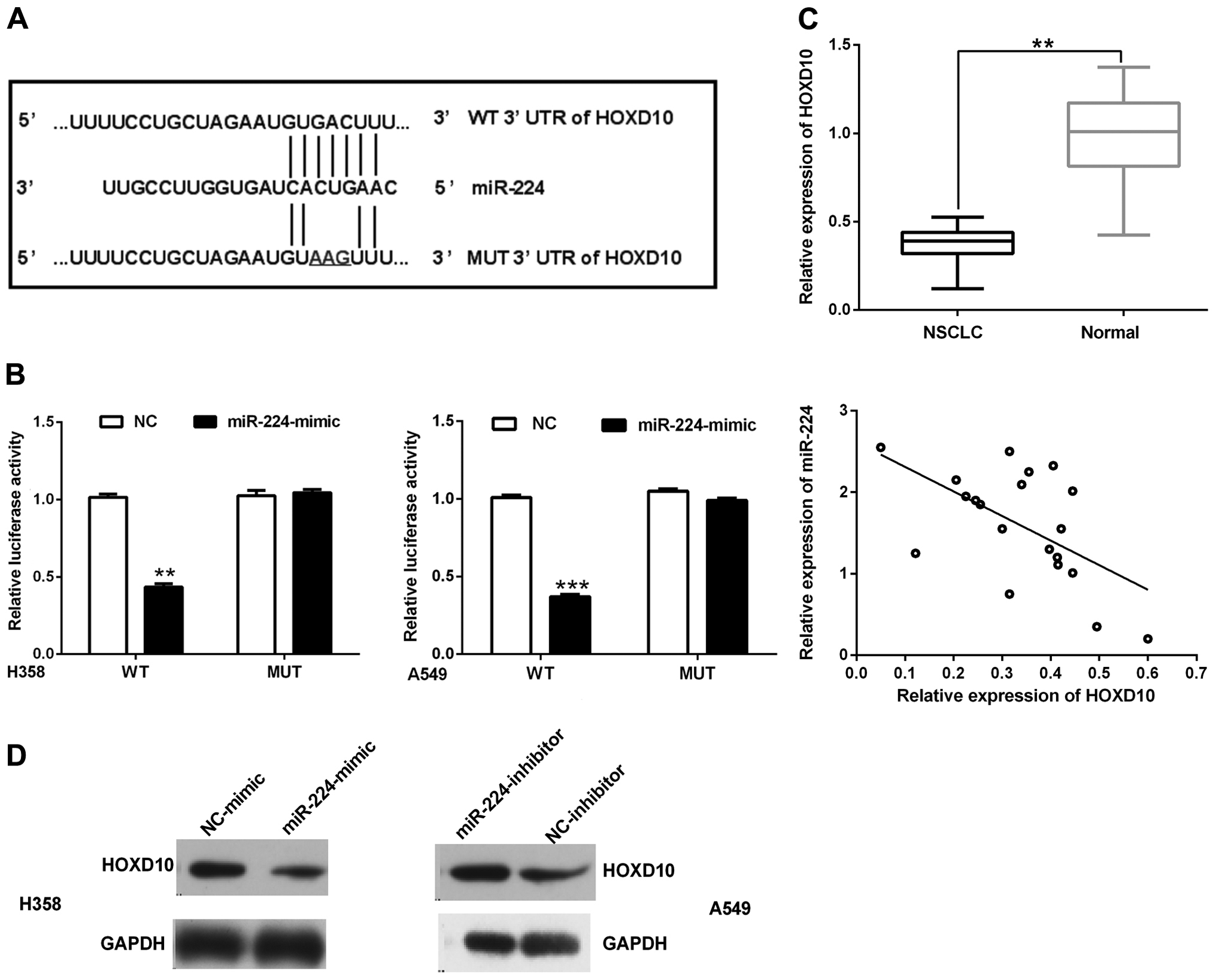
To find the putative downstream target of miR-224c,
bioinformatic tools, such as TargetScan and miRanda, were used. By
the online prediction, we obtained the outcome that HOXD10 was
selected as a potential target gene of miR-224 and has a highly
conserved binding site to miR-224 at 152–158 bp in the 3′-UTR
(Fig. 3A). In order to further verify
the predicted binding site, dual luciferase reporter assay was
carried out using two NSCLC cell lines (H358, A549). The results
indicated that the relative luciferase activity transfected with
HOXD10-3′UTR-WT reporter and miR-224 mimics was significantly
decreased, on the other hand, it had no suppressive effect on the
mutant reporter in H358 and A549 cells (Fig. 3B).
The mRNA expression levels of HOXD10 were also
tested in 40 pairs of samples using the approach of qRT-PCR. The
outcome suggested that the expression of HOXD10 was obviously lower
in NSCLC tissues. Furthermore, a correlation was performed among
mRNA levels of HOXD10 and miR-224 by Spearman's correlation
analysis. The statistical analysis suggested that the expression of
HOXD10 was significantly inversely correlated with miR-224 levels
in the NSCLC tissues (Fig. 3C).
Furthermore, the re-expression of miR-224
significantly suppressed endogenous HOXD10 expression at protein
levels in H358 cells. We consistently found that the silencing of
miR-224 can increase the protein levels of endogenous HOXD10 in
A549 cells (Fig. 3D and E). Our
results indicate that both of the binding sites may take part in
miR-224 regulation, and miR-224 binds to the 3′-UTR of HOXD10 to
affect its expression.
HOXD10 was functionally important for
the biological function of miR-224
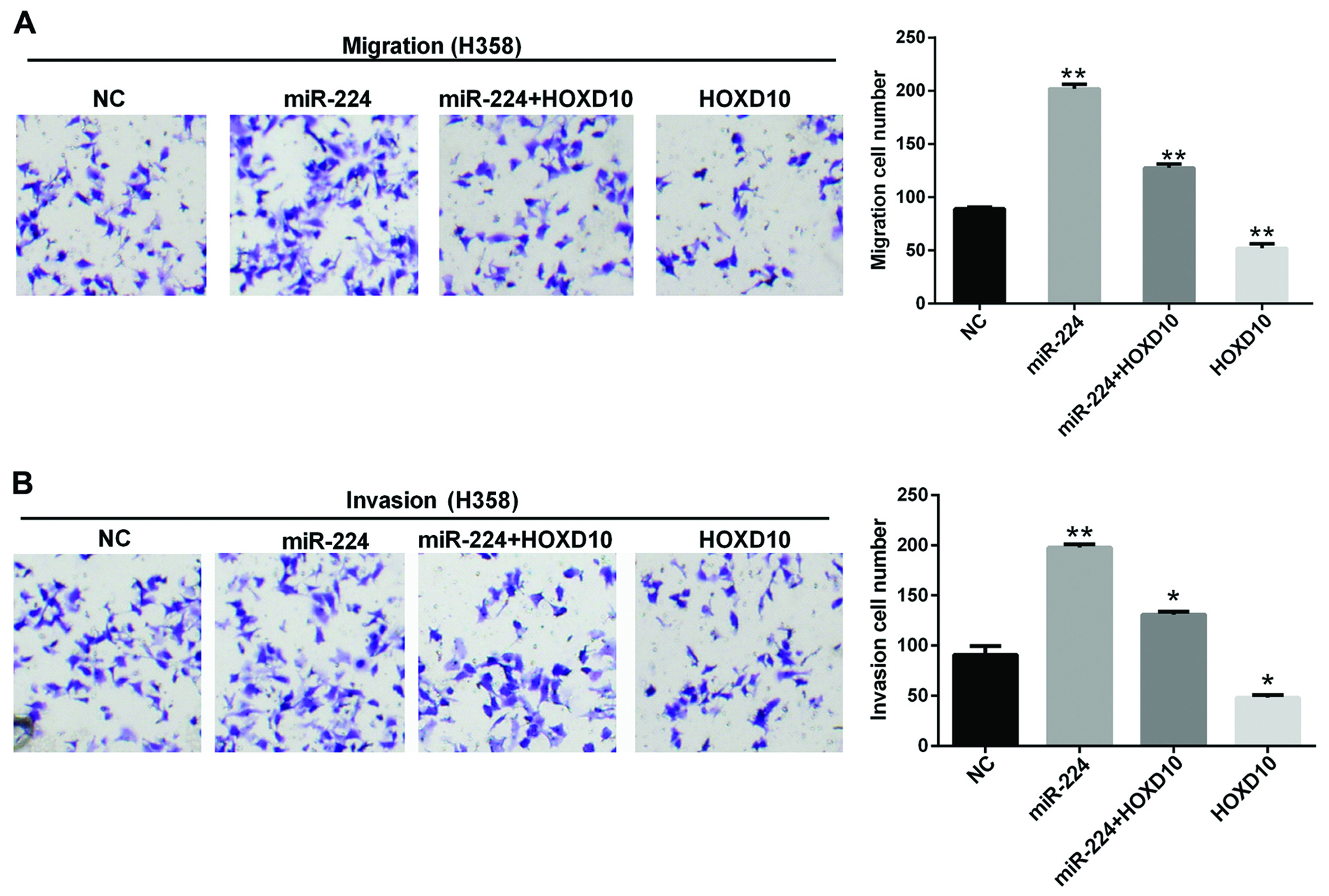
For further determining whether HOXD10 takes part in
the regulation of NSCLC cells, migration and invasion assays
suggested that silencing of HOXD10 obviously promoted
miR-224-induced migration and invasion within H358 cells, and
overexpression of HOXD10 could significantly reverse the
tumour-inductive functions of miR-224 on the migration and invasion
in H358 cells (Fig. 4A and B). These
results demonstrated that miR-224 plays a significant role in the
migration and invasion of NSCLC cells by targeting HOXD10.
Discussion
Lung cancer remains the leading cause of
cancer-associated mortality (1), 80%
of which are due to NSCLC (2). In
recent years, great improvements have been made in comprehension of
the pathophysiological functions and finding potential therapeutic
methods for NSCLC. miRNAs belong to small endogenous non-coding
RNAs, and they may mediate the expression of related gene and/or
induce the degradation at the post-transcriptional process
(18). Increasing evidence suggests
that miRNAs play essential part in the development of cancers such
as NSCLC through regulation of target genes (19,20).
Moreover, growing number of evidence has indicated
that miR-224 functioned either as tumor oncogene or suppressor.
Previous research has indicated that miR-224 was increased in a
wide class of solid tumors, such as ovarian cancer (21), hepatocellular carcinoma (22–24), and
glioma (25), gastric cancer
(26) and may have diagnostic,
therapeutic and prognostic values by targeting KLLN, pAKT, EP300,
HepG2 and mTOR. In addition, miR-224 acts as a tumor-suppressor in
breast cancer and prostate cancer (27,28) by
targeting frizzled 5 and TPD52, respectively. Furthermore, various
studies suggested that upregulation miR-224 had significant
correlation with NSCLC metastasis, and overexpression level of
miR-224 enhanced the H1573, H460 cells and H1299 cell abilities of
migration, invasion, and proliferation in NSCLC (12). Moreover, Cui et al reported
that CASP7 and CASP3 were identified as downstream targets of
miR-224, which are functionally important in the miR-224 mediated
lung cancer progression (13). Our
result showed that miR-224 expression was upregulated in the NSCLC
tissues and H358, 95-D, A549 cell lines (Fig. 1A and B), which was consistent with the
previous study. Upon this finding, another experiment was performed
where miR-224 was overexpressed in three different NSCLC cell lines
(H358, A549 and 95D) via transfection (Fig. 2) and the results suggested
overexpression of miR-224 may enhance the migration and invasion
abilities of NSCLC cells (Fig. 4A and
B).
HOXD10, an important regulator of cell-maintainence
on differentiated phenotype, has been suggested to take part in
tumorigenesis of various human malignancies (29). HOXD10 was also detected as the cancer
suppressor target regularly lost on chromosome 10q23 and a previous
study reported that HOXD10 might play a significant part as a
cancer suppressor of invasive growth, cell migration,
differentiation and morphogenesis (30,31).
Another study validated the HOXD10 functioned as a direct
downstream target gene of miR-224 in human hepatocellular carcinoma
and indicated that the HOXD10 functioned as a crucial inhibitor of
cancer cell migration and invasion (17). In addition, in this study, at the
molecular level for the first time, luciferase activity assay and
western blot suggested that miR-224 targets the 3′-UTR of HOXD10 to
regulate its expression in NSCLC (Fig.
3). Furthermore, Transwell assays showed that silencing or
overexpression of HOXD10 has different benefits on tumour-inductive
influences of miR-224 on the cancer cell migration and invasion
(Fig. 4A and B), which indicated
miR-224 inhibited expression by targeting 3′-UTR of HOXD10 in
NSCLC.
In summary, miR-224 overexpression can enhance the
migration and invasion abilities of NSCLC cells. Moreover, HOXD10
was detected to be a downstream target of miR-224, and to regulate
the influence on cell migration and invasion of NSCLC. A further
study to evaluate the potential function of miR-224/HOXD10 axis on
tumorigenesis and progression of NSCLC is needed.
Acknowledgements
Not applicable.
Funding
This research did not receive any specific grant
from funding agencies in the public, commercial, or not-for-profit
sectors.
Availability of data and materials
The datasets used and/or analyzed during the present
study are available from the corresponding author on reasonable
request.
Authors' contributions
SL and JZ contributed to the conception of the
study; YZ contributed significantly to data analysis and manuscript
preparation; FW performed the data analyses and wrote the
manuscript; YC and XF helped perform the analysis with constructive
discussions. All authors read and approved the final
manuscript.
Ethics approval and consent to
participate
This study was approved by the of the Ethics
Committee of The First Affiliated Hospital of Jiamusi University
(Jiamusi, China). Informed consent was obtained from all
patients.
Consent for publication
Not applicable.
Competing interests
The authors declare that they have no competing
interests.
References
|
1
|
Siegel R, Ma J, Zou Z and Jemal A: Cancer
statistics, 2014. CA Cancer J Clin. 64:9–29. 2014. View Article : Google Scholar : PubMed/NCBI
|
|
2
|
Tiseo M, Bordi P, Bortesi B, Boni L, Boni
C, Baldini E, Grossi F, Recchia F, Zanelli F, Fontanini G, et al:
Bio-FAST trial group: ERCC1/BRCA1 expression and gene polymorphisms
as prognostic and predictive factors in advanced NSCLC treated with
or without cisplatin. Br J Cancer. 108:1695–1703. 2013. View Article : Google Scholar : PubMed/NCBI
|
|
3
|
Caramori G, Casolari P, Cavallesco GN,
Giuffrè S, Adcock I and Papi A: Mechanisms involved in lung cancer
development in COPD. Int J Biochem Cell Biol. 43:1030–1044. 2011.
View Article : Google Scholar : PubMed/NCBI
|
|
4
|
Buttery RC, Rintoul RC and Sethi T: Small
cell lung cancer: The importance of the extracellular matrix. Int J
Biochem Cell Biol. 36:1154–1160. 2004. View Article : Google Scholar : PubMed/NCBI
|
|
5
|
Ettinger DS: Ten years of progress in
non-small cell lung cancer. J Natl Compr Cancer Netw. 10:292–295.
2012. View Article : Google Scholar
|
|
6
|
Su S, Hu Y, Ouyang W, Ma Z, Li Q, Li H,
Wang Y, Wang X, Li T, Li J, et al: Might radiation therapy in
addition to chemotherapy improve overall survival of patients with
non-oligometastatic Stage IV non-small cell lung cancer?: Secondary
analysis of two prospective studies. BMC Cancer. 16:9082016.
View Article : Google Scholar : PubMed/NCBI
|
|
7
|
Saumet A and Lecellier CH: microRNAs and
personalized medicine: Evaluating their potential as cancer
biomarkers. Adv Exp Med Biol. 888:5–15. 2015. View Article : Google Scholar : PubMed/NCBI
|
|
8
|
He L and Hannon GJ: MicroRNAs: Small RNAs
with a big role in gene regulation. Nat Rev Genet. 5:522–531. 2004.
View Article : Google Scholar : PubMed/NCBI
|
|
9
|
Garzon R, Calin GA and Croce CM: MicroRNAs
in cancer. Annu Rev Med. 60:167–179. 2009. View Article : Google Scholar : PubMed/NCBI
|
|
10
|
O'Connell RM, Rao DS, Chaudhuri AA and
Baltimore D: Physiological and pathological roles for microRNAs in
the immune system. Nat Rev Immunol. 10:111–122. 2010. View Article : Google Scholar : PubMed/NCBI
|
|
11
|
Baer C, Claus R and Plass C: Genome-wide
epigenetic regulation of miRNAs in cancer. Cancer Res. 73:473–477.
2013. View Article : Google Scholar : PubMed/NCBI
|
|
12
|
Cui R, Meng W, Sun HL, Kim T, Ye Z, Fassan
M, Jeon YJ, Li B, Vicentini C, Peng Y, et al: MicroRNA-224 promotes
tumor progression in nonsmall cell lung cancer. Proc Natl Acad Sci
USA. 112:E4288–E4297. 2015. View Article : Google Scholar : PubMed/NCBI
|
|
13
|
Cui R, Kim T, Fassan M, Meng W, Sun HL,
Jeon YJ, Vicentini C, Tili E, Peng Y, Scarpa A, et al: MicroRNA-224
is implicated in lung cancer pathogenesis through targeting
caspase-3 and caspase-7. Oncotarget. 6:21802–21815. 2015.
View Article : Google Scholar : PubMed/NCBI
|
|
14
|
Carroll SB: Homeotic genes and the
evolution of arthropods and chordates. Nature. 376:479–485. 1995.
View Article : Google Scholar : PubMed/NCBI
|
|
15
|
Hedlund E, Karsten SL, Kudo L, Geschwind
DH and Carpenter EM: Identification of a Hoxd10-regulated
transcriptional network and combinatorial interactions with Hoxa10
during spinal cord development. J Neurosci Res. 75:307–319. 2004.
View Article : Google Scholar : PubMed/NCBI
|
|
16
|
Nakayama I, Shibazaki M, Yashima-Abo A,
Miura F, Sugiyama T, Masuda T and Maesawa C: Loss of HOXD10
expression induced by upregulation of miR-10b accelerates the
migration and invasion activities of ovarian cancer cells. Int J
Oncol. 43:63–71. 2013. View Article : Google Scholar : PubMed/NCBI
|
|
17
|
Li Q, Ding C, Chen C, Zhang Z, Xiao H, Xie
F, Lei L, Chen Y, Mao B, Jiang M, et al: miR-224 promotion of cell
migration and invasion by targeting Homeobox D 10 gene in human
hepatocellular carcinoma. J Gastroenterol Hepatol. 29:835–842.
2014. View Article : Google Scholar : PubMed/NCBI
|
|
18
|
Bartel DP: MicroRNAs: Genomics,
biogenesis, mechanism, and function. Cell. 116:281–297. 2004.
View Article : Google Scholar : PubMed/NCBI
|
|
19
|
Alonso DF, Ripoll GV, Garona J, Iannucci
NB and Gomez DE: Metastasis: Recent discoveries and novel
perioperative treatment strategies with particular interest in the
hemostatic compound desmopressin. Curr Pharm Biotechnol.
12:1974–1980. 2011. View Article : Google Scholar : PubMed/NCBI
|
|
20
|
Hwang HW and Mendell JT: MicroRNAs in cell
proliferation, cell death, and tumorigenesis. Br J Cancer. 96
Suppl:R40–R44. 2007.PubMed/NCBI
|
|
21
|
Hu K and Liang M: Upregulated microRNA-224
promotes ovarian cancer cell proliferation by targeting KLLN. In
Vitro Cell Dev Biol Anim. 53:149–156. 2017. View Article : Google Scholar : PubMed/NCBI
|
|
22
|
Yu L, Zhang J, Guo X, Li Z and Zhang P:
MicroRNA-224 upregulation and AKT activation synergistically
predict poor prognosis in patients with hepatocellular carcinoma.
Cancer Epidemiol. 38:408–413. 2014. View Article : Google Scholar : PubMed/NCBI
|
|
23
|
Li Q, Wang G, Shan JL, Yang ZX, Wang HZ,
Feng J, Zhen JJ, Chen C, Zhang ZM, Xu W, et al: MicroRNA-224 is
upregulated in HepG2 cells and involved in cellular migration and
invasion. J Gastroenterol Hepatol. 25:164–171. 2010. View Article : Google Scholar : PubMed/NCBI
|
|
24
|
Wang Y, Toh HC, Chow P, Chung AY, Meyers
DJ, Cole PA, Ooi LL and Lee CG: MicroRNA-224 is up-regulated in
hepatocellular carcinoma through epigenetic mechanisms. FASEB J.
26:3032–3041. 2012. View Article : Google Scholar : PubMed/NCBI
|
|
25
|
Lu S, Wang S, Geng S, Ma S, Liang Z and
Jiao B: Upregulation of microRNA-224 confers a poor prognosis in
glioma patients. Clin Transl Oncol. 15:569–574. 2013. View Article : Google Scholar : PubMed/NCBI
|
|
26
|
Zhang Y, Li CF, Ma LJ, Ding M and Zhang B:
MicroRNA-224 aggrevates tumor growth and progression by targeting
mTOR in gastric cancer. Int J Oncol. 49:1068–1080. 2016. View Article : Google Scholar : PubMed/NCBI
|
|
27
|
Liu F, Liu Y, Shen J, Zhang G and Han J:
MicroRNA-224 inhibits proliferation and migration of breast cancer
cells by down-regulating Fizzled 5 expression. Oncotarget.
7:49130–49142. 2016.PubMed/NCBI
|
|
28
|
Goto Y, Nishikawa R, Kojima S, Chiyomaru
T, Enokida H, Inoguchi S, Kinoshita T, Fuse M, Sakamoto S, Nakagawa
M, et al: Tumour-suppressive microRNA-224 inhibits cancer cell
migration and invasion via targeting oncogenic TPD52 in prostate
cancer. FEBS Lett. 588:1973–1982. 2014. View Article : Google Scholar : PubMed/NCBI
|
|
29
|
de Barros E, Bueno Lima R, Ramão A,
Pinheiro DG, Alves CP, Kannen V, Jungbluth AA, de Araújo LF, Muys
BR, Fonseca AS, Plaça JR, et al: HOX genes: Potential candidates
for the progression of laryngeal squamous cell carcinoma. Tumour
Biol. 37:15087–15096. 2016. View Article : Google Scholar : PubMed/NCBI
|
|
30
|
Vardhini NV, Rao PJ, Murthy PB and
Sudhakar G: HOXD10 expression in human breast cancer. Tumour Biol.
35:10855–10860. 2014. View Article : Google Scholar : PubMed/NCBI
|
|
31
|
Carrio M, Arderiu G, Myers C and Boudreau
NJ: Homeobox D10 induces phenotypic reversion of breast tumor cells
in a three-dimensional culture model. Cancer Res. 65:7177–7185.
2005. View Article : Google Scholar : PubMed/NCBI
|