Introduction
Cholangiocarcinoma includes 3 categories based on
the anatomical location of the origin within the biliary system:
Intrahepatic, hilar and distal (1).
These malignancies are slow-growing but aggressive and are
associated with a very poor prognosis with a median survival of
6–12 months from the point of diagnosis (2). Intrahepatic cholangiocarcinoma (ICC) is
the second most common primary hepatic malignancy following
hepatocellular carcinoma worldwide, which also has a higher
incidence in East Asia (3,4). In recent decades, the incidence and
mortality rates of ICC have been progressively increasing (5,6). Curative
resection appears to be the most effective treatment for ICC
(7,8).
Unfortunately, the resectability rate remains low due to the late
presentation of the disease and the invasion of tumor cells into
the blood and lymphatic vessels (9).
Furthermore, the etiology of ICC remains unknown, as no
identifiable risk factors are identified in 90% of patients with
ICC. Predisposing factors include primary hepatolithiasis,
sclerosing cholangitis, choledochal cysts, primary biliary
cirrhosis and infection with Clonorchis sinensis or
Opisthorchis viverrini, as well as inflammatory bowel
disease and chronic pancreatitis (10,11).
Furthermore, genetic factors regulating the progression and
prognosis of ICC remain to be investigated. To date, certain key
molecules may aid in diagnosing and predicting the prognosis and
future recurrence of ICC (12–14).
The Inorganic pyrophosphatase gene (PPA1) encodes
the enzyme, inorganic pyrophosphatase (PPase), which catalyzes the
hydrolysis of inorganic pyrophosphate (PPi) to orthophosphate. PPi
is a high-energy phosphate compound involved in multiple cell
metabolism process, including polysaccharide, nucleic acid and
protein synthesis (15). The present
study revealed that PPase was associated with the molting and
development of roundworm Ascaris (16), and was necessary for the growth of E.
coli (17). Additionally, the
expression of PPA1 in aging rat liver was higher than that in young
rats (18,19). Notably, PPA1 was overexpressed in
various types of human tumor, including lung adenocarcinoma, breast
cancer, hepatocellular carcinoma and primary colorectal cancer
(20–24). However, it remains unclear whether or
not PPA1 serves an oncogenic role in ICC, and the mechanisms
responsible for this also require further investigation.
The present study aimed to detect the expression of
PPA1 in human resected ICC and to analyze the correlation between
PPA1 expression and the malignant behaviors of ICC, in order to
predict the outcomes of patients with ICC.
Materials and methods
Patient specimens and tissue
microarray construction
A total of 93 patients with ICC and 25 with benign
diseases at the Eastern Hepatobiliary Hospital (Shanghai, China; 75
with ICC and 25 with non-cancerous bile duct tissues) and Changhai
Hospital (Shanghai, China; 18 with ICC), between January 2005 and
December 2008, were enrolled in the present study. The mean age of
these patients was 55 years, ranging from 31 to 79 years. The
patient medical records were reviewed to obtain data and detailed
information is listed in Table I. Of
the enrolled patients, 39 (41.9%) were male and 54 (58.1%) were
female, and 51 (54.8%) were diagnosed with stage III/IV disease,
while 42 (45.2) exhibited stage I/II disease. All the enrolled
patients were available for follow-up and none of the patients had
received preoperative treatment, either radiotherapy or
chemotherapy.
 | Table I.Correlation between PPA1 expression
and clinicopathological parameters of intrahepatic
cholangiocarcinoma. |
Table I.
Correlation between PPA1 expression
and clinicopathological parameters of intrahepatic
cholangiocarcinoma.
| Variable | n | PPA1 positive
(%) | P-value |
|---|
| Age, years |
|
|
|
| ≤60 | 69 | 29 (42.0) | 0.015 |
|
>60 | 24 | 17 (70.8) |
|
| Sex |
|
|
|
| Male | 39 | 21 (53.8) | 0.472 |
|
Female | 54 | 25 (46.3) |
|
| Tumor size, cm |
|
|
|
| ≤3 | 34 | 9
(26.5) | 0.001 |
|
>3 | 59 | 37 (62.7) |
|
| Positive margin |
|
|
|
| No | 58 | 22 (37.9) | 0.004 |
| Yes | 35 | 24 (68.6) |
|
| T stage |
|
|
|
|
T1/T2 | 31 | 5
(16.1) | <0.001 |
|
T3/T4 | 62 | 41 (66.1) |
|
| Lymph node
metastasis |
|
|
|
| No | 42 | 13 (31.0) | 0.001 |
|
Yes | 51 | 33 (64.7) |
|
|
Differentiation |
|
|
|
|
Well/moderately | 77 | 32 (41.6) | 0.001 |
|
Poorly | 16 | 14 (87.5) |
|
| TNM |
|
|
|
|
I/II | 42 | 13 (31.0) | 0.001 |
|
III/IV | 51 | 33 (64.7) |
|
Tissue microarray blocks of benign diseases and
tumor tissue specimens were constructed using a manual arrayer
(Beecher Instruments, Sun Prairie, WI, USA). Each block had at
least one 1.5-mm core of nonneoplastic mucosal tissue and two
1.5-mm cores of primary tumor tissue (25). All the tissue specimens in the present
study were obtained with written informed consent and the use of
the tissues and clinical information was approved by the Eastern
Hepatobiliary Hospital and Changhai Hospital Institutional Review
Boards.
Immunohistochemistry and evaluation of
immunostaining
4-µm thick sections of the paraffin-embedded tissue
microarrays (TMAs) were deparaffinized in xylene, and then
rehydrated in graded concentrations of ethyl alcohol (100, 95,
75%), then water. TMA sections were microwave-treated in 0.01 mol/l
citrate buffer (pH 6.0) at 99°C for 4 min. TMAs were placed in 3%
H2O2 for 10 min to inhibit endogenous
peroxide activity, washed 3 times with phosphate-buffered saline
(PBS) for 3 min and blocked in goat serum (SP KIT-B1 Fuzhou Maixin
Biotechnology Development Co., Ltd., Fuzhou, China) at room
temperature for 10 min. Anti-PPA1 primary antibody (cat. no. H62;
dilution, 1:100; Santa Cruz Biotechnology, Inc., Dallas, TX, USA),
was incubated with the sections for at 4°C for 24 h. TMAs were then
washed 3 times with PBS buffer for 10 min. A
streptavidin-peroxidase kit (cat. no. KIT-9720; Maixin Biotech Co.,
Ltd., Fuzhou, China) was used to visualize antibody binding,
according to the manufacturer's instructions. The sections were
counterstained with hematoxylin for 3 min at room temperature and
washed in water for 3 min. These TMAs were rehydrated in a
descending series of alcohol (85, 95, and 100%; 2 min each) and
Xylene for 1 min. A semiquantitative scoring system was used to
evaluate the expression of PPA1 under an Olympus CX31 microscope
(Olympus, Center Valley, PA, USA), as previously described
(26). A light microscope was used at
a magnification is of ×40 or ×200. Staining intensity was divided
into: Negative, 0; weak, 1; moderate, 2; and intense, 3. The
percentage of positively stained cells was scored as 0–1 (0–100%).
Theoretically, a weighted score ranging between 0 (0% of cells
stained) and 3 (100% of the cells stained at 3+ intensity) was
generated for each case. A score >0 was considered as
positive.
Statistical analysis
Categorical data were analyzed using the
χ2 test. Survival rates were calculated using the
Kaplan-Meier method. The Cox proportional hazards model for
multivariate survival analysis was used to assess predictors
associated with tumor recurrence and survival. P<0.05 was
considered to indicate a statistically significant difference.
Statistical analyses and graphics were performed using the SPSS
19.0 statistical package (IBM Corp., Armonk, NY, USA) (27).
Results
Expression of PPA1 in patients with
ICC
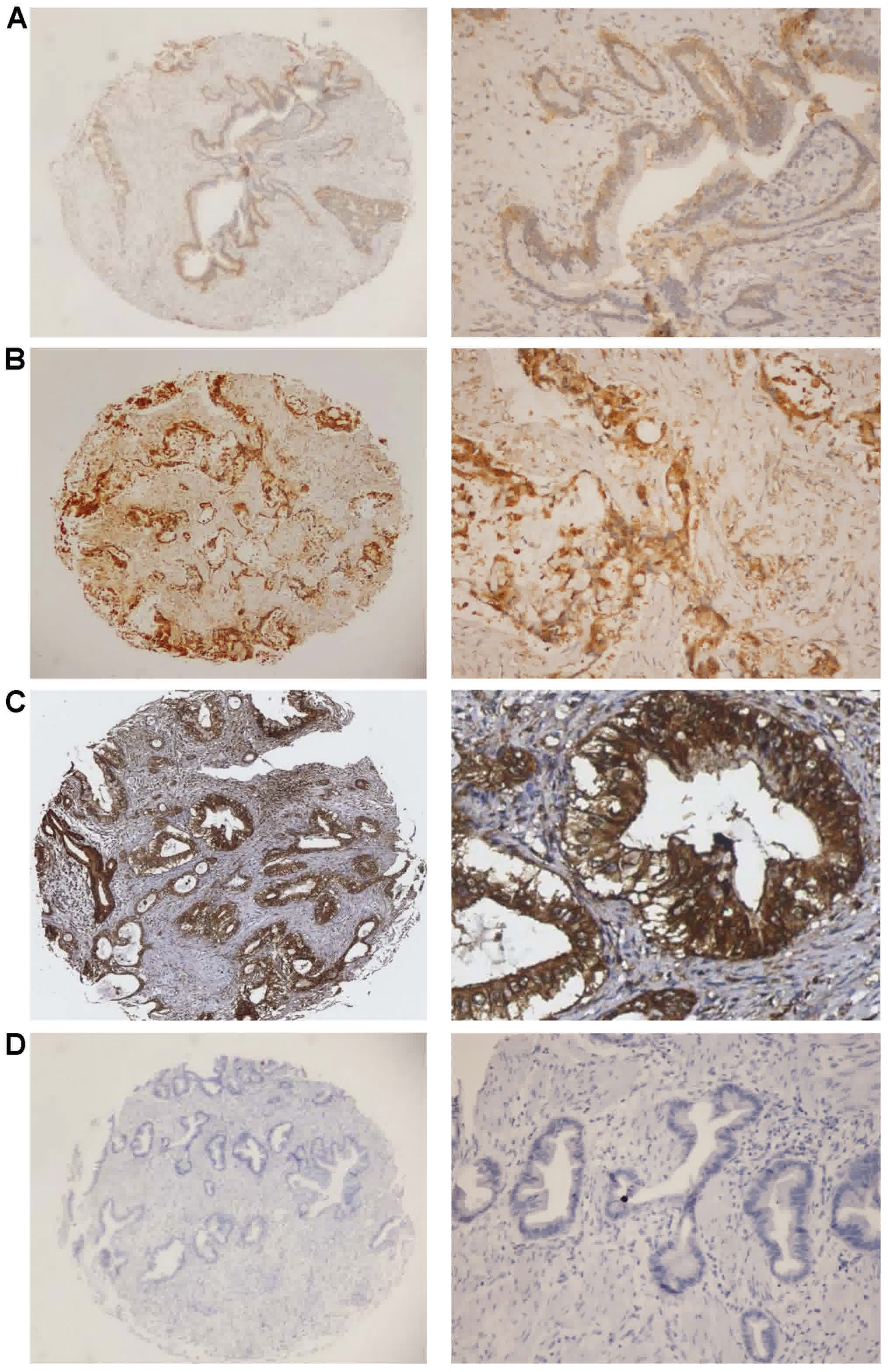
Representative images of PPA1 immunostaining in
human ICC and paired adjacent non-neoplastic tissues are presented
in Fig. 1. No staining or weak
staining of PPA1 (21.7%; 5/23) was observed in the cytoplasm of
cholangiocytes of normal bile ducts and benign diseases (Fig. 1A). In tumor cells, however, strong
PPA1-positive staining was preferentially localized to the
cytoplasm. Positive expression of PPA1 was observed in 46/93
(49.5%) of the primary ICC tissues (Fig.
1B-D).
Correlation between PPA1 expression
and clinicopathological parameters in ICC
A statistically significant correlation was observed
between PPA1 expression and age, tumor size, positive margin and
histology (Table I). Of the 24
patients aged >60 years, 17 (70.8%) exhibited positive PPA1
expression, while only 29/69 (42.0%) patients aged ≤60 years
exhibited positive PPA1 expression (P=0.015). Of the 59 patients
with a tumor size >3 cm, 37 (62.7%) presented with PPA1
expression, while only 9 (26.5%) of 34 cases with a tumor size ≤3
cm presented with PPA1 expression (P=0.001). Of the 58 cases with
negative tumor margins, 22 (37.9%) exhibited positive PPA1
expression while 24 (68.6%) of the 35 cases with positive tumor
margins exhibited positive PPA1 expression. Of the 16 patients with
poorly-differentiated tumors, 14 (87.5%) exhibited positive PPA1
expression; whereas of the 77 patients with well-differentiated to
moderately-differentiated tumors, only 32 (41.6%) exhibited
positive PPA1 expression (P=0.001).
Furthermore, it was also revealed that
overexpression of PPA1 was correlated with advanced tumor (T), node
(N), and Tumor-Node-Metastasis (TNM) stages according to the 8th
edition AJCC staging manual (28).
Positive PPA1 expression was observed more frequently in large ICC
tumors (invasion level T3-T4) (66.1%) than in small ICC tumors
(invasion level T1-T2; 16.1%; P<0.001), and more frequently in
cases with regional lymph node metastasis (64.7%) than in N0-stage
tumors (31.0%; P=0.001). With regards to the TNM stage,
overexpression of PPA1 was significantly associated with advanced
disease stages: 31% at stage I/II and 64.7% at stage III/IV
(P=0.001).
PPA1 expression is associated with
decreased overall survival (OS) in patients with ICC
The median cumulative overall survival in patients
with resected ICC was 33 months. Kaplan-Meier analyses revealed
that the ICC patients with positive PPA1 expression had a poor
prognosis compared with those with negative PPA1 expression
(P<0.001; Fig. 2A). Furthermore,
subgroup analysis of PPA1 expression according to TNM stage was
performed. The outcome of patients with PPA1-positive expression
was worse in those with stage I/II disease than in those without
PPA1 expression with stage I/II disease (51.6 vs. 30.5 months;
P=0.009; Fig. 2B). In patients with
stage III/IV disease, patients with PPA1-positive expression tended
to have a worse outcome than those without PPA1 expression, but
this difference was no statistically significant (30.2 vs. 20.8
months; P=0.138; Fig. 2C).
Additionally, univariate analysis revealed that all other factors
were significantly associated with patient overall survival
(Table II), including gender
(P<0.001), tumor size (P=0.008), positive tumor margins
(P<0.001), T stage (P<0.001), regional lymph node metastasis
(P<0.001), TNM stage (P<0.001) and differentiation
(P<0.001). Subsequent multivariate analysis using the Cox
proportional hazards model demonstrated that T stage was an
independent prognostic indicator of OS in patients with ICC
(Table II).
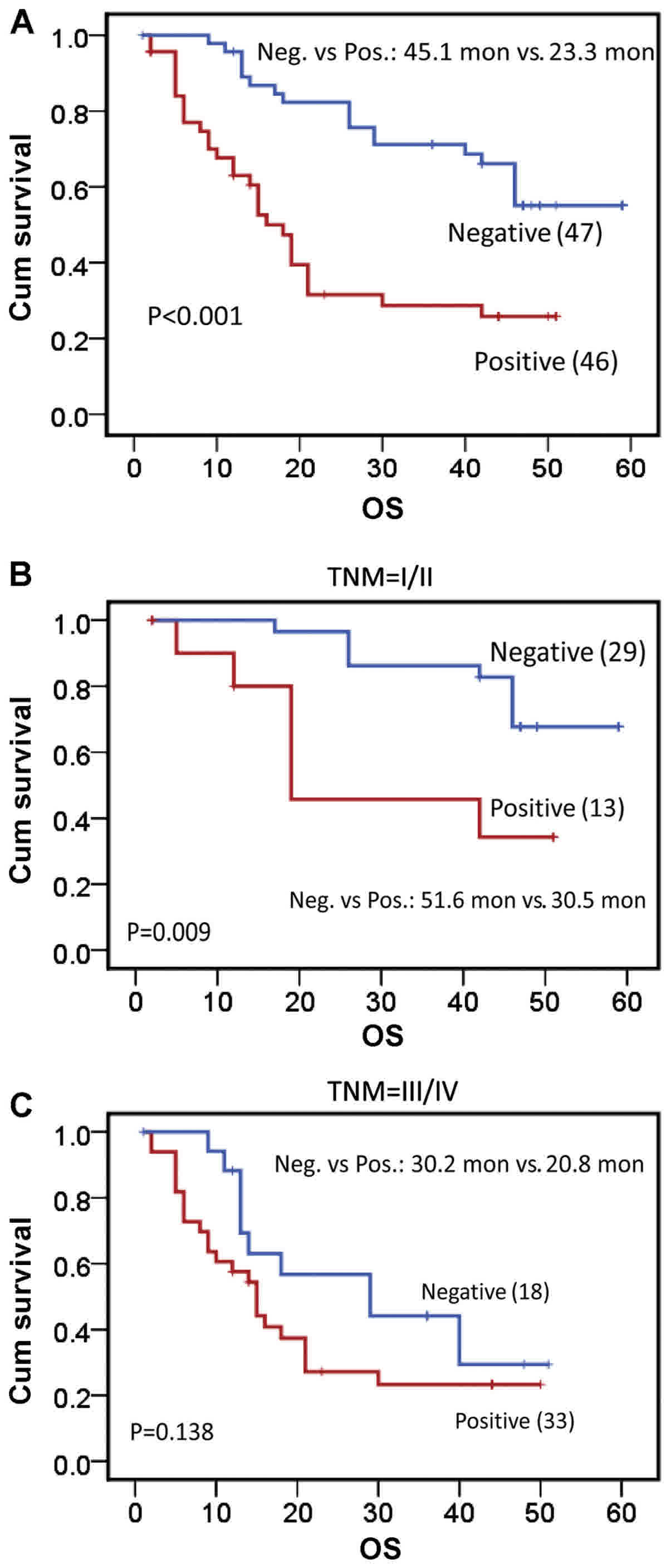 | Figure 2.Kaplan-Meier analysis of the OS in
patients with ICC according to the expression of PPA1. (A) OS were
significantly shorter in patients with positive PPA1 expression
(median survival, 23.3 months) than in those with negative PPA1
(median survival, 45.1 months; P<0.001). (B) OS were
significantly shorter in patients exhibiting stage I/II disease
with positive PPA1 expression (median survival, 30.5 months) than
in those with negativePPA1 expression (median survival, 51.6
months; P=0.009). (C) OS were shorter in patients exhibiting stage
III/IV disease with positive PPA1 expression (median survival, 20.8
months) than in thosewith negative PPA1 expression, but with no
statistical significance (median survival, 30.2 months; P=0.138).
OS, overall survival; ICC, intrahepatic cholangiocarcinoma; PPA1,
inorganic pyrophosphatase; TNM, Tumor-Node-Metastasis. |
| Table II.Univariate and multivariate analysis
of variables associated with overall survival in patients with
intrahepatic cholangiocarcinoma. |
Table II.
Univariate and multivariate analysis
of variables associated with overall survival in patients with
intrahepatic cholangiocarcinoma.
|
|
|
| P-value |
|
|
|---|
|
|
|
|
|
|
|
|---|
| Variable | n | Mean survival,
months | Univariate | Multivariate | Hazard ratio | 95% CI |
|---|
| Sex |
|
|
|
|
|
|
|
Male | 39 | 25.8 | <0.001 |
|
|
|
|
Female | 54 | 42.0 |
|
|
|
|
| Tumor size, cm |
|
|
|
|
|
|
| ≤3 | 34 | 42.5 | 0.008 |
|
|
|
|
>3 | 59 | 29.0 |
|
|
|
|
| Positive
margin |
|
|
|
|
|
|
| No | 58 | 43.2 | <0.001 |
|
|
|
|
Yes | 35 | 21.8 |
|
|
|
|
| T stage |
|
|
|
|
|
|
|
T1/T2 | 31 | 53.2 | <0.001 | 0.01 | 0.240 | 0.080–0.715 |
|
T3/T4 | 62 | 24.9 |
|
|
|
|
| Regional lymph
nodes positive |
|
|
|
|
|
|
| No | 42 | 47.2 | <0.001 | 0.055 | 0.477 | 0.224–1.017 |
|
Yes | 51 | 24.3 |
|
|
|
|
| TNM stage |
|
|
|
|
|
|
|
I/II | 42 | 47.2 | <0.001 | 0.055 | 0.477 | 0.224–1.017 |
|
III/IV | 51 | 24.3 |
|
|
|
|
| PPA1 |
|
|
|
|
|
|
|
Negative | 47 | 45.1 | <0.001 |
|
|
|
|
Positive | 46 | 23.3 |
|
|
|
|
|
Differentiation |
|
|
|
|
|
|
|
Well/moderately | 77 | 39.0 | <0.001 |
|
|
|
|
Poorly/undifferentiated | 16 | 17.7 |
|
|
|
|
PPA1 expression is associated with
recurrence in patients with ICC
Among the 93 patients with ICC, 90 experienced
recurrence following resection. Patients with PPA1-positive tumors
exhibited higher chanceto recurrence compared with those with
PPA1-negative tumors (P<0.001; Fig.
3A). Furthermore, in patients with stage I/II disease,
Kaplan-Meier survival analyses according to TNM stage revealed that
those with PPA1-negative tumors exhibited a significantly longer
disease-free survival (DFS) than those with PPA1-positive tumors
(50.2 vs. 26.7 months; P=0.008; Fig.
3B). However, this difference was not statistically significant
in patients with stage III/IV disease (PPA1-negative vs.
PPA1-positive: 27.5 vs. 19.6 months; P=0.184; Fig. 3C). In addition, the univariate
analysis revealed that age (P=0.011), sex (P=0.005), tumor size
(P=0.003), positive margin (P<0.001), T stage (P<0.001),
lymph node metastasis (P<0.001), disease stage (P<0.001) and
differentiation (P<0.001) were significant predictors of tumor
recurrence (Table III).
Multivariate analysis using the Cox proportional hazards model
demonstrated that PPA1 expression, T stage and differentiation were
independent predictors of tumor recurrence (Table III).
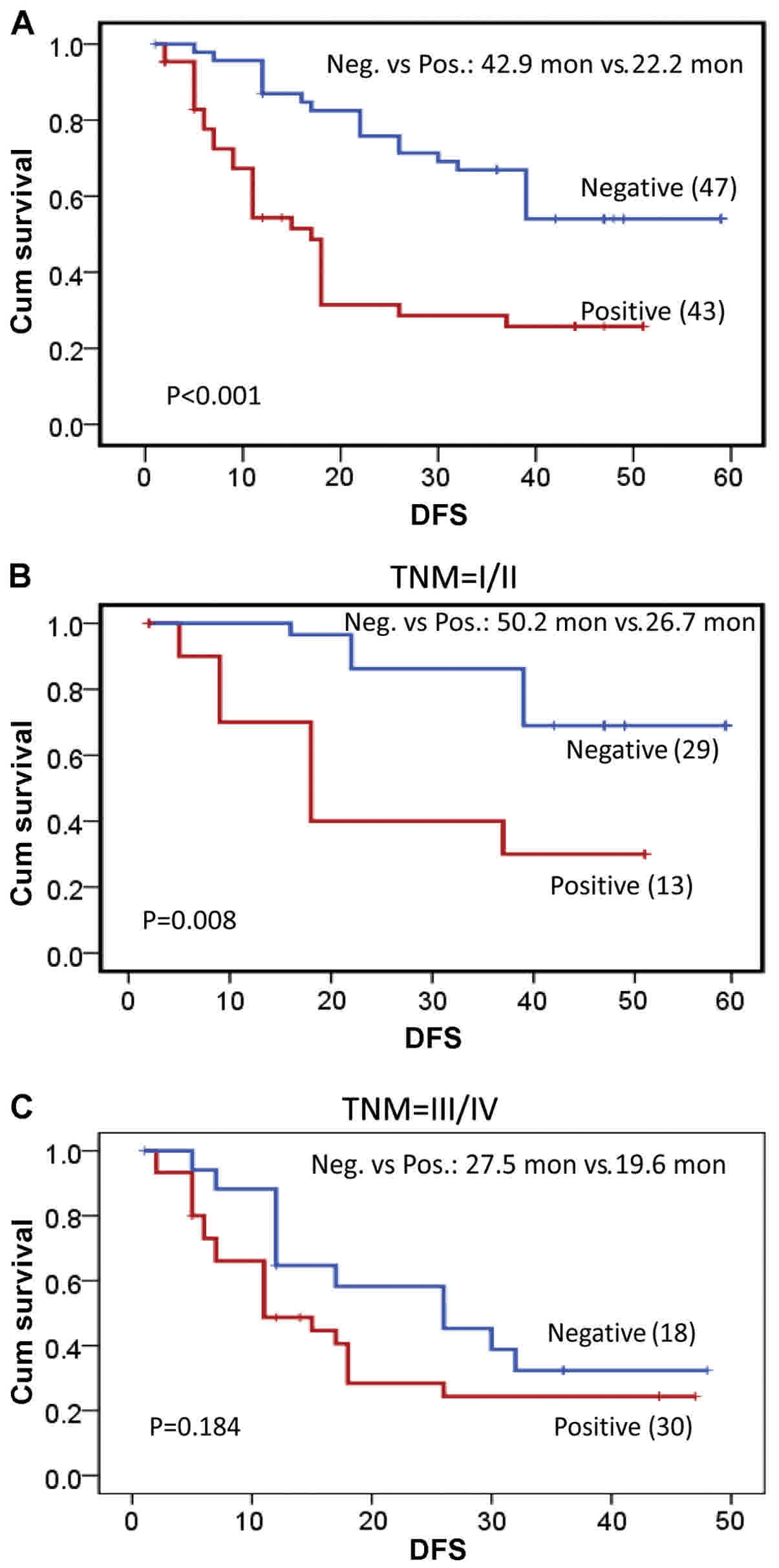 | Figure 3.Kaplan-Meier of DFS in patients with
ICC according to the expression of PPA1. (A) DFS were significantly
shorter in patients with positive PPA1 (median survival, 22.2
months) than in those with negative PPA1 expression (median
survival, 42.9 months; P<0.001). (B) DFS were significantly
shorter in patients exhibiting stage I/II disease with positive
PPA1 expression (median survival, 26.7 months) than in those with
negative PPA1 expression (median survival, 50.2 months; P=0.008).
(C) DFS were shorter in patients exhibiting III/IV stage disease
with positive PPA1 expression (median survival, 19.6 months) than
in those with negative PPA1 expression, but with no statistical
significance (median survival, 27.5 months; P=0.184). DFS,
disease-free survival; ICC, intrahepatic cholangiocarcinoma; PPA1,
inorganic pyrophosphatase; TNM, Tumor-Node-Metastasis. |
| Table III.Univariate and multivariate analysis
of variables associated with recurrence in patients with
intrahepatic cholangiocarcinoma. |
Table III.
Univariate and multivariate analysis
of variables associated with recurrence in patients with
intrahepatic cholangiocarcinoma.
|
|
|
| P-value |
|
|
|---|
|
|
|
|
|
|
|
|---|
| Variable | no. | Mean survival,
months | Univariate | Multivariate | Hazard ratio | 95% CI |
|---|
| Age, years |
|
|
|
|
|
|
|
≤60 | 66 | 38.2 | 0.011 |
|
|
|
|
>60 | 24 | 25.6 |
|
|
|
|
| Sex |
|
|
|
|
|
|
|
Male | 36 | 25.1 | 0.005 |
|
|
|
|
Female | 54 | 39.8 |
|
|
|
|
| Tumor size, cm |
|
|
|
|
|
|
| ≤3 | 31 | 44.2 | 0.003 |
|
|
|
|
>3 | 59 | 26.8 |
|
|
|
|
| Positive
margin |
|
|
|
|
|
|
| No | 58 | 42.0 | <0.001 |
|
|
|
|
Yes | 32 | 19.2 |
|
|
|
|
| T stage |
|
|
|
|
|
|
|
T1/T2 | 31 | 52.5 | <0.001 | 0.004 | 0.208 | 0.072–0.601 |
|
T3/T4 | 59 | 23.2 |
|
|
|
|
| Regional lymph
nodes positive |
|
|
|
|
|
|
| No | 42 | 44.8 | <0.001 |
|
|
|
|
Yes | 48 | 22.7 |
|
|
|
|
| TNM stage |
|
|
|
|
|
|
|
I/II | 42 | 44.8 | <0.001 |
|
|
|
|
III/IV | 48 | 22.7 |
|
|
|
|
| PPA1 |
|
|
|
|
|
|
|
Negative | 47 | 42.9 | <0.001 | <0.001 | 0.302 | 0.112–0.651 |
|
Positive | 43 | 22.2 |
|
|
|
|
|
Differentiation |
|
|
|
|
|
|
|
Well/moderately | 74 | 38.7 | <0.001 | 0.006 | 0.313 | 0.137–0.711 |
|
Poor/undifferentiated | 16 | 14.7 |
|
|
|
|
Discussion
The expression profile of the PPA1 gene has been
investigated in lung adenocarcinoma, breast cancer, hepatocellular
carcinoma, primary colorectal cancer and gastric cancer, and the
PPA1 protein has been revealed to be overexpressed in these types
of cancer (20–24,29). Given
that ICC has a high mortality rate worldwide and that early tumor
invasion, wide metastases and recurrence result in a poor prognosis
for patients with this disease (2),
the present study aimed to investigate the potential role of PPA1
in ICC. It was revealed that PPA1 was highly overexpressed in ICC
specimens compared with expression in adjacent non-neoplastic
tissues and benign disease tissues, and overexpression of PPA1 was
significantly correlated with malignant behaviors of ICC including
tumor size, tumor margins, T stage, lymph node metastasis,
differentiation and TNM stage. Additionally, patients with
PPA1-overexpression exhibited poorer OS rates and higher rates of
recurrence than patients with low PPA1 expression. Therefore, to
the best of our knowledge, these data serve as the first evidence
that PPA1 may serve an important role in ICC development and
progression.
A number of previous studies have examined
clinicopathological prognostic factors for ICC following surgical
resection, including sex, age at diagnosis, tumor size, tumor
margins, depth of tumor invasion, differentiation, lymph node
metastasis and TNM stage (30–33).
Furthermore, it was well-known that lymph node metastases, TNM
stage and tumor margins are important indicators for predicting
tumor recurrence and OS (31,33). In the present study, it was revealed
that age, sex, tumor size, tumor margins, T stage, lymph node
metastasis, differentiation, TNM stage and PPA1 expression levels
were predictors of survival in a group of Chinese patients with
ICC. Additionally, T stage was revealed to be an independent
predictor of OS. Additionally, tumor recurrence, T stage, PPA1 and
differentiation may predict future recurrence independently.
Notably, only in the relatively early disease stages, patients with
positive PPA1 expression experienced significantly shorter OS and
higher recurrence rates than those with negative PPA1 expression,
indicating that early detection may be an effective way to prolong
the outcome of patients with ICC.
It is known that poorly-differentiated tumors
proliferate and metastasize more frequently than
well-differentiated tumors. In the present study, PPA1 was
expressed more frequently in poorly-differentiated tumors than in
well/moderately-differentiated tumors. In addition, positive PPA1
expression was observed more frequently at late stages than at
early stages of the disease, suggesting that PPA1 may serve an
important role in promoting the growth and development of ICC.
However, there are several limitations to the present study. To
begin with, the number of ICC samples was small. Additionally, the
underlying molecular mechanisms of PPA1 in ICC progression and
prognosis were not thoroughly investigated. However, it may be
concluded that PPA1 may serve an important role in ICC by
regulating energy metabolism and signaling pathways (34,35).
In summary, the present study demonstrated that PPA1
was overexpressed in human ICC and that the level of PPA1
expression may be associated with adverse clinical outcomes in
patients with ICC. Furthermore, overexpression of PPA1 was a
promising prognostic and predictive factor in Chinese patients with
ICC. These observations support PPA1 as an indicator of a worse
outcome for patients with ICC and as a potential biomarker in
predicting the outcome of patients.
Acknowledgements
The authors would like to thank Professor Wenlong Yu
from Eastern Hepatobiliary Hospital and and Dr Ying Chen from
Changhai Hospital for providing the tumor specimens. The present
study was supported in part by the Shanghai Pujiang Program (grant
no. 13PJD002), the National Natural Science Foundation of China
(grant no. 81572856) and the International S&T Cooperation
Program of China (grant no. 2014DFA33010).
Competing interests
The authors declare that they have no competing
interests.
References
|
1
|
Razumilava N and Gores GJ:
Cholangiocarcinoma. Lancet. 383:2168–2179. 2014. View Article : Google Scholar : PubMed/NCBI
|
|
2
|
Nehls O, Gregor M and Klump B: Serum and
bile markers for cholangiocarcinoma. Semin Liver Dis. 24:139–154.
2004. View Article : Google Scholar : PubMed/NCBI
|
|
3
|
Patel T: Increasing incidence and
mortality of primary intrahepatic cholangiocarcinoma in the United
States. Hepatology. 33:1353–1357. 2001. View Article : Google Scholar : PubMed/NCBI
|
|
4
|
Patel T: Worldwide trends in mortality
from biliary tract malignancies. BMC Cancer. 2:102002. View Article : Google Scholar : PubMed/NCBI
|
|
5
|
Poultsides GA, Zhu AX, Choti MA and Pawlik
TM: Intrahepatic cholangiocarcinoma. Surg Clin North Am.
90:817–837. 2010. View Article : Google Scholar : PubMed/NCBI
|
|
6
|
Cardinale V, Carpino G, Reid L, Gaudio E
and Alvaro D: Multiple cells of origin in cholangiocarcinoma
underlie biological, epidemiological and clinical heterogeneity.
World J Gastrointest Oncol. 4:94–102. 2012. View Article : Google Scholar : PubMed/NCBI
|
|
7
|
Harrison LE, Fong Y, Klimstra DS, Zee SY
and Blumgart LH: Surgical treatment of 32 patients with peripheral
intrahepatic cholangiocarcinoma. Br J Surg. 85:1068–1070. 1998.
View Article : Google Scholar : PubMed/NCBI
|
|
8
|
Yamamoto M, Takasaki K, Yoshikawa T, Ueno
K and Nakano M: Does gross appearance indicate prognosis in
intrahepatic cholangiocarcinoma? J Surg Oncol. 69:162–167. 1998.
View Article : Google Scholar : PubMed/NCBI
|
|
9
|
Nakagohri T, Kinoshita T, Konishi M,
Takahashi S and Gotohda N: Surgical outcome and prognostic factors
in intrahepatic cholangiocarcinoma. World J Surg. 32:2675–2680.
2008. View Article : Google Scholar : PubMed/NCBI
|
|
10
|
El-Serag HB, Engels EA, Landgren O, Chiao
E, Henderson L, Amaratunge HC and Giordano TP: Risk of
hepatobiliary and pancreatic cancers after hepatitis C virus
infection: A population-based study of U.S. veterans. Hepatology.
49:116–123. 2009. View Article : Google Scholar : PubMed/NCBI
|
|
11
|
Welzel TM, Graubard BI, El-Serag HB, Shaib
YH, Hsing AW, Davila JA and McGlynn KA: Risk factors for
intrahepatic and extrahepatic cholangiocarcinoma in the United
States: A population-based case-control study. Clin Gastroenterol
Hepatol. 5:1221–1228. 2007. View Article : Google Scholar : PubMed/NCBI
|
|
12
|
Zhang F, Li L, Yang X, Wang B, Zhao J, Lu
S and Yu X: Expression and activation of EGFR and STAT3 during the
multistage carcinogenesis of intrahepatic cholangiocarcinoma
induced by 3′-methyl-4 dimethylaminoazobenzene in rats. J Toxicol
Pathol. 28:79–87. 2015. View Article : Google Scholar : PubMed/NCBI
|
|
13
|
Chen Y, Ma L, He Q, Zhang S, Zhang C and
Jia W: TGF-β1 expression is associated with invasion and metastasis
of intrahepatic cholangiocarcinoma. Biol Res. 48:262015. View Article : Google Scholar : PubMed/NCBI
|
|
14
|
Tian X, Wang Q, Li Y, Hu J, Wu L, Ding Q
and Zhang C: The expression of S100A4 protein in human intrahepatic
cholangiocarcinoma: Clinicopathologic significance and prognostic
value. Pathol Oncol Res. 21:195–201. 2015. View Article : Google Scholar : PubMed/NCBI
|
|
15
|
Baykov AA, Cooperman BS, Goldman A and
Lahti R: Cytoplasmic inorganic pyrophosphatase. Prog Mol Subcell
Biol. 23:127–150. 1999. View Article : Google Scholar : PubMed/NCBI
|
|
16
|
Islam MK, Miyoshi T, Yamada M and Tsuji N:
Pyrophosphatase of the roundworm Ascaris suum plays an essential
role in the worm's molting and development. Infect Immun.
73:1995–2004. 2005. View Article : Google Scholar : PubMed/NCBI
|
|
17
|
Chen J, Brevet A, Fromant M, Lévêque F,
Schmitter JM, Blanquet S and Plateau P: Pyrophosphatase is
essential for growth of Escherichia coli. J Bacteriol.
172:5686–5689. 1990. View Article : Google Scholar : PubMed/NCBI
|
|
18
|
Kharbhih WJ and Sharma R: Age-dependent
increased expression and activity of inorganic pyrophosphatase in
the liver of male mice and its further enhancement with short- and
long-term dietary restriction. Biogerontology. 15:81–86. 2014.
View Article : Google Scholar : PubMed/NCBI
|
|
19
|
Panda H, Pandey RS, Debata PR and Supakar
PC: Age-dependent differential expression and activity of rat liver
cytosolic inorganic pyrophosphatase gene. Biogerontology.
8:517–525. 2007. View Article : Google Scholar : PubMed/NCBI
|
|
20
|
Chen G, Gharib TG, Huang CC, Thomas DG,
Shedden KA, Taylor JM, Kardia SL, Misek DE, Giordano TJ, Iannettoni
MD, et al: Proteomic analysis of lung adenocarcinoma:
Identification of a highly expressed set of proteins in tumors.
Clin Cancer Res. 8:2298–2305. 2002.PubMed/NCBI
|
|
21
|
Hamler RL, Zhu K, Buchanan NS, Kreunin P,
Kachman MT, Miller FR and Lubman DM: A two-dimensional liquid-phase
separation method coupled with mass spectrometry for proteomic
studies of breast cancer and biomarker identification. Proteomics.
4:562–577. 2004. View Article : Google Scholar : PubMed/NCBI
|
|
22
|
Chahed K, Kabbage M, Ehret-Sabatier L,
Lemaitre-Guillier C, Remadi S, Hoebeke J and Chouchane L:
Expression of fibrinogen E-fragment and fibrin E-fragment is
inhibited in the human infiltrating ductal carcinoma of the breast:
The two-dimensional electrophoresis and MALDI-TOF-mass spectrometry
analyses. Int J Oncol. 27:1425–1431. 2005.PubMed/NCBI
|
|
23
|
Megger DA, Bracht T, Kohl M, Ahrens M,
Naboulsi W, Weber F, Hoffmann AC, Stephan C, Kuhlmann K, Eisenacher
M, et al: Proteomic differences between hepatocellular carcinoma
and nontumorous liver tissue investigated by a combined gel-based
and label-free quantitative proteomics study. Mol Cell Proteomics.
12:2006–2020. 2013. View Article : Google Scholar : PubMed/NCBI
|
|
24
|
Tomonaga T, Matsushita K, Yamaguchi S,
Oh-Ishi M, Kodera Y, Maeda T, Shimada H, Ochiai T and Nomura F:
Identification of altered protein expression and post-translational
modifications in primary colorectal cancer by using agarose
two-dimensional gel electrophoresis. Clin Cancer Res. 10:2007–2014.
2004. View Article : Google Scholar : PubMed/NCBI
|
|
25
|
Yu WL, Cong WM, Zhang Y, Chen Y, Wang F
and Yu G: Overexpression of ATA1/SLC38A1 predicts future recurrence
and death in Chinese patients with hilar cholangiocarcinoma. J Surg
Res. 171:663–668. 2011. View Article : Google Scholar : PubMed/NCBI
|
|
26
|
Chen Y, Cha Z, Fang W, Qian B, Yu W, Li W,
Yu G and Gao Y: The prognostic potential and oncogenic effects of
PRR11 expression in hilar cholangiocarcinoma. Oncotarget.
6:20419–20433. 2015.PubMed/NCBI
|
|
27
|
Yu G, Yu W, Jin G, Xu D, Chen Y, Xia T, Yu
A, Fang W, Zhang X, Li Z and Xie K: PKM2 regulates neural invasion
of and predicts poor prognosis for human hilar cholangiocarcinoma.
Mol Cancer. 14:1932015. View Article : Google Scholar : PubMed/NCBI
|
|
28
|
Kim Y, Moris DP, Zhang XF, Bagante F,
Spolverato G, Schmidt C, Dilhoff M and Pawlik TM: Evaluation of the
8th edition American joint commission on cancer (AJCC) staging
system for patients with intrahepatic cholangiocarcinoma: A
surveillance, epidemiology, and end results (SEER) analysis. J Surg
Oncol. 116:643–650. 2017. View Article : Google Scholar : PubMed/NCBI
|
|
29
|
Jeong SH, Ko GH, Cho YH, Lee YJ, Cho BI,
Ha WS, Choi SK, Kim JW, Lee CW, Heo YS, et al: Pyrophosphatase
overexpression is associated with cell migration, invasion, and
poor prognosis in gastric cancer. Tumour Biol. 33:1889–1898. 2012.
View Article : Google Scholar : PubMed/NCBI
|
|
30
|
Sempoux C, Jibara G, Ward SC, Fan C, Qin
L, Roayaie S, Fiel MI, Schwartz M and Thung SN: Intrahepatic
cholangiocarcinoma: New insights in pathology. Semin Liver Dis.
31:49–60. 2011. View Article : Google Scholar : PubMed/NCBI
|
|
31
|
Hyder O, Marques H, Pulitano C, Marsh JW,
Alexandrescu S, Bauer TW, Gamblin TC, Sotiropoulos GC, Paul A,
Barroso E, et al: A nomogram to predict long-term survival after
resection for intrahepatic cholangiocarcinoma: An Eastern and
Western experience. JAMA Surg. 149:432–438. 2014. View Article : Google Scholar : PubMed/NCBI
|
|
32
|
Ribero D, Pinna AD, Guglielmi A, Ponti A,
Nuzzo G, Giulini SM, Aldrighetti L, Calise F, Gerunda GE, Tomatis
M, et al: Surgical approach for long-term survival of patients with
intrahepatic cholangiocarcinoma: A multi-institutional analysis of
434 patients. Arch Surg. 147:1107–1113. 2012. View Article : Google Scholar : PubMed/NCBI
|
|
33
|
Li YY, Li H, Lv P, Liu G, Li XR, Tian BN
and Chen DJ: Prognostic value of cirrhosis for intrahepatic
cholangiocarcinoma after surgical treatment. J Gastrointest Surg.
15:608–613. 2011. View Article : Google Scholar : PubMed/NCBI
|
|
34
|
Mishra DR, Chaudhary S, Krishna BM and
Mishra SK: Identification of critical elements for regulation of
inorganic pyrophosphatase (PPA1) in MCF7 breast cancer cells. PLoS
One. 10:e01248642015. View Article : Google Scholar : PubMed/NCBI
|
|
35
|
Thoma I, Loeffler C, Sinha AK, Gupta M,
Krischke M, Steffan B, Roitsch T and Mueller MJ: Cyclopentenone
isoprostanes induced by reactive oxygen species trigger defense
gene activation and phytoalexin accumulation in plants. Plant J.
34:363–375. 2003. View Article : Google Scholar : PubMed/NCBI
|