Introduction
The density-regulated re-initiation and release
factor (DENR) gene has been mapped to the 12q24 region of
chromosome 12 in humans (1).
DENR encodes a 198 amino acid protein. Deyo et al
(1) identified that DENR
encodes a novel protein, the expression of which is upregulated in
cells cultured at high density, in comparison with those grown at
low density. Cell-cell contact is similarly important to immune
system function and malignant tumour metastasis (2,3). Certain
studies have suggested that alterations in cell density lead to
changes in the biology of a cell, including modulated expression of
differentiation properties of LLC-PK1 cells (4) and gene transcriptional activity,
including MYC proto-oncogene, BHLH transcription factor
(5). One potential initiating
mechanism for DENR increase is cell contact itself. Reinert
et al (6) revealed novel
actions of MCT1, the monocarboxylate transporter 1 gene
located at chromosome Xq22-24 (7),
whose protein product is comprised of an SUI1 domain involving the
translation initiation factor, eukaryotic initiation factor 2
(eIF2) (8). Reinert et al
(6) identified that MCT1 is a
cap-binding protein that recruits and interacts with DENR and
subsequently, modifies the mRNA translational profile. Using a
yeast two-hybrid method, MCT1 was demonstrated to interact with
DENR involving the SUI1 domain, which may play a role in the
pathogenesis of human breast carcinoma (6–9). Skabkin
et al (10) studied the
interactions of Ligatin and MCT-1/DENR and identified related
proteins that singly (Ligatin) or jointly (MCT-1 and DENR) elevate
efficient eIF2-independent recruitment of Met-tRNA to 40S/mRNA
complexes, and demonstrated that MCT-1/DENR could elevate the
release of mRNA. A report by Schleich et al (11) suggested that DENR affects the
translation of mRNAs involved in cell proliferation. Recently, a
study identified that DENR was highly associated with glioma
susceptibility (12). Although, to
the best of our knowledge, the specific role of DENR has not
been elucidated in humans, these studies suggest an important role
in cancer. However, a comprehensive analysis of DENR
expression and its relation to the survival of cancer patients is
lacking.
The current study evaluated the expression of
DENR in normal and cancerous tissues in humans. In addition,
the current study analysed the significance of DENR in
cancer prognosis using publicly available datasets of gene
expression coupled with clinical outcomes.
Materials and methods
Data collection
The expression status of DENR in human
healthy and tumour tissues was studied using the GEO dataset
(http://www.ncbi.nlm.nih.gov/geo/), which
included microarray-based experiments measuring mRNA expression.
The primary filtering criteria were set to ‘Cancer vs. Normal
Analysis’ and ‘Differential Analysis’, and the raw data. (CEL
format) of each dataset were obtained online. The following dataset
were included in the present study: GSE15852 (13); GSE8671 (14); GSE13911 (15); GSE10072 (16); GSE6344 (17); GSE14520 (18); GSE15471 (19); GSE9844 (20) and GSE5563 (21). A standard data normalisation process
was used for all datasets. The platform filtering criterion was set
to ‘Affymetrix U133’ to minimise platform variation when detecting
differences in DENR expression between cancer types. The
Affymetrix U133 platform includes three types of arrays: Human
Genome U133A 2.0, Human Genome U133A&B and Human Genome U133
Plus 2.0 array. These arrays differed by the number of probe sets
on the chip, but all included DENR. The association between
DENR expression and clinicopathological features was
analysed, and the relationship between DENR and survival was
calculated using the GEO dataset and the TCGA (https://cancergenome.nih.gov/). The following
clinicopathological features and survival dataset were included in
the present study: GSE15459 (22);
GSE30219 (23); GSE27020 (24); and breast, kidney, rectal, pancreatic
cancer primary data from TCGA (25).
Finally, the expression profiles and clinical information for 3,389
tissue samples from nine common cancer types were downloaded,
including breast, tongue, gastric, colorectal, lung, renal,
pancreatic and vulvar cancers and hepatocellular carcinoma.
Data pre-processing and
representation
Samples were defined as either carcinoma or normal.
Datasets from the nine cancer types were normalised by the RMA
algorithm (26) using R statistical
3.1 software (https://www.r-project.org/). Expression values of
DENR were dichotomised into low- and high-expression groups
using the median as a cut-off value.
Data analysis
Data were analysed using R statistical 3.1 software.
Paired or unpaired t-tests were used to analyse expression
differences between carcinoma and normal groups. Associations
between gene expression and clinicopathological characteristics
were evaluated by Chi-square test. Overall survival and
recurrence-free survival were evaluated by Kaplan-Meier analysis
and a log-rank test. GSEA was used to predict the gene sets
modulated by DENR. Expression differences were analysed
between normal and carcinoma tissues by paired or unpaired t-tests
with threshold values of P<0.05. P<0.05 was considered to
indicate a statistically significant difference. Bars indicate the
median and the interquartile range of the dataset analysis in the
present study.
Results
DENR upregulation in multiple
cancers
To examine DENR expression in human cancers
the tumour expression profiles were downloaded and normalised by
RMA. As demonstrated in Fig. 1,
DENR expression was significantly increased in the following
cancer tissues compared with normal tissues: Breast cancer (43
cancer tissues, 43 normal tissues; GSE15852;
P=1.591×10−05), colorectal cancer (32 cancer tissues, 32
normal tissues; GSE8671; P=9.991×10⁻¹³), gastric cancer
(31 cancer tissues, 31 normal tissues; GSE13911;
P=1.179×10−06), lung cancer (58 cancer tissues, 49
normal tissues; GSE10072; P=2.116×10⁻¹¹), renal cancer
(10 cancer tissues, 10 normal tissues; GSE6344; P=0.002771),
hepatocellular carcinoma (247 cancer tissues, 239 normal tissues;
GSE14520; P<2.2×10⁻¹⁶), pancreatic cancer (39 cancer
tissues, 39 normal tissues; GSE15471; P=2.249×10−05),
tongue cancer (26 cancer tissues, 12 normal tissues; GSE9844;
P=0.006865) and vulvar cancer (9 cancer tissues, 10 normal tissues;
GSE5563; P=3.844×10−07).
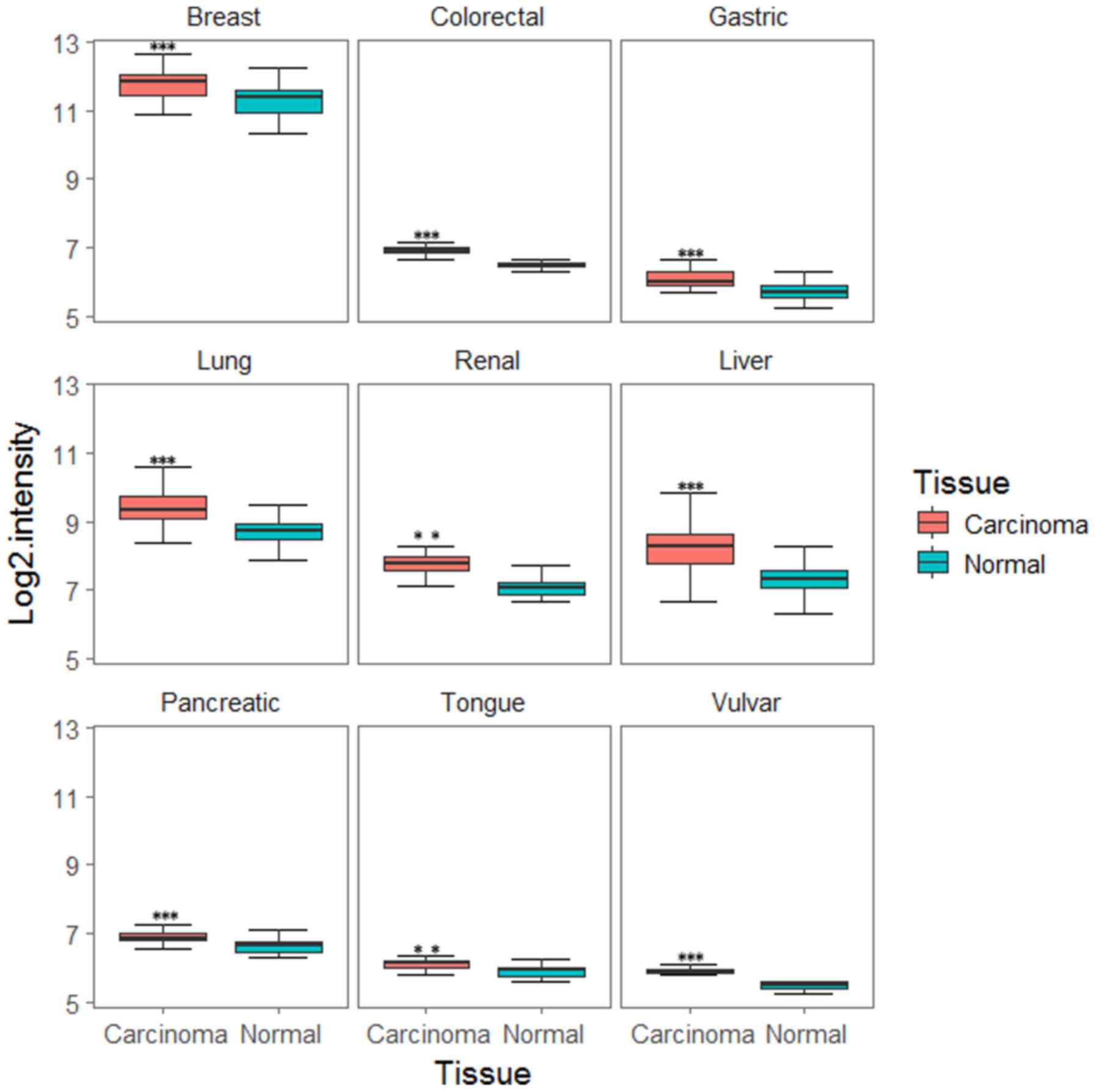 | Figure 1.Expression of DENR in multiple
cancer types. These data were extracted from the Gene Expression
Omnibus database. DENR was upregulated in breast, gastric,
colorectal, renal, lung, liver, pancreatic, tongue and vulvar
cancers. **P<0.01, ***P<0.001 vs. normal, by paired or
unpaired t-test. DENR, density-regulated re-initiation and
release factor. |
Associations between DENR expression
and clinicopathological features of patients with nine common
cancer types
The data summarised in Table I reveal significant associations
between DENR expression and clinicopathological features of
patients with multiple cancer types, including hepatocellular
carcinoma (primary data from GSE14520), gastric cancer (primary
data from GSE15459), lung cancer (primary data from GSE30219),
breast cancer (primary data from TCGA), kidney cancer (primary data
from TCGA), rectal cancer (primary data from TCGA) and pancreatic
cancer (primary data from TCGA). Associations between DENR
expression and clinicopathological features for head and neck
cancer (primary data from GSE9844) including, age, gender and lymph
node metastases were not significant. In addition, data involving
clinicopathological features for vulvar cancer in public databases
were not available.
 | Table I.Correlation between DENR
expression and clinicopathological features of patients with nine
common cancer types. |
Table I.
Correlation between DENR
expression and clinicopathological features of patients with nine
common cancer types.
|
|
|
| DENR
expression |
|
|
|---|
|
|
|
|
|
|
|
|---|
| Type of cancer | Characteristic | Case (n) | High (n) | Low (n) | χ2
value | P-value |
|---|
| Hepatocellular
carcinoma (primary data from GSE14520) | AFP
(ng/ml−1) |
|
|
|
|
|
|
|
>300 | 100 | 69 | 31 | 25.407 | <0.001 |
|
|
≤300 | 118 | 41 | 77 |
|
|
|
| AJCC TNM stage |
|
|
|
|
|
|
| I | 93 | 41 | 52 | 6.005 | 0.049 |
|
| II | 77 | 37 | 40 |
|
|
|
|
III | 39 | 32 | 17 |
|
|
|
| CLIP stage |
|
|
|
|
|
|
| 0 | 97 | 33 | 64 | 18.308 | <0.001 |
|
| 1 | 74 | 47 | 27 |
|
|
|
|
2–5 | 48 | 30 | 18 |
|
|
| Gastric cancer
(primary data from GSE15459) | Lauren
classification |
|
|
|
|
|
|
|
Diffuse | 75 | 29 | 46 | 6.348 | 0.041 |
|
|
Mixed | 99 | 57 | 42 |
|
|
|
|
Intestinal | 18 | 10 | 8 |
|
|
|
| Subtype |
|
|
|
|
|
|
|
Invasive | 51 | 28 | 23 | 55.099 | <0.001 |
|
|
Metabolic | 40 | 2 | 28 |
|
|
|
|
Unstable | 70 | 54 | 16 |
|
|
|
|
Proliferative | 31 | 12 | 19 |
|
|
| Lung cancer
(primary data from GSE30219) | AJCC T stage |
|
|
|
|
|
|
| I | 166 | 68 | 98 | 11.694 | 0.008 |
|
| II | 69 | 42 | 27 |
|
|
|
|
III | 31 | 20 | 11 |
|
|
|
| IV | 21 | 12 | 9 |
|
|
|
| Lymph node
metastasis |
|
|
|
|
|
|
|
Positive | 93 | 63 | 30 | 16.878 | <0.001 |
|
|
Negative | 208 | 83 | 115 |
|
|
| Breast invasive
carcinoma (primary data from TCGA) | Age/year |
|
|
|
|
|
|
|
≤65 | 759 | 357 | 402 | 8.461 | 0.004 |
|
|
>65 | 319 | 181 | 138 |
|
|
|
| AJCC T stage |
|
|
|
|
|
|
| T1 | 279 | 126 | 153 | 13.487 | 0.004 |
|
| T2 | 633 | 340 | 293 |
|
|
|
| T3 | 138 | 56 | 82 |
|
|
|
| T4 | 40 | 25 | 15 |
|
|
|
| AJCC N stage |
|
|
|
|
|
|
| N0 | 515 | 253 | 262 | 9.324 | 0.025 |
|
| N1 | 361 | 173 | 188 |
|
|
|
| N2 | 120 | 75 | 45 |
|
|
|
| N3 | 77 | 34 | 43 |
|
|
| Kidney chromophobe
carcinoma (primary data from TCGA) | AJCC TNM stage |
|
|
|
|
|
|
|
I–III | 60 | 27 | 33 | 6.600 | 0.010 |
|
| IV | 6 | 6 | 0 |
|
|
| Rectal
adenocarcinoma (primary data from TCGA) | AJCC T stage |
|
|
|
|
|
|
| T1 | 4 | 3 | 1 | 9.423 | 0.024 |
|
| T2 | 13 | 9 | 4 |
|
|
|
| T3 | 65 | 34 | 31 |
|
|
|
| T4 | 10 | 1 | 9 |
|
|
| Pancreatic
adenocarcinoma (primary data from TCGA) | Sex |
|
|
|
|
|
|
|
Male | 98 | 60 | 38 | 10.989 | <0.001 |
|
|
Female | 80 | 29 | 51 |
|
|
| Head and neck
carcinoma and vulvar carcinoma | Clinicopathological
feature data for head and neck cancer and vulvar cancer in public
databases were either non-significant or not available. |
The results presented in Table I demonstrate that increased
DENR expression was significantly associated with more
aggressive phenotypes. This was measured by the American Joint
Committee on Cancer (AJCC) classification of malignant tumours
including T, N, M and TNM stages (27). DENR expression was
significantly higher in advanced AJCC tumour stages than in early
tumour stages in multiple cancers including hepatocellular cancer,
lung cancer, breast cancer, kidney cancer and rectal cancer.
DENR expression was significantly elevated in lymph node
metastases compared to that in non-lymph node metastases in lung
cancer. High DENR expression was positively associated with
histological tumour subtype and Lauren classification (27) in gastric cancer. DENR
expression was significantly increased in high α-fetoprotein (AFP)
tumours compared with low AFP tumours in hepatocellular cancer.
Association of DENR expression with
survival outcome in gastric cancer, hepatocellular carcinoma, lung
cancer, kidney cancer and laryngeal cancer
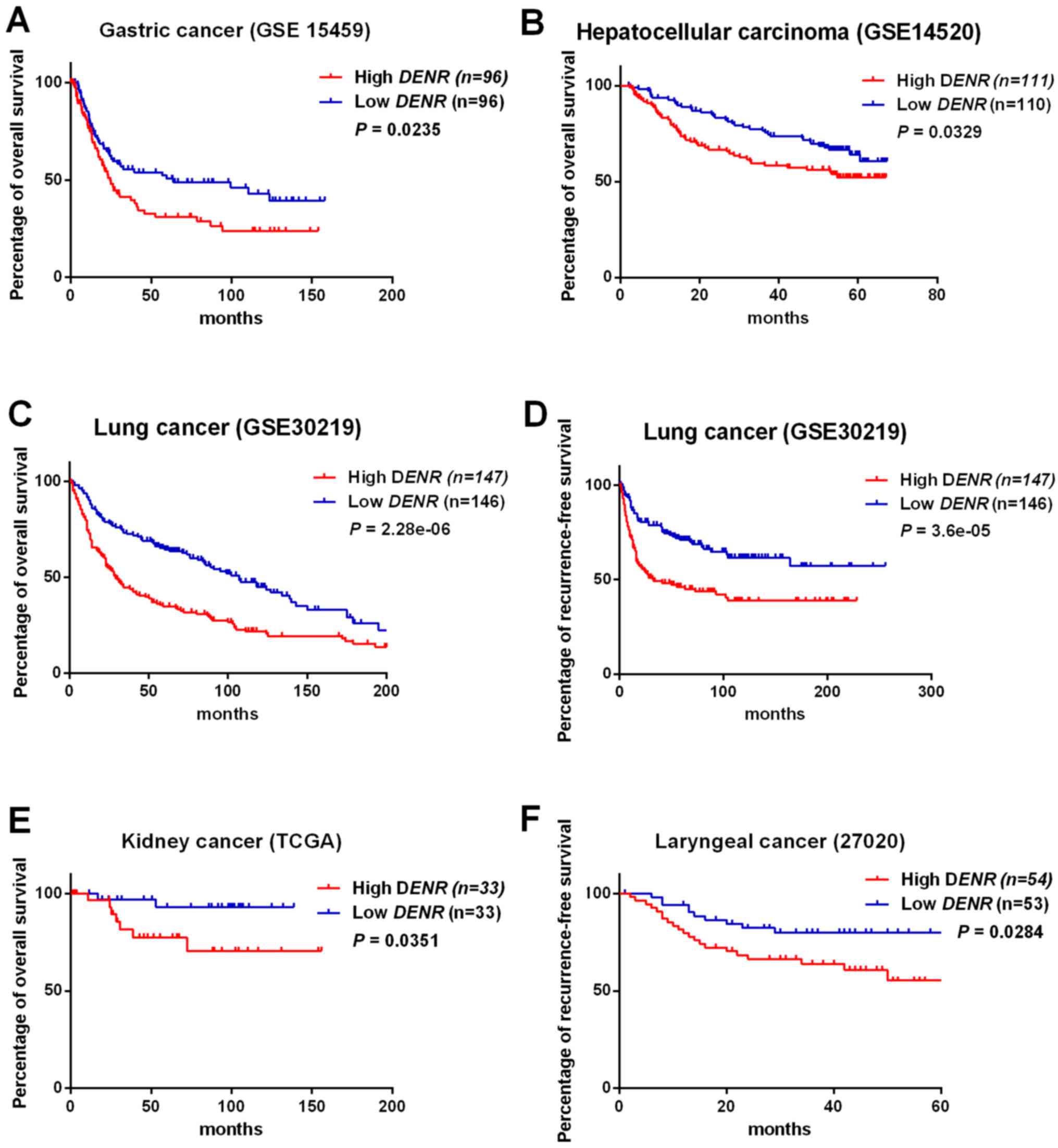
DENR expression (low DENR, n=96; high
DENR, n=96) in gastric cancer tissues (primary data from
GSE15459) was significantly associated with reduced overall
survival (χ2=5.1 and P=0.0235 in log-rank test; Fig. 2A). Expression of DENR (low
DENR, n=110; high DENR, n=111) in hepatocellular
carcinoma tissues (primary data from GSE14520) was significantly
associated with worse overall survival (χ2=4.6 and
P=0.0329 in log-rank test; Fig. 2B).
In lung cancer tissues (primary data from GSE30219), DENR
expression (low DENR, n=146; high DENR, n=147) was
significantly associated with poor overall survival
(χ2=22.3 and P=2.28×10−06 in log-rank test;
Fig. 2C). For lung cancer (primary
data from GSE30219), expression of DENR (low DENR,
n=146; high DENR, n=147) was significantly associated with
diminished recurrence-free survival (χ2=17.1 and
P=3.6×10−05 in log-rank test; Fig. 2D). DENR expression (low
DENR, n=33; high DENR, n=33) in kidney cancer tissues
(primary data from TCGA) was significantly associated with poor
overall survival (χ2=4.4 and P=0.0351 in log-rank test;
Fig. 2E). DENR levels (low
DENR, n=53; high DENR, n=54) in laryngeal cancer
tissues (primary data from GSE27020) were significantly associated
with reduced recurrence-free survival (χ2=4.8 and
P=0.0284 in log-rank test; Fig.
2F).
In summary, these results demonstrate that high
DENR expression is indicative of a poor prognosis for
patients with hepatocellular carcinoma, gastric cancer, kidney
cancer, laryngeal cancer and lung cancer.
GSEA for lung cancer tissues with high
DENR expression
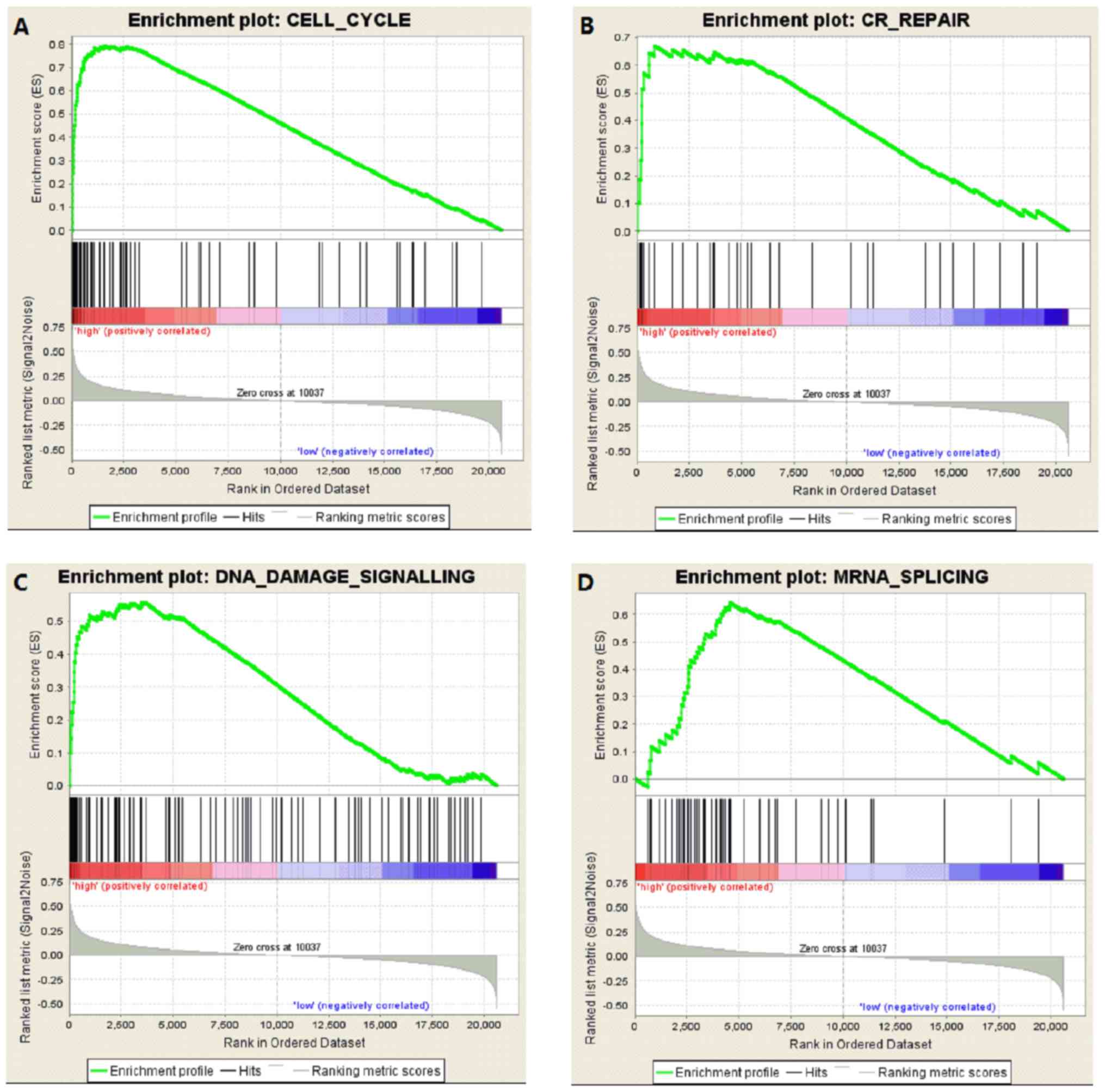
Fig. 3 demonstrates
the results of GSEA for lung cancer tissues with high DENR
expression (primary data from GSE30219). The curated gene set was
used as an example dataset. The results revealed that enriched gene
sets were associated with CELL_CYCLE [P<0.001, false discovery
rate (FDR)=0.068, enrichment score (ES)=0.793; Fig. 3A], CR_REPAIR (cancer-related DNA
repair) (P=0.012, FDR=0.071, ES=0.670; Fig. 3B), DNA_DAMAGE_SIGNALLING (P=0.002,
FDR=0.056, ES=0.558; Fig. 3C) and
MRNA_SPLICING (P<0.001, FDR=0.003, ES=0.644; Fig. 3D). These findings indicated that
DENR regulates cell cycle, cancer-related DNA repair, DNA
damage signalling and mRNA splicing activities.
Discussion
In the current study, it has been demonstrated that
DENR expression is upregulated in different cancer tissues
compared with that observed in normal tissues. Deyo et al
(1) demonstrated that the DENR
gene maps to human chromosome 12. Skabkin et al (28) revealed that the release of tRNA and
mRNA is associated with eukaryotic translation initiation factor 1
(eIF1)/eIF1A, Ligatin or MCT-1/DENR. Furthermore, Schleich
et al (11) demonstrated that
the regulation of the translation of a specific set of mRNAs is
associated with DENR. The results of GSEA for lung cancer
tissues with high DENR expression identified in the current
study established that enriched gene sets were associated with the
MRNA_SPLICING categorisation. These findings indicated that
DENR regulates mRNA splicing. A previous study disclosed
that cells harbour a previously unappreciated translational control
system that involves DENR and exerts a key role in tissue
development and supporting cellular proliferation (11). The current study demonstrates that
DENR is associated with cell cycle, CR_REPAIR
(cancer-related DNA repair), DNA damage signalling, disrupted DNA
replication, DNA repair and cell cycle progression, which promotes
uncontrolled proliferation of tumour cells (29). Similarly, the current study identified
that elevated DENR expression was significantly associated
with advanced AJCC tumour stages in multiple cancer types including
hepatocellular cancer, lung cancer, breast cancer, kidney cancer
and rectal cancer.
Advanced tumour stage, tumour size and lymph node
metastasis are each indicative of poor prognosis (30,31). High
DENR expression was associated with these disadvantageous
features in the current study and was also associated with poor
overall survival or recurrence-free survival in hepatocellular
carcinoma, gastric cancer, kidney cancer, laryngeal cancer and lung
cancer. In hepatocellular carcinoma, DENR expression was
significantly increased in high AFP tumours compared with low AFP
tumours. A recent study suggested that AFP is associated with
malignant hepatic tumours (32). The
current study revealed high DENR expression was positively
associated with the histological tumour invasive subtype and
metabolic subtype in gastric cancer. A previous study demonstrated
that invasive subtype is associated with malignant gastric cancer
and poor prognosis (33). The current
study revealed that DENR expression in gastric cancer
tissues is significantly associated with overall survival. High
DENR expression is indicative of poor prognosis for patients
with gastric cancer.
In conclusion, the current study demonstrated that
DENR is highly expressed in multiple cancer types and is
associated with poor survival of patients with hepatocellular
carcinoma, gastric cancer, kidney cancer, laryngeal cancer and lung
cancer. Elevated expression of DENR may contribute to
tumourigenesis and affect clinical outcome.
Acknowledgements
The present study was performed in accordance with
The Cancer Genome Atlas (TCGA) and Gene Expression Omnibus (GEO)
publication policy, as outlined in TCGA data portal (http://cancergenome.nih.gov) and GEO data portal
(http://www.ncbi.nlm.nih.gov/geo/).
Funding
Not applicable.
Availability of data and materials
The results of the present study are in whole or
part based upon data generated by the TCGA Research Network
(http://cancergenome.nih.gov/) and the
GEO dataset (http://www.ncbi.nlm.nih.gov/geo/).
Authors' contributions
DW and SZ conceived and designed the study. Data
were curated and analyzed by DW, SZ, LW and PZ. Data collection and
software analysis were performed by DW, LW, CR and MW. All authors
contributed to the writing of the manuscript.
Ethics approval and consent to
participate
Not applicable.
Patient consent for publication
Not applicable.
Competing interests
The authors declare that they have no competing
interests.
References
|
1
|
Deyo JE, Chiao PJ and Tainsky MA: Drp, a
novel protein expressed at high cell density but not during growth
arrest. DNA Cell Biol. 17:437–447. 1998. View Article : Google Scholar : PubMed/NCBI
|
|
2
|
Kehry MR and Hodgkin PD: B-cell activation
by helper T-cell membranes. Crit Rev Immunol. 14:221–238. 1994.
View Article : Google Scholar : PubMed/NCBI
|
|
3
|
Bussemakers MJ and Schalken JA: The role
of cell adhesion molecules and proteases in tumor invasion and
metastasis. World J Urol. 14:151–156. 1996. View Article : Google Scholar : PubMed/NCBI
|
|
4
|
Amsler K: Role of cell density/cell-cell
contact, and growth state in expression of differentiated
properties by the LLC-PK1 cell. J Cell Physiol. 159:331–339. 1994.
View Article : Google Scholar : PubMed/NCBI
|
|
5
|
Lee LA, Resar LM and Dang CV: Cell density
and paradoxical transcriptional properties of c-Myc and Max in
cultured mouse fibroblasts. J Clin Invest. 95:900–904. 1995.
View Article : Google Scholar : PubMed/NCBI
|
|
6
|
Reinert LS, Shi B, Nandi S, Mazan-Mamczarz
K, Vitolo M, Bachman KE, He H and Gartenhaus RB: MCT-1 protein
interacts with the cap complex and modulates messenger RNA
translational profiles. Cancer Res. 66:8994–9001. 2006. View Article : Google Scholar : PubMed/NCBI
|
|
7
|
Prosniak M, Dierov J, Okami K, Tilton B,
Jameson B, Sawaya BE and Gartenhaus RB: A novel candidate oncogene,
MCT-1, is involved in cell cycle progression. Cancer Res.
58:4233–4237. 1998.PubMed/NCBI
|
|
8
|
Kasperaitis MA, Voorma HO and Thomas AA:
The amino acid sequence of eukaryotic translation initiation factor
1 and its similarity to yeast initiation factor SUI1. FEBS Lett.
365:47–50. 1995. View Article : Google Scholar : PubMed/NCBI
|
|
9
|
Levenson AS, Thurn KE, Simons LA,
Veliceasa D, Jarrett J, Osipo C, Jordan VC, Volpert OV, Satcher RL
Jr and Gartenhaus RB: MCT-1 oncogene contributes to increased in
vivo tumorigenicity of MCF7 cells by promotion of angiogenesis and
inhibition of apoptosis. Cancer Res. 65:10651–10656. 2005.
View Article : Google Scholar : PubMed/NCBI
|
|
10
|
Skabkin MA, Skabkina OV, Dhote V, Komar
AA, Hellen CU and Pestova TV: Activities of Ligatin and MCT-1/DENR
in eukaryotic translation initiation and ribosomal recycling. Genes
Dev. 24:1787–1801. 2010. View Article : Google Scholar : PubMed/NCBI
|
|
11
|
Schleich S, Strassburger K, Janiesch PC,
Koledachkina T, Miller KK, Haneke K, Cheng YS, Kuechler K,
Stoecklin G, Duncan KE and Teleman AA: DENR-MCT-1 promotes
translation re-initiation downstream of uORFs to control tissue
growth. Nature. 512:208–212. 2014. View Article : Google Scholar : PubMed/NCBI
|
|
12
|
Truvé K, Dickinson P, Xiong A, York D,
Jayashankar K, Pielberg G, Koltookian M, Murén E, Fuxelius HH,
Weishaupt H, et al: Utilizing the dog genome in the search for
novel candidate genes involved in glioma development-genome wide
association mapping followed by targeted massive parallel
sequencing identifies a strongly associated locus. PLoS Genet.
12:e10060002016. View Article : Google Scholar : PubMed/NCBI
|
|
13
|
Pau Ni IB, Zakaria Z, Muhammad R, Abdullah
N, Ibrahim N, Aina Emran N, Hisham Abdullah N and Syed Hussain SN:
Gene expression patterns distinguish breast carcinomas from normal
breast tissues: The Malaysian context. Pathol Res Pract.
206:223–228. 2010. View Article : Google Scholar : PubMed/NCBI
|
|
14
|
Sabates-Bellver J, Van der Flier LG, de
Palo M, Cattaneo E, Maake C, Rehrauer H, Laczko E, Kurowski MA,
Bujnicki JM, Menigatti M, et al: Transcriptome profile of human
colorectal adenomas. Mol Cancer Res. 5:1263–1275. 2007. View Article : Google Scholar : PubMed/NCBI
|
|
15
|
D'Errico M, de Rinaldis E, Blasi MF, Viti
V, Falchetti M, Calcagnile A, Sera F, Saieva C, Ottini L, Palli D,
et al: Genome-wide expression profile of sporadic gastric cancers
with microsatellite instability. Eur J Cancer. 45:461–469. 2009.
View Article : Google Scholar
|
|
16
|
Landi MT, Dracheva T, Rotunno M, Figueroa
JD, Liu H, Dasgupta A, Mann FE, Fukuoka J, Hames M, Bergen AW, et
al: Gene expression signature of cigarette smoking and its role in
lung adenocarcinoma development and survival. PLoS One.
3:e16512008. View Article : Google Scholar : PubMed/NCBI
|
|
17
|
Tun HW, Marlow LA, von Roemeling CA,
Cooper SJ, Kreinest P, Wu K, Luxon BA, Sinha M, Anastasiadis PZ and
Copland JA: Pathway signature and cellular differentiation in clear
cell renal cell carcinoma. PLoS One. 5:e106962010. View Article : Google Scholar : PubMed/NCBI
|
|
18
|
Roessler S, Jia HL, Budhu A, Forgues M, Ye
QH, Lee JS, Thorgeirsson SS, Sun Z, Tang ZY, Qin LX and Wang XW: A
unique metastasis gene signature enables prediction of tumor
relapse in early-stage hepatocellular carcinoma patients. Cancer
Res. 70:10202–10212. 2010. View Article : Google Scholar : PubMed/NCBI
|
|
19
|
Badea L, Herlea V, Dima SO, Dumitrascu T
and Popescu I: Combined gene expression analysis of whole-tissue
and microdissected pancreatic ductal adenocarcinoma identifies
genes specifically overexpressed in tumor epithelia.
Hepatogastroenterology. 55:2016–2027. 2008.PubMed/NCBI
|
|
20
|
Ye H, Yu T, Temam S, Ziober BL, Wang J,
Schwartz JL, Mao L, Wong DT and Zhou X: Transcriptomic dissection
of tongue squamous cell carcinoma. BMC Genomics. 9:692008.
View Article : Google Scholar : PubMed/NCBI
|
|
21
|
Santegoets LA, Seters MV, Helmerhorst TJ,
Heijmans-Antonissen C, Hanifi-Moghaddam P, Ewing PC, van Ijcken WF,
van der Spek PJ, van der Meijden WI and Blok LJ: HPV related VIN:
Highly proliferative and diminished responsiveness to extracellular
signals. Int J Cancer. 121:759–766. 2007. View Article : Google Scholar : PubMed/NCBI
|
|
22
|
Ooi CH, Ivanova T, Wu J, Lee M, Tan IB,
Tao J, Ward L, Koo JH, Gopalakrishnan V, Zhu Y, et al: Oncogenic
pathway combinations predict clinical prognosis in gastric cancer.
PLoS Genet. 5:e10006762009. View Article : Google Scholar : PubMed/NCBI
|
|
23
|
Rousseaux S, Debernardi A, Jacquiau B,
Vitte AL, Vesin A, Nagy-Mignotte H, Moro-Sibilot D, Brichon PY,
Lantuejoul S, Hainaut P, et al: Ectopic activation of germline and
placental genes identifies aggressive metastasis-prone lung
cancers. Sci Transl Med. 5:186ra662013. View Article : Google Scholar : PubMed/NCBI
|
|
24
|
Fountzilas E, Kotoula V, Angouridakis N,
Karasmanis I, Wirtz RM, Eleftheraki AG, Veltrup E, Markou K,
Nikolaou A, Pectasides D and Fountzilas G: Identification and
validation of a multigene predictor of recurrence in primary
laryngeal cancer. PLoS One. 8:e704292013. View Article : Google Scholar : PubMed/NCBI
|
|
25
|
Tomczak K, Czerwińska P and Wiznerowicz M:
The cancer genome atlas (TCGA): An immeasurable source of
knowledge. Contemp Oncol (Pozn). 19A:A68–A77. 2015.
|
|
26
|
Irizarry RA, Hobbs B, Collin F,
Beazer-Barclay YD, Antonellis KJ, Scherf U and Speed TP:
Exploration, normalization, and summaries of high density
oligonucleotide array probe level data. Biostatistics. 4:249–264.
2003. View Article : Google Scholar : PubMed/NCBI
|
|
27
|
Washington K: 7th edition of the AJCC
cancer staging manual: Stomach. Ann Surg Oncol. 17:3077–3079. 2010.
View Article : Google Scholar : PubMed/NCBI
|
|
28
|
Skabkin MA, Skabkina OV, Hellen CU and
Pestova TV: Reinitiation and other unconventional posttermination
events during eukaryotic translation. Mol Cell. 51:249–264. 2013.
View Article : Google Scholar : PubMed/NCBI
|
|
29
|
Evan GI and Vousden KH: Proliferation,
cell cycle and apoptosis in cancer. Nature. 411:342–348. 2001.
View Article : Google Scholar : PubMed/NCBI
|
|
30
|
Carter CL, Allen C and Henson DE: Relation
of tumor size, lymph node status, and survival in 24,740 breast
cancer cases. Cancer. 63:181–187. 1989. View Article : Google Scholar : PubMed/NCBI
|
|
31
|
Hanrahan EO, Gonzalez-Angulo AM, Giordano
SH, Rouzier R, Broglio KR, Hortobagyi GN and Valero V: Overall
survival and cause-specific mortality of patients with stage T1a,
bN0M0 breast carcinoma. J Clin Oncol. 25:4952–4960. 2007.
View Article : Google Scholar : PubMed/NCBI
|
|
32
|
Ryu T, Takami Y, Wada Y, Tateishi M,
Matsushima H, Mikagi K and Saitsu H: Double- and triple-positive
tumor markers predict early recurrence and poor survival in
patients with hepatocellular carcinoma within the Milan criteria
and Child-Pugh class A. J Gastrointest Surg. 21:957–966. 2017.
View Article : Google Scholar : PubMed/NCBI
|
|
33
|
Rugge M, Meggio A, Pennelli G, Piscioli F,
Giacomelli L, De Pretis G and Graham DY: Gastritis staging in
clinical practice: The OLGA staging system. Gut. 56:631–636. 2007.
View Article : Google Scholar : PubMed/NCBI
|