Introduction
Prostate carcinoma is one of the most frequently
diagnosed malignancies in men worldwide (1). As a heavy burden on public health,
prostate carcinoma has an unacceptably high mortality rate
(2). Patients with prostate
carcinoma are mostly treated with androgen ablation therapies;
although there is a high rate of initial response, emergence of
castration-resistant prostate carcinoma in 10–20% of patients,
results in failure of treatment (3).
Prostate cancer affects 1 in 9 men during their lifetime and
<30% of patients with prostate cancer with evidence of
metastasis will live longer than 5 years in cases (2,3). In
addition, early stages of prostate carcinoma lack do not exhibit
any noticeable symptoms and the majority of present are diagnosed
with tumor metastasis, which makes surgical intervention, a radical
treatment for solid tumors, unsuitable (4,5).
Non-coding RNAs (ncRNAs) are involved in many
physiological and pathological processes (6,7). ncRNAs
are divided into subgroups based on their length and functions;
long ncRNAs (lncRNAs) are ncRNAs >200 nucleotides (8). A growing body of literature has shown
that lncRNAs participate in cancer biology through their
interactions with multiple signaling molecules (8–10),
including microRNAs (miRNAs), which is another subgroup of ncRNAs
(11). miR-145 and lncRNA growth
arrest specific 5 (GAS5) serve a role as tumor suppressor in
prostate carcinoma (12,13). Mir-145 and GAS5 negatively regulate
cancer progression and are downregulated in prostate carcinoma
(12,13). The results of the present study
provided further evidence that miR-145 and lncRNA GAS5 may function
in prostate carcinoma and demonstrated that miR-145 may inhibit
cell proliferation and induce apoptosis in human prostate carcinoma
possibly by upregulating lncRNA GAS5.
Materials and methods
Tissue samples and cell culture
Tumor tissue and adjacent healthy tissue samples
were collected from 62 patients with prostate carcinoma who were
admitted to Ruijin Hospital, Shanghai Jiaotong University
(Shanghai, China) between January 2010 and January 2013. Patients
were aged between 38 and 70 years (mean, 51.2±5.3 years). Inclusion
criteria: i) Patients diagnosed by pathological examinations in
Ruijin Hospital, Shanghai Jiaotong University; ii) patients with
complete medical records treated at Ruijin Hospital, Shanghai
Jiaotong University; iii) patients who participated in the 5-year
follow-up after discharge; iv) patients willing to participate.
Exclusion criteria: i) Patients diagnosed with other diseases; ii)
patients who were transferred to other hospitals during treatment;
iii) patients who died from other causes during the follow-up
period. There were 12 cases in stage I, 14 cases in stage II, 18
cases in stage III and 18 cases in stage IV. The study was approved
by the Ethics Committee of Ruijin Hospital, Shanghai Jiaotong
University. All participants signed informed consent before
admission.
The 22Rv1 human prostate carcinoma cell line was
used in this study. Cells were obtained from American Type Culture
Collection (ATCC; Manassas, VA, USA) and cultured in DMEM
containing 10% fetal bovine serum (cat. no. 30-2020; ATCC) at 37°C
in a 5% CO2 incubator with 98% humidity.
Follow-up study
Following discharge, all patients were followed-up
monthly for 5 years and overall survival was recorded. Three
patients who died from other causes were not included; a total of
57 patients completed the follow-up.
Reverse transcription-quantitative PCR
(RT-qPCR)
To detect the expression levels of miR-145, miRNAs
were extracted from 0.1 g of tissue specimen from each sample and
1×10⁵ cells using miRNeasy Mini kit (Qiagen, Inc.,
Valencia, CA, USA), and PCR reaction systems were prepared using
TaqMan MicroRNA Reverse Transcription kit (Thermo Fisher
Scientific, Inc., Waltham, MA, USA). To detect the expression
levels of lncRNA GAS5, total RNAs were extracted from 0.1 g of
tissue specimen from each sample and 1×10⁵ cells using
TRIzol reagent (Invitrogen; Thermo Fisher Scientific, Inc.),
reverse transcription was performed using MMLV Reverse
Transcriptase 1st-Strand cDNA Synthesis kit (Lucigen Corporation,
Middleton, WI, USA), and SYBR® Green Real-Time PCR
Master Mix (Thermo Fisher Scientific, Inc.) was used to prepare
qPCR reaction systems. The thermocycling conditions were 95°C for
55 sec, followed by 40 cycles of 95°C for 25 sec and 55.5°C for 30
sec. Primers for miR-145, lncRNA GAS5 and endogenous controls U6
and β-actin were designed and synthesized by Sangon Biotech Co.,
Ltd. (Shanghai, China). Primer sequences were: miR-145 forward,
5′-CAGTGCGTGTCGTGGAGT-3′ and reverse, 5′-AGGTCCAGTTTTCCCAGG-3′; U6
forward, 5′-CGCTTCACGAATTTGCGTGTCA-3′ and reverse,
5′-GCTTCGGCAGCACATATACTAAAAT-3′; GAS5 forward,
5′-CACACAGGCATTAGACAGA-3′ and reverse, 5′-GCTCCACACAGTGTAGTCA-3′;
β-actin forward, 5′-GACCTCTATGCCAACACAG-3′ and reverse,
5′-AGTACTTGCGCTCAGGAGGA-3′. Expression of miR-145 was normalized to
U6 and expression of lncRNA GAS5 was normalized to β-actin using
the 2−ΔΔCq method (14).
Cell transfection
lncRNA GAS5 pcDNA3.1 expression vector and siRNA
(5′-GCAGAACCATAAAGATGGTCCA-3′) were designed and constructed by
Sangon Biotech Co., Ltd. Empty vectors and negative control (NC)
siRNA (5′-TTCTCCGAACGTGTCACGTTT-3′) were also provided by Sangon
Biotech Co., Ltd. MISSION® microRNA mimic hsa-miR-145
and scrambled NC miRNAs were obtained from Sigma-Aldrich (Merck
KGaA, Darmstadt, Germany). Cell transfections were performed using
Lipofectamine® 2000 reagent (Thermo Fisher Scientific,
Inc.) at 37°C with vectors, siRNAs and miRNAs at doses of 10, 40
and 40 nM, respectively. Cells were incubated with the transfection
mixtures for 6 h. Cells treated with Lipofectamine® 2000
reagent only were used as untreated control cells. Cells
transfected with empty vectors, NC siRNAs, or scrambled NC miRNAs
were used as transfection controls. The thresholds for successful
transfections were 200% for lncRNA GAS5 and miR-145 overexpression
and 50% for lncRNA GAS5 knockdown. Further experiments were
performed 24 h post-transfection.
Cell Counting Kit-8 (CCK-8) assay
Cell proliferation was detected using CCK-8 assay
(Dojindo Molecular Technologies, Inc., Kumamoto, Japan). Cell
suspensions (5×10⁴ cells/ml) were cultivated in a
96-well plate (0.1 ml/well) under normal conditions (37°C; 5%
CO2), and 15 µl CCK-8 solution (Dojindo Molecular
Technologies, Inc.) was added into each well at 24, 48, 72 and 96
h. Cells were incubated with CCK-8 solution for 4 h. Optical
density values at 450 nm were measured using a plate reader to
determine cell proliferation rate.
Apoptosis assay
Apoptosis was detected using cell a apoptosis assay.
Serum-free DMEM was used to prepare cell suspensions
(5×10⁴ cells/ml). Cells were transferred to a 6-well
plate (10 ml/well), cultivated for 60 h, and cell digestion with
0.25% trypsin was performed. Annexin V-FITC (Dojindo, Kumamoto,
Japan) and propidium iodide (PI) staining was performed at room
temperature for 30 min in the dark, and then flow cytometry was
performed using BD Biosciences 2 Laser 4 Color FacsCalibur Flow
Cytometer (BD Biosciences, Franklin Lakes, NJ, USA) to detect
apoptotic cells. Data were analyzed using BD Paint-A-Gate™ Pro
Software (BD Biosciences).
Statistical analysis
All experiments were performed in triplicate and
data are presented as the mean ± standard deviation. Comparisons of
lncRNA GAS5 and miR-145 expression between tumors and adjacent
healthy tissues were performed using Student's paired t-test.
Comparisons among multiple groups were performed by one-way
analysis of variance followed by Fisher's Least Significant
Difference post hoc test. Correlation analyses between the
expression levels of lncRNA GAS5 and miR-145 were performed using
Pearson's correlation coefficient. Patients were divided into high
(n=32) and low (n=30) lncRNA GAS5 expression groups, as well as
high (n=28) and low (n=34) miR-145 expression groups according to
Youden's index. Association analyses between GAS5 and miR-145
expression in tumor tissue and patients' clinicopathological data
were performed by χ2 test. Kaplan-Meier method was used
to plot survival curves, which were compared using logrank test.
P<0.05 was considered to indicate a statistically significant
difference.
Results
lncRNA GAS5 and miR-145 expression
levels are downregulated in tumor tissues compared with adjacent
healthy tissues in patients with prostate carcinoma
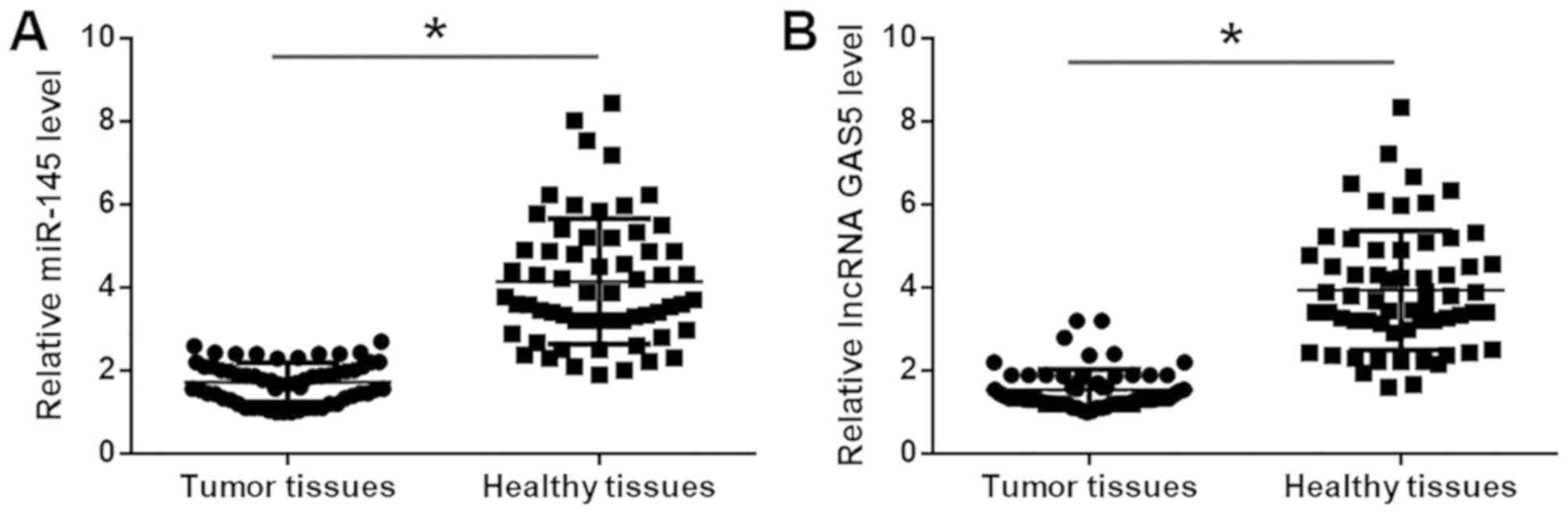
Expression levels of lncRNA GAS5 and miR-145 in 62
tumor tissues and adjacent healthy tissues were detected by
RT-qPCR. Compared with adjacent healthy tissues, expression of
lncRNA GAS5 (Fig. 1A) and miR-145
(Fig. 1B) were significantly
downregulated in tumor tissues (P<0.05).
lncRNA GAS5 and miR-145 expression
levels are positively correlated in tumor tissues
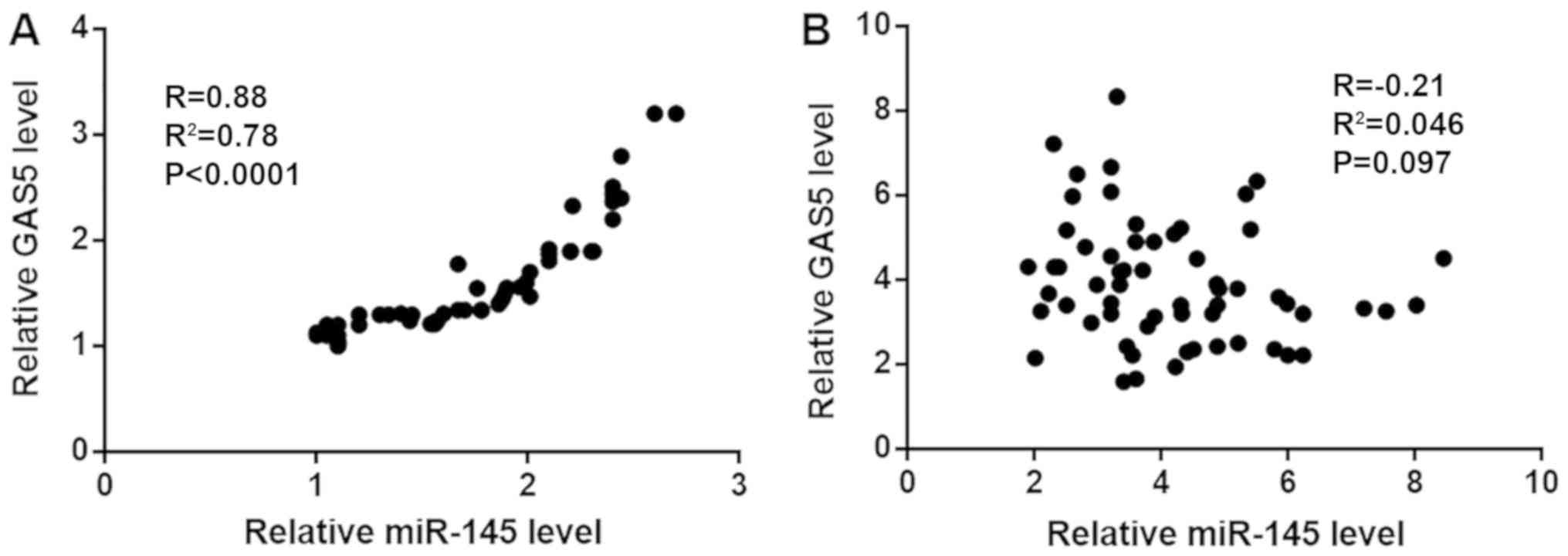
Correlation between the expression levels of lncRNA
GAS5 and miR-145 was detected using Pearson's correlation
coefficient. Expression levels of miR-145 and lncRNA GAS5 were
positively and significantly correlated in tumor tissues (Fig. 2A). By contrast, no relationship was
observed between lncRNA GAS5 and miR-145 expression levels in
adjacent tissues (Fig. 2B).
Low miR-145 and lncRNA GAS5 expression
levels are associated with poor survival
Patients were divided into high (n=32) and low
(n=30) lncRNA GAS5 (cutoff value=1.58), as well as high (n=28) and
low (n=34) miR-145 (cutoff value=1.64) expression groups according
Youden's index. χ2 test revealed no significant
association between expression levels of lncRNA GAS5 (Table I) and miR-145 (Table II) in tumor tissues and patient age
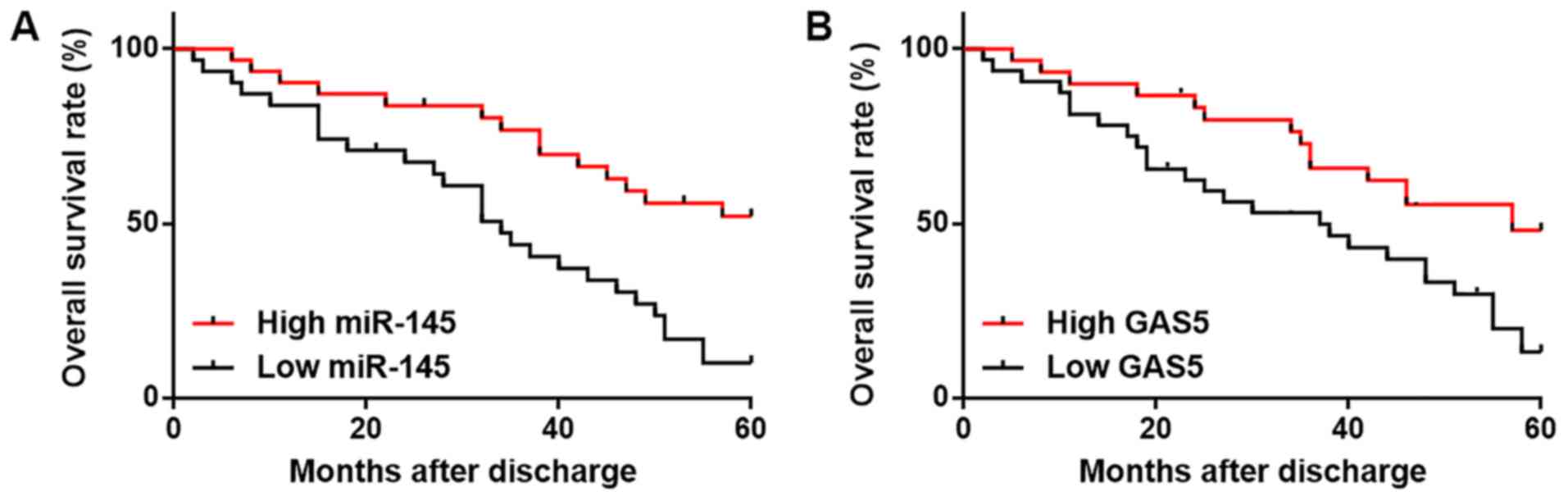
or clinical stage. Kaplan-Meier method was used to plot survival
curves, which were compared using logrank test. Patients in the low
miR-145 (Fig. 3A) and low lncRNA
GAS5 (Fig. 3B) groups exhibited
significantly lower overall survival rates compared with patients
in the high miR-145 and high lncRNA GAS5 groups (P=0.021).
 | Table I.Association between lncRNA GAS5
expression levels in tumor tissue and patient clinicopathological
characteristics. |
Table I.
Association between lncRNA GAS5
expression levels in tumor tissue and patient clinicopathological
characteristics.
|
|
| Expression |
|
|
|---|
|
|
|
|
|
|
|---|
| Clinicopathological
factor | Cases (n=62) | High | Low | χ2 | P-value |
|---|
| Age (years) |
|
|
| 0.59 | 0.44 |
|
>50 | 30 | 17 | 13 |
|
|
| ≤50 | 32 | 15 | 17 |
|
|
| Stage |
|
|
| 0.78 | 0.85 |
| I | 12 | 7 | 5 |
|
|
| II | 14 | 8 | 6 |
|
|
| III | 18 | 8 | 10 |
|
|
| IV | 18 | 9 | 9 |
|
|
| Table II.Association between miR-145 expression
levels in tumor tissue and patient clinicopathological data. |
Table II.
Association between miR-145 expression
levels in tumor tissue and patient clinicopathological data.
|
|
| Expression |
|
|
|---|
|
|
|
|
|
|
|---|
| Clinicopathological
factor | Cases (n=62) | High | Low | χ2 | P-value |
|---|
| Age (years) |
|
|
| 1.56 | 0.21 |
|
>50 | 30 | 16 | 14 |
|
|
| ≤50 | 32 | 12 | 20 |
|
|
| Stage |
|
|
| 1.16 | 0.76 |
| I | 12 | 5 | 7 |
|
|
| II | 14 | 6 | 8 |
|
|
| III | 18 | 10 | 8 |
|
|
| IV | 18 | 7 | 11 |
|
|
Overexpression of miR-145 results in
upregulated lncRNA GAS5
The significant and positive correlation between
miR-145 and lncRNA GAS5 indicated a possible interaction between
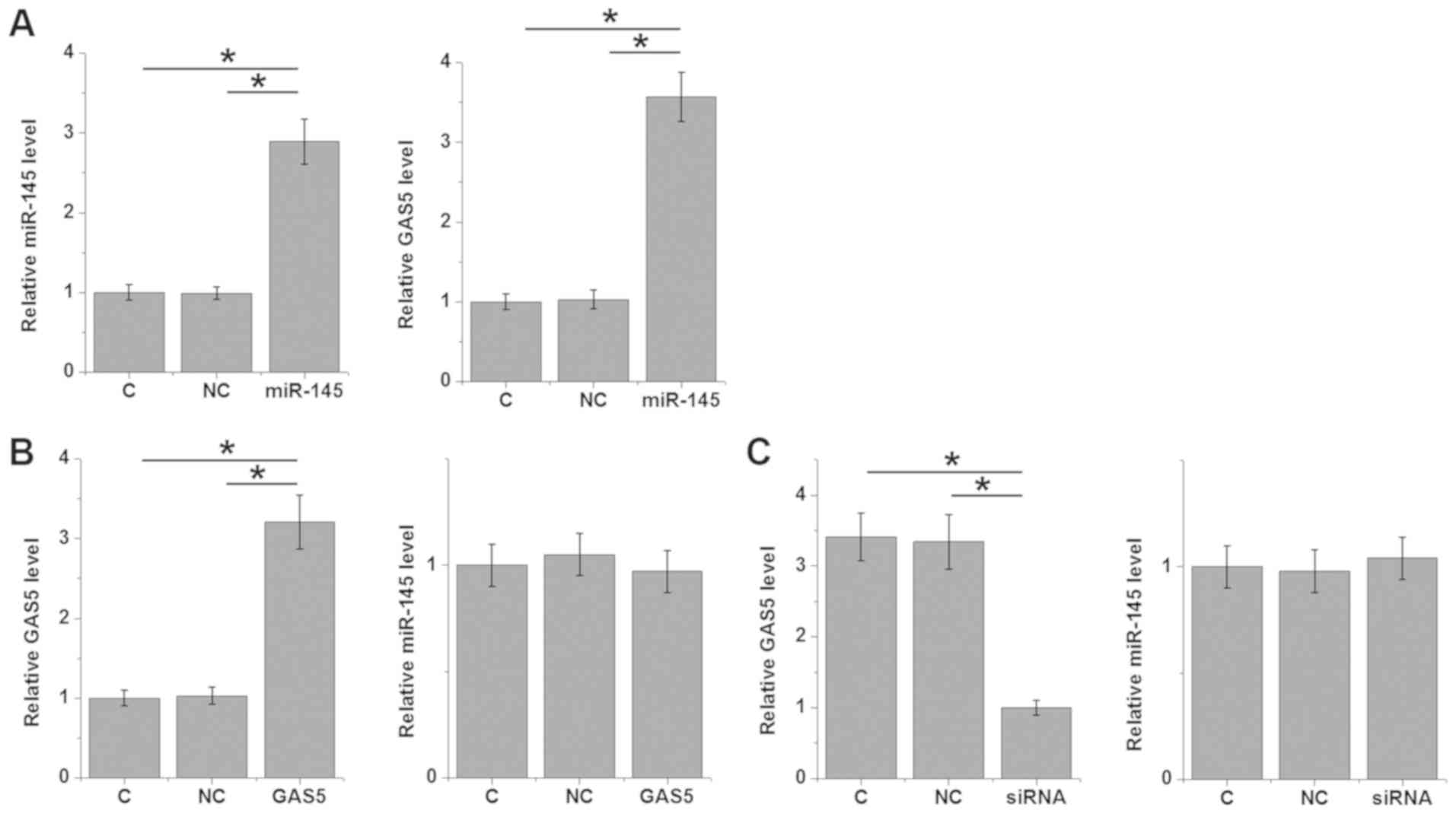
them. Overexpression experiments were performed in 22Rv1 prostate
cancer cells to further investigate the interactions between
miR-145 and lncRNA GAS5. Compared with control and NC groups,
overexpression of miR-145 led to upregulated lncRNA GAS5
(P<0.05; Fig. 4A). By contrast,
lncRNA GAS5 overexpression (P>0.05; Fig. 4B) and siRNA silencing (P>0.05;
Fig. 4C) caused no significant
changes in expression levels of miR-145.
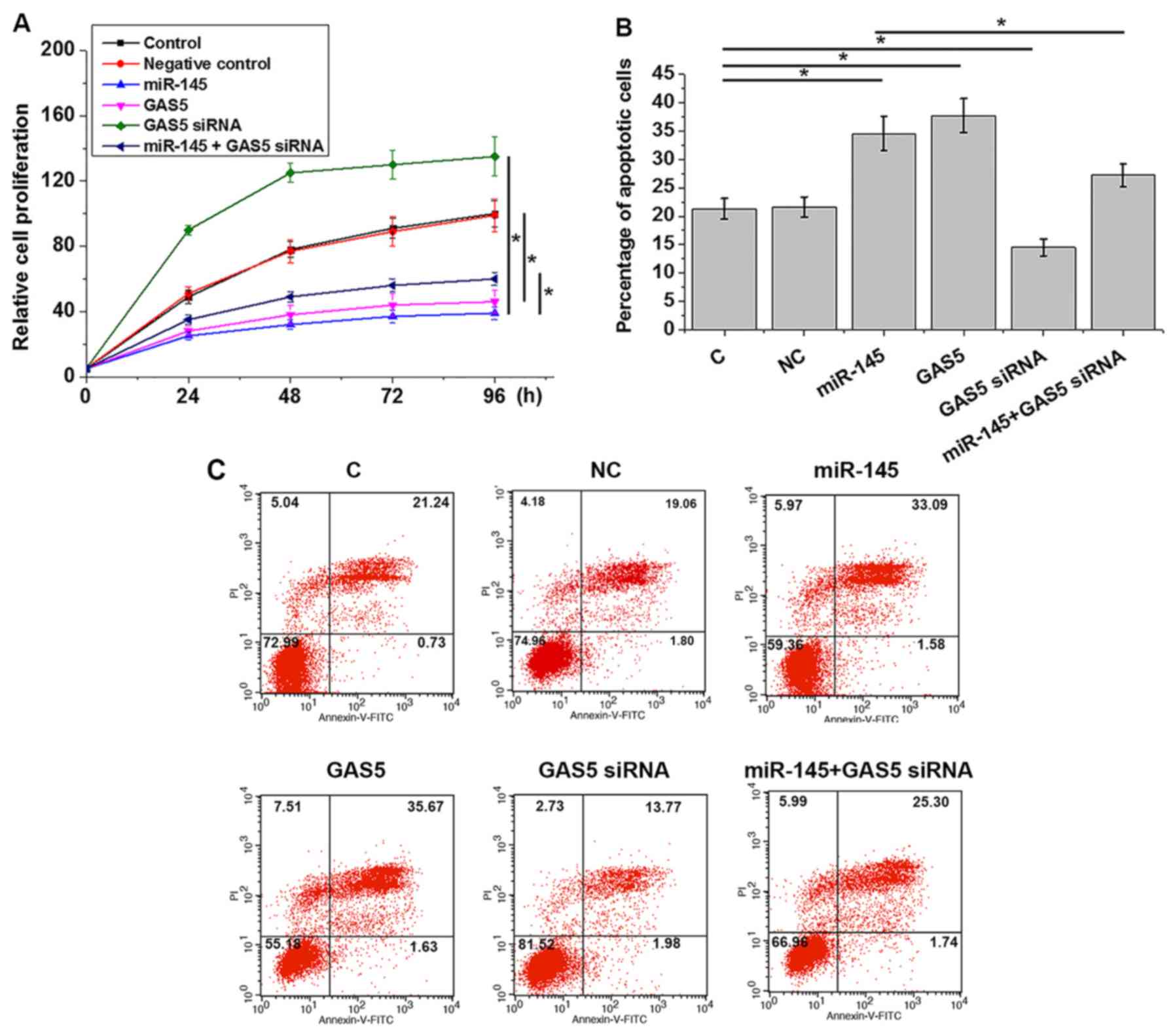
Overexpression of miR-145 inhibits
cell proliferation and promotes apoptosis through lncRNA GAS5
Compared with control and NC groups, overexpression
of miR-145 and lncRNA GAS5 led to significantly inhibited
proliferation (Fig. 5A) and
increased apoptosis (Fig. 5B) of
22Rv1 prostate cancer cells (P<0.05). lncRNA GAS5 knockdown
attenuated the effects of miR-145 overexpression of cell
proliferation (Fig. 5A) and
apoptosis (Fig. 5B and C)
(P<0.05).
Discussion
miR-145 and lncRNA GAS5 have exhibit similar
functions in regulating the behaviours of cancerous cells during
the development of prostate carcinoma (12,13);
however, no studies examining a potential interaction have been
published, to the best of our knowledge. The present study provided
further evidence to support the role of miR-145 and lncRNA GAS5 as
tumor suppressors in prostate carcinoma. The results also revealed
that miR-145 inhibited cell proliferation and induced apoptosis in
human prostate carcinoma possibly by upregulating lncRNA GAS5.
The interaction between lncRNAs and miRNAs are
frequently reported in the development of human cancers. For
example, during the development of hepatocellular cancer, miR-29a
inhibits lncRNA maternally expressed 3 expression through promoter
hypermethylation (15); miRNA-218-5p
is negatively regulated by lncRNA colon cancer-associated
transcript 1 to promote gallbladder cancer development (16). The present study focused on miR-145
and lncRNA GAS5 since they have similar functions in inhibiting
prostate carcinoma (12,13). The results indicated that miR-145 may
indirectly upregulate lncRNA GAS5 in prostate carcinoma cells. In a
recent study, Xue et al demonstrated that lncRNA GAS5
targets miR-103 through the AKT serine/threonine kinase/mammalian
target of rapamycin pathway to inhibit the progression of prostate
carcinoma (17). Therefore, miRNAs
may be upstream and downstream of lncRNA GAS5 to participate in the
development of prostate carcinoma.
The present study failed to elucidate the molecular
mechanism of the regulation of lncRNA GAS5 by miR-145 in prostate
carcinoma cells. It has been reported that Notch-1 negatively
regulates lncRNA GAS5 to promote breast cancer cell proliferation
(18). In addition, miRNA-145
targets Notch signaling to induce apoptosis in glioma cells
(19). However, no significant
changes in expression levels of Notch-1 are observed after
miRNA-145 overexpression (data not shown), which suggests that
Notch-1 is unlikely the mediator between miRNA-145 and lncRNA GAS5
in prostate carcinoma. Notably, the present study demonstrated that
expression levels of miR-145 and lncRNA GAS5 were positively and
significantly correlated in tumor tissues, but not in adjacent
healthy tissues. It is hypothesized that one of the existing
prostate carcinoma-related factors may mediate the interactions
between lncRNA GAS5 and miR-145; however, future studies are
required to identify these factors.
The present study failed to perform the knockdown of
miR-145 due to a technical problem. This experiment needs to be
performed in future studies to further validate the conclusions of
the present study. More cell lines also need to be used to analyze
the effects of different expression levels of lncRNA GAS5 on cancer
cell behaviors.
In conclusion, miR-145 and lncRNA GAS5 may function
as tumor suppressors in prostate carcinoma. miR-145 may inhibit
cell proliferation and induce apoptosis in human prostate carcinoma
by upregulating lncRNA GAS5.
Acknowledgements
Not applicable.
Funding
The present study was funded by The Shanghai
Municipal Commission of Health and Family Planning (grant no.
201540081).
Availability of data and materials
The analyzed datasets generated during the present
study are available from the corresponding author on reasonable
request.
Author's contributions
XX and WH designed experiments. XX, JD and XH
performed experiments. XX, CF and WH analyzed data. WH wrote the
manuscript. All authors read and approved the final manuscript.
Ethics approval and consent to
participate
The present study was approved by The Ethics
Committee of Ruijin Hospital, Shanghai Jiaotong University
(Shanghai, China). All participants signed informed consent before
admission.
Patient consent for publication
All patients signed informed consent for the
possible publication of this study.
Competing interests
The authors declare that they have no competing
interests.
References
|
1
|
Siegel RL, Miller KD and Jemal A: Cancer
statistics, 2018. CA Cancer J Clin. 68:7–30. 2018. View Article : Google Scholar : PubMed/NCBI
|
|
2
|
Siegel RL, Miller KD and Jemal A: Cancer
statistics, 2016. CA Cancer J Clin. 66:7–30. 2016. View Article : Google Scholar : PubMed/NCBI
|
|
3
|
Grasso CS, Wu YM, Robinson DR, Cao X,
Dhanasekaran SM, Khan AP, Quist MJ, Jing X, Lonigro RJ, Brenner JC,
et al: The mutational landscape of lethal castration-resistant
prostate cancer. Nature. 487:239–243. 2012. View Article : Google Scholar : PubMed/NCBI
|
|
4
|
Gundem G, Van Loo P, Kremeyer B,
Alexandrov LB, Tubio JMC, Papaemmanuil E, Brewer DS, Kallio HML,
Högnäs G, Annala M, et al: The evolutionary history of lethal
metastatic prostate cancer. Nature. 520:353–357. 2015. View Article : Google Scholar : PubMed/NCBI
|
|
5
|
Taft RJ, Pang KC, Mercer TR, Dinger M and
Mattick JS: Non-coding RNAs: Regulators of disease. J Pathol.
220:126–139. 2010. View Article : Google Scholar : PubMed/NCBI
|
|
6
|
Esteller M: Non-coding RNAs in human
disease. Nat Rev Genet. 12:861–874. 2011. View Article : Google Scholar : PubMed/NCBI
|
|
7
|
Mercer TR, Dinger ME and Mattick JS: Long
non-coding RNAs: Insights into functions. Nat Rev Genet.
10:155–159. 2009. View
Article : Google Scholar : PubMed/NCBI
|
|
8
|
Quinn JJ and Chang HY: Unique features of
long non-coding RNA biogenesis and function. Nat Rev Genet.
17:47–62. 2016. View Article : Google Scholar : PubMed/NCBI
|
|
9
|
Gutschner T and Diederichs S: The
hallmarks of cancer: A long non-coding RNA point of view. RNA Biol.
9:703–719. 2012. View Article : Google Scholar : PubMed/NCBI
|
|
10
|
Gibb EA, Brown CJ and Lam WL: The
functional role of long non-coding RNA in human carcinomas. Mol
Cancer. 10:382011. View Article : Google Scholar : PubMed/NCBI
|
|
11
|
Yu Y, Nangia-Makker P, Farhana L and
Majumdar APN: A novel mechanism of lncRNA and miRNA interaction:
CCAT2 regulates miR-145 expression by suppressing its maturation
process in colon cancer cells. Mol Cancer. 16:1552017. View Article : Google Scholar : PubMed/NCBI
|
|
12
|
Zaman MS, Chen Y, Deng G, Shahryari V, Suh
SO, Saini S, Majid S, Liu J, Khatri G, Tanaka Y and Dahiya R: The
functional significance of microRNA-145 in prostate cancer. Br J
Cancer. 103:256–264. 2010. View Article : Google Scholar : PubMed/NCBI
|
|
13
|
Pickard MR, Mourtada-Maarabouni M and
Williams GT: Long non-coding RNA GAS5 regulates apoptosis in
prostate cancer cell lines. Biochim Biophys Acta. 1832:1613–1623.
2013. View Article : Google Scholar : PubMed/NCBI
|
|
14
|
Livak KJ and Schmittgen TD: Analysis of
relative gene expression data using real-time quantitative PCR and
the 2(-Delta Delta C(T)) method. Methods. 25:402–408. 2001.
View Article : Google Scholar : PubMed/NCBI
|
|
15
|
Braconi C, Kogure T, Valeri N, Huang N,
Nuovo G, Costinean S, Negrini M, Miotto E, Croce CM and Patel T:
MicroRNA-29 can regulate expression of the long non-coding RNA gene
MEG3 in hepatocellular cancer. Oncogene. 30:4750–4756. 2011.
View Article : Google Scholar : PubMed/NCBI
|
|
16
|
Ma MZ, Chu BF, Zhang Y, Weng MZ, Qin YY,
Gong W and Quan ZW: Long non-coding RNA CCAT1 promotes gallbladder
cancer development via negative modulation of miRNA-218-5p. Cell
Death Dis. 6:e15832015. View Article : Google Scholar : PubMed/NCBI
|
|
17
|
Xue D, Zhou C, Lu H, Xu R, Xu X and He X:
lncRNA GAS5 inhibits proliferation and progression of prostate
cancer by targeting miR-103 through AKT/mTOR signaling pathway.
Tumour Biol. 2016. View Article : Google Scholar
|
|
18
|
Pei J and Wang B: Notch-1 promotes breast
cancer cells proliferation by regulating lncRNA GAS5. Int J Clin
Exp Med. 8:14464–14471. 2015.PubMed/NCBI
|
|
19
|
Du Y, Li J, Xu T, Zhou DD, Zhang L and
Wang X: MicroRNA-145 induces apoptosis of glioma cells by targeting
BNIP3 and Notch signaling. Oncotarget. 8:61510–61527. 2017.
View Article : Google Scholar : PubMed/NCBI
|