|
1
|
Kulathu Y and Komander D: Atypical
ubiquitylation-the unexplored world of polyubiquitin beyond Lys48
and Lys63 linkages. Nat Rev Mol Cell Bio. 13:508–523. 2012.
View Article : Google Scholar : PubMed/NCBI
|
|
2
|
Eldridge AG and O'Brien T: Therapeutic
strategies within the ubiquitin proteasome system. Cell Death
Differ. 17:4–13. 2010. View Article : Google Scholar : PubMed/NCBI
|
|
3
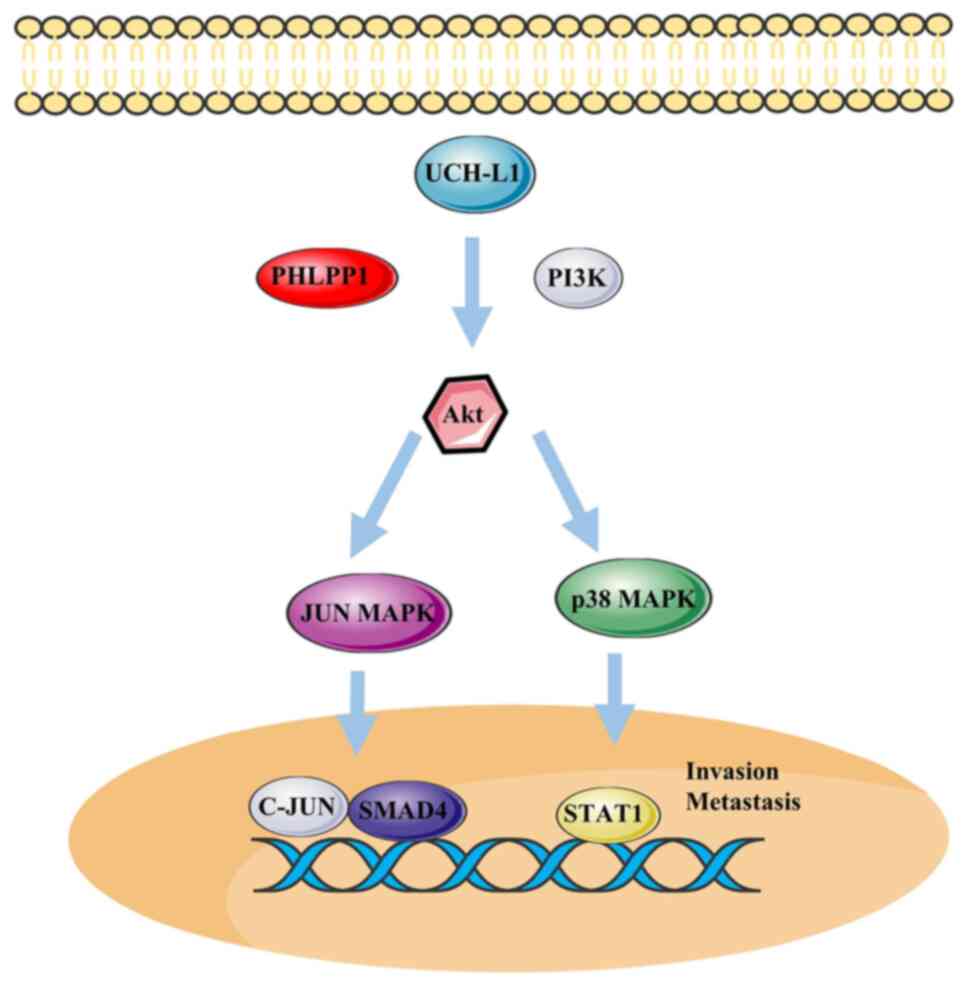
|
Mata-Cantero L, Lobato-Gil S, Aillet F,
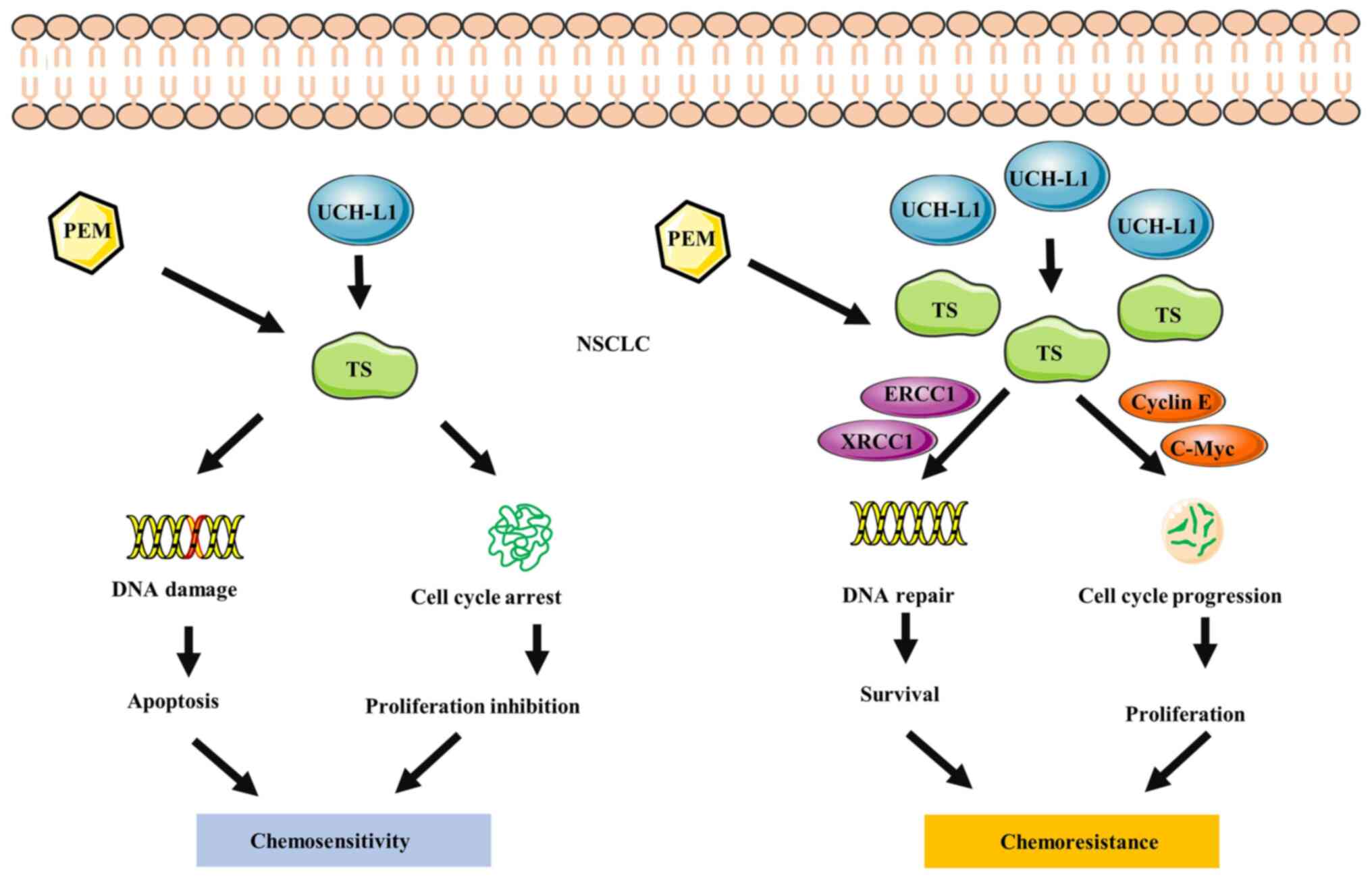
Lang V and Rodriguez MS: The ubiquitin-proteasome system (UPS) as a
cancer drug target: Emerging mechanisms and therapeutics. Springer;
Netherlands, Dordrecht: pp. 225–264. 2014
|
|
4
|
Komander D, Clague MJ and Urbé S: Breaking
the chains: Structure and function of the deubiquitinases. Nat Rev
Mol Cell Bio. 10:550–563. 2009. View Article : Google Scholar : PubMed/NCBI
|
|
5
|
Das C, Hoang QQ, Kreinbring CA, Luchansky
SJ, Meray RK, Ray SS, Lansbury PT, Ringe D and Petsko GA:
Structural basis for conformational plasticity of the Parkinson's
disease-associated ubiquitin hydrolase UCH-L1. Proc Natl Acad Sci
USA. 103:4675–4680. 2006. View Article : Google Scholar : PubMed/NCBI
|
|
6
|
Setsuie R and Wada K: The functions of
UCH-L1 and its relation to neurodegenerative diseases. Neurochem
Int. 51:105–111. 2007. View Article : Google Scholar : PubMed/NCBI
|
|
7
|
Doran JF, Jackson P, Kynoch PA and
Thompson RJ: Isolation of PGP 9.5, a new human neurone-specific
protein detected by high-resolution two-dimensional
electrophoresis. J Neurochem. 40:1542–1547. 1983. View Article : Google Scholar : PubMed/NCBI
|
|
8
|
Day INM and Thompson RJ: UCHL1 (PGP 9.5):
Neuronal biomarker and ubiquitin system protein. Prog Neurobiol.
90:327–362. 2010. View Article : Google Scholar : PubMed/NCBI
|
|
9
|
Bishop P, Rocca D and Henley JM: Ubiquitin
C-terminal hydrolase L1 (UCH-L1): Structure, distribution and roles
in brain function and dysfunction. Biochem J. 473:2453–2462. 2016.
View Article : Google Scholar : PubMed/NCBI
|
|
10
|
Wang KK, Yang Z, Sarkis G, Torres I and
Raghavan V: Ubiquitin C-terminal hydrolase-L1 (UCH-L1) as a
therapeutic and diagnostic target in neurodegeneration, neurotrauma
and neuro-injuries. Expert Opin Ther Targets. 21:627–638. 2017.
View Article : Google Scholar : PubMed/NCBI
|
|
11
|
Gong B and Leznik E: The role of ubiquitin
C-terminal hydrolase L1 in neurodegenerative disorders. Drug News
Perspect. 20:365–370. 2007. View Article : Google Scholar : PubMed/NCBI
|
|
12
|
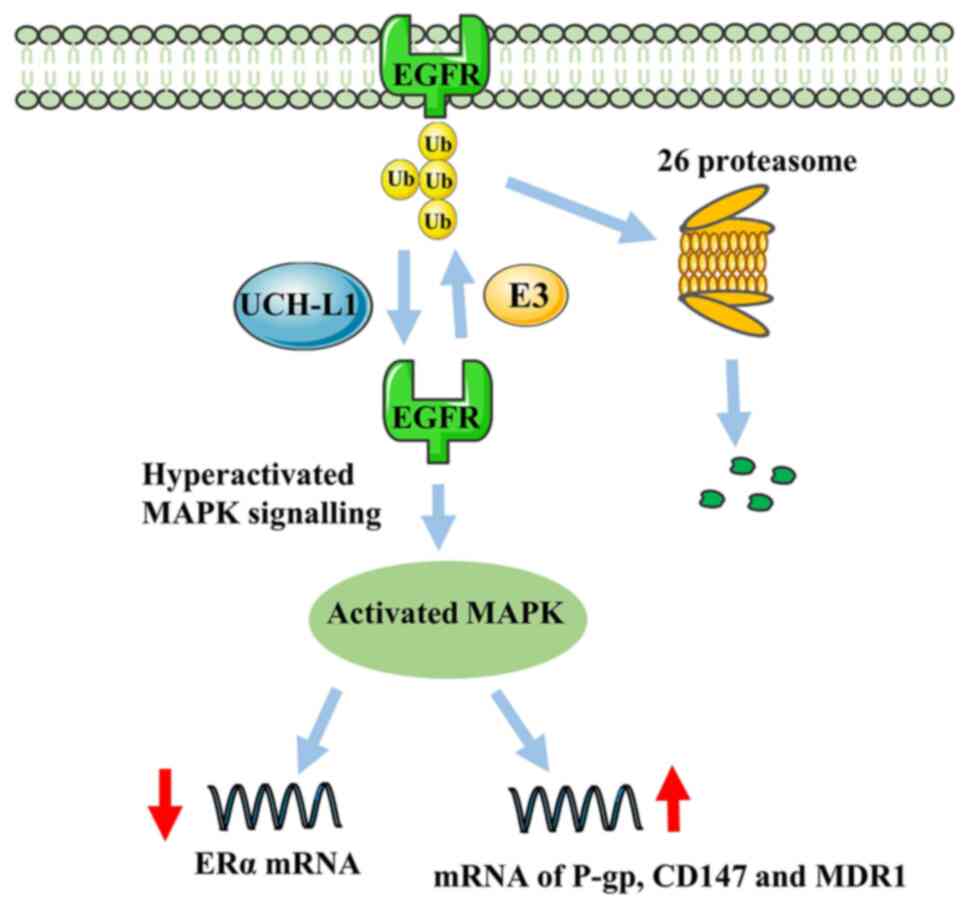
Butterfield DA: Ubiquitin
carboxyl-terminal hydrolase L-1 in brain: Focus on its
oxidative/nitrosative modification and role in brains of subjects
with Alzheimer disease and mild cognitive impairment. Free Radic
Biol Med. 177:278–286. 2021. View Article : Google Scholar : PubMed/NCBI
|
|
13
|
Matuszczak E, Tylicka M, Komarowska MD,
Debek W and Hermanowicz A: Ubiquitin carboxy-terminal hydrolase
L1-physiology and pathology. Cell Biochem Funct. 38:533–540. 2020.
View Article : Google Scholar : PubMed/NCBI
|
|
14
|
Fang Y and Shen X: Ubiquitin
carboxyl-terminal hydrolases: Involvement in cancer progression and
clinical implications. Cancer Metast Rev. 36:669–682. 2017.
View Article : Google Scholar : PubMed/NCBI
|
|
15
|
Fang Y, Fu D and Shen X: The potential
role of ubiquitin c-terminal hydrolases in oncogenesis. Biochim
Biophys Acta. 1806:1–6. 2010.PubMed/NCBI
|
|
16
|
Ning K, Wang T, Sun X, Zhang P, Chen Y,
Jin J and Hua D: UCH-L1-containing exosomes mediate
chemotherapeutic resistance transfer in breast cancer. J Surg
Oncol. 115:932–940. 2017. View Article : Google Scholar : PubMed/NCBI
|
|
17
|
Luo Y, He J, Yang C, Orange M, Ren X,
Blair N, Tan T, Yang JM and Zhu H: UCH-L1 promotes invasion of
breast cancer cells through activating Akt signaling pathway. J
Cell Biochem. 119:691–700. 2018. View Article : Google Scholar : PubMed/NCBI
|
|
18
|
Sharma A, Liu H, Tobar-Tosse F, Chand
Dakal T, Ludwig M, Holz FG, Loeffler KU, Wüllner U and Herwig-Carl
MC: Ubiquitin carboxyl-terminal hydrolases (UCHs): Potential
mediators for cancer and neurodegeneration. Int J Mol Sci.
21:39102020. View Article : Google Scholar : PubMed/NCBI
|
|
19
|
Ding X, Gu Y, Jin M, Guo X, Xue S, Tan C,
Huang J, Yang W, Xue M, Zhou Q, et al: The deubiquitinating enzyme
UCHL1 promotes resistance to pemetrexed in non-small cell lung
cancer by upregulating thymidylate synthase. Theranostics.
10:6048–6060. 2020. View Article : Google Scholar : PubMed/NCBI
|
|
20
|
Tokumaru Y, Yamashita K, Kim MS, Park HL,
Osada M, Mori M and Sidransky D: The role of PGP9.5 as a tumor
suppressor gene in human cancer. Int J Cancer. 123:753–759. 2008.
View Article : Google Scholar : PubMed/NCBI
|
|
21
|
Mandelker DL, Yamashita K, Tokumaru Y,
Mimori K, Howard DL, Tanaka Y, Carvalho AL, Jiang WW, Park HL, Kim
MS, et al: PGP9.5 promoter methylation is an independent prognostic
factor for esophageal squamous cell carcinoma. Cancer Res.
65:4963–4968. 2005. View Article : Google Scholar : PubMed/NCBI
|
|
22
|
Yamashita K, Park HL, Kim MS, Osada M,
Tokumaru Y, Inoue H, Mori M and Sidransky D: PGP9.5 methylation in
diffuse-type gastric cancer. Cancer Res. 66:3921–3927. 2006.
View Article : Google Scholar : PubMed/NCBI
|
|
23
|
Okochi-Takada E, Nakazawa K, Wakabayashi
M, Mori A, Ichimura S, Yasugi T and Ushijima T: Silencing of the
UCHL1 gene in human colorectal and ovarian cancers. Int J Cancer.
119:1338–1344. 2006. View Article : Google Scholar : PubMed/NCBI
|
|
24
|
Kagara I, Enokida H, Kawakami K, Matsuda
R, Toki K, Nishimura H, Chiyomaru T, Tatarano S, Itesako T,
Kawamoto K, et al: CpG hypermethylation of the UCHL1 gene promoter
is associated with pathogenesis and poor prognosis in renal cell
carcinoma. J Urol. 180:343–351. 2008. View Article : Google Scholar : PubMed/NCBI
|
|
25
|
Yu J, Tao Q, Cheung KF, Jin H, Poon FF,
Wang X, Li H, Cheng YY, Röcken C, Ebert MPA, et al: Epigenetic
identification of ubiquitin carboxyl-terminal hydrolase L1 as a
functional tumor suppressor and biomarker for hepatocellular
carcinoma and other digestive tumors. Hepatology. 48:508–518. 2008.
View Article : Google Scholar : PubMed/NCBI
|
|
26
|
Xiang T, Li L, Yin X, Yuan C, Tan C, Su X,
Xiong L, Putti TC, Oberst M, Kelly K, et al: The ubiquitin
peptidase UCHL1 induces G0/G1 cell cycle arrest and apoptosis
through stabilizing p53 and is frequently silenced in breast
cancer. PLoS One. 7:e297832012. View Article : Google Scholar : PubMed/NCBI
|
|
27
|
Finnerty BM, Moore MD, Verma A, Aronova A,
Huang S, Edwards DP, Chen Z, Seandel M, Scognamiglio T, Du YN, et
al: UCHL1 loss alters the cell-cycle in metastatic pancreatic
neuroendocrine tumors. Endocr Relat Cancer. 26:411–423. 2019.
View Article : Google Scholar : PubMed/NCBI
|
|
28
|
Zhao Y, Lei Y, He SW, Li YQ, Wang YQ, Hong
XH, Liang YL, Li JY, Chen Y, Luo WJ, et al: Hypermethylation of
UCHL1 promotes metastasis of nasopharyngeal carcinoma by
suppressing degradation of cortactin (CTTN). Cells. 9:5592020.
View Article : Google Scholar : PubMed/NCBI
|
|
29
|
Liu S, González-Prieto R, Zhang M, Geurink
PP, Kooij R, Iyengar PV, van Dinther M, Bos E, Zhang X, Le Dévédec
SE, et al: Deubiquitinase activity profiling identifies UCHL1 as a
candidate oncoprotein that promotes TGFβ-induced breast cancer
metastasis. Clin Cancer Res. 26:1460–1473. 2020. View Article : Google Scholar : PubMed/NCBI
|
|
30
|
Shimada Y, Kudo Y, Maehara S, Matsubayashi
J, Otaki Y, Kajiwara N, Ohira T, Minna JD and Ikeda N: Ubiquitin
C-terminal hydrolase-L1 has prognostic relevance and is a
therapeutic target for high-grade neuroendocrine lung cancers.
Cancer Sci. 111:610–620. 2020. View Article : Google Scholar : PubMed/NCBI
|
|
31
|
Hussain S, Foreman O, Perkins SL, Witzig
TE, Miles RR, van Deursen J and Galardy PJ: The de-ubiquitinase
UCH-L1 is an oncogene that drives the development of lymphoma in
vivo by deregulating PHLPP1 and Akt signaling. Leukemia.
24:1641–1655. 2010. View Article : Google Scholar : PubMed/NCBI
|
|
32
|
Howell VM, Gill A, Clarkson A, Nelson AE,
Dunne R, Delbridge LW, Robinson BG, Teh BT, Gimm O and Marsh DJ:
Accuracy of combined protein gene product 9.5 and parafibromin
markers for immunohistochemical diagnosis of parathyroid carcinoma.
J Clin Endocrinol Metab. 94:434–441. 2009. View Article : Google Scholar : PubMed/NCBI
|
|
33
|
Kim HJ, Kim YM, Lim S, Nam YK, Jeong J,
Kim HJ and Lee KJ: Ubiquitin C-terminal hydrolase-L1 is a key
regulator of tumor cell invasion and metastasis. Oncogene.
28:117–127. 2009. View Article : Google Scholar : PubMed/NCBI
|
|
34
|
Mastoraki A, Ioannidis E, Patsouris E,
Safioleas M and Aroni K: PGP 9.5 expression in cutaneous
keratoacanthomas and squamous cell carcinomas. Arch Dermatol Res.
301:653–658. 2009. View Article : Google Scholar : PubMed/NCBI
|
|
35
|
Zheng S, Qiao G, Min D, Zhang Z, Lin F,
Yang Q, Feng T, Tang L, Sun Y, Zhao H, et al: Heterogeneous
expression and biological function of ubiquitin carboxy-terminal
hydrolase-L1 in osteosarcoma. Cancer Lett. 359:36–46. 2015.
View Article : Google Scholar : PubMed/NCBI
|
|
36
|
Kwan SY, Au-Yeung CL, Yeung TL,
Rynne-Vidal A, Wong KK, Risinger JI, Lin HK, Schmandt RE, Yates MS,
Mok SC and Lu KH: Ubiquitin carboxyl-terminal hydrolase L1 (UCHL1)
promotes uterine serous cancer cell proliferation and cell cycle
progression. Cancers (Basel). 12:1182020. View Article : Google Scholar : PubMed/NCBI
|
|
37
|
Gu Y, Lv F, Xue M, Chen K, Cheng C, Ding
X, Jin M, Xu G, Zhang Y, Wu Z, et al: The deubiquitinating enzyme
UCHL1 is a favorable prognostic marker in neuroblastoma as it
promotes neuronal differentiation. J Exp Clin Canc Res. 37:2582018.
View Article : Google Scholar : PubMed/NCBI
|
|
38
|
Luchansky SJ, Lansbury PT Jr and Stein RL:
Substrate recognition and catalysis by UCH-L1. Biochemistry.
45:14717–14725. 2006. View Article : Google Scholar : PubMed/NCBI
|
|
39
|
Leroy E, Boyer R, Auburger G, Leube B, Ulm
G, Mezey E, Harta G, Brownstein MJ, Jonnalagada S, Chernova T, et
al: The ubiquitin pathway in Parkinson's disease. Nature.
395:451–452. 1998. View
Article : Google Scholar : PubMed/NCBI
|
|
40
|
Sekiguchi S, Kwon J, Yoshida E, Hamasaki
H, Ichinose S, Hideshima M, Kuraoka M, Takahashi A, Ishii Y, Kyuwa
S, et al: Localization of ubiquitin C-terminal hydrolase L1 in
mouse ova and its function in the plasma membrane to block
polyspermy. Am J Pathol. 169:1722–1729. 2006. View Article : Google Scholar : PubMed/NCBI
|
|
41
|
Day IN and Thompson RJ: Molecular cloning
of cDNA coding for human PGP 9.5 protein. A novel cytoplasmic
marker for neurones and neuroendocrine cells. FEBS Lett.
210:157–160. 1987. View Article : Google Scholar : PubMed/NCBI
|
|
42
|
Larsen CN, Krantz BA and Wilkinson KD:
Substrate specificity of deubiquitinating enzymes: Ubiquitin
C-terminal hydrolases. Biochemistry. 37:3358–3368. 1998. View Article : Google Scholar : PubMed/NCBI
|
|
43
|
Esteve-Rudd J, Campello L, Herrero MT,
Cuenca N and Martin-Nieto J: Expression in the mammalian retina of
parkin and UCH-L1, two components of the ubiquitin-proteasome
system. Brain Res. 1352:70–82. 2010. View Article : Google Scholar : PubMed/NCBI
|
|
44
|
Liu Y, Wu J, Wu H, Wang T, Gan H, Zhang X,
Liu Y, Li R, Zhao Z, Chen Q, et al: UCH-L1 expression of podocytes
in diseased glomeruli and in vitro. J Pathol. 217:642–653. 2009.
View Article : Google Scholar : PubMed/NCBI
|
|
45
|
Johnston SC, Larsen CN, Cook WJ, Wilkinson
KD and Hill CP: Crystal structure of a deubiquitinating enzyme
(human UCH-L3) at 1.8 A resolution. EMBO J. 16:3787–3796. 1997.
View Article : Google Scholar : PubMed/NCBI
|
|
46
|
Grabbe C, Husnjak K and Dikic I: The
spatial and temporal organization of ubiquitin networks. Nat Rev
Mol Cell Biol. 12:295–307. 2011. View Article : Google Scholar : PubMed/NCBI
|
|
47
|
Zhang M, Cai F, Zhang S, Zhang S and Song
W: Overexpression of ubiquitin carboxyl-terminal hydrolase L1
(UCHL1) delays Alzheimer's progression in vivo. Sci Rep.
4:72982014. View Article : Google Scholar : PubMed/NCBI
|
|
48
|
Suong DN, Thao DT, Masamitsu Y and Thuoc
TL: Ubiquitin carboxyl hydrolase L1 significance for human
diseases. Protein Pept Lett. 21:624–630. 2014. View Article : Google Scholar : PubMed/NCBI
|
|
49
|
Wilkinson KD, Lee KM, Deshpande S,
Duerksen-Hughes P, Boss JM and Pohl J: The neuron-specific protein
PGP 9.5 is a ubiquitin carboxyl-terminal hydrolase. Science.
246:670–673. 1989. View Article : Google Scholar : PubMed/NCBI
|
|
50
|
Zhong J, Zhao M, Ma Y, Luo Q, Liu J, Wang
J, Yuan X, Sang J and Huang C: UCHL1 acts as a colorectal cancer
oncogene via activation of the β-catenin/TCF pathway through its
deubiquitinating activity. Int J Mol Med. 30:430–436. 2012.
View Article : Google Scholar : PubMed/NCBI
|
|
51
|
Bheda A, Yue W, Gullapalli A, Whitehurst
C, Liu R, Pagano JS and Shackelford J: Positive reciprocal
regulation of ubiquitin C-terminal hydrolase L1 and
beta-catenin/TCF signaling. PLoS One. 4:e59552009. View Article : Google Scholar : PubMed/NCBI
|
|
52
|
Takami Y, Nakagami H, Morishita R, Katsuya
T, Cui TX, Ichikawa T, Saito Y, Hayashi H, Kikuchi Y, Nishikawa T,
et al: Ubiquitin carboxyl-terminal hydrolase L1, a novel
deubiquitinating enzyme in the vasculature, attenuates NF-kappaB
activation. Arterioscler Thromb Vasc Biol. 27:2184–2190. 2007.
View Article : Google Scholar : PubMed/NCBI
|
|
53
|
Zhang H, Sun Y, Hu R, Luo W, Mao X, Zhao
Z, Chen Q and Zhang Z: The regulation of the UCH-L1 gene by
transcription factor NF-κB in podocytes. Cell Signal. 25:1574–1585.
2013. View Article : Google Scholar : PubMed/NCBI
|
|
54
|
Nagata A, Itoh F, Sasho A, Sugita K,
Suzuki R, Hinata H, Shimoda Y, Suzuki E, Maemoto Y, Inagawa T, et
al: The evolutionarily conserved deubiquitinase UBH1/UCH-L1
augments DAF7/TGF-β signaling, inhibits dauer larva formation, and
enhances lung tumorigenesis. J Biol Chem. 295:9105–9120. 2020.
View Article : Google Scholar : PubMed/NCBI
|
|
55
|
Liu Y, Fallon L, Lashuel HA, Liu Z and
Lansbury PT Jr: The UCH-L1 gene encodes two opposing enzymatic
activities that affect alpha-synuclein degradation and Parkinson's
disease susceptibility. Cell. 111:209–218. 2002. View Article : Google Scholar : PubMed/NCBI
|
|
56
|
Chuma M, Sakamoto M, Yasuda J, Fujii G,
Nakanishi K, Tsuchiya A, Ohta T, Asaka M and Hirohashi S:
Overexpression of cortactin is involved in motility and metastasis
of hepatocellular carcinoma. J Hepatol. 41:629–636. 2004.
View Article : Google Scholar : PubMed/NCBI
|
|
57
|
Osaka H, Wang YL, Takada K, Takizawa S,
Setsuie R, Li H, Sato Y, Nishikawa K, Sun YJ, Sakurai M, et al:
Ubiquitin carboxy-terminal hydrolase L1 binds to and stabilizes
monoubiquitin in neuron. Hum Mol Genet. 12:1945–1958. 2003.
View Article : Google Scholar : PubMed/NCBI
|
|
58
|
Kabuta T, Mitsui T, Takahashi M, Fujiwara
Y, Kabuta C, Konya C, Tsuchiya Y, Hatanaka Y, Uchida K, Hohjoh H
and Wada K: Ubiquitin C-terminal hydrolase L1 (UCH-L1) acts as a
novel potentiator of cyclin-dependent kinases to enhance cell
proliferation independently of its hydrolase activity. J Biol Chem.
288:12615–12626. 2013. View Article : Google Scholar : PubMed/NCBI
|
|
59
|
Hussain S, Bedekovics T, Ali A, Zaid O,
May DG, Roux KJ and Galardy PJ: A cysteine near the C-terminus of
UCH-L1 is dispensable for catalytic activity but is required to
promote AKT phosphorylation, eIF4F assembly, and malignant B-cell
survival. Cell Death Discov. 5:1522019. View Article : Google Scholar : PubMed/NCBI
|
|
60
|
Fulga TA, Elson-Schwab I, Khurana V,
Steinhilb ML, Spires TL, Hyman BT and Feany MB: Abnormal bundling
and accumulation of F-actin mediates tau-induced neuronal
degeneration in vivo. Nat Cell Biol. 9:139–148. 2007. View Article : Google Scholar : PubMed/NCBI
|
|
61
|
Xie M, Han Y, Yu Q, Wang X, Wang S and
Liao X: UCH-L1 inhibition decreases the microtubule-binding
function of tau protein. J Alzheimers Dis. 49:353–363. 2016.
View Article : Google Scholar : PubMed/NCBI
|
|
62
|
Yu Q, Zhang H, Li Y, Liu C, Wang S and
Liao X: UCH-L1 inhibition suppresses tau aggresome formation during
proteasomal impairment. Mol Neurobiol. 55:3812–3821.
2018.PubMed/NCBI
|
|
63
|
Bheda A, Gullapalli A, Caplow M, Pagano JS
and Shackelford J: Ubiquitin editing enzyme UCH L1 and microtubule
dynamics: Implication in mitosis. Cell Cycle. 9:980–994. 2010.
View Article : Google Scholar : PubMed/NCBI
|
|
64
|
Seo EY, Jin SP, Sohn KC, Park CH, Lee DH
and Chung JH: UCHL1 regulates melanogenesis through controlling
MITF stability in human melanocytes. J Invest Dermatol.
137:1757–1765. 2017. View Article : Google Scholar : PubMed/NCBI
|
|
65
|
Rolén U, Freda E, Xie J, Pfirrmann T,
Frisan T and Masucci MG: The ubiquitin C-terminal hydrolase UCH-L1
regulates B-cell proliferation and integrin activation. J Cell Mol
Med. 13:1666–1678. 2009. View Article : Google Scholar : PubMed/NCBI
|
|
66
|
Lohmann F, Sachs M, Meyer TN, Sievert H,
Lindenmeyer MT, Wiech T, Cohen CD, Balabanov S, Stahl RA and
Meyer-Schwesinger C: UCH-L1 induces podocyte hypertrophy in
membranous nephropathy by protein accumulation. Biochim Biophys
Acta. 1842:945–958. 2014. View Article : Google Scholar : PubMed/NCBI
|
|
67
|
Li L, Tao Q, Jin H, van Hasselt A, Poon
FF, Wang X, Zeng MS, Jia WH, Zeng YX, Chan AT and Cao Y: The tumor
suppressor UCHL1 forms a complex with p53/MDM2/ARF to promote p53
signaling and is frequently silenced in nasopharyngeal carcinoma.
Clin Cancer Res. 16:2949–2958. 2010. View Article : Google Scholar : PubMed/NCBI
|
|
68
|
Goto Y, Zeng L, Yeom CJ, Zhu Y, Morinibu
A, Shinomiya K, Kobayashi M, Hirota K, Itasaka S, Yoshimura M, et
al: UCHL1 provides diagnostic and antimetastatic strategies due to
its deubiquitinating effect on HIF-1α. Nat Commun. 6:61532015.
View Article : Google Scholar : PubMed/NCBI
|
|
69
|
Gu Y, Yang M, Zhao M, Luo Q, Yang L, Peng
H, Wang J, Huang SK, Zheng ZX, Yuan XH, et al: The de-ubiquitinase
UCHL1 promotes gastric cancer metastasis via the Akt and Erk1/2
pathways. Tumour Biol. 36:8379–8387. 2015. View Article : Google Scholar : PubMed/NCBI
|
|
70
|
Wang G, Zhang W, Zhou B, Jin C, Wang Z,
Yang Y, Wang Z, Chen Y and Feng X: The diagnosis value of promoter
methylation of UCHL1 in the serum for progression of gastric
cancer. Biomed Res Int. 2015:7410302015. View Article : Google Scholar : PubMed/NCBI
|
|
71
|
Seliger B, Handke D, Schabel E, Bukur J,
Lichtenfels R and Dammann R: Epigenetic control of the ubiquitin
carboxyl terminal hydrolase 1 in renal cell carcinoma. J Transl
Med. 7:902009. View Article : Google Scholar : PubMed/NCBI
|
|
72
|
Mitsui Y, Shiina H, Hiraki M, Arichi N,
Hiraoka T, Sumura M, Honda S, Yasumoto H and Igawa M: Tumor
suppressor function of PGP9.5 is associated with epigenetic
regulation in prostate cancer-novel predictor of biochemical
recurrence after radical surgery. Cancer Epidemiol Biomarkers Prev.
21:487–496. 2012. View Article : Google Scholar : PubMed/NCBI
|
|
73
|
Brait M, Maldonado L, Noordhuis MG, Begum
S, Loyo M, Poeta ML, Barbosa A, Fazio VM, Angioli R, Rabitti C, et
al: Association of promoter methylation of VGF and PGP9.5 with
ovarian cancer progression. PLoS One. 8:e708782013. View Article : Google Scholar : PubMed/NCBI
|
|
74
|
Abdelmaksoud-Dammak R, Saadallah-Kallel A,
Miladi-Abdennadher I, Ayedi L, Khabir A, Sallemi-Boudawara T,
Frikha M, Daoud J and Mokdad-Gargouri R: CpG methylation of
ubiquitin carboxyl-terminal hydrolase 1 (UCHL1) and P53 mutation
pattern in sporadic colorectal cancer. Tumour Biol. 37:1707–1714.
2016. View Article : Google Scholar : PubMed/NCBI
|
|
75
|
Nanok C, Jearanaikoon P, Proungvitaya S
and Limpaiboon T: Aberrant methylation of HTATIP2 and UCHL1 as a
predictive biomarker for cholangiocarcinoma. Mol Med Rep.
17:4145–4153. 2018.PubMed/NCBI
|
|
76
|
Jaferian S, Soleymaninejad M and Daraee H:
Verapamil (VER) enhances the cytotoxic effects of docetaxel and
vinblastine combined therapy against non-small cell lung cancer
cell lines. Drug Res (Stuttg). 68:146–152. 2018. View Article : Google Scholar : PubMed/NCBI
|
|
77
|
Ge N, Yang GS, Zhang TY, Chang N, Kang YH,
Zhou Q and Fan PS: Upregulation of KCNMA1 facilitates the reversal
effect of verapamil on the chemoresistance to cisplatin of
esophageal squamous cell carcinoma cells. Eur Rev Med Pharmacol
Sci. 25:1869–1880. 2021.PubMed/NCBI
|
|
78
|
Li P, Zhong D and Gong PY: Synergistic
effect of paclitaxel and verapamil to overcome multi-drug
resistance in breast cancer cells. Biochem Biophys Res Commun.
516:183–188. 2019. View Article : Google Scholar : PubMed/NCBI
|
|
79
|
Yang G, Fan G, Zhang T, Ma K, Huang J, Liu
M, Teng X, Xu K, Fan P and Cheng D: Upregulation of ubiquitin
carboxyl-terminal hydrolase L1 (UCHL1) mediates the reversal effect
of verapamil on chemo-resistance to adriamycin of hepatocellular
carcinoma. Med Sci Monit. 24:2072–2082. 2018. View Article : Google Scholar : PubMed/NCBI
|
|
80
|
Wang WJ, Li QQ, Xu JD, Cao XX, Li HX, Tang
F, Chen Q, Yang JM, Xu ZD and Liu XP: Over-expression of ubiquitin
carboxy terminal hydrolase-L1 induces apoptosis in breast cancer
cells. Int J Oncol. 33:1037–1045. 2008.PubMed/NCBI
|
|
81
|
Maroufi F, Maali A, Abdollahpour-Alitappeh
M, Ahmadi MH and Azad M: CRISPR-mediated modification of DNA
methylation pattern in the new era of cancer therapy. Epigenomics.
12:1845–1859. 2020. View Article : Google Scholar : PubMed/NCBI
|
|
82
|
Moore MD, Finnerty B, Gray KD, Hoda R, Liu
Y, Soong L, Beninato T, Rao R, Zarnegar R and Fahey TJ III:
Decreased UCHL1 expression as a cytologic biomarker for aggressive
behavior in pancreatic neuroendocrine tumors. Surgery. 163:226–231.
2018. View Article : Google Scholar : PubMed/NCBI
|
|
83
|
Scully OJ, Bay BH, Yip G and Yu Y: Breast
cancer metastasis. Cancer Genomics Proteomics. 9:311–320.
2012.PubMed/NCBI
|
|
84
|
Miyoshi Y, Nakayama S, Torikoshi Y, Tanaka
S, Ishihara H, Taguchi T, Tamaki Y and Noguchi S: High expression
of ubiquitin carboxy-terminal hydrolase-L1 and -L3 mRNA predicts
early recurrence in patients with invasive breast cancer. Cancer
Sci. 97:523–529. 2006. View Article : Google Scholar : PubMed/NCBI
|
|
85
|
Schröder C, Milde-Langosch K, Gebauer F,
Schmid K, Mueller V, Wirtz RM, Meyer-Schwesinger C, Schlüter H,
Sauter G and Schumacher U: Prognostic relevance of ubiquitin
C-terminal hydrolase L1 (UCH-L1) mRNA and protein expression in
breast cancer patients. J Cancer Res Clin. 139:1745–1755. 2013.
View Article : Google Scholar : PubMed/NCBI
|
|
86
|
Wang W, Zou L, Zhou D, Zhou Z, Tang F, Xu
Z and Liu X: Overexpression of ubiquitin carboxyl terminal
hydrolase-L1 enhances multidrug resistance and invasion/metastasis
in breast cancer by activating the MAPK/Erk signaling pathway. Mol
Carcinog. 55:1329–1342. 2016. View Article : Google Scholar : PubMed/NCBI
|
|
87
|
Dongre A and Weinberg RA: New insights
into the mechanisms of epithelial-mesenchymal transition and
implications for cancer. Nat Rev Mol Cell Biol. 20:69–84. 2019.
View Article : Google Scholar : PubMed/NCBI
|
|
88
|
Jin Y, Zhang W, Xu J, Wang H, Zhang Z, Chu
C, Liu X and Zou Q: UCH-L1 involved in regulating the degradation
of EGFR and promoting malignant properties in drug-resistant breast
cancer. Int J Clin Exp Patho. 8:12500–12508. 2015.PubMed/NCBI
|
|
89
|
Li QQ, Wang WJ, Xu JD, Cao XX, Chen Q,
Yang JM and Xu ZD: Up-regulation of CD147 and matrix
metalloproteinase-2, −9 induced by P-glycoprotein substrates in
multidrug resistant breast cancer cells. Cancer Sci. 98:1767–1774.
2007. View Article : Google Scholar : PubMed/NCBI
|
|
90
|
Chen XS, Wang KS, Guo W, Li LY, Yu P, Sun
XY, Wang HY, Guan YD, Tao YG, Ding BN, et al: UCH-L1-mediated
down-regulation of estrogen receptor α contributes to insensitivity
to endocrine therapy for breast cancer. Theranostics. 10:1833–1848.
2020. View Article : Google Scholar : PubMed/NCBI
|
|
91
|
Rochefort H, Glondu M, Sahla ME, Platet N
and Garcia M: How to target estrogen receptor-negative breast
cancer? Endocr Relat Cancer. 10:261–266. 2003. View Article : Google Scholar : PubMed/NCBI
|
|
92
|
Mondal M, Conole D, Nautiyal J and Tate
EW: UCHL1 as a novel target in breast cancer: Emerging insights
from cell and chemical biology. Br J Cancer. 126:24–33. 2022.
View Article : Google Scholar : PubMed/NCBI
|
|
93
|
Yu J, Yu S, Jia M, Sun PL and Gao H:
Ubiquitin C-terminal hydrolase-L1 expression in non-small-cell lung
cancer and its association with clinicopathological features and
prognosis. Virchows Arch. 480:577–585. 2022. View Article : Google Scholar : PubMed/NCBI
|
|
94
|
Sanmamed MF and Chen L: A paradigm shift
in cancer immunotherapy: From enhancement to normalization. Cell.
175:313–326. 2018. View Article : Google Scholar : PubMed/NCBI
|
|
95
|
Mao R, Tan X, Xiao Y, Wang X, Wei Z, Wang
J, Wang X, Zhou H, Zhang L and Shi Y: Ubiquitin C-terminal
hydrolase L1 promotes expression of programmed cell death-ligand 1
in non-small-cell lung cancer cells. Cancer Sci. 111:3174–3183.
2020. View Article : Google Scholar : PubMed/NCBI
|
|
96
|
Hussain S, Bedekovics T, Liu Q, Hu W, Jeon
H, Johnson SH, Vasmatzis G, May DG, Roux KJ and Galardy PJ: UCH-L1
bypasses mTOR to promote protein biosynthesis and is required for
MYC-driven lymphomagenesis in mice. Blood. 132:2564–2574. 2018.
View Article : Google Scholar : PubMed/NCBI
|
|
97
|
Bedekovics T, Hussain S, Feldman AL and
Galardy PJ: UCH-L1 is induced in germinal center B cells and
identifies patients with aggressive germinal center diffuse large
B-cell lymphoma. Blood. 127:1564–1574. 2016. View Article : Google Scholar : PubMed/NCBI
|
|
98
|
Sui R and Piao HZ: UCHL1 enhances the
malignant development of glioma via targeting GAS2. Eur Rev Med
Pharmacol Sci. 24:6195–6203. 2020.PubMed/NCBI
|
|
99
|
Nakao K, Hirakawa T, Suwa H, Kogure K,
Ikeda S, Yamashita S, Minegishi T and Kishi H: High expression of
ubiquitin C-terminal hydrolase L1 Is associated with poor prognosis
in endometrial cancer patients. Int J Gynecol Cancer. 28:675–683.
2018. View Article : Google Scholar : PubMed/NCBI
|
|
100
|
Jang MJ, Baek SH and Kim JH: UCH-L1
promotes cancer metastasis in prostate cancer cells through EMT
induction. Cancer Lett. 302:128–135. 2011. View Article : Google Scholar : PubMed/NCBI
|
|
101
|
Rashid M, Zadeh LR, Baradaran B, Molavi O,
Ghesmati Z, Sabzichi M and Ramezani F: Up-down regulation of HIF-1α
in cancer progression. Gene. 798:1457962021. View Article : Google Scholar : PubMed/NCBI
|
|
102
|
Li X, Hattori A, Takahashi S, Goto Y,
Harada H and Kakeya H: Ubiquitin carboxyl-terminal hydrolase L1
promotes hypoxia-inducible factor 1-dependent tumor cell malignancy
in spheroid models. Cancer Sci. 111:239–252. 2020. View Article : Google Scholar : PubMed/NCBI
|
|
103
|
Kobayashi E, Hwang D, Bheda-Malge A,
Whitehurst CB, Kabanov AV, Kondo S, Aga M, Yoshizaki T, Pagano JS,
Sokolsky M and Shakelford J: Inhibition of UCH-L1 deubiquitinating
activity with two forms of LDN-57444 has anti-invasive effects in
metastatic carcinoma cells. Int J Mol Sci. 20:37332019. View Article : Google Scholar : PubMed/NCBI
|
|
104
|
Liu Y, Lashuel HA, Choi S, Xing X, Case A,
Ni J, Yeh LA, Cuny GD, Stein RL and Lansbury PT Jr: Discovery of
inhibitors that elucidate the role of UCH-L1 activity in the H1299
lung cancer cell line. Chem Biol. 10:837–846. 2003. View Article : Google Scholar : PubMed/NCBI
|
|
105
|
Hussain S, Bedekovics T, Chesi M,
Bergsagel PL and Galardy PJ: UCHL1 is a biomarker of aggressive
multiple myeloma required for disease progression. Oncotarget.
6:40704–40718. 2015. View Article : Google Scholar : PubMed/NCBI
|
|
106
|
D'Arcy P, Wang X and Linder S:
Deubiquitinase inhibition as a cancer therapeutic strategy.
Pharmacol Ther. 147:32–54. 2015. View Article : Google Scholar : PubMed/NCBI
|
|
107
|
Mermerian AH, Case A, Stein RL and Cuny
GD: Structure-activity relationship, kinetic mechanism, and
selectivity for a new class of ubiquitin C-terminal hydrolase-L1
(UCH-L1) inhibitors. Bioorg Med Chem Lett. 17:3729–3732. 2007.
View Article : Google Scholar : PubMed/NCBI
|
|
108
|
Panyain N, Godinat A, Thawani AR,
Lachiondo-Ortega S, Mason K, Elkhalifa S, Smith LM, Harrigan JA and
Tate EW: Activity-based protein profiling reveals deubiquitinase
and aldehyde dehydrogenase targets of a cyanopyrrolidine probe. RSC
Med Chem. 12:1935–1943. 2021. View Article : Google Scholar : PubMed/NCBI
|
|
109
|
Krabill AD, Chen H, Hussain S, Feng C,
Abdullah A, Das C, Aryal UK, Post CB, Wendt MK, Galardy PJ and
Flaherty DP: Ubiquitin C-terminal hydrolase L1: Biochemical and
cellular characterization of a covalent cyanopyrrolidine-based
inhibitor. Chembiochem. 21:712–722. 2020. View Article : Google Scholar : PubMed/NCBI
|
|
110
|
Kooij R, Liu S, Sapmaz A, Xin BT, Janssen
GMC, van Veelen PA, Ovaa H, Dijke PT and Geurink PP: Small-molecule
activity-based probe for monitoring ubiquitin C-terminal hydrolase
L1 (UCHL1) activity in live cells and zebrafish embryos. J Am Chem
Soc. 142:16825–16841. 2020. View Article : Google Scholar : PubMed/NCBI
|
|
111
|
Berkers CR, van Leeuwen FW, Groothuis TA,
Peperzak V, van Tilburg EW, Borst J, Neefjes JJ and Ovaa H:
Profiling proteasome activity in tissue with fluorescent probes.
Mol Pharm. 4:739–748. 2007. View Article : Google Scholar : PubMed/NCBI
|
|
112
|
Panyain N, Godinat A, Lanyon-Hogg T,
Lachiondo-Ortega S, Will EJ, Soudy C, Mondal M, Mason K, Elkhalifa
S, Smith LM, et al: Discovery of a potent and selective covalent
inhibitor and activity-based probe for the deubiquitylating enzyme
UCHL1, with antifibrotic activity. J Am Chem Soc. 142:12020–12026.
2020. View Article : Google Scholar : PubMed/NCBI
|
|
113
|
Roy B, Zhao J, Yang C, Luo W, Xiong T, Li
Y, Fang X, Gao G, Singh CO, Madsen L, et al: CRISPR/cascade
9-mediated genome editing-challenges and opportunities. Front
Genet. 9:2402018. View Article : Google Scholar : PubMed/NCBI
|
|
114
|
Takano T, Miyauchi A, Matsuzuka F, Yoshida
H, Nakata Y, Kuma K and Amino N: PGP9.5 mRNA could contribute to
the molecular-based diagnosis of medullary thyroid carcinoma. Eur J
Cancer. 40:614–618. 2004. View Article : Google Scholar : PubMed/NCBI
|
|
115
|
Sabapathy K and Lane DP: Therapeutic
targeting of p53: All mutants are equal, but some mutants are more
equal than others. Nat Rev Clin Oncol. 15:13–30. 2018. View Article : Google Scholar : PubMed/NCBI
|
|
116
|
Chibaya L, Karim B, Zhang H and Jones SN:
Mdm2 phosphorylation by Akt regulates the p53 response to oxidative
stress to promote cell proliferation and tumorigenesis. Proc Natl
Acad Sci USA. 118:e20031931182021. View Article : Google Scholar : PubMed/NCBI
|
|
117
|
De S, Campbell C, Venkitaraman AR and
Esposito A: Pulsatile MAPK signaling modulates p53 activity to
control cell fate decisions at the G2 checkpoint for DNA damage.
Cell Rep. 30:2083–2093.e5. 2020. View Article : Google Scholar : PubMed/NCBI
|
|
118
|
Brinkmann K, Zigrino P, Witt A, Schell M,
Ackermann L, Broxtermann P, Schüll S, Andree M, Coutelle O,
Yazdanpanah B, et al: Ubiquitin C-terminal hydrolase-L1 potentiates
cancer chemosensitivity by stabilizing NOXA. Cell Rep. 3:881–891.
2013. View Article : Google Scholar : PubMed/NCBI
|
|
119
|
Kabuta T, Setsuie R, Mitsui T, Kinugawa A,
Sakurai M, Aoki S, Uchida K and Wada K: Aberrant molecular
properties shared by familial Parkinson's disease-associated mutant
UCH-L1 and carbonyl-modified UCH-L1. Hum Mol Genet. 17:1482–1496.
2008. View Article : Google Scholar : PubMed/NCBI
|
|
120
|
Kabuta T, Furuta A, Aoki S, Furuta K and
Wada K: Aberrant interaction between Parkinson disease-associated
mutant UCH-L1 and the lysosomal receptor for chaperone-mediated
autophagy. J Biol Chem. 283:23731–23738. 2008. View Article : Google Scholar : PubMed/NCBI
|
|
121
|
Nishikawa K, Li H, Kawamura R, Osaka H,
Wang YL, Hara Y, Hirokawa T, Manago Y, Amano T, Noda M, et al:
Alterations of structure and hydrolase activity of
parkinsonism-associated human ubiquitin carboxyl-terminal hydrolase
L1 variants. Biochem Biophys Res Commun. 304:176–183. 2003.
View Article : Google Scholar : PubMed/NCBI
|
|
122
|
Duffy MJ, Synnott NC and Crown J: Mutant
p53 in breast cancer: Potential as a therapeutic target and
biomarker. Breast Cancer Res Treat. 170:213–219. 2018. View Article : Google Scholar : PubMed/NCBI
|
|
123
|
Sporikova Z, Koudelakova V, Trojanec R and
Hajduch M: Genetic markers in triple-negative breast cancer. Clin
Breast Cancer. 18:e841–e850. 2018. View Article : Google Scholar : PubMed/NCBI
|
|
124
|
Bazarian JJ, Biberthaler P, Welch RD,
Lewis LM, Barzo P, Bogner-Flatz V, Gunnar Brolinson P, Büki A, Chen
JY, Christenson RH, et al: Serum GFAP and UCH-L1 for prediction of
absence of intracranial injuries on head CT (ALERT-TBI): A
multicentre observational study. Lancet Neurol. 17:782–789. 2018.
View Article : Google Scholar : PubMed/NCBI
|
|
125
|
Meyer-Schwesinger C, Meyer TN, Sievert H,
Hoxha E, Sachs M, Klupp EM, Münster S, Balabanov S, Carrier L,
Helmchen U, et al: Ubiquitin C-terminal hydrolase-l1 activity
induces polyubiquitin accumulation in podocytes and increases
proteinuria in rat membranous nephropathy. Am J Pathol.
178:2044–2057. 2011. View Article : Google Scholar : PubMed/NCBI
|
|
126
|
Fang Y, Li F, Qi C, Mao X, Xu Y, Zhao Z,
Wu H and Zhang Z: Plakoglobin is involved in cytoskeletal
rearrangement of podocytes under the regulation of UCH-L1. Biochem
Biophys Res Commun. 529:112–118. 2020. View Article : Google Scholar : PubMed/NCBI
|
|
127
|
Cui JH and Xie X: UCH-L1 expressed by
podocytes: A potentially therapeutic target for lupus nephritis?
Inflammation. 40:657–665. 2017. View Article : Google Scholar : PubMed/NCBI
|
|
128
|
Xu Y, Gao H, Hu Y, Fang Y, Qi C, Huang J,
Cai X, Wu H, Ding X and Zhang Z: High glucose-induced apoptosis and
necroptosis in podocytes is regulated by UCHL1 via RIPK1/RIPK3
pathway. Exp Cell Res. 382:1114632019. View Article : Google Scholar : PubMed/NCBI
|
|
129
|
Ichikawa T, Li J, Dong X, Potts JD, Tang
D, Li DQ, Li DS and Cui T: Ubiquitin carboxyl terminal hydrolase L1
negatively regulates TNFalpha-mediated vascular smooth muscle cell
proliferation via suppressing ERK activation. Biochem Biophys Res
Commun. 391:852–856. 2010. View Article : Google Scholar : PubMed/NCBI
|
|
130
|
Gao X, Wu L, Wang K, Zhou X, Duan M, Wang
X, Zhang Z and Liu X: Ubiquitin carboxyl terminal hydrolase L1
attenuates TNF-α-mediated vascular smooth muscle cell migration
through suppression of NF-κB activation. Int Heart J. 59:1409–1415.
2018. View Article : Google Scholar : PubMed/NCBI
|
|
131
|
Bi HL, Zhang XL, Zhang YL, Xie X, Xia YL,
Du J and Li HH: The deubiquitinase UCHL1 regulates cardiac
hypertrophy by stabilizing epidermal growth factor receptor. Sci
Adv. 6:eaax48262020. View Article : Google Scholar : PubMed/NCBI
|