|
1
|
Gao S, Fang C, Wang T, Lu W, Wang N, Sun
L, Fang W, Chen Y and Hu R: The effect of ginsenoside Rg3 combined
with chemotherapy on immune function in non-small cell lung cancer:
A systematic review and meta-analysis of randomized controlled
trials. Medicine (Baltimore). 102:e334632023. View Article : Google Scholar : PubMed/NCBI
|
|
2
|
Nakhjavani M, Smith E, Townsend AR, Price
TJ and Hardingham JE: Anti-Angiogenic properties of ginsenoside
Rg3. Molecules. 25:49052020. View Article : Google Scholar : PubMed/NCBI
|
|
3
|
Wang J, Qi F, Wang Z, Zhang Z, Pan N, Huai
L, Qu S and Zhao L: A review of traditional Chinese medicine for
treatment of glioblastoma. Biosci Trends. 13:476–487. 2020.
View Article : Google Scholar : PubMed/NCBI
|
|
4
|
Sun M, Ye Y, Xiao L, Duan X, Zhang Y and
Zhang H: Anticancer effects of ginsenoside Rg3 (Review). Int J Mol
Med. 39:507–518. 2017. View Article : Google Scholar : PubMed/NCBI
|
|
5
|
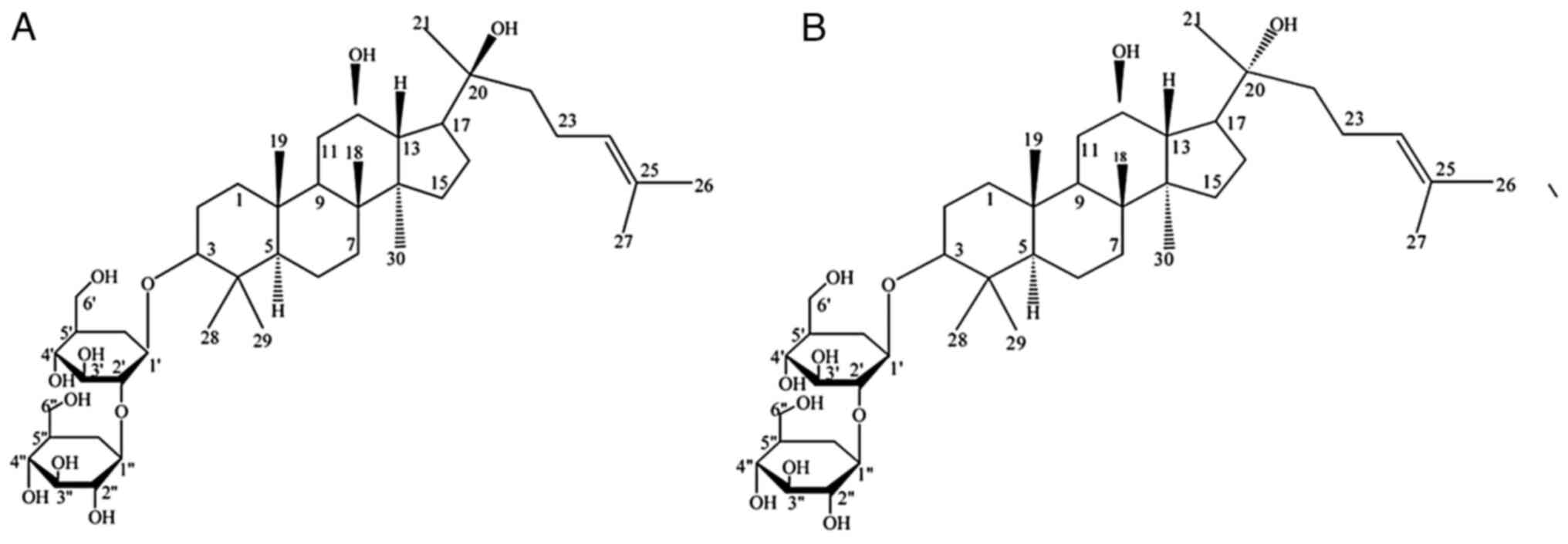
Kim IW, Sun WS, Yun BS, Kim NR, Min D and
Kim SK: Characterizing a full spectrum of physico-chemical
properties of (20S)-and (20R)-ginsenoside Rg3 to be proposed as
standard reference materials. J Ginseng Res. 37:124–134. 2013.
View Article : Google Scholar : PubMed/NCBI
|
|
6
|
Ren Z, Chen X, Hong L, Zhao X, Cui G, Li
A, Liu Y, Zhou L, Sun R, Shen S, et al: Nanoparticle conjugation of
ginsenoside Rg3 inhibits hepatocellular carcinoma development and
metastasis. Small. 16:e19052332020. View Article : Google Scholar : PubMed/NCBI
|
|
7
|
Zhu Y, Liang J, Gao C, Wang A, Xia J, Hong
C, Zhong Z, Zuo Z, Kim J, Ren H, et al: Multifunctional ginsenoside
Rg3-based liposomes for glioma targeting therapy. J Control
Release. 330:641–657. 2021. View Article : Google Scholar : PubMed/NCBI
|
|
8
|
Liu ZL, Chen HH, Zheng LL, Sun LP and Shi
L: Angiogenic signaling pathways and anti-angiogenic therapy for
cancer. Sig Transduct Target Ther. 8:1982023. View Article : Google Scholar : PubMed/NCBI
|
|
9
|
Lugano R, Ramachandran M and Dimberg A:
Tumor angiogenesis: Causes, consequences, challenges and
opportunities. Cell Mol Life Sci. 77:1745–1770. 2020. View Article : Google Scholar : PubMed/NCBI
|
|
10
|
Carmeliet P and Jain RK: Principles and
mechanisms of vessel normalization for cancer and other angiogenic
diseases. Nat Rev Drug Discov. 10:417–427. 2011. View Article : Google Scholar : PubMed/NCBI
|
|
11
|
Kim JW, Jung SY, Kwon YH, Lee SH, Lee JH,
Lee BY and Kwon SM: Ginsenoside Rg3 inhibits endothelial progenitor
cell differentiation through attenuation of VEGF-Dependent Akt/eNOS
signaling. Phytother Res. 26:1286–1293. 2012. View Article : Google Scholar : PubMed/NCBI
|
|
12
|
Zeng D, Wang J, Kong P, Chang C and Li J
and Li J: Ginsenoside Rg3 inhibits HIF-1α and VEGF expression in
patient with acute leukemia via inhibiting the activation of
PI3K/Akt and ERK1/2 pathways. Int J Clin Exp Pathol. 7:2172–2178.
2014.PubMed/NCBI
|
|
13
|
Maniotis AJ, Folberg R, Hess A, Seftor EA,
Gardner LM, Pe'er J, Trent JM, Meltzer PS and Hendrix MJ: Vascular
channel formation by human melanoma cells in vivo and in vitro:
Vasculogenic Mimicry. Am J Pathol. 155:739–752. 1999. View Article : Google Scholar : PubMed/NCBI
|
|
14
|
Delgado-Bellido D, Zamudio-Martínez E,
Fernández-Cortés M, Herrera-Campos AB, Olmedo-Pelayo J, Perez CJ,
Expósito J, de Álava E, Amaral AT, Valle FO, et al: VE-Cadherin
modulates β-catenin/TCF-4 to enhance vasculogenic mimicry. Cell
Death Dis. 14:1352023. View Article : Google Scholar : PubMed/NCBI
|
|
15
|
Zhang F, Lin H, Cao K, Wang H, Pan J,
Zhuang J, Chen X, Huang B, Wang D and Qiu S: Vasculogenic mimicry
plays an important role in adrenocortical carcinoma. Int J Urol.
23:371–377. 2016. View Article : Google Scholar : PubMed/NCBI
|
|
16
|
Williamson SC, Metcalf RL, Trapani F,
Mohan S, Antonello J, Abbott B, Leong HS, Chester CP, Simms N,
Polanski R, et al: Vasculogenic mimicry in small cell lung cancer.
Nat Commun. 7:133222016. View Article : Google Scholar : PubMed/NCBI
|
|
17
|
Li X, Xue Y, Liu X, Zheng J, Shen S, Yang
C, Chen J, Li Z, Liu L, Ma J, et al: ZRANB2/SNHG20/FOXK1 Axis
regulates Vasculogenic mimicry formation in glioma. J Exp Clin
Cancer Res. 38:682019. View Article : Google Scholar : PubMed/NCBI
|
|
18
|
Wang S, Zhang Z, Qian W, Ji D, Wang Q, Ji
B, Zhang Y, Zhang C and Sun Y, Zhu C and Sun Y: Angiogenesis and
vasculogenic mimicry are inhibited by 8-Br-cAMP through activation
of the cAMP/PKA pathway in colorectal cancer. Onco Targets Ther.
11:3765–3774. 2018. View Article : Google Scholar : PubMed/NCBI
|
|
19
|
Xu MR, Wei PF, Suo MZ, Hu Y, Ding W, Su L,
Zhu YD, Song WJ, Tang GH, Zhang M and Li P: Brucine suppresses
vasculogenic mimicry in human triple-negative breast cancer cell
line MDA-MB-231. Biomed Res Int. 2019:65432302019.PubMed/NCBI
|
|
20
|
Treps L, Faure S and Clere N: Vasculogenic
mimicry, a complex and devious process favoring
tumorigenesis-Interest in making it a therapeutic target. Pharmacol
Ther. 223:1078052021. View Article : Google Scholar : PubMed/NCBI
|
|
21
|
Guo JQ, Zheng QH, Chen H, Chen L, Xu JB,
Chen MY, Lu D, Wang ZH, Tong HF and Lin S: Ginsenoside Rg3
inhibition of vasculogenic mimicry in pancreatic cancer through
downregulation of VE-cadherin/EphA2/MMP9/MMP2 expression. Int J
Oncol. 45:1065–1072. 2014. View Article : Google Scholar : PubMed/NCBI
|
|
22
|
Qi L, Song W, Liu Z, Zhao X, Cao W and Sun
B: Wnt3a promotes the vasculogenic mimicry formation of colon
cancer via Wnt/β-Catenin signaling. Int J Mol Sci. 16:18564–18579.
2015. View Article : Google Scholar : PubMed/NCBI
|
|
23
|
Junmin S, Hongxiang L, Zhen L, Chao Y and
Chaojie W: Ginsenoside Rg3 inhibits colon cancer cell migration by
suppressing nuclear factor kappa B activity. J Tradit Chin Med.
35:440–444. 2015. View Article : Google Scholar : PubMed/NCBI
|
|
24
|
Xie Q, Wen H, Zhang Q, Zhou W, Lin X, Xie
D and Liu Y: Inhibiting PI3K-AKt signaling pathway is involved in
antitumor effects of ginsenoside Rg3 in lung cancer cell. Biomed
Pharmacother. 85:16–21. 2017. View Article : Google Scholar : PubMed/NCBI
|
|
25
|
Zhao L, Shou H, Chen L, Gao W, Fang C and
Zhang P: Effects of ginsenoside Rg3 on epigenetic modification in
ovarian cancer cells. Oncol Rep. 41:3209–3218. 2019.PubMed/NCBI
|
|
26
|
Kim H, Ji HW, Kim HW, Yun SH, Park JE and
Kim SJ: Ginsenoside Rg3 prevents oncogenic long noncoding RNA
ATXN8OS from inhibiting tumor-suppressive microRNA-424-5p in breast
cancer cells. Biomolecules. 11:1182021. View Article : Google Scholar : PubMed/NCBI
|
|
27
|
Zhao JY, Yuan XK, Luo RZ, Wang LX, Gu W,
Yamane D and Feng H: Phospholipase A and acyltransferase 4/retinoic
acid receptor responder 3 at the intersection of tumor suppression
and pathogen restriction. Front Immunol. 14:11072392023. View Article : Google Scholar : PubMed/NCBI
|
|
28
|
Liu W, Pan HF, Yang LJ, Zhao ZM, Yuan DS,
Liu YL and Lin LZ: Panax ginseng C.A. Meyer (Rg3) ameliorates
gastric precancerous lesions in Atp4a-/- Mice via inhibition of
glycolysis through PI3K/AKT/miRNA-21 Pathway. Evid Based Complement
Alternat Med. 2020.2672648. 2020.
|
|
29
|
Mao X, Jin Y, Feng T, Wang H, Liu D, Zhou
Z, Yan Q, Yang H, Yang J, Yang J, et al: Ginsenoside Rg3 inhibits
the growth of osteosarcoma and attenuates metastasis through the
Wnt/β-Catenin and EMT signaling pathway. Evid Based Complement
Alternat Med. 2020:60651242020. View Article : Google Scholar : PubMed/NCBI
|
|
30
|
Bian S, Zhao Y, Li F, Lu S, Wang S, Bai X,
Liu M, Zhao D, Wang J and Guo D: 20(S)-Ginsenoside Rg3 Promotes
HeLa Cell Apoptosis by Regulating Autophagy. Molecules.
24:36552019. View Article : Google Scholar : PubMed/NCBI
|
|
31
|
Wu R, Ru Q, Chen L, Ma B and Li C:
Stereospecificity of Ginsenoside Rg3 in the promotion of cellular
immunity in hepatoma H22-Bearing mice. J Food Sci. 79:H1430–H1435.
2014. View Article : Google Scholar : PubMed/NCBI
|
|
32
|
Sun MY, Song YN, Zhang M, Zhang CY, Zhang
LJ and Zhang H: Ginsenoside Rg3 inhibits the migration and invasion
of liver cancer cells by increasing the protein expression of
ARHGAP9. Oncol Lett. 17:965–973. 2019.PubMed/NCBI
|
|
33
|
Liu T, Zuo L, Guo D, Chai X, Xu J, Cui Z,
Wang Z and Hou C: Ginsenoside Rg3 regulates DNA damage in non-small
cell lung cancer cells by activating VRK1/P53BP1 pathway. Biomed
Pharmacother. 120:1094832019. View Article : Google Scholar : PubMed/NCBI
|
|
34
|
Liang Y, Zhang T, Jing S, Zuo P, Li T,
Wang Y, Xing S, Zhang J and Wei Z: 20(S)-Ginsenoside Rg3 inhibits
lung cancer cell proliferation by targeting EGFR-Mediated
Ras/Raf/MEK/ERK pathway. Am J Chin Med. 49:753–765. 2021.
View Article : Google Scholar : PubMed/NCBI
|
|
35
|
Lu J, Zhou Y, Zheng X, Chen L, Tuo X, Chen
H, Xue M, Chen Q, Chen W, Li X and Zhao L: 20(S)-Rg3 upregulates
FDFT1 via reducing miR-4425 to inhibit ovarian cancer progression.
Arch Biochem Biophys. 693:1085692020. View Article : Google Scholar : PubMed/NCBI
|
|
36
|
Peng Y, Zhang R, Yang X, Zhang Z, Kang N,
Bao L, Shen Y, Yan H and Zheng F: Ginsenoside Rg3 suppresses the
proliferation of prostate cancer cell line PC3 through ROS-induced
cell cycle arrest. Oncol Lett. 17:1139–1145. 2019.PubMed/NCBI
|
|
37
|
Liu Z, Liu T, Li W, Li J, Wang C and Zhang
K: Insights into the antitumor mechanism of ginsenosides Rg3. Mol
Biol Rep. 48:2639–2652. 2021. View Article : Google Scholar : PubMed/NCBI
|
|
38
|
Liu W, Zhang SX, Ai B, Pan HF, Zhang D,
Jiang Y, Hu LH, Sun LL, Chen ZS and Lin LZ: Ginsenoside Rg3
promotes cell growth through activation of mTORC1. Front Cell Dev
Biol. 9:7303092021. View Article : Google Scholar : PubMed/NCBI
|
|
39
|
Hwang SK, Jeong YJ, Cho HJ, Park YY, Song
KH and Chang YC: Rg3-enriched red ginseng extract promotes lung
cancer cell apoptosis and mitophagy by ROS production. J Ginseng
Res. 46:138–146. 2022. View Article : Google Scholar : PubMed/NCBI
|
|
40
|
Sun X, Hong Y, Shu Y, Wu C, Ye G, Chen H,
Zhou H, Gao R and Zhang J: The involvement of Parkin-dependent
mitophagy in the anti-cancer activity of Ginsenoside. J Ginseng
Res. 46:266–274. 2022. View Article : Google Scholar : PubMed/NCBI
|
|
41
|
Dai Y, Wang W, Sun Q and Tuohayi J:
Ginsenoside Rg3 promotes the antitumor activity of gefitinib in
lung cancer cell lines. Exp Ther Med. 17:953–959. 2019.PubMed/NCBI
|
|
42
|
Peng Z, Wu WW and Yi P: The efficacy of
ginsenoside Rg3 combined with first-line chemotherapy in the
treatment of advanced non-small cell lung cancer in China: A
systematic review and meta-analysis of randomized clinical trials.
Front Pharmacol. 11:6308252020. View Article : Google Scholar : PubMed/NCBI
|
|
43
|
Wang X, He R, Geng L, Yuan J and Fan H:
Ginsenoside Rg3 alleviates cisplatin resistance of gastric cancer
cells through inhibiting SOX2 and the PI3K/Akt/mTOR signaling axis
by Up-Regulating miR-429. Front Genet. 13:8231822022. View Article : Google Scholar : PubMed/NCBI
|
|
44
|
Pan H, Yang L, Bai H, Luo J and Deng Y:
Ginsenoside Rg3 increases gemcitabine sensitivity of pancreatic
adenocarcinoma via reducing ZFP91 mediated TSPYL2 destabilization.
J Ginseng Res. 46:636–645. 2022. View Article : Google Scholar : PubMed/NCBI
|
|
45
|
Li J and Yang B: Ginsenoside Rg3 enhances
the radiosensitivity of lung cancer A549 and H1299 cells via the
PI3K/AKT signaling pathway. In Vitro Cell Dev Biol Anim. 59:19–30.
2023. View Article : Google Scholar : PubMed/NCBI
|
|
46
|
Changizi V, Gharekhani V and Motavaseli E:
Co-treatment with Ginsenoside 20(S)-Rg3 and curcumin increases
radiosensitivity of MDA-MB-231 cancer cell line. Iran J Med Sci.
46:291–297. 2021.PubMed/NCBI
|
|
47
|
Hu G, Luo N, Guo Q, Wang D, Peng P, Liu D,
Liu S, Zhang L, Long G and Sun W: Ginsenoside Rg3 sensitizes
nasopharyngeal carcinoma cells to radiation by suppressing
epithelial mesenchymal transition. Radiat Res. 199:460–467. 2023.
View Article : Google Scholar : PubMed/NCBI
|
|
48
|
Chen YJ, Wu JY, Deng YY, Wu Y, Wang XQ, Li
AS, Wong LY, Fu XQ, Yu ZL and Liang C: Ginsenoside Rg3 in
combination with artesunate overcomes sorafenib resistance in
hepatoma cell and mouse models. J Ginseng Res. 46:418–425. 2022.
View Article : Google Scholar : PubMed/NCBI
|
|
49
|
Wei Q, Ren Y, Zheng X, Yang S, Lu T, Ji H,
Hua H and Shan K: Ginsenoside Rg3 and sorafenib combination therapy
relieves the hepatocellular carcinomaprogression through regulating
the HK2-mediated glycolysis and PI3K/Akt signaling pathway.
Bioengineered. 13:13919–13928. 2022. View Article : Google Scholar : PubMed/NCBI
|
|
50
|
Zhu H, Wang SY, Zhu JH, Liu H, Kong M, Mao
Q, Zhang W and Li SL: Efficacy and safety of transcatheter arterial
chemoembolization combined with ginsenosides in hepatocellular
carcinoma treatment. Phytomedicine. 91:1537002021. View Article : Google Scholar : PubMed/NCBI
|
|
51
|
Pu Z, Ge F, Wang Y, Jiang Z, Zhu S, Qin S,
Dai Q, Liu H and Hua H: Ginsenoside-Rg3 inhibits the proliferation
and invasion of hepatoma carcinoma cells via regulating long
non-coding RNA HOX antisense intergenic. Bioengineered.
12:2398–2409. 2021. View Article : Google Scholar : PubMed/NCBI
|
|
52
|
Wang T, Zhang C and Wang S: Ginsenoside
Rg3 inhibits osteosarcoma progression by reducing circ_0003074
expression in a miR-516b-5p/KPNA4-dependent manner. J Orthop Surg
Res. 16:7242021. View Article : Google Scholar : PubMed/NCBI
|
|
53
|
Zhao L, Sun W, Zheng A, Zhang Y, Fang C
and Zhang P: Ginsenoside Rg3 suppresses ovarian cancer cell
proliferation and invasion by inhibiting the expression of lncRNA
H19. Acta Biochim Pol. 68:575–582. 2021.PubMed/NCBI
|
|
54
|
Bilotta MT, Antignani A and Fitzgerald DJ:
Managing the TME to improve the efficacy of cancer therapy. Front
Immunol. 13:9549922022. View Article : Google Scholar : PubMed/NCBI
|
|
55
|
Zhu Y, Wang A, Zhang S, Kim J, Xia J,
Zhang F, Wang D, Wang Q and Wang J: Paclitaxel-loaded ginsenoside
Rg3 liposomes for drug-resistant cancer therapy by dual targeting
of the tumor microenvironment and cancer cells. J Adv Res.
49:159–173. 2023. View Article : Google Scholar : PubMed/NCBI
|
|
56
|
Xia J, Zhang S, Zhang R, Wang A, Zhu Y,
Dong M, Ma S, Hong C, Liu S, Wang D and Wang J: Targeting therapy
and tumor microenvironment remodeling of triple-negative breast
cancer by ginsenoside Rg3 based liposomes. J Nanobiotechnol.
20:4142022. View Article : Google Scholar
|
|
57
|
Wu H, Wei G, Luo L, Li L, Gao Y, Tan X,
Wang S, Chang H, Liu Y, Wei Y, et al: Ginsenoside Rg3 nanoparticles
with permeation enhancing based chitosan derivatives were
encapsulated with doxorubicin by thermosensitive hydrogel and
anti-cancer evaluation of peritumoral hydrogel injection combined
with PD-L1 antibody. Biomater Res. 26:772022. View Article : Google Scholar : PubMed/NCBI
|
|
58
|
Xia J, Ma S, Zhu X, Chen C, Zhang R, Cao
Z, Chen X, Zhang L, Zhu Y, Zhang S, et al: Versatile ginsenoside
Rg3 liposomes inhibit tumor metastasis by capturing circulating
tumor cells and destroying metastatic niches. Sci Adv.
8:eabj12622022. View Article : Google Scholar : PubMed/NCBI
|
|
59
|
Sun D, Zou Y, Song L, Han S, Yang H, Chu
D, Dai Y, Ma J, O'Driscoll CM, Yu Z and Guo J: A cyclodextrin-based
nanoformulation achieves co-delivery of ginsenoside Rg3 and
quercetin for chemo-immunotherapy in colorectal cancer. Acta Pharm
Sin B. 12:378–393. 2022. View Article : Google Scholar : PubMed/NCBI
|
|
60
|
Zuo S, Wang J, An X, Wang Z, Zheng X and
Zhang Y: Fabrication of ginsenoside-based nanodrugs for enhanced
antitumor efficacy on triple-negative breast cancer. Front Bioeng
Biotechnol. 10:9454722022. View Article : Google Scholar : PubMed/NCBI
|
|
61
|
Xiong J, Yuan H, Wu H, Cheng J, Yang S and
Hu T: Black phosphorus conjugation of chemotherapeutic ginsenoside
Rg3: enhancing targeted multimodal nanotheranostics against lung
cancer metastasis. Drug Deliv. 28:1748–1758. 2021. View Article : Google Scholar : PubMed/NCBI
|
|
62
|
Luo X, Wang H and Ji D: Carbon nanotubes
(CNT)-loaded ginsenosides Rb3 suppresses the PD-1/PD-L1 pathway in
triple-negative breast cancer. Aging (Albany NY). 13:17177–17189.
2021. View Article : Google Scholar : PubMed/NCBI
|
|
63
|
Chen M, Qiao Y, Cao J, Ta L, Ci T and Ke
X: Biomimetic doxorubicin/ginsenoside co-loading nanosystem for
chemoimmunotherapy of acute myeloid leukemia. J Nanobiotechnol.
20:2732022. View Article : Google Scholar
|
|
64
|
Lu SL, Wang YH, Liu GF, Wang L, Li Y, Guo
ZY and Cheng C: Graphene oxide nanoparticle-loaded ginsenoside rg3
improves photodynamic therapy in inhibiting malignant progression
and stemness of osteosarcoma. Front Mol Biosci. 8:6630892021.
View Article : Google Scholar : PubMed/NCBI
|
|
65
|
Wang B, Xu Q, Zhou C and Lin Y: Liposomes
co-loaded with ursolic acid and ginsenoside Rg3 in the treatment of
hepatocellular carcinoma. Acta Biochim Pol. 68:711–715.
2021.PubMed/NCBI
|
|
66
|
Zhao X, Wu J, Zhang K, Guo D, Hong L, Chen
X, Wang B and Song Y: The synthesis of a nanodrug using metal-based
nanozymes conjugated with ginsenoside Rg3 for pancreatic cancer
therapy. Nanoscale Adv. 4:190–199. 2021. View Article : Google Scholar : PubMed/NCBI
|
|
67
|
Wei X, Chen J, Su F, Su X, Hu T and Hu S:
Stereospecificity of ginsenoside Rg3 in promotion of the immune
response to ovalbumin in mice. Int Immunol. 24:465–471. 2012.
View Article : Google Scholar : PubMed/NCBI
|
|
68
|
Lee Y, Park A, Park YJ, Jung H, Kim TD,
Noh JY, Choi I, Lee S and Ran Yoon S: Ginsenoside 20(R)-Rg3
enhances natural killer cell activity by increasing activating
receptor expression through the MAPK/ERK signaling pathway. Int
Immunopharmacol. 107:1086182022. View Article : Google Scholar : PubMed/NCBI
|
|
69
|
Cho M, Choi G, Shim I and Chung Y:
Enhanced Rg3 negatively regulates Th1 cell responses. J Ginseng
Res. 43:49–57. 2019. View Article : Google Scholar : PubMed/NCBI
|
|
70
|
Liu X, Zhang Z, Liu J, Wang Y, Zhou Q,
Wang S and Wang X: Ginsenoside Rg3 improves
cyclophosphamide-induced immunocompetence in Balb/c mice. Int
Immunopharmacol. 72:98–111. 2019. View Article : Google Scholar : PubMed/NCBI
|
|
71
|
Park YJ, Cho M, Choi G, Na H and Chung Y:
A Critical Regulation of Th17 Cell Responses and Autoimmune
Neuro-Inflammation by Ginsenoside Rg3. Biomolecules. 10:1222020.
View Article : Google Scholar : PubMed/NCBI
|
|
72
|
Sun J, Hu S and Song X: Adjuvant effects
of protopanaxadiol and protopanaxatriol saponins from ginseng roots
on the immune responses to ovalbumin in mice. Vaccine.
25:1114–1120. 2007. View Article : Google Scholar : PubMed/NCBI
|
|
73
|
Yang QY, Lai XD, Ouyang J and Yang JD:
Effects of Ginsenoside Rg3 on fatigue resistance and SIRT1 in aged
rats. Toxicology. 409:144–151. 2018. View Article : Google Scholar : PubMed/NCBI
|
|
74
|
Park KT, Jo H, Kim B and Kim W: Red Ginger
Extract Prevents the Development of Oxaliplatin-Induced Neuropathic
Pain by Inhibiting the Spinal Noradrenergic System in Mice.
Biomedicines. 11:4322023. View Article : Google Scholar : PubMed/NCBI
|
|
75
|
Suzuki T, Yamamoto A, Ohsawa M, Motoo Y,
Mizukami H and Makino T: Effect of ninjin'yoeito and ginseng
extracts on oxaliplatin-induced neuropathies in mice. J Nat Med.
71:757–764. 2017. View Article : Google Scholar : PubMed/NCBI
|
|
76
|
Xu Y, Zhang P, Wang C, Shan Y, Wang D,
Qian F, Sun M and Zhu C: Effect of ginsenoside Rg3 on tyrosine
hydroxylase and related mechanisms in the forced swimming-induced
fatigue rats. J Ethnopharmacol. 150:138–147. 2013. View Article : Google Scholar : PubMed/NCBI
|
|
77
|
Zhang Y and Zhang Z: The history and
advances in cancer immunotherapy: Understanding the characteristics
of tumor-infiltrating immune cells and their therapeutic
implications. Cell Mol Immunol. 17:807–821. 2020. View Article : Google Scholar : PubMed/NCBI
|
|
78
|
Wastyk HC, Fragiadakis GK, Perelman D,
Dahan D, Merrill BD, Yu FB, Topf M, Gonzalez CG, Van Treuren W, Han
S, et al: Gut-microbiota-targeted diets modulate human immune
status. Cell. 184:4137–4153.e14. 2021. View Article : Google Scholar : PubMed/NCBI
|
|
79
|
Zhou CB, Zhou YL and Fang JY: Gut
Microbiota in cancer immune response and immunotherapy. Trends
Cancer. 7:647–660. 2021. View Article : Google Scholar : PubMed/NCBI
|
|
80
|
Pickard JM, Zeng MY, Caruso R and Núñez G:
Gut microbiota: Role in pathogen colonization, immune responses,
and inflammatory disease. Immunol Rev. 279:70–89. 2017. View Article : Google Scholar : PubMed/NCBI
|
|
81
|
Adak A and Khan MR: An insight into gut
microbiota and its functionalities. Cell Mol Life Sci. 76:473–493.
2019. View Article : Google Scholar : PubMed/NCBI
|
|
82
|
Panigrahi DP, Praharaj PP, Bhol CS,
Mahapatra KK, Patra S, Behera BP, Mishra SR and Bhutia SK: The
emerging, multifaceted role of mitophagy in cancer and cancer
therapeutics. Semin Cancer Biol. 66:45–58. 2020. View Article : Google Scholar : PubMed/NCBI
|
|
83
|
Zecchini V, Paupe V, Herranz-Montoya I,
Janssen J, Wortel IMN, Morris JL, Ferguson A, Chowdury SR,
Segarra-Mondejar M, Costa ASH, et al: Fumarate induces vesicular
release of mtDNA to drive innate immunity. Nature. 615:499–506.
2023. View Article : Google Scholar : PubMed/NCBI
|
|
84
|
Qiu S, Zhong X, Meng X, Li S, Qian X, Lu
H, Cai J, Zhang Y, Wang M, Ye Z, et al: Mitochondria-localized cGAS
suppresses ferroptosis to promote cancer progression. Cell Res.
33:299–311. 2023. View Article : Google Scholar : PubMed/NCBI
|
|
85
|
Tang YC, Zhang Y, Zhou J, Zhi Q, Wu MY,
Gong FR, Shen M, Liu L, Tao M, Shen B, et al: Ginsenoside Rg3
targets cancer stem cells and tumor angiogenesis to inhibit
colorectal cancer progression in vivo. Int J Oncol. 52:127–138.
2018.PubMed/NCBI
|
|
86
|
Song JH, Eum DY, Park SY, Jin YH, Shim JW,
Park SJ, Kim MY, Park SJ, Heo K and Choi YJ: Inhibitory effect of
ginsenoside Rg3 on cancer stemness and mesenchymal transition in
breast cancer via regulation of myeloid-derived suppressor cells.
PLoS One. 15:e02405332020. View Article : Google Scholar : PubMed/NCBI
|
|
87
|
Ge X, Zhen F, Yang B, Yang X, Cai J, Zhang
C, Zhang S, Cao Y, Ma J, Cheng H and Sun X: Ginsenoside Rg3
enhances radiosensitization of hypoxic oesophageal cancer cell
lines through vascular endothelial growth factor and hypoxia
inducible factor 1α. J Int Med Res. 42:628–640. 2014. View Article : Google Scholar : PubMed/NCBI
|
|
88
|
Qu G and Li B: Inhibition of the
hypoxia-induced factor-1α and vascular endothelial growth factor
expression through ginsenoside Rg3 in human gastric cancer cells. J
Can Res Ther. 15:1642–1646. 2019. View Article : Google Scholar : PubMed/NCBI
|
|
89
|
Chang L, Huo B, Lv Y, Wang Y and Liu W:
Ginsenoside Rg3 enhances the inhibitory effects of chemotherapy on
esophageal squamous cell carcinoma in mice. Mol Clin Oncol.
2:1043–1046. 2014. View Article : Google Scholar : PubMed/NCBI
|
|
90
|
Lee YJ, Lee S, Ho JN, Byun SS, Hong SK,
Lee SE and Lee E: Synergistic antitumor effect of ginsenoside Rg3
and cisplatin in cisplatin-resistant bladder tumor cell line. Oncol
Rep. 32:1803–1808. 2014. View Article : Google Scholar : PubMed/NCBI
|
|
91
|
Zou J, Su H, Zou C, Liang X and Fei Z:
Ginsenoside Rg3 suppresses the growth of gemcitabine-resistant
pancreatic cancer cells by upregulating lncRNA-CASC2 and activating
PTEN signaling. J Biochem Mol Toxicol. 34:e224802020. View Article : Google Scholar : PubMed/NCBI
|
|
92
|
Ahmmed B, Kampo S, Khan M, Faqeer A, Kumar
SP, Yulin L, Liu JW and Yan Q: Rg3 inhibits gemcitabine-induced
lung cancer cell invasiveness through ROS-dependent, NF-κB- and
HIF-1α-mediated downregulation of PTX3. J Cell Physiol.
234:10680–10697. 2019. View Article : Google Scholar : PubMed/NCBI
|
|
93
|
Yuan Z, Jiang H, Zhu X, Liu X and Li J:
Ginsenoside Rg3 promotes cytotoxicity of Paclitaxel through
inhibiting NF-κB signaling and regulating Bax/Bcl-2 expression on
triple-negative breast cancer. Biomed Pharmacother. 89:227–232.
2017. View Article : Google Scholar : PubMed/NCBI
|
|
94
|
Li L, Ni J, Li M, Chen J, Han L, Zhu Y,
Kong D, Mao J, Wang Y, Zhang B, et al: Ginsenoside Rg3 micelles
mitigate doxorubicin-induced cardiotoxicity and enhance its
anticancer efficacy. Drug Deliv. 24:1617–1630. 2017. View Article : Google Scholar : PubMed/NCBI
|
|
95
|
Shan K, Wang Y, Hua H, Qin S, Yang A and
Shao J: Ginsenoside Rg3 combined with oxaliplatin inhibits the
proliferation and promotes apoptosis of hepatocellular carcinoma
cells via downregulating PCNA and cyclin D1. Biol Pharm Bull.
42:900–905. 2019. View Article : Google Scholar : PubMed/NCBI
|