Introduction
Gastric cancer (GC) is the third leading cause of
cancer-related mortality globally and is identified as the fifth
most prevalent malignancy in the world (1). Despite significant advancements in GC
management encompassing endoscopy, surgical interventions, and
chemotherapy, treatment outcomes remain to be significantly
improved (2). In recent years, the
perioperative inflammatory and nutritional status of patients has
garnered increased attention for its potential impact on the
treatment outcomes and overall prognosis of cancer (3–9).
Several methodologies have been developed for the assessment of
inflammation and nutritional status in patients with GC (10–12).
Nonetheless, further research to refine and develop more effective
indices for the assessment of patients with GC is warranted.
The Advanced Lung Cancer Inflammation Index (ALI),
conceptualized by Jafri et al, is a novel prognostic
predictor for patients with metastatic non-small cell lung cancer
(13). ALI combines the
Neutrophil-to-Lymphocyte Ratio/Albumin (NLR/Alb) ratio (14), which reflects inflammation,
nutritional, and immune status, with the body mass index (BMI)
(15), a straightforward metric of
obesity. The prognostic value of ALI has been documented across
various cancer types (16–18). However, the applicability of ALI as
a prognostic tool specifically for patients with GC has been
sporadically reported (19–23) and remains insufficiently explored.
Consequently, in this study, we aimed to evaluate the clinical
significance of preoperative ALI measurement in patients with GC
undergoing curative resection.
Materials and methods
Patients
A total of 459 patients with GC were enrolled in
this study at the Kanagawa Cancer Center between December 2013 and
November 2017. The inclusion criteria were as follows: i) GC
confirmed by pathological diagnosis; ii) gastrectomy achieving R0
resection with radical lymph node resection as the initial
treatment for GC; iii) age over 20 years, and iv) Eastern
Cooperative Oncology Group performance status of 0–2. In principle,
pathological stage (pStage) II patients received S-1 mono-therapy,
and pStage III patients received S-1 therapy plus docetaxel or
capecitabine plus oxaliplatin therapy for one year. All study
protocols were approved by the Ethics Committee of the Kanagawa
Cancer Center (approval number: 25Research-20), and all procedures
were conducted following the Declaration of Helsinki in 1996. In
this study, informed consent was obtained from all patients by
completing an informed consent form.
Measurement of ALI
We calculated ALI based on preoperative blood test
data as follows: ALI=BMI (kg/m2) * albumin
(g/dl)/[Neutrophil (/µl)/Lymphocyte (/µl)]. The cutoff value was
defined as 56.8 based on a receiver operating characteristic
analysis of survival and death (area under the curve 0.61, 95%
confidence interval 0.54–0.68). According to the cutoff value, the
patients were categorized into high- and low-ALI groups.
Analyzed parameters
Prognostic factors were examined using the following
variables: patient age, sex, BMI, operation, tumor size,
histological type, lymphatic invasion, venous invasion,
pathological Stage (pStage), and postoperative complications.
Statistical analyses
Categorical variables were examined using the χ2
test or Fisher exact test, as appropriate. Propensity matched
analysis was performed for ALI. The matched variables included age,
sex, and lymphatic invasion. Overall survival (OS) and relapse-free
survival (RFS) were assessed using the Kaplan-Meier method and
log-rank test. Variables identified as significant (P<0.05) in
the univariate analysis were considered candidates for the
multivariate COX regression analysis, and results were presented as
hazard ratios (HRs) with a 95% confidence interval (CI). A P-value
<0.05 was considered significant. All statistical analyses were
performed using EZR (Saitama Medical Center, Jichi Medical
University, Saitama, Japan), a graphical user interface for R (The
R Foundation for Statistical Computing, Vienna, Austria).
Results
Relationship between ALI and
clinicopathological factors
Table I shows the
relationship between preoperative ALI and clinicopathological
factors in patients with GC. A total of 459 patients were
categorized into the high-ALI (n=150) and low-ALI (n=309) groups
based on their preoperative ALI (Table
I). In the low-ALI group, patients were older (P=0.017), more
likely to be female (P=0.007), had lower BMI (P<0.001), and had
a higher incidence of lymphatic invasion (P=0.03) by comparison
with the high-ALI group before propensity matched analysis.
 | Table I.Clinicopathological data between
low-ALI vs. high-ALI groups. |
Table I.
Clinicopathological data between
low-ALI vs. high-ALI groups.
|
| ALI of the original
dataset |
| ALI of the 1:1
matched dataset |
|
|---|
|
|
|
|
|
|
|---|
| Variables | Low (n=309) | High (n=150) | P-value | Low (n=149) | High (n=149) | P-value |
|---|
| Age |
|
|
|
|
|
|
|
<65 | 83 (26.9) | 57 (38.0) | 0.017 | 56 (37.6) | 56 (37.6) | 1.000 |
| ≥65 | 226 (73.1) | 93 (62.0) |
| 93 (62.4) | 93 (62.4) |
|
| Sex |
|
|
|
|
|
|
|
Male | 189 (61.2) | 111 (74.0) | 0.007 | 110 (73.8) | 110 (73.8) | 1.000 |
|
Female | 120 (38.8) | 39 (26.0) |
| 39 (26.2) | 39 (26.2) |
|
| BMI |
|
|
|
|
|
|
|
<18.5 | 44 (14.2) | 3 (2.0) | <0.001 | 14 (9.4) | 3 (2.0) | <0.001 |
| ≥18.5,
<25.0 | 217 (70.2) | 94 (62.7) |
| 111 (74.5) | 94 (63.1) |
|
| ≥
25 | 48 (15.5) | 53 (35.3) |
| 24 (16.1) | 52 (34.9) |
|
| Operation |
|
|
|
|
|
|
| Not
TG | 229 (74.1) | 120 (80.0) | 0.200 | 115 (77.2) | 119 (79.9) | 0.672 |
| TG | 80 (25.9) | 30 (20.0) |
| 34 (22.8) | 30 (20.1) |
|
| Histological
type |
|
|
|
|
|
|
|
Well/moderately
differentiated | 156 (50.5) | 70 (46.7) | 0.486 | 84 (56.4) | 70 (47.0) | 0.132 |
| Poorly
differentiated | 153 (49.5) | 80 (53.3) |
| 65 (43.6) | 79 (53.0) |
|
| Lymphatic
invasion |
|
|
|
|
|
|
| - | 205 (66.3) | 115 (76.7) | 0.030 | 115 (77.2) | 115 (77.2) | 1.000 |
| + | 104 (33.7) | 35 (23.3) |
| 34 (22.8) | 34 (22.8) |
|
| Venous
invasion |
|
|
|
|
|
|
| - | 178 (57.6) | 93 (62.0) | 0.418 | 91 (61.1) | 93 (62.4) | 0.905 |
| + | 131 (42.4) | 57 (38.0) |
| 58 (38.9) | 56 (37.6) |
|
| pStage |
|
|
|
|
|
|
| I | 205 (66.3) | 111 (74.0) | 0.107 | 106 (71.1) | 111 (74.5) | 0.603 |
|
II/III | 104 (33.7) | 39 (26.0) |
| 43 (28.9) | 38 (25.5) |
|
| Surgical
complications |
|
|
|
|
|
|
| - | 265 (85.8) | 123 (82.0) | 0.336 | 129 (86.6) | 122 (81.9) | 0.266 |
| + | 44 (14.2) | 27 (18.0) |
| 20 (13.4) | 27 (18.1) |
|
Relationship between ALI and OS and
RFS
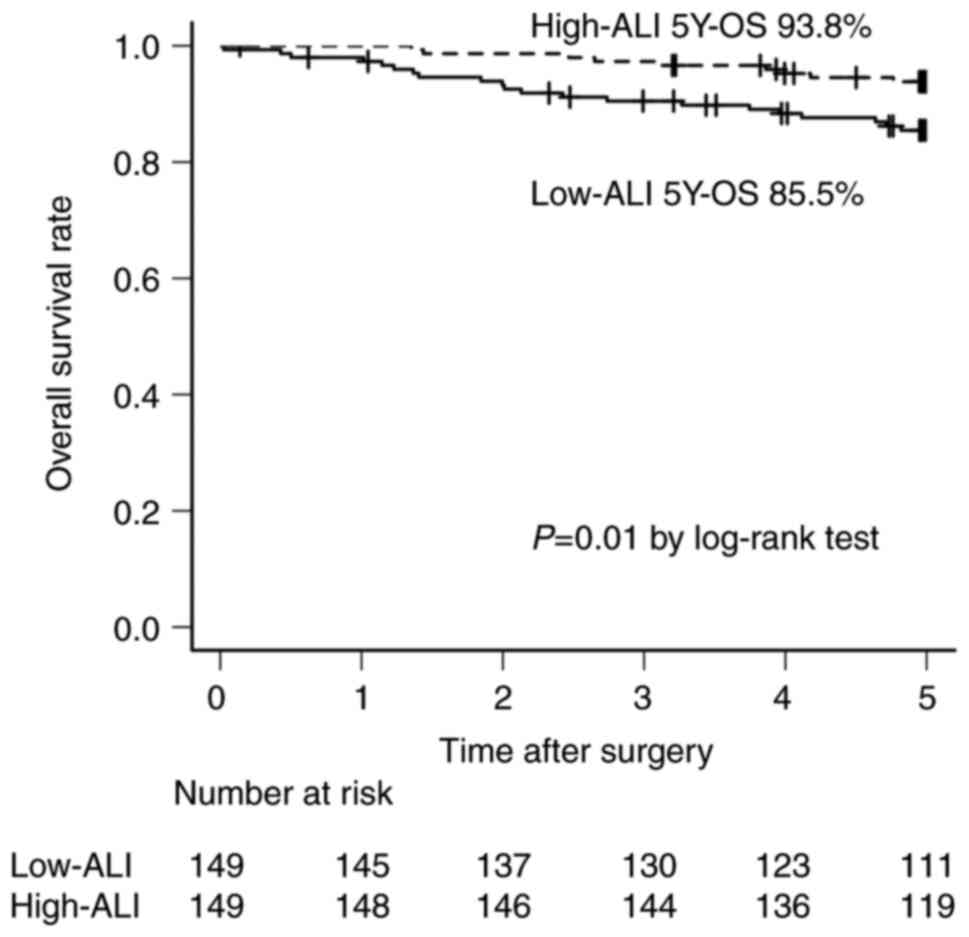
The OS of the low-ALI group was significantly poorer
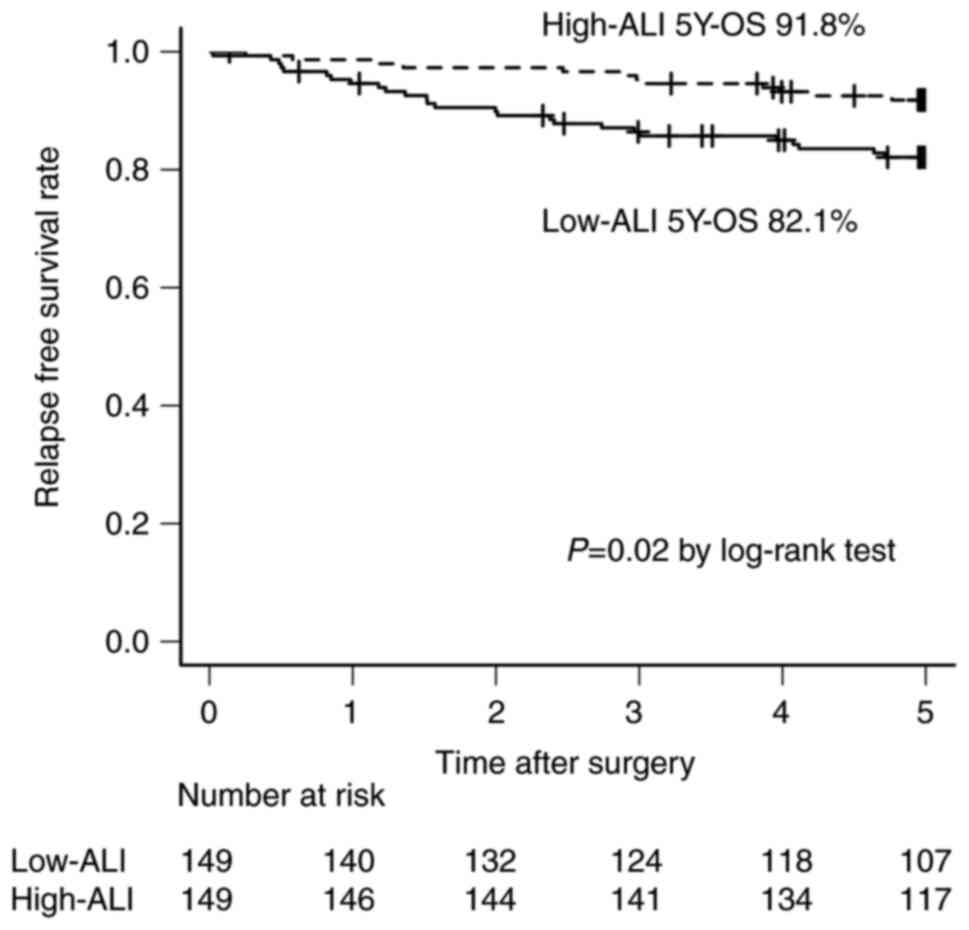
than that of the high-ALI group (85.5% vs. 93.8%, P=0.01) (Fig. 1). The RFS of the low-ALI group was
significantly poorer than that of the high-ALI group (82.1% vs.
91.8%, P=0.02) (Fig. 2).
Univariate and multivariate analyses
for OS and RFS
Tables II and
III show the results of the
univariate and multivariate analyses of OS and RFS in patients with
GC, who underwent gastrectomy according to ALI. Multivariate
analyses for OS demonstrated that low ALI (Hazard Ratio [HR]: 2.26;
95% CI: 1.11–4.59; P=0.03) was an independent prognostic factor
(Table II). Moreover, multivariate
analyses for RFS demonstrated that age≥65 years (HR: 2.35; 95% CI:
1.15–4.80; P=0.03), lymphatic invasion (HR: 2.08; 95% CI:
1.03–4.18; P=0.04), pStage II/III (HR: 2.13; 95% CI: 1.03–4.41;
P=0.04), and low ALI (HR: 1.97; 95% CI: 1.06–3.69; P=0.03) were
independent prognostic factors (Table
III).
| Table II.Univariate and multivariate analyses
of clinicopathological factors and preoperative ALI for overall
survival after propensity matched analysis. |
Table II.
Univariate and multivariate analyses
of clinicopathological factors and preoperative ALI for overall
survival after propensity matched analysis.
|
|
| Univariate |
| Multivariate |
|
|---|
|
|
|
|
|
|
|
|---|
| Factors | Groups | HR | 95% CI | P-value | HR | 95% CI | P-value |
|---|
| Age (years) | <65 | 1 |
|
|
|
|
|
|
| ≥65 | 2.21 | 1.01–4.85 | 0.05 |
|
|
|
| Sex | Male | 1 |
|
|
|
|
|
|
| Female | 0.46 | 0.18–1.17 | 0.10 |
|
|
|
| Surgery | Not TG | 1 |
|
|
|
|
|
|
| TG | 1.36 | 0.65–2.82 | 0.41 |
|
|
|
| Histological
type | Well/Moderately
differentiated | 1 |
|
|
|
|
|
|
| Poorly
differentiated | 0.66 | 0.34–1.29 | 0.23 |
|
|
|
| Lymphatic
invasion | - | 1 |
|
| 1 |
|
|
|
| + | 2.76 | 1.41–5.39 | 0.003 | 1.60 | 0.74–3.49 | 0.23 |
| Venous
invasion | - | 1 |
|
| 1 |
|
|
|
| + | 2.92 | 1.48–5.78 | 0.002 | 1.86 | 0.83–4.18 | 0.13 |
| pStage | I | 1 |
|
| 1 |
|
|
|
| II/III | 3.03 | 1.57–5.84 | <0.001 | 1.75 | 0.77–3.97 | 0.18 |
| Surgical
complications | - | 1 |
|
|
|
|
|
|
| + | 0.66 | 0.23–1.86 | 0.43 |
|
|
|
| Preoperative
ALI | High | 1 |
|
| 1 |
|
|
|
| Low | 2.33 | 1.15–4.74 | 0.02 | 2.26 | 1.11–4.59 | 0.03 |
| Table III.Univariate and multivariate analyses
of clinicopathological factors and preoperative ALI for
relapse-free survival after propensity matched analysis. |
Table III.
Univariate and multivariate analyses
of clinicopathological factors and preoperative ALI for
relapse-free survival after propensity matched analysis.
|
|
| Univariate |
| Multivariate |
|
|---|
|
|
|
|
|
|
|
|---|
| Factors | Groups | HR | 95% CI | P-value | HR | 95% CI | P-value |
|---|
| Age (years) | <65 | 1 |
|
| 1 |
|
|
|
| ≥65 | 2.13 | 1.05–4.31 | 0.04 | 2.35 | 1.15–4.80 | 0.03 |
| Sex | Male | 1 |
|
|
|
|
|
|
| Female | 0.53 | 0.23–1.18 | 0.12 |
|
|
|
| Surgery | Not TG | 1 |
|
|
|
|
|
|
| TG | 1.33 | 0.68–2.58 | 0.40 |
|
|
|
| Histological
type | Well/moderately
differentiated | 1 |
|
|
|
|
|
|
| Poorly
differentiated | 0.80 | 0.44–1.45 | 0.45 |
|
|
|
| Lymphatic
invasion | - | 1 |
|
| 1 |
|
|
|
| + | 2.81 | 1.53–5.16 | <0.001 | 2.08 | 1.03–4.18 | 0.04 |
| Venous
invasion | - | 1 |
|
| 1 |
|
|
|
| + | 2.23 | 1.23–4.05 | 0.009 | 1.20 | 0.58–2.45 | 0.62 |
| pStage | I | 1 |
|
| 1 |
|
|
|
| II/III | 3.13 | 1.73–5.67 | <0.001 | 2.13 | 1.03–4.41 | 0.04 |
| Surgical
complications | - | 1 |
|
|
|
|
|
|
| + | 0.82 | 0.35–1.95 | 0.66 |
|
|
|
| Preoperative
ALI | High | 1 |
|
| 1 |
|
|
|
| Low | 2.01 | 1.08–3.75 | 0.03 | 1.97 | 1.06–3.69 | 0.03 |
Discussion
This research focused on ALI as a marker of
inflammation and nutritional status in patients with GC undergoing
curative resection. We examined its clinical utility by analyzing
the association between preoperative ALI and survival. Our findings
revealed a significantly poorer prognosis in terms of OS and RFS in
the low-ALI group compared with that in the high-ALI group.
Multivariate analysis further confirmed that low ALI was an
independent poor prognostic indicator for both OS and RFS.
Initially, ALI was reported as a prognostic factor
in patients with lung cancer, although recent studies have
highlighted the prognostic value of ALI in various gastrointestinal
malignancies postoperatively. In esophageal squamous cell
carcinoma, retrospective studies demonstrated that lower ALI
correlated with worse cancer-specific survival (CSS) and OS
(24,25). Similarly, in colorectal cancer,
patients with lower ALI exhibited poorer PFS and OS, with ALI
identified as an independent prognostic factor in multivariate
analyses (26,27). For GC, our results align with those
of previous research, underscoring the potential of ALI as a
significant prognostic marker postoperatively.
Several investigations have examined the prognostic
significance of ALI in patients with GC after surgery, and these
results are generally consistent with those of the present study. A
retrospective study of 620 patients with GC after surgery showed
that patients with low ALI had significantly poorer OS and DFS than
that of those with high ALI (P<0.001 and P<0.001,
respectively) (19). In
multivariate analysis, ALI was an independent prognostic indicator
for OS (P=0.006). A retrospective study of 615 patients with GC
after surgery showed that patients with high ALI had significantly
longer OS and DFS than that of those with low ALI (P<0.001 and
P<0.001, respectively) (20). In
multivariate analysis, ALI was an independent prognostic factor for
OS and DFS (P=0.001 and P=0.009, respectively). A retrospective
study of 1657 patients with GC after surgery showed that patients
with low ALI had significantly worse OS and CSS than that of those
with low ALI (P<0.001 and P=0.001, respectively) (21). In multivariate analysis, ALI was an
independent prognostic factor for OS and DFS (P=0.01 and P=0.04,
respectively). In light of these findings, this study is one of the
few novel studies to identify ALI as a useful prognostic factor for
patients with GC using propensity score matching analysis.
Furthermore, our results support the robustness of ALI as a
prognostic predictor and may lead to further large-scale
prospective studies in the future.
The effectiveness of ALI as a prognostic tool likely
stems from its incorporation of both BMI and NLR/Alb, reflecting a
patient's inflammatory immune function and nutritional status. In
GC, low BMI has been established as a prognostic factor for DFS,
and a positive correlation exists between preoperative BMI and
prognostic nutritional indices (28), thereby emphasizing the importance of
nutritional and immune status in patient outcomes. Recently,
NLR/Alb has also been reported to be an important prognostic factor
in patients with GC (29,30). Therefore, interventions such as
aggressive nutritional therapy and rehabilitation (31) may be possible in patients with low
ALI, which may contribute to improved prognosis.
However, this study had some limitations. First, is
its single-center and retrospective design. Second, the paucity of
literature on ALI in GC left the optimal cutoff value undetermined.
Further multicenter, prospective studies are required to validate
the utility of ALI and establish a clinically relevant cutoff
value. Third, the data set used was that of Japanese people only,
thus no comparisons could be made between races.
In conclusion, preoperative ALI emerges as a
potentially valuable prognostic tool in patients with GC undergoing
radical surgery. Our study supports the notion that lower ALI
levels are indicative of poorer survival outcomes, highlighting the
need for further research to effectively integrate this marker into
clinical practice.
Acknowledgements
Not applicable.
Funding
Funding: No funding was received.
Availability of data and materials
The data generated in the present study may be
requested from the corresponding author.
Authors' contributions
IH and TOs conceived and designed the study. IH, MT,
SO, JM, SN, YM, KK, TA, TY, TOg, NY, AS, YR and TOs analyzed and
interpreted the data. IH and TOs confirm the authenticity of all
the raw data. IH and TOs prepared the draft manuscript and figures.
IH, MT, SO, JO, SN, YM, KK, TA, TY, TOg, NY, AS, YR and TOs
collected the data and performed the literature search. All authors
have read and approved the final manuscript.
Ethics approval and consent to
participate
The present study was approved by the Ethics
Committee of the Kanagawa Cancer Center (approval no.
25Research-20), and all procedures were conducted following the
Declaration of Helsinki in 1996. Written informed consent was
obtained from all patients in this study.
Patient consent for publication
Not applicable.
Competing interests
The authors declare that they have no competing
interests.
Glossary
Abbreviations
Abbreviations:
|
ALI
|
advanced lung cancer inflammation
index
|
|
BMI
|
body mass index
|
|
CI
|
confidence interval
|
|
HR
|
hazard ratio
|
|
pStage
|
pathological stage
|
|
TG
|
total gastrectomy
|
|
OS
|
overall survival
|
|
RFS
|
relapse-free survival
|
|
GC
|
gastric cancer
|
|
NLR/Alb
|
neutrophil-to-lymphocyte
ratio/albumin
|
|
CSS
|
cancer-specific survival
|
References
|
1
|
Sung H, Ferlay J, Siegel RL, Laversanne M,
Soerjomataram I, Jemal A and Bray F: Global cancer statistics 2020:
GLOBOCAN estimates of incidence and mortality worldwide for 36
cancers in 185 countries. CA Cancer J Clin. 71:209–249. 2021.
View Article : Google Scholar : PubMed/NCBI
|
|
2
|
Smyth EC, Nilsson M, Grabsch HI, van
Grieken NC and Lordick F: Gastric cancer. Lancet. 396:635–648.
2020. View Article : Google Scholar : PubMed/NCBI
|
|
3
|
Ishikawa D, Nishi M, Takasu C, Kashihara
H, Tokunaga T, Higashijima J, Yoshikawa K and Shimada MT: The role
of neutrophil-to-lymphocyte ratio on the effect of CRT for patients
with rectal cancer. In Vivo. 34:863–868. 2020. View Article : Google Scholar : PubMed/NCBI
|
|
4
|
Fukuda N, Toda K, Fujiwara YU, Wang X,
Ohmoto A, Urasaki T, Hayashi N, Sato Y, Nakano K, Yunokawa M, et
al: Neutrophil-to-lymphocyte ratio as a prognostic marker for
anaplastic thyroid cancer treated with lenvatinib. In Vivo.
34:2859–2864. 2020. View Article : Google Scholar : PubMed/NCBI
|
|
5
|
Hayama T, Ozawa T, Tsukamoto M, Fukushima
Y, Shimada R, Nozawa K, Matsuda K, Fujii S, Fukagawa T and
Hashiguchi Y: Predicting overall survival using preoperative
nutritional and inflammation status for colorectal cancer. In Vivo.
36:450–457. 2022. View Article : Google Scholar : PubMed/NCBI
|
|
6
|
Tsukioka T, Izumi N, Komatsu H, Inoue H,
Ito R, Suzuki S and Nishiyama N: Elevation of
neutrophil-to-lymphocyte ratio is a significant poor prognostic
factor in completely resected centrally located lung squamous cell
carcinoma. In Vivo. 36:2303–2307. 2022. View Article : Google Scholar : PubMed/NCBI
|
|
7
|
Hsueh WH, Hsueh SW, Yeh KY, Hung YS, Ho
MM, Lin SY, Tseng CK, Hung CY and Chou WC: Albumin and
neutrophil-to-lymphocyte ratio score in neoadjuvant concurrent
chemoradiotherapy for esophageal cancer: Comparison with prognostic
nutritional index. In Vivo. 36:2400–2408. 2022. View Article : Google Scholar : PubMed/NCBI
|
|
8
|
Hsu CC, Chou WC, Hung YS, Lin SY, Hung CY,
Yeh KY, Wang HM and Lu CH: Predictive value of albumin and
neutrophil-to-lymphocyte ratio score for treatment completeness and
safety profiles in patients with head and neck cancer receiving
definitive concurrent chemoradiotherapy. In Vivo. 36:2875–2883.
2022. View Article : Google Scholar : PubMed/NCBI
|
|
9
|
Aoyama T, Kazama K, Maezawa Y and Hara K:
Usefulness of nutrition and inflammation assessment tools in
esophageal cancer treatment. In Vivo. 37:22–35. 2023. View Article : Google Scholar : PubMed/NCBI
|
|
10
|
Deng Q, He B, Liu X, Yue J, Ying H, Pan Y,
Sun H, Chen J, Wang F, Gao T, et al: Prognostic value of
pre-operative inflammatory response biomarkers in gastric cancer
patients and the construction of a predictive model. J Transl Med.
13:662015. View Article : Google Scholar : PubMed/NCBI
|
|
11
|
Aoyama T, Hara K, Kazama K and Maezawa Y:
Clinical impact of nutrition and inflammation assessment tools in
gastric cancer treatment. Anticancer Res. 42:5167–5180. 2022.
View Article : Google Scholar : PubMed/NCBI
|
|
12
|
Hirahara N, Matsubara T, Kaji S, Hayashi
H, Sasaki Y, Kawakami K, Hyakudomi R, Yamamoto T and Tajima Y:
Novel inflammation-combined prognostic index to predict survival
outcomes in patients with gastric cancer. Oncotarget. 14:71–82.
2023. View Article : Google Scholar : PubMed/NCBI
|
|
13
|
Jafri SH, Shi R and Mills G: Advance lung
cancer inflammation index (ALI) at diagnosis is a prognostic marker
in patients with metastatic non-small cell lung cancer (NSCLC): A
retrospective review. BMC Cancer. 13:1582013. View Article : Google Scholar : PubMed/NCBI
|
|
14
|
Zhao Q, Chen S and Feng JF: A novel
inflammation-based prognostic index for patients with esophageal
squamous cell carcinoma: Neutrophil lymphocyte ratio/albumin ratio.
Oncotarget. 8:103535–103542. 2017. View Article : Google Scholar : PubMed/NCBI
|
|
15
|
Jun DH, Kim BJ, Park JH, Kim JG, Chi KC,
Park JM, Kim MK and Kang H: Preoperative body mass index
maydetermine the prognosis of advanced gastric cancer. Nutr Cancer.
68:1295–1300. 2016. View Article : Google Scholar : PubMed/NCBI
|
|
16
|
He X, Zhou T, Yang Y, Hong S, Zhan J, Hu
Z, Fang W, Qin T, Ma Y, Zhao Y, et al: Advanced lung cancer
inflammation index, a new prognostic score, predicts outcome in
patients with small-cell lung cancer. Clin Lung Cancer.
16:e165–e171. 2015. View Article : Google Scholar : PubMed/NCBI
|
|
17
|
Park YH, Yi HG, Lee MH, Kim CS and Lim JH:
Prognostic value of the pretreatment advanced lung cancer
inflammation index (ALI) in diffuse large B cell lymphoma patients
treated with R-CHOP chemotherapy. Acta Haematol. 137:76–85. 2017.
View Article : Google Scholar : PubMed/NCBI
|
|
18
|
Jank BJ, Kadletz L, Schnöll J, Selzer E,
Perisanidis C and Heiduschka G: Prognostic value of advanced lung
cancer inflammation index in head and neck squamous cell carcinoma.
Eur Arch Otorhinolaryngol. 276:1487–1492. 2019. View Article : Google Scholar : PubMed/NCBI
|
|
19
|
Yin C, Toiyama Y, Okugawa Y, Omura Y,
Kusunoki Y, Kusunoki K, Imaoka Y, Yasuda H, Ohi M and Kusunoki M:
Clinical significance of advanced lung cancer inflammation index, a
nutritional and inflammation index, in gastric cancer patients
after surgical resection: A propensity score matching analysis.
Clin Nutr. 40:1130–1136. 2021. View Article : Google Scholar : PubMed/NCBI
|
|
20
|
Zhang X, Wang D, Sun T, Li W and Dang C:
Advanced lung cancer inflammation index (ALI) predicts prognosis of
patients with gastric cancer after surgical resection. BMC Cancer.
22:6842022. View Article : Google Scholar : PubMed/NCBI
|
|
21
|
Chen H, Zhang F, Luo D, Guo J, Lin Y, Chen
S, Yin S, Chen X, Peng J and Lian L: Advanced lung cancer
inflammation index predicts the outcomes of patients with
non-metastatic gastric cancer after radical surgical resection. J
Gastrointest Oncol. 14:85–96. 2023. View Article : Google Scholar : PubMed/NCBI
|
|
22
|
Huo C, Liu Y, Xie F, Zhao L, Huang H and
Feng Q: Advanced lung cancer inflammation index predicts the
outcomes of patients with non-metastatic gastric cancer after
radical surgical resection. J Gastrointest Oncol. 14:1653–1654.
2023. View Article : Google Scholar : PubMed/NCBI
|
|
23
|
Wang X, Liu X, Dai H and Jia J: Peripheral
blood nutrient indices as biomarkers for anti-PD-1 therapy efficacy
and prognosis in patients with advanced gastric cancer. Oncol Lett.
26:3972023. View Article : Google Scholar : PubMed/NCBI
|
|
24
|
Feng JF, Huang Y and Chen QX: A new
inflammation index is useful for patients with esophageal squamous
cell carcinoma. Onco Targets Ther. 7:1811–1815. 2014. View Article : Google Scholar : PubMed/NCBI
|
|
25
|
Tan X, Peng H, Gu P, Chen M and Wang Y:
Prognostic significance of the L3 skeletal muscle index and
advanced lung cancer inflammation index in elderly patients with
esophageal cancer. Cancer Manag Res. 13:3133–3143. 2021. View Article : Google Scholar : PubMed/NCBI
|
|
26
|
Kusunoki K, Toiyama Y, Okugawa Y, Yamamoto
A, Omura Y, Ohi M, Araki T and Kusunoki M: Advanced lung cancer
inflammation index predicts outcomes of patients with colorectal
cancer after surgical resection. Dis Colon Rectum. 63:1242–1250.
2020. View Article : Google Scholar : PubMed/NCBI
|
|
27
|
Zhang B, Li ZW, Tong Y, Yuan C, Liu XY,
Wei ZQ, Zhang W and Peng D: The predictive value of advanced lung
cancer inflammation index for short-term outcomes and prognosis of
colorectal cancer patients who underwent radical surgery. Int J
Clin Oncol. 28:1616–1624. 2023. View Article : Google Scholar : PubMed/NCBI
|
|
28
|
Park SH, Lee S, Song JH, Choi S, Cho M,
Kwon IG, Son T, Kim HI, Cheong JH, Hyung WJ, et al: Prognostic
significance of body mass index and prognostic nutritional index in
stage II/III gastric cancer. Eur J Surg Oncol. 46:620–625. 2020.
View Article : Google Scholar : PubMed/NCBI
|
|
29
|
Hashimoto I, Kano K, Onuma S, Suematsu H,
Nagasawa S, Kanematsu K, Furusawa K, Hamaguchi T, Watanabe M,
Hayashi K, et al: Clinical significance of neutrophil-to-lymphocyte
ratio/serum albumin ratio in patients with metastatic gastric or
gastroesophageal junction cancer administered
trifluridine/tipiracil. Anticancer Res. 43:1689–1697. 2023.
View Article : Google Scholar : PubMed/NCBI
|
|
30
|
Onuma S, Hashimoto I, Suematsu H, Nagasawa
S, Kanematsu K, Aoyama T, Yamada T, Rino Y, Ogata T and Oshima T:
Clinical effects of the neutrophil-to-lymphocyte ratio/serum
albumin ratio in patients with gastric cancer after gastrectomy. J
Pers Med. 13:4322023. View Article : Google Scholar : PubMed/NCBI
|
|
31
|
Yamamoto K, Nagatsuma Y, Fukuda Y, Hirao
M, Nishikawa K, Miyamoto A, Ikeda M, Nakamori S, Sekimoto M,
Fujitani K and Tsujinaka T: Effectiveness of a preoperative
exercise and nutritional support program for elderly sarcopenic
patients with gastric cancer. Gastric Cancer. 20:913–918. 2017.
View Article : Google Scholar : PubMed/NCBI
|