Oncol Lett 11: [Related article:] 2946–2952, 2016; DOI:
10.3892/ol.2016.4323
Following the publication of the above article, an
interested reader drew to the authors’ attention that, for the
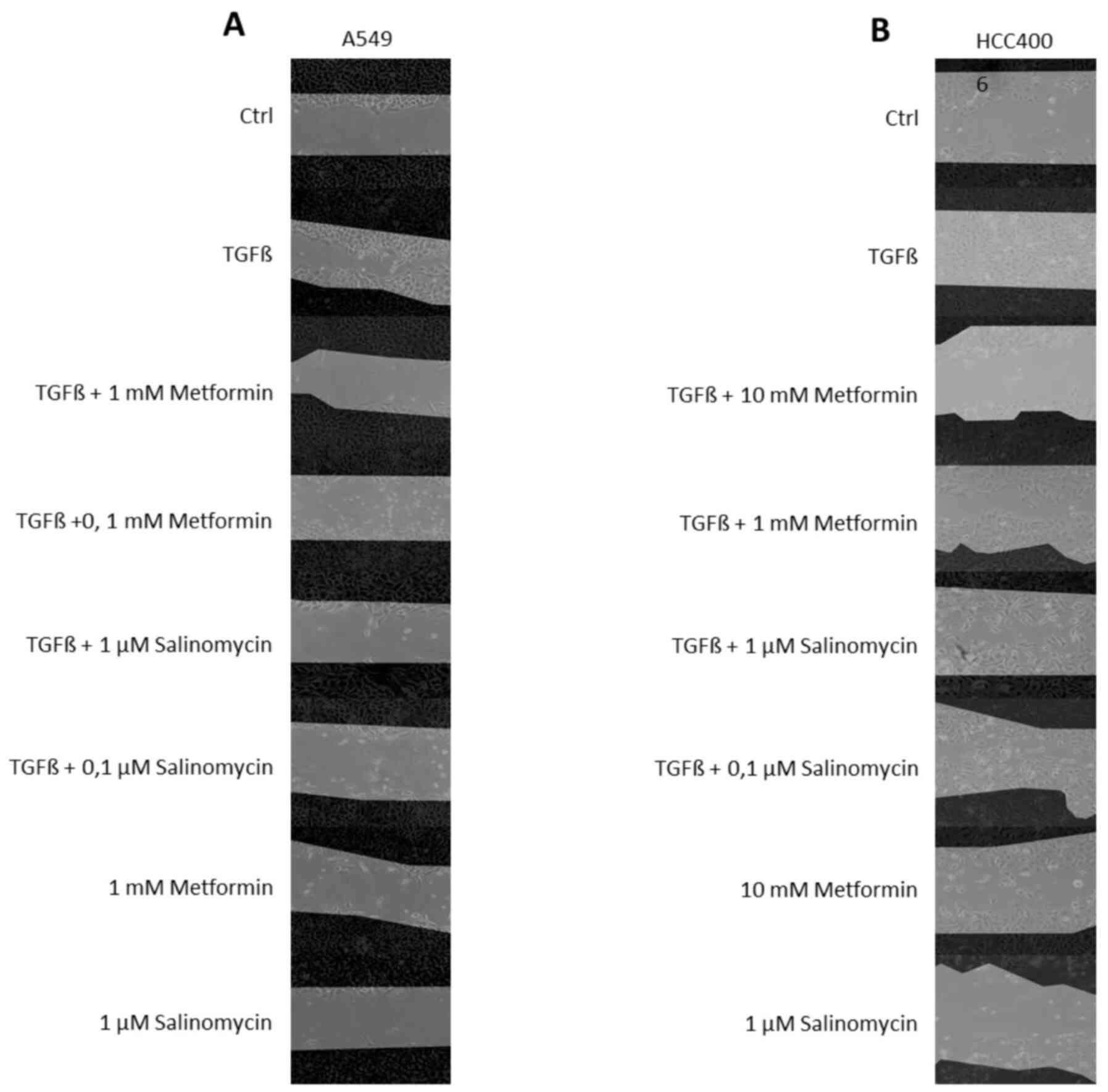
scratch-wound assay experiments shown in Fig. 3 on p. 2948, the bottom two panels
for the ‘Salinomycin, 1 μM’ experiments (the ‘-TGFβ’ and ‘+TGFβ’
panels) appeared to show the same cells, but with a different layer
of edge tracking. Upon asking the authors for an explanation of
this phenomenon, they were able to confirm that the underlying
images in the bottom two panels were identical, and that the
mistake occurred during the figure adaptation process for
publication, given that an earlier version (prepared for an initial
submission) did not contain this error. Furthermore, upon asking
the authors how the dark areas in the abovementioned data panels
differed, whereas the patterning of the cells appeared to be
identical, they explained that the dark areas represented the
regions initially covered by cells at the starting time point (0
h); the second images, captured 48 h later, were displayed as a
grayscale background. The dark areas from the first image were then
overlaid on to the second images to show the initial area covered
with cells, and the same cellular (grayscale) image had been
erroneously selected for the ‘Salinomycin, 1 μM/-TGFβ’ and
‘Salinomycin, 1 μM/+TGFβ’ experiments. [Note that ImageJ (v1.44;
National Institutes of Health) was used to create the dark areas
and to overlay the images.] The authors were also able to provide
us with the raw data underlying the composite images shown in the
various figure panels.
A revised version of Fig. 3, now showing the corrected data and
all the experiments for the treatments of the A549 and HCC400 cell
lines with different combinations/concentrations of metformin and
salinomycin, is shown on the next page. The authors regret the
error that occurred in the originally published version of this
figure, although this did not grossly affect the results or the
conclusions reported in this article. All the authors agree with
the publication of this Corrigendum, and thank the Editor of
Oncology Letters for granting them the opportunity to
publish this; furthermore, they apologize to the readership for any
inconvenience caused.