Spandidos Publications Logo
  • About
    • About Spandidos
    • Aims and Scopes
    • Abstracting and Indexing
    • Editorial Policies
    • Reprints and Permissions
    • Job Opportunities
    • Terms and Conditions
    • Contact
  • Journals
    • All Journals
    • Oncology Letters
      • Oncology Letters
      • Information for Authors
      • Editorial Policies
      • Editorial Board
      • Aims and Scope
      • Abstracting and Indexing
      • Bibliographic Information
      • Archive
    • International Journal of Oncology
      • International Journal of Oncology
      • Information for Authors
      • Editorial Policies
      • Editorial Board
      • Aims and Scope
      • Abstracting and Indexing
      • Bibliographic Information
      • Archive
    • Molecular and Clinical Oncology
      • Molecular and Clinical Oncology
      • Information for Authors
      • Editorial Policies
      • Editorial Board
      • Aims and Scope
      • Abstracting and Indexing
      • Bibliographic Information
      • Archive
    • Experimental and Therapeutic Medicine
      • Experimental and Therapeutic Medicine
      • Information for Authors
      • Editorial Policies
      • Editorial Board
      • Aims and Scope
      • Abstracting and Indexing
      • Bibliographic Information
      • Archive
    • International Journal of Molecular Medicine
      • International Journal of Molecular Medicine
      • Information for Authors
      • Editorial Policies
      • Editorial Board
      • Aims and Scope
      • Abstracting and Indexing
      • Bibliographic Information
      • Archive
    • Biomedical Reports
      • Biomedical Reports
      • Information for Authors
      • Editorial Policies
      • Editorial Board
      • Aims and Scope
      • Abstracting and Indexing
      • Bibliographic Information
      • Archive
    • Oncology Reports
      • Oncology Reports
      • Information for Authors
      • Editorial Policies
      • Editorial Board
      • Aims and Scope
      • Abstracting and Indexing
      • Bibliographic Information
      • Archive
    • Molecular Medicine Reports
      • Molecular Medicine Reports
      • Information for Authors
      • Editorial Policies
      • Editorial Board
      • Aims and Scope
      • Abstracting and Indexing
      • Bibliographic Information
      • Archive
    • World Academy of Sciences Journal
      • World Academy of Sciences Journal
      • Information for Authors
      • Editorial Policies
      • Editorial Board
      • Aims and Scope
      • Abstracting and Indexing
      • Bibliographic Information
      • Archive
    • International Journal of Functional Nutrition
      • International Journal of Functional Nutrition
      • Information for Authors
      • Editorial Policies
      • Editorial Board
      • Aims and Scope
      • Abstracting and Indexing
      • Bibliographic Information
      • Archive
    • International Journal of Epigenetics
      • International Journal of Epigenetics
      • Information for Authors
      • Editorial Policies
      • Editorial Board
      • Aims and Scope
      • Abstracting and Indexing
      • Bibliographic Information
      • Archive
    • Medicine International
      • Medicine International
      • Information for Authors
      • Editorial Policies
      • Editorial Board
      • Aims and Scope
      • Abstracting and Indexing
      • Bibliographic Information
      • Archive
  • Articles
  • Information
    • Information for Authors
    • Information for Reviewers
    • Information for Librarians
    • Information for Advertisers
    • Conferences
  • Language Editing
Spandidos Publications Logo
  • About
    • About Spandidos
    • Aims and Scopes
    • Abstracting and Indexing
    • Editorial Policies
    • Reprints and Permissions
    • Job Opportunities
    • Terms and Conditions
    • Contact
  • Journals
    • All Journals
    • Biomedical Reports
      • Information for Authors
      • Editorial Policies
      • Editorial Board
      • Aims and Scope
      • Abstracting and Indexing
      • Bibliographic Information
      • Archive
    • Experimental and Therapeutic Medicine
      • Information for Authors
      • Editorial Policies
      • Editorial Board
      • Aims and Scope
      • Abstracting and Indexing
      • Bibliographic Information
      • Archive
    • International Journal of Epigenetics
      • Information for Authors
      • Editorial Policies
      • Editorial Board
      • Aims and Scope
      • Abstracting and Indexing
      • Bibliographic Information
      • Archive
    • International Journal of Functional Nutrition
      • Information for Authors
      • Editorial Policies
      • Editorial Board
      • Aims and Scope
      • Abstracting and Indexing
      • Bibliographic Information
      • Archive
    • International Journal of Molecular Medicine
      • Information for Authors
      • Editorial Policies
      • Editorial Board
      • Aims and Scope
      • Abstracting and Indexing
      • Bibliographic Information
      • Archive
    • International Journal of Oncology
      • Information for Authors
      • Editorial Policies
      • Editorial Board
      • Aims and Scope
      • Abstracting and Indexing
      • Bibliographic Information
      • Archive
    • Medicine International
      • Information for Authors
      • Editorial Policies
      • Editorial Board
      • Aims and Scope
      • Abstracting and Indexing
      • Bibliographic Information
      • Archive
    • Molecular and Clinical Oncology
      • Information for Authors
      • Editorial Policies
      • Editorial Board
      • Aims and Scope
      • Abstracting and Indexing
      • Bibliographic Information
      • Archive
    • Molecular Medicine Reports
      • Information for Authors
      • Editorial Policies
      • Editorial Board
      • Aims and Scope
      • Abstracting and Indexing
      • Bibliographic Information
      • Archive
    • Oncology Letters
      • Information for Authors
      • Editorial Policies
      • Editorial Board
      • Aims and Scope
      • Abstracting and Indexing
      • Bibliographic Information
      • Archive
    • Oncology Reports
      • Information for Authors
      • Editorial Policies
      • Editorial Board
      • Aims and Scope
      • Abstracting and Indexing
      • Bibliographic Information
      • Archive
    • World Academy of Sciences Journal
      • Information for Authors
      • Editorial Policies
      • Editorial Board
      • Aims and Scope
      • Abstracting and Indexing
      • Bibliographic Information
      • Archive
  • Articles
  • Information
    • For Authors
    • For Reviewers
    • For Librarians
    • For Advertisers
    • Conferences
  • Language Editing
Login Register Submit
  • This site uses cookies
  • You can change your cookie settings at any time by following the instructions in our Cookie Policy. To find out more, you may read our Privacy Policy.

    I agree
Search articles by DOI, keyword, author or affiliation
Search
Advanced Search
presentation
Oncology Letters
Join Editorial Board Propose a Special Issue
Print ISSN: 1792-1074 Online ISSN: 1792-1082
Journal Cover
October-2025 Volume 30 Issue 4

Full Size Image

Sign up for eToc alerts
Recommend to Library

Journals

International Journal of Molecular Medicine

International Journal of Molecular Medicine

International Journal of Molecular Medicine is an international journal devoted to molecular mechanisms of human disease.

International Journal of Oncology

International Journal of Oncology

International Journal of Oncology is an international journal devoted to oncology research and cancer treatment.

Molecular Medicine Reports

Molecular Medicine Reports

Covers molecular medicine topics such as pharmacology, pathology, genetics, neuroscience, infectious diseases, molecular cardiology, and molecular surgery.

Oncology Reports

Oncology Reports

Oncology Reports is an international journal devoted to fundamental and applied research in Oncology.

Experimental and Therapeutic Medicine

Experimental and Therapeutic Medicine

Experimental and Therapeutic Medicine is an international journal devoted to laboratory and clinical medicine.

Oncology Letters

Oncology Letters

Oncology Letters is an international journal devoted to Experimental and Clinical Oncology.

Biomedical Reports

Biomedical Reports

Explores a wide range of biological and medical fields, including pharmacology, genetics, microbiology, neuroscience, and molecular cardiology.

Molecular and Clinical Oncology

Molecular and Clinical Oncology

International journal addressing all aspects of oncology research, from tumorigenesis and oncogenes to chemotherapy and metastasis.

World Academy of Sciences Journal

World Academy of Sciences Journal

Multidisciplinary open-access journal spanning biochemistry, genetics, neuroscience, environmental health, and synthetic biology.

International Journal of Functional Nutrition

International Journal of Functional Nutrition

Open-access journal combining biochemistry, pharmacology, immunology, and genetics to advance health through functional nutrition.

International Journal of Epigenetics

International Journal of Epigenetics

Publishes open-access research on using epigenetics to advance understanding and treatment of human disease.

Medicine International

Medicine International

An International Open Access Journal Devoted to General Medicine.

Journal Cover
October-2025 Volume 30 Issue 4

Full Size Image

Sign up for eToc alerts
Recommend to Library

  • Article
  • Citations
    • Cite This Article
    • Download Citation
    • Create Citation Alert
    • Remove Citation Alert
    • Cited By
  • Similar Articles
    • Related Articles (in Spandidos Publications)
    • Similar Articles (Google Scholar)
    • Similar Articles (PubMed)
  • Download PDF
  • Download XML
  • View XML
Article Open Access

Elevated plasma HSP90α as a prognostic marker in EGFR‑mutant non‑small cell lung cancer

  • Authors:
    • Xiaoyu Tan
    • Jiaying Tang
    • Yamei Tang
    • Haiguang Wang
    • Shanli Mo
    • Xiaoqian Huang
    • Haijie Gan
  • View Affiliations / Copyright

    Affiliations: Department of Experimental Research, Guangxi Medical University Cancer Hospital, Nanning, Guangxi Zhuang Autonomous Region 530021, P.R. China, Department of Respiratory Oncology, Guangxi Medical University Cancer Hospital, Nanning, Guangxi Zhuang Autonomous Region 530021, P.R. China
    Copyright: © Tan et al. This is an open access article distributed under the terms of Creative Commons Attribution License.
  • Article Number: 457
    |
    Published online on: July 22, 2025
       https://doi.org/10.3892/ol.2025.15203
  • Expand metrics +
Metrics: Total Views: 0 (Spandidos Publications: | PMC Statistics: )
Metrics: Total PDF Downloads: 0 (Spandidos Publications: | PMC Statistics: )
Cited By (CrossRef): 0 citations Loading Articles...

This article is mentioned in:


Abstract

The heat shock protein 90α (HSP90α), as a molecular chaperone, plays an important role in the development and progression of various malignant tumors. The aim of the present study was to assess the plasma level of heat shock protein 90α (HSP90α) in patients with non‑small cell lung cancer (NSCLC) harboring different epidermal growth factor receptor (EGFR) mutations and its association with clinical characteristics and EGFR gene mutations. Plasma HSP90α levels, clinicopathological data and prognostic information were collected and analyzed from 1,347 patients with a pathological diagnosis of lung cancer to evaluate their association with EGFR gene mutations. The results demonstrated that patients with elevated plasma HSP90α levels are more likely to have SCLC, advanced tumor stages and poorer prognosis compared to patients with lower HSP90α levels. Among patients with NSCLC harboring EGFR mutations, those with higher plasma HSP90α levels are more frequently associated with L858R wild‑type and exon 20 mutations compared to other EGFR mutation subtypes. Furthermore, using the optimal cutoff value of 62.1 ng/ml for plasma HSP90α levels, the results revealed that patients with lower plasma HSP90α levels have a better prognosis compared to those with higher HSP90α levels. In conclusion, elevated plasma HSP90α expression is associated with poor overall survival in patients with NSCLC and could serve as a prognostic indicator independent of EGFR mutation status.
View Figures

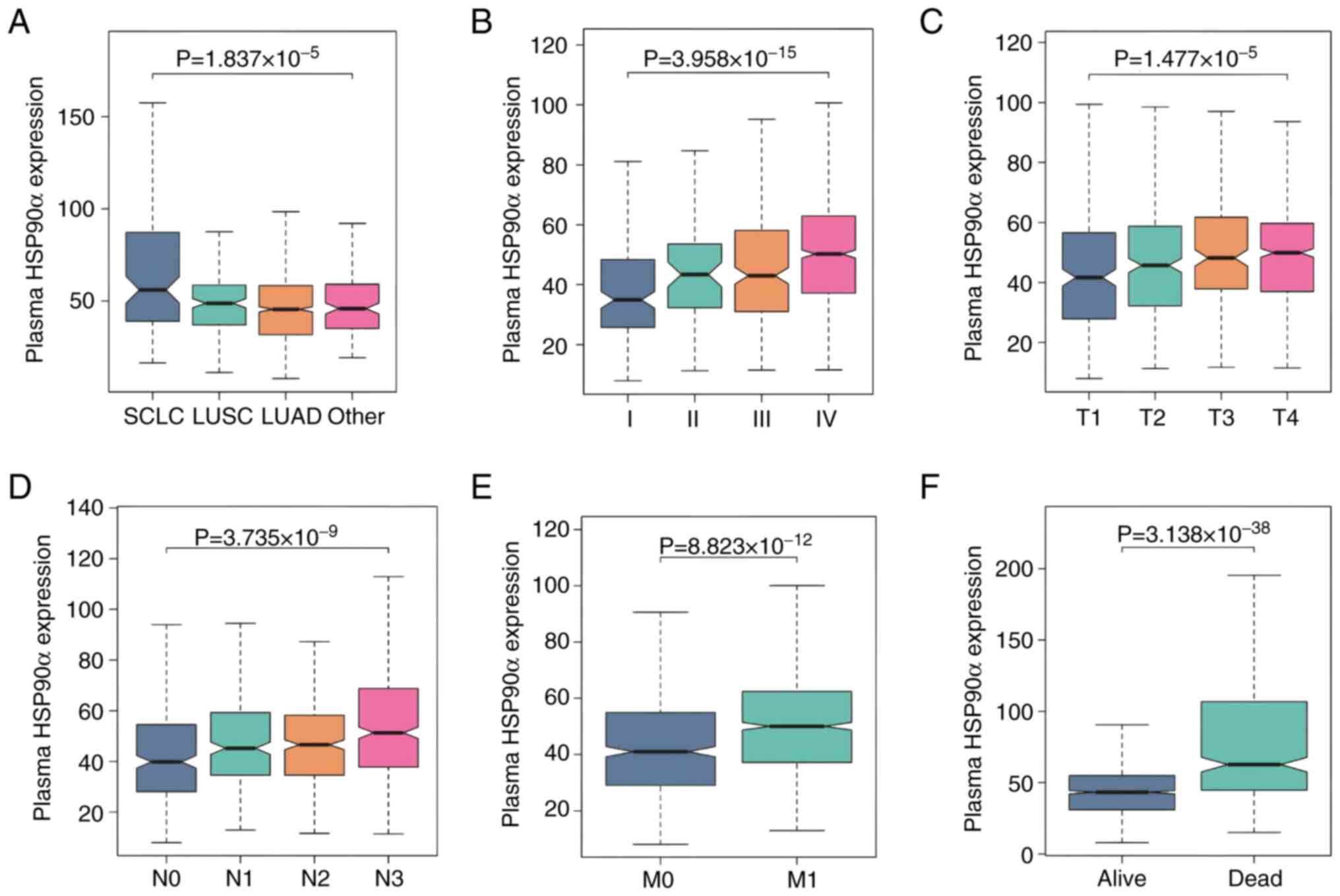
Figure 1

Box plots of plasma HSP90α expression
according to different clinical characteristics. (A) Pathological
classification revealing that plasma HSP90α levels were
significantly higher in SCLC compared with LUSC, LUAD and other
histological types. (B) Plasma HSP90α expression was significantly
higher in patients with stage IV lung cancer than in those with
earlier stages. Higher plasma HSP90α levels were demonstrated in
patients with advanced (C) T, (D) N and (E) M stages. (F) Patients
with lung cancer who died had significantly higher plasma HSP90α
expression than survivors. Group differences were assessed using
the Mann-Whitney U-test for two groups or the Kruskal-Wallis test
for comparisons involving >2 groups. HSP90α, heat shock protein
90α; SCLC, small cell lung cancer; LUSC, lung squamous cell cancer;
LUAD, lung adenocarcinoma; T, tumor; N, node; M, metastasis.

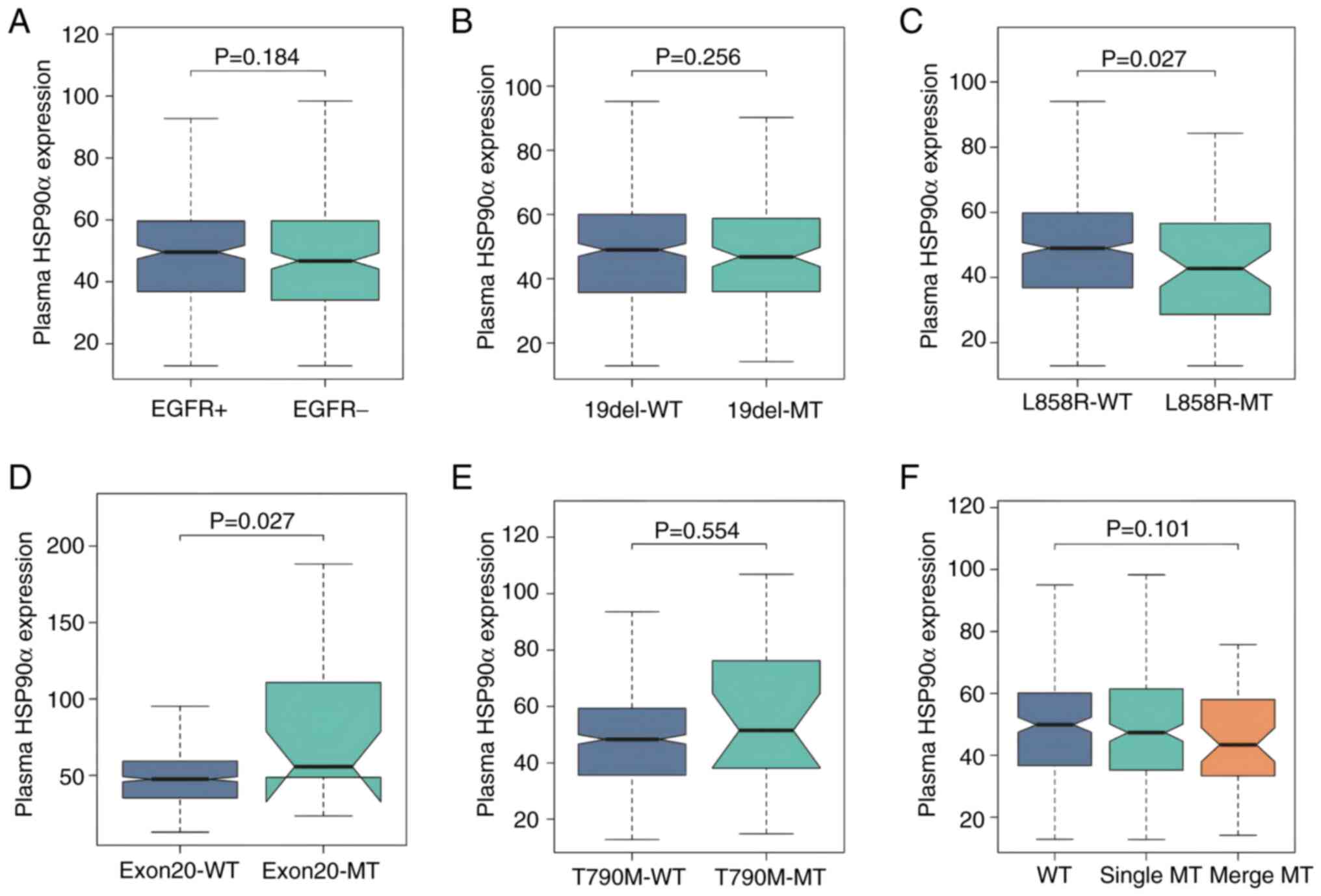
Figure 2

Box plots of plasma HSP90α expression
according to different EGFR mutation types. (A) EGFR mutation
status did not significantly affect plasma HSP90α levels. (B)
Plasma HSP90α expression in patients with exon 19 deletion was
comparable with that in wild type patients. (C) Plasma HSP90α
levels were significantly decreased in patients with the exon 21
L858R mutation. (D) Patients with exon 20 mutations demonstrated
significantly higher plasma HSP90α expression. (E) Plasma HSP90α
expression was not significantly elevated in patients with T790M
mutations. (F) There was no significant difference in plasma HSP90α
levels between patients with multiple EGFR mutations and those with
wild-type EGFR. Group differences were assessed using the
Mann-Whitney U-test (two independent groups) or Kruskal-Wallis test
for comparisons involving >2 groups. HSP90α, heat shock protein
90α; EGFR, epidermal growth factor receptor; WT, wild type; MT,
mutant.

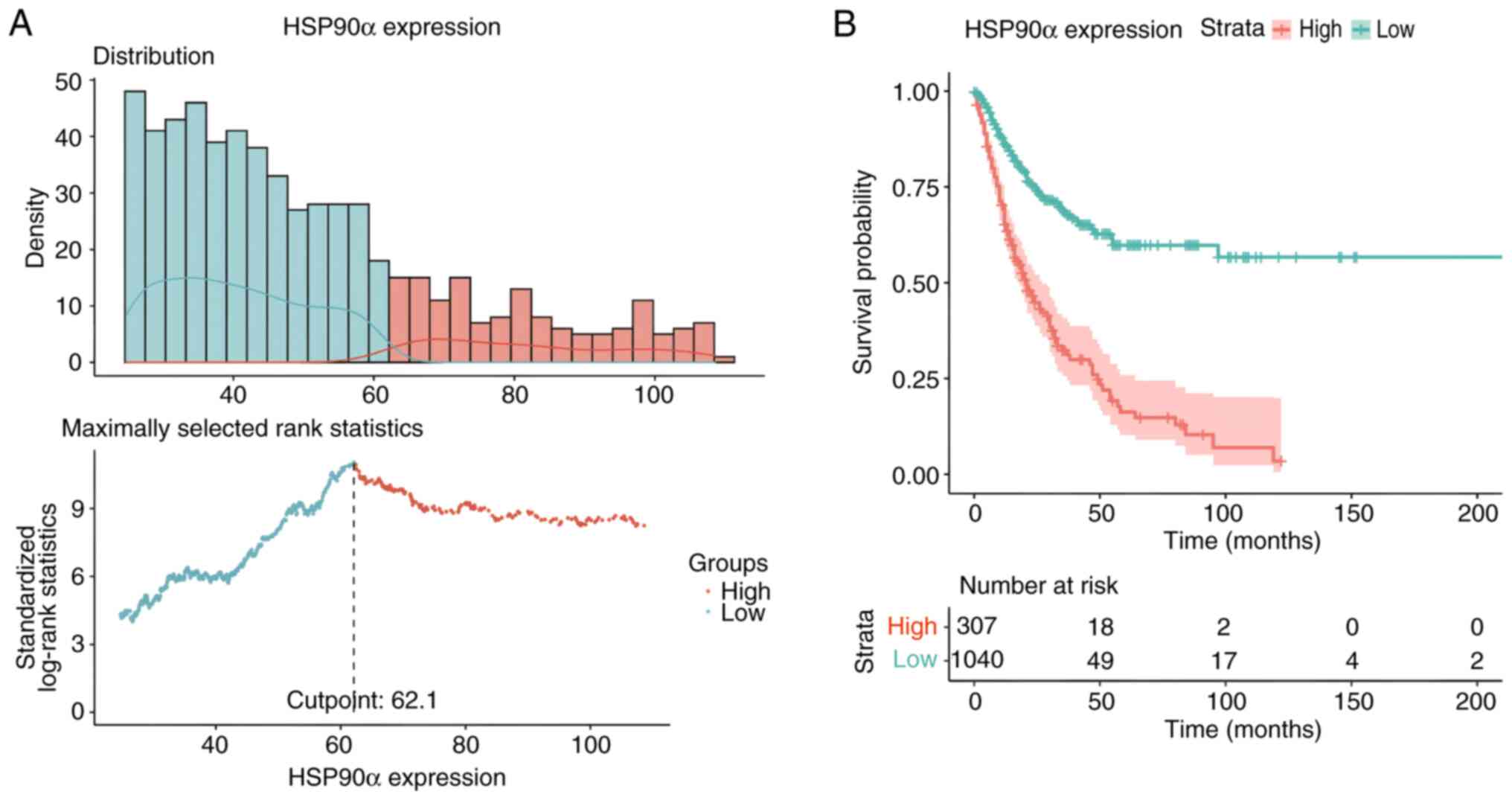
Figure 3

Selection of the optimal cutoff value
for plasma HSP90α expression. (A) Density distribution of plasma
HSP90α levels. Using the Log-rank test, the optimal cutoff value
was determined to be 62.1 ng/ml. (B) Based on the cutoff, patients
with lung cancer were stratified into risk groups, and overall
survival curves were plotted. The high-risk group demonstrated a
significantly worse prognosis (Log-rank P<0.01). HSP90α, heat
shock protein 90α.
View References

1 

Khanali J and Kolahi AA: National and subnational cancer incidence for 22 cancer groups, 2000 to 2016: A study based on cancer registration data of Iran. J Cancer Epidemiol. 2021:66766662021. View Article : Google Scholar : PubMed/NCBI

2 

Cheng L, Alexander RE, Maclennan GT, Cummings OW, Montironi R, Lopez-Beltran A, Cramer HM, Davidson DD and Zhang S: Molecular pathology of lung cancer: Key to personalized medicine. Mod Pathol. 25:347–369. 2012. View Article : Google Scholar : PubMed/NCBI

3 

Yang CY, Yang JC and Yang PC: Precision management of advanced non-small cell lung cancer. Annu Rev Med. 71:117–136. 2020. View Article : Google Scholar : PubMed/NCBI

4 

He J, Huang Z, Han L, Gong Y and Xie C: Mechanisms and management of 3rd-generation EGFR-TKI resistance in advanced non-small cell lung cancer (Review). Int J Oncol. 59:902021. View Article : Google Scholar : PubMed/NCBI

5 

Mok TS: Personalized medicine in lung cancer: What we need to know. Nat Rev Clin Oncol. 8:661–668. 2011. View Article : Google Scholar : PubMed/NCBI

6 

Paola U and Stefano I: Liquid biopsies in cancer diagnosis, monitoring and prognosis. Biomedicines. 10:27482022. View Article : Google Scholar

7 

Frydman J: Folding of newly translated proteins in vivo: The role of molecular chaperones. Annu Rev Biochem. 70:603–647. 2001. View Article : Google Scholar : PubMed/NCBI

8 

Condelli V, Crispo F, Pietrafesa M, Lettini G, Matassa DS, Esposito F, Landriscina M and Maddalena F: HSP90 molecular chaperones, metabolic rewiring, and epigenetics: Impact on tumor progression and perspective for anticancer therapy. Cells. 8:5322019. View Article : Google Scholar : PubMed/NCBI

9 

Ahsan A, Ramanand SG, Whitehead C, Hiniker SM, Rehemtulla A, Pratt WB, Jolly S, Gouveia C, Truong K, Van Waes C, et al: Wild-type EGFR is stabilized by direct interaction with HSP90 in cancer cells and tumors. Neoplasia. 14:670–677. 2012. View Article : Google Scholar : PubMed/NCBI

10 

Flannery PJ and Spurney RF: Transactivation of the epidermal growth factor receptor by angiotensin II in glomerular podocytes. Nephron Exp Nephrol. 103:e109–e118. 2006. View Article : Google Scholar : PubMed/NCBI

11 

Zhou G, Pu Y, Zhao K, Chen Y and Zhang G: Heat shock proteins in non-small-cell lung cancer-functional mechanism. Front Biosci (Landmark Ed). 28:562023. View Article : Google Scholar : PubMed/NCBI

12 

AL Elaimy A, Ahsan A, Ray D, Lawrence TS and Nyati MK: Role of Hsp90 in the stability of EGFR from radiation and cisplatin-induced degradation. Cancer Res. 73:10282013. View Article : Google Scholar

13 

Sui Y, Shen Z, Pan R, Ma R, Si R, Feng J and Zhou G: AHSA1-HSP90AA1 complex stabilized IFI6 and TGFB1 promotes mitochondrial stability and EMT in EGFR-mutated lung adenocarcinoma under Osimertinib pressure. Cell Death Dis. 16:2982025. View Article : Google Scholar : PubMed/NCBI

14 

Ercan D, Zejnullahu K, Yonesaka K, Xiao Y, Capelletti M, Rogers A, Lifshits E, Brown A, Lee C, Christensen JG, et al: Amplification of EGFR T790M causes resistance to an irreversible EGFR inhibitor. Oncogene. 29:2346–2356. 2010. View Article : Google Scholar : PubMed/NCBI

15 

Wei W, Zhou J, Chen L, Liu H, Zhang F, Li J, Ning S, Li S, Wang C, Huang Y, et al: plasma levels of heat shock protein 90 alpha associated with colorectal cancer development. Front Mol Biosci. 8:6848362021. View Article : Google Scholar : PubMed/NCBI

16 

Liu H, Zhang Z, Huang Y, Wei W, Ning S, Li J, Liang X, Liu K and Zhang L: Plasma HSP90AA1 predicts the risk of breast cancer onset and distant metastasis. Front Cell Dev Biol. 9:6395962021. View Article : Google Scholar : PubMed/NCBI

17 

Fu Y, Xu X, Huang D, Cui D, Liu L, Liu J, He Z, Liu J, Zheng S and Luo Y: Plasma heat shock protein 90alpha as a biomarker for the diagnosis of liver cancer: An official, large-scale, and multicenter clinical trial. EBioMedicine. 24:56–63. 2017. View Article : Google Scholar : PubMed/NCBI

18 

Shi Y, Liu X, Lou J, Han X, Zhang L, Wang Q, Li B, Dong M and Zhang Y: Plasma levels of heat shock protein 90 alpha associated with lung cancer development and treatment responses. Clin Cancer Res. 20:6016–6022. 2014. View Article : Google Scholar : PubMed/NCBI

19 

Su K, Liu Y, Wang P, He K, Wang F, Chi H, Rao M, Li X, Wen L, Song Y, et al: Heat-shock protein 90α is a potential prognostic and predictive biomarker in hepatocellular carcinoma: A large-scale and multicenter study. Hepatol Int. 16:1208–1219. 2022. View Article : Google Scholar : PubMed/NCBI

20 

Van Schil PE, Rami-Porta R and Asamura H: The 8th TNM edition for lung cancer: A critical analysis. Ann Transl Med. 6:872018. View Article : Google Scholar : PubMed/NCBI

21 

Shimamura T, Li D, Ji H, Haringsma HJ, Liniker E, Borgman CL, Lowell AM, Minami Y, McNamara K, Perera SA, et al: Hsp90 inhibition suppresses mutant EGFR-T790M signaling and overcomes kinase inhibitor resistance. Cancer Res. 68:5827–5838. 2008. View Article : Google Scholar : PubMed/NCBI

22 

Jorge SE, Lucena-Araujo AR, Yasuda H, Piotrowska Z, Oxnard GR, Rangachari D, Huberman MS, Sequist LV, Kobayashi SS and Costa DB: EGFR exon 20 insertion mutations display sensitivity to Hsp90 inhibition in preclinical models and lung adenocarcinomas. Clin Cancer Res. 24:6548–6555. 2018. View Article : Google Scholar : PubMed/NCBI

23 

Shimamura T, Lowell AM, Engelman JA and Shapiro GI: Epidermal growth factor receptors harboring kinase domain mutations associate with the heat shock protein 90 chaperone and are destabilized following exposure to geldanamycins. Cancer Res. 65:6401–6408. 2005. View Article : Google Scholar : PubMed/NCBI

24 

Lin Y, Wang X and Jin H: EGFR-TKI resistance in NSCLC patients: Mechanisms and strategies. Am J Cancer Res. 4:411–435. 2014.PubMed/NCBI

25 

Hong S, Gao F, Fu S, Wang Y, Fang W, Huang Y and Zhang L: Concomitant genetic alterations with response to treatment and epidermal growth factor receptor tyrosine kinase inhibitors in patients with EGFR-Mutant advanced non-small cell lung cancer. JAMA Oncol. 4:739–742. 2018. View Article : Google Scholar : PubMed/NCBI

26 

Attili I, Passaro A, Pisapia P, Malapelle U and de Marinis F: Uncommon EGFR compound mutations in non-small cell lung cancer (NSCLC): A systematic review of available evidence. Curr Oncol. 29:255–266. 2022. View Article : Google Scholar : PubMed/NCBI

27 

Kitadai R and Okuma Y: Treatment strategies for non-small cell lung cancer harboring common and uncommon EGFR mutations: Drug sensitivity based on exon classification, and structure-function analysis. Cancers (Basel). 14:25192022. View Article : Google Scholar : PubMed/NCBI

28 

Ou SI, Lin HM, Hong JL, Yin Y, Jin S, Lin J, Mehta M, Nguyen D and Neal J: Real-world response and outcomes in patients with NSCLC with EGFR exon 20 insertion mutations. JTO Clin Res Rep. 4:1005582023.PubMed/NCBI

29 

Yang JC, Sequist LV, Geater SL, Tsai CM, Mok TS, Schuler M, Yamamoto N, Yu CJ, Ou SH, Zhou C, et al: Clinical activity of afatinib in patients with advanced non-small-cell lung cancer harbouring uncommon EGFR mutations: A combined post-hoc analysis of LUX-Lung 2, LUX-Lung 3, and LUX-Lung 6. Lancet Oncol. 16:830–838. 2015. View Article : Google Scholar : PubMed/NCBI

30 

Eustace BK, Sakurai T, Stewart JK, Yimlamai D, Unger C, Zehetmeier C, Lain B, Torella C, Henning SW, Beste G, et al: Functional proteomic screens reveal an essential extracellular role for hsp90 alpha in cancer cell invasiveness. Nat Cell Biol. 6:507–514. 2004. View Article : Google Scholar : PubMed/NCBI

31 

Zhou X, Wen Y, Tian Y, He M, Ke X, Huang Z, He Y, Liu L, Scharf A, Lu M, et al: Heat shock protein 90α-dependent B-cell-2-associated transcription factor 1 promotes hepatocellular carcinoma proliferation by regulating MYC Proto-Oncogene c-MYC mRNA stability. Hepatology. 69:1564–1581. 2019. View Article : Google Scholar : PubMed/NCBI

32 

Du Y, Wu J and Luo L: Secreted heat shock protein 90α attenuated the effect of anticancer drugs in small-cell lung cancer cells through AKT/GSK3β/β-Catenin signaling. Cancer Control. 25:10732748188044892018. View Article : Google Scholar : PubMed/NCBI

33 

Liu W, Li J, Zhang P, Hou Q, Feng S, Liu L, Cui D, Shi H, Fu Y and Luo Y: A novel pan-cancer biomarker plasma heat shock protein 90alpha and its diagnosis determinants in clinic. Cancer Sci. 110:2941–2959. 2019. View Article : Google Scholar : PubMed/NCBI

34 

Smith DL, Acquaviva J, Sequeira M, Jimenez JP, Zhang C, Sang J, Bates RC and Proia D: The HSP90 inhibitor ganetespib potentiates the antitumor activity of EGFR tyrosine kinase inhibition in mutant and wild-type non-small cell lung cancer. Target Oncol. 10:235–245. 2015. View Article : Google Scholar : PubMed/NCBI

35 

Chen S, Yu Q and Zhou S: Plasmatic levels of HSP90α at diagnosis: A novel prognostic indicator of clinical outcome in advanced lung cancer patients treated with PD-1/PD-L1 inhibitors plus chemotherapy. Front Oncol. 11:7651152021. View Article : Google Scholar : PubMed/NCBI

36 

Proia DA, Sang J, He S, Smith DL, Sequeira M, Zhang C, Liu Y, Ye S, Zhou D, Blackman RK, et al: Synergistic activity of the Hsp90 inhibitor ganetespib with taxanes in non-small cell lung cancer models. Invest New Drugs. 30:2201–2209. 2012. View Article : Google Scholar : PubMed/NCBI

37 

Magwenyane AM, Ugbaja SC, Amoako DG, Somboro AM, Khan RB and Kumalo HM: Heat shock protein 90 (HSP90) inhibitors as anticancer medicines: A review on the computer-aided drug discovery approaches over the past five years. Comput Math Methods Med. 2022:21477632022. View Article : Google Scholar : PubMed/NCBI

38 

Wan X, Fang Y, Du J, Cai S and Dong H: GW4869 can inhibit epithelial-mesenchymal transition and extracellular HSP90α in gefitinib-sensitive NSCLC cells. Onco Targets Ther. 16:913–922. 2023. View Article : Google Scholar : PubMed/NCBI

39 

Saarenheimo J, Andersen H, Eigeliene N and Jekunen A: Gene-Guided treatment decision-making in non-small cell lung cancer-a systematic review. Front Oncol. 11:7544272021. View Article : Google Scholar : PubMed/NCBI

40 

Wang Y, Barghi SM, Yang Y and Akhavan-Sigari R: Value of HSP90α in lung cancer diagnosis and recurrence prediction: A cohort study. Oncol Res Treat. 44:583–589. 2021. View Article : Google Scholar : PubMed/NCBI

41 

Fang Y, Yuan Z, Zhang H, Wang P and Hao J: Predictive value of serum heat shock protein 90α on the prognosis of patients with lung adenocarcinoma. J Inflamm Res. 16:1183–1193. 2023. View Article : Google Scholar : PubMed/NCBI

42 

Li Y, Jin Y, Wang Y, Liu W, Jia W and Wang J: MR-based radiomics predictive modelling of EGFR mutation and HER2 overexpression in metastatic brain adenocarcinoma: A two-centre study. Cancer Imaging. 24:652024. View Article : Google Scholar : PubMed/NCBI

43 

Ruiz MI, Floor K, Roepman P, Rodriguez JA, Meijer GA, Mooi WJ, Jassem E, Niklinski J, Muley T, van Zandwijk N, et al: Integration of gene dosage and gene expression in non-small cell lung cancer, identification of HSP90 as potential target. PLoS One. 3:e00017222008. View Article : Google Scholar : PubMed/NCBI

44 

Fang L, Barekati Z, Zhang B, Liu Z and Zhong X: Targeted therapy in breast cancer: What's new? Swiss Med Wkly. 141:w132312011.PubMed/NCBI

45 

Tsai YC, Leu SY, Chen SY, Kung CW, Lee YM, Liu YP, Yen MH and Cheng PY: 17-DMAG, an Hsp90 inhibitor, ameliorates ovariectomy-induced obesity in rats. Life Sci. 232:1166722019. View Article : Google Scholar : PubMed/NCBI

46 

Chen L, Fan H, Chu H, Du F, Chen Y, Hu L, Li Z, Wang W, Hou X and Yang L: The HSP90 inhibitor 17-DMAG alleviates primary biliary cholangitis via cholangiocyte necroptosis prevention. J Cell Biochem. 123:1857–1872. 2022. View Article : Google Scholar : PubMed/NCBI

47 

Hu C, Yang J, Qi Z, Wu H, Wang B, Zou F, Mei H, Liu J, Wang W and Liu Q: Heat shock proteins: Biological functions, pathological roles, and therapeutic opportunities. MedComm (2020). 3:e1612022. View Article : Google Scholar : PubMed/NCBI

48 

Liao Y, Liu Y, Yu C, Lei Q, Cheng J, Kong W, Yu Y, Zhuang X, Sun W, Yin S, et al: HSP90β impedes STUB1-induced ubiquitination of YTHDF2 to drive sorafenib resistance in hepatocellular carcinoma. Adv Sci (Weinh). 10:e23020252023. View Article : Google Scholar : PubMed/NCBI

49 

Qi S, Yi G, Yu K, Feng C and Deng S: The role of hsp90 inhibitors in the treatment of cardiovascular diseases. Cells. 11:34442022. View Article : Google Scholar : PubMed/NCBI

50 

Chadli A, Felts SJ and Toft DO: GCUNC45 is the first Hsp90 co-chaperone to show alpha/beta isoform specificity. J Biol Chem. 283:9509–9512. 2008. View Article : Google Scholar : PubMed/NCBI

51 

Prince TL, Kijima T, Tatokoro M, Lee S, Tsutsumi S, Yim K, Rivas C, Alarcon S, Schwartz H, Khamit-Kush K, et al: Client proteins and small molecule inhibitors display distinct binding preferences for constitutive and stress-induced HSP90 isoforms and their conformationally restricted mutants. PLoS One. 10:e01417862015. View Article : Google Scholar : PubMed/NCBI

52 

Wang C, Zhang Y, Guo K, Wang N, Jin H, Liu Y and Qin W: Heat shock proteins in hepatocellular carcinoma: Molecular mechanism and therapeutic potential. Int J Cancer. 138:1824–1834. 2016. View Article : Google Scholar : PubMed/NCBI

53 

Dimas DT, Perlepe CD, Sergentanis TN, Misitzis I, Kontzoglou K, Patsouris E, Kouraklis G, Psaltopoulou T and Nonni A: The prognostic significance of Hsp70/Hsp90 expression in breast cancer: A systematic review and meta-analysis. Anticancer Res. 38:1551–1562. 2018.PubMed/NCBI

54 

Zhang S, Guo S, Li Z, Li D and Zhan Q: High expression of HSP90 is associated with poor prognosis in patients with colorectal cancer. PeerJ. 7:e79462019. View Article : Google Scholar : PubMed/NCBI

55 

Liu K, Kang M, Li J, Qin W and Wang R: Prognostic value of the mRNA expression of members of the HSP90 family in non-small cell lung cancer. Exp Ther Med. 17:2657–2665. 2019.PubMed/NCBI

56 

Ding Q, Sun Y, Zhang J, Yao Y, Huang D and Jiang Y: Utility and specificity of plasma heat shock protein 90 alpha, CEA, and CA199 as the diagnostic test in colorectal cancer liver metastasis. J Gastrointest Oncol. 13:2497–2504. 2022. View Article : Google Scholar : PubMed/NCBI

57 

Zhao Q, Miao C, Lu Q, Wu W, He Y, Wu S, Liu H and Lian C: Clinical significance of monitoring circulating free DNA and plasma heat shock protein 90alpha in patients with esophageal squamous cell carcinoma. Cancer Manag Res. 13:2223–2234. 2021. View Article : Google Scholar : PubMed/NCBI

58 

Riely GJ, Wood DE, Ettinger DS, Aisner DL, Akerley W, Bauman JR, Bharat A, Bruno DS, Chang JY, Chirieac LR, et al: Non-small cell lung cancer, version 4.2024, NCCN clinical practice guidelines in oncology. J Natl Compr Canc Netw. 22:249–274. 2024. View Article : Google Scholar : PubMed/NCBI

59 

Wang T, Zhang J, Wang S, Sun X, Wang D, Gao Y, Zhang Y, Xu L, Wu Y, Wu Y, et al: The exon 19-deleted EGFR undergoes ubiquitylation-mediated endocytic degradation via dynamin activity-dependent and -independent mechanisms. Cell Commun Signal. 16:402018. View Article : Google Scholar : PubMed/NCBI

60 

Bian Y, Liu H, Huang J, Feng Z, Lin Y, Li J and Zhang L: eHSP90α in front-line therapy in EGFR exon 19 deletion and 21 Leu858Arg mutations in advanced lung adenocarcinoma. BMC Cancer. 241:8352024. View Article : Google Scholar : PubMed/NCBI

61 

Xu W, Soga S, Beebe K, Lee MJ, Kim YS, Trepel J and Neckers L: Sensitivity of epidermal growth factor receptor and ErbB2 exon 20 insertion mutants to Hsp90 inhibition. Br J Cancer. 97:741–744. 2007. View Article : Google Scholar : PubMed/NCBI

Related Articles

  • Abstract
  • View
  • Download
  • Twitter
Copy and paste a formatted citation
Spandidos Publications style
Tan X, Tang J, Tang Y, Wang H, Mo S, Huang X and Gan H: Elevated plasma HSP90&alpha; as a prognostic marker in EGFR‑mutant non‑small cell lung cancer. Oncol Lett 30: 457, 2025.
APA
Tan, X., Tang, J., Tang, Y., Wang, H., Mo, S., Huang, X., & Gan, H. (2025). Elevated plasma HSP90&alpha; as a prognostic marker in EGFR‑mutant non‑small cell lung cancer. Oncology Letters, 30, 457. https://doi.org/10.3892/ol.2025.15203
MLA
Tan, X., Tang, J., Tang, Y., Wang, H., Mo, S., Huang, X., Gan, H."Elevated plasma HSP90&alpha; as a prognostic marker in EGFR‑mutant non‑small cell lung cancer". Oncology Letters 30.4 (2025): 457.
Chicago
Tan, X., Tang, J., Tang, Y., Wang, H., Mo, S., Huang, X., Gan, H."Elevated plasma HSP90&alpha; as a prognostic marker in EGFR‑mutant non‑small cell lung cancer". Oncology Letters 30, no. 4 (2025): 457. https://doi.org/10.3892/ol.2025.15203
Copy and paste a formatted citation
x
Spandidos Publications style
Tan X, Tang J, Tang Y, Wang H, Mo S, Huang X and Gan H: Elevated plasma HSP90&alpha; as a prognostic marker in EGFR‑mutant non‑small cell lung cancer. Oncol Lett 30: 457, 2025.
APA
Tan, X., Tang, J., Tang, Y., Wang, H., Mo, S., Huang, X., & Gan, H. (2025). Elevated plasma HSP90&alpha; as a prognostic marker in EGFR‑mutant non‑small cell lung cancer. Oncology Letters, 30, 457. https://doi.org/10.3892/ol.2025.15203
MLA
Tan, X., Tang, J., Tang, Y., Wang, H., Mo, S., Huang, X., Gan, H."Elevated plasma HSP90&alpha; as a prognostic marker in EGFR‑mutant non‑small cell lung cancer". Oncology Letters 30.4 (2025): 457.
Chicago
Tan, X., Tang, J., Tang, Y., Wang, H., Mo, S., Huang, X., Gan, H."Elevated plasma HSP90&alpha; as a prognostic marker in EGFR‑mutant non‑small cell lung cancer". Oncology Letters 30, no. 4 (2025): 457. https://doi.org/10.3892/ol.2025.15203
Follow us
  • Twitter
  • LinkedIn
  • Facebook
About
  • Spandidos Publications
  • Careers
  • Cookie Policy
  • Privacy Policy
How can we help?
  • Help
  • Live Chat
  • Contact
  • Email to our Support Team