Spandidos Publications Logo
  • About
    • About Spandidos
    • Aims and Scopes
    • Abstracting and Indexing
    • Editorial Policies
    • Reprints and Permissions
    • Job Opportunities
    • Terms and Conditions
    • Contact
  • Journals
    • All Journals
    • Oncology Letters
      • Oncology Letters
      • Information for Authors
      • Editorial Policies
      • Editorial Board
      • Aims and Scope
      • Abstracting and Indexing
      • Bibliographic Information
      • Archive
    • International Journal of Oncology
      • International Journal of Oncology
      • Information for Authors
      • Editorial Policies
      • Editorial Board
      • Aims and Scope
      • Abstracting and Indexing
      • Bibliographic Information
      • Archive
    • Molecular and Clinical Oncology
      • Molecular and Clinical Oncology
      • Information for Authors
      • Editorial Policies
      • Editorial Board
      • Aims and Scope
      • Abstracting and Indexing
      • Bibliographic Information
      • Archive
    • Experimental and Therapeutic Medicine
      • Experimental and Therapeutic Medicine
      • Information for Authors
      • Editorial Policies
      • Editorial Board
      • Aims and Scope
      • Abstracting and Indexing
      • Bibliographic Information
      • Archive
    • International Journal of Molecular Medicine
      • International Journal of Molecular Medicine
      • Information for Authors
      • Editorial Policies
      • Editorial Board
      • Aims and Scope
      • Abstracting and Indexing
      • Bibliographic Information
      • Archive
    • Biomedical Reports
      • Biomedical Reports
      • Information for Authors
      • Editorial Policies
      • Editorial Board
      • Aims and Scope
      • Abstracting and Indexing
      • Bibliographic Information
      • Archive
    • Oncology Reports
      • Oncology Reports
      • Information for Authors
      • Editorial Policies
      • Editorial Board
      • Aims and Scope
      • Abstracting and Indexing
      • Bibliographic Information
      • Archive
    • Molecular Medicine Reports
      • Molecular Medicine Reports
      • Information for Authors
      • Editorial Policies
      • Editorial Board
      • Aims and Scope
      • Abstracting and Indexing
      • Bibliographic Information
      • Archive
    • World Academy of Sciences Journal
      • World Academy of Sciences Journal
      • Information for Authors
      • Editorial Policies
      • Editorial Board
      • Aims and Scope
      • Abstracting and Indexing
      • Bibliographic Information
      • Archive
    • International Journal of Functional Nutrition
      • International Journal of Functional Nutrition
      • Information for Authors
      • Editorial Policies
      • Editorial Board
      • Aims and Scope
      • Abstracting and Indexing
      • Bibliographic Information
      • Archive
    • International Journal of Epigenetics
      • International Journal of Epigenetics
      • Information for Authors
      • Editorial Policies
      • Editorial Board
      • Aims and Scope
      • Abstracting and Indexing
      • Bibliographic Information
      • Archive
    • Medicine International
      • Medicine International
      • Information for Authors
      • Editorial Policies
      • Editorial Board
      • Aims and Scope
      • Abstracting and Indexing
      • Bibliographic Information
      • Archive
  • Articles
  • Information
    • Information for Authors
    • Information for Reviewers
    • Information for Librarians
    • Information for Advertisers
    • Conferences
  • Language Editing
Spandidos Publications Logo
  • About
    • About Spandidos
    • Aims and Scopes
    • Abstracting and Indexing
    • Editorial Policies
    • Reprints and Permissions
    • Job Opportunities
    • Terms and Conditions
    • Contact
  • Journals
    • All Journals
    • Biomedical Reports
      • Information for Authors
      • Editorial Policies
      • Editorial Board
      • Aims and Scope
      • Abstracting and Indexing
      • Bibliographic Information
      • Archive
    • Experimental and Therapeutic Medicine
      • Information for Authors
      • Editorial Policies
      • Editorial Board
      • Aims and Scope
      • Abstracting and Indexing
      • Bibliographic Information
      • Archive
    • International Journal of Epigenetics
      • Information for Authors
      • Editorial Policies
      • Editorial Board
      • Aims and Scope
      • Abstracting and Indexing
      • Bibliographic Information
      • Archive
    • International Journal of Functional Nutrition
      • Information for Authors
      • Editorial Policies
      • Editorial Board
      • Aims and Scope
      • Abstracting and Indexing
      • Bibliographic Information
      • Archive
    • International Journal of Molecular Medicine
      • Information for Authors
      • Editorial Policies
      • Editorial Board
      • Aims and Scope
      • Abstracting and Indexing
      • Bibliographic Information
      • Archive
    • International Journal of Oncology
      • Information for Authors
      • Editorial Policies
      • Editorial Board
      • Aims and Scope
      • Abstracting and Indexing
      • Bibliographic Information
      • Archive
    • Medicine International
      • Information for Authors
      • Editorial Policies
      • Editorial Board
      • Aims and Scope
      • Abstracting and Indexing
      • Bibliographic Information
      • Archive
    • Molecular and Clinical Oncology
      • Information for Authors
      • Editorial Policies
      • Editorial Board
      • Aims and Scope
      • Abstracting and Indexing
      • Bibliographic Information
      • Archive
    • Molecular Medicine Reports
      • Information for Authors
      • Editorial Policies
      • Editorial Board
      • Aims and Scope
      • Abstracting and Indexing
      • Bibliographic Information
      • Archive
    • Oncology Letters
      • Information for Authors
      • Editorial Policies
      • Editorial Board
      • Aims and Scope
      • Abstracting and Indexing
      • Bibliographic Information
      • Archive
    • Oncology Reports
      • Information for Authors
      • Editorial Policies
      • Editorial Board
      • Aims and Scope
      • Abstracting and Indexing
      • Bibliographic Information
      • Archive
    • World Academy of Sciences Journal
      • Information for Authors
      • Editorial Policies
      • Editorial Board
      • Aims and Scope
      • Abstracting and Indexing
      • Bibliographic Information
      • Archive
  • Articles
  • Information
    • For Authors
    • For Reviewers
    • For Librarians
    • For Advertisers
    • Conferences
  • Language Editing
Login Register Submit
  • This site uses cookies
  • You can change your cookie settings at any time by following the instructions in our Cookie Policy. To find out more, you may read our Privacy Policy.

    I agree
Search articles by DOI, keyword, author or affiliation
Search
Advanced Search
presentation
Oncology Letters
Join Editorial Board Propose a Special Issue
Print ISSN: 1792-1074 Online ISSN: 1792-1082
Journal Cover
October-2025 Volume 30 Issue 4

Full Size Image

Sign up for eToc alerts
Recommend to Library

Journals

International Journal of Molecular Medicine

International Journal of Molecular Medicine

International Journal of Molecular Medicine is an international journal devoted to molecular mechanisms of human disease.

International Journal of Oncology

International Journal of Oncology

International Journal of Oncology is an international journal devoted to oncology research and cancer treatment.

Molecular Medicine Reports

Molecular Medicine Reports

Covers molecular medicine topics such as pharmacology, pathology, genetics, neuroscience, infectious diseases, molecular cardiology, and molecular surgery.

Oncology Reports

Oncology Reports

Oncology Reports is an international journal devoted to fundamental and applied research in Oncology.

Experimental and Therapeutic Medicine

Experimental and Therapeutic Medicine

Experimental and Therapeutic Medicine is an international journal devoted to laboratory and clinical medicine.

Oncology Letters

Oncology Letters

Oncology Letters is an international journal devoted to Experimental and Clinical Oncology.

Biomedical Reports

Biomedical Reports

Explores a wide range of biological and medical fields, including pharmacology, genetics, microbiology, neuroscience, and molecular cardiology.

Molecular and Clinical Oncology

Molecular and Clinical Oncology

International journal addressing all aspects of oncology research, from tumorigenesis and oncogenes to chemotherapy and metastasis.

World Academy of Sciences Journal

World Academy of Sciences Journal

Multidisciplinary open-access journal spanning biochemistry, genetics, neuroscience, environmental health, and synthetic biology.

International Journal of Functional Nutrition

International Journal of Functional Nutrition

Open-access journal combining biochemistry, pharmacology, immunology, and genetics to advance health through functional nutrition.

International Journal of Epigenetics

International Journal of Epigenetics

Publishes open-access research on using epigenetics to advance understanding and treatment of human disease.

Medicine International

Medicine International

An International Open Access Journal Devoted to General Medicine.

Journal Cover
October-2025 Volume 30 Issue 4

Full Size Image

Sign up for eToc alerts
Recommend to Library

  • Article
  • Citations
    • Cite This Article
    • Download Citation
    • Create Citation Alert
    • Remove Citation Alert
    • Cited By
  • Similar Articles
    • Related Articles (in Spandidos Publications)
    • Similar Articles (Google Scholar)
    • Similar Articles (PubMed)
  • Download PDF
  • Download XML
  • View XML

  • Supplementary Files
    • Supplementary_Data.pdf
Article Open Access

Association between FGF10 expression and gland‑forming differentiation pattern in gastric adenocarcinoma: An immunohistochemical analysis

  • Authors:
    • Seito Fujibayashi
    • Kazuhiro Kobayashi
    • Hiroyuki Tomita
    • Daichi Watanabe
    • Masahide Endo
    • Ryoma Yokoi
    • Keita Matsumoto
    • Hirokatsu Hayashi
    • Masashi Kuno
    • Masahiro Fukada
    • Itaru Yasufuku
    • Yuta Sato
    • Ryuichi Asai
    • Jesse Yu Tajima
    • Akira Hara
    • Nobuhisa Matsuhashi
  • View Affiliations / Copyright

    Affiliations: Department of Gastroenterological Surgery and Pediatric Surgery, Gifu University Graduate School of Medicine, Gifu 501‑1194, Japan, Department of Tumor Pathology, Gifu University Graduate School of Medicine, Gifu 501‑1194, Japan, Department of Pharmacy, Gifu University Hospital, Gifu 501‑1194, Japan
    Copyright: © Fujibayashi et al. This is an open access article distributed under the terms of Creative Commons Attribution License.
  • Article Number: 479
    |
    Published online on: August 12, 2025
       https://doi.org/10.3892/ol.2025.15224
  • Expand metrics +
Metrics: Total Views: 0 (Spandidos Publications: | PMC Statistics: )
Metrics: Total PDF Downloads: 0 (Spandidos Publications: | PMC Statistics: )
Cited By (CrossRef): 0 citations Loading Articles...

This article is mentioned in:


Abstract

The histological classification of gastric adenocarcinoma influences its prognostic outcomes and therapeutic strategies. Although fibroblast growth factor (FGF)10 is important for gastric morphogenesis, its use as a molecular marker of gland‑forming differentiation pattern remains undefined. The present study examined 117 surgically resected gastric adenocarcinoma specimens using immunohistochemical analysis to evaluate the expression of FGF10 and FGF receptor 2 (FGFR2). Expression patterns in tumor cells and the surrounding stroma were assessed using a four‑tier scale. Associations between marker expression and histological differentiation were analyzed by multivariable ordinal logistic regression, adjusting for age, human epidermal growth factor receptor 2 and epidermal growth factor receptor status. Elevated FGF10 expression was significantly associated with well‑differentiated, gland‑forming histological subtypes, particularly in moderately differentiated tubular adenocarcinoma [adjusted odds ratio (OR) in tumor cells: 1.749, 95% confidence interval (CI) 1.231‑2.487, P=0.002; adjusted OR in stroma: 2.418, 95% CI 1.123‑5.206, P=0.024]. Conversely, FGFR2 expression showed no association with differentiation pattern (adjusted OR: 0.908, 95% CI 0.452‑1.824, P=0.788). Survival analysis revealed no significant relationship between FGF10 or FGFR2 expression level and overall patient survival [hazard ratio (HR) for FGF10 in tumor cells: 0.823, 95% CI 0.640‑1.057, P=0.127; HR for FGF10 in stroma: 0.675, 95% CI 0.385‑1.183, P=0.170; HR for FGFR2 in tumor cells: 1.080, 95% CI 0.559‑2.085, P=0.819]. FGF10 may thus be a promising molecular marker of gland‑forming differentiation pattern in gastric adenocarcinoma, offering valuable insights for refining its histopathological classification. These findings may contribute to the development of stratification biomarkers for personalized therapeutic approaches, particularly for the selection of molecular‑targeted therapies. The absence of an association with overall survival, however, highlights the need for further investigations into the underlying mechanisms and their broader clinical significance.
View Figures

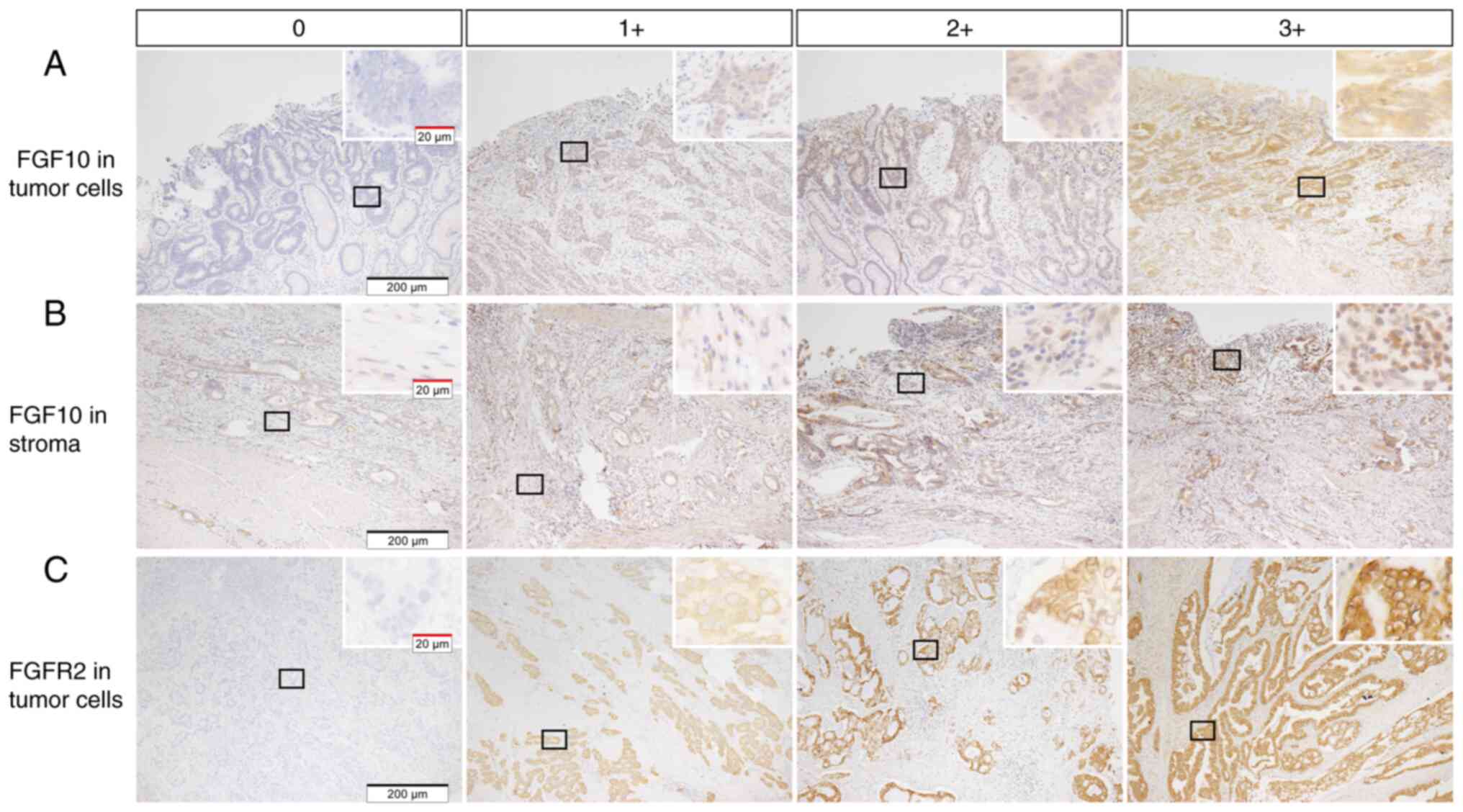
Figure 1

Expression of FGF10 and FGFR2 in
gastric cancer tissues. Representative immunohistochemical images
demonstrating the differential expression patterns of FGF10 and
FGFR2 in gastric adenocarcinoma tissues. (A) FGF10 immunoreactivity
in tumor cells (boxes), demonstrating heterogeneous cytoplasmic
expression patterns graded as negative (0), weakly positive (1+),
moderately positive (2+), and strongly positive (3+). (B) FGF10
expression in stromal compartments (boxes), exhibiting variable
immunopositivity across the four-tier intensity scale. (C) FGFR2
immunolocalization in tumor cells (boxes), showing differential
membrane and cytoplasmic staining intensities categorized according
to the standardized four-tier grading system. (A) Tumor cells
stained for FGF10, (C) tumor cells stained for FGFR2 and (B) stroma
including immune cells stained for FGF10 are shown in the insets as
higher magnification views of the boxed areas. Scale bars: black,
200 µm; red (insets), 20 µm. Tumor cells were identified as
malignant epithelial cells, distinguished by their characteristic
morphological features such as formation of abnormal glandular
structures, nuclear atypia (enlargement, irregular contours,
hyperchromasia), and cytoplasmic changes typical of gastric
adenocarcinoma. Stromal cells were identified as the non-neoplastic
cells within the connective tissue surrounding the tumor glands,
including fibroblasts, inflammatory cells (such as lymphocytes and
plasma cells), and vascular endothelial cells. FGF10, fibroblast
growth factor 10; FGFR2, fibroblast growth factor receptor 2.

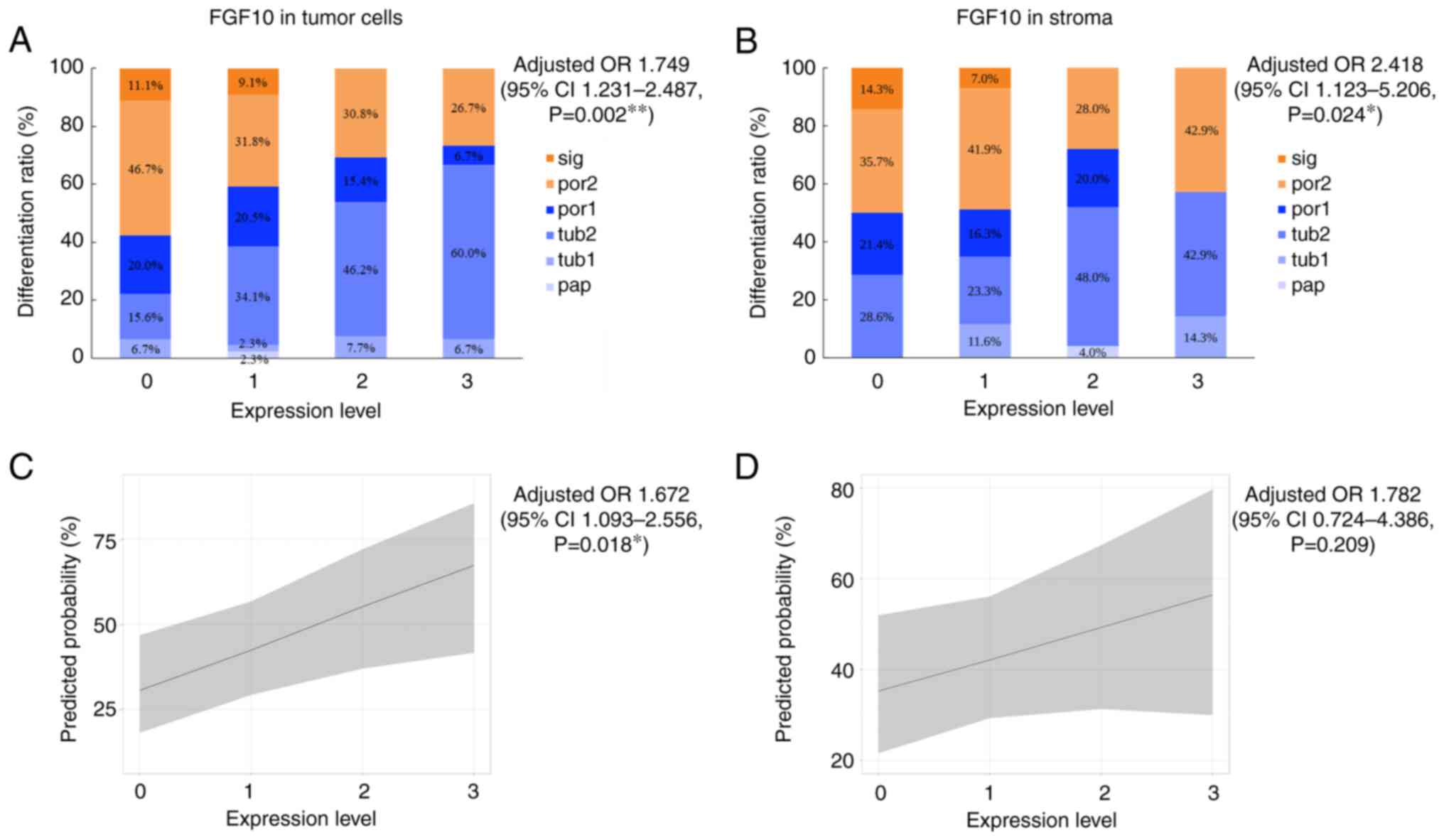
Figure 2

Association between FGF10 expression
in tumor cells and stroma and histological subtype. (A) Association
between FGF10 expression levels in tumor cells and histological
subtypes (pap, tub1, tub2, por1, por2, sig). (B) Association
between FGF10 expression levels in stroma and histological subtypes
(pap, tub1, tub2, por1, por2, sig). (C) Predicted probability plot
showing the association between FGF10 expression levels in tumor
cells and histological tumor classifications. (D) Predicted
probability plot showing the association between FGF10 expression
levels in stroma and histological tumor classifications. In the
predicted probability plots, pap, tub1, tub2, and por1 were
classified as intestinal/indeterminate type, and por2 and sig were
classified as diffuse type. Solid lines represent the point
estimate of the predicted probability and gray shaded areas
indicate the 95% CIs, both derived from a logistic regression
model. Estimates calculated using maximum likelihood estimation.
*P<0.05, **P<0.01. FGF10, fibroblast growth factor 10; pap,
papillary adenocarcinoma; tub1, well-differentiated tubular
adenocarcinoma; tub2, moderately differentiated tubular
adenocarcinoma; por1, solid-type poorly differentiated
adenocarcinoma; por2, non-solid-type poorly differentiated
adenocarcinoma; sig, signet-ring cell carcinoma; OR, odds ratio;
CI, confidence interval.

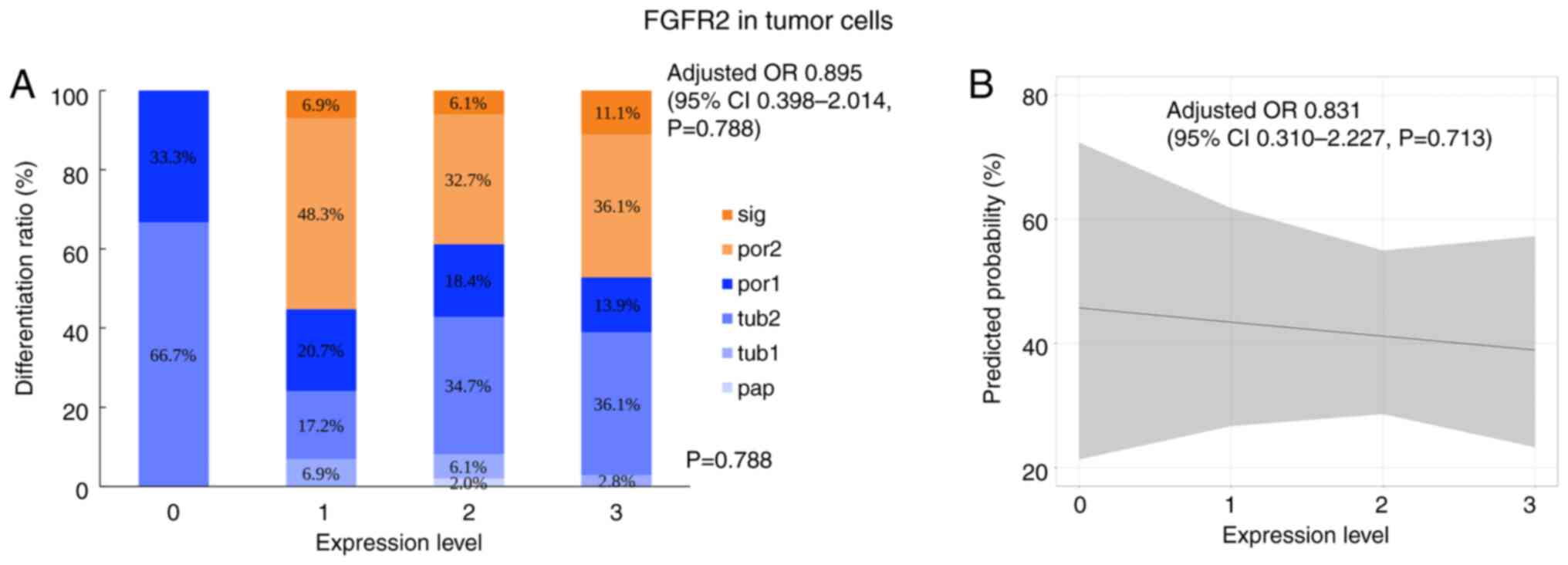
Figure 3

Association between FGFR2 expression
in tumor cells and histological subtype. (A) Association between
FGFR2 expression levels in tumor cells and histological subtypes
(pap, tub1, tub2, por1, por2, sig). (B) Predicted probability plot
showing the association between FGFR2 expression levels in tumor
cells and histological tumor classifications. In the predicted
probability plots, pap, tub1, tub2, and por1 were classified as
intestinal/indeterminate type, and por2 and sig were classified as
diffuse type. Solid lines represent the point estimate of the
predicted probability and gray shaded areas indicate the 95% CIs,
both derived from a logistic regression model. Estimates calculated
using maximum likelihood estimation. FGFR2, fibroblast growth
factor receptor 2; pap, papillary adenocarcinoma; tub1,
well-differentiated tubular adenocarcinoma; tub2, moderately
differentiated tubular adenocarcinoma; por1, solid-type poorly
differentiated adenocarcinoma; por2, non-solid-type poorly
differentiated adenocarcinoma; sig, signet-ring cell carcinoma; CI,
confidence interval; OR, odds ratio.

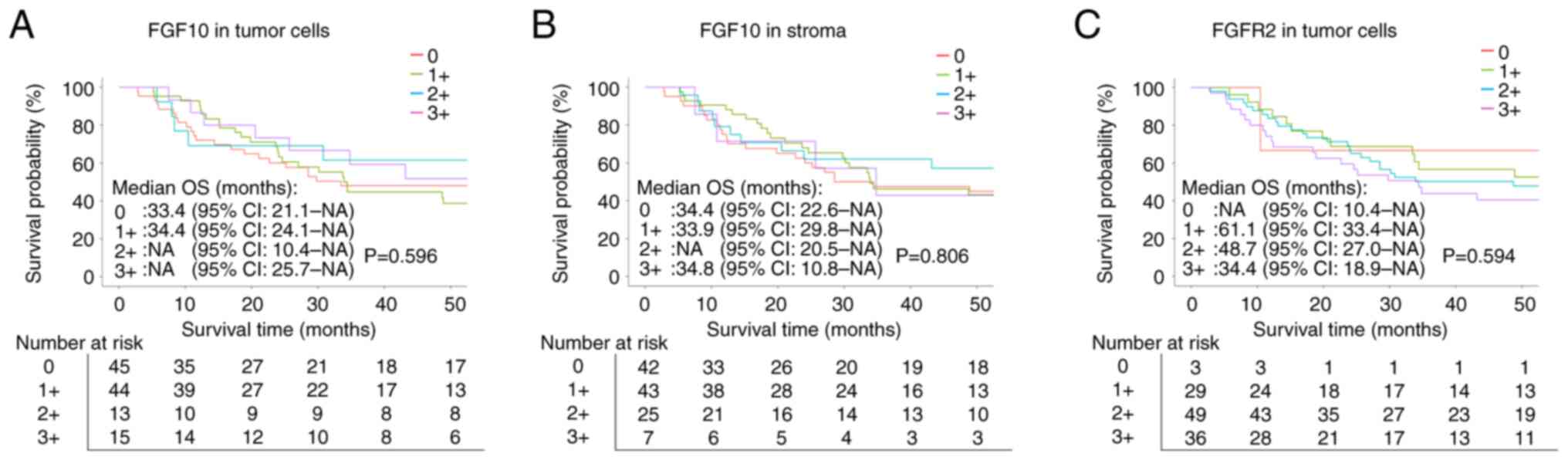
Figure 4

Association between FGF10 and FGFR2
expression and postoperative OS. OS was analyzed according to the
four-tier expression scores (0, 1+, 2+, 3+) for (A) FGF10 in tumor
cells, (B) FGF10 in stroma, and (C) FGFR2 in tumor cells.
Kaplan-Meier curves are presented without shaded CIs for visual
clarity, but corresponding 95% CI values are shown numerically.
FGF10, fibroblast growth factor 10; FGFR2, fibroblast growth factor
receptor 2; OS, overall survival; CI, confidence interval; NA, not
available.
View References

1 

Bray F, Laversanne M, Sung H, Ferlay J, Siegel RL, Soerjomataram I and Jemal A: Global cancer statistics 2022: GLOBOCAN estimates of incidence and mortality worldwide for 36 cancers in 185 countries. CA Cancer J Clin. 74:229–263. 2024.PubMed/NCBI

2 

Kakeji Y, Ishikawa T, Suzuki S, Akazawa K, Irino T, Miyashiro I, Ono H, Suzuki H, Tanabe S, Kadowaki S, et al: A retrospective 5-year survival analysis of surgically resected gastric cancer cases from the Japanese gastric cancer association nationwide registry (2001–2013). Gastric Cancer. 25:1082–1093. 2022. View Article : Google Scholar : PubMed/NCBI

3 

Cancer Genome Atlas Research Network, . Comprehensive molecular characterization of gastric adenocarcinoma. Nature. 513:202–209. 2014. View Article : Google Scholar : PubMed/NCBI

4 

Janjigian YY, Shitara K, Moehler M, Garrido M, Salman P, Shen L, Wyrwicz L, Yamaguchi K, Skoczylas T, Campos Bragagnoli A, et al: First-line nivolumab plus chemotherapy versus chemotherapy alone for advanced gastric, gastro-oesophageal junction, and oesophageal adenocarcinoma (CheckMate 649): A randomised, open-label, phase 3 trial. Lancet. 398:27–40. 2021. View Article : Google Scholar : PubMed/NCBI

5 

Sato Y, Okamoto K, Kawano Y, Kasai A, Kawaguchi T, Sagawa T, Sogabe M, Miyamoto H and Takayama T: Novel biomarkers of gastric cancer: Current research and future perspectives. J Clin Med. 12:46462023. View Article : Google Scholar : PubMed/NCBI

6 

Shitara K, Lordick F, Bang YJ, Enzinger P, Ilson D, Shah MA, Van Cutsem E, Xu RH, Aprile G, Xu J, et al: Zolbetuximab plus mFOLFOX6 in patients with CLDN18.2-positive, HER2-negative, untreated, locally advanced unresectable or metastatic gastric or gastro-oesophageal junction adenocarcinoma (SPOTLIGHT): A multicentre, randomised, double-blind, phase 3 trial. Lancet. 401:1655–1668. 2023. View Article : Google Scholar : PubMed/NCBI

7 

Kawakami H and Okamoto I: MET-targeted therapy for gastric cancer: The importance of a biomarker-based strategy. Gastric Cancer. 19:687–695. 2016. View Article : Google Scholar : PubMed/NCBI

8 

Shi T, Zhang Y, Wang Y, Song X, Wang H, Zhou X, Liang K, Luo Y, Che K, Wang X, et al: DKK1 promotes tumor immune evasion and impedes anti-PD-1 treatment by inducing immunosuppressive macrophages in gastric cancer. Cancer Immunol Res. 10:1506–1524. 2022. View Article : Google Scholar : PubMed/NCBI

9 

Kim HS, Kim JH and Jang HJ: Pathologic and prognostic impacts of FGFR2 amplification in gastric cancer: A meta-analysis and systemic review. J Cancer. 10:2560–2567. 2019. View Article : Google Scholar : PubMed/NCBI

10 

Gao Y, Zhang K, Xi H, Cai A, Wu X, Cui J, Li J, Qiao Z, Wei B and Chen L: Diagnostic and prognostic value of circulating tumor DNA in gastric cancer: A meta-analysis. Oncotarget. 8:6330–6340. 2017. View Article : Google Scholar : PubMed/NCBI

11 

Lee JS, Won HS, Sun S, Hong JH and Ko YH: Prognostic role of tumor-infiltrating lymphocytes in gastric cancer: A systematic review and meta-analysis. Medicine (Baltimore). 97:e117692018. View Article : Google Scholar : PubMed/NCBI

12 

Nakamura K, Sugano H and Takagi K: Carcinoma of the stomach in incipient phase: Its histogenesis and histological appearances. Gan. 59:251–258. 1968.PubMed/NCBI

13 

Feng F, Liu J, Wang F, Zheng G, Wang Q, Liu S, Xu G, Guo M, Lian X and Zhang H: Prognostic value of differentiation status in gastric cancer. BMC Cancer. 18:8652018. View Article : Google Scholar : PubMed/NCBI

14 

Zu H, Wang H, Li C and Xue Y: Clinicopathologic characteristics and prognostic value of various histological types in advanced gastric cancer. Int J Clin Exp Pathol. 7:5692–5700. 2014.PubMed/NCBI

15 

Association JGC: Japanese Classification of Gastric Carcinoma 2017. 15th edition. Kanehara; Tokyo: 2017

16 

Wang X, Deng J and Liang H: Well differentiated carcinoma with a poor prognosis: A retrospective analysis of papillary gastric adenocarcinoma. Surg Today. 51:1387–1396. 2021. View Article : Google Scholar : PubMed/NCBI

17 

Li HZ, Zhu HT, Chen YY, Zheng RS, Jin GF, Du LB and Cheng XD: Five-year survival analysis of gastric cancer from population-based cancer registration data in Zhejiang province, China. Zhonghua Zhong Liu Za Zhi. 46:862–870. 2024.(In Chinese). PubMed/NCBI

18 

Kunisaki C, Akiyama H, Nomura M, Matsuda G, Otsuka Y, Ono HA, Nagahori Y, Takahashi M, Kito F and Shimada H: Clinicopathological properties of poorly-differentiated adenocarcinoma of the stomach: Comparison of solid- and non-solid-types. Anticancer Res. 26:639–646. 2006.PubMed/NCBI

19 

Yasuda K, Adachi Y, Shiraishi N, Maeo S and Kitano S: Papillary adenocarcinoma of the stomach. Gastric Cancer. 3:33–38. 2000. View Article : Google Scholar : PubMed/NCBI

20 

Shin HD, Bang KB, Kang SH, Moon HS, Sung JK, Jeong HY, Lee DK, Kim KB, Kim SM, Lee SW, et al: Clinical outcome of endoscopic submucosal dissection for papillary type early gastric cancer: A multicenter study. Gut Liver. 18:426–433. 2024. View Article : Google Scholar : PubMed/NCBI

21 

Kim HS, Kim JH, Jang HJ, Han B and Zang DY: Pathological and prognostic impacts of FGFR2 overexpression in gastric cancer: A meta-analysis. J Cancer. 10:20–27. 2019. View Article : Google Scholar : PubMed/NCBI

22 

Hur JY, Chao J, Kim K, Kim ST, Kim KM, Klempner SJ and Lee J: High-level FGFR2 amplification is associated with poor prognosis and Lower response to chemotherapy in gastric cancers. Pathol Res Pract. 216:1528782020. View Article : Google Scholar : PubMed/NCBI

23 

Ooki A and Yamaguchi K: The beginning of the era of precision medicine for gastric cancer with fibroblast growth factor receptor 2 aberration. Gastric Cancer. 24:1169–1183. 2021. View Article : Google Scholar : PubMed/NCBI

24 

Yashiro M, Kuroda K, Masuda G, Okuno T, Miki Y, Yamamoto Y, Sera T, Sugimoto A, Kushiyama S, Nishimura S, et al: Clinical difference between fibroblast growth factor receptor 2 subclass, type IIIb and type IIIc, in gastric cancer. Sci Rep. 11:46982021. View Article : Google Scholar : PubMed/NCBI

25 

Kunii K, Davis L, Gorenstein J, Hatch H, Yashiro M, Di Bacco A, Elbi C and Lutterbach B: FGFR2-amplified gastric cancer cell lines require FGFR2 and Erbb3 signaling for growth and survival. Cancer Res. 68:2340–2348. 2008. View Article : Google Scholar : PubMed/NCBI

26 

Wainberg ZA, Enzinger PC, Kang YK, Qin S, Yamaguchi K, Kim IH, Saeed A, Oh SC, Li J, Turk HM, et al: Bemarituzumab in patients with FGFR2b-selected gastric or gastro-oesophageal junction adenocarcinoma (FIGHT): A randomised, double-blind, placebo-controlled, phase 2 study. Lancet Oncol. 23:1430–1440. 2022. View Article : Google Scholar : PubMed/NCBI

27 

Kang YK, Qin S, Lee KW, Oh SC, Kim IH, Kim JG, Li Y, Yan Z, Li J, Bai LY, et al: Bemarituzumab plus mFOLFOX6 as first-line treatment in East Asian patients with FGFR2b-overexpressing locally advanced or metastatic gastric/gastroesophageal junction cancer: Subgroup of FIGHT final analysis. Gastric Cancer. 27:1046–1057. 2024. View Article : Google Scholar : PubMed/NCBI

28 

Wainberg ZA, Kang YK, Lee KW, Qin S, Yamaguchi K, Kim IH, Saeed A, Oh SC, Li J, Turk HM, et al: Bemarituzumab as first-line treatment for locally advanced or metastatic gastric/gastroesophageal junction adenocarcinoma: Final analysis of the randomized phase 2 FIGHT trial. Gastric Cancer. 27:558–570. 2024. View Article : Google Scholar : PubMed/NCBI

29 

Ornitz DM, Xu J, Colvin JS, McEwen DG, MacArthur CA, Coulier F, Gao G and Goldfarb M: Receptor specificity of the fibroblast growth factor family. J Biol Chem. 271:15292–15297. 1996. View Article : Google Scholar : PubMed/NCBI

30 

Zhang X, Ibrahimi OA, Olsen SK, Umemori H, Mohammadi M and Ornitz DM: Receptor specificity of the fibroblast growth factor family. The complete mammalian FGF family. J Biol Chem. 281:15694–15700. 2006. View Article : Google Scholar : PubMed/NCBI

31 

Ornitz DM and Itoh N: The fibroblast growth factor signaling pathway. Wiley Interdiscip Rev Dev Biol. 4:215–266. 2015. View Article : Google Scholar : PubMed/NCBI

32 

Nyeng P, Norgaard GA, Kobberup S and Jensen J: FGF10 signaling controls stomach morphogenesis. Dev Biol. 303:295–310. 2007. View Article : Google Scholar : PubMed/NCBI

33 

Speer AL, Al Alam D, Sala FG, Ford HR, Bellusci S and Grikscheit TC: Fibroblast growth factor 10-fibroblast growth factor receptor 2b mediated signaling is not required for adult glandular stomach homeostasis. PLoS One. 7:e491272012. View Article : Google Scholar : PubMed/NCBI

34 

Ooi A, Oyama T, Nakamura R, Tajiri R, Ikeda H, Fushida S, Nakamura H and Dobashi Y: Semi-comprehensive analysis of gene amplification in gastric cancers using multiplex ligation-dependent probe amplification and fluorescence in situ hybridization. Mod Pathol. 28:861–871. 2015. View Article : Google Scholar : PubMed/NCBI

35 

Sun Q, Lin P, Zhang J, Li X, Yang L, Huang J, Zhou Z, Liu P and Liu N: Expression of fibroblast growth factor 10 is correlated with poor prognosis in gastric adenocarcinoma. Tohoku J Exp Med. 236:311–318. 2015. View Article : Google Scholar : PubMed/NCBI

36 

Board WCoTE: Digestive System Tumours. International Agency for Research on Cancer; Lyon: 2019

37 

Brierley JD, Gospodarowicz MK and Wittekind C: TNM Classification of Malignant Tumours. 8th edition. Wiley-Blackwell; Hoboken: pp. 63–69. 2017

38 

Altman DG, McShane LM, Sauerbrei W and Taube SE: Reporting recommendations for tumor marker prognostic studies (REMARK): Explanation and elaboration. PLoS Med. 9:e10012162012. View Article : Google Scholar : PubMed/NCBI

39 

Röcken C: Predictive biomarkers in gastric cancer. J Cancer Res Clin Oncol. 149:467–481. 2023. View Article : Google Scholar : PubMed/NCBI

40 

Watson J and Francavilla C: Regulation of FGF10 signaling in development and disease. Front Genet. 9:5002018. View Article : Google Scholar : PubMed/NCBI

41 

Sankoda N, Tanabe W, Tanaka A, Shibata H, Woltjen K, Chiba T, Haga H, Sakai Y, Mandai M, Yamamoto T, et al: Epithelial expression of Gata4 and Sox2 regulates specification of the squamous-columnar junction via MAPK/ERK signaling in mice. Nat Commun. 12:5602021. View Article : Google Scholar : PubMed/NCBI

42 

Abolhassani A, Riazi GH, Azizi E, Amanpour S, Muhammadnejad S, Haddadi M, Zekri A and Shirkoohi R: FGF10: Type III epithelial mesenchymal transition and invasion in breast cancer cell lines. J Cancer. 5:537–547. 2014. View Article : Google Scholar : PubMed/NCBI

43 

Lv YQ, Wu J, Li XK, Zhang JS and Bellusci S: Role of FGF10/FGFR2b signaling in mouse digestive tract development, repair and regeneration following injury. Front Cell Dev Biol. 7:3262019. View Article : Google Scholar : PubMed/NCBI

44 

Clayton NS and Grose RP: Emerging roles of fibroblast growth factor 10 in cancer. Front Genet. 9:4992018. View Article : Google Scholar : PubMed/NCBI

45 

Ndlovu R, Deng LC, Wu J, Li XK and Zhang JS: Fibroblast growth factor 10 in pancreas development and pancreatic cancer. Front Genet. 9:4822018. View Article : Google Scholar : PubMed/NCBI

46 

Memarzadeh S, Xin L, Mulholland DJ, Mansukhani A, Wu H, Teitell MA and Witte ON: Enhanced paracrine FGF10 expression promotes formation of multifocal prostate adenocarcinoma and an increase in epithelial androgen receptor. Cancer Cell. 12:572–585. 2007. View Article : Google Scholar : PubMed/NCBI

47 

Matsuike A, Ishiwata T, Watanabe M and Asano G: Expression of fibroblast growth factor (FGF)-10 in human colorectal adenocarcinoma cells. J Nippon Med Sch. 68:397–404. 2001. View Article : Google Scholar : PubMed/NCBI

Related Articles

  • Abstract
  • View
  • Download
  • Twitter
Copy and paste a formatted citation
Spandidos Publications style
Fujibayashi S, Kobayashi K, Tomita H, Watanabe D, Endo M, Yokoi R, Matsumoto K, Hayashi H, Kuno M, Fukada M, Fukada M, et al: Association between FGF10 expression and gland‑forming differentiation pattern in gastric adenocarcinoma: An immunohistochemical analysis. Oncol Lett 30: 479, 2025.
APA
Fujibayashi, S., Kobayashi, K., Tomita, H., Watanabe, D., Endo, M., Yokoi, R. ... Matsuhashi, N. (2025). Association between FGF10 expression and gland‑forming differentiation pattern in gastric adenocarcinoma: An immunohistochemical analysis. Oncology Letters, 30, 479. https://doi.org/10.3892/ol.2025.15224
MLA
Fujibayashi, S., Kobayashi, K., Tomita, H., Watanabe, D., Endo, M., Yokoi, R., Matsumoto, K., Hayashi, H., Kuno, M., Fukada, M., Yasufuku, I., Sato, Y., Asai, R., Tajima, J. Y., Hara, A., Matsuhashi, N."Association between FGF10 expression and gland‑forming differentiation pattern in gastric adenocarcinoma: An immunohistochemical analysis". Oncology Letters 30.4 (2025): 479.
Chicago
Fujibayashi, S., Kobayashi, K., Tomita, H., Watanabe, D., Endo, M., Yokoi, R., Matsumoto, K., Hayashi, H., Kuno, M., Fukada, M., Yasufuku, I., Sato, Y., Asai, R., Tajima, J. Y., Hara, A., Matsuhashi, N."Association between FGF10 expression and gland‑forming differentiation pattern in gastric adenocarcinoma: An immunohistochemical analysis". Oncology Letters 30, no. 4 (2025): 479. https://doi.org/10.3892/ol.2025.15224
Copy and paste a formatted citation
x
Spandidos Publications style
Fujibayashi S, Kobayashi K, Tomita H, Watanabe D, Endo M, Yokoi R, Matsumoto K, Hayashi H, Kuno M, Fukada M, Fukada M, et al: Association between FGF10 expression and gland‑forming differentiation pattern in gastric adenocarcinoma: An immunohistochemical analysis. Oncol Lett 30: 479, 2025.
APA
Fujibayashi, S., Kobayashi, K., Tomita, H., Watanabe, D., Endo, M., Yokoi, R. ... Matsuhashi, N. (2025). Association between FGF10 expression and gland‑forming differentiation pattern in gastric adenocarcinoma: An immunohistochemical analysis. Oncology Letters, 30, 479. https://doi.org/10.3892/ol.2025.15224
MLA
Fujibayashi, S., Kobayashi, K., Tomita, H., Watanabe, D., Endo, M., Yokoi, R., Matsumoto, K., Hayashi, H., Kuno, M., Fukada, M., Yasufuku, I., Sato, Y., Asai, R., Tajima, J. Y., Hara, A., Matsuhashi, N."Association between FGF10 expression and gland‑forming differentiation pattern in gastric adenocarcinoma: An immunohistochemical analysis". Oncology Letters 30.4 (2025): 479.
Chicago
Fujibayashi, S., Kobayashi, K., Tomita, H., Watanabe, D., Endo, M., Yokoi, R., Matsumoto, K., Hayashi, H., Kuno, M., Fukada, M., Yasufuku, I., Sato, Y., Asai, R., Tajima, J. Y., Hara, A., Matsuhashi, N."Association between FGF10 expression and gland‑forming differentiation pattern in gastric adenocarcinoma: An immunohistochemical analysis". Oncology Letters 30, no. 4 (2025): 479. https://doi.org/10.3892/ol.2025.15224
Follow us
  • Twitter
  • LinkedIn
  • Facebook
About
  • Spandidos Publications
  • Careers
  • Cookie Policy
  • Privacy Policy
How can we help?
  • Help
  • Live Chat
  • Contact
  • Email to our Support Team