Spandidos Publications Logo
  • About
    • About Spandidos
    • Aims and Scopes
    • Abstracting and Indexing
    • Editorial Policies
    • Reprints and Permissions
    • Job Opportunities
    • Terms and Conditions
    • Contact
  • Journals
    • All Journals
    • Oncology Letters
      • Oncology Letters
      • Information for Authors
      • Editorial Policies
      • Editorial Board
      • Aims and Scope
      • Abstracting and Indexing
      • Bibliographic Information
      • Archive
    • International Journal of Oncology
      • International Journal of Oncology
      • Information for Authors
      • Editorial Policies
      • Editorial Board
      • Aims and Scope
      • Abstracting and Indexing
      • Bibliographic Information
      • Archive
    • Molecular and Clinical Oncology
      • Molecular and Clinical Oncology
      • Information for Authors
      • Editorial Policies
      • Editorial Board
      • Aims and Scope
      • Abstracting and Indexing
      • Bibliographic Information
      • Archive
    • Experimental and Therapeutic Medicine
      • Experimental and Therapeutic Medicine
      • Information for Authors
      • Editorial Policies
      • Editorial Board
      • Aims and Scope
      • Abstracting and Indexing
      • Bibliographic Information
      • Archive
    • International Journal of Molecular Medicine
      • International Journal of Molecular Medicine
      • Information for Authors
      • Editorial Policies
      • Editorial Board
      • Aims and Scope
      • Abstracting and Indexing
      • Bibliographic Information
      • Archive
    • Biomedical Reports
      • Biomedical Reports
      • Information for Authors
      • Editorial Policies
      • Editorial Board
      • Aims and Scope
      • Abstracting and Indexing
      • Bibliographic Information
      • Archive
    • Oncology Reports
      • Oncology Reports
      • Information for Authors
      • Editorial Policies
      • Editorial Board
      • Aims and Scope
      • Abstracting and Indexing
      • Bibliographic Information
      • Archive
    • Molecular Medicine Reports
      • Molecular Medicine Reports
      • Information for Authors
      • Editorial Policies
      • Editorial Board
      • Aims and Scope
      • Abstracting and Indexing
      • Bibliographic Information
      • Archive
    • World Academy of Sciences Journal
      • World Academy of Sciences Journal
      • Information for Authors
      • Editorial Policies
      • Editorial Board
      • Aims and Scope
      • Abstracting and Indexing
      • Bibliographic Information
      • Archive
    • International Journal of Functional Nutrition
      • International Journal of Functional Nutrition
      • Information for Authors
      • Editorial Policies
      • Editorial Board
      • Aims and Scope
      • Abstracting and Indexing
      • Bibliographic Information
      • Archive
    • International Journal of Epigenetics
      • International Journal of Epigenetics
      • Information for Authors
      • Editorial Policies
      • Editorial Board
      • Aims and Scope
      • Abstracting and Indexing
      • Bibliographic Information
      • Archive
    • Medicine International
      • Medicine International
      • Information for Authors
      • Editorial Policies
      • Editorial Board
      • Aims and Scope
      • Abstracting and Indexing
      • Bibliographic Information
      • Archive
  • Articles
  • Information
    • Information for Authors
    • Information for Reviewers
    • Information for Librarians
    • Information for Advertisers
    • Conferences
  • Language Editing
Spandidos Publications Logo
  • About
    • About Spandidos
    • Aims and Scopes
    • Abstracting and Indexing
    • Editorial Policies
    • Reprints and Permissions
    • Job Opportunities
    • Terms and Conditions
    • Contact
  • Journals
    • All Journals
    • Biomedical Reports
      • Information for Authors
      • Editorial Policies
      • Editorial Board
      • Aims and Scope
      • Abstracting and Indexing
      • Bibliographic Information
      • Archive
    • Experimental and Therapeutic Medicine
      • Information for Authors
      • Editorial Policies
      • Editorial Board
      • Aims and Scope
      • Abstracting and Indexing
      • Bibliographic Information
      • Archive
    • International Journal of Epigenetics
      • Information for Authors
      • Editorial Policies
      • Editorial Board
      • Aims and Scope
      • Abstracting and Indexing
      • Bibliographic Information
      • Archive
    • International Journal of Functional Nutrition
      • Information for Authors
      • Editorial Policies
      • Editorial Board
      • Aims and Scope
      • Abstracting and Indexing
      • Bibliographic Information
      • Archive
    • International Journal of Molecular Medicine
      • Information for Authors
      • Editorial Policies
      • Editorial Board
      • Aims and Scope
      • Abstracting and Indexing
      • Bibliographic Information
      • Archive
    • International Journal of Oncology
      • Information for Authors
      • Editorial Policies
      • Editorial Board
      • Aims and Scope
      • Abstracting and Indexing
      • Bibliographic Information
      • Archive
    • Medicine International
      • Information for Authors
      • Editorial Policies
      • Editorial Board
      • Aims and Scope
      • Abstracting and Indexing
      • Bibliographic Information
      • Archive
    • Molecular and Clinical Oncology
      • Information for Authors
      • Editorial Policies
      • Editorial Board
      • Aims and Scope
      • Abstracting and Indexing
      • Bibliographic Information
      • Archive
    • Molecular Medicine Reports
      • Information for Authors
      • Editorial Policies
      • Editorial Board
      • Aims and Scope
      • Abstracting and Indexing
      • Bibliographic Information
      • Archive
    • Oncology Letters
      • Information for Authors
      • Editorial Policies
      • Editorial Board
      • Aims and Scope
      • Abstracting and Indexing
      • Bibliographic Information
      • Archive
    • Oncology Reports
      • Information for Authors
      • Editorial Policies
      • Editorial Board
      • Aims and Scope
      • Abstracting and Indexing
      • Bibliographic Information
      • Archive
    • World Academy of Sciences Journal
      • Information for Authors
      • Editorial Policies
      • Editorial Board
      • Aims and Scope
      • Abstracting and Indexing
      • Bibliographic Information
      • Archive
  • Articles
  • Information
    • For Authors
    • For Reviewers
    • For Librarians
    • For Advertisers
    • Conferences
  • Language Editing
Login Register Submit
  • This site uses cookies
  • You can change your cookie settings at any time by following the instructions in our Cookie Policy. To find out more, you may read our Privacy Policy.

    I agree
Search articles by DOI, keyword, author or affiliation
Search
Advanced Search
presentation
Oncology Letters
Join Editorial Board Propose a Special Issue
Print ISSN: 1792-1074 Online ISSN: 1792-1082
Journal Cover
March-2026 Volume 31 Issue 3

Full Size Image

Sign up for eToc alerts
Recommend to Library

Journals

International Journal of Molecular Medicine

International Journal of Molecular Medicine

International Journal of Molecular Medicine is an international journal devoted to molecular mechanisms of human disease.

International Journal of Oncology

International Journal of Oncology

International Journal of Oncology is an international journal devoted to oncology research and cancer treatment.

Molecular Medicine Reports

Molecular Medicine Reports

Covers molecular medicine topics such as pharmacology, pathology, genetics, neuroscience, infectious diseases, molecular cardiology, and molecular surgery.

Oncology Reports

Oncology Reports

Oncology Reports is an international journal devoted to fundamental and applied research in Oncology.

Experimental and Therapeutic Medicine

Experimental and Therapeutic Medicine

Experimental and Therapeutic Medicine is an international journal devoted to laboratory and clinical medicine.

Oncology Letters

Oncology Letters

Oncology Letters is an international journal devoted to Experimental and Clinical Oncology.

Biomedical Reports

Biomedical Reports

Explores a wide range of biological and medical fields, including pharmacology, genetics, microbiology, neuroscience, and molecular cardiology.

Molecular and Clinical Oncology

Molecular and Clinical Oncology

International journal addressing all aspects of oncology research, from tumorigenesis and oncogenes to chemotherapy and metastasis.

World Academy of Sciences Journal

World Academy of Sciences Journal

Multidisciplinary open-access journal spanning biochemistry, genetics, neuroscience, environmental health, and synthetic biology.

International Journal of Functional Nutrition

International Journal of Functional Nutrition

Open-access journal combining biochemistry, pharmacology, immunology, and genetics to advance health through functional nutrition.

International Journal of Epigenetics

International Journal of Epigenetics

Publishes open-access research on using epigenetics to advance understanding and treatment of human disease.

Medicine International

Medicine International

An International Open Access Journal Devoted to General Medicine.

Journal Cover
March-2026 Volume 31 Issue 3

Full Size Image

Sign up for eToc alerts
Recommend to Library

  • Article
  • Citations
    • Cite This Article
    • Download Citation
    • Create Citation Alert
    • Remove Citation Alert
    • Cited By
  • Similar Articles
    • Related Articles (in Spandidos Publications)
    • Similar Articles (Google Scholar)
    • Similar Articles (PubMed)
  • Download PDF
  • Download XML
  • View XML
Case Report Open Access

Cerebral infarctions caused by pulmonary vein metastasis from gastric cancer: A case report

  • Authors:
    • Nobuhito Hara
    • Yumi Yoshii
    • Yoshiki Kojitani
    • Rika Sasaki
    • Masahide Ota
    • Shunsuke Okazaki
    • Hitoshi Nakagawa
    • Junichi Takemura
    • Ryo Miyata
    • Masatsugu Hamaji
    • Mitsuharu Hosono
    • Fumi Okada
    • Akihiko Yoshizawa
    • Masayuki Takeda
  • View Affiliations / Copyright

    Affiliations: Department of Cancer Genomics and Medical Oncology, Nara Medical University, Kashihara, Nara 634‑8521, Japan, Department of Cardiovascular Medicine, Nara Medical University, Kashihara, Nara 634‑8521, Japan, Department of Thoracic and Cardiovascular Surgery, Nara Medical University, Kashihara, Nara 634‑8521, Japan, Department of Pathology, Nara Medical University, Kashihara, Nara 634‑8521, Japan
    Copyright: © Hara et al. This is an open access article distributed under the terms of Creative Commons Attribution License.
  • Article Number: 116
    |
    Published online on: January 22, 2026
       https://doi.org/10.3892/ol.2026.15469
  • Expand metrics +
Metrics: Total Views: 0 (Spandidos Publications: | PMC Statistics: )
Metrics: Total PDF Downloads: 0 (Spandidos Publications: | PMC Statistics: )
Cited By (CrossRef): 0 citations Loading Articles...

This article is mentioned in:


Abstract

Gastric cancer remains one of the leading causes of cancer‑related mortality worldwide, particularly in East Asian countries, despite advances in systemic therapy and the development of novel targeted and immune‑based treatments. Due to its aggressive biological behavior, gastric cancer frequently metastasizes to the liver, peritoneum, lymph nodes, lungs and bone. Although extremely rare, pulmonary vein metastasis is clinically significant as it can cause embolic events in vital organs, including multiple cerebral infarctions. The present report describes an extremely rare case of cerebral infarction secondary to pulmonary vein metastasis originating from a gastric adenocarcinoma. To the best of our knowledge, the current case is the first documented case of its kind.

Introduction

Gastric cancer has a relatively high prevalence, especially in East Asia, and it is one of the most common causes of cancer-related death worldwide. Despite many improvements in its diagnosis and treatment, the prognosis of gastric cancer remains poor, especially in its advanced stages. It exhibits several distinct metastatic patterns depending on the histological subtype, tumor location, and disease progression. The metastatic spread of the primary gastric cancer can occur through four pathways: peritoneal dissemination, hematogenous dissemination, lymphatic spread, and direct tumor invasion. Based on previous registration studies evaluating the hematogenous metastasis of gastric cancer, 17, 6, 5, and 1% of patients present with liver, lung, bone, and brain metastasis at the time of diagnosis, respectively (1). This report describes a very rare case of gastric cancer with metastasis to the pulmonary veins, which has not been reported previously. Tumor embolization of the pulmonary vein is a precarious condition because it can cause serious embolism if it migrates to the arteries.

Case report

A 71-year-old male with a 20-year smoking history underwent laparoscopic distal gastrectomy, D1 lymph node dissection, and Billroth-I reconstruction for gastric cancer at a previous hospital in March 2021. The histological examinations revealed moderately differentiated tubular adenocarcinoma with No4d lymph node metastasis; pT1b(SM)N1M0 pStage1B (UICC TNM 8th edition). Seven months after the first surgery, partial hepatic resection was performed for a solitary S7 hepatic recurrence, followed by a 12-month course of postoperative chemotherapy with S-1 and docetaxel.

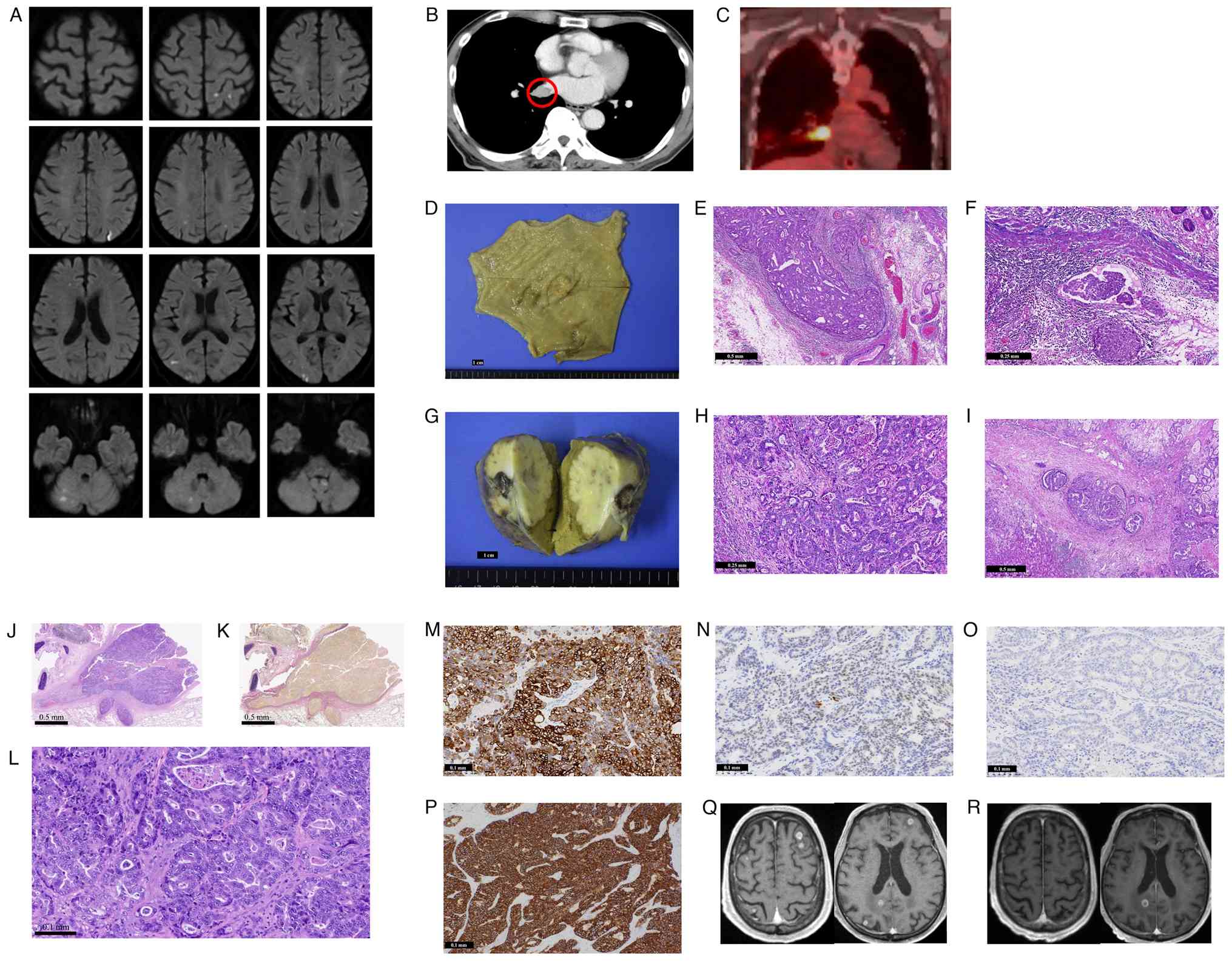
In December 2023, the patient presented with weakness and numbness of the right lower extremity and was admitted to our hospital. Non-contrast magnetic resonance imaging (MRI) of the brain demonstrated multiple small acute infarcts, characterized by diffusion restriction and low ADC values, located in the left cerebellar tonsil, right cerebellar hemisphere, and bilateral frontal watershed regions (Fig. 1A). Contrast-enhanced computed tomography (CT) of the chest revealed right-sided pleural effusion with no apparent lung metastatic nodules, but with a filling defect in the right inferior pulmonary vein (Fig. 1B). The vital signs upon admission were as follows: oxygen saturation, 99% on room air; blood pressure, 138/88 mmHg; heart rate, 61/min; and body temperature, 37.0°C. Physical examination revealed no murmurs or abnormal sounds during respiration, and echocardiography showed no evidence of valvular disease or intracardiac thrombus. Positron emission tomography/CT demonstrated FDG accumulation [maximum standardized uptake value (SUVmax) 13.0] at the right inferior pulmonary vein (Fig. 1C). Based on these findings, the patient was suspected to have multiple cerebral tumor emboli, likely induced by pulmonary vein metastasis. The acute cerebral infarctions were managed with rehabilitation and aspirin therapy, and the patient's right lower extremity weakness and numbness had improved by two weeks after treatment initiation. A follow-up contrast-enhanced brain MRI revealed multiple enhancing lesions in the bilateral cerebellum and cerebrum, which were consistent with brain metastases. Stereotactic radiotherapy (35 Gy/5 fractions) was delivered to the 9 brain lesions. Subsequently, video-assisted thoracoscopic right lower lobectomy, pulmonary vein tumor resection, and left atrial repair were performed in February 2024. Pulmonary vein resection was done for diagnostic purposes, as well as to prevent any further cerebral infarctions caused by tumor emboli.
(A) Diffusion-weighted imaging of
non-contrast brain MRI demonstrating multiple small acute infarcts
characterized by diffusion restriction. Lesions were observed in
the left cerebellar tonsil, right cerebellar hemisphere and
bilateral frontal watershed regions. (B) Contrast-enhanced CT
revealed a filling defect in the right inferior pulmonary vein (red
circle) (C) Positron emission tomography/CT revealed abnormal
uptake in the right inferior pulmonary vein with a maximum
standardized uptake value of 13.0, as well as right-sided pleural
effusion. (D) Gross image of the primary gastric carcinoma specimen
after formalin fixation. Scale bar, 1 cm. (E) H&E-stained
section of the primary gastric carcinoma demonstrating vascular
invasion by adenocarcinoma. Scale bar, 0.5 mm. (F) H&E-stained
section of the primary gastric carcinoma demonstrating lymphatic
invasion by adenocarcinoma. Scale bar, 0.25 mm. (G) Gross image of
the liver metastatic tumor after formalin fixation. Scale bar, 1
cm. (H) H&E-stained section of the liver metastatic tumor
demonstrating adenocarcinoma with morphological features similar to
those of the primary gastric carcinoma. Scale bar, 0.25 mm. (I)
H&E-stained section of the liver metastatic tumor demonstrating
vascular invasion by adenocarcinoma. Scale bar, 0.5 mm. (J)
H&E-stained section of the tumor metastasized to the pulmonary
vein. Scale bar, 0.5 mm. (K) Elastica van Gieson-stained section of
the tumor metastasized to the pulmonary vein, demonstrating tumor
invasion into the pulmonary vein. Scale bar, 0.5 mm. (L)
H&E-stained section of the tumor metastasized to the pulmonary
vein at a magnification of ×100 (objective lens, ×10; ocular lens,
×10). The adenocarcinoma exhibited complex tubulopapillary
structures with a stromal reaction. The tumor morphology was
similar to that of the previously identified primary gastric
carcinoma and liver metastasis. Scale bar, 0.1 mm. (M)
Immunohistochemical staining of the pulmonary vein metastatic tumor
showing positivity for cytokeratin 7. Scale bar, 0.1 mm. (N)
Immunohistochemical staining of the pulmonary vein metastatic tumor
showing partial positivity for caudal type homeobox 2. Scale bar,
0.1 mm. (O) Immunohistochemical staining of the pulmonary vein
metastatic tumor showing negativity for cytokeratin 20. Scale bar,
0.1 mm. (P) Immunohistochemical staining of the pulmonary vein
metastatic tumor showing strong positivity for HER2. Scale bar, 0.1
mm. Contrast-enhanced brain MRI performed in (Q) October 2024 and
(R) March 2025. After initiating trastuzumab deruxtecan, a partial
radiological response was observed, with some metastatic brain
lesions disappearing on the follow-up MRI. CT, computed tomography;
H&E, hematoxylin and eosin; MRI, magnetic resonance
imaging.

Figure 1.

(A) Diffusion-weighted imaging of non-contrast brain MRI demonstrating multiple small acute infarcts characterized by diffusion restriction. Lesions were observed in the left cerebellar tonsil, right cerebellar hemisphere and bilateral frontal watershed regions. (B) Contrast-enhanced CT revealed a filling defect in the right inferior pulmonary vein (red circle) (C) Positron emission tomography/CT revealed abnormal uptake in the right inferior pulmonary vein with a maximum standardized uptake value of 13.0, as well as right-sided pleural effusion. (D) Gross image of the primary gastric carcinoma specimen after formalin fixation. Scale bar, 1 cm. (E) H&E-stained section of the primary gastric carcinoma demonstrating vascular invasion by adenocarcinoma. Scale bar, 0.5 mm. (F) H&E-stained section of the primary gastric carcinoma demonstrating lymphatic invasion by adenocarcinoma. Scale bar, 0.25 mm. (G) Gross image of the liver metastatic tumor after formalin fixation. Scale bar, 1 cm. (H) H&E-stained section of the liver metastatic tumor demonstrating adenocarcinoma with morphological features similar to those of the primary gastric carcinoma. Scale bar, 0.25 mm. (I) H&E-stained section of the liver metastatic tumor demonstrating vascular invasion by adenocarcinoma. Scale bar, 0.5 mm. (J) H&E-stained section of the tumor metastasized to the pulmonary vein. Scale bar, 0.5 mm. (K) Elastica van Gieson-stained section of the tumor metastasized to the pulmonary vein, demonstrating tumor invasion into the pulmonary vein. Scale bar, 0.5 mm. (L) H&E-stained section of the tumor metastasized to the pulmonary vein at a magnification of ×100 (objective lens, ×10; ocular lens, ×10). The adenocarcinoma exhibited complex tubulopapillary structures with a stromal reaction. The tumor morphology was similar to that of the previously identified primary gastric carcinoma and liver metastasis. Scale bar, 0.1 mm. (M) Immunohistochemical staining of the pulmonary vein metastatic tumor showing positivity for cytokeratin 7. Scale bar, 0.1 mm. (N) Immunohistochemical staining of the pulmonary vein metastatic tumor showing partial positivity for caudal type homeobox 2. Scale bar, 0.1 mm. (O) Immunohistochemical staining of the pulmonary vein metastatic tumor showing negativity for cytokeratin 20. Scale bar, 0.1 mm. (P) Immunohistochemical staining of the pulmonary vein metastatic tumor showing strong positivity for HER2. Scale bar, 0.1 mm. Contrast-enhanced brain MRI performed in (Q) October 2024 and (R) March 2025. After initiating trastuzumab deruxtecan, a partial radiological response was observed, with some metastatic brain lesions disappearing on the follow-up MRI. CT, computed tomography; H&E, hematoxylin and eosin; MRI, magnetic resonance imaging.

The resected specimen measured 16×12×7 cm. The pulmonary vein was dilated to 2.0 cm and filled with a grayish-white mass, which had similar histologic features as the previously resected gastric and hepatic tumors (Fig. 1D-L). Immunohistochemical staining was positive for CK7, partially positive for CDX2, and negative for CK20, confirming the diagnosis of pulmonary vein metastasis from gastric adenocarcinoma. Additionally, HER2 immunohistochemistry was strongly positive (IHC 3+) (Fig. 1M-P). Because the surgical margins of the pulmonary vein were positive, chemotherapy with S-1, oxaliplatin, and trastuzumab was subsequently initiated in March 2024. In August 2024, the patient developed new brain metastases, which were treated with additional stereotactic radiotherapy (SRT/SRS). In October 2024, the brain metastases further progressed, prompting a switch in the chemotherapy regimen to trastuzumab deruxtecan for its potential efficacy against brain metastases, resulting in partial regression of the brain lesions (Fig. 1Q and R). In June 2025, however, chemotherapy was discontinued due to a decline in the patient's performance status. As of July 2025, the patient remains alive under best supportive care.

Discussion

The most common metastatic sites of gastric cancer are the liver, peritoneum, lungs, and bones (1). Although several reports have described metastases to the pericardium and heart (2–4), pulmonary vein metastasis is extremely rare. The current literature describes pulmonary vein metastases from other malignancies such as hepatocellular carcinoma, chordoma, breast cancer, and melanoma (5–8), but no reports have described pulmonary vein metastasis from a gastric adenocarcinoma primary. Thus, this appears to be the first documented case of its kind.

In this case, the patient presented with acute right lower extremity weakness and numbness, and brain MRI revealed multiple infarcts involving the left cerebellar tonsil, right cerebellar hemisphere, and bilateral frontal watershed regions. Because the lesions were multiple and small, it was not possible to identify a definitive responsible focus that could clearly account for the patient's right lower extremity weakness and numbness. No notable cerebellar symptoms, such as ataxia or balance disturbance, were observed.

The distribution of infarcts across both supratentorial and infratentorial regions suggests that embolic material reached the brain via more than one arterial route. The coexistence of watershed infarcts in the frontal lobes and infarcts in the cerebellum indicates potential involvement of both the internal carotid and vertebrobasilar arterial systems. In this patient, it was not possible to definitively determine whether these multiple cerebral infarctions were caused by tumor emboli originating from the pulmonary vein, as thrombus retrieval was not performed. However, previous reports in other malignancies have described pulmonary vein tumor emboli as a cause of cerebral infarction (8). Therefore, in clinical situations where pulmonary vein metastasis is suspected, careful monitoring for cerebral embolic events is warranted.

For gastrointestinal cancers to metastasize to the pulmonary vein, the tumor cells must traverse the portal vein, pass through the right heart, and enter the pulmonary artery before finally reaching the pulmonary vein. Since gastric cancer cells are approximately 10 µm in diameter, it is unlikely that they can pass directly through the pulmonary capillaries, which typically have a smaller diameter. Additionally, there was no apparent pulmonary metastasis that could have trapped the tumor in the lungs in this patient, nor was there definitive evidence of the tumor invading the myocardium and pericardium. One hypothesis is that microscopic pulmonary artery-vein shunts could promote the migration of tumor cells into the pulmonary veins. However, Elastica van Gieson staining revealed tumor proliferation in the pulmonary veins and the stroma around the ruptured pulmonary veins, but there was no obvious pulmonary artery infiltration. Furthermore, a bubble test echocardiogram performed postoperatively revealed no macroscopic arteriovenous shunt.

Pulmonary vein metastasis can predispose patients to hematogenous brain metastases. In this case, nine metastatic lesions were identified bilaterally in the cerebrum and cerebellum. After multidisciplinary discussion, the patient underwent stereotactic radiotherapy and pulmonary vein tumor resection with left atrial repair, considering the possibility of further brain metastasis from the pulmonary vein, which could cause a decline in performance. By preventing appearance of new brain metastases in a short period of time, HER2-based chemotherapy could have been introduced, which could improve the chances of long-term survival (9,10).

This case highlights the importance of recognizing pulmonary vein metastasis as a potential source of tumor embolism and brain metastasis in gastric adenocarcinoma. Multimodal treatment with a combination of surgery, radiotherapy, and systemic therapy can help achieve long-term disease control even in such rare and challenging clinical situations.

This case was previously reported in part by the Department of Thoracic and Cardiovascular Surgery, focusing on the surgical technique (JTCVS Tech. 2025;29:103-105) (11). The present report offers a distinct perspective on the oncological and neurological aspects of the same case, including the clinical course, cerebral complications and systemic therapy, and does not overlap with the previous publication.

Acknowledgements

Not applicable.

Funding

Funding: No funding was received.

Availability of data and materials

The data generated in the present study may be requested from the corresponding author.

Authors' contributions

NH and MT confirm the authenticity of all the raw data. NH conceived and designed the study. Acquisition and interpretation of data was performed by NH, YY, YK, RS, MO, SO, HN, JT, RM, MHa, MHo, FO, AY and MT. Writing of the original draft was undertaken by NH, and writing, review and editing of the manuscript were carried out by NH and MT. All authors agree to be accountable for all aspects of the research in ensuring that the accuracy or integrity of any part of the work are appropriately investigated and resolved. All authors have read and approved the final version of the manuscript.

Ethics approval and consent to participate

Not applicable.

Patient consent for publication

Written informed consent was obtained from the patient for publication of this case report and the accompanying images. The patient was informed that all identifying information would be removed to ensure anonymity.

Competing interests

MT received honoraria from Chugai Pharmaceutical, AstraZeneca K.K., Bristol-Myers Squibb Company, Novartis Pharma K.K., and Ono Pharmaceutical. The other authors declare that they have no competing interests.

References

1 

Qiu M, Shi S, Chen ZH, Yu HE, Sheng H, Jin Y, Wang DS, Wang FH, Li YH, Xie D, et al: Frequency and clinicopathological features of metastasis to liver, lung, bone, and brain from gastric cancer: A SEER-based study. Cancer Med. 7:3662–3672. 2018. View Article : Google Scholar : PubMed/NCBI

2 

Moriyama A, Murata I, Kuroda T, Yoshikawa I, Tabaru A, Ogami Y and Otsuki M: Pericardiac metastasis from advanced gastric cancer. J Gastroenterol. 30:512–516. 1995. View Article : Google Scholar : PubMed/NCBI

3 

Bernhardt P, Jones A, Kaufmann J, Hombach V and Spiess J: Cardiac metastasis of a gastric adenocarcinoma. Eur Heart J. 30:16552009. View Article : Google Scholar : PubMed/NCBI

4 

Oza T, Shafique K, Gilani A, Lanjewar S and Shao C: Cardiac metastases of primary gastric adenocarcinoma presenting as cardiac failure. Am J Clin Pathol. 144 (Suppl 2):A0102015. View Article : Google Scholar

5 

Diallo O, Yaméogo VN, Dao SBA, Ouattara B and Cissé R: Right upper pulmonary vein metastasis from hepatocarcinoma. Radiol Case Rep. 13:11–13. 2018. View Article : Google Scholar : PubMed/NCBI

6 

Prompona M, Linn J, Burdorf L, Assmann G, Reichart B, Reiser M and Nikolaou K: Pulmonary vein metastasis of a sacral chordoma extending into the left atrial cavity. J Cardiovasc Med (Hagerstown). 10:557–559. 2009. View Article : Google Scholar : PubMed/NCBI

7 

Makhija Z, Luckraz H and Butchart EG: Pseudo-myxoma: Massive pulmonary vein metastasis from a primary breast carcinoma. Eur J Cardiothorac Surg. 33:3142008. View Article : Google Scholar : PubMed/NCBI

8 

Nukata R, Ikeda H, Akaike N, Fujiwara T, Yamashita H, Uezato M, Kinosada M, Kurosaki Y, Shindo K and Chin M: White embolus-induced basilar artery occlusion due to pulmonary vein invasion of a metastasis of a malignant melanoma. Intern Med. 62:2889–2893. 2023. View Article : Google Scholar : PubMed/NCBI

9 

Bang YJ, Van Cutsem E, Feyereislova A, Chung HC, Shen L, Sawaki A, Lordick F, Ohtsu A, Omuro Y, Satoh T, et al: Trastuzumab in combination with chemotherapy versus chemotherapy alone for treatment of HER2-positive advanced gastric or gastro-oesophageal junction cancer (ToGA): A phase 3, open-label, randomised controlled trial. Lancet. 376:687–697. 2010. View Article : Google Scholar : PubMed/NCBI

10 

Harbeck N, Ciruelos E, Jerusalem G, Müller V, Niikura N, Viale G, Bartsch R, Kurzeder C, Higgins MJ, Connolly RM, et al: Trastuzumab deruxtecan in HER2-positive advanced breast cancer with or without brain metastases: A phase 3b/4 trial. Nat Med. 30:3717–3727. 2024. View Article : Google Scholar : PubMed/NCBI

11 

Takemura J, Miyata R, Miura S, Hamaji M and Hosono M: Salvage lobectomy for an intravascular mass occluding the right lower lobe vein. JTCVS Tech. 29:103–105. 2024. View Article : Google Scholar : PubMed/NCBI

Related Articles

  • Abstract
  • View
  • Download
  • Twitter
Copy and paste a formatted citation
Spandidos Publications style
Hara N, Yoshii Y, Kojitani Y, Sasaki R, Ota M, Okazaki S, Nakagawa H, Takemura J, Miyata R, Hamaji M, Hamaji M, et al: <p>Cerebral infarctions caused by pulmonary vein metastasis from gastric cancer: A case report</p>. Oncol Lett 31: 116, 2026.
APA
Hara, N., Yoshii, Y., Kojitani, Y., Sasaki, R., Ota, M., Okazaki, S. ... Takeda, M. (2026). <p>Cerebral infarctions caused by pulmonary vein metastasis from gastric cancer: A case report</p>. Oncology Letters, 31, 116. https://doi.org/10.3892/ol.2026.15469
MLA
Hara, N., Yoshii, Y., Kojitani, Y., Sasaki, R., Ota, M., Okazaki, S., Nakagawa, H., Takemura, J., Miyata, R., Hamaji, M., Hosono, M., Okada, F., Yoshizawa, A., Takeda, M."<p>Cerebral infarctions caused by pulmonary vein metastasis from gastric cancer: A case report</p>". Oncology Letters 31.3 (2026): 116.
Chicago
Hara, N., Yoshii, Y., Kojitani, Y., Sasaki, R., Ota, M., Okazaki, S., Nakagawa, H., Takemura, J., Miyata, R., Hamaji, M., Hosono, M., Okada, F., Yoshizawa, A., Takeda, M."<p>Cerebral infarctions caused by pulmonary vein metastasis from gastric cancer: A case report</p>". Oncology Letters 31, no. 3 (2026): 116. https://doi.org/10.3892/ol.2026.15469
Copy and paste a formatted citation
x
Spandidos Publications style
Hara N, Yoshii Y, Kojitani Y, Sasaki R, Ota M, Okazaki S, Nakagawa H, Takemura J, Miyata R, Hamaji M, Hamaji M, et al: <p>Cerebral infarctions caused by pulmonary vein metastasis from gastric cancer: A case report</p>. Oncol Lett 31: 116, 2026.
APA
Hara, N., Yoshii, Y., Kojitani, Y., Sasaki, R., Ota, M., Okazaki, S. ... Takeda, M. (2026). <p>Cerebral infarctions caused by pulmonary vein metastasis from gastric cancer: A case report</p>. Oncology Letters, 31, 116. https://doi.org/10.3892/ol.2026.15469
MLA
Hara, N., Yoshii, Y., Kojitani, Y., Sasaki, R., Ota, M., Okazaki, S., Nakagawa, H., Takemura, J., Miyata, R., Hamaji, M., Hosono, M., Okada, F., Yoshizawa, A., Takeda, M."<p>Cerebral infarctions caused by pulmonary vein metastasis from gastric cancer: A case report</p>". Oncology Letters 31.3 (2026): 116.
Chicago
Hara, N., Yoshii, Y., Kojitani, Y., Sasaki, R., Ota, M., Okazaki, S., Nakagawa, H., Takemura, J., Miyata, R., Hamaji, M., Hosono, M., Okada, F., Yoshizawa, A., Takeda, M."<p>Cerebral infarctions caused by pulmonary vein metastasis from gastric cancer: A case report</p>". Oncology Letters 31, no. 3 (2026): 116. https://doi.org/10.3892/ol.2026.15469
Follow us
  • Twitter
  • LinkedIn
  • Facebook
About
  • Spandidos Publications
  • Careers
  • Cookie Policy
  • Privacy Policy
How can we help?
  • Help
  • Live Chat
  • Contact
  • Email to our Support Team












