Oncol Lett 30: [Related article:] 597, 2025; DOI:
10.3892/ol.2025.15343
Subsequently to the publication of the above paper,
an interested reader drew to the Editor's attention that a pair of
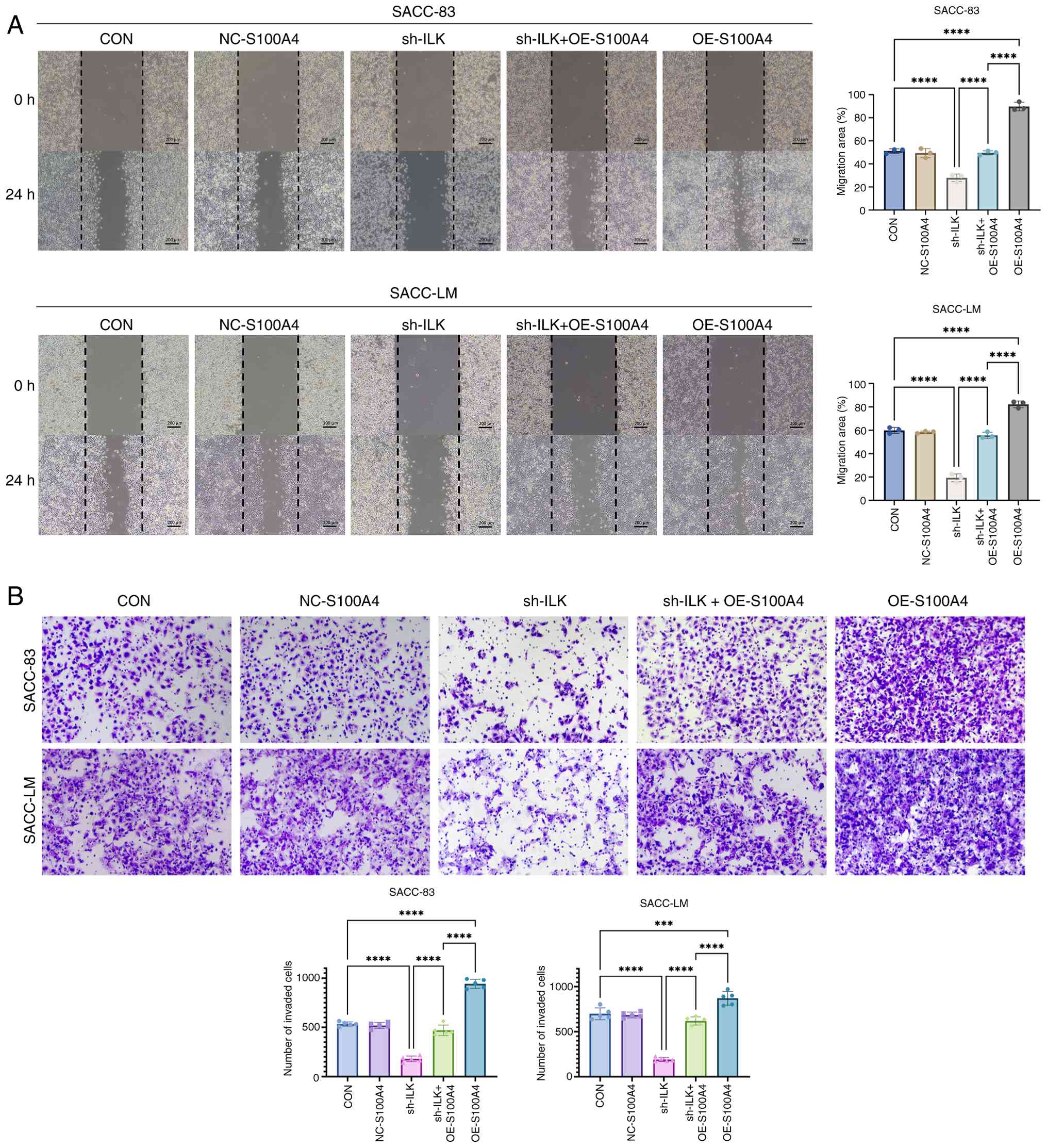
data panels shown for the scratch-wound assay experiments in Figs.
1 and 7 were apparently
overlapping; in addition, another pair of data panels within
Fig. 7 itself were also found to be
overlapping.
Upon examining their original raw data (which were
also presented to the Editorial Office for our inspection), the
authors realized that several inadvertent errors had been made in
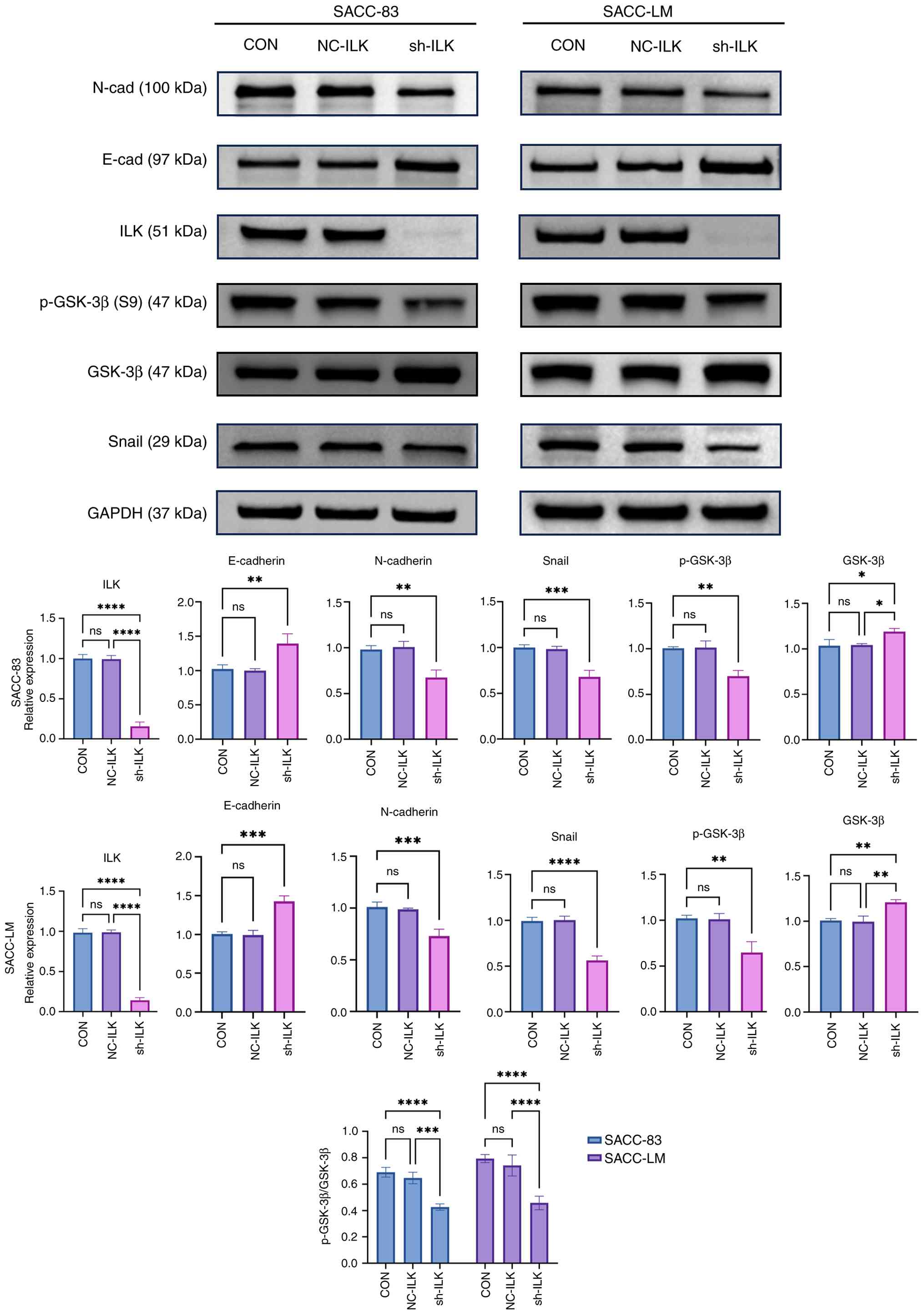
the presentation of Figs. 2 and
7 in the published paper.
Specifically, the image for the 24 h, SACC-LM Control (CON) group
in Fig. 7 was inadvertently
duplicated and used for the 24 h, negative control (NC-S100A4)
group of the same cell line. Secondly, the image intended for the
24 h, SACC-LM sh-ILK group in Fig.
7 had mistakenly been replaced by an image from a separate
sh-ILK experiment performed with the SACC-83 cells. Thirdly, the
western blot data depicting ILK and Snail expression in the SACC-83
cell line in Fig. 2 were
inadvertently re-used to represent different experimental endpoints
in Figs. 3 and 6.
The revised versions of Figs. 2 and 7, featuring the correct data for the ILK
and Snail blots for the SACC-83 cell line in Fig. 2, and the correct data for the 24 h,
NC-S100A4 and 24 h, sh-ILK experiments for the SACC-LM cell line in
Fig. 7, are shown on the next two
pages. The authors regret these errors were made in compiling these
figures, which resulted from administrative oversights during the
image selection and integration process, although note that these
errors did not grossly affect either the results or the conclusions
reported in this study. The authors are grateful to the editor of
Oncology Letters for allowing them the opportunity to
publish a Corrigendum; furthermore, they apologize to the
readership for any inconvenience caused.