|
1
|
Houston KA, Henley SJ, Li J, White MC and
Richards TB: Patterns in lung cancer incidence rates and trends by
histologic type in the United States, 2004–2009. Lung cancer.
86:22–28. 2014. View Article : Google Scholar : PubMed/NCBI
|
|
2
|
Sung H, Ferlay J, Siegel RL, Laversanne M,
Soerjomataram I, Jemal A and Bray F: Global cancer statistics 2020:
GLOBOCAN estimates of incidence and mortality worldwide for 36
cancers in 185 countries. CA Cancer J Clin. 71:209–249.
2021.PubMed/NCBI
|
|
3
|
Zhang Y, Vaccarella S, Morgan E, Li M,
Etxeberria J, Chokunonga E, Manraj SS, Kamate B, Omonisi A and Bray
F: Global variations in lung cancer incidence by histological
subtype in 2020: A population-based study. Lancet Oncol.
24:1206–1218. 2023. View Article : Google Scholar : PubMed/NCBI
|
|
4
|
Gálffy G, Morócz É, Korompay R, Hécz R,
Bujdosó R, Puskás R, Lovas T, Gáspár E, Yahya K, Király P and
Lohinai Z: Targeted therapeutic options in early and metastatic
NSCLC-overview. Pathol Oncol Res. 30:16117152024. View Article : Google Scholar : PubMed/NCBI
|
|
5
|
Tan AC and Tan DSW: Targeted therapies for
lung cancer patients with oncogenic driver molecular alterations. J
Clin Oncol. 40:611–625. 2022. View Article : Google Scholar : PubMed/NCBI
|
|
6
|
Mosele F, Remon J, Mateo J, Westphalen CB,
Barlesi F, Lolkema MP, Normanno N, Scarpa A, Robson M,
Meric-Bernstam F, et al: Recommendations for the use of
next-generation sequencing (NGS) for patients with metastatic
cancers: A report from the ESMO Precision Medicine Working Group.
Ann Oncol. 31:1491–1505. 2020. View Article : Google Scholar : PubMed/NCBI
|
|
7
|
Redman MW, Papadimitrakopoulou VA,
Minichiello K, Hirsch FR, Mack PC, Schwartz LH, Vokes E, Ramalingam
S, Leighl N, Bradley J, et al: Biomarker-driven therapies for
previously treated squamous non-small-cell lung cancer (Lung-MAP
SWOG S1400): A biomarker-driven master protocol. Lancet Oncol.
21:1589–1601. 2020. View Article : Google Scholar : PubMed/NCBI
|
|
8
|
Niu Z, Jin R, Zhang Y and Li H: Signaling
pathways and targeted therapies in lung squamous cell carcinoma:
mechanisms and clinical trials. Signal Transduct Target Ther.
7:3532022. View Article : Google Scholar : PubMed/NCBI
|
|
9
|
Socinski MA, Obasaju C, Gandara D, Hirsch
FR, Bonomi P, Bunn PA Jr, Kim ES, Langer CJ, Natale RB, Novello S,
et al: Current and emergent therapy options for advanced squamous
cell lung cancer. J Thorac Oncol. 13:165–183. 2018. View Article : Google Scholar : PubMed/NCBI
|
|
10
|
Friedlaender A, Banna G, Malapelle U,
Pisapia P and Addeo A: Next generation sequencing and genetic
alterations in squamous cell lung carcinoma: Where are we today?
Front Oncol. 9:1662019. View Article : Google Scholar : PubMed/NCBI
|
|
11
|
Brahmer J, Reckamp KL, Baas P, Crinò L,
Eberhardt WE, Poddubskaya E, Antonia S, Pluzanski A, Vokes EE,
Holgado E, et al: Nivolumab versus docetaxel in advanced
squamous-cell non-small-cell lung cancer. N Engl J Med.
373:123–135. 2015. View Article : Google Scholar : PubMed/NCBI
|
|
12
|
Doroshow DB, Sanmamed MF, Hastings K,
Politi K, Rimm DL, Chen L, Melero I, Schalper KA and Herbst RS:
Immunotherapy in non-small cell lung cancer: Facts and hopes. Clin
Cancer Res. 25:4592–4602. 2019. View Article : Google Scholar : PubMed/NCBI
|
|
13
|
Yuan H, Liu J and Zhang J: The current
landscape of immune checkpoint blockade in metastatic lung squamous
cell carcinoma. Molecules. 26:13922021. View Article : Google Scholar : PubMed/NCBI
|
|
14
|
Olaussen KA and Postel-Vinay S: Predictors
of chemotherapy efficacy in non-small-cell lung cancer: A
challenging landscape. Ann Oncol. 27:2004–2016. 2016. View Article : Google Scholar : PubMed/NCBI
|
|
15
|
Travis WD, Brambilla E, Nicholson AG,
Yatabe Y, Austin JHM, Beasley MB, Chirieac LR, Dacic S, Duhig E,
Flieder DB, et al: The 2015 world health organization
classification of lung tumors: impact of genetic, clinical and
radiologic advances since the 2004 classification. J Thorac Oncol.
10:1243–1260. 2015. View Article : Google Scholar : PubMed/NCBI
|
|
16
|
Tang Y, Li Y, Wang W, Lizaso A, Hou T,
Jiang L and Huang M: Tumor mutation burden derived from small next
generation sequencing targeted gene panel as an initial screening
method. Transl Lung Cancer Res. 9:71–81. 2020. View Article : Google Scholar : PubMed/NCBI
|
|
17
|
Li H and Durbin R: Fast and accurate short
read alignment with burrows-wheeler transform. Bioinformatics.
25:1754–1760. 2009. View Article : Google Scholar : PubMed/NCBI
|
|
18
|
McKenna A, Hanna M, Banks E, Sivachenko A,
Cibulskis K, Kernytsky A, Garimella K, Altshuler D, Gabriel S, Daly
M and DePristo MA: The genome analysis toolkit: A mapreduce
framework for analyzing next-generation DNA sequencing data. Genome
Res. 20:1297–1303. 2010. View Article : Google Scholar : PubMed/NCBI
|
|
19
|
Koboldt DC, Zhang Q, Larson DE, Shen D,
McLellan MD, Lin L, Miller CA, Mardis ER, Ding L and Wilson RK:
VarScan 2: Somatic mutation and copy number alteration discovery in
cancer by exome sequencing. Genome Res. 22:568–576. 2012.
View Article : Google Scholar : PubMed/NCBI
|
|
20
|
Wang K, Li M and Hakonarson H: ANNOVAR:
Functional annotation of genetic variants from high-throughput
sequencing data. Nucleic Acids Res. 38:e1642010. View Article : Google Scholar : PubMed/NCBI
|
|
21
|
Cingolani P, Platts A, Wang le L, Coon M,
Nguyen T, Wang L, Land SJ, Lu X and Ruden DM: A program for
annotating and predicting the effects of single nucleotide
polymorphisms, SnpEff: SNPs in the genome of Drosophila
melanogaster strain w1118; iso-2; iso-3. Fly(Austin). 6:80–92.
2012.PubMed/NCBI
|
|
22
|
Newman AM, Bratman SV, Stehr H, Lee LJ,
Liu CL, Diehn M and Alizadeh AA: FACTERA: A practical method for
the discovery of genomic rearrangements at breakpoint resolution.
Bioinformatics. 30:3390–3393. 2014. View Article : Google Scholar : PubMed/NCBI
|
|
23
|
Xiang C, Ji CY, Cai YR, Teng H, Wang Y,
Zhao R, Shang Z, Guo L, Chen S, Lizaso A, et al: Distinct
mutational features across preinvasive and invasive subtypes
identified through comprehensive profiling of surgically resected
lung adenocarcinoma. Mod Pathol. 35:1181–1192. 2022. View Article : Google Scholar : PubMed/NCBI
|
|
24
|
Wu D, Xie YC, Jin CE, Qiu J, Hou T, Du H,
Chen S, Xiang J, Shi X and Liu J: The landscape of kinase domain
duplication in Chinese lung cancer patients. Ann Transl Med.
8:16422020. View Article : Google Scholar : PubMed/NCBI
|
|
25
|
Wu F, Cai J, Wen C and Tan H: Co-sparse
non-negative matrix factorization. Front in Neurosci.
15:8045542021. View Article : Google Scholar : PubMed/NCBI
|
|
26
|
Hamamoto R, Takasawa K, Machino H,
Kobayashi K, Takahashi S, Bolatkan A, Shinkai N, Sakai A, Aoyama R,
Yamada M, et al: Application of non-negative matrix factorization
in oncology: One approach for establishing precision medicine.
Briefings in bioinformatics. 23:2022. View Article : Google Scholar : PubMed/NCBI
|
|
27
|
Lee DD and Seung HS: Learning the parts of
objects by non-negative matrix factorization. Nature. 401:788–791.
1999. View Article : Google Scholar : PubMed/NCBI
|
|
28
|
Brunet JP, Tamayo P, Golub TR and Mesirov
JP: Metagenes and molecular pattern discovery using matrix
factorization. Proc Natl Acad Sci USA. 101:4164–4169. 2004.
View Article : Google Scholar : PubMed/NCBI
|
|
29
|
Huang Y, Liu N, Liu J, Liu Y, Zhang C,
Long S, Luo G, Zhang L and Zhang Y: Mutant p53 drives cancer
chemotherapy resistance due to loss of function on activating
transcription of PUMA. Cell Cycle. 18:3442–3455. 2019. View Article : Google Scholar : PubMed/NCBI
|
|
30
|
Santini V, Stahl M and Sallman DA: TP53
Mutations in acute leukemias and myelodysplastic syndromes:
Insights and treatment updates. Am Soc Clin Oncol Educ Book.
44:e4326502024. View Article : Google Scholar : PubMed/NCBI
|
|
31
|
Tashakori M, Kadia T, Loghavi S, Daver N,
Kanagal-Shamanna R, Pierce S, Sui D, Wei P, Khodakarami F, Tang Z,
et al: TP53 copy number and protein expression inform mutation
status across risk categories in acute myeloid leukemia. Blood.
140:58–72. 2022. View Article : Google Scholar : PubMed/NCBI
|
|
32
|
Mina SA, Shanshal M, Leventakos K and
Parikh K: Emerging targeted therapies in non-small-cell lung cancer
(NSCLC). Cancers (Basel). 17:3532025. View Article : Google Scholar : PubMed/NCBI
|
|
33
|
Azmal M, Miah MM, Prima FS, Paul JK, Haque
A and Ghosh A: Advances and challenges in cancer immunotherapy:
Strategies for personalized treatment. Semin Oncol. 52:1523452025.
View Article : Google Scholar : PubMed/NCBI
|
|
34
|
Zhang NX, Tong XY and Ji HB: Emerging
horizons in cancer therapy: Squamous transition drives drug
resistance. Clin Transl Med. 14:2024. View Article : Google Scholar
|
|
35
|
Tong Y, Wang Y, Chen Y, Fan Y and Li H:
Decoding the tumor immune microenvironment in lung squamous cell
carcinoma: Characteristics, regulatory mechanisms, and future
directions in immunotherapy. Transl Lung Cancer Res. 14:4112–4130.
2025. View Article : Google Scholar : PubMed/NCBI
|
|
36
|
Cheng WP, Lai CY, Lai HC, Liu JF and Lin
SS: Efficacy and safety of taxane versus gemcitabine for advanced
stage lung squamous cell carcinoma in global EHR-based
retrospective cohorts: A pairwise propensity score-matched
comparison. Lung Cancer. 208:1087512025. View Article : Google Scholar : PubMed/NCBI
|
|
37
|
Ding Q, Sun Y, Shang J, Li F, Zhang Y and
Liu JX: NMFNA: A non-negative matrix factorization network analysis
method for identifying modules and characteristic genes of
pancreatic cancer. Front Genet. 12:6786422021. View Article : Google Scholar : PubMed/NCBI
|
|
38
|
Li XY, An HB, Zhang LY, Liu H, Shen YC and
Yang XT: Non-negative matrix factorization model-based construction
for molecular clustering and prognostic assessment of head and neck
squamous carcinoma. Heliyon. 8:e101002022. View Article : Google Scholar : PubMed/NCBI
|
|
39
|
Sia D, Jiao Y, Martinez-Quetglas I, Kuchuk
O, Villacorta-Martin C, Castro de Moura M, Putra J, Camprecios G,
Bassaganyas L, Akers N, et al: Identification of an immune-specific
class of hepatocellular carcinoma, based on molecular features.
Gastroenterology. 153:812–826. 2017. View Article : Google Scholar : PubMed/NCBI
|
|
40
|
Akçay S, Güven E, Afzal M and Kazmi I:
Non-negative matrix factorization and differential expression
analyses identify hub genes linked to progression and prognosis of
glioblastoma multiforme. Gene. 824:1463952022. View Article : Google Scholar : PubMed/NCBI
|
|
41
|
Wang J, Zhu J, Tang Y, Zhang A, Zhou T,
Zhou Y and Shi J: Characteristic of molecular subtypes in lung
squamous cell carcinoma based on autophagy-related genes and tumor
microenvironment infiltration. J Oncol. 2022:35281422022.PubMed/NCBI
|
|
42
|
Li XS, Nie KC, Zheng ZH, Zhou RS, Huang
YS, Ye ZJ, He F and Tang Y: Molecular subtypes based on DNA
methylation predict prognosis in lung squamous cell carcinoma. BMC
Cancer. 21:962021. View Article : Google Scholar : PubMed/NCBI
|
|
43
|
Shen Y, Chen JQ and Li XP: Differences
between lung adenocarcinoma and lung squamous cell carcinoma:
Driver genes, therapeutic targets, and clinical efficacy. Genes
Dis. 12:1013742025. View Article : Google Scholar : PubMed/NCBI
|
|
44
|
Cardona AF, Ruiz-Patiño A, Arrieta O,
Ricaurte L, Zatarain-Barrón ZL, Rodriguez J, Avila J, Rojas L,
Recondo G, Barron F, et al: Genotyping squamous cell lung carcinoma
in colombia (Geno1.1-CLICaP). Front Oncol. 10:5889322020.
View Article : Google Scholar : PubMed/NCBI
|
|
45
|
Kim Y, Hammerman PS, Kim J, Yoon JA, Lee
Y, Sun JM, Wilkerson MD, Pedamallu CS, Cibulskis K, Yoo YK, et al:
Integrative and comparative genomic analysis of lung squamous cell
carcinomas in East Asian patients. J Clin Oncol. 32:121–128. 2014.
View Article : Google Scholar : PubMed/NCBI
|
|
46
|
Heist RS, Sequist LV and Engelman JA:
Genetic changes in squamous cell lung cancer: A review. J Thorac
Oncol. 7:924–933. 2012. View Article : Google Scholar : PubMed/NCBI
|
|
47
|
Ramos AH, Dutt A, Mermel C, Perner S, Cho
J, Lafargue CJ, Johnson LA, Stiedl AC, Tanaka KE, Bass AJ, et al:
Amplification of chromosomal segment 4q12 in non-small cell lung
cancer. Cancer Biol Ther. 8:2042–2050. 2009. View Article : Google Scholar : PubMed/NCBI
|
|
48
|
Zarczynska I, Gorska-Arcisz M, Cortez AJ,
Kujawa KA, Wilk AM, Skladanowski AC, Stanczak A, Skupinska M,
Wieczorek M, Lisowska KM, et al: p38 Mediates resistance to FGFR
inhibition in non-small cell lung cancer. Cells. 10:33632021.
View Article : Google Scholar : PubMed/NCBI
|
|
49
|
Monaco SE, Rodriguez EF, Mahaffey AL and
Dacic S: FGFR1 amplification in squamous cell carcinoma of the lung
with correlation of primary and metastatic tumor status. Am J Clin
Pathol. 145:55–61. 2016. View Article : Google Scholar : PubMed/NCBI
|
|
50
|
Cancer Genome Atlas Research Network, .
Comprehensive genomic characterization of squamous cell lung
cancers. Nature. 489:519–525. 2012. View Article : Google Scholar : PubMed/NCBI
|
|
51
|
Tonon G, Wong KK, Maulik G, Brennan C,
Feng B, Zhang Y, Khatry DB, Protopopov A, You MJ, Aguirre AJ, et
al: High-resolution genomic profiles of human lung cancer. Proc
Natl Acad Sci USA. 102:9625–9630. 2005. View Article : Google Scholar : PubMed/NCBI
|
|
52
|
Drews RM, Hernando B, Tarabichi M, Haase
K, Lesluyes T, Smith PS, Morrill Gavarró L, Couturier DL, Liu L,
Schneider M, et al: A pan-cancer compendium of chromosomal
instability. Nature. 606:976–983. 2022. View Article : Google Scholar : PubMed/NCBI
|
|
53
|
Teixeira VH, Pipinikas CP, Pennycuick A,
Lee-Six H, Chandrasekharan D, Beane J, Morris TJ, Karpathakis A,
Feber A, Breeze CE, et al: Deciphering the genomic, epigenomic and
transcriptomic landscapes of pre-invasive lung cancer lesions. Nat
Med. 25:517–525. 2019. View Article : Google Scholar : PubMed/NCBI
|
|
54
|
van Dijk E, van den Bosch T, Lenos KJ, El
Makrini K, Nijman LE, van Essen HFB, Lansu N, Boekhout M, Hageman
JH, Fitzgerald RC, et al: Chromosomal copy number heterogeneity
predicts survival rates across cancers. Nat Commun. 12:31882021.
View Article : Google Scholar : PubMed/NCBI
|
|
55
|
Sansregret L, Vanhaesebroeck B and Swanton
C: Determinants and clinical implications of chromosomal
instability in cancer. Nat Rev Clin Oncol. 15:139–150. 2018.
View Article : Google Scholar : PubMed/NCBI
|
|
56
|
el-Deiry WS, Kern SE, Pietenpol JA,
Kinzler KW and Vogelstein B: Definition of a consensus binding site
for p53. Nat Genet. 1:45–49. 1992. View Article : Google Scholar : PubMed/NCBI
|
|
57
|
Vogelstein B, Lane D and Levine AJ:
Surfing the p53 network. Nature. 408:307–310. 2000. View Article : Google Scholar : PubMed/NCBI
|
|
58
|
Wang H, Guo M, Wei H and Chen Y: Targeting
p53 pathways: Mechanisms, structures, and advances in therapy.
Signal Transduct Target Ther. 8:922023. View Article : Google Scholar : PubMed/NCBI
|
|
59
|
Voskarides K and Giannopoulou N: The role
of TP53 in adaptation and evolution. Cells. 12:5122023. View Article : Google Scholar : PubMed/NCBI
|
|
60
|
Forgione MO, McClure BJ, Page EC, Yeung
DT, Eadie LN and White DL: TP53 loss-of-function mutations reduce
sensitivity of acute leukaemia to the curaxin CBL0137. Oncol Rep.
47:992022. View Article : Google Scholar : PubMed/NCBI
|
|
61
|
Aubrey BJ, Strasser A and Kelly GL:
Tumor-suppressor functions of the TP53 pathway. Cold Spring Harb
Perspect Med. 6:a0260622016. View Article : Google Scholar : PubMed/NCBI
|
|
62
|
Hosea R, Hillary S, Naqvi S, Wu S and
Kasim V: The two sides of chromosomal instability: drivers and
brakes in cancer. Signal Transduct Target Ther. 9:752024.
View Article : Google Scholar : PubMed/NCBI
|
|
63
|
Janssen A, Kops GJPL and Medema RH:
Elevating the frequency of chromosome mis-segregation as a strategy
to kill tumor cells. P Natl Acad Sci USA. 106:19108–19113. 2009.
View Article : Google Scholar : PubMed/NCBI
|
















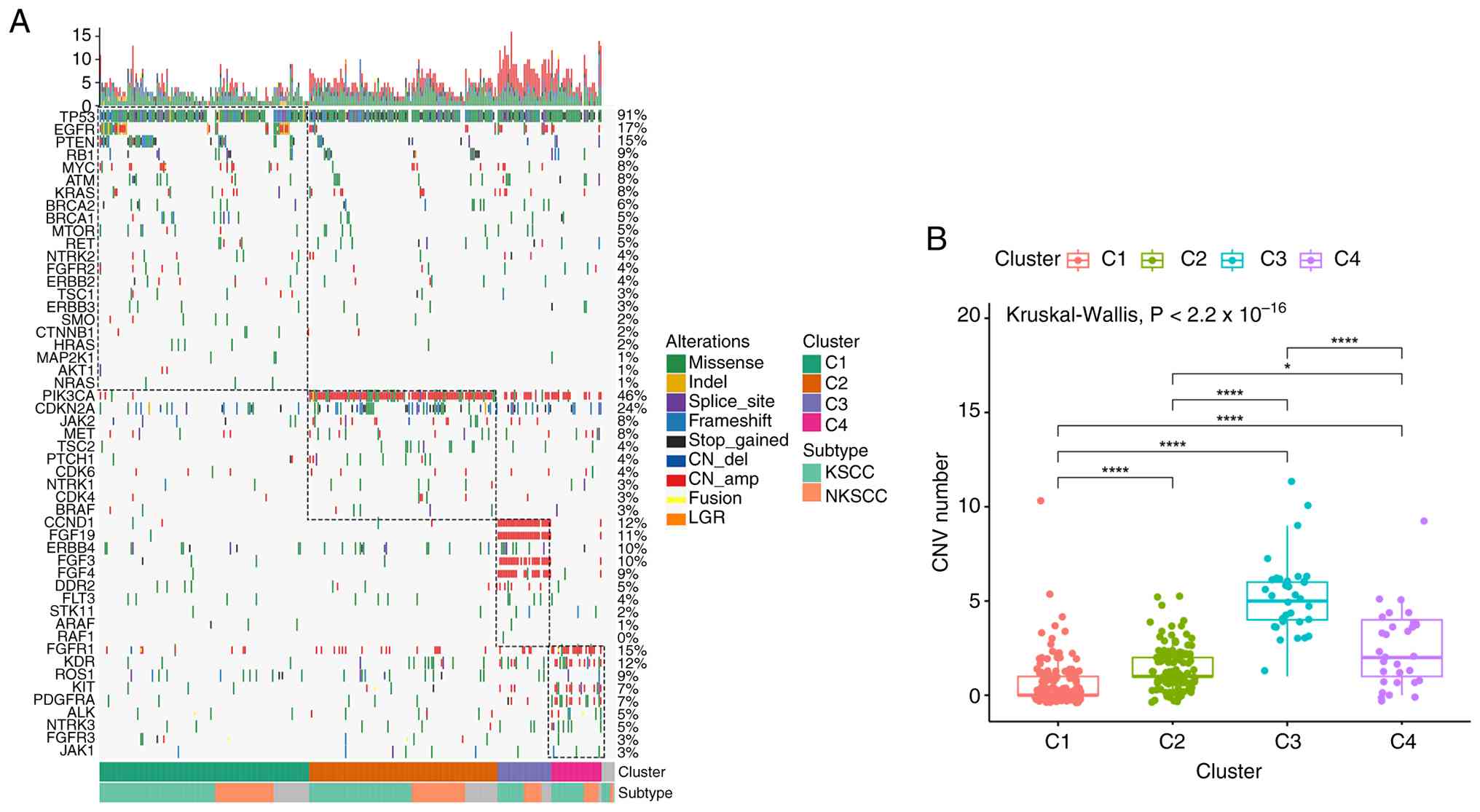
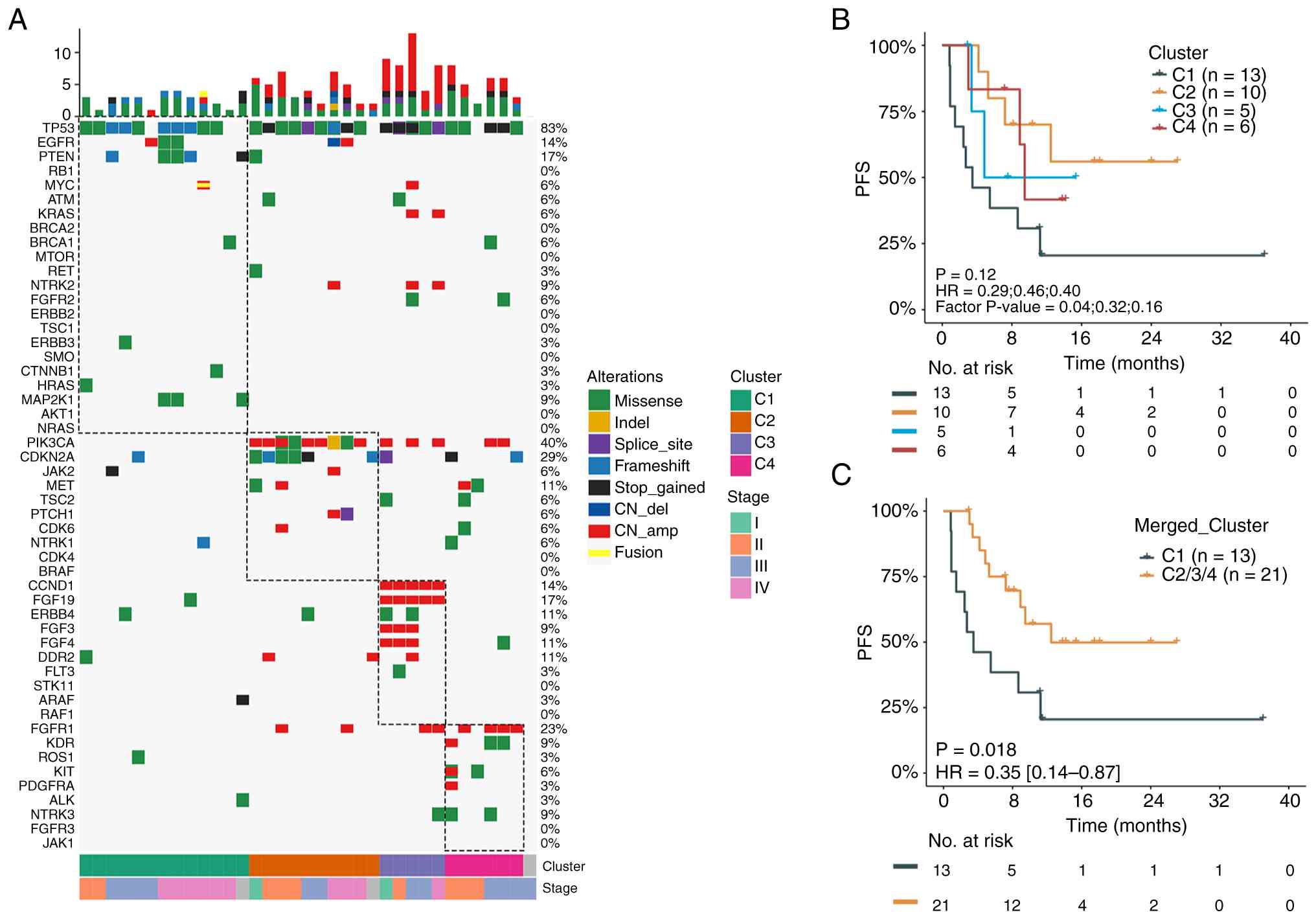
![Prognostic value of TP53 LOF
alterations alone or in combination with non-negative matrix
factorization-based molecular clustering or gene amp status in
patients with lung squamous cell carcinoma who received first-line
chemotherapy. (A) PFS stratified by TP53 LOF status. (B) PFS
comparison among four subgroups: C1 with TP53 LOF, C1
without TP53 LOF, C2/3/4 with TP53 LOF and C2/3/4
without TP53 LOF. (C) PFS comparison among patients
harboring Amp(9G) with TP53 LOF, Amp(9G) without TP53
LOF, TP53 LOF without Amp(9G) and those without TP53
LOF and Amp(9G). (D) PFS comparison among patients harboring
TP53 LOF without Amp(9G), Amp(9G) without TP53 LOF
and others [including those with Amp(9G) and TP53 LOF and
those without Amp(9G) and TP53 LOF]. LOF, loss-of-function;
PFS, progression-free survival; C, cluster; amp, amplification;
Amp(9G), amplification of at least one of nine genes.](/article_images/ol/32/1/ol-32-01-15644-g02.jpg)
![Validation of the prognostic
potential of TP53 LOF alone or combined with Amp(9G) in the
TCGA LUSC cohort treated with chemotherapy. (A) PFS stratified by
TP53 LOF status in the TCGA LUSC cohort. (B) PFS comparison
among patients harboring TP53 LOF without Amp(9G), Amp(9G)
without TP53 LOF and others [including those with Amp(9G)
and TP53 LOF, and those without Amp(9G) and TP53
LOF]. LOF, loss-of-function; TCGA, The Cancer Genome Atlas; LUSC,
lung squamous cell carcinoma; PFS, progression-free survival; amp,
amplification; Amp(9G), amplification of at least one of nine
genes.](/article_images/ol/32/1/ol-32-01-15644-g03.jpg)


