Introduction
Glioma is the most common primary intracranial
tumor, accounting for ~22.2% of all central nervous system
malignancies (1). The World Health
Organization (WHO) classifies gliomas into grades I–IV, with grades
I–II considered low-grade gliomas (LGG) and grades III–IV
considered high-grade gliomas (HGG) (2). Histopathological features are closely
correlated with the degree of malignancy (3,4). HGGs
are associated with high morbidity, therapeutic resistance,
frequent recurrence and poor survival, thereby imposing a
substantial burden on patients and society (5–7).
Surgical resection remains the primary treatment; however, its
efficacy is limited and adjuvant radiotherapy and chemotherapy are
often required (8–10). Despite multimodal therapy,
recurrence rates remain high (11).
The median survival of patients with LGG is ~10 years, whereas that
of untreated patients with HGG is <20 months (12), with only a minority surviving beyond
3 years after surgery (13).
Therefore, understanding the molecular mechanisms underlying glioma
progression is essential for identifying novel diagnostic
biomarkers and therapeutic targets.
Primarily localized in the nucleus, the histone
methyltransferase EZH2 is integral to the assembly of the Polycomb
repressive complex (14,15). This enzyme trimethylates lysine 27
of histone H3 (H3K27me3), leading to gene silencing through both
canonical and non-canonical mechanisms, thereby exerting
transcriptional repression or activation (16–18).
EZH2 plays a crucial role in cell proliferation, differentiation
and apoptosis and its functions are closely associated with the
regulation of diverse targets and signaling pathways (19,20).
EZH2 has recently emerged as a significant regulator
in various cancers (21),
influencing cell proliferation, apoptosis, epithelial-mesenchymal
transition, invasion and drug resistance in glioma and other
malignancies (22–24). Suppression of EZH2 through
small-molecule inhibitors or gene knockdown results in reduced
growth and tumor formation in rectal cancer cells (25). Moreover, within the tumor
microenvironment, EZH2 expression directly influences T-cell
responses and is involved in the suppression of chemokine signaling
and cytotoxic lymphocyte activity (26). In cancer, elevated EZH2 expression
is associated with tumor aggressiveness, unfavorable prognosis and
recurrence across multiple tumor types, thereby serving as a
diagnostic marker (27–29). The present study investigated the
prognostic relevance of EZH2 expression in glioma by integrating
public database analyses [TIMER2.0, The Cancer Genome Atlas (TCGA)]
with a large Chinese cohort of 147 patients, with detailed
stratification by WHO grade, IDH status and 1p/19q co-deletion.
Materials and methods
Bioinformatics analysis
EZH2 mRNA expression levels across cancer samples
were analyzed using TIMER 2.0 (http://timer.comp-genomics.org/). Its expression in
normal brain tissues and glioma tissues was assessed using TCGA
database (https://portal.gdc.cancer.gov/). Clinical and
molecular data from patients with glioma were also extracted from
TCGA for subsequent prognostic analysis. The prognostic
significance of EZH2 mRNA expression was evaluated using an online
tool (https://www.helixlife.cn/). The optimal
cut-off value was determined by selecting the ‘auto select best
cut-off’ option. Based on this cut-off, patients were stratified
into high and low EZH2 expression cohorts and overall survival
(OS), disease-specific survival (DSS) and progression-free interval
(PFI) curves were generated.
Tissue samples and clinical data
The tissue samples used in the present study were
obtained from Shanghai Outdo Biotech Company (China). A total of
149 human glioma tissue specimens were initially collected, of
which 147 were included in the final analysis due to the
availability of complete clinicopathological data. The tissue
samples were collected (patient surgery dates) from February 2008
to October 2011. All immunohistochemistry staining, imaging, and
data analysis were performed in the laboratory of Shanghai Outdo
Biotech Company from January 2018 to June 2025. The present study
was approved by the Ethics Committee of Shanghai Outdo Biotech
Company (approval no. HBraG149Su01), which covers both sample
collection and the experimental procedures. Written informed
consent was obtained from all patients and/or their legal guardians
prior to sample collection.
Immunohistochemical analysis
Tissue specimens were processed by formalin fixation
[10% neutral buffered formalin, at room temperature (20–25°C), for
24 h], dehydration (graded ethanol series: 75, 85, 95, 100 and 100%
at room temperature, each for 1 h), clearing (xylene, at room
temperature, two changes, each for 15 min), and paraffin embedding
(molten paraffin at 60°C, for 2 h) to obtain 4-µm-thick sections.
Dewaxing was performed by baking at 70°C for 3 h, followed by
alcohol rehydration and antigen retrieval using a microwave in 0.01
M citrate buffer (pH 6.0) at 100°C for 15 min. The sections were
then treated with 3% H2O2 at room temperature
for 15 min, washed three times with PBS (5 min each), and blocked
with 5% bovine serum albumin (cat. no. A8020; Beijing Solarbio
Science & Technology, Co., Ltd.) in PBS for 30 min at room
temperature. The primary antibody used was a rabbit anti-EZH2
monoclonal antibody (1:50; cat. no. 5246; CST Biological Reagents
Co., Ltd.), which was incubated overnight at 4°C. The following
day, the sections were washed three times with PBS, followed by
incubation with biotinylated goat anti-rabbit secondary antibody
(1:200 dilution; cat. no. PMK-016-001M; Wuhan Pumike Biotechnology
Co., Ltd.) for 30 min at room temperature. After incubation, the
sections were rinsed with PBS. Visualization was achieved using
DAB, followed by counterstaining with hematoxylin. The sections
were then dehydrated, treated with xylene, and mounted with neutral
gum. Finally, immunohistochemistry images were captured using a
digital section scanning system (KF-PRO-005; Ningbo Jiangfeng
Bioinformatics Technology Co., Ltd.).
EZH2 exhibited nuclear staining with a
brownish-yellow color. Immunohistochemical results were scored
based on staining intensity and the percentage of cells at each
intensity. Staining intensity was semi-quantitatively assessed
using the H-score method, categorized into four grades: 0 (no
staining), 1+ (weak staining), 2+ (moderate staining), or 3+
(strong staining). The percentage of cells at each staining
intensity was determined, and a staining score was calculated by
multiplying the percentage by the corresponding intensity score.
The total score ranged from 0 (no staining) to 300 (100% of cells
with staining intensity 3+). Two experienced pathologists, blinded
to the patients' clinical information, independently evaluated all
immunohistochemical results. Inter-observer differences were
averaged, and the median value was used to classify final
expression as high or low.
Statistical analysis
The association between EZH2 expression and
clinicopathological data was assessed using univariate survival
analysis with the Cox proportional hazards model, and Pearson's
χ2 test was applied. Variables that were significant in
univariate analyses were subsequently included in multivariate
analysis, in which hazard ratios (HRs), log-rank P-values, and 95%
confidence intervals (CIs) were calculated. Kaplan-Meier survival
curves were generated to estimate survival probabilities, and
statistical significance was assessed using the log-rank test. All
statistical analyses were performed using IBM SPSS Statistics
version 21.0 (IBM Corp.) and GraphPad Prism version 9.0
(Dotmatics). P<0.05 was considered to indicate a statistically
significant difference
Results
EZH2 mRNA expression and prognosis in
glioma
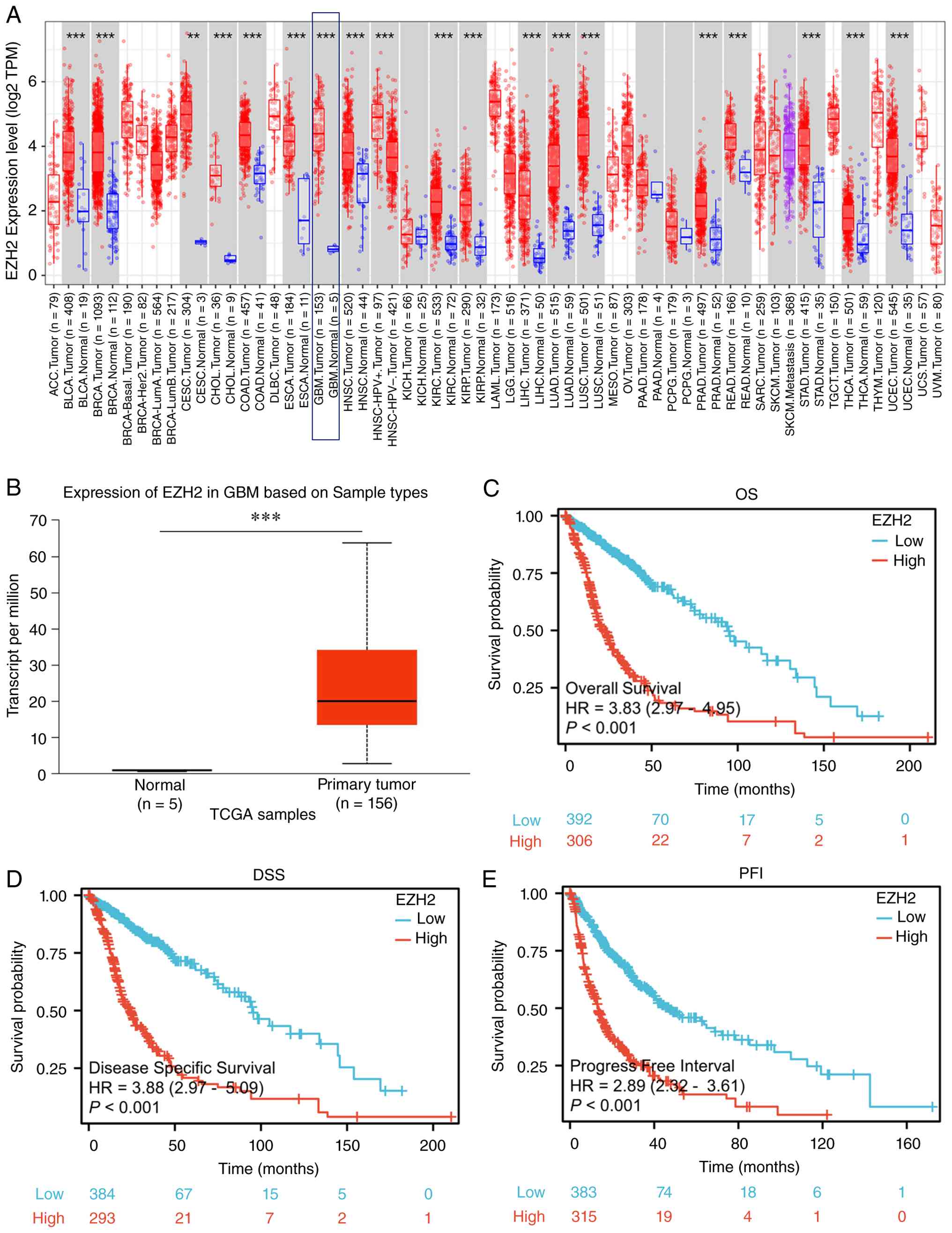
Analysis of TIMER 2.0 data revealed significantly
elevated EZH2 mRNA expression in 19 cancer types, including
glioblastoma, compared with normal tissues (***P<0.001, Fig. 1A). Similarly, EZH2 expression was
higher in glioma tissues than in normal brain tissues in the CGGA
dataset (***P<0.001, Fig. 1B).
Using TCGA data, Kaplan-Meier analysis demonstrated that high EZH2
mRNA expression was significantly associated with shorter OS, DSS
and PFI in patients with glioma (P<0.001, Fig. 1C-E).
Correlation between EZH2 mRNA
expression and clinicopathological features
Univariate Cox analysis of 673 TCGA patients with
glioma indicated that high EZH2 expression was significantly
associated with age, WHO grade and sex (Table I). EZH2 expression was significantly
higher in isocitrate dehydrogenase (IDH) wild-type tumors than in
IDH-mutant tumors, and lower in tumors with 1p/19q co-deletion
(Table I).
 | Table I.Association between EZH2 mRNA
expression and clinicopathological characteristics of glial
patients. |
Table I.
Association between EZH2 mRNA
expression and clinicopathological characteristics of glial
patients.
|
| Expression level of
EZH2 |
|
|
|---|
|
|
|
|
|
|---|
| Clinicopathological
characteristics | Low, n (%) | High, n (%) | Pearson
χ2 | P-value |
|---|
| n | 336 | 337 |
|
|
| Age, years |
|
| 27.222 | <0.001 |
|
≤60 | 294 (43.7) | 240 (35.7) |
|
|
|
>60 | 42 (6.2) | 97 (14.4) |
|
|
| Sex |
|
| 0.940 | 0.332 |
|
Male | 188 (27.9) | 201 (29.9) |
|
|
|
Female | 148 (22) | 136 (20.2) |
|
|
| WHO grade |
|
| 165.320 | <0.001 |
| G1 | 31 (4.6) | 27 (4.0) |
|
|
| G2 | 169 (25.1) | 47 (7.0) |
|
|
| G3 | 118 (17.5) | 121 (18.0) |
|
|
| G4 | 18 (2.7) | 142 (21.1) |
|
|
| IDH status |
|
| 110.400 | <0.001 |
| WT | 54 (8.1) | 183 (27.6) |
|
|
|
Mut | 279 (42) | 148 (22.3) |
|
|
| 1p/19q codeletion,
n (%) |
|
| 51.027 | <0.001 |
|
Non-codel | 210 (31.5) | 288 (43.2) |
|
|
|
Codel | 125 (18.7) | 44 (6.6) |
|
|
Association between EZH2 protein
expression and WHO grade
WHO grade is closely associated with patient
prognosis, with higher grades indicating significantly worse
outcomes than lower grades. In the analysis of the present study a
total of 147 glioma tissue samples, the correlation between EZH2
expression and WHO grade was assessed using immunohistochemical
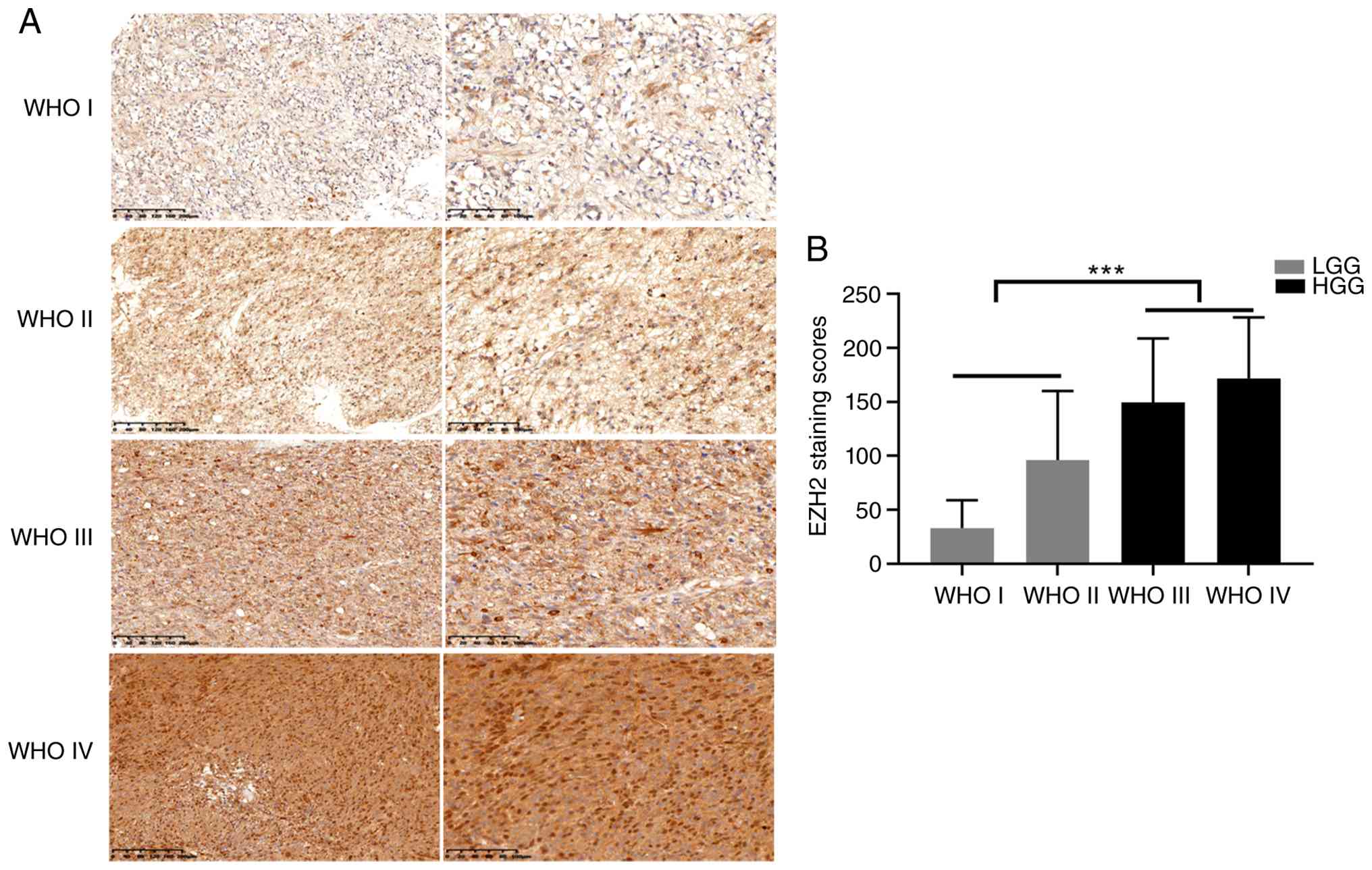
staining. The results demonstrated that EZH2 was predominantly
localized in the nucleus and its expression increased markedly with
advancing WHO grade (Fig. 2A).
Notably, EZH2 protein expression was significantly higher in the
WHO high-grade group than in the LGG (***P<0.001, Fig. 2B), indicating a positive association
between elevated EZH2 expression, advanced tumor grade and poorer
prognosis.
Association between EZH2 expression
levels and patient prognosis in glioma tissue samples
Clinical data from 147 patients with glioma were
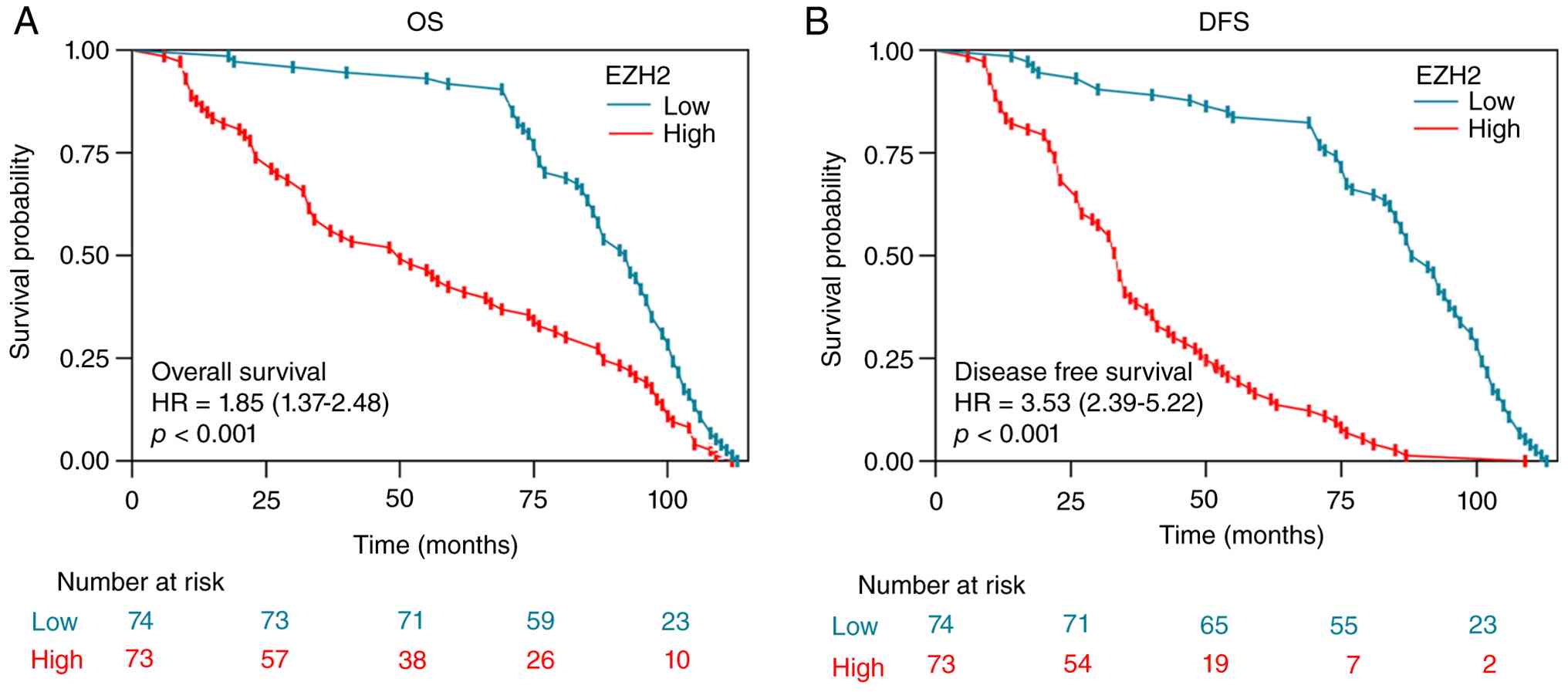
analyzed using Kaplan-Meier survival curves and the log-rank test.
The results demonstrated that patients in the high EZH2 expression
group had significantly shorter OS and DFS than those in the low
expression group (P<0.001, Fig. 3A
and B).
The relationship between EZH 2
expression levels in glioma tissue samples and the
clinicopathological features of patients with glioma
Analysis of clinicopathological parameters from 147
patients with glioma revealed a significant correlation between
high EZH2 protein expression and age, WHO grade and recurrence, but
not gender (Table II). These
findings were consistent with data derived from the TCGA database,
further supporting the prognostic relevance of EZH2 expression.
Additionally, univariate Cox regression analysis indicated that
EZH2 expression, sex, age and WHO grade were all associated with
patient outcomes (Table III).
Furthermore, multivariate Cox regression analysis confirmed that
EZH2 expression, age and WHO grade were independent risk factors
for survival in patients with glioma (Table III).
| Table II.Relationship between the protein
expression of EZH2 and clinicopathological characteristics of
patients with glioma (n=147). |
Table II.
Relationship between the protein
expression of EZH2 and clinicopathological characteristics of
patients with glioma (n=147).
|
|
| Expression level of
EZH2 |
|
|
|---|
|
|
|
|
|
|
|---|
| Clinicopathological
characteristics | Total, n | Low, n (%) | High, n (%) | Pearson
χ2 | P-value |
|---|
| n |
| 74 | 73 |
|
|
| Sex |
|
|
| 0.396 | 0.529 |
|
Male | 95 | 46 (48.4) | 49 (51.6) |
|
|
|
Female | 52 | 28 (53.8) | 24 (46.2) |
|
|
| Age, years |
|
|
| 5.961 | 0.015 |
|
≤40 | 61 | 38 | 23 |
|
|
|
>40 | 86 | 36 | 50 |
|
|
| WHO stage |
|
|
| 35.277 | <0.001 |
| G1 +
G2 | 110 | 71 (48.3) | 39 (26.5) |
|
|
| G3 +
G4 | 37 | 3 (2.0) | 34 (23.1) |
|
|
| Recurrence
rate |
|
|
| 88.226 | <0.001 |
| No recurrence | 65 | 61 (41.5) | 4 (2.7) |
|
|
| Recurrence | 82 | 13 (8.8) | 69 (46.9) |
|
|
| Table III.Analysis of prognostic parameters for
overall survival of patients with glioma. |
Table III.
Analysis of prognostic parameters for
overall survival of patients with glioma.
|
| Univariate
analysis | Multivariate
analysis |
|---|
|
|
|
|
|---|
| Clinicopathological
characteristic | P-value | HR (95% CI) | P-value | HR (95% CI) |
|---|
| EZH2 expression:
High vs. low | <0.01 | 8.111
(3.962–16.606) | 0.038 | 2.399
(1.048–5.492) |
| Sex: Male vs.
female | 0.041 | 0.532
(0.291–0.975) | 0.274 | 0.705
(0.378–1.318) |
| Age, years: ≤40
vs.40 | <0.01 | 1.034
(1.017–1.052) | 0.001 | 1.032
(1.013–1.052) |
| WHO stage: G1 vs.
G2 vs. G3 vs. G4 | <0.01 | 4.669
(3.409–6.395) | <0.01 | 3.694
(2.557–5.338) |
Discussion
Gliomas represent the most prevalent primary tumors
of the central nervous system (1,30,31),
with glioblastoma accounting for 60–75% of cases (32). Despite the establishment of combined
surgical resection, localized fractionated radiotherapy, and
adjuvant temozolomide as the standard first-line therapy, the
5-year survival rate for patients with glioblastoma remains
strikingly low at 6.8% (33,34).
This highlights the critical need to identify novel and reliable
prognostic biomarkers to improve survival prediction and optimize
therapeutic strategies for patients with glioma.
EZH2, a histone methyltransferase, is frequently
overexpressed in multiple cancers and is consistently associated
with poor prognosis (35–38). Mechanistically, EZH2 exerts its
oncogenic effects through both canonical and non-canonical
pathways. Canonically, it catalyzes H3K27 trimethylation
(H3K27me3), leading to transcriptional silencing of tumor
suppressor genes such as CDKN2A, CDKN1C and RUNX3 (39). Non-canonically, EZH2 can regulate
gene expression or methylate non-histone proteins independently of
its methyltransferase activity (40). Moreover, crosstalk between EZH2 and
several signaling pathways, including PI3K/AKT and Notch, has been
implicated in pancreatic neuroendocrine neoplasm cell
proliferation, maintenance of stemness, and therapy resistance
(41). Previous studies have shown
that EZH2 inhibition impairs glioma cell self-renewal in
vitro, reduces tumorigenicity in vivo, and enhances
chemo-radio-sensitivity, ultimately improving survival (42–44).
Despite these findings, the association between EZH2 expression and
key clinicopathological features, including glioma grade, IDH
mutation status, 1p/19q co-deletion, and prognosis, had not been
comprehensively characterized prior to the present study.
In the present study, EZH2 expression in glioma was
systematically evaluated using both public databases and the
present clinical cohort. Analysis of TIMER2.0 and TCGA data
demonstrated that EZH2 mRNA expression was significantly
upregulated in glioma tissues compared with normal brain tissue and
was highly expressed across multiple cancer types. In the TCGA
cohort, high EZH2 mRNA expression was strongly associated with
higher WHO grade, aggressive histological subtypes, IDH wild-type
status, and the absence of 1p/19q co-deletion. Kaplan-Meier
analysis showed that elevated EZH2 mRNA expression was associated
with shorter OS, DSS, and PFI. To validate these findings at the
protein level, immunohistochemistry was performed on 147 glioma
specimens spanning WHO grades I–IV. The results demonstrated that
higher WHO grade was associated with increased EZH2 protein
expression. Conversely, lower EZH2 expression was associated with
more favorable pathological features, lower histological grade,
reduced recurrence, and longer survival. Univariate Cox regression
analysis identified EZH2 expression level, patient age, sex, and
WHO grade as significant prognostic factors. Subsequent
multivariate analysis confirmed that EZH2 expression, age, and WHO
grade were independent predictors of OS in patients with glioma.
Collectively, these findings indicate a strong association between
elevated EZH2 expression and higher tumor grade, with increased
expression levels predicting poorer prognosis.
Beyond its prognostic value, EZH2 is emerging as a
promising therapeutic target. The EZH2 inhibitor tazemetostat has
received FDA approval for epithelioid sarcoma and follicular
lymphoma, and preclinical studies have evaluated its efficacy in
glioma models (45,46). In glioblastoma cell lines and
xenograft models, EZH2 inhibition suppresses proliferation, induces
differentiation, and sensitizes tumors to temozolomide and
radiotherapy (47,48). However, the clinical translation of
EZH2 inhibitors for glioma faces considerable challenges, including
the blood-brain barrier and intratumoral heterogeneity.
Nevertheless, these findings support further exploration of EZH2
not only as a biomarker for patient stratification but also as a
candidate for combination therapy with current standard-of-care
regimens.
Limitations and future directions: Several
limitations of the present study should be acknowledged. First, the
molecular mechanisms by which EZH2 promotes glioma progression were
not experimentally investigated. In vitro or in vivo
functional assays were not performed (for example, knockdown or
overexpression of EZH2) to establish causality or dissect the
downstream signaling pathways. Second, multi-factor interaction
analyses incorporating other clinically relevant molecular markers,
such as MGMT promoter methylation and TERT mutations, were not
conducted, as these data were not available for all patients in the
present retrospective cohort. Consequently, the authors could not
assess whether EZH2 expression adds independent predictive value
beyond these established markers or evaluate its role in treatment
response prediction. Third, the tissue samples were obtained from a
single commercial source (Shanghai Outdo Biotech Company), which
may introduce selection bias and limit the generalizability of the
findings of the present study to other populations or clinical
settings. Finally, the retrospective design inherently carries the
risk of unmeasured confounding. Future studies should prospectively
validate the findings of the present study in larger, multi-center
cohorts with comprehensive molecular profiling to enable robust
multi-factor interaction analyses. Mechanistically,
gain-of-function and loss-of-function approaches are urgently
needed to elucidate the canonical and non-canonical pathways of
EZH2 in glioma. Additionally, the therapeutic potential of
combining EZH2 inhibitors with temozolomide and radiotherapy
warrants further investigation, particularly in the context of
overcoming chemo-radio-resistance.
In summary, the present study provided robust
evidence that EZH2 expression is closely associated with glioma
grade, molecular subtype and patient survival. The consistency
between mRNA and protein expression data, its independent
prognostic value in multivariate analysis, and its biological
plausibility based on established mechanisms collectively support
EZH2 as a clinically useful prognostic biomarker in glioma. Further
independent validation and mechanistic studies are warranted to
facilitate translation of these findings into clinical
practice.
Acknowledgements
Not applicable.
Funding
The present study was supported by the Medical and Health
Research Project of Zhejiang (grant no. 2025KY1437), the Ningbo
Leading Medical & Health Discipline (grant no. 2022-F30) and
the Ningbo Top Medical and Health Research Program (grant no.
2023010211).
Availability of data and materials
The data generated in the present study may be
requested from the corresponding author.
Authors' contributions
CP, WC and RG performed experiments and data
analysis. JY, LW and LL assisted with data acquisition. CP, WC and
RG contributed to statistical analysis, figure preparation and
manuscript drafting. CP revised the manuscript. RG designed and
supervised the present study. CP and RG confirm the authenticity of
all the raw data. All authors read and approved the final version
of the manuscript.
Ethics approval and consent to
participate
The present study was approved by the Ethics
Committee of Shanghai Outdo Biotech Company (approval no.
HBraG149Su01). All tissue samples were provided by Shanghai Outdo
Biotech Company, and written informed consent was obtained from all
patients and/or their legal guardians prior to sample
collection.
Patient consent for publication
Not applicable.
Competing interests
The authors declare that they have no competing
interests.
References
|
1
|
Price M, Ballard CAP, Benedetti JR,
Kruchko C, Barnholtz-Sloan JS and Ostrom QT: CBTRUS statistical
report: Primary brain and other central nervous system tumors
diagnosed in the united states in 2018–2022. Neuro Oncol. 27 (Suppl
4):iv1–iv66. 2026. View Article : Google Scholar : PubMed/NCBI
|
|
2
|
Li J, Liu R, Xing Y, Gao X, Yin Q and Su
Q: A foundation model for brain tumor MRI analysis: WHO grading and
subtype classification. Radiother Oncol. 214:1112972026. View Article : Google Scholar : PubMed/NCBI
|
|
3
|
Li Q, Liu X, Mao J, Liu S, Hou B, Li K and
Fang D: RRAGB-mediated suppression of PI3K/AKT exerts anti-cancer
role in glioblastoma. Biochem Biophys Res Commun. 676:149–157.
2023. View Article : Google Scholar : PubMed/NCBI
|
|
4
|
Li W, Xiao J, Zhang C, Di X, Yao J, Li X,
Huang J and Li Z: Pathomics models for CD40LG expression and
prognosis prediction in glioblastoma. Sci Rep. 14:243502024.
View Article : Google Scholar : PubMed/NCBI
|
|
5
|
Lei Q, Yang Y, Zhou W, Liu W, Li Y, Qi N,
Li Q, Wen Z, Ding L, Huang X, et al: MicroRNA-based therapy for
glioblastoma: Opportunities and challenges. Eur J Pharmacol.
938:1753882023. View Article : Google Scholar : PubMed/NCBI
|
|
6
|
Palavani LB, de Barros Oliveira L, Reis
PA, Batista S, Santana LS, de Freitas Martins LP, Rabelo NN,
Bertani R, Welling LC, Figueiredo EG, et al: Efficacy and safety of
intraoperative radiotherapy for High-grade gliomas: A systematic
review and Meta-analysis. Neurosurg Rev. 47:472024. View Article : Google Scholar : PubMed/NCBI
|
|
7
|
Bittencurt Thomaz de Assis E, Ferreira MY,
Sales de Oliveira J, Mitre LP, Correa da Silva EM, Salim Coelho LL,
Moreno DA and Polverini AD: Metformin as an Adjunct treatment to
temozolomide for High-Grade gliomas: A systematic review and
Meta-analysis. World Neurosurg. 197:1238422025. View Article : Google Scholar : PubMed/NCBI
|
|
8
|
White K, Connor K, Meylan M, Bougoüin A,
Salvucci M, Bielle F, O'Farrell AC, Sweeney K, Weng L, Bergers G,
et al: Identification, validation and biological characterisation
of novel glioblastoma tumour microenvironment subtypes:
Implications for precision immunotherapy. Ann Oncol. 34:300–314.
2023. View Article : Google Scholar : PubMed/NCBI
|
|
9
|
Jezierzański M, Nafalska N, Stopyra M,
Furgoł T, Miciak M, Kabut J and Gisterek-Grocholska I: Temozolomide
(TMZ) in the treatment of glioblastoma Multiforme-A Literature
review and clinical outcomes. Curr Oncol. 31:3994–4002. 2024.
View Article : Google Scholar : PubMed/NCBI
|
|
10
|
Costantini S, Gennaro ED, Fanelli G,
Bagnara P, Argenziano C, Maccanico C, Paggi MG, Budillon A and
Abbruzzese C: Glioblastoma metabolomics: Uncovering biomarkers for
diagnosis, prognosis and targeted therapy. J Exp Clin Cancer Res.
44:2302025. View Article : Google Scholar : PubMed/NCBI
|
|
11
|
Fengyu C, Yuanyuan M, Yunsong P, Tianpeng
Z, Mingxing L, Rui Z, Hui Z and Hui S: The NLRP3 signaling pathway
is a potential target for clinical translation in glioma treatment.
SLAS Discov. 36:1002792025. View Article : Google Scholar : PubMed/NCBI
|
|
12
|
Jiang S, Chai H, Tang Q, Shi Z and Zhou L:
Clinical advances in oncolytic virus therapy for malignant glioma:
A systematic review. Discov Oncol. 14:1832023. View Article : Google Scholar : PubMed/NCBI
|
|
13
|
Le VH, Minh T, Kha QH and Le N: A transfer
learning approach on MRI-based radiomics signature for overall
survival prediction of low-grade and high-grade gliomas. Med Biol
Eng Comput. 61:2699–2712. 2023. View Article : Google Scholar : PubMed/NCBI
|
|
14
|
Porazzi P, Nason S, Yang Z, Carturan A,
Ghilardi G, Guruprasad P, Patel RP, Tan M, Padmanabhan AA, Lemoine
J, et al: EZH1/EZH2 inhibition enhances adoptive T cell
immunotherapy against multiple cancer models. Cancer Cell.
43:537–551.e7. 2025. View Article : Google Scholar : PubMed/NCBI
|
|
15
|
Liu Y and Yang Q: The roles of EZH2 in
cancer and its inhibitors. Med Oncol. 40:1672023. View Article : Google Scholar : PubMed/NCBI
|
|
16
|
Bonfiglio CA, Lacy M, Triantafyllidou V,
Farina FM, Janjic A, Nitz K, Wu Y, Bazioti V, Avcilar-Kücükgöze I,
Marques YFS, et al: Ezh2 Shapes T cell plasticity to drive
atherosclerosis. Circulation. 151:1391–1408. 2025. View Article : Google Scholar : PubMed/NCBI
|
|
17
|
Wang K, Jiang X, Jiang Y, Liu J, Du Y,
Zhang Z, Li Y, Zhao X, Li J and Zhang R: EZH2-H3K27me3-mediated
silencing of mir-139-5p inhibits cellular senescence in
hepatocellular carcinoma by activating TOP2A. J Exp Clin Cancer
Res. 42:3202023. View Article : Google Scholar : PubMed/NCBI
|
|
18
|
Xu M, Xu C, Wang R, Tang Q, Zhou Q, Wu W,
Wan X, Mo H, Pan J and Wang S: Treating human cancer by targeting
EZH2. Genes Dis. 12:1013132025. View Article : Google Scholar : PubMed/NCBI
|
|
19
|
Hou Y, Zak J, Shi Y, Pratumchai I, Dinner
B, Wang W, Qin K, Weber EW, Teijaro JR and Wu P: Transient EZH2
suppression by tazemetostat during in vitro expansion maintains
T-Cell stemness and improves adoptive T-cell therapy. Cancer
Immunol Res. 13:47–65. 2025. View Article : Google Scholar : PubMed/NCBI
|
|
20
|
Wang Y, Tian J, Huang D, Gao Y, Lin H, Liu
L and Wang A: EZH2 promotes multiple myeloma progression via STAT3
pathway activation. Discov Med. 36:721–729. 2024. View Article : Google Scholar : PubMed/NCBI
|
|
21
|
Fang J, Zhang J, Zhu L, Xin X and Hu H:
The epigenetic role of EZH2 in acute myeloid leukemia. PeerJ.
12:e186562024. View Article : Google Scholar : PubMed/NCBI
|
|
22
|
Zhao G, Deng Z, Li X, Wang H, Chen G, Feng
M and Zhou Y: Targeting EZH2 regulates the biological
characteristics of glioma stem cells via the Notch1 pathway. Exp
Brain Res. 241:2409–2418. 2023. View Article : Google Scholar : PubMed/NCBI
|
|
23
|
Sircar A, Singh S, Xu-Monette ZY, Coyle
KM, Hilton LK, Chavdoula E, Ranganathan P, Jain N, Hanel W,
Tsichlis P, et al: Exploiting the fibroblast growth factor
receptor-1 vulnerability to therapeutically restrict the
MYC-EZH2-CDKN1C axis-driven proliferation in Mantle cell lymphoma.
Leukemia. 37:2094–2106. 2023. View Article : Google Scholar : PubMed/NCBI
|
|
24
|
Ko MY, Park H, Kim Y, Min E, Cha S, Lee B,
Hyun S and Ka M: Bisphenol S (BPS) induces glioblastoma progression
via regulation of EZH2-mediated PI3K/AKT/mTOR pathway in U87-MG
cells. Toxicology. 507:1538982024. View Article : Google Scholar : PubMed/NCBI
|
|
25
|
Wang L, Wu X, Xu W, Gao L, Wang X and Li
T: Combined detection of RUNX3 and EZH2 in evaluating efficacy of
neoadjuvant therapy and prognostic value of middle and low locally
advanced rectal cancer. Front Oncol. 12:7133352022. View Article : Google Scholar : PubMed/NCBI
|
|
26
|
Chibaya L, Murphy KC, DeMarco KD, Gopalan
S, Liu H, Parikh CN, Lopez-Diaz Y, Faulkner M, Li J, Morris JP IV,
et al: EZH2 inhibition remodels the inflammatory
senescence-associated secretory phenotype to potentiate pancreatic
cancer immune surveillance. Nat Cancer. 4:872–892. 2023. View Article : Google Scholar : PubMed/NCBI
|
|
27
|
Shishido K, Purvis IJ, Velpula KK,
Venkataraman S, Vibhakar R and Asuthkar S: Targeting B7-H3 through
EZH2 inhibition in MYC-positive Group 3 medulloblastoma. Oncol Rep.
49:1192023. View Article : Google Scholar : PubMed/NCBI
|
|
28
|
Martinez-Baquero D, Sakhdari A, Mo H, Kim
DH, Kanagal-Shamanna R, Li S, Young KH, O'Malley DP, Dogan A, Jain
P, et al: EZH2 expression is associated with inferior overall
survival in mantle cell lymphoma. Mod Pathol. 34:2183–2191. 2021.
View Article : Google Scholar : PubMed/NCBI
|
|
29
|
Eichenauer T, Simmendinger L, Fraune C,
Mandelkow T, Blessin NC, Kluth M, Hube-Magg C, Möller K, Clauditz
T, Weidemann S, et al: High level of EZH2 expression is linked to
high density of CD8-positive T-lymphocytes and an aggressive
phenotype in renal cell carcinoma. World J Urol. 39:481–490. 2021.
View Article : Google Scholar : PubMed/NCBI
|
|
30
|
Price M, Neff C, Nagarajan N, Kruchko C,
Waite KA, Cioffi G, Cordeiro BB, Willmarth N, Penas-Prado M,
Gilbert MR, et al: CBTRUS statistical report: American brain tumor
association & NCI Neuro-Oncology branch adolescent and young
adult primary brain and other central nervous system tumors
diagnosed in the united states in 2016–2020. Neuro Oncol.
26:iii1–iii53. 2024. View Article : Google Scholar : PubMed/NCBI
|
|
31
|
Tian G, Song Y, Zhang Y, Kan L, Hou A and
Han S: Phenotypic variations in glioma stem cells: Regulatory
mechanisms and implications for therapeutic strategies. J Transl
Med. 23:9842025. View Article : Google Scholar : PubMed/NCBI
|
|
32
|
Verma P, Singh BK, Sudhan MD, Singh RK,
Bagul SD, Chandak AR, Soni BK, Shelly D and Basu S: 68 Ga-PSMA-11
PET/CT imaging in brain gliomas and its correlation with
clinicopathological prognostic parameters. Clin Nucl Med.
48:e559–e563. 2023. View Article : Google Scholar : PubMed/NCBI
|
|
33
|
Srivastava R, Dodda M, Zou H, Li X and Hu
B: Tumor Niches: Perspectives for targeted therapies in
glioblastoma. Antioxid Redox Signal. 39:904–922. 2023. View Article : Google Scholar : PubMed/NCBI
|
|
34
|
Machado GC and Ferrer VP: MUC17 mutations
and methylation are associated with poor prognosis in adult-type
diffuse glioma patients. J Neurol Sci. 452:1207622023. View Article : Google Scholar : PubMed/NCBI
|
|
35
|
Tang Q, Xu M, Long S, Yu Y, Ma C, Wang R,
Li J, Wang X, Fang F, Han L, et al: FZKA reverses gefitinib
resistance by regulating EZH2/Snail/EGFR signaling pathway in lung
adenocarcinoma. J Ethnopharmacol. 318:1166462024. View Article : Google Scholar : PubMed/NCBI
|
|
36
|
Zhou B, Wang B, Zou F, Mei H, Liu Q, Qi S,
Wang W, Jin R, Wang A, Chen Y, et al: Discovery of
dihydropyridinone derivative as a covalent EZH2 degrader. Eur J Med
Chem. 261:1158252023. View Article : Google Scholar : PubMed/NCBI
|
|
37
|
Endo I, Amatya VJ, Kushitani K, Nakagiri
T, Aoe K and Takeshima Y: Long Non-coding RNA LINC00152 requires
EZH2 to promote mesothelioma cell proliferation, migration, and
invasion. Anticancer Res. 43:5367–5376. 2023. View Article : Google Scholar : PubMed/NCBI
|
|
38
|
Tulkens D, Boelens M, Naert T, Carron M,
Demuynck S, Dewaele S, Van Isterdael G, Creytens D, Pieters T,
Goossens S, et al: Mutations in the histone methyltransferase Ezh2
drive context-dependent leukemia in Xenopus tropicalis. Leukemia.
37:2404–2413. 2023. View Article : Google Scholar : PubMed/NCBI
|
|
39
|
Chen W, Wang HT, Ji JF, Wang ZY, Shi T, Wu
MH and Yu PJ: Epigenetic network of EZH2/SFRP1/Wnt in the
epithelial-mesenchymal transition of laryngeal carcinoma cells.
Neoplasma. 69:680–690. 2022. View Article : Google Scholar : PubMed/NCBI
|
|
40
|
Hwang IJ, Park J and Seo SB: Non-canonical
transcriptional regulation of INHAT subunit SET/TAF-Iβ by EZH2.
Biochem Biophys Res Commun. 635:136–143. 2022. View Article : Google Scholar : PubMed/NCBI
|
|
41
|
He N, Xu Y, Yan L, Hu P, Bai J, Xue B, Hu
C, Lu X, Liu M, Ye M and Tang Q: HMGCS1 as a Potential mediator of
resistance to EZH2 inhibition via ferroptosis mediated by
PI3K/AKT/mTOR pathway in the pancreatic neuroendocrine neoplasms.
Endocr Relat Cancer. 33:e2504782026. View Article : Google Scholar : PubMed/NCBI
|
|
42
|
El Baba R, Pasquereau S, Haidar Ahmad S,
Monnien F, Abad M, Bibeau F and Herbein G: EZH2-Myc driven
glioblastoma elicited by cytomegalovirus infection of human
astrocytes. Oncogene. 42:2031–2045. 2023. View Article : Google Scholar : PubMed/NCBI
|
|
43
|
Gong M, Fan X, Yu H, Niu W, Sun S, Wang H
and Chen X: Loss of p53 Concurrent with RAS and TERT activation
induces glioma formation. Mol Neurobiol. 60:3452–3463. 2023.
View Article : Google Scholar : PubMed/NCBI
|
|
44
|
Liang Q, Wang B, Zhang C, Song C, Wang J,
Sun W, Jiang L and Lin J: EZH2-regulated PARP 1 expression is a
likely mechanism for the chemoresistance of gliomas to
temozolomide. Curr Cancer Drug Targets. 24:328–339. 2024.
View Article : Google Scholar : PubMed/NCBI
|
|
45
|
Mohammaei S, Lee J, Bouchard A, Bernal
Ballesteros E, Diamantopoulos N, Hou L, Remold E, Cho J and Suh WK:
Identification of a neoplastic Tfh-like cellular subset in a mouse
model of angioimmunoblastic T cell lymphoma. Front Oncol.
16:17156132026. View Article : Google Scholar : PubMed/NCBI
|
|
46
|
Xia C, Liu J, Hu L, Chen J and Zhang L:
Post-marketing safety of tazemetostat in antitumor therapy: A
Real-world pharmacovigilance study of the FDA adverse event
reporting system. Cancer Invest. 44:239–247. 2026. View Article : Google Scholar : PubMed/NCBI
|
|
47
|
Zhu D, Li Z, Feng H, Zheng J, Xiao X,
Huang Z, Zheng L, Guo J, Ling F, Li Y, et al: EZH2 inhibition and
5-azacytidine enhance antitumor immunity in PTEN-deficient
glioblastoma by activation viral mimicry response. J Immunother
Cancer. 13:e0116502025. View Article : Google Scholar : PubMed/NCBI
|
|
48
|
Skredėnienė R, Stakišaitis D, Preikšaitis
A, Valančiūtė A, Lesauskaitė V and Balnytė I: Effect of treatment
with a combination of dichloroacetate and valproic acid on adult
glioblastoma Patient-derived primary cells xenografts on the chick
embryo chorioallantoic membrane. Pharmaceutics. 18:522025.
View Article : Google Scholar : PubMed/NCBI
|