Introduction
Breast cancer is the most prevalent malignancy among
women worldwide, accounting for approximately 24% of all newly
diagnosed cancer cases in women in 2022 (1). Breast cancer is conventionally
classified into three intrinsic subtypes according to estrogen
receptor, progesterone receptor, and human epidermal growth factor
receptor 2 (HER2) expression: Hormone receptor
(HR)-positive/HER2-negative, HER2-positive, and triple-negative
breast cancer (TNBC) (2). TNBC,
which accounts for approximately 10–15% of all breast cancer cases,
is associated with a higher risk of recurrence and poorer overall
survival than other molecular subtypes (3). However, treatment options for TNBC
remain limited because of its lack of HRs and HER2 expression,
resulting in lower therapeutic efficacy compared to other breast
cancer subtypes (4,5).
Cyclin-dependent kinase 4/6 (CDK4/6) and cyclin D
play critical roles in promoting the G1-to-S phase transition of
the cell cycle. The primary target of CDK4/6 in complex with cyclin
D is retinoblastoma (Rb) protein (6). Rb functions as a key regulator of the
cell cycle by binding to E2F transcription factors and suppressing
their activity. In the early G1 phase, Rb is maintained in a
non-phosphorylated state, thereby inhibiting E2F-mediated
transcription. Upon mitogenic stimulation, CDK4/6, activated by
cyclin D, phosphorylates Rb, leading to its dissociation from E2F
(7). E2F transcription factors
subsequently induce the expression of genes required for S-phase
entry and promote cell cycle progression (8). To date, only three CDK4/6 inhibitors
(palbociclib, ribociclib, and abemaciclib) have been approved by
the U.S. Food and Drug Administration for clinical use in
HR-positive HER2-negative breast cancer (9,10).
Recently, several pre-clinical studies have demonstrated the
potential efficacy of CDK4/6 inhibitors for TNBC treatment. Asghar
et al (11) revealed that
the luminal androgen receptor TNBC subtype cell lines are more
sensitive to palbociclib than basal-like TNBC cell lines and that
treatment with palbociclib significantly reduces tumor volume in a
xenograft model of luminal androgen receptor TNBC. Furthermore, the
combination of palbociclib with paclitaxel (12), phosphoinositide 3-kinase-α
inhibitors (13), or mechanistic
target of rapamycin kinase inhibitors (14) shows enhanced antitumor efficacy
against TNBC. These reports suggest that CDK4/6 inhibitors,
including palbociclib, exhibit potential as therapeutic agents for
TNBC. However, changes in TNBC cell characteristics upon exposure
to CDK4/6 inhibitors remain unclear.
In TNBC, prolonged exposure to anticancer agents
induces diverse alterations in cellular characteristics, including
acquisition of drug resistance (15), enhancement of stem cell-like
properties (16),
epithelial-mesenchymal transition (EMT) (17).
In this study, we established an in vitro
continuous exposure model using the MDA-MB-231 human TNBC cell line
to investigate the molecular signatures associated with the changes
in cellular characteristics induced by prolonged treatment with
palbociclib, a selective CDK4/6 inhibitor. Additionally, we
evaluated the associations between changes in cellular
characteristics and molecular alterations related to drug
resistance.
Materials and methods
Cell lines and reagents
The MDA-MB-231 human TNBC cell line was kindly
provided by Dr Tamotsu Sudo of the Hyogo Cancer Center (Hyogo,
Japan). The cells were cultured in the Roswell Park Memorial
Institute (RPMI)-1640 medium (Sigma-Aldrich, St. Louis, MO, USA)
supplemented with 10% heat-inactivated fetal bovine serum (Gibco,
Tokyo, Japan), 100 U/ml penicillin G, and 100 µg/l streptomycin
sulfate (Fujifilm Wako Pure Chemical, Osaka, Japan). Palbociclib
and abemaciclib were purchased from Cayman Chemical (Ann Arbor, MI,
USA). Verapamil was purchased from Tokyo Chemical Industry
(Chuo-ku, Tokyo, Japan). MG-132 and CVT-313 were obtained from
MedChemExpress (Monmouth Junction, NJ, USA). Rhodamine 123 was
purchased from Molecular Probes Inc. (Eugene, OR, USA).
2-(4-Iodophenyl)-3-(4-nitrophenyl)-5- (2,
4-disulfophenyl)-2H-tetrazolium monosodium salt and
1-methoxy-5-methylphenazinium methyl sulfate were obtained from
Dojindo Laboratories (Kumamoto, Japan).
Establishment of palbociclib-resistant
human TNBC sublines
MDA-MB-231 cells were cultured continuously in the
RPMI-1640 medium containing palbociclib at stepwise increasing
concentrations (0.01–1 µM) to establish resistant cell lines over
at least 3 months. Palbociclib-resistant cells were designated as
MB231/PalR cells. These resistant cells were maintained under the
same conditions as MDA-MB-231 cells, except that the culture medium
contained 1 µM palbociclib.
Cell viability assay
MDA-MB-231 and MB231/PalR cells were seeded at a
density of 5,000 cells/well and cultured in 100 µl RPMI 1640 medium
without palbociclib at 37°C for 24 h. The culture medium was
replaced with fresh medium containing various concentrations of the
test drugs. For co-treatment experiments, cells were treated with
palbociclib alone or in combination with verapamil (10 µM) or
CVT-313 (5 µM) for 72 h. After 72 or 144 h of incubation at 37°C,
the medium was replaced with 110 µl of medium including 10 µl of
2-(4-Iodophenyl)-3-(4-nitrophenyl)-5- (2,
4-disulfophenyl)-2H-tetrazolium monosodium salt reagent solution.
After 3 h, absorbance was measured at 450 nm using SpectraMax iD3
(Molecular Devices, San Jose, CA, USA). The 50% growth inhibitory
concentration (IC50) values of the test drugs in
MDA-MB-231 and MB231/PalR cells were calculated using the sigmoid
inhibitory effect model, E=Emax × [1-Cγ/(Cγ +
IC50γ)], via non-linear least-squares fitting (Solver;
Microsoft Excel). In this equation, E and Emax represent the
surviving fraction (% of control) and its maximum, respectively,
and C and γ represent the drug concentration in the medium and
sigmoidicity factor, respectively (18–20).
Reverse transcription-quantitative
polymerase chain reaction (RT-qPCR)
MDA-MB-231 and MB231/PalR cells were pre-cultured in
the RPMI-1640 medium without palbociclib for 48 h, and total RNA
was isolated using the Quick-RNA Miniprep Kit (Zymo Research,
Irvine, CA, USA). First-strand cDNA was synthesized from 500 ng of
total RNA using oligo(dT) primers and the PrimeScript RT Reagent
Kit (Takara Bio, Shiga, Japan) on a thermal cycler (iCycler;
Bio-Rad Laboratories, Hercules, CA, USA). Reverse transcription was
performed in a 20-µl reaction mixture at 37°C for 15 min, followed
by inactivation at 85°C for 5 sec and cooling to 4°C. The cDNA was
subsequently used to detect the mRNA expression. qPCR was performed
using TB Green Premix Ex Taq II (Takara Bio) on the StepOnePlus
Real-Time PCR System (Applied Biosystems, Waltham, MA, USA). The
reaction consisted of an initial denaturation at 95°C for 10 min,
followed by 40 cycles of 95°C for 15 sec and 60°C for 1 min. The
dissociation step was conducted at 95°C for 15 sec, 60°C for 1 min,
and 95°C for 15 sec. ACTB was used as an internal control.
All primers used in this study are listed in Table I. Relative expression levels were
calculated using the 2−ΔΔCq method (21) and normalized to the internal
reference gene ACTB.
 | Table I.List of primer sequences used in this
study. |
Table I.
List of primer sequences used in this
study.
| Gene | Forward, 5′-3′ | Reverse, 5′-3′ |
|---|
| RB1 |
CACTTTGTGAACGCCTTCTGT |
CACGTTTGAATGTCTCCTGAACA |
| E2F1 |
TCTCGGCCAGGTACTGATG |
ACCCTGACCTGCTGCTCTT |
| CCND1 |
ACAAACAGATCATCCGCAAACAC |
TGTTGGGGCTCCTCAGGTTC |
| CCND2 |
TCATTGCTCTGTGTGCCACC |
CAGCTCAGTCAGGGCATCAC |
| CCND3 |
AGGGATCACTGGCACTGAAG |
ACAGGTGTATGGCTGTGACAT |
| CCNE1 |
TAGAGAGGAAGTCTGGAAAATCATG |
ATATACCGGTCAAAGAAATCTTGTG |
| CDK4 |
ATGGCTACCTCTCGATATGAGC |
CATTGGGGACTCTCACACTCT |
| CDK6 |
CGTGGTCAGGTTGTTTGATG |
CAGGCTCTGGAACTTTATCC |
| ABCB1 |
TTCCTTCACCCAGGCAATG |
ATGAGTTTATGTGCCACCAAGTAG |
| ABCC1 |
CAGTGACCTCTGGTCCTTAAACAA |
TTGGCGCATTCCTTCTTCC |
| ABCC2 |
ACTTGTGACATCGGTAGCATGGA |
AAGAGGCAGTTTGTGAGGGATGA |
| ABCG2 |
TGACGGTGAGAGAAAACTTAC |
TGCCACTTTATCCAGACCT |
| CD274 |
ATTTGGAGGATGTGCCAGAG |
CCAGCACACTGAGAATCAACA |
| ACTB |
TCATGAAGTGTGACGTGGACATC |
TGCATCCTGTCGGCAATG |
Western blotting
MDA-MB-231 and MB231/PalR cells were pre-cultured in
the RPMI-1640 medium without palbociclib for 48 h. For proteasome
inhibition experiments, cells were treated with MG-132 (0.25 µM)
for 6 h in the absence of palbociclib before protein extraction.
Proteins were extracted using the radioimmunoprecipitation assay
buffer containing 50 mM Tris-HCl, 150 mM NaCl, 0.1% sodium dodecyl
sulfate, 1% Triton X-100, 0.5% sodium deoxycholate, 1 mM
ethylenediaminetetraacetic acid, a protease inhibitor cocktail
(Sigma-Aldrich), and phosphatase inhibitor cocktails 2 and 3
(Sigma-Aldrich). The extracted proteins were separated via sodium
dodecyl sulfate-polyacrylamide gel electrophoresis and transferred
onto a polyvinylidene difluoride membrane (Millipore, Burlington,
MA, USA). The membrane was blocked with wash buffer containing 20
mM Tris (pH 7.6), 150 mM NaCl, 50 mM KCl, and 0.2% Tween-20 with 3%
bovine serum albumin and immunoblotted with antibodies against
phosphorylated Rb, total Rb (1:1,000; cat. nos. 30376-1AP and
67521-1-Ig, Proteintech, Rosemont, IL, USA), Cyclin E1 (1:1,000;
cat. no. 20808, Cell Signaling Technology, Inc., Danvers, MA, USA)
and GAPDH (cytosolic marker; 1:2,000; cat. no. 60004-1-Ig,
Proteintech). Primary antibody incubation was performed overnight
at 4°C using an immunoreaction enhancer solution (Can Get Signal;
Toyobo, Osaka, Japan). GAPDH was used as an internal control.
Subsequently, the membranes were incubated with the horseradish
peroxidase-conjugated secondary antibody (1:2,000; anti-rabbit,
cat. no. 7074, Cell Signaling Technology, Inc., anti-mouse, cat.
no. ab6728, Abcam, Cambridge, UK) for 1 h at room temperature. An
enhanced chemiluminescence detection system (Bio-Rad Laboratories)
was used, and protein expression levels were quantified using the
ImageJ software (National Institutes of Health, Bethesda, Maryland,
USA).
Intracellular accumulation of
rhodamine 123
MDA-MB-231 and MB231/PalR cells were seeded at a
density of 5×10⁶ cells and incubated in the RPMI-1640
medium without palbociclib at 37°C for 48 h. After washing thrice
with warmed Hanks' balanced salt solution (HBSS, Fujifilm Wako Pure
Chemical), the cells were incubated in fresh HBSS containing 3 µM
rhodamine 123 (Fujifilm Wako Pure Chemical) at 37°C for 30 or 120
min. The accumulation process was terminated by removing HBSS from
the dishes, followed by three washes with ice-cold
phosphate-buffered saline (Takara Bio). The cells were collected in
ice-cold phosphate-buffered saline and subjected to flow cytometric
analysis using FACSAria II (BD Biosciences, Franklin Lakes, NJ,
USA). The data were analyzed using the BD FACS Diva software (BD
Biosciences).
Statistical analyses
All statistical analyses were performed using the
EZR (version 1.7; Jichi Medical University, Tochigi, Japan), a
graphical user interface for R (22). Data are represented as the mean ±
standard deviation. Comparisons between two groups were performed
using an unpaired Student's t-test. For experiments involving two
independent variables, two-way ANOVA followed by Tukey's post hoc
test was used. P<0.05 was considered to indicate a statistically
significant difference.
Results
MDA-MB-231 and MB231/PalR cell
sensitivity to CDK4/6 inhibitors
The sensitivity of MDA-MB-231 and MB231/PalR cells
to palbociclib and abemaciclib was evaluated using cell viability
assays, with IC50 values after 72 and 144 h of exposure
presented in Table II. Continuous
exposure to palbociclib resulted in the establishment of MB231/PalR
cells, which exhibited significantly reduced sensitivity to CDK4/6
inhibitors. Compared to those in MDA-MB-231 cells, IC50
values of palbociclib increased 2.15- and 9.28-fold at 72 and 144
h, respectively, and those of abemaciclib increased 11.3- and
34.2-fold, respectively, in the resistant cells.
| Table II.IC50 values of
cyclin-dependent kinase-4/6 inhibitors at 72 and 144 h. |
Table II.
IC50 values of
cyclin-dependent kinase-4/6 inhibitors at 72 and 144 h.
| A, Palbociclib |
|---|
|
|---|
|
| IC50
value, µM |
|
|---|
|
|
|
|
|---|
| Exposure time,
h | MDA-MB-231 | MB231/PalR | R.S. |
|---|
| 72 | 4.90±0.94 |
10.54±2.25a | 2.15 |
| 144 | 1.09±0.25 |
10.13±0.96a | 9.29 |
|
| B,
Abemaciclib |
|
|
| IC50
value, µM |
|
|
|
|
|
| Exposure time,
h |
MDA-MB-231 |
MB231/PalR | R.S. |
|
| 72 | 0.49±0.18 |
5.57±2.6a | 11.3 |
| 144 | 0.098±0.03 |
3.36±1.9a | 34.2 |
mRNA expression profiles of cell
cycle-related genes
Next, we investigated the effects of continuous
exposure of MDA-MB-231 cells to palbociclib on the mRNA expression
levels of cell cycle-related genes, such as CCND1, CCND2, CCND3,
CCNE1, CDK4, CDK6, RB1, and E2F1, via RT-qPCR. The mRNA
expression levels of CCNE1, which encodes cyclin E1, and
CDK6 were significantly higher in MB231/PalR cells than in
MDA-MB-231 cells (P<0.01, Table
III). However, mRNA levels of CCND2, which encodes
cyclin D2, were significantly lower in MB231/PalR cells
(P<0.01). Notably, no significant difference in the mRNA levels
of CDK4, a key target of palbociclib, was observed between
the resistant and parental cells.
| Table III.mRNA expression levels of cell
cycle-related genes in resistant cells. |
Table III.
mRNA expression levels of cell
cycle-related genes in resistant cells.
| Gene | Protein name | mRNA expression
levels relative to MDA-MB-231 |
|---|
| CCND1 | Cyclin D1 | 0.85±0.22 |
| CCND2 | Cyclin D2 |
0.30±0.06a |
| CCND3 | Cyclin D3 | 1.07±0.50 |
| CCNE1 | Cyclin E1 |
26.2±8.48a |
| CDK4 | CDK4 | 1.43±0.31 |
| CDK6 | CDK6 |
2.46±0.26a |
| RB1 | Rb | 1.99±1.01 |
| E2F1 | E2F | 0.86±0.34 |
Effects of continuous palbociclib
exposure on Rb protein expression and phosphorylation
CDK4/6 promotes the cell cycle via Rb
phosphorylation. Therefore, we elucidated the expression and
phosphorylation status of Rb in MB231/PalR cells via western
blotting analysis (Figs. 1A and
S1). Expression levels of total
and phosphorylated Rb were significantly lower in MB231/PalR cells
than in MDA-MB-231 cells (P<0.05, Fig. 1B; P<0.01, Fig. 1C). However, the ratio of
phosphorylated Rb to total Rb remained unchanged (Fig. 1D). To investigate the mechanism
underlying the post-transcriptional reduction of Rb protein
expression, MDA-MB-231 and MB231/PalR cells were treated with 0.25
µM MG-132 for 6 h, a condition that did not induce apparent
cytotoxicity, in the absence of palbociclib. However, MG-132
treatment did not restore Rb protein expression in MB231/PalR cells
(Fig. S2).
Cyclin E1 protein expression and
response to CDK2 inhibition
We performed western blotting to evaluate cyclin E1
protein expression in MB231/PalR cells. Cyclin E1 protein
expression was significantly higher in MB231/PalR cells than in
MDA-MB-231 cells (P<0.01, Figs.
2A and S3). To investigate the
involvement of the cyclin E1-CDK2 axis in palbociclib resistance,
cell viability was evaluated using the CDK2 inhibitor CVT-313.
MB231/PalR cells exhibited reduced sensitivity to CVT-313 compared
with parental cells (IC50 values: 9.0±0.5 vs. 4.8±0.2,
respectively; P<0.01, Fig. 2B).
In addition, co-treatment with 5 µM CVT-313 partially reduced the
IC50 value of palbociclib in both cells. However, the
relative difference in palbociclib sensitivity between the two cell
lines was maintained, with MB231/PalR cells remained resistant to
palbociclib (IC50 values: 5.5±0.7 vs. 2.0±0.7,
respectively; P<0.01, Fig.
2C).
mRNA expression profiles of
ATP-binding cassette (ABC) transporters and immune checkpoint
molecules
To clarify the effects of continuous palbociclib
exposure on the expression levels of ABC transporters, we analyzed
their mRNA expression profiles. The mRNA levels of ABCB1, which
encodes P-glycoprotein, were significantly higher in MB231/PalR
cells than in MDA-MB-231 cells (P<0.01, Table IV). In contrast, mRNA levels of
ABCC1 and ABCG2, which encode multidrug resistance-associated
protein 1 and breast cancer resistance protein (BCRP),
respectively, were significantly lower in the resistant cells
(P<0.01). Notably, mRNA expression levels of ABCC2, which
encodes multidrug resistance-associated protein 2, showed no
significant difference between the two cell types. MB231/PalR cells
exhibited significantly lower expression levels of CD274, which
encodes programmed death ligand 1 (PD-L1), than the parental cells
(P<0.01, Fig. 3).
| Table IV.mRNA expression profiles of ABC
transporters in resistant cells. |
Table IV.
mRNA expression profiles of ABC
transporters in resistant cells.
| Gene | Protein name | mRNA expression
levels relative to MDA-MB-231 |
|---|
| ABCB1 | P-glycoprotein |
13.1±3.06a |
| ABCC1 | MRP1 |
0.55±0.07a |
| ABCC2 | MRP2 | 1.26±0.30 |
| ABCG2 | BCRP |
0.23±0.06a |
Functional evaluation of
P-glycoprotein activity
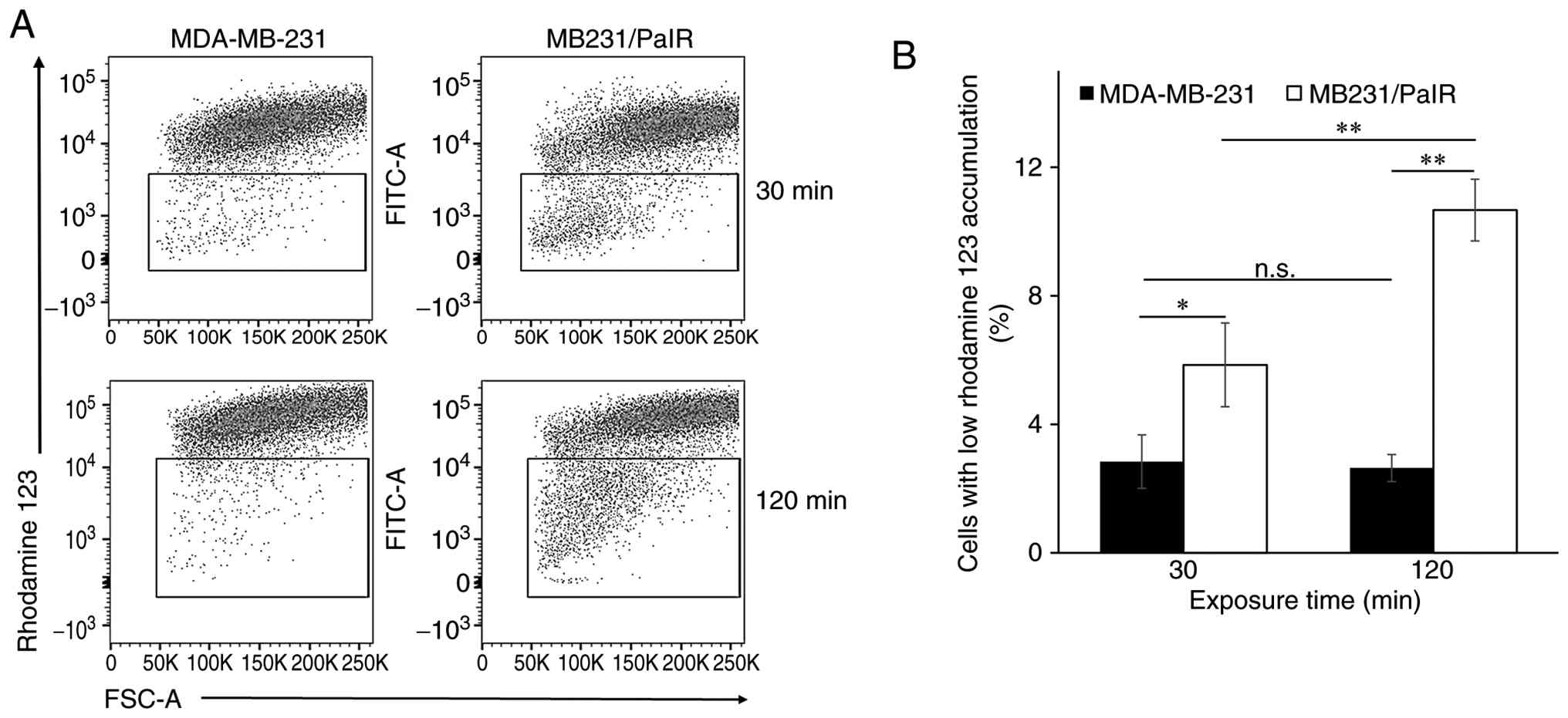
We evaluated the P-glycoprotein-mediated efflux
capacity in MB231/PalR and MDA-MB-231 cells using rhodamine 123, a
P-glycoprotein substrate, via flow cytometric analysis.
Intracellular accumulation of rhodamine 123 was observed in both
cell lines at 30 and 120 min after exposure. The population of
cells with low rhodamine 123 accumulation was significantly higher
in MB231/PalR cells than in the parental cells at both time points,
with a more pronounced difference at 120 min (Fig. 4A and B). To further investigate the
contribution of P-glycoprotein to palbociclib resistance, both cell
lines were co-treated with palbociclib and the P-glycoprotein
inhibitor verapamil. Verapamil co-treatment did not change the
IC50 values of palbociclib in either cell line (Fig. S4).
Discussion
In this study, we established a
palbociclib-resistant TNBC cell line, designated MB231/PalR, by
continuous exposure to 1 µM palbociclib. This concentration was
selected based on previous studies that established
palbociclib-resistant cell lines using 1 µM (23), 4 µM (24,25)
palbociclib. Although it is 2.4-fold higher than the clinical
Cmax (0.41 µM) (26), it
was used to provide sufficient selective pressure to induce
resistance. The aim of generating resistant sublines is to apply
sufficient selective pressure to identify potential adaptive
mechanisms, rather than to mimic clinical pharmacokinetics.
Nevertheless, the use of a single concentration represents a
limitation of this study. We could not determine whether the
observed molecular changes occur only upon reaching this
concentration or develop in a dose-dependent manner at lower
concentrations. Accordingly, it remains unclear whether these
changes occur at clinically relevant concentrations, and further
validation under such conditions will be required.
Continuous exposure to palbociclib decreased the
sensitivity of breast cancer cells to palbociclib. This change was
associated with reduced Rb protein levels. In contrast, RB1
mRNA levels showed no significant changes. These findings suggest
that the decrease in protein abundance is regulated at the
post-transcriptional or post-translational level. A previous study
reported that palbociclib reduces Rb protein levels within one day
in breast cancer cell lines (27).
Furthermore, a previous study reported that increased
ubiquitin-mediated degradation of Rb confers resistance to CDK4/6
inhibitors in breast cancer cells (28). However, Proteasome inhibitor MG-132
treatment did not clearly restore Rb protein expression in
MB231/PalR cells, suggesting that mechanisms other than
proteasome-dependent degradation may also contribute to the
reduction in Rb protein levels. Collectively, these findings
suggest that reduced Rb protein levels following long-term
palbociclib exposure may contribute to decreased sensitivity to
CDK4/6 inhibitors and the acquisition of drug resistance.
In this study, both CCNE1 mRNA and cyclin E1
protein expression were increased in MB231/PalR cells compared with
parental cells. Several studies have indicated that the
upregulation of cyclin E1 is a critical mechanism underlying
resistance to CDK4/6 inhibition. Palbociclib-resistant cells in
HR-positive breast cancer cell lines (MCF-7 and T47D) showed
significantly overexpress cyclin E1 which was reversed by a CDK2
inhibitor (29,30). Consistent with these reports,
MB231/PalR cells also showed increased cyclin E1 expression.
However, in contrast to previous findings, MB231/PalR cells also
exhibited resistance to CVT-313. Although co-treatment with CVT-313
reduced the IC50 of palbociclib in both parental and
resistant cells, the relative difference in palbociclib sensitivity
between the two cell lines was maintained. These findings suggest
that although cyclin E1 upregulation may contribute to palbociclib
resistance, additional molecular alterations may also be involved
in MB231/PalR cells. Supporting this interpretation, Guarducci
et al (31) reported that a
common molecular feature associated with palbociclib resistance in
HR-positive breast cancer cell lines is the concomitant
overexpression of cyclin E1 and downregulation of Rb. These
findings are consistent with the characteristics observed in our
established MB231/PalR cells, suggesting that reduced Rb protein
levels and increased CCNE1/cyclin E1 expression contribute
to resistance to CDK4/6 inhibitors. However, the precise mechanisms
underlying the reduction in Rb protein levels and the upregulation
of CCNE1 following long-term palbociclib exposure remain
unclear. Further investigation of these molecular alterations may
provide important insights into strategies for overcoming
resistance to CDK4/6 inhibitors.
Palbociclib is a substrate of both P-glycoprotein,
encoded by ABCB1, and BCRP, encoded by ABCG2
(32). In addition, abemaciclib
acts as both a substrate and an inhibitor of P-glycoprotein and
BCRP (33,34). Therefore, we evaluated the mRNA
expression profiles of ABC transporters and P-glycoprotein efflux
capacity in MB231/PalR cells. ABCB1 mRNA levels were
increased, whereas ABCC1 and ABCG2 were decreased.
Consistently, enhanced P-glycoprotein-mediated rhodamine 123 efflux
was observed. However, pharmacological inhibition of P-glycoprotein
with verapamil did not change palbociclib sensitivity in either
parental or resistant cells. Increased P-glycoprotein or BCRP
expression in cancer cells, not limited to breast cancer,
contributes to resistance to various anticancer drugs (35–38).
Although ABCB1 overexpression has been reported to reduce
sensitivity to palbociclib, and verapamil co-treatment fully
reversed this resistance in cells where ABCB1 overexpression was
the sole resistance mechanism (39), verapamil did not restore palbociclib
sensitivity in MB231/PalR cells. This suggests that the
contribution of ABCB1 upregulation to palbociclib resistance in our
model may be limited relative to other molecular alterations, such
as reduced Rb protein expression and cyclin E1 upregulation.
Decreased ABCG2 expression may reduce the efflux of palbociclib and
partially counterbalance the effect of increased ABCB1. However,
previous studies have shown that ABCG2 overexpression does not
significantly contribute to palbociclib resistance (39), and its efflux capacity for
palbociclib is lower than that of ABCB1 (40). Therefore, the observed decrease in
ABCG2 expression is unlikely to substantially affect drug
sensitivity. A previous study reported that CDK6 inhibition leads
to ABCB1 downregulation (41), suggesting that alterations in CDK4/6
signaling partially modulate ABC transporter expression. Continuous
exposure to palbociclib may alter the expression profiles of
several ABC transporters, as observed in MB231/PalR cells. However,
the precise molecular mechanisms underlying these changes remain
unclear and require further investigation.
MB231/PalR cells exhibited significantly lower mRNA
levels of CD274, which encodes PD-L1, than the parental
cells. This is notable as the relationship between cyclin D-CDK4/6
and PD-L1 expression remains controversial. Zhang et al
(42) suggested that cyclin D-CDK4
promotes speckle type BTB/POZ protein-dependent PD-L1 degradation
and that CDK4/6 inhibition leads to increased PD-L1 protein levels.
In contrast, Shrestha et al (43) reported that CDK4/6 inhibitors
suppress PD-L1 expression through Rb-mediated inhibition of E2F
activation. The reduction in CD274 mRNA levels in MB231/PalR
cells with decreased Rb protein is consistent with the observation
of Shrestha et al (43), who
showed that Rb-mediated suppression of E2F activation regulates
CD274 transcription. However, CDK4/6 also modulates PD-L1
protein degradation via speckle type BTB/POZ protein (42). Therefore, the observed decrease in
CD274 mRNA levels may not directly translate into reduced
PD-L1 protein levels on the cell surface. Determining whether this
transcriptional decrease translates into reduced surface PD-L1
levels and altered immune interactions is important for the
effective combination of CDK4/6 inhibitors and immune checkpoint
blockade against TNBC.
MB231/PalR cells exhibited reduced sensitivity to
both palbociclib and abemaciclib, indicating the development of
cross-resistance to abemaciclib. Moreover, the change in the
relative sensitivity of resistant cells was greater for abemaciclib
than for palbociclib. Although abemaciclib exhibited stronger
antitumor activity than palbociclib, as reflected by its lower
IC50 value in the parental cells, this difference was
more pronounced in the resistant cells. This is possibly because
long-term palbociclib exposure induces alterations in the signaling
pathways directly associated with the pharmacological action of
CDK4/6 inhibitors. Particularly, the reduction in Rb protein levels
and increase in CCNE1 mRNA levels in MB231/PalR cells
represent alterations in both the cyclin D-CDK4/6-Rb and cyclin
E1-CDK2 pathways, which drive the G1-to-S phase transition
(6,44,45).
Consistent with our findings, the neoMONARCH Phase II neoadjuvant
study in patients with HR-positive breast cancer reported decreased
RB1 mRNA levels and increased CCNE1 mRNA levels in
patients exhibiting resistance to abemaciclib (46). Because abemaciclib more strongly
inhibits the cyclin D-CDK4/6 axis than palbociclib, the reduction
in drug sensitivity after resistance acquisition may become more
pronounced. Collectively, these data suggest that the cellular
changes induced by long-term palbociclib exposure reflect
alterations in the pathways associated with the pharmacological
action of CDK4/6 inhibitors, thereby conferring cross-resistance to
both palbociclib and abemaciclib.
Current treatment options for TNBC include
chemotherapy, immune checkpoint inhibitors (47), antibody-drug conjugates (48), and PARP inhibitors (49). Despite these advances, drug
resistance remains a major clinical challenge. Although CDK4/6
inhibitors are not currently standard treatments for TNBC, they
have shown therapeutic potential in preclinical studies of TNBC
(11). In this study, we
established a palbociclib-resistant TNBC cell line through
continuous exposure to palbociclib and characterized its molecular
signatures. In addition, the reduction in Rb protein expression
observed in resistant cells suggests that resistance may not be
fully overcome by strategies targeting the cyclin D-CDK4/6-Rb axis
alone. Therefore, combination approaches with agents targeting
pathways outside the cell cycle machinery, such as mTOR inhibitors
(14) or cytotoxic anticancer drugs
(12), may represent rational
strategies for overcoming resistance to CDK4/6 inhibitors. Further
elucidation of the molecular mechanisms underlying palbociclib
resistance may contribute to the optimization of CDK4/6
inhibitor-based therapeutic strategies for TNBC.
A key limitation of this study is that all
experiments were performed using a single TNBC cell line
(MDA-MB-231). Considering the substantial heterogeneity of TNBC,
the extent to which these findings can be generalized to other
subtypes remains uncertain. Nevertheless, MDA-MB-231 cells
represent a well-characterized basal-like TNBC model with
functional Rb signaling, which is particularly relevant for
studying mechanisms of resistance to CDK4/6 inhibition. The
observed molecular changes, including Rb protein loss,
CCNE1/cyclin E1 upregulation, and ABCB1 induction,
are biologically plausible and consistent with previously reported
resistance-associated pathways in HR-positive breast cancer cell
lines (31,39,50).
Future studies incorporating additional TNBC cell lines and
patient-derived models will be important to validate and extend
these findings. Another limitation of this study is that
EMT-related changes were not evaluated in the resistant cells. EMT
is an important process associated with cancer progression and drug
resistance, and evaluation of EMT markers may provide a more
comprehensive characterization of the resistant phenotype. However,
the present study focused primarily on characterizing the molecular
signatures of cells that acquired resistance following prolonged
palbociclib exposure. Therefore, whether prolonged palbociclib
exposure induces EMT-like phenotypic changes in MB231/PalR cells
remains unclear. Future studies evaluating epithelial and
mesenchymal markers, such as E-cadherin, N-cadherin, vimentin, and
Snail, will be needed to further characterize the phenotypic
changes associated with acquired resistance.
In conclusion, the present study established a
palbociclib-resistant TNBC cell model and identified molecular
alterations associated with acquired resistance, including reduced
Rb protein expression and increased CCNE1/cyclin E1
expression. These findings provide insight into the mechanisms
underlying CDK4/6 inhibitor resistance and may contribute to the
identification of predictive biomarkers and the development of
novel therapeutic strategies to overcome resistance in TNBC.
Supplementary Material
Supporting Data
Acknowledgements
The authors would like to thank Dr Tamotsu Sudo
(Hyogo Cancer Center, Hyogo, Japan) for kindly providing the
MDA-MB-231 cells and for his valuable assistance.
Funding
This work was supported by the Hyogo Medical University Grant
for Research Promotion (2024).
Availability of data and materials
The data generated in the present study may be
requested from the corresponding authors.
Authors' contributions
DE and KT conceived and designed the study. DE, YI,
NI and HO prepared the experimental materials and conducted the
experiments. DE, YI, NI, HO, YU, MM and TS contributed to data
acquisition and preliminary data interpretation. DE and KT
performed the statistical analysis, interpreted the data and
analyzed the results. KT provided supervision, critically revised
the manuscript for important intellectual content and approved the
final version of the manuscript. DE and KT confirm the authenticity
of all the raw data. All authors read and approved the final
manuscript, and agree to be accountable for all aspects of the
work, ensuring that any questions related to the accuracy or
integrity of any part of the work are appropriately investigated
and resolved.
Ethics approval and consent to
participate
Not applicable.
Patient consent for publication
Not applicable.
Competing interests
The authors declare that they have no competing
interests.
References
|
1
|
Ghoncheh M, Pournamdar Z and Salehiniya H:
Incidence and mortality and epidemiology of breast cancer in the
world. Asian Pac J Cancer Prev. 17((S3)): S43–S46. 2016. View Article : Google Scholar : PubMed/NCBI
|
|
2
|
Parise CA and Caggiano V: Breast cancer
survival defined by the ER/PR/HER2 subtypes and a surrogate
classification according to tumor grade and immunohistochemical
biomarkers. J Cancer Epidemiol. 2014:4692512014. View Article : Google Scholar : PubMed/NCBI
|
|
3
|
Bianchini G, Balko JM, Mayer IA, Sanders
ME and Gianni L: Triple-negative breast cancer: Challenges and
opportunities of a heterogeneous disease. Nat Rev Clin Oncol.
13:674–690. 2016. View Article : Google Scholar : PubMed/NCBI
|
|
4
|
Lehmann BD, Bauer JA, Chen X, Sanders ME,
Chakravarthy AB, Shyr Y and Pietenpol JA: Identification of human
triple-negative breast cancer subtypes and preclinical models for
selection of targeted therapies. J Clin Invest. 121:2750–2767.
2011. View
Article : Google Scholar : PubMed/NCBI
|
|
5
|
Foulkes WD, Smith IE and Reis-Filho JS:
Triple-negative breast cancer. N Engl J Med. 363:1938–1948. 2010.
View Article : Google Scholar : PubMed/NCBI
|
|
6
|
Narasimha AM, Kaulich M, Shapiro GS, Choi
YJ, Sicinski P and Dowdy SF: Cyclin D activates the Rb tumor
suppressor by mono-phosphorylation. Elife. 3:e028722014. View Article : Google Scholar : PubMed/NCBI
|
|
7
|
Foster DA, Yellen P, Xu L and Saqcena M:
Regulation of G1 cell cycle progression: Distinguishing the
restriction point from a nutrient-sensing cell growth
checkpoint(s). Genes Cancer. 11:1124–1131. 2010. View Article : Google Scholar : PubMed/NCBI
|
|
8
|
Clark AS, Karasic TB, DeMichele A, Vaughn
DJ, O'Hara M, Perini R, Zhang P, Lal P, Feldman M, Gallagher M and
O'Dwyer PJ: Palbociclib (PD0332991)-a selective and potent
cyclin-dependent kinase inhibitor: A review of pharmacodynamics and
clinical development. JAMA Oncol. 2:253–260. 2016. View Article : Google Scholar : PubMed/NCBI
|
|
9
|
Finn RS, Crown JP, Lang I, Boer K,
Bondarenko IM, Kulyk SO, Ettl J, Patel R, Pinter T, Schmidt M, et
al: The cyclin-dependent kinase 4/6 inhibitor palbociclib in
combination with letrozole versus letrozole alone as first-line
treatment of oestrogen receptor-positive, HER2-negative, advanced
breast cancer (PALOMA-1/TRIO-18): A randomised phase 2 study.
Lancet Oncol. 16:25–35. 2015. View Article : Google Scholar : PubMed/NCBI
|
|
10
|
Corona SP and Generali D: Abemaciclib: A
CDK4/6 inhibitor for the treatment of HR+/HER2-advanced breast
cancer. Drug Des Devel Ther. 12:321–330. 2018. View Article : Google Scholar : PubMed/NCBI
|
|
11
|
Asghar US, Barr AR, Cutts R, Beaney M,
Babina I, Sampath D, Giltnane J, Lacap JA, Crocker L, Young A, et
al: Single-cell dynamics determines response to CDK4/6 inhibition
in triple-negative breast cancer. Clin Cancer Res. 23:5561–5572.
2017. View Article : Google Scholar : PubMed/NCBI
|
|
12
|
Cretella D, Fumarola C, Bonelli M, Alfieri
R, La Monica S, Digiacomo G, Cavazzoni A, Galetti M, Generali D and
Petronini PG: Pre-treatment with the CDK4/6 inhibitor palbociclib
improves the efficacy of paclitaxel in TNBC cells. Sci Rep.
9:130142019. View Article : Google Scholar : PubMed/NCBI
|
|
13
|
Cretella D, Ravelli A, Fumarola C, La
Monica S, Digiacomo G, Cavazzoni A, Alfieri R, Biondi A, Generali
D, Bonelli M and Petronini PG: The anti-tumor efficacy of CDK4/6
inhibition is enhanced by the combination with PI3K/AKT/mTOR
inhibitors through impairment of glucose metabolism in TNBC cells.
J Exp Clin Cancer Res. 37:722018. View Article : Google Scholar : PubMed/NCBI
|
|
14
|
Yamamoto T, Kanaya N, Somlo G and Chen S:
Synergistic anti-cancer activity of CDK4/6 inhibitor palbociclib
and dual mTOR kinase inhibitor MLN0128 in pRb-expressing
ER-negative breast cancer. Breast Cancer Res Treat. 174:615–625.
2019. View Article : Google Scholar : PubMed/NCBI
|
|
15
|
Winter M, Nait Eldjoudi A, Guette C,
Hondermarck H, Bourette RP, Fovez Q, Laine W, Ghesquiere B,
Adriaenssens E, Kluza J and Le Bourhis X: Mitochondrial adaptation
decreases drug sensitivity of persistent triple negative breast
cancer cells surviving combinatory and sequential chemotherapy.
Neoplasia. 46:1009492023. View Article : Google Scholar : PubMed/NCBI
|
|
16
|
Koh SY, Moon JY, Unno T and Cho SK:
Baicalein suppresses stem cell-like characteristics in radio- and
chemoresistant MDA-MB-231 human breast cancer cells through
up-regulation of IFIT2. Nutrients. 11:6242019. View Article : Google Scholar : PubMed/NCBI
|
|
17
|
Błaszczak E, Miziak P, Odrzywolski A,
Baran M, Gumbarewicz E and Stepulak A: Triple-negative breast
cancer progression and drug resistance in the context of
epithelial-mesenchymal transition. Cancers (Basel). 17:2282025.
View Article : Google Scholar : PubMed/NCBI
|
|
18
|
Takara K, Sakaeda T, Yagami T, Kobayashi
H, Ohmoto N, Horinouchi M, Nishiguchi K and Okumura K: Cytotoxic
effects of 27 anticancer drugs in HeLa and MDR1-overexpressing
derivative cell lines. Biol Pharm Bull. 25:771–778. 2002.
View Article : Google Scholar : PubMed/NCBI
|
|
19
|
Takara K, Kitada N, Yoshikawa E, Yamamoto
K, Horibe S, Sakaeda T, Nishiguchi K, Ohnishi N and Yokoyama T:
Molecular changes to HeLa cells on continuous exposure to SN-38, an
active metabolite of irinotecan hydrochloride. Cancer Lett.
278:88–96. 2009. View Article : Google Scholar : PubMed/NCBI
|
|
20
|
Nakayama Y, Takara K, Minegaki T, Yamamoto
K, Omura T and Yano I: Induction of cross-resistance to ABCB1
substrates in venetoclax-resistant human leukemia HL60 cells.
Anticancer Res. 41:4239–4248. 2021. View Article : Google Scholar : PubMed/NCBI
|
|
21
|
Schmittgen TD and Livak KJ: Analyzing
real-time PCR data by the comparative C(T) method. Nat Protoc.
3:1101–1108. 2008. View Article : Google Scholar : PubMed/NCBI
|
|
22
|
Kanda Y: Investigation of the freely
available easy-to-use software ‘EZR’ for medical statistics. Bone
Marrow Transplant. 48:452–458. 2013. View Article : Google Scholar : PubMed/NCBI
|
|
23
|
Lypova N, Lanceta L, Gibson A, Vega S,
Garza-Morales R, McMasters KM, Chesney J, Gomez-Gutierrez JG and
Imbert-Fernandez Y: Targeting palbociclib-resistant estrogen
receptor-positive breast cancer cells via oncolytic virotherapy.
Cancers (Basel). 11:6842019. View Article : Google Scholar : PubMed/NCBI
|
|
24
|
Lanceta L, Lypova N, O'Neill C, Li X,
Rouchka E, Chesney J and Imbert-Fernandez Y: Differential gene
expression analysis of palbociclib-resistant TNBC via RNA-seq.
Breast Cancer Res Treat. 186:677–686. 2021. View Article : Google Scholar : PubMed/NCBI
|
|
25
|
Pesch AM, Hirsh NH, Michmerhuizen AR,
Jungles KM, Wilder-Romans K, Chandler BC, Liu M, Lerner LM, Nino
CA, Ward C, et al: RB expression confers sensitivity to CDK4/6
inhibitor-mediated radiosensitization across breast cancer
subtypes. JCI Insight. 7:e1544022022. View Article : Google Scholar : PubMed/NCBI
|
|
26
|
Tamura K, Mukai H, Naito Y, Yonemori K,
Kodaira M, Tanabe Y, Yamamoto N, Osera S, Sasaki M, Mori Y, et al:
Phase I study of palbociclib, a cyclin-dependent kinase 4/6
inhibitor, in Japanese patients. Cancer Sci. 107:755–763. 2016.
View Article : Google Scholar : PubMed/NCBI
|
|
27
|
Kim S, Armand J, Safonov A, Zhang M, Soni
RK, Schwartz G, McGuinness JE, Hibshoosh H, Razavi P, Kim M, et al:
Sequential activation of E2F via Rb degradation and c-Myc drives
resistance to CDK4/6 inhibitors in breast cancer. Cell Rep.
42:1131982023. View Article : Google Scholar : PubMed/NCBI
|
|
28
|
Ma J, Li L, Ma B, Liu T, Wang Z, Ye Q,
Peng Y, Wang B, Chen Y, Xu S, et al: MYC induces CDK4/6 inhibitors
resistance by promoting pRB1 degradation. Nat Commun. 15:18712024.
View Article : Google Scholar : PubMed/NCBI
|
|
29
|
Pandey K, Park N, Park KS, Hur J, Cho YB,
Kang M, An HJ, Kim S, Hwang S and Moon YW: Combined CDK2 and CDK4/6
inhibition overcomes palbociclib resistance in breast cancer by
enhancing senescence. Cancers (Basel). 12:35662020. View Article : Google Scholar : PubMed/NCBI
|
|
30
|
Cai Z, Shi Q, Li Y, Jin L, Li S, Wong LL,
Wang J, Jiang X, Zhu M, Lin J, et al: LncRNA EILA promotes CDK4/6
inhibitor resistance in breast cancer by stabilizing cyclin E1
protein. Sci Adv. 9:eadi38212023. View Article : Google Scholar : PubMed/NCBI
|
|
31
|
Guarducci C, Bonechi M, Benelli M,
Biagioni C, Boccalini G, Romagnoli D, Verardo R, Schiff R, Osborne
CK, De Angelis C, et al: Cyclin E1 and Rb modulation as common
events at time of resistance to palbociclib in hormone
receptor-positive breast cancer. NPJ Breast Cancer. 4:382018.
View Article : Google Scholar : PubMed/NCBI
|
|
32
|
de Gooijer MC, Zhang P, Thota N,
Mayayo-Peralta I, Buil LCM, Beijnen JH and van Tellingen O:
P-glycoprotein and breast cancer resistance protein restrict the
brain penetration of the CDK4/6 inhibitor palbociclib. Invest New
Drugs. 33:1012–1019. 2015. View Article : Google Scholar : PubMed/NCBI
|
|
33
|
Wu T, Chen Z, To KKW, Fang X, Wang F,
Cheng B and Fu L: Effect of abemaciclib (LY2835219) on enhancement
of chemotherapeutic agents in ABCB1 and ABCG2 overexpressing cells
in vitro and in vivo. Biochem Pharmacol. 124:29–42. 2017.
View Article : Google Scholar : PubMed/NCBI
|
|
34
|
Martínez-Chávez A, Loos NHC, Lebre MC,
Tibben MM, Rosing H, Beijnen JH and Schinkel AH: ABCB1 and ABCG2
limit brain penetration and, together with CYP3A4, total plasma
exposure of abemaciclib and its active metabolites. Pharmacol Res.
178:1059542022. View Article : Google Scholar : PubMed/NCBI
|
|
35
|
Takara K, Sakaeda T and Okumura K: An
update on overcoming MDR1-mediated multidrug resistance in cancer
chemotherapy. Curr Pharm Des. 12:273–286. 2006. View Article : Google Scholar : PubMed/NCBI
|
|
36
|
Mohammad IS, He W and Yin L: Understanding
of human ATP binding cassette superfamily and novel multidrug
resistance modulators to overcome MDR. Biomed Pharmacother.
100:335–348. 2018. View Article : Google Scholar : PubMed/NCBI
|
|
37
|
Ji N, Yang Y, Cai CY, Lei ZN, Wang JQ,
Gupta P, Shukla S, Ambudkar SV, Kong D and Chen ZS: Selonsertib
(GS-4997), an ASK1 inhibitor, antagonizes multidrug resistance in
ABCB1- and ABCG2-overexpressing cancer cells. Cancer Lett. 440–441.
82–93. 2019.
|
|
38
|
Modi A, Roy D, Sharma S, Vishnoi JR,
Pareek P, Elhence P, Sharma P and Purohit P: ABC transporters in
breast cancer: Their roles in multidrug resistance and beyond. J
Drug Target. 30:927–947. 2022. View Article : Google Scholar : PubMed/NCBI
|
|
39
|
Fu H, Wu ZX, Lei ZN, Teng QX, Yang Y,
Ashby CR, Lei Y, Lian Y and Chen ZS: The resistance of cancer cells
to palbociclib, a cyclin-dependent kinase 4/6 inhibitor, is
mediated by the ABCB1 transporter. Front Pharmacol. 13:8616422022.
View Article : Google Scholar : PubMed/NCBI
|
|
40
|
Li J, Jiang J, Wu J, Bao X and Sanai N:
Physiologically based pharmacokinetic modeling of central nervous
system pharmacokinetics of CDK4/6 inhibitors to guide selection of
drug and dosing regimen for brain cancer treatment. Clin Pharmacol
Ther. 109:494–506. 2021. View Article : Google Scholar : PubMed/NCBI
|
|
41
|
Zhang L, Li Y, Hu C, Chen Y, Chen Z, Chen
ZS, Zhang JY and Fang S: CDK6-PI3K signaling axis is an efficient
target for attenuating ABCB1/P-gp mediated multi-drug resistance
(MDR) in cancer cells. Mol Cancer. 21:1032022. View Article : Google Scholar : PubMed/NCBI
|
|
42
|
Zhang J, Bu X, Wang H, Zhu Y, Geng Y,
Nihira NT, Tan Y, Ci Y, Wu F, Dai X, et al: Cyclin D-CDK4 kinase
destabilizes PD-L1 via cullin 3-SPOP to control cancer immune
surveillance. Nature. 553:91–95. 2018. View Article : Google Scholar : PubMed/NCBI
|
|
43
|
Shrestha M, Wang DY, Ben-David Y and
Zacksenhaus E: CDK4/6 inhibitors and the pRB-E2F1 axis suppress PVR
and PD-L1 expression in triple-negative breast cancer. Oncogenesis.
12:292023. View Article : Google Scholar : PubMed/NCBI
|
|
44
|
Diehl JA: Cycling to cancer with cyclin
D1. Cancer Biol Ther. 1:226–231. 2002. View
Article : Google Scholar : PubMed/NCBI
|
|
45
|
Gladden AB and Diehl JA: Cell cycle
progression without cyclin E/CDK2: Breaking down the walls of
dogma. Cancer Cell. 4:160–162. 2003. View Article : Google Scholar : PubMed/NCBI
|
|
46
|
Hurvitz SA, Martin M, Press MF, Chan D,
Fernandez-Abad M, Petru E, Rostorfer R, Guarneri V, Huang CS,
Barriga S, et al: Potent cell-cycle inhibition and upregulation of
immune response with abemaciclib and anastrozole in neoMONARCH,
phase II neoadjuvant study in HR+/HER2−breast
cancer. Clin Cancer Res. 26:566–580. 2020. View Article : Google Scholar : PubMed/NCBI
|
|
47
|
Schmid P, Cortes J, Pusztai L, McArthur H,
Kümmel S, Bergh J, Denkert C, Park YH, Hui R, Harbeck N, et al:
Pembrolizumab for early triple-negative breast cancer. N Engl J
Med. 382:810–821. 2020. View Article : Google Scholar : PubMed/NCBI
|
|
48
|
Tolaney SM, de Azambuja E, Kalinsky K, Loi
S, Kim SB, Yam C, Rapoport B, Im SA, Pistilli B, Mchayleh W, et al:
Sacituzumab govitecan plus pembrolizumab for advanced
triple-negative breast cancer. N Engl J Med. 394:354–366. 2026.
View Article : Google Scholar : PubMed/NCBI
|
|
49
|
Rugo HS, Cescon DW, Robson ME, Im SA,
Dalenc F, Yañez Ruiz E, Reyes-Cosmelli F, Walshe JM, Im YH, Kulyk
S, et al: KEYLYNK-009: Pembrolizumab plus olaparib in locally
recurrent inoperable or metastatic triple-negative breast cancer
after clinical benefit from first-line pembrolizumab plus
chemotherapy. Clin Cancer Res. 32:883–893. 2026. View Article : Google Scholar : PubMed/NCBI
|
|
50
|
Malorni L, Piazza S, Ciani Y, Guarducci C,
Bonechi M, Biagioni C, Hart CD, Verardo R, Di Leo A and Migliaccio
I: A gene expression signature of retinoblastoma loss-of-function
is a predictive biomarker of resistance to palbociclib in breast
cancer cell lines and is prognostic in patients with ER positive
early breast cancer. Oncotarget. 7:68012–68022. 2016. View Article : Google Scholar : PubMed/NCBI
|