Introduction
Triple-negative breast cancer (TNBC) is a type of
breast cancer that is defined by the absence of estrogen receptor,
progesterone receptor and HER2 expression, accounting for 12–17% of
all breast cancer cases (1–3). In the present review, early-stage TNBC
refers to non-metastatic stage II–III disease unless otherwise
stated; staging terminology follows the American Joint Committee on
Cancer (AJCC) 8th edition TNM staging system (4). TNBC remains one of the most clinically
aggressive early-stage breast cancer subtypes. Recurrence tends to
occur early, and distant failure refers to distant recurrence or
metastatic relapse after initial treatment; biological
heterogeneity further complicates treatment planning (2,3).
In stage II–III TNBC, neoadjuvant therapy has become
a key therapeutic protocol as its application extends beyond tumor
downstaging (4–9). By exposing the intact primary tumor
and regional disease to systemic treatment before surgery,
neoadjuvant therapy provides an in vivo assessment of
treatment sensitivity, identifies tumors with resistant biology
through residual invasive disease, informs post-neoadjuvant risk
assessment, and links preoperative and postoperative management
within one treatment sequence. These clinical difficulties, namely
heterogeneous response, non-uniform chemotherapy and immunotherapy
platforms, different endpoints and variable postoperative
strategies, explain why the rapid expansion of perioperative TNBC
clinical trials has not made clinical decision-making simpler.
Studies built on different chemotherapy backbones, immunotherapy
schedules, endpoints and risk populations are frequently discussed
together, which encourages recurrent errors. In particular,
exploratory signals are treated as if they were practice-defining
evidence, whereas postoperative strategies are projected backward
into the neoadjuvant setting without sufficient validation. For a
clinically useful review, the key task is therefore to distinguish
what is established from what is context-dependent and what remains
investigational.
The present review is organized around the following
main decision points in neoadjuvant TNBC therapy: Core clinical
challenges, evidence-based treatment strategies, biomarker
interpretation, post-neoadjuvant management, circulating tumor
(ct)DNA/minimal residual disease (MRD) and emerging drug
development. The aim is to distinguish established standards from
context-dependent choices and investigational approaches.
Literature search strategy
The present narrative review was informed by
targeted searches of PubMed/MEDLINE (https://pubmed.ncbi.nlm.nih.gov/) and
ClinicalTrials.gov (https://clinicaltrials.gov/) from database inception
until June 15, 2026. Searches were supplemented by contemporary
oncology guidelines, including the ASCO neoadjuvant breast cancer
guideline, the ASCO pembrolizumab rapid recommendation update, the
CSCO Breast Cancer guidelines and the St. Gallen consensus
recommendations, as well as pivotal-trial updates, regulatory
documents when needed to reconcile data cut-offs and backward
reference-list screening (5,9–11).
English-language human study publications were prioritized.
Eligible evidence included randomized trials,
prospective interventional studies, mature survival updates,
clinically annotated prospective translational studies and major
guidelines relevant to stage II–III TNBC. In this context,
clinically annotated prospective translational studies were defined
as prospective biomarker studies linked to clinical variables,
treatment exposure and response or survival outcomes. Retrospective
studies were used if they addressed clinically important evidence
gaps, including treatment delivery, residual-risk assessment or
biomarker interpretation. Case reports, non-clinical studies
without a direct clinical decision link, duplicate publications and
conference abstracts superseded by full peer-reviewed reports were
excluded as primary evidence for the present review.
Evidence was prioritized in the following order: i)
Practice-defining randomized evidence and mature survival updates,
defined as randomized data with clinically meaningful pCR, EFS, DFS
or OS endpoints; ii) boundary-defining randomized negative trials,
defined as randomized studies that failed to support a proposed
escalation, de-escalation or scheduling strategy and therefore
helped define the limits of routine practice; iii) guidelines; iv)
prospective translational studies; and v) hypothesis-generating
observational evidence. Because the present review was narrative
rather than systematic, duplicate screening, PRISMA flow reporting,
formal risk-of-bias grading and meta-analytic pooling were not
performed.
Full search concepts and database search strings are
provided in Tables SI and SII.
Core clinical challenges of neoadjuvant
therapy for stage II–III TNBC
Neoadjuvant therapy has become a key therapeutic
strategy for the management of stage II–III TNBC. However, clinical
challenges shape routine practice. First, only a limited number of
regimens are supported by mature survival-level evidence, meaning
EFS, DFS or OS data with sufficient follow-up, and pathological
complete response (pCR) gains do not always concur with durable
outcome data (6–8,12–14).
Second, treatment benefit is biologically heterogeneous, where
apparently similar patients may respond differently due to
differences in immune infiltration, DNA-repair capacity, tumor
burden and residual disease biology (15–19).
Finally, regimen intensification is often easier to justify than to
deliver safely, with real-world chemo-immunotherapy cohorts showing
frequent dose reductions, delays, discontinuation and clinically
meaningful immune-related toxicity (20–23).
Furthermore, although biomarkers can be used to refine prognosis,
far fewer of these can be used as validated stand-alone treatment
determinants.
For the majority of patients with stage II–III TNBC,
neoadjuvant systemic therapy is the preferred starting point of
perioperative management (4–5,9).
Selected patients with smaller primary tumors may also enter a
neoadjuvant treatment pathway either when breast conservation is a
realistic goal or when recurrence risk appears biologically high,
as residual disease after neoadjuvant therapy can guide
postoperative escalation. Nevertheless, the clinical objective
should not be framed simply as ‘achieving pCR’. A superior
formulation can be proposed threefold: i) To reduce tumor burden
and optimize surgery; ii) to identify tumors that are highly
sensitive or clearly resistant to the chosen regimen; and iii) to
generate interpretable information for post-neoadjuvant escalation
or de-escalation. This threshold-based selection is consistent with
the American Society of Clinical Oncology (ASCO) neoadjuvant
guidelines, which support neoadjuvant systemic therapy for
high-risk TNBC when the finding of residual disease would influence
postoperative treatment. However, these guidelines do not recommend
routine neoadjuvant therapy for cT1a-bN0 disease (5).
Current standard-of-care pathway
In contemporary practice, the baseline clinical
treatment method for the majority of fit patients with stage II–III
TNBC is neoadjuvant systemic therapy followed by surgery,
radiotherapy according to baseline and post-treatment locoregional
risk, and response-guided adjuvant therapy (4–11,24,25).
For patients eligible for immune checkpoint inhibition, the most
evidence-supported pathway is a KEYNOTE-522-like regimen; namely,
pembrolizumab combined with carboplatin-paclitaxel, followed by
anthracycline-cyclophosphamide chemotherapy, surgery and completion
of adjuvant pembrolizumab (6–9).
Patients with residual invasive disease would then require
individualized evaluation for evidence-based post-neoadjuvant
options, including capecitabine in appropriate residual-disease
populations and olaparib for germline BRCA1/2-mutated high-risk
HER2-negative disease (24–26). This baseline is essential, because
escalation and de-escalation should be judged against an
established treatment pathway, not against an undefined
chemotherapy reference.
Baseline evaluation must include pathological
confirmation, clinical stage according to AJCC TNM criteria, organ
function assessment and biomarker sampling, all of which can affect
treatment planning (4–5,9–11,27).
In TNBC, regional nodal evaluation warrants more attention than it
currently receives in routine practice. This is because the
additional ultrasound evaluation of regional nodal basins may
upstage the disease, alter surgical planning and change the
indication or extent of regional nodal irradiation (27–31).
This matters because locoregional treatment should be integrated at
baseline rather than only reconsidered after surgery.
Response assessment during treatment should be
pragmatic and repetitive. Clinical examination combined with breast
ultrasound or MRI remains the central approach, and early imaging
response has been associated with pathological response in TNBC
(32). However, imaging should not
be used to justify automatic completion of a preplanned regimen in
the face of unequivocal progression. When progression or persistent
inoperability is documented, the priority should then shift to
multidisciplinary reassessment, restoration of resectability if
possible and preservation of local control. The practical value of
interim assessment is therefore not merely prognostic. It is to
decide whether the current pathway still makes clinical sense. This
point has become more relevant in the current immunotherapy era.
Certain patients experience notable shrinkage before the full
number of cycles have been completed, whereas others develop
toxicity that renders nominal treatment completion unrealistic. The
key clinical question in this case is therefore not whether the
patient remains ‘on study’, but whether the balance among tumor
control, deliverability and postoperative options remains
favorable. In practice, treatment escalation, schedule modification
or earlier surgery may all be more rational compared with strict
adherence to a preplanned timeline when the biology or tolerance
profile has been altered.
From a treatment-design perspective, three baseline
questions remain especially important: Whether the patient is
considered sufficiently high-risk for recurrence, based on stage
II–III disease, nodal positivity, larger tumor burden or other
adverse clinical features, to justify platinum and/or perioperative
immunotherapy; whether germline BRCA1/2 mutations or other
molecular features that will influence post-neoadjuvant therapy are
present; and whether the anticipated treatment intensity is
realistic in light of marrow reserve, comorbidity and expected
treatment adherence. The answers to these questions will typically
determine outcome as much as any nominal difference between
regimens.
Evidence-based neoadjuvant treatment
strategies in TNBC
The development of neoadjuvant treatment in TNBC has
gradually shifted the more traditional chemotherapy-centered
treatment to a more perioperative strategy that integrates response
evaluation, post-neoadjuvant escalation and residual-risk
stratification. In broad terms, the evidence pathway has moved
through the following four stages: i) Establishment of
anthracycline-taxane chemotherapy as the standard backbone; ii)
selective exploration of platinum intensification in
high-recurrence-risk disease; iii) maturation of post-neoadjuvant
capecitabine and olaparib strategies; and iv) subsequent
consolidation of pembrolizumab-based perioperative immunotherapy.
However, previous studies have further extended this framework
toward ctDNA-guided risk assessment and antibody-drug conjugate
(ADC)-based development. The resulting response-adapted clinical
framework is summarized in Fig. 1
(6–8,24–25,33–44).
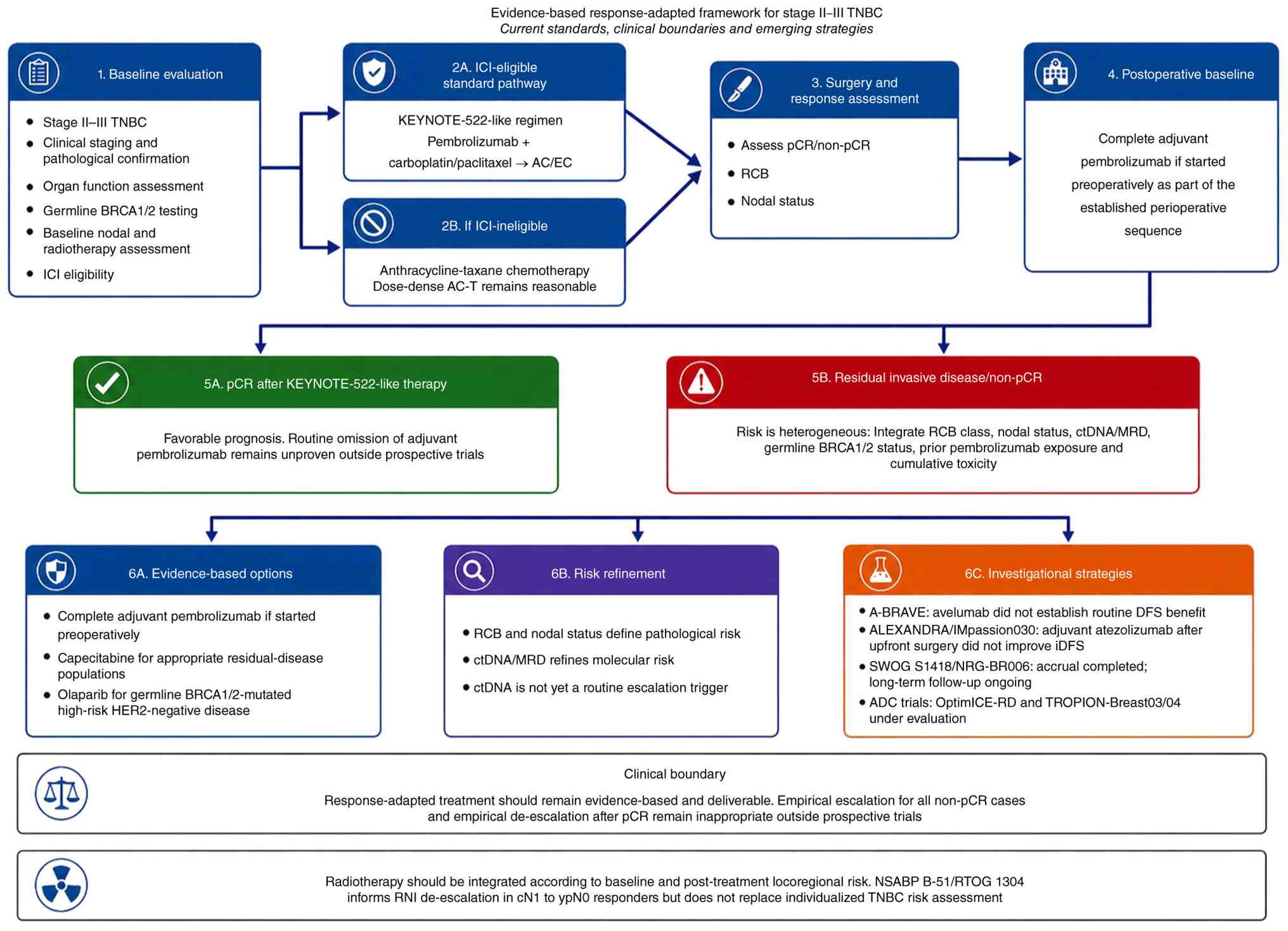 | Figure 1.Evidence-based response-adapted
framework for stage II–III TNBC. The framework proceeds through six
linked decision points: i) Baseline confirmation of non-metastatic
stage II–III TNBC and recurrence risk; ii) selection of a
chemotherapy-alone or KEYNOTE-522-like chemoimmunotherapy backbone
according to eligibility and contraindications; iii) interim
response and toxicity assessment to determine whether the selected
pathway remains deliverable; iv) surgery and pathological response
evaluation using pCR and RCB; v) post-neoadjuvant risk
stratification integrating residual burden, nodal status, germline
BRCA1/2 status and ctDNA/MRD where available; and vi)
response-adapted postoperative treatment, including completion of
pembrolizumab, capecitabine, olaparib or trial-based
ADC/ctDNA-guided strategies as appropriate. TNBC, triple-negative
breast cancer; ICI, immune checkpoint inhibitor; AC,
doxorubicin-cyclophosphamide; EC, epirubicin-cyclophosphamide;
AC-T, anthracycline-taxane; pCR, pathological complete response;
RCB, residual cancer burden; ctDNA, circulating tumor DNA; MRD,
minimal residual disease; ADC, antibody-drug conjugate. |
Standard chemotherapy backbone and
selective intensification
Anthracycline-taxane chemotherapy remains the most
frequently applied neoadjuvant platform for the treatment of
early-stage TNBC, particularly non-metastatic stage II–III disease.
This is because it most readily delivers pCR rates and provides the
scaffold on which the majority of modern perioperative strategies
have been tested (5–8,33–38).
Accordingly, the interpretation of platinum, immunotherapy and
post-neoadjuvant escalation results cannot be analyzed separately
from the backbone treatment on which these data were generated.
The continuing role of dose-dense
anthracycline-taxane therapy should also be stated clearly,
especially for patients who are not appropriate candidates for
immune checkpoint inhibition. KEYNOTE-522 established
pembrolizumab-based perioperative therapy as the best-supported
regimen for patients with high-recurrence-risk early-stage TNBC,
but it did not directly compare its efficacy with dose-dense
anthracycline-taxane therapy (6–9,45).
Therefore, although a KEYNOTE-522-like perioperative pathway is
currently the preferred evidence-supported approach for immune
checkpoint inhibitor-eligible high-risk patients, dose-dense
anthracycline-taxane chemotherapy remains a reasonable standard
option for selected patients with active autoimmune diseases, at a
high risk of severe immune-related adverse events, prior organ
transplantation or with other contraindications to
pembrolizumab.
Platinum is a selective intensification strategy
reserved for especially high-recurrence-risk populations, rather
than a mandatory addition to all TNBC neoadjuvant regimens. Current
randomized and pooled evidence supports higher pCR rates, but the
magnitude and consistency of survival benefits remain much less
stable compared with the pathological response datapoint itself. In
addition, platinum comes at the cost of substantially higher rates
of grade ≥3 hematological toxicity in intensified regimens
(33–38). For that reason, anthracycline-taxane
chemotherapy remains the standard backbone treatment option,
whereas platinum is best positioned as a conditional intensifier
when baseline recurrence risk, expected benefit, marrow reserve and
treatment deliverability are considered together. This positioning
refers specifically to the use of platinum in chemotherapy-alone
neoadjuvant platforms. When chemotherapy is used without
immunotherapy, platinum is best considered as a selective
intensifier, the benefits of which must be weighed against
hematological toxicity and treatment completion. By contrast, for
patients who are candidates for the KEYNOTE-522 regimen,
carboplatin is not an empirical intensification step, but is
instead part of the validated chemoimmunotherapy backbone on which
the pCR, event-free survival (EFS) and overall survival (OS) data
are generated (6–9). Substituting or omitting carboplatin
within that pathway should therefore be considered a regimen
modification rather than simple de-escalation. Longer-term
follow-up from BrighTNess, a randomized phase III trial, further
validated this point by EFS: carboplatin, not veliparib, mainly
accounted for the observed long-term benefit, whereas adding the
PARP inhibitor veliparib to a carboplatin-containing regimen did
not improve long-term efficacy (38). This is clinically informative,
because it corrects a common overinterpretation that mechanistic
appeal does not automatically justify regimen proliferation. In
patients with early-stage TNBC, ‘more targeted’ should not be
interpreted as synonymous with ‘superior’, especially when the
incremental component has not improved survival endpoints.
The current anthracycline-free literature is
informative but should not be overstated. NeoPACT, a single-arm
phase II clinical trial, previously showed that pembrolizumab
combined with carboplatin-docetaxel can produce a relatively high
pCR rate and encouraging 3-year EFS rate in patients with high-risk
TNBC, supporting the feasibility of a non-anthracycline
chemoimmunotherapy platform (39).
However, this single-arm design lacked a randomized comparator and
cannot replace randomized evidence. The Neo-N randomized phase II
trial, which evaluated nivolumab timing on a carboplatin-paclitaxel
backbone, did not show that a lead-in immunotherapy window was
superior to concurrent initiation in terms of pCR (40). WSG-ADAPT-TN, a randomized phase II
neoadjuvant de-escalation trial, has contributed invaluable
de-escalation framework data. Specifically, short-course
anthracycline-free therapy may be reasonable in tumors that show
early treatment sensitivity, assessed by early response and
pathological response rather than by a pre-treatment test alone,
but the key is biological selection and early response, not
empirical subtraction, for all patients; the final analysis
supported the prognostic relevance of pCR and molecular markers
after de-escalated therapy (41).
NeoSTOP reached a similar conclusion from another angle by directly
comparing anthracycline-free vs. anthracycline-containing
carboplatin-based neoadjuvant chemotherapy in a randomized phase II
trial. Anthracycline omission reduced toxicity, but equivalence
claims remain limited as the study enrolled 100 patients and
follow-up was not powered to establish definitive long-term
survival equivalence (46).
In addition, two recent analyses support a cautious
interpretation of anthracycline-free strategies. A 2025
meta-analysis of platinum-based anthracycline-free regimens
suggested that such approaches are feasible and can generate
substantial pCR rates, but heterogeneity is pronounced and survival
evidence remains less stable compared with standard
anthracycline-taxane regimens (47). Another comparative study of
anthracycline-free vs. anthracycline-containing chemoimmunotherapy
also reported that efficacy may be similar in certain selected
settings, particularly in node-negative disease, but such
retrospective or non-standardized comparisons are not sufficient to
justify redefining current standard treatment procedures (48). Likewise, differences in dose
intensity matter. Dose-dense anthracycline may retain value in
patients with higher-burden disease (45), whereas cisplatin-taxane
alternatives, such as the HELEN-001 phase II trial, can improve pCR
in selected subgroups, including germline BRCA1/2 mutation
carriers, without yet establishing a new universal standard
(49). A 2024 network meta-analysis
also suggested that although intensified regimens may rank higher
for pCR in indirect cross-trial comparisons, standard chemotherapy
remains one of the most reliable treatments for long-term survival
endpoints (13). However,
real-world pembrolizumab-based data add a practical warning:
Toxicity-related chemotherapy dose reduction or discontinuation can
adversely affect the likelihood of pCR, meaning that deliverability
is not a peripheral issue in regimen selection (23).
Biologically, the appeal of platinum is high in the
patient subtype enriched for DNA repair defects. Clinically,
however, the experience of moving PARP inhibitors, such as
olaparib, into the neoadjuvant phase is a warning against broad
inference. In PARTNER, a randomized clinical trial, adding olaparib
to platinum-based neoadjuvant chemotherapy in germline BRCA
wild-type TNBC did not improve pCR, EFS or OS (50), meaning that knowledge of a plausible
mechanism is not sufficient. Standard chemotherapy remains the core
therapeutic scaffold of perioperative TNBC treatment regimen
expansion, where platinum is a reasonable intensifier in genuinely
high-recurrence-risk disease. However, the use of platinum should
be judged together with toxicity, deliverability and the intended
postoperative plan. Positioned in this manner, platinum directly
addresses the central conundrum between legitimate escalation and
avoidable toxicity, while acknowledging that TNBC heterogeneity
does not support a universal one-size-fits-all intensified
regimen.
Perioperative immunotherapy
Among the recent developments in early-stage TNBC
treatment, perioperative immunotherapy has had a notable impact on
clinical practice. However, positive studies are not
interchangeable: A trial may be positive for pCR without having
mature EFS or OS evidence, and studies may differ in checkpoint
inhibitor, chemotherapy backbone, timing and risk population.
KEYNOTE-522 remains the only perioperative immunotherapy strategy
with convincing level I evidence, defined here as randomized phase
III evidence, reporting pCR, EFS and OS endpoints (6–8). This
hierarchy is also reflected in contemporary guidelines and
consensus statements, including ASCO, CSCO and St. Gallen
recommendations, which treat pembrolizumab-based chemoimmunotherapy
as the most optimally-supported therapeutic option for high-risk
stage II–III TNBC (9–11). Representative perioperative
immunotherapy trials and pivotal or boundary-defining studies are
summarized in Table I, listing
study design, population, treatment arms or regimens, primary
endpoints, key efficacy findings, survival updates and grade ≥3
adverse-event or treatment-related adverse-event rates.
 | Table I.Summary of pivotal and
boundary-defining trials in stage II–III TNBC. |
Table I.
Summary of pivotal and
boundary-defining trials in stage II–III TNBC.
| Trial |
Design/population | Arms/regimen | Primary
endpoint | pCR or main
efficacy | Survival
update | Grade ≥3
toxicity/practical boundary | (Refs.) |
|---|
|
KEYNOTE-522a | Phase III;
1,174 | Pembrolizumab | pCR and | pCR: 64.8 | 36-month EFS: | Grade ≥3 | (6–9,16) |
|
| patients with
high- | + carboplatin- | EFS | vs. 51.2% | 84.5 vs. 76.8% | treatment- |
|
|
| risk stage
II–III | paclitaxel |
| at first | (HR=0.63; 95% | related AEs: |
|
|
| TNBC | followed by |
| interim | CI,
0.48–0.82); | 77.1 vs.
73.3%; |
|
|
|
| AC/EC, then |
| analysis; | 60-month OS: | establishes
the |
|
|
|
| adjuvant |
| 63.0 vs. | 86.6 vs. 81.7% | current |
|
|
|
| pembrolizumab |
| 55.6% in | (HR=0.66; 95% | evidence- |
|
|
|
| vs. matched |
| the FDA | CI, 0.50–0.87) | supported |
|
|
|
| placebo + |
| regulatory |
| perioperative |
|
|
|
| chemotherapy |
| analysis |
| pathway, |
|
|
|
|
|
|
|
| including |
|
|
|
|
|
|
|
| adjuvant |
|
|
|
|
|
|
|
| pembrolizumab |
|
|
|
|
|
|
|
| completion |
|
| IMpassion031 | Phase III; 333 | Atezolizumab + | pCR | pCR: 57.6 | Final analysis | Neoadjuvant | (51–52) |
|
| patients with
stage | nab-paclitaxel |
| vs. 41.1% | showed | grade 3–4 |
|
|
| II/III TNBC | followed by |
| (difference | favorable but | treatment- |
|
|
|
| anthracycline- |
| of 16.5%) | not definitive | related AEs:
~57 |
|
|
|
| based |
|
| time-to-event | vs. ~53%; |
|
|
|
| chemotherapy |
|
| trends. EFS: | supports |
|
|
|
| vs. placebo + |
|
| HR=0.76 (95% | biological |
|
|
|
| chemotherapy; |
|
| CI,
0.47–1.21); | consistency
but |
|
|
|
| postoperative |
|
| OS: HR=0.56 | not the same |
|
|
|
| atezolizumab
in |
|
| (95% CI, 0.30- | evidence |
|
|
|
| the
experimental |
|
| 1.04) | hierarchy as |
|
|
|
| arm |
|
|
| KEYNOTE-522 |
|
| NeoTRIP | Randomized
phase | Atezolizumab + | pCR | pCR: 48.6 | Reported | Grade ≥3 drug- | (53,54) |
| Michelangelo | III; 280
patients |
carboplatin/nab- |
| vs. 44.4% | follow-up did | related AEs: |
|
|
| with high-risk
or | paclitaxel vs. |
| (absolute | not show a
clear | 77.5 vs.
70.0%; |
|
|
| locally
advanced |
carboplatin/nab- |
| difference | EFS advantage. | serious AEs:
18 |
|
|
| TNBC | paclitaxel
before |
| of 4.2%); | 5-year EFS: | vs. 6%.
Defines |
|
|
|
| surgery; |
| odds ratio, | 70.6 | a boundary for |
|
|
|
| anthracycline |
| 1.18; 95% | (atezolizumab) | backbone- and |
|
|
|
| was not part
of |
| CI, 0.74- | vs. 74.9% |
setting-specific |
|
|
|
| the
preoperative |
| 1.89 | (without | immune |
|
|
|
| backbone |
| (P=0.48) | atezolizumab)
in | checkpoint |
|
|
|
|
|
|
| later reports | inhibitor
effects |
|
| BrighTNess | Randomized
phase | Paclitaxel + | pCR | pCR: 53% | 4-year EFS | Across | (38) |
|
| III; 634
patients | carboplatin
+/- |
| with | favored | treatment,
grade |
|
|
| with stage
II–III | veliparib |
| paclitaxel/ | carboplatin- | 3-4
neutropenia |
|
|
| TNBC | followed by AC |
| carboplatin/ | containing | (56%), anemia |
|
|
|
| vs. paclitaxel |
| veliparib, | treatment; | (29%) and |
|
|
|
| followed by AC |
| 58% with | carboplatin
plus |
thrombocytopenia |
|
|
|
|
|
| paclitaxel/ | veliparib vs. | (12%);
toxicity |
|
|
|
|
|
| carboplatin | control: | was higher in |
|
|
|
|
|
| and 31% with | HR=0.63 (95% | carboplatin- |
|
|
|
|
|
| paclitaxel | CI,
0.43–0.92). | containing
arms |
|
|
|
|
|
| alone. | No EFS benefit |
|
|
|
|
|
|
| Veliparib | for veliparib |
|
|
|
|
|
|
| added no | added to |
|
|
|
|
|
|
| benefit beyond | carboplatin |
|
|
|
|
|
|
| carboplatin |
|
|
|
| CALGB | Randomized
phase | Weekly | pCR | Carboplatin | Median follow- | Carboplatin | (35,36) |
| 40603 | II; 443
patients | paclitaxel |
| increased | up: 7.9 years. | increased
grade |
|
| (Alliance) | with stage
II–III | followed by |
| breast/ | Carboplatin: | 3-4
neutropenia |
|
|
| TNBC | dose-dense AC, |
| axillary | EFS HR=0.94 | (56 vs. 20%) |
|
|
|
| with or
without |
| pCR: 54 | (95% CI, 0.67- | and |
|
|
|
| carboplatin
and/ |
| vs. 41% | 1.32) and OS |
thrombocytopenia |
|
|
|
| or bevacizumab |
|
| HR=1.12 (95% | (22 vs. 4%); |
|
|
|
|
|
|
| CI,
0.77–1.61). | CALGB 40603 |
|
|
|
|
|
|
| Bevacizumab: | was not |
|
|
|
|
|
|
| EFS HR=0.92 | powered for |
|
|
|
|
|
|
| (95% CI, 0.66- | definitive EFS |
|
|
|
|
|
|
| 1.29) and OS | or OS |
|
|
|
|
|
|
| HR=0.97 (95% | comparison |
|
|
|
|
|
|
| CI, 0.67–1.40) |
|
|
| CREATE-X | Phase III; 910 | Adjuvant | DFS | Not a | TNBC subgroup | Hand-foot | (24) |
|
| patients with | capecitabine
vs. |
| neoadjuvant | DFS: 69.8 vs. | syndrome |
|
|
| HER2-negative | no additional |
| pCR trial. | 56.1% | occurred in |
|
|
| residual
invasive | chemotherapy |
| Enrolled | (HR=0.58; 95% | ~75% with |
|
|
| disease after |
|
| residual | CI,
0.39–0.87); | capecitabine. |
|
|
| neoadjuvant |
|
| disease | OS: 78.8 vs. | Dose |
|
|
| chemotherapy; |
|
|
| 70.3% | interruption
or |
|
|
| prespecified
TNBC |
|
|
| (HR=0.52; 95% | reduction may |
|
|
| subgroup |
|
|
| CI, 0.30–0.90) | be required |
|
| OlympiA | Phase III;
1,836 | 1 year of | IDFS | Not a pCR | OS update: | Anemia and | (25,26) |
|
| patients with | adjuvant |
| trial. | HR=0.68 | fatigue were |
|
|
| pathogenic | olaparib vs. |
| Selection | (98.5% CI,
0.47- | common;
standard |
|
|
| germline
BRCA1/2 | placebo after |
| based on | 0.97); 4-year | for eligible |
|
|
| variants and
high- | local therapy
and |
| germline | OS: 89.8 vs. | germline |
|
|
| risk HER2- | chemotherapy |
| BRCA1/2 | 86.4%. IDFS | BRCA-mutated |
|
|
| negative early |
|
| and high- | benefit was | high-risk
HER2- |
|
|
| breast cancer |
|
| risk features | maintained | negative
disease |
|
| EA1131 | Randomized
phase | Adjuvant | IDFS/non- | Residual- | Basal-subtype
3- | Grade ≥3 AEs: | (86) |
|
| III; 410 of a | platinum vs. | inferiority | disease | year iDFS 42% | 25 vs. 15%; |
|
|
| planned 775 | capecitabine | framework | trial, not | with platinum | argues against |
|
|
| patients with
≥1 |
|
| pCR-based | vs. 49% with | empirically |
|
|
| cm residual
TNBC |
|
|
| capecitabine; | replacing |
|
|
| after
neoadjuvant |
|
|
| platinum
failed | capecitabine |
|
|
| chemotherapy |
|
|
| the non- | with |
|
|
|
|
|
|
| inferiority | postoperative |
|
|
|
|
|
|
| framework and | platinum |
|
|
|
|
|
|
| the trial
stopped |
|
|
|
|
|
|
|
| for futility |
|
|
| NSABP B- | Randomized
phase | RNI vs. no | IBCRFI | Not a pCR | 5-year IBCRFI: | No unexpected | (31) |
| 51/RTOG | III; initially | RNI, according |
| systemic- | 92.7 with RNI | safety issues. |
|
| 1304 | biopsy-proven
cN1 | to surgery
type |
| therapy trial. | vs. 91.8% | Informs RNI |
|
|
| breast cancer |
|
| Focused on | without RNI | de-escalation
in |
|
|
| converting to |
|
| nodal | (HR=0.88; 95% | ypN0
responders |
|
|
| ypN0 after |
|
| response and | CI, 0.60–1.28) | but should be |
|
|
| neoadjuvant |
|
| radiotherapy |
| contextualized |
|
|
| chemotherapy |
|
|
|
| for TNBC risk |
|
|
|
|
|
|
|
| features |
|
| A-BRAVE | Phase III;
high- | 1 year of | DFS | Post- | DFS: HR=0.81 | Does not | (95) |
|
| risk
early-stage | adjuvant |
| treatment | (95% CI, 0.61- | establish |
|
|
| TNBC after | avelumab vs. |
| adjuvant | 1.09) in the | routine
adjuvant |
|
|
| standard | observation |
| immunotherapy | intention-to- | avelumab. OS |
|
|
|
curative-intent |
|
| trial | treat
population; | remains |
|
|
| treatment, |
|
|
| HR=0.80 (95% | hypothesis- |
|
|
| including |
|
|
| CI, 0.58–1.10) | generating and |
|
|
| residual
disease |
|
|
| in the
residual- | should not be |
|
|
| after
neoadjuvant |
|
|
| disease
stratum. | used to
justify |
|
|
| chemotherapy
or |
|
|
| Descriptive OS | routine |
|
|
| high-risk
disease |
|
|
| signal: | checkpoint- |
|
|
| after upfront |
|
|
| HR=0.66 (95% | blockade |
|
|
| surgery |
|
|
| CI, 0.45–0.97) | escalation |
|
| ALEXANDRA/ | Phase III;
2,199 | Standard | Invasive | Not a | Invasive DFS: | Grade 3/4 | (96) |
| IMpassion030 | patients with | adjuvant | DFS | neoadjuvant | HR=1.11 (95% | treatment- |
|
|
| stage II/III | chemotherapy |
| pCR trial; | CI, 0.87–1.42; | related AEs:
54 |
|
|
| TNBC after | plus |
| evaluated | P=0.38), | vs. 44%; |
|
|
| upfront
surgery | atezolizumab |
| adjuvant-only | showing no | supports the |
|
|
|
| followed by |
| checkpoint | benefit from | boundary that |
|
|
|
| maintenance |
| blockade after | adding | adjuvant-only |
|
|
|
| atezolizumab |
| surgery | atezolizumab
to | atezolizumab |
|
|
|
| vs. standard |
|
| postoperative | after upfront |
|
|
|
| adjuvant |
|
| chemotherapy | surgery should |
|
|
|
| chemotherapy |
|
|
| not be routine |
|
|
|
| alone |
|
|
|
|
|
| NeoSTAR and | NeoSTAR phase | SG alone or | pCR/ | pCR | NeoSTAR 2- | NeoSTAR grade | (42–44, |
| ongoing ADC | II: 50
patients | ADC-based | response | (NeoSTAR): | year EFS: 92% | 3/4 | 88) |
| programs | with localized | combinations; | in | 30% after | overall and | neutropenia: |
|
|
| TNBC; ongoing | Dato-DXd +/- | NeoSTA | four cycles | 100% among | 14%; |
|
|
| phase III | durvalumab in | R; EFS/ | of single- | patients with | perioperative |
|
|
|
residual-disease | TROPION- | IDFS | agent SG; | pCR after SG. | ADC regimens |
|
|
| and
neoadjuvant | Breast03/04; | in | 64% | Randomized | remain |
|
|
| ADC trials | SG + | ongoing | proceeded | perioperative |
investigational |
|
|
|
| pembrolizumab | randomized | directly to | ADC survival | and must be |
|
|
|
| in OptimICE- | trials | surgery | data remain | interpreted by |
|
|
|
| RD |
| after SG alone | preliminary | agent and
setting |
|
KEYNOTE-522 remains the reference framework to date,
because it delivered the most complete evidence chain.
Pembrolizumab added to neoadjuvant chemotherapy and continued after
surgery was found to improve pCR and EFS, and the 2024 update
reported an OS benefit (6–8). The importance of this sequence of
results cannot be overstated. Early-stage TNBC has seen various
regimens improve pCR, including platinum intensification and
non-pembrolizumab immunotherapy trials, but far fewer have shown
conclusive event-driven benefit and fewer still have extended that
benefit to OS (6–8,33–38,51–55).
For these reasons, KEYNOTE-522 serves as the benchmark against
which other prospective perioperative immunotherapy strategies
should be compared and then interpreted. This distinction is now
reflected in formal guidance. The ASCO rapid recommendation update
now specifically endorses pembrolizumab with neoadjuvant
chemotherapy followed by adjuvant pembrolizumab for stage II–III or
otherwise high-risk early-stage TNBC, rather than extrapolating
benefit across all immune checkpoint-inhibitor regimens (9). However, the KEYNOTE-522 data should be
interpreted by the publication version and data cut-off. The pCR
result of 64.8 vs. 51.2% is derived from the first interim analysis
among the first 602 randomized patients, the EFS result reported in
2022 used a later data cut-off and showed 36-month EFS of 84.5 vs.
76.8% [hazard ratio (HR), 0.63; 95% CI, 0.48–0.82], and the 2024 OS
update with a March 22, 2024, data cut-off and median follow-up of
75.1 months reported 60-month OS of 86.6 vs. 81.7% (HR, 0.66; 95%
CI, 0.50–0.87) (6–8). These figures should therefore serve as
complementary updates rather than a single simultaneous analysis,
and Table I specifies which update
is being cited.
IMpassion031, a randomized phase III clinical trial,
reported similar trends but did not provide identical evidence. The
original report documented pCR benefits from atezolizumab treatment
(51,52). The final 2025 analysis suggested
favorable trends in EFS, disease-free survival and OS, while adding
informative ctDNA analyses, but wider confidence intervals and
postoperative treatment heterogeneity limit interpretation
(51).
Negative or neutral trials are equally important for
defining the clinical boundaries of perioperative immunotherapy,
rather than simply refuting its activity. NeoTRIP, a randomized
study of atezolizumab combined with carboplatin-paclitaxel, failed
to demonstrate a convincing efficacy advantage on its primary
framework when paired with a non-anthracycline
carboplatin-paclitaxel backbone (53). This result does not invalidate the
survival benefit observed with pembrolizumab in KEYNOTE-522.
Instead, it shows that the effect of immune checkpoint blockade in
early-stage TNBC is inseparable from the chemotherapy platform,
schedule and risk population in which it is tested. A common
clinical mistake is to extrapolate the OS finding of pembrolizumab
administered with an anthracycline-taxane platform to unvalidated
non-anthracycline regimens within the same drug class; current
evidence does not support that shortcut. CamRelief, a randomized
clinical trial of camrelizumab plus chemotherapy, likewise supports
programmed cell death protein 1-based chemoimmunotherapy, but the
survival-level evidence reported remains less complete compared
with KEYNOTE-522 (55). Taken
together, these studies are important for biological consistency,
but they do not erase the hierarchy between exploratory or
preliminary benefit parameter findings and a regimen already
supported by concrete survival endpoint data.
The question of timing has also not been settled in
favor of more complex schedules. Neo-N, a randomized phase II
trial, did not support lead-in nivolumab treatment over concurrent
administration (40). More
aggressive chemotherapy-free or window-only immunotherapy
strategies remain hypothesis-generating. Adaptive
nivolumab/ipilimumab approaches and short atezolizumab windows
suggest that a biologically immune-enriched subset, defined by
favorable immune microenvironment features or early immune
activation, may respond without the full conventional chemotherapy
(56,57). However, toxicity, strict selection
criteria and lack of confirmatory randomized outcome data keep
these approaches in the research domain at present. In routine
care, they should be interpreted as information leveraged for
future biomarker development rather than as substitutes for
established chemoimmunotherapy.
In addition, endpoint interpretation warrants
similar degrees of discipline. A shift in pCR may yield beneficial
information in TNBC, but a clinically useful perioperative regimen
should also show that it can change the distribution of residual
disease, not merely the binary pCR threshold. The residual cancer
burden (RCB) analysis of KEYNOTE-522 is therefore particularly
informative, because pembrolizumab improved not only RCB-0 but the
overall migration toward lower residual disease classes (16). That type of effect is more
persuasive compared with isolated pCR gains, especially when later
postoperative decisions are increasingly being based on residual
burden rather than on a single yes/no pathological definition.
Biomarker enrichment is attractive, but the current
data do not support a single universal immunotherapy selector.
DetermaIO is an immune-related 27-gene expression signature,
tumor-specific MHC-II expression is an immunohistochemical or
transcriptomic tumor-cell antigen-presentation marker, and
GeparNuevo-derived immune signatures are translational biomarker
models derived from a clinical trial dataset; together, these
studies suggest that composite immune marker profiles may
outperform single markers, such as programmed death-ligand 1
(PD-L1), staining alone (17–18,58–60).
However, they remain mainly translational analyses rather than
decision-defining tests. Currently, the most defensible position is
that perioperative immunotherapy has established clinical activity,
meaning improvement in pathological response and survival endpoints
in appropriately selected high-risk patients, but treatment
selection should remain anchored to conclusive randomized evidence,
not to isolated biomarkers (6–9).
Contemporary reviews therefore frame the main unresolved questions
less as whether checkpoint blockade is active and more as how to
select patients appropriately, how to integrate pembrolizumab with
other post-neoadjuvant options, such as capecitabine or olaparib,
and how to limit the burden of immune-related toxicity and
financial hardship (12,14,61).
Preserving this evidence hierarchy helps avoid the clinical mistake
of treating promising but exploratory biomarker signals as
practice-defining evidence, clarifying the present boundary between
prognostic enrichment and validated treatment selection.
Radiotherapy integration in the
perioperative sequence
Radiotherapy decisions after neoadjuvant therapy
remain more nuanced than a simple yes/no discussion based on the yp
stage. Current data support a relatively stable principle, whereby
benefit from postmastectomy or regional nodal radiotherapy is the
most consistent in patients with persistent nodal disease,
especially ypN2-3 (28–30). By contrast, omission of regional
nodal irradiation is more controversial in ypN0 populations and
must be interpreted in combination with initial nodal status,
subtype and residual burden (28–31).
In TNBC, reducing this decision to a ‘ypN0 equals no radiotherapy’
rule is likely clinically inappropriate, even in patients who
achieved pCR. Locoregional recurrence risk remains dependent on the
baseline nodal burden, primary tumor extent and biological behavior
of the original disease. Therefore, yp status alone should not be
used as a universally simplified standard.
The NSABP B-51/RTOG 1304 randomized clinical trial
provided an important reference point for patients who present with
biopsy-proven cN1 disease, which then converted to ypN0 after
neoadjuvant chemotherapy. In the randomized trial, regional nodal
irradiation did not significantly improve the interval free from
invasive breast cancer recurrence compared with omission of
regional nodal irradiation (5-year rate, 92.7 vs. 91.8%; HR, 0.88;
95% CI, 0.60–1.28) (31). These
data support a more evidence-based discussion of regional nodal
irradiation de-escalation in ypN0 responders, while still requiring
caution in patients with TNBC with high baseline burden, incomplete
systemic response or other adverse risk features. These results and
the eligibility framework are reported in the primary NSABP
B-51/RTOG 1304 publication (31).
However, the more difficult question concerns the
timing of radiotherapy relative to postoperative systemic therapy.
In residual TNBC, a multi-center Korean retrospective comparative
study suggested that concurrent radiotherapy and capecitabine may
be associated with superior disease-free and OS compared with
sequential treatment, without a major penalty in clinically
significant toxicity (62).
However, the non-randomized design means this should be treated
mainly as a preliminary finding that warrants future
validation.
A similarly cautious approach is warranted when
radiotherapy is combined with olaparib or pembrolizumab. RADIOPARP,
a phase I clinical trial, established feasibility and dose
escalation boundaries for concurrent olaparib and radiotherapy by
testing dose levels and monitoring acute and 1-year toxicity rather
than demonstrating superiority (63,64).
Real-world pembrolizumab-radiotherapy reports suggest that
concurrent treatment is generally feasible, but these series are
small and are more suitable as safety-oriented implementation data
instead of evidence of incremental efficacy (65,66).
Modern surgical series also suggest that neoadjuvant
chemoimmunotherapy does not necessarily compromise surgical
deliverability or cause prohibitive delay to radiotherapy, but
these are implementation data rather than efficacy data (67). In a small prospective observational
series of residual TNBC, persistent ctDNA positivity before
radiotherapy was associated with poor distant control despite local
treatment, underscoring that radiotherapy cannot substitute for
systemic risk management when molecular residual disease is already
present (68).
Axillary management raises a parallel issue.
Surgical de-escalation after neoadjuvant therapy is attractive, but
for TNBC it cannot be assumed that less axillary surgery
necessarily translates into less regional treatment. Ongoing data
from modern cohorts suggest that residual nodal disease burden
after preoperative therapy continues to matter, where radiotherapy
decisions should not simply mirror surgical de-escalation
algorithms without conclusive clinicopathological and stage-based
information (28–30). The practical conclusion is modest
but important: Radiotherapy should be planned as part of the
perioperative sequence, but concurrent systemic intensification
remains selective and should be interpreted cautiously. In this
manner, radiotherapy integration can contribute to local control
without blurring the broader boundary between justified
multimodality intensification and unsupported combination
escalation.
Combined-modality and response-adapted
strategies
When chemotherapy, immunotherapy, radiotherapy and
postoperative escalation are considered across one treatment
course, the key issue is not the number of components added, but
whether the sequence remains deliverable and evidence-based.
Response-adapted treatment is an attractive concept in TNBC, but it
should not mean empirical escalation in response to slow early
shrinkage or empirical de-escalation in response to an encouraging
interim response. Adjustment should be reasonable only when the
evolving response, toxicity profile and evidence of benefit all
align. WSG-ADAPT-TN, a randomized phase II clinical trial,
suggested that abbreviated anthracycline-free therapy may be
appropriate in certain highly sensitive tumors rather than as a
routine de-escalation strategy for all patients (41). By the same logic, treatments proven
in the post-neoadjuvant residual-disease setting should not be
moved upstream without prospective validation. In routine care,
combined-modality intensification should remain selective.
Prognostic and predictive biomarkers in
neoadjuvant TNBC
For clinical interpretation, biomarkers in
neoadjuvant TNBC should first be separated by function and then by
timing. A prognostic biomarker refines the probability of
recurrence or survival outcome, whereas a predictive biomarker
identifies a higher likelihood of benefit from a specific
intervention (17–19,69–77).
This distinction matters because a variety of markers in TNBC have
been repeatedly discussed as though prognostic enrichment
automatically implies treatment-selection value. In reality, the
majority of the currently available markers are instead more
beneficial for refining heterogeneity within a given clinical stage
than for independently choosing, withholding or replacing a
standard regimen. With this boundary in mind, biomarker
interpretation is more practical when organized into baseline
pretreatment markers, on-treatment dynamic markers and
post-treatment residual-risk markers.
Baseline pretreatment biomarkers
The value of biomarkers for early-stage TNBC is not
to replace clinical staging, but to resolve heterogeneity within
patient groups with apparently similar clinical burden. PD-L1
expression and stromal tumor-infiltrating lymphocytes (TILs) have
been found to be associated with higher pCR rates, with more
favorable outcomes in some datasets (17–18).
Even so, their role in routine practice should not be overstated.
The ASCO neoadjuvant guidelines do not support using these markers
alone to determine whether established neoadjuvant therapy should
be given (5). Despite their
prognostic value, PD-L1, TILs, homologous recombination deficiency
(HRD) and related baseline markers remain to be fully validated as
stand-alone selectors that can safely exclude patients from
established perioperative therapies.
An equally cautious interpretation is warranted for
HRD. Broad HRD labels do not always predict platinum or PARP
inhibitor sensitivity consistently, where more functional readouts
may be more informative. In GeparSixto, a randomized clinical
trial, low RAD51 foci formation was observed to be a more viable
marker compared with conventional HRD labeling for predicting
platinum-associated benefit (19).
This distinction matters, because TNBC is frequently extrapolated
erroneously as if all DNA damage-related biomarkers are clinically
interchangeable. In this context, ‘conventional HRD markers’ refer
mainly to germline or somatic BRCA1/2 mutation status and
genomic-scar assays based on measures such as loss of
heterozygosity, telomeric allelic imbalance and large-scale state
transitions (78). RAD51 foci
formation is different, because it is a functional readout of
homologous recombination activity rather than a static genomic scar
(19,79). This distinction may explain why
RAD51 performs differently from conventional HRD parameters in
predicting platinum sensitivity (19,79).
Phase II clinical trial programs further illustrate
why HRD-related signals require clinical context. In I-SPY2, an
adaptively randomized phase II platform trial, durvalumab plus
olaparib and paclitaxel increased estimated pCR in patients with
high-risk HER2-negative disease compared with standard paclitaxel
followed by doxorubicin-cyclophosphamide (80). GeparOLA, a randomized phase II
trial, compared paclitaxel/olaparib with paclitaxel/carboplatin in
HRD-defined HER2-negative disease and reported long-term survival
on follow-up after the neoadjuvant comparison (81). These studies support the prospective
refinement of functional HRD assessment, but they do not validate a
broad range of HRD markers as standalone selectors for routine
PARP-based neoadjuvant therapy.
Dynamic biomarkers during
treatment
Dynamic biomarkers are more promising compared with
static markers for the next stage of treatment personalization.
WSG-ADAPT-TN, a randomized phase II neoadjuvant trial, and related
analyses suggest that early changes in stromal TILs, tumor cell
density and proliferative markers, such as Ki-67, can improve
discrimination beyond baseline measures alone (18,41,82).
Early ultrasound tumor-volume reduction after two cycles of
anthracycline/taxane-based therapy has likewise shown useful
discriminatory value for identifying optimal responders,
illustrating that interim assessment can contribute more than
simple anatomic restaging when interpreted within the treatment
context (32). Similarly, the
prognostic value of RCB appears to be more accurate when
interpreted together with the baseline clinical stage, as shown in
I-SPY2 analyses (83). These
observations support a broader shift in how perioperative TNBC
should be conceptualized: From a one-time pre-treatment
categorization to a trajectory-based model, in which early
responses actively influence later decisions. At present, these
aforementioned dynamic markers may help interpret evolving
sensitivity, but they remain to be fully validated as standalone
tools for routine regimen omission, substitution or switching
outside the current structured clinical contexts.
Post-treatment residual-risk markers
and integrated assessment
Among the post-treatment markers, RCB provides more
discriminatory information compared with the simple pCR/non-pCR
dichotomy. This is clinically important because postoperative
decisions now increasingly depend on the amount of residual disease
rather than on the binary absence or presence of residual invasive
tumor alone (16,83). Analyses from KEYNOTE-522 and I-SPY2
showed that RCB, when interpreted together with initial staging,
can further refine long-term risk assessment beyond pCR alone
(16,83). In practical terms, RCB is currently
one of the strongest biomarkers for guiding post-neoadjuvant
management, although it functions primarily as a prognostic marker
rather than a treatment-selective biomarker.
Composite immune and genomic tools remain of clear
interest, but their current utility remains in enrichment and risk
communication. TNBC-DX is a genomic test, DetermaIO is an
immune-related gene-expression signature, tumor-specific MHC-II
expression is a tumor antigen-presentation marker, and related
integrative models may improve the biological resolution and help
identify response-enriched subsets (58–59,84).
Mature tertiary lymphoid structures may add another layer of
stratification, since higher tertiary lymphoid structure maturity
has recently been associated with superior responses to neoadjuvant
therapy and more favorable prognosis in TNBC (85). However, they have not replaced
established clinical decision frameworks. The most defensible
hierarchy at present is therefore to let baseline markers refine
the expected sensitivity and let dynamic markers show whether
sensitivity is emerging, before allowing post-treatment markers,
such as RCB and ctDNA, to redefine residual risk. At present, these
integrated tools mainly support residual-risk refinement rather
than the independent replacement of established post-neoadjuvant
decision frameworks.
ctDNA/MRD and current clinical
boundaries in neoadjuvant TNBC
ctDNA is emerging as one of the most informative
tools for refining residual risk across the neoadjuvant and
post-neoadjuvant continuum in TNBC, but its most notable role is
currently prognostic rather than interventional. Current data
consistently show that ctDNA positivity after neoadjuvant therapy
is associated with residual disease, earlier recurrence and
inferior survival outcomes (69–77).
This makes ctDNA clinically valuable for risk stratification and
for the design of enriched post-neoadjuvant trials. However, it
does not yet make ctDNA a validated routine trigger for treatment
escalation in unselected practice.
Post-treatment interpretation tends to be most
accurate when ctDNA is read together with residual burden rather
than in isolation. In residual-disease populations, ctDNA and RCB
have been reported to provide complementary prognostic information,
including in patients with intermediate-burden disease, where ctDNA
separates patients with materially different relapse risks
(71,74). In this context, materially different
relapse risks means clinically meaningful differences in recurrence
probability despite similar pathological residual-burden
categories. A post-treatment hotspot-panel study similarly
suggested that ctDNA can optimize risk assessment when tissue
response alone is insufficient to identify which non-pCR patients
remain the most vulnerable to recurrence (75). The practical implication is not that
ctDNA can replace pathology, but that it adds another molecular
layer to the residual-disease phenotype. Assay sensitivity is
therefore not a technical footnote but a clinical boundary.
Comparative studies in early-stage TNBC have revealed meaningful
differences between molecular residual disease platforms, such that
epigenomic approaches may further increase surveillance sensitivity
(76–77). These advances may explain why
ctDNA-negative results are not automatically equivalent across
studies. However, c-TRAK TN, a clinical trial using ctDNA mutation
tracking to detect molecular residual disease and trigger
intervention, remains the clearest reminder of the present limit.
Namely, ctDNA positivity can identify a group at particularly high
risk, but intervention triggered at molecular relapse frequently
occurs when occult metastatic disease is already present (69). This is a core reason why ctDNA,
despite its potent prognostic value, cannot yet be treated as a
routine trigger for treatment escalation in standard clinical
practice. The major unanswered question is no longer whether ctDNA
is prognostic, but when it should trigger intervention, in which
patient cohort and if so, with which treatment regimen.
Post-neoadjuvant treatment guided by
response to neoadjuvant therapy
Postoperative management should follow the extent
and biological significance of residual disease rather than a
simple non-pCR label. Pathological response remains the key bridge
between preoperative treatment sensitivity and adjuvant risk
stratification, but residual burden, nodal status, germline BRCA
status and prior pembrolizumab exposure can all influence the next
step (6–8,16,24–26,61,83,86,87).
Although pCR identifies a group with favorable
prognosis, it does not erase all baseline risk. Conversely,
residual disease does not define a homogeneous population. The
clinically relevant task is therefore not simply to escalate all
non-pCR cases, but to determine who remains at sufficiently high
risk to justify additional therapy and which therapy has actually
yielded benefit (16,24–26,61,83,86,87).
After a KEYNOTE-522-like regimen, pCR has favorable
prognostic accuracy but should not currently be used to omit
adjuvant pembrolizumab outside prospective trials (6,9,61).
Such omission would count as a de-escalation strategy that has not
been proven to preserve EFS or OS. For non-pCR disease, the
discussion should separate established options from investigational
escalation: i) Completion of adjuvant pembrolizumab is viewed as
the tested perioperative regimen; ii) capecitabine remains the
evidence-based strategy for appropriate residual TNBC populations,
particularly after chemotherapy-alone neoadjuvant treatment or when
no superior treatment option is available (24,61);
iii) olaparib is the evidence-based option for germline
BRCA1/2-mutated high-risk HER2-negative disease (25,26);
and iv) additional checkpoint blockade, ADCs, ctDNA-triggered
therapy or multi-agent escalation should generally remain
trial-based (61,88).
For patients with residual invasive disease after
neoadjuvant chemotherapy, CREATE-X, a randomized phase III clinical
trial, established adjuvant capecitabine as a landmark treatment
option, with particularly relevant benefit in the TNBC subgroup
compared with no capecitabine (24). For germline BRCA1/2-mutated,
high-risk HER2-negative disease, OlympiA, a randomized phase III
clinical trial, established adjuvant olaparib as another standard
compared with placebo (25). At the
prespecified second interim analysis, olaparib improved OS compared
with placebo (HR, 0.68; 98.5% CI, 0.47–0.97), with 4-year OS of
89.8 vs. 86.4% (26). By contrast,
EA1131, a randomized phase III postoperative trial, did not show
platinum to be superior to capecitabine in residual TNBC, instead
finding higher toxicity rates (86). Together, these trials define an
important boundary, whereby postoperative intensification in
residual TNBC should be based on trials that improved clinically
meaningful outcomes, not on the linear extension of preoperative
platinum sensitivity arguments. The unresolved issue in
contemporary practice is therefore not whether escalation matters,
but how it should be individualized after prior chemoimmunotherapy.
Accounts exist arguing against applying capecitabine, olaparib and
adjuvant pembrolizumab completion as interchangeable add-ons.
Instead, selection should be based on germline BRCA status, prior
pembrolizumab exposure, residual burden and cumulative toxicity
(61,87).
The immunotherapy era has not invalidated
capecitabine, which deserves stronger emphasis. Previous
post-neoadjuvant observational and subtype analyses continue to
support the clinical relevance of capecitabine in residual TNBC,
even though the magnitude of benefit varies across cohorts and
treatment contexts (89–91). For patients with residual invasive
disease after neoadjuvant chemotherapy, especially those without
germline BRCA1/2 mutations and without access to experimental novel
agents in clinical trials, adjuvant capecitabine remains the core
evidence-based standard regimen (24,61,89–91).
The emergence of pembrolizumab, PARP inhibition and ADCs should
therefore not be misread as automatic grounds for marginalizing
capecitabine in appropriate residual-disease populations.
Attempts to intensify postoperative immunotherapy
beyond established pathways should still be considered
investigational. OXEL, a randomized phase II study, suggested
immunological modulation, meaning changes in immune activation and
immune-cell or tumor immune-marker profiles, with nivolumab plus
capecitabine in residual TNBC, but this study was small and not
powered for survival practice change (92). MIRINAE, a randomized phase II trial,
addressed a clinically important question, namely whether
atezolizumab can add benefit to capecitabine in residual TNBC.
However, until its results become conclusive it should not be
applied to influence routine care (93,94).
Likewise, for patients already treated according to a
KEYNOTE-522-like perioperative pathway, adjuvant pembrolizumab
completion should be viewed as the completion of an integrated
strategy rather than as a separate, independently optimized
decision (6,7). Recent adjuvant immunotherapy studies
have reinforced this boundary. A-BRAVE, a phase III randomized
trial, randomized 466 patients with high-risk early-stage TNBC to
receive adjuvant avelumab or observation for 12 months after the
completion of standard surgery and neoadjuvant or adjuvant
chemotherapy. Avelumab did not significantly improve disease-free
survival in the intention-to-treat population (HR, 0.81; 95% CI,
0.61–1.09) or in the residual-disease stratum (HR, 0.80; 95% CI,
0.58–1.10), although a descriptive improvement in OS was reported
(HR, 0.66; 95% CI, 0.45–0.97) (95). ALEXANDRA/IMpassion030, a randomized
phase III trial, likewise showed that adding atezolizumab to
postoperative chemotherapy after upfront surgery did not improve
invasive disease-free survival (HR, 1.11; 95% CI, 0.87–1.42),
supporting the same practical conclusion. Therefore, the effects of
additional adjuvant checkpoint blockade outside the established
perioperative pembrolizumab pathway remain unresolved and should
not be treated as routine care (96). SWOG S1418/NRG-BR006 is a randomized
phase III trial of adjuvant pembrolizumab for patients with
residual invasive TNBC after neoadjuvant chemotherapy. It opened to
accrual in November 2016 and closed to accrual on June 30, 2021.
Because complete peer-reviewed final efficacy results are not yet
available, it should be cited as an important completed-accrual
study under long-term follow-up rather than as evidence supporting
routine escalation (97).
The residual-disease setting is also where
over-treatment is easiest to justify rhetorically and hardest to
justify evidentially. Residual disease certainly marks higher
recurrence risk, but not all residual disease carries the same
prognosis (16,71,74,83).
Small-volume residual disease with low RCB, favorable nodal status
and negative postoperative ctDNA is not equivalent to bulky
residual burden with persistent ctDNA positivity. The future of
post-neoadjuvant management is therefore unlikely to be a single
stronger regimen for all non-pCR patients. It is more likely to be
a risk-adapted framework in which capecitabine, olaparib, adjuvant
pembrolizumab completion and novel agents are positioned according
to the quality of residual risk rather than to non-pCR alone.
A practical response-adapted framework should
therefore connect the caution against empirical escalation or
de-escalation with the later biomarker and post-neoadjuvant
treatment discussion, rather than relying on any single marker. pCR
supports favorable prognosis but does not prove that adjuvant
pembrolizumab can be omitted after a KEYNOTE-522-like regimen
(6,9,61).
Residual cancer burden and nodal status define the anatomical and
pathological risk left after treatment (16,83).
ctDNA may refine molecular residual-risk assessment, but it is not
yet a validated standalone trigger for routine escalation (69–77).
Germline BRCA1/2 status can identify patients eligible for adjuvant
olaparib (25), prior pembrolizumab
exposure determines whether the pembrolizumab regimen should be
completed or newly introduced and cumulative toxicity determines
whether additional treatment is clinically deliverable (61). Response-adapted treatment
modification should therefore be based on the convergence of
pathological response, molecular residual-risk information,
actionable germline status, prior therapy exposure and
patient-level tolerability, preferably within prospective trials
when de-escalation or novel escalation is being considered.
Emerging therapeutic strategies in
neoadjuvant and post-neoadjuvant TNBC
ADC development is now one of the most active areas
of perioperative treatment research in TNBC, but the field is
currently at two different stages depending on the clinical
setting. In the neoadjuvant setting, NeoSTAR, a phase II clinical
trial, showed that sacituzumab govitecan has clear single-agent
activity and can support a response-guided design, with a pCR rate
of 30% and encouraging short-term EFS (42). This is an important proof of
principle, but not a basis for replacing chemoimmunotherapy in
routine care. As such, ADCs should not be treated as a homogeneous
drug class. Sacituzumab govitecan is a TROP-2-directed ADC using
SN-38 as its topoisomerase I inhibitor payload through a
hydrolyzable linker (98). By
contrast, datopotamab deruxtecan is also TROP-2-directed, but uses
a tetrapeptide-based cleavable linker and a deruxtecan
topoisomerase I inhibitor payload (99). Trastuzumab deruxtecan is
HER2-directed and is most relevant to HER2-low or HER2-ultralow
breast cancer rather than the classic HER2-negative TNBC.
Differences in target, linker stability, payload, bystander effect,
toxicity profile and clinical setting mean that ADC evidence should
be interpreted by agent rather than generalized across the entire
class.
The more clinically compelling near-term role for
ADCs may be in residual disease. TROPION-Breast03 and OptimICE-RD
are randomized phase III post-neoadjuvant residual-disease trials
in high-risk populations: TROPION-Breast03 evaluated datopotamab
deruxtecan either alone or with durvalumab vs.
investigator-selected therapy in patients with residual invasive
TNBC after neoadjuvant treatment, whereas OptimICE-RD evaluated
sacituzumab govitecan plus pembrolizumab vs. pembrolizumab with or
without capecitabine in residual stage II–III TNBC (44,88).
These two trials are protocol and trial-design reports, and
definitive efficacy findings have not yet been reported; they
should therefore be described as ongoing or awaiting efficacy
results rather than as positive studies. TROPION-Breast04 has a
different position in the treatment sequence, testing neoadjuvant
datopotamab deruxtecan plus durvalumab followed by adjuvant
durvalumab in treatment-naive early-stage TNBC or hormone
receptor-low/HER2-negative breast cancer against a
pembrolizumab-chemotherapy standard-of-care arm (43). These are coherent development
strategies, but they remain ongoing randomized trials that are
awaiting efficacy evidence for routine perioperative ADC use. Here,
HR refers to hormone receptor status, not hazard ratio.
Conclusion and future perspectives
Current evidence reinforces three practical
problems in neoadjuvant TNBC: Heterogeneity in treatment
sensitivity; the balance between intensification and toxicity; and
the persistent gap between prognostic biomarkers and validated
treatment-selection tools. Clinical management should be viewed as
a linked sequence of decisions rather than as a list of
regimens.
As a result, three conclusions follow.
Anthracycline-taxane chemotherapy remains the reference platform,
platinum should be treated as a selective intensifier rather than a
universal component, and pembrolizumab-based perioperative therapy
has the strongest evidence base. Post-neoadjuvant treatment should
be risk-adapted, with capecitabine and olaparib anchored to
conclusive randomized evidence. In patients receiving a
KEYNOTE-522-like regimen, however, carboplatin should be described
as part of the validated chemoimmunotherapy backbone rather than as
an optional platinum intensifier.
Near-term evidence that requires further
verification includes residual-disease ADC programs, such as
OptimICE-RD and TROPION-Breast03, in addition to neoadjuvant
ADC-immunotherapy strategies, such as TROPION-Breast04. In
parallel, A-BRAVE and ALEXANDRA/IMpassion030 help define a negative
boundary for empiric adjuvant checkpoint-inhibitor escalation,
whereas SWOG S1418/NRG-BR006 has completed accrual and remains an
important residual-disease adjuvant pembrolizumab study under
long-term follow-up (95–97). These studies are likely to clarify
whether the next treatment boundary is defined by additional
adjuvant immunotherapy, ADC-based residual-disease treatment,
ctDNA/MRD-enriched intervention or safer de-escalation for patients
with deep response.
Biomarkers improve risk refinement, particularly
RCB and ctDNA, but most function better as prognostic tools instead
of as standalone treatment selectors. Progress will depend less on
adding agents indiscriminately and more on defining which patients
can safely de-escalate, when ctDNA-guided intervention is justified
and which residual-disease subsets truly warrant new standards. At
present, the most defensible approach remains evidence-based,
response-aware, and explicit about the boundary between routine
practice and investigation.
Supplementary Material
Supporting Data
Acknowledgements
Not applicable.
Funding
Funding: No funding was received.
Availability of data and materials
Not applicable.
Authors' contributions
HC and QQY conceived the review topic and
supervised manuscript development. BL and XT performed the
literature search and evidence appraisal, and drafted the initial
manuscript. QQY and HC critically revised the manuscript for
important intellectual content. Data authentication is not
applicable. All authors read and approved the final manuscript.
Ethics approval and consent to
participate
Not applicable.
Patient consent for publication
Not applicable.
Competing interests
The authors declare that they have no competing
interests.
Glossary
Abbreviations
Abbreviations:
|
TNBC
|
triple-negative breast cancer
|
|
pCR
|
pathological complete response
|
|
RCB
|
residual cancer burden
|
|
ctDNA
|
circulating tumor DNA
|
|
ADC
|
antibody-drug conjugate
|
References
|
1
|
Siegel RL, Kratzer TB, Wagle NS, Sung H
and Jemal A: Cancer statistics, 2026. CA Cancer J Clin.
76:e700432026.PubMed/NCBI
|
|
2
|
Foulkes WD, Smith IE and Reis-Filho JS:
Triple-negative breast cancer. N Engl J Med. 363:1938–1948. 2010.
View Article : Google Scholar : PubMed/NCBI
|
|
3
|
Derakhshan F and Reis-Filho JS:
Pathogenesis of triple-negative breast cancer. Annu Rev Pathol.
17:181–204. 2022. View Article : Google Scholar : PubMed/NCBI
|
|
4
|
Amin MB, Edge SB, Greene FL, Byrd DR,
Brookland RK, Washington MK, Gershenwald JE, Compton CC, Hess KR,
Sullivan DC, et al: AJCC Cancer Staging Manual. 8th edition.
Springer; Cham: 2017
|
|
5
|
Korde LA, Somerfield MR, Carey LA, Crews
JR, Denduluri N, Hwang ES, Khan SA, Loibl S, Morris EA, Perez A, et
al: Neoadjuvant chemotherapy, endocrine therapy, and targeted
therapy for breast cancer: ASCO guideline. J Clin Oncol.
39:1485–1505. 2021. View Article : Google Scholar : PubMed/NCBI
|
|
6
|
Schmid P, Cortes J, Dent R, McArthur H,
Pusztai L, Kümmel S, Denkert C, Park YH, Hui R, Harbeck N, et al:
Overall survival with pembrolizumab in early-stage triple-negative
breast cancer. N Engl J Med. 391:1981–1991. 2024. View Article : Google Scholar : PubMed/NCBI
|
|
7
|
Schmid P, Cortés J, Dent R, Pusztai L,
McArthur H, Kümmel S, Bergh J, Denkert C, Park YH, Hui R, et al:
Event-free survival with pembrolizumab in early triple-negative
breast cancer. N Engl J Med. 386:556–567. 2022. View Article : Google Scholar : PubMed/NCBI
|
|
8
|
Shah M, Osgood CL, Amatya AK, Fiero MH,
Pierce WF, Nair A, Herz J, Robertson KJ, Mixter BD, Tang S, et al:
FDA approval summary: Pembrolizumab for neoadjuvant and adjuvant
treatment of patients with high-risk early-stage triple negative
breast cancer. Clin Cancer Res. 28:5249–5253. 2022. View Article : Google Scholar : PubMed/NCBI
|
|
9
|
Korde LA, Somerfield MR and Hershman DL;
Neoadjuvant Chemotherapy, : Endocrine Therapy, Targeted Therapy for
Breast Cancer Guideline Expert Panel: Use of immune checkpoint
inhibitor pembrolizumab in the treatment of high-risk, early-stage
triple-negative breast cancer: ASCO guideline rapid recommendation
update. J Clin Oncol. 40:1696–1698. 2022. View Article : Google Scholar : PubMed/NCBI
|
|
10
|
Li J, Hao C, Wang K, Zhang J, Chen J, Liu
Y, Nie J, Yan M, Liu Q, Geng C, et al: Chinese Society of Clinical
Oncology (CSCO) Breast Cancer guidelines 2024. Transl Breast Cancer
Res. 5:182024. View Article : Google Scholar : PubMed/NCBI
|
|
11
|
Curigliano G, Burstein HJ, Gnant M, Loibl
S, Cameron D, Regan MM, Denkert C, Poortmans P, Weber WP and
Thürlimann B; St Gallen Consensus Conference Panelists 2023, :
Understanding breast cancer complexity to improve patient outcomes:
The St. Gallen International consensus conference for the primary
therapy of individuals with early breast cancer 2023. Ann Oncol.
34:970–986. 2023. View Article : Google Scholar : PubMed/NCBI
|
|
12
|
Dixon-Douglas J, Loibl S, Denkert C, Telli
M and Loi S: Integrating immunotherapy into the treatment landscape
for patients with triple-negative breast cancer. Am Soc Clin Oncol
Educ Book. 42:1–13. 2022.PubMed/NCBI
|
|
13
|
Liu Z, Li J, Zhao F, Ren D, Li Z, Chen Y,
Huang S, Liu Z, Zhao Y, Wang M, et al: Long-term survival after
neoadjuvant therapy for triple-negative breast cancer under
different treatment regimens: A systematic review and network
meta-analysis. BMC Cancer. 24:4402024. View Article : Google Scholar : PubMed/NCBI
|
|
14
|
Tarantino P, Corti C, Schmid P, Cortes J,
Mittendorf EA, Rugo H, Tolaney SM, Bianchini G, Andrè F and
Curigliano G: Immunotherapy for early triple negative breast
cancer: Research agenda for the next decade. NPJ Breast Cancer.
8:232022. View Article : Google Scholar : PubMed/NCBI
|
|
15
|
Adamo B and Anders CK: Stratifying
triple-negative breast cancer: Which definition(s) to use? Breast
Cancer Res. 13:1052011. View Article : Google Scholar : PubMed/NCBI
|
|
16
|
Pusztai L, Denkert C, O'Shaughnessy J,
Cortes J, Dent R, McArthur H, Kümmel S, Bergh J, Park YH, Hui R, et
al: Event-free survival by residual cancer burden with
pembrolizumab in early-stage TNBC: Exploratory analysis from
KEYNOTE-522. Ann Oncol. 35:429–436. 2024. View Article : Google Scholar : PubMed/NCBI
|
|
17
|
Song F, Tarantino P, Garrido-Castro A,
Lynce F, Tolaney SM and Schlam I: Immunotherapy for early-stage
triple negative breast cancer: Is earlier better? Curr Oncol Rep.
26:21–33. 2024. View Article : Google Scholar : PubMed/NCBI
|
|
18
|
Kolberg-Liedtke C, Feuerhake F, Garke M,
Christgen M, Kates R, Grischke EM, Forstbauer H, Braun M, Warm M,
Hackmann J, et al: Impact of stromal tumor-infiltrating lymphocytes
(sTILs) on response to neoadjuvant chemotherapy in triple-negative
early breast cancer in the WSG-ADAPT TN trial. Breast Cancer Res.
24:582022. View Article : Google Scholar : PubMed/NCBI
|
|
19
|
Llop-Guevara A, Loibl S, Villacampa G,
Vladimirova V, Schneeweiss A, Karn T, Zahm DM, Herencia-Ropero A,
Jank P, van Mackelenbergh M, et al: Association of RAD51 with
homologous recombination deficiency (HRD) and clinical outcomes in
untreated triple-negative breast cancer (TNBC): Analysis of the
GeparSixto randomized clinical trial. Ann Oncol. 32:1590–1596.
2021. View Article : Google Scholar : PubMed/NCBI
|
|
20
|
Arnaud E, Vaflard P, Escalup L, Ramtohul
T, Meziani D, Thibault L, Desmaris RP, Feron JG, Pierga JY, Cabel
L, et al: Treatment toxicities and pathological response through
the evolution of neoadjuvant regimens in early triple-negative
breast cancer. ESMO Real World Data Digit Oncol. 9:1001572025.
View Article : Google Scholar : PubMed/NCBI
|
|
21
|
Rached L, Peyre-Pradat F, Spotti M,
Baldini C, Laparra A, Lambotte O, Sakkal M, Perret A, Viansone A,
Michiels S, et al: Real-world safety and effectiveness of
neoadjuvant chemotherapy combination with pembrolizumab in
triple-negative breast cancer. ESMO Real World Data Digit Oncol.
5:1000612024. View Article : Google Scholar : PubMed/NCBI
|
|
22
|
Andrade MO, Gutierres IG, Tavares MC, de
Sousa IM, Balint FC, Marin Comini AC, Gouveia MC, Bines J, Madasi
F, Ferreira RDP, et al: Immune-related adverse events among
patients with early-stage triple-negative breast cancer treated
with pembrolizumab plus chemotherapy: Real-world data from the
Neo-Real/GBECAM 0123 study. Breast. 83:1044732025. View Article : Google Scholar : PubMed/NCBI
|
|
23
|
Krishnan J, Patel A, Roy AM, Alharbi M,
Kapoor A, Yao S, Khoury T, Hong CC, Held N, Chakraborty A, et al:
Detrimental impact of chemotherapy dose reduction or
discontinuation in early stage triple-negative breast cancer
treated with pembrolizumab and neoadjuvant chemotherapy: A
multicenter experience. Clin Breast Cancer. 24:e701–e711.e2. 2024.
View Article : Google Scholar : PubMed/NCBI
|
|
24
|
Masuda N, Lee SJ, Ohtani S, Im YH, Lee ES,
Yokota I, Kuroi K, Im SA, Park BW, Kim SB, et al: Adjuvant
capecitabine for breast cancer after preoperative chemotherapy. N
Engl J Med. 376:2147–2159. 2017. View Article : Google Scholar : PubMed/NCBI
|
|
25
|
Tutt ANJ, Garber JE, Kaufman B, Viale G,
Fumagalli D, Rastogi P, Gelber RD, de Azambuja E, Fielding A,
Balmaña J, et al: Adjuvant olaparib for patients with BRCA1- or
BRCA2-mutated breast cancer. N Engl J Med. 384:2394–2405. 2021.
View Article : Google Scholar : PubMed/NCBI
|
|
26
|
Geyer CE Jr, Garber JE, Gelber RD, Yothers
G, Taboada M, Ross L, Rastogi P, Cui K, Arahmani A, Aktan G, et al:
Overall survival in the OlympiA phase III trial of adjuvant
olaparib in patients with germline pathogenic variants in BRCA1/2
and high-risk, early breast cancer. Ann Oncol. 33:1250–1268. 2022.
View Article : Google Scholar : PubMed/NCBI
|
|
27
|
Shaitelman SF, Tereffe W, Dogan BE, Hess
KR, Caudle AS, Valero V, Stauder MC, Krishnamurthy S, Candelaria
RP, Strom EA, et al: Role of ultrasonography of regional nodal
basins in staging triple-negative breast cancer and implications
for local-regional treatment. Int J Radiat Oncol Biol Phys.
93:102–110. 2015. View Article : Google Scholar : PubMed/NCBI
|
|
28
|
Kim D, Kim JH, Kim IA, Chang JH and Shin
KH: Impact of postmastectomy radiation therapy on breast cancer
patients according to pathologic nodal status after modern
neoadjuvant chemotherapy. Cancer Res Treat. 55:592–602. 2023.
View Article : Google Scholar : PubMed/NCBI
|
|
29
|
Zhang Y, Zhang Y, Liu Z, Qin Z, Li Y, Zhao
J, Ma X, Yang Q, Han N, Zeng X, et al: Impact of postmastectomy
radiotherapy on locoregional control and disease-free survival in
patients with breast cancer treated with neoadjuvant chemotherapy.
J Oncol. 2021:66326352021.PubMed/NCBI
|
|
30
|
Chen X, Xia F, Luo J, Ma J, Yang Z, Zhang
L, Feng Y, Shao Z, Yu X and Guo X: Postmastectomy radiotherapy
reduces locoregional and disease recurrence in patients with stage
II–III triple-negative breast cancer treated with neoadjuvant
chemotherapy and mastectomy. Onco Targets Ther. 11:1973–1980. 2018.
View Article : Google Scholar : PubMed/NCBI
|
|
31
|
Mamounas EP, Bandos H, White JR, Julian
TB, Khan AJ, Shaitelman SF, Torres MA, Vicini FA, Ganz PA,
McCloskey SA, et al: Omitting regional nodal irradiation after
response to neoadjuvant chemotherapy. N Engl J Med. 392:2113–2124.
2025. View Article : Google Scholar : PubMed/NCBI
|
|
32
|
Adrada BE, Candelaria R, Moulder S,
Thompson A, Wei P, Whitman GJ, Valero V, Litton JK, Santiago L,
Scoggins ME, et al: Early ultrasound evaluation identifies
excellent responders to neoadjuvant systemic therapy among patients
with triple-negative breast cancer. Cancer. 127:2880–2887. 2021.
View Article : Google Scholar : PubMed/NCBI
|
|
33
|
Gupta S, Nair N, Hawaldar RW, Joshi S,
Gulia S, Shet T, Sarin R, Parmar V, Desai S, Ghosh J, et al:
Addition of carboplatin to sequential taxane-anthracycline
neoadjuvant chemotherapy in triple-negative breast cancer: A phase
III randomized controlled trial. J Clin Oncol. 44:9–19. 2026.
View Article : Google Scholar : PubMed/NCBI
|
|
34
|
de Pádua Souza C, Carneiro ASB, de
Oliveira Lessa AC, Lacerda DC, Paiva CE, Zorzetto MMC, de Freitas
AJA, Santana IVV, de Oliveira MA, Palmero EI, et al: Neoadjuvant
carboplatin in triple-negative breast cancer: Results from
NACATRINE, a randomized phase II clinical trial. Breast Cancer Res
Treat. 202:57–65. 2023. View Article : Google Scholar : PubMed/NCBI
|
|
35
|
Sikov WM, Berry DA, Perou CM, Singh B,
Cirrincione CT, Tolaney SM, Kuzma CS, Pluard TJ, Somlo G, Port ER,
et al: Impact of the addition of carboplatin and/or bevacizumab to
neoadjuvant once-per-week paclitaxel followed by dose-dense
doxorubicin and cyclophosphamide on pathologic complete response
rates in stage II to III triple-negative breast cancer: CALGB 40603
(Alliance). J Clin Oncol. 33:13–21. 2015. View Article : Google Scholar : PubMed/NCBI
|
|
36
|
Shepherd JH, Ballman K, Polley MC,
Campbell JD, Fan C, Selitsky S, Fernandez-Martinez A, Parker JS,
Hoadley KA, Hu Z, et al: CALGB 40603 (Alliance): Long-term outcomes
and genomic correlates of response and survival after neoadjuvant
chemotherapy with or without carboplatin and bevacizumab in
triple-negative breast cancer. J Clin Oncol. 40:1323–1334. 2022.
View Article : Google Scholar : PubMed/NCBI
|
|
37
|
Mason SRE, Willson ML, Egger SJ, Beith J,
Dear RF and Goodwin A: Platinum chemotherapy for early
triple-negative breast cancer. Breast. 75:1037122024. View Article : Google Scholar : PubMed/NCBI
|
|
38
|
Geyer CE, Sikov WM, Huober J, Rugo HS,
Wolmark N, O'Shaughnessy J, Maag D, Untch M, Golshan M, Lorenzo JP,
et al: Long-term efficacy and safety of addition of carboplatin
with or without veliparib to standard neoadjuvant chemotherapy in
triple-negative breast cancer: 4-year follow-up data from
BrighTNess, a randomized phase III trial. Ann Oncol. 33:384–394.
2022. View Article : Google Scholar : PubMed/NCBI
|
|
39
|
Sharma P, Stecklein SR, Yoder R, Staley
JM, Schwensen K, O'Dea A, Nye L, Satelli D, Crane G, Madan R, et
al: Clinical and biomarker findings of neoadjuvant pembrolizumab
and carboplatin plus docetaxel in triple-negative breast cancer:
NeoPACT phase 2 clinical trial. JAMA Oncol. 10:227–235. 2024.
View Article : Google Scholar : PubMed/NCBI
|
|
40
|
Zdenkowski N, Kuper-Hommel MJJ, Niman SM,
Francis PA, Baron-Hay S, Fox W, Menzies AM, Angus R, Punie K,
Zardawi S, et al: Timing of nivolumab with neoadjuvant carboplatin
and paclitaxel for early triple-negative breast cancer
(BCT1902/IBCSG 61–20; Neo-N): A non-comparative, open-label,
randomized phase 2 trial. Lancet Oncol. 26:367–377. 2025.
View Article : Google Scholar : PubMed/NCBI
|
|
41
|
Gluz O, Nitz U, Kolberg-Liedtke C, Prat A,
Christgen M, Kuemmel S, Mohammadian MP, Gebauer D, Kates R, Paré L,
et al: De-escalated neoadjuvant chemotherapy in early
triple-negative breast cancer (TNBC): Impact of molecular markers
and final survival analysis of the WSG-ADAPT-TN trial. Clin Cancer
Res. 28:4995–5003. 2022. View Article : Google Scholar : PubMed/NCBI
|
|
42
|
Spring LM, Tolaney SM, Fell G, Bossuyt V,
Abelman RO, Wu B, Maheswaran S, Trippa L, Comander A, Mulvey T, et
al: Response-guided neoadjuvant sacituzumab govitecan for localized
triple-negative breast cancer: Results from the NeoSTAR trial. Ann
Oncol. 35:293–301. 2024. View Article : Google Scholar : PubMed/NCBI
|
|
43
|
McArthur HL, Tolaney SM, Dent R, Schmid P,
Asselah J, Liu Q, Meisel JL, Niikura N, Park YH, Werutsky G, et al:
TROPION-Breast04: A randomized phase III study of neoadjuvant
datopotamab deruxtecan (Dato-DXd) plus durvalumab followed by
adjuvant durvalumab versus standard of care in patients with
treatment-naïve early-stage triple negative or HR-low/HER2-negative
breast cancer. Ther Adv Med Oncol. 17:175883592513161762025.
View Article : Google Scholar : PubMed/NCBI
|
|
44
|
Bardia A, Pusztai L, Albain K, Ciruelos
EM, Im SA, Hershman D, Kalinsky K, Isaacs C, Loirat D, Testa L, et
al: TROPION-Breast03: A randomized phase III global trial of
datopotamab deruxtecan ± durvalumab in patients with
triple-negative breast cancer and residual invasive disease at
surgical resection after neoadjuvant therapy. Ther Adv Med Oncol.
16:175883592412483362024. View Article : Google Scholar : PubMed/NCBI
|
|
45
|
Bonadio RC, de Sousa IM, Balint FC, Comini
ACM, Tavares MC, Madasi F, Bines J, Ferreira RDP, Rosa DD, Santos
CL, et al: Dose dense versus 3 weekly AC during neoadjuvant
chemoimmunotherapy for triple negative breast cancer. NPJ Breast
Cancer. 10:1122024. View Article : Google Scholar : PubMed/NCBI
|
|
46
|
Sharma P, Kimler BF, O'Dea A, Nye L, Wang
YY, Yoder R, Staley JM, Prochaska L, Wagner J, Amin AL, et al:
Randomized phase II trial of anthracycline-free and
anthracycline-containing neoadjuvant carboplatin chemotherapy
regimens in stage I–III triple-negative breast cancer (NeoSTOP).
Clin Cancer Res. 27:975–982. 2021. View Article : Google Scholar : PubMed/NCBI
|
|
47
|
Du Y and Huang L: Efficacy and safety of
platinum-based, anthracycline-free neoadjuvant chemotherapy for
triple-negative breast cancer: A systematic review and
meta-analysis. Discov Oncol. 16:15672025. View Article : Google Scholar : PubMed/NCBI
|
|
48
|
Wei Y, Li Q, Mo H, Qi Y, Ge H, Sun X, Fan
Y, Zhang P, Wang J, Luo Y, et al: Comparative efficacy of
anthracycline-free and anthracycline-containing neoadjuvant
chemoimmunotherapy regimens for triple-negative breast cancer.
Transl Oncol. 51:1021712025. View Article : Google Scholar : PubMed/NCBI
|
|
49
|
Jiao D, Qiao J, Sun X, Wang C, Lu Z, Zhang
C, Li L, Yan M, Feng Y, Zhou Y, et al: Application of neoadjuvant
docetaxel plus cisplatin in early-stage triple-negative breast
cancer (HELEN-001): Results from a phase II trial. Clin Cancer Res.
31:2589–2598. 2025. View Article : Google Scholar : PubMed/NCBI
|
|
50
|
Abraham JE, Pinilla K, Dayimu A, Grybowicz
L, Demiris N, Harvey C, Drewett LM, Lucey R, Fulton A, Roberts AN,
et al: The PARTNER trial of neoadjuvant olaparib with chemotherapy
in triple-negative breast cancer. Nature. 629:1142–1148. 2024.
View Article : Google Scholar : PubMed/NCBI
|
|
51
|
Mittendorf EA, Zhang H, Harbeck N, Zhang
H, Saji S, Jung KH, Hegg R, Koehler A, Sohn J, Iwata H, et al:
Peri-operative atezolizumab in early-stage triple-negative breast
cancer: Final results and ctDNA analyses from the randomized phase
3 IMpassion031 trial. Nat Med. 31:2397–2404. 2025. View Article : Google Scholar : PubMed/NCBI
|
|
52
|
Mittendorf EA, Zhang H, Barrios CH, Saji
S, Jung KH, Hegg R, Koehler A, Sohn J, Iwata H, Telli ML, et al:
Neoadjuvant atezolizumab in combination with sequential
nab-paclitaxel and anthracycline-based chemotherapy versus placebo
and chemotherapy in patients with early-stage triple-negative
breast cancer (IMpassion031): A randomised, double-blind, phase 3
trial. Lancet. 396:1090–1100. 2020. View Article : Google Scholar : PubMed/NCBI
|
|
53
|
Gianni L, Huang CS, Egle D, Bermejo B,
Zamagni C, Thill M, Anton A, Zambelli S, Bianchini G, Russo S, et
al: Pathologic complete response (pCR) to neoadjuvant treatment
with or without atezolizumab in triple-negative, early high-risk
and locally advanced breast cancer: NeoTRIP Michelangelo randomized
study. Ann Oncol. 33:534–543. 2022. View Article : Google Scholar : PubMed/NCBI
|
|
54
|
Gianni L, Huang C, Egle D, Bermejo B,
Zamagni C, Thill M, Anton Torres A, Bianchini G, Sevillano
Fernandez E, et al: LBA19 Event-free survival (EFS) analysis of
neoadjuvant taxane/carboplatin with or without atezolizumab
followed by an adjuvant anthracycline regimen in high-risk triple
negative breast cancer (TNBC): NeoTRIP Michelangelo randomized
study. Ann Oncol. 34 (Suppl 2):S1258–S1259. 2023. View Article : Google Scholar
|
|
55
|
Chen L, Li H, Zhang H, Yang H, Qian J, Li
Z, Ren Y, Wang S, Fu P, Yang H, et al: Camrelizumab vs placebo in
combination with chemotherapy as neoadjuvant treatment in patients
with early or locally advanced triple-negative breast cancer: The
camrelief randomized clinical trial. JAMA. 333:673–681. 2025.
View Article : Google Scholar : PubMed/NCBI
|
|
56
|
Nederlof I, Isaeva OI, de Graaf M, Gielen
RCAM, Bakker NAM, Rolfes AL, Garner H, Boeckx B, Traets JJH,
Mandjes IAM, et al: Neoadjuvant nivolumab or nivolumab plus
ipilimumab in early-stage triple-negative breast cancer: A phase 2
adaptive trial. Nat Med. 30:3223–3235. 2024. View Article : Google Scholar : PubMed/NCBI
|
|
57
|
Kolberg HC, Schumacher J, Erber R, Braun
M, Fasching PA, Grischke EM, Schem C, Lux MP, Deryal M, Hoffmann O,
et al: Atezolizumab monotherapy window preceding combined
neoadjuvant chemo- and immune therapy in triple-negative breast
cancer: the neoMono trial. Clin Cancer Res. 31:4680–4687. 2025.
View Article : Google Scholar : PubMed/NCBI
|
|
58
|
Dugo M, Huang CS, Egle D, Bermejo B,
Zamagni C, Seitz RS, Nielsen TJ, Thill M, Antón-Torres A, Russo S,
et al: The Immune-related 27-gene signature DetermaIO predicts
response to neoadjuvant atezolizumab plus chemotherapy in
triple-negative breast cancer. Clin Cancer Res. 30:4900–4909. 2024.
View Article : Google Scholar : PubMed/NCBI
|
|
59
|
Balko JM, Licata L, Wang XQ, Dugo M, Huang
CS, Egle D, Bermejo B, Zamagni C, Thill M, Anton A, et al:
Tumor-specific major histocompatibility-II expression predicts
pathological complete response to atezolizumab combined to
chemotherapy in triple-negative breast cancer. NPJ Breast Cancer.
11:1032025. View Article : Google Scholar : PubMed/NCBI
|
|
60
|
Blenman KRM, Marczyk M, Karn T, Qing T, Li
X, Gunasekharan V, Yaghoobi V, Bai Y, Ibrahim EY, Park T, et al:
Predictive markers of response to neoadjuvant durvalumab with
nab-paclitaxel and dose-dense doxorubicin/cyclophosphamide in
basal-like triple-negative breast cancer. Clin Cancer Res.
28:2587–2597. 2022. View Article : Google Scholar : PubMed/NCBI
|
|
61
|
Bonadio RC, Tarantino P, Testa L, Punie K,
Pernas S, Barrios C, Curigliano G, Tolaney SM and Barroso-Sousa R:
Management of patients with early-stage triple-negative breast
cancer following pembrolizumab-based neoadjuvant therapy: What are
the evidences? Cancer Treat Rev. 110:1024592022. View Article : Google Scholar : PubMed/NCBI
|
|
62
|
Kim N, Kim SS, Cho WK, Park W, Chang JH,
Kim YB, Chang AR, Kim TH, Park J, Kim JH, et al: Concurrent versus
sequential adjuvant capecitabine-based chemoradiation in residual
triple-negative breast cancer after preoperative systemic therapy:
A multicenter comparative study. Int J Radiat Oncol Biol Phys.
122:72–83. 2025. View Article : Google Scholar : PubMed/NCBI
|
|
63
|
Loap P, Loirat D, Berger F, Rodrigues M,
Bazire L, Pierga JY, Vincent-Salomon A, Laki F, Boudali L,
Raizonville L, et al: Concurrent olaparib and radiotherapy in
patients with triple-negative breast cancer: The phase 1 Olaparib
and Radiation Therapy for Triple-Negative Breast Cancer trial. JAMA
Oncol. 8:1802–1808. 2022. View Article : Google Scholar : PubMed/NCBI
|
|
64
|
Loap P, Loirat D, Berger F, Cao K, Ricci
F, Jochem A, Raizonville L, Mosseri V, Fourquet A and Kirova Y:
Combination of Olaparib with radiotherapy for triple-negative
breast cancers: One-year toxicity report of the RADIOPARP Phase I
trial. Int J Cancer. 149:1828–1832. 2021. View Article : Google Scholar : PubMed/NCBI
|
|
65
|
Colciago RR, Presti D, Giandini C, Rocca
E, Carnevale MG, Cavallo A, Pignoli E, Lobefaro R, Listorti C,
Lozza L, et al: Real world feasibility of combining pembrolizumab
with radiotherapy in early triple negative breast cancer. Discov
Oncol. 16:16332025. View Article : Google Scholar : PubMed/NCBI
|
|
66
|
El Fakih A, Loap P, Cabel L, Allali S, Cao
K, Mirabel M, Pierga JY and Kirova Y: Real-world safety of
concurrent pembrolizumab and radiotherapy in triple-negative breast
cancer. Am J Clin Oncol. 49:62–68. 2026. View Article : Google Scholar : PubMed/NCBI
|
|
67
|
Myers SP, Sevilimedu V, Jones VM, Abuhadra
N, Montagna G, Plitas G, Morrow M and Downs-Canner SM: Impact of
neoadjuvant chemoimmunotherapy on surgical outcomes and time to
radiation in triple-negative breast cancer. Ann Surg Oncol.
31:5180–5188. 2024. View Article : Google Scholar : PubMed/NCBI
|
|
68
|
Lee TH, Kim H, Kim YJ, Park WY, Park W,
Cho WK and Kim N: Implication of pre- and post-radiotherapy ctDNA
dynamics in patients with residual triple-negative breast cancer at
surgery after neoadjuvant chemotherapy: Findings from a prospective
observational study. Cancer Res Treat. 56:531–537. 2024. View Article : Google Scholar : PubMed/NCBI
|
|
69
|
Turner NC, Swift C, Jenkins B, Kilburn L,
Coakley M, Beaney M, Fox L, Goddard K, Garcia-Murillas I, Proszek
P, et al: Results of the c-TRAK TN trial: A clinical trial
utilising ctDNA mutation tracking to detect molecular residual
disease and trigger intervention in patients with moderate- and
high-risk early stage triple negative breast cancer. Ann Oncol.
34:200–211. 2023. View Article : Google Scholar : PubMed/NCBI
|
|
70
|
Zhang D, Jahanfar S, Rabinowitz JB, Dower
J, Song F, Wu CH, Hu X, Tracy P, Basik M, Medford A, et al: Role of
circulating tumor DNA in early-stage triple-negative breast cancer:
A systematic review and meta-analysis. Breast Cancer Res.
27:382025. View Article : Google Scholar : PubMed/NCBI
|
|
71
|
Stecklein SR, Kimler BF, Yoder R,
Schwensen K, Staley JM, Khan QJ, O'Dea AP, Nye LE, Elia M, Heldstab
J, et al: ctDNA and residual cancer burden are prognostic in
triple-negative breast cancer patients with residual disease. NPJ
Breast Cancer. 9:102023. View Article : Google Scholar : PubMed/NCBI
|
|
72
|
Radovich M, Jiang G, Hancock BA, Chitambar
C, Nanda R, Falkson C, Lynce FC, Gallagher C, Isaacs C, Blaya M, et
al: Association of circulating tumor DNA and circulating tumor
cells after neoadjuvant chemotherapy with disease recurrence in
patients with triple-negative breast cancer: Preplanned secondary
analysis of the BRE12-158 Randomized clinical trial. JAMA Oncol.
6:1410–1415. 2020. View Article : Google Scholar : PubMed/NCBI
|
|
73
|
Cavallone L, Aguilar-Mahecha A, Lafleur J,
Brousse S, Aldamry M, Roseshter T, Lan C, Alirezaie N, Bareke E,
Majewski J, et al: Prognostic and predictive value of circulating
tumor DNA during neoadjuvant chemotherapy for triple negative
breast cancer. Sci Rep. 10:147042020. View Article : Google Scholar : PubMed/NCBI
|
|
74
|
Parsons HA, Blewett T, Chu X, Sridhar S,
Santos K, Xiong K, Abramson VG, Patel A, Cheng J, Brufsky A, et al:
Circulating tumor DNA association with residual cancer burden after
neoadjuvant chemotherapy in triple-negative breast cancer in TBCRC
030. Ann Oncol. 34:899–906. 2023. View Article : Google Scholar : PubMed/NCBI
|
|
75
|
Zaikova E, Cheng BYC, Cerda V, Kong E, Lai
D, Lum A, Bates C, den Brok W, Kono T, Bourque S, et al:
Circulating tumour mutation detection in triple-negative breast
cancer as an adjunct to tissue response assessment. NPJ Breast
Cancer. 10:32024. View Article : Google Scholar : PubMed/NCBI
|
|
76
|
Coakley M, Villacampa G, Sritharan P,
Swift C, Dunne K, Kilburn L, Goddard K, Pipinikas C, Rojas P,
Emmett W, et al: Comparison of circulating tumor DNA assays for
molecular residual disease detection in early-stage triple negative
breast cancer. Clin Cancer Res. 30:895–903. 2024. View Article : Google Scholar : PubMed/NCBI
|
|
77
|
Ademuyiwa FO, Ma CX, Weilbaecher K, Suresh
R, Peterson LL, Bose R, Bagegni N, Rigden CE, Frith A, Clifton K,
et al: Detection of circulating tumor DNA using a tissue-free
epigenomic assay is a highly prognostic biomarker in early-stage
triple-negative breast cancer. Clin Cancer Res. 31:2173–2182. 2025.
View Article : Google Scholar : PubMed/NCBI
|
|
78
|
Watkins JA, Irshad S, Grigoriadis A and
Tutt AN: Genomic scars as biomarkers of homologous recombination
deficiency and drug response in breast and ovarian cancers. Breast
Cancer Res. 16:2112014. View Article : Google Scholar : PubMed/NCBI
|
|
79
|
Villacampa G, Llop-Guevara A, Filmann N,
Herencia-Ropero A, Fasching PA, Karn T, Marmé F, Klare P, Müller V,
Stefek A, et al: RAD51 testing in patients with early HER2-Negative
breast cancer and homologous recombination deficiency: A Post Hoc
analysis of the GeparOLA trial. Clin Cancer Res. 31:808–814. 2025.
View Article : Google Scholar : PubMed/NCBI
|
|
80
|
Pusztai L, Yau C, Wolf DM, Han HS, Du L,
Wallace AM, String-Reasor E, Boughey JC, Chien AJ, Elias AD, et al:
Durvalumab with olaparib and paclitaxel for high-risk HER2-negative
stage II/III breast cancer: Results from the adaptively randomized
I-SPY2 trial. Cancer Cell. 39:989–998.e5. 2021. View Article : Google Scholar : PubMed/NCBI
|
|
81
|
Fasching PA, Schmatloch S, Hauke J, Rey J,
Jackisch C, Klare P, Link T, Hanusch C, Huober J, Stefek A, et al:
Neoadjuvant paclitaxel/olaparib in comparison to
paclitaxel/carboplatin in patients with HER2-negative breast cancer
and HRD - long-term survival of the GeparOLA study. Clin Cancer
Res. 31:1596–1604. 2025. View Article : Google Scholar : PubMed/NCBI
|
|
82
|
Sinn BV, Sychra K, Untch M, Karn T, van
Mackelenbergh M, Huober J, Schmitt W, Marmé F, Schem C, Solbach C,
et al: On-treatment biopsies to predict response to neoadjuvant
chemotherapy for breast cancer. Breast Cancer Res. 26:1382024.
View Article : Google Scholar : PubMed/NCBI
|
|
83
|
Leon-Ferre RA, Dimitroff K, Yau C,
Giridhar KV, Mukhtar R, Hirst G, Hylton N, Perlmutter J, DeMichele
A, Yee D, et al: Combined prognostic impact of initial clinical
stage and residual cancer burden after neoadjuvant systemic therapy
in triple-negative and HER2-positive breast cancer: An analysis of
the I-SPY2 randomized clinical trial. Breast Cancer Res.
27:1152025. View Article : Google Scholar : PubMed/NCBI
|
|
84
|
Martín M, Stecklein SR, Gluz O, Villacampa
G, Monte-Millán M, Nitz U, Cobo S, Christgen M, Brasó-Maristany F,
Álvarez EL, et al: TNBC-DX genomic test in early-stage
triple-negative breast cancer treated with neoadjuvant taxane-based
therapy. Ann Oncol. 36:158–171. 2025. View Article : Google Scholar : PubMed/NCBI
|
|
85
|
Wang Q, Yu Y, Wang C, Jiang Z, Li J, Li X,
Huang X, Song Y, Li Z, Tang S and Song C: Heterogeneity of tertiary
lymphoid structures predicts the response to neoadjuvant therapy
and immune microenvironment characteristics in triple-negative
breast cancer. Br J Cancer. 132:295–310. 2025. View Article : Google Scholar : PubMed/NCBI
|
|
86
|
Mayer IA, Zhao F, Arteaga CL, Symmans WF,
Park BH, Burnette BL, Tevaarwerk AJ, Garcia SF, Smith KL, Makower
DF, et al: Randomized phase III postoperative trial of
platinum-based chemotherapy versus capecitabine in patients with
residual triple-negative breast cancer following neoadjuvant
chemotherapy: ECOG-ACRIN EA1131. J Clin Oncol. 39:2539–2551. 2021.
View Article : Google Scholar : PubMed/NCBI
|
|
87
|
Agostinetto E, Jacobs F, Debien V, De
Caluwé A, Pop CF, Catteau X, Aftimos P, de Azambuja E and Buisseret
L: Post-neoadjuvant treatment strategies for patients with early
breast cancer. Cancers (Basel). 14:54672022. View Article : Google Scholar : PubMed/NCBI
|
|
88
|
Tolaney SM, DeMichele A, Takano T, Rugo
HS, Perou C, Lynce F, Parsons HA, Santa-Maria CA, Rocque GB, Yao W,
et al: OptimICE-RD: Sacituzumab govitecan plus pembrolizumab versus
pembrolizumab (± capecitabine) for residual triple-negative breast
cancer. Future Oncol. 20:2343–2355. 2024. View Article : Google Scholar : PubMed/NCBI
|
|
89
|
Graciano N, López L, Rodriguez CA, Montoya
K and Cortés J: Survival impact of adjuvant capecitabine in
triple-negative breast cancer Latin American patients with residual
disease: A real-world study. Breast Cancer Res Treat. 214:265–275.
2025. View Article : Google Scholar : PubMed/NCBI
|
|
90
|
Beyerlin K, Jimenez R, Zangardi M, Fell
GG, Edmonds C, Johnson A, Bossuyt V, Specht M, Mulvey TM, Moy B, et
al: The adjuvant use of capecitabine for residual disease following
pre-operative chemotherapy for breast cancer: Challenges applying
CREATE-X to a US population. J Oncol Pharm Pract. 27:1883–1890.
2021. View Article : Google Scholar : PubMed/NCBI
|
|
91
|
Asleh K, Lluch A, Goytain A, Barrios C,
Wang XQ, Torrecillas L, Gao D, Ruiz-Borrego M, Leung S, Bines J, et
al: Triple-negative PAM50 non-basal breast cancer subtype predicts
benefit from extended adjuvant capecitabine. Clin Cancer Res.
29:389–400. 2023. View Article : Google Scholar : PubMed/NCBI
|
|
92
|
Lynce F, Mainor C, Donahue RN, Geng X,
Jones G, Schlam I, Wang H, Toney NJ, Jochems C, Schlom J, et al:
Adjuvant nivolumab, capecitabine or the combination in patients
with residual triple-negative breast cancer: The OXEL randomized
phase II study. Nat Commun. 15:26912024. View Article : Google Scholar : PubMed/NCBI
|
|
93
|
Lee J, Ahn HK, Lee KH, Jung KH, Park YH,
Sim SH, Kim MH, Kim JH, Kim JH, Lee KE, et al: Randomized, phase II
trial to evaluate the efficacy and safety of atezolizumab plus
capecitabine adjuvant therapy compared to capecitabine monotherapy
for triple receptor-negative breast cancer with residual invasive
cancer after neoadjuvant chemotherapy (MIRINAE trial,
KCSG-BR18-21). BMC Cancer. 25:12952025. View Article : Google Scholar : PubMed/NCBI
|
|
94
|
Im SA, Park K, Koh J, Park C, Jung KH, Lee
J, Ahn HK, Lee A, Sim SH, Kim MH, et al: Genomic and transcriptomic
analyses of residual invasive triple-negative breast cancer after
neoadjuvant chemotherapy in the prospective MIRINAE trial (a
randomized phase II trial of adjuvant atezolizumab plus
capecitabine compared to capecitabine; KCSG-BR18-21). ESMO Open.
10:1058042025. View Article : Google Scholar : PubMed/NCBI
|
|
95
|
Conte PF, Dieci MV, Bisagni G, Schmid P,
Zambelli A, Piacentini F, De Laurentiis M, Favaretto AG, Tamberi S,
Bianchi GV, et al: A-BRAVE trial: A phase III randomized trial with
anti-PD-L1 avelumab in high-risk triple-negative early breast
cancer patients. Ann Oncol. 36:1492–1502. 2025. View Article : Google Scholar : PubMed/NCBI
|
|
96
|
Ignatiadis M, Bailey A, McArthur H,
El-Abed S, de Azambuja E, Metzger O, Chui SY, Dieterich M, Perretti
T, Shearer-Kang E, et al: Adjuvant atezolizumab for early
triple-negative breast cancer: The ALEXANDRA/IMpassion030
randomized clinical trial. JAMA. 333:1150–1160. 2025. View Article : Google Scholar : PubMed/NCBI
|
|
97
|
SWOG Cancer Research Network, .
S1418/BR006: A randomized phase III trial to evaluate efficacy and
safety of MK-3475 (pembrolizumab) as adjuvant therapy for triple
receptor-negative breast cancer with >/=1 cm residual invasive
cancer or positive lymph nodes (ypN1mi, ypN1-3) after neoadjuvant
chemotherapy. https://www.swog.org/clinical-trials/s1418br006June
15–2026
|
|
98
|
Bardia A, Hurvitz SA, Tolaney SM, Loirat
D, Punie K, Oliveira M, Brufsky A, Sardesai SD, Kalinsky K, Zelnak
AB, et al: Sacituzumab govitecan in metastatic triple-negative
breast cancer. N Engl J Med. 384:1529–1541. 2021. View Article : Google Scholar : PubMed/NCBI
|
|
99
|
Okajima D, Yasuda S, Maejima T, Karibe T,
Sakurai K, Aida T, Toki T, Yamaguchi J, Kitamura M, Kamei R, et al:
Datopotamab deruxtecan, a novel TROP2-directed antibody-drug
conjugate, demonstrates potent antitumor activity by efficient drug
delivery to tumor cells. Mol Cancer Ther. 20:2329–2340. 2021.
View Article : Google Scholar : PubMed/NCBI
|

















