Introduction
The 2017 International Consensus Criteria (ICC)
redefined borderline resectable pancreatic ductal adenocarcinoma
according to its anatomical, biological, and conditional
characteristics (1). Resectable (R)
pancreatic cancer with markedly elevated carbohydrate antigen 19-9
(CA19-9) level is classified as biological borderline resectable
(BR-B) and is associated with poor prognosis (2). However, consensus regarding the
optimal preoperative treatment for BR-B remains lacking.
Although elevated CA19-9 levels clearly indicate the
need for preoperative intervention (3), other biomarkers that may define BR-B
have not yet been identified. C-reactive protein (CRP), a marker of
systemic inflammation, and neutrophil-to-lymphocyte ratio (NLR), an
index of inflammation and nutritional status, have been reported to
be prognostic factors in pancreatic cancer (4–6).
Nevertheless, no study has directly evaluated the combined
prognostic significance of CA19-9, CRP, and NLR in resected
pancreatic cancer. As such, we focused on CRP and NLR-simple,
accessible preoperative biomarkers-and investigated their
prognostic relevance alongside CA19-9 to develop an improved
definition of BR-B.
Materials and methods
Patient demographics and clinical
characteristics
Data from consecutive patients diagnosed with R and
BR-B pancreatic cancer, who underwent surgery at the Dokkyo Medical
University Saitama Medical Center (Saitama, Japan) between March
2014 and June 2024, were evaluated. A total of 154 patients were
included, comprising 87 males and 67 females, with a median age of
74 years (range, 69–78 years). Demographic, operative, and
postoperative data were collected prospectively. The timing for
measuring laboratory parameters, including biomarkers, such as
CA19-9, CRP, and NLR, was defined as pretreatment. For the
surgery-first group, this was the preoperative timing; for the
neoadjuvant chemotherapy (NAC) group, it was pre-NAC timing. Serum
CRP and NLR values were obtained before initiation of treatment. In
patients presenting with cholangitis or obstructive jaundice,
biomarker measurements were performed only after clinical
improvement and resolution of biliary inflammation following
appropriate biliary drainage. Patients with active cholangitis or
unresolved obstructive jaundice at the time of biomarker assessment
were not included in the analysis. Patients with missing CRP or NLR
data were excluded from subgroup analyses. Computed tomography was
routinely performed preoperatively to evaluate local tumor extent.
In accordance with the ICC criteria, BR-B was defined as
R-pancreatic cancer with a CA19-9 level >500 U/ml, and patients
were categorized into R or BR-B groups. The Lewis antigen status
was not routinely assessed in this cohort and was therefore not
used as an exclusion criterion. NAC was limited to gemcitabine and
S-1 (GS) therapy. Patients who received adjuvant chemotherapy were
treated with S-1 for 6 months as the standard regimen. Surgery was
only performed in patients without distant metastases. This study
was approved by the Institutional Review Board of the Dokkyo
Medical University Saitama Medical Center (Approval no. 25044), and
written informed consent was obtained from all participants. This
study was conducted in accordance with the principles of the
Declaration of Helsinki.
Statistical analysis
Categorical variables were compared using the
chi-squared or Fisher's exact tests, whereas continuous variables
were compared using the Wilcoxon rank-sum test. Overall survival
(OS) and disease-free survival (DFS) were estimated using the
Kaplan-Meier method, and were compared using the log-rank test. For
pairwise comparisons of Kaplan-Meier survival curves, all groups
were compared with each other using the log-rank test. Bonferroni
correction was applied for multiple comparisons. Statistical
significance was defined as P<0.0167 for three-group comparisons
and P<0.0083 for four-group comparisons. Patients who were alive
at the last follow-up visit were excluded. Multivariate Cox
regression analysis was used to identify independent prognostic
factors and reported as hazard ratio (HR) and corresponding 95%
confidence interval (CI). Variables included in the multivariate
Cox regression model were selected a priori based on their clinical
relevance and previously reported prognostic factors for pancreatic
cancer, including age, surgical procedure, and pathological T
stage. Receiver operating characteristic (ROC) curve analysis,
based on 1-year OS, was performed to evaluate the prognostic
performance of CRP level and NLR. Based on the ROC analysis and
clinical relevance, cut-off values of 0.3 mg/dl for CRP and 3.13
for NLR were adopted. The area under the ROC curve (AUC) for CRP
was 0.661 (95% CI: 0.495–0.826), with a sensitivity of 55.6% and a
specificity of 83.7%. The AUC for NLR was 0.602 (95% CI:
0.457–0.747), with a sensitivity of 56.5% and a specificity of
74.3%. Differences with P<0.05 were considered to be
statistically significant. Statistical analyses were performed
using SPSS version 29 (IBM Corp., Armonk, NY, USA).
Results
Patient characteristics
Data from 154 patients, comprising 128 with R and 26
with BR-B pancreatic cancer, were included in this study. The
median age did not differ significantly between the groups (74 vs.
[vs.] 75 years), and the sex distribution was comparable.
Pancreaticoduodenectomy (PD) was performed in 104 patients, of whom
50 underwent distal pancreatectomy (DP). No significant differences
were observed between the R and BR-B groups in preoperative albumin
level, tumor size, T stage, lymph node metastasis, NAC, or adjuvant
chemotherapy. Adjuvant chemotherapy was administered to 105 of 154
patients (68.2%), including 87 of 128 patients (68.0%) in the R
group and 18 of 26 patients (69.2%) in the BR-B group (P>0.999).
Among the 102 patients who received S-1, 88 (86.3%) completed the
planned course of treatment, including 72 of 85 patients (84.7%) in
the R group and 16 of 17 patients (94.1%) in the BR-B group
(P=0.455). In contrast, the BR-B group exhibited markedly higher
median CA19-9 levels than the R group (1417.0 vs. 48.3 U/ml;
P<0.001) (Table I). The CRP and
NLR values stratified according high/low groups also exhibited
significant differences across clinical variables, consistent with
their biological roles. Due to missing data, CRP and NLR analyses
were performed in 141 and 128 patients, respectively (Table II).
 | Table I.Comparison of clinicopathological
characteristics between resectable and biological borderline
resectable pancreatic cancer. |
Table I.
Comparison of clinicopathological
characteristics between resectable and biological borderline
resectable pancreatic cancer.
| Characteristics | Biological borderline
resectable (n=26) | Resectable
(n=128) | P-value |
|---|
| Sex, n |
|
| 0.388 |
|
Female | 9 | 58 |
|
| Male | 17 | 70 |
|
| Age, years | 73.5 (67.5–77.5) | 74.5 (69.0–78.8) | 0.830 |
| Surgical procedure,
n |
|
| 0.496 |
| PD | 16 | 88 |
|
| DP | 10 | 40 |
|
| Preoperative CA19-9,
U/ml | 1417.0
(785.8–2776.0) | 48.3
(12.1–127.6) | <0.001 |
| Preoperative CRP,
mg/dl | 0.07 (0.06–0.14) | 0.11 (0.06–0.28) | 0.319 |
| Preoperative albumin,
g/dl | 3.9 (3.3–4.3) | 3.9 (3.6–4.3) | 0.276 |
| Preoperative NLR | 2.9 (1.6–3.6) | 2.4 (1.6–3.4) | 0.197 |
| Tumor size, mm | 23.0 (18.0–30.0) | 20.5 (17.0–30.0) | 0.506 |
| T stage, n |
|
| 0.050 |
| T3/4 | 20 | 71 |
|
| T1/2 | 6 | 57 |
|
| Lymph node
metastasis, n |
|
| 0.121 |
|
Positive | 4 | 8 |
|
|
Negative | 22 | 120 |
|
| Neoadjuvant
chemotherapy, n |
|
| 0.359 |
|
Positive | 6 | 44 |
|
|
Negative | 20 | 84 |
|
| Adjuvant
chemotherapy, n |
|
| >0.999 |
|
Positive | 17 | 81 |
|
|
Negative | 9 | 47 |
|
| Table II.Clinicopathological characteristics
according to CRP and NLR status. |
Table II.
Clinicopathological characteristics
according to CRP and NLR status.
|
| CRP | NLR |
|---|
|
|
|
|
|---|
|
Characteristics | High (n=31) | Low (n=110) | P-value | High (n=41) | Low (n=87) | P-value |
|---|
| Sex, n |
|
| 0.545 |
|
| 0.702 |
|
Female | 12 | 50 |
| 19 | 36 |
|
|
Male | 19 | 60 |
| 22 | 51 |
|
| Age, years | 74.0
(70.0–78.0) | 75.0
(68.0–78.5) | 0.785 | 76.0
(71.5–79.5) | 73.0
(66.0–78.0) | 0.002 |
| Surgical procedure,
n |
|
| 0.002 |
|
| 0.687 |
| PD | 28 | 67 |
| 29 | 57 |
|
| DP | 3 | 43 |
| 12 | 30 |
|
| Preoperative
CA19-9, U/ml | 67.1
(2.3–325.3) | 69.8
(14.4–314.7) | 0.964 | 75.9
(13.5–349.8) | 60.3
(13.4–325.3) | 0.256 |
| Preoperative CRP,
mg/dl | 0.66
(0.47–2.62) | 0.06
(0.06–0.13) | <0.001 | 0.17
(0.06–0.50) | 0.08
(0.06–0.18) | 0.025 |
| Preoperative
albumin, g/dl | 3.5 (2.9–3.8) | 4.1 (3.7–4.3) | <0.001 | 3.8 (3.2–4.2) | 4.0 (3.6–4.3) | 0.256 |
| Preoperative
NLR | 3.0 (1.9–3.7) | 2.4 (1.5–3.2) | 0.187 | 3.8 (3.4–5.3) | 1.9 (1.4–2.4) | <0.001 |
| Tumor size, mm | 20.0
(18.0–30.0) | 21.0
(16.5–31.5) | 0.925 | 25.0
(17.0–30.0) | 20.0
(17.0–31.0) | 0.102 |
| T stage, n |
|
| 0.221 |
|
| 0.327 |
|
T3/4 | 21 | 60 |
| 29 | 53 |
|
|
T1/2 | 10 | 50 |
| 12 | 34 |
|
| Lymph node
metastasis, n |
|
| 0.684 |
|
| 0.710 |
|
Positive | 1 | 8 |
| 3 | 5 |
|
|
Negative | 30 | 102 |
| 38 | 82 |
|
| Neoadjuvant
chemotherapy, n |
|
| 0.668 |
|
| >0.999 |
|
Positive | 9 | 39 |
| 16 | 34 |
|
|
Negative | 22 | 71 |
| 25 | 53 |
|
| Adjuvant
chemotherapy, n |
|
| 0.086 |
|
| 0.175 |
|
Positive | 25 | 70 |
| 29 | 50 |
|
|
Negative | 6 | 40 |
| 12 | 37 |
|
Multivariate Cox regression analysis identified
elevated CA19-9, CRP, and NLR as independent predictors of poor
prognosis (Table III). More
specifically: CA19-9 ≥500 U/ml (HR 4.237, 95% CI: 2.140–8.389
[P<0.001]; CRP ≥0.3 mg/dl (HR 2.595, 95% CI: 1.395–4.829
[P=0.003]; and NLR ≥3.13 (HR 2.250, 95% CI: 1.234–4.102
[P=0.008])
| Table III.Multivariate Cox regression analysis
of prognostic factors. |
Table III.
Multivariate Cox regression analysis
of prognostic factors.
|
Characteristics | Hazard ratio | 95% CI | P-value |
|---|
| Sex (male vs.
female) | 0.741 | 0.414–1.327 | 0.313 |
| Age (≥75 vs. <75
years) | 1.066 | 0.799–1.421 | 0.664 |
| Albumin (<4.0
vs. ≥4.0 g/dl) | 0.696 | 0.509–0.950 | 0.023 |
| CRP (≥0.3 vs.
<0.3 mg/dl) | 2.595 | 1.395–4.829 | 0.003 |
| CA19-9 (≥500 vs.
<500 U/ml) | 4.237 | 2.140–8.389 | <0.001 |
| NLR (≥3.13 vs.
<3.13) | 2.250 | 1.234–4.102 | 0.008 |
| Tumor size (≥22.5
vs. <22.5 mm) | 0.793 | 0.586–1.073 | 0.132 |
| T stage (T3/4 vs.
T1/2) | 1.625 | 0.865–3.055 | 0.132 |
| Lymph node
metastasis (positive vs. negative) | 1.058 | 0.319–3.506 | 0.927 |
Albumin <4.0 g/dl was marginally associated with
poor survival (P=0.023), although the magnitude of the hazard was
lower.
Comparison of survival between R and
BR-B cases
The median follow-up was 24.8 months (range,
14.1–48.0 months), and none of the patients were lost to follow-up.
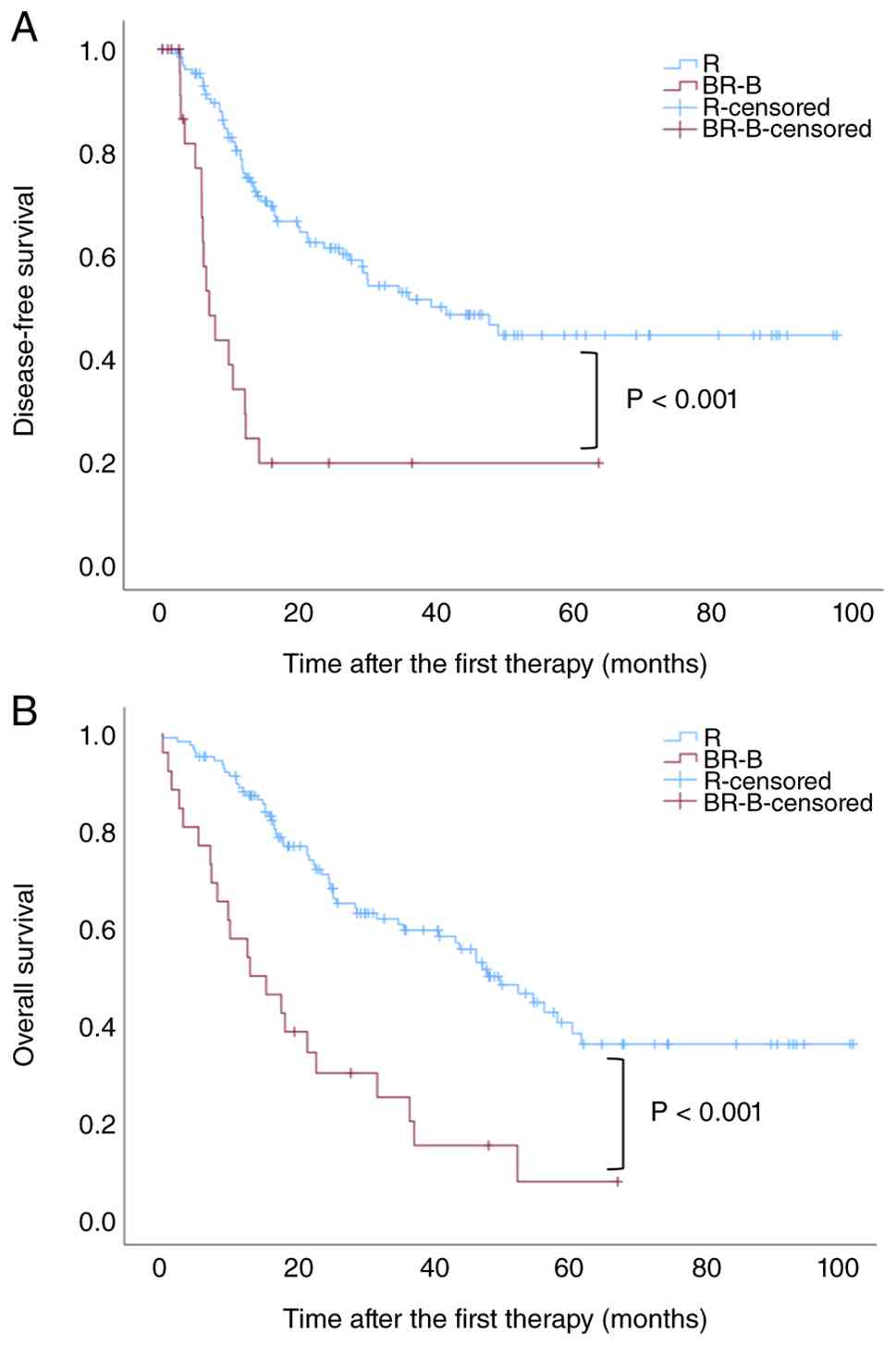
Kaplan-Meier analysis revealed that patients with BR-B experienced
significantly shorter DFS (P<0.001) and OS (P<0.001) than
those with R (Fig. 1A and B). This
confirms the poor prognosis associated with BR-B classification
based solely on CA19-9 levels.
Survival stratified according to CRP
status
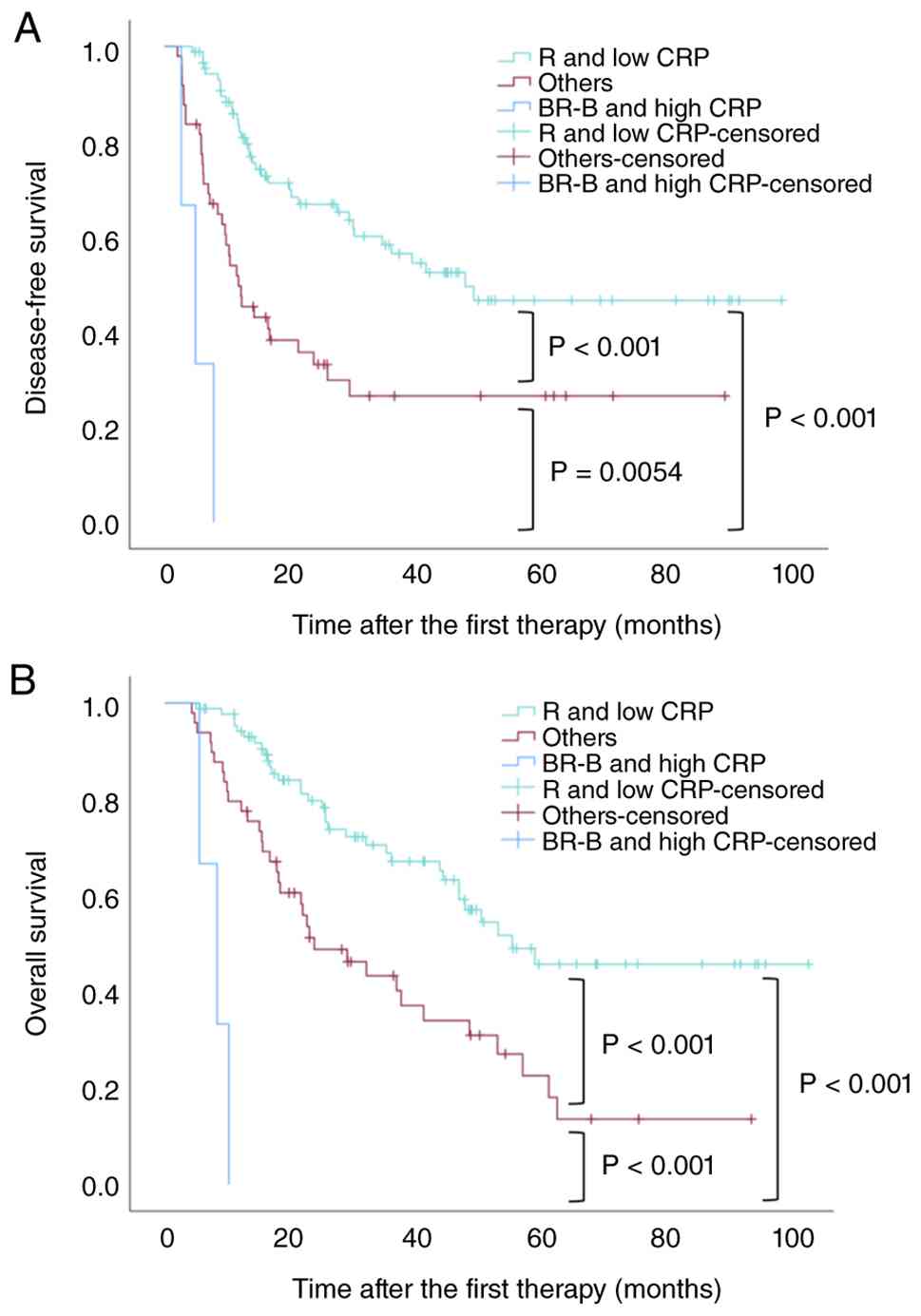
To evaluate the added prognostic utility of CRP,
patients were categorized into 3 groups: BR-B with high CRP level
(n=3); R with low CRP level (n=89); and all remaining patients
(others [n=49]). Clear survival differences were observed among
these groups (Fig. 2A and B). The
BR-B + high CRP group had a significantly poorer DFS than the
others group (P=0.0054) and a significantly poorer OS than the
others group (P<0.001), and both DFS and OS were also
significantly worse than those of the R + low CRP group (both
P<0.001). The R + low CRP group exhibited the best prognosis,
with a significantly better DFS and OS than the others group (both
P<0.001). This indicates that CRP adds substantial
stratification beyond CA19-9 alone.
Survival stratified according to NLR
status
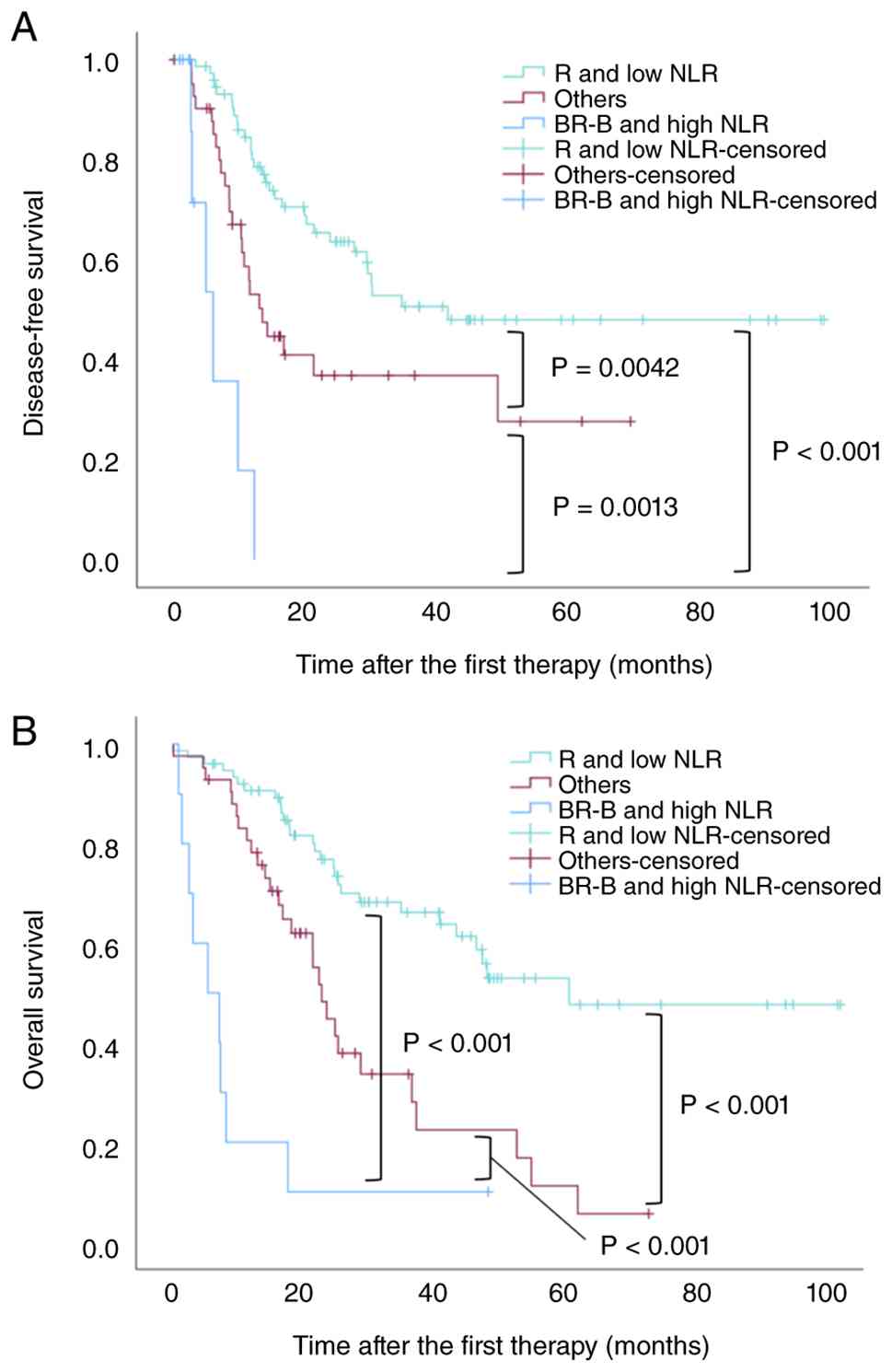
Similarly, patients were categorized into BR-B with
high NLR (n=10), R with low NLR (n=76), and other groups (n=42).
Survival analysis revealed the same pattern as that observed in CRP
analysis (Fig. 3A and B). The BR-B
+ high NLR group had a significantly poorer DFS than the others
group (P=0.0013) and a significantly poorer OS than the others
group (P<0.001), and both DFS and OS were also significantly
worse than those of the R + low NLR group (both P<0.001). The R
+ low NLR group exhibited the best prognosis, with a significantly
better DFS than the others group (P=0.0042) and a significantly
better OS than the others group (P<0.001). These results further
demonstrate that the NLR serves as an important biological marker
that refines preoperative risk stratification.
Combined biomarker score using CA19-9,
CRP, and NLR
To assess cumulative biomarker burden, patients were
stratified according to the number of elevated biomarkers among
CA19-9 ≥500 U/ml, CRP ≥0.3 mg/dl, and NLR ≥3.13. This
stratification resulted in 4 groups: 0 factors (n=55); 1 factor
(n=44); 2 factors (n=15); and 3 factors (n=2). Survival curves
demonstrated a clear trend toward progressively poorer DFS and OS
with increasing biomarker burden (Fig.
4A and B). Significant pairwise group differences included the
following: DFS, 0 vs. 1 factor (P=0.0037); 2 vs. 3 factors
(P=0.0076); OS, 0 vs. 1 factor (P<0.001); 2 vs. 3 factors
[P=0.0587 (borderline)]. Patients with no elevated biomarkers
experienced the most favorable outcomes, whereas those with 3
factors had the worst survival, reinforcing the additive prognostic
impact of CA19-9, CRP, and NLR.
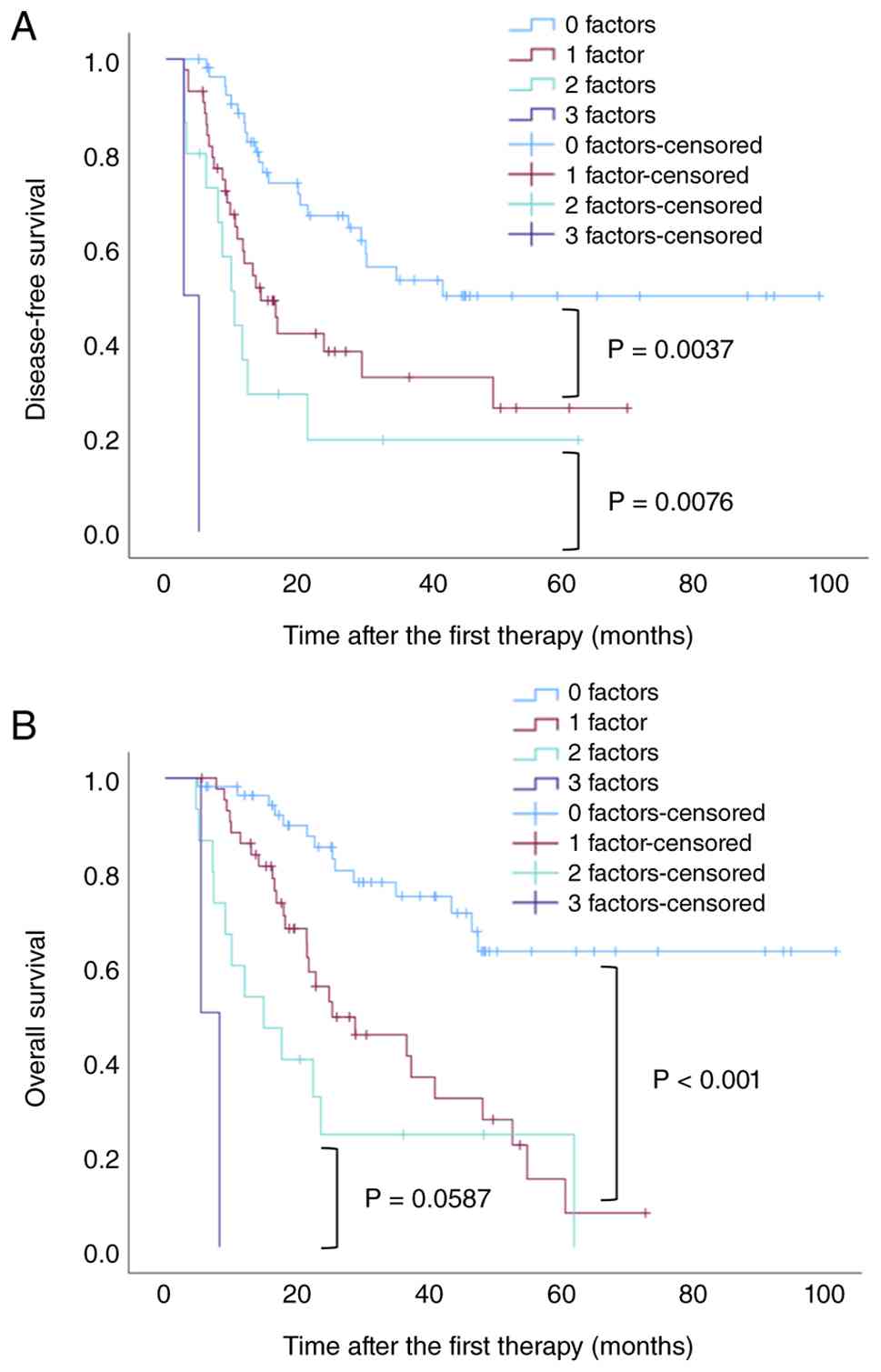 | Figure 4.Survival according to the number of
elevated biomarkers (CA19-9, CRP and NLR). Kaplan-Meier curves for
(A) DFS and (B) OS in patient groups stratified according to the
number of high-risk biomarkers (high CA19-9, high CRP and high
NLR): 0 factors (n=55), 1 factor (n=44), 2 factors (n=15) and 3
factors (n=2). The 0 factors group exhibited the most favorable
survival, whereas the 3 factors group exhibited the poorest
outcomes. Significant differences were observed between the 0
factors group and 1 factor group for both DFS (P=0.0037) and OS
(P<0.001), and between the 2 factors group and 3 factors group
for DFS (P=0.0076). Only patients with complete CA19-9, CRP and NLR
data were included in this analysis (n=116). CA19-9, carbohydrate
antigen 19-9; CRP, C-reactive protein; DFS, disease-free survival;
NLR, neutrophil-to-lymphocyte ratio; OS, overall survival. |
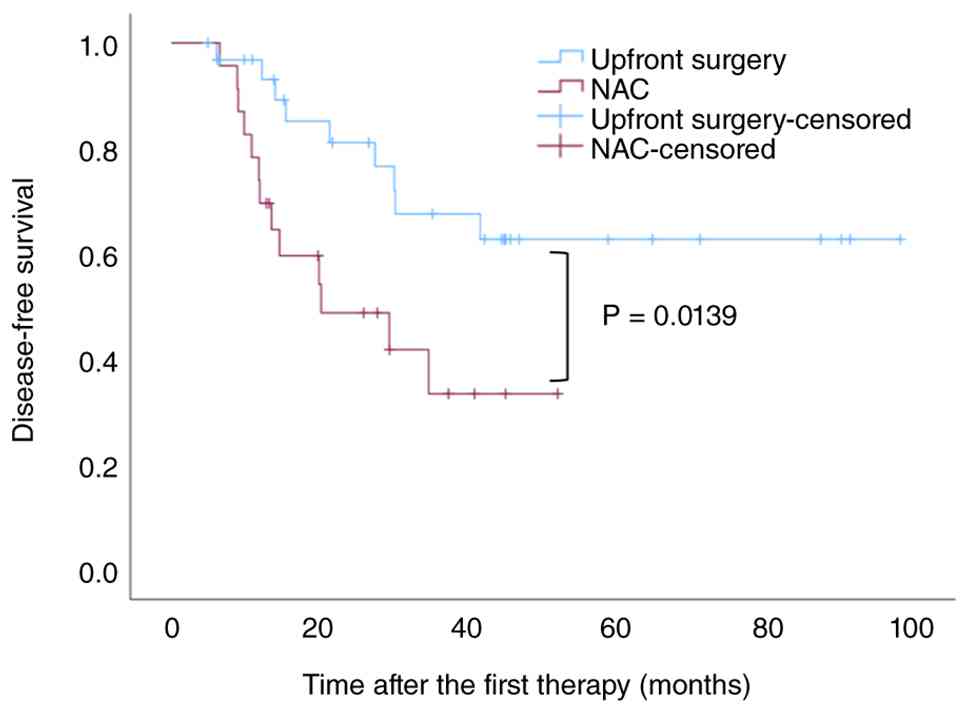
In the favorable prognosis subgroup, defined by the
absence of elevated biomarkers, patients who underwent NAC
exhibited significantly poorer DFS than those who underwent upfront
surgery (P=0.0139) (Fig. 5).
Discussion
Postoperative survival after resection of pancreatic
cancer has improved with the introduction of multiagent adjuvant
chemotherapy. Nevertheless, the outcomes for patients with BR-B
pancreatic cancer remain poor, and several reports have emphasized
the need for preoperative treatment strategies comparable with
those used for anatomically borderline resectable disease (2,7).
Therefore, a more refined biological definition of tumor
resectability is clinically important.
Historically, BR-B pancreatic cancer was defined
using criteria proposed in earlier studies, including CA19-9 level
≥200 U/ml (8–10), cancer-related symptoms lasting
>40 days (8), and radiological
or cytological suspicion of lymph node metastasis at diagnosis
(1). However, the 2017 ICC first
established CA19-9 levels >500 U/ml as the primary marker of
BR-B pancreatic cancer; this threshold has since been widely
adopted (1).
Although CA19-9 plays a central role in estimating
tumor aggressiveness (3), it
remains unclear whether additional biomarkers would further refine
the definition of BR-B pancreatic cancer. As such, we focused on 2
easily measurable inflammatory markers-CRP level and NLR-which
emerged as independent predictors of poor prognosis in our
multivariate analysis and have been implicated in pancreatic cancer
biology in the previous literature (4–6,11).
Because these markers can be obtained through routine preoperative
laboratory investigations, these markers are highly practical and
broadly applicable.
Elevated CRP is not merely a bystander but reflects
the complex interplay between the host and the tumor. Advanced
tumor progression induces systemic inflammation via the
upregulation of the interleukin (IL)-1-IL-6 cytokine network and
the release of tumor-derived degradation products, leading to
enhanced hepatic CRP production. High CRP levels characterize a
proinflammatory tumor microenvironment (TME), which facilitates
tumor proliferation, angiogenesis, and the metastatic cascade,
while also potentially indicating tumor necrosis and a high tumor
burden. Furthermore, CRP may be involved in complement activation
and opsonization of tumor cells, thereby linking the innate and
adaptive immune responses (12–15).
The prognostic significance of NLR in pancreatic
cancer lies in its effect on the balance between tumor-promoting
inflammation and anti-tumor immunity. Tumor-driven systemic
inflammatory responses play a crucial role in malignant
transformation by facilitating increased neutrophil infiltration
within the TME, which is a hallmark of cancer progression. These
neutrophils can suppress the cytotoxic activity of lymphocytes,
whose infiltration is essential for a favorable prognosis but is
frequently diminished in the advanced stages of disease. Therefore,
an elevated NLR characterizes an immune environment that shifts
toward tumor promotion and evasion (16–18).
Previous studies have examined pairwise combinations
of CA19-9 levels and CRP or NLR. Nurmi et al (19) evaluated a prognostic score
incorporating CA19-9 and CRP and demonstrated significantly worse
DFS and disease-specific survival in patients with elevated levels
of both markers, and significantly better outcomes when both were
low. Similarly, Sakamoto et al (20) stratified patients according to NLR
and CA19-9 and found that the group with elevated levels of both
markers had the worst prognosis, whereas the double-low group had
the best. Asaoka et al (21)
also reported that elevated CA19-9 levels and NLR were associated
with markedly reduced postoperative survival in pancreatic cancer.
The relationship between CRP and NLR has also been described, with
Schlick et al (22)
reporting that prognosis worsens as the number of elevated markers
increases (22,23). A unique feature of the present study
was the simultaneous integration of CA19-9, CRP, and NLR, thereby
capturing the complementary aspects of tumor burden, systemic
inflammation, and host immune status. This three-factor approach
enabled a more refined prognostic stratification than models based
on a single inflammatory marker and identified a subgroup with
particularly favorable outcomes in the absence of all elevated
biomarkers.
Building on this evidence, our study explored the
utility of combining and scoring 3 biological markers-CA19-9, CRP,
and NLR-in the preoperative assessment of pancreatic cancer to
refine the concept of BR-B disease. Using this three-factor model,
we successfully identified the group with poor prognosis. This
suggests that patients with multiple elevated biomarkers may
benefit from intensified preoperative management, including more
aggressive NAC or structured prehabilitation programs. Our findings
suggest a practical framework for the preoperative risk
stratification of anatomically resectable pancreatic cancers.
Patients without elevated biomarker (CA19-9 <500 U/ml, CRP
<0.3 mg/dl, and NLR <3.13) levels experienced favorable
outcomes and may be suitable candidates for upfront surgery. In
contrast, patients with multiple elevated biomarkers experienced
substantially poorer survival and may benefit from more intensive
preoperative strategies, including NAC and structured
prehabilitation. Therefore, this three-factor model may refine the
current definition of BR-B pancreatic cancer by incorporating
markers of systemic inflammation and immune status in addition to
tumor burden. However, this three-factor model should be regarded
as exploratory and hypothesis-generating rather than a validated
revised BR-B criterion or definitive treatment algorithm. External
validation in larger multicenter cohorts is required before
clinical implementation. Furthermore, because the model
incorporates CRP and NLR, it may identify biologically aggressive
diseases, even in Lewis antigen-negative patients who may not
express CA19-9 (24). PD was more
frequently performed in the CRP-high group, possibly reflecting
differences in tumor location and surgical invasiveness. However,
the surgical procedure was not identified as an independent
prognostic factor in the multivariate analysis, suggesting that the
prognostic significance of CRP and NLR was not solely attributable
to differences in the surgical procedures. Interestingly, in the
favorable prognosis subgroup (i.e., those with no elevated
biomarkers), patients who underwent NAC exhibited poorer DFS
outcomes than those who underwent upfront surgery (P=0.014).
Although limited by the sample size and retrospective design of
this study, this finding suggests that NAC may not be beneficial
and may even be detrimental in biologically favorable cases.
Therefore, biomarker-guided selection may help to avoid
overtreatment. However, this observation should be interpreted with
caution and a causal relationship should not be established.
The present study had several limitations, the first
of which was its retrospective, single-center design and relatively
small sample size, particularly the BR-B subgroup, which may have
introduced a selection bias. All patients who underwent NAC were
treated with GS and adjuvant chemotherapy consisting of S-1
administered for 6 months. However, treatment strategies have not
been fully standardized with regard to the indications and timing
of NAC, and whether adjuvant chemotherapy should be administered.
In addition, the subgroup with three elevated biomarkers was very
small (n=2); therefore, the corresponding findings should be
considered exploratory and hypothesis-generating rather than
definitive evidence and should be interpreted with caution. CRP and
NLR are nonspecific biomarkers that may be influenced by factors
unrelated to tumor biology, including the timing of measurement,
transient inflammatory conditions, and interlaboratory variability.
Although biomarker measurements were standardized to the
pretreatment period and obtained only after the resolution of
cholangitis or obstructive jaundice, residual confounding factors
cannot be excluded. Postoperative complications were not included
in the present analysis because this study focused on preoperative
prognostic factors. External validation in larger multicenter
cohorts is required to confirm the generalizability and clinical
utility of the proposed three-factor model.
In conclusion, CRP level and NLR were identified as
significant prognostic markers for pancreatic cancer. When combined
with CA19-9, these markers enabled a more detailed preoperative
stratification and may help identify patients requiring intensive
treatment. Conversely, patients with favorable biomarker profiles
may be candidates for upfront surgery without NAC. Thus,
incorporating CA19-9, CRP, and NLR into the biological evaluation
of pancreatic cancer may contribute to a more individualized and
biologically informed treatment approach.
Acknowledgements
Not applicable.
Funding
Funding: No funding was received.
Availability of data and materials
The data generated in the present study may be
requested from the corresponding author.
Authors' contributions
KK conceived and designed the study. KK collected
the data, performed the statistical analyses, interpreted the data
and drafted the manuscript. HT contributed to data interpretation,
critically revised the manuscript for important intellectual
content and supervised the study. TT, MT, SM and HI contributed to
data acquisition, data interpretation and critical revision of the
manuscript. HY contributed to study supervision, data
interpretation and critical revision of the manuscript. KK and HT
confirm the authenticity of all the raw data. All authors have read
and approved the final version of the manuscript.
Ethics approval and consent to
participate
The study was approved by the Ethics Committee of
Dokkyo Medical University Saitama Medical Center (approval no.
25044; Koshigaya, Japan). The present study was performed in
compliance with the regulations and carried out in accordance with
the relevant guidelines. Data collection and analysis followed the
ethical guidelines of the World Medical Association Declaration of
Helsinki. Written informed consent was obtained from all
participants.
Patient consent for publication
Not applicable.
Competing interests
The authors declare that they have no competing
interests.
Glossary
Abbreviations
Abbreviations:
|
AUC
|
area under the curve
|
|
BR-B
|
biologically borderline resectable
|
|
CA19-9
|
carbohydrate antigen 19-9
|
|
CRP
|
C-reactive protein
|
|
DFS
|
disease-free survival
|
|
GS
|
gemcitabine and S-1
|
|
ICC
|
International Consensus Criteria
|
|
NAC
|
neoadjuvant chemotherapy
|
|
NLR
|
neutrophil-to-lymphocyte ratio
|
|
OS
|
overall survival
|
|
R
|
resectable
|
|
ROC
|
receiver operating characteristic
|
References
|
1
|
Isaji S, Mizuno S, Windsor JA, Bassi C,
Fernández-Del Castillo C, Hackert T, Hayasaki A, Katz MHG, Kim SW,
Kishiwada M, et al: International consensus on definition and
criteria of borderline resectable pancreatic ductal adenocarcinoma
2017. Pancreatology. 18:2–11. 2018. View Article : Google Scholar : PubMed/NCBI
|
|
2
|
Lee B, Yoon YS, Kang M, Park Y, Lee E, Jo
Y, Lee JS, Lee HW, Cho JY and Han HS: Validation of the anatomical
and biological definitions of borderline resectable pancreatic
cancer according to the 2017 International consensus for survival
and recurrence in patients with pancreatic ductal adenocarcinoma
undergoing upfront surgery. Ann Surg Oncol. 30:3444–3454. 2023.
View Article : Google Scholar : PubMed/NCBI
|
|
3
|
Luo G, Jin K, Deng S, Cheng H, Fan Z, Gong
Y, Qian Y, Huang Q, Ni Q, Liu C and Yu X: Roles of CA19-9 in
pancreatic cancer: Biomarker, predictor and promoter. Biochim
Biophys Acta Rev Cancer. 1875:1884092021. View Article : Google Scholar : PubMed/NCBI
|
|
4
|
Cheng H, Luo G, Lu Y, Jin K, Guo M, Xu J,
Long J, Liu L, Yu X and Liu C: The combination of systemic
inflammation-based marker NLR and circulating regulatory T cells
predicts the prognosis of resectable pancreatic cancer patients.
Pancreatology. 16:1080–1084. 2016. View Article : Google Scholar : PubMed/NCBI
|
|
5
|
Szkandera J, Stotz M, Absenger G,
Stojakovic T, Samonigg H, Kornprat P, Schaberl-Moser R, Alzoughbi
W, Lackner C, Ress AL, et al: Validation of C-reactive protein
levels as a prognostic indicator for survival in a large cohort of
pancreatic cancer patients. Br J Cancer. 110:183–188. 2014.
View Article : Google Scholar : PubMed/NCBI
|
|
6
|
Yang JJ, Hu ZG, Shi WX, Deng T, He SQ and
Yuan SG: Prognostic significance of neutrophil to lymphocyte ratio
in pancreatic cancer: A meta-analysis. World J Gastroenterol.
21:2807–2815. 2015. View Article : Google Scholar : PubMed/NCBI
|
|
7
|
Takahashi H, Yamada D, Asukai K, Wada H,
Hasegawa S, Hara H, Shinno N, Ushigome H, Haraguchi N, Sugimura K,
et al: Clinical implications of the serum CA19-9 level in
‘biological borderline resectability’ and ‘biological downstaging’
in the setting of preoperative chemoradiation therapy for
pancreatic cancer. Pancreatology. 20:919–928. 2020. View Article : Google Scholar : PubMed/NCBI
|
|
8
|
Barugola G, Partelli S, Marcucci S,
Sartori N, Capelli P, Bassi C, Pederzoli P and Falconi M:
Resectable pancreatic cancer: Who really benefits from resection?
Ann Surg Oncol. 16:3316–3322. 2009. View Article : Google Scholar : PubMed/NCBI
|
|
9
|
Gemenetzis G, Groot VP, Blair AB, Ding D,
Thakker SS, Fishman EK, Cameron JL, Makary MA, Weiss MJ, Wolfgang
CL and He J: Incidence and risk factors for abdominal occult
metastatic disease in patients with pancreatic adenocarcinoma. J
Surg Oncol. 118:1277–1284. 2018. View Article : Google Scholar : PubMed/NCBI
|
|
10
|
Groot VP, Gemenetzis G, Blair AB,
Rivero-Soto RJ, Yu J, Javed AA, Burkhart RA, Rinkes IHMB, Molenaar
IQ, Cameron JL, et al: Defining and predicting early recurrence in
957 patients with resected pancreatic ductal adenocarcinoma. Ann
Surg. 269:1154–1162. 2019. View Article : Google Scholar : PubMed/NCBI
|
|
11
|
Mitsunaga S, Ikeda M, Shimizu S, Ohno I,
Takahashi H, Okuyama H, Ueno H, Morizane C, Kondo S, Sakamoto Y, et
al: C-reactive protein level is an indicator of the aggressiveness
of advanced pancreatic cancer. Pancreas. 45:110–116. 2016.
View Article : Google Scholar : PubMed/NCBI
|
|
12
|
Black S, Kushner I and Samols D:
C-reactive protein. J Biol Chem. 279:48487–48490. 2004. View Article : Google Scholar : PubMed/NCBI
|
|
13
|
Coussens LM and Werb Z: Inflammation and
cancer. Nature. 420:860–867. 2002. View Article : Google Scholar : PubMed/NCBI
|
|
14
|
McMillan DC, Canna K and McArdle CS:
Systemic inflammatory response predicts survival following curative
resection of colorectal cancer. Br J Surg. 90:215–219. 2003.
View Article : Google Scholar : PubMed/NCBI
|
|
15
|
Miki C, Konishi N, Ojima E, Hatada T,
Inoue Y and Kusunoki M: C-reactive protein as a prognostic variable
that reflects uncontrolled up-regulation of the IL-1-IL-6 network
system in colorectal carcinoma. Dig Dis Sci. 49:970–976. 2004.
View Article : Google Scholar : PubMed/NCBI
|
|
16
|
Hanahan D and Weinberg RA: Hallmarks of
cancer: The next generation. Cell. 144:646–674. 2011. View Article : Google Scholar : PubMed/NCBI
|
|
17
|
Kawata A, Une Y, Hosokawa M, Uchino J and
Kobayashi H: Tumor-infiltrating lymphocytes and prognosis of
hepatocellular carcinoma. Jpn J Clin Oncol. 22:256–263.
1992.PubMed/NCBI
|
|
18
|
Yamashita J, Ogawa M and Shirakusa T:
Free-form neutrophil elastase is an independent marker predicting
recurrence in primary breast cancer. J Leukoc Biol. 57:375–378.
1995. View Article : Google Scholar : PubMed/NCBI
|
|
19
|
Nurmi AM, Mustonen H, Haglund C and
Seppänen H: Changes in CRP and CA19-9 during preoperative
oncological therapy predict postoperative survival in pancreatic
ductal adenocarcinoma. Oncology. 99:686–698. 2021. View Article : Google Scholar : PubMed/NCBI
|
|
20
|
Sakamoto T, Saito H, Uchinaka E, Morimoto
M, Amisaki M, Tokuyasu N, Honjo S, Ashida K and Fujiwara Y: The
Combination of neutrophil-to-lymphocyte ratio and serum
carbohydrate antigen 19-9 level as a prognostic indicator in
patients with recurrent pancreatic cancer. Anticancer Res.
38:5497–5503. 2018. View Article : Google Scholar : PubMed/NCBI
|
|
21
|
Asaoka T, Miyamoto A, Maeda S, Tsujie M,
Hama N, Yamamoto K, Miyake M, Haraguchi N, Nishikawa K, Hirao M, et
al: Prognostic impact of preoperative NLR and CA19-9 in pancreatic
cancer. Pancreatology. 16:434–440. 2016. View Article : Google Scholar : PubMed/NCBI
|
|
22
|
Schlick K, Magnes T, Huemer F, Ratzinger
L, Weiss L, Pichler M, Melchardt T, Greil R and Egle A: C-reactive
protein and neutrophil/lymphocytes ratio: prognostic indicator for
doubling overall survival prediction in pancreatic cancer patients.
J Clin Med. 8:17912019. View Article : Google Scholar : PubMed/NCBI
|
|
23
|
Stevens L, Pathak S, Nunes QM,
Pandanaboyana S, Macutkiewicz C, Smart N and Smith AM: Prognostic
significance of pre-operative C-reactive protein and the
neutrophil-lymphocyte ratio in resectable pancreatic cancer: A
systematic review. HPB (Oxford). 17:285–291. 2015. View Article : Google Scholar : PubMed/NCBI
|
|
24
|
Luo G, Fan Z, Cheng H, Jin K, Guo M, Lu Y,
Yang C, Fan K, Huang Q, Long J, et al: New observations on the
utility of CA19-9 as a biomarker in Lewis negative patients with
pancreatic cancer. Pancreatology. 18:971–976. 2018. View Article : Google Scholar : PubMed/NCBI
|