Introduction
Nasopharyngeal carcinoma (NPC) is a distinct subtype
of head and neck cancer characterized by undifferentiated
histopathological features and a high incidence in Taiwan and
Southeast China. Its etiology is multifactorial, involving complex
interactions among genetic, environmental and lifestyle factors.
Notable contributing factors include Epstein-Barr virus (EBV)
infection, genetic susceptibility, oncogenic mechanisms, ethnicity,
specific dietary habits, environmental exposures and lifestyle
behaviors (1–3). Histopathologically, NPC is typically
an undifferentiated carcinoma with a prominent lymphoid stroma,
which accounts for its distinct biological and clinical
characteristics compared with those of other head and neck squamous
cell carcinomas. Because NPC is sensitive to both radiotherapy and
chemotherapy, concurrent chemoradiotherapy (CCRT) remains the
standard treatment for locally advanced disease. Recent advances in
diagnostic techniques and therapeutic strategies have substantially
improved prognosis and long-term survival rates for patients with
NPC (4,5).
A comprehensive approach is essential to address the
complex challenges faced by patients with head and neck cancers,
particularly the elevated incidence of second primary cancers
(SPCs). Aerodigestive malignancies share several common risk
factors, including tobacco use, alcohol consumption, dietary habits
and environmental exposures. These SPCs contribute substantially to
morbidity and mortality among these patients (6–8).
Compared with other head and neck malignancies, NPC typically
presents at a younger age, underscoring the importance of long-term
follow-up to monitor for recurrence and to maintain overall health
and quality of life.
Although SPCs following NPC are relatively uncommon,
they can have a substantial impact on patient survival.
Observational studies have demonstrated NPC survivors face an
elevated risk of SPCs among NPC survivors (9–14). A
population-based study from Taiwan reported this increased risk of
SPCs in NPC survivors, which was associated with unfavorable
overall survival (OS) (9).
Despite these findings, real-world clinical data on
SPCs in patients with NPC treated in the era of CCRT remain
limited. Such data are crucial for bridging the gap between
population-based evidence and detailed clinical observations.
Therefore, the present study aimed to determine the occurrence and
characteristics of SPCs in a non-metastatic NPC cohort treated with
CCRT. Comprehensive case descriptions may provide valuable insights
for tailoring long-term surveillance strategies.
Patients and methods
Study population
Patients diagnosed with pathologically confirmed NPC
were enrolled retrospectively at Chi Mei Medical Center (Liouying,
Taiwan) between January 2012 and December 2022. The patients' data
were accessed and extracted after obtaining institutional review
board (IRB) approval in November 2025. The follow-up period ended
on December 31, 2024. Patients were excluded if they had a history
of cancer prior to NPC diagnosis, distant metastasis at initial
presentation, unknown pathological type, missing clinical and
therapeutic data, and were aged <18 years. Clinical evaluations
to assess SPC findings included reviews of radiographic, positron
emission tomography, endoscopic, surgical and pathological records,
alongside follow-up imaging to assess SPC findings. The possibility
that an SPC was a metastasis of the primary NPC was strictly ruled
out. To distinguish SPCs from recurrences or metastases, the SPC
diagnosis was validated using pathological findings from resected
specimens or biopsy examinations to distinguish SPC from recurrence
or metastasis. The definition of SPC followed the Warren and Gates
criteria, as modified by Morris et al (6). Additional diagnostic workups were
conducted in response to clinical complaints or abnormal imaging
findings.
Treatments
The standard CCRT regimen included platinum-based
chemotherapy agents and radiation, with doses exceeding 6,600 cGy
delivered in daily fractions to the gross target volume and
high-risk regional neck region delivered in daily fractions. Highly
conformal external beam radiation techniques, such as
intensity-modulated radiation therapy (IMRT) and volumetric
modulated arc therapy (VMAT), were used. All patients with
non-metastatic NPC underwent definitive CCRT as described in a
previous study by our group (5), in
accordance with National Comprehensive Cancer Network guidelines
(15).
Measurements of covariates and outcome
definition
Data on sex, age, histology, American Joint
Committee on Cancer (AJCC) clinical stages, clinical tumor (cT)
stages, clinical node (cN) stages, year of diagnosis, pre-treatment
EBV DNA load (4) and the last
follow-up date were extracted. Clinical staging was determined
according to the AJCC 8th edition for NPC (15). The pre-treatment blood EBV DNA load
was evaluated using an EBV PCR Kit (cat. no. 8N54.85) with fully
automated DNA extraction and amplification on the m2000 system
(Abbott Pharmaceutical Co. Ltd.), according to the manufacturer's
recommendations. The primary outcome of this study was OS, defined
as the time from NPC diagnosis until death from any cause. All
patients were followed up until death; surviving patients were
censored on the last day of the database record (December 31,
2024).
Statistical analysis
Descriptive statistics were used to summarize
categorical variables as frequencies and percentages, and
continuous variables as means or medians with standard deviations
or medians as appropriate. Age was analyzed both as a continuous
variable, and also categorized as a categorical variable
(dichotomized at a cutoff of 65 years). Differences between the SPC
and non-SPC groups were compared using chi-square test for
categorical variables when all expected cell counts exceeded 5 or
when no more than 20% of cells had expected counts of 5 or less;
otherwise, Fisher's exact test was applied. Continuous variables
were compared using Student's t-test, as appropriate. Kaplan-Meier
survival curves were generated and differences between groups were
compared using the log-rank test. Firth's penalized Cox regression
was used to mitigate analytical biases caused by the small sample
sizes. To identify independent prognostic factors, multivariate
regression analyses were conducted, incorporating variables with
P<0.10 from the univariate analyses. Hazard ratios (HRs) and 95%
confidence intervals (CIs) were calculated. A two-tailed P<0.05
was considered to indicate statistical significance. All analyses
were performed using SPSS version 25 for Windows (IBM Corp.).
Results
Demographic characteristics of
patients with NPC and SPC development
Between January 2012 and December 2022, 223 patients
with confirmed NPC or referred for NPC were identified from the
hospital's cancer registry database. The final analysis focused on
161 eligible patients with histologically confirmed NPC with no
metastasis and clinical stage I to IVA. Table I summarizes the patients'
characteristics and clinical details. The study cohort was
predominantly male, comprising 117 men and 44 women. The median age
was 51 years, with ages ranging from 25–84 years, and 86% of the
patients were <65 years old. Based on the 8th edition of the
AJCC staging manual, most patients (81%) had stage III–IVA disease.
All patients received platinum-based chemotherapy as part of the
CCRT regimen. Radiation and chemotherapy doses were highly
consistent across the cohort. Between 2012 and 2022, the
pre-treatment EBVDNA load was not mandatory for routine stage
work-up. Only 124 patients (77%) had records of pre-treatment EBV
DNA load, and EBV levels in the blood was detectable in 93 patients
(75% of those with available records; 58% of the total cohort).
During a median follow-up period of 4.5 years, seven patients
developed an SPC, resulting in a crude incidence rate of 4.3%. The
most common SPC site for an SPC development was the lung (42%,
n=3), followed by the colon (n=1), thyroid (n=1), breast (n=1) and
liver (n=1). The SPC cohort comprised six male and one female
patients. The median age was 63 years (range, 45–68 years). Six
cases occurred outside the radiation field of the head and neck
region, and only one case (14%) occurred within the field, a
pathologically confirmed papillary thyroid carcinoma. The median
interval from NPC diagnosis to the first SPC was 2.7 years.
Table II details the
characteristics of the patients who developed an SPC.
 | Table I.Clinical characteristics of patients
with nasopharyngeal carcinoma with vs. without second primary
cancer. |
Table I.
Clinical characteristics of patients
with nasopharyngeal carcinoma with vs. without second primary
cancer.
| Characteristic | Patients (n=161) | Second primary cancer
(n=7) | Without second
primary cancer (n=154) | P-valuea |
|---|
| Age, years [median
(range)] | 51 (25–84) | 56 | 51 | 0.05 |
| Age, years |
|
|
| 0.05 |
|
<65 | 139 (86) | 4 (57) | 135 (88) |
|
| ≥65 | 22 (14) | 3 (43) | 19 (12) |
|
| Sex |
|
|
| 0.68 |
| Male | 117 (73) | 6 (86) | 111 (72) |
|
|
Female | 44 (27) | 1 (14) | 43 (28) |
|
| AJCC clinical
stageb |
|
|
| 0.29 |
| I | 11 (7) | 0 (0) | 11 (7) |
|
| II | 20 (12) | 0 (0) | 20 (13) |
|
| III | 58 (36) | 1 (14) | 57 (37) |
|
|
IVA | 72 (45) | 6 (86) | 66 (43) |
|
| Clinical T
stage |
|
|
| 0.26 |
|
T1-2 | 84 (52) | 2 (29) | 82 (53) |
|
|
T3-4 | 77 (48) | 5 (71) | 72 (47) |
|
| Clinical N
stage |
|
|
| >0.99 |
|
N0-1 | 57 (35) | 2 (29) | 55 (36) |
|
|
N2-3 | 104 (65) | 5 (71) | 99 (64) |
|
| Pre-treatment EBV
DNA load |
|
|
| >0.99 |
| Not
detected | 31 (25) | 1 (20) | 30 (23) |
|
| DNA
detected | 93 (75) | 4 (80) | 89 (77) |
|
| Table II.Summary of clinical findings,
treatment and outcomes in patients with NPC with second primary
cancer. |
Table II.
Summary of clinical findings,
treatment and outcomes in patients with NPC with second primary
cancer.
| No | Sex/age, years | AJCC
stagea of NPC | Latent period,
years | Second primary
cancer (pathology/stage) | Treatment of second
primary cancer | Outcome (cause of
death) |
|---|
| 1 | M/45 | IVA (T4N2M0) | 7.1 | Lung
(adenocarcinoma/pT2aN0M0) | Lobectomy,
CCRT | Alive |
| 2 | M/49 | IVA (T3N3M0) | 2.4 | Lung
(SCC/cT4N2M1a) | CCRT | Dead (lung
cancer) |
| 3 | M/57 | III (T3N0M0) | 2.6 | Lung
(adenocarcinoma/pT1bN0M0) | Lobectomy | Alive |
| 4 | M/68 | IIIA (T2N3M0) | 2.6 | Colon
(adenocarcinoma/pT1bN0M0) | Sigmoidectomy | Dead (NPC) |
| 5 | M/63 | IVA (T4N0M0) | 1 | Thyroid (papillary
carcinoma/pT3N1bM0) | Thyroidectomy, neck
dissection | Alive |
| 6 | F/67 | IVA (T4N2M0) | 2.6 | Breast
(T2N1M0) | Lumpectomy, CT and
RT | Alive |
| 7 | M/68 | IVA (T4N3M0) | 0.3 | HCC (T1bN0M0) | Radiofrequency
ablation, TACE | Dead
(COVID-19) |
The cohort was categorized into two groups: Patients
with the occurrence of an SPC and those without an SPC. Table I compares the demographic and
clinical characteristics between these groups. The continuous age
and the proportion of patients aged ≥65 years did not differ
significantly between the two groups (all P=0.05). No significant
differences were observed in sex (P=0.68), overall clinical stage
(P=0.29), cT stage (P=0.26), cN stage, treatment (P>0.99) or
pre-treatment EBV DNA viral load (all P>0.99).
Survival analyses between the SPC and
non-SPC Groups
The mean follow-up time from diagnosis was similar
between the two groups (SPC group: 4.6±3.1 years; non-SPC group:
5.5±3.3 years; P=0.48). The median OS for the entire cohort was 4.2
years. The median OS was 3.5 years for the SPC group and 4.0 years
for the non-SPC group. At the end of the follow-up period, 26
patients (16.1%) in the overall cohort had died. In the SPC group
there were three deaths: One attributable to the SPC (lung cancer),
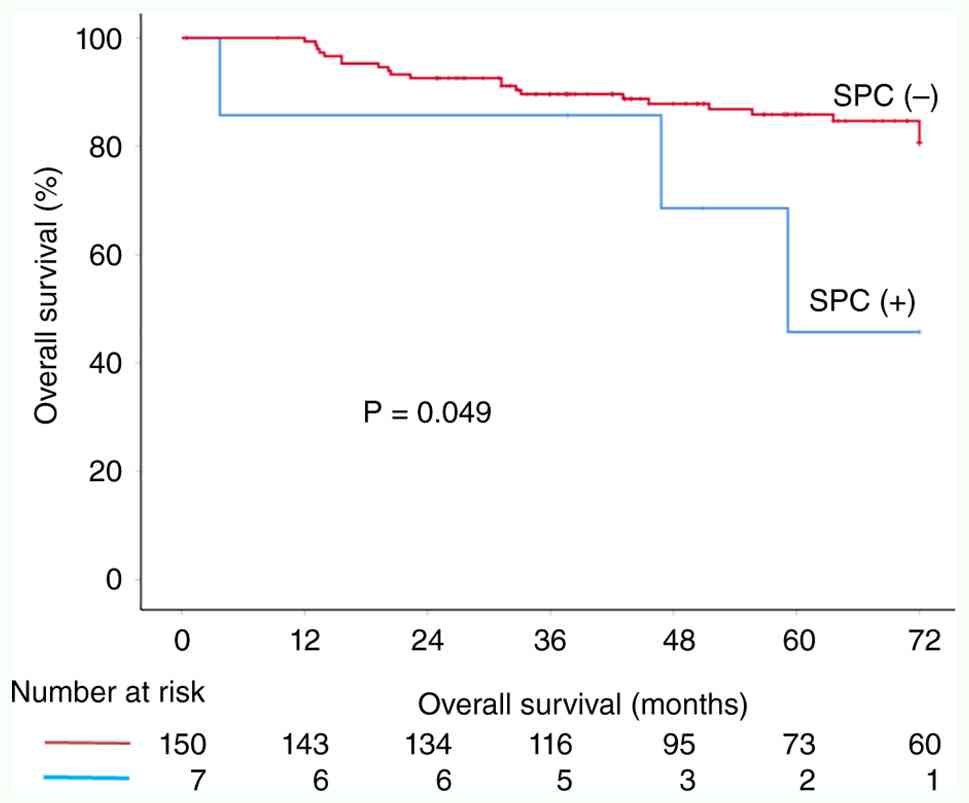
one to COVID-19 and one to relapsed NPC. Kaplan-Meier survival
analysis indicated that SPC development significantly decreased OS
(P=0.049; Fig. 1).
Univariate and multivariate regression analyses.
Univariate analyses revealed that absence of an SPC was associated
with better OS (HR=0.27, 95% CI: 0.09–0.86 P=0.03), whereas older
age (≥65 years) was associated with worse OS (HR=3.66, 95% CI:
1.60–8.40, P=0.002). Overall clinical stage, cT stage and cN stage
showed trends toward significance regarding OS. Sex and
pre-treatment EBV DNA load were not significantly associated with
OS. However, in the multivariate Firth's penalized Cox regression
model, only the older age (≥65 years) (HR=3.34, 95% CI: 1.43–7.80,
P=0.005) remained significantly associated with worse OS, while the
presence of an SPC was no longer an independent predictor. Table III presents the results of the
univariate and multivariate analyses.
| Table III.Univariate and multivariate Cox
regression analyses with Firth's correction were performed to
identify potential factors associated with overall survival in
patients with nasopharyngeal carcinoma. |
Table III.
Univariate and multivariate Cox
regression analyses with Firth's correction were performed to
identify potential factors associated with overall survival in
patients with nasopharyngeal carcinoma.
|
| Univariate |
Multivariatea |
|---|
|
|
|
|
|---|
| Variable | HR (95% CI) | P-value | HR (95% CI) | P-value |
|---|
| Second primary
cancer (no vs. yes) | 0.27
(0.09–0.86) | 0.03 | 0.43
(0.13–1.41) | 0.16 |
| Age at diagnosis
(<65 vs. ≥65 years) | 3.66
(1.60–8.40) | 0.002 | 3.34
(1.43–7.80) | 0.005 |
| Sex (female vs.
male) | 0.47
(0.17–1.32) | 0.15 | - | - |
| AJCC clinical
stageb (III–IV vs.
I–II) | 4.35
(0.81–23.30) | 0.07 | 1.83
(0.22–15.12) | 0.57 |
| Clinical T stage
(T3-4 vs. T1-2) | 2.17
(0.97–4.86) | 0.06 | 1.62
(0.70–3.78) | 0.26 |
| Clinical N stage
(N2-3 vs. N0-1) | 2.70
(0.96–7.58) | 0.06 | 1.82
(0.57–5.89) | 0.32 |
| Pre-treatment EBV
DNA load (detected vs. not detected) | 0.59
(0.20–1.80) | 0.33 | - | - |
Discussion
An SPC is defined as the development of a new
malignancy in a patient who has previously been diagnosed with
cancer. It is distinct from a recurrence or metastasis of the
primary tumor, as it arises independently and often exhibits a
different histological profile. SPCs may occur in the same or
different organs and are diagnosed based on established criteria
that distinguish them from the initial cancer. The core requirement
for defining an SPC is histological confirmation of malignancy. The
tumors must be anatomically distinct and separated by a clear
margin of normal tissue from the previous tumor, and the
possibility that the SPC is a metastasis of the primary tumor must
be ruled out (6,16). With advances in early detection,
supportive care and treatment, the number of cancer survivors has
increased substantially in recent decades. Consequently, greater
clinical vigilance has led to the earlier identification of SPCs
before they progress or metastasize. According to Travis, SPCs and
multiple primary cancers account for ~16% of all incident cancers
reported to the US National Cancer Institute Surveillance,
Epidemiology and End Results Program (16). The diagnosis of an SPC represents
one of the most serious events faced by cancer survivors. SPCs may
reflect late treatment-associated sequelae, as well as the
influence of lifestyle factors, environmental exposures, host
susceptibility and complex gene-environment or gene-gene
interactions.
A comprehensive approach is essential to address the
complex challenges faced by patients with head and neck cancers,
particularly the elevated incidence of SPCs within the
aerodigestive tract. These malignancies share several common risk
factors, including tobacco use, alcohol consumption, dietary habits
and environmental exposures. Morris et al (6) reported that patients with head and
neck cancer have a ~2.2-fold higher standardized incidence ratio
for developing SPCs, most frequently involving the head and neck
region, esophagus and lungs. These SPCs contribute substantially to
morbidity and mortality among these patients (6–8). NPC
typically presents at a younger age compared to other head and neck
cancers (mean age, 49.9 vs. 53.4 years) (7), underscoring the importance of
long-term follow-up to monitor for recurrence, manage late
radiation-related complications, and maintain overall health and
quality of life.
Observational studies have demonstrated an elevated
risk of SPCs among patients with NPC, with reported crude
incidences ranging from 2.0 to 5.6% across different follow-up
periods (9–14). A population-based study by Lin et
al (9), involving 10,299
patients with NPC in Taiwan, reported a 1.59-fold higher incidence
of SPCs in NPC survivors compared with age- and sex-matched
controls. The aforementioned study also found that the increased
risk of SPCs in NPC survivors was associated with worse OS. Among
patients with head and neck cancers, a nationwide cohort study in
Taiwan identified 9,996 SPCs in 93,891 patients, corresponding to a
crude incidence of 10.6% between 1986 and 2008. In a subgroup
analysis, the crude incidence among patients with NPC was lower
than that for other head and neck cancers, at 5.6% (1,545 SPCs
among 27,834 patients) (7). Svärd
et al (10) reviewed data
from 21 studies encompassing 89,168 patients with NPC and found a
mean SPC incidence of ~6.6%, ranging from 2.5 to 9.2% in endemic
regions such as Taiwan, Hong Kong, Singapore and China. This
systematic review also noted that the most frequent SPC sites
include the oral cavity, pharynx, nasal cavity and paranasal
sinuses, esophagus and lungs; furthermore, although the mean
incidence rate of SPCs after NPC is lower than that observed in
other head and neck cancers, the risk remains clinically
significant (10). The elevated
risk of SPCs among NPC survivors compared with the general
population may be attributed to persistent behavioral risk factors,
genetic predisposition, prolonged survival and the long-term
effects of CCRT (10). In the
present study, 7 SPCs were identified among 161 patients with NPC,
corresponding to a crude incidence of 4.3%, which is consistent
with previous reports (9–14). Therefore, long-term follow-up for
NPC survivors is essential, not only for monitoring recurrence and
managing late treatment effects but also for providing
comprehensive and earlier identification of SPCs before they
progress or metastasize.
The present retrospective study demonstrated that
the development of an SPC was associated with worse OS in the
unadjusted analysis, but this association was not independent after
adjustment, likely because of limited statistical power. According
to previous reports, the 5-year OS rates for patients with
non-metastatic NPC treated with CCRT typically range from ~70 to
85% (4–5). Given the high curability of NPC and
its relatively younger age of onset compared with that of other
head and neck cancers, long-term follow-up is crucial. Notably,
>60% of SPCs were detected within the first 3 years after the
initial NPC diagnosis (10).
Previous studies have reported poorer survival among patients with
oral cancer who developed SPCs within 2 years, primarily due to the
inability to administer curative radiotherapy or chemotherapy in
this setting, as critical organ tolerances had already been reached
(17–22). Therefore, the present study may
offer valuable clinical insights into the early detection of SPCs
within this time frame. However, SPCs may occur many years after
treatment, particularly radiation-related malignancies; thus, the
present study may underestimate the long-term cumulative incidence
of SPCs. The proportion of deaths attributable to SPCs continued to
increase over the long-term follow-up period, accounting for 4.3
and 9.0% of all deaths at the end of the 5- and 10-year follow-up
durations, respectively (22). This
upward trend in SPC-related mortality highlights the importance of
early recognition of this serious complication, particularly during
the later phases of survivorship and among patients with
early-stage NPC who generally achieve excellent primary tumor
control. During extended follow-up, SPCs may become a leading cause
of mortality among survivors of head and neck cancers (8,16).
Consistent with the present findings, two population-based studies
from Taiwan reported that patients with NPC with NPC who developed
SPCs had significantly lower survival rates (9,14).
Furthermore, multiple studies have confirmed SPCs as an independent
negative prognostic factor for survival in patients with NPC
(9,11,14,17,18).
Similarly, in other head and neck cancers, the diagnosis of an SPC
has been associated with a markedly worse prognosis compared with
that of patients who do not develop SPCs. Most population-based or
hospital-based studies in the literature, including the present
study, have used OS as the primary outcome (7,8,19–22).
However, cancer-specific survival or competing-risk analysis may be
optimal for evaluating the impact of SPCs. Because of the small
number of SPC events observed in the present study, it was not
possible to compare cancer-specific survival between the two
groups.
In the current study, three cases of lung cancer,
one case of thyroid cancer and one case of sigmoid colon cancer
were identified, with a median latency period of 2.7 years.
Consistent with the present findings, several previous studies have
also reported lung cancer as the most common SPC among patients
with NPC (11,21). Notably, 59% of respiratory SPCs
occurred within the first 2 years of follow-up, while 53% of oral
cavity SPCs developed during the 3-to-4-year and >5-year
follow-up intervals (9). Tobacco
smoking has been established as a risk factor for NPC, and previous
studies that included smoking history have identified it as an
independent risk factor for the development of SPC (10,11,21).
By contrast, alcohol consumption has not shown a statistically
significant association with survival in patients with metachronous
multiple primary cancers of NPC (22).
NPC is an EBV-related malignancy, and EBV DNA levels
before and after treatment affect the prognosis of patients with
NPC (4,23). The current study did not identify an
association between pre-treatment EBV DNA load and SPCs. However, a
previous review indicated that EBV status is significantly
associated with SPC development. The mean incidence of SPCs among
patients with NPC is ~6.6%, ranging from 4.9% in endemic regions to
8.7% in non-endemic regions (10).
This variation suggests that the epidemiology of both NPC and SPCs
may differ between areas of low and high endemicity. In the era of
IMRT and VMAT, patients with NPC are exposed to broader radiation
fields, resulting in greater irradiation of surrounding head and
neck tissues. Wang et al (12) reported that, compared with
conventional radiotherapy, treatment with IMRT is associated with a
higher risk of SPCs, possibly reflecting the increased total volume
of head and neck tissue exposed to radiation.
In the multivariate Cox regression analysis with
Firth's correction of the present study, older age (≥65 years) was
associated with unfavorable OS. However, there is consistency in
the literature indicating that younger patients with NPC have a
higher risk of developing SPCs. Studies have reported an increased
risk of SPCs when NPC is diagnosed at a younger age (e.g., <40
or <50 years) (10). This
finding is biologically plausible; although the baseline risk of
sporadic cancers naturally increases with aging, younger patients
have a longer survivorship period during which a radiation-induced
or second malignancy may develop.
The present retrospective, hospital-based study
included only 161 eligible cases; therefore, the development of an
SPC was not an independent predictor in the adjusted analysis due
to the limited statistical power caused by the small number of
SPCs. Furthermore, the present study had lacked data regarding the
role of smoking, alcohol consumption, betel nut use, family history
and comorbidities, which may all influence the development of SPCs.
Finally, as with all retrospective studies, it is impossible to
eliminate all potential sources of bias. Nevertheless, the present
real-world analysis of SPCs in patients with NPC treated during the
CCRT era helps bridge the gap between population-based studies and
clinical practice by providing detailed clinical insights. As
earlier diagnosis and advances in treatment continue to improve the
survival of patients with NPC, the incidence of SPCs may increase,
underscoring the importance of careful long-term follow-up in this
population.
Acknowledgements
Not applicable.
Funding
This study was supported by grants from the Ministry of Science
and Technology (MOST) (Taiwan) (grant no. MOST
111-2314-B-384-006-MY3) and Chi Mei Medical Center (Tainan, Taiwan)
(grant no. CMMOST11106).
Availability of data and materials
The data generated in the present study may be
requested from the corresponding author.
Author's contributions
SCY and SYH conceived the study. SCY and SYH
designed the study. LTS, SWL and CCC analyzed and interpreted data.
SCY and SYH analyzed and interpreted the data and wrote the
manuscript. SCY and CHH performed the statistical analysis. SCY
edited the manuscript. SCY and SYH confirm the authenticity of all
the raw data. All authors reviewed the manuscript. All authors and
have read and approved the final version of the manuscript.
Ethics approval and consent to
participate
This study was conducted according to the
Declaration of Helsinki and was approved by the Research Ethics
Committee of Chi Mei Hospital (IRB permit no. 11406-L1). The
Research Ethics Committee of Chi Mei Medical Center waived the
requirement for informed consent. All data were fully anonymized
before access. Written informed consent for participation was not
required for the present retrospective study.
Patient consent for publication
Not applicable.
Competing interests
The authors declare that they have no competing
interests.
Glossary
Abbreviations
Abbreviations:
|
CCRT
|
concurrent chemoradiotherapy
|
|
CI
|
confidence interval
|
|
EBV
|
Epstein-Barr virus
|
|
HR
|
hazard ratio
|
|
IMRT
|
intensity-modulated radiation
therapy
|
|
NPC
|
nasopharyngeal carcinoma
|
|
OS
|
overall survival
|
|
SPC
|
second primary cancer
|
References
|
1
|
Zhang Y, Rumgay H, Li M, Cao S and Chen W:
Nasopharyngeal Cancer Incidence and mortality in 185 countries in
2020 and the projected burden in 2040: Population- aling. JMIR
Public Health Surveill. 9:e499682023. View
Article : Google Scholar : PubMed/NCBI
|
|
2
|
Tsao SW, Yip YL, Tsang CM, Pang PS, Lau
VM, Zhang G and Lo KW: Etiological factors of nasopharyngeal
carcinoma. Oral Oncol. 50:330–338. 2014. View Article : Google Scholar : PubMed/NCBI
|
|
3
|
Ho SY, Wang YJ, Huang PC, Tsai ST, Chen
CH, Chen HH, Chang CJ and Guo HR: Evaluation of the associations
between the single nucleotide polymorphisms of the promoter region
of the tumor necrosis factor-alpha gene and nasopharyngeal
carcinoma. J Chin Med Assoc. 69:351–357. 2006. View Article : Google Scholar : PubMed/NCBI
|
|
4
|
Zhang Y, Chen L, Hu GQ, Zhang N, Zhu XD,
Yang KY, Jin F, Shi M, Chen YP, Hu WH, et al: Final overall
survival analysis of gemcitabine and cisplatin induction
chemotherapy in nasopharyngeal carcinoma: A multicenter, randomized
phase III trial. J Clin Oncol J Clin Oncol. 40:2420–2425. 2022.
View Article : Google Scholar : PubMed/NCBI
|
|
5
|
Wang YW, Ho SY, Lee SW, Chen CC, Litsu S,
Huang WT, Yang CC, Lin CH, Chen HY and Lin LC: Induction
chemotherapy improved long term outcomes in stage IV locoregional
advanced nasopharyngeal carcinoma. Int J Med Sci. 17:568–576. 2020.
View Article : Google Scholar : PubMed/NCBI
|
|
6
|
Morris LG, Sikora AG, Patel SG, Hayes RB
and Ganly I: Second primary cancers after an index head and neck
cancer: subsite-specific trends in the era of human
papillomavirus-associated oropharyngeal cancer. J Clin Oncol.
29:739–746. 2011. View Article : Google Scholar : PubMed/NCBI
|
|
7
|
Liao LJ, Chou HW, Wang CT, Chung CS and
Lai MS: The impact of second primary malignancies on head and neck
cancer survivors: A nationwide cohort study. PLoS One.
8:e621162013. View Article : Google Scholar : PubMed/NCBI
|
|
8
|
Boakye EA, Buchanan P, Hinyard L,
Osazuwa-Peters N, Schootman M and Piccirillo JF: Incidence and risk
of second primary malignant neoplasm after a first head and neck
squamous cell carcinoma. JAMA Otolaryngol Head Neck Surg.
144:727–737. 2018. View Article : Google Scholar : PubMed/NCBI
|
|
9
|
Lin C, Lin SW, Weng SF and Lin YS: Risk of
second primary malignancies after nasopharyngeal carcinoma: A
population-based cohort study in Taiwan. Head Neck. 36:209–214.
2014. View Article : Google Scholar : PubMed/NCBI
|
|
10
|
Svärd F, Alabi RO, Leivo I, Mäkitie AA and
Almangush A: The risk of second primary cancer after nasopharyngeal
cancer: A systematic review. Eur Arch Otorhinolaryngol.
280:4775–4781. 2023. View Article : Google Scholar : PubMed/NCBI
|
|
11
|
Chow JCH, Tam AHP, Cheung KM, Lee VHF,
Chiang CL, Tong M, Wong ECY, Cheung AKW, Chan SPC, Lai JWY, et al:
Second primary cancer after intensity-modulated radiotherapy for
nasopharyngeal carcinoma: A territory-wide study by HKNPCSG. Oral
Oncol. 111:1050122020. View Article : Google Scholar : PubMed/NCBI
|
|
12
|
Wang X, Wang S, Cao Y, Li C, Fang C, He W
and Guo Z: Clinicopathologic characteristics of second primary
squamous cell carcinoma in patients with nasopharyngeal carcinoma
after intensity-modulated radiotherapy. Sci Rep. 13:81812023.
View Article : Google Scholar : PubMed/NCBI
|
|
13
|
Kong L, Lu JJ, Hu C, Guo X, Wu Y and Zhang
Y: The risk of second primary tumors in patients with
nasopharyngeal carcinoma after definitive radiotherapy. Cancer.
107:1287–1293. 2006. View Article : Google Scholar : PubMed/NCBI
|
|
14
|
Chen MC, Feng IJ, Lu CH, Chen CC, Lin JT,
Huang SH and Lee KD: The incidence and risk of second primary
cancers in patients with nasopharyngeal carcinoma: A
population-based study in Taiwan over a 25-year period (1979–2003).
Ann Oncol. 19:1180–1186. 2008. View Article : Google Scholar : PubMed/NCBI
|
|
15
|
National Comprehensive Cancer Network
(NCCN), . Head and neck cancer. Version 1. NCCN; Plymouth Meeting,
PA: 2025
|
|
16
|
Travis LB: The epidemiology of second
primary cancers. Cancer Epidemiol Biomarkers Prev. 15:2020–2026.
2006. View Article : Google Scholar : PubMed/NCBI
|
|
17
|
Wang X, Li Y, Gao Y, Ouyang D and Guo Z:
Second primary squamous cell carcinoma in patients with
nasopharyngeal carcinoma after radiotherapy-Predictors and
prognostic factors. Head Neck. 40:1434–1442. 2018. View Article : Google Scholar : PubMed/NCBI
|
|
18
|
Shen T, Cai W, Li T, Yu D, Ren C and Yu J:
Impact of primary site on survival in patients with nasopharyngeal
carcinoma from 2004 to 2015. Front Surg. 9:10018492022. View Article : Google Scholar : PubMed/NCBI
|
|
19
|
Rennemo E, Zätterström U and Boysen M:
Impact of second primary tumors on survival in head and neck
cancer: An analysis of 2,063 cases. Laryngoscope. 118:1350–1356.
2008. View Article : Google Scholar : PubMed/NCBI
|
|
20
|
Bertolini F, Trudu L, Banchelli F,
Schipilliti F, Napolitano M, Alberici MP, Depenni R, D'Angelo E,
Mattioli F, Rubino L and Presutti L: Second primary tumors in head
and neck cancer patients: The importance of a ‘tailored’
surveillance. Oral Dis. 27:1412–1420. 2021. View Article : Google Scholar : PubMed/NCBI
|
|
21
|
Zhao W, Lei H, Zhu X, Li L, Qu S, Liang X
and Wang X: The clinical characteristics of secondary primary
tumors in patients with nasopharyngeal carcinoma after
intensity-modulated radiotherapy: A retrospective analysis.
Medicine (Baltimore). 95:e53642016. View Article : Google Scholar : PubMed/NCBI
|
|
22
|
Sung JJ, Ahn AR, Park HS, Jang KY, Moon
WS, Lee JH, Kim KM and Chung MJ: Incidence and pattern of second
primary cancer in patients diagnosed with primary cancer. Oncol
Lett. 28:5352024. View Article : Google Scholar : PubMed/NCBI
|
|
23
|
Zhao FP, Liu X, Chen XM, Lu J, Yu BL, Tian
WD, Wang L, Xu X, Huang HR, Zhang MW, et al: Levels of plasma
Epstein-Barr virus DNA prior and subsequent to treatment predicts
the prognosis of nasopharyngeal carcinoma. Oncol Lett.
10:2888–2894. 2015. View Article : Google Scholar : PubMed/NCBI
|