Introduction
Cancer remains a major public health challenge
worldwide and is the second leading cause of death in the United
States, ranking as the leading cause among individuals aged <85
years old (1). Endometrial cancer
(EC) is currently the sixth most commonly diagnosed cancer in
women, with its incidence to rise by ~1% annually since the
mid-2000s (1–4). Due to the tumor metastasis and
recurrence, there is a marked discrepancy in survival rates between
women diagnosed with early and late-stage disease.
EC is one of the most common gynecological
malignancies and the pathogenesis is complex. Polycystic ovary
syndrome, diabetes, obesity, nulliparity, metabolic syndrome, and
advanced age are established risk factors of EC (5–7). It
typically presents at an early stage with postmenopausal abnormal
uterine bleeding noted in ~90% patients (4,8). At
present, the treatment of EC is mainly based on surgery, including
hysterectomy and bilateral salpingo-oophorectomy (9,10).
However surgical treatment is not an ideal option for numerous
patients as it may be hazardous and lead to infertility young
women. In the younger population, the incidence of EC is unabatedly
increasing, with one study demonstrating that <10% of young
women have ovarian conservation with type I (11). With the increasing incidence and
mortality of EC, it is important to elucidate the pathogenesis of
EC at the molecular level and propose novel therapeutic targets,
especially since patients with advanced/recurrent EC are unlikely
to be cured by surgery, conventional chemotherapy, radiotherapy or
a combination of these treatments (12,13).
Molecular targeted therapy has long been considered a valuable
treatment modality in oncology due to its small size, selective
binding to various extracellular and intracellular targets,
superiority to cytotoxic chemotherapy and minimal side effects
(14).
Several previous reviews have summarized important
advances in EC molecular classification, FIGO staging, targeted
therapy, immunotherapy, and treatment strategies for advanced or
recurrent disease (15–19). However, most existing reviews have
primarily focused on either molecular classification and prognosis,
recent FIGO staging updates, general therapeutic advances, or
systemic treatment for advanced/recurrent EC. Compared with these
reviews, the present review provides a more integrated molecular
subtype-based framework. Specifically, it links each major
molecular subtype with signaling pathway status, therapeutic
vulnerabilities, clinical efficacy of pathway targeting,
limitations of failed or modest-efficacy clinical studies,
immunotherapy responsiveness, guideline and regulatory
implications, and emerging preclinical or early-stage therapeutic
concepts. Therefore, the present review aims to provide a
subtype-centered translational perspective that connects molecular
classification with current and future treatment decision-making in
EC.
The present review aimed to provide a comprehensive
and up-to-date overview of the current landscape of EC treatment
from a molecular classification-driven perspective. First, The
Cancer Genome Atlas (TCGA) and traditional-based classification
systems were summarized, emphasizing their clinical relevance and
limitations. In addition, conventional treatment approaches,
including surgery, radiotherapy, chemotherapy and hormonal therapy,
were outlined, and their differential efficacy across molecular
subtypes were discussed.
Furthermore, the present review focused on key
oncogenic signaling pathways implicated in EC, such as the
phosphoinositide 3-kinase/protein kinase B/mammalian target of
rapamycin (PI3K/AKT/mTOR), RAS-RAF-MEK-ERK, transforming growth
factor-β (TGF-β), and nuclear factor-κB (NF-κB) pathways,
highlighting their molecular alterations, therapeutic targets and
associated clinical evidence (17).
Special attention was also given to the role of immunotherapy, in
particular immune checkpoint inhibitors (ICIs), and their
application in molecularly defined subgroups. Finally, current
challenges and future directions in EC management, including
treatment-related toxicities, resistance mechanisms, and emerging
personalized therapeutic strategies, were explored. By integrating
molecular classification with targeted and immune-based therapies,
the present review aimed to provide insights that may facilitate
the development of more precise and effective treatment paradigms
for EC.
Classification systems of EC
Traditional pathogenetic and
histopathological classification
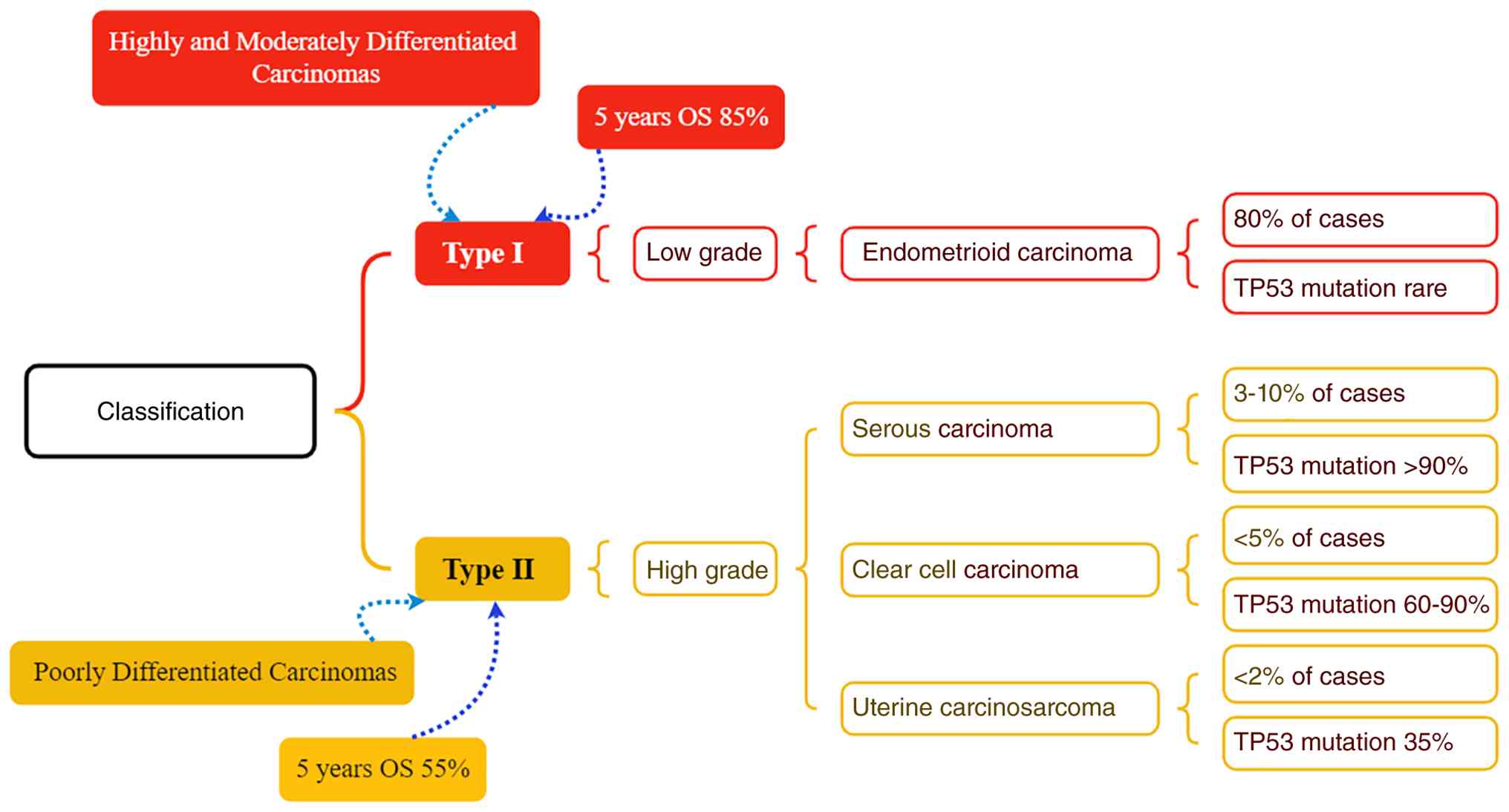
EC has previously been classified according to the
dualistic model proposed by Bokhman in 1983, which distinguishes
between type I (estrogen-dependent) and type II
(non-estrogen-dependent) tumors (20–23).
This framework has long guided clinical decision-making. However,
it does not fully capture the molecular heterogeneity of EC.
Histopathologically, EC includes several subtypes,
among which endometrioid carcinoma (24), serous carcinoma (25–27),
and clear cell carcinoma are the most common, while rarer entities
include uterine carcinosarcoma and mixed histologies. Endometrioid
carcinoma accounts for ~80% of EC cases and is typically associated
with estrogen exposure, obesity and favorable prognosis. These
tumors are often low- to intermediate-grade and may arise from
atypical endometrial hyperplasia (28,29).
By contrast, serous carcinoma represents a highly aggressive
subtype, accounting for 3–10% of cases, and is frequently
characterized by TP53 mutations and poor clinical outcomes
(22). It typically arises in an
atrophic endometrium and is independent of estrogen stimulation.
Clear cell carcinoma is a rare but aggressive subtype with unclear
molecular origins, sharing features with both endometrioid and
serous carcinomas (22,24). Uterine carcinosarcoma, a biphasic
tumor containing both epithelial and mesenchymal components, is
highly aggressive and associated with poor prognosis (30,31).
Although histopathological classification provides important
diagnostic and prognostic information, its ability to guide
targeted therapy remains limited, highlighting the need for
molecular classification systems. The traditional pathogenetic and
histopathological classification of EC is summarized in Fig. 1.
TCGA-based molecular classification
and clinical implications
TCGA project has redefined EC classification based
on genomic and molecular features, enabling a more precise
stratification of patients and providing a framework for
personalized therapy (28,32). EC is classified into four molecular
subtypes: (i) POLE ultra-mutated; (ii) microsatellite
instability-high (MSI-H/dMMR); (iii) NSMP; and (iv) CN-high. In
Table I, the key features of each
EC subtype were summarized, demonstrating the variation in mutated
genes and tumor immunity in EC.
 | Table I.Molecular characteristics and
clinical relevance of TCGA-based subtypes in EC (8,17,34). |
Table I.
Molecular characteristics and
clinical relevance of TCGA-based subtypes in EC (8,17,34).
| Feature | POLE
ultra-mutated | MSI-H/dMMR | NSMP (CN-low) | CN-high
(p53-abn) |
|---|
| Key mutations | POLE | MMR genes | PTEN, PIK3CA | TP53 |
| PTEN mutation | ~94% | ~88% | ~77% | ~2% |
| TP53 mutation | ~35% | ~5% | ~1% | ~92% |
| PIK3CA
mutation | ~71% | ~54% | ~53% | ~47% |
| KRAS mutation | ~53% | ~35% | Low | Rare |
| ARID1A
mutation | ~76% | ~37% | 42% | Rare |
| CTNNB1
mutation | Rare | Rare | 52% | Rare |
| Tumor mutational
burden | Very high | High | Low | Low |
| Tumor infiltrating
lymphocytes | High | High | Low-moderate | Low |
| PD-L1
expression | High | High | Variable | Low |
| Clinical
behavior | Excellent
prognosis | Intermediate
prognosis | Intermediate
prognosis | Poor prognosis |
| Therapeutic
implications | Strong response to
immunotherapy | Responsive to
immunotherapy | May benefit from
targeted therapy | Limited response;
aggressive management |
The POLE ultra-mutated subtype is characterized by
notably high tumor mutational burden (TMB) due to mutations in the
exonuclease domain of the POLE gene. These tumors exhibit abundant
tumor-infiltrating lymphocytes (TILs) and are associated with
favorable prognosis, suggesting strong immunogenicity and potential
responsiveness to immunotherapy (33–36).
The MSI-H/dMMR subtype results from defects in DNA mismatch repair
and is associated with elevated immune infiltration and high
PD-1/PD-L1 expression (37). These
features provide a clear rationale for immune checkpoint blockade
in this subgroup. The CN-low subtype, also referred to as
microsatellite stable, typically shows lower mutation rates but
frequent alterations in genes such as PTEN and PIK3CA (21). These tumors are often associated
with endometrioid histology and may be amenable to targeted
therapies involving the PI3K/AKT/mTOR pathway. The CN-high subtype
is characterized by extensive copy-number alterations and a high
prevalence of TP53 mutations (21).
This group is associated with serous histology, aggressive clinical
behavior and poor prognosis (38,39),
often requiring intensive multimodal treatment strategies. Overall,
the TCGA classification provides critical insights into tumor
biology and establishes a foundation for molecularly guided
therapeutic strategies in EC.
Molecular classification and
therapeutic implications
The integration of molecular classification into
clinical practice has notably improved the understanding of
therapeutic vulnerabilities in EC. Each molecular subtype exhibits
distinct genomic alterations, tumor microenvironment (TME)
characteristics and treatment sensitivities, providing a rationale
for precision medicine approaches.
POLE ultra-mutated tumors, characterized by notably
high TMB, demonstrate strong immunogenicity and favorable
prognosis. Although these patients often have optimal outcomes with
conventional therapy, emerging evidence suggests that immunotherapy
may further enhance disease control in selected cases. MSI-H/dMMR
tumors exhibit high levels of immune infiltration and increased
expression of immune checkpoint molecules such as PD-1 and PD-L1.
These features make them particularly responsive to ICIs, which
have become a standard treatment option for advanced or recurrent
disease in this subgroup. CN-low tumors frequently harbor mutations
in PTEN, PIK3CA and other components of the PI3K/AKT/mTOR pathway.
These molecular alterations provide opportunities for targeted
therapy, particularly with PI3K, AKT or mTOR inhibitors, either as
monotherapy or in combination with hormonal or immune-based
approaches. CN-high tumors are characterized by TP53 mutations,
genomic instability and aggressive clinical behavior. These tumors
are less immunogenic and often exhibit resistance to conventional
therapies, necessitating combined treatment strategies, including
chemotherapy, targeted agents and emerging immunotherapeutic
approaches. Taken together, these findings highlight that molecular
classification not only refines prognostic stratification but also
serves as a critical framework for guiding individualized
therapeutic strategies in EC.
Conventional treatment approaches
Surgery as a primary treatment
modality
EC is one of the most common gynecological
malignancies in women (2). Current
management strategies for EC include surgery as the cornerstone of
treatment, often combined with adjuvant radiotherapy, chemotherapy,
hormonal therapy or targeted therapy depending on disease stage and
risk stratification (40). For the
majority of patients, surgical intervention remains the primary and
most effective therapeutic approach.
A total of ~90% of endometrial tumors are amenable
to surgical resection, which typically consists of total
hysterectomy with bilateral salpingo-oophorectomy, with or without
pelvic and para-aortic lymph node assessment (4,41). A
recent clinical review emphasized that surgery remains the
cornerstone of EC management and outline its role relative to
evolving systemic therapies (42).
In recent years, minimally invasive techniques have increasingly
replaced open abdominal procedures. Laparoscopic hysterectomy has
demonstrated comparable overall survival outcomes to abdominal
hysterectomy while offering notable advantages, including reduced
intraoperative blood loss, shorter hospitalization times and lower
postoperative morbidity. Consequently, minimally invasive surgery
is currently considered the preferred approach for patients with
early-stage EC (4,43,44).
The inclusion of oophorectomy in standard surgical
management is primarily based on the risk of synchronous ovarian
malignancy, occult ovarian metastasis and the role of the ovaries
as a major source of estrogen, which may promote tumor growth in
hormone-dependent EC (11,45,46).
However, bilateral oophorectomy induces premature menopause, which
is associated with vasomotor symptoms, reduced quality of life and
an increased risk of long-term metabolic complications (11,45,47).
Emerging evidence suggests that in carefully selected premenopausal
patients with clearly defined early-stage, low-risk disease,
ovarian preservation may be a feasible option without compromising
oncologic outcomes, while potentially improving long-term quality
of life (4,11).
Despite the effectiveness of surgery in early-stage
EC, its therapeutic benefit is limited in patients with advanced,
recurrent or metastatic disease. In these settings, radical
surgical resection is often not feasible, and survival outcomes
remain poor. Therefore, adjuvant radiotherapy and/or systemic
chemotherapy are commonly required to reduce the risk of disease
recurrence and to improve disease control in high-risk patients
(48,49). These limitations of surgery
underscore the need for integrated multimodal treatment strategies,
including systemic therapies, which are discussed in the following
sections.
Adjuvant treatment
Radiotherapy
Radiotherapy plays an established role in improving
local disease control, particularly tailored based on
histopathological risk factors (49,50).
Given the limited efficacy of cytotoxic chemotherapy and hormonal
therapy in preventing locoregional recurrence in certain patient
populations, radiotherapy is frequently incorporated as an adjuvant
treatment modality for patients with adverse prognostic factors,
including deep myometrial invasion, lymphovascular space invasion
and advanced stage disease (9).
Recent clinical trials (49,50)
continue to explore optimal radiotherapy strategies and their
integration with systemic therapy. An ongoing clinical trial (trial
no. NCT05691010) is evaluating the efficacy of short-course
radiotherapy combined with chemotherapy in patients with stage III
EC, with particular attention to therapeutic outcomes across
different molecular subtypes, including CN-low and CN-high tumors.
This trial reflects the growing interest in tailoring adjuvant
treatment strategies based on molecular classification.
Evidence from large, randomized studies suggests
that the benefit of combined chemoradiotherapy may be primarily
attributable to improved local control rather than an extension of
relapse-free survival (RFS). In a study conducted by Matei et
al (51), RFS was analyzed in
736 patients with stage III or IVA EC, of whom 707 were randomized
to receive either combined chemoradiotherapy or chemotherapy alone.
At a median follow-up of 60 months, the proportion of patients who
were alive and relapse-free was similar between the two groups (59
vs. 58%). Although the combination regimen did not demonstrate
superiority in prolonging RFS, it was associated with a lower
incidence of locoregional recurrence. Notably, higher rates of
grade 4 or greater acute adverse events were observed in the
chemotherapy-alone group compared with the combined treatment
group, highlighting the need to balance efficacy and toxicity when
selecting adjuvant therapies.
Consistent with the ESGO/ESTRO/ESP 2025 guideline
update, adjuvant treatment selection in EC should increasingly be
guided by an integrated assessment of anatomical stage,
histological features, lymphovascular space invasion and molecular
classification. In particular, POLE-mutated, MMRd, NSMP and
p53-abnormal status refine prognostic risk grouping and may
influence the intensity of adjuvant and systemic treatment
(52).
Chemotherapy
Systemic chemotherapy remains a key component of
adjuvant and palliative treatment for EC, particularly in patients
with high-risk early-stage disease, advanced-stage tumors or
recurrent disease (53,54). The American Society of Clinical
Oncology Endorsement Panel recommends chemotherapy as an important
therapeutic option for women with high-risk early-stage or advanced
EC, reflecting its role in reducing the risk of distant metastasis
and improving disease control (55). Platinum-based regimens combined with
taxanes, most commonly carboplatin plus paclitaxel, are currently
considered the standard first-line chemotherapy for EC (12,56,57).
While these regimens provide clinical benefit in a substantial
proportion of patients, their long-term effectiveness is limited by
cumulative toxicity and the development of chemotherapy resistance,
particularly in recurrent or metastatic settings. These limitations
underscore the unmet need for more effective systemic
therapies.
In recent years, the integration of immunotherapy
into chemotherapy-based regimens has emerged as a promising
strategy for advanced and recurrent EC. In February 2024,
pembrolizumab (Keytruda) received priority review from the U.S.
Food and Drug Administration (FDA) for use in combination with
carboplatin and paclitaxel as first-line treatment for patients
with primary advanced or recurrent endometrial carcinoma. This
milestone reflects a paradigm shift toward combined systemic
approaches and further supports the transition from conventional
cytotoxic therapy to molecularly informed treatment strategies,
which are discussed in detail in subsequent sections.
Molecular subtype-based signaling pathways
and targeted therapeutic strategies in EC
Molecular classification provides a
critical framework for understanding the biological heterogeneity
of EC and for guiding therapeutic decision-making
Distinct molecular subtypes are defined by specific
genomic alterations and signaling dependencies, which influence
their responses to targeted therapies and immunotherapy. Rather
than acting as isolated mechanisms, key oncogenic pathways,
including PI3K/AKT/mTOR, RAS/RAF/MEK/ERK, TGF-β and NF-κB are
differentially activated across EC subtypes and contribute to tumor
initiation, progression and therapeutic resistance (42). Therefore, the clinical relevance of
these pathways should be interpreted in the context of molecular
subtype.
In this section, the major signaling pathways and
pathway-targeted therapeutic strategies are discussed according to
the four major molecular subtypes of EC: POLE-mutated, MSI-H/dMMR,
NSMP/CN-low and CN-high/p53-abnormal tumors. For each subtype,
pathway activation status, therapeutic vulnerabilities, current
efficacy of pathway targeting, and major limitations of available
evidence, were summarized. Established therapeutic strategies,
investigational approaches and emerging concepts were distinguished
between, where appropriate.
In addition, failed or limited-efficacy clinical
studies are discussed where relevant, particularly for single-agent
pathway inhibitors whose clinical benefits have been constrained by
toxicity, compensatory signaling, lack of subtype-specific patient
selection, or insufficient biomarker validation.
POLE-mutated EC
Signaling pathway status in POLE-mutated EC
POLE-mutated EC is characterized by an ultramutated
genotype, high TMB and strong immunogenicity. Although this subtype
generally has a favorable prognosis, signaling pathway alterations
may still contribute to tumor growth, immune modulation and
therapeutic resistance in selected cases. Among the pathways
discussed in this review, RAS/RAF/MEK/ERK signaling is particularly
relevant in POLE-mutated tumors, as KRAS mutations are frequently
observed in POLE-mutated and MSI-H/dMMR EC (Table I). These alterations suggest that
MAPK signaling may act as a context-dependent oncogenic driver in
this subtype.
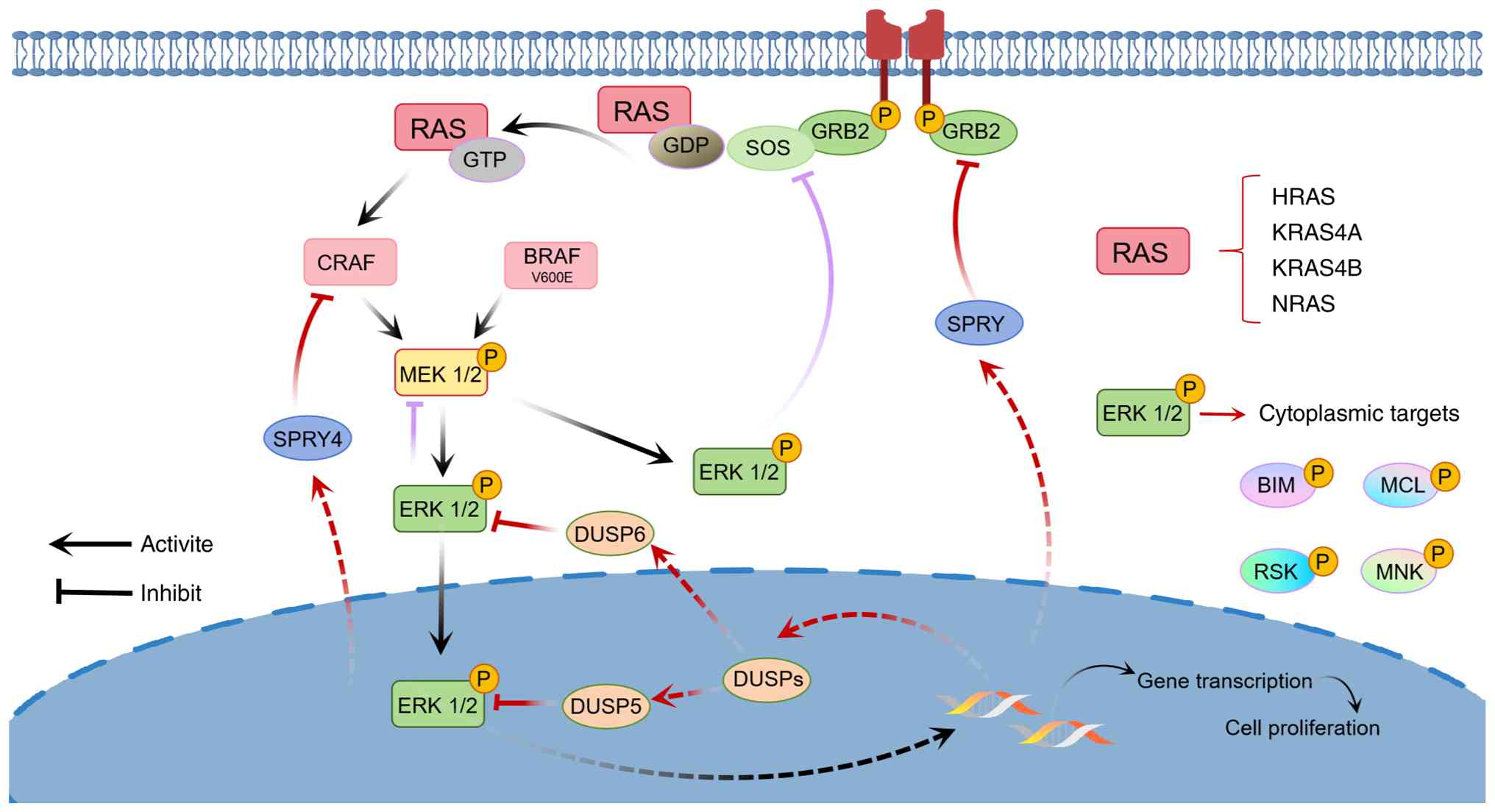
The RAS-RAF-MEK-ERK signaling pathway is a classical
MAPK cascade that regulates cell proliferation, survival and
differentiation (Fig. 2) (58). Upon activation, RAS recruits RAF
kinases, leading to sequential activation of MEK1/2 and ERK1/2,
thereby promoting tumor growth and survival (59,60).
In EC, aberrant MAPK activation is primarily driven by KRAS
mutations, whereas BRAF mutations are rare (61). In addition, crosstalk between MAPK
and PI3K/AKT/mTOR pathways may contribute to tumor progression,
metabolic reprogramming and therapeutic resistance (62).
POLE-mutated tumors are also characterized by immune
activation and inflammatory signaling. In this context,
NF-κB-related inflammatory pathways may participate in cytokine
production, immune-cell recruitment and tumor-immune
microenvironment (TIME) interactions. However, the clinical
significance of directly targeting NF-κB or other inflammatory
pathways in POLE-mutated EC remains insufficiently defined.
Therapeutic implications and efficacy
of pathway targeting
Although MAPK pathway activation provides a
biological rationale for pathway-directed therapy in selected
POLE-mutated tumors, the clinical efficacy of targeting this
pathway in POLE-mutated EC has not been firmly established. MEK
inhibitors may be relevant in KRAS-mutant tumors, and Preclinical
studies have shown that MEK inhibition can exert cytotoxic effects
and enhances sensitivity to chemotherapy, such as paclitaxel
(63). However, durable clinical
benefit in molecularly selected EC populations remains
uncertain.
Combination strategies targeting both MAPK and PI3K
pathways have demonstrated synergistic effects. For example,
trametinib (MEK inhibitor) combined with the AKT inhibitor
GSK2141795 has shown enhanced activity in EC models (64), while cobimetinib, alone or in
combination with PI3K inhibitors, has shown activity in KRAS-mutant
or PTEN-intact tumors (61). These
findings support the rationale for combined pathway inhibition, but
clinical validation in POLE-mutated EC remains limited.
Although actionable BRAF V600E mutations are rare in
EC, BRAF inhibitors such as dabrafenib have shown clinical benefit
in selected patients (65–67). In addition, the pan-RAF inhibitors
including lifirafenib (BGB-283), have demonstrated activity in
early-phase clinical studies involving BRAF- or RAS-mutant solid
tumors, supporting further investigation in molecularly selected
patients with EC patients (68,69).
Nevertheless, because POLE-mutated EC usually has favorable
clinical outcomes and strong immunogenicity, pathway-targeted
therapies are currently more relevant as investigational or salvage
approaches rather than standard treatment strategies. Future
studies should clarify whether MAPK-targeted therapy may benefit
selected POLE-mutated tumors with actionable RAS/RAF alterations or
acquired treatment resistance.
MSI-H/dMMR EC
Signaling pathway status in MSI-H/dMMR EC
MSI-H/dMMR EC is characterized by mismatch repair
deficiency, microsatellite instability, increased mutational burden
and immune activation. In addition to its immunogenic features,
this subtype frequently harbors alterations in oncogenic signaling
pathways, particularly PI3K/AKT/mTOR and RAS/RAF/MEK/ERK pathways.
These pathway alterations provide potential therapeutic
vulnerabilities but also contribute to pathway redundancy and
treatment resistance.
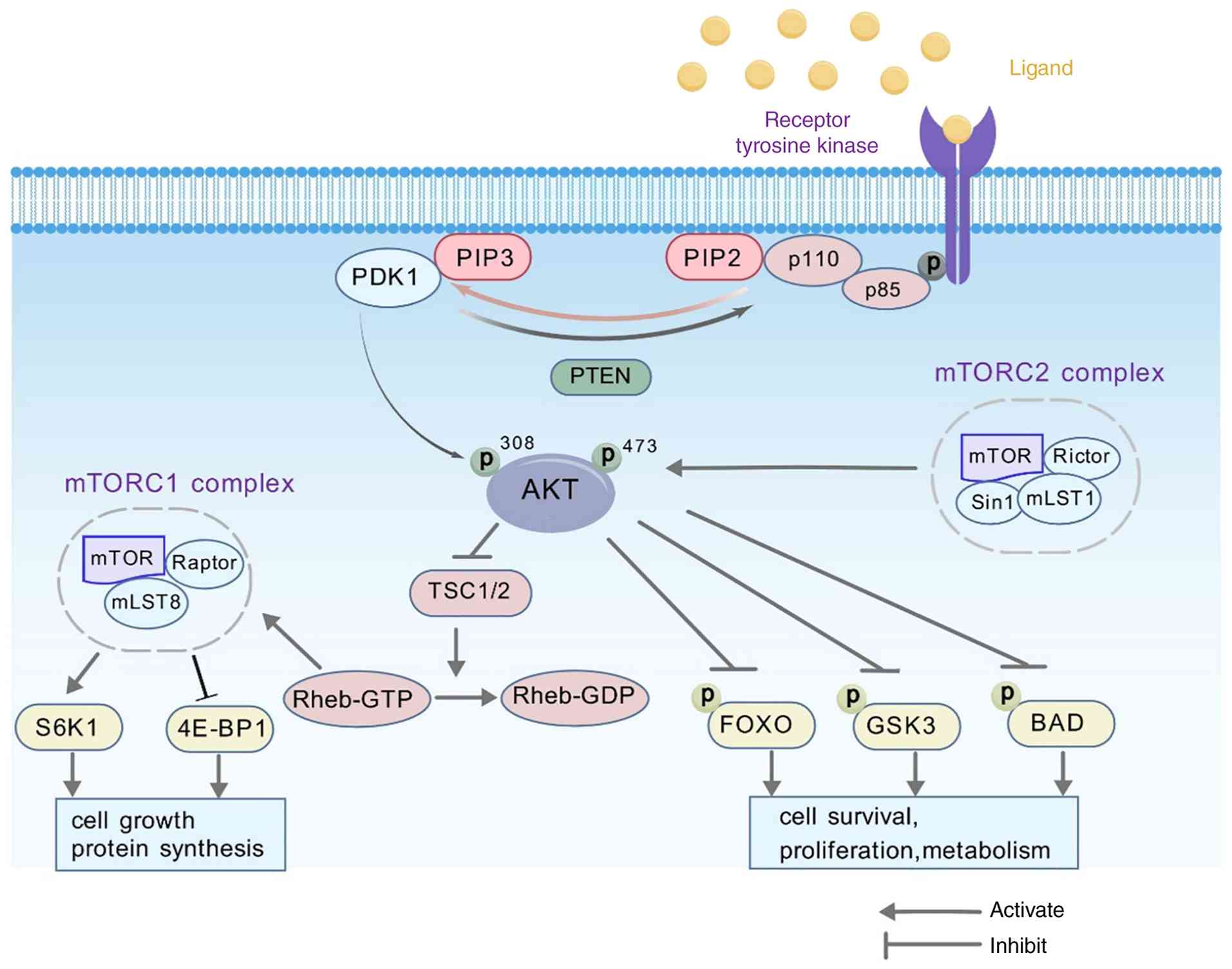
The PI3K/AKT/mTOR pathway is a central regulator of
cell growth, metabolism and survival and represents one of the most
frequently dysregulated pathways in EC (24,70–72)
Its activation is observed across multiple histological and
molecular subtypes (Fig. 3), but it
is particularly enriched in NSMP and MSI-H/dMMR tumors, where
alterations in PTEN, PIK3CA and PIK3R1 are commonly observed. Class
I PI3Ks are heterodimeric lipid kinases composed of a catalytic
subunit (p110) and a regulatory subunit (p85) and are activated
downstream of receptor tyrosine kinases or G protein-coupled
receptors (73). AKT,
phosphorylates multiple substrates involved in cell survival,
proliferation and metabolic regulation (74), while mTOR functions through two
distinct complexes, mTORC1 and mTORC2 (75). Dysregulation of this pathway is
frequently driven by loss of PTEN function or activating mutations
in PIK3CA and PIK3R1, resulting to sustained pathway activation and
tumor progression (28,76–78).
MAPK pathway activation is also relevant in
MSI-H/dMMR tumors. KRAS mutations occur frequently in POLE-mutated
and MSI-H/dMMR subtypes (Table I),
supporting the role of MAPK signaling as a subtype-associated
oncogenic pathway (61). Moreover,
crosstalk between MAPK and PI3K/AKT/mTOR signaling may promote
adaptive resistance following single-pathway inhibition (62).
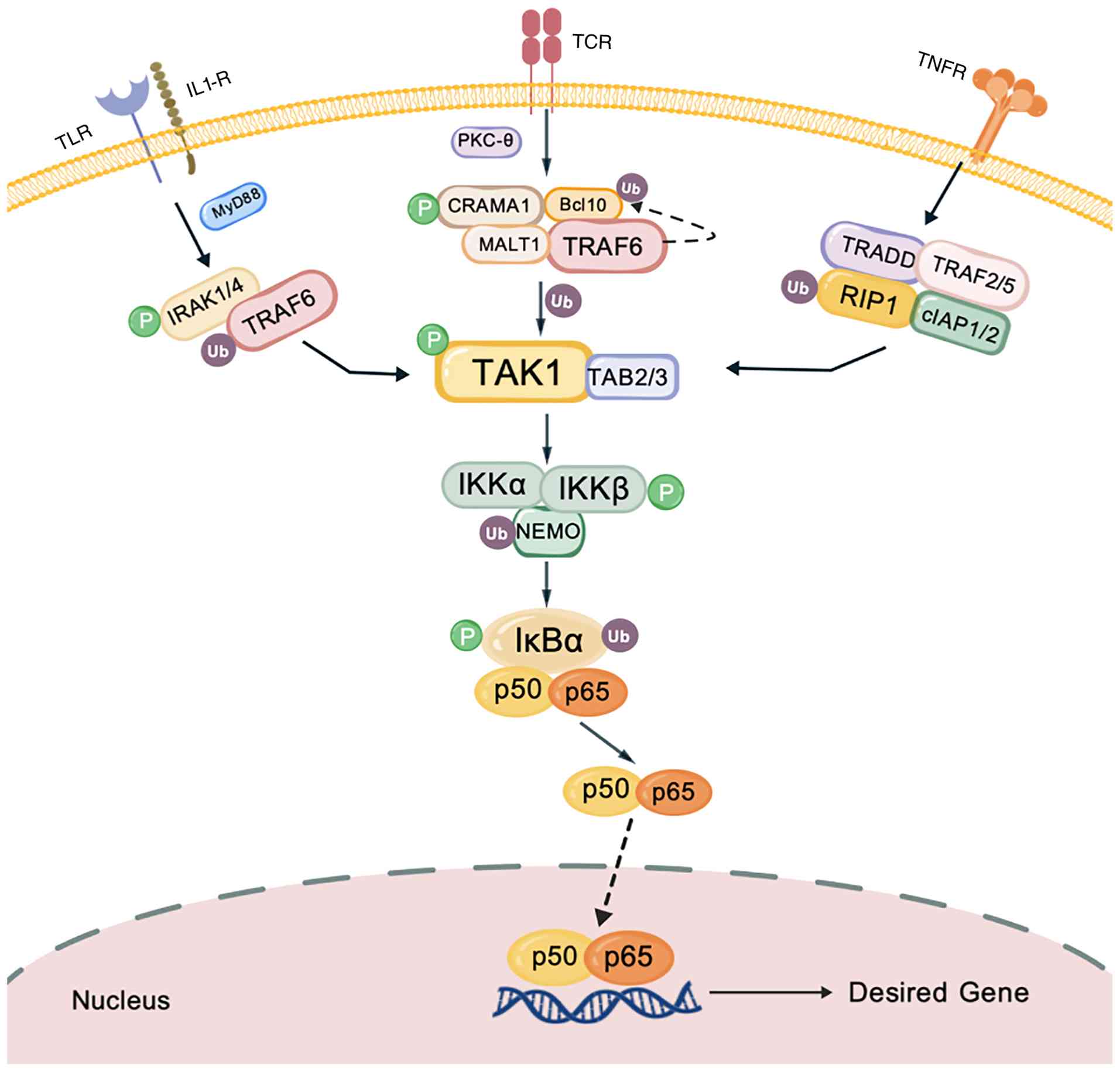
NF-κB signaling is another pathway with
subtype-associated relevance in MSI-H/dMMR EC. NF-κB is a key
transcription factor regulating cell proliferation, apoptosis,
migration and inflammatory responses (79). It is activated through canonical and
noncanonical pathways that converge on the IκB kinase complex,
leading to nuclear translocation and transcription of
pro-inflammatory cytokines, chemokines and survival-related genes
(Fig. 4) (80–84).
In MSI-H/dMMR and immune-enriched tumors, NF-κB activation is
associated with increased immune infiltration, cytokine production
and inflammatory amplification.
Therapeutic implications and efficacy
of pathway targeting
Given the frequent activation of PI3K/AKT/mTOR
signaling in MSI-H/dMMR EC, this pathway has been explored as a
therapeutic target. Multiple classes of inhibitors have been
developed, including PI3K, AKT, mTOR and dual PI3K/mTOR inhibitors
(85). However, despite strong
biological rationale, clinical responses to PI3K/AKT/mTOR pathway
inhibition remain variable and are often limited by pathway
redundancy, compensatory activation and tumor heterogeneity.
Isoform-selective PI3K inhibitors, such as alpelisib
(BYL719), have shown clinical activity in PIK3CA-mutant
endometrioid EC, supporting a subtype-directed therapeutic approach
(86–88). However, pan-PI3K inhibitors have
demonstrated limited clinical utility due to toxicity. AKT
inhibitors, including ipatasertib and afuresertib, have shown
promising activity in preclinical and early-phase clinical studies,
and are being evaluated in combination strategies (89,90).
mTOR inhibitors, such as temsirolimus and everolimus, have
demonstrated modest activity as monotherapies, partly due to
feedback activation of AKT signaling (91). Consequently, next-generation
inhibitors targeting both mTORC1 and mTORC2, as well as dual
PI3K/mTOR inhibitors (such as dactolisib and samotolisib), are
under investigation (92,93).
In MSI-H/dMMR tumors, the integration of pathway
inhibition with immune-based therapy may be particularly relevant
because of the immunogenic TME. Increasingly, combination
strategies integrating PI3K/AKT/mTOR or MAPK pathway inhibition
with immune checkpoint blockade are being explored to improve
therapeutic outcomes (Table II).
Nevertheless, the efficacy of pathway-targeted therapy in
MSI-H/dMMR EC remains incompletely established, and predictive
biomarkers beyond MSI/MMR status are needed.
| Table II.Target inhibitors of the
PI3K-AKT-mTOR pathway in clinical trials for EC. |
Table II.
Target inhibitors of the
PI3K-AKT-mTOR pathway in clinical trials for EC.
| A, PI3K inhibitors
(primarily active in NSMP and MSI-H/dMMR EC with PI3K pathway
alterations; modest clinical efficacy, with limited durability of
response) |
|---|
|
|---|
| First author/s,
year | Therapy | Target | Subtype
relevance | Clinical
setting | Evidence
stage/Phase | Key outcomes | (Refs.) |
|---|
| Duggan and
Al-Salama, 2023 | Copanlisib (BAY
80-6946) | PI3Kα/δ | NSMP; MSI-H/dMMR
(PI3K-altered EC) |
Persistent/recurrent EC | II | Modest efficacy
(ORR, PFS); manageable toxicity | (87) |
| Matulonis et
al, 2015 | Pilaralisib
(XL-147) | Pan-PI3K | NSMP (PI3K
pathway-driven EC) | Advanced/recurrent
EC | II | Limited efficacy;
modest response rates | (155) |
| Heudel et
al, 2017 | Buparlisib
(BKM120) | Pan-PI3K | NSMP | Advanced/recurrent
EC | II | Modest efficacy;
PFS benefit limited | (156) |
|
| B, AKT
inhibitors (most relevant in PI3K/AKT pathway-altered EC,
particularly NSMP; preliminary clinical activity, with efficacy
requiring further validation) |
|
| First author/s,
year | Therapy | Target | Subtype
relevance | Clinical
setting | Evidence
stage/Phase | Key
outcomes | (Refs.) |
|
| Myers et al,
2020 | MK2206 | AKT | PI3K/AKT-altered
EC; NSMP | Advanced/recurrent
EC | II | Modest activity;
limited clinical benefit | (157) |
| Rodon et al,
2022 | Pifusertib
(TAS-117) | AKT | PTEN-deficient EC;
NSMP | Advanced/metastatic
Solid tumors with Germline PTEN Inactivating Mutations | II | Early-phase data;
efficacy not well established | (158) |
| Smyth et al,
2020 | Capivasertib
(AZD5363) | AKT | PI3K/AKT
pathway-altered EC | Advanced Solid
Malignancy (EC) | I | Preliminary
activity observed; further validation needed | (159) |
| Aghajanian et
al, 2018 | Uprosertib
(GSK2141795) | AKT | Advanced/recurrent
EC (PI3K/AKT axis) |
Recurrent/metastatic EC | I | Safety and PK
characterized; efficacy data limited | (160) |
|
| C, mTOR
inhibitors (primarily active in NSMP and hormone-driven EC; modest
clinical efficacy, with greater benefit observed in combination
strategies) |
|
| First author/s,
year | Therapy | Target | Subtype
relevance | Clinical
setting | Evidence
stage/Phase | Key
outcomes | (Refs.) |
|
| Colombo et
al, 2013 | Ridaforolimus
(AP23573) | mTORC1 | NSMP; PI3K
pathway-activated EC |
Persistent/recurrent EC | II | Disease
stabilization observed (PFS benefit) | (161) |
| Oza et al,
2011 | Temsirolimus
(CCI-779) | mTORC1 | NSMP | Advanced/metastatic
EC | II | Modest activity;
limited ORR | (162) |
|
| Everolimus
(RAD001) | mTORC1 | Hormone-driven EC;
NSMP | Recurrent EC | II | Improved outcomes
in combination therapy |
|
| Voss et al,
2020 | Sapanisertib
(TAK-228) | mTORC1/2 | PI3K/mTOR-altered
EC | Advanced EC | I | Early signals of
activity; limited clinical data | (163) |
|
| D, Dual PI3K and
mTOR inhibitors |
|
| First author/s,
year | Therapy | Target | Subtype
relevance | Clinical
setting | Evidence
stage/Phase | Key
outcomes | (Refs.) |
|
| Rubinstein et
al, 2020 | Samotolisib
(LY3023414) | Pan-PI3K
mTORC1/2 | NSMP; PI3K-driven
EC |
Persistent/recurrent EC | II | Limited efficacy;
combination strategies needed | (164) |
| Makker et
al, 2016 | Apitolisib
(GDC-0980) | Pan-PI3K
mTORC1/2 | NSMP |
Persistent/recurrent EC | II | Modest activity;
toxicity concerns | (165) |
| Del Campo et
al, 2016 | Gedatolisib
(PF-05212384) PF-04691502 | Pan-PI3K
mTORC1/2 | PI3K/mTOR-altered
EC | Recurrent EC | II | Promising early
activity; needs validation | (166) |
|
| E,
Combination |
|
| First author/s,
year | Therapy | Target | Subtype
relevance | Clinical
setting | Evidence
stage/Phase | Key
outcomes | (Refs.) |
|
| Gaillard et
al, 2024 | Alpelisib (BYL719)
and Fulvestrant (ICI 182780) | PI3Kα and Estrogen
receptor | ER+ endometrioid
EC; NSMP | ER-positive
endometrioid EC | II | Improved endocrine
sensitivity; combination benefit | (167) |
| Heudel et
al, 2022 | Vistusertib
(AZD2014) and Anastrozole ATG 008 and ATG 010 | mTORC1/2 and
aromatase mTORC1/2 and XPO1 | Hormone
receptor-positive EC; NSMP | Hormone receptor
positive EC | I/II | Limited efficacy;
modest endocrine enhancement | (168) |
|
|
|
| Advanced EC
(mTOR-driven) | Recurrent or
Metastatic EC | II | Early-phase;
efficacy not yet defined |
|
|
| Ipatasertib
(GDC0068) and Megestrol Acetate | AKT and
Progesterone receptor | Hormone-driven EC;
NSMP |
Recurrent/metastatic EC | Ib/II | Potential benefit
in combination; data limited |
|
Several pathway-targeted approaches in EC have shown
only limited or inconsistent clinical efficacy despite strong
biological rationale. In particular, single-agent PI3K/AKT/mTOR
pathway inhibitors have generally produced modest responses, partly
because MSI-H/dMMR status alone does not identify tumors that are
dependent on this pathway. Moreover, compensatory activation of
MAPK signaling and tumor heterogeneity may reduce the durability of
response. These findings suggest that future trials in MSI-H/dMMR
EC should incorporate additional pathway biomarkers and should
distinguish between preclinical rationale, early-phase activity and
clinically validated benefit.
Therapeutic inhibition of MAPK signaling may also be
relevant in KRAS-mutant MSI-H/dMMR tumors. MEK inhibition has
demonstrated antitumor activity in preclinical EC models and may
enhance chemotherapy sensitivity (63). However, monotherapy approaches are
often insufficient due to compensatory signaling and pathway
crosstalk. Therefore, combined MAPK and PI3K pathway inhibition may
represent a rational strategy, although its clinical benefit in
MSI-H/dMMR EC remains to be fully validated.
NSMP/CN-low EC
Signaling pathway status in NSMP/CN-low EC
NSMP/CN-low EC is a heterogeneous subtype that often
overlaps with endometrioid, hormone-driven tumors and frequently
harbors alterations in the PI3K/AKT/mTOR pathway. Among all
molecular subtypes, NSMP/CN-low tumors are particularly relevant to
PI3K/AKT/mTOR-directed and endocrine-based therapeutic strategies.
Alterations in PTEN, PIK3CA and PIK3R1 are commonly observed and
contribute to sustained pathway activation, tumor growth, metabolic
reprogramming and treatment resistance (28,76–78).
Beyond canonical PI3K/AKT/mTOR pathway components,
additional regulators have been identified as potential therapeutic
targets. Proteins such as TPX2, SGK1 and MELK have been implicated
in pathway activation and tumor progression (94–97).
In addition, cytoskeletal-associated proteins and regulatory
microRNAs have been shown to modulate pathway activity and
contribute to tumor progression and metastasis (98–102).
These findings suggest that PI3K/AKT signaling extends beyond
canonical oncogenic drivers and involves broader regulatory
networks.
MAPK signaling is also relevant in selected
NSMP/CN-low tumors, particularly in hormone-resistant or
KRAS-mutant contexts. Several metabolic and hormone-related
regulators influence MAPK activation. Visfatin promotes tumor
proliferation through concurrent activation of PI3K/AKT and MAPK
pathways, linking metabolic dysregulation to oncogenic signaling
(103). Similarly, CNR1
contributes to progesterone resistance by enhancing ERK signaling,
whereas loss of MIG-6 leads to sustained ERBB2-ERK activation and
tumor progression (104,105).
TGF-β signaling may retain tumor-suppressive
functions in early-stage or CN-low tumors by regulating cell cycle
arrest and apoptosis (106,107).
However, disruption of SMAD signaling and crosstalk with PI3K/AKT
may alter these tumor-suppressive effects and contribute to
progression (108,109). NF-κB signaling is also relevant in
hormone-resistant NSMP/CN-low tumors, as metabolic and inflammatory
regulators can promote survival signaling and progesterone
resistance.
Therapeutic implications and efficacy
of pathway targeting
Because PI3K/AKT/mTOR alterations are common in
NSMP/CN-low EC, this subtype provides a strong biological rationale
for pathway-directed treatment. PI3K inhibitors, AKT inhibitors,
mTOR inhibitors and dual PI3K/mTOR inhibitors have all been
evaluated in EC (85). However, the
clinical efficacy of single-agent pathway inhibition has generally
been modest and variable.
This limited efficacy is particularly evident for
single-agent PI3K/AKT/mTOR pathway inhibition. Although PI3K
pathway alterations are common in NSMP/CN-low EC, clinical
responses to PI3K, AKT and mTOR inhibitors have often been modest
and not durable. Pan-PI3K inhibitors have been limited by toxicity,
whereas mTOR inhibitors may induce feedback activation of AKT
signaling, reducing their long-term antitumor activity. These
limitations indicate that the presence of pathway alterations alone
is insufficient to predict clinical benefit and that
subtype-specific biomarkers are required for more precise patient
selection.
Isoform-selective PI3K inhibitors, such as alpelisib
(BYL719), have shown clinical activity in PIK3CA-mutant
endometrioid EC, supporting a subtype-directed therapeutic
approach. AKT inhibitors including ipatasertib and afuresertib
(89,90), have shown promising activity in
preclinical and early-phase clinical studies, but their efficacy
requires further validation (86–88).
mTOR inhibitors, such as temsirolimus and everolimus, have
demonstrated modest activity as monotherapies, partly due to
feedback activation of AKT signaling (91). Therefore, mTOR inhibitors may be
more useful in combination regimens, particularly in hormone-driven
EC.
Combination strategies integrating PI3K/AKT/mTOR
inhibition with hormonal therapy represent a clinically relevant
approach for NSMP/CN-low and hormone receptor-positive endometrioid
EC. These strategies may improve endocrine sensitivity and overcome
hormone resistance. However, clinical responses remain variable,
and durable benefit is limited to selected patients. Therefore,
predictive biomarkers are needed to identify patients most likely
to benefit from endocrine-targeted or pathway-directed
combinations.
MAPK pathway inhibition may also be relevant in
selected NSMP/CN-low tumors, particularly those with KRAS
activation, PTEN-intact status or hormone resistance. Cobimetinib,
alone or in combination with PI3K inhibitors, has shown activity in
KRAS-mutant or PTEN-intact tumors (61). In addition, combined MEK and AKT
inhibition has shown enhanced activity in EC models (64). However, clinical outcomes remain
inconsistent due to adaptive resistance and pathway crosstalk.
Targeting TGF-β or NF-κB signaling in NSMP/CN-low EC
remains largely preclinical. Metformin may restore TGF-β-mediated
apoptotic signaling through AMPK activation, particularly in PTEN-
or SMAD-deficient contexts (110).
In hormone-resistant tumors, sterol regulatory element-binding
protein 1 promotes proliferation and progesterone resistance
through NF-κB signaling, and its inhibition by fatostatin
suppresses NF-κB activity and partially restores hormone
sensitivity (111–113). These findings support further
investigation of subtype-specific combination strategies but
require clinical validation.
Overall, NSMP/CN-low EC represents the subtype most
closely linked to PI3K/AKT/mTOR and endocrine-related therapeutic
strategies. However, single-pathway inhibition is often
insufficient due to pathway redundancy, compensatory signaling and
intratumoral heterogeneity. Future research should focus on
identifying robust biomarkers and optimizing rational combination
regimens in molecularly selected patients.
CN-high/p53-abnormal EC
Signaling pathway status in CN-high/p53-abnormal
EC
CN-high/p53-abnormal EC is characterized by
extensive copy-number alterations, TP53 abnormalities, aggressive
clinical behavior and poor prognosis. Compared with POLE-mutated
and MSI-H/dMMR tumors, CN-high tumors are generally less
immunogenic and more strongly associated with genomic instability,
cell-cycle dysregulation, invasive behavior and treatment
resistance. In this subtype, the clinical relevance of signaling
pathways lies not only in their oncogenic activation but also in
their contribution to aggressive tumor biology and therapeutic
failure.
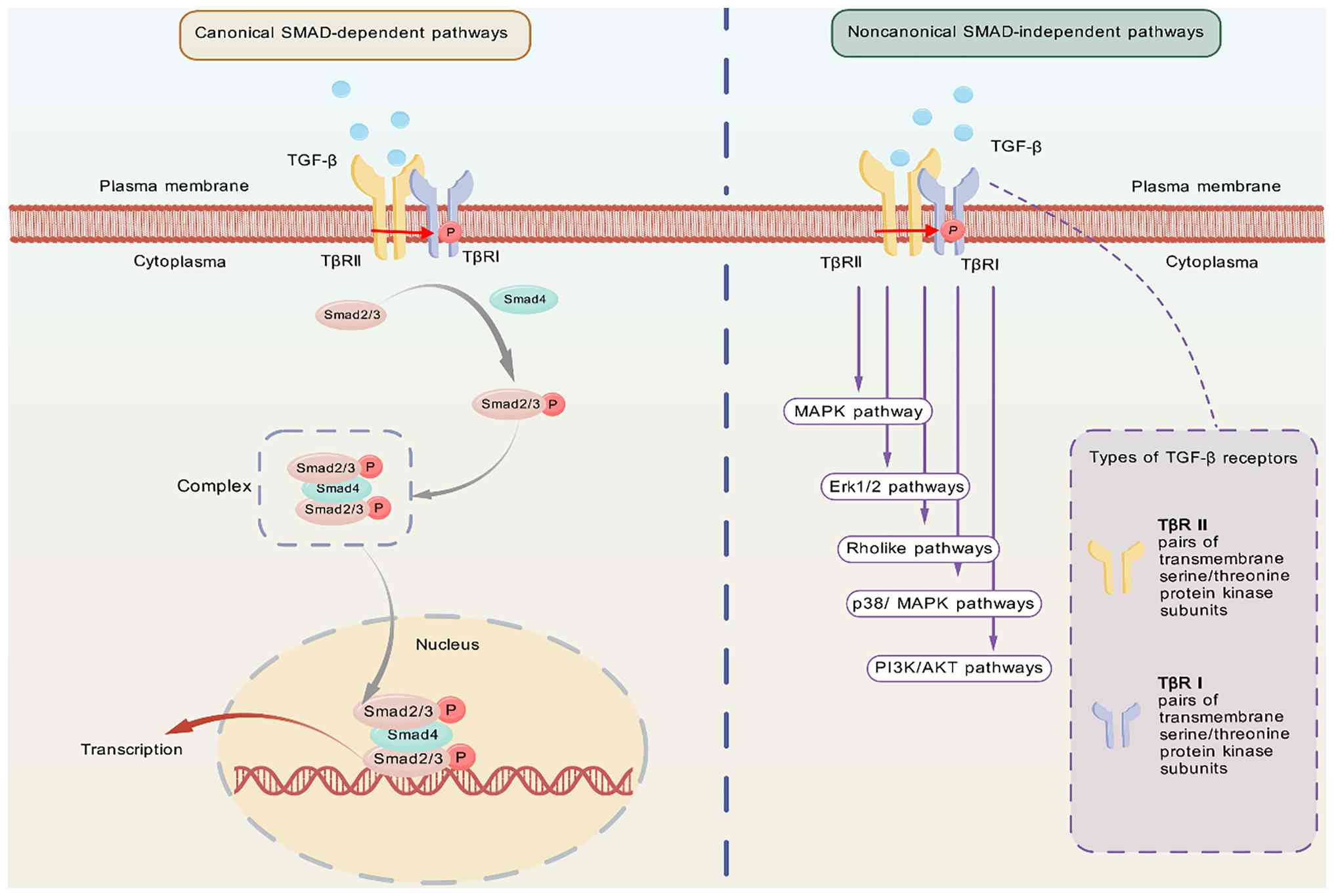
TGF-β signaling is particularly relevant in
aggressive and advanced EC. The human endometrium undergoes
cyclical remodeling regulated by estrogen and progesterone,
involving proliferation, differentiation and repair (114). The TGF-β superfamily, including
TGF-β1-3, bone morphogenetic proteins, growth and differentiation
factors (GDFs), and activins/inhibins, plays a central role in
embryonic development and tissue homeostasis (Fig. 5) (115). In EC, TGF-β signaling exhibits a
context-dependent. In early-stage or CN-low tumors, it may retain
tumor-suppressive functions by regulating cell cycle arrest and
apoptosis (106,107). By contrast, in advanced or CN-high
tumors, TGF-β signaling is associated with EMT, invasion and
metastasis, indicating a shift toward tumor-promoting activity
(108).
NF-κB signaling is also relevant in
CN-high/p53-abnormal EC. Persistent NF-κB activation promotes
chronic inflammation and a pro-tumorigenic microenvironment. In
CN-high or hormone-resistant tumors, NF-κB enhances tumor
aggressiveness by promoting survival signaling, inflammatory
amplification and immune evasion (79–84).
Furthermore, interaction between NF-κB signaling, cell-cycle
dysregulation and PTEN loss may accelerate tumor progression. For
example, cyclin D1, a regulatory subunit of CDK4/6, interacts with
NF-κB signaling. The cyclin D1T286A mutation, particularly in the
context of PTEN loss, accelerates tumor progression and enhances
NF-κB-mediated inflammatory signaling (116,117).
PI3K/AKT/mTOR and MAPK pathway crosstalk may also
contribute to tumor progression and therapeutic resistance in
CN-high tumors. Although these pathways are not defining molecular
features of CN-high/p53-abnormal EC, their interaction with
inflammatory, TGF-β and cell-cycle-related pathways may promote
aggressive behavior and resistance to therapy.
Therapeutic implications and efficacy
of pathway targeting
Therapeutic targeting of the TGF-β signaling in
CN-high or advanced EC requires careful consideration of tumor
subtype and disease stage. In aggressive tumors, inhibition of
TGF-β signaling may help suppress EMT and metastatic progression.
Current approaches include neutralizing antibodies, antisense
oligonucleotides and small-molecule inhibitors targeting TGF-β
receptor I kinase (118). Several
repurposed agents and natural compounds have also shown modulatory
effects in EC models. Withaferin A inhibits EC cell proliferation
through suppression of SMAD2 phosphorylation (119,120), while isoliqueritigenin induces
apoptosis and inhibits EMT by downregulating TGF-β/SMAD signaling.
Similarly, the bisphenol A derivative BHPF reduces p-SMAD2/3 levels
and suppresses metastatic signaling (121). These findings suggest that TGF-β
inhibition may be relevant in molecularly defined EC subsets
characterized by enhanced EMT and invasive potential.
Additional regulators interacting with TGF-β
signaling contribute to EC progression. Loss of PTEN alters SMAD2/3
nuclear localization and may attenuate tumor-suppressive signaling,
highlighting crosstalk between PI3K/AKT and TGF-β pathways
(109). PDIA6, CD73 and LPCAT1,
modulate TGF-β signaling and influence tumor proliferation,
metastasis and EMT-related process (122–125). GDF-15 is associated with EMT,
chemoresistance and poor prognosis (126,127). Activin signaling also exhibits
context-dependent effects, with activin A suppressing proliferation
in some settings, whereas activin B promotes invasion and is linked
to poor survival in type II EC (128,129).
Despite these biological findings, TGF-β-directed
therapies in EC remain largely preclinical, and their clinical
efficacy has not yet been clearly established. The dual
tumor-suppressive and tumor-promoting roles of TGF-β signaling
complicate clinical translation. Therefore, future studies should
identify the specific molecular contexts in which TGF-β inhibition
may provide therapeutic benefit, particularly in CN-high or
invasive tumors.
Direct targeting of NF-κB signaling remains
challenging due to its essential role in normal immune function and
the lack of highly selective inhibitors. However, indirect
targeting approaches may have therapeutic potential. ERK5, a MAPK
family member, regulates survival, invasion and autophagy (130–132). Alterations in the MEK5-ERK5
pathway are observed in a substantial proportion of patients with
EC (133). Pharmacological
inhibition of ERK5 (such as JWG-071) suppresses NF-κB activation
and reduces EC cell proliferation, supporting the ERK5/NF-κB axis
as a potential therapeutic target.
Metabolic regulation also contributes to NF-κB
activation. Sterol regulatory element-binding protein 1 is
overexpressed in EC and promotes proliferation and progesterone
resistance through NF-κB signaling (111–113). Inhibition of this pathway by
fatostatin suppresses NF-κB activity and partially restores hormone
sensitivity, linking metabolic reprogramming to inflammation-driven
tumor progression. Nevertheless, the clinical utility of
NF-κB-directed strategies in CN-high/p53-abnormal EC remains
insufficiently validated.
Overall, failed or limited-efficacy experiences in
aggressive EC subtypes suggest that targeting a single signaling
pathway is unlikely to be sufficient for CN-high/p53-abnormal
tumors. Although TGF-β-, NF-κB-, PI3K/MAPK- and cell-cycle-related
pathways provide biological rationale for therapeutic intervention,
most corresponding strategies remain preclinical or early-phase
clinical approaches. Their clinical efficacy has not yet been
validated in molecularly stratified EC trials, highlighting the
need for subtype-specific trial design and combination
regimens.
Overall, CN-high/p53-abnormal EC remains a
clinically aggressive subtype with limited efficacy from currently
established pathway-targeted strategies. Targeting TGF-β, NF-κB,
PI3K/MAPK crosstalk and cell-cycle-related pathways may provide
therapeutic opportunities, but most available evidence remains
preclinical or early-stage. Therefore, rational combination
strategies and subtype-specific clinical trials are needed.
Cross-subtype pathway crosstalk and
therapeutic evidence gaps
Although the PI3K-AKT-mTOR, RAS-RAF-MEK-ERK, TGF-β
and NF-κB pathways are often described as independent cascades,
increasing evidence indicates that they function as an
interconnected regulatory network in EC (134). Crosstalk among these pathways
coordinates tumor cell proliferation, metabolic reprogramming,
immune modulation, EMT and therapeutic resistance. Importantly, the
pattern and functional impact of pathway crosstalk differ across
molecular subtypes.
In POLE-mutated and MSI-H/dMMR tumors, pathway
interactions are frequently linked to immune activation,
inflammatory responses and TIME regulation. In NSMP/CN-low tumors,
crosstalk between PI3K/AKT/mTOR, MAPK and hormone-related signaling
contributes to endocrine resistance and variable responses to
targeted therapy. In CN-high/p53-abnormal tumors, integration of
PI3K, MAPK, TGF-β and NF-κB pathways contributes to aggressive
tumor behavior, invasion and therapy resistance.
A key interaction occurs between the PI3K-AKT-mTOR
and RAS-RAF-MEK-ERK pathways (135). RAS can directly activate PI3K,
while AKT and ERK share downstream targets regulating cell cycle
progression and survival. Reciprocal feedback activation between
these pathways following single-agent inhibition represents a key
mechanism of adaptive resistance, supporting the rationale for
combined PI3K/MAPK-targeted therapies. However, combination
strategies are often limited by toxicity, compensatory pathway
activation and lack of validated predictive biomarkers.
The TGF-β pathway further integrates with PI3K/MAPK
and NF-κB signaling (134). While
TGF-β exerts tumor-suppressive effects during early tumorigenesis,
it promotes EMT, invasion and stemness in advanced EC through
cooperation with these pathways. In addition, TGF-β-induced
cytokines can activate NF-κB, forming a feed-forward loop that
sustains a pro-tumorigenic microenvironment.
NF-κB functions as a central inflammatory hub
linking oncogenic signaling to the TME (136). Activation of MAPK signaling,
metabolic regulators such as SREBPs, or PTEN loss can enhance NF-κB
activity, amplifying cytokine production and immune cell
recruitment. This inflammatory amplification contributes not only
to tumor progression but also to hormone resistance and immune
evasion.
Lessons from limited-efficacy clinical studies
further support the importance of pathway crosstalk. Many targeted
therapies have shown encouraging preclinical activity but only
modest clinical benefit when evaluated as single agents. Potential
explanations include compensatory activation of parallel pathways,
insufficient molecular selection, intratumoral heterogeneity and
dose-limiting toxicity. Therefore, future clinical trials should
classify therapeutic strategies according to evidence stage,
including preclinical, phase I, phase II, phase III and approved
settings, and should incorporate molecular subtype-based
stratification from the design stage.
Collectively, these findings indicate that signaling
pathways in EC operate as an integrated and dynamic network rather
than isolated cascades. However, the therapeutic implications of
pathway crosstalk remain incompletely understood. Current treatment
strategies largely rely on single-pathway inhibition, which may be
insufficient to overcome adaptive resistance. Future research
should focus on defining subtype-specific pathway interactions and
developing rational co-targeting strategies to improve clinical
outcomes.
Molecular subtype-guided immunotherapy in
EC
Immune landscapes and rationale for
ICIs in molecularly defined EC
EC is a heterogeneous malignancy characterized by
distinct molecular subtypes with divergent immunogenicity and
therapeutic responses. These subtype-specific differences in tumor
antigenicity and immune microenvironment provide a critical
foundation for immunotherapy-based treatment strategies (137). In this context, ICIs have emerged
as an effective approach, particularly in advanced and recurrent
EC.
From a molecular classification perspective,
POLE-mutated and MSI-H/dMMR tumors represent highly immunogenic
subtypes. These tumors exhibit high TMB, increased neoantigen load
and abundant TILs, along with elevated expression of immune
checkpoint molecules such as PD-1 and PD-L1. These features
collectively confer strong sensitivity to PD-1/PD-L1 blockade. By
contrast, p53-abnormal (CN-high) tumors are typically associated
with an immunosuppressive microenvironment, characterized by
increased macrophage infiltration and heterogeneous PD-L1
expression, whereas NSMP tumors generally display intermediate
immune activation profiles (34).
These subtype-specific immune landscapes partially explain the
variability in response to immune checkpoint inhibition.
Recent transcriptomic and spatial profiling studies
further refine this landscape, demonstrating that immune cell
spatial distribution, interferon-γ signaling signatures and the
presence of tertiary lymphoid structures are more predictive of
immunotherapy responses than PD-L1 expression alone. In addition to
PD-1/PD-L1, other immune checkpoints-including CTLA-4, LAG-3,
TIM-3, B7-H4 and IDO1-also contribute to immune evasion in EC,
supporting the development of combination immunotherapeutic
strategies. (21,34,138–140).
Collectively, these findings indicate that
immunogenic subtypes (particularly POLE-mutated and MSI-H/dMMR EC)
are optimal candidates for immune checkpoint blockade, whereas
immunologically ‘cold’ tumors (such as CN-high or NSMP) may require
combination approaches to enhance immune activation and overcome
resistance. However, molecular subtype alone is insufficient to
fully predict immunotherapy benefit. Although POLE-mutated and
MSI-H/dMMR tumors are generally more responsive to ICIs, primary
and acquired resistance can still occur. Conversely, pMMR,
NSMP/CN-low and p53-abnormal/CN-high tumors often exhibit
immune-excluded or immunosuppressive phenotypes, which may limit
the efficacy of single-agent immune checkpoint blockade.
Clinical application, evidence stage
and subtype-specific outcomes
Clinically, ICIs targeting the PD-1/PD-L1 axis have
reshaped the therapeutic landscape of advanced and recurrent EC.
Pembrolizumab was approved for patients with advanced MSI-H/dMMR EC
who progressed after prior systemic therapy and were not candidates
for curative surgery or radiotherapy (141,142). Dostarlimab-gxly was subsequently
approved in combination with carboplatin and paclitaxel, followed
by dostarlimab maintenance, for primary advanced or recurrent
MSI-H/dMMR EC, and this indication was later expanded to a broader
population of adult patients with primary advanced or recurrent EC
(141,143). More recently, pembrolizumab
combined with carboplatin and paclitaxel, followed by pembrolizumab
maintenance, was approved for adult patients with primary advanced
or recurrent EC (144,145). These approvals indicate that
immunotherapy has moved from a biomarker-selected salvage strategy
toward a frontline component of treatment for advanced or recurrent
EC.
Clinical outcomes of ICIs in EC are strongly
influenced by molecular subtype. Patients with dMMR/MSI-H tumors
demonstrate the most robust and durable responses, consistent with
their high TMB and immunogenic TME. By contrast, pMMR tumors,
including NSMP/CN-low and p53-abnormal/CN-high subtypes, exhibit
more variable and generally lower response rates, reflecting their
relatively immunologically ‘cold’ phenotype. Large phase III trials
reported in recent years further demonstrated that the addition of
PD-1/PD-L1 blockade to platinum-based chemotherapy significantly
improves progression-free survival across both dMMR and pMMR
populations. However, the magnitude of benefit remains notably
greater in dMMR tumors, underscoring the importance of molecular
stratification in guiding treatment decisions and optimizing
therapeutic outcomes.
Therefore, immunotherapeutic strategies in EC should
be interpreted according to evidence stage. Approved or phase
III-supported strategies include PD-1/PD-L1 blockade alone or in
combination with platinum-based chemotherapy in selected clinical
settings. By contrast, dual checkpoint blockade, ICIs combined with
anti-angiogenic agents, PI3K/AKT/mTOR inhibitors, antibody-drug
conjugates (ADCs) or other immune modulators remain investigational
and are mainly supported by phase I, phase II or ongoing clinical
trial evidence. Preclinical immune-sensitizing concepts, including
modulation of tumor-associated macrophages, metabolic regulators or
novel immune checkpoints, require further validation before routine
clinical application.
Failed or limited responses and
resistance to immunotherapy across molecular subtypes
Although ICIs have substantially improved the
treatment landscape of EC, failed or limited responses remain
important clinical challenges. The benefit of ICIs is most evident
in POLE-mutated and MSI-H/dMMR tumors; however, durable responses
are not universal even in these immunogenic subtypes. Primary or
acquired resistance may result from defective antigen presentation,
impaired interferon signaling, immune editing, T-cell exhaustion
and myeloid-driven immunosuppression. These mechanisms may allow
tumors to escape immune surveillance despite high neoantigen burden
and apparent baseline immunogenicity.
By contrast, pMMR, NSMP/CN-low and
p53-abnormal/CN-high tumors generally show lower response rates to
single-agent immune checkpoint blockade. These tumors frequently
exhibit immune-excluded or immunosuppressive microenvironments,
which may limit T-cell infiltration and reduce sensitivity to ICIs.
Therefore, single-agent immunotherapy has limited efficacy in these
molecular contexts, and combination strategies are usually
required.
The phase III chemo-immunotherapy studies also
highlight an important limitation: clinical benefit is not uniform
across molecular subtypes. Although benefit is observed in both
dMMR and pMMR populations, responses in pMMR, NSMP/CN-low and
p53-abnormal/CN-high tumors are more heterogeneous and generally
less pronounced than those in dMMR/MSI-H tumors. This suggests that
non-stratified immunotherapy-based combinations may be insufficient
for less immunogenic EC subtypes and that additional biomarkers are
required to identify patients most likely to benefit.
Another important limitation is the lack of
sufficiently accurate predictive biomarkers. PD-L1 expression and
TMB do not fully explain response heterogeneity across molecular
subtypes. Emerging biomarkers, including spatial immune
architecture, interferon-γ signaling signatures, tertiary lymphoid
structures and myeloid composition, may better reflect therapeutic
response, but these remain largely investigational. Therefore,
ongoing clinical trials should be interpreted according to both
molecular subtype and evidence stage, including phase I, phase II,
phase III and approved clinical settings. Future studies should
incorporate subtype-stratified endpoints and biomarker-defined
patient selection to improve the clinical translation of
immunotherapy.
Investigational combination strategies
and future directions
To address the limited efficacy of single-agent ICIs
in less immunogenic EC subtypes, ongoing clinical studies are
evaluating rational combination strategies. Representative ongoing
clinical trials and emerging immunotherapy strategies in EC are
summarized in Table III. These
include dual immune checkpoint inhibition, such as PD-1 plus CTLA-4
blockade, combinations with anti-angiogenic agents, PI3K/AKT/mTOR
inhibitors, ADCs and emerging immune modulators. These approaches
are intended to enhance tumor antigen presentation, increase T-cell
infiltration, remodel the immunosuppressive TME and overcome
adaptive resistance to PD-1/PD-L1 blockade.
| Table III.Ongoing clinical trials and emerging
immunotherapy strategies in EC. |
Table III.
Ongoing clinical trials and emerging
immunotherapy strategies in EC.
| Therapy | Phase | Trial ID | Registration
year | Subtype
relevance |
|---|
| Avutometinib +
Defactinib + Everolimus | I | NCT07318324 | January 2026 | RAS-muntant;
NSMP |
| EIK1005 (WRN
inhibitor) | I/II | NCT07262619 | November 2025 | MSI-H/dMMR |
| Bevacizumab +
Chemotherapy + Pembrolizumab | III | NCT07198074 | September 2025 | pMMR, CN-high
(TP53-abnormal) |
| Fruquintinib +
Chemotherapy | II | NCT07170982 | September 2025 | pMMR; NSMP |
| AZD8205 | III | NCT07044336 | September 2025 | Unselected EC (all
subtypes) |
| TER-2013 | I/II | NCT07109726 | July 2025 | PI3K/AKT
pathway-altered EC; NSMP; MSI-H |
| TQB2450 +
Progestin | II | NCT06914297 | March 2025 | MSI-H/dMMR EC
(fertility-sparing) |
| NKT3447 (CDK2
Inhibitor) | I | NCT06264921 | February 2024 | Proliferative EC;
NSMP |
| Dostarlimab | II | NCT06278857 | January 2024 | MSI-H/dMMR |
| PRO1107 (PTK7) | I/II | NCT06171789 | November 2023 | Unselected EC (all
subtypes) |
| MK-2870 (TROP2
ADC) | III | NCT06132958 | November 2023 | pMMR EC
(Post-immunotherapy setting) |
| AO-252 (TACC3 PPI
Inhibitor) | I | NCT06136884 | November 2023 | Serous EC;
CN-high |
| Sacituzumab
Govitecan (TROP2 ADC) | I/II | NCT06040970 | September 2023 | Broad EC;
post-chemotherapy |
| MK-4280A
(Favezelimab + Pembrolizumab | II | NCT06036836 | August 2023 | pMMR EC |
| HS-20089 (B7-H4
ADC) | II | NCT06014190 | August 2023 | B7-H4-high EC;
often pMMR |
| M1774 + ZEN-3694
(ATR) | I | NCT05950464 | July 2023 | CN-high
(TP53-abnormal) |
| ILB2109 +
Toripalimab (A2aR) | I/II | NCT05955105 | July 2023 | Immunosuppressive
EC; pMMR |
| BBI-355 (CHK1
Inhibitor) | I | NCT05827614 | March 2023 | DNA damage-altered
EC; CN-high (TP53-abnormal) |
| Navtemadlin (MDM2
inhibitor) | II/III | NCT05797831 | March 2023 | CN-high
(TP53-abnormal); NSMP |
| DKN-01 +
Pembrolizumab | II | NCT05761951 | February 2023 | Immune-resistant
EC; pMMR |
| Narazaciclib +
Letrozole | I/II | NCT05705505 | January 2023 | Hormone-driven EC;
NSMP |
| APG-1252
(Bcl-2/Bcl-xl inhibitor) | I | NCT05691504 | January 2023 | Apoptosis-resistant
EC; broad |
However, most of these strategies remain under
clinical investigation, and their efficacy across distinct
molecular subtypes has not yet been fully established. Some
chemo-immunotherapy regimens are supported by phase III clinical
evidence or regulatory approval, whereas many dual-checkpoint,
targeted therapy-based or ADC-based combinations remain
investigational and are currently supported mainly by phase I/II
trials or preclinical rationale. Therefore, future studies should
avoid grouping all immunotherapy-based strategies together and
instead classify them according to evidence stage, molecular
subtype and biomarker-defined population.
Overall, immune checkpoint inhibition has become a
cornerstone therapy for molecularly defined EC, particularly in
dMMR/MSI-H subtypes. However, its broader clinical applicability
remains constrained by resistance mechanisms, heterogeneous benefit
in pMMR and p53-abnormal/CN-high tumors, and insufficient biomarker
precision. Future progress will depend on biomarker-driven
selection, optimized combination strategies and deeper
characterization of the TIME to extend durable benefit to less
immunogenic EC subtypes.
Future directions and novel approaches
according to molecular subtype
Despite notable advances in molecular
stratification and immune checkpoint blockade, durable disease
control in EC remains uneven across molecular subgroups.
Therapeutic resistance, including both intrinsic and acquired
resistance, continues to limit long-term benefit across
chemotherapy, endocrine therapy, targeted agents and immunotherapy.
Importantly, these limitations exhibit clear molecular
subtype-dependent patterns. Therefore, future therapeutic
innovation in EC should move beyond a uniform treatment model and
instead focus on molecular subtype-specific vulnerabilities,
resistance mechanisms, treatment sequencing and biomarker-guided
clinical translation.
POLE-mutated EC
POLE-mutated EC is characterized by an ultramutated
genotype, high TMB, strong immune infiltration and generally
favorable prognosis. These biological features provide a strong
rationale for immune-based approaches and, in selected early-stage
patients, potential treatment de-escalation. However, although
POLE-mutated tumors are usually associated with excellent outcomes,
durable responses are not universal in advanced or recurrent
settings, and the mechanisms underlying immune escape in this
subtype remain incompletely understood.
For this subtype, one important future direction is
to avoid overtreatment while maintaining oncologic safety.
Molecular classification has already reshaped risk assessment by
identifying POLE-mutated tumors as a favorable-risk group,
suggesting that some patients may benefit from reduced treatment
intensity when supported by clinicopathological features and
guideline-based assessment (52,146).
However, prospective evidence is still needed before broad
treatment de-escalation can be routinely applied.
In advanced or recurrent POLE-mutated EC, ICIs may
have therapeutic relevance because of the high neoantigen burden
and immunogenic TME. Nevertheless, resistance can still occur
through defective antigen presentation, attenuation of interferon
signaling, T-cell exhaustion and myeloid-driven immunosuppression
(147). Therefore, future studies
should investigate whether combination strategies targeting
alternative immune checkpoints, tumor-associated macrophages or
metabolic regulators can overcome resistance in this subtype.
Personalized immunotherapeutic strategies,
including neoantigen-based vaccines and adoptive cellular
therapies, may be particularly relevant for POLE-mutated tumors
because of their high mutational burden. However, these approaches
remain largely preclinical or early-stage clinical concepts and
require further validation before routine clinical application.
MSI-H/dMMR EC
MSI-H/dMMR EC is characterized by mismatch repair
deficiency, microsatellite instability, increased mutational burden
and immune activation. This subtype generally shows high
sensitivity to immune checkpoint blockade, and chemo-immunotherapy
has redefined frontline management in advanced or recurrent
disease. Phase III clinical evidence has shown that adding
PD-1/PD-L1 blockade to platinum-based chemotherapy improves
clinical outcomes, with particularly strong benefit observed in
dMMR/MSI-H tumors (145,148,149).
Despite these advances, not all patients with
MSI-H/dMMR EC achieve durable disease control. Primary and acquired
resistance remain important clinical challenges. Mechanistically,
defective antigen presentation, impaired interferon-γ signaling,
immune-editing, T-cell exhaustion and myeloid-driven
immunosuppression may contribute to checkpoint inhibitor failure
across EC subtypes (147).
However, the relative contribution of these mechanisms in
MSI-H/dMMR tumors has not yet been fully defined.
Future therapeutic strategies for MSI-H/dMMR EC
should focus on overcoming immune resistance and optimizing
combination therapy. Strategies targeting alternative immune
checkpoints (such as LAG-3 and TIM-3), metabolic regulators and
tumor-associated macrophages aim to restore effective antitumor
immunity (150,151). These strategies are currently
investigational and remain mostly in preclinical, phase I or
early-phase clinical development. In addition, integration of ICIs
with targeted therapies, anti-angiogenic agents or PI3K/AKT/mTOR
pathway inhibitors may help overcome immune resistance, but optimal
sequencing and patient selection remain unclear.
A major translational gap lies in biomarker
precision. Although MSI-H/dMMR status is clinically useful, it does
not fully capture response heterogeneity. Currently used biomarkers
such as PD-L1 expression and TMB, are insufficient to predict
durable benefit across all patients. Emerging evidence suggests
that spatial immune architecture, interferon-γ signaling signatures
and myeloid composition may more accurately reflect therapeutic
response, However, these biomarkers remain largely investigational
(152).
NSMP/CN-low EC
NSMP/CN-low EC represents a heterogeneous molecular
subgroup that frequently overlaps with hormone-driven endometrioid
tumors. Compared with POLE-mutated and MSI-H/dMMR tumors,
NSMP/CN-low tumors often show lower immunogenicity and more
heterogeneous responses to single-agent ICIs. Therefore, future
strategies for this subtype should focus on endocrine-based
combinations, PI3K/AKT/mTOR pathway targeting, immune-sensitizing
approaches and biomarker refinement.
In NSMP/CN-low EC, endocrine therapy remains
clinically relevant, particularly in hormone receptor-positive
tumors. However, endocrine resistance is common and may be driven
by PI3K/AKT/mTOR activation, MAPK signaling, epigenetic plasticity
and TME remodeling. Combination strategies integrating hormonal
therapy with PI3K/AKT/mTOR inhibitors, mTOR inhibitors or other
targeted agents may improve endocrine sensitivity. Nevertheless,
clinical efficacy remains variable, and predictive biomarkers are
needed to identify patients most likely to benefit from these
approaches.
For immunologically ‘cold’ NSMP/CN-low tumors,
emerging strategies aim to enhance immune responsiveness through
rational combinations. These include co-targeting angiogenesis,
PI3K/AKT/mTOR signaling and other tumor-intrinsic pathways that
modulate the TME. Although these approaches have biological
rationale, their clinical efficacy varies across molecular
subtypes, and optimal treatment sequencing remains unclear.
ADCs represent another emerging therapeutic
strategy for recurrent or treatment-resistant EC. By enabling
selective cytotoxic delivery through tumor-associated antigens such
as Trop-2, ADCs may help overcome resistance after chemotherapy or
immunotherapy and expand treatment options beyond conventional
cytotoxic therapy (153). However,
most ADC-based approaches in EC remain under investigation, with
limited phase III evidence, and their long-term efficacy and
subtype-specific benefit have yet to be fully established.
Future progress in NSMP/CN-low EC will depend on
improved molecular stratification within this heterogeneous
subgroup. Integration of multi-omic profiling, spatial
immunogenomics and circulating tumor DNA-based monitoring may
refine patient selection and enable adaptive treatment decisions.
However, these technologies remain limited by cost, standardization
and accessibility challenges.
CN-high/p53-abnormal EC
CN-high/p53-abnormal EC is characterized by
extensive copy-number alterations, TP53 abnormalities, aggressive
clinical behavior and poor prognosis. This subtype frequently
demonstrates immune-excluded or immunosuppressive phenotypes and is
often less responsive to single-agent ICIs than MSI-H/dMMR tumors.
Therefore, future strategies for CN-high/p53-abnormal EC should
focus on intensified combination therapy, antibody-drug conjugates,
HER2-targeted therapy, DNA damage response targeting,
cell-cycle-directed approaches and TME modulation.
Although chemo-immunotherapy has improved the
treatment landscape of advanced or recurrent EC, the magnitude of
benefit in pMMR, NSMP and CN-high tumors is generally more
heterogeneous than in MSI-H/dMMR tumors (145,148,149). Therefore, additional biomarkers
are needed to identify which patients with CN-high/p53-abnormal EC
are most likely to benefit from immune-based combinations. In this
subtype, immune resistance may be mediated by tumor-intrinsic
genomic instability, defective antigen presentation,
immunosuppressive myeloid infiltration and inflammatory pathway
activation.
ADCs may be particularly relevant for aggressive or
recurrent CN-high/p53-abnormal tumors, especially when conventional
chemotherapy has failed. Agents targeting Trop-2, B7-H4 or other
tumor-associated antigens may provide subtype-relevant therapeutic
opportunities. However, these strategies remain investigational,
and their efficacy across molecularly defined subgroups has not yet
been clearly established.
HER2-targeted therapy may also be clinically
relevant in selected serous or p53-abnormal EC with HER2
overexpression or amplification. In addition, DNA damage response
inhibitors, PARP inhibitor-based combinations and
cell-cycle-directed strategies are being explored in tumors
characterized by genomic instability. These approaches provide a
rational direction for CN-high/p53-abnormal EC, but most remain in
preclinical, phase I or phase II development and require validation
in subtype-stratified clinical trials.
Modulation of the immunosuppressive TME is another
important direction for this subtype. Strategies targeting
alternative immune checkpoints, macrophage-mediated
immunosuppression, metabolic regulators or inflammatory pathways
may help convert immune-excluded tumors into more immune-responsive
tumors (150,151). However, these approaches remain in
early clinical development, and their ability to consistently
overcome immune resistance has not yet been established.
Impact of molecular classification on
clinical guidelines and regulatory decision-making
Molecular classification has increasingly shifted
EC management from a histology-based model toward an integrated
clinicopathological and molecular framework. This shift has
important implications for diagnosis, risk stratification, adjuvant
treatment selection, systemic therapy and regulatory
decision-making. The 2025 ESGO/ESTRO/ESP guideline update further
reinforces this transition by incorporating the revised 2023 FIGO
staging system and newly available clinical evidence into EC
management.
First, molecular classification has been
incorporated into modern staging and risk assessment systems. The
2023 FIGO staging system integrates molecular features into EC
staging and recognizes POLE-mutated, MMRd, p53-abnormal and NSMP as
clinically relevant molecular categories (146). This represents an important step
toward molecularly informed staging, as POLE-mutated status is
associated with favorable prognosis, whereas p53-abnormal status is
associated with aggressive biology and poorer outcomes. The 2025
ESGO/ESTRO/ESP guidelines further strengthen this approach by
recommending molecular classification based on POLE mutation
analysis and immunohistochemical assessment of MMR and p53 status,
thereby defining POLE-mutated, MMRd, NSMP and p53-abnormal tumors
as clinically relevant categories for risk allocation and treatment
planning (52).
Second, the ESGO 2025 update refines prognostic
risk grouping by integrating anatomical stage, histological
features, lymphovascular space invasion, estrogen receptor status
and molecular subtype. When molecular classification is available,
FIGO staging can be reported with molecular annotation. For
example, molecularly defined categories such as stage IAm
POLE-mutated and stage IICm p53-abnormal highlight the distinct
prognostic implications of POLE mutation and p53 abnormality in
early-stage disease (52,146). In the 2025 ESGO/ESTRO/ESP
framework, several POLE-mutated early-stage tumors are classified
as low risk, and no adjuvant therapy is recommended for low-risk
EC. By contrast, p53-abnormal tumors are more frequently assigned
to high-risk categories, supporting more intensive adjuvant or
systemic treatment strategies (52).
Third, molecular classification has influenced
clinical treatment guidelines by improving patient selection for
adjuvant and systemic therapy. POLE-mutated tumors may support
treatment de-escalation in appropriate clinical contexts, whereas
p53-abnormal tumors often support treatment de-escalation in
selected clinical contexts, whereas p53-abnormal tumors often
support treatment intensification because of their aggressive
biology. MSI-H/dMMR status has become clinically important for
identifying patients likely to benefit from immune checkpoint
blockade. NSMP/CN-low tumors require further refinement because
this group remains biologically heterogeneous and may require
additional biomarkers, such as hormone receptor status, CTNNB1
mutation, PI3K pathway alterations or immune microenvironment
features.
Fourth, the ESGO 2025 update has important
implications for systemic therapy in advanced or recurrent EC. For
MMRd tumors with unresectable stage III/IV or recurrent disease,
ICIs, such as dostarlimab, durvalumab or pembrolizumab, in
combination with carboplatin-paclitaxel chemotherapy followed by
immune checkpoint inhibitor maintenance, are recommended as part of
first-line treatment (52). For
non-MMRd tumors, carboplatin-paclitaxel chemotherapy remains
important, particularly in rapidly progressive or symptomatic
disease; however, immune checkpoint inhibitor-based combinations
and maintenance strategies may be considered in selected patients
according to clinical context and available evidence (52). In the second-line setting, treatment
is also guided by MMR status, and repeated MMR testing on relapsed
tumor tissue may be considered when feasible to guide treatment
selection (52).
Fifth, molecular classification has directly
influenced regulatory approvals and drug development. Regulatory
decisions increasingly rely on biomarker-defined subgroups and
molecularly stratified clinical trial outcomes. In 2024,
pembrolizumab combined with carboplatin and paclitaxel, followed by
pembrolizumab maintenance, was approved for adult patients with
primary advanced or recurrent EC (144,148,154). Dostarlimab combined with
carboplatin and paclitaxel, followed by dostarlimab maintenance,
was also approved and subsequently expanded for adult patients with
primary advanced or recurrent EC, including a previous approval for
dMMR/MSI-H disease and later expansion to a broader population
(154). These approvals illustrate
how molecular classification and biomarker-defined trial analyses
have accelerated the incorporation of ICIs into standard EC
treatment.
Finally, molecular classification has reshaped
clinical trial design. Modern EC trials increasingly stratify
patients according to MMR/MSI status, p53 status, POLE mutation
status and other molecular or immune biomarkers. This enables more
precise evaluation of treatment efficacy across subgroups and helps
identify populations that may require intensified treatment,
combination therapy or de-escalation. Future regulatory decisions
will likely depend increasingly on molecularly stratified
endpoints, adaptive trial designs and companion biomarker
development. Overall, the ESGO 2025 update supports the central
concept of this review: molecular classification is no longer only
a prognostic tool, but has become an essential framework for
risk-adapted, biomarker-guided and subtype-specific treatment of
EC.
Lessons from failed or
limited-efficacy clinical studies
Failed or limited-efficacy clinical studies provide
important lessons for future EC drug development. Across molecular
subtypes, one recurring limitation is that biological pathway
activation does not always translate into clinical dependence on
that pathway. For example, PI3K/AKT/mTOR pathway alterations are
frequent in EC, particularly in NSMP/CN-low and MSI-H/dMMR tumors,
but single-agent PI3K, AKT and mTOR inhibitors have generally
produced modest and variable clinical responses. Toxicity
associated with some pan-PI3K inhibitors, feedback activation after
mTOR inhibition and compensatory MAPK signaling may partly explain
these limited outcomes.
Similarly, MAPK-, TGF-β- and NF-κB-directed
strategies have strong mechanistic rationale but remain
insufficiently validated in EC. Many of these approaches are still
in the preclinical, phase I or phase II stage, and their benefit in
molecularly defined EC populations has not been clearly
established. These findings indicate that future studies should not
rely solely on pathway presence but should incorporate functional
biomarkers, subtype-specific stratification and rational
combination strategies.
In immunotherapy, the most robust benefit has been
observed in MSI-H/dMMR and POLE-mutated tumors, whereas pMMR,
NSMP/CN-low and CN-high/p53-abnormal tumors show more heterogeneous
or limited responses to single-agent immune checkpoint blockade.
Even in immunogenic tumors, primary and acquired resistance may
occur. Therefore, future immunotherapy trials should distinguish
approved phase III-supported strategies from investigational phase
I/II combinations and preclinical immune-sensitizing concepts.
These lessons support a more rigorous
evidence-stage framework for EC treatment development. Ongoing and
emerging strategies should be categorized as preclinical concepts,
phase I safety studies, phase II efficacy studies, phase III
confirmatory trials or approved clinical strategies. Such
classification may help readers better interpret the maturity of
current evidence and may facilitate the design of
subtype-stratified clinical trials.
Integrated future perspective
Overall, future EC management will likely evolve
from static molecular classification toward adaptive,
subtype-guided combination strategies. While current molecular
classification provides a strong biological and clinical framework,
it does not fully capture intratumoral heterogeneity, temporal
evolution or treatment-induced resistance. Therefore, integration
of multi-omic profiling, spatial immunogenomics, circulating tumor
DNA monitoring and real-world clinical data may enable more dynamic
treatment adaptation. Representative preclinical and emerging
therapeutic concepts according to molecular subtype are summarized
in Table IV. This table highlights
subtype-specific biological vulnerabilities, candidate therapeutic
strategies, evidence stage and major translational challenges.
| Table IV.Preclinical and emerging therapeutic
concepts according to molecular subtype in EC. |
Table IV.
Preclinical and emerging therapeutic
concepts according to molecular subtype in EC.
| Molecular
subtype | Biological
vulnerability | Preclinical or
emerging strategy | Evidence stage | Translational
challenge |
|---|
| POLE-mutated
EC | Ultra-mutated
genotype, high TMB, high neoantigen burden, strong immune
infiltration | Neoantigen-based
vaccines; adoptive cellular therapy; alternative immune checkpoint
targeting; treatment de-escalation strategies | Preclinical/early
clinical concept | Most patients have
favorable prognosis; optimal candidates for escalation or
de-escalation remain undefined; prospective validation is
required |
| MSI-H/dMMR EC | Mismatch repair
deficiency, microsatellite instability, high TMB, immune-active
tumor microenvironment | Strategies to
overcome ICI resistance, including LAG-3/TIM-3 targeting,
tumor-associated macrophage modulation, metabolic immune regulation
and ICI-based combinations | Preclinical/phase
I–II/ongoing clinical studies | Primary and
acquired resistance remain incompletely understood; biomarkers
beyond MSI/MMR status are needed |
| NSMP/CN-low EC | Hormone-driven
biology, PI3K/AKT/mTOR pathway alterations, heterogeneous immune
activation | Endocrine therapy
combined with PI3K/AKT/mTOR inhibitors; immune-sensitizing
combinations; Wnt/β-catenin-or CTNNB1-related strategies;
ctDNA-guided treatment adaptation | Preclinical/phase
I–II/ongoing clinical studies | This subtype is
biologically heterogeneous; predictive biomarkers for endocrine
sensitivity, pathway dependence and immunotherapy benefit remain
insufficient |
|
CN-high/p53-abnormal EC | TP53 abnormality,
copy-number instability, aggressive biology, immune-excluded or
immunosuppressive phenotype | HER2-targeted
therapy in HER2-positive serous-like tumors; ADCs targeting Trop-2
or B7-H4; DNA damage response inhibitors; PARP inhibitor-based
combinations; cell-cycle-directed strategies | Preclinical/phase
I–II/ongoing clinical studies | Clinical benefit
remains variable; molecular selection and biomarker-defined trial
design are required |
| Cross-subtype
strategies | Pathway crosstalk,
tumor heterogeneity, adaptive resistance and tumor-immune
microenvironment remodeling | Multi-omic
profiling; spatial immunogenomics; circulating tumor DNA
monitoring; rational co-targeting of PI3K/MAPK/immune pathways | Emerging
translational concept | Cost,
standardization, accessibility and prospective clinical validation
remain major barriers |
While emerging strategies show promise, their
clinical applicability remains limited by the lack of validated
predictive biomarkers. Moreover, the translational relevance of
numerous emerging targets remains to be established in large-scale
clinical studies. Future progress will depend on rigorous
subtype-stratified clinical validation to translate emerging
strategies into clinically meaningful benefit. Ultimately, a deeper
understanding of pathway crosstalk and TIME interactions will be
essential for transitioning from subtype-based treatment toward
fully individualized precision oncology in EC, with the goal of
extending long-term survival across all molecular subgroups.
Conclusion
EC has evolved from a histopathology-defined entity
into a molecularly stratified disease in which genomic alterations,
signaling pathway dysregulation and immune contexture collectively
determine clinical behavior and therapeutic response. The
integration of molecular classification has not only refined
prognostic assessment but also established a framework for
subtype-guided therapeutic strategies.
Distinct molecular subtypes exhibit divergent
biological features and treatment sensitivities. Hypermutated
tumors, including POLE-mutated and MSI-H/dMMR EC, demonstrate
strong immunogenicity and favorable responses to immune checkpoint
blockade, whereas NSMP and p53-abnormal (CN-high) subtypes often
display limited responsiveness and require combination strategies
targeting oncogenic signaling and the TME.
The incorporation of ICIs and rational combination
approaches has notably reshaped the management of advanced EC.
However, therapeutic resistance, tumor heterogeneity, and the
limited predictive accuracy of current biomarkers continue to
restrict durable benefit across broader patient populations.
Future progress will depend on integrating
multi-omic profiling, spatial immune characterization and real-time
disease monitoring to refine patient stratification and enable
adaptive therapeutic strategies. Ultimately, a deeper understanding
of pathway crosstalk and tumor-immune microenvironment interactions
will be essential for transitioning from subtype-based treatment
toward fully individualized precision oncology in EC, with the goal
of extending long-term survival across all molecular subgroups.
Acknowledgements
Not applicable.
Funding
Funding: No funding was received.
Availability of data and materials
Not applicable.
Authors' contributions
XL designed the review article, researched
references and wrote the majority of the manuscript. JL researched
references and wrote the manuscript. FH, XD, MC and WM researched
references and wrote the manuscript. WL designed the review article
and revised the manuscript. Data authentication is not applicable.
All authors read and approved the final version of the
manuscript.
Ethics approval and consent to
participate
Not applicable.
Patient consent for publication
Not applicable.
Competing interests
The authors declare that they have no competing
interests.
References
|
1
|
Siegel RL, Miller KD, Wagle NS and Jemal
A: Cancer statistics, 2023. CA Cancer J Clin. 73:17–48.
2023.PubMed/NCBI
|
|
2
|
Sung H, Ferlay J, Siegel RL, Laversanne M,
Soerjomataram I, Jemal A and Bray F: Global cancer statistics 2020:
GLOBOCAN estimates of incidence and mortality worldwide for 36
cancers in 185 countries. CA Cancer J Clin. 71:209–249.
2021.PubMed/NCBI
|
|
3
|
Njoku K, Abiola J, Russell J and Crosbie
EJ: Endometrial cancer prevention in high-risk women. Best Pract
Res Clin Obstet Gynaecol. 65:66–78. 2020. View Article : Google Scholar : PubMed/NCBI
|
|
4
|
Crosbie EJ, Kitson SJ, McAlpine JN,
Mukhopadhyay A, Powell ME and Singh N: Endometrial cancer. Lancet.
399:1412–1428. 2022. View Article : Google Scholar : PubMed/NCBI
|
|
5
|
Passarello K, Kurian S and Villanueva V:
Endometrial cancer: An overview of pathophysiology, management, and
care. Semin Oncol Nurs. 35:157–165. 2019. View Article : Google Scholar : PubMed/NCBI
|
|
6
|
Lortet-Tieulent J, Ferlay J, Bray F and
Jemal A: International patterns and trends in endometrial cancer
incidence, 1978–2013. J Natl Cancer Inst. 110:354–361. 2018.
View Article : Google Scholar : PubMed/NCBI
|
|
7
|
Raglan O, Kalliala I, Markozannes G,
Cividini S, Gunter MJ, Nautiyal J, Gabra H, Paraskevaidis E,
Martin-Hirsch P, Tsilidis KK and Kyrgiou M: Risk factors for
endometrial cancer: An umbrella review of the literature. Int J
Cancer. 145:1719–1730. 2019. View Article : Google Scholar : PubMed/NCBI
|
|
8
|
Morice P, Leary A, Creutzberg C,
Abu-Rustum N and Darai E: Endometrial cancer. Lancet.
387:1094–1108. 2016. View Article : Google Scholar : PubMed/NCBI
|
|
9
|
Southcott BM: Carcinoma of the
Endometrium. DRUGS. 61:1395–1405. 2001. View Article : Google Scholar : PubMed/NCBI
|
|
10
|
Mannschreck D, Matsuno RK, Moriarty JP,
Borah BJ, Dowdy SC, Tanner EJ III, Makary MA, Stone RL, Levinson
KL, Temkin SM and Fader AN: Disparities in surgical care among
women with endometrial cancer. Obstet Gynecol. 128:526–534. 2016.
View Article : Google Scholar : PubMed/NCBI
|
|
11
|
Matsuo K, Machida H, Shoupe D, Melamed A,
Muderspach LI, Roman LD and Wright JD: Ovarian conservation and
overall survival in young women with early-stage low-grade
endometrial cancer. Obstet Gynecol. 128:761–770. 2016. View Article : Google Scholar : PubMed/NCBI
|
|
12
|
Pierce SR, Fang Z, Yin Y, West L, Asher M,
Hao T, Zhang X, Tucker K, Staley A, Fan Y, et al: Targeting
dopamine receptor D2 as a novel therapeutic strategy in endometrial
cancer. J Exp Clin Cancer Res. 40:612021. View Article : Google Scholar : PubMed/NCBI
|
|
13
|
Xie S, Jin Y, Wang J, Li J, Peng M and Zhu
X: DOCK1 regulates the malignant biological behavior of endometrial
cancer through c-Raf/ERK pathway. BMC Cancer. 24:2962024.
View Article : Google Scholar : PubMed/NCBI
|
|
14
|
Song Y, Bi Z, Liu Y, Qin F, Wei Y and Wei
X: Targeting RAS-RAF-MEK-ERK signaling pathway in human cancer:
Current status in clinical trials. Genes Dis. 10:76–88. 2022.
View Article : Google Scholar : PubMed/NCBI
|
|
15
|
Yen TT, Wang TL, Fader AN, Shih IM and
Gaillard S: Molecular classification and emerging targeted therapy
in endometrial cancer. Int J Gynecol Pathol. 39:26–35. 2020.
View Article : Google Scholar : PubMed/NCBI
|
|
16
|
Anca-Stanciu MB, Manu A, Olinca MV,
Coroleucă C, Comandașu DE, Coroleuca CA, Maier C and Bratila E:
Comprehensive review of endometrial cancer: New molecular and FIGO
classification and recent treatment changes. J Clin Med.
14:13852025. View Article : Google Scholar : PubMed/NCBI
|
|
17
|
Yan L, Ding X, Deng Y, Li Y and Du X: The
molecular classification ushers in a new era for the treatment of
advanced and recurrent endometrial cancer. Front Oncol.
15:17611592026. View Article : Google Scholar : PubMed/NCBI
|
|
18
|
Corr B, Cosgrove C, Spinosa D and
Guntupalli S: Endometrial cancer: Molecular classification and
future treatments. BMJ Med. 1:e0001522022. View Article : Google Scholar : PubMed/NCBI
|
|
19
|
Lin H, Ou YC, Fu HC, Huang SW, Wu CH and
Changchien CC: Molecular subtyping and the 2023 FIGO staging in
endometrial cancer: Redefining adjuvant therapy. Taiwan J Obstet
Gynecol. 64:616–624. 2025. View Article : Google Scholar : PubMed/NCBI
|
|
20
|
Bokhman JV: Two pathogenetic types of
endometrial carcinoma. Gynecol Oncol. 15:10–17. 1983. View Article : Google Scholar : PubMed/NCBI
|
|
21
|
Cao W, Ma X, Fischer JV, Sun C, Kong B and
Zhang Q: Immunotherapy in endometrial cancer: Rationale, practice
and perspectives. Biomark Res. 9:492021. View Article : Google Scholar : PubMed/NCBI
|
|
22
|
Dedes KJ, Wetterskog D, Ashworth A, Kaye
SB and Reis-Filho JS: Emerging therapeutic targets in endometrial
cancer. Nat Rev Clin Oncol. 8:261–271. 2011. View Article : Google Scholar : PubMed/NCBI
|
|
23
|
Di Tucci C, Capone C, Galati G, Iacobelli
V, Schiavi MC, Di Donato V, Muzii L and Panici PB: Immunotherapy in
endometrial cancer: New scenarios on the horizon. J Gynecol Oncol.
30:e462019. View Article : Google Scholar : PubMed/NCBI
|
|
24
|
Bell DW and Ellenson LH: Molecular
genetics of endometrial carcinoma. Annu Rev Pathol. 14:339–367.
2019. View Article : Google Scholar : PubMed/NCBI
|
|
25
|
Urick ME and Bell DW: Clinical
actionability of molecular targets in endometrial cancer. Nat Rev
Cancer. 19:510–521. 2019. View Article : Google Scholar : PubMed/NCBI
|
|
26
|
Bogani G, Ray-Coquard I, Concin N, Ngoi
NYL, Morice P, Enomoto T, Takehara K, Denys H, Nout RA, Lorusso D,
et al: Uterine serous carcinoma. Gynecol Oncol. 162:226–234. 2021.
View Article : Google Scholar : PubMed/NCBI
|
|
27
|
Costas L, Frias-Gomez J, Guardiola M,
Benavente Y, Pineda M, Pavón MÁ, Martínez JM, Climent M, Barahona
M, Canet J, et al: New perspectives on screening and early
detection of endometrial cancer. Int J Cancer. 145:3194–3206. 2019.
View Article : Google Scholar : PubMed/NCBI
|
|
28
|
Cancer Genome Atlas Research Network, .
Kandoth C, Schultz N, Cherniack AD, Akbani R, Liu Y, Shen H,
Robertson AG, Pashtan I, Shen R, et al: Integrated genomic
characterization of endometrial carcinoma. Nature. 497:67–73. 2013.
View Article : Google Scholar : PubMed/NCBI
|
|
29
|
Amant F, Moerman P, Neven P, Timmerman D,
Van Limbergen E and Vergote I: Endometrial cancer. Lancet.
366:491–505. 2005. View Article : Google Scholar : PubMed/NCBI
|
|
30
|
Matsuo K, Takazawa Y, Ross MS, Elishaev E,
Podzielinski I, Yunokawa M, Sheridan TB, Bush SH, Klobocista MM,
Blake EA, et al: Significance of histologic pattern of carcinoma
and sarcoma components on survival outcomes of uterine
carcinosarcoma. Ann Oncol. 27:1257–1266. 2016. View Article : Google Scholar : PubMed/NCBI
|
|
31
|
Cantrell LA, Blank SV and Duska LR:
Uterine carcinosarcoma: A review of the literature. Gynecol Oncol.
137:581–588. 2015. View Article : Google Scholar : PubMed/NCBI
|
|
32
|
Kumari A, Kumar H, Harvey SE, Xing D and
Li Z: Molecular classification of endometrial carcinomas: Review
and recent updates. Cancers (Basel). 18:512025. View Article : Google Scholar : PubMed/NCBI
|
|
33
|
Church DN, Briggs SE, Palles C, Domingo E,
Kearsey SJ, Grimes JM, Gorman M, Martin L, Howarth KM, Hodgson SV,
et al: DNA polymerase ε and δ exonuclease domain mutations in
endometrial cancer. Hum Mol Genet. 22:2820–2828. 2013. View Article : Google Scholar : PubMed/NCBI
|
|
34
|
Dey DK, Krause D, Rai R, Choudhary S,
Dockery LE and Chandra V: The role and participation of immune
cells in the endometrial tumor microenvironment. Pharmacol Ther.
251:1085262023. View Article : Google Scholar : PubMed/NCBI
|
|
35
|
Church DN, Stelloo E, Nout RA, Valtcheva
N, Depreeuw J, ter Haar N, Noske A, Amant F, Tomlinson IP, Wild PJ,
et al: Prognostic significance of POLE proofreading mutations in
endometrial cancer. J Natl Cancer Inst. 107:4022014.PubMed/NCBI
|
|
36
|
Imboden S, Nastic D, Ghaderi M, Rydberg F,
Rau TT, Mueller MD, Epstein E and Carlson JW: Phenotype of
POLE-mutated endometrial cancer. PLoS One. 14:e02143182019.
View Article : Google Scholar : PubMed/NCBI
|
|
37
|
Dong D, Lei H, Liu D, Bai H, Yang Y, Tang
B, Li K, Liu J, Xu G and Xiao X: POLE and mismatch repair status,
checkpoint proteins and tumor-infiltrating lymphocytes in
combination, and tumor differentiation: Identify endometrial
cancers for immunotherapy. Front Oncol. 11:6400182021. View Article : Google Scholar : PubMed/NCBI
|
|
38
|
Murali R, Soslow RA and Weigelt B:
Classification of endometrial carcinoma: More than two types.
Lancet Oncol. 15:e268–e278. 2014. View Article : Google Scholar : PubMed/NCBI
|
|
39
|
Cosgrove CM, Tritchler DL, Cohn DE, Mutch
DG, Rush CM, Lankes HA, Creasman WT, Miller DS, Ramirez NC, Geller
MA, et al: An NRG Oncology/GOG study of molecular classification
for risk prediction in endometrioid endometrial cancer. Gynecol
Oncol. 148:174–180. 2018. View Article : Google Scholar : PubMed/NCBI
|
|
40
|
Muratori L, Sperone P, Gorzegno G, La
Salvia A and Scagliotti GV: Systemic recurrence of endometrial
cancer more than 10 years after hysterectomy: A report of two cases
and a brief review of the literature. J Egypt Natl Canc Inst.
32:412020. View Article : Google Scholar : PubMed/NCBI
|
|
41
|
Southcott BM: Carcinoma of the
endometrium. Drugs. 61:1395–1405. 2001. View Article : Google Scholar : PubMed/NCBI
|
|
42
|
Corr BR, Erickson BK, Barber EL, Fisher CM
and Slomovitz B: Advances in the management of endometrial cancer.
BMJ. 388:e0809782025. View Article : Google Scholar : PubMed/NCBI
|
|
43
|
Janda M, Gebski V, Davies LC, Forder P,
Brand A, Hogg R, Jobling TW, Land R, Manolitsas T, Nascimento M, et
al: Effect of total laparoscopic hysterectomy vs total abdominal
hysterectomy on disease-free survival among women with stage I
endometrial cancer: A randomized clinical trial. JAMA.
317:1224–1233. 2017. View Article : Google Scholar : PubMed/NCBI
|
|
44
|
Galaal K, Donkers H, Bryant A and Lopes
AD: Laparoscopy versus laparotomy for the management of early stage
endometrial cancer. Cochrane Database Syst Rev.
10:CD0066552018.PubMed/NCBI
|
|
45
|
Wright JD: Take ‘em or leave ‘em:
Management of the ovaries in young women with endometrial cancer.
Gynecol Oncol. 131:287–288. 2013. View Article : Google Scholar : PubMed/NCBI
|
|
46
|
Biler A, Solmaz U, Erkilinc S, Gokcu M,
Bagci M, Temel O, Karadeniz T and Sanci M: Analysis of endometrial
carcinoma in young women at a high-volume cancer center. Int J
Surg. 44:185–190. 2017. View Article : Google Scholar : PubMed/NCBI
|
|
47
|
Matsuo K, Gualtieri MR, Cahoon SS, Jung
CE, Paulson RJ, Shoupe D, Muderspach LI, Wakatsuki A, Wright JD and
Roman LD: Surgical menopause and increased risk of nonalcoholic
fatty liver disease in endometrial cancer. Menopause. 23:189–196.
2016. View Article : Google Scholar : PubMed/NCBI
|
|
48
|
Hao Q, Wu H, Liu E and Wang L: BUB1,
BUB1B, CCNA2, and CDCA8, along with miR-524-5p, as clinically
relevant biomarkers for the diagnosis and treatment of endometrial
carcinoma. BMC Cancer. 23:9952023. View Article : Google Scholar : PubMed/NCBI
|
|
49
|
Colombo N, Preti E, Landoni F, Carinelli
S, Colombo A, Marini C and Sessa C; ESMO Guidelines Working Group,
: Endometrial cancer: ESMO clinical practice guidelines for
diagnosis, treatment and follow-up. Ann Oncol. 24 (Suppl
6):vi33–vi38. 2013. View Article : Google Scholar : PubMed/NCBI
|
|
50
|
Hsieh K, Bloom JR, Dickstein DR, Shah A,
Yu C, Nehlsen AD, Resende Salgado L, Gupta V, Chadha M and Sindhu
KK: Risk-tailoring radiotherapy for endometrial cancer: A narrative
review. Cancers (Basel). 16:13462024. View Article : Google Scholar : PubMed/NCBI
|
|
51
|
Matei D, Filiaci V, Randall ME, Mutch D,
Steinhoff MM, DiSilvestro PA, Moxley KM, Kim YM, Powell MA,
O'Malley DM, et al: Adjuvant chemotherapy plus radiation for
locally advanced endometrial cancer. N Engl J Med. 380:2317–2326.
2019. View Article : Google Scholar : PubMed/NCBI
|
|
52
|
Concin N, Matias-Guiu X, Cibula D, Colombo
N, Creutzberg CL, Ledermann J, Mirza MR, Vergote I, Abu-Rustum NR,
Bosse T, et al: ESGO-ESTRO-ESP guidelines for the management of
patients with endometrial carcinoma: Update 2025. Lancet Oncol.
26:e423–e435. 2025. View Article : Google Scholar : PubMed/NCBI
|
|
53
|
Xiao Q, Liu Y, Jiang G, Liu Y, Huang Y,
Liu W and Zhang Z: Heteroleptic Gold(I)-bisNHC complex with
excellent activity in vitro, ex vivo and in vivo against
endometrial cancer. Eur J Med Chem. 236:1143022022. View Article : Google Scholar : PubMed/NCBI
|
|
54
|
Rowlands CE, Folberg AM, Beickman ZK,
Devor EJ, Leslie KK and Givens BE: Particles and prejudice:
Nanomedicine approaches to reducing health disparities in
endometrial cancer. Small. 20:e23000962024.PubMed/NCBI
|
|
55
|
Meyer LA, Bohlke K, Powell MA, Fader AN,
Franklin GE, Lee LJ, Matei D, Coallier L and Wright AA:
Postoperative radiation therapy for endometrial cancer: American
society of clinical oncology clinical practice guideline
endorsement of the American society for radiation oncology
evidence-based guideline. J Clin Oncol. 33:2908–2913. 2015.
View Article : Google Scholar : PubMed/NCBI
|
|
56
|
Bestvina CM and Fleming GF: Chemotherapy
for endometrial cancer in adjuvant and advanced disease settings.
Oncologist. 21:1250–1259. 2016. View Article : Google Scholar : PubMed/NCBI
|
|
57
|
Mori Y, Yamawaki K, Ishiguro T, Yoshihara
K, Ueda H, Sato A, Ohata H, Yoshida Y, Minamino T, Okamoto K and
Enomoto T: ALDH-Dependent glycolytic activation mediates stemness
and paclitaxel resistance in patient-derived spheroid models of
uterine endometrial cancer. Stem Cell Reports. 13:730–746. 2019.
View Article : Google Scholar : PubMed/NCBI
|
|
58
|
Chang L and Karin M: Mammalian MAP kinase
signalling cascades. Nature. 410:37–40. 2001. View Article : Google Scholar : PubMed/NCBI
|
|
59
|
Luke JJ, Ott PA and Shapiro GI: The
biology and clinical development of MEK inhibitors for cancer.
Drugs. 74:2111–2128. 2014. View Article : Google Scholar : PubMed/NCBI
|
|
60
|
Liu F, Yang X, Geng M and Huang M:
Targeting ERK, an Achilles' Heel of the MAPK pathway, in cancer
therapy. Acta Pharm Sin B. 8:552–562. 2018. View Article : Google Scholar : PubMed/NCBI
|
|
61
|
Wiwatchaitawee K, Mekkawy AI, Quarterman
JC, Naguib YW, Ebeid K, Geary SM and Salem AK: The MEK 1/2
inhibitor PD98059 exhibits synergistic anti-endometrial cancer
activity with paclitaxel in vitro and enhanced tissue distribution
in vivo when formulated into PAMAM-coated PLGA-PEG nanoparticles.
Drug Deliv Transl Res. 12:1684–1696. 2022. View Article : Google Scholar : PubMed/NCBI
|
|
62
|
Takao T, Masuda H, Kajitani T, Miki F,
Miyazaki K, Yoshimasa Y, Katakura S, Tomisato S, Uchida S, Uchida
H, et al: Sorafenib targets and inhibits the oncogenic properties
of endometrial cancer stem cells via the RAF/ERK pathway. Stem Cell
Res Ther. 13:2252022. View Article : Google Scholar : PubMed/NCBI
|
|
63
|
Moreno-Bueno G, Sanchez-Estevez C,
Palacios J, Hardisson D and Shiozawa T: Low frequency of BRAF
mutations in endometrial and in cervical carcinomas. Clin Cancer
Res. 12:3865author reply 3865. –3866. 2006. View Article : Google Scholar : PubMed/NCBI
|
|
64
|
Li Q, Li Z, Luo T and Shi H: Targeting the
PI3K/AKT/mTOR and RAF/MEK/ERK pathways for cancer therapy. Mol
Biomed. 3:472022. View Article : Google Scholar : PubMed/NCBI
|
|
65
|
BGB-283 deemed effective in phase I study.
Cancer Discov. 6:OF12016. View Article : Google Scholar
|
|
66
|
Tang Z, Yuan X, Du R, Cheung SH, Zhang G,
Wei J, Zhao Y, Feng Y, Peng H, Zhang Y, et al: BGB-283, a novel RAF
kinase and EGFR inhibitor, displays potent antitumor activity in
BRAF-Mutated colorectal cancers. Mol Cancer Ther. 14:2187–2197.
2015. View Article : Google Scholar : PubMed/NCBI
|
|
67
|
Roskoski R Jr: Targeting oncogenic Raf
protein-serine/threonine kinases in human cancers. Pharmacol Res.
135:239–258. 2018. View Article : Google Scholar : PubMed/NCBI
|
|
68
|
Nassar D and Blanpain C: Cancer stem
cells: Basic concepts and therapeutic implications. Annu Rev
Pathol. 11:47–76. 2016. View Article : Google Scholar : PubMed/NCBI
|
|
69
|
Hubbard SA, Friel AM, Kumar B, Zhang L,
Rueda BR and Gargett CE: Evidence for cancer stem cells in human
endometrial carcinoma. Cancer Res. 69:8241–8248. 2009. View Article : Google Scholar : PubMed/NCBI
|
|
70
|
Polivka J Jr and Janku F: Molecular
targets for cancer therapy in the PI3K/AKT/mTOR pathway. Pharmacol
Ther. 142:164–175. 2014. View Article : Google Scholar : PubMed/NCBI
|
|
71
|
Castel P, Toska E, Engelman JA and
Scaltriti M: The present and future of PI3K inhibitors for cancer
therapy. Nat Cancer. 2:587–597. 2021. View Article : Google Scholar : PubMed/NCBI
|
|
72
|
Renaud LI, St-Laurent E, Compare C, Proulx
R, Nolan J and Asselin E: Endometrial cancer: From clinical reality
to molecular treatment. Discov Oncol. 16:18742025. View Article : Google Scholar : PubMed/NCBI
|
|
73
|
Katso R, Okkenhaug K, Ahmadi K, White S,
Timms J and Waterfield MD: Cellular function of phosphoinositide
3-kinases: implications for development, homeostasis, and cancer.
Annu Rev Cell Dev Biol. 17:615–675. 2001. View Article : Google Scholar : PubMed/NCBI
|
|
74
|
Manning BD and Toker A: AKT/PKB signaling:
Navigating the network. Cell. 169:381–405. 2017. View Article : Google Scholar : PubMed/NCBI
|
|
75
|
Chen X, Liu M, Tian Y, Li J, Qi Y, Zhao D,
Wu Z, Huang M, Wong CCL, Wang HW, et al: Cryo-EM structure of human
mTOR complex 2. Cell Res. 28:518–528. 2018. View Article : Google Scholar : PubMed/NCBI
|
|
76
|
Song MS, Salmena L and Pandolfi PP: The
functions and regulation of the PTEN tumour suppressor. Nat Rev Mol
Cell Biol. 13:283–296. 2012. View Article : Google Scholar : PubMed/NCBI
|
|
77
|
Urick ME, Rudd ML, Godwin AK, Sgroi D,
Merino M and Bell DW: PIK3R1 (p85α) is somatically mutated at high
frequency in primary endometrial cancer. Cancer Res. 71:4061–4067.
2011. View Article : Google Scholar : PubMed/NCBI
|
|
78
|
McConechy MK, Ding J, Cheang MC, Wiegand
K, Senz J, Tone A, Yang W, Prentice L, Tse K, Zeng T, et al: Use of
mutation profiles to refine the classification of endometrial
carcinomas. J Pathol. 228:20–30. 2012. View Article : Google Scholar : PubMed/NCBI
|
|
79
|
Pallares J, Martinez-Guitarte JL, Dolcet
X, Llobet D, Rue M, Palacios J, Prat J and Matias-Guiu X:
Abnormalities in the NF-kappaB family and related proteins in
endometrial carcinoma. J Pathol. 204:569–577. 2004. View Article : Google Scholar : PubMed/NCBI
|
|
80
|
Liu T, Zhang L, Joo D and Sun SC: NF-ĸB
signaling in inflammation. Signal Transduct Target Ther.
2:170232017. View Article : Google Scholar : PubMed/NCBI
|
|
81
|
Eluard B, Thieblemont C and Baud V: NF-ĸB
in the new era of cancer therapy. Trends Cancer. 6:677–687. 2020.
View Article : Google Scholar : PubMed/NCBI
|
|
82
|
Karin M and Lin A: NF-kappaB at the
crossroads of life and death. Nat Immunol. 3:221–227. 2002.
View Article : Google Scholar : PubMed/NCBI
|
|
83
|
Erez N, Truitt M, Olson P, Arron ST and
Hanahan D: Cancer-Associated fibroblasts are activated in incipient
neoplasia to orchestrate tumor-promoting inflammation in an
NF-kappaB-Dependent manner. Cancer Cell. 17:135–147. 2010.
View Article : Google Scholar : PubMed/NCBI
|
|
84
|
Zhang T, Ma C, Zhang Z, Zhang H and Hu H:
NF-ĸB signaling in inflammation and cancer. MedComm (2020).
2:618–653. 2021. View Article : Google Scholar : PubMed/NCBI
|
|
85
|
Konstantinopoulos PA, Zhou N, Penson RT,
Le TV, Campos S, Krasner C, Wright AA, Porter R, Horowitz N,
Bouberhan S, et al: Letrozole, abemaciclib and metformin in
endometrial cancer: A non-randomized phase 2 trial. Nat Commun.
17:3952025. View Article : Google Scholar : PubMed/NCBI
|
|
86
|
Passarelli A, Ventriglia J, Pisano C,
Cecere SC, Napoli MD, Rossetti S, Tambaro R, Tarotto L, Fiore F,
Farolfi A, et al: The way to precision medicine in gynecologic
cancers: The first case report of an exceptional response to
alpelisib in a PIK3CA-mutated endometrial cancer. Front Oncol.
12:10889622023. View Article : Google Scholar : PubMed/NCBI
|
|
87
|
Duggan S and Al-Salama ZT: Leniolisib:
First approval. Drugs. 83:943–948. 2023. View Article : Google Scholar : PubMed/NCBI
|
|
88
|
Santin AD, Filiaci V, Bellone S, Ratner
ES, Mathews CA, Cantuaria G, Gunderson CC, Rutledge T, Buttin BM,
Lankes HA, et al: Phase II evaluation of copanlisib, a selective
inhibitor of Pi3kca, in patients with persistent or recurrent
endometrial carcinoma harboring PIK3CA hotspot mutations: An NRG
Oncology study (NRG-GY008). Gynecol Oncol Rep. 31:1005322020.
View Article : Google Scholar : PubMed/NCBI
|
|
89
|
Song M, Bode AM, Dong Z and Lee MH: AKT as
a therapeutic target for cancer. Cancer Res. 79:1019–1031. 2019.
View Article : Google Scholar : PubMed/NCBI
|
|
90
|
Buckingham L, Hao T, O'Donnell J, Zhao Z,
Zhang X, Fan Y, Sun W, Zhang Y, Suo H, Secord AA, et al:
Ipatasertib, an oral AKT inhibitor, inhibits cell proliferation and
migration, and induces apoptosis in serous endometrial cancer. Am J
Cancer Res. 12:2850–2862. 2022.PubMed/NCBI
|
|
91
|
Wander SA, Hennessy BT and Slingerland JM:
Next-generation mTOR inhibitors in clinical oncology: How pathway
complexity informs therapeutic strategy. J Clin Invest.
121:1231–1241. 2011. View Article : Google Scholar : PubMed/NCBI
|
|
92
|
Shoji K, Oda K, Kashiyama T, Ikeda Y,
Nakagawa S, Sone K, Miyamoto Y, Hiraike H, Tanikawa M, Miyasaka A,
et al: Genotype-dependent efficacy of a dual PI3K/mTOR inhibitor,
NVP-BEZ235, and an mTOR inhibitor, RAD001, in endometrial
carcinomas. PLoS One. 7:e374312012. View Article : Google Scholar : PubMed/NCBI
|
|
93
|
Konstantinopoulos PA, Xiong N, Krasner C,
Liu JF, Sawyer H, Polak M, Needham H, Geddes M, Koppermann L, Shea
M, et al: Combined aromatase, CDK4/6 and PI3K blockade using
letrozole/abemaciclib/LY3023414 in endometrial cancer. Gynecol
Oncol Rep. 52:1013482024. View Article : Google Scholar : PubMed/NCBI
|
|
94
|
Haddadi N, Lin Y, Travis G, Simpson AM,
Nassif NT and McGowan EM: PTEN/PTENP1: ‘Regulating the regulator of
RTK-dependent PI3K/Akt signalling’, new targets for cancer therapy.
Mol Cancer. 17:372018. View Article : Google Scholar : PubMed/NCBI
|
|
95
|
Yang M, Mao X, Li L, Yang J, Xing H and
Jiang C: High TPX2 expression results in poor prognosis, and Sp1
mediates the coupling of the CX3CR1/CXCL10 chemokine pathway to the
PI3K/Akt pathway through targeted inhibition of TPX2 in endometrial
cancer. Cancer Med. 13:e69582024. View Article : Google Scholar : PubMed/NCBI
|
|
96
|
Conza D, Mirra P, Cali G, Tortora T,
Insabato L, Fiory F, Schenone S, Amato R, Beguinot F, Perrotti N
and Ulianich L: The SGK1 inhibitor SI113 induces autophagy,
apoptosis, and endoplasmic reticulum stress in endometrial cancer
cells. J Cell Physiol. 232:3735–3743. 2017. View Article : Google Scholar : PubMed/NCBI
|
|
97
|
Lang F, Bohmer C, Palmada M, Seebohm G,
Strutz-Seebohm N and Vallon V: (Patho)physiological significance of
the serum- and glucocorticoid-inducible kinase isoforms. Physiol
Rev. 86:1151–1178. 2006. View Article : Google Scholar : PubMed/NCBI
|
|
98
|
Wang P, Liu T, Zhao Z, Wang Z, Liu S and
Yang X: SPTBN2 regulated by miR-424-5p promotes endometrial cancer
progression via CLDN4/PI3K/AKT axis. Cell Death Discov. 7:3822021.
View Article : Google Scholar : PubMed/NCBI
|
|
99
|
Deryugina EI and Quigley JP: Matrix
metalloproteinases and tumor metastasis. Cancer Metastasis Rev.
25:9–34. 2006. View Article : Google Scholar : PubMed/NCBI
|
|
100
|
Xu X, Liu T, Wang Y, Fu J, Yang Q, Wu J
and Zhou H: miRNA-mRNA associated with survival in endometrial
cancer. Front Genet. 10:7432019. View Article : Google Scholar : PubMed/NCBI
|
|
101
|
Chen L, Heikkinen L, Wang C, Yang Y, Sun H
and Wong G: Trends in the development of miRNA bioinformatics
tools. Brief Bioinform. 20:1836–1852. 2019. View Article : Google Scholar : PubMed/NCBI
|
|
102
|
Parayath NN, Gandham SK and Amiji MM:
Tumor-targeted miRNA nanomedicine for overcoming challenges in
immunity and therapeutic resistance. Nanomedicine (Lond).
17:1355–1373. 2022. View Article : Google Scholar : PubMed/NCBI
|
|
103
|
Wang Y, Gao C, Zhang Y, Gao J, Teng F,
Tian W, Yang W, Yan Y and Xue F: Visfatin stimulates endometrial
cancer cell proliferation via activation of PI3K/Akt and
MAPK/ERK1/2 signalling pathways. Gynecol Oncol. 143:168–178. 2016.
View Article : Google Scholar : PubMed/NCBI
|
|
104
|
Yoo JY, Kim TH, Shin JH, Marquardt RM,
Müller U, Fazleabas AT, Young SL, Lessey BA, Yoon HG and Jeong JW:
Loss of MIG-6 results in endometrial progesterone resistance via
ERBB2. Nat Commun. 13:11012022. View Article : Google Scholar : PubMed/NCBI
|
|
105
|
Ding F, Qiu C, Li W, Liu Z, Kong D, Ma X
and Jiang J: CNR1 may reverse progesterone-resistance of
endometrial cancer through the ERK pathway. Biochem Biophys Res
Commun. 548:148–154. 2021. View Article : Google Scholar : PubMed/NCBI
|
|
106
|
Batlle E and Massague J: transforming
growth factor-β signaling in immunity and cancer. Immunity.
50:924–940. 2019. View Article : Google Scholar : PubMed/NCBI
|
|
107
|
Ruiz-Mitjana A, Navaridas R, Vidal-Sabanes
M, Perramon-Güell A, Yeramian A, Felip I, Eritja N, Egea J, Encinas
M, Matias-Guiu X and Dolcet X: Lack of extracellular matrix
switches TGF-beta induced apoptosis of endometrial cells to
epithelial to mesenchymal transition. Sci Rep. 12:148212022.
View Article : Google Scholar : PubMed/NCBI
|
|
108
|
Kriseman M, Monsivais D, Agno J, Masand
RP, Creighton CJ and Matzuk MM: Uterine double-conditional
inactivation of Smad2 and Smad3 in mice causes endometrial
dysregulation, infertility, and uterine cancer. Proc Natl Acad Sci
USA. 116:3873–3882. 2019. View Article : Google Scholar : PubMed/NCBI
|
|
109
|
Eritja N, Navaridas R, Ruiz-Mitjana A,
Vidal-Sabanés M, Egea J, Encinas M, Matias-Guiu X and Dolcet X:
Endometrial PTEN deficiency leads to SMAD2/3 nuclear translocation.
Cancers (Basel). 13:49902021. View Article : Google Scholar : PubMed/NCBI
|
|
110
|
Ruiz-Mitjana A, Vidal-Sabanes M, Navaridas
R, Perramon-Güell A, Yeramian A, Nicholson-Sabaté N, Egea J,
Encinas M, Matias-Guiu X and Dolcet X: Metformin exhibits
antineoplastic effects on Pten-deficient endometrial cancer by
interfering with TGF-β and p38/ERK MAPK signalling. Biomed
Pharmacother. 168:1158172023. View Article : Google Scholar : PubMed/NCBI
|
|
111
|
Brown MS and Goldstein JL: The SREBP
pathway: Regulation of cholesterol metabolism by proteolysis of a
membrane-bound transcription factor. Cell. 89:331–340. 1997.
View Article : Google Scholar : PubMed/NCBI
|
|
112
|
Shimano H: Sterol regulatory
element-binding proteins (SREBPs): Transcriptional regulators of
lipid synthetic genes. Prog Lipid Res. 40:439–452. 2001. View Article : Google Scholar : PubMed/NCBI
|
|
113
|
Huang WC, Li X, Liu J, Lin J and Chung LW:
Activation of androgen receptor, lipogenesis, and oxidative stress
converged by SREBP-1 is responsible for regulating growth and
progression of prostate cancer cells. Mol Cancer Res. 10:133–142.
2012. View Article : Google Scholar : PubMed/NCBI
|
|
114
|
Jones RL, Stoikos C, Findlay JK and
Salamonsen LA: TGF-beta superfamily expression and actions in the
endometrium and placenta. Reproduction. 132:217–232. 2006.
View Article : Google Scholar : PubMed/NCBI
|
|
115
|
Hao Y, Baker D and Ten Dijke P:
TGF-β-Mediated epithelial-mesenchymal transition and cancer
metastasis. Int J Mol Sci. 20:27672019. View Article : Google Scholar : PubMed/NCBI
|
|
116
|
Sherr CJ: G1 phase progression: Cycling on
cue. Cell. 79:551–555. 1994. View Article : Google Scholar : PubMed/NCBI
|
|
117
|
Sherr CJ: Cancer cell cycles. Science.
274:1672–1677. 1996. View Article : Google Scholar : PubMed/NCBI
|
|
118
|
Bendell JC, Gordon MS, Hurwitz HI, Jones
SF, Mendelson DS, Blobe GC, Agarwal N, Condon CH, Wilson D,
Pearsall AE, et al: Safety, pharmacokinetics, pharmacodynamics, and
antitumor activity of dalantercept, an activin receptor-like
kinase-1 ligand trap, in patients with advanced cancer. Clin Cancer
Res. 20:480–489. 2014. View Article : Google Scholar : PubMed/NCBI
|
|
119
|
Lee IC and Choi BY: Withaferin-A-A natural
anticancer agent with pleitropic mechanisms of action. Int J Mol
Sci. 17:2902016. View Article : Google Scholar : PubMed/NCBI
|
|
120
|
Xu K, Shi H, Du Y and Ou J: Withaferin A
inhibits proliferation of human endometrial cancer cells via
transforming growth factor-β (TGF-β) signalling. 3 Biotech.
11:3232021. View Article : Google Scholar : PubMed/NCBI
|
|
121
|
Wang L, Zhuang T, Li F and Wei W:
Fluorene-9-bisphenol inhibits epithelial-mesenchymal transition of
human endometrial cancer Ishikawa cells by repressing TGF-beta
signaling pathway. Environ Sci Pollut Res Int. 26:27407–27413.
2019. View Article : Google Scholar : PubMed/NCBI
|
|
122
|
Uhlen M, Zhang C, Lee S, Sjöstedt E,
Fagerberg L, Bidkhori G, Benfeitas R, Arif M, Liu Z, Edfors F, et
al: A pathology atlas of the human cancer transcriptome. Science.
357:eaan25072017. View Article : Google Scholar : PubMed/NCBI
|
|
123
|
Bowser JL, Blackburn MR, Shipley GL,
Molina JG, Dunner K Jr and Broaddus RR: Loss of CD73-mediated actin
polymerization promotes endometrial tumor progression. J Clin
Invest. 126:220–238. 2016. View Article : Google Scholar : PubMed/NCBI
|
|
124
|
Wang B and Tontonoz P: Phospholipid
remodeling in physiology and disease. Annu Rev Physiol. 81:165–188.
2019. View Article : Google Scholar : PubMed/NCBI
|
|
125
|
He RQ, Li JD, Du XF, Dang YW, Yang LJ,
Huang ZG, Liu LM, Liao LF, Yang H and Chen G: LPCAT1 overexpression
promotes the progression of hepatocellular carcinoma. Cancer Cell
Int. 21:4422021. View Article : Google Scholar : PubMed/NCBI
|
|
126
|
Welsh JB, Sapinoso LM, Kern SG, Brown DA,
Liu T, Bauskin AR, Ward RL, Hawkins NJ, Quinn DI, Russell PJ, et
al: Large-scale delineation of secreted protein biomarkers
overexpressed in cancer tissue and serum. Proc Natl Acad Sci USA.
100:3410–3415. 2003. View Article : Google Scholar : PubMed/NCBI
|
|
127
|
Modi A, Dwivedi S, Roy D, Khokhar M,
Purohit P, Vishnoi J, Pareek P, Sharma S, Sharma P and Misra S:
Growth differentiation factor 15 and its role in carcinogenesis: An
update. Growth Factors. 37:190–207. 2019. View Article : Google Scholar : PubMed/NCBI
|
|
128
|
Di Simone N, Schneyer AL, Caliandro D,
Castellani R and Caruso A: Regulation of endometrial adenocarcinoma
cell proliferation by Activin-A and its modulation by
17beta-estradiol. Mol Cell Endocrinol. 192:187–195. 2002.
View Article : Google Scholar : PubMed/NCBI
|
|
129
|
Petraglia F, Florio P, Luisi S, Gallo R,
Gadducci A, Viganò P, Di Blasio AM, Genazzani AR and Vale W:
Expression and secretion of inhibin and activin in normal and
neoplastic uterine tissues. High levels of serum activin A in women
with endometrial and cervical carcinoma. J Clin Endocrinol Metab.
83:1194–1200. 1998. View Article : Google Scholar : PubMed/NCBI
|
|
130
|
Kato Y, Kravchenko VV, Tapping RI, Han J,
Ulevitch RJ and Lee JD: BMK1/ERK5 regulates serum-induced early
gene expression through transcription factor MEF2C. EMBO J.
16:7054–7066. 1997. View Article : Google Scholar : PubMed/NCBI
|
|
131
|
Drew BA, Burow ME and Beckman BS:
MEK5/ERK5 pathway: The first fifteen years. Biochim Biophys Acta.
1825:37–48. 2012.PubMed/NCBI
|
|
132
|
Miller DC, Harnor SJ, Martin MP, Noble RA,
Wedge SR and Cano C: Modulation of ERK5 activity as a therapeutic
anti-cancer strategy. J Med Chem. 66:4491–4502. 2023. View Article : Google Scholar : PubMed/NCBI
|
|
133
|
Dieguez-Martinez N, Espinosa-Gil S, Yoldi
G, Megías-Roda E, Bolinaga-Ayala I, Viñas-Casas M, Gorgisen G,
Domingo-Ortí I, Pérez-Montoyo H, Bayascas JR, et al: The ERK5/NF-ĸB
signaling pathway targets endometrial cancer proliferation and
survival. Cell Mol Life Sci. 79:5242022. View Article : Google Scholar : PubMed/NCBI
|
|
134
|
Ibanez KR, Huang TT and Lee JM:
Combination therapy approach to overcome the resistance to PI3K
pathway inhibitors in gynecological cancers. Cells. 13:10642024.
View Article : Google Scholar : PubMed/NCBI
|
|
135
|
Kim HK and Kim T: Integrating multi-omics
in endometrial cancer: From molecular insights to clinical
applications. Cells. 14:14042025. View Article : Google Scholar : PubMed/NCBI
|
|
136
|
Xu X, Wang Q and Liu S: Pharmacological
insights into targeting PI3K/Akt and NF-ĸB pathways for treating
endometriosis-associated infertility. Pak J Pharm Sci. 38:449–455.
2025.PubMed/NCBI
|
|
137
|
Marin-Jimenez JA, Garcia-Mulero S,
Matias-Guiu X and Piulats JM: Facts and hopes in immunotherapy of
endometrial cancer. Clin Cancer Res. 28:4849–4860. 2022. View Article : Google Scholar : PubMed/NCBI
|
|
138
|
Mahdi H, Chelariu-Raicu A and Slomovitz
BM: Immunotherapy in endometrial cancer. Int J Gynecol Cancer.
33:351–357. 2023. View Article : Google Scholar : PubMed/NCBI
|
|
139
|
Moore M, Ring KL and Mills AM: TIM-3 in
endometrial carcinomas: An immunotherapeutic target expressed by
mismatch repair-deficient and intact cancers. Mod Pathol.
32:1168–1179. 2019. View Article : Google Scholar : PubMed/NCBI
|
|
140
|
Bregar A, Deshpande A, Grange C, Zi T,
Stall J, Hirsch H, Reeves J, Sathyanarayanan S, Growdon WB and
Rueda BR: Characterization of immune regulatory molecules B7-H4 and
PD-L1 in low and high grade endometrial tumors. Gynecol Oncol.
145:446–452. 2017. View Article : Google Scholar : PubMed/NCBI
|
|
141
|
Mirza MR, Chase DM, Slomovitz BM, dePont
Christensen R, Novák Z, Black D, Gilbert L, Sharma S, Valabrega G,
Landrum LM, et al: Dostarlimab for primary advanced or recurrent
endometrial cancer. N Engl J Med. 388:2145–2158. 2023. View Article : Google Scholar : PubMed/NCBI
|
|
142
|
O'Malley DM, Bariani GM, Cassier PA,
Marabelle A, Hansen AR, Acosta AJ, Miller WH Jr, Safra T, Italiano
A, Mileshkin L, et al: Pembrolizumab in microsatellite
instability-high/mismatch repair deficient (MSI-H/dMMR) and
non-MSI-H/non-dMMR advanced endometrial cancer: Phase 2 KEYNOTE-158
study results. Gynecol Oncol. 193:130–135. 2025. View Article : Google Scholar : PubMed/NCBI
|
|
143
|
Chow RD, Michaels T, Bellone S, Hartwich
TMP, Bonazzoli E, Iwasaki A, Song E and Santin AD: Distinct
mechanisms of mismatch repair deficiency delineate two modes of
response to PD-1 immunotherapy in endometrial carcinoma. Cancer
Discov. 13:312–331. 2023. View Article : Google Scholar : PubMed/NCBI
|
|
144
|
Eskander RN, Sill MW, Beffa L, Moore RG,
Hope JM, Musa FB, Mannel R, Shahin MS, Cantuaria GH, Girda E, et
al: Pembrolizumab plus chemotherapy in advanced endometrial cancer.
N Engl J Med. 388:2159–2170. 2023. View Article : Google Scholar : PubMed/NCBI
|
|
145
|
Eskander RN, Sill MW, Beffa L, Moore RG,
Hope JM, Musa FB, Mannel RS, Shahin MS, Cantuaria GH, Girda E, et
al: Pembrolizumab plus chemotherapy in advanced or recurrent
endometrial cancer: Overall survival and exploratory analyses of
the NRG GY018 phase 3 randomized trial. Nat Med. 31:1539–1546.
2025. View Article : Google Scholar : PubMed/NCBI
|
|
146
|
Berek JS, Matias-Guiu X, Creutzberg C,
Fotopoulou C, Gaffney D, Kehoe S, Lindemann K, Mutch D and Concin
N; Endometrial Cancer Staging Subcommittee and FIGO Women's Cancer
Committee, : FIGO staging of endometrial cancer: 2023. J Gynecol
Oncol. 34:e852023. View Article : Google Scholar : PubMed/NCBI
|
|
147
|
Melendez B, Shah S, Jiang Y, Dottino J,
Watson E, Pearce H, Borthwick M, Schmandt RE, Zhang Q, Cumpian K,
et al: Novel polymer-based system for intrauterine delivery of
everolimus for anti-cancer applications. J Control Release.
339:521–530. 2021. View Article : Google Scholar : PubMed/NCBI
|
|
148
|
Powell MA, Bjorge L, Willmott L, Novák Z,
Black D, Gilbert L, Sharma S, Valabrega G, Landrum LM, Gropp-Meier
M, et al: Overall survival in patients with endometrial cancer
treated with dostarlimab plus carboplatin-paclitaxel in the
randomized ENGOT-EN6/GOG-3031/RUBY trial. Ann Oncol. 35:728–738.
2024. View Article : Google Scholar : PubMed/NCBI
|
|
149
|
Colombo N, Biagioli E, Harano K, Galli F,
Hudson E, Antill Y, Choi CH, Rabaglio M, Marmé F, Marth C, et al:
Atezolizumab and chemotherapy for advanced or recurrent endometrial
cancer (AtTEnd): A randomised, double-blind, placebo-controlled,
phase 3 trial. Lancet Oncol. 25:1135–1146. 2024. View Article : Google Scholar : PubMed/NCBI
|
|
150
|
Li R, Zhang X and Shen J: Combination of
immunotherapy and chemotherapy as first-line treatment for advanced
or recurrent endometrial cancer: A meta-analysis of phase 3 trials.
BMC Cancer. 25:15792025. View Article : Google Scholar : PubMed/NCBI
|
|
151
|
Lian M, Zhang C, Li T and Wang A:
Immunotherapy in endometrial cancer: Mechanisms, clinical evidence,
and future directions. Front Immunol. 16:16970652026. View Article : Google Scholar : PubMed/NCBI
|
|
152
|
Dzobo K, Senthebane DA, Ganz C, Thomford
NE, Wonkam A and Dandara C: Advances in therapeutic targeting of
cancer stem cells within the tumor microenvironment: An updated
review. Cells. 9:18962020. View Article : Google Scholar : PubMed/NCBI
|
|
153
|
Tu P, Li G, Zou W, Xu C and Wang J:
Advances in antibody-drug conjugates for endometrial cancer. Mol
Cancer Ther. 24:993–1004. 2025. View Article : Google Scholar : PubMed/NCBI
|
|
154
|
Auranen A, Powell MA, Sukhin V, Landrum
LM, Ronzino G, Buscema J, Bauerschlag D, Lalisang R, Bender D,
Gilbert L, et al: Safety of dostarlimab in combination with
chemotherapy in patients with primary advanced or recurrent
endometrial cancer in a phase III, randomized, placebo-controlled
trial (ENGOT-EN6-NSGO/GOG-3031/RUBY). Ther Adv Med Oncol.
16:175883592412776562024. View Article : Google Scholar : PubMed/NCBI
|
|
155
|
Matulonis U, Vergote I, Backes F, Martin
LP, McMeekin S, Birrer M, Campana F, Xu Y, Egile C and Ghamande S:
Phase II study of the PI3K inhibitor pilaralisib (SAR245408; XL147)
in patients with advanced or recurrent endometrial carcinoma.
Gynecol Oncol. 136:246–253. 2015. View Article : Google Scholar : PubMed/NCBI
|
|
156
|
Heudel PE, Fabbro M, Roemer-Becuwe C,
Kaminsky MC, Arnaud A, Joly F, Roche-Forestier S, Meunier J, Foa C,
You B, et al: Phase II study of the PI3K inhibitor BKM120 in
patients with advanced or recurrent endometrial carcinoma: A
stratified type I-type II study from the GINECO group. Br J Cancer.
116:303–309. 2017. View Article : Google Scholar : PubMed/NCBI
|
|
157
|
Myers AP, Konstantinopoulos PA, Barry WT,
Luo W, Broaddus RR, Makker V, Drapkin R, Liu J, Doyle A, Horowitz
NS, et al: Phase II, 2-stage, 2-arm, PIK3CA mutation stratified
trial of MK-2206 in recurrent endometrial cancer. Int J Cancer.
147:413–422. 2020. View Article : Google Scholar : PubMed/NCBI
|
|
158
|
Rodon J, Funchain P, Laetsch TW, Arkenau
HT, Hervieu A, Singer CF, Murciano-Goroff YR, Chawla SP, Anthony K,
Yamamiya I, et al: A phase II study of TAS-117 in patients with
advanced solid tumors harboring germline PTEN-inactivating
mutations. Future Oncol. 18:3377–3387. 2022. View Article : Google Scholar : PubMed/NCBI
|
|
159
|
Smyth LM, Tamura K, Oliveira M, Ciruelos
EM, Mayer IA, Sablin MP, Biganzoli L, Ambrose HJ, Ashton J,
Barnicle A, et al: Capivasertib, an AKT kinase inhibitor, as
monotherapy or in combination with fulvestrant in patients with
AKT1 (E17K)-Mutant, ER-Positive metastatic breast cancer. Clin
Cancer Res. 26:3947–3957. 2020. View Article : Google Scholar : PubMed/NCBI
|
|
160
|
Aghajanian C, Bell-McGuinn KM, Burris HA
III, Siu LL, Stayner LA, Wheler JJ, Hong DS, Kurkjian C, Pant S,
Santiago-Walker A, et al: A phase I, open-label, two-stage study to
investigate the safety, tolerability, pharmacokinetics, and
pharmacodynamics of the oral AKT inhibitor GSK2141795 in patients
with solid tumors. Invest New Drugs. 36:1016–1025. 2018. View Article : Google Scholar : PubMed/NCBI
|
|
161
|
Colombo N, McMeekin DS, Schwartz PE, Sessa
C, Gehrig PA, Holloway R, Braly P, Matei D, Morosky A, Dodion PF,
et al: Ridaforolimus as a single agent in advanced endometrial
cancer: Results of a single-arm, phase 2 trial. Br J Cancer.
108:1021–1026. 2013. View Article : Google Scholar : PubMed/NCBI
|
|
162
|
Oza AM, Elit L, Tsao MS, Kamel-Reid S,
Biagi J, Provencher DM, Gotlieb WH, Hoskins PJ, Ghatage P, Tonkin
KS, et al: Phase II study of temsirolimus in women with recurrent
or metastatic endometrial cancer: A trial of the NCIC Clinical
Trials Group. J Clin Oncol. 29:3278–3285. 2011. View Article : Google Scholar : PubMed/NCBI
|
|
163
|
Voss MH, Gordon MS, Mita M, Rini B, Makker
V, Macarulla T, Smith DC, Cervantes A, Puzanov I, Pili R, et al:
Phase 1 study of mTORC1/2 inhibitor sapanisertib (TAK-228) in
advanced solid tumours, with an expansion phase in renal,
endometrial or bladder cancer. Br J Cancer. 123:1590–1598. 2020.
View Article : Google Scholar : PubMed/NCBI
|
|
164
|
Rubinstein MM, Hyman DM, Caird I, Won H,
Soldan K, Seier K, Iasonos A, Tew WP, O'Cearbhaill RE, Grisham RN,
et al: Phase 2 study of LY3023414 in patients with advanced
endometrial cancer harboring activating mutations in the PI3K
pathway. Cancer. 126:1274–1282. 2020. View Article : Google Scholar : PubMed/NCBI
|
|
165
|
Makker V, Recio FO, Ma L, Matulonis UA,
Lauchle JO, Parmar H, Gilbert HN, Ware JA, Zhu R, Lu S, et al: A
multicenter, single-arm, open-label, phase 2 study of apitolisib
(GDC-0980) for the treatment of recurrent or persistent endometrial
carcinoma (MAGGIE study). Cancer. 122:3519–3528. 2016. View Article : Google Scholar : PubMed/NCBI
|
|
166
|
Del Campo JM, Birrer M, Davis C, Fujiwara
K, Gollerkeri A, Gore M, Houk B, Lau S, Poveda A, González-Martín
A, et al: A randomized phase II non-comparative study of
PF-04691502 and gedatolisib (PF-05212384) in patients with
recurrent endometrial cancer. Gynecol Oncol. 142:62–69. 2016.
View Article : Google Scholar : PubMed/NCBI
|
|
167
|
Gaillard S HA, McGree ME, Klein J, Reid T,
Callahan M, Fehniger J, Sobecki J, Gold MA, Herzog TJ, Slomovitz BM
and Matulonis UA: GOG3069: Phase 2 study of alpelisib and
fulvestrant for PIK3CA-mutated estrogen receptor (ER)-positive
endometrioid endometrial cancers. J Clin Oncol. 42:TPS56392024.
View Article : Google Scholar
|
|
168
|
Heudel P, Frenel JS, Dalban C, Bazan F,
Joly F, Arnaud A, Abdeddaim C, Chevalier-Place A, Augereau P,
Pautier P, et al: Safety and efficacy of the mTOR inhibitor,
vistusertib, combined with anastrozole in patients with hormone
receptor-positive recurrent or metastatic endometrial cancer: The
VICTORIA multicenter, open-label, phase 1/2 randomized clinical
trial. JAMA Oncol. 8:1001–1009. 2022. View Article : Google Scholar : PubMed/NCBI
|