Introduction
Immunotherapy revolution in
genitourinary (GU) oncology
The therapeutic landscape for GU malignancies has
been reshaped over the last decade, which has largely been driven
by the advent of immunotherapy, particularly immune checkpoint
inhibitors (ICIs) (1,2). This class of agents, which boost the
antitumor immune response in patients by suppressing inhibitory
immune pathways, have established new standards of care and have
demonstrated the potential to promote durable, long-term survival
in a subset of patients with cancer (1,2).
However, the success of immunotherapy remains inconsistent across
GU cancer types, emphasizing the necessity for strategies to
optimize immunotherapeutic efficacy, broaden its applicability and
overcome mechanisms of therapeutic resistance (1).
The most notable effects of ICI-based treatments
within GU oncology have been observed in renal cell carcinoma (RCC)
and urothelial carcinoma (UC). In metastatic RCC, ICIs have become
the foundation of first-line therapeutic strategies (1,2).
Landmark clinical trials have demonstrated the improved efficacy of
ICI-based combinations compared with previous standard treatments.
The CheckMate-214 trial established that cotreatment with
nivolumab, an anti-programmed cell death protein 1 (PD-1) antibody,
and ipilimumab, an anti-cytotoxic T-lymphocyte protein 4 antibody,
represents a more effective therapeutic option than sunitinib for
patients with intermediate- and poor-risk RCC, leading to a marked
improvement in overall survival (OS) (3,4).
Subsequently, trials such as the KEYNOTE-426, CheckMate-9ER and
CLEAR trials have validated the therapeutic efficacy of the
combination of an ICI with a vascular endothelial growth factor
(VEGF)-tyrosine kinase inhibitor (TKI) in RCC, demonstrating
superior OS and progression-free survival (PFS) compared with TKI
alone (5–7). The rationale for these combinations
extends beyond the additive effects of individual therapeutic
agents; VEGF inhibitors may help to normalize tumor vasculature and
modulate the tumor microenvironment (TME) to be more permissive to
immune cell infiltration, potentially contributing to a synergistic
antitumor effect (2). Similarly,
immunotherapy has reshaped the treatment paradigm for UC. For
patients with advanced or metastatic UC, pembrolizumab (P) and
avelumab have demonstrated therapeutic efficacy in
platinum-refractory and first-line maintenance settings,
respectively (8,9). More recently, the EV-302 trial
provided evidence that the combination of enfortumab vedotin (EV),
an antibody-drug conjugate, with P represented a new standard of
care in the first-line treatment of unresectable or metastatic UC,
doubling the median PFS and OS of patients compared with
chemotherapy (10). This treatment
regimen has also been studied in the perioperative setting,
demonstrating improved patient outcomes, including an increase in
the pathological complete response rate of patients with UC
(11,12).
Despite these transformative advancements, an
important challenge remains: A notable proportion of patients with
RCC or UC do not respond to ICI-based therapies, and numerous
patients that initially respond to ICI-based treatments eventually
develop acquired resistance (13).
Primary progressive disease occurs in up to 30% of patients with
RCC who are treated with dual ICIs and 10–20% of those receiving
ICI-TKI combination therapies (14). This challenge is magnified in
patients with prostate cancer, which is the most prevalent GU
malignancy in male patients; notably, prostate cancer is largely
considered to be immunologically cold and therefore unresponsive to
ICIs (15). Although ICIs have been
approved for treating patients with microsatellite instability-high
(MSI-H) malignancies, ICI-based treatments have failed to improve
outcomes for the majority of patients (16). These challenges in GU cancer
treatment highlight the necessity of optimizing treatment
strategies. One promising yet underexplored mechanism of optimizing
cancer treatment involves the endogenous circadian clock, a system
that controls the circadian rhythms of the body, including the
activity of the immune system and its interactions with cancer
cells. This review provides a roadmap for translating the concept
of the circadian clock into clinical practice by examining its
biological rationale, summarizing emerging clinical evidence
supporting its influence on patient outcomes and outlining a path
for prospective validation of the therapeutic potential of the
circadian clock in GU oncology.
Circadian clock: An endogenous
conductor of the antitumor immune response
The efficacy of the immune system is not a static
property, but is dynamically sculpted by the 24-h cycle of day and
night, a phenomenon governed by a highly conserved internal
timekeeping system known as the circadian clock (17,18).
These fluctuations in the immune system provide a biological
rationale for chronotherapy, which refers to the practice of timing
medical treatments to align with the endogenous rhythms of the body
to maximize their efficacy and minimize toxicity. The emerging
field of chronotherapy has been built upon the foundational
understanding that the circadian clock is a master conductor of the
antitumor immune response, orchestrating its components spatially
and temporally (17–19).
At the molecular level, the circadian clock is
driven by a cell-autonomous transcription-translation feedback loop
present in the majority of cells in the body. The core mechanism of
this feedback loop involves the heterodimerization of key
transcription factors, such as circadian locomotor output cycles
kaput (CLOCK) and brain and muscle ARNT-like protein 1 (BMAL1),
which drives the expression of their own repressors; for example,
period circadian regulator (PER) and cryptochrome (CRY) (20–23).
This feedback loop generates a robust, 24-h oscillation in gene
expression that rhythmically regulates a range of cellular
processes, including DNA repair, cell cycle progression and
metabolism, which are fundamental to cancer biology. Although this
molecular clock operates within individual cells, it is
synchronized system-wide by the suprachiasmatic nucleus (SCN) of
the hypothalamus, which operates as a central pacemaker by
interpreting external factors in order to align internal
physiological processes with the external environment (Figs. 1 and 2) (24).
This hierarchical control ensures that the functions of the immune
system are orchestrated over the course of a 24-h circadian
cycle.
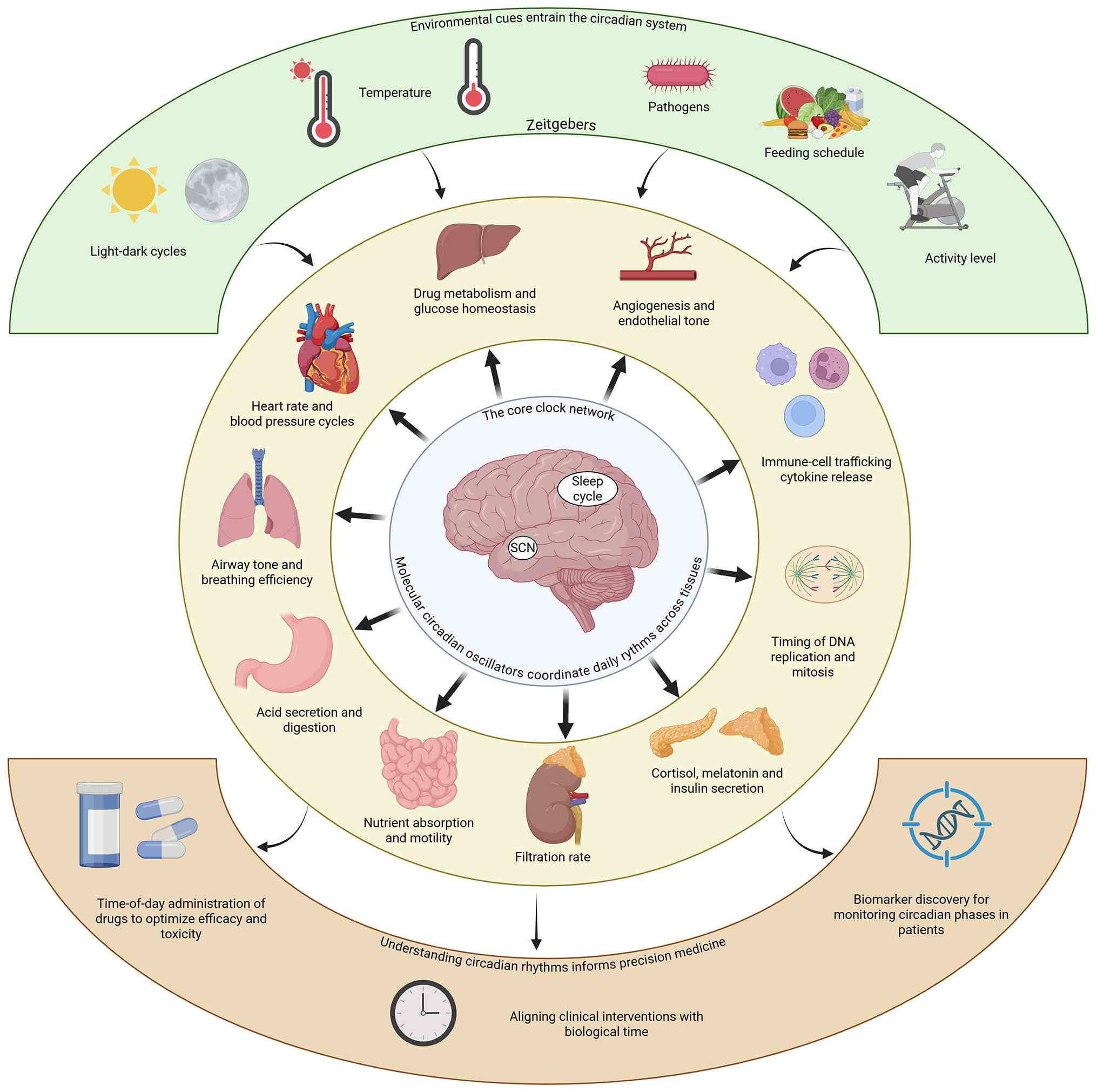 | Figure 1.Multi-layered organization of the
human circadian system. Created in BioRender. Ozgun, G. (2026)
https://BioRender.com/sqawr62. The
figure illustrates the hierarchical structure and clinical
relevance of circadian biology. The central ring represents the
core neural clock network, with the SCN acting as the master
pacemaker that synchronizes peripheral clocks across tissues via
the rhythmic expression of core clock genes, such as brain and
muscle ARNT-like protein 1, circadian locomotor output cycles
kaput, period circadian regulator and cryptochrome. The central
ring depicts key physiological processes that are subject to
circadian regulation, including metabolism, cardiovascular
function, immune activity, endocrine secretion and cell cycle
control; each of these processes follow tissue-specific circadian
patterns. The upper outer ring integrates environmental cues, such
as light, temperature, pathogens, eating schedule and activity,
which entrain internal clocks. The lower outer ring highlights the
clinical and translational implications of the circadian clock,
including the implementation of a chronotherapeutic approach in
clinical practice, which may pave the way for circadian biomarker
discovery and time-based optimization of treatment efficacy and
safety, as well as the development of personalized medicine. SCN,
suprachiasmatic nucleus. |
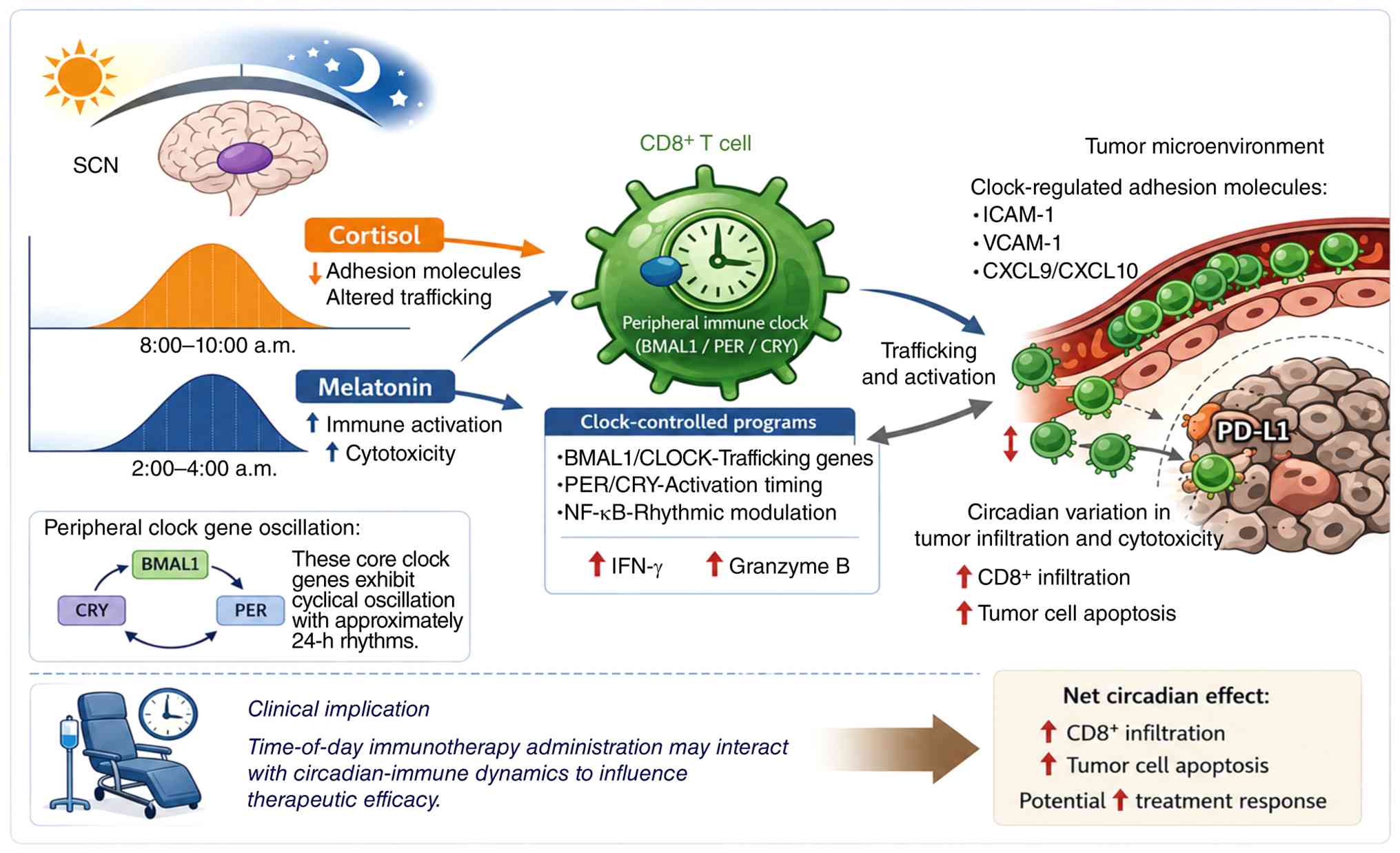 | Figure 2.Circadian regulation of
CD8+ T-cell infiltration and antitumor activity in
genitourinary malignancies. Created in BioRender. Ozgun, G. (2026)
https://BioRender.com/r2hqu0u. The
suprachiasmatic nucleus (purple) drives rhythmic systemic
oscillations in cortisol and melatonin, which provide temporal cues
to peripheral immune cells. Circulating CD8+ T cells
contain intrinsic circadian clock machinery, which includes BMAL1,
CLOCK, PER and CRY, that regulates trafficking programs and
effector functions, such as IFN-γ and granzyme B production. Within
the tumor vasculature, circadian variation in adhesion molecules,
such as ICAM-1 and VCAM-1, and chemokines, for example CXCL9 and
CXCL10, may influence T-cell adhesion and extravasation. In the
tumor microenvironment, rhythmic modulation of CD8+ infiltration
and cytotoxicity intersects with PD-1/PD-L1 signaling. The net
circadian effect may result in time-of-day-dependent variation in
tumor immune infiltration and apoptosis, providing a mechanistic
rationale for chrono-immunotherapy. CLOCK, circadian locomotor
output cycles kaput; BMAL1, brain and muscle ARNT-like protein 1;
PER, period circadian regulator; CRY, cryptochrome; ICAM-1,
intercellular adhesion molecule 1; VCAM, vascular cell adhesion
protein; PD-1, programmed cell death protein 1; PD-L1, programmed
cell death 1 ligand 1; CXCL, C-X-C motif chemokine. |
The influence of the circadian clock on the immune
system is multi-layered, affecting a range of factors, from the
systemic availability of immune cells to their local function
within the TME. A foundational manifestation of this control is the
daily oscillation of immune cells in circulation. Naive CD4 and CD8
T-cells have demonstrated notable circadian rhythms with a daytime
nadir, whereas mature effector CD8 T-cell counts have been shown to
peak during daytime hours. Notably, daytime increases in cortisol
mediated by C-X-C chemokine receptor type 4 (CXCR4) have
demonstrated the potential to redirect naive T cells from the
bloodstream into tissues rich in the corresponding ligand, C-X-C
motif chemokine ligand 12 (CXCL12), to the lymph nodes and bone
marrow (25,26). This rhythm of T-cell activity is
primarily driven by the morning surge of cortisol from the
hypothalamic-pituitary-adrenal axis (27).
Furthermore, T-cell infiltration in the tumor is
governed by a more complex, dual-layered control system. Beyond the
systemic availability of circulating lymphocytes, the vasculature
of the tumor itself exerts a local gatekeeping function (28). Preclinical models have demonstrated
that the endothelial cells lining tumor blood vessels possess their
own intrinsic circadian clock, which rhythmically modulates the
expression of adhesion molecules, such as intercellular adhesion
molecule 1 (ICAM-1) (29). This
local endothelial rhythm directly controls the extravasation of T
cells, which is influenced by hormones and the endothelial
clock-mediated permeability of local vasculature, from the
bloodstream into the TME, creating a specific time window for the
immune infiltration of tumors. As such, this dual control system
and the resulting immune infiltration window establishes a notable
framework for immune surveillance. The existence of two layers of
control suggests an evolutionarily conserved, redundant system.
This dual control also presents a notable therapeutic
consideration; it is unlikely that the optimal window for
immunotherapy administration is solely dependent on when T cells
are most abundant in the circulation, but instead when their
systemic availability is synchronized with the opening of the local
endothelial gate at the tumor site. The phase relationship between
these two rhythms may vary between individuals and tumor types,
suggesting that a one-size-fits-all timing strategy may be
suboptimal.
The optimal window for immunotherapy administration
and temporal differences in therapeutic response have been
attributed to multiple factors studied in preclinical settings,
resulting from SCN-mediated regulation of the aforementioned
biological clock genes of the immune system. As the circadian clock
controls the availability of immune cells, such as CD4+
and CD8+ T cells, dendritic cells and
macrophages, in the TME, immune-cell depletion is expected to occur
in the afternoon and peak a few hours after midnight (30). CD8+ T cells exhibit
natural day-night fluctuations in their function and infiltration
of tumor tissues, and these rhythms can influence the therapeutic
efficacy of immunotherapy. The activity of these cells varies not
only due to their own internal clocks but also as tumor blood
vessels respond differently to immune cell trafficking throughout
the day. In a number of preclinical models, chimeric antigen
receptor T-cell therapy or treatment using ICIs has been shown to
result in improved outcomes when CD8+ T cells reach
their peak count and activation status (29,31–33).
Chronic disruption of this complex system, whether through
environmental factors, such as shift work or jet lag, or internal
factors, such as aging, represents a recognized risk factor for
cancer development as well as a direct impediment to therapeutic
efficacy (34). Circadian
disruption fosters a pro-tumorigenic, immunosuppressive TME and can
directly dysregulate the molecular clock within tumor cells,
leading to the upregulation of immune checkpoint molecules, such as
programmed cell death 1 ligand 1 (PD-L1) (35). This creates a deleterious cycle in
which a disrupted circadian clock promotes oncogenesis, and the
dysregulated circadian clock of tumor tissues arms the tumor with
potent mechanisms of immune evasion, rendering it intrinsically
more resistant to treatment with ICIs (35).
Clinical evidence and emerging frontiers in
GU oncology
Clinical signal: Retrospective
evidence in RCC and UC
In previous years, there has been a growing interest
in the therapeutic potential of chronotherapy, with research
investigating the timing of chemotherapy dating back decades and
including a large body of work examining the timing of multiple
chemotherapy drugs in both experimental and human studies (36–38).
The largest prospective trial investigating chronotherapy was a
randomized trial involving 564 patients with colon cancer who
received 5-fluorouracil/oxaliplatin chemotherapy on either a
standard schedule or via timed administration, which was based on
optimal administration times predicted by male mouse studies
(39). The risk of mortality was
reduced by 25% in male patients subject to chronotherapy but
increased by 38% in female patients. Notably, there was no
sex-based difference in survival among patients subject to the
standard administration schedule; this schedule involved the
administration of drugs at random times, which is common in
chemotherapeutic regimens. Thus, the consistent timing of
therapeutic administration highlighted sex-based differences in
survival outcomes.
Despite a compelling biological rationale,
immunotherapeutic studies focused on GU cancers rarely evaluate the
effects of treatment timing and sex together; additionally, women
remain underrepresented in numerous trials, limiting the ability to
identify clinically meaningful interactions (40–43).
Furthermore, a growing body of retrospective evidence has suggested
that earlier administration of ICIs associates with improved
patient survival, although the causality of this association
remains to be elucidated in patients with metastatic RCC and UC
(44). As summarized in Table I (45–52),
multiple studies using international cohorts have reported notably
consistent findings regarding the therapeutic effects of
chrono-immunotherapy. However, only three studies from Table I explicitly adjusted for sex in
multivariable models; for the remaining studies, inclusion of sex
as a covariate was not specified in the described methods. As
evidence suggesting that time-of-day administration influences
ICI-based treatment outcomes continues to accumulate,
investigations into the role of sex in chrono-immunotherapy studies
is necessary to advance the clinical translation of
chrono-immunotherapeutic strategies (46,53).
 | Table I.Key retrospective studies of
chrono-immunotherapy in renal cell and urothelial carcinoma. |
Table I.
Key retrospective studies of
chrono-immunotherapy in renal cell and urothelial carcinoma.
| First author,
year | Cancer type | Regimen | Time of day
cut-off | Primary
endpoints | Number of
patients | Sex adjustment or
stratification | Key findings | (Refs.) |
|---|
| Molina-Cerrillo
et al, 2022 | mRCC | Immune checkpoint
inhibitor combinations, including PD-1 + CTLA-4, PD-1 + VEGF-TKI,
nivolumab + ipilimumab and pembrolizumab + axitinib | 4:30 p.m. | PFS | 61 | NR | Median PFS doubled
with earlier infusion (before 4:30 p.m.) at 12.3 vs. 5.6 months
(HR, 2.28; 95% CI, 1.1–5.15; P=0.048); trend to improved OS, but
data was immature | (45) |
| Nelson et
al, 2022 | Advanced solid
tumors (14.4% renal cell carcinoma) | Immune checkpoint
inhibitors and immunomodulatory combinations, including PD-1, PD-L1
inhibitors ± other investigational agents. | One cohort was
treated from 8 a.m. to 8 p.m. Another cohort was treated from 8
p.m. to 8 a.m. | OS and PFS | 4,441 | Yes, there were
adjustments for sex in the models | Poorer OS with
overnight time-of-day infusion for lung, renal and breast cancer;
specific daytime TOI in melanoma and H&N cancers also
associated with lower survival | (46) |
| Ortego et
al, 2022 | mUC | Immune checkpoint
inhibitor monotherapy using PD-1 or PD-L1 inhibitors | 4:30 p.m. | PFS, OS and RR | 92 | NR | <20% late
infusions associated with improved PFS (11.38 vs. 3.58 months), OS
more than doubled (14.04 vs. 6.8 months; HR, 2.62; P=0.001); RR
markedly improved (59.3% vs. 16.0%) | (47) |
| Fernandez-Mañas
et al, 2023 | mRCC | Immune checkpoint
inhibitor-based regimens ± VEGF-targeted therapy, for 2nd line
treatment | 4:30 p.m. | OS | 104 | NR | Late infusions of
ICIs in 2nd line treatments and beyond in the late group were
linked to shorter OS and treatment duration, as well as higher
progression rates | (48) |
| Dizman et
al, 2023 | mRCC | Immune checkpoint
inhibitors, including PD-1 monotherapy or PD-1 + CTLA-4, as well as
nivolumab ± ipilimumab, in 1st or 2nd line treatments | ≥20% infusions
occurred after 4:30 p.m. This defined the late TOI group | TTF, OS and
ORR | 135 | NR | The early TOI group
exhibited improved ORR (36% vs. 29.5%), longer TTF (9.5 vs. 4.6
months) and longer OS (46.3 vs. 41.7 months); TTF significance was
confirmed | (49) |
| Arroyave Ramirez
et al, 2024 | mRCC | Immune checkpoint
inhibitor combinations, such as PD-1 + CTLA-4 and nivolumab +
ipilimumab, in 1st line treatments | 4:30 p.m. | OS and ORR | 127 | NR | The early TOI group
(<20% infusions after 4:30 p.m.) had markedly longer OS (64.8
vs. 46.3 months; HR, 0.67; P=0.03)and higher ORR (32.8% vs. 22.4%;
P=0.04); stronger impact in intermediate- and poor-risk groups | (50) |
| Patel et al,
2024 | mRCC | Immune checkpoint
inhibitors, for example PD-1 monotherapy or PD-1 + CTLA-4
combination therapy, nivolumab, nivolumab + ipilimumab and
pembrolizumab | 12:00 p.m. | PFS, OS | 201 | Yes | Patient who
received ≥20% infusions before noon (Group A) demonstrated markedly
improved PFS (HR, 0.70; P=0.04) and OS (HR, 0.57; P=0.043); greater
peripheral CD8+ T-cell activation compared to those who
received <20% of infusions prior to noon (Group B) | (51) |
| Gonçalves et
al, 2025 | aUC | Immune checkpoint
inhibitor maintenance via PD-L1 inhibitors or avelumab | 2:00 p.m. | PFS, OS and
ORR | 105 | Yes | Morning infusions,
which were defined as those before 2:00 p.m., led to markedly
improved OS (39.5 vs. 14.4 months; HR, 0.35); trend toward improved
PFS (9.8 vs. 6.6 months; HR, 0.43) | (52) |
Furthermore, several retrospective studies have
demonstrated that morning or early-day infusions were associated
with improved PFS and OS in patients with metastatic RCC. For
example, a 2024 multi-center analysis reported a 43% reduction in
mortality risk for patients receiving infusions before noon [hazard
ratio (HR), 0.57] (51). These
findings were corroborated by studies on Mexican and European
cohorts, which showed that earlier infusions could more than double
median PFS and extend median OS (45,51).
The therapeutic benefits of early-day infusions in
UC have been shown to be of similar notability. A retrospective
study of patients receiving avelumab maintenance therapy published
in 2025 demonstrated that morning infusions were associated with a
65% reduction in mortality rate, extending the median OS of
patients from 14.4 to 39.5 months (HR, 0.35) (52). An earlier study in a cohort of
patients with metastatic UC reported that early-day infusions more
than doubled the median OS and tripled the median PFS (47). The consistency and magnitude of
these findings provide a strong impetus for prospective validation.
Our previous study, which was conducted using a limited cohort of
patients with metastatic UC who received P as a second line
treatment, also demonstrated that OS and PFS were markedly improved
in patients whose average infusion time for the first two treatment
cycles was before 2:00 p.m. compared with the late-time-of-day
infusion group (54). A larger
retrospective cohort analysis is currently underway.
Chrono-immunotherapy in prostate
cancer: Biological rationale
Despite the relative paucity of clinical data
evaluating chrono-immunotherapy in prostate cancer, several
converging lines of evidence support a biologically plausible role
for circadian timing in modulating tumor-immune interactions for
this disease.
The interaction between circadian biology and
androgen signaling represents a notable consideration for the
implementation of chronotherapy in prostate cancer treatment. The
circadian clock gene PER1 has been revealed to be downregulated in
human prostate cancer samples and its protein product has been
shown to physically interact with androgen receptors (ARs),
resulting in a decrease in AR transactivation (55). Coordination of the circadian clock
and androgen signaling is important for maintaining the rhythmic
expression of androgen-regulated genes. Furthermore, androgens have
been shown to regulate the structure and function of the SCN
circadian clock, where ARs are highly present (56,57).
Androgen levels have also been shown to exhibit diurnal variation.
Notably, single nucleotide polymorphisms associated with variable
prostate cancer risk have been identified in several clock genes
(29,33).
Androgen deprivation therapy (ADT), a foundational
therapeutic strategy for prostate cancer management, has been shown
to exert notable immunomodulatory effects that may be temporally
dynamic (58). ADT has also been
shown to notably aggravate the prostate TME, resulting in an
inflamed milieu that exhibits increased activated CD8+ T
cell counts, expansion of pro-inflammatory M1-like tumor-associated
macrophages, upregulation of major histocompatibility complex class
I and II antigen presentation and downregulation of CD47 (59,60).
ADT also restores thymic output, with newly generated thymic
emigrants trafficking to tumors where they become activated
(61). However, a proportional
increase in regulatory T cell count and PD-L1 expression has been
shown to accompany the CD8+ T-cell infiltrate,
suggesting that ADT contributes to the development of adaptive
immune resistance (62). Anti-PD-1
immunotherapy combined with ADT has been shown to induce robust
immune infiltration in patients with metastatic
castration-sensitive prostate cancer (63). Given the established circadian
oscillations in CD8+ T-cell tumor infiltration and
function, as well as the aforementioned circadian expression of
PD-L1 on myeloid suppressor cells, the immunological effects of ADT
and its synergy with immunotherapy could plausibly be influenced by
treatment timing (64,65).
Notably, the chronotherapeutic rationale in prostate
cancer extends beyond the use of ICIs, which only benefits the
small subset of patients with MSI-H prostate cancer. Testosterone
levels have been shown to peak in the early morning, and AR-driven
transcriptional activity, including prostate-specific antigen
expression, also follows this diurnal pattern (66,67).
This creates a pharmacodynamic window during which AR pathway
inhibitors may achieve maximal target engagement by blocking the AR
signaling pathway at its point of greatest activity (68). Furthermore, circulating lymphocyte
counts reach a nadir in the daytime, which reflects the active
redistribution of immune cells into tissues, including lymph nodes
and tumors, where they are optimally positioned for antigen
encounter and activation (69).
Dendritic cells exhibit peak lymphatic migration and enhanced
antigen processing during this redistribution period, and
CD8+ T-cell tumor infiltration and effector function
also oscillate in a circadian manner (29,55).
The convergence of peak androgen signaling vulnerability with
tissue-positioned immune readiness suggests that morning-timed
treatments could simultaneously optimize both hormonal blockade and
immune-mediated tumor clearance. This rationale applies broadly
across the prostate cancer treatment landscape, including: i) ADT
and next-generation AR pathway inhibition; ii) radiation therapy,
for which preclinical data have demonstrated superior therapeutic
efficacy with morning-timed administration than standard
scheduling; and iii) combination strategies employing
poly(ADP-ribose) polymerase (PARP) inhibitors, which target DNA
damage repair genes that also exhibit circadian expression patterns
(70,71). Together, this suggests that the
administration of treatments in the morning could improve their
overall effectiveness by aligning therapies with hormonal and
immune rhythms.
Overall, the complex interplay between the circadian
clock, androgen signaling and cellular senescence represents a
promising yet underexplored subject in prostate cancer research
(33,72). Future studies should take this into
account in clinical trial design to explore whether temporal
optimization of ADT or immunotherapy can enhance treatment efficacy
in this immunologically cold malignancy (58,73).
From hypothesis to clinical standard: A
roadmap for translation
Critical appraisal: The indispensable
caveat of retrospective data
Although basic scientific data exists to explain the
influence of the circadian rhythm on immunotherapy, the underlying
mechanisms of this interaction remain incompletely elucidated. It
is important to recognize that almost all current human evidence is
retrospective and, therefore, hypothesis-generating at best,
despite the consistency of results across clinical studies
(74–76). Retrospective analyses are highly
susceptible to selection bias and confounding factors that cannot
be fully adjusted for. It is also possible that patient-related
factors, rather than the timing of the treatment itself, were
responsible for the results of the aforementioned retrospective
studies. For instance, patients who receive immunotherapeutic
infusions earlier in the day may be healthier, employed and
demonstrate improved therapeutic outcomes, whereas frail patients
or those with a poorer prognosis may require more time to prepare
for appointments and consequently receive treatment later in the
day (74).
Furthermore, chronotype is shaped by a mix of
biology, environment and lifestyle, and represents another
consideration regarding the applicability and efficacy of
chronotherapy (77). Genetics play
a notable role in determining chronotype, as sleep onset time is
influenced by a number of rare mutations in core clock genes and
numerous common variants, whereas age and sex have also been shown
to contribute to chronotype; individuals tend to exhibit
chronotypes favoring later sleep onset times during puberty and
gradually shift chronotype towards earlier sleep onset with aging,
and men generally exhibit more evening-typed chronotypes than women
until menopause (78–80). Women exhibit stronger circadian
immune rhythms and sex hormone-dependent regulation of clock genes
compared with men, as well as distinct cortisol patterns, yet the
majority of chronotherapy studies lack sex-stratified analyses
(44,81,82).
Female patients also demonstrate greater hormonal amplitude than
male patients, as well as sex-specific circadian-immune
interactions, which may influence optimal treatment timing
(83–90). Sex-based differences in cortisol
dynamics and generally stronger baseline immune responses in women
further support this, with clinical data suggesting greater timing
sensitivity in women (75,91–95).
Hormones, homeostatic sleep pressure and individual circadian
traits further shape these chronotype patterns (78). Environmental factors, particularly
light exposure and screen use, strongly affect chronotype: High
exposure to bright lights at night and limited exposure to daylight
have been shown to affect sleeping patterns, with light sensitivity
varying widely between individuals (96).
Geography has also been shown to contribute to
chronotype; individuals living farther from the equator or in
locations that experience later sunsets tend to display later sleep
onset times than individuals located in equatorial regions
(97). Finally, social and
behavioral factors, including work schedules, education level,
physical activity, alcohol consumption, smoking, childcare
responsibilities, religious practices and even sleep quality, can
shift or mask intrinsic circadian preferences, often widening the
gap between desired and true sleep onset time (98,99).
Meanwhile, the manner in which clinics and
healthcare systems operate can introduce additional biases into
practice. Logistical constraints and clinical workflow primarily
govern appointment scheduling in oncology centers. Clinical
scheduling is influenced by a number of practical issues, for
example: i) How complex an appointment is expected to be; ii) how
predictable patient flow is; iii) the experience level of
individuals responsible for curating schedules; and iv) the limits
of the information technology system used by the clinic (100). Clinics may implicitly or
explicitly assign complex or potentially time-consuming
appointments to periods with lower workload, which are often later
in the day. All of the aforementioned factors, as well as
variations in study design, such as the definitions of timing for
morning and afternoon infusions, treatment type and the line of
therapy studied, complicate the interpretation of retrospective
studies and may explain the observed differences in patient
survival outcomes between studies.
Notably, a retrospective analysis of the
single-center, multi-cohort investigator-initiated phase II study
of pembrolizumab immunological response evaluation (INSPIRE) study
evaluated whether the timing of P administration influenced
clinical outcomes in 106 patients with diverse malignancies,
including GU malignancies. The median infusion start time was 3:06
p.m. for the first treatment dose and 3:11 p.m. across all doses,
and the range of infusion start times extended from 09:19 a.m. to
6:34 p.m. Multiple predefined timing thresholds were assessed,
including: i) Administration before vs. after noon; ii)
administration before vs. after the median start time; iii) the
proportion of doses delivered after 4:30 p.m. (≥20% threshold); and
iv) the season of treatment initiation. Across all analyses,
infusion timing was not associated with PFS, OS or the incidence of
grade ≥2 immune-related adverse events according to Common
Terminology Criteria for Adverse Events, and findings were
consistent across tumor-specific subgroup analyses. However, the
initial study demonstrated a median follow-up of only 11.5 months,
which was notably shorter than positive studies in the literature,
such as the MEMOIR trial, which extended OS monitoring to 5 years,
Retro TIMing trial, which lasted 29 months, and a trial on a
Japanese non-small cell lung cancer (NSCLC) cohort, which lasted
for 62.5 months. With only 106 patients fragmented across five
cohorts of patients with cancer, containing as few as 12 patients
with melanoma per subgroup, the INSPIRE study was too underpowered
to derive a sufficient conclusion on chronotherapeutic efficacy.
Additional limitations of the INSPIRE study included: i) Tumor
heterogeneity inherent to the basket design of the study; ii) the
possibility that lower overall response rates in a mixed tumor
population may have diluted potential chronotherapy signals
observed in more immunotherapy-responsive cancers; and iii) the
single-center Canadian setting, which raises the possibility that
geographical or seasonal differences not observed within the study
may limit treatment generalizability (75,76,101,102).
Negative trials are important for defining the
boundaries of chrono-immunotherapy. A detailed comparison of the
INSPIRE study and GU-specific retrospective analyses is provided in
Table SI (45–51,76,103),
highlighting key differences in study design, patient populations,
timing definitions and statistical reporting. Furthermore, several
features of prior retrospective analyses have raised the
possibility of false-positive findings in chrono-immunotherapy
studies, including: i) Residual confounding factors, for example
patients with higher fitness levels may have been preferentially
treated earlier in the day; ii) the use of operational rather than
biologically defined timing cut-offs; and iii) multiple hypothesis
testing across different time thresholds without correction. All of
these factors may inflate type I error rates (44,91–93).
These features raise the possibility of publication bias and serve
as a reminder that biological rationale on its own is not
sufficient to support the efficacy of a treatment. A prime example
of this is the Cardiac Arrhythmia Suppression Trial, which
demonstrated higher mortality rates in patients treated with
anti-arrhythmic drugs (compared with placebo) after myocardial
infarction despite strong biological reasoning supporting their
therapeutic potential, further supporting the necessity of
prospective trials (74).
Path forward: A methodological
framework for prospective validation
The convergence of a strong biological rationale and
consistent retrospective data has generated an important hypothesis
regarding the efficacy of chrono-immunotherapy. To translate this
concept into a clinical standard of care, well-designed pragmatic,
prospective, randomized controlled trials (RCTs) are needed
(74).
However, emerging research has revealed an important
layer of complexity that should inform the design of future
studies: The plasticity of human chronotype. Chronotype is not a
fixed trait but a dynamic state resulting from continuous
interactions between the endogenous circadian system and external
environmental cues (104). A
number of external signals have been shown to influence the
circadian system, which are known as zeitgebers. The most
implicated zeitgebers with the largest reported effects are
light-dark cycles, temperature, exercise, pathogens and nutrition
(105). Prior analyses have shown
that societal factors, particularly work schedules, markedly shape
the internal time of an individual. Occupationally active
individuals exhibit chronotypes that are markedly earlier than
those of non-working individuals, and internal rhythms can shift
measurably between workdays and weekends (106,107). This plasticity provides a
mechanistic explanation for potential confounding effects in prior
retrospective studies; patients available for morning infusions may
have more structured daily routines; therefore, the improved
patient outcomes observed in early-administration cohorts may have
been linked to the more robust underlying circadian health of these
individuals, rather than the treatment timing itself. As such, a
randomized trial design is required to definitively isolate the
therapeutic effect of administration time (37,108),
including: i) Randomized treatment timing; ii) standardized
definitions of exposure windows; iii) tumor-specific stratification
factors; and iv) sex and individual circadian measures, such as
chronotype.
Historically, the morningness-eveningness
questionnaire (MEQ), a subjective assessment tool, has been used to
assess circadian phases, with important limitations. Notably, this
questionnaire reflects self-reported preference rather than true
biological circadian phase and can be influenced by social factors.
As such, MEQ may misclassify circadian timing and should be
interpreted cautiously in chronotherapy studies (109). Subsequently, the dim light
melatonin onset (DLMO) assay was developed, which measures the
increases in melatonin level in saliva observed during evening
hours (109,110). Although the DLMO assay represents
the physiological benchmark for circadian phase assessment, routine
implementation of this assay in high-volume oncology practice is
unrealistic due to the resulting logistical burden, complicated
technique and cost (110–112). Therefore, more powerful and
feasible tools are required for the identification of patients who
may respond more effectively to morning or afternoon treatment
schedules, thereby helping to align therapy with the circadian
rhythm of each patient for improved outcomes.
Molecular clock-based assays, such as TimeTeller,
which estimate internal circadian time via RNA sequencing of
tissues such as the oral mucosa, offer a robust and feasible
approach (113,114). In parallel, actigraphy and
consumer-grade wearable devices provide low-cost, minimally
invasive longitudinal estimates of activity-rest cycles and
chronotype that could serve as practical surrogates for circadian
phase (112). Notably, initial
implementation of circadian rhythm data for chrono-immunotherapy
studies may not require individualized phase assessment; the
standardization of therapeutic infusions to a defined morning
window could serve as a pragmatic first step, with biomarker-guided
refinement reserved for further research settings. This tiered
approach may balance biological precision with clinical feasibility
and therefore enhance the translational viability of
chrono-immunotherapy.
Moving forward, a combination of clinical and
molecular tools could enable the capture of multidimensional
information to examine the real-time effects of the circadian
rhythm and its effects on the immune system. Within this context,
integrated translational studies may represent an important method
of elucidating immune biology mechanisms and TME changes that are
influenced by circadian time, helping to distinguish true circadian
effects from experimental noise and generate evidence that will
markedly influence clinical practices. Incorporating longitudinal
sampling into the design of future studies may help to capture
dynamic changes in the immune system over time, revealing daily
oscillations in key immune cell populations and clarifying the
mechanisms (115). The ultimate
goal is to determine optimal treatment timing, for example morning
versus afternoon, and the appropriate number or proportion of
treatment cycles to mandate for improved therapeutic efficacy.
On another note, circadian amplitude, which is the
magnitude of oscillation between peak and trough values in
circadian rhythms, is another important factor in chronobiology and
represents an important indicator of health that often declines
with age and disease. The circadian amplitude of an individual
patient could represent an important predictive biomarker,
identifying patients with a robust, coordinated immune system who
are most likely to benefit from timed immunotherapy (110). Overall, the combination of
advanced technologies could help determine whether the timing of a
therapy influences patient outcomes, paving the way for
personalized chronotherapy approaches.
From bench to bedside: Considerations
for clinical application
It is important to determine a cut-off time for
grouping patients for early- or late-time-of-day drug
administration (116). However,
this was not standardized in the available retrospective data, and
cut-off times for patient stratification were predominantly based
on data from Qian et al (75), which were modified according to
practical or clinical considerations. Across retrospective studies,
the cut-off time to determine early and late treatment groups
varies, including noon, 2:00, 3:00 or 4:30 p.m. (75,101,117). As such, an optimal cut-off time
has yet to be determined. A portion of this variability may reflect
practical scheduling constraints within clinical infusion centers,
whereas this variation also partially reflects attempts to align
treatment timing with different interpretations of circadian immune
biology.
The MEMOIR study, for example, selected 4:30 p.m. as
the cut-off time for treatment groups based on data suggesting that
circulating naïve CD4 and CD8 T cells approach a late-day nadir at
this approximate time (75). Due to
the differential classification of patients treated between midday
and late afternoon across studies, some degree of exposure
misclassification remains unavoidable, which likely contributes to
variability in the reported outcomes.
More broadly, these differences in cut-off time
highlight the absence of a consensus regarding the biologically
optimal treatment window. Similar challenges have been identified
in earlier chronotherapy research involving chemotherapy, which
uncovered promising biological signals that were difficult to
translate into clinical practice (37). An additional layer of complexity
regarding temporal stratification stems from the growing
recognition that circadian phases vary widely between individuals.
Differences in chronotype may shift the biologically relevant
treatment window by several hours, raising the possibility that
fixed clock-time cut-off values only represent a practical
approximation of chronotherapeutic efficacy rather than a
physiologically precise strategy (30,37,53,118).
Toward a biologically informed
treatment window
Circadian physiology provides a useful framework for
elucidating how treatment timing might influence immunotherapy
outcomes. Cortisol levels have been shown to reach their peak in
the early morning and then decline gradually over the course of the
day, and lymphocyte trafficking and T-cell activation capacity have
also been shown to follow coordinated daily rhythms (95,119–123). Circadian variation in circulating
T cells is subset-specific: Naïve CD4+ and CD8+ T cells show a
daytime decrease, potentially due to cortisol/CXCR4-driven
redistribution to the bone marrow, while terminally differentiated
effector CD8+ T cells are increased during daytime hours (75). Although these findings require
validation in well-designed trials, they support the broader
concept that immunotherapy delivered during periods of greater
immune activation capacity may produce more effective antitumor
responses.
Taken together, available physiological and early
clinical data suggest that the late-morning to early-afternoon
period may represent a reasonable biologically aligned window for
ICI administration. Furthermore, the circadian phase and chronotype
of an individual may shift the optimal timing of ICI
administration. Future studies incorporating simple circadian
assessments may help to progress chrono-immunotherapy translation
to create more personalized scheduling approaches aligned with the
intrinsic biological rhythms of each patient (30,37,118).
Other clinical considerations for
determining the optimal treatment window
Another aspect of treatment timing to consider is
the type of ICI used, as there may be differences in therapeutic
responses to variable time-of-day administration among different
treatments and diseases, which should be addressed in future
research (124). The number of
treatment cycles required for immune priming represents another
aspect of chronotherapy that remains poorly defined.
Rodent studies have shown that after initial
treatment cycles, the response to the timing of administration
diminished. The reasons behind this reduction in response intensity
over the course of treatment remains poorly understood. The reason
may partly have been due to the potentially long half-lives of
drugs used, resulting in the maintenance of relatively constant
systemic drug levels and therefore a reduction in patient
sensitivity to dosing time (125–128). Notably, an immunotherapy trial
conducted in patients with NSCLC reported improved median PFS and
OS in patients who received at least one of the first four
treatment cycles prior to noon compared with those who received
only late-day drug administration (129). As such, investigations into the
optimal number of treatment cycles or the percentage of cycles that
should be mandated to achieve a meaningful difference in treatment
response will play an important role in translation.
In the rapidly evolving field of chronotherapy,
well-designed prospective RCTs are required to validate
retrospective findings and to further elucidate the mechanisms
underlying chronotherapy and chronobiology in GU oncology. Building
on our retrospective research project that supported the findings
reported in the literature, two investigator-initiated phase III
RCTs have been initiated by our research group: i) An RCT
investigating the impact of time-of-day administration of EV and P
in metastatic UC (ClinicalTrials.gov identifier NCT07346053); and
ii) an RCT examining the impact of time-of-day administration on
dual immune checkpoint inhibition in advanced RCC
(ClinicalTrials.gov identifier NCT07338981). As the opposite
sex-specific effects were observed in the literature, we have
incorporated sex as a stratification factor in the trial design.
Treatment timing was determined according to existing literature
and expert opinion. Additionally, the assessment of different
timing groups in the morning and afternoon, as well as correlation
analyses on the observed outcomes, to improve the analysis of the
therapeutic benefits associated with different administration
times, will be included. Furthermore, the chronotype information of
trial participants has been incorporated into the study design. We
have also intentionally included a gap between the morning and
afternoon groups to capture potential differences in outcomes with
improved accuracy and to avoid potential overlap between treatment
groups. These studies aim to reshape the field of GU oncology by
providing insights into the relationship between tumor biology and
chronotherapy, guiding the design of prospective trials and
accelerating progress toward determining whether chronotherapy can
optimize treatment outcomes in GU cancers.
Practical considerations for clinical
implementation
In the event that prospective RCTs support the
influence of time-of-day administration on immunotherapy outcomes,
the most notable challenge for clinical translation will be
implementing chronotherapy into routine oncology practice. Unlike
pharmacological innovations, the clinical translation of
treatment-timing strategies requires health-system workflow
adjustments, staffing considerations and careful attention to
equitable patient access (44).
Implementation planning should therefore be considered early in the
translation process.
Clinical workflow and capacity
The majority of oncology infusion centers already
experience peak activity during morning hours, which is driven by
patient preference, laboratory processing workflows and staffing
patterns (130). A shift toward
preferential morning delivery of immunotherapy could exacerbate
existing clinical bottlenecks associated with chair availability,
pharmacy preparation timelines and nursing support. Health systems
may therefore need to adopt a range of operational strategies if
early treatment administration demonstrates improved efficacy
(130).
One approach to implementing chronotherapy in
clinical practice would involve the expansion of morning infusion
capacity through earlier opening hours and increased staffing
support. Although this may be feasible in some clinical centers,
its implementation could incur substantial financial costs and, if
not carefully managed, may markedly increase workload demands and
contribute to fatigue among nursing staff. Although
treatment-timing interventions have often been described as
‘low-cost’ or ‘cost-neutral’, rigid scheduling recommendations
could unintentionally create access barriers for some patient
populations (53). Patients living
in rural or geographically remote areas may need to travel several
hours to reach clinical infusion centers; as such, mandatory
early-morning appointments could necessitate overnight
accommodation or departures during the early pre-dawn hours.
Notably, transportation barriers and limit paratransit servies have
been associated with delayed follow-up, reduced accessibility of
specialized medical care and treatment inconsistent with
established guidelines in remote areas (131–133). Considering chronotherapy from a
health economics perspective, formal cost-effectiveness analyses
would be necessary before implementing widespread timing-based
clinical scheduling changes. Cost-effectiveness frameworks should
therefore incorporate not only potential survival benefits, but
also operational costs, patient-incurred expenses, such as
transportation and accommodation, and equity impacts. Notably, even
interventions with minimal drug-related costs may not be
cost-effective if they exacerbate access barriers or
disproportionately burden vulnerable populations (134,135).
An alternate strategy for synthesizing optimal
therapeutic timing with clinical practice involves staggered
morning scheduling, for example 07:00, 09:00 and 11:00 a.m. start
times within medical centers, to distribute patient flow more
evenly while preserving early-day drug administration (130). A third approach may involve
biologically targeted prioritization, in which patients most likely
to benefit from chrono-immunotherapy, based on evaluations using
biomarkers, chronotype assessments or disease-specific evidence,
are preferentially allocated to the appropriate clinical time
slots.
Collectively, these strategies highlight the fact
that the practical implementation of chrono-immunotherapy would
likely require adaptive, institution-specific scheduling solutions
rather than uniform mandates across all infusion centers (130). Additionally, given that
retrospective data suggest that the timing of initial treatment
cycles exerts the greatest impact on therapeutic efficacy, focusing
the allocation of early-day clinical time slots to patients
undergoing initial treatment cycles may simplify the practical
implementation of chronotherapy, as this strategy would not require
timing adjustments for the entire course of therapy.
Conclusions: Translating biological rhythms
into standard of care
The field of chrono-immunotherapy in GU oncology
stands at an important juncture. The study of chrono-immunotherapy
has progressed from a biological concept rooted in the fundamental
role of the circadian clock in regulating immunity to a tangible
clinical signal supported by consistent retrospective data, with
ongoing prospective trials attempting to validate the concept.
Ultimately, chrono-immunotherapy represents a paradigm shift in
therapeutic rationale. This therapeutic strategy does not involve a
new drug, but a new dimension of care: A readily accessible
strategy that leverages the physiology of a patient to enhance the
efficacy of existing treatments. Although chrono-immunotherapy
involves no additional drug costs, implementation into clinical
practice would require upfront investment in clinical workflow
optimization and may therefore impose indirect costs on patients.
Formal cost-effectiveness analyses comparing these implementation
costs against the potential survival benefits associated with
chrono-immunotherapy will be necessary before widespread adoption
of this therapeutic strategy.
Supplementary Material
Supporting Data
Acknowledgements
Not applicable.
Funding
Funding: No funding was received.
Availability of data and materials
Not applicable.
Authors' contributions
OZD, BE and GO conceived and designed the present
review. OZD, XY and GO wrote the original draft of the manuscript.
OZD, XY, PL, RA, GB, CK, BE and GO revised the manuscript. Data
authentication is not applicable. All authors read and approved the
final version of the manuscript.
Ethics approval and consent to
participate
Not applicable.
Patient consent for publication
Not applicable.
Competing interests
The authors declare that they have no competing
interests.
Glossary
Abbreviations
Abbreviations:
|
GU
|
genitourinary
|
|
UC
|
urothelial carcinoma
|
|
RCC
|
renal cell carcinoma
|
|
ICIs
|
immune checkpoint inhibitors
|
|
OS
|
overall survival
|
|
VEGF
|
vascular endothelial growth factor
|
|
TKI
|
tyrosine kinase inhibitor
|
|
PFS
|
progression-free survival
|
|
TME
|
tumor microenvironment
|
|
P
|
pembrolizumab
|
|
EV
|
enfortumab vedotin
|
|
MSI-H
|
microsatellite instability-high
|
|
SCN
|
suprachiasmatic nucleus
|
|
HR
|
hazard ratio
|
|
NSCLC
|
non-small cell lung cancer
|
|
RCT
|
randomized controlled trial
|
|
MEQ
|
morningness-eveningness
questionnaire
|
|
DLMO
|
dim light melatonin onset
|
|
AR
|
androgen receptor
|
|
ADT
|
androgen deprivation therapy
|
References
|
1
|
Jang A, Adler DM, Rauterkus GP, Bilen MA
and Barata PC: Immunotherapies in genitourinary oncology: Where are
we now? Where are we going? Cancers (Basel). 13:50652021.
View Article : Google Scholar : PubMed/NCBI
|
|
2
|
Labadie BW, Balar AV and Luke JJ: Immune
checkpoint inhibitors for genitourinary cancers: Treatment
indications, investigational approaches and biomarkers. Cancers
(Basel). 13:54152021. View Article : Google Scholar : PubMed/NCBI
|
|
3
|
Motzer RJ, Tannir NM, McDermott DF, Arén
Frontera O, Melichar B, Choueiri TK, Plimack ER, Barthélémy P,
Porta C, George S, et al: Nivolumab plus ipilimumab versus
sunitinib in advanced renal-cell carcinoma. N Engl J Med.
378:1277–1290. 2018. View Article : Google Scholar : PubMed/NCBI
|
|
4
|
Tannir NM, Albigès L, McDermott DF,
Burotto M, Choueiri TK, Hammers HJ, Barthélémy P, Plimack ER, Porta
C, George S, et al: Nivolumab plus ipilimumab versus sunitinib for
first-line treatment of advanced renal cell carcinoma: Extended
8-year follow-up results of efficacy and safety from the phase III
CheckMate 214 trial. Ann Oncol. 35:1026–1038. 2024. View Article : Google Scholar : PubMed/NCBI
|
|
5
|
Rini BI, Plimack ER, Stus V, Gafanov R,
Hawkins R, Nosov D, Pouliot F, Alekseev B, Soulières D, Melichar B,
et al: Pembrolizumab plus axitinib versus sunitinib for advanced
renal-cell carcinoma. N Engl J Med. 380:1116–1127. 2019. View Article : Google Scholar : PubMed/NCBI
|
|
6
|
Choueiri TK, Powles T, Burotto M, Escudier
B, Bourlon MT, Zurawski B, Oyervides Juárez VM, Hsieh JJ, Basso U,
Shah AY, et al: Nivolumab plus cabozantinib versus sunitinib for
advanced renal-cell carcinoma. N Engl J Med. 384:829–841. 2021.
View Article : Google Scholar : PubMed/NCBI
|
|
7
|
Motzer R, Alekseev B, Rha SY, Porta C, Eto
M, Powles T, Grünwald V, Hutson TE, Kopyltsov E, Méndez-Vidal MJ,
et al: Lenvatinib plus pembrolizumab or everolimus for advanced
renal cell carcinoma. N Engl J Med. 384:1289–1300. 2021. View Article : Google Scholar : PubMed/NCBI
|
|
8
|
Powles T, Park SH, Voog E, Caserta C,
Valderrama BP, Gurney H, Kalofonos H, Radulović S, Demey W, Ullén
A, et al: Avelumab maintenance therapy for advanced or metastatic
urothelial carcinoma. N Engl J Med. 383:1218–1230. 2020. View Article : Google Scholar : PubMed/NCBI
|
|
9
|
Bellmunt J, de Wit R, Vaughn DJ, Fradet Y,
Lee JL, Fong L, Vogelzang NJ, Climent MA, Petrylak DP, Choueiri TK,
et al: Pembrolizumab as second-line therapy for advanced urothelial
carcinoma. N Engl J Med. 376:1015–1026. 2017. View Article : Google Scholar : PubMed/NCBI
|
|
10
|
Powles T, Valderrama BP, Gupta S, Bedke J,
Kikuchi E, Hoffman-Censits J, Iyer G, Vulsteke C, Park SH, Shin SJ,
et al: Enfortumab vedotin and pembrolizumab in untreated advanced
urothelial cancer. N Engl J Med. 390:875–888. 2024. View Article : Google Scholar : PubMed/NCBI
|
|
11
|
Necchi A, Bedke J, Galsky MD, Shore ND,
Plimack ER, Xylinas E, Jia C, Hennika T, Moreno BH and Witjes A:
Phase 3 KEYNOTE-905/EV-303: Perioperative pembrolizumab (pembro) or
pembro + enfortumab vedotin (EV) for muscle-invasive bladder cancer
(MIBC). J Clin Oncol. 41 (Suppl 6):TPS5852023. View Article : Google Scholar
|
|
12
|
Hoimes CJ, Bedke J, Loriot Y, Nishiyama H,
Fang X, Kataria RS, Moreno BH and Galsky MD: KEYNOTE-B15/EV-304:
Randomized phase 3 study of perioperative enfortumab vedotin plus
pembrolizumab versus chemotherapy in cisplatin-eligible patients
with muscle-invasive bladder cancer (MIBC). J Clin Oncol. 39 (15
Suppl):TPS45872021. View Article : Google Scholar
|
|
13
|
Evans ST, Jani Y, Jansen CS, Yildirim A,
Kalemoglu E and Bilen MA: Understanding and overcoming resistance
to immunotherapy in genitourinary cancers. Cancer Biol Ther.
25:23425992024. View Article : Google Scholar : PubMed/NCBI
|
|
14
|
Iinuma K, Yamada T, Kameyama K, Taniguchi
T, Kawada K, Ishida T, Nagai S, Enomoto T, Ueda S, Takagi K, et al:
The efficacy and safety of immune checkpoint inhibitor and tyrosine
kinase inhibitor combination therapy for advanced or metastatic
renal cell carcinoma: A multicenter retrospective real-world cohort
study. Cancers (Basel). 15:9472023. View Article : Google Scholar : PubMed/NCBI
|
|
15
|
Stultz J and Fong L: How to turn up the
heat on the cold immune microenvironment of metastatic prostate
cancer. Prostate Cancer Prostatic Dis. 24:697–717. 2021. View Article : Google Scholar : PubMed/NCBI
|
|
16
|
Abida W, Cheng ML, Armenia J, Middha S,
Autio KA, Vargas HA, Rathkopf D, Morris MJ, Danila DC, Slovin SF,
et al: Analysis of the prevalence of microsatellite instability in
prostate cancer and response to immune checkpoint blockade. JAMA
Oncol. 5:471–478. 2019. View Article : Google Scholar : PubMed/NCBI
|
|
17
|
Liu JL, Xu X, Rixiati Y, Wang CY, Ni HL,
Chen WS, Gong HM, Zhang ZL, Li S, Shen T and Li JM: Dysfunctional
circadian clock accelerates cancer metastasis by intestinal
microbiota triggering accumulation of myeloid-derived suppressor
cells. Cell Metab. 36:1320–1334.e9. 2024. View Article : Google Scholar : PubMed/NCBI
|
|
18
|
Li J, Luo P, Liu Y, Fang Y, Wang L and
Jiang A: Circadian rhythms in tumor regulation: Impacts on tumor
progression and the immune microenvironment. Explor Res Hypothesis
Med. 10:135–139. 2025.PubMed/NCBI
|
|
19
|
Albuquerque T, Neves AR, Quintela T and
Costa D: Exploring the link between chronobiology and drug
delivery: Effects on cancer therapy. J Mol Med (Berl).
99:1349–1371. 2021. View Article : Google Scholar : PubMed/NCBI
|
|
20
|
Wu Y, Tao B, Zhang T, Fan Y and Mao R:
Pan-cancer analysis reveals disrupted circadian clock associates
with T cell exhaustion. Front Immunol. 10:24512019. View Article : Google Scholar : PubMed/NCBI
|
|
21
|
Li HX: The role of circadian clock genes
in tumors. Onco Targets Ther. 12:3645–3660. 2019. View Article : Google Scholar : PubMed/NCBI
|
|
22
|
Reppert SM and Weaver DR: Coordination of
circadian timing in mammals. Nature. 418:935–941. 2002. View Article : Google Scholar : PubMed/NCBI
|
|
23
|
Takahashi JS: Transcriptional architecture
of the mammalian circadian clock. Nat Rev Genet. 18:164–179. 2017.
View Article : Google Scholar : PubMed/NCBI
|
|
24
|
Wu YL, Tsuboi M, He J, John T, Grohe C,
Majem M, Goldman JW, Laktionov K, Kim SW, Kato T, et al:
Osimertinib in resected EGFR-mutated non-small-cell lung cancer. N
Engl J Med. 383:1711–1723. 2020. View Article : Google Scholar : PubMed/NCBI
|
|
25
|
Dimitrov S, Benedict C, Heutling D,
Westermann J, Born J and Lange T: Cortisol and epinephrine control
opposing circadian rhythms in T cell subsets. Blood. 113:5134–5143.
2009. View Article : Google Scholar : PubMed/NCBI
|
|
26
|
Labrecque N and Cermakian N: Circadian
clocks in the immune system. J Biol Rhythms. 30:277–290. 2015.
View Article : Google Scholar : PubMed/NCBI
|
|
27
|
Zeng Y, Guo Z, Wu M, Chen F and Chen L:
Circadian rhythm regulates the function of immune cells and
participates in the development of tumors. Cell Death Discov.
10:1992024. View Article : Google Scholar : PubMed/NCBI
|
|
28
|
Ebrahim T, Ebrahim AS and Kandouz M:
Diversity of intercellular communication modes: A cancer biology
perspective. Cells. 13:4952024. View Article : Google Scholar : PubMed/NCBI
|
|
29
|
Wang C, Zeng Q, Gül ZM, Wang S, Pick R,
Cheng P, Bill R, Wu Y, Naulaerts S, Barnoud C, et al: Circadian
tumor infiltration and function of CD8+ T cells dictate
immunotherapy efficacy. Cell. 187:2690–2702.e17. 2024. View Article : Google Scholar : PubMed/NCBI
|
|
30
|
Lévi FA, Okyar A, Hadadi E, Innominato PF
and Ballesta A: Circadian regulation of drug responses: Toward
sex-specific and personalized chronotherapy. Annu Rev Pharmacol
Toxicol. 64:89–114. 2024. View Article : Google Scholar : PubMed/NCBI
|
|
31
|
Nobis CC, Dubeau Laramée G, Kervezee L,
Maurice De Sousa D, Labrecque N and Cermakian N: The circadian
clock of CD8 T cells modulates their early response to vaccination
and the rhythmicity of related signaling pathways. Proc Natl Acad
Sci USA. 116:20077–20086. 2019. View Article : Google Scholar : PubMed/NCBI
|
|
32
|
Almonte AA, Cavic G, Carroll CSE, Neeman T
and Fahrer AM: Early T cell infiltration correlates with anti-CTLA4
treatment response in murine cancer models. J Immunol.
211:1858–1867. 2023. View Article : Google Scholar : PubMed/NCBI
|
|
33
|
Cermakian N and Labrecque N: Regulation of
cytotoxic CD8+ T cells by the circadian clock. J Immunol.
210:12–18. 2023. View Article : Google Scholar : PubMed/NCBI
|
|
34
|
Peng T, Wan Y, Sun Y, Ren Y, Shi F, Lv Y,
Wen X, Chen Q, Yang X, Xu S and Li J: Dysfunctional
circadian-driven dynamics in gut microbiota and tumor
microenvironment. Gut Microbes. 17:25267162025. View Article : Google Scholar : PubMed/NCBI
|
|
35
|
El-Tanani M, Rabbani SA, Ali AA, Alfaouri
IGA, Al Nsairat H, Al-Ani IH, Aljabali AA, Rizzo M, Patoulias D,
Khan MA, et al: Circadian rhythms and cancer: Implications for
timing in therapy. Discov Oncol. 15:7672024. View Article : Google Scholar : PubMed/NCBI
|
|
36
|
Lévi F, Okyar A, Dulong S, Innominato PF
and Clairambault J: Circadian timing in cancer treatments. Annu Rev
Pharmacol Toxicol. 50:377–421. 2010. View Article : Google Scholar : PubMed/NCBI
|
|
37
|
Printezi MI, Kilgallen AB, Bond MJG,
Štibler U, Putker M, Teske AJ, Cramer MJ, Punt CJA, Sluijter JPG,
Huitema ADR, et al: Toxicity and efficacy of chronomodulated
chemotherapy: A systematic review. Lancet Oncol. 23:e129–e143.
2022. View Article : Google Scholar : PubMed/NCBI
|
|
38
|
Kisamore CO, Kisamore CA and Walker WH II:
Circadian rhythm disruption in cancer survivors: From oncogenesis
to quality of life. Cancer Med. 13:e703532024. View Article : Google Scholar : PubMed/NCBI
|
|
39
|
Giacchetti S, Bjarnason G, Garufi C, Genet
D, Iacobelli S, Tampellini M, Smaaland R, Focan C, Coudert B,
Humblet Y, et al: Phase III trial comparing 4-day chronomodulated
therapy versus 2-day conventional delivery of fluorouracil,
leucovorin, and oxaliplatin as first-line chemotherapy of
metastatic colorectal cancer: The European organisation for
research and treatment of cancer chronotherapy group. J Clin Oncol.
24:3562–3569. 2006. View Article : Google Scholar : PubMed/NCBI
|
|
40
|
Incorvaia L, Scagliarini S, Marques
Monteiro FS, Takeshita H, Tapia JC, Gandur Quiroga MN, Lam E, Tural
D, Popovic L, Campos-Gomez S, et al: Sex as modifier of survival in
patients with advanced urothelial cancer treated with
pembrolizumab. Sci Rep. 15:88152025. View Article : Google Scholar : PubMed/NCBI
|
|
41
|
Yanagisawa T, Kawada T, Quhal F, Bekku K,
Laukhtina E, Rajwa P, von Deimling M, Majdoub M, Chlosta M, Pradere
B, et al: Impact of sex on the efficacy of immune checkpoint
inhibitors in kidney and urothelial cancers: A systematic review
and meta-analysis. World J Urol. 41:1763–1774. 2023. View Article : Google Scholar : PubMed/NCBI
|
|
42
|
Ishihara H, Fukuda H, Mizoguchi Y,
Yamashita M, Aoki K, Ishiyama R, Ikeda T, Nemoto Y, Shimmura H,
Hashimoto Y, et al: Sex differences in immunotherapy outcomes and
tumor-infiltrating immune cell profiles in patients with advanced
renal cell carcinoma. Cancer Immunol Immunother. 74:512025.
View Article : Google Scholar : PubMed/NCBI
|
|
43
|
Tao X, Wang Y, Xiang B, Hu D, Xiong W,
Liao W, Zhang S, Liu C, Wang X and Zhao Y: Sex bias in tumor
immunity: Insights from immune cells. Theranostics. 15:5045–5072.
2025. View Article : Google Scholar : PubMed/NCBI
|
|
44
|
Karaboué A, Innominato PF, Wreglesworth
NI, Duchemann B, Adam R and Lévi FA: Why does circadian timing of
administration matter for immune checkpoint inhibitors' efficacy?
Br J Cancer. 131:783–796. 2024. View Article : Google Scholar : PubMed/NCBI
|
|
45
|
Molina-Cerrillo J, Ortego I, Pinto A,
Alonso-Gordoa T, Massari F, Aurilio G, Buti S, Santoni M and Grande
E: Does timing of Immune checkpoint inhibitors (ICIs)
administration in first line metastatic renal cell carcinoma (mRCC)
have impact in survival outcomes? J Clin Oncol. 40 (16
Suppl):e165122022. View Article : Google Scholar
|
|
46
|
Nelson BE, Andersen C, Yuan Y, Hong DS,
Naing A, Karp DD, Yap TA, Ahnert JR, Campbell E, Tsimberidou MA, et
al: Effect of immunotherapy and time-of-day infusion
chronomodulation on survival in advanced cancers. J Clin Oncol. 40
(16 Suppl):S15882022. View Article : Google Scholar
|
|
47
|
Ortego I, Molina-Cerrillo J, Pinto A,
Santoni M, Alonso-Gordoa T, Lopez Criado MP, Gonzalez-Morales A and
Grande E: Time-of-day infusion of immunotherapy in metastatic
urothelial cancer (mUC): Should it be considered to improve
survival outcomes? J Clin Oncol. 40 (16 Suppl):e165412022.
View Article : Google Scholar
|
|
48
|
Fernandez-Mañas L, Gonzalez Aguado L,
Aversa C, Ferrer-Mileo L, de Herreros MG, Jiménez N, Febrer A,
Vernet R, García-Esteve S, Mellado B and Torras OR: Does the
time-of-day administration of immune checkpoint inhibitors affect
efficacy in patients with metastatic renal cell carcinoma? A
single-center study. J Clin Oncol. 41 (16 Suppl):S6812023.
View Article : Google Scholar
|
|
49
|
Dizman N, Govindarajan A, Zengin ZB, Meza
L, Tripathi N, Sayegh N, Castro DV, Chan EH, Lee KO, Prajapati S,
et al: Association between time-of-day of immune checkpoint
blockade administration and outcomes in metastatic renal cell
carcinoma. Clin Genitourin Cancer. 21:530–536. 2023. View Article : Google Scholar : PubMed/NCBI
|
|
50
|
Arroyave Ramirez AM, Motola D, Morales
Garcia MG and Conde-Flores E: Impact of time-of-day administration
of immunotherapy on overall survival among patients with metastatic
renal cell carcinoma. J Clin Oncol. 42 (16 Suppl):e165372024.
View Article : Google Scholar
|
|
51
|
Patel JS, Woo Y, Draper A, Jansen CS,
Carlisle JW, Innominato PF, Lévi FA, Dhabaan L, Master VA, Bilen
MA, et al: Impact of immunotherapy time-of-day infusion on survival
and immunologic correlates in patients with metastatic renal cell
carcinoma: A multicenter cohort analysis. J Immunother Cancer.
12:e0080112024. View Article : Google Scholar : PubMed/NCBI
|
|
52
|
Gonçalves L, Guedes H, Fortuna AR, Lemos
T, Gramaça J, Mourão N, Cunha G, Pichel R, Simões P, Luís JA, et
al: Avelumab maintenance therapy in advanced urothelial carcinoma:
Implications of timing and treatment sequencing. Cancers Basel).
17:8982025. View Article : Google Scholar : PubMed/NCBI
|
|
53
|
Ismail-Sutton S, Hughes B, Buchwald ZS,
Wreglesworth NI, Dallmann R and Innominato PF: Personalizing
chronotherapy of immune checkpoint blockade. J Immunother Cancer.
13:e0130262025. View Article : Google Scholar : PubMed/NCBI
|
|
54
|
Lee P, Ozgun G and Eigl B: 3096P Impact of
time of infusion of immunotherapy on efficacy in metastatic
urothelial cancer. Ann Oncol. 36 (Suppl 2):S15002025. View Article : Google Scholar
|
|
55
|
Cervantes-Silva MP, Carroll RG, Wilk MM,
Moreira D, Payet CA, O'Siorain JR, Cox SL, Fagan LE, Klavina PA, He
Y, et al: The circadian clock influences T cell responses to
vaccination by regulating dendritic cell antigen processing. Nat
Commun. 13:72172022. View Article : Google Scholar : PubMed/NCBI
|
|
56
|
Ince LM, Barnoud C, Lutes LK, Pick R, Wang
C, Sinturel F, Chen CS, de Juan A, Weber J, Holtkamp SJ, et al:
Influence of circadian clocks on adaptive immunity and vaccination
responses. Nat Commun. 14:4762023. View Article : Google Scholar : PubMed/NCBI
|
|
57
|
Holtkamp SJ, Ince LM, Barnoud C, Schmitt
MT, Sinturel F, Pilorz V, Pick R, Jemelin S, Mühlstädt M, Boehncke
WH, et al: Circadian clocks guide dendritic cells into skin
lymphatics. Nat Immunol. 22:1375–1381. 2021. View Article : Google Scholar : PubMed/NCBI
|
|
58
|
Dallos MC, Obradovic AZ, McCann P,
Chowdhury N, Pratapa A, Aggen DH, Gaffney C, Autio KA, Virk RK, De
Marzo AM, et al: Androgen deprivation therapy drives a distinct
immune phenotype in localized prostate cancer. Clin Cancer Res.
30:5218–5230. 2024. View Article : Google Scholar : PubMed/NCBI
|
|
59
|
Timmons GA, O'Siorain JR, Kennedy OD,
Curtis AM and Early JO: Innate rhythms: Clocks at the center of
monocyte and macrophage function. Front Immunol. 11:17432020.
View Article : Google Scholar : PubMed/NCBI
|
|
60
|
Dar MI, Hussain Y and Pan X: Roles of
circadian clocks in macrophage metabolism: Implications in
inflammation and metabolism of lipids, glucose, and amino acids. Am
J Physiol Endocrinol Metab. 328:E723–E741. 2025. View Article : Google Scholar : PubMed/NCBI
|
|
61
|
Wang CL, Zhang X and Dang CV: Clocking
cancer immunotherapy responses. Cancer Res. 84:2756–2758. 2024.
View Article : Google Scholar : PubMed/NCBI
|
|
62
|
Aiello I, Mul Fedele ML, Román F, Marpegan
L, Caldart C, Chiesa JJ, Golombek DA, Finkielstein CV and Paladino
N: Circadian disruption promotes tumor-immune microenvironment
remodeling favoring tumor cell proliferation. Sci Adv.
6:eaaz45302020. View Article : Google Scholar : PubMed/NCBI
|
|
63
|
Collins EJ, Cervantes-Silva MP, Timmons
GA, O'Siorain JR, Curtis AM and Hurley JM: Post-transcriptional
circadian regulation in macrophages organizes temporally distinct
immunometabolic states. Genome Res. 31:171–185. 2021. View Article : Google Scholar : PubMed/NCBI
|
|
64
|
Gao Y, Meng D, Sun N, Zhu Z, Zhao R, Lu C,
Chen S, Hua L and Qian R: Clock upregulates intercellular adhesion
molecule-1 expression and promotes mononuclear cells adhesion to
endothelial cells. Biochem Biophys Res Commun. 443:586–591. 2014.
View Article : Google Scholar : PubMed/NCBI
|
|
65
|
Maple C, Kirk G, McLaren M, Veale D and
Belch JJ: A circadian variation exists for soluble levels of
intercellular adhesion molecule-1 and E-selectin in healthy
volunteers. Clin Sci (Lond). 94:537–540. 1998. View Article : Google Scholar : PubMed/NCBI
|
|
66
|
Grotzinger H, Pritschet L, Shapturenka P,
Santander T, Murata EM and Jacobs EG: Diurnal fluctuations in
steroid hormones tied to variation in intrinsic functional
connectivity in a densely sampled male. J Neurosci.
44:e18562320242024. View Article : Google Scholar : PubMed/NCBI
|
|
67
|
Akimoto S, Masai M and Shimazaki J:
Relationship between diurnal rhythm of serum testosterone and two
prostatic markers (PSA and PAP) in untreated prostate cancer.
Urology. 43:337–341. 1994. View Article : Google Scholar : PubMed/NCBI
|
|
68
|
Heidari Horestani M and Baniahmad A: The
intricate interplay between circadian rhythm, androgen signaling,
hormone therapy, and cellular senescence in prostate cancer. Cancer
Metastasis Rev. 44:842025. View Article : Google Scholar : PubMed/NCBI
|
|
69
|
Suzuki K, Hayano Y, Nakai A, Furuta F and
Noda M: Adrenergic control of the adaptive immune response by
diurnal lymphocyte recirculation through lymph nodes. J Exp Med.
213:2567–2574. 2016. View Article : Google Scholar : PubMed/NCBI
|
|
70
|
Chopra R, Li H, Xie W, Lam DHT and Chan
FL: Arrhythmic expression signatures of circadian clock-associated
transcription factors and chronic circadian disruption contribute
to advanced prostate cancer growth. Int J Cancer. 158:775–789.
2026. View Article : Google Scholar : PubMed/NCBI
|
|
71
|
Romero-Franco A, Checa-Rodríguez C, Jimeno
S, Castellano-Pozo M, Aguilera P, Miras H, Wals A, Jimeno-González
S, Lopez-Contreras AJ and Huertas P: Circadian regulation of
homologous recombination by cryptochrome1-mediated dampening of DNA
end resection. Nat Commun. 16:108022025. View Article : Google Scholar : PubMed/NCBI
|
|
72
|
Scheiermann C, Kunisaki Y, Lucas D, Chow
A, Jang JE, Zhang D, Hashimoto D, Merad M and Frenette PS:
Adrenergic nerves govern circadian leukocyte recruitment to
tissues. Immunity. 37:290–301. 2012. View Article : Google Scholar : PubMed/NCBI
|
|
73
|
Pick R, He W, Chen CS and Scheiermann C:
Time-of-day-dependent trafficking and function of leukocyte
subsets. Trends Immunol. 40:524–537. 2019. View Article : Google Scholar : PubMed/NCBI
|
|
74
|
Özdemir BC, Bill R, Okyar A, Scheiermann
C, Hayoz S and Olivier T: Chrono-immunotherapy as a low-hanging
fruit for cancer treatment? A call for pragmatic randomized
clinical trials. J Immunother Cancer. 13:e0106442025. View Article : Google Scholar : PubMed/NCBI
|
|
75
|
Qian DC, Kleber T, Brammer B, Xu KM,
Switchenko JM, Janopaul-Naylor JR, Zhong J, Yushak ML, Harvey RD,
Paulos CM, et al: Effect of immunotherapy time-of-day infusion on
overall survival among patients with advanced melanoma in the USA
(MEMOIR): A propensity score-matched analysis of a single-centre,
longitudinal study. Lancet Oncol. 22:1777–1786. 2021. View Article : Google Scholar : PubMed/NCBI
|
|
76
|
Janse van Rensburg HJ, (Amy) Liu Z, Abdul
Razak AR, Spreafico A, Bedard PL, Hansen AR, Lheureux S, Butler MO
and Siu LL: The effect of circadian rhythm on clinical outcome in
patients receiving pembrolizumab in the INSPIRE pan-cancer trial. J
Clin Oncol. 40 (16 Suppl):S25892022. View Article : Google Scholar
|
|
77
|
Chauhan S, Norbury R, Faßbender KC,
Ettinger U and Kumari V: Beyond sleep: A multidimensional model of
chronotype. Neurosci Biobehav Rev. 148:1051142023. View Article : Google Scholar : PubMed/NCBI
|
|
78
|
Meyer N, Harvey AG, Lockley SW and Dijk
DJ: Circadian rhythms and disorders of the timing of sleep. Lancet.
400:1061–1078. 2022. View Article : Google Scholar : PubMed/NCBI
|
|
79
|
Taillard J, Sagaspe P, Philip P and
Bioulac S: Sleep timing, chronotype and social jetlag: Impact on
cognitive abilities and psychiatric disorders. Biochem Pharmacol.
191:1144382021. View Article : Google Scholar : PubMed/NCBI
|
|
80
|
Jankowski KS, Fajkowska M, Domaradzka E
and Wytykowska A: Chronotype, social jetlag and sleep loss in
relation to sex steroids. Psychoneuroendocrinology. 108:87–93.
2019. View Article : Google Scholar : PubMed/NCBI
|
|
81
|
Nowak TJ and Muehlenbein MP: Toward
understanding sexual immune dimorphism in humans. Front Immunol.
16:15705652025. View Article : Google Scholar : PubMed/NCBI
|
|
82
|
Abo SMC and Layton AT: Modeling the
circadian regulation of the immune system: Sexually dimorphic
effects of shift work. PLoS Comput Biol. 17:e10085142021.
View Article : Google Scholar : PubMed/NCBI
|
|
83
|
Hatcher KM, Royston SE and Mahoney MM:
Modulation of circadian rhythms through estrogen receptor
signaling. Eur J Neurosci. 51:217–228. 2020. View Article : Google Scholar : PubMed/NCBI
|
|
84
|
Alvord VM, Kantra EJ and Pendergast JS:
Estrogens and the circadian system. Semin Cell Dev Biol. 126:56–65.
2022. View Article : Google Scholar : PubMed/NCBI
|
|
85
|
Schlaeger L, Olejniczak I, Lehmann M,
Schmidt CX, Astiz M, Oster H and Pilorz V: Estrogen-mediated
coupling via gap junctions in the suprachiasmatic nucleus. Eur J
Neurosci. 59:1723–1742. 2024. View Article : Google Scholar : PubMed/NCBI
|
|
86
|
Kloehn I, Pillai SB, Officer L, Klement C,
Gasser PJ and Evans JA: Sexual differentiation of circadian clock
function in the adrenal gland. Endocrinology. 157:1895–1904. 2016.
View Article : Google Scholar : PubMed/NCBI
|
|
87
|
Shepherd R, Cheung AS, Pang K, Saffery R
and Novakovic B: Sexual dimorphism in innate immunity: The role of
sex hormones and epigenetics. Front Immunol. 11:6040002021.
View Article : Google Scholar : PubMed/NCBI
|
|
88
|
Furtado A, Costa D, Lemos MC, Cavaco JE,
Santos CRA and Quintela T: The impact of biological clock and sex
hormones on the risk of disease. Adv Protein Chem Struct Biol.
137:39–81. 2023. View Article : Google Scholar : PubMed/NCBI
|
|
89
|
Gunn PJ, Middleton B, Davies SK, Revell VL
and Skene DJ: Sex differences in the circadian profiles of
melatonin and cortisol in plasma and urine matrices under constant
routine conditions. Chronobiol Int. 33:39–50. 2016. View Article : Google Scholar : PubMed/NCBI
|
|
90
|
Michaud JM, Waring CT, Medeiros Contini F,
Burns ME, Price JC, Quintana J, Concepcion HA, Deane HV and Seggio
JA: Estradiol regulates circadian responses to acute and constant
light exposure in female mice. J Biol Rhythms. 38:407–415. 2023.
View Article : Google Scholar : PubMed/NCBI
|
|
91
|
Conforti F, Pala L, Bagnardi V, De Pas T,
Martinetti M, Viale G, Gelber RD and Goldhirsch A: Cancer
immunotherapy efficacy and patients' sex: A systematic review and
meta-analysis. Lancet Oncol. 19:737–746. 2018. View Article : Google Scholar : PubMed/NCBI
|
|
92
|
Wang S, Cowley LA and Liu XS: Sex
differences in cancer immunotherapy efficacy, biomarkers, and
therapeutic strategy. Molecules. 24:32142019. View Article : Google Scholar : PubMed/NCBI
|
|
93
|
Juster RP, Raymond C, Desrochers AB,
Bourdon O, Durand N, Wan N, Pruessner JC and Lupien SJ: Sex
hormones adjust ‘sex-specific’ reactive and diurnal cortisol
profiles. Psychoneuroendocrinology. 63:282–290. 2016. View Article : Google Scholar : PubMed/NCBI
|
|
94
|
Van Cauter E, Leproult R and Kupfer DJ:
Effects of gender and age on the levels and circadian rhythmicity
of plasma cortisol. J Clin Endocrinol Metab. 81:2468–2473. 1996.
View Article : Google Scholar : PubMed/NCBI
|
|
95
|
Oster H, Challet E, Ott V, Arvat E, de
Kloet ER, Dijk DJ, Lightman S, Vgontzas A and Van Cauter E: The
functional and clinical significance of the 24-h rhythm of
circulating glucocorticoids. Endocr Rev. 38:3–45. 2017. View Article : Google Scholar : PubMed/NCBI
|
|
96
|
Porcheret K, Wald L, Fritschi L, Gerkema
M, Gordijn M, Merrrow M, Rajaratnam SMW, Rock D, Sletten TL, Warman
G, et al: Chronotype and environmental light exposure in a student
population. Chronobiol Int. 35:1365–1374. 2018. View Article : Google Scholar : PubMed/NCBI
|
|
97
|
Leocadio-Miguel MA, Louzada FM, Duarte LL,
Areas RP, Alam M, Freire MV, Fontenele-Araujo J, Menna-Barreto L
and Pedrazzoli M: Latitudinal cline of chronotype. Sci Rep.
7:54372017. View Article : Google Scholar : PubMed/NCBI
|
|
98
|
Wang H, Wang S, Yu W and Lei X:
Consistency of chronotype measurements is affected by sleep
quality, gender, longitude, and latitude. Chronobiol Int.
40:952–960. 2023. View Article : Google Scholar : PubMed/NCBI
|
|
99
|
Ujma PP, Horváth CG and Bódizs R: Daily
rhythms, light exposure and social jetlag correlate with
demographic characteristics and health in a nationally
representative survey. Sci Rep. 13:122872023. View Article : Google Scholar : PubMed/NCBI
|
|
100
|
Gupta D and Denton B: Appointment
scheduling in health care: Challenges and opportunities. IIE Trans.
40:800–819. 2008. View Article : Google Scholar
|
|
101
|
Gonçalves L, Goncalves D, Casanelles TE,
Guerra LP, Menezes MB, Branco BD, Luís JA, Simões F, Gramaça J,
Pinho IS, et al: Retro TIMing: A multicentric retrospective
analysis of immunotherapy timing in metastatic melanoma. J Clin
Oncol. 42 (16 Suppl):S95422024. View Article : Google Scholar
|
|
102
|
Tsukaguchi A, Matsumoto K, Tamiya A,
Tamiya M, Mori M, Suzuki H, Shiroyama T, Miyazaki A, Komuta K,
Mihashi Y, et al: Timing of first pembrolizumab infusion and
long-term outcomes in non-small cell lung cancer: A retrospective
multicenter study. Eur J Cancer. 228:1157482025. View Article : Google Scholar : PubMed/NCBI
|
|
103
|
Rizzo A, Monteiro FSM, Mollica V, Soares
A, Brunetti O, Ricci AD, Massari F and Santoni M: Impact of
time-of-day administration of immunotherapy on survival in
metastatic renal cell carcinoma: The MOUSEION-09 meta-analysis.
Clin Exp Metastasis. 42:32024. View Article : Google Scholar : PubMed/NCBI
|
|
104
|
Hughes BR, Shanaz S, Ismail-Sutton S,
Wreglesworth NI, Subbe CP and Innominato PF: Circadian lifestyle
determinants of immune checkpoint inhibitor efficacy. Front Oncol.
13:12840892023. View Article : Google Scholar : PubMed/NCBI
|
|
105
|
Amiama-Roig A, Verdugo-Sivianes EM,
Carnero A and Blanco JR: Chronotherapy: Circadian rhythms and their
influence in cancer therapy. Cancers (Basel). 14:50712022.
View Article : Google Scholar : PubMed/NCBI
|
|
106
|
Paine SJ and Gander PH: Differences in
circadian phase and weekday/weekend sleep patterns in a sample of
middle-aged morning types and evening types. Chronobiol Int.
33:1009–1017. 2016. View Article : Google Scholar : PubMed/NCBI
|
|
107
|
Charoenthammanon RS and Gooley JJ: The
adolescent circadian clock entrains to social time rather than sun
time. Curr Biol. 35:2100–2111.e5. 2025. View Article : Google Scholar : PubMed/NCBI
|
|
108
|
Inoue S, Tsuboi I, Miszczyk M, Miyajima K,
Roessler N, Alfarhan AR, Katayama S, Karakiewicz PI, Araki M and
Shariat SF: Time-of-day immunotherapy administration and outcomes
in advanced cancers: A systematic review and meta-analysis. JAMA
Netw Open. 9:e26108152026. View Article : Google Scholar : PubMed/NCBI
|
|
109
|
Horne JA and Ostberg O: A self-assessment
questionnaire to determine morningness-eveningness in human
circadian rhythms. Int J Chronobiol. 4:97–110. 1976.PubMed/NCBI
|
|
110
|
Pandi-Perumal SR, Smits M, Spence W,
Srinivasan V, Cardinali DP, Lowe AD and Kayumov L: Dim light
melatonin onset (DLMO): A tool for the analysis of circadian phase
in human sleep and chronobiological disorders. Prog
Neuropsychopharmacol Biol Psychiatry. 31:1–11. 2007. View Article : Google Scholar : PubMed/NCBI
|
|
111
|
Walch O, Huang Y, Forger D and Goldstein
C: Sleep stage prediction with raw acceleration and
photoplethysmography heart rate data derived from a consumer
wearable device. Sleep. 42:zsz1802019. View Article : Google Scholar : PubMed/NCBI
|
|
112
|
Ancoli-Israel S, Cole R, Alessi C,
Chambers M, Moorcroft W and Pollak CP: The role of actigraphy in
the study of sleep and circadian rhythms. Sleep. 26:342–392. 2003.
View Article : Google Scholar : PubMed/NCBI
|
|
113
|
Vlachou D, Veretennikova M, Usselmann L,
Vasilyev V, Ott S, Bjarnason GA, Dallmann R, Levi F and Rand DA:
TimeTeller: A tool to probe the circadian clock as a multigene
dynamical system. PLoS Comput Biol. 20:e10117792024. View Article : Google Scholar : PubMed/NCBI
|
|
114
|
Hughey JJ: Machine learning identifies a
compact gene set for monitoring the circadian clock in human blood.
Genome Med. 9:192017. View Article : Google Scholar : PubMed/NCBI
|
|
115
|
Peng Q, Xu Y and Yao X: scRNA+ TCR-seq
revealed dual TCR T cells antitumor response in the TME of NSCLC. J
Immunother Cancer. 12:e0093762024. View Article : Google Scholar : PubMed/NCBI
|
|
116
|
Landré T, Karaboué A, Buchwald ZS,
Innominato PF, Qian DC, Assié JB, Chouaïd C, Lévi F and Duchemann
B: Effect of immunotherapy-infusion time of day on survival of
patients with advanced cancers: A study-level meta-analysis. ESMO
Open. 9:1022202024. View Article : Google Scholar : PubMed/NCBI
|
|
117
|
Guo X, Qin L, Wang X, Geng Q, Li D, Lu Y
and Jiang H: Chronological effects of immune checkpoint inhibitors
in non-small cell lung cancer. Immunology. 174:402–410. 2025.
View Article : Google Scholar : PubMed/NCBI
|
|
118
|
Innominato PF, Roche VP, Palesh OG,
Ulusakarya A, Spiegel D and Lévi FA: The circadian timing system in
clinical oncology. Ann Med. 46:191–207. 2014. View Article : Google Scholar : PubMed/NCBI
|
|
119
|
Bhake RC, Kluckner V, Stassen H, Russell
GM, Leendertz J, Stevens K, Linthorst ACE and Lightman SL:
Continuous free cortisol profiles-circadian rhythms in healthy men.
J Clin Endocrinol Metab. 104:5935–5947. 2019. View Article : Google Scholar : PubMed/NCBI
|
|
120
|
Bowles NP, Thosar SS, Butler MP, Clemons
NA, Robinson LD, Ordaz OH, Herzig MX, McHill AW, Rice SPM, Emens J
and Shea SA: The circadian system modulates the cortisol awakening
response in humans. Front Neurosci. 16:9954522022. View Article : Google Scholar : PubMed/NCBI
|
|
121
|
Panigrahi SK, Toedesbusch CD, McLeland JS,
Lucey BP and Wardlaw SL: Diurnal patterns for cortisol, cortisone
and agouti-related protein in human cerebrospinal fluid and blood.
J Clin Endocrinol Metab. 105:e1584–e1592. 2020. View Article : Google Scholar : PubMed/NCBI
|
|
122
|
Szredzka A, Chwastowicz A, Pergoł J and
Matryba P: Circadian clocks and adaptive immune function: From
mechanisms to therapeutic applications. Front Immunol.
16:16978542025. View Article : Google Scholar : PubMed/NCBI
|
|
123
|
Druzd D, Matveeva O, Ince L, Harrison U,
He W, Schmal C, Herzel H, Tsang AH, Kawakami N, Leliavski A, et al:
Lymphocyte circadian clocks control lymph node trafficking and
adaptive immune responses. Immunity. 46:120–132. 2017. View Article : Google Scholar : PubMed/NCBI
|
|
124
|
Leary A, Besse B and André F: The need for
pragmatic, affordable, and practice-changing real-life clinical
trials in oncology. Lancet. 403:406–408. 2024. View Article : Google Scholar : PubMed/NCBI
|
|
125
|
Weigl Y, Peleg L, Dotan A and Ashkenazi
IE: Cisplatin effects on rhythmic functions of mice: Strain and
tissue dependence. Chronobiol Int. 29:724–735. 2012. View Article : Google Scholar : PubMed/NCBI
|
|
126
|
Ortiz-Tudela E, Iurisci I, Beau J,
Karaboue A, Moreau T, Rol MA, Madrid JA, Lévi F and Innominato PF:
The circadian rest-activity rhythm, a potential safety pharmacology
endpoint of cancer chemotherapy. Int J Cancer. 134:2717–2725. 2014.
View Article : Google Scholar : PubMed/NCBI
|
|
127
|
Allada R and Bass J: Circadian mechanisms
in medicine. N Engl J Med. 384:550–561. 2021. View Article : Google Scholar : PubMed/NCBI
|
|
128
|
Kobuchi S, Satake T and Ito Y:
Chronopharmacokinetic model analysis of 5-fluorouracil following
S-1 administration in rats: Comparison with infusion and other
prodrugs for chronochemotherapy. J Pharm Sci. 114:1038282025.
View Article : Google Scholar : PubMed/NCBI
|
|
129
|
Vilalta A, Arasanz H, Rodriguez-Remirez M,
Lopez L, Puyalto A, Lecumberri A, Baraibar I, Corral J, Gúrpide A,
Perez-Gracia JL, et al: 967P The time of anti-PD-1 infusion
improves survival outcomes by fasting conditions simulation in
non-small cell lung cancer. Ann Oncol. 32 (Suppl 5):S8352021.
View Article : Google Scholar
|
|
130
|
Innominato PF, Landré T, Karaboué A,
Duchemann B, Buchwald ZS, Zhang YC, Griffiths D, Chouaïd C and Lévi
FA: Timing of immunotherapy in practice: Feasibility and impact of
morning checkpoint inhibitor administration. JCO Oncol Pract.
OP2500661. 2025.(Epub ahead of print). PubMed/NCBI
|
|
131
|
Wercholuk AN, Parikh AA and Snyder RA: The
road less traveled: Transportation barriers to cancer care delivery
in the rural patient population. JCO Oncol Pract. 18:652–662. 2022.
View Article : Google Scholar : PubMed/NCBI
|
|
132
|
Graboyes EM, Chaiyachati KH, Sisto Gall J,
Johnson W, Krishnan JA, McManus SS, Thompson L, Shulman LN and
Yabroff KR: Addressing transportation insecurity among patients
with cancer. J Natl Cancer Inst. 114:1593–1600. 2022. View Article : Google Scholar : PubMed/NCBI
|
|
133
|
Labban M, Chen CR, Frego N, Nguyen DD,
Lipsitz SR, Reich AJ, Rebbeck TR, Choueiri TK, Kibel AS, Iyer HS
and Trinh QD: Disparities in travel-related barriers to accessing
health care from the 2017 national household travel survey. JAMA
Netw Open. 6:e23252912023. View Article : Google Scholar : PubMed/NCBI
|
|
134
|
Sanders GD, Neumann PJ, Basu A, Brock DW,
Feeny D, Krahn M, Kuntz KM, Meltzer DO, Owens DK, Prosser LA, et
al: Recommendations for conduct, methodological practices, and
reporting of cost-effectiveness analyses: Second panel on
cost-effectiveness in health and medicine. JAMA. 316:1093–1103.
2016. View Article : Google Scholar : PubMed/NCBI
|
|
135
|
Drummond MF, Sculpher MJ, Claxton K,
Stoddart GL and Torrance GW: Methods for the economic evaluation of
health care programmes. Fourth edition. Oxford University Press;
Oxford, New York: 2015
|

















