Introduction
Renal cell carcinoma (RCC), a malignant tumor
originating from renal tubular epithelial cells, is characterized
by high heterogeneity and variable pathological types; its global
incidence has been increasing annually, particularly among males
aged 50 to 70, although in recent years, the affected population
has gradually become younger (1,2). The
notable pathological features of RCC include its high invasiveness
and propensity for metastasis. Notably, ~30% of patients present
with distant metastases at initial diagnosis, and even after
surgical treatment for localized RCC, there is still a 20–50% risk
of RCC progressing to metastatic RCC (mRCC), which has a poor
prognosis (3,4). At this stage, surgery is no longer the
primary treatment and medication becomes crucial.
In recent years, with the in-depth study of the
pathogenesis of RCC, targeted therapy and immunotherapy have made
notable progress in the treatment of advanced RCC, becoming
important means of precision medicine. Particularly, the roles of
the vascular endothelial growth factor (VEGF) and mTOR) pathways in
RCC have been elucidated: VEGF signaling promotes tumor
angiogenesis to support tumor growth and metastasis, while mTOR
regulates cell proliferation and amplifies VEGF expression, making
targeted therapy a crucial strategy for advanced renal cancer
(5). Pazopanib, a VEGF receptor
tyrosine kinase inhibitor (TKI), can inhibit multiple receptors
closely related to tumor angiogenesis, cell proliferation and
migration, effectively suppressing tumor angiogenesis and achieving
antitumor effects (6). Multiple
clinical studies have confirmed that pazopanib demonstrates
significant efficacy in prolonging progression-free survival (PFS)
and overall survival (OS) in patients with mRCC, and is feasible
and safe as a first-line treatment option (7–9).
Although pazopanib has shown notable effects in RCC treatment, the
efficacy of single targeted therapy is still limited for some
patients with refractory mRCC.
With the development of immunotherapy, the combined
application of immunotherapy and targeted therapy has become a
research hotspot (10,11). Rallis et al (12) comprehensively reviewed the potential
application value of combining targeted therapy with immunotherapy
for the treatment of mRCC in the future. Toripalimab, a programmed
death 1 (PD-1) inhibitor, has demonstrated good safety and
efficacy; it exerts antitumor effects by relieving the
immunosuppression in the tumor microenvironment and activating T
cell immune responses against tumors (13). Studies have shown that the
combination of PD-1 inhibitors with targeted drugs has achieved
positive results in the treatment of mRCC (14–16).
However, at present, there are few studies on the treatment of
Chinese patients with mRCC using pazopanib combined with
toripalimab, and there is a lack of real-world data. Therefore,
there is an urgent need to further investigate the therapeutic
effects, clinical adverse events (AEs) and the impact on survival
of this combination therapy.
The aim of the present study was to retrospectively
analyze the clinical data of patients with mRCC who received the
treatment regimen of pazopanib combined with toripalimab at Shanxi
Province Cancer Hospital (Taiyuan, China). Efficacy indicators such
as objective response rate (ORR), disease control rate (DCR), PFS
and OS, as well as the occurrence of AEs were assessed. The results
of the present study may offer preliminary real-world data that
could help generate hypotheses and inform the design of future
prospective trials, rather than serving as a direct reference for
clinical decision-making.
Materials and methods
Data collection
Patients with mRCC who received first-line treatment
with pazopanib combined with toripalimab at Shanxi Province Cancer
Hospital from January 2021 to December 2023 were selected and
stratified into the favorable-, intermediate- and poor-risk groups
according to the International Metastatic Renal Cell Carcinoma
Database Consortium (IMDC) risk criteria. Patients with 0 adverse
prognostic factors were classified as favorable-risk, those with
1–2 factors as intermediate-risk, and those with ≥3 factors as
poor-risk (16). The present study
was approved by the Ethics Committee of Shanxi Province Cancer
Hospital (Taiyuan, China; approval no. KY2023106), and all patients
provided informed consent for the use of their clinical data.
Inclusion criteria were as follows: i)
Pathologically confirmed clear cell RCC (ccRCC) or non-clear cell
RCC; ii) imaging indicates local progression or distant metastasis;
iii) measurable lesions according to the Response Evaluation
Criteria in Solid Tumors version 1.1 (RECIST 1.1) (16); iv) estimated survival time ≥12 weeks
to allow 3-month follow-up for efficacy evaluation; v) Eastern
Cooperative Oncology Group (ECOG) (16) performance status score of 0 or 1;
and vi) good function of major organs, including absolute
neutrophil count ≥1.5×10⁹/l, platelets
≥100×109/l, hemoglobin ≥90 g/l, creatinine ≤130 µmol/l,
alanine aminotransferase and aspartate aminotransferase ≤60 U/l,
prothrombin time ≤13s, activated partial thromboplastin time ≤35
sec and left ventricular ejection fraction ≥50%.
Exclusion criteria: i) Patients who had
previously received targeted therapy or immune checkpoint
inhibitors (ICIs) such as PD-1, cytotoxic T lymphocyte associated
antigen-4 (CTLA-4) and programmed death ligand 1 (PD-L1); ii)
inclusion in other interventional clinical studies; and iii)
patients that required long-term systemic hormone therapy or any
other immunosuppressive drug therapy, excluding inhaled hormone
therapy.
Treatment method
All patients were administered pazopanib 800 mg
orally once daily and toripalimab 240 mg intravenously once every 3
weeks. The dose of pazopanib was adjusted based on patient
tolerance and adverse reactions. For grade 3 AEs according to the
National Cancer Institute's Common Terminology Criteria for Adverse
Events (CTCAE) version 5.0 (16),
the pazopanib dose was reduced to 600 mg once daily; for grade 4
AEs, pazopanib was temporarily suspended until the AE resolved to
grade ≤1, after which it was resumed at 600 mg. Administration of
toripalimab was temporarily suspended for grade 2–3 immune-related
AEs (irAEs) and permanently discontinued for grade 4 or recurrent
grade 3 irAEs. These criteria were based on the drug package
inserts and institutional clinical practice guidelines. Symptomatic
treatment was provided during the treatment period, and medication
was continued until tumor progression, patient death or loss to
follow-up.
Evaluation of efficacy, survival and
follow-up
Efficacy
Imaging examinations using CT or MRI were conducted
before treatment and after 2 cycles of treatment, followed by
subsequent monitoring every 3 months, to evaluate efficacy
according to the RECIST 1.1. Complete response (CR) was defined as
complete disappearance of all target lesions, no emergence of new
lesions and normalization of tumor marker levels, which persisted
for at least 4 weeks; partial response (PR) was defined as a
reduction of at least 30% in the sum of the maximum diameters of
all target lesions, which also persisted for at least 4 weeks;
progressive disease (PD) was defined as an increase of at least 20%
in the sum of the maximum diameters of all target lesions or the
appearance of new lesions; stable disease (SD) was defined as a
decrease in the sum of the maximum diameters of all target lesions
that did not meet the criteria for PR or an increase that did not
meet the criteria for PD. ORR was calculated as follows: (CR +
PR)/total number of cases ×100%; DCR was calculated as follows: (CR
+ PR + SD)/total number of cases ×100%.
Survival status
Patients were followed up to record their disease
outcomes and survival status. PFS was defined as the time from the
start of the combined pazopanib + toripalimab treatment until the
first occurrence of disease progression or patient death, with the
discontinuation of the pazopanib plus toripalimab treatment or the
first occurrence of disease progression serving as the event
endpoint. OS was defined as the time from the start of the combined
pazopanib plus toripalimab treatment until patient death or the end
of follow-up.
Follow-up
Follow-up was conducted, which included assessing
patient survival, blood routine, liver and kidney function,
coagulation tests, imaging examinations, efficacy and adverse
reactions to medication.
Statistical analysis
SPSS 25.0 software (IBM Corp.) was used for
statistical analysis of the data. Median was used to describe the
age distribution of patients, and rates (%) were used to describe
baseline patient data and the occurrence of AEs. The median
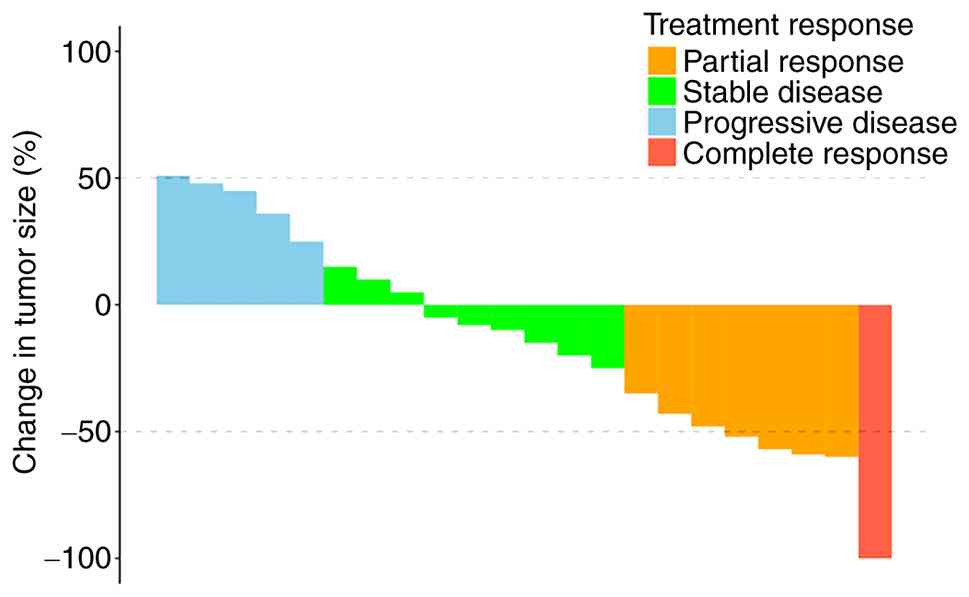
survival time was used to describe PFS and OS. Waterfall plots were
used to visualize the best percentage changes in target lesion size
from baseline, summarizing therapeutic responses. The Kaplan-Meier
survival analysis method and the log-rank test was employed to
estimate OS and PFS. P<0.05 was considered to indicate a
statistically significant difference.
Results
Comparison of general
characteristics
A total of 22 patients (17 men and 5 women) were
included in the present study. The age range of the patients was
from 40 to 79 years old (median age, 63.5 years) and their body
mass index ranged from 18.6 to 31.7 (mean value, 21.9). According
to the ECOG scoring criteria, 19 patients had a score of 0 and 3
patients had a score of 1. In terms of pathological classification,
19 patients were diagnosed with ccRCC, accounting for 86.4%, while
the remaining 3 patients had papillary RCC (2 cases) and
chromophobe RCC (1 case). Based on the 8th edition of
American Joint Committee on Cancer clinical Tumor Node Metastasis
staging system for RCC (16), the
number and proportion of patients in each stage were as follows: 4
cases (18.2%) in stage cT2a, 2 cases (9.1%) in stage cT2b, 6 cases
(27.3%) in stage cT3a, 8 cases (36.4%) in stage cT3b and 2 cases
(9.1%) in stage cT3c. Regarding lymph node metastasis, 16 patients
(72.7%) were in the N0-x stage, and 6 patients (27.3%) were in the
N1 stage. In total, 17 patients had previously undergone
nephrectomy, while 5 had not. Additionally, 13 patients had cancer
on the left side, 8 on the right side and 1 patient had bilateral
renal cancer. Of all patients, 10 had metastasis to only one organ,
while 12 had metastasis to two or more organs. The organs with
metastases included the lungs (15 cases, 68.2%), lymph nodes (10
cases, 45.5%), bones (8 cases, 36.4%), liver (3 cases, 13.6%),
brain (2 cases, 9.1%) and other sites (2 cases, 9.1%). According to
the IMDC risk stratification, 3 patients were classified as
favorable-risk (13.6%), 17 as intermediate-risk (77.3%), and 2 as
poor-risk (9.1%). Furthermore, 6 patients discontinued treatment
due to AEs (27.3%). Please see Table
I for a summary of the general characteristics of the patients
included in the present study.
 | Table I.General characteristics of the 22
included patients. |
Table I.
General characteristics of the 22
included patients.
| Characteristic | Value |
|---|
| Median age, years
(range) | 63.5 (40–79) |
| Sex, n (%) |
|
|
Male | 17 (77.3) |
|
Female | 5 (22.7) |
| BMI, kg/m2
(range) | 21.9
(18.6–31.7) |
| ECOG score (%) |
|
| 0 | 19 (86.4) |
| 1 | 3 (13.6) |
| Baseline cTNM, n
(%) |
|
|
cT2a | 4 (18.2) |
|
cT2b | 2 (9.1) |
|
cT3a | 6 (27.3) |
|
cT3b | 8 (36.4) |
|
cT3c | 2 (9.1) |
|
N0-x | 16 (72.7) |
| N1 | 6 (27.3) |
| Prior nephrectomy,
n (%) |
|
|
Yes | 17 (77.3) |
| No | 5 (22.7) |
| Metastatic organs,
n (%) |
|
| 1
organ | 10 (45.5) |
| ≥2
organs | 12 (54.5) |
| Major metastatic
organs, n (%) |
|
|
Lung | 15 (68.2) |
| Lymph
node | 10 (45.5) |
|
Bone | 8 (36.4) |
|
Liver | 3 (13.6) |
|
Brain | 2 (9.1) |
|
Other | 2 (9.1) |
| Side, n (%) |
|
|
Left | 13 (59.1) |
|
Right | 8 (36.4) |
|
Bilateral | 1 (4.5) |
| With tumor
thrombus, n (%) | 5 (22.7) |
| Histology, n
(%) |
|
|
ccRCC | 19 (86.4) |
|
Other | 3 (13.6) |
| Sarcomatoid
features, n (%) |
|
|
Yes | 2 (9.1) |
| No | 20 (90.9) |
| IMDC
classification, n (%) |
|
|
Favorable | 3 (13.6) |
|
Intermediate | 17 (77.3) |
|
Poor | 2 (9.1) |
| Discontinuation of
therapy due to AEs, n (%) |
|
|
Yes | 6 (27.3) |
| No | 16 (72.7) |
Comparison of efficacy
In the present study, as of the follow-up in March
2024, 17 patients were still undergoing treatment. Among all
patients, 1 achieved a CR (4.55%), 7 achieved a PR (31.82%), 9 had
SD (40.91%) and 5 had PD (22.73%) (Fig.
1). The overall ORR was 36.36% (8/22) and the DCR was 77.27%
(17/22).
Survival analysis
The median follow-up time in the present study was
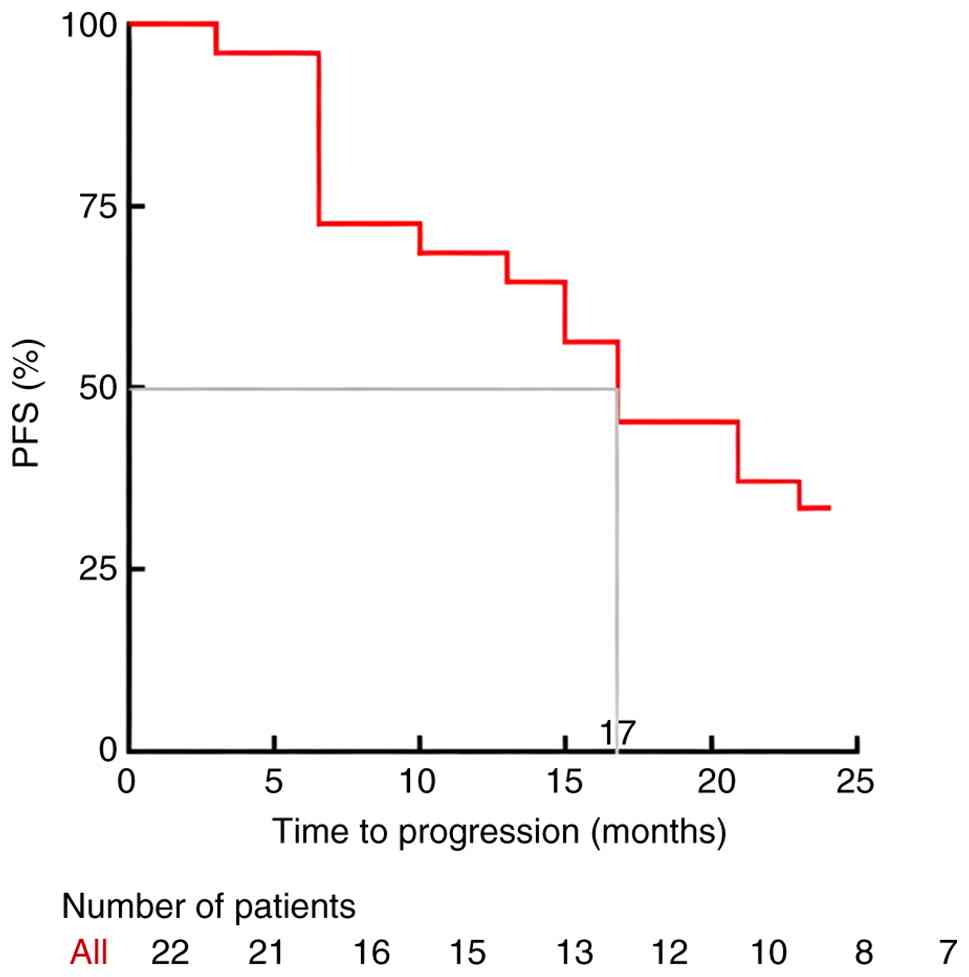
14 months (range, 3–24 months). The median PFS time was 17.1 months
[range, 5.9–22.6; Fig. 2], but the
median OS time was not reached. Due to the limited follow-up
duration of 14 months, OS data are not available; therefore, PFS
served as the primary efficacy endpoint in this preliminary
analysis. At 2 years, most patients had controlled disease, with
only 5 patients experiencing disease progression. The PFS
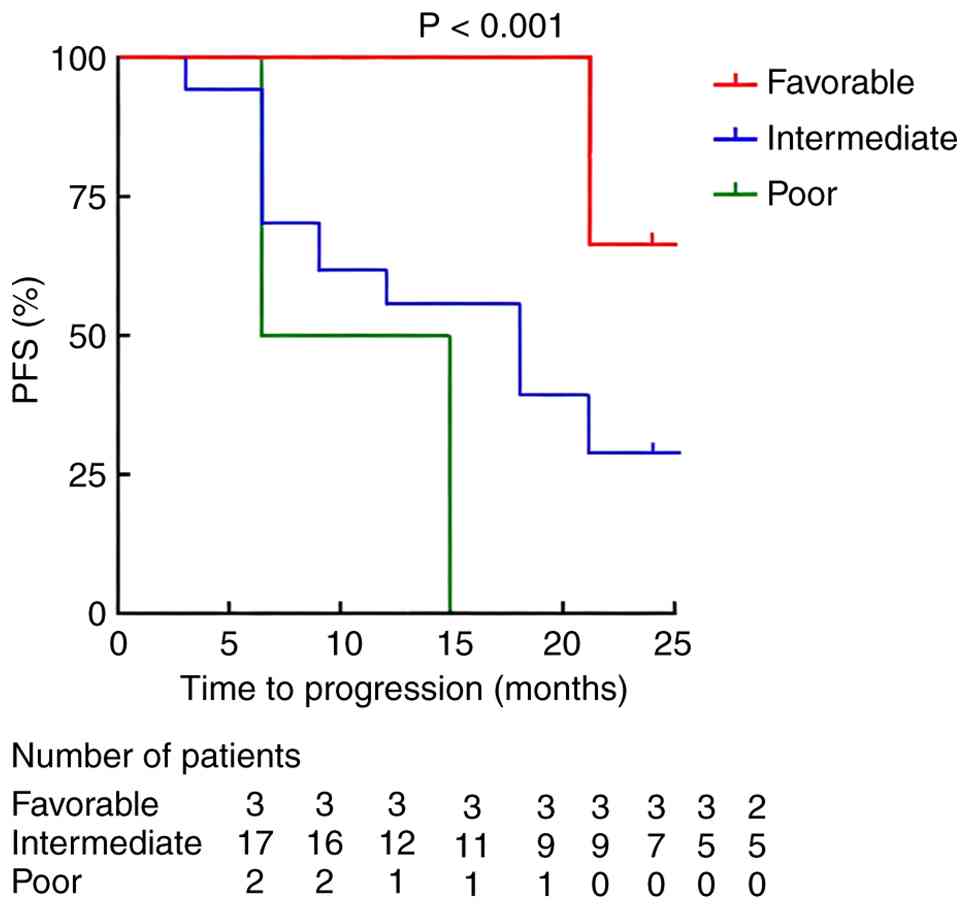
stratified by IMDC risk criteria is shown in Fig. 3. There was a significant difference
in PFS across risk groups (log-rank P<0.001). Patient in the
favorable-risk group showed the most favorable outcomes, with no
events occurring before 20 months and a 24-month PFS rate of 66.7%.
In contrast, patients in the intermediate-risk group had a gradual
decline in PFS, reaching a 24-month PFS rate of 28.6%. Patients in
the poor-risk group had the shortest PFS, with all patients
experiencing disease progression by 15 months.
Comparison of AEs
The incidence of AEs of all grades was 81.82%
(Table II). Most of these AEs were
grade 1–2, with 6 patients experiencing grade 3–4 reactions,
leading to treatment interruption. Among these patients, 3 had
elevated transaminases. After discontinuing pazopanib for 4–6 weeks
and receiving symptomatic and supportive treatment, their levels
returned to the normal range (ALT, AST ≤40U/l). Subsequently, the
pazopanib dose was resumed at 600 mg and continued until the data
cutoff date, with 1 patient achieving PR, 1 maintaining stability
and 1 experiencing PD. The remaining 3 patients were considered to
have irAEs. After discontinuing toripalimab and receiving
symptomatic, supportive and hormonal treatment, these patients
showed notable improvement. Then, they continued treatment with
pazopanib monotherapy until the data cutoff date, with 2 patients
maintaining SD and 1 experiencing PD.
| Table II.Incidence of AEs. |
Table II.
Incidence of AEs.
|
| Grade |
|
|---|
|
|
|
|
|---|
| AEs | 1-2, n | 3-4, n | Total, n (%) |
|---|
| Any | 12 | 6 | 18 (81.82) |
| Fatigue | 6 | 0 | 6 (27.27) |
|
Nausea/vomiting | 4 | 0 | 4 (18.18) |
| Diarrhea | 7 | 0 | 7 (31.82) |
| Hypertension | 6 | 1 | 7 (31.82) |
| Proteinuria | 4 | l | 5 (22.73) |
| Elevated
transaminases | 11 | 3 | 14 (63.64) |
| Hypothyroidism | 3 | 1 | 4 (18.18) |
| Hand-foot skin
reaction | 5 | 0 | 5 (22.73) |
| Rash | 2 | 0 | 2 (9.09) |
| Leucopenia | 3 | 0 | 3 (13.64) |
Discussion
In recent years, the incidence of RCC has continued
to rise globally, with a 5-year mortality rate reaching 30–40%
(1,2). According to statistics, factors such
as sex, obesity, chronic kidney disease, smoking and hypertension
are known risk factors for RCC (17). When RCC progresses to the advanced
stage and metastasizes, it is referred to as mRCC. The common sites
of metastasis include the liver, lungs, adrenal glands, bones, skin
and even the brain (2). The
progression to mRCC often indicates a poor prognosis for patients,
with a potentially significant reduction in survival time (2). The underlying mechanism of mRCC
development involves inactivation of the von Hippel-Lindau tumor
suppressor gene, which promotes the upregulation of crucial
proteins such as VEGF, platelet-derived growth factor, transforming
growth factor and other proteins related to neovascularization
(18). These factors play pivotal
roles in the development and metastasis of tumors (19).
Immunotherapy, which activates the immune system to
inhibit tumor growth and dissemination, has emerged as a new hope
in the treatment of mRCC (20).
PD-1/PD-L1 and CTLA-4 inhibitors are commonly used ICIs. ICIs
targeting PD-1/PD-L1 have made significant breakthroughs in the
field of oncology. Toripalimab, which targets PD-1, has been
approved for first-line clinical treatment of multiple malignancies
(21,22), and significantly prolongs PFS
without introducing new safety concerns compared with existing
treatment regimens. In a Phase I clinical study of toripalimab for
advanced melanoma and urological tumors, 5 patients with advanced
renal cancer who had progressed after previous conventional
treatments were enrolled. Among them, 2 patients achieved confirmed
PR and 1 patient had SD, resulting in an overall ORR of 33% and a
DCR of 50%. These findings initially demonstrated the antitumor
activity of toripalimab in advanced renal cancer (23).
Targeted therapy, characterized by its high
specificity and relatively milder side effects, has become a
cornerstone in the treatment of renal cancer. Commonly used
targeted drugs in renal cancer primarily inhibit tumor growth by
affecting tumor angiogenesis. Representative drugs in this category
include sorafenib, sunitinib, everolimus and pazopanib, which exert
their tumor-suppressing effects through different pathways
(24–30). In particular, pazopanib targets
tyrosine kinases to block the formation of new blood vessels in
tumors, thereby inhibiting the further proliferation and migration
of tumor cells, ultimately suppressing tumor growth and
dissemination (31,32). Multiple studies have shown evidence
of pazopanib's positive response as a first-line treatment for
mRCC. For instance, Park et al (33) reported that pazopanib treatment
resulted in a PFS time of 8 months compared with placebo, and a PFS
of 11 months compared with sunitinib. Joshi et al (34) reported that, in a continuous
treatment study of 28 patients with mRCC in India, the overall
clinical benefit rate (PR + SD) was 76%, with a median PFS time of
5.9 months. In a single-center retrospective study of 40 patients
with mRCC treated with three different TKIs (sunitinib, pazopanib
and sorafenib), Rudresha et al (35) reported that the median PFS and OS
times for patients treated with pazopanib were 11.2 and 20.1
months, respectively.
In recent years, the combination of targeted therapy
and immunotherapy has achieved certain efficacy in the field of
oncology. For instance, a study by Hedegaard et al (36) reported the results of a Phase III
clinical trial where the combination of axitinib and pembrolizumab
was used to treat advanced renal cancer, showing significant
improvements in OS and PFS compared with axitinib alone. The
KEYNOTE-426 study (37) focused on
the combined application of pembrolizumab with axitinib, using
sunitinib as a comparator, for first-line treatment of advanced
ccRCC. This long-term follow-up study demonstrated that the
immune-targeted combination therapy significantly improved the PFS
and OS times of patients, with the median OS time in the
combination therapy group reaching 45.7 months, exhibiting a
significant advantage over the 40.1 months in the sunitinib group
[hazard ratio (HR), 0.73; 95% CI 0.60–0.88; P<0.001]. The
JAVELIN Renal-101 study (38)
evaluated the efficacy of avelumab combined with axitinib in
patients with advanced RCC. Although this combination therapy
showed a significant advantage in PFS, particularly among patients
with PD-L1-positive tumors, the OS in the overall patient
population did not reach statistical significance. However, in the
high-risk patient subgroup, the combination therapy group
demonstrated a significant improvement in OS, providing a new
perspective and basis for the application of immune-targeted
combination therapy in specific patient populations. Furthermore,
the CheckMate 9ER study (39)
explored the combined therapy of cabozantinib with nivolumab,
comparing its effectiveness with sunitinib in patients with
advanced RCC and bone metastases. The combination therapy
significantly prolonged the PFS time in both patients with and
without bone metastases, and the ORR was also significantly higher
than that of the sunitinib group. Notably, for patients with bone
metastases, the median PFS time of the combination therapy reached
18.2 months, far exceeding the 4.4 months in the sunitinib group
(HR, 0.38; 95% CI, 0.25–0.59). Compared with studies conducted
abroad, this type of research in China is scarce. The latest
domestic research was the RENOTORCH study (40), jointly led by Professor Guo Jun from
Peking University Cancer Hospital and Professor Huang Yiran from
Renji Hospital (School of Medicine, Shanghai Jiao Tong University),
which aimed to evaluate the efficacy and safety of the PD-1
immunotherapy drug toripalimab (developed in China) combined with
axitinib as first-line treatment for patients with unresectable or
mRCC, compared with sunitinib. The present study showed that the
median PFS time in the toripalimab + axitinib group reached 18.0
months, while that in the sunitinib monotherapy group was 9.8
months, representing a nearly two-fold extension (HR, 0.66; 95% CI
0.490–0.864; P=0.0034). The ORR in the combination group was 56.7%,
significantly higher than the 30.8% in the sunitinib monotherapy
group. Although the median OS data are not available, the
combination therapy group demonstrated a clear OS benefit trend,
with a 39% reduction in the risk of death (HR, 0.61; 95% CI,
0.40–0.92) and 1-year and 2-year OS rates of 90.5 vs. 81.9% and
71.8 vs. 63.2%, respectively.
Despite the existence of numerous associated studies
(36–40), to the best of our knowledge, there
is currently a paucity of clinical research on toripalimab for the
treatment of patients with mRCC, especially the first-line
treatment of mRCC with the combination of pazopanib and
toripalimab. The results of the present study are not directly
comparable to those from large phase III trials such as KEYNOTE-426
(41) (pembrolizumab + axitinib) or
CheckMate 9ER (nivolumab + cabozantinib), which were randomized,
controlled studies and included hundreds of patients (39). These trials provided high-level
evidence supporting the superiority of immune-TKI combinations over
sunitinib. By contrast, the present single-arm, retrospective
analysis of 22 patients can only offer hypothesis-generating
observations. Direct cross-trial comparisons should be avoided and
the present findings should be viewed as complementary real-world
data rather than confirmatory evidence. The present study aimed to
explore the clinical application effect of this combination therapy
by treating patients with mRCC with pazopanib + toripalimab and
observing the clinical efficacy and occurrence of adverse
reactions.
In the present study, among all patients, there was
1 case of CR, 7 cases of PR, 9 cases of SD and 5 cases of PD. The
overall ORR was 36.4%, indicating that approximately one-third of
patients experienced positive treatment outcomes; the DCR was
77.3%, suggesting that the condition of most patients was somewhat
controlled. Given the small sample size, these rates should be
interpreted as descriptive statistics only; that is, no comparative
inferences can be drawn. Treatment was interrupted due to AEs in
27.3% of patients, with half of these patients having their
pazopanib dosage reduced to 600 mg. However, given the small sample
size, no definitive conclusion can be drawn regarding the impact of
dose reduction on efficacy; the observation that some patients
maintained disease control after reduction to 600 mg is
hypothesis-generating and warrants further investigation. Regarding
PFS, the decline in the PFS curve became gradual over time, which
may be related to the time required for immunotherapy to take
effect. In the initial stages of immunotherapy, the immune system
may not be fully activated, requiring time to activate and expand T
cells within the body to achieve sufficient numbers and activity to
effectively kill tumor cells. This process involves multiple steps,
including T-cell recognition, activation, proliferation and
migration, all of which require time to complete.
In the present study, the safety profile during
treatment revealed that common AEs included primarily fatigue
(27.27%), nausea/vomiting (18.18%), diarrhea (31.82%), hypertension
(31.82%), proteinuria (22.73%), elevated transaminases (63.64%),
hypothyroidism (18.18%), hand-foot skin reaction (22.73%), rash
(9.09%) and leukopenia (13.64%). Most patients experienced mild to
moderate (grade 1–2) AEs, although some reported severe (grade 3–4)
AEs such as hypertension, proteinuria, elevated transaminases and
hypothyroidism. Among these, liver function abnormalities due to
elevated transaminases were the most frequent AE, occurring in up
to 63.64% of patients. Xu et al (42), through pharmacogenetic analysis,
found that this elevation in transaminases was associated with the
mechanism of pazopanib-induced liver injury. Ezponda et al
(43) confirmed that pazopanib
could improve PFS in patients with advanced non-lipogenic soft
tissue sarcoma but could also trigger the occurrence of chronic
active hepatitis. These findings further explain the higher
incidence of liver function abnormalities and highlight the need to
carefully consider appropriate dose titration of pazopanib in this
combination therapy strategy.
In summary, within the constraints of the present
small retrospective cohort, the combination of pazopanib and
toripalimab showed preliminary signs of activity in the first-line
treatment for mRCC, with a median PFS time of 17.1 months and a
generally manageable safety profile. These real-world observations
do not provide comparative evidence of benefit over standard
therapies and should not be overinterpreted. The safety data were
consistent with previous reports, but attention should be paid to
the hepatotoxicity of pazopanib and the rational determination of
its dosage.
The present study has several limitations that must
be considered when interpreting the results. First, it is a
retrospective, single-arm, single-center analysis with a small
sample size (n=22), which notably limits the statistical power and
generalizability of the findings. Second, no comparator group (such
as pazopanib monotherapy or other standard first-line regimens) was
included, making it impossible to determine the true added benefit
of toripalimab. Third, the median follow-up of 14 months is
relatively short for assessing OS in mRCC; therefore, OS data
remained immature, and PFS was the primary focus of the present
preliminary report. Fourth, the limited sample size precluded
robust subgroup analyses (such as by IMDC risk groups or metastatic
burden) and the reported 95% CIs for ORR and DCR should be
interpreted with caution. Fifth, as a real-world study, potential
selection bias and unmeasured confounders (such as performance
status changes and concomitant medications) cannot be excluded.
Consequently, these findings should be regarded as exploratory and
hypothesis-generating, not as definitive evidence of efficacy.
Prospective randomized controlled trials are essential to validate
the role of pazopanib plus toripalimab in the first-line treatment
of mRCC.
In conclusion, in the present real-world,
single-center, retrospective study of 22 patients, first-line
pazopanib combined with toripalimab for mRCC showed exploratory,
hypothesis-generating signs of efficacy with a safety profile that
appeared manageable. Owing to the lack of a control group and the
small sample size, no definitive conclusions regarding superiority
over existing standard therapies can be drawn. These observations
support the feasibility of the combination and highlight the need
for further prospective randomized controlled trials, but they do
not justify current clinical recommendations.
Acknowledgements
Not applicable.
Funding
Funding: No funding was received.
Availability of data and materials
The data generated in the present study may be
requested from the corresponding author.
Authors' contributions
BW designed the study, acquired funding, performed
data collation and wrote the manuscript. TX, HL, XH and KW analyzed
and interpreted the data. BW, TX, HL, XH and KW revised the
manuscript. XH and KW supervised the study. BW and KW confirm the
authenticity of all the raw data. All the authors have contributed
to this manuscript. All authors read and approved the final
manuscript.
Ethics approval and consent to
participate
The present study was approved by the Ethics
Committee of Shanxi Cancer Hospital (approval no. KY2023106), and
all patients provided written informed consent for the use of their
clinical data. The study adhered to the Declaration of
Helsinki.
Patient consent for publication
Not applicable.
Competing interests
The authors declare that they have no competing
interests.
Glossary
Abbreviations
Abbreviations:
|
RCC
|
renal cell carcinoma
|
|
mRCC
|
metastatic RCC
|
|
ORR
|
objective response rate
|
|
DCR
|
disease control rate
|
|
PFS
|
progression-free survival
|
|
OS
|
overall survival
|
|
ccRCC
|
clear cell RCC
|
|
IMDC
|
International Metastatic Renal Cell
Carcinoma Database Consortium
|
|
VEGF
|
vascular endothelial growth factor
|
|
TKI
|
tyrosine kinase inhibitor
|
|
PD-1
|
programmed death 1
|
|
ECOG
|
Eastern Cooperative Oncology Group
|
|
ICIs
|
immune checkpoint inhibitors
|
|
CTLA-4
|
cytotoxic T lymphocyte associated
antigen-4
|
|
PD-L1
|
programmed death ligand 1
|
|
CR
|
complete response
|
|
PR
|
partial response
|
|
PD
|
progressive disease
|
|
SD
|
stable disease
|
|
irAEs
|
immune-related adverse events
|
References
|
1
|
Song L, Chen Z and Lu Q: Advances on
research on prognostic models for renal cell carcinoma. Chin J Res
Hosp. 11:34–37. 2024.(In Chinese).
|
|
2
|
Zhang J, Cui F, Han S, Wang X, Lin X and
Mei K: Clinicopathological observation on clear cell renal cell
carcinoma metastasizing to the lung. Chin J N Clin Med. 17:749–752.
2024.(In Chinese).
|
|
3
|
Li S and Sheng X: Review of progress in
renal cancer therapy in 2018. Electron J Integr Oncol. 5:15–19.
2019.
|
|
4
|
Wang J, Hu X, Jiang S, Xu L, Yang N, Xu X,
Xia Y, Bai Q, Wang H, Zhu Y and Guo J: Efficacy and safety of
pazopanib for metastatic renal cell carcinoma. J Mod Urol.
27:205–209+217. 2022.
|
|
5
|
Sternberg CN, Davis ID, Mardiak J,
Szczylik C, Lee E, Wagstaff J, Barrios CH, Salman P, Gladkov OA,
Kavina A, et al: Pazopanib in locally advanced or metastatic renal
cell carcinoma: Results of a randomized phase III trial. J Clin
Oncol. 28:1061–1068. 2010. View Article : Google Scholar : PubMed/NCBI
|
|
6
|
Hamberg P, Verweij J and Sleijfer S:
(Pre-)clinical pharmacology and activity of pazopanib, a novel
multikinase angiogenesis inhibitor. Oncologist. 15:539–547. 2010.
View Article : Google Scholar : PubMed/NCBI
|
|
7
|
Chen J, Ye W, Jiang W, Li X, Liu R, Lin B,
Xiang J, Tian W, Bai J, Zuo T, et al: Pazopanib in patients with
metastatic renal cell carcinoma: a single-center, real-world,
retrospective Chinese study. Transl Androl Urol. 10:1321–1331.
2021. View Article : Google Scholar : PubMed/NCBI
|
|
8
|
Wang Y, Wu X, Men P and Zhou M:
Effectiveness, safety and economy of pazopanib in
advanced/metastatic renal cell carcinoma: A rapid health technology
assessment. Chin J N Drugs. 28:3030–3034. 2019.
|
|
9
|
Rini BI, Escudier B, Tomczak P, Kaprin A,
Szczylik C, Hutson TE, Michaelson MD, Gorbunova VA, Gore ME,
Rusakov IG, et al: Comparative effectiveness of axitinib versus
sorafenib in advanced renal cell carcinoma (AXIS): A randomised
phase 3 trial. Lancet. 378:1931–1939. 2011. View Article : Google Scholar : PubMed/NCBI
|
|
10
|
Huang D, Jiang S, Li J, Chang Y and Jiang
M: Efficacy of apatinib combined with camrelizumab in the treatment
of advanced hepatocellular carcinoma and its impact on patients'
immune function and tumor markers. Chin J Gen Surg. 33:1070–1077.
2024.
|
|
11
|
Huang L, Li X, Zhang C, Huang H, Liu T and
Zhou J: Retrospective analysis for comparing efficacy of axitinib
combined with different PD-1 monoclonal antibody in treatment of
advanced renal cell carcinoma. Pharmacy Today. 34:857–861.
2024.
|
|
12
|
Rallis KS, Kleeman SO, Grant M, Ordidge
KL, Sahdev A and Powles T: Radiomics for renal cell carcinoma:
Predicting outcomes from immunotherapy and targeted therapies-a
narrative review. Eur Urol Focus. 7:717–721. 2021. View Article : Google Scholar : PubMed/NCBI
|
|
13
|
Huang J, Shi G, Wang Y, Wang P, Zhang J,
Kong W, Huang Y, Wang S and Xue W: Second-line treatment with
axitinib plus toripalimab in metastatic renal cell carcinoma: A
retrospective multicenter study. Future Oncol. 18:1461–1471. 2022.
View Article : Google Scholar : PubMed/NCBI
|
|
14
|
Lu D, Feng Y, Wang W, Mou Z and Zhao N:
Efficacy and safety of toripalimab combined with apatinib as
second-line treatment for recurrent/metastatic nasopharyngeal
carcinoma. Mod Oncol. 32:1809–1814. 2024.
|
|
15
|
Fang Y, Zhou X, Lin Q, Lin Z and Lin Y:
Efficacy and safety of PD-1/PD-L1 inhibitors-based
immunocombination therapy versus sunitinib in the treatment of
advanced renal cell carcinoma: A meta-analysis. Chin J Cancer
Biother. 30:393–400. 2023.
|
|
16
|
Motzer RJ, Tannir NM, McDermott DF, Arén
Frontera O, Melichar B, Choueiri TK, Plimack ER, Barthélémy P,
Porta C, George S, et al: Nivolumab plus ipilimumab versus
sunitinib in advanced renal-cell carcinoma. N Engl J Med.
378:1277–1290. 2018. View Article : Google Scholar : PubMed/NCBI
|
|
17
|
Bahadoram S, Davoodi M, Hassanzadeh S,
Bahadoram M, Barahman M and Mafakher L: Renal cell carcinoma: An
overview of the epidemiology, diagnosis, and treatment. G Ital
Nefrol. 39:2022–vol3. 2022.PubMed/NCBI
|
|
18
|
Yanagisawa T, Mori K, Kawada T, Katayama
S, Uchimoto T, Tsujino T, Nishimura K, Adachi T, Toyoda S, Nukaya
T, et al: First-line therapy for metastatic renal cell carcinoma: A
propensity score-matched comparison of efficacy and safety. Urol
Oncol. 42:374.e21–374.e29. 2024. View Article : Google Scholar : PubMed/NCBI
|
|
19
|
Lang JM and Harrison MR: Pazopanib for the
treatment of patients with advanced renal cell carcinoma. Clin Med
Insights Oncol. 4:95–105. 2010. View Article : Google Scholar : PubMed/NCBI
|
|
20
|
Lara PN Jr, Villanueva L, Ibanez C, Erman
M, Lee JL, Heinrich D, Lipatov ON, Gedye C, Gokmen E, Acevedo A,
Semenov A, et al: A randomized, open-label, phase 3 trial of
pembrolizumab plus epacadostat versus sunitinib or pazopanib as
first-line treatment for metastatic renal cell carcinoma
(KEYNOTE-679/ECHO-302). BMC Cancer. 23 (Suppl 1):S12532024.
View Article : Google Scholar
|
|
21
|
Su L, Xu Q, Wan S, Zhang H, Chen Y and He
Y: Analysis of the efficacy and safety of toripalimab in the
comprehensive treatment of bladder tumors. J Chongqing Med Univ.
49:740–744. 2024.
|
|
22
|
Chen Z, Mei X and Wu S: Influence of
toripalimab injection combined with OFL regimen on sPD-1, sTim-3,
and sLAG-3 levels in patients from gastric cancer. J Qiqihar Med
Univ. 45:1136–1139. 2024.
|
|
23
|
Tang B, Yan X, Sheng X, Si L, Cui C, Kong
Y, Mao L, Lian B, Bai X, Wang X, et al: Safety and clinical
activity with an anti-PD-1 antibody JS001 in advanced melanoma or
urologic cancer patients. J Hematol Oncol. 12:72019. View Article : Google Scholar : PubMed/NCBI
|
|
24
|
Uhlig A, Bergmann L, Bögemann M, Fischer
T, Goebell PJ, Leitsmann M, Reichert M, Rink M, Schlack K, Trojan
L, et al: Sunitinib for metastatic renal cell carcinoma: Real-world
data from the STAR-TOR registry and detailed literature review.
Urol Int. 108:198–210. 2024. View Article : Google Scholar : PubMed/NCBI
|
|
25
|
Liu H, Wu Y and Xu W: Literature study on
pharmacoeconomics evaluation of first-line therapy drugs for
metastatic renal cell carcinoma as sunitinib, sorafenib, and
pazopanib. China Pharm. 31:612–616. 2020.
|
|
26
|
Rosenberg L, Yoon CH, Sharma G,
Bertagnolli MM and Cho NL: Sorafenib inhibits proliferation and
invasion in desmoid-derived cells by targeting Ras/MEK/ERK and
PI3K/Akt/mTOR pathways. Carcinogenesis. 39:681–688. 2018.
View Article : Google Scholar : PubMed/NCBI
|
|
27
|
Kim YJ, Lim B, Kim SY, Shin YZ, Yu N, Shin
EK, Lee JE, Jeon YH, Kim DD, Lee J and Cha HJ: Remodeling of
sorafenib as an orally bioavailable ferroptosis inducer for Lung
Cancer by chemical modification of adenine-binding motif. Biomed
Pharmacother. 176:1167582024. View Article : Google Scholar : PubMed/NCBI
|
|
28
|
El-Masry TA, El-Nagar MMF, El Mahdy NA,
Alherz FA, Taher R and Osman EY: Potential antitumor activity of
combined lycopene and Sorafenib against Solid Ehrlich carcinoma via
targeting autophagy and apoptosis and suppressing proliferation.
Pharmaceuticals (Basel). 17:5272024. View Article : Google Scholar : PubMed/NCBI
|
|
29
|
Yau T, Kaseb A, Cheng AL, Qin S, Zhu AX,
Chan SL, Melkadze T, Sukeepaisarnjaroen W, Breder V, Verset G, et
al: Cabozantinib plus atezolizumab versus sorafenib for advanced
hepatocellular carcinoma (COSMIC-312): Final results of a
randomised phase 3 study. Lancet Gastroenterol Hepatol. 9:310–322.
2024. View Article : Google Scholar : PubMed/NCBI
|
|
30
|
Xu D, Luo Y, Wang P, Li J, Ma L, Huang J,
Zhang H, Yang X, Li L, Zheng Y, et al: Clinical progress of
anti-angiogenic targeted therapy and combination therapy for
gastric cancer. Front Oncol. 13:11481312023. View Article : Google Scholar : PubMed/NCBI
|
|
31
|
Kumar R, Knick VB, Rudolph SK, Johnson JH,
Crosby RM, Crouthamel MC, Hopper TM, Miller CG, Harrington LE,
Onori JA, et al: Pharmacokinetic-pharmacodynamic correlation from
mouse to human with pazopanib, a multikinase angiogenesis inhibitor
with potent antitumor and antiangiogenic activity. Mol Cancer Ther.
6:2012–2021. 2007. View Article : Google Scholar : PubMed/NCBI
|
|
32
|
Jo JK, Seo SI, Kang M, Chung J, Kwak C,
Hong SH, Song C, Park JY, Jeong CW, Choi SH, et al: Optimal
sequential therapy using tyrosine kinase inhibitors as the
first-line treatment in patients with metastatic renal cell
carcinoma: A nationwide multicenter study. Asian J Urol.
11:450–459. 2024. View Article : Google Scholar : PubMed/NCBI
|
|
33
|
Park J, Jiao X, Ghate S, Wilson T, Ahmad
QL and Vogelzang NJ: Predictors of long-term response with
pazopanib in patients with advanced Renal-cell carcinoma. Clin
Genitourin Cancer. 16:293–297. 2018. View Article : Google Scholar : PubMed/NCBI
|
|
34
|
Joshi A, Agarwala V, Ramaswamy A, Noronha
V, Patil VM, Menon S, Popat P, Sable N and Prabhash K: Initial
experience with first-line pazopanib in the treatment of metastatic
renal cell carcinoma: A single institution data. Indian J Cancer.
53:575–578. 2016. View Article : Google Scholar : PubMed/NCBI
|
|
35
|
Rudresha AH, Chaudhuri T, Lakshmaiah KC,
Babu GK, Lokanatha D, Jacob LA, Suresh Babu MC, Lokesh KN and
Rajeev LK: First-line tyrosine kinase inhibitors in metastatic
renal cell carcinoma: A regional cancer center experience. Indian J
Cancer. 54:626–630. 2017. View Article : Google Scholar : PubMed/NCBI
|
|
36
|
Hedegaard J, Lamy P, Nordentoft I, Algaba
F, Høyer S, Ulhøi BP, Vang S, Reinert T, Hermann GG, Mogensen K, et
al: Comprehensive transcriptional analysis of early-stage
urothelial carcinoma. Cancer Cell. 30:27–42. 2016. View Article : Google Scholar : PubMed/NCBI
|
|
37
|
Motzer RJ, Penkov K, Haanen J, Rini B,
Albiges L, Campbell MT, Venugopal B, Kollmannsberger C, Negrier S,
Uemura M, et al: Avelumab plus Axitinib versus sunitinib for
advanced renal-cell carcinoma. N Engl J Med. 380:1103–1115. 2019.
View Article : Google Scholar : PubMed/NCBI
|
|
38
|
Froehner M, Re: Marc-Oliver Grimm,
Mototsuga Oya, Toni K. Choueiri, et al: Impact of prior
Cytoreductive nephrectomy on efficacy in patients with synchronous
metastatic renal cell carcinoma treated with Avelumab plus Axitinib
or Sunitinib: Post hoc analysis from the JAVELIN renal 101 phase 3
trial. Eur Urol. 2024.85:8–12. Eur Urol. 86:e1262024. View Article : Google Scholar
|
|
39
|
Powles T, Burotto M, Escudier B, Apolo AB,
Bourlon MT, Shah AY, Suárez C, Porta C, Barrios CH, Richardet M, et
al: Nivolumab plus cabozantinib versus sunitinib for first-line
treatment of advanced renal cell carcinoma: Extended follow-up from
the phase III randomised CheckMate 9ER trial. ESMO Open.
9:1029942024. View Article : Google Scholar : PubMed/NCBI
|
|
40
|
Yan XQ, Ye MJ, Zou Q, Chen P, He ZS, Wu B,
He DL, He CH, Xue XY, Ji ZG, et al: Toripalimab plus axitinib
versus sunitinib as first-line treatment for advanced renal cell
carcinoma: RENOTORCH, a randomized, open-label, phase III study.
Ann Oncol. 35:190–199. 2024. View Article : Google Scholar : PubMed/NCBI
|
|
41
|
Powles T, Plimack ER, Soulières D, Waddell
T, Stus V, Gafanov R, Nosov D, Pouliot F, Melichar B, Vynnychenko
I, et al: Pembrolizumab plus axitinib versus sunitinib monotherapy
as first-line treatment of advanced renal cell carcinoma
(KEYNOTE-426): Extended follow-up from a randomised, open-label,
phase 3 trial. Lancet Oncol. 21:1563–1573. 2020. View Article : Google Scholar : PubMed/NCBI
|
|
42
|
Xu CF, Johnson T, Wang X, Carpenter C,
Graves AP, Warren L, Xue Z, King KS, Fraser DJ, Stinnett S, et al:
HLA-B*57:01 confers susceptibility to Pazopanib-associated liver
injury in patients with cancer. Clin Cancer Res. 22:1371–1377.
2016. View Article : Google Scholar : PubMed/NCBI
|
|
43
|
Ezponda A, De La Huebra IG, Calvo M,
Idoate MÁ and Vivas I: Chronic active hepatitis induced by
Pazopanib mimicking hypervascular liver metastases in a patient
with recurrent soft tissue sarcoma: A case report. Oncol Lett.
16:4043–4048. 2018.PubMed/NCBI
|