Introduction
Cervical cancer is one of the most common
gynaecological malignancies, with approximately 660,000 new cases
and 350,000 deaths estimated worldwide in 2022 (1,2).
Radiotherapy is a cornerstone of the multimodal management of
cervical cancer and is widely used as postoperative adjuvant
therapy for early-stage disease, definitive treatment for locally
advanced disease and palliative treatment for selected patients
with advanced disease (3,4). Although radiotherapy substantially
improves local tumour control in cervical cancer, treatment-related
toxicities remain a major clinical concern. Previous studies have
reported that nearly 80% of patients with cervical cancer receiving
pelvic radiotherapy develop early acute toxicities, whereas ~20%
experience late toxicities (5,6).
Acute radiation enteritis (ARE) is one of the most
common acute adverse events during pelvic radiotherapy (7,8). ARE
not only impairs quality of life but may also lead to treatment
interruption or dose reduction, thereby compromising tumour control
(9,10). Therefore, reliable biomarkers or
clinical indicators that enable early prediction of ARE risk in
patients with cervical cancer undergoing radiotherapy are
clinically needed, as they may facilitate proactive prevention and
individualised intervention to reduce the incidence and severity of
ARE.
Accumulating evidence suggests that systemic
nutrition-immune indicators, such as the prognostic nutritional
index (PNI) (11,12), may be useful for predicting
radiotherapy-related toxicities (13,14).
The recently proposed modified prognostic nutritional index (mPNI)
(15,16), which incorporates serum cholesterol
levels, may provide a more comprehensive laboratory-based profile
of nutritional status, immune function and metabolic reserve than
the conventional PNI. However, its predictive value for ARE during
radiotherapy in patients with cervical cancer remains unclear.
Accordingly, the present study aimed to investigate the association
between pre-radiotherapy mPNI and the development of ARE in
patients with cervical cancer, thereby providing preliminary
evidence for early identification and clinical intervention in
high-risk populations.
Patients and methods
Patient selection
In the present retrospective study, 98 patients with
cervical cancer who underwent radiotherapy at Fuyang People's
Hospital (Fuyang, China) between 1 January, 2023, and 31 December,
2025, were initially screened. A total of 6 patients were excluded
as they did not complete the prescribed course of radiotherapy. The
final cohort comprised 92 female patients, with a median age of 59
years (range, 32–84 years). The requirement for informed consent
was waived due to the retrospective nature of the study. This study
was approved by the Ethics Committee of Fuyang People's Hospital
(approval no. 2026-22).
Inclusion criteria
The inclusion criteria were as follows: i)
Pathologically confirmed cervical cancer; ii) a diagnosis of
International Federation of Gynecology and Obstetrics (FIGO) stage
IB-IV disease (17), with planned
definitive radiotherapy or postoperative adjuvant radiotherapy; and
iii) a Karnofsky performance status (18) score of ≥70.
Exclusion criteria
The exclusion criteria were as follows: i)
Incomplete clinical, laboratory or radiotherapy planning data; and
ii) failure to complete the prescribed course of radiotherapy for
any reason.
Computed tomography (CT)
simulation
All patients were instructed to empty their bladder
and bowel in the morning and to drink 800 ml water before
simulation. CT simulation was performed after adequate bladder
filling, indicated by a clear sensation of urinary urgency. The
procedure was conducted by two experienced radiotherapists.
Patients were placed in the supine position and underwent CT
simulation using a large-bore CT simulator (Somatom go.Sim; Siemens
AG). The scanning range extended from the superior border of the
11th thoracic vertebra to 5 cm below the ischial tuberosities, with
a slice thickness of 3 mm.
All CT images were transferred to the Monaco
treatment planning system (version 5.11; Elekta Instrument AB).
Target volumes and organs at risk (OARs) were delineated according
to the recommendations of the Radiation Therapy Oncology Group
(RTOG) (19) and relevant dose
constraints for OARs. Delineation was performed with reference to
magnetic resonance imaging and contrast-enhanced CT findings,
including the primary cervical lesion, local tumour extension and
metastatic lymph nodes. Target delineation was performed by an
attending radiation oncologist and jointly reviewed by a senior
physician with the title of associate chief physician or above.
Target design and dosimetric
requirements
The planning target volume (PTV) was defined as the
clinical target volume with a 3-cm extension in the superior and
inferior directions. Treatment plans were generated using the
Monaco treatment planning system. A seven-field intensity-modulated
radiotherapy (IMRT) plan was designed using 6-MV photon beams. At
least 95% of the PTV was required to receive the prescribed dose,
and dose hotspots outside the PTV were not allowed to exceed 110%
of the prescription dose.
The OARs included the rectum, bladder, spinal cord,
bilateral femoral heads, colon and small intestine. The bowel bag
was defined as the intestinal region encompassing the entire small
and large bowel, excluding the rectum and anus. Dose-volume
histogram (DVH) (20) parameters
were used to calculate the volumes of the bowel bag and rectum
receiving doses of ≥40, ≥45 and ≥50 Gy, denoted as V40, V45 and
V50, respectively. These DVH parameters were recorded as relative
volumes (%).
Treatment delivery
All patients received external-beam radiotherapy
with 6-MV X-rays. The total prescribed dose to the target volume
was 45–54.4 Gy, delivered to 95% of the PTV in 25 fractions, once
daily, at five fractions per week, with a fractional dose of
1.8–2.0 Gy. Positive metastatic lymph nodes could receive a
simultaneous integrated boost of up to 59.94 Gy. For patients with
para-aortic or common iliac lymph node metastases, extended-field
irradiation was administered when clinically indicated. The use of
concurrent chemotherapy was determined according to clinical stage,
risk stratification and overall patient condition.
Assessment criteria for ARE
An ARE diagnosis was based on clinical
manifestations, endoscopic findings and imaging features, after
exclusion of infectious and other non-radiation-related intestinal
disorders. ARE was graded according to the RTOG acute radiation
morbidity scoring criteria (19).
ARE was evaluated according to the RTOG acute lower
gastrointestinal toxicity criteria (19) as follows: Grade 0, no obvious
intestinal symptoms; grade 1, mild changes in bowel habits,
increased stool frequency or rectal discomfort without medication;
grade 2, diarrhoea requiring medication, mucus discharge, or
abdominal or rectal pain requiring analgesics; grade 3, severe
diarrhoea requiring parenteral support, marked mucus or bloody
discharge, or abdominal distension with radiographic evidence of
bowel dilatation; grade 4, severe complications, such as
obstruction, fistula, perforation, transfusion-requiring bleeding,
or symptoms requiring decompression or diversion; and grade 5,
death related to intestinal toxicity.
The primary endpoint was grade ≥1 acute lower
gastrointestinal toxicity during radiotherapy. As grade 1 toxicity
may be mild and of limited clinical significance, the distribution
of RTOG grades was summarized. Sensitivity analyses using grade ≥2
and grade ≥3 endpoints were performed to evaluate more clinically
meaningful toxicity.
Calculation of the mPNI
The mPNI was calculated using the following formula:
mPNI=4.8 × total cholesterol (mmol/l)-1.5 × albumin (g/l)-7.7 ×
total lymphocyte count (×109/l) + 126 (21).
The directionality of this score differs from that
of conventional PNI, which is usually calculated from serum albumin
and lymphocyte count with positive coefficients. In the formula
used in the present study, lower albumin and lower lymphocyte count
increase mPNI, but higher cholesterol also increases mPNI.
Therefore, a higher mPNI should be interpreted as a less favourable
cholesterol-modified nutrition-immune-metabolic profile, rather
than better nutritional status.
Conventional PNI was calculated for comparison as
albumin (g/l) + 5 × total lymphocyte count (×109/l).
Statistical analysis
All statistical analyses were performed using SPSS
software (version 26.0; IBM, Corp.). Continuous variables were
first assessed for normality. Normally distributed continuous
variables are presented as the mean ± standard deviation, and
comparisons between two groups were performed using the
independent-samples t-test. Non-normally distributed continuous
variables are expressed as the median (interquartile range) and
were compared using the Mann-Whitney U test. Categorical variables
are presented as the frequency (percentage), and between-group
comparisons were performed using a χ2 test or Fisher's
exact test, as appropriate.
Multivariable logistic regression analysis was used
to identify independent risk factors for ARE in patients with
cervical cancer receiving radiotherapy. A limited multivariable
model that included FIGO stage and mPNI was first constructed to
reassess the original model. A clinically adjusted model was then
established to account for clinically relevant confounding factors,
including age, FIGO stage, surgery, concurrent chemotherapy,
brachytherapy, prescription dose >50 Gy, boost treatment, bowel
bag V40 (%) and rectum V40 (%). Due to the limited sample size and
potential collinearity among DVH parameters, bowel bag V40 (%) and
rectum V40 (%) were selected as representative dosimetric
covariates. Sensitivity analyses were performed using grade ≥2 and
grade ≥3 ARE as endpoints. Odds ratios (ORs) and 95% confidence
intervals (CIs) were calculated.
Receiver operating characteristic (ROC) curve
analysis was used to evaluate the discriminatory performance of
mPNI and associated indicators. The optimal cut-off value was
determined using the Youden index. Bootstrap resampling was used to
estimate AUC stability and compare paired AUCs. Decision-curve
analysis was performed to assess potential clinical usefulness.
Two-sided P<0.05 was considered to indicate a statistically
significant difference.
Results
Incidence of ARE and baseline clinical
characteristics of patients with cervical cancer during
radiotherapy
Among the 92 eligible patients, 25 did not develop
ARE and 67 developed grade ≥1 ARE, corresponding to an incidence
rate of 72.8%. The RTOG grade distribution was as follows: grade 0,
25 patients (27.2%); grade 1, 21 patients (22.8%); grade 2, 28
patients (30.4%); grade 3, 18 patients (19.6%); and grade 4/5, 0
patients (0.0%) (Table SI). The
patient selection process is shown in Fig. 1.
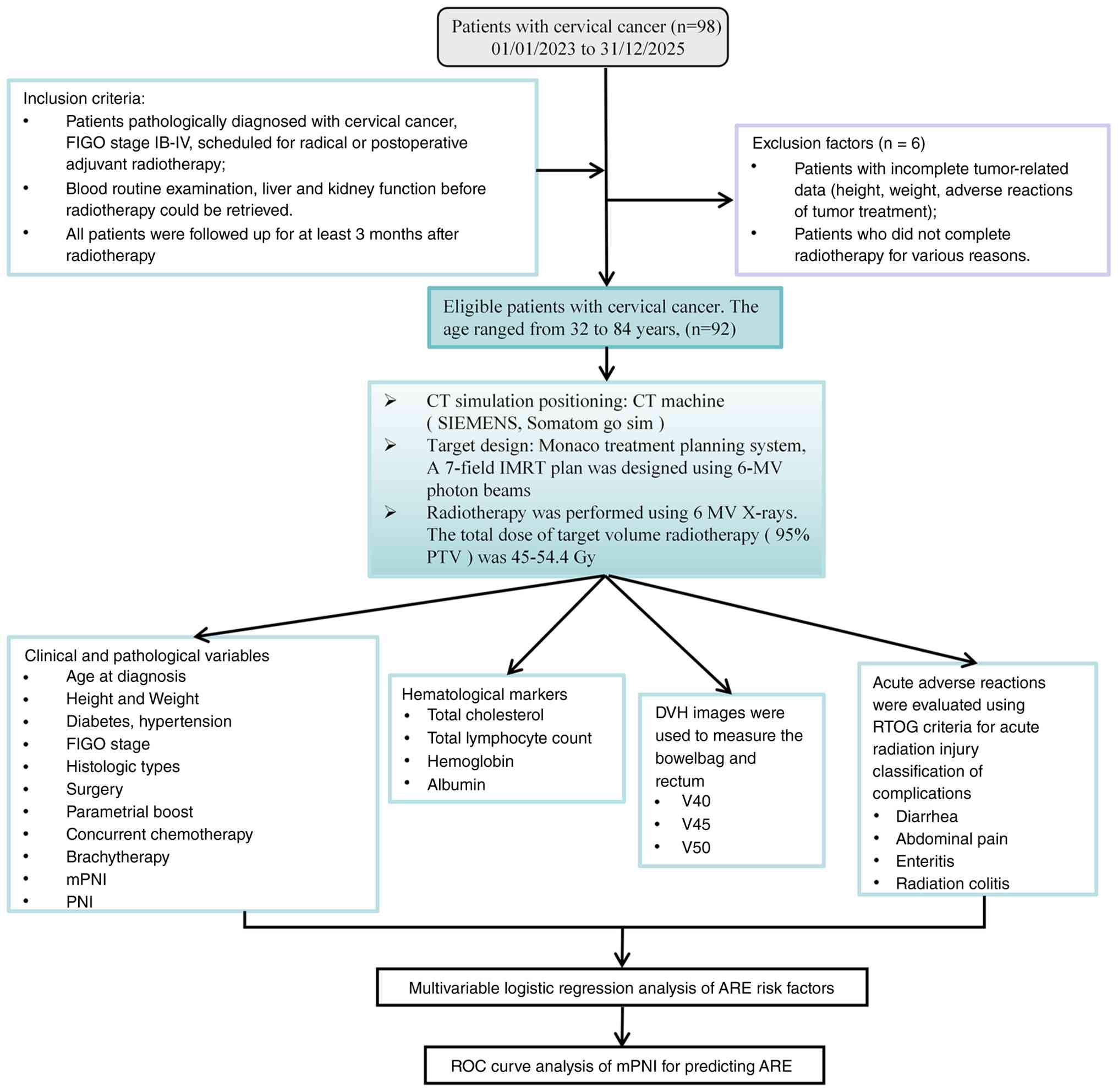 | Figure 1.Patient selection and study design.
FIGO, International Federation of Gynecology and Obstetrics; CT,
computed tomography; IMRT, intensity-modulated radiotherapy; PTV,
planning target volume; mPNI, modified prognostic nutritional
index; DVH, dose-volume histogram; RTOG, Radiation Therapy Oncology
Group; ROC, receiver operating characteristic; ARE, acute radiation
enteritis; V40, relative volume (%) receiving at least 40 Gy. |
The FIGO stages ranged from I–IV, with 62 patients
having stage I–II disease and 30 having stage III–IV disease. Stage
I–II disease was present in 19 patients in the non-ARE group and 43
patients in the ARE group, whereas stage III–IV disease was present
in 6 and 24 patients, respectively. This distribution was not
statistically significant (Pearson χ2=1.158; P=0.282).
Hypertension and diabetes mellitus were present in 36 and 24
patients, respectively. In total, 63 patients underwent radical
surgery for cervical cancer, 33 received brachytherapy after
external-beam radiotherapy and 10 received boost treatment, with
boost doses ranging from 50 to 59.94 Gy. Concurrent chemotherapy
was administered to 55 patients. Before treatment, anaemia was
observed in 62 patients. In total, 20 patients received >50 Gy,
whereas 72 received ≤50 Gy (Table
I).
 | Table I.Comparison of general data between the
non-ARE (n=25) and ARE (n=67) groups. |
Table I.
Comparison of general data between the
non-ARE (n=25) and ARE (n=67) groups.
| Clinical
features | Non-ARE group | ARE group | χ2/t | P-value |
|---|
| Mean age ± SD,
years | 55.12±11.41 | 59.4±8.91 | −1.89 | 0.062 |
| Mean BMI ± SD,
kg/m2 | 24.10±3.69 | 23.87±3.0 | 0.31 | 0.761 |
| Hypertension, n
(%) |
|
|
|
|
| No | 13 (52.0) | 43 (64.18) | 1.13 | 0.287 |
| Yes | 12 (48.0) | 24 (35.82) |
|
|
| Diabetes, n (%) |
|
|
|
|
| No | 18 (72.0) | 50 (74.63) | 0.07 | 0.799 |
|
Yes | 7 (28.0) | 17 (25.37) |
|
|
| FIGO stage, n
(%) |
|
|
|
|
|
I–II | 19 (76.0) | 43 (64.18) | 1.16 | 0.282 |
|
III–IV | 6 (24.0) | 24 (35.82) |
|
|
| Surgery, n (%) |
|
|
|
|
| No | 5 (20.0) | 24 (35.82) | 2.11 | 0.146 |
|
Yes | 20 (80.0) | 43 (64.18) |
|
|
| Parametrial boost,
n (%) |
|
|
|
|
| No | 24 (96.0) | 58 (86.57) | 0.84 | 0.359 |
|
Yes | 1 (4.0) | 9 (13.43) |
|
|
| Concurrent
chemotherapy, n (%) |
|
|
|
|
| No | 14 (56.0) | 23 (34.33) | 3.56 | 0.059 |
|
Yes | 11 (44.0) | 44 (65.67) |
|
|
| Brachytherapy, n
(%) |
|
|
|
|
| No | 17 (68.0) | 42 (62.69) | 0.22 | 0.636 |
|
Yes | 8 (32.0) | 25 (37.31) |
|
|
| Prescription dose,
n (%) |
|
|
|
|
| ≤50
Gy | 18 (72.0) | 54 (80.60) |
|
|
| >50
Gy | 7 (28.0) | 13 (19.40) | 0.79 | 0.374 |
| Anemia, n (%) |
|
|
|
|
| HB
<120 g/l | 15 (60.0) | 47 (70.15) | 0.85 | 0.356 |
| HB ≥120
g/l | 10 (40.0) | 20 (29.85) |
|
|
| Pathological type
(%) |
|
|
|
|
|
Squamous cell carcinoma | 24 (96.0) | 66 (98.51) | 0.00 | >0.999 |
|
Adenocarcinoma | 1 (4.0) | 1 (1.49) |
|
|
| Mean mPNI ± SD | 76.45±8.59 | 89.72±11.14 | −5.38 | <0.001 |
| Conventional
PNIa | 47.85
(45.05–51.30) | 43.60
(39.03–48.33) | −2.83 | 0.005 |
Univariate analysis of factors
associated with ARE during radiotherapy in patients with cervical
cancer
The mean pre-radiotherapy mPNI was significantly
higher in the ARE group than in the non-ARE group (89.72±11.14 vs.
76.45±8.59; t=−5.381; P<0.001). Conventional PNI was
significantly lower in the ARE group than in the non-ARE group
[43.60 (39.03–48.33) vs. 47.85 (45.05–51.30); Z=−2.83; P=0.005]. No
significant differences were observed in age, BMI, hypertension,
diabetes, FIGO stage, surgery, parametrial boost, concurrent
chemotherapy, brachytherapy, prescription dose, anaemia or
pathological type between the two groups (all P>0.05) Table I.
Association between dosimetric
parameters and ARE occurrence
Comparison of radiotherapy dosimetric parameters
showed no significant differences in bowel bag V40, V45 or V50, or
in rectal V40, V45 or V50 between the ARE and non-ARE groups
(P>0.05). These DVH parameters are expressed as relative volumes
(%). These findings suggest that, in this cohort, the analysed
bowel bag and rectal DVH parameters were not significantly
associated with the occurrence of ARE during radiotherapy in
patients with cervical cancer. Detailed results are presented in
Table II.
| Table II.DVH parameters between the non-ARE
and ARE groups. |
Table II.
DVH parameters between the non-ARE
and ARE groups.
| DVH (%) | Non-ARE group
(n=25) | ARE group
(n=67) | t/Z | P-value |
|---|
| Bowel bag V40 | 26.05±8.37 | 25.97±11.49 | 0.034 | 0.973 |
| Bowel bag V45 | 19.62±7.74 | 17.95±8.66 | 1.087 | 0.28 |
| Bowel bag V50 | 6.67
(1.56–11.56) | 3.86
(0.00–18.44) | −1.516 | 0.124 |
| Rectum V40 | 90.16±9.29 | 86.54±16.20 | 1.053 | 0.295 |
| Rectum V45 | 73.33±19.75 | 67.72±22.22 | 1.108 | 0.271 |
| Rectum V50 | 26.08
(7.94–40.27) | 24.75
(0.00–39.89) | −0.485 | 0.643 |
Representative external-beam radiotherapy plans from
the ARE and non-ARE groups are shown in Fig. 2. In both representative plans,
adequate dose coverage of the PTV was achieved and the dose
distribution to OARs, including the rectum, small intestine and
bladder, met the clinical planning requirements.
Multivariable logistic regression
analysis of risk factors for ARE
In the limited multivariable logistic model that
included FIGO stage and pre-radiotherapy mPNI, pre-radiotherapy
mPNI was significantly associated with grade ≥1 ARE [odds ratio
(OR), 1.154; 95% confidence interval (CI), 1.075–1.239;
P<0.001], whereas FIGO stage was not independently associated
with ARE (OR, 1.477; 95% CI, 0.426–5.126; P=0.539). To address
potential confounding by clinically relevant factors, a clinically
adjusted model was constructed. Given the limited sample size and
potential collinearity among DVH parameters, bowel bag V40 (%) and
rectum V40 (%) were selected as representative dosimetric
covariates in the clinically adjusted model. In this model, mPNI
remained associated with grade ≥1 ARE (OR, 1.163; 95% CI,
1.072–1.261; P<0.001). The principal regression results are
summarised in Table III, and the
full clinically adjusted model is provided in Table SII.
| Table III.Multivariable logistic regression
analysis of factors associated with acute radiation enteritis. |
Table III.
Multivariable logistic regression
analysis of factors associated with acute radiation enteritis.
| Model/variable | OR | 95% CI | P-value |
|---|
| Limited model: FIGO
III–IV vs. I–II | 1.477 | 0.426–5.126 | 0.539 |
| Limited model:
mPNI | 1.154 | 1.075–1.239 | <0.001 |
| Clinically adjusted
model: mPNI | 1.163 | 1.072–1.261 | <0.001 |
| Grade ≥2
sensitivity endpoint: mPNI | 1.069 | 1.023–1.117 | 0.003 |
| Grade ≥3
sensitivity endpoint: mPNI | 1.071 | 1.013–1.133 | 0.016 |
Sensitivity analyses using more clinically
meaningful endpoints showed that mPNI remained associated with
grade ≥2 ARE (OR, 1.069; 95% CI, 1.023–1.117; P=0.003) and grade ≥3
ARE (OR, 1.071; 95% CI, 1.013–1.133; P=0.016) in models adjusted
for age, FIGO stage, surgery, concurrent chemotherapy,
brachytherapy, prescription dose >50 Gy and boost treatment. The
grade ≥3 model should be interpreted as exploratory due to the
limited number of severe events. Additional details are shown in
Table SII.
ROC curve analysis of mPNI for
predicting ARE during radiotherapy in patients with cervical
cancer
ROC curve analysis was performed to evaluate the
predictive performance of pre-radiotherapy mPNI for ARE in patients
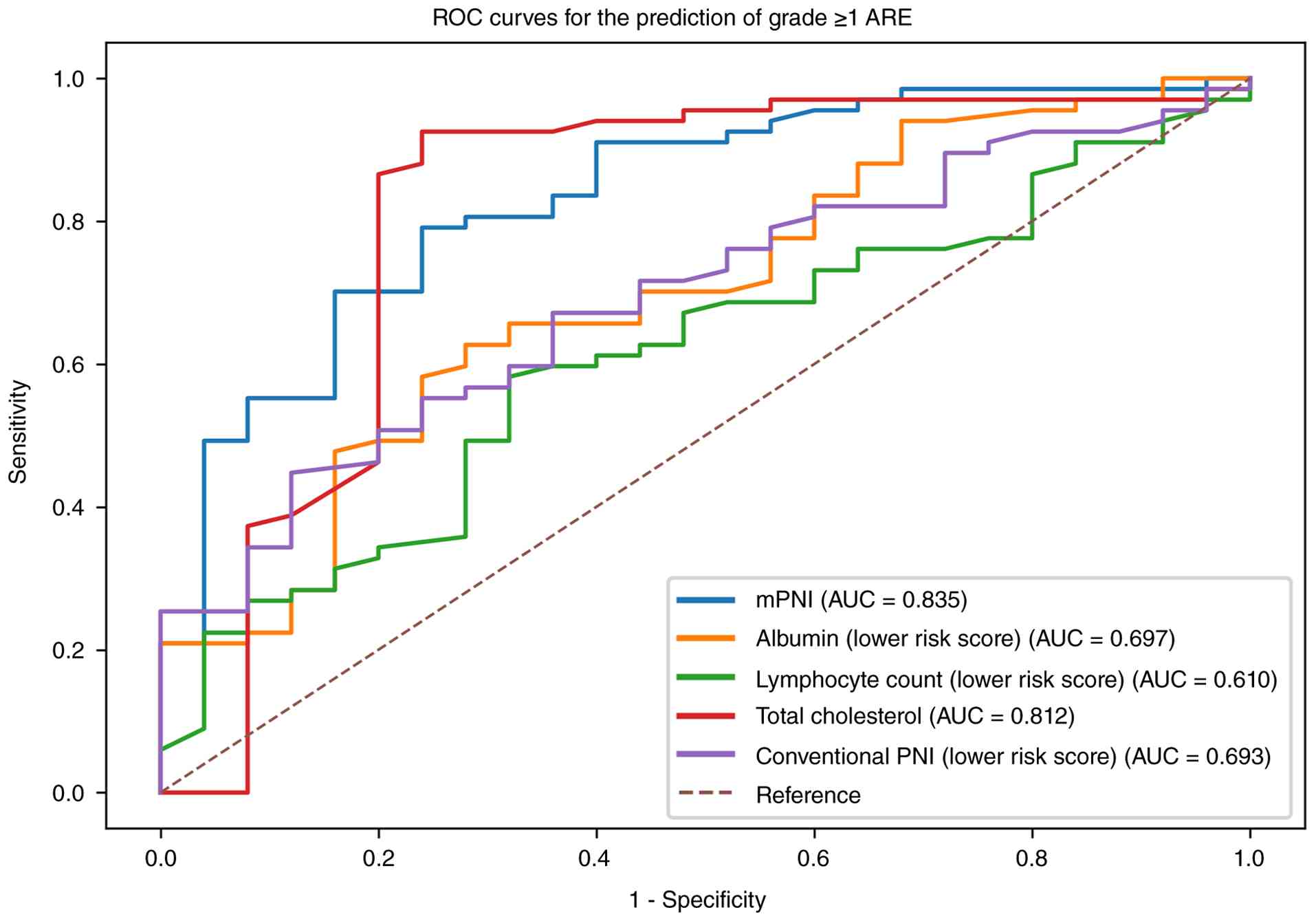
with cervical cancer undergoing radiotherapy (22). ROC analysis showed that mPNI had an
AUC of 0.835 (95% CI, 0.732–0.917) for grade ≥1 ARE. The optimal
cut-off value was 80.406, with a sensitivity of 79.1% and a
specificity of 76.0% (P<0.001). The bootstrap mean AUC was
0.835. ROC comparisons with albumin, lymphocyte count, total
cholesterol and conventional PNI are shown in Fig. 3 and Table SIII, mPNI had the highest AUC,
although its discriminatory performance was close to that of total
cholesterol. Apparent calibration of the mPNI logistic model was
acceptable in this dataset (Brier score, 0.139; Hosmer-Lemeshow
χ2 value, 3.004; P=0.934). Decision-curve analysis
showed that the mPNI model provided a higher net benefit than the
treat-all and treat-none strategies across most threshold
probabilities from 0.25 to 0.80 (Fig.
4).
Compared with its individual components and
conventional PNI, mPNI had the highest AUC, although its
discrimination was close to that of total cholesterol. Paired
bootstrap comparisons showed that the AUC of mPNI was higher than
that of albumin (difference, 0.138; P=0.048), total lymphocyte
count (difference, 0.226; P<0.001) and conventional PNI
(difference, 0.143; P=0.022), but was not significantly higher than
that of total cholesterol (difference, 0.023; P=0.644). These
findings suggest that mPNI may provide additional discriminatory
information beyond albumin, lymphocyte count and conventional PNI
in this cohort; however, its advantage over total cholesterol alone
was not statistically significant.
Discussion
Radiotherapy remains one of the primary effective
treatment modalities for the comprehensive management of cervical
cancer (23,24); however, its associated toxicities
should not be overlooked. ARE is a common adverse reaction during
pelvic radiotherapy (25); it
typically appears in the second week after the initiation of
radiotherapy and peaks at weeks 4–5. In severe cases, ARE may
reduce the tolerance of a patient to radiotherapy and even lead to
interruption or discontinuation of treatment, thereby adversely
affecting tumour control and overall treatment efficacy (26). Previous studies have shown that the
occurrence and progression of ARE are associated with radiotherapy
technique, total dose, total irradiated volume, fractional dose,
dose-volume ratio and the homogeneity of radiation dose
distribution (3,5–7). In
recent years, IMRT (27) has been
used for radiotherapy in gynecological tumours. Although advances
in IMRT have reduced the radiation exposure of OARs, ARE is
difficult to avoid completely. Therefore, simple pretreatment
indicators that can identify patients at increased risk of ARE may
help guide individualised monitoring and early supportive
intervention.
Malnutrition is relatively common in patients with
cervical cancer and has clinical significance (28). Impaired nutritional status may
weaken immune function, reduce treatment tolerance and increase
susceptibility to treatment-related adverse reactions. The PNI,
calculated from serum albumin and peripheral blood lymphocyte
count, reflects nutritional and immune status to some extent and
has been investigated in perioperative and oncological settings,
including retroperitoneal sarcoma, as well as in patients with
nasopharyngeal and head and neck malignancies undergoing
radiotherapy (11–14). The mPNI is an indicator that further
incorporates serum cholesterol level based on the traditional PNI.
Compared with conventional PNI, mPNI may more comprehensively
reflect the nutritional status, immune function and metabolic
reserve of patients. Previous studies have shown that mPNI has good
predictive value for overall survival and recurrence-free survival
in malignant tumours such as colorectal cancer, breast cancer and
hepatocellular carcinoma (15,16,21),
and that its predictive performance may be superior to that of the
original PNI and some traditional nutritional assessment tools,
such as the Global Leadership Initiative on Malnutrition criteria
(29), the controlling nutritional
status score (30) and the
nutritional risk index (31).
However, evidence regarding the value of mPNI in predicting
radiotherapy-related adverse events, particularly ARE in cervical
cancer, remains limited.
In the present study, higher pre-radiotherapy mPNI
was associated with grade ≥1 ARE in patients with cervical cancer
undergoing radiotherapy. As grade 1 toxicity reflects mild bowel
habit changes, the use of grade ≥1 ARE as the primary endpoint may
partly explain the relatively high incidence of ARE in the present
cohort. However, the association between mPNI and ARE persisted
when grades ≥2 and ≥3 endpoints were used, suggesting that the
finding was not solely driven by mild events. The grade ≥3 analysis
should still be interpreted cautiously due to the limited number of
severe events. ROC analysis also showed that pre-radiotherapy mPNI
had good discriminatory performance for grade ≥1 ARE, with an AUC
of 0.835, an optimal cut-off value of 80.406, a sensitivity of
79.1% and a specificity of 76.0%. The discriminatory performance of
mPNI was close to that of total cholesterol, suggesting that
cholesterol may have contributed substantially to the predictive
signal in this cohort. Nevertheless, mPNI integrates metabolic,
nutritional and immune-related information and remained associated
with ARE after clinical adjustment. Therefore, it should be
interpreted as a composite risk indicator rather than as evidence
of superiority over all individual components.
The direction of the mPNI formula should be clearly
distinguished from that of conventional PNI. In the formula used in
the present study, albumin and lymphocyte count have negative
coefficients; therefore, a higher mPNI may indicate a less
favourable nutrition-immune-metabolic profile rather than better
nutritional status. Patients with poorer nutritional and immune
reserves before radiotherapy may have weaker intestinal mucosal
repair capacity and may be more susceptible to radiation-induced
intestinal injury, more severe symptoms and delayed recovery
(32). Therefore, mPNI may serve as
a simple laboratory-based indicator for preliminary ARE risk
assessment before radiotherapy. For patients with elevated mPNI,
closer symptom monitoring, early nutritional evaluation and
supportive care may be considered during treatment.
Dosimetric variables are central determinants of
intestinal toxicity. In the present study, bowel bag and rectal
V40-V50 values were verified as relative volumes (%) and did not
differ significantly between the ARE and non-ARE groups. This
finding should not be interpreted as excluding the role of
dosimetry in ARE. Rather, the available retrospective dosimetric
dataset was limited to routinely extracted V40-V50 parameters.
Lower-dose intestinal parameters, such as V15, V30 and V35, as well
as mean and maximum dose, were not available. Future studies should
incorporate more comprehensive DVH parameters and standardised
bowel contouring to further clarify the interaction between
nutritional status, metabolic indicators and radiation dose
distribution.
The present study has several limitations. First,
this was a single-centre retrospective study with a relatively
limited sample size; therefore, selection bias may have been
present, and the stability of the multivariable and predictive
analyses requires further validation. Second, although mPNI is an
easily obtainable laboratory-based indicator, it cannot replace a
comprehensive nutritional assessment. Validated nutritional
assessment tools were not used, and data on recent weight loss,
dietary intake, nutritional support, prior malnutrition and body
composition were unavailable. Third, only pre-radiotherapy mPNI was
evaluated, and dynamic changes in nutritional, immune and
inflammatory statuses during radiotherapy were not assessed. In
addition, albumin and cholesterol levels may be influenced by
non-nutritional factors, such as inflammation, infection,
lipid-lowering therapy and metabolic disorders. Finally, external
validation was not available. Despite these limitations, the
present findings support the potential role of pre-radiotherapy
mPNI as a practical screening indicator for ARE risk. Future
prospective studies should determine whether mPNI-guided
nutritional assessment and supportive care can reduce clinically
meaningful gastrointestinal toxicity.
In conclusion, pre-radiotherapy mPNI was
independently associated with ARE in patients with cervical cancer
undergoing radiotherapy, and this association remained consistent
when grades ≥2 and ≥3 toxicity endpoints were evaluated. Given that
mPNI is derived from routinely available laboratory parameters, it
may provide a practical, low-cost approach for pretreatment risk
stratification. Incorporating mPNI into clinical assessment may
help identify patients who could benefit from closer
gastrointestinal toxicity monitoring, early nutritional evaluation
and timely supportive intervention during radiotherapy. These
findings should be interpreted as associative rather than causal
and warrant validation in larger prospective multicentre
studies.
Supplementary Material
Supporting Data
Acknowledgements
Not applicable.
Funding
This study was supported by the Fuyang People's Hospital
Postdoctoral Research Foundation.
Availability of data and materials
The data generated in the present study may be
requested from the corresponding author.
Authors' contributions
WZ designed the study. YZ designed the study,
interpreted the clinical data and wrote the manuscript. RH analyzed
and interpreted data. WQ and CW conducted the literature search,
interpreted data and revised the manuscript. WZ and YZ confirm the
authenticity of all the raw data. All authors read and approved the
final version of the manuscript.
Ethics approval and consent to
participate
This study was approved by the Ethics Committee of
Fuyang People's Hospital (Fuyang, China; approval no. 2026-22). Due
to the retrospective nature of the study, the requirement for
informed consent was waived.
Patient consent for publication
Not applicable.
Competing interests
The authors declare that they have no competing
interests.
References
|
1
|
Bray F, Ferlay J, Soerjomataram I, Siegel
RL, Torre LA and Jemal A: Global cancer statistics 2018: GLOBOCAN
estimates of incidence and mortality worldwide for 36 cancers in
185 countries. CA Cancer J Clin. 68:394–424. 2018.PubMed/NCBI
|
|
2
|
Bray F, Laversanne M, Sung H, Ferlay J,
Siegel RL, Soerjomataram I and Jemal A: Global cancer statistics
2022: GLOBOCAN estimates of incidence and mortality worldwide for
36 cancers in 185 countries. CA Cancer J Clin. 74:229–263.
2024.PubMed/NCBI
|
|
3
|
Shadad AK, Sullivan FJ, Martin JD and Egan
LJ: Gastrointestinal radiation injury: Symptoms, risk factors and
mechanisms. World J Gastroenterol. 19:185–198. 2013. View Article : Google Scholar : PubMed/NCBI
|
|
4
|
Zheng Y, Gao W, Spratt DE, Sun Y and Xing
L: Management of gastrointestinal perforation related to radiation.
Int J Clin Oncol. 25:1010–1015. 2020. View Article : Google Scholar : PubMed/NCBI
|
|
5
|
Wang Y, Kong W, Lv N, Li F, Chen J, Jiao
S, Ding D, Zhao H and Song D: Incidence of radiation enteritis in
cervical cancer patients treated with definitive radiotherapy
versus adjuvant radiotherapy. J Cancer Res Ther. 14
(Suppl):S120–S124. 2018. View Article : Google Scholar : PubMed/NCBI
|
|
6
|
Zeng C, Ji J, Huang Y, Peng Y, Zhang X,
Yang Z and Guo Z: A novel scoring system to predict acute radiation
enteritis recovery in cervical cancer patients undergoing
concurrent chemoradiotherapy: A southwest China cohort study. Int J
Gen Med. 17:5907–5919. 2024. View Article : Google Scholar : PubMed/NCBI
|
|
7
|
Ma CY, Zhao J, Gan GH, He XL, Xu XT, Qin
SB, Wang LL, Li L and Zhou JY: Establishment of a prediction model
for severe acute radiation enteritis associated with cervical
cancer radiotherapy. World J Gastroenterol. 29:1344–1358. 2023.
View Article : Google Scholar : PubMed/NCBI
|
|
8
|
Feng T, Shou HF, Yuan SH, Tang HR, Lyu XJ,
Yin ZM, Lou HM and Ni J: Treatment and prognosis analysis of 488
patients with FIGO 2018 stage IIIc squamous cervical cancer.
Zhonghua Fu Chan Ke Za Zhi. 58:359–367. 2023.(In Chinese).
PubMed/NCBI
|
|
9
|
Wang Y, Qiang WM, Li JQ, Shen AM, Chen XC,
Li XF, Zhang BZ, Xie J, Yan R, Li XH, et al: The effect of
chronoradiotherapy on cervical cancer patients: A multicenter
randomized controlled study. Front Oncol. 12:10214532022.
View Article : Google Scholar : PubMed/NCBI
|
|
10
|
Xue J, Wu M, Zhang J, Yang J, Lv G, Qu B,
Zhang Y, Yan X and Song J: Delta-radiomics analysis based on
magnetic resonance imaging to identify radiation proctitis in
patients with cervical cancer after radiotherapy. Front Oncol.
15:15235672025. View Article : Google Scholar : PubMed/NCBI
|
|
11
|
Cai Q, Guo J, Zhao Z, Zhang L, Yan S,
Zhang L, Wang S, Xiao Q, Gao J and Xiong F: Prognostic nutritional
index (PNI) for predicting perioperative complications after
tuberculous constrictive pericarditis surgery: A single-center
retrospective study. BMC Surg. 25:4462025. View Article : Google Scholar : PubMed/NCBI
|
|
12
|
Samà L, Kumar S, Covello E, D'Orazio F,
Pindilli S, Levi R, Sicoli F, Ruspi L, D'Amato V, Cozzaglio L, et
al: Nutritional status in retroperitoneal sarcoma: Implication of
prognostic nutritional index (PNI) and skeletal muscle index (SMI)
on postoperative and oncological outcomes. Clin Nutr ESPEN.
69:167–176. 2025. View Article : Google Scholar : PubMed/NCBI
|
|
13
|
Miao J, Xiao W, Wang L, Han F, Wu H, Deng
X, Guo X and Zhao C: The value of the prognostic nutritional index
(PNI) in predicting outcomes and guiding the treatment strategy of
nasopharyngeal carcinoma (NPC) patients receiving
intensity-modulated radiotherapy (IMRT) with or without
chemotherapy. J Cancer Res Clin Oncol. 143:1263–1273. 2017.
View Article : Google Scholar : PubMed/NCBI
|
|
14
|
Shi Y, Zhang Y, Niu Y, Chen Y and Kou C:
Prognostic role of the prognostic nutritional index (PNI) in
patients with head and neck neoplasms undergoing radiotherapy: A
meta-analysis. PLoS One. 16:e02574252021. View Article : Google Scholar : PubMed/NCBI
|
|
15
|
Papila B, Durmus S, Guliyev M, Alan O,
Demirci NS, Gelisgen R, Papila C and Uzun H: Diagnostic utility and
discriminative ability of cholesterol-modified prognostic
nutritional index and inflammatory indicators in colorectal cancer:
A retrospective case-control study. Sci Rep. 16:126732026.
View Article : Google Scholar : PubMed/NCBI
|
|
16
|
Chen K, Li G, Qiu Y, Yang M, Wang T, Yang
Y, Qiu H, Sun T and Wang W: The role of cholesterol-modified
prognostic nutritional index in nutritional status assessment and
predicting survival after liver resection for hepatocellular
carcinoma. Biosci Trends. 18:388–397. 2024. View Article : Google Scholar : PubMed/NCBI
|
|
17
|
Salvo G, Odetto D, Pareja R, Frumovitz M
and Ramirez PT: Revised 2018 international federation of gynecology
and obstetrics (FIGO) cervical cancer staging: A review of gaps and
questions that remain. Int J Gynecol Cancer. 30:873–878. 2020.
View Article : Google Scholar : PubMed/NCBI
|
|
18
|
McNair KM, Zeitlin D, Slivka AM, Lequerica
AH and Stubblefield MD: Translation of karnofsky performance status
(KPS) for use in inpatient cancer rehabilitation. PM R. 15:65–68.
2023. View Article : Google Scholar : PubMed/NCBI
|
|
19
|
Cox JD, Stetz J and Pajak TF: Toxicity
criteria of the radiation therapy oncology group (RTOG) and the
European organization for research and treatment of cancer (EORTC).
Int J Radiat Oncol Biol Phys. 31:1341–1346. 1995. View Article : Google Scholar : PubMed/NCBI
|
|
20
|
Chen X, Men K, Zhu J, Yang B, Li M, Liu Z,
Yan X, Yi J and Dai J: DVHnet: A deep learning-based prediction of
patient-specific dose volume histograms for radiotherapy planning.
Med Phys. 48:2705–2713. 2021. View
Article : Google Scholar : PubMed/NCBI
|
|
21
|
Shi J, Liu T, Ge Y, Liu C, Zhang Q, Xie H,
Ruan G, Lin S, Zheng X, Chen Y, et al: Cholesterol-modified
prognostic nutritional index (CPNI) as an effective tool for
assessing the nutrition status and predicting survival in patients
with breast cancer. BMC Med. 21:5122023. View Article : Google Scholar : PubMed/NCBI
|
|
22
|
Zhang L, Jie Z, Xu S, Zhang L and Guo X:
Use of receiver operating characteristic (ROC) curve analysis for
tyrer-cuzick and gail in breast cancer screening in Jiangxi
Province, China. Med Sci Monit. 24:5528–5532. 2018. View Article : Google Scholar : PubMed/NCBI
|
|
23
|
Chargari C, Ducassou A, Laville A, Lucia
F, Petit A, Flandin I, Cordoba A, Renard S, Demontoy S,
Hannoun-Lévi JM, et al: Radiotherapy and brachytherapy for cervical
cancer: Recommendations of the Société française de radiothérapie
oncologique. Cancer Radiother. 29:1047532025. View Article : Google Scholar : PubMed/NCBI
|
|
24
|
Chargari C, Peignaux K, Escande A, Renard
S, Lafond C, Petit A, Lam Cham Kee D, Durdux C and Haie-Méder C:
Radiotherapy of cervical cancer. Cancer Radiother. 26:298–308.
2022. View Article : Google Scholar : PubMed/NCBI
|
|
25
|
Loge L, Florescu C, Alves A and Menahem B:
Radiation enteritis: Diagnostic and therapeutic issues. J Visc
Surg. 157:475–485. 2020. View Article : Google Scholar : PubMed/NCBI
|
|
26
|
Mou Y, Liang P, Cheng X, He X, Zhang J,
Liu L and Liu Q: Influence of radiotherapy interruption on
esophageal cancer with intensity-modulated radiotherapy: A
retrospective study. BMC Cancer. 24:6462024. View Article : Google Scholar : PubMed/NCBI
|
|
27
|
Sevilla-Moreno AC, Puerta-Yepes ME, Wahl
N, Benito-Herce R and Cabal-Arango G: Interval analysis-based
optimization: A robust model for intensity-modulated radiotherapy
(IMRT). Cancers (Basel). 17:5042025. View Article : Google Scholar : PubMed/NCBI
|
|
28
|
Argefa TG and Roets L: Malnutrition and
the survival of cervical cancer patients: A prospective cohort
study using the PG-SGA tool. Nutr Cancer. 74:605–612. 2022.
View Article : Google Scholar : PubMed/NCBI
|
|
29
|
de Souza MTP, Gonzalez MC, Gil LA,
Cardenas TC, Caires RA, Burdmann EA and E Silva VTDC: Agreement
between the global leadership initiative on malnutrition (GLIM)
criteria and the patient-generated subjective global assessment
(PG-SGA) for diagnosing malnutrition in patients with solid tumors
admitted for treatment. Clin Nutr ESPEN. 73:1032862026. View Article : Google Scholar : PubMed/NCBI
|
|
30
|
Amatullah M, Begum SA, Mahmud T, Nahar K,
Ara R, Kulsum SU and Sharmin F: Association of preoperative
controlling nutritional status (CONUT) score with the staging of
cervical cancer. J Pharm Bioallied Sci. 17 (Suppl 5):S3732–S3734.
2025. View Article : Google Scholar : PubMed/NCBI
|
|
31
|
Xu Y, Zhang L, Huang Q, Yin Z and Zhang W:
Nutritional risk index (NRI) predicts the clinical outcomes of
patients with gastric cancer who received immune checkpoint
inhibitors (PD-1/PD-L1). Medicine (Baltimore). 104:e408982025.
View Article : Google Scholar : PubMed/NCBI
|
|
32
|
Zhou Y, Huang H, Wan T, Feng YL and Liu
JH: Chronic radiation-induced rectal injury after adjuvant
radiotherapy for pelvic malignant tumors: Report based on a phase 3
randomized clinical trial. Zhonghua Wei Chang Wai Ke Za Zhi.
24:962–968. 2021.(In Chinese). PubMed/NCBI
|