Introduction
Lung cancer is among the most common cancers
worldwide (1). Lung adenocarcinoma,
a major subtype of non-small cell lung cancer (NSCLC), accounts for
40–55% of all lung cancer cases (2). Owing to the insidious nature of its
early clinical symptoms, most patients are diagnosed at an advanced
stage, which limits treatment efficacy and can markedly reduce the
5-year survival rate (3).
Currently, for patients with advanced-stage NSCLC, treatment
strategies primarily depend on driver gene status. For patients
without definite driver gene alterations, clinical practice
typically involves the use of chemotherapy combined with
immunotherapy and/or antiangiogenic targeted therapy.
Immune escape mechanisms in the tumor
microenvironment are key factors contributing to lung
adenocarcinoma progression and treatment resistance. Tumor cells
utilize multiple immunosuppressive pathways, especially the
programmed cell death protein 1 (PD-1)/programmed death-ligand 1
(PD-L1) and cytotoxic T-lymphocyte-associated protein 4 (CTLA-4)
pathways, to effectively suppress immune surveillance and
cytotoxic. The PD-1/PD-L1 interaction induces functional exhaustion
of cytotoxic T lymphocytes (CTLs), thereby promoting immune escape
by tumor cells (2). Angiogenesis is
a critical biological hallmark of tumor growth and metastasis. As a
key angiogenic regulator, vascular endothelial growth factor (VEGF)
supports tumor cell survival by promoting endothelial cell
proliferation, migration and lumen formation.
Despite the remarkable progress achieved in immune
checkpoint inhibitors ICIs and antiangiogenic therapy in recent
years, the optimal treatment regimen for advanced driver
gene-negative NSCLC remains controversial. In lung cancer clinical
practice guidelines (4),
atezolizumab in combination with bevacizumab, carboplatin and
paclitaxel has been approved as a standard first-line treatment for
advanced NSCLC, demonstrating substantial clinical advantages.
However, the efficacy of other chemotherapy agents combined with
ICIs and antiangiogenic agents still lacks sufficient
evidence-based support. Thus, there is an urgent clinical need for
more alternative ICI-based triple combination regimens for driver
gene-negative NSCLC. In recent years, clinical studies have shown
that ICI-based triple combination regimens can confer survival
benefits to patients with advanced lung adenocarcinoma (5,6).
The present study aimed to investigate the clinical
efficacy and safety of the ICI-based triple combination regimen in
the first-line treatment of advanced lung adenocarcinoma in a
real-world, single-arm retrospective study, thereby providing a
reference basis for clinicians to optimize treatment strategies and
improve patient prognosis.
Materials and methods
Study subjects
The present study was a single-center, retrospective
study. Patients with driver gene-negative advanced lung
adenocarcinoma who received ICIs combined with antiangiogenic
agents and chemotherapy as first-line treatment at The Sixth
Affiliated Hospital (School of Medicine, South China University of
Technology, Foshan, China) between January 1, 2022 and December 31,
2024, were enrolled. The present study was a retrospective
observational study and its protocol was approved by the Medical
Ethics Committee of The Sixth Affiliated Hospital, School of
Medicine, South China University of Technology (approval no.
2023080).
Inclusion criteria were i) Age: ≥18 years; ii)
disease stage and treatment history: Patients with stage IIIb or IV
lung adenocarcinoma as defined by the American Joint Committee on
Cancer (AJCC)/Union for International Cancer Control (UICC) 8th
edition TNM staging system (https://ajccstaging.org/en) with no prior systemic
treatment for advanced disease; iii) driver gene-negative; iv)
Physical status: Eastern Cooperative Oncology Group (ECOG)
performance status (PS) ≤2 (ecog-acrin.org/scale); v) complete
imaging data and laboratory test indicators and vi) treatment
contraindication exclusion: No pneumonia induced by systemic
treatment.
Exclusion criteria were i) severe organ dysfunction
or cachexia: Patients who were definitively diagnosed with severe
hepatic or renal insufficiency before treatment or those with
terminal cancer cachexia (characterized by severe weight loss,
muscle wasting, and inability to tolerate antitumor treatment), ii)
insufficient treatment duration: Patients who received <3 cycles
of combination therapy; iii) prolonged treatment interruption:
Patients whose treatment was interrupted for >1 month during the
course of combination therapy course; iv) missing key data:
Patients with missing imaging data or laboratory test data; v)
chronic use of immunosuppressive drugs: Patients with long-term
continuous use of glucocorticoids or other immunosuppressants
before or during treatment.
Patient baseline characteristics are given in
Table I.
 | Table I.Patient baseline characteristics. |
Table I.
Patient baseline characteristics.
| Clinical feature | Cases (n=12) | Percentage (%) |
|---|
| Sex |
|
|
| Male | 11 | 91.7 |
|
Female | 1 | 8.3 |
| Age |
|
|
|
<60 | 2 | 16.7 |
|
≥60 | 10 | 83.3 |
| Smoker |
|
|
|
Yes | 2 | 16.7 |
| No | 10 | 83.3 |
| Underlying
diseases |
|
|
|
Yes | 8 | 66.7 |
| No | 4 | 33.3 |
| Tumor location |
|
|
|
LUL | 2 | 16.7 |
|
LLL | 1 | 8.3 |
|
RUL | 5 | 41.7 |
|
RML | 2 | 16.7 |
|
RLL | 2 | 16.7 |
| TNM staging |
|
|
| Stage
IV | 9 | 75.0 |
| Stage
IIIb | 3 | 25.0 |
| PD-1
expression |
|
|
|
Positive | 3 | 25.0 |
|
Negative | 9 | 75.0 |
| ECOG |
|
|
| 1 | 9 | 75.0 |
| 2 | 3 | 25.0 |
| Chemotherapeutic
agents |
|
|
|
Pemetrexed | 12 | 100.0 |
|
Carboplatin | 10 | 83.3 |
|
Nedaplatin | 3 | 25 |
|
Cisplatin | 1 | 8.3 |
| ICIs |
|
|
|
Tislelizumab | 10 | 83.3 |
|
Sintilimab | 1 | 8.3 |
|
Toripalimab | 1 | 8.3 |
| Anti-angiogenic
agents |
|
|
|
Bevacizumab | 11 | 91.7 |
|
Endostatin | 1 | 8.3 |
|
Anlotinib | 1 | 8.3 |
Treatment regimen
All enrolled patients were definitively diagnosed
with NSCLC via integrated multimodal assessment, including imaging
(CT/MRI), pathological biopsy, and clinical symptom evaluation.
Lung cancer staging was performed according to the AJCC/UICC 8th
TNM staging system, with all patients categorized as stage IIIb or
IV. PD-L1 expression was detected using the Dako 22C3 assay, and a
tumor proportion score ≥1% was defined as positive.
All patients received first-line combination therapy
consisting of ICIs, antiangiogenic agents, and platinum-based
chemotherapy, which was administered in a synchronous manner unless
contraindicated. The specific regimens were as follows:
ICIs: Tislelizumab, 200 mg every 3 weeks;
toripalimab, 240 mg every 3 weeks; sintilimab, 200 mg every 3
weeks; camrelizumab, 200 mg every 3 weeks.
Antiangiogenic agents: bevacizumab, 15 mg/kg every 3
weeks; recombinant human endostatin, 15 mg/m2 on Days
1–3 of each 21-day cycle; anlotinib, 12 mg orally once daily for 2
weeks, followed by a 1-week break (21-day cycle).
Chemotherapy: Pemetrexed 500 mg/m2;
paclitaxel 175 mg/m2; cisplatin 75 mg/m2;
carboplatin AUC 5–6.
Efficacy and safety evaluation
Efficacy assessment
Efficacy was assessed on the basis of imaging
findings (such as contrast-enhanced CT or MRI) and the Response
Evaluation Criteria in Solid Tumors (RECIST) version 1.1 (7).
The primary outcome measures of the present study
included the disease control rate (DCR), objective response rate
(ORR), progression-free survival (PFS), and overall survival (OS).
The definitions of each indicator were consistent with
international oncology research standards and the RECIST 1.1
criteria, as detailed below: PFS was defined as the time interval
from the date of the first dose of the ICI-based triple combination
regimen to the earliest occurrence of radiologically confirmed
tumor progression, mortality from any cause, or the present study
cutoff date. OS was defined as the time interval from the date of
the first dose of the ICI-based triple combination regimen to the
earliest occurrence of death from any cause or The present study
cutoff date. The ORR was defined as the percentage of patients who
achieved the best overall complete response (CR) or partial
response (PR) after the initiation of the ICI-based triple
combination regimen. DCR was defined as the percentage of patients
who achieved the best overall response [CR, PR, or stable disease
(SD)] after treatment initiation.
Safety assessment
In the present retrospective study, the monitoring
of adverse events (AEs), such as blood pressure, proteinuria and
hepatic function during treatment was performed using routine
clinical tests based on archived medical records (blood pressure
was measured with a standard electronic sphygmomanometer,
proteinuria was quantified by dry chemistry-based urinalysis and
overall hepatic function was evaluated by routine serum liver
biochemical tests). All AEs were graded according to the Common
Terminology Criteria for Adverse Events, version 5.0 (8).
Statistical analysis
Statistical analysis of the baseline data was
performed using IBM SPSS Statistics 27 (version 27.0.1). Patients'
baseline characteristics were summarized using frequency (n) and
the constituent ratio (%) for descriptive statistics. Continuous
variables that conformed to a normal distribution were analyzed
using the independent samples t test, and nonnormally distributed
variables were analyzed using the Mann-Whitney test. In the
influencing factor analysis, univariate analysis was performed
using the log-rank test to explore the associations of variables
(including sex, tumor location, comorbid underlying diseases,
smoking history and treatment drugs) with PFS and OS.
Progression-free survival and overall survival curves were plotted
using the Kaplan-Meier method, ensuring consistency with the
survival endpoint definitions in the present study. A two-tailed
P<0.05 was considered to indicate a statistically significant
difference.
Results
Patient characteristics
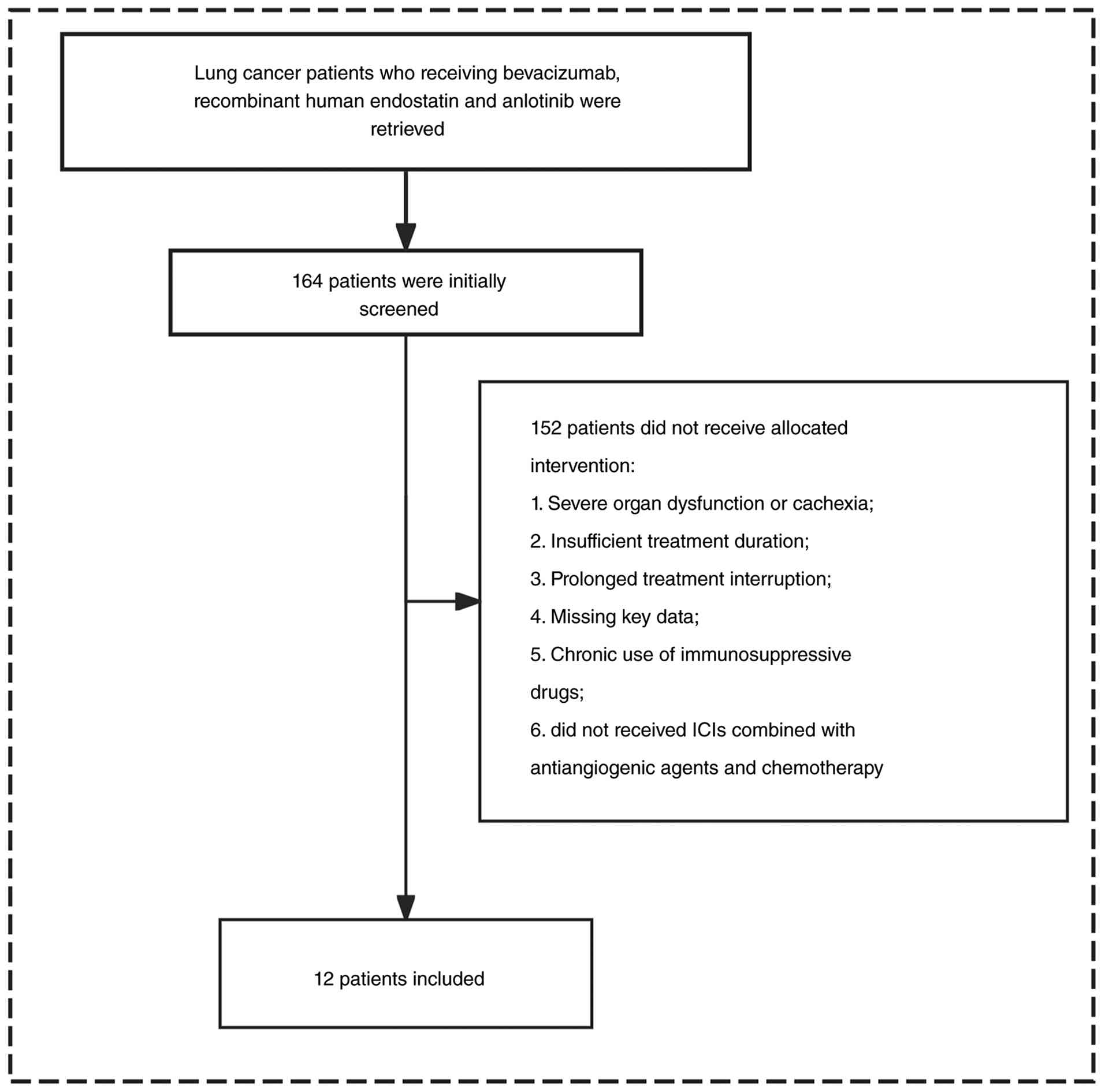
All patients were identified from the hospital
medical records system, diagnosed with advanced lung adenocarcinoma
and received first-line treatment at The Sixth Affiliated Hospital
(School of Medicine, South China University of Technology) between
January 1, 2022 and December 31, 2024. Follow-up was initiated from
the date of the first combined regimen administration and ended at
the time of censoring, the present study cutoff date (March 31,
2025), or the occurrence of the primary endpoint (patient
mortality). The median follow-up duration was 26.6 months (95% CI:
21.3–31.8 months). During the follow-up period, seven patients were
censored and six patients succumbed. The median age of the patients
was 71 years (range: 45–76 years), including two patients (16.7%)
aged <60 years and ten patients (83.3%) aged ≥60 years. There
were eleven male patients (91.7%) and one female patient (8.3%).
Among them, ten patients (83.3%) had no smoking history, and eight
patients (66.7%) had comorbid underlying diseases such as diabetes
mellitus, hypertension, and coronary heart disease. The patients
were staged according to the tumor TNM staging system, with nine
patients (75.0%) at stage IV and three patients (25.0%) at stage
IIIb. (Fig. 1; Table I).
Efficacy evaluation
All patients received ≥3 cycles of ICI-based triple
combination therapy comprising ICIs, antiangiogenic agents, and
chemotherapy. After treatment, therapeutic efficacy was assessed by
integrating imaging examinations and other relevant tests: the
primary pulmonary lesions were defined as target lesions, and the
sizes of the baseline lesions and posttreatment lesions were
compared. The evaluation was conducted in accordance with the
Response Evaluation Criteria in Solid Tumors (RECIST) version 1.1
(9). The results were as follows: a
PR of 58.3%, an SD of 33.3%, a PD of 8.3%, an ORR of 58.3%, and a
DCR of 83.3% (Tables II and
III).
| Table II.Therapeutic efficacy. |
Table II.
Therapeutic efficacy.
| Efficacy | Cases (n=12) | Percentage (%) |
|---|
| CR | 0 | 0.0 |
| PR | 7 | 58.3 |
| SD | 4 | 33.3 |
| PD | 1 | 8.3 |
| ORR | 7 | 58.3 |
| DCR | 11 | 83.3 |
| Table III.Treatment conditions. |
Table III.
Treatment conditions.
| Patient | Sex | Age | Treatment |
Pre-Treatmenta (mm) |
Post-Treatmenta (mm) | Tumor Reduction
Rate (%) | Efficacy |
|---|
| 1 | Male | 71 | Pemetrexed +
Carboplatin/Nedaplatin/Cisplatin + Bevacizumab/Endostatin +
Tislelizumabb | 13.0 | 7.0 | 46.2 | PR |
| 2 | Male | 71 | Pemetrexed +
Nedaplatin + Anlotinib + Tislelizumab | 69.0 | 48.0 | 30.4 | PR |
| 3 | Male | 45 | Pemetrexed +
Nedaplatin + Bevacizumab + Tislelizumab | 44.0 | 19.0 | 56.8 | PR |
| 4 | Male | 66 | Pemetrexed +
Carboplatin + Bevacizumab + Tislelizumab | 38.0 | 47.0 | −23.7 | PD |
| 5 | Female | 75 | Pemetrexed +
Carboplatin + Bevacizumab + Tislelizumab | 86.0 | 53.0 | 38.4 | PR |
| 6 | Male | 75 | Pemetrexed +
Carboplatin + Bevacizumab + Tislelizumab | 79.0 | 44.0 | 44.3 | PR |
| 7 | Male | 70 | Pemetrexed +
Carboplatin + Bevacizumab + Sintilimab | 56.0 | 35.0 | 37.5 | PR |
| 8 | Male | 72 | Pemetrexed +
Carboplatin + Bevacizumab + Toripalimab | 51.0 | 37.0 | 27.5 | SD |
| 9 | Male | 62 | Pemetrexed +
Carboplatin + Bevacizumab + Sintilimab | 26.0 | 19.0 | 26.9 | SD |
| 10 | Male | 46 | Pemetrexed +
Carboplatin + Bevacizumab + Sintilimab | 14.0 | 14.0 | 0.0 | SD |
| 11 | Male | 76 | Pemetrexed +
Carboplatin + Bevacizumab + Sintilimab | 43.0 | 35.0 | 18.6 | SD |
| 12 | Male | 73 | Pemetrexed +
Carboplatin + Bevacizumab + Sintilimab | 58.0 | 38.0 | 34.5 | PR |
Analysis of factors influencing
short-term efficacy
To investigate the effect of baseline data (such as
age, sex, tumor location and comorbid underlying diseases) on the
ORR of short-term efficacy, univariate analysis was performed.
Patients whose efficacy was evaluated as CR or PR were classified
into the high-sensitivity group, while those whose efficacy was
evaluated as SD or PD were classified into the low-sensitivity
group. The analysis revealed that there was no statistically
significant difference in the effect on short-term efficacy among
factors such as age, sex, tumor location, smoking status,
chemotherapeutic agents, ICIs and targeted agents (P>0.05). By
contrast, comorbid underlying diseases had a statistically
significant effect on short-term treatment efficacy (P<0.05;
Table IV).
| Table IV.Analysis of factors affecting recent
therapeutic efficacy. |
Table IV.
Analysis of factors affecting recent
therapeutic efficacy.
| Clinical
features | High-sensitivity
group (%) | Low-sensitivity
group (%) | Total | F | P-value |
|---|
| Sex |
|
|
|
|
|
|
Male | 6 (85.7) | 5 (100.0) | 11 (91.7) | 0.694 | 0.624 |
|
Female | 1 (14.3) | 0 (0.0) | 1 (8.3) |
|
|
| Age |
|
|
|
|
|
|
<60 | 1 (14.3) | 1 (20.0) | 2 (16.7) | 0.057 | 0.815 |
|
≥60 | 6 (85.7) | 4 (80.0) | 10 (83.3) |
|
|
| Tumor location |
|
|
|
|
|
| Left
lung | 1 (14.3) | 2 (40.0) | 3 (25.0) | 0.938 | 0.356 |
| Right
lung | 6 (85.7) | 3 (60.0) | 9 (75.0) |
|
|
| Underlying
diseases |
|
|
|
|
|
|
Yes | 3 (42.9) | 5 (100.0) | 8 (66.7) | 5.556 | 0.04a |
| No | 4 (57.1) | 0 (0.0) | 4 (33.3) |
|
|
| Smoker |
|
|
|
|
|
|
Yes | 0 (0.0) | 2 (40.0) | 2 (16.7) | 3.889 | 0.077 |
| No | 7 (100.0) | 3 (60.0) | 10 (83.3) |
|
|
| Chemotherapeutic
agentsb |
|
|
|
|
|
|
Pemetrexed + carboplatin | 4 (66.7) | 5 (100.0) | 9 (81.8) | 2.045 | 0.186 |
|
Pemetrexed + nedaplatin | 2 (33.3) | 0 (0.0) | 2 (18.2) |
|
|
| ICIs |
|
|
|
|
|
|
Tislelizumab | 6 (85.7) | 4 (80.0) | 10 (83.3) | 0.969 | 0.416 |
|
Sintilimab | 1 (14.3) | 0 (0.0) | 1 (8.3) |
|
|
|
Toripalimab | 0 (0.0) | 1 (20.0) | 1 (8.3) |
|
|
| Anti-Angiogenic
Agentsb |
|
|
|
|
|
|
Bevacizumab | 5 (83.3) | 5 (100.0) | 10 (90.9) | 0.818 | 0.389 |
|
Anlotinib | 1 (16.6) | 0 (0.0) | 1 (9.1) |
|
|
Safety
All patients developed various adverse reactions.
The specific manifestations and incidence were as follows: Seven
patients (58.3%) experienced toxicity and six patients (50.0%)
experienced nausea and vomiting. All adverse reactions were
alleviated after symptomatic treatment, and no severe adverse
events (SAEs) occurred (Table
V).
| Table V.Occurrence of adverse reactions. |
Table V.
Occurrence of adverse reactions.
| Adverse
reaction | Case (n=12) | Incidence rate
(%) | Proportion of grade
1–2 (%) | Proportion of grade
3 (%) | Proportion of grade
4–5 (%) |
|---|
| Hematological
toxicity | 7 | 58.3 | 5 (71.4) | 2 (28.6) | 0 (0.0) |
| Nausea and
vomiting | 6 | 50.0 | 6 (100.0) | 0 (0.0) | 0 (0.0) |
| Fatigue and
anorexia | 4 | 33.3 | 4 (100.0) | 0 (0.0) | 0 (0.0) |
| Myalgia | 4 | 33.3 | 3 (75.0) | 1 (25.0) | 0 (0.0) |
| Chest tightness and
shortness of breath | 4 | 33.3 | 4 (100.0) | 0 (0.0) | 0 (0.0) |
| Liver
dysfunction | 2 | 16.6 | 2 (100.0) | 0 (0.0) | 0 (0.0) |
| Hypothyroidism | 2 | 16.6 | 2 (100.0) | 0 (0.0) | 0 (0.0) |
| Fever | 1 | 8.3 | 1 (100.0) | 0 (0.0) | 0 (0.0) |
| Rash | 1 | 8.3 | 1 (100.0) | 0 (0.0) | 0 (0.0) |
| Abnormal blood
glucose | 1 | 8.3 | 1 (100.0) | 0 (0.0) | 0 (0.0) |
| Dizziness and
palpitations | 1 | 8.3 | 1 (100.0) | 0 (0.0) | 0 (0.0) |
Survival status
The results of the analysis revealed that there was
no statistically significant difference in survival status between
the high-sensitivity group (CR, PR) and the low-sensitivity group
(SD, PD) (P>0.05). In accordance with AJCC/UICC 8th TNM staging
system (10), staging was performed
on the basis of the maximum tumor diameter: two patients (16.7%)
were in the T1 stage, four patients (33.3%) were in the T2 stage,
four patients (33.3%) were in the T3 stage, and two patients
(16.7%) were in the T4 stage. Of the patients, eight (66.67%) were
in the N2 stage and four (33.33%) were in the N3 stage. The data
revealed no statistically significant difference in the effect of
tumor size or lymphatic metastasis on survival status (Table VI).
| Table VI.Analysis of the effect of therapeutic
efficacy and tumor size on survival status. |
Table VI.
Analysis of the effect of therapeutic
efficacy and tumor size on survival status.
|
| Survival status
(%) |
|
|
|
|---|
|
|
|
|
|
|
|---|
| Category | Survived | Died | Total (%) | F | P-value |
|---|
| Efficacy |
|
|
| 0.008 | 0.930 |
|
High-sensitivity group | 4 (57.1) | 3 (60.0) | 7 (58.3) |
|
|
|
Low-sensitivity group | 3 (42.9) | 2 (40.0) | 5 (41.7) |
|
|
| T Staging |
|
|
| 0.444 | 0.728 |
| T1 | 2 (28.6) | 0 (0.0) | 2 (16.7) |
|
|
| T2 | 2 (28.6) | 2 (40.0) | 4 (33.3) |
|
|
| T3 | 2 (28.6) | 2 (40.0) | 4 (33.3) |
|
|
| T4 | 1 (14.3) | 1 (20.0) | 2 (16.7) |
|
|
| N Staging |
|
|
| 0.145 | 0.711 |
| N2 | 5 (71.43) | 3 (60) | 8 (66.67) | N2 |
|
| N3 | 2 (28.57) | 2 (40) | 4 (33.33) | N3 |
|
Survival time
PFS and OS curves of patients were plotted using the
Kaplan-Meier method. The median PFS of patients reached 25.4 months
(95% CI: 12.7–38.0 months), as shown in Fig. 2. The median OS of patients reached
26.6 months (95% CI: 21.3–31.8 months), as shown in Fig. 3.
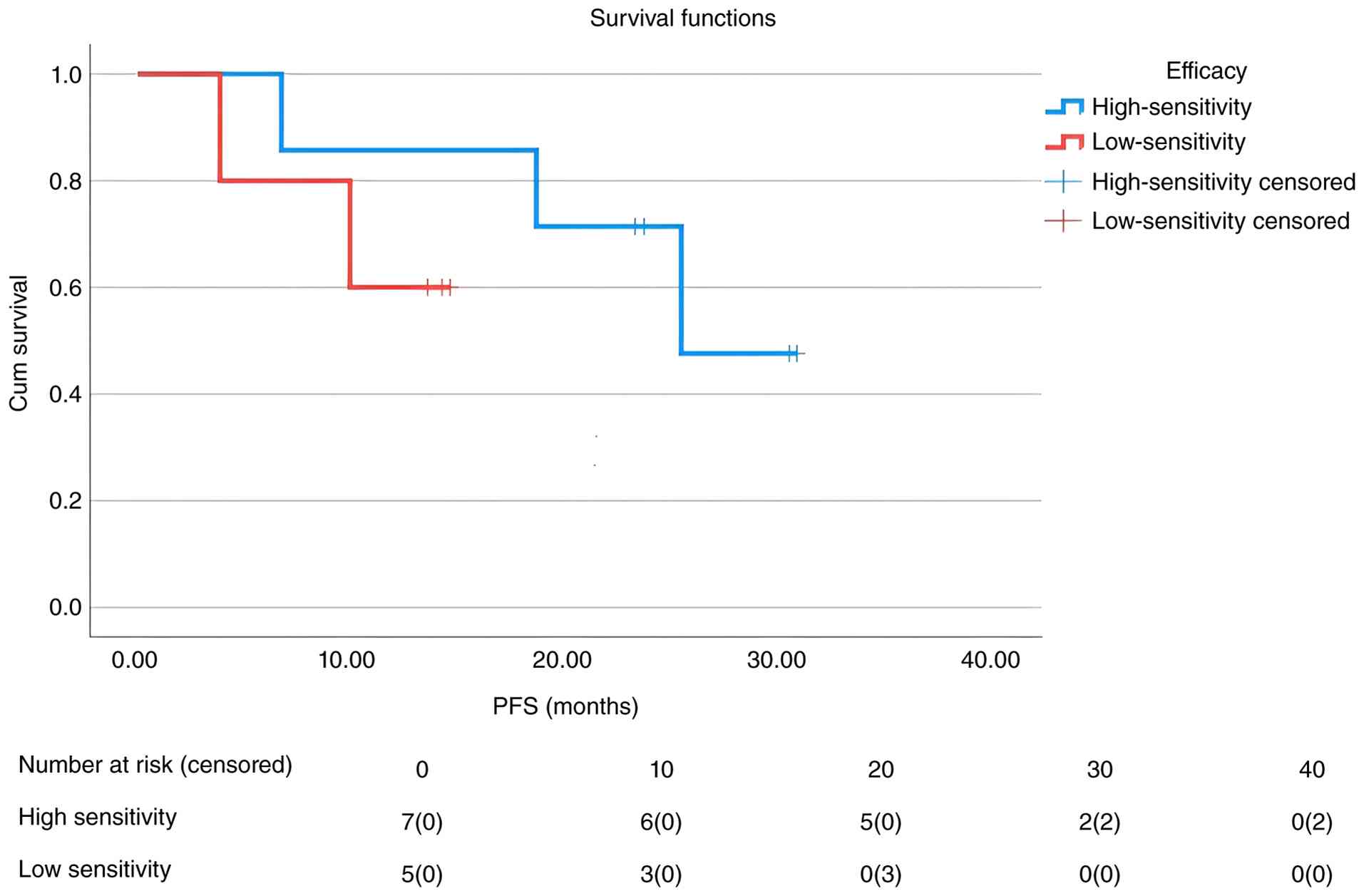
As shown in the figures, the median PFS and median
OS were not reached in either the high-sensitivity group or the
low-sensitivity group. The log-rank test was used to compare
intergroup survival differences, and the results revealed that,
compared with the low-sensitivity group, the high-sensitivity group
had a longer PFS; however, there was no statistically significant
difference in PFS between the two groups (P=0.332). Additionally,
there was no statistically significant difference in OS between the
two groups (P=0.691; Figs. 4 and
5). This was primarily due to the
limited sample size (n=12) and the relatively small number of
events (five deaths) in the present study, which resulted in
insufficient endpoint events occurring in some subgroups during the
observation period, making accurate estimation of the median
survival times challenging.
Discussion
The present study investigated the efficacy and
safety of a first-line ICI-based triple combination for advanced
lung adenocarcinoma. The results demonstrated clinical benefits of
this regimen. Although the present study has several limitations,
including a small sample size, a lack of a control group and other
confounding factors, these findings still possess certain heuristic
value. Its underlying mechanism is closely associated with the
synergistic effects of immune modulation and angiogenesis
inhibition.
PD-1 is an inhibitory receptor expressed on the
surface of T cells (2), whereas its
ligand, PD-L1, is expressed primarily on antigen-presenting cells
(APCs) and tumor cells. The binding of PD-1 to PD-L1 accelerates
the apoptosis of activated lymphocytes and suppresses the
activation and proliferation of T cells. By blocking this
PD-1/PD-L1 interaction, PD-1 inhibitors increase the number and
functional activity of antitumor CTLs, thereby achieving tumor
control (11,12).
VEGF plays a critical role in tumor initiation and
progression by mediating angiogenesis and vascular regulation.
Specifically, the binding of VEGF-A to VEGF receptor 2 (VEGFR-2)
activates the Raf/MEK/ERK signaling pathway (13,14).
This pathway promotes endothelial cell proliferation and increases
vascular permeability by activating endothelial nitric oxide
synthase, thereby facilitating angiogenesis. Antiangiogenic agents
exert antitumor effects by blocking VEGF-induced signal
transduction, ultimately inhibiting tumor growth (15).
VEGF is not only a key angiogenic factor but also an
immunomodulator in the tumor microenvironment (TME). It exerts
immunosuppressive effects by inhibiting antigen presentation,
stimulating regulatory T cells and inducing an immunosuppressive
TME (14). Studies have shown that
continuous VEGF infusion reduces the number and proportion of T
cells in patients and decreases thymus volume, suggesting that VEGF
inhibitors can abrogate such immunosuppression (16,17).
Additionally, tumor cells achieve immune escape by killing immune
cells via high expression of Fas ligand (FasL). VEGF further
contributes to immunosuppression by upregulating FasL levels, which
impair T-cell function and modulate T-cell recruitment in the TME,
thereby enhancing immunosuppressive activity (14). Thus, VEGF antagonism can prevent
excessive FasL expression and increase the efficacy of
immunotherapy.
Moreover, dendritic cells (DCs), a critical subset
of APCs, are responsible for antigen presentation. VEGF suppresses
the activation of DC transcription factors, thereby inhibiting DC
differentiation and maturation; notably, high PD-L1 expression also
impairs DC function (18).
Collectively, these findings suggest that tumor vascular
normalization promotes the infiltration of effector T cells and
enhances immunotherapeutic efficacy. Conversely, activated immune
cells further facilitate tumor vascular normalization, resulting in
the formation of a positive feedback loop. This bidirectional
interaction highlights the robust synergistic effects between VEGF
inhibitors and PD-1 inhibitors.
Efficacy
In recent years, clinical trials investigating the
combination of ICIs, antiangiogenic agents, and chemotherapy for
advanced driver gene-negative lung cancer have yielded promising
results. The IMpower150 study (19)
demonstrated significant improvements in survival outcomes among
driver gene-negative patients, the ICI-containing arm achieved a
median progression-free survival (mPFS) of 8.3 months and a median
overall survival (mOS) of 19.2 months, both of which were markedly
longer than those in the control arm. Lee et al (20) reported that the addition of
bevacizumab to ICIs further improved mPFS and mOS, supporting the
value of salvage therapy with this combination. In a multicenter,
phase II prospective cohort study (21), revealed that the combination of
Rh-endostatin with PD-1 inhibitors and chemotherapy could yield
favorable clinical outcomes and tolerable toxicity profile, the ORR
was 57.7 vs. 34.2%, DCR was 88.5 vs. 84.2%, and the mPFS was 16.7
months vs. 16.4 months.
In studies exploring small-molecule multitarget
tyrosine kinase inhibitors combined with ICIs, anlotinib plus ICIs
conferred survival benefits in terms of PFS and OS (22). Specifically, first-line treatment
with this combination in advanced driver gene-negative NSCLC
achieved a high mPFS of 15 months; however, the incidence of grade
≥3 adverse events was 54.5% (23),
highlighting a trade-off between efficacy and toxicity. By
contrast, the TISAL-FE-01 study (24) reported exceptional efficacy with
anlotinib plus ICIs, with an ORR of 75% and a DCR of 100%.
Notably, some studies investigating other
antiangiogenic agents combined with ICIs, such as lenvatinib plus
ICIs and cabozantinib plus ICIs (25,26),
failed to meet their primary endpoints. This discrepancy may be
attributed to excessive modification of the tumor vasculature by
antiangiogenic agents, which induces intratumoral hypoxia and
subsequently exacerbates immunosuppression in the TME.
In this real-world, single-center, retrospective
study, the ICI-based triple combination therapy showed promising
preliminary antitumor activity in patients with advanced driver
gene-negative lung adenocarcinoma, with an ORR of 58.3%, a DCR of
83.3%, a mPFS of 25.4 months, and a median OS of 26.6 months.
Numerically, the median PFS and OS in the cohort were longer than
those reported in previously published trials of similar
combination regimens, and the ORR and DCR suggested clinically
relevant antitumor effects. For historical reference, the
NCT02039674 study (27) (evaluating
pembrolizumab plus bevacizumab, paclitaxel, and carboplatin)
reported an ORR of 56%, mPFS of 7.1 months, and median OS of 16.7
months; the present study revealed a numerically prolonged median
PFS and OS compared with these historical data. Notably, 75% of
patients in the present cohort were PD-L1-negative, which may
suggest that the ICI-based triple combination could help overcome
immunotherapy resistance in patients with negative PD-L1, although
this hypothesis requires validation in larger, well-controlled
studies.
The clinical benefits observed in the present study
may be attributed to two factors: Strategic drug selection and
unique patient population characteristics. First, all the patients
received pemetrexed. High tissue specificity for lung
adenocarcinoma is well documented for pemetrexed. Some studies have
shown that pemetrexed enhances the efficacy of immunotherapy by
reducing the infiltration of myeloid-derived suppressor cells
(MDSCs) in the TME (28,29). MDSCs are a major component of the
immunosuppressive TME, and their depletion by pemetrexed creates a
more favorable environment for ICI-mediated antitumor immune
responses, thereby synergizing with ICIs and antiangiogenic agents.
Second, the majority of patients were treated with tislelizumab, an
anti-PD-1 antibody with proprietary Fc region engineering. This
modification reduces the phagocytosis of T cells by macrophages
(30), which prevents the loss of
effector T cells and may further amplify the synergistic antitumor
effect, contributing to its enhanced efficacy in this cohort.
Univariate analysis revealed that comorbid underlying diseases
(such as diabetes mellitus and hypertension) were critical factors
affecting short-term treatment efficacy (P<0.05). The potential
mechanism underlying this association involves chronic inflammatory
states induced by comorbidities: Persistent elevation of
proinflammatory cytokines (such as IL-6 and TNF-α) can alter TME
homeostasis (31). These changes
ultimately reduce the responsiveness to the ICI-based triple
combination, highlighting the need for optimized comorbidity
management in clinical practice. By contrast, age, sex, and PD-L1
expression status did not markedly affect treatment efficacy (all
P>0.05). Notably, the effect of smoking history on efficacy also
did not reach statistical significance (P>0.05), which may be
attributed to insufficient statistical power due to the small
sample size. Larger-scale studies are therefore needed to further
validate the association between smoking history and the efficacy
of this ICI-based triple combination.
Safety
In terms of safety, the majority of adverse
reactions were grade 1 or 2 in the present study and patients
exhibited good tolerance to the ICI-based triple combination. The
most frequently reported AEs were hematological toxicity (58.3%),
followed by nausea and vomiting (50.0%), fatigue and anorexia
(33.3%), myalgia (33.3%) and chest tightness with dyspnea (33.3%).
Of the patients. three developed grade 3 adverse events, including
hematological toxicity and myalgia, all of which improved after
symptomatic treatment. Myalgia was mainly transient. Prophylactic
interventions for myelosuppression were actively administered
during subsequent antitumor therapy, and the patients successfully
completed the remaining treatment cycles. As a limitation,
retrospective data failed to clarify the monitoring frequency of
adverse reactions, so the present study was unable to calculate
their median onset time.
Hematological toxicity and gastrointestinal
reactions were the primary treatment-related adverse events, which
is consistent with the common toxicity profile of platinum-based
chemotherapy (32). Notably,
hypertension and proteinuria, two typical adverse events associated
with antiangiogenic agents, were not observed in the present
cohort, further supporting the favorable safety of the regimen.
Compared with the IMpower150 study (19), which reported a grade 3–4 AEs
incidence of 67% in the ICI-containing arm, the severity of AEs in
the present study was substantially lower. This discrepancy may be
attributed to differences in drug doses, specific drug types, or
patient baseline characteristics. The low incidence of severe
hypertension and proteinuria in the present study may also be
associated with the long-term use of antihypertensive drugs in some
patients with preexisting hypertension, which masked the onset of
such adverse reactions. Regardless, the milder toxicity profile
observed here reinforces the good tolerability of the ICI-based
triple combination (22),
particularly providing a safe basis for elderly patients with
advanced lung adenocarcinoma. Importantly, all AEs were alleviated
after intervention and no treatment discontinuation or dose
reduction was attributed to SAE.
Limitations
The present study has several limitations that
should be acknowledged. First, owing to its single-center
retrospective nature and relatively small sample volume, the
present investigation may be subject to inherent selection bias.
Furthermore, non-typical baseline demographic and clinical
characteristics could impair the generalizability of the research
outcomes across diverse patient populations. Additionally, the
small sample size limited the statistical power of the subgroup
analyses, leading to insufficient statistical stability and making
it difficult to draw reliable conclusions about these subgroups.
Although the drug types included in the patient treatment regimens
were the same, there were differences in specific drugs for some
patients. Additionally, some patients changed their treatment
regimens during the treatment process. Since no subgroup analysis
was performed on the drugs, there may be potential effects of
specific drug combinations on efficacy. This could affect the
accuracy of the experimental results. In the future, it is planned
to increase the number of included patients and perform subgroup
analysis of patient medications to exclude the effects produced by
specific drug combinations. The limited sample size and number of
events resulted in reduced statistical power, which not only made
it difficult to detect statistically significant differences in
survival between groups but also restricted the application of
multivariable Cox proportional hazards regression models (as the
model failed to converge when multiple covariates were included).
Therefore, The present study primarily employed the Kaplan-Meier
method for survival analysis. Second, the present study lacked a
control group, which precluded direct comparison of the ICI-based
triple combination with other commonly used combination regimens.
Without such a comparison, it is not possible to definitively
determine whether the survival benefits observed in the present
study were unique to the ICI-based triple combination or comparable
to those of alternative therapies. Third, one patient was
administered anlotinib. Although anlotinib exerts targeted
inhibitory effects on VEGFR, it also suppresses multiple receptor
tyrosine kinases including PDGFR, FGFR and c-Kit. Due to the
limited sample size, sensitivity or subgroup analyses to eliminate
the influence of anlotinib-related drug heterogeneity on the
outcomes could not be performed, which may partially affect the
results. Finally, radiotherapy-related factors were not included in
the analysis. A subset of patients may have received local
radiotherapy during treatment, which could have confounded survival
outcomes. Subsequent studies should explicitly account for
radiotherapy use and adjust for this variable to exclude potential
confounding effects on efficacy assessments.
In summary, as a first-line therapy for patients
with advanced driver-gene-negative lung adenocarcinoma, ICI-based
triple combination therapy results in relatively high response
rates and a manageable safety profile to a certain extent. To
further validate the efficacy of the regimens and identify factors
influencing their therapeutic outcomes, multicenter, large-sample
randomized controlled trials are needed in the future to support
the integration of this ICI-based triple combination into
personalized treatment strategies for advanced lung adenocarcinoma,
ultimately improving clinical outcomes for patients with this
disease. In addition, it is planned to perform basic research for
direct verification of the underlying mechanism and detection of
critical biomarkers in subsequent investigations.
Acknowledgements
Not applicable.
Funding
The present study was funded by Wu Jieping Medical Foundation
(grant no. 320.6750.2023–6-27).
Availability of data and materials
The data generated in the present study may be
requested from the corresponding author.
Authors' contributions
DM and XP conceived and designed the present study.
ZZ, KW and XY collected and organized data. HC, ZZ and GX performed
data analysis. DM, HC and ZZ wrote the original draft. JY, LL and
YL reviewed and verified the clinical data, reviewed and
interpreted the experimental data and provided supervision. XP and
LL reviewed and revised the manuscript and approved the final
version. DM, JY and XP confirm the authenticity of all the raw
data. All authors read and approved the final version of the
manuscript.
Ethics approval and consent to
participate
The present study was a retrospective observational
study and its protocol was approved by the Medical Ethics Committee
of The Sixth Affiliated Hospital, School of Medicine, South China
University of Technology (approval no. 2023080). The present study
registration number is MR-44-25-045421 (available at http://www.medicalresearch.org.cn/). Written
informed consent was obtained from all participants at admission
for routine clinical treatment, which included authorization for
the use of their anonymized clinical data in this retrospective
research.
Patient consent for publication
Not applicable.
Competing interests
The authors declare that they have no competing
interests.
References
|
1
|
Li XY, Huang Q, Wu YM and Su S: The global
cancer statistics report in 2022: A narrow spectrum summary and
outlook. Cancer Res Prev Treat. 51:307–312. 2024.
|
|
2
|
Tang S, Qin C, Hu H, Liu T, He Y, Guo H,
Yan H, Zhang J, Tang S and Zhou H: Immune checkpoint inhibitors in
non-small cell lung cancer: Progress, challenges, and prospects.
Cells. 11:3202022. View Article : Google Scholar : PubMed/NCBI
|
|
3
|
Lu T, Yang X, Huang Y, Zhao M, Li M, Ma K,
Yin J, Zhan C and Wang Q: Trends in the incidence, treatment, and
survival of patients with lung cancer in the last four decades.
Cancer Manag Res. 11:943–953. 2019. View Article : Google Scholar : PubMed/NCBI
|
|
4
|
Chinese Society of Clinical Oncology, .
Diagnosis and treatment of non-small cell lung cancer 2025. CSCO
Guidelines; Beijing: 2025
|
|
5
|
Bylicki O, Tomasini P, Radj G, Guisier F,
Monnet I, Ricordel C, Bigay-Game L, Geier M, Chouaid C, Daniel C,
et al: Atezolizumab with or without bevacizumab and
platinum-pemetrexed in patients with stage IIIB/IV non-squamous
non-small cell lung cancer with EGFR mutation, ALK rearrangement or
ROS1 fusion progressing after targeted therapies: A multicentre
phase II open-label non-randomised study GFPC 06-2018. Eur J
Cancer. 183:38–48. 2023. View Article : Google Scholar : PubMed/NCBI
|
|
6
|
Shiraishi Y, Kishimoto J, Sugawara S,
Mizutani H, Daga H, Azuma K, Matsumoto H, Hataji O, Nishino K, Mori
M, et al: Atezolizumab and platinum plus pemetrexed with or without
bevacizumab for metastatic nonsquamous non-small cell lung cancer:
A phase 3 randomized clinical trial. JAMA Oncol. 10:315–324. 2024.
View Article : Google Scholar : PubMed/NCBI
|
|
7
|
Yan Persijn van Meerten EL, Gelderblom H
and Bloem JL: RECIST revised: Implications for the radiologist. A
review article on the modified RECIST guideline. Eur Radiol.
20:1456–1467. 2010. View Article : Google Scholar : PubMed/NCBI
|
|
8
|
National Cancer Institute, . Common
Terminology Criteria for Adverse Events (CTCAE), version 5.0. U.S.
Department of Health and Human Services; 2017
|
|
9
|
Eisenhauer EA, Therasse P, Bogaerts J,
Schwartz LH, Sargent D, Ford R, Dancey J, Arbuck S, Gwyther S,
Mooney M, et al: New response evaluation criteria in solid tumours:
Revised RECIST guideline (version 1.1). Eur J Cancer. 45:228–247.
2009. View Article : Google Scholar : PubMed/NCBI
|
|
10
|
Zhang M, Fei X and Zhou X: Proposals for
revisions of the TNM descriptors in the eighth edition of the TNM
classification for lung cancer. World Clinical Drugs. 37:441–445.
2016.(In Chinese).
|
|
11
|
Naimi A, Mohammed RN, Raji A, Chupradit S,
Yumashev AV, Suksatan W, Shalaby MN, Thangavelu L, Kamrava S,
Shomali N, et al: Tumor immunotherapies by immune checkpoint
inhibitors (ICIs); the pros and cons. Cell Commun Signal.
20:442022. View Article : Google Scholar : PubMed/NCBI
|
|
12
|
Wang SJ, Dougan SK and Dougan M: Immune
mechanisms of toxicity from checkpoint inhibitors. Trends Cancer.
9:543–553. 2023. View Article : Google Scholar : PubMed/NCBI
|
|
13
|
Elebiyo TC, Rotimi D, Evbuomwan IO,
Maimako RF, Iyobhebhe M, Ojo OA, Oluba OM and Adeyemi OS:
Reassessing vascular endothelial growth factor (VEGF) in
anti-angiogenic cancer therapy. Cancer Treat Res Commun.
32:1006202022.PubMed/NCBI
|
|
14
|
Zhao Y, Guo S, Deng J, Shen J, Du F, Wu X,
Chen Y, Li M, Chen M, Li X, et al: VEGF/VEGFR-targeted therapy and
immunotherapy in non-small cell lung cancer: Targeting the tumor
microenvironment. Int J Biol Sci. 18:3845–3858. 2022. View Article : Google Scholar : PubMed/NCBI
|
|
15
|
Ghalehbandi S, Yuzugulen J, Pranjol MZI
and Pourgholami MH: The role of VEGF in cancer-induced angiogenesis
and research progress of drugs targeting VEGF. Eur J Pharmacol.
949:1755862023. View Article : Google Scholar : PubMed/NCBI
|
|
16
|
Gabrilovich D, Ishida T, Oyama T, Ran S,
Kravtsov V, Nadaf S and Carbone DP: Vascular endothelial growth
factor inhibits the development of dendritic cells and dramatically
affects the differentiation of multiple hematopoietic lineages in
vivo. Blood. 92:4150–4166. 1998. View Article : Google Scholar : PubMed/NCBI
|
|
17
|
Ohm JE, Gabrilovich DI, Sempowski GD,
Kisseleva E, Parman KS, Nadaf S and Carbone DP: VEGF inhibits
T-cell development and may contribute to tumor-induced immune
suppression. Blood. 101:4878–4886. 2003. View Article : Google Scholar : PubMed/NCBI
|
|
18
|
Chen DS and Hurwitz H: Combinations of
bevacizumab with cancer immunotherapy. Cancer J. 24:193–204. 2018.
View Article : Google Scholar : PubMed/NCBI
|
|
19
|
Socinski MA, Jotte RM, Cappuzzo F, Orlandi
F, Stroyakovskiy D, Nogami N, Rodríguez-Abreu D, Moro-Sibilot D,
Thomas CA, Barlesi F, et al: Atezolizumab for first-line treatment
of metastatic nonsquamous NSCLC. N Engl J Med. 378:2288–2301. 2018.
View Article : Google Scholar : PubMed/NCBI
|
|
20
|
Lee J, Koh J, Kim HK, Hong S, Kim K, Park
S, Jung HA, Sun JM, Lee SH, Ahn JS, et al: Bevacizumab plus
atezolizumab after progression on atezolizumab monotherapy in
pretreated patients with NSCLC: An open-label, two-stage, phase 2
trial. J Thorac Oncol. 17:900–908. 2022. View Article : Google Scholar : PubMed/NCBI
|
|
21
|
Wang D, Feng Y, Wang H, Peng H, Zhang W,
Su W, Li H, Hu B, Bai Y, Ma H, et al: EP11.02–09 Rh-endostatin
combined with PD-1 inhibitors as first-line treatment for
EGFR/ALK-negative, non-squamous NSCLC. J Thorac Oncol. 18
(Suppl):S6182023. View Article : Google Scholar
|
|
22
|
Yu L, Xu J, Qiao R, Zhong H, Brueckl WM
and Zhong R: Comparative efficacy and safety of multitarget
angiogenesis inhibitor combined with immune checkpoint inhibitor
and nivolumab monotherapy as second-line or beyond for advanced
lung adenocarcinoma in driver-negative patients: A retrospective
comparative cohort study. Transl Lung Cancer Res. 12:1108–1121.
2023. View Article : Google Scholar : PubMed/NCBI
|
|
23
|
Chu T, Zhong R, Zhong H, Zhang B, Zhang W,
Shi C, Qian J, Zhang Y, Chang Q, Zhang X, et al: Phase 1b study of
sintilimab plus anlotinib as first-line therapy in patients with
advanced NSCLC. J Thorac Oncol. 16:643–652. 2021. View Article : Google Scholar : PubMed/NCBI
|
|
24
|
Tang JW, Qian X, Luo J, Lin S, Xu J, Zhou
Y, Li Z, Zeng Y, Li B and Lin H: 80P Efficacy and safety of
tislelizumab combined with anlotinib and 2-cycle chemotherapy as
first-line treatment for advanced NSCLC (TISAL-FE-01). Immunooncol
Technol. 20 (Suppl):1005522023. View Article : Google Scholar
|
|
25
|
Herbst RS, Cho BC, Zhou C, Burotto M, Dols
MC, Sendur MAN, Moiseyenko V, Casarini I, Nishio M, Hui R, et al:
64O Lenvatinib plus pembrolizumab, pemetrexed and a platinum as
first-line therapy for metastatic nonsquamous (NSCLC): phase 3
LEAP-006 study. J Thorac Oncol. 20:1302–1314. 2025. View Article : Google Scholar : PubMed/NCBI
|
|
26
|
Neal J, Pavlakis N, Kim SW, Goto Y, Lim
SM, Mountzios G, Fountzilas E, Mochalova A, Christoph DC, Bearz A,
et al: CONTACT-01: A randomized phase III trial of atezolizumab +
cabozantinib versus docetaxel for metastatic non-small cell lung
cancer after a checkpoint inhibitor and chemotherapy. J Clin Oncol.
42:2393–2403. 2024. View Article : Google Scholar : PubMed/NCBI
|
|
27
|
Gadgeel SM, Stevenson JP, Langer CJ,
Gandhi L, Borghaei H, Patnaik A, Villaruz LC, Gubens M, Hauke R,
Yang JC, et al: Pembrolizumab and platinum-based chemotherapy as
first-line therapy for advanced non-small-cell lung cancer: Phase 1
cohorts from the KEYNOTE-021 study. Lung Cancer. 125:273–281. 2018.
View Article : Google Scholar : PubMed/NCBI
|
|
28
|
He M, Sun J, Tao K and Tang R: LncRNA
NEAT1 targets miR-379-3p to regulate autophagy in pemetrexed
chemotherapy resistance in lung adenocarcinoma. Zhejiang Medical
Journal. 47:1240–1247. 12522025.(In Chinese).
|
|
29
|
He R, Yan KP and Wang J: Targeting folate
cycle enhances effects of cancer immunotherapy by modulating
myeloid-derived suppressor cells. Journal of Shanghai Jiao Tong
University (Medical Science). 44:1011–1022. 2024.(In Chinese).
|
|
30
|
Lu S, Wang J, Yu Y, Yu X, Hu Y, Ai X, Ma
Z, Li X, Zhuang W, Liu Y, et al: Tislelizumab plus chemotherapy as
first-line treatment for locally advanced or metastatic nonsquamous
NSCLC (RATIONALE 304): A randomized phase 3 trial. J Thorac Oncol.
16:1512–1522. 2021. View Article : Google Scholar : PubMed/NCBI
|
|
31
|
Kong WN, Li J, Zhao SH and Yang H:
Progress of metabolic syndrome in endometrial cancer and its tumor
microenvironment. Shaanxi Medical Journal. 52:1607–1611. 2023.(In
Chinese).
|
|
32
|
Lu XW, Qiao K, Li HC, Feng R and Zhong WZ:
Expert consensus on the diagnosis and treatment of coexistent
pulmonary tuberculosis and lung cancer. Chin J Antituberc.
47:1105–1125. 2025.(In Chinese).
|