Introduction
Nasopharyngeal carcinoma (NPC) is a distinctive
epithelial malignancy characterized by marked geographic and sex
disparities, with endemic concentrations in East and Southeast Asia
and a strong association with Epstein-Barr virus (EBV) (1–3).
According to the latest GLOBOCAN 2022 estimates, 120,434 new NPC
cases and 73,482 mortalities occurred worldwide, corresponding to a
global age-standardized incidence rate of 1.3 per 100,000
person-years (1). The disease
burden is substantially higher in men than in women, with 86,289
and 34,145 new cases, respectively. Across 185 countries and
territories, South-Eastern Asia had the highest NPC
age-standardized incidence and mortality rates, at 4.7 and 3.1 per
100,000 person-years, respectively. If these rates remain
unchanged, the annual number of NPC cases is projected to increase
by 46.40% by 2050 (1). A
complementary 2026 analysis based on Global Burden of Disease 2021
data similarly demonstrated a marked increase in annual incident
cases, from ~76,256 in 1990 to 118,878 in 2021. East Asia accounted
for ~68,039 new cases (57.2% of the global total), and forecasting
models predicted that the incidence and prevalence among males may
continue to rise through 2036 (2).
Advances in intensity-modulated radiotherapy (IMRT) and systemic
therapy have substantially improved tumor control, and contemporary
guidelines recommend stage-adapted radiotherapy-based treatment for
non-metastatic disease (3–5). Patients with recurrent or metastatic
NPC may require systemic therapy, immunotherapy and, in selected
cases, reirradiation, surgery or focal radiotherapy (5–7).
Radioresistance remains a major obstacle to
improving therapeutic outcomes in NPC. Traditional empirical
treatment intensification, such as radiation dose escalation or the
addition of systemic therapy without biological selection, may
improve disease control in some patients but is often accompanied
by increased mucositis, xerostomia, bone marrow suppression,
nephrotoxicity and late normal-tissue injury. Mechanism-guided
radiosensitization offers a more selective strategy by matching
therapeutic interventions to dominant resistance pathways, disease
stage and biomarker-defined risk (4,8,9).
The present narrative review is organized around
clinically relevant mechanisms of radioresistance and
experimentally supported radiosensitization strategies, with
emphasis on translating radiobiological vulnerabilities into
rational combination therapies rather than relying on empirical
treatment intensification. To enhance clinical applicability, the
evidence is discussed according to disease setting, including
primary locoregionally advanced NPC, recurrent/metastatic NPC and
special populations such as older adult or frail patients. The
review also distinguishes evidence derived from preclinical
studies, observational cohorts, phase II trials, phase III trials
and guideline-supported treatment recommendations.
Radiobiology and the challenge of
radioresistance
Mechanisms of radiation-induced cell
death
Ionizing radiation exerts cytotoxic effects
primarily through DNA damage, including DNA double-strand breaks
(DSBs) and the generation of reactive oxygen species through water
radiolysis (10,11). Cellular responses to
radiation-induced DSBs ultimately determine cell fate, with DNA
repair pathways, cell-cycle checkpoints and cell-death mechanisms
collectively shaping radiosensitivity (11). Mammalian cells employ two major DSB
repair pathways: Homologous recombination (HR), which operates
predominantly during S/G2 and uses a sister chromatid as
a repair template, and non-homologous end joining (NHEJ), which
functions more broadly throughout the cell cycle (11). Radiation sensitivity also varies
across the cell cycle, with cells in G2/M generally more
radiosensitive and those in late S phase more radioresistant
(12). This temporal heterogeneity
provides a rationale for radiosensitization strategies that
modulate cell-cycle progression.
Major mechanisms of radioresistance in
NPC
Radioresistance in NPC arises from an intricate
network of tumor-intrinsic and microenvironmental factors that
collectively attenuate radiation-induced cytotoxicity.
DNA damage repair activation
Enhanced DNA repair capacity represents a cardinal
mechanism of radioresistance. NPC cells can exhibit activation of
key repair proteins, including DNA-dependent protein kinase
catalytic subunit (DNA-PKcs), ataxia telangiectasia mutated (ATM)
and poly(ADP-ribose) polymerase-1 (PARP-1) (13,14).
These proteins coordinate DSB repair and checkpoint signaling,
enabling tumor cells to survive otherwise lethal radiation-induced
damage. The long non-coding RNA linc00312 directly binds DNA-PKcs,
and its downregulation in radioresistant NPC cells removes this
inhibitory interaction and accelerates NHEJ repair (15).
Cell-cycle checkpoint
dysregulation
Radiation normally activates cell-cycle checkpoints
(G1/S, intra-S and G2/M) to halt cell-cycle
progression and permit DNA repair (16). However, NPC cells often display
checkpoint abnormalities that paradoxically promote survival.
Although G2/M arrest generally provides time for repair,
prolonged arrest in radiosensitive phases can be therapeutically
exploited. Conversely, aberrant checkpoint activation in
radioresistant cells facilitates escape from radiation-induced
growth arrest. Proteins such as cell division cycle 25C, CDK1 and
cyclin B1 regulate G2/M transition, and modulation of
these molecules by radiosensitizers can override protective
checkpoints (17).
Cancer stem cell (CSC)
populations
CSCs constitute a critical reservoir of
radioresistance in NPC. These cells, characterized by markers
including CD133, CD44 and aldehyde dehydrogenase 1, exhibit
enhanced DNA repair capacity, preferential activation of survival
signaling [such as interleukin-6/signal transducer and activator of
transcription 3 (STAT3)], and quiescence in the radioresistant
G0 phase (18,19). Circulating RNA networks, including
hsa\_circRNA\_102115, regulate CSC properties and radioresistance,
and curcumin-mediated suppression of these networks enhances
radiosensitivity (20,21). The persistence of CSCs after
radiotherapy likely underlies disease recurrence, highlighting the
need for CSC-targeted radiosensitization strategies.
Hypoxic microenvironment
Tumor hypoxia, present in ~50% of solid tumors,
including NPC, profoundly impairs radiation efficacy (22). Hypoxic cells exhibit two- to
three-fold greater radioresistance than normoxic cells, because
oxygen is required to ‘fix’ radiation-induced DNA damage through
the formation of DNA-peroxy radicals (23). Hypoxia-inducible factor-1α (HIF-1α)
coordinates adaptive responses, including upregulation of
glycolysis (via glucose transporter 1 and lactate dehydrogenase A),
angiogenesis (via vascular endothelial growth factor) and DNA
repair genes [DNA repair protein RAD51 homolog 1 (RAD51) and
BRCA2], collectively promoting survival under hypoxic stress
(24,25). Moreover, hypoxia fosters
immunosuppression through the recruitment of regulatory T cells and
M2-polarized macrophages, further attenuating antitumor immunity
(26).
EBV-driven oncogenic signaling
EBV infection, etiologically associated with 95% of
endemic NPC cases, directly contributes to radioresistance through
multiple mechanisms (27). Latent
membrane protein 1 (LMP1), a central EBV oncoprotein, activates
NF-κB signaling and transcriptionally upregulates ATM, thereby
accelerating DNA damage repair (28). LMP1 also drives metabolic
reprogramming via the PI3K/Akt-GSK3β-F-box/WD repeat-containing
protein 7 axis, stabilizing c-Myc and upregulating hexokinase 2,
which enhances glycolysis (the Warburg effect) and reinforces
radioresistance (29). In addition,
LMP1 induces peroxisome proliferator-activated receptor g
coactivator 1-a expression through protein arginine
methyltransferase 1-mediated methylation, thereby inhibiting
anoikis, facilitating metastasis and further promoting
radioresistance (30).
Metabolic reprogramming
Beyond glycolysis, NPC cells exhibit broader
metabolic alterations, including enhanced fatty acid synthesis.
Fatty acid synthase (FASN), which is frequently upregulated in NPC,
is associated with radioresistance, and FASN inhibition sensitizes
cells to radiation (31). Crosstalk
between metabolism and DNA repair, exemplified by NADPH production
that supports antioxidant defenses, creates metabolic
vulnerabilities that can be therapeutically exploited (32).
The biological determinants of radioresistance,
their clinical contexts and candidate biomarkers are integrated in
Fig. 1.
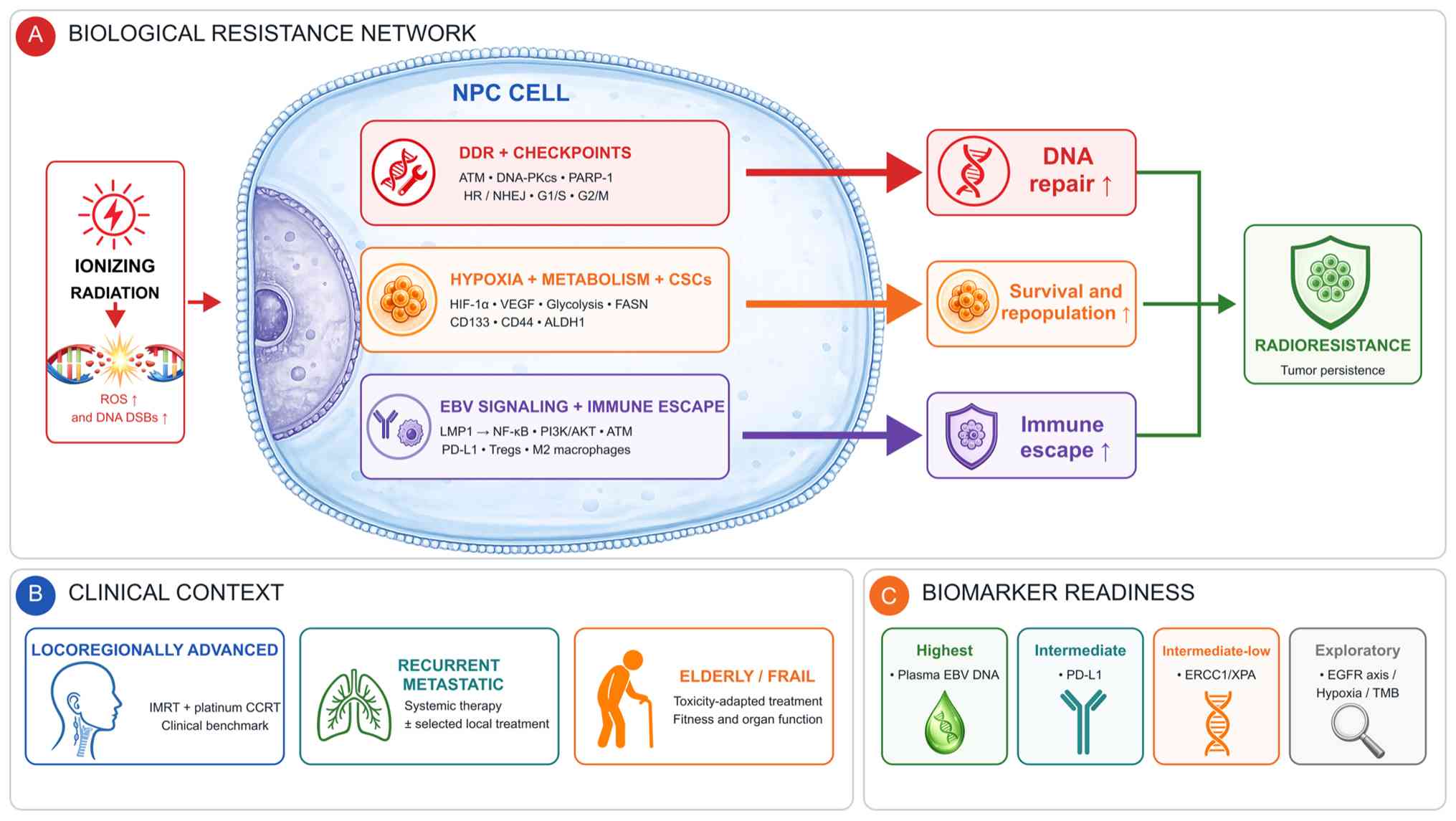 | Figure 1.Integrated biological and clinical
framework of radioresistance in NPC. (A) Ionizing radiation
generates ROS and DNA DSBs. Radioresistance is sustained by three
interconnected modules: DDR and checkpoint signaling; hypoxia,
metabolic adaptation and CSC persistence; and EBV-associated
signaling and immune escape. ATM, DNA-PKcs and PARP-1 coordinate
DNA repair through HR or NHEJ. Hypoxia-inducible, metabolic and
stemness-associated factors promote survival and repopulation. LMP1
activates NF-κB, PI3K/AKT and ATM-associated signaling, while
PD-L1, regulatory T cells and M2 macrophages contribute to immune
escape. These processes converge on tumor persistence. (B) The
principal clinical contexts are locoregionally advanced, recurrent
or metastatic, and elderly or frail disease. Definitive
intensity-modulated radiotherapy-based platinum chemoradiotherapy
is the benchmark for locoregionally advanced disease; systemic
therapy predominates in recurrent or metastatic disease; and
treatment intensity should be adapted to fitness and organ function
in elderly or frail patients. (C) Plasma EBV DNA has the greatest
current clinical readiness. PD-L1 is context-dependent, ERCC1/XPA
remains a retrospective platinum-response candidate, and EGFR-axis,
hypoxia and TMB markers remain investigational. Arrows indicate
biological relationships rather than validated treatment-selection
rules. AKT, protein kinase B; ALDH1, aldehyde dehydrogenase 1; ATM,
ataxia telangiectasia mutated; CCRT, concurrent chemoradiotherapy;
CSC, cancer stem cell; DDR, DNA damage response; DNA-PKcs,
DNA-dependent protein kinase catalytic subunit; DSB, DNA
double-strand break; EBV, Epstein-Barr virus; EGFR, epidermal
growth factor receptor; ERCC1, excision repair
cross-complementation group 1; FASN, fatty acid synthase; HIF-1α,
hypoxia-inducible factor 1α; HR, homologous recombination; IMRT,
intensity-modulated radiotherapy; LMP1, latent membrane protein 1;
NF-κB, nuclear factor-κB; NHEJ, non-homologous end joining; NPC,
nasopharyngeal carcinoma; PARP-1, poly(ADP-ribose) polymerase 1;
PD-L1, programmed death-ligand 1; PI3K, phosphoinositide 3-kinase;
ROS, reactive oxygen species; TMB, tumor mutational burden; Treg,
regulatory T cell; VEGF, vascular endothelial growth factor; XPA,
xeroderma pigmentosum group A. |
Clinical settings and evidence
hierarchy
For clinical interpretation, radiosensitization
strategies should be considered according to the treatment context.
In primary locoregionally advanced NPC, the benchmark remains
definitive IMRT combined with platinum-based chemotherapy, with
induction chemotherapy and concurrent chemoradiotherapy supported
by guideline-level evidence in selected patients with stage II–IVA
NPC (4). In recurrent or metastatic
NPC, systemic chemotherapy and immunotherapy have stronger
supporting evidence than most local radiosensitization strategies,
although selected patients may benefit from reirradiation, surgery
or focal radiotherapy when disease distribution and normal-tissue
constraints permit (5,7). In older adult or medically frail
patients, treatment intensity should be individualized according to
renal function, bone marrow reserve, comorbidity, nutritional
status and expected late toxicity. Accordingly, each
radiosensitizing strategy in the present review is interpreted
according to both its underlying mechanism and level of evidence
rather than mechanistic plausibility alone.
Chemotherapeutic agents: The foundation of
radio-sensitization
Central role in combined modality
treatment
Concurrent chemoradiotherapy (CCRT) represents the
standard backbone for numerous patients with locoregionally
advanced NPC, whereas induction chemotherapy followed by CCRT is
recommended for selected higher-risk patients with stage II–IVA NPC
according to contemporary guideline frameworks (4,5,7,33).
The radiosensitizing effects of chemotherapy extend beyond simple
additive cytotoxicity and involve mechanism-based synergies,
including inhibition of radiation-induced DNA repair,
redistribution of cells into radiosensitive cell-cycle phases and
disruption of protective signaling pathways (34).
Platinum-based agents: DNA damage
amplification
Cisplatin
Cisplatin is the prototypical concurrent systemic
agent used with definitive radiotherapy in NPC. Preclinical NPC
data show that its interaction with radiation is strongly
schedule-dependent. A 24-h cisplatin exposure before radiation
produced greater cytotoxicity than shorter exposure, while the
sequence and interval between treatments also altered the radiation
effect (35). Cisplatin efficacy is
constrained by DNA repair capacity, with excision repair
cross-complementation group 1 (ERCC1) serving as a potential
predictive biomarker. High ERCC1 expression was associated with a
lower response rate (75.0 vs. 97.7%) in CCRT-treated NPC (36). In another cohort, ERCC1-high tumors
had higher recurrence (29.41 vs. 12.5%) and lower 5-year overall
survival (OS; 58.82 vs. 84.37%) than ERCC1-low tumors (37).
Other platinum analogs
Lobaplatin, a third-generation platinum compound,
has shown feasibility as a concurrent agent in older adult patients
with NPC. In a small cohort of 29 patients aged ≥65 years,
lobaplatin-based CCRT was associated with no liver or kidney
dysfunction and a reported 3-year OS of 100%; however, this result
should be interpreted cautiously because of the limited sample
size, short-to-intermediate follow-up and non-randomized design
(38). The gemcitabine plus
cisplatin (GP) regimen has emerged as an established systemic
option in recurrent/metastatic NPC, with superior progression-free
survival (PFS) compared with fluorouracil plus cisplatin (7.0 vs.
5.6 months) in a phase III trial (39). Thus, platinum selection should be
separated by clinical setting: Cisplatin remains a standard
radiosensitizer in definitive CCRT, lobaplatin may be considered
investigational or individualized in older adult/frail populations
and GP is primarily supported in recurrent/metastatic systemic
therapy.
Taxanes: Cell cycle-mediated
sensitization
Paclitaxel promotes microtubule polymerization and
stabilization, inducing G2/M-phase arrest, a relatively
radiosensitive phase of the cell cycle (40). Low-dose paclitaxel pretreatment
(0.05 or 1.0 nmol/l for 24 h) enhanced radiosensitivity in CNE-I
NPC cells (41). G2/M
accumulation may drive cells toward mitotic catastrophe after
irradiation. In locoregionally advanced NPC, GP and docetaxel,
cisplatin and fluorouracil (TPF) sequential chemoradiotherapy
showed similar long-term efficacy but different toxicity profiles,
with more thrombocytopenia in the GP group and more leukopenia and
neutropenia in the TPF group (42).
Mechanism-based combination
strategies
Autophagy modulation
Radiation-induced autophagy can be cytoprotective or
cytotoxic depending on context (43). Chloroquine, which inhibits
autophagosome-lysosome fusion, enhanced radiosensitivity in four of
five tested NPC cell lines without sensitizing an immortalized
nasopharyngeal epithelial cell line (44). The study was limited to cell-line
experiments, and in vivo confirmation remains necessary. The
PARP-1 inhibitor 3-aminobenzamide suppresses radiation-induced
autophagy by downregulating Beclin1 and enhances apoptosis through
caspase-3 activation (13).
Epigenetic reprogramming
DNA methylation is implicated in NPC
radioresistance, including interactions with microRNA
(miRNA/miR)-mediated regulation (45). 5-Azacytidine enhanced the
radiosensitivity of CNE2 and SUNE1 cells in vitro and in
vivo, supporting further investigation of DNA-demethylating
strategies in NPC (46).
Predictive biomarkers for
chemotherapy-based radio-sensitization
ERCC1 and xeroderma pigmentosum complementation
group A (XPA)
Beyond ERCC1, XPA, another nucleotide excision
repair protein, is associated with outcomes after platinum-based
chemoradiotherapy. High XPA expression is associated with shorter
OS and PFS in patients with NPC receiving platinum-based CCRT
(47). Together with retrospective
ERCC1 studies (36,37), these findings support prospective
evaluation of biomarker-stratified treatment, but they do not
justify directing ERCC1/XPA-low tumors to platinum-based CCRT or
ERCC1/XPA-high tumors to alternative therapy in routine practice.
Assay harmonization, prespecified cut-offs and prospective
treatment-by-biomarker interaction testing are required.
Metabolic biomarkers
Nicotinamide N-methyltransferase (NNMT) promotes Akt
phosphorylation and enhances proliferation and migration. High NNMT
expression is associated with shortened disease-specific survival
and metastasis-free survival, suggesting utility as both a
prognostic biomarker and a potential therapeutic target (48).
Overall, chemotherapy-based radiosensitization
remains the most clinically mature strategy in NPC; however, its
value differs by setting. In primary locoregionally advanced
disease, platinum-based CCRT and induction chemotherapy are
supported by the highest level of clinical evidence. In
recurrent/metastatic disease, systemic disease control and
immunochemotherapy have clearer roles than radiosensitization
alone. Further gains are likely to depend on DNA repair, metabolic
and EBV-related biomarkers that can identify patients most likely
to benefit from treatment intensification while avoiding
unnecessary toxicity.
Molecularly targeted therapies:
Mechanism-guided radiosensitization
Epidermal growth factor receptor
(EGFR) pathway inhibition
The EGFR pathway is clinically relevant in NPC, and
EGFR/phosphorylated (p-)EGFR expression has been evaluated as a
prognostic biomarker (49). Nuclear
EGFR is also linked to radiation response and DNA repair signaling
(50). However, EGFR-targeted
therapy should not be considered uniformly beneficial. A recent
randomized phase 2 trial in patients with a suboptimal response to
induction chemotherapy found no PFS improvement from adding
nimotuzumab to concurrent chemoradiotherapy (51). These findings support biomarker
development rather than unselected anti-EGFR intensification.
Annexin A3 (ANXA3)
ANXA3, a calcium-dependent phospholipid-binding
protein, is inversely associated with radioresistance in NPC. Low
ANXA3 expression facilitates EGFR phosphorylation (Tyr1068) and
nuclear translocation, activates DNA-PKcs and accelerates DSB
repair. Clinical samples show that ANXA3-low/nuclear EGFR-high
tumors are radioresistant, whereas cetuximab (an EGFR monoclonal
antibody) reverses this phenotype (52). These findings support combination
strategies pairing EGFR inhibitors with radiotherapy.
Anti-EGFR strategies
Mechanistic and early clinical data support
continued evaluation of anti-EGFR agents with radiotherapy-based
regimens, but efficacy remains uncertain. In a randomized phase 2
trial, 2-year PFS was 81.0% with nimotuzumab plus CCRT and 80.8%
with CCRT alone (hazard ratio=0.93; P=0.70), with no improvement in
survival outcomes and more frequent low-grade rash (51).
ANXA1-EGFR axis
ANXA1 binds to the intracellular C-terminal tail of
EGFR and stabilizes the receptor by competing with the Casitas
B-lineage lymphoma (Cbl) E3 ubiquitin ligase, thereby reducing
Cbl-mediated EGFR ubiquitination and subsequent degradation. This
interaction activates STAT3, promotes programmed death-ligand 1
(PD-L1) expression and contributes to radioresistance. A
nine-amino-acid peptide designed to disrupt the ANXA1-EGFR
interaction downregulated EGFR and enhanced radiosensitivity in NPC
cell and mouse models (53).
DNA damage response (DDR) pathway
targeting
PARP inhibitors
PARP-1 orchestrates single-strand break repair and
also regulates autophagy. In addition to their effects on
autophagy, PARP inhibitors exploit synthetic lethality in
HR-deficient tumors (54). Although
NPC typically retains HR proficiency, combination with HR
disruptors may sensitize cells to PARP inhibitors plus
radiotherapy.
ATM/ATR checkpoint kinase (ATR)
inhibitors
ATM and ATR are apical DDR kinases that activate
downstream checkpoint and repair pathways. ATR kinase-dead cells
exhibit impaired HR, defective G2 checkpoint function
and enhanced radiosensitivity independent of NHEJ status (14). These findings support ATR inhibition
as a promising radiosensitization strategy, particularly in rapidly
proliferating NPC cells with replication stress.
Ubiquitin-specific protease 5
(USP5)-methyltransferase 3, N6-adenosine-methyltransferase complex
catalytic subunit (METTL3) axis
Bromodomain-containing protein 7 (BRD7), a tumor
suppressor, competes with USP5 for METTL3 binding and promotes
proteasomal degradation of METTL3. METTL3 reduction suppresses HR
repair proteins (BRCA1 and RAD51), thereby enhancing
radiosensitivity. Clinical correlations indicate that
BRD7-high/METTL3-low tumors are associated with radiosensitivity
and favorable prognosis (55).
Hypoxia-targeted strategies
Hypoxia-activated prodrugs
Tirapazamine (TPZ), a bioreductive alkylating agent,
is converted into cytotoxic radicals under hypoxic conditions,
selectively damaging hypoxic cells. TPZ downregulates HIF-1α and
osteopontin mRNA in HNE-1 cells and enhances radiosensitivity, but
shows cell line-dependent efficacy (ineffective in CNE-1),
highlighting challenges related to tumor heterogeneity (25).
Vascular normalization
Recombinant human endostatin (Endostar) is an
anti-angiogenic strategy evaluated with PF chemotherapy and
sequential IMRT in locally advanced NPC. A randomized, open-label
multicenter phase II study found the regimen tolerable and reported
improved PFS, although confirmatory trials are required (56).
Nanozyme-based oxygen generation
Ferritin-encapsulated platinum nanoparticles target
hypoxic NPC cells through transferrin receptor 1, which is
upregulated under hypoxia. These nanozymes catalyze
H2O2 decomposition into O2,
alleviating hypoxia and enhancing radiosensitivity. In a
preclinical study, Pt-HFn combined with RT inhibited tumor growth
and prolonged survival more effectively than RT combined with
sodium glycididazole (57). Sodium
glycididazole itself has shown radiosensitizing activity in NPC
models by enhancing DNA damage and apoptosis (58).
Signal transduction pathway
modulators
STAT3 inhibition
p-STAT3 promotes cyclin D1 expression and suppresses
apoptosis. Stattic, a highly selective STAT3 inhibitor, reduces
p-STAT3 and cyclin D1 levels, induces apoptosis, and enhances NPC
cell sensitivity to cisplatin and radiotherapy (59).
Jun activation domain-binding protein
1 (JAB1)/COP9 signalosome subunit 5 (CSN5) targeting
JAB1, also known as CSN5, participates in signaling
that supports NPC cell survival and radioresistance. The curcumin
analogue T83 inhibited JAB1 expression, induced G2/M
arrest and apoptosis, and enhanced radiosensitivity in NPC models
(60). miR-24 similarly targets
JAB1, and its upregulation induces apoptosis and radiosensitization
(61).
PI3K/Akt pathway
Leucine zipper tumor suppressor 2 (LZTS2), which is
downregulated in NPC, binds the PI3K regulatory subunit p85,
prevents p85-p110 interaction and inhibits Akt activation (62). LZTS2 overexpression suppresses
proliferation and radioresistance, whereas p85 knockdown reverses
these effects (62). Raf kinase
inhibitor protein (RKIP), also downregulated in NPC, suppresses ERK
and Akt pathways when expressed, and RKIP-low patients exhibit
shorter OS and disease-free survival (63).
Collectively, these strategies are most plausible
when a measurable molecular vulnerability, such as aberrant EGFR
trafficking, defective DNA damage response or hypoxia-driven
survival, can be matched to an intervention whose dose, schedule
and toxicity permit combination with radiotherapy.
Clinical translation of targeted radiosensitizers
remains uneven. Anti-EGFR antibodies have early clinical data in
selected locoregionally advanced NPC, whereas a number of DDR
inhibitors, peptide inhibitors and nanozyme-based oxygenation
strategies remain preclinical or early translational. Eligible
patient subgroups should be defined by measurable pathway
activation, such as EGFR trafficking, HR deficiency, replication
stress, hypoxia markers or dynamic EBV DNA risk, rather than by
diagnosis alone. Safety evaluation is essential because DDR
inhibition or hypoxia modification may also sensitize normal
mucosa, salivary tissue and marrow to radiation.
Immune checkpoint inhibitors (ICIs):
Redefining the radiosensitization paradigm
Synergy between radiotherapy and
immunotherapy
Radiotherapy can produce direct and bystander
effects beyond the irradiated cells, although the clinical
importance of these effects remains to be elucidated (64). Low-dose radiation can modulate
antioxidant responses, DNA repair, apoptosis and antitumor immune
responses (65). In NPC, epigenetic
mechanisms contribute to immune evasion, providing a rationale for
investigating DNA methyltransferase (DNMT) or histone deacetylase
(HDAC) inhibitors, together with immune checkpoint blockade
(66). These observations support
further investigations of immunoradiotherapy, but do not by
themselves establish a uniform abscopal effect or radiation-induced
PD-L1 response in NPC. NPC-specific in vitro evidence
indicates that high-dose irradiation can induce an immunogenic
cell-death phenotype and enhance dendritic cell (DC) maturation;
this supports the proposed pathway from immunogenic cell death to
DC maturation, but tumor-antigen release and downstream T-cell
priming were not directly demonstrated (67). Separately, radiotherapy-associated
PD-L1 upregulation was observed in NPC cell lines and a
patient-derived xenograft model, suggesting a context-dependent
adaptive checkpoint response that remains to be validated
clinically (68).
Programmed cell death protein 1
(PD-1)/PD-L1 axis inhibition
Preclinical mechanisms
The ANXA1-EGFR-STAT3-PD-L1 axis exemplifies
radiation-induced immunosuppression. As previously discussed, ANXA1
stabilizes EGFR, activates STAT3 and promotes PD-L1 transcription
(53). Disruption of this axis with
peptide inhibitors reduces PD-L1 expression and enhances
radiosensitivity, demonstrating convergence between targeted and
immune-based therapeutic strategies (53).
Clinical evidence in
recurrent/metastatic NPC
Camrelizumab, a PD-1 monoclonal antibody, achieved
an objective response rate (ORR) of 28.2% in pretreated
recurrent/metastatic NPC, with greater efficacy in PD-L1-positive
patients (69). Tislelizumab
combined with chemotherapy as first-line treatment for
recurrent/metastatic NPC markedly prolonged PFS in the phase III
RATIONALE-309 trial (hazard ratio=0.52) (70). These data support the use of
checkpoint blockade most strongly in recurrent/metastatic disease.
In locoregionally advanced NPC, induction chemoimmunotherapy before
CCRT remains an evolving strategy; a small non-randomized study
reported higher ORR (95.7 vs. 77.8%), complete response rate (39.1
vs. 22.2%) and 24-month event-free survival (88.9 vs. 62.6%) than
induction chemotherapy alone (71).
Combination strategies and safety
In a retrospective cohort, TPF induction
chemotherapy combined with a PD-1 inhibitor produced a higher ORR
(88.5 vs. 71.2%) and complete response rate (29.5 vs. 11.3%) than
TPF alone (72). Nevertheless,
combined radiotherapy, chemotherapy and immunotherapy may increase
mucositis, dermatitis, hematologic toxicity, endocrinopathy,
hepatitis, pneumonitis or other immune-related adverse events.
Prospective trials should define whether ICIs are best used as
induction, concurrent, consolidation or salvage therapy.
Biomarkers for immunotherapy
response
PD-L1 expression
Although PD-L1 positivity predicts response to
camrelizumab, standardized cutoff values remain undefined (69). Integrating PD-L1
immunohistochemistry with complementary biomarkers may improve
patient selection.
EBV DNA
Circulating EBV DNA serves as a dynamic biomarker in
NPC and associates with tumor burden and treatment response
(73). Early EBV DNA clearance (2
weeks) after induction chemotherapy predicts greater tumor
shrinkage (78.9 vs. 56.7% nasopharyngeal volume reduction; 81.6 vs.
59.3% nodal volume reduction) and superior 3-year OS (89.2 vs.
71.4%) and PFS (85.7 vs. 64.3%) (74). Persistent EBV DNA positivity during
follow-up, even in the absence of clinical recurrence, supports
consideration of metronomic chemotherapy (such as capecitabine) in
selected patients, which prolongs modified disease-free survival
(12.9 vs. 6.8 months) (75).
Longitudinal EBV DNA monitoring (0–2 weeks and 8–12 weeks
post-radiotherapy) enables early recurrence detection, with
persistent positivity associating with shorter PFS (73).
Tumor mutational burden (TMB) and
microsatellite instability (MSI)
Although validated in other malignancies, data on
TMB and MSI in NPC remain limited. Given NPC's viral etiology and
distinct mutational landscape, these biomarkers require prospective
validation (76).
Emerging immune-oncology
approaches
EBV-targeted vaccines
mRNA vaccines encoding T-cell epitope-rich domains
from LMP2 have demonstrated antitumor efficacy in preclinical NPC
models, inducing antigen-specific T-cell responses and tumor
suppression in murine models (77).
This evidence remains preclinical: No clinical benefit as a
radiosensitizer has been demonstrated in patients with NPC, no
patient subgroup has been prospectively defined beyond the
hypothesis of EBV-antigen-positive disease, and safety with
concurrent or sequential radiotherapy is unknown. Early clinical
studies should assess antigen expression, immune escape, treatment
sequencing and overlapping inflammatory or mucosal toxicity before
efficacy claims are made.
Epigenetic-immune crosstalk
DNMT and HDAC inhibitors can reverse immune
suppression by upregulating antigen-presentation machinery and
chemokine expression, potentially synergizing with ICIs (66). This epigenetic reprogramming may
convert immunologically cold tumors into hot, immunogenic lesions
that are more amenable to checkpoint blockade.
These findings support immunoradiotherapy as a
biologically plausible strategy; however, patient selection should
be guided by PD-L1 expression, dynamic EBV DNA kinetics, and immune
microenvironment features rather than treating checkpoint blockade
as a uniform radiosensitizing approach. Mechanism-guided treatment
strategies across clinical settings and levels of evidence are
summarized in Fig. 2.
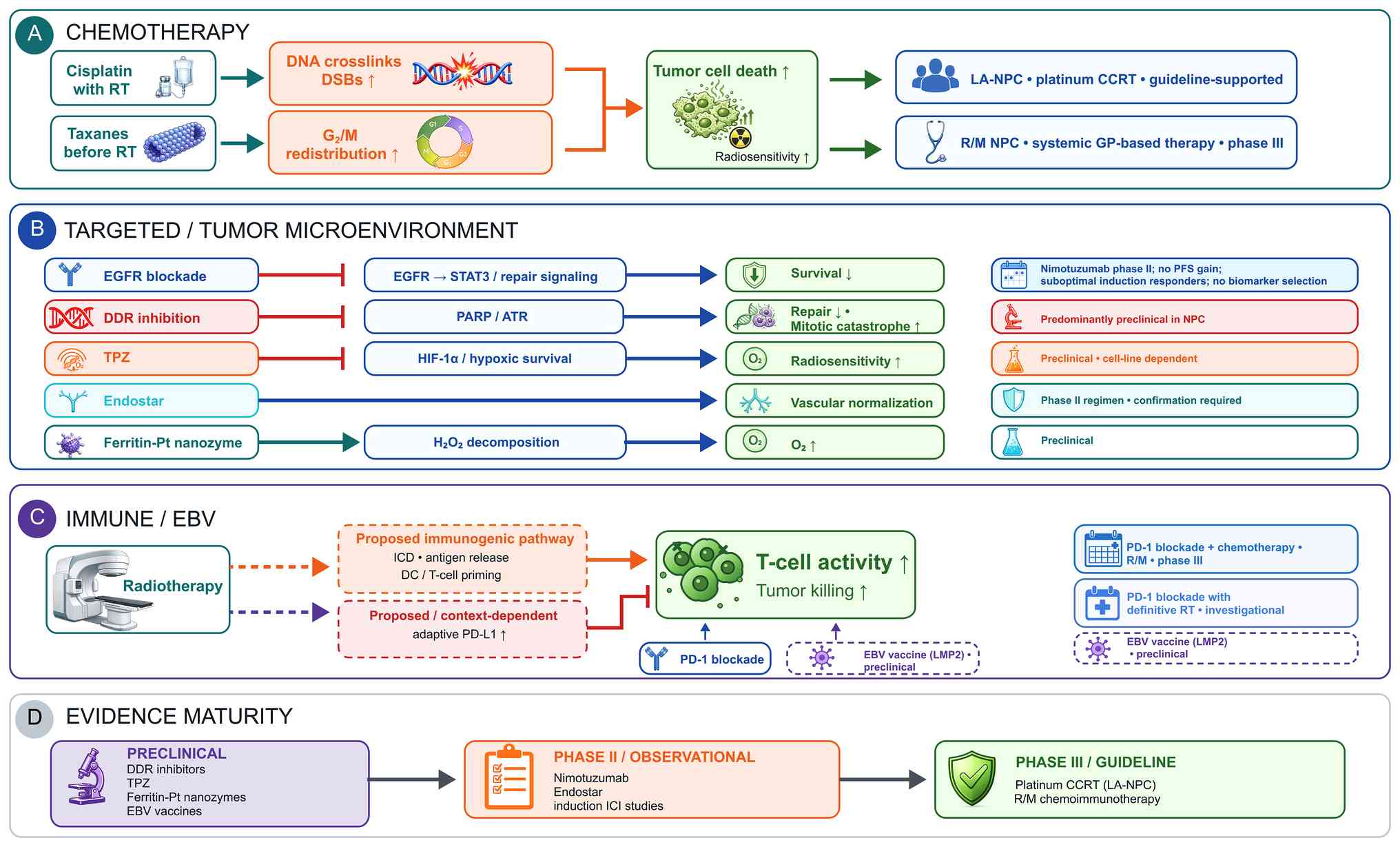 | Figure 2.Mechanism-guided treatment strategies
across clinical settings and evidence maturity. (A) Cisplatin
administered with RT increases DNA crosslinks and DSBs, whereas
taxane pretreatment redistributes cells toward the radiosensitive
G2/M phase. These mechanisms increase tumor-cell death
and radiosensitivity. Platinum-based CCRT is guideline-supported in
locoregionally advanced NPC, whereas gemcitabine-cisplatin-based
therapy is a phase III-supported systemic option in recurrent or
metastatic disease. (B) EGFR blockade, DDR inhibition and
hypoxia-directed strategies have distinct mechanisms and evidence
levels. Nimotuzumab did not improve PFS in a phase II trial
enrolling patients with a suboptimal response to induction
chemotherapy without predictive-biomarker selection. PARP and ATR
targeting remains predominantly preclinical in nasopharyngeal
carcinoma. TPZ inhibits HIF-1α-associated hypoxic survival in
preclinical, cell-line-dependent models. Endostar is shown as a
vascular-normalization strategy evaluated in a phase II regimen,
whereas ferritin-Pt nanozymes catalyze H2O2
decomposition to generate O2 in preclinical models. (C)
The dashed immunogenic pathway represents a proposed sequence in
which RT may promote immunogenic cell death, antigen release and
dendritic-cell/T-cell priming. The separate dashed pathway to
adaptive PD-L1 denotes a proposed, context-dependent
immunosuppressive response. PD-1 blockade relieves inhibitory
signaling. Phase III evidence applies to PD-1 blockade plus
chemotherapy in recurrent or metastatic disease, whereas
combination with definitive RT remains investigational. EBV
LMP2-directed vaccination remains preclinical. (D) Evidence
maturity ranges from preclinical studies to phase II or
observational data and phase III or guideline-supported
applications. ATR, ataxia telangiectasia and Rad3-related protein;
CCRT, concurrent chemoradiotherapy; DC, dendritic cell; DDR, DNA
damage response; DSB, DNA double-strand break; EBV, Epstein-Barr
virus; EGFR, epidermal growth factor receptor; GP, gemcitabine plus
cisplatin; HIF-1α, hypoxia-inducible factor 1α; ICD, immunogenic
cell death; ICI, immune checkpoint inhibitor; LA-NPC,
locoregionally advanced nasopharyngeal carcinoma; LMP2, latent
membrane protein 2; NPC, nasopharyngeal carcinoma; PARP,
poly(ADP-ribose) polymerase; PD-1, programmed cell death protein 1;
PD-L1, programmed death-ligand 1; PFS, progression-free survival;
R/M, recurrent or metastatic; RT, radiotherapy; STAT3, signal
transducer and activator of transcription 3; TPZ, tirapazamine. |
Natural compounds and traditional Chinese
medicine (TCM)-derived agents
DDR and checkpoint modulation
Several natural compounds and TCM-derived molecules
converge on DDR and checkpoint regulation. Curcumin, the principal
curcuminoid derived from Curcuma longa, exemplifies this
mechanism-based group through multi-pathway modulation, but its
clinical translation remains limited by bioavailability,
formulation variability and a lack of definitive randomized NPC
trials.
miRNA networks
Curcumin downregulates miR-205-5p, thereby
derepressing tumor protein p53-inducible nuclear protein 1
(TP53INP1), which promotes apoptosis in radioresistant NPC cells
(C666-IR) (78). In addition,
curcumin modulates circular RNA (circRNA) networks, particularly
the hsa-circRNA-102115-hsa-miR-335-3p-MAPK1 axis, suppressing
cancer stem cell properties and enhancing radiosensitivity
(20,21). Curcumin also upregulates miR-593,
which targets multidrug resistance protein 1 and reverses
radioresistance (79).
Cell-cycle modulation
The curcumin analogue T83 targets JAB1/CSN5, induces
G2/M arrest and apoptosis and enhances radiosensitivity
in NPC models (60). The parent
compound curcumin also alters cell-cycle and radiation-response
pathways (80).
Epithelial-mesenchymal transition
(EMT), EGFR trafficking and apoptotic regulation
Tetrandrine, ginsenoside Rg3 and berberine
illustrate a second mechanism-based group targeting checkpoints,
EMT and EGFR-associated signaling. At non-cytotoxic concentrations,
tetrandrine enhanced radiation-induced growth inhibition and
apoptosis, increased DNA damage and abrogated G2/M
arrest in NPC cells; combined treatment also reduced xenograft
growth (17).
Ginsenoside Rg3 and berberine: EMT and
EGFR-related mechanisms
Ginsenoside Rg3 from Panax ginseng suppresses
radiation-induced EMT, a process that confers radioresistance and
metastatic potential (81). Rg3
inhibits EGFR nuclear translocation and reduces DNA-PK expression,
thereby impairing DSB repair while promoting apoptosis (81). Berberine similarly sensitizes NPC
cells to radiation through Sp1 inhibition and EMT suppression
(82). Compared with synthetic EGFR
or DDR inhibitors, these agents may affect several pathways
simultaneously but have weaker pharmacokinetic standardization and
substantially lower clinical evidence.
Oxidative stress and hypoxia
modulation
Ras association domain-containing protein 1
(RASSF1A)-associated redox control and gambogic acid illustrate
mechanisms that modulate oxidative stress and hypoxia-related
survival. RASSF1A overexpression promoted FoxO3a activity and
inhibited the Kelch-like ECH-associated protein 1/nuclear factor
erythroid 2-related factor 2/thioredoxin reductase 1 axis,
increasing oxidative stress and radiosensitivity in NPC models
(83). Gambogic acid inhibited
HIF-1α expression and sensitized hypoxic NPC cells to radiation
(84). These findings remain
largely preclinical.
TCM formulas, oral microecology and
supportive modulation
Complex TCM formulations differ from single
synthetic radiosensitizers because they are usually developed
within multi-component and multi-target frameworks. Their effects
should therefore be evaluated using quantifiable clinical and
biological outcomes rather than by treating TCM syndrome categories
as direct molecular entities. A 2024 observational study measured
serum inhibin subunit α, inhibin subunit β B, EBV DNA and EBV viral
capsid antigen immunoglobulin A in relation to clinical stage;
however, its retrospective design precluded causal or
treatment-predictive conclusions (85). For radiation injury, a meta-analysis
of 30 randomized controlled trials involving 2,562 patients
evaluated heterogeneous oral TCM herbal formulations categorized as
‘nourishing Yin and clearing Heat’ therapy, rather than a single
standardized preparation. These formulations were administered as
adjuncts to trial-specific control regimens, which varied across
studies and included gentamicin, dexamethasone, local anesthetics,
vitamin B12, compound borax or chlorhexidine gargles and
recombinant human epidermal growth factor. Compared with the
control regimens alone, adjunctive TCM therapy delayed the onset of
grade I radiotherapy-induced oral mucositis by 10.80 days,
increased the cumulative radiation dose delivered before its onset
by 5.72 Gy and reduced the risk of grade III–IV oral mucositis
(relative risk=0.25). However, the heterogeneity of the herbal
formulations and control regimens limits the generalizability of
these findings, and further large, rigorously designed randomized
trials are required (86). A 2025
double-blind randomized trial included 24 evaluable patients
receiving Danggui Buxue Tang (n=11) or placebo (n=13). Grade 2–3
neutropenia occurred in 0/11 and 4/13 patients, respectively
(P=0.10), while grade 1 anemia occurred in 1/11 and 4/13 patients,
respectively (P=0.33). Conversely, grade 2–3 anorexia was more
frequent in the Danggui Buxue Tang group than in the placebo group
(10/11 vs. 5/13 patients; P=0.01). RNA sequencing identified
differential gene expression associated with B-cell receptor
signaling. Due to the small sample size, mixed toxicity findings
and absence of statistically significant differences for several
outcomes, these results remain exploratory (87).
Modern observations involving oxidative stress,
inflammation, epithelial injury, immunity and the oral microbiome
should therefore be interpreted as measurable parallel domains
rather than literal biomedical translations of TCM syndromes.
Within this cautious framework, Shengmai Jianghuang San (SMJHS)
inhibits cancer stem cells and hypoxic adaptation through the
tenascin C/HIF-1α/YAP1 pathway. SMJHS suppresses proliferation,
migration and cancer stem cell biomarker (CD44) expression under
hypoxia while downregulating HIF-1α and YAP1, thereby enhancing
radiosensitivity (88). Metabolomic
profiling indicates multi-target engagement across lipid metabolism
and oxidative stress pathways (89).
Shengmai Yin (SMY)
SMY reversed radiation-associated EMT in
radioresistant NPC cells by inhibiting lipocalin 2 expression
(90). DNA methylation analysis
also indicates that SMY modulates epigenetic landscapes in
radioresistant cells (91).
Dendrobium officinale and modified
Sijunzi decoction
Dendrobium officinale was evaluated for
radiation-induced oral mucositis and salivary/oral-microbiome
changes in patients with NPC (92).
Separately, modified Sijunzi decoction was associated with reduced
radiation-induced sinusitis in a retrospective study, and network
pharmacology implicated JAK-STAT and NF-kB-related pathways
(93).
Other bioactive natural compounds and
related viral mechanisms
Schisandrin B and emodin provide additional
preclinical examples. Schisandrin B targets CDK4/6, induces
cell-cycle arrest and enhances NPC radiosensitivity (94). Emodin inhibits EBV reactivation and
NPC tumorigenic phenotypes, although the cited study did not test
ionizing-radiation sensitization (95).
Light-based cytotoxic approaches
outside the ionizing-radiation radiosensitization framework
Photodynamic therapy (PDT) uses non-ionizing visible
light and photosensitizers and therefore should not be classified
as radiosensitization for ionizing radiation. Studies of Zn-BC-AM,
hypericin and hypocrellin are best interpreted as related
light-based cytotoxic approaches (96–99).
They are retained only to clarify this distinction and are not
included in Table I as
ionizing-radiation radiosensitizers.
 | Table I.Clinical summary of mechanism-guided
radiosensitization strategies in nasopharyngeal carcinoma. |
Table I.
Clinical summary of mechanism-guided
radiosensitization strategies in nasopharyngeal carcinoma.
| Strategy | Setting | Examples and
principal mechanism | Evidence
statusa | Main caveat |
|---|
| Chemotherapy | LA-NPC; R/M | Cisplatin, GP,
taxanes: DNA damage; G2/M redistribution | Cisplatin CCRT, L1;
systemic GP, L1; lobaplatin, L2; taxane radiosensitization, L3 | Toxicity;
sequencing; selection |
| EGFR signaling | Selected
LA-NPC |
Nimotuzumabb, cetuximab, ANXA1/ANXA3-EGFR
axes: Survival and repair inhibition | L2-L3 | No validated
biomarker; skin/mucosal toxicity |
| DDR targeting | Biomarker-selected
research | PARP and ATR/ATM:
Repair and checkpoint inhibition | L3 | Normal-tissue
sensitization; no strategy trial |
| Hypoxia/TME | Hypoxic or bulky
disease | TPZ, Endostar,
nanozymes: Hypoxic killing, vascular normalization and
O2 generation | L2-L3 | Heterogeneity;
delivery; no phase III evidence |
| ICI + RT | R/M; definitive RT
research | PD-1/PD-L1 and EBV
targets: immune activation | Systemic R/M
chemoimmunotherapy L1; induction studies, L2; definitive-RT
radio-sensitization, L3 | Timing; immune
toxicity; biomarkers |
| Natural
products/TCM | Preclinical;
adjunct/supportive | Curcumin/T83,
tetrandrine, Rg3 and SMJHS: DDR, EMT, redox and hypoxia
modulation | Radiosensitization,
L3; supportive/toxicity studies, L2 | Standardization;
PK; interactions |
Comparative advantages, limitations
and translational requirements
Compared with synthetic agents that usually target a
defined molecule such as EGFR, PARP, ATR or PD-1, natural compounds
and TCM-derived agents may engage multiple pathways, including DDR,
EMT, oxidative stress, hypoxia, inflammation and microecology. This
breadth may be advantageous for heterogeneous tumors but also
complicates dose standardization, target attribution and regulatory
evaluation. A large matched observational cohort reported an
association between adjunctive Chinese herbal medicine and clinical
outcomes, supported by experimental work, but its non-randomized
design cannot establish causality (100). Key challenges therefore include
limited bioavailability, batch variability, insufficient
pharmacokinetic characterization, uncertain herb-drug interactions
and a lack of randomized multicenter validation.
Therefore, natural compounds and TCM-derived agents
should be regarded primarily as hypothesis-generating or adjunctive
candidates until standardized preparations, quality control,
optimal dosing, safety with CCRT and interactions with
immunotherapy or targeted therapy are prospectively clarified.
Natural products and TCM-derived interventions, together with their
evidence limitations and translational requirements, are summarized
in Fig. 3. Representative
mechanism-guided radiosensitization strategies for NPC are
summarized in Table I.
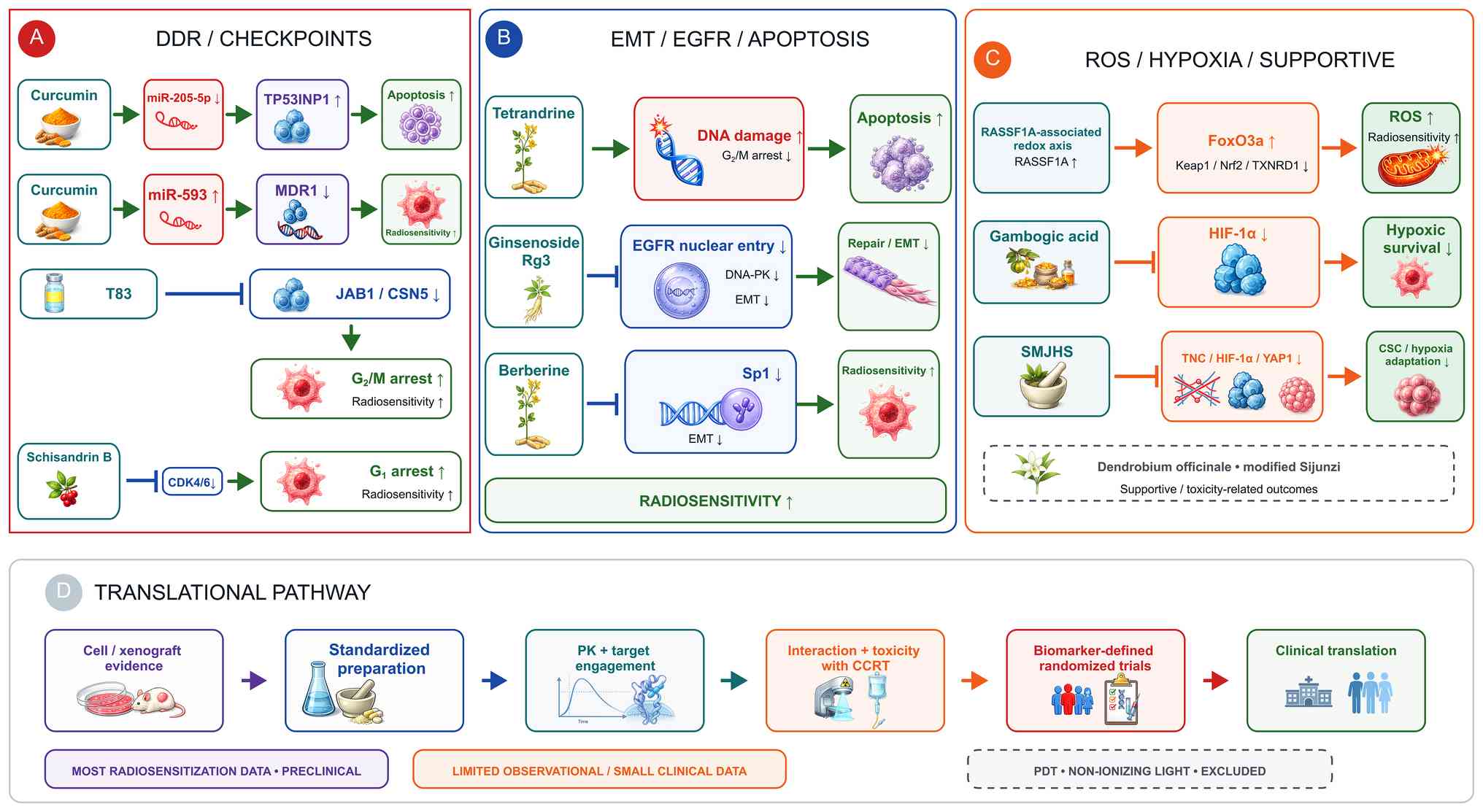 | Figure 3.Mechanism-based organization and
translational pathway for natural products and traditional Chinese
medicine-derived interventions in nasopharyngeal carcinoma. (A)
Curcumin regulates two distinct miRNA pathways: Downregulation of
miR-205-5p derepresses TP53INP1 and promotes apoptosis, whereas
upregulation of miR-593 suppresses MDR1 and increases
radiosensitivity. The curcumin analogue T83 inhibits JAB1/CSN5 and
promotes G2/M arrest and radiosensitivity. Schisandrin B
downregulates CDK4/6, induces G1-phase arrest, delays
DNA double-strand-break repair and enhances radiosensitivity. (B)
Tetrandrine increases DNA damage, abrogates protective
G2/M arrest and promotes apoptosis. Ginsenoside Rg3
suppresses EGFR nuclear entry, DNA-PK expression and EMT, thereby
impairing repair and EMT-associated resistance. Berberine inhibits
Sp1 and EMT and increases radiosensitivity. (C) RASSF1A is shown as
a host-gene redox axis: Increased RASSF1A promotes FoxO3a activity
and inhibits the Keap1/Nrf2/TXNRD1 pathway, increasing ROS and
radiosensitivity. Gambogic acid inhibits HIF-1α-associated hypoxic
survival. Shengmai Jianghuang San suppresses the TNC/HIF-1α/YAP1
axis and cancer stem-cell/hypoxia adaptation. Dendrobium officinale
and modified Sijunzi decoction are shown separately because they
have mainly been evaluated for supportive or toxicity-related
outcomes. (D) Most radiosensitization evidence remains preclinical.
Translation requires standardized preparations, pharmacokinetic and
target-engagement studies, herb-drug interaction and toxicity
assessment with CCRT, biomarker-defined enrollment and randomized
validation. Photodynamic therapy is excluded because it uses
non-ionizing light. CCRT, concurrent chemoradiotherapy; CDK4/6,
cyclin-dependent kinases 4 and 6; CSC, cancer stem cell; CSN5, COP9
signalosome subunit 5; DNA-PK, DNA-dependent protein kinase; EGFR,
epidermal growth factor receptor; EMT, epithelial-mesenchymal
transition; FoxO3a, forkhead box O3a; HIF-1α, hypoxia-inducible
factor 1α; JAB1, Jun activation domain-binding protein 1; Keap1,
Kelch-like ECH-associated protein 1; MDR1, multidrug resistance
protein 1; miR/miRNA, microRNA; Nrf2, nuclear factor erythroid
2-related factor 2; NPC, nasopharyngeal carcinoma; PDT,
photodynamic therapy; PK, pharmacokinetics; RASSF1A, Ras
association domain family member 1A; ROS, reactive oxygen species;
SMJHS, Shengmai Jianghuang San; Sp1, specificity protein 1; TCM,
traditional Chinese medicine; TNC, tenascin C; TP53INP1, tumor
protein p53-inducible nuclear protein 1; TXNRD1, thioredoxin
reductase 1; YAP1, yes-associated protein 1. |
Conclusions and future perspectives
Synthesis of core findings
The present review indicates that mechanism-guided
radiosensitization in NPC has progressed from empirical
chemotherapy-based approaches toward mechanism-guided, multimodal
therapeutic strategies. The principal conclusions are as follows:
i) Mechanistic convergence: Radioresistance emerges from
interconnected mechanisms, including enhanced DNA repair,
cell-cycle checkpoint adaptation, CSC enrichment, hypoxic
microenvironments, EBV-driven oncogenic signaling and metabolic
reprogramming; effective radiosensitization therefore requires
pathway-informed interventions rather than non-specific treatment
intensification; ii) clinical setting matters: Platinum-based
chemoradiotherapy remains most established in primary
locoregionally advanced NPC, whereas chemoimmunotherapy has
stronger evidence in recurrent/metastatic disease and selected
induction settings; iii) precision targeting: EGFR inhibition, DDR
pathway inhibition and hypoxia-directed strategies provide
mechanism-based opportunities to enhance radiotherapy, although
numerous approaches still require prospective clinical validation;
iv) biomarker hierarchy: Plasma EBV DNA currently has the strongest
disease-specific and dynamic clinical readiness; PD-L1 is context-
and cut-off-dependent, whereas TMB, ERCC1/XPA, EGFR-axis and
hypoxia markers require further prospective validation for
treatment selection; and v) natural compounds and TCM-derived
agents provide multi-target mechanistic hypotheses and emerging
supportive-care signals, but clinical adoption requires
standardized preparations, pharmacokinetic characterization and
rigorous multicenter trial validation.
Biomarkers, limitations and
translational challenges
A central requirement for clinical translation is a
practical biomarker hierarchy that distinguishes prognostic
association from demonstrated treatment-predictive utility. A 2025
systematic review identified plasma EBV DNA and its kinetics as a
robust candidate for risk stratification after chemoradiotherapy,
while emphasizing the need to standardize assays and cut-off values
(101). In a 2025 meta-analysis of
13 cohorts comprising 1,507 patients receiving ICIs, high
pretreatment EBV DNA was associated with worse PFS (hazard
ratio=1.72) and OS (hazard ratio=2.03) (102). By comparison, a 2024 meta-analysis
of prospective trials reported a higher pooled ORR in later-line
immunotherapy when PD-L1 expression was at least 1% (0.37 vs.
0.22), but first-line PFS benefit was not notably different between
PD-L1 subgroups and cut-offs of 10 or 25% did not discriminate
outcomes (103). A broader 2023
meta-analysis similarly associated lower baseline or decreasing EBV
DNA with improved immunotherapy response, whereas positive vs.
negative PD-L1 status and high vs. low TMB were not notably
associated with ORR (104). Thus,
plasma EBV DNA has the highest current clinical readiness; PD-L1
remains context-dependent; ERCC1/XPA is a retrospective
platinum-response candidate (36,37,47);
EGFR/p-EGFR and nuclear EGFR have mechanistic and prognostic
support but no validated selection threshold (49–51);
and hypoxia markers remain predominantly preclinical or
investigational (25,57). Table
II provides a direct comparison of these biomarkers and their
supporting evidence (25,36,37,47,49–51,57,69,73,74,76,101–104). Despite notable advances, several
obstacles impede optimal radiosensitization.
| Table II.Comparative clinical readiness of
candidate biomarkers in nasopharyngeal carcinoma. |
Table II.
Comparative clinical readiness of
candidate biomarkers in nasopharyngeal carcinoma.
| Biomarker | Principal
context | Key evidence |
Readinessa | (Refs.) |
|---|
| Plasma EBV
DNAb | Risk and response
monitoring | Baseline level and
kinetics correlate with outcomes | R1 | (73,74,101,102,104) |
| PD-L1c | ICI selection in
R/M disease | Later-line ORR
enrichment at 1%; first-line and cutoff findings inconsistent | R2 | (69,76,103,104) |
| ERCC1/XPA | Platinum CCRT | Retrospective
response and survival associations | R3 | (36,37,47) |
| EGFR-axis
markersd | EGFR-directed
RT |
Mechanistic/prognostic support; phase II
strategy negative | R4 | (49–51) |
| Hypoxia
markersd | Hypoxia-directed
therapy | Preclinical or
early translational rationale | R4 | (25,57) |
| TMBe | ICI selection | No consistent
association with ORR; PFS evidence remains limited. | R4 | (104) |
Biomarker deficiency
The main gap is no longer the absence of candidate
markers, but the lack of standardized assays, prospectively
validated thresholds, head-to-head incremental-value analyses and
trials showing that biomarker-directed treatment improves outcomes.
Multiomics panels should therefore be compared against the
clinically simpler EBV-DNA benchmark before routine
implementation.
Combination strategy optimization
Optimal sequencing, dosing and partner selection
remain incompletely defined. NPC cell-line experiments demonstrate
that cisplatin exposure duration, sequence and interval relative to
radiation can materially alter cytotoxicity, supporting systematic
clinical optimization (35).
Therapeutic resistance
Failure of treatment benefit cannot be summarized
by a single percentage across chemotherapy, targeted therapy,
immunotherapy and natural compounds because the clinical settings
and endpoints differ. Resistance reflects interacting DNA-repair,
hypoxia, metabolic, stemness and immune mechanisms (9,22,26),
while proposed immunotherapy biomarkers remain heterogeneous and
variably validated (76).
Normal tissue toxicity and special
populations
Combination regimens may produce additive or
synergistic toxicities, including mucositis, dermatitis,
xerostomia, marrow suppression, nephrotoxicity, ototoxicity and
immune-related adverse events. Older adult patients, patients with
renal dysfunction, malnutrition, heavy comorbidity burden, prior
irradiation or recurrent disease require individualized assessment
of therapeutic index rather than automatic treatment
intensification.
Clinical guideline and real-world
evidence
Current guidelines and evidence summaries support
intensity-modulated radiotherapy-based CCRT for locoregionally
advanced NPC, induction chemotherapy for selected high-risk
disease, and platinum-based chemotherapy plus a PD-1 inhibitor for
recurrent or metastatic disease (4,5,7).
Existing real-world evidence discussed in the present review
includes a 29-patient older adult lobaplatin cohort (38), a retrospective study of a PD-1
inhibitor plus TPF induction chemotherapy (72), a matched observational cohort of
adjunctive Chinese herbal medicine (100) and a prognostic model integrating
nutritional, inflammatory and post-treatment EBV DNA variables
(105). These studies broaden
representation of older patients and routine-care populations, but
heterogeneous treatment settings and endpoints, non-randomized
treatment allocation and residual confounding prevent causal
comparisons across strategies.
Accordingly, real-world data should complement
rather than replace randomized evidence. Priority analyses should
use prespecified treatment definitions, propensity-based or
target-trial methods, standardized toxicity and quality-of-life
outcomes, and stratification by age, renal function, prior
irradiation, endemic region and EBV DNA kinetics. Until such
evidence is available, guideline-supported CCRT or
chemoimmunotherapy should remain the clinical benchmark, whereas
experimental radiosensitizers should be restricted to trials or
carefully documented individualized use.
EBV-centered
etiopathogenesis-biomarker-target axis
EBV biology should be integrated as a unifying axis
that distinguishes NPC from most other head and neck cancers.
Etiopathogenetically, EBV latent proteins such as LMP1 promote
NF-kB activation, ATM-mediated DNA repair, PI3K/Akt-driven
metabolic reprogramming, immune escape and metastatic fitness. As a
biomarker, plasma EBV DNA provides a dynamic measure of tumor
burden, early response, minimal residual disease and recurrence
risk, although assay and cut-off standardization remain necessary
(101,102). As a therapeutic target,
EBV-associated antigens such as LMP2A and Epstein-Barr virus
nuclear antigen 1 support vaccine and T-cell-based approaches,
whereas EBV-driven signaling may identify tumors vulnerable to
metabolic, immune or DDR-directed radiosensitization. A cohesive
EBV-centered framework may therefore integrate etiopathogenesis,
risk stratification and therapeutic targeting more effectively than
discussing these aspects separately.
Treatment sequencing, overlapping
toxicities and special populations
Administration sequence is a central unresolved
issue. Cisplatin and taxanes may require defined lead times before
radiotherapy to maximize DNA damage or cell-cycle redistribution,
whereas ICIs may be used as induction, concurrent, consolidation or
salvage therapy depending on stage and trial design. EGFR
inhibitors combined with radiotherapy may increase skin and mucosal
toxicity; DDR inhibitors may compromise normal-tissue repair;
platinum agents may worsen renal, auditory and marrow toxicity; and
immunotherapy may add immune-related adverse events. For older
adults or medically frail patients, treatment choice should
incorporate comprehensive geriatric assessment, renal function,
hearing status, nutrition, baseline EBV DNA, comorbidity, patient
preference and expected late toxicity.
Future research directions
First, multiomics biomarker integration should
combine genomic profiling of DNA repair alterations, transcriptomic
signatures including miRNA, long non-coding RNA and circRNA
networks and proteomic or phosphoproteomic quantification of DDR
proteins, checkpoint kinases and signaling states (106–109). Second, rational combination
optimization should include experimental evaluation of fraction
timing and dose rate (110),
biomarker-selected investigation of dual checkpoint blockade in NPC
(111), and disease-specific
validation before extrapolating multi-target miRNA
radiosensitization findings from other tumor types (112). Third, artificial intelligence
models may facilitate individualized induction-chemotherapy
selection and risk stratification for distant metastasis in NPC
(113,114). Stimuli-responsive nanocarriers may
improve tumor selectivity, but the cited pH-activated fullerene
nanogel is a photodynamic, light-activated platform rather than an
ionizing-radiation radiosensitizer (115). Ultra-high-dose-rate radiotherapy
has shown partial reversal of radioresistance in preclinical head
and neck squamous cell carcinoma models, but NPC-specific clinical
validation is required before extrapolation (116). Long-term comparative studies
should also track late toxicity and second-primary cancer risk
after NPC radiotherapy (117).
Fourth, translational implementation should incorporate validated
artificial intelligence-assisted target segmentation (118). Careful mechanistic evaluation of
DNA damage checkpoints is also required. In a previous NPC study,
CHK1/WEE1 inhibitors were not effective radiosensitizers when
administered after irradiation (119), underscoring the importance of
treatment sequencing. Standardized post-induction target
delineation should also be incorporated (120). Fifth, survivorship research should
focus on radioprotective and regenerative strategies to reduce late
toxicities, including xerostomia, osteoradionecrosis and cognitive
impairment, as well as mechanistic studies of radiation-induced
second primary cancers (117,121). Finally, implementation studies
should prospectively validate risk models integrating nutritional,
inflammatory and post-treatment EBV DNA variables (105) and combined nasopharyngeal-brush
plus plasma EBV DNA surveillance (122). Their feasibility, clinical utility
and cost-effectiveness require dedicated evaluation rather than
being assumed from the current retrospective and diagnostic
studies.
Concluding remarks
Mechanism-guided radiosensitization in NPC reflects
the integration of molecular oncology, immunology, pharmacology,
radiobiology and computational science. Its clinical value will
depend less on adding more agents indiscriminately and more on
matching strategies to disease setting, EBV-related risk,
biomarker-defined vulnerabilities and patient fitness.
Chemotherapy, targeted therapy, immunotherapy, and selected natural
compounds constitute a broad therapeutic armamentarium, but their
optimal use depends on rigorous biomarker validation, rational
regimen sequencing, toxicity-aware clinical trial design and
equitable access to advanced diagnostics and therapeutics. By
aligning therapeutic interventions with the biological determinants
of radioresistance, individualized radiosensitization may improve
disease control while preserving quality of life.
Acknowledgements
Not applicable.
Funding
The present work was supported by the National Traditional
Chinese Medicine Advantage Specialty Construction Unit [grant no.
(2024)90] and the Hunan Clinical Research Center for Traditional
Chinese Medicine Otorhinolaryngology (grant no. 2021SK4024).
Availability of data and materials
Not applicable.
Authors' contributions
WD and ZZ conceived and designed the review. WD and
ZL developed the literature-search strategy and evidence-synthesis
approach and collected and curated the relevant literature. WD
drafted the manuscript. ZL and ZZ critically reviewed and revised
the manuscript for important intellectual content. ZZ supervised
the work and acquired funding. All authors read and approved the
final version of the manuscript. Data authentication is not
applicable.
Ethics approval and consent to
participate
Not applicable.
Patient consent for publication
Not applicable.
Competing interests
The authors declare that they have no competing
interests.
Use of artificial intelligence tools
During the preparation of this work, artificial
intelligence tools were used to improve the readability and
language of the manuscript or to generate images, and subsequently,
the authors revised and edited the content produced by the
artificial intelligence tools as necessary, taking full
responsibility for the ultimate content of the present
manuscript.
Glossary
Abbreviations
Abbreviations:
|
NPC
|
nasopharyngeal carcinoma
|
|
DSBs
|
double-strand breaks
|
|
HR
|
homologous recombination
|
|
NHEJ
|
non-homologous end joining
|
|
DNA-PKcs
|
DNA-dependent protein kinase
catalytic subunit
|
|
CSC
|
cancer stem cell
|
|
EBV
|
Epstein-Barr virus
|
|
EGFR
|
epidermal growth factor receptor
|
|
DDR
|
DNA damage response
|
|
ICI
|
immune checkpoint inhibitor
|
|
TCM
|
traditional Chinese medicine
|
References
|
1
|
Jang W, Kim S, Son Y, Kim S, Lee S, Kim
HJ, Jo H, Park J, Lee K, Lee H, et al: Global, regional, and
national burden of pharyngeal cancer and projections to 2050 in 185
countries: A population-based systematic analysis of GLOBOCAN 2022.
J Korean Med Sci. 40:e1772025. View Article : Google Scholar : PubMed/NCBI
|
|
2
|
Zhong W, Xu Y, Yuan H and Meng Y: Gender
disparities in the global burden of nasopharyngeal carcinoma:
Persistence and evolution of male predominance. Eur Arch
Otorhinolaryngol. 283:3139–3160. 2026. View Article : Google Scholar : PubMed/NCBI
|
|
3
|
Chua MLK, Wee JTS, Hui EP and Chan ATC:
Nasopharyngeal carcinoma. Lancet. 387:1012–1024. 2016. View Article : Google Scholar : PubMed/NCBI
|
|
4
|
Chen YP, Ismaila N, Chua MLK, Colevas AD,
Haddad R, Huang SH, Wee JTS, Whitley AC, Yi JL, Yom SS, et al:
Chemotherapy in combination with radiotherapy for definitive-intent
treatment of stage II–IVA nasopharyngeal carcinoma: CSCO and ASCO
guideline. J Clin Oncol. 39:840–859. 2021. View Article : Google Scholar : PubMed/NCBI
|
|
5
|
Domínguez AR, Cirauqui B, Castaño AG,
Cabellos RA, Maseda AC, Fernández BC, Rey LI, Rubió-Casadevall J,
Arrazubi V and Mesía R: SEOM-TTCC clinical guideline for
nasopharyngeal carcinoma (update 2025). Clin Transl Oncol.
28:1151–1164. 2026. View Article : Google Scholar : PubMed/NCBI
|
|
6
|
He SQ, Lv SH, Wen SQ, Lin-Wang Yu YH,
Zhang GY, Peng DS, Bei WX, Chen CL, Zhao ZY, et al: Efficacy of
metastatic lesion radiotherapy in de novo metastatic nasopharyngeal
carcinoma patients receiving local regional radiotherapy and
chemo-immunotherapy: A multicenter retrospective study. Radiother
Oncol. 213:1111602025. View Article : Google Scholar : PubMed/NCBI
|
|
7
|
PDQ Adult Treatment Editorial Board, .
Nasopharyngeal carcinoma treatment (PDQ(R))-Health professional
version. National Cancer Institute. updated May 14. 2025
|
|
8
|
Busato F, Khouzai BE and Mognato M:
Biological mechanisms to reduce radioresistance and increase the
efficacy of radiotherapy: State of the art. Int J Mol Sci.
23:102112022. View Article : Google Scholar : PubMed/NCBI
|
|
9
|
Xing JL and Stea B: Molecular mechanisms
of sensitivity and resistance to radiotherapy. Clin Exp Metastasis.
41:517–524. 2024. View Article : Google Scholar : PubMed/NCBI
|
|
10
|
Sakai K and Okada S: Radiation-induced DNA
damage and cellular lethality in cultured mammalian cells. Radiat
Res. 98:479–490. 1984. View Article : Google Scholar : PubMed/NCBI
|
|
11
|
Lord CJ and Ashworth A: The DNA damage
response and cancer therapy. Nature. 481:287–294. 2012. View Article : Google Scholar : PubMed/NCBI
|
|
12
|
Pawlik TM and Keyomarsi K: Role of cell
cycle in mediating sensitivity to radiotherapy. Int J Radiat Oncol
Biol Phys. 59:928–942. 2004. View Article : Google Scholar : PubMed/NCBI
|
|
13
|
Zhou ZR, Zhu XD, Zhao W, Qu S, Su F, Huang
ST, Ma JL and Li XY: Poly(ADP-ribose) polymerase-1 regulates the
mechanism of irradiation-induced CNE-2 human nasopharyngeal
carcinoma cell autophagy and inhibition of autophagy contributes to
the radiation sensitization of CNE-2 cells. Oncol Rep.
29:2498–2506. 2013. View Article : Google Scholar : PubMed/NCBI
|
|
14
|
Wang H, Wang H, Powell SN, Iliakis G and
Wang Y; New Collective Author, : ATR affecting cell
radiosensitivity is dependent on homologous recombination repair
but independent of nonhomologous end joining. Cancer Res.
64:7139–7143. 2004. View Article : Google Scholar : PubMed/NCBI
|
|
15
|
Guo Z, Wang YH, Xu H, Yuan CS, Zhou HH,
Huang WH, Wang H and Zhang W: LncRNA linc00312 suppresses
radiotherapy resistance by targeting DNA-PKcs and impairing DNA
damage repair in nasopharyngeal carcinoma. Cell Death Dis.
12:692021. View Article : Google Scholar : PubMed/NCBI
|
|
16
|
Nakanishi M: Cell cycle checkpoints and
cancer. Tanpakushitsu Kakusan Koso. 54:556–560. 2009.(In Japanese).
PubMed/NCBI
|
|
17
|
Wang J, Chang L, Lai X, Li X, Wang Z,
Huang Z, Huang J and Zhang G: Tetrandrine enhances radiosensitivity
through the CDC25C/CDK1/cyclin B1 pathway in nasopharyngeal
carcinoma cells. Cell Cycle. 17:671–680. 2018. View Article : Google Scholar : PubMed/NCBI
|
|
18
|
Chen Y, Zhang F, Tsai Y, Yang X, Yang L,
Duan S, Wang X, Keng P and Lee SO: IL-6 signaling promotes DNA
repair and prevents apoptosis in CD133+ stem-like cells of lung
cancer after radiation. Radiat Oncol. 10:2272015. View Article : Google Scholar : PubMed/NCBI
|
|
19
|
Moncharmont C, Levy A, Gilormini M,
Bertrand G, Chargari C, Alphonse G, Ardail D, Rodriguez-Lafrasse C
and Magné N: Targeting a cornerstone of radiation resistance:
Cancer stem cell. Cancer Lett. 322:139–147. 2012. View Article : Google Scholar : PubMed/NCBI
|
|
20
|
Yang J, Zhu D, Liu S, Shao M, Liu Y, Li A,
Lv Y, Huang M, Lou D and Fan Q: Curcumin enhances
radiosensitization of nasopharyngeal carcinoma by regulating
circRNA network. Mol Carcinog. 59:202–214. 2020. View Article : Google Scholar : PubMed/NCBI
|
|
21
|
Zhu D, Shao M, Yang J, Fang M, Liu S, Lou
D, Gao R, Liu Y, Li A, Lv Y, et al: Curcumin enhances
radiosensitization of nasopharyngeal carcinoma via mediating
regulation of tumor stem-like cells by a CircRNA network. J Cancer.
11:2360–2370. 2020. View Article : Google Scholar : PubMed/NCBI
|
|
22
|
Khoshinani HM, Afshar S and Najafi R:
Hypoxia: A double-edged sword in cancer therapy. Cancer Invest.
34:536–545. 2016. View Article : Google Scholar : PubMed/NCBI
|
|
23
|
Schiavo F, Toma-Dasu I and Lindblom EK:
Perfusion-limited hypoxia determines the outcome of radiation
therapy of hypoxic tumours. Adv Exp Med Biol. 1395:249–254. 2022.
View Article : Google Scholar : PubMed/NCBI
|
|
24
|
Harada H: How can we overcome tumor
hypoxia in radiation therapy? J Radiat Res. 52:545–556. 2011.
View Article : Google Scholar : PubMed/NCBI
|
|
25
|
Xu P, Huang JM, Ren Y, Zha X, Deng BF, Wu
JH and Lang JY: Regulation of hypoxia-induced mRNA expressions of
HIF-1alpha and osteopontin and in vitro radiosensitization by
tirapazamine in human nasopharyngeal carcinoma HNE-1 and CNE-1
cells. Chin J Cancer. 29:126–130. 2010. View Article : Google Scholar : PubMed/NCBI
|
|
26
|
Chen Z, Han F, Du Y, Shi H and Zhou W:
Hypoxic microenvironment in cancer: Molecular mechanisms and
therapeutic interventions. Signal Transduct Target Ther. 8:702023.
View Article : Google Scholar : PubMed/NCBI
|
|
27
|
Lenoci D, Resteghini C, Serafini MS,
Pistore F, Canevari S, Ma B, Cavalieri S, Alfieri S, Trama A,
Licitra L and De Cecco L: Tumor molecular landscape of Epstein-Barr
virus (EBV) related nasopharyngeal carcinoma in EBV-endemic and
non-endemic areas: Implications for improving treatment modalities.
Transl Res. 265:1–16. 2024. View Article : Google Scholar : PubMed/NCBI
|
|
28
|
Ma X, Yang L, Xiao L, Tang M, Liu L, Li Z,
Deng M, Sun L and Cao Y: Down-regulation of EBV-LMP1
radio-sensitizes nasal pharyngeal carcinoma cells via NF-κB
regulated ATM expression. PLoS One. 6:e246472011. View Article : Google Scholar : PubMed/NCBI
|
|
29
|
Xiao L, Hu ZY, Dong X, Tan Z, Li W, Tang
M, Chen L, Yang L, Tao Y, Jiang Y, et al: Targeting Epstein-Barr
virus oncoprotein LMP1-mediated glycolysis sensitizes
nasopharyngeal carcinoma to radiation therapy. Oncogene.
33:4568–4578. 2014. View Article : Google Scholar : PubMed/NCBI
|
|
30
|
Liao C, Li M, Chen X, Tang C, Quan J, Bode
AM, Cao Y and Luo X: Anoikis resistance and immune escape mediated
by Epstein-Barr virus-encoded latent membrane protein 1-induced
stabilization of PGC-1α promotes invasion and metastasis of
nasopharyngeal carcinoma. J Exp Clin Cancer Res. 42:2612023.
View Article : Google Scholar : PubMed/NCBI
|
|
31
|
Chen J, Zhang F, Ren X, Wang Y, Huang W,
Zhang J and Cui Y: Targeting fatty acid synthase sensitizes human
nasopharyngeal carcinoma cells to radiation via downregulating
frizzled class receptor 10. Cancer Biol Med. 17:740–752. 2020.
View Article : Google Scholar : PubMed/NCBI
|
|
32
|
Liu Q, Bode AM, Chen X and Luo X:
Metabolic reprogramming in nasopharyngeal carcinoma: Mechanisms and
therapeutic opportunities. Biochim Biophys Acta Rev Cancer.
1878:1890232023. View Article : Google Scholar : PubMed/NCBI
|
|
33
|
Perri F, Bosso D, Buonerba C, Lorenzo GD
and Scarpati GD: Locally advanced nasopharyngeal carcinoma: Current
and emerging treatment strategies. World J Clin Oncol. 2:377–383.
2011. View Article : Google Scholar : PubMed/NCBI
|
|
34
|
Seshacharyulu P, Baine MJ, Souchek JJ,
Menning M, Kaur S, Yan Y, Ouellette MM, Jain M, Lin C and Batra SK:
Biological determinants of radioresistance and their remediation in
pancreatic cancer. Biochim Biophys Acta Rev Cancer. 1868:69–92.
2017. View Article : Google Scholar : PubMed/NCBI
|
|
35
|
Wang X, Chow LS, Nicholls JM, Kwong DL,
Sham JS, Wong YC and Tsao SW: Significance of scheduling on the
cytotoxicity of radiation and cisplatin combination treatment in
nasopharyngeal carcinoma cells. Anticancer Drugs. 13:957–964. 2002.
View Article : Google Scholar : PubMed/NCBI
|
|
36
|
Liang R, Lin Y, Liu ZH, Liao XL, Yuan CL,
Liao SN and Li YQ: Correlation between ERCC1 expression and
concurrent chemotherapy and radiotherapy in patients with locally
advanced nasopharyngeal cancer. Genet Mol Res. 14:5804–5811. 2015.
View Article : Google Scholar : PubMed/NCBI
|
|
37
|
Zhang Z, Jiang C and Hu L: Low expression
of excision repair cross-complementation group-1 protein predicts
better outcome in patients with locally advanced nasopharyngeal
cancer treated with concurrent chemoradiotherapy. Tumori.
100:328–332. 2014. View Article : Google Scholar : PubMed/NCBI
|
|
38
|
Yu YF, Zhou P, Zhou R, Lin Q and Wu SG:
Lobaplatin-based concurrent chemoradiotherapy in elderly
nasopharyngeal carcinoma. Ann Med. 56:23839592024. View Article : Google Scholar : PubMed/NCBI
|
|
39
|
Zhang L, Huang Y, Hong S, Yang Y, Yu G,
Jia J, Peng P, Wu X, Lin Q, Xi X, et al: Gemcitabine plus cisplatin
versus fluorouracil plus cisplatin in recurrent or metastatic
nasopharyngeal carcinoma: A multicentre, randomised, open-label,
phase 3 trial. Lancet. 388:1883–1892. 2016. View Article : Google Scholar : PubMed/NCBI
|
|
40
|
Denekamp J: Cell kinetics and radiation
biology. Int J Radiat Biol Relat Stud Phys Chem Med. 49:357–380.
1986. View Article : Google Scholar : PubMed/NCBI
|
|
41
|
Yuan ZY, Yang WZ, Jin J, Gao L, Liu XF and
Xu GZ: Radiosensitization of paclitaxel combined with radiation on
nasopharygneal carcinoma cells (CNE-I) in vitro. Zhonghua Zhong Liu
Za Zhi. 29:649–652. 2007.(In Chinese). PubMed/NCBI
|
|
42
|
Zhu Y and Xue F: Comparing long-term
efficacy and safety of GP versus TPF sequential chemoradiotherapy
for locoregionally advanced nasopharyngeal carcinoma: A propensity
score-matched analysis. BMC Cancer. 24:11452024. View Article : Google Scholar : PubMed/NCBI
|
|
43
|
Levine B and Kroemer G: Autophagy in the
pathogenesis of disease. Cell. 132:27–42. 2008. View Article : Google Scholar : PubMed/NCBI
|
|
44
|
Makowska A, Eble M, Prescher K, Hoß M and
Kontny U: Chloroquine sensitizes nasopharyngeal carcinoma cells but
not nasoepithelial cells to irradiation by blocking autophagy. PLoS
One. 11:e01667662016. View Article : Google Scholar : PubMed/NCBI
|
|
45
|
Wang S, Zhang R, Claret FX and Yang H:
Involvement of microRNA-24 and DNA methylation in resistance of
nasopharyngeal carcinoma to ionizing radiation. Mol Cancer Ther.
13:3163–3174. 2014. View Article : Google Scholar : PubMed/NCBI
|
|
46
|
Jiang W, Li YQ, Liu N, Sun Y, He QM, Jiang
N, Xu YF, Chen L and Ma J: 5-Azacytidine enhances the
radiosensitivity of CNE2 and SUNE1 cells in vitro and in vivo
possibly by altering DNA methylation. PLoS One. 9:e932732014.
View Article : Google Scholar : PubMed/NCBI
|
|
47
|
Fu X, Hu J, Han HY, Hua YJ, Zhou L, Shuai
WD, Du WY, Kuang CM, Chen S, Huang W and Liu RY: High expression of
XPA confers poor prognosis for nasopharyngeal carcinoma patients
treated with platinum-based chemoradiotherapy. Oncotarget.
6:28478–28490. 2015. View Article : Google Scholar : PubMed/NCBI
|
|
48
|
Win KT, Lee SW, Huang HY, Lin LC, Lin CY,
Hsing CH, Chen LT and Li CF: Nicotinamide N-methyltransferase
overexpression is associated with Akt phosphorylation and indicates
worse prognosis in patients with nasopharyngeal carcinoma. Tumour
Biol. 34:3923–3931. 2013. View Article : Google Scholar : PubMed/NCBI
|
|
49
|
Chen X, Liang R, Lai L, Chen K and Zhu X:
Prognostic Role of EGFR/p-EGFR in patients with nasopharyngeal
carcinoma: A meta-analysis. Front Oncol. 11:6973692021. View Article : Google Scholar : PubMed/NCBI
|
|
50
|
Brand TM, Iida M, Luthar N, Starr MM,
Huppert EJ and Wheeler DL: Nuclear EGFR as a molecular target in
cancer. Radiother Oncol. 108:370–377. 2013. View Article : Google Scholar : PubMed/NCBI
|
|
51
|
Liu LT, Sun XS, Quan TT, Li XY, Guo L, Mo
HY, Guo SS, Liu SL, Huang Y, Luo DH, et al: Concurrent
chemoradiotherapy plus nimotuzumab versus chemoradiotherapy alone
for locoregionally advanced nasopharyngeal carcinoma with a
suboptimal response to induction chemotherapy: A randomized phase 2
trial. Nat Commun. 17:46312026. View Article : Google Scholar : PubMed/NCBI
|
|
52
|
Yang L, Lu P, Yang X, Li K, Chen X, Zhou Y
and Qu S: Downregulation of annexin A3 promotes ionizing
radiation-induced EGFR activation and nuclear translocation and
confers radioresistance in nasopharyngeal carcinoma. Exp Cell Res.
418:1132922022. View Article : Google Scholar : PubMed/NCBI
|
|
53
|
Zeng T, Xiao D, Zhu W, Wu D, Yi H, Huang
W, Lu SS, Yu ZZ, Wen Q, Peng YX, et al: ANXA1 binds and stabilizes
EGFR to promote nasopharyngeal carcinoma radioresistance. Mol
Cancer Ther. 24:1611–1625. 2025. View Article : Google Scholar : PubMed/NCBI
|
|
54
|
Le Z, Zhang H, Chen L, Lin W, Huang Q,
Geng S, Hu W, Chen H, Wan F, Liu X, et al: Autophagy-dependent
sensitization effects of PARP inhibitors on recurrent
nasopharyngeal carcinoma treated with carbon ion and photon
irradiation. Acta Biochim Biophys Sin (Shanghai). 58:595–609. 2025.
View Article : Google Scholar : PubMed/NCBI
|
|
55
|
Li M, Wei J, Xue C, Chen S, Zhou X, Zheng
L, Duan Y, Deng H, Fan S, Xiong W, et al: BRD7 enhances the
radiosensitivity of nasopharyngeal carcinoma cells by negatively
regulating USP5/METTL3 axis-mediated homologous recombination
repair. Int J Biol Sci. 20:6130–6145. 2024. View Article : Google Scholar : PubMed/NCBI
|
|
56
|
Xu L, Li D, Ji J, Chen Z, Tang X, Chen D,
Li X, Bao D, Yan F, Pang Y, et al: Recombinant human endostatin
injection (Endostar) combined with PF chemotherapy and sequential
intensity-modulated radiotherapy is tolerable and improves
prognosis of locally advanced nasopharyngeal carcinoma: A
randomized, open, multicenter phase II clinical study. Am J Cancer
Res. 12:4622–4636. 2022.PubMed/NCBI
|
|
57
|
Zhang R, Shen Y, Zhou X, Li J, Zhao H,
Zhang Z, Zhao J, Jin H, Guo S, Ding H, et al: Hypoxia-tropic
delivery of nanozymes targeting transferrin receptor 1 for
nasopharyngeal carcinoma radiotherapy sensitization. Nat Commun.
16:8902025. View Article : Google Scholar : PubMed/NCBI
|
|
58
|
Min X, Huang F, Huang H, Zhao S, Wang G,
Zhou M, Chen Z, Li M and Chen Y: The radiosensitization of sodium
Glycididazole on nasopharyngeal carcinoma cells via enhancing DNA
damage and promoting apoptosis. J Cancer. 10:305–312. 2019.
View Article : Google Scholar : PubMed/NCBI
|
|
59
|
Pan Y, Zhou F, Zhang R and Claret FX:
Stat3 inhibitor Stattic exhibits potent antitumor activity and
induces chemo- and radio-sensitivity in nasopharyngeal carcinoma.
PLoS One. 8:e545652013. View Article : Google Scholar : PubMed/NCBI
|
|
60
|
Pan Y, Wang M, Bu X, Zuo Y, Wang S, Wang
D, Liu Q, Su B, Xu T, Wang C, et al: Curcumin analogue T83 exhibits
potent antitumor activity and induces radiosensitivity through
inactivation of Jab1 in nasopharyngeal carcinoma. BMC Cancer.
13:3232013. View Article : Google Scholar : PubMed/NCBI
|
|
61
|
Wang S, Pan Y, Zhang R, Xu T, Wu W, Zhang
R, Wang C, Huang H, Calin CA, Yang H and Claret FX: Hsa-miR-24-3p
increases nasopharyngeal carcinoma radiosensitivity by targeting
both the 3′UTR and 5′UTR of Jab1/CSN5. Oncogene. 35:6096–6108.
2016. View Article : Google Scholar : PubMed/NCBI
|
|
62
|
Xu S, Li Y, Lu Y, Huang J, Ren J, Zhang S,
Yin Z, Huang K, Wu G and Yang K: LZTS2 inhibits PI3K/AKT activation
and radioresistance in nasopharyngeal carcinoma by interacting with
p85. Cancer Lett. 420:38–48. 2018. View Article : Google Scholar : PubMed/NCBI
|
|
63
|
Yuan L, Yi HM, Yi H, Qu JQ, Zhu JF, Li LN,
Xiao T, Zheng Z, Lu SS and Xiao ZQ: Reduced RKIP enhances
nasopharyngeal carcinoma radioresistance by increasing ERK and AKT
activity. Oncotarget. 7:11463–11477. 2016. View Article : Google Scholar : PubMed/NCBI
|
|
64
|
Lara PC, López-Peñalver JJ, de Araújo
Farias V, Ruiz-Ruiz MC, Oliver FJ and Ruiz de Almodóvar JM: Direct
and bystander radiation effects: A biophysical model and clinical
perspectives. Cancer Lett. 356:5–16. 2015. View Article : Google Scholar : PubMed/NCBI
|
|
65
|
Farooque A, Mathur R, Verma A, Kaul V,
Bhatt AN, Adhikari JS, Afrin F, Singh S and Dwarakanath BS:
Low-dose radiation therapy of cancer: Role of immune enhancement.
Expert Rev Anticancer Ther. 11:791–802. 2011. View Article : Google Scholar : PubMed/NCBI
|
|
66
|
Looi CK, Foong LC, Chung FF, Khoo AS, Loo
EM, Leong CO and Mai CW: Targeting the crosstalk of epigenetic
modifications and immune evasion in nasopharyngeal cancer. Cell
Biol Toxicol. 39:2501–2526. 2023. View Article : Google Scholar : PubMed/NCBI
|
|
67
|
Zeng X, Jin X, Leng J, Zhang S, Wang Y,
Chen J, Zhang S, Teng L, Hu Z, Zhou S, et al: High-dose radiation
induces dendritic cells maturation by promoting immunogenic cell
death in nasopharyngeal carcinoma. Front Immunol. 16:15540182025.
View Article : Google Scholar : PubMed/NCBI
|
|
68
|
Makowska A, Lelabi N, Nothbaum C, Shen L,
Busson P, Tran TTB, Eble M and Kontny U: Radiotherapy combined with
PD-1 inhibition increases NK cell cytotoxicity towards
nasopharyngeal carcinoma cells. Cells. 10:24582021. View Article : Google Scholar : PubMed/NCBI
|
|
69
|
Yang Y, Zhou T, Chen X, Li J, Pan J, He X,
Lin L, Shi YR, Feng W, Xiong J, et al: Efficacy, safety, and
biomarker analysis of camrelizumab in previously treated recurrent
or metastatic nasopharyngeal carcinoma (CAPTAIN study). J
Immunother Cancer. 9:e0037902021. View Article : Google Scholar : PubMed/NCBI
|
|
70
|
Yang Y, Pan J, Wang H, Zhao Y, Qu S, Chen
N, Chen X, Sun Y, He X, Hu C, et al: Tislelizumab plus chemotherapy
as first-line treatment for recurrent or metastatic nasopharyngeal
cancer: A multicenter phase 3 trial (RATIONALE-309). Cancer Cell.
41:1061–1072.e4. 2023. View Article : Google Scholar : PubMed/NCBI
|
|
71
|
Wu KP, Li QQ, Luo XQ, Wang XX, Lai YZ,
Tian D, Yang HC, Wei XL, Wang LY, Li QM, et al: Chemoimmunotherapy
as induction treatment in concurrent chemoradiotherapy for patients
with nasopharyngeal carcinoma stage IVa. Ann Med. 57:24530912025.
View Article : Google Scholar : PubMed/NCBI
|
|
72
|
Zhang W, Meng Y, Zhang P, Tian D, Zeng X,
Dong M and He L: PD-1 inhibitor combined with TPF induction
chemotherapy in locally advanced nasopharyngeal carcinoma: A
retrospective study of efficacy and safety. Front Immunol.
16:16546162025. View Article : Google Scholar : PubMed/NCBI
|
|
73
|
Neo J, Yip PL, Ong EHW, Miao J, Chow WM,
Wee JTS, Fong KW, Soong YL, Tan TWK, Tan JSH, et al: Longitudinal
post-radiotherapy plasma Epstein-Barr virus DNA trends inform on
optimal risk stratification in endemic nasopharyngeal carcinoma.
Oral Oncol. 148:1066552024. View Article : Google Scholar : PubMed/NCBI
|
|
74
|
Lu X, Zhu L, Tan B, Liang Z, Chen K, Huang
S, Li L and Zhu X: Early circulating EBV-DNA clearance predicts
enhanced short-term treatment response and survival benefit in
locally advanced nasopharyngeal carcinoma. BMC Cancer. 25:14992025.
View Article : Google Scholar : PubMed/NCBI
|
|
75
|
Huang CL, Wang GY, Lou JH, Chen L, Li QJ,
Li KP, Liang XY, Li YQ, Sun Y, Ma J, et al: Oral chemotherapy
versus observation alone in nasopharyngeal carcinoma patients with
persistently detected circulating cell-free Epstein-Barr virus DNA
during follow-up. Radiother Oncol. 190:1100322024. View Article : Google Scholar : PubMed/NCBI
|
|
76
|
Huang S, Liang Y, Liu N and Ma J:
Predictive biomarkers for immunotherapy in nasopharyngeal
carcinoma: from tumor microenvironment to macroenvironment. Front
Med. 19:721–742. 2025. View Article : Google Scholar : PubMed/NCBI
|
|
77
|
Zhao GX, Bu GL, Liu GF, Kong XW, Sun C, Li
ZQ, Dai DL, Sun HX, Kang YF, Feng GK, et al: mRNA-based vaccines
targeting the T-cell Epitope-rich Domain of Epstein Barr Virus
latent proteins elicit robust anti-tumor immunity in mice. Adv Sci
(Weinh). 10:e23021162023. View Article : Google Scholar : PubMed/NCBI
|
|
78
|
Wang G, Zhu J, Wang Z, Xu Z, Shi Y and Luo
L: Curcumin increases radiosensitivity of radioresistant
nasopharyngeal cancer. Discov Med. 35:418–428. 2023. View Article : Google Scholar : PubMed/NCBI
|
|
79
|
Fan H, Shao M, Huang S, Liu Y, Liu J, Wang
Z, Diao J, Liu Y, Tong LI and Fan Q: MiR-593 mediates
curcumin-induced radiosensitization of nasopharyngeal carcinoma
cells via MDR1. Oncol Lett. 11:3729–3734. 2016. View Article : Google Scholar : PubMed/NCBI
|
|
80
|
Wang Q, Fan H, Liu Y, Yin Z, Cai H, Liu J,
Wang Z, Shao M, Sun X, Diao J, et al: Curcumin enhances the
radiosensitivity in nasopharyngeal carcinoma cells involving the
reversal of differentially expressed long non-coding RNAs. Int J
Oncol. 44:858–864. 2014. View Article : Google Scholar : PubMed/NCBI
|
|
81
|
Hu G, Luo N, Guo Q, Wang D, Peng P, Liu D,
Liu S, Zhang L, Long G and Sun W: Ginsenoside Rg3 sensitizes
nasopharyngeal carcinoma cells to radiation by suppressing
epithelial mesenchymal transition. Radiat Res. 199:460–467. 2023.
View Article : Google Scholar : PubMed/NCBI
|
|
82
|
Wang J, Kang M, Wen Q, Qin YT, Wei ZX,
Xiao JJ and Wang RS: Berberine sensitizes nasopharyngeal carcinoma
cells to radiation through inhibition of Sp1 and EMT. Oncol Rep.
37:2425–2432. 2017. View Article : Google Scholar : PubMed/NCBI
|
|
83
|
Si Y, Meng L, Zhang B, Wu Y, Du Q, Xu J
and Qi J: RASSF1A promotes radiosensitivity in nasopharyngeal
carcinoma by promoting FoxO3a and inhibiting the Nrf2/TXNRD1
signaling pathway. Neoplasma. 70:633–644. 2023. View Article : Google Scholar : PubMed/NCBI
|
|
84
|
Yang M, Yang Y, Cui H, Guan Z, Yang Y,
Zhang H, Chen X, Zhu H, Yang X, Cai J, et al: The natural compound
gambogic acid radiosensitizes nasopharyngeal carcinoma cells under
hypoxic conditions. Tumori. 102:135–143. 2016. View Article : Google Scholar : PubMed/NCBI
|
|
85
|
Ma N, Deng X, Liu Q, Xu F, Guo Q, Yan K,
Yang Y and Zou G: Study on the value of Inhibin B in the diagnosis
of nasopharyngeal carcinoma and its correlation with traditional
Chinese medicine syndromes: An observational study. Medicine
(Baltimore). 103:e384162024. View Article : Google Scholar : PubMed/NCBI
|
|
86
|
Huang J, Kan J, Fan T, Quan Q, Li X, Jiang
Q, Zhang B and Guo G: Efficacy of the nourishing Yin and clearing
Heat therapy based on traditional Chinese medicine in the
prevention and treatment of radiotherapy-induced oral mucositis in
nasopharyngeal carcinomas: A systematic review and meta-analysis of
thirty randomized controlled trials. Evid Based Complement Alternat
Med. 2022:44363612022.PubMed/NCBI
|
|
87
|
Hsieh HY, Yang SN, Lien MY, Wang YC, Chang
CH, Wu HK, Hsu YC, Hsieh CY, Huang YC and Chang HH: Combination of
Danggui Buxue Tang and concurrent chemoradiotherapy improves
treatment outcomes by strengthening B cell immunity in patients
with nasopharyngeal carcinoma-a double-blind, randomized trial.
Transl Cancer Res. 14:5199–5210. 2025. View Article : Google Scholar : PubMed/NCBI
|
|
88
|
Su C, Gong F, You Y, Jiang Z, Wen X, Wang
Y, Lin S, Li F, Li J, Liu Y, et al: Shengmai Jianghuang San
enhances radiosensitivity of hypoxic nasopharyngeal carcinoma by
inhibiting cancer stemness. QJM. 118:817–829. 2025. View Article : Google Scholar : PubMed/NCBI
|
|
89
|
Zeng S, Zhu Y, Su C, Jiang Z, You Y, Zhu D
and Fan Q: Integrating serum metabolomics analysis and network
pharmacology to reveal the potential mechanism of Shengmai
Jianghuang San in the treatment of nasopharyngeal carcinoma. Biomed
Chromatogr. 38:e59812024. View Article : Google Scholar : PubMed/NCBI
|
|
90
|
Wang ZT, Peng Y, Lou DD, Zeng SY, Zhu YC,
Li AW, Lyu Y, Zhu DQ and Fan Q: Effect of Shengmai yin on
epithelial-mesenchymal transition of nasopharyngeal carcinoma
radioresistant cells. Chin J Integr Med. 29:691–698. 2023.
View Article : Google Scholar : PubMed/NCBI
|
|
91
|
Liu S, Wang Z, Zhu D, Yang J, Lou D, Gao
R, Wang Z, Li A, Lv Y and Fan Q: Effect of Shengmai Yin on the DNA
methylation status of nasopharyngeal carcinoma cell and its
radioresistant strains. J Pharm Anal. 11:783–790. 2021. View Article : Google Scholar : PubMed/NCBI
|
|
92
|
Yang J, Liu Y, Yao H, Sun M, Tong Y, Ma G,
Chen Z, Qian X and Zhang A: Effect of dendrobium officinale on
radioactive oral mucositis of nasopharyngeal carcinoma and changes
of oral microecology. Integr Cancer Ther. 24:153473542513135242025.
View Article : Google Scholar : PubMed/NCBI
|
|
93
|
Wang H, Peng J, Liu W, Wang X, Jiang J,
Huang L and Wang S: Therapeutic association and mechanistic
exploration of modified Sijunzi Decoction in radiation-induced
sinusitis: An integrated retrospective analysis and network
pharmacology study. Eur Arch Otorhinolaryngol. 282:6437–6448. 2025.
View Article : Google Scholar : PubMed/NCBI
|
|
94
|
Fang Y, Lv X, Li G, Wang P, Zhang L, Wang
R, Jia L and Liang S: Schisandrin B targets CDK4/6 to suppress
proliferation and enhance radiosensitivity in nasopharyngeal
carcinoma by inducing cell cycle arrest. Sci Rep. 15:84522025.
View Article : Google Scholar : PubMed/NCBI
|
|
95
|
Wu CC, Chen MS, Cheng YJ, Ko YC, Lin SF,
Chiu IM and Chen JY: Emodin inhibits EBV reactivation and represses
NPC tumorigenesis. Cancers (Basel). 11:17952019. View Article : Google Scholar : PubMed/NCBI
|
|
96
|
Mak NK, Li KM, Leung WN, Wong RN, Huang
DP, Lung ML, Lau YK and Chang CK: Involvement of both endoplasmic
reticulum and mitochondria in photokilling of nasopharyngeal
carcinoma cells by the photosensitizer Zn-BC-AM. Biochem Pharmacol.
68:2387–2396. 2004. View Article : Google Scholar : PubMed/NCBI
|
|
97
|
Koon HK, Chan PS, Wong RN, Wu ZG, Lung ML,
Chang CK and Mak NK: Targeted inhibition of the EGFR pathways
enhances Zn-BC-AM PDT-induced apoptosis in well-differentiated
nasopharyngeal carcinoma cells. J Cell Biochem. 108:1356–1363.
2009. View Article : Google Scholar : PubMed/NCBI
|
|
98
|
Ali SM and Olivo M: Bio-distribution and
subcellular localization of Hypericin and its role in PDT induced
apoptosis in cancer cells. Int J Oncol. 21:531–540. 2002.PubMed/NCBI
|
|
99
|
Ali SM, Chee SK, Yuen GY and Olivo M:
Hypericin and hypocrellin induced apoptosis in human mucosal
carcinoma cells. J Photochem Photobiol B. 65:59–73. 2001.
View Article : Google Scholar : PubMed/NCBI
|
|
100
|
Song YC, Hung KF, Liang KL, Chiang JH,
Huang HC, Lee HJ, Wu MY, Yu SJ, Lo HY, Ho TY and Yen HR: Adjunctive
Chinese herbal medicine therapy for nasopharyngeal carcinoma:
Clinical evidence and experimental validation. Head Neck.
41:2860–2872. 2019. View Article : Google Scholar : PubMed/NCBI
|
|
101
|
Blanchard P, De Felice F and Chua MLK:
Advances in individualization of systemic treatment for
locoregionally advanced nasopharyngeal carcinoma: A systematic
review. ESMO Open. 10:1045132025. View Article : Google Scholar : PubMed/NCBI
|
|
102
|
Li Y, Cai L and Zuo H: Influence of blood
EBV-DNA level on survival of patients with nasopharyngeal cancer on
immune checkpoint inhibitors: A meta-analysis. Infect Agent Cancer.
21:32025. View Article : Google Scholar : PubMed/NCBI
|
|
103
|
Xu R, Wong CHL, Chan KSK and Chiang CL:
PD-L1 expression as a potential predictor of immune checkpoint
inhibitor efficacy and survival in patients with recurrent or
metastatic nasopharyngeal cancer: A systematic review and
meta-analysis of prospective trials. Front Oncol. 14:13863812024.
View Article : Google Scholar : PubMed/NCBI
|
|
104
|
Qian X, Chen H and Tao Y: Biomarkers
predicting clinical outcomes in nasopharyngeal cancer patients
receiving immune checkpoint inhibitors: A systematic review and
meta-analysis. Front Immunol. 14:11468982023. View Article : Google Scholar : PubMed/NCBI
|
|
105
|
Guo J, Yang Q, Jiang Q, Gu LW, Lin HX and
Guo L: integrating baseline nutritional and inflammatory parameters
with post-treatment EBV DNA level to predict outcomes of patients
with de novo metastatic nasopharyngeal carcinoma receiving
chemotherapy combination PD-1 inhibitor. Nutrients. 15:42622023.
View Article : Google Scholar : PubMed/NCBI
|
|
106
|
Thiagarajan A and Iyer NG: Genomics of
radiation sensitivity in squamous cell carcinomas.
Pharmacogenomics. 20:457–466. 2019. View Article : Google Scholar : PubMed/NCBI
|
|
107
|
Lei F, Lei T, Huang Y, Yang M, Liao M and
Huang W: Radio-susceptibility of nasopharyngeal carcinoma: Focus on
epstein- barr virus, MicroRNAs, long non-coding RNAs and circular
RNAs. Curr Mol Pharmacol. 13:192–205. 2020. View Article : Google Scholar : PubMed/NCBI
|
|
108
|
Carpov D, Buigă R and Nagy VM: DNA damage
response and potential biomarkers of radiosensitivity in head and
neck cancers: Clinical implications. Rom J Morphol Embryol.
64:5–13. 2023. View Article : Google Scholar : PubMed/NCBI
|
|
109
|
Vallard A, Rancoule C, Guy JB, Espenel S,
Sauvaigo S, Rodriguez-Lafrasse C and Magné N: Biomarkers of
radiation-induced DNA repair processes. Bull Cancer. 104:981–987.
2017.(In French). View Article : Google Scholar : PubMed/NCBI
|
|
110
|
Terashima S, Hosokawa Y, Tsuruga E, Mariya
Y and Nakamura T: Impact of time interval and dose rate on cell
survival following low-dose fractionated exposures. J Radiat Res.
58:782–790. 2017. View Article : Google Scholar : PubMed/NCBI
|
|
111
|
Ma Y, Lin S, Chen Q, Xue J, Yang Y, Zang
A, Cheng Y, Zhang Y, Wang X, Chen Z, et al: Updated efficacy and
predictive biomarkers of QL1706, a bifunctional PD-1/CTLA-4 dual
blocker in advanced solid tumors-A phase 1/1b study. Cell Rep Med.
6:1023962025. View Article : Google Scholar : PubMed/NCBI
|
|
112
|
Pajic M, Froio D, Daly S, Doculara L,
Millar E, Graham PH, Drury A, Steinmann A, de Bock CE,
Boulghourjian A, et al: miR-139-5p modulates radiotherapy
resistance in breast cancer by repressing multiple gene networks of
DNA repair and ROS defense. Cancer Res. 78:501–515. 2018.
View Article : Google Scholar : PubMed/NCBI
|
|
113
|
Chen ZH, Han X, Lin L, Lin GY, Li B, Kou
J, Wu CF, Ai XL, Zhou GQ, Gao MY, et al: Harnessing deep learning
to optimize induction chemotherapy choices in nasopharyngeal
carcinoma. Radiother Oncol. 211:1110472025. View Article : Google Scholar : PubMed/NCBI
|
|
114
|
Zhou J, Wibawa MS, Wang R, Deng Y, Huang
H, Luo Z, Xia Y, Guo X, Young LS, Lo KW, et al: Multimodal AI-based
risk stratification for distant metastasis in nasopharyngeal
carcinoma. ESMO Open. 10:1058092025. View Article : Google Scholar : PubMed/NCBI
|
|
115
|
Kim S, Lee DJ, Kwag DS, Lee UY, Youn YS
and Lee ES: Acid pH-activated glycol chitosan/fullerene nanogels
for efficient tumor therapy. Carbohydr Polym. 101:692–698. 2014.
View Article : Google Scholar : PubMed/NCBI
|
|
116
|
Li HS, Tang R, Shi HS, Qin ZJ, Zhang XY,
Sun YF, Wei ZG, Ma CF, Yang L, Chen Y, et al: Ultra-high dose rate
radiotherapy overcomes radioresistance in head and neck squamous
cell carcinoma. Signal Transduct Target Ther. 10:822025. View Article : Google Scholar : PubMed/NCBI
|
|
117
|
Wang X, Wang S, Cao Y, Li C, Fang C, He W
and Guo Z: Clinicopathologic characteristics of second primary
squamous cell carcinoma in patients with nasopharyngeal carcinoma
after intensity-modulated radiotherapy. Sci Rep. 13:81812023.
View Article : Google Scholar : PubMed/NCBI
|
|
118
|
Huang Z, Tang S, Chen Z, Wang G, Shen H,
Zhou Y, Wang H, Fan W, Liang D, Hu Y and Hu Z: TG-Net: Combining
transformer and GAN for nasopharyngeal carcinoma tumor segmentation
based on total-body uEXPLORER PET/CT scanner. Comput Biol Med.
148:1058692022. View Article : Google Scholar : PubMed/NCBI
|
|
119
|
Mak JP, Man WY, Chow JP, Ma HT and Poon
RY: Pharmacological inactivation of CHK1 and WEE1 induces mitotic
catastrophe in nasopharyngeal carcinoma cells. Oncotarget.
6:21074–21084. 2015. View Article : Google Scholar : PubMed/NCBI
|
|
120
|
Fourati N, Bacorro W, Nouri O, Agas RA,
Larnaudie A, Co LB, Hammami H, Calma C, Chua MLK, Zhao C, et al:
International consensus guidelines on the delineation of radiation
therapy target volumes for nasopharyngeal carcinoma after induction
chemotherapy using a 2-round modified delphi survey. Pract Radiat
Oncol. 15:347–366. 2025. View Article : Google Scholar : PubMed/NCBI
|
|
121
|
Zhang M, Gong J, Zhu Y, Yang ZH, Zhou YC,
Hu J, Guo H, Li HL, Shi Q, Wang ZF, et al: A predictive model based
on the dosimetric parameters of the parotid stem cell region to
assess the recovery of radiation-induced xerostomia in long-term
survivors of nasopharyngeal carcinoma after radical radiotherapy.
Radiother Oncol. 213:1111632025. View Article : Google Scholar : PubMed/NCBI
|
|
122
|
Lai R, Yeung DCM, Yeung ZWC, Hui TSC, Lam
WKJ, Chan KCA, Ng CWK, To ZWH, Cho RHW, Chan CPL, et al: Combining
transoral nasopharyngeal brush and plasma epstein-barr virus DNA in
detecting locally recurrent nasopharyngeal carcinoma. Otolaryngol
Head Neck Surg. 169:1208–1214. 2023. View Article : Google Scholar : PubMed/NCBI
|

















