Introduction
Type 2 diabetes mellitus (T2DM) is a chronic
metabolic disease accompanied by a broad spectrum of comorbidities
that collectively contribute to reduced life expectancy.
Epidemiological data from the Danish National Diabetes Registry
show that the incidence of cancer in diabetic patients aged 40–70
years increases by 7.2–10.6% annually (1). Furthermore, diabetic patients with
cancer experience higher mortality rates than their non-diabetic
counterparts (2), and T2DM is
considered an independent risk factor associated with increased
mortality of colorectal cancer (3).
Nationwide registry studies have demonstrated that patients with
diabetes have significantly increased cardiovascular disease
(CVD)-related risks of mortality and death than controls,
underscoring the broad systemic consequences of diabetes (2,4).
Traditional CVD risk factors, including high blood
pressure, obesity, diabetes and high lipid profiles, are
indispensable for cardiovascular risk prediction but may be
insufficient to capture the full spectrum of disease risk (5). However, despite the availability of
markers for tumor detection, no reliable surrogate biomarker
currently exists to predict cancer risk or cancer-related mortality
in patients with diabetes. Therefore, it is essential to find
practical and clinically measurable biomarkers that can predict
cancer-related outcomes in addition to biochemical controls.
Accumulating evidence suggests that several novel
circulating biomarkers that may be linked to the pathophysiology of
diabetes, CVD and cancer. Proprotein convertase subtilisin/kexin
type 9 (PCSK9) influences cholesterol homeostasis and
cardiovascular risk through regulation of low-density lipoprotein
(LDL) receptor degradation. Emerging evidence implicates PCSK9 in
cancer progression and metastasis through the modulation of
apoptosis and tumor cell survival. Cluster of differentiation 147
(CD147), an immunoglobulin superfamily glycoprotein also known as
extracellular matrix metalloproteinase inducer, facilitates
nutrient transport, inflammatory cell recruitment and matrix
metalloproteinase activation, thereby promoting tumor invasion and
metastasis. Oxidized LDL antibodies (oxi-LDL-Abs) serve as
indicators of oxidative stress and immune activation, whereas
cyclophilin A (CyPA), an intracellular chaperone, contributes to
inflammation, endothelial dysfunction, malignant transformation and
cellular senescence (6). Chronic
low-grade inflammation is a hallmark of diabetes and has been
implicated in both cardiovascular and cancer development. Previous
studies have suggested potential associations between inflammatory
or lipid-related biomarkers and metabolic or oncogenic processes
(6,7); however, most available evidence is
derived from short-term or cross-sectional studies. Consequently,
the long-term relationships between these circulating biomarkers
and cancer occurrence or mortality in patients with diabetes remain
incompletely understood. Therefore, the present study aimed to
investigate whether circulating biomarkers, including CD147, CyPA,
oxi-LDL, oxi-LDL-Abs and PCSK9, are associated with cancer
occurrence and mortality during long-term follow-up in patients
with T2DM.
Materials and methods
Participants
A total of 141 participants with T2DM were recruited
at the Changhua Christian Hospital (CCH; Changhua, Taiwan) from
March 2010 to February 2011. Baseline clinical data and plasma
samples were collected at enrollment, and cancer occurrence and
vital status were subsequently ascertained over a ~10-year
follow-up period, through to February 2022. Patients with a
confirmed diagnosis of diabetes who had received treatment for at
least 12 months were included. Participants with a history of
infectious diseases, liver disease, cancer or autoimmune diseases
were excluded from the study. According to the standards of the
Taiwan Health Promotion Administration, a body mass index (BMI) ≥27
kg/m2 was used to define obesity (8). Cancer diagnoses and vital status were
verified through a review of medical records, International
Classification of Diseases codes and information available through
Taiwan's National Health Insurance system. During the 10-year
follow-up period, cancer occurred in 23 of the 141 patients with
T2DM (16.3%). The identified cancer types included gastrointestinal
cancer (n=9), breast cancer (n=3), cervical cancer (n=3), oral
cancer (n=3), lung cancer (n=2), prostate cancer (n=2) and thyroid
cancer (n=1). Baseline demographic characteristics, family history
and medical histories were collected using standardized
questionnaires. The cohort study was approved by the Institutional
Review Board (IRB) of the CCH conducted under two ethics approvals:
i) IRB ID: 071228 (March 2010 to March 2011), and ii) IRB ID:
161220 (February 2017 to February 2022). Blood samples were
collected in the morning after an 8-h fast, and plasma was promptly
separated by centrifugation, aliquoted and stored at −80°C until
analysis.
Biochemical measurements
Serum lipid profiles were determined using an
automated enzymatic colorimetric method on a DxC 800 analyzer from
Beckman Coulter, Inc., plasma oxi-LDL-Abs using an ELISA kit (cat.
no. BI-20032; Biomedica Medizinprodukte GmbH), plasma oxi-LDL using
an ELISA kit (cat. no. 10-1143-01; Mercodia AB) and plasma PCSK9
concentrations using an ELISA kit (cat. no. CY-8079, Medical &
Biological Laboratories Co., Ltd.). Plasma inflammatory biomarkers,
including high-sensitivity C-reactive protein (cat. no. DCRP00B,
hs-CRP) and plasma cytokine and adhesion molecules, were measured
using ELISA kits (DY202 for IL-2, DY204 for IL-4 and DY206 for
IL-6) from R&D Systems, Inc., while plasma CyPA (cat. no.
USEA979Hu) and CD147 (cat. no. USEB540Hu) were quantified using
ELISA kits from Wuhan USCN Business Co., Ltd., in accordance with
the manufacturer's instructions.
Statistical analysis
Statistical analyses were performed using IBM SPSS
Statistics version 22.0 (IBM Corp.). Continuous variables are
presented as the mean ± standard deviation and categorical
variables are expressed as frequencies and percentages. Comparisons
of continuous baseline characteristics and inflammatory biomarkers
between groups were performed using an unpaired independent-samples
Student's t-test, whereas categorical variables, including
mortality and cancer incidence, were compared using the
χ2 test. A two-sided P<0.05 was considered to
indicate statistical significance.
After 10 years of follow-up, Cox proportional
hazards regression analyses were performed to estimate adjusted
hazard ratios (aHRs) and corresponding 95% confidence intervals
(CIs) for the association between plasma biomarkers and cancer
incidence. Plasma CD147 concentrations were dichotomized according
to the median plasma concentration of the study population (3,196
pg/ml) and categorized as low (<3,196 pg/ml) or high (≥3,196
pg/ml). Plasma PCSK9 concentrations were categorized into tertiles
based on their distribution within the study population (<170.5,
170.5–238 and ≥239 ng/ml). BMI was categorized according to the
obesity criteria of the Taiwan Health Promotion Administration
(<27 and ≥27 kg/m2) (9).
Two multivariate Cox regression models were
constructed. Model 1 was adjusted for age, sex and BMI, whereas
Model 2 was adjusted for BMI alone. Receiver operating
characteristic (ROC) curve analysis was performed to evaluate the
discriminatory ability of plasma biomarkers for predicting 10-year
cancer incidence. Areas under the ROC curves (AUCs) and
corresponding 95% CIs were calculated.
Results
Baseline characteristics and long-term
clinical outcomes
In this cohort, a total of 141 participants with
T2DM were enrolled and followed up for up to 10 years. Participants
had a mean age of 70±9 years and 41% were male (n=58). Participants
had a mean BMI of 26±4 kg/m2 and 37.6% met the criteria
for obesity (BMI ≥27 kg/m2). Over the 10-year follow-up
period, 34.8% of the patients (n=49) died and 16.3% (n=23)
developed cancer (Table I).
 | Table I.Basic demographic data of diabetes
patients. |
Table I.
Basic demographic data of diabetes
patients.
| Group of
patients | Diabetes
(n=141) |
|---|
| Basic
characteristics |
|
| Age,
years | 70±9 |
| Male
sex | 58 (41) |
| BMI,
kg/m2 | 26±4 |
| BMI
≥27 | 53 (37.6) |
|
Mortality after 10 years | 49 (34.8) |
|
Morbidity of cancer after 10
years | 23 (16.3) |
| Smoking
index | 19±11 |
| Inflammatory
factors (reference ranges) |
|
| IL-2,
pg/ml | 25.03±13.90 |
| IL-4,
pg/ml | 0.17±0.85 |
| IL-6,
pg/ml | 12.49±11.46 |
| Hs-CRP,
mg/dl (<1.0) | 0.06±0.05 |
| Lipid profile |
|
|
LDL-cholesterol, mg/dl
(<130) | 101±22 |
| Total
cholesterol, mg/dl (<200) | 174±29 |
|
HDL-cholesterol, mg/dl
(>40) | 50±13 |
|
Triglyceride, mg/dl
(<150) | 136±122 |
Clinical and biomarker characteristics
according to obesity status
Among the 141 participants with T2DM, 52 were
classified as obese and 89 as non-obese. Patients in the obese
group had a significantly higher use of antihypertensive
medications compared with those in the non-obese group (70 vs. 30%,
P<0.001), suggesting a higher prevalence of hypertension among
obese participants. In addition, obese participants exhibited
significantly elevated serum insulin levels relative to non-obese
participants (52.46±48.53 vs. 30.46±38.77 µg/l, P=0.007). Drug use,
lipid profiles and 10-year cancer-related morbidity rates did not
differ significantly between obese and non-obese groups (Table II).
| Table II.Characteristics of patients with
diabetes (with and without obesity). |
Table II.
Characteristics of patients with
diabetes (with and without obesity).
| Item | BMI<27
(n=89) | BMI≥27 (n=52) | P-value |
|---|
| Basic
characteristics |
|
|
|
| Age,
years | 71±9 | 69±9 | 0.257 |
| Male
sex | 40 (45) | 18 (35) | 0.108 |
| Disease
duration, years | 13±9 | 15±7 | 0.190 |
|
Mortality after 10 years | 36 (41) | 14 (27) | 0.630 |
|
Morbidity of cancer after 10
years | 13 (14.6) | 10 (19.2) | 0.360 |
| Statin
usagea | 38 (43) | 23 (45) | 0.143 |
|
Anti-hypertensivesa | 27 (30) | 36 (70) | 0.001 |
| Metabolic factors
(reference ranges) |
|
|
|
|
Insulin, µU/ml (2.0–20.0) | 30.46±38.77 | 52.46±48.53 | 0.007 |
| HbA1c,
% (<5.7) | 7.84±2.31 | 7.78±1.55 | 0.850 |
| Total
cholesterol, mg/dl (<200) | 171±30 | 177±27 | 0.270 |
|
Triglyceride, mg/dl
(<150) | 121±91 | 160±160 | 0.067 |
|
LDL-cholesterol, mg/dl
(<130) | 99±23 | 104±22 | 0.236 |
|
HDL-cholesterol, mg/dl
(>40) | 52±14 | 48±11 | 0.070 |
| Inflammatory and
biomolecular factors |
|
|
|
| IL-2,
pg/ml | 24.83±13.78 | 25.02±14.21 | 0.941 |
| IL-4,
pg/ml | 0.16±0.88 | 0.18±0.82 | 0.880 |
| IL-6,
pg/ml | 12.53±12.16 | 11.39±7.24 | 0.541 |
|
Oxidized-LDL antibody,
U/l | 540±349 | 306±165 | 0.002 |
|
Oxi-LDL, mg/dl | 55.82±22.37 | 67.02±20.87 | 0.004 |
|
sICAM-1, mg/dl | 298±93.4 | 339±11 | 0.028 |
|
sVCAM-1, mg/dl | 1111±410 | 1145±320 | 0.602 |
|
sE-selectin, mg/dl | 41.48±19.05 | 44.06±21.19 | 0.466 |
| PCSK9,
µg/l | 212±76.93 | 250±94.69 | 0.013 |
| Plasma
CyPA, ng/ml | 83.33±34.12 | 96.10±35.02 | 0.012 |
| Plasma
CD147, pg/ml | 3283±1204 | 3778±986.6 | 0.006 |
Compared with non-obese patients with diabetes,
those with both obesity and diabetes exhibited significantly higher
plasma levels of oxi-LDL (P=0.004), PCSK9 (P=0.013), soluble
intercellular adhesion molecule-1 (sICAM-1) (P=0.028), CyPA
(P=0.012) and CD147 (P=0.006) (Table
II).
These findings indicate that obesity in diabetic
patients is associated with elevated oxidative stress and
endothelial activation markers, accompanied by a reduced antibody
response to oxidized lipoproteins, suggesting a state of
intensified vascular inflammation and metabolic dysregulation.
Association between plasma biomarkers
and cancer occurrence
Over a 10-year follow-up, multivariate Cox
proportional hazards analysis identified plasma CD147 as an
independent predictor of cancer-related morbidity in patients with
T2DM. In Model 1, elevated CD147 levels were associated with a
4.45-fold increased cancer risk (aHR=4.45, P=0.021). By contrast,
PCSK9, BMI, sex and age were not statistically significant
predictors in the model. For validation, Model 2, which adjusted
for BMI alone, also demonstrated that plasma CD147 remained a
robust and significant predictor of cancer risk (aHR=10.00,
P=0.026) (Table III). These
results consistently highlight plasma CD147 as a strong independent
biomarker associated with long-term cancer occurrence in patients
with diabetes, independent of adiposity and conventional metabolic
risk factors.
| Table III.Multivariate Cox regression analysis
of plasma CD147 and PCSK9 in predicting cancer morbidity after 10
years. |
Table III.
Multivariate Cox regression analysis
of plasma CD147 and PCSK9 in predicting cancer morbidity after 10
years.
| A, Model 1
(adjusted for age, gender, BMI) |
|---|
|
|---|
| Variable | aHR | 95% CI | P-value |
|---|
| Plasma CD147 (high
vs. low)a | 4.45 | 1.26–15.76 | 0.021 |
| Plasma PCSK9
(tertile)b | 0.70 | 0.21–2.29 | 0.552 |
| BMI (≥27 vs. <27
kg/m2) | 0.75 | 0.30–1.85 | 0.530 |
| Sex (male vs.
female) | 1.21 | 0.51–2.87 | 0.664 |
| Age | 1.00 | 0.97–1.04 | 0.975 |
|
| B, Model 2
(Adjusted for BMI only) |
|
|
Variable | aHR | 95% CI | P-value |
|
| Plasma CD147 (high
vs. low)a | 10.00 | 1.32–75.50 | 0.026 |
| Plasma PCSK9
(tertile)b | 0.83 | 0.47–1.45 | 0.511 |
Clinical and biomarker characteristics
according to survival status
Of the patients with T2DM, the incidence of cancer
was significantly higher among those who died than among survivors,
irrespective of obesity status (obese: 44.7 vs. 14.3%, P=0.018;
non-obese: 29.7 vs. 3.8%, P=0.001). However, in both the obese and
non-obese diabetic groups, patients who died exhibited
significantly higher plasma CD147 levels than survivors (obese:
P=0.008; non-obese: P=0.006). Among obese patients with T2DM,
deceased individuals had significantly lower high-density
lipoprotein (HDL) cholesterol levels compared with survivors
(P=0.008) and exhibited a trend toward lower plasma CyPA
concentrations (P=0.060). In addition, patients who died had
significantly higher plasma levels of soluble vascular adhesion
molecule-1 (sVCAM-1) than surviving patients in the non-obese group
(P=0.022). In the obese group, sVCAM-1 levels were numerically
higher among patients who died than among survivors; however, this
difference did not reach statistical significance (P=0.092;
Table IV). Collectively, these
findings indicate that elevated plasma CD147 and sVCAM-1 levels are
associated with increased mortality risk in patients with diabetes,
whereas reduced HDL cholesterol may further contribute to adverse
outcomes among those with obesity.
| Table IV.Subgroup analysis of patients with
diabetes (with or without obesity) according to survival
status. |
Table IV.
Subgroup analysis of patients with
diabetes (with or without obesity) according to survival
status.
|
| BMI <27
kg/m2 (n=89) | BMI ≥27
kg/m2 (n=52) |
|---|
|
|
|
|
|---|
| Group of
patients | Alive (n=52) | Deceased
(n=37) | P-value | Alive (n=14) | Deceased
(n=38) | P-value |
|---|
| Age, years | 69±8 | 74±7 | 0.006 | 69±7 | 67±14 | 0.332 |
| Male sex | 23 (44) | 18 (49) | 0.679 | 4 (29) | 16 (42) | 0.490 |
| Morbidity of cancer
after 10 years | 2 (3.8) | 11 (29.7) | 0.001 | 2 (14.3) | 17 (44.7) | 0.018 |
| Total cholesterol,
mg/dl | 173±31 | 169±31 | 0.535 | 180±29 | 169±21 | 0.229 |
| Triglyceride,
mg/dl | 127±107 | 117±73 | 0.636 | 172±191 | 143±36 | 0.601 |
| LDL-cholesterol,
mg/dl | 99±19 | 100±27 | 0.757 | 103±23 | 105±17 | 0.791 |
| HDL-cholesterol,
mg/dl | 54±15 | 48±13 | 0.086 | 50±11 | 40±10 | 0.008 |
| sICAM-1, mg/dl | 289±85.77 | 312.0±105.4 | 0.292 | 332±85 | 371±192 | 0.528 |
| sVCAM-1, mg/dl | 1030±329 | 1193±432 | 0.022 | 1110±252 | 1301±493 | 0.092 |
| sE-selectin,
mg/dl | 41.74±21.50 | 40.15±14.19 | 0.715 | 47.23±22.59 | 38.78±17.52 | 0.262 |
| PCSK9, µg/l | 215.1±76.48 | 212.6±80.67 | 0.887 | 253.7±102.0 | 251.6±74.88 | 0.943 |
| Plasma CyPA,
ng/ml | 87.56±30.43 | 100.1±47.75 | 0.503 | 100.9±28.42 | 89.15±48.82 | 0.060 |
| Plasma CD147,
pg/ml | 3372±946 | 3810±872 | 0.006 | 3569±811 | 4406±1159 | 0.008 |
| Oxi-LDL antibody,
U/l | 782.9±828.8 | 611.1±572.3 | 0.495 | 401.4±285.4 | 249.3±90.66 | 0.227 |
| Oxi-LDL, mg/dl | 56.41±23.64 | 54.79±21.85 | 0.991 | 68.33±22.80 | 70.10±14.98 | 0.568 |
Obesity-stratified biomarker profiles
and ROC analyses for cancer occurrence
In the non-obese diabetic group, patients diagnosed
with cancer exhibited significantly elevated plasma CD147
concentrations compared with those without cancer (P=0.034). A
similar trend was observed in the obese diabetic group, although
the difference was not statistically significant (Table V). ROC curve analysis demonstrated
that plasma CD147 had a moderate predictive value for cancer in the
non-obese diabetic group, with an AUC of 0.665 (95% CI,
0.534–0.795; P=0.036) (Fig. 1A).
The optimal cutoff value determined by the maximum Youden index was
3,162.3 pg/ml, corresponding to a sensitivity of 68.8% and a
specificity of 62.2%. Among patients with obesity, diabetes and
cancer, plasma PCSK9 levels were significantly higher than those in
obese diabetic patients without cancer (P=0.029; Table V). The AUC for PCSK9 in predicting
cancer among obese diabetic patients was 0.726 (95% CI,
0.543–0.910; P=0.035) (Fig. 1B),
which was superior to that of CD147 and CyPA. The optimal cutoff
value for plasma PCSK9 was 193.1 ng/ml, yielding a sensitivity of
100.0% and a specificity of 36.6%. These results indicate that
elevated plasma CD147 is associated with cancer risk in non-obese
diabetic patients, whereas PCSK9 serves as a stronger predictor of
cancer in obese patients, suggesting distinct biomarker profiles
across different metabolic phenotypes of diabetes.
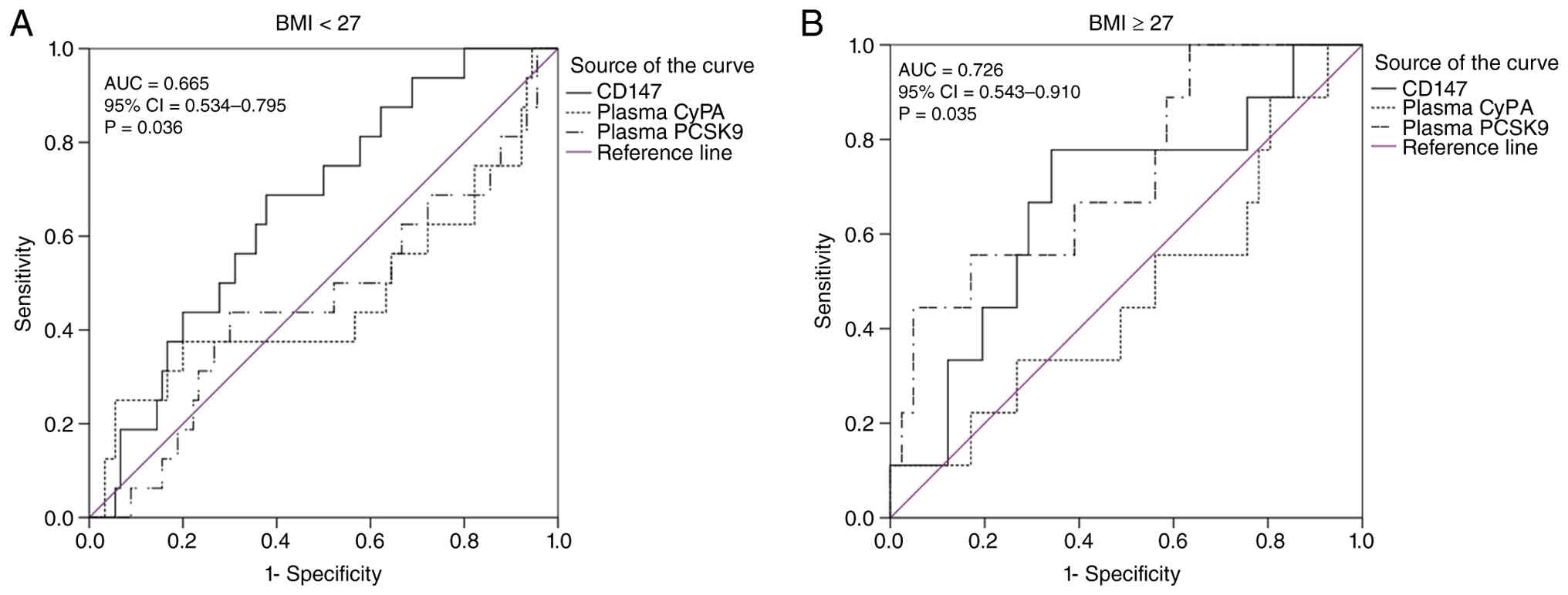 | Figure 1.ROC curve analysis of plasma
biomarkers for predicting 10-year cancer incidence in patients with
type 2 diabetes stratified by BMI. (A) In patients with BMI <27
kg/m2, plasma CD147 demonstrated significant
discriminatory performance (AUC=0.665; 95% CI, 0.534–0.795;
P=0.036), with an optimal cutoff value of 3,162.3 pg/ml
(sensitivity, 68.8%; specificity, 62.2%). CyPA and PCSK9 showed no
significant discriminatory ability. (B) In patients with BMI ≥27
kg/m2, plasma PCSK9 demonstrated the highest
discriminatory performance (AUC=0.726; 95% CI, 0.543–0.910;
P=0.035), with an optimal cutoff value of 193.1 ng/ml (sensitivity,
100.0%; specificity, 36.6%). CD147 and CyPA showed no significant
discriminatory ability. BMI, body mass index; ROC, receiver
operating characteristic; AUC, area under the ROC curve; PCSK9,
type 9 proprotein convertase subtilisin/kexin type 9; CyPA,
cyclophilin A. |
| Table V.Subgroup analysis of patients with
diabetes (with or without obesity) according to cancer
morbidity. |
Table V.
Subgroup analysis of patients with
diabetes (with or without obesity) according to cancer
morbidity.
|
| BMI <27
kg/m2 (n=89) | BMI ≥27
kg/m2 (n=52) |
|---|
|
|
|
|
|---|
| Group of
patients | Non-cancer
(n=76) | Cancer (n=13) | P-value | Non-cancer
(n=42) | Cancer (n=10) | P-value |
|---|
| Oxi-LDL antibody,
U/l | 782.9±828.8 | 611.1±572.3 | 0.495 | 401.4±285.4 | 249.3±90.66 | 0.227 |
| Oxi-LDL, mg/dl | 56.41±23.64 | 54.79±21.85 | 0.991 | 68.33±22.80 | 70.10±14.98 | 0.568 |
| sICAM-1, mg/dl | 273.5±84.09 | 319.4±107.2 | 0.069 | 329.0±118.6 | 300.1±74.46 | 0.527 |
| PCSK9, µg/l | 202.1±69.55 | 198.5±65.21 | 0.850 | 226.3±64.89 | 288.5±79.13 | 0.029 |
| Plasma CyPA,
ng/ml | 82.63±33.41 | 88.04±44.29 | 0.993 | 93.67±29.27 | 102.4±53.32 | 0.993 |
| Plasma CD147,
pg/ml | 3252±1257 | 3604±912.9 | 0.034 | 3653±962.9 | 4258±1002 | 0.096 |
Discussion
In the present study, the predictive value of
circulating CD147 and PCSK9 levels for cancer risk among obese and
non-obese patients with T2DM was investigated. The results
indicated that higher PCSK9 concentrations were associated with
increased cancer risk in obese patients with diabetes. Elevated
CD147 levels are associated with cancer in non-obese diabetic
patients (2). Further multivariate
Cox analysis indicated that plasma CD147 was independently
associated with an increased risk of cancer (P=0.021). This
highlights the robustness of CD147 as a potential biomarker, beyond
conventional demographic and metabolic risk factors. After 10 years
of follow-up, in patients with T2DM, high CD147 levels were
significantly associated with cancer (P=0.026). Importantly,
although this association was statistically significant in Model 2
(aHR=9.998; 95% CI=1.324–75.498), the wide confidence interval
indicates uncertainty in the effect size, and it therefore warrants
cautious interpretation. Taken together, these results suggest that
diabetes and obesity play important roles in cancer development and
mortality. Furthermore, the present data indicate that distinct
circulating biomarkers may be useful for risk stratification:
Plasma PCSK9 with obesity and diabetes and plasma CD147 in obese
and non-diabetic patients. Nevertheless, residual confounding
factors cannot be fully excluded, emphasizing the need for larger,
age-matched, multicenter studies to validate these
observations.
Patients with diabetes have been reported to exhibit
a 10–20% higher incidence of cancer compared with individuals
without diabetes (1). Furthermore,
diabetes is recognized as an independent risk factor for mortality
from several malignancies, including colorectal, pancreatic,
breast, liver and bladder cancers, regardless of BMI status
(9,10). Cancer often suppresses antitumor
immunity through metabolic and signaling reprogramming. CD147 can
promote immune escape through multiple mechanisms. As a molecular
chaperone of monocarboxylate transporter 1 (MCT1) and MCT4, the
CD147-MCT complex is crucial for tumor lactate transport and
glycolytic conversion, which consumes glucose, acidifies the tumor
microenvironment and impairs T-cell function. Elevated lactate
levels further promote tumor-infiltrating lymphocyte dysfunction
and broad immunosuppression (7,10). In
addition, metabolic stress in fatty liver disease and fibrosis is
associated with increased glucose transporter expression; notably,
solute carrier family 2 member 1 (SLC2A1/GLUT1) is upregulated in
advanced NAFLD-related hepatocellular carcinoma with steatosis and
fibrosis (11,12). CD147 also forms a complex with
CD98hc (SLC3A2), activating the PI3K/Akt pathway, which drives
tumor cell proliferation and is associated with adverse prognosis
in multiple cancers (13).
Collectively, these pathways may provide biological context for the
observed association between circulating CD147 levels and cancer
occurrence in patients with diabetes, particularly in metabolically
dysregulated conditions, such as diabetes. Barone et al
(14), in an analysis of 23
studies, estimated that diabetes confers a 41% higher risk of
mortality relative to non-diabetic populations (HR=1.41; 95% CI,
1.28–1.55), which is higher than that of individuals without
diabetes. Obesity has also been associated with an increased risk
of all-cause cancer mortality (HR=1.23, 95% CI, 1.01–1.50)
(14,15). Consistent with prior reports, higher
rates of cancer, all-cause mortality and obesity were observed in
patients with diabetes in the present study. Both diabetes and
obesity appear to contribute to increased risks of cancer and
mortality. Notably, although obesity and cancer were more prevalent
in the diabetic population than in non-diabetic individuals, cancer
incidence among patients with diabetes did not differ significantly
according to obesity status.
IL-2, IL-6 and hs-CRP are key players in the immune
response and inflammation and have been linked to apoptosis and
oxidative stress mechanisms. Although IL2, IL6 and hs-CRP are
commonly used indicators of chronic inflammation in clinical
practice, their differences cannot be observed when diabetes itself
is already in a state of chronic and persistent inflammation
(6,16).
PCSK9 is a circulating protein that plays a central
role in the regulation of LDL metabolism (15,17).
Although statin therapy is known to increase PCSK9 levels,
significantly higher PCSK9 concentrations were observed in obese
patients with diabetes in the present study, despite comparable
statin use rates and LDL cholesterol levels. However, the
association between obesity and circulating PCSK9 levels remains
inconclusive (17). Higher
circulating PCSK9 levels have been observed in obese individuals
compared with those of normal weight or overweight (18,19).
However, other studies have reported an inverse association between
waist circumference and PCSK9 levels in women (20). While Chan et al (21) identified a positive correlation
between PCSK9 and adiposity indices, other investigators observed
no association between PCSK9 and body composition parameters
(14). In the present study, obese
patients with diabetes exhibited elevated plasma PCSK9
concentrations compared with their non-obese counterparts, with a
significant positive correlation between PCSK9 levels and obesity
(rho=0.245, P=0.001; data not shown).
Previous studies have reported associations between
PCSK9 levels and myocardial infarction as well as CVD (15,17,18).
However, a meta-analysis found no significant association between
plasma PCSK9 concentrations and CVD risk (17). Although PCSK9 inhibitors have been
shown to improve cardiovascular outcomes and reduce all-cause
mortality rates, circulating PCSK9 concentrations may not
independently predict mortality (21). Although Schlegel et al
(22) observed an inverse
association between PCSK9 levels and mortality in end-stage liver
disease, no significant difference in circulating PCSK9
concentrations between deceased and surviving diabetic patients was
detected in the present study, regardless of BMI status.
In addition to its established role in cholesterol
homeostasis, PCSK9 has recently been implicated in cancer biology.
It promotes immune evasion by facilitating the degradation of major
histocompatibility complex class I molecules on tumor cells,
thereby limiting its recognition by cytotoxic T lymphocytes
(23,24). Experimental studies have
demonstrated that PCSK9 inhibition enhances antitumor immunity and
improves response to immune checkpoint blockade (17,18,23).
In addition, PCSK9-mediated dysregulation of cholesterol metabolism
may contribute to tumor growth and metastasis. These previously
reported mechanisms may partially explain the observed association
between higher plasma PCSK9 levels and cancer occurrence in obese
patients with diabetes. However, among patients with non-obese
diabetes, where metabolic stressors such as CD147 predominate,
PCSK9′s contribution to the risk of cancer appears less
pronounced.
Higher circulating CD147 levels have been observed
in the context of obesity. Wilson et al (25) described a positive association
between BMI and CD147 levels in an animal model, and the findings
of the present study similarly indicate a positive correlation
between BMI and plasma CD147 levels (rho=0.157, P=0.012; data not
shown).
In the present study, among patients with diabetes,
those who died exhibited a higher prevalence of cancer and elevated
plasma CD147 levels, regardless of BMI status. Previous studies
have reported associations between elevated CD147 expression and
adverse oncologic characteristics in several cancers (13,26,27).
CD147 has been investigated as a potential
prognostic biomarker in upper gastrointestinal cancers (26). In the present study, higher CD147
levels were observed in diabetic patients with cancer, although
only a marginal association was noted in the obese group. In the
present study, ROC curve analysis suggested that plasma CD147 may
have predictive utility for 10-year cancer risk in non-obese
patients with T2DM, whereas plasma PCSK9 may serve as a predictive
biomarker for 10-year cancer risk in obese patients with T2DM. The
anti-CD147 antibody improves the effects of chemoradiation therapy
in certain cancer treatments (28).
Overexpression of CD147 has been associated with unfavorable
clinical outcomes in cancer patients, suggesting possible relevance
in tumor biology. Individuals with concomitant obesity and diabetes
exhibited elevated circulating PCSK9 concentrations relative to
non-diabetic individuals. In the present study, higher circulating
PCSK9 levels were observed in patients with cancer, obesity and
diabetes. Emerging evidence has suggested possible associations
between PCSK9 and cancer-related outcomes in experimental and
clinical studies and experimental studies have shown that PCSK9
inhibition can improve cancer-related outcomes and tumor behavior
(29,30). Tumor-induced lipoprotein cholesterol
has been reported to promote tumor growth through PCSK9 activation,
which is associated with elevated LDL cholesterol levels (31). However, LDL cholesterol levels were
not increased in patients with cancer in the present cohort,
indicating that the association between PCSK9 and cancer prevalence
may not be mediated by dyslipidemia. Instead, PCSK9 may influence
cancer progression through alternative mechanisms, such as
modulation of proprotein convertase substrates, including matrix
metalloproteinases (32). Notably,
PCSK9 demonstrated superior predictive performance for cancer risk
among patients with obesity and diabetes compared with CD147 and
CyPA. The apparent discrepancy between the Cox regression and ROC
analyses likely reflects the different statistical objectives of
these approaches. Multivariate Cox regression evaluates independent
associations after adjustment for covariates, whereas ROC analysis
assesses the discriminatory performance of biomarkers within
specific subgroups. Therefore, although PCSK9 did not remain
independently associated with cancer risk in the overall adjusted
Cox model, it demonstrated relatively better discriminatory
performance in obese patients with T2DM, suggesting potential
subgroup-specific discriminatory performance that warrants further
validation.
In the present study, plasma CyPA levels were
associated with the BMI. Consistent with the current findings,
Kumar et al (16) reported
elevated CyPA concentrations in obese individuals, irrespective of
diabetes status. Overexpression of CyPA has been linked to adverse
clinical outcomes in several pathological conditions, including
congestive heart failure, pancreatitis, brain injury and cancer
(32–35). In the present cohort, lower plasma
CyPA levels were observed among deceased patients with obesity and
diabetes; however, this difference did not reach statistical
significance. Furthermore, CyPA concentrations did not differ
according to cancer status in these patients.
This study had several methodological limitations
that warrant consideration. First, the sample size was determined
by the available cohort during the study period rather than by a
priori power calculations. Although the overall cohort was
sufficient for exploratory analyses, the relatively small number of
cancer events and subgroup stratification may have limited
statistical precision and reduced the ability to detect modest
associations. Furthermore, the limited number and heterogeneous
distribution of cancer types prevented cancer site-specific
analyses. Because the biological relevance of CD147 and PCSK9 may
vary across different malignancies, the present findings should be
interpreted cautiously and considered exploratory and
hypothesis-generating. In addition, detailed oncologic information,
including tumor stage, metastatic status, recurrence and treatment
response, was not consistently available in this cohort. Second,
missing baseline biomarker data were minimal (<5%) and were
handled by listwise deletion. Although this approach was unlikely
to have substantially influenced the main findings, a minor degree
of bias cannot be excluded. Third, only 23 cancer events occurred
among the 141 patients with type 2 diabetes during the 10-year
follow-up period. Further stratification by obesity status reduced
both the subgroup sample sizes and the number of events, resulting
in wide confidence intervals and limited statistical precision.
Although baseline smoking status, statin use and renal function
were available for evaluation, detailed information on metformin
and other glucose-lowering medications, including treatment
duration, dosage and changes during follow-up, was not
comprehensively available. In addition, the small numbers of cases
across heterogeneous cancer types precluded reliable cancer
site-specific analyses. Given the limited number of events,
including all potentially relevant covariates in the multivariate
Cox regression models, would have increased the risk of
overfitting. Therefore, only a limited set of clinically relevant
covariates was included. Residual confounding cannot be excluded
and the phenotype-specific subgroup findings should be interpreted
cautiously as exploratory and hypothesis-generating. Fourth, this
was a single-center observational cohort study based on patients
with available follow-up data; therefore, potential selection bias
remains possible. In addition, the imbalance in baseline age
distribution and the relative homogeneity of the study population
may limit the generalizability of the present findings. Future
large-scale, multicenter prospective studies incorporating larger
and more diverse populations, together with detailed cancer-related
clinical information, are needed to validate these findings and
further clarify the clinical relevance of these biomarkers across
different cancer types.
Despite these limitations, this study has several
important strengths. To our knowledge, this is one of the first
studies to simultaneously evaluate plasma CD147, CyPA and PCSK9 in
relation to long-term cancer risk in patients with T2DM. With up to
10 years of follow-up, the present findings revealed
phenotype-specific predictive associations, suggesting that CD147
may have greater predictive value in non-obese patients, whereas
PCSK9 may have greater predictive value in obese patients with
T2DM. These findings provide a foundation for future
biomarker-based cancer risk stratification and precision medicine
in patients with type 2 diabetes.
Acknowledgements
Not applicable.
Funding
This study was supported by the Ministry of Science and
Technology (grant no. 103-2314-B-371-010) and CCH, Changhua, Taiwan
(grant nos. 106-CCHIRP-095 and 104-CCH-MST-001).
Availability of data and materials
The data generated in the present study may be
requested from the corresponding author.
Authors' contributions
LCT, CSL and SLS contributed to the conception and
experimental design. CLK completed the data analysis. LCT and CLK
drafted the manuscript. CSH and YSC performed data analysis and
literature searches. LCT, CSL, CLK and SLS contributed to the
drafting and revision of the manuscript. CSL and SLS checked and
confirmed the authenticity of all the raw data. All authors have
read and approved the final manuscript.
Ethics approval and consent to
participate
This study was approved by the IRB of CCH (Changhua,
Taiwan; approval nos. 071228 and 161220). All patients provided
written informed consent to participate in this study.
Patient consent for publication
Not applicable.
Competing interests
The authors declare that they have no competing
interests.
References
|
1
|
Carstensen B, Jørgensen ME and Friis S:
The epidemiology of diabetes and cancer. Curr Diab Rep. 14:5352014.
View Article : Google Scholar : PubMed/NCBI
|
|
2
|
Li Y, Luo J, Bao K, Wei Q, Wang X, Chen J,
Zhang T, Wang F and Zhu Y: Association of age at diagnosis of type
2 diabetes mellitus with the risks of the morbidity of
cardiovascular disease, cancer and all-cause mortality: Evidence
from a real-world study with a large population-based cohort study.
Diabetes Res Clin Pract. 217:1118702024. View Article : Google Scholar : PubMed/NCBI
|
|
3
|
Lawler T, Hibler E, Walts ZL, Giurini L,
Steinwandel M, Lipworth L, Murff HJ, Zheng W and Warren Andersen S:
Associations of diabetes and mortality among colorectal cancer
patients from the southern community cohort study. Br J Cancer.
131:1050–1059. 2024. View Article : Google Scholar : PubMed/NCBI
|
|
4
|
Rawshani A, Rawshani A and Gudbjörnsdottir
S: Mortality and cardiovascular disease in type 1 and type 2
diabetes. N Engl J Med. 377:300–301. 2017. View Article : Google Scholar : PubMed/NCBI
|
|
5
|
Petersen SE, Sanghvi MM, Aung N, Cooper
JA, Paiva JM, Zemrak F, Fung K, Lukaschuk E, Lee AM, Carapella V,
et al: The impact of cardiovascular risk factors on cardiac
structure and function: Insights from the UK Biobank imaging
enhancement study. PLoS One. 12:e01851142017. View Article : Google Scholar : PubMed/NCBI
|
|
6
|
Nigro P, Pompilio G and Capogrossi MC:
Cyclophilin A: A key player for human disease. Cell Death Dis.
4:e8882013. View Article : Google Scholar : PubMed/NCBI
|
|
7
|
Kirk P, Wilson MC, Heddle C, Brown MH,
Barclay AN and Halestrap AP: CD147 is tightly associated with
lactate transporters MCT1 and MCT4 and facilitates their cell
surface expression. EMBO J. 19:3896–3904. 2000. View Article : Google Scholar : PubMed/NCBI
|
|
8
|
Coughlin SS, Calle EE, Teras LR, Petrelli
J and Thun MJ: Diabetes mellitus as a predictor of cancer mortality
in a large cohort of US adults. Am J Epidemiol. 159:1160–1167.
2004. View Article : Google Scholar : PubMed/NCBI
|
|
9
|
Pan WH, Lee MS, Chuang SY, Lin YC and Fu
ML: Obesity pandemic, correlated factors and guidelines to define,
screen and manage obesity in Taiwan. Obes Rev. 9 (Suppl 1):S22–S31.
2008. View Article : Google Scholar
|
|
10
|
Taghizadeh N, Boezen HM, Schouten JP,
Schröder CP, Elisabeth de Vries EG and Vonk JM: BMI and lifetime
changes in BMI and cancer mortality risk. PLoS One.
10:e01252612015. View Article : Google Scholar : PubMed/NCBI
|
|
11
|
Tu SH, Chen C, Hsieh YT, Chang HY, Yeh CJ,
Lin YC and Pan WH: Design and sample characteristics of the
2005–2008 nutrition and health survey in Taiwan. Asia Pac J Clin
Nutr. 20:225–237. 2011.PubMed/NCBI
|
|
12
|
Amann T, Maegdefrau U, Hartmann A, Agaimy
A, Marienhagen J, Weiss TS, Stoeltzing O, Warnecke C, Schölmerich
J, Oefner PJ, et al: GLUT1 expression is increased in
hepatocellular carcinoma and promotes tumorigenesis. Am J Pathol.
174:1544–1552. 2009. View Article : Google Scholar : PubMed/NCBI
|
|
13
|
Yang XM, Bian H and Chen ZN:
CD147/Basigin: From integrative molecular hub to translational
therapeutic target. Adv Sci (Weinh). 13:e188842026. View Article : Google Scholar : PubMed/NCBI
|
|
14
|
Barone BB, Yeh HC, Snyder CF, Peairs KS,
Stein KB, Derr RL, Wolff AC and Brancati FL: Long-term all-cause
mortality in cancer patients with preexisting diabetes mellitus: A
systematic review and meta-analysis. JAMA. 300:2754–2764. 2008.
View Article : Google Scholar : PubMed/NCBI
|
|
15
|
Arsenault BJ, Pelletier-Beaumont E,
Alméras N, Tremblay A, Poirier P, Bergeron J and Després JP: PCSK9
levels in abdominally obese men: association with cardiometabolic
risk profile and effects of a one-year lifestyle modification
program. Atherosclerosis. 236:321–326. 2014. View Article : Google Scholar : PubMed/NCBI
|
|
16
|
Kumar J, Badade ZG and Rai S: Study of
cyclophilin-A, high sensitivity C-reactive protein, and
malondialdehyde in obese and nonobese type 2 diabetes mellitus
patients. MGM J Med Sci. 5:159–163. 2018. View Article : Google Scholar
|
|
17
|
Leander K, Mälarstig A, Van't Hooft FM,
Hyde C, Hellénius ML, Troutt JS, Konrad RJ, Öhrvik J, Hamsten A and
de Faire U: Circulating proprotein convertase subtilisin/Kexin type
9 (PCSK9) predicts future risk of cardiovascular events
independently of established risk factors. Circulation.
133:1230–1239. 2016. View Article : Google Scholar : PubMed/NCBI
|
|
18
|
Xiao Y, Peng C, Huang W, Zhang J, Gao Y,
Kim JH, Yeoh EK and Su X: Circulating proprotein convertase
subtilisin/Kexin type 9 (PCSK9) concentration and risk of
cardiovascular events-systematic review and meta-analysis of
prospective studies. Circ J. 81:1150–1157. 2017. View Article : Google Scholar : PubMed/NCBI
|
|
19
|
Tóth Š, Fedačko J, Pekárová T, Hertelyová
Z, Katz M, Mughees A, Kuzma J, Štefanič P, Kopolovets I and Pella
D: Elevated circulating PCSK9 concentrations predict subclinical
atherosclerotic changes in low risk obese and non-obese patients.
Cardiol Ther. 6:281–289. 2017. View Article : Google Scholar : PubMed/NCBI
|
|
20
|
Hasan H, Attlee A, Raigangar V, Madkour M
and Awadallah S: Proprotein convertase subtilisin/kexin type 9
(PCSK9) and metabolic syndrome components among young adult
females. Diabetes Metab Syndr. 11 (Suppl 1):S337–S341. 2017.
View Article : Google Scholar : PubMed/NCBI
|
|
21
|
Chan DC, Pang J, McQuillan BM, Hung J,
Beilby JP, Barrett PH and Watts GF: Plasma proprotein convertase
subtilisin kexin type 9 as a predictor of carotid atherosclerosis
in asymptomatic adults. Heart Lung Circ. 25:520–525. 2016.
View Article : Google Scholar : PubMed/NCBI
|
|
22
|
Schlegel V, Treuner-Kaueroff T, Seehofer
D, Berg T, Becker S, Ceglarek U, Thiery J and Kaiser T: Low PCSK9
levels are correlated with mortality in patients with end-stage
liver disease. PLoS One. 12:e01815402017. View Article : Google Scholar : PubMed/NCBI
|
|
23
|
Silbernagel G, Scharnagl H, Kleber ME,
Stojakovic T and März W: Circulating proprotein convertase
subtilisin-kexin type 9, all-cause mortality, and cardiovascular
mortality: The ludwigshafen risk and cardiovascular health study.
Eur J Prev Cardiol. 24:1095–1101. 2017. View Article : Google Scholar : PubMed/NCBI
|
|
24
|
Seeger H, Latus J, Kitterer D, Alscher MD,
Biegger D, Chen J, Edenhofer I, Wüthrich RP and Segerer S: CD147
expression in peritoneal injury. Clin Exp Nephrol. 21:1097–1104.
2017. View Article : Google Scholar : PubMed/NCBI
|
|
25
|
Wilson MR, Petrie JE, Shaw MW, Hu C,
Oakley CM, Woods SJ, Patel BV, O'Dea KP and Takata M: High-fat
feeding protects mice from ventilator-induced lung injury, via
neutrophil-independent mechanisms. Crit Care Med. 45:e831–e839.
2017. View Article : Google Scholar : PubMed/NCBI
|
|
26
|
Sato M, Nakai Y, Nakata W, Yoshida T,
Hatano K, Kawashima A, Fujita K, Uemura M, Takayama H and Nonomura
N: EMMPRIN promotes angiogenesis, proliferation, invasion and
resistance to sunitinib in renal cell carcinoma, and its level
predicts patient outcome. PLoS One. 8:e743132013. View Article : Google Scholar : PubMed/NCBI
|
|
27
|
Li H, Jiang C, Wu D, Shi S, Liao M, Wang
J, Li Y and Xu Z: The prognostic and clinicopathologic
characteristics of CD147 and esophagus cancer: A meta-analysis.
PLoS One. 12:e01802712017. View Article : Google Scholar : PubMed/NCBI
|
|
28
|
Han JM and Jung HJ: Cyclophilin A/CD147
interaction: A promising target for anticancer therapy. Int J Mol
Sci. 23:93412022. View Article : Google Scholar : PubMed/NCBI
|
|
29
|
Bonaventura A, Grossi F, Carbone F,
Vecchié A, Minetti S, Bardi N, Elia E, Ansaldo AM, Ferrara D,
Rijavec E, et al: Serum PCSK9 levels at the second nivolumab cycle
predict overall survival in elderly patients with NSCLC: A pilot
study. Cancer Immunol Immunother. 68:1351–1358. 2019. View Article : Google Scholar : PubMed/NCBI
|
|
30
|
Momtazi-Borojeni AA, Nik ME, Jaafari MR,
Banach M and Sahebkar A: Effects of immunization against PCSK9 in
an experimental model of breast cancer. Arch Med Sci. 15:570–579.
2019. View Article : Google Scholar : PubMed/NCBI
|
|
31
|
Huang J, Li L, Lian J, Schauer S, Vesely
PW, Kratky D, Hoefler G and Lehner R: Tumor-induced hyperlipidemia
contributes to tumor growth. Cell Rep. 15:336–348. 2016. View Article : Google Scholar : PubMed/NCBI
|
|
32
|
Bassi DE, Fu J, Lopez de Cicco R and
Klein-Szanto AJ: Proprotein convertases: ‘Master switches’ in the
regulation of tumor growth and progression. Mol Carcinog.
44:151–161. 2005. View
Article : Google Scholar : PubMed/NCBI
|
|
33
|
Lu GW, Lu DW and Zhang YX: Predictive
value of serum cyclophilin A concentrations after acute
pancreatitis. Clin Chim Acta. 484:237–245. 2018. View Article : Google Scholar : PubMed/NCBI
|
|
34
|
Jin HH, Mao TM, Bai ZQ, Chen Y, Ji HL and
Jin Y: The 90-day prognostic value of serum cyclophilin A in
traumatic brain injury. Clin Chim Acta. 484:258–264. 2018.
View Article : Google Scholar : PubMed/NCBI
|
|
35
|
Jin S, Zhang M and Qiao X: Cyclophilin A:
Promising target in cancer therapy. Cancer Biol Ther.
25:24251272024. View Article : Google Scholar : PubMed/NCBI
|

















