Introduction
Breast cancer (BC) is one of the most prevalent
malignancies among women worldwide. In 2022, female BC accounted
for >2.3 million novel cases, constituting 11.6% of the global
cancer incidence rate and for 6.9% of all cancer-associated
mortalities (1).
BC incidence has shifted toward younger populations,
with a notable annual increase of 2.5% among women aged 20–29 years
(2). It has been reported that
~30.2% of patients with BC experience depression (3). Notably, younger patients with BC are
more susceptible to depressive symptoms, such as persistent
sadness, fatigue and loss of appetite; a previous study reported
that patients with BC aged ≤45 years had a 1.5 times higher risk of
screening positive for potential depression compared with those
aged >45 years (4). It is well
known that depressive and anxious states can impair the quality of
life of patients (5,6), which may adversely affect tumor
recovery. Therefore, psychological support should be considered for
these patients with BC, and for those with severe or persistent
psychological distress, adjunctive pharmacotherapy with
antidepressant (AD) or anxiolytic may be warranted.
Regarding the association between AD exposure and BC
prognosis, a previous cohort study by Baxter et al (7) reported an 11% increase in mortality
risk among exposed patients compared with the control group.
However, other studies (8,9), including those focusing on major AD
classes such as selective serotonin reuptake inhibitors (SSRIs) and
tricyclic ADs (TCAs), have not identified an association between AD
exposure and BC prognosis. Another previous study by Suppli et
al (10) suggested that the
observed association might not be attributable to AD per se,
but rather to the finding that patients with AD exposure had worse
adherence to standard BC treatment compared with the control group.
Thus, research findings on AD exposure and BC outcomes remain
conflicting, and currently no meta-analysis has explored this
association, to the best of our knowledge. Therefore, the present
study aimed to investigate this association by systematically
searching for and reviewing relevant cohort studies and randomized
controlled trials (RCTs).
Materials and methods
Study design
The present meta-analysis adhered to the Preferred
Reporting Items for Systematic Reviews and Meta-Analyses guidelines
(11). Furthermore, the present
study was registered in the International Prospective Register of
Systematic Reviews database under (https://www.crd.york.ac.uk/PROSPERO/) registration
number CRD420251232706.
Search strategy
A systematic literature search was conducted across
PubMed (https://pubmed.ncbi.nlm.nih.gov/), Web of Science
(https://webofscience.com/), Embase
(https://www.embase.com/) and the Cochrane Library
databases (https://www.cochranelibrary.com/) from inception to
October 2025 to identify studies investigating the association
between AD exposure and survival outcomes in patients with BC. The
search strategy combined Medical Subject Headings terms and
free-text keywords using Boolean operators. The detailed search
strategy is provided in Table SI.
For example, terms for BC (https://www.ncbi.nlm.nih.gov/mesh/68001943) included
‘breast neoplasms’, ‘neoplasm, breast’ and ‘breast cancer’; and
terms for AD (https://www.ncbi.nlm.nih.gov/mesh/68000928) included
‘antidepressive agents’, ‘antidepressant medication’ and
‘antidepressant’. To identify additional relevant studies, the
reference lists of included publications were manually searched in
the aforementioned databases. To ensure comprehensiveness and
minimize oversight, all searches were performed independently by
two reviewers and any disagreements were resolved through
discussion or by consulting a third reviewer. The titles and
abstracts were first screened and then the full texts of
potentially eligible studies were assessed.
Inclusion and exclusion criteria
Study eligibility was determined based on the
following framework: Population, Intervention, Comparison, Outcomes
and Study Design (12). The
inclusion criteria were as follows: i) The study population
comprised of patients with BC; ii) the exposure group involved
patients who received any class of AD; iii) the control group
consisted of patients not exposed to AD; iv) the study reported
patient survival outcomes, specifically with overall survival (OS)
or BC-specific survival (BCSS); v) the study design was a cohort
study or an RCT; and vi) the article was published in English.
Studies were excluded if any of the following criteria applied: i)
Data were unavailable or could not be extracted; ii) full-text
articles were not accessible; and iii) the study was a duplicate
publication or an updated version of an already included study.
Data extraction
A standardized data extraction form was used to
collate the following information from each included study:
Authors, publication year, country, study design, sample size,
participant characteristics (for example, mean age), follow-up
duration, type of AD, exposure definition, exposure assessment,
adjusted covariates and prognostic data (13). For studies reporting BCSS, the
present study verified that the outcome was consistently defined as
BC-specific mortality based on the underlying cause of mortality.
Data extraction was performed independently by two reviewers. Any
discrepancies between the reviewers were resolved through consensus
or by consulting a third reviewer.
Risk of bias and quality
assessments
The methodological quality of the included studies
was appraised using design-specific tools. For the RCTs, the
Cochrane Risk of Bias tool (ROB 1; version 5.1.0) was used
(14). The Cochrane Risk of Bias
tool evaluated the risk of bias across six domains: Selection bias,
performance bias, detection bias, attrition bias, reporting bias
and other biases (such as baseline imbalance, funding bias or early
trial termination). Each domain was judged as ‘low risk’, ‘high
risk’ or having an ‘unclear risk’ of bias. For cohort studies, the
Newcastle-Ottawa Scale (NOS) was utilized, rating the studies on
selection (0–4 points), comparability (0–2 points) and outcome
ascertainment (0–3 points) (15).
The total score ranged from 0 to 9, with higher scores reflecting
improved methodological quality and a lower risk of bias. Two
reviewers independently conducted these assessments and any
disagreements that arose were resolved through discussion with a
third reviewer.
Statistical analysis
In the present meta-analysis, all statistical
analyses were performed using Stata software (version 12.0;
StataCorp LP). The association between AD exposure and BC prognosis
was evaluated by pooling hazard ratios (HR) with 95% confidence
intervals (CIs). An HR>1 indicated that AD exposure was
associated with worse prognosis; by contrast, an HR <1 suggested
that AD exposure was associated with improved prognosis.
Heterogeneity across studies was evaluated using the I2
statistic, with an I2 value >50% denoting notable
heterogeneity and an I2 value ≤50% denoting low
heterogeneity. Due to the potential sources of heterogeneity (for
example, ethnicity, tumor stage and type or frequency of AD
exposure), a random-effects model was used for the present
meta-analysis to improve the robustness of the statistical results.
To investigate the sources of heterogeneity, subgroup analyses were
performed based on pre-specified factors including AD type and
timing of exposure associated with cancer diagnosis. The potential
for publication bias was examined using Egger's test (16). Sensitivity analyses were performed
using the leave-one-out approach, in which each included study was
sequentially omitted to evaluate whether any single study markedly
influenced the pooled estimates (17). All P-values were two-sided and
P<0.05 was considered to indicate a statistically significant
difference.
Results
Study search results
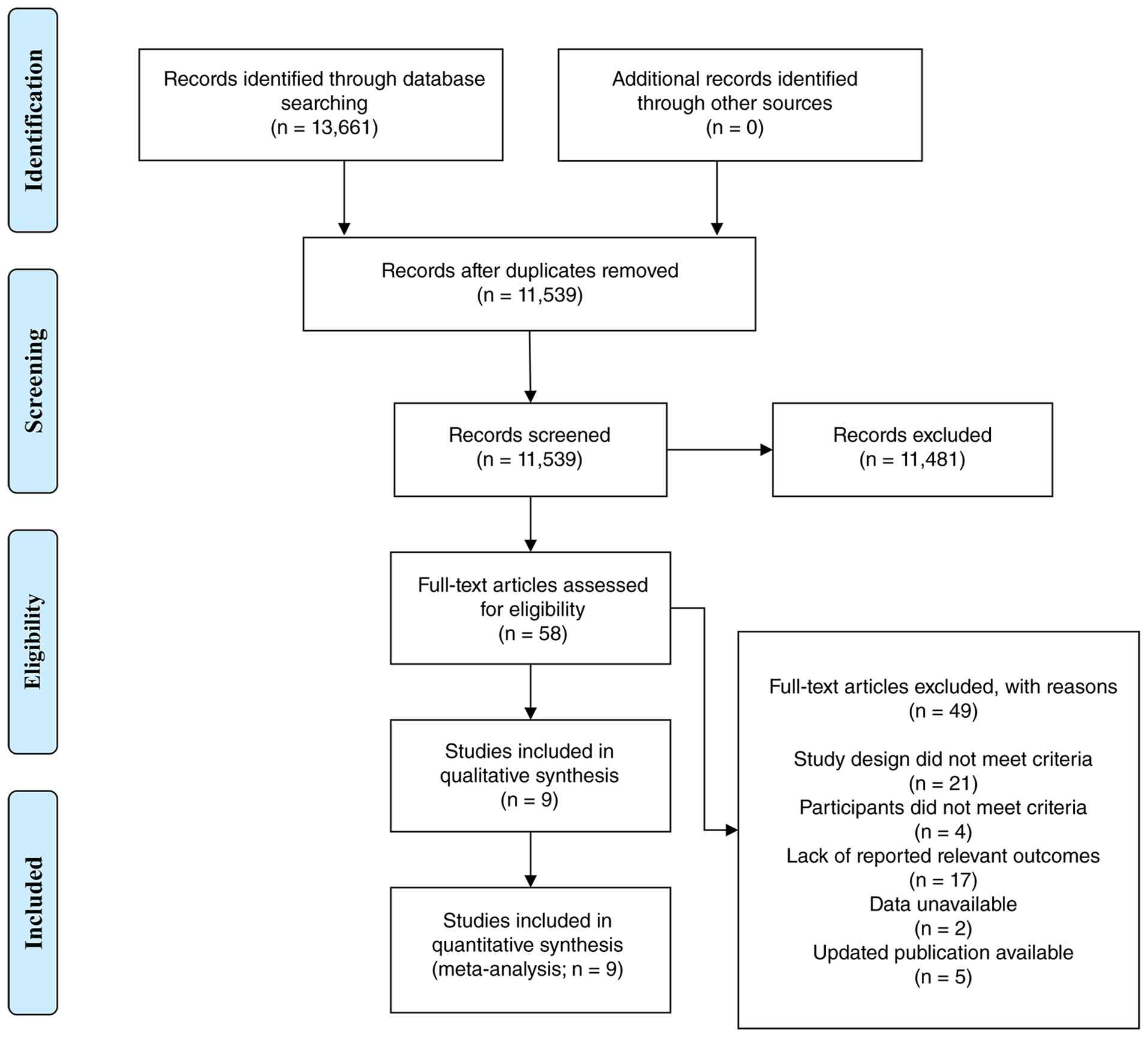
The initial systematic search across four databases
yielded 13,661 records. After removing duplicates, 11,539 unique
records remained. Following screening of titles and abstracts,
11,481 records were excluded, leaving 58 studies for full-text
review. Upon detailed assessment, 49 studies were excluded for the
following reasons: Used an ineligible study design (n=21), enrolled
a population that did not meet the inclusion criteria of the
present study (n=4), lacked reporting on relevant outcomes (n=17),
had unavailable or non-extractable data (n=2) and were identified
as duplicate or updated publications (n=5). This process resulted
in the inclusion of nine studies (7–10,18–22),
as detailed in Fig. 1.
Study characteristics
The nine included studies, published between 2007
and 2025, were conducted across eight countries: United States
(n=2), Australia, Northern Ireland, Israel, South Korea, United
Kingdom, France and Denmark (each n=1). The total sample size
consisted of ~90,000 patients in the AD-exposed group and
>300,000 patients in the control group. The types of AD exposure
varied, including any AD as well as specific agents such as SSRIs,
TCAs, sertraline, venlafaxine and mianserin. Regarding exposure
definition, six studies involved post-diagnosis use and six studies
involved continuous use, as three studies (8,19,21)
reported both exposure definitions. Notably, patients with
pre-diagnosis use who were included without specification of
post-diagnosis were classified into the continuous use group. The
primary outcomes of interest in the present study were OS and BCSS.
A summary of these study characteristics is presented in Table I. Additional information, such as
cohort names and dates of BC diagnosis, are provided in Table SII.
 | Table I.Characteristics of all the studies
included in the present meta-analysis. |
Table I.
Characteristics of all the studies
included in the present meta-analysis.
| First author,
year | Country | No. of AD- exposed
patients | No. of unexposed
patients | AD type | Exposure
definition | Outcomes
reported | (Refs.) |
|---|
| Stockler et
al, 2007 | Australia | 32 | 157 | Sertraline | Sertraline; 50 mg
daily | OS | (18) |
| Baxter, et
al, 2025 | Northern
Ireland | 4,358 | 9,488 | Any AD | Filled AD
prescription within 12 months before breast cancer diagnosis | OS and BCSS | (7) |
| Fischer et
al, 2022 | Israel | 1,048 | 3,143 | SSRIs | Use of SSRIs based
on filled prescriptions from 1998 to 2020 | OS | (19) |
| Shim et al,
2020 | South Korea | 76,328 | 47,225 | Any AD | Use of AD within
the 1st year after diagnosis | OS | (20) |
| Busby et al,
2018 | United Kingdom | 4,784 | 18,885 | SSRIs, TCAs and
venlafaxine | At least one AD
prescription after diagnosis | OS and BCSS | (21) |
| Wernli et
al, 2011 | USA | 308 | 2,750 | Any AD | Use of AD after
diagnosis at least twice weekly for ≥3 months | OS and BCSS | (8) |
| Chubak et
al, 2016 | USA | 2,302 | 1,914 | Any AD | Use of AD after
diagnosis | BCSS | (9) |
| Dumas et al,
2024 | France | 1,490 | 233,878 | Mianserin | ≥3 months of the
full mianserin dose in the 6 months before breast cancer
diagnosis | OS | (22) |
| Suppli et
al, 2017 | Denmark | 1,450 | 6,733 | Any AD | AD treatment from 3
years to 3 months before breast cancer diagnosis | OS and BCSS | (10) |
Quality assessment and risk of
bias
Among the nine included studies, one study was an
RCT. The methodological quality of this RCT was appraised using The
Cochrane Risk of Bias tool, and it was judged to be at an overall
low risk of bias. The remaining eight studies were cohort designs,
which were assessed using the NOS. The NOS scores for these cohort
studies ranged from 6 to 8, indicating moderate to high
methodological quality. The detailed ratings for all studies are
provided in Tables SIII and
SIV.
Meta-analysis
The meta-analysis of OS, based on eight studies
reporting this outcome, demonstrated that patients exposed to AD
had worse OS compared with the control group (HR=1.28; 95% CI,
1.22–1.34; P<0.001), with low heterogeneity
(I2=25.2%; P=0.228). The corresponding forest plot is
presented in Fig. 2. For BCSS, a
pooled analysis of the five studies reporting this outcome revealed
that the exposure group had lower survival compared with the
control group (HR=1.16; 95% CI, 1.09–1.25; P<0.001;
I2=30.1%; P=0.221). The corresponding forest plot is
presented in Fig. 3.
Subgroup analysis
In the subgroup analysis of OS, when stratified by
ethnicity, the pooled results indicated a significantly worse
prognosis in the AD-exposed group compared with their respective
control groups within both the European (HR=1.27; 95% CI,
1.21–1.34; P<0.001) and Asian (HR=1.30; 95% CI, 1.19–1.42;
P<0.001) subgroups. The North American subgroup was not analyzed
separately because it contained only one study (8), precluding a meaningful meta-analysis.
Stratified by drug class, the AD exposure group had significantly
worse OS compared with the control group for both SSRIs (HR=1.34;
95% CI, 1.18–1.51; P<0.001) and other ADs (HR=1.36; 95% CI,
1.15–1.59; P<0.001). Regarding timing of exposure, patients in
the exposure group demonstrated significantly worse survival
outcomes compared with the control group for both continuous
exposure (HR=1.24; 95% CI, 1.19–1.30; P<0.001) and
post-diagnosis exposure (HR=1.32; 95% CI, 1.23–1.42; P<0.001).
Detailed results are presented in Table II.
| Table II.Subgroup analysis of the association
between AD exposure and overall survival. |
Table II.
Subgroup analysis of the association
between AD exposure and overall survival.
| Subgroup | No. of studies | HR | 95% CI | P-value | I2,
% |
|---|
| Geographical
region |
|
|
|
|
|
|
Europe | 4 | 1.27 | (1.21, 1.34) |
<0.001a | 35.3 |
|
Asia | 2 | 1.30 | (1.19, 1.42) |
<0.001a | 0.0 |
| Type of AD |
|
|
|
|
|
|
SSRIs | 4 | 1.34 | (1.18, 1.51) |
<0.001a | 31.7 |
| Other
ADs | 2 | 1.36 | (1.15, 1.59) |
<0.001a | 0.0 |
| Timing of
exposureb |
|
|
|
|
|
|
Continuous | 5 | 1.24 | (1.19, 1.30) |
<0.001a | 0.0 |
|
Post-diagnosis | 5 | 1.32 | (1.23, 1.42) |
<0.001a | 17.4 |
An analysis of BCSS was performed across subgroups.
Among European patients, those in the exposed group demonstrated a
significantly worse prognosis compared with the control groups
(HR=1.18; 95% CI, 1.08–1.28; P<0.001); however, no significant
difference in BCSS was observed between both groups in the North
American cohort (HR=1.05; 95% CI, 0.83–1.34; P=0.671). In the
analysis stratified by drug class, patients exposed to SSRIs
(HR=1.21; 95% CI, 1.13–1.31; P<0.001) and TCAs (HR=1.26; 95% CI,
1.14–1.40; P<0.001) demonstrated significantly worse BCSS
compared with the control groups. However, no statistical
difference in survival outcomes was observed between the two groups
for other ADs (HR=1.14; 95% CI, 0.82–1.59; P=0.421). Further
subgroup analysis within SSRIs revealed a significantly worse
prognosis with citalopram exposure vs. non-exposure (HR=1.29; 95%
CI, 1.14–1.46; P<0.001), whereas no significant differences were
identified for exposure to sertraline, paroxetine and fluoxetine
[sertraline (HR=1.31; 95% CI, 0.55–3.11; P=0.547); paroxetine
(HR=1.25; 95% CI, 0.99–1.57; P=0.063); fluoxetine (HR=1.11; 95% CI,
0.71–1.72; P=0.647)]. Regarding timing of exposure, both continuous
exposure (HR=1.14; 95% CI, 1.07–1.20; P<0.001) and
post-diagnosis exposure (HR=1.22; 95% CI, 1.08–1.37; P=0.001) to AD
had significantly lower BCSS in patients compared with the control
groups. Complete data are presented in Table III.
| Table III.Subgroup analysis of the association
between AD exposure and breast cancer-specific survival. |
Table III.
Subgroup analysis of the association
between AD exposure and breast cancer-specific survival.
| Subgroup | No. of studies | HR | 95% CI | P-value | I2,
% |
|---|
| Geographical
region |
|
|
|
|
|
|
Europe | 3 | 1.18 | (1.08, 1.28) |
<0.001a | 58.1 |
| North
America | 2 | 1.05 | (0.83, 1.34) | 0.671 | 0.0 |
| Type of AD |
|
|
|
|
|
|
SSRIsb | 4 | 1.21 | (1.13, 1.31) |
<0.001a | 0.0 |
|
Sertraline | 2 | 1.31 | (0.55, 3.11) | 0.547 | 64 |
|
Paroxetine | 2 | 1.25 | (0.99, 1.57) | 0.063 | 0.0 |
|
Fluoxetine | 2 | 1.11 | (0.71, 1.72) | 0.647 | 36.3 |
|
Citalopram | 2 | 1.29 | (1.14, 1.46) |
<0.001a | 0.0 |
|
TCAs | 3 | 1.26 | (1.14, 1.40) |
<0.001a | 3.5 |
| Other
ADs | 2 | 1.14 | (0.82, 1.59) | 0.421 | 53.3 |
| Timing of
exposure |
|
|
|
|
|
|
Continuous | 3 | 1.14 | (1.07, 1.20) |
<0.001a | 0.0 |
|
Post-diagnosis | 3 | 1.22 | (1.08, 1.37) | 0.001a | 12.3 |
Publication bias and sensitivity
analysis
For OS, no significant publication bias was observed
using Egger's test (P=0.271; Fig.
S1). Sensitivity analysis further confirmed the robustness of
the OS results and the leave-one-out analysis excluding the RCT by
Stockler et al (18) did not
materially alter the pooled estimate (HR=1.28; 95% CI, 1.23–1.33;
Fig. S2). Similarly, Egger's test
for BCSS revealed no significant publication bias (P=0.223;
Fig. S3), and sensitivity analysis
also indicated robust results (Fig.
S4; Table SV).
Discussion
The present meta-analysis demonstrated that patients
with BC with exposure to AD had a worse prognosis compared with
non-exposed patients. Sensitivity analysis demonstrated the
robustness of these findings. Before interpreting the observed
association as a direct effect of AD exposure, it is key to
consider the primary confounding effect of depression. Notable
evidence has associated depressive states with increased tumor
aggressiveness, immune suppression, poor treatment adherence and
elevated risk of recurrence and metastasis (23–26).
According to a previous meta-analysis of 65 cohort studies
published in 2025, depression is markedly associated with increased
cancer-specific mortality across multiple cancer types, such as
colorectal cancer, lung cancer and prostate cancer, with a 23%
higher hazard for poor survival (27). Therefore, the observed associations
in the present study cannot rule out the potential confounding
effect of depression, and the findings should be interpreted
primarily as reflecting the prognostic impact of the underlying
depressive disorder rather than a direct pharmacological effect of
the drugs themselves.
Several pathophysiological pathways may mediate this
association, such as neuroendocrine dysregulation, chronic
inflammation and alterations in the gut microbiota. Firstly, in
depressive states, persistent activation of the
hypothalamic-pituitary-adrenal (HPA) axis leads to chronically
elevated cortisol levels, which can result in glucocorticoid
receptor dysfunction and impaired cortisol regulation (28,29).
Epidemiological studies suggested that patients with flattened
cortisol rhythms have a higher risk of cancer mortality (29,30).
In addition to HPA axis dysregulation, emotional stress associated
with depression can activate the sympathetic nervous system and
promote the release of the neurotransmitter norepinephrine
(31), which has been implicated in
BC pathogenesis (32). For example,
a previous study by Szpunar et al (33) demonstrated that chronic
administration of TCAs suppresses norepinephrine reuptake, thereby
stimulating the proliferation of mammary adenocarcinoma cell lines.
This dual neuroendocrine dysregulation may collectively contribute
to the observed association between depression and worse cancer
outcomes.
Secondly, several studies have demonstrated that
postoperative depressive symptoms in patients with BC are markedly
associated with elevated levels of pro-inflammatory cytokines,
including IL-1β, IL-6 and TNF-α (34,35).
These cytokines serve a key role in tumor angiogenesis, metastatic
dissemination and therapeutic resistance. For instance, IL-6
promotes cancer stem cell properties and induces
epithelial-mesenchymal transition via the Janus kinase (JAK)/STAT3
signaling pathway (36), while also
remodeling the immunosuppressive tumor microenvironment by
modulating the regulatory T/T helper 17 cell balance (37). Clinically, elevated IL-6 levels are
associated with a 2.25 times higher risk of mortality in patients
with BC, compared with patients without elevated IL-6 levels
(38).
Thirdly, depression alters gut microbiota
composition and reduces microbial diversity, which in turn promotes
BC progression (23,39). A mechanistic study by Cui et
al (40) revealed that a
reduction in beneficial bacteria may decrease butyrate levels, a
key microbial metabolite. Butyrate deficiency can aberrantly
activate the low-density lipoprotein receptor-related protein
5/β-catenin pathway, thereby enhancing cancer stem cell properties
and promoting tumor growth and metastasis. Furthermore, gut-derived
microbial metabolites including short-chain fatty acids, secondary
bile acids and aromatic amino acid metabolites, have been
implicated in BC development via the circulatory system (41). Furthermore, gut microbiota dysbiosis
may contribute to immune dysfunction, affecting the response to
antitumor therapy and facilitating tumor progression (42).
Notably, when interpreting the present study
findings, it is key to consider not only the
neuroendocrine-immunological mechanisms of depression, but also the
potential impact of psychological comorbidities in patients with BC
receiving AD treatment. At the prevention and early detection
stage, depression may lead patients to avoid preventive medical
services. Baeker Bispo et al (43) reported that women with untreated
depression or anxiety had a 14–17% lower rate of timely BC
screening compared with women without depression or anxiety,
suggesting that psychological distress may impair cancer prevention
engagement and lead to delayed diagnosis and worse prognosis. In
the treatment stage, psychological states such as fear of
recurrence, treatment concerns and loss of confidence may reduce
adherence to standard therapies (44,45).
Patients who use ADs have been reported to be 1.14 times more
likely to forego standard BC treatment compared with patients who
do not use ADs (10), and a TAILORx
trial (46) sub analysis reported
that patients with BC with a history of depression had an 82%
higher risk of prematurely discontinuing adjuvant endocrine
therapy, compared with those without a history of depression
(47). By contrast, positive
psychological resources, such as belief in treatment effectiveness
and optimism, are associated with improved outcomes (48). Mindfulness-based interventions also
markedly reduce depressive symptoms, such as persistent sadness,
fatigue and loss of appetite (49),
as well as improve the quality of life of patients with BC,
highlighting the clinical relevance of addressing psychological
well-being (50,51).
Beyond the confounding effect of depression, the
impact of AD on malignant tumors is complex, encompassing both
pro-tumorigenic and antitumorigenic potential, with inconsistent
findings from in vitro and in vivo experiments.
Certain ADs have reported intrinsic antitumor properties, including
the induction of cancer cell apoptosis and inhibition of the
PI3K/AKT/mTOR signaling axis to trigger autophagy (52–54).
However, the translational relevance of these preclinical findings
remains to be elucidated. The concentrations used in most in
vitro studies exceed therapeutic doses, and cell line systems
fail to replicate the complex in vivo microenvironment,
immune surveillance and pharmacokinetics. A previous study by Taler
et al (55) demonstrated
that while sertraline significantly inhibited BC tumor growth in
vitro, it paradoxically promoted tumor growth in
vivo.
Furthermore, several studies have suggested that AD
may carry a potential risk of promoting tumorigenesis (56,57).
This finding was replicated in the present meta-analysis, which
demonstrated that exposure to AD is associated with worse prognosis
in patients with BC. Firstly, tamoxifen is a common adjuvant
endocrine therapy for patients with hormone receptor-positive
(HR+) BC (58). As a
prodrug, tamoxifen is metabolized primarily by the hepatic
cytochrome P450 (CYP) enzyme system, particularly CYP family 2
subfamily D member 6 (CYP2D6), which converts it into its active
metabolite endoxifen to inhibit BC tumor growth (59–61).
In patients receiving tamoxifen, concomitant use of certain SSRIs
that are potent to moderate CYP2D6 inhibitors may interfere with
this activation pathway (60),
leading to reduced endoxifen concentrations and potentially
diminished therapeutic efficacy. This pathway is relevant only to
HR+ patients treated with tamoxifen and cannot explain
the associations observed in HR− subtypes or in patients
receiving aromatase inhibitors. In the present study, although the
overall findings are consistent with this hypothesis, the limited
subgroup data do not allow robust confirmation.
Secondly, SSRIs block the serotonin transporter,
promoting increased extracellular 5-hydroxytryptamine (5-HT)
levels, which drive tumor cell proliferation through multiple
mechanisms. 5-HT activates the JAK1/STAT3 signaling cascade to
drive glycolysis and the cAMP/protein kinase A cascade to promote
mitochondrial biogenesis (62),
both closely associated with aggressive tumor behavior and poor
prognosis in BC (62,63). Furthermore, 5-HT effects are
partially mediated by the upregulation of G-protein-coupled
receptor 30 (GPR30) (64), which
activates PI3K/AKT and ERK signaling to promote BC cell
proliferation (65). Notably,
certain SSRIs, such as fluoxetine, paroxetine and sertraline, may
directly interact with estrogen receptors (ERs), including GPR30
and ERα (66), exerting
estrogen-like effects that activate these downstream pathways.
Furthermore, the category of other ADs in the
subgroup analyses of the present study warrants particular
attention. This group combined mianserin with other agents.
Pharmacologically, mianserin is a tetracyclic AD with a mechanism
fundamentally distinct from that of SSRIs or TCAs. Ideally,
mianserin would have been analyzed as a separate category; however,
the limited number of studies precluded a notable subgroup analysis
for this agent alone, so this classification was adopted for
analytical feasibility.
Due to the limited number of studies in the
drug-specific subgroup analyses, the null findings for certain
SSRIs should be interpreted with caution and may reflect
insufficient statistical power to detect a true association.
Therefore, these results should be considered inconclusive rather
than evidence of no effect. The pro-tumorigenic effects of SSRIs
such as fluoxetine, paroxetine and sertraline, which are mediated
via 5-HT-associated mechanisms, do not provide a complete
understanding of these drugs. Of note, previous studies have also
revealed antitumorigenic mechanisms: Fluoxetine inhibits eukaryotic
elongation factor 2 kinase and activates the AMP-activated protein
kinase-mTOR-Unc-51-like kinase complex axis (67), inducing autophagic cell death; both
sertraline and paroxetine have been reported to enhance the
sensitivity of tumor cells to apoptosis (52,68).
This duality of pro-tumor and antitumor effects may offer a
plausible explanation for the lack of a notable association
observed in the subgroup analysis for these three specific agents,
although this interpretation requires further investigation. By
contrast, citalopram demonstrated a notable association with worse
BCSS. This discrepancy may be partly explained by the intermediate
CYP2D6 inhibitory potency of citalopram and its documented impact
on tamoxifen metabolism (69),
which could be clinically relevant in patients receiving this
endocrine therapy. Furthermore, citalopram has been associated with
prolongation of the QT interval (the time from the start of the QRS
complex to the end of the T wave on an electrocardiogram) (70), a potential risk factor for sudden
cardiac death. Nevertheless, the precise mechanism underlying this
association remains speculative and warrants further study.
In the present study, geographical variation was
observed in the association between AD use and BC survival.
Subgroup analysis revealed that this association reached
statistical significance in Europe and Asia, whereas no such
association was observed in North America. However, this null
finding should be interpreted with caution, as it may reflect
limited statistical power due to the small number of included
studies and extensive CIs, rather than a true absence of effect.
Several factors may contribute to the observed geographical
differences. The prevalence of depression in patients with BC is
24.9% in North America, compared with 28.9% in Europe and 34.2% in
Asia (3). Therefore, the influence
of depression on prognosis may be smaller in the North American
cohort. Furthermore, CONCORD study data indicated that the
incidence rate of locally advanced tumors in Europe is double that
in North America (71), suggesting
later-stage diagnosis and greater tumor burden, which inherently
worsens prognosis. Similarly, in Asia, a majority of patients with
BC are diagnosed at advanced stages, with limited national data
available for precise quantification (72). Therefore, these findings should not
be overgeneralized as evidence that AD use is safe in North
American patients with BC.
To the best of our knowledge, the present
meta-analysis is the first systematic evaluation of the association
between AD exposure and BC prognosis. Comprehensive subgroup
analyses were performed, revealing differential effects across
specific AD classes and geographical regions. However, several
limitations should be considered. The majority of the studies
included were observational cohort designs, with only one RCT
included. The inherent heterogeneity among the included studies
combined with the weak causal evidence reduces the credibility of
the pooled estimates. The limited number of studies precluded
subgroup analyses stratified by key pathological factors, including
molecular subtype (ER/progesterone receptor/HER2 status) and TNM
stage. Due to the notable heterogeneity of BC in terms of prognosis
across these subtypes, the inability to perform such analyses
represents a major methodological constraint. Therefore, the
generalizability of the present study findings across different
molecular subtypes and disease stages remains to be elucidated.
Notably, confounding by indication cannot be ruled out in the
present meta-analysis, as the underlying depression leading to AD
exposure may account for the observed survival disadvantage rather
than the medication. Furthermore, a majority of the included
studies lacked comprehensive adjustment for depression severity.
Therefore, the observed associations should be interpreted with
caution and causality cannot be inferred from the present study
findings. This represents a major limitation of the present
study.
In conclusion, the present study observed a
statistical association between AD exposure and worse OS and BCSS
in patients with BC. However, this association is hypothesized to
be largely driven by depression and its associated psychosocial
factors, rather than by a direct pharmacological effect of AD. The
independent effects of AD could not be distinguished from those of
the underlying depressive disorder based on the findings of the
present study. Due to the limited sample size and the key
confounding by indication, these findings should be interpreted
with caution and warrant confirmation in larger-scale,
well-designed prospective studies that adequately control for
depression severity in the future.
Supplementary Material
Supporting Data
Supporting Data
Acknowledgements
Not applicable.
Funding
The present study was supported by the Ningbo City Yinzhou
District Health and Wellness Science and Technology Project (grant
no. 2024Y09).
Availability of data and materials
The data generated in the present study may be
requested from the corresponding author.
Authors' contributions
QC conceptualized the present study, conducted
literature screening, collected the data, conducted the formal
analysis of data, devised the methodology, wrote the original draft
and reviewed and edited the manuscript. YS collected the data,
conducted literature screening, conducted the formal analysis of
data, devised the methodology and reviewed and edited the
manuscript. XZ conceptualized the present study, conducted
literature screening, collected the data, verified the accuracy of
the extracted data and reviewed and edited the manuscript. TJ
collected the data, conducted the formal analysis of data,
visualized the data, reviewed and edited the manuscript. SZ
collected the data, conducted literature screening, reviewed and
edited the manuscript. XY collected the data, conducted literature
screening, reviewed and edited the manuscript. FH conceptualized
the present study, acquired funding, devised the methodology,
participated in project administration, obtained resources,
provided supervision, reviewed and edited the manuscript. QC and YS
confirm the authenticity of all the raw data. All authors read and
approved the final version of the manuscript.
Ethics approval and consent to
participate
Not applicable.
Patient consent for publication
Not applicable.
Competing interests
The authors declare that they have no competing
interests.
References
|
1
|
Bray F, Laversanne M, Sung H, Ferlay J,
Siegel RL, Soerjomataram I and Jemal A: Global cancer statistics
2022: GLOBOCAN estimates of incidence and mortality worldwide for
36 cancers in 185 countries. CA Cancer J Clin. 74:229–263.
2024.PubMed/NCBI
|
|
2
|
di Martino E, Smith L, Bradley SH,
Hemphill S, Wright J, Renzi C, Bergin R, Emery J and Neal RD:
Incidence trends for twelve cancers in younger adults-a rapid
review. Br J Cancer. 126:1374–1386. 2022. View Article : Google Scholar : PubMed/NCBI
|
|
3
|
Javan Biparva A, Raoofi S, Rafiei S,
Rafiei S, Masoumi M, Doustmehraban M, Bagheribayati F, Vaziri
Shahrebabak ES, Noorani Mejareh Z, Khani S, et al: Global
depression in breast cancer patients: Systematic review and
meta-analysis. PLoS One. 18:e02873722023. View Article : Google Scholar : PubMed/NCBI
|
|
4
|
Soqia J, Al-Shafie M, Agha LY, Alameer MB,
Alhomsi D, Saadoun R and Saifo M: Depression, anxiety and related
factors among Syrian breast cancer patients: A cross-sectional
study. BMC Psychiatry. 22:7962022. View Article : Google Scholar : PubMed/NCBI
|
|
5
|
Alsdfan RM, Abdul Kadir A, Mohd Noor N and
Al-Jubouri MBA: Quality of life and its associated factors among
breast cancer women in iraq: A Cross-sectional study. Asian Pac J
Cancer Prev. 26:339–345. 2025. View Article : Google Scholar : PubMed/NCBI
|
|
6
|
Cáceres MC, Nadal-Delgado M, López-Jurado
C, Pérez-Civantos D, Guerrero-Martín J and Durán-Gómez N: Factors
related to anxiety, depressive symptoms and quality of life in
breast cancer. Int J Environ Res Public Health. 19:35472022.
View Article : Google Scholar : PubMed/NCBI
|
|
7
|
Baxter SM, McShane CM, McIntosh SA,
Bennett D, Lohfeld L, Middleton DRS, Savage G, Fitzpatrick D, Kane
J, McBrien A, et al: Stage at diagnosis and breast cancer-specific
mortality in breast cancer patients treated with antidepressants,
anxiolytics, and antipsychotics: A population-based cohort study
from Northern Ireland. Breast Cancer Res Treat. 213:137–150. 2025.
View Article : Google Scholar : PubMed/NCBI
|
|
8
|
Wernli KJ, Hampton JM, Trentham-Dietz A
and Newcomb PA: Use of antidepressants and NSAIDs in relation to
mortality in long-term breast cancer survivors. Pharmacoepidemiol
Drug Saf. 20:131–137. 2011. View
Article : Google Scholar : PubMed/NCBI
|
|
9
|
Chubak J, Bowles EJ, Yu O, Buist DS, Fujii
M and Boudreau DM: Breast cancer recurrence in relation to
antidepressant use. Cancer Causes Control. 27:125–136.
2016.PubMed/NCBI
|
|
10
|
Suppli NP, Johansen C, Kessing LV, Toender
A, Kroman N, Ewertz M and Dalton SO: Survival after Early-stage
breast cancer of women previously treated for depression: A
nationwide Danish cohort study. J Clin Oncol. 35:334–342. 2017.
View Article : Google Scholar : PubMed/NCBI
|
|
11
|
Liberati A, Altman DG, Tetzlaff J, Mulrow
C, Gøtzsche PC, Ioannidis JP, Clarke M, Devereaux PJ, Kleijnen J
and Moher D: The PRISMA statement for reporting systematic reviews
and meta-analyses of studies that evaluate healthcare
interventions: Explanation and elaboration. BMJ. 339:b27002009.
View Article : Google Scholar : PubMed/NCBI
|
|
12
|
Amir-Behghadami M and Janati A:
Population, intervention, comparison, outcomes and study (PICOS)
design as a framework to formulate eligibility criteria in
systematic reviews. Emerg Med J. 37:3872020. View Article : Google Scholar : PubMed/NCBI
|
|
13
|
Büchter RB, Weise A and Pieper D:
Development, testing and use of data extraction forms in systematic
reviews: A review of methodological guidance. BMC Med Res Methodol.
20:2592020. View Article : Google Scholar : PubMed/NCBI
|
|
14
|
Higgins JP, Altman DG, Gøtzsche PC, Jüni
P, Moher D, Oxman AD, Savovic J, Schulz KF, Weeks L, Sterne JA, et
al: The Cochrane Collaboration's tool for assessing risk of bias in
randomised trials. BMJ. 343:d59282011. View Article : Google Scholar : PubMed/NCBI
|
|
15
|
Zeng X, Zhang Y, Kwong JS, Zhang C, Li S,
Sun F, Niu Y and Du L: The methodological quality assessment tools
for preclinical and clinical studies, systematic review and
meta-analysis, and clinical practice guideline: A systematic
review. J Evid Based Med. 8:2–10. 2015. View Article : Google Scholar : PubMed/NCBI
|
|
16
|
Egger M, Davey Smith G, Schneider M and
Minder C: Bias in meta-analysis detected by a simple, graphical
test. BMJ. 315:629–634. 1997. View Article : Google Scholar : PubMed/NCBI
|
|
17
|
Viechtbauer W and Cheung MW: Outlier and
influence diagnostics for meta-analysis. Res Synth Methods.
1:112–125. 2010. View
Article : Google Scholar : PubMed/NCBI
|
|
18
|
Stockler MR, O'Connell R, Nowak AK,
Goldstein D, Turner J, Wilcken NR, Wyld D, Abdi EA, Glasgow A,
Beale PJ, et al: Effect of sertraline on symptoms and survival in
patients with advanced cancer, but without major depression: A
placebo-controlled double-blind randomised trial. Lancet Oncol.
8:603–612. 2007. View Article : Google Scholar : PubMed/NCBI
|
|
19
|
Fischer A, Rennert HS and Rennert G:
Selective serotonin reuptake inhibitors associated with increased
mortality risk in breast cancer patients in Northern Israel. Int J
Epidemiol. 51:807–816. 2022. View Article : Google Scholar : PubMed/NCBI
|
|
20
|
Shim EJ, Lee JW, Cho J, Jung HK, Kim NH,
Lee JE, Min J, Noh WC, Park SH and Kim YS: Association of
depression and anxiety disorder with the risk of mortality in
breast cancer: A National Health Insurance Service study in Korea.
Breast Cancer Res Treat. 179:491–498. 2020. View Article : Google Scholar : PubMed/NCBI
|
|
21
|
Busby J, Mills K, Zhang SD, Liberante FG
and Cardwell CR: Selective serotonin reuptake inhibitor use and
breast cancer survival: A population-based cohort study. Breast
Cancer Res. 20:42018. View Article : Google Scholar : PubMed/NCBI
|
|
22
|
Dumas E, Grandal Rejo B, Gougis P, Houzard
S, Abécassis J, Jochum F, Marande B, Ballesta A, Del Nery E, Dubois
T, et al: Concomitant medication, comorbidity and survival in
patients with breast cancer. Nat Commun. 15:29662024. View Article : Google Scholar : PubMed/NCBI
|
|
23
|
Lin S, Zhou Z, Qi Y, Chen J, Xu G, Shi Y,
Yu Z, Li M and Chai K: Depression promotes breast cancer
progression by regulating amino acid neurotransmitter metabolism
and gut microbial disturbance. Clin Transl Oncol. 26:1407–1418.
2024. View Article : Google Scholar : PubMed/NCBI
|
|
24
|
Chen G, Yin B, Khan M, Yang Y, Sun Q,
Zhang T, Hu H and Lin J: Pan-cancer analysis of a
Depression-related gene signature identifies an immunosuppressive
tumor microenvironment and links to immunotherapy response in
breast cancer. Breast Cancer (Dove Med Press).
18:5789302026.PubMed/NCBI
|
|
25
|
Valachis A, Garmo H, Weinman J,
Fredriksson I, Ahlgren J, Sund M and Holmberg L: Effect of
selective serotonin reuptake inhibitors use on endocrine therapy
adherence and breast cancer mortality: A population-based study.
Breast Cancer Res Treat. 159:293–303. 2016. View Article : Google Scholar : PubMed/NCBI
|
|
26
|
Wang X, Wang N, Zhong L, Wang S, Zheng Y,
Yang B, Zhang J, Lin Y and Wang Z: Prognostic value of depression
and anxiety on breast cancer recurrence and mortality: A systematic
review and meta-analysis of 282,203 patients. Mol Psychiatry.
25:3186–3197. 2020. View Article : Google Scholar : PubMed/NCBI
|
|
27
|
Ungvari Z, Fekete M, Buda A, Lehoczki A,
Fekete JT, Varga P, Ungvari A and Győrffy B: Depression increases
cancer mortality by 23–83%: A meta-analysis of 65 studies across
five major cancer types. Geroscience. 48:293–309. 2026. View Article : Google Scholar : PubMed/NCBI
|
|
28
|
Yu S, Gan C, Li W, Zhang Q, Cai Y, Xu J,
Huang R, Yao S, Cheng L and Cheng H: Depression decreases immunity
and PD-L1 inhibitor efficacy via the hypothalamic-pituitary-adrenal
(HPA) axis in triple-negative breast cancer. Biochim Biophys Acta
Mol Basis Dis. 1871:1675812025. View Article : Google Scholar : PubMed/NCBI
|
|
29
|
Samayoa C, Santana-Ufret V, Santoyo-Olsson
J, Strassle PD, Stewart A, Bonilla J, Escalera C, Mendez RM,
Márquez-Magaña L, Ortiz C, et al: Cortisol levels in rural Latina
breast cancer survivors participating in a peer-delivered
cognitive-behavioral stress management intervention: The Nuevo
Amanecer-II RCT. Compr Psychoneuroendocrinol. 11:1001532022.
View Article : Google Scholar : PubMed/NCBI
|
|
30
|
Cohen L, Cole SW, Sood AK, Prinsloo S,
Kirschbaum C, Arevalo JM, Jennings NB, Scott S, Vence L, Wei Q, et
al: Depressive symptoms and cortisol rhythmicity predict survival
in patients with renal cell carcinoma: Role of inflammatory
signaling. PLoS One. 7:e423242012. View Article : Google Scholar : PubMed/NCBI
|
|
31
|
Ge M, Zhang W, Zhang W, Zhang Z, Zeng X,
Deng L, Wen M, Lu X, Shen X, Li Z and Shi G: Depression remodels
tumor microenvironment to drive tumor progression: Bio-behavioural
signalling pathways and clinical interventions. J Adv Res.
86:197–217. 2026. View Article : Google Scholar : PubMed/NCBI
|
|
32
|
Carrasco M, Bjørnstad OV, Vethe H and
Akslen LA: Adrenergic signals influence proteomic responses in
breast cancer cells. Front Neurosci. 19:16080172025. View Article : Google Scholar : PubMed/NCBI
|
|
33
|
Szpunar MJ, Burke KA, Dawes RP, Brown EB
and Madden KS: The antidepressant desipramine and α2-adrenergic
receptor activation promote breast tumor progression in association
with altered collagen structure. Cancer Prev Res (Phila).
6:1262–1272. 2013. View Article : Google Scholar : PubMed/NCBI
|
|
34
|
Bouchard LC, Antoni MH, Blomberg BB, Stagl
JM, Gudenkauf LM, Jutagir DR, Diaz A, Lechner S, Glück S,
Derhagopian RP and Carver CS: Postsurgical depressive symptoms and
proinflammatory cytokine elevations in women undergoing primary
treatment for breast cancer. Psychosom Med. 78:26–37. 2016.
View Article : Google Scholar : PubMed/NCBI
|
|
35
|
Harel K, Czamanski-Cohen J, Cohen M, Lane
RD, Dines M, Caspi O and Weihs KL: Differences in emotional
awareness moderate Cytokine-symptom associations among breast
cancer survivors. Brain Behav Immun. 124:387–396. 2025. View Article : Google Scholar : PubMed/NCBI
|
|
36
|
Qi Y, Li R and Han M: Tumor-associated
macrophages induce epithelial-mesenchymal transition and promote
lung metastasis in breast cancer by activating the IL-6/STAT3/TGM2
axis. Int Immunopharmacol. 143:1133872024. View Article : Google Scholar : PubMed/NCBI
|
|
37
|
Chen J, Wei Y, Yang W, Huang Q, Chen Y,
Zeng K and Chen J: IL-6: The link between inflammation, immunity
and breast cancer. Front Oncol. 12:9038002022. View Article : Google Scholar : PubMed/NCBI
|
|
38
|
De La Cruz-Vargas JA, Gómez H, Talavera
JE, Gonzales-Rospigliosi C, Córdova Salazar AA and
Pichardo-Rodriguez R: Prognostic relevance of inflammatory
cytokines Il-6 and TNF-Alpha in patients with breast cancer: A
systematic review and Meta-Analysis. Curr Oncol. 32:3442025.
View Article : Google Scholar : PubMed/NCBI
|
|
39
|
Liu C, Yang T, Ji H, Wang S and Li X:
Correlation between anxiety, depression, and intestinal flora in
breast cancer patients: Based on 16S rRNA sequence analysis. Altern
Ther Health Med. 30:390–405. 2024.PubMed/NCBI
|
|
40
|
Cui B, Luo H, He B, Liu X, Lv D, Zhang X,
Su K, Zheng S, Lu J, Wang C, et al: Gut dysbiosis conveys
psychological stress to activate LRP5/β-catenin pathway promoting
cancer stemness. Signal Transduct Target Ther. 10:792025.
View Article : Google Scholar : PubMed/NCBI
|
|
41
|
Zhang J, Xia Y and Sun J: Breast and gut
microbiome in health and cancer. Genes Dis. 8:581–589. 2021.
View Article : Google Scholar : PubMed/NCBI
|
|
42
|
Gopalakrishnan V, Helmink BA, Spencer CN,
Reuben A and Wargo JA: The influence of the gut microbiome on
cancer, immunity, and cancer immunotherapy. Cancer Cell.
33:570–580. 2018. View Article : Google Scholar : PubMed/NCBI
|
|
43
|
Baeker Bispo J, Jemal A and Islami F:
Association of mental health treatment receipt with cancer
screening among US adults with a history of anxiety or depression.
Cancer. 131:e357242025. View Article : Google Scholar : PubMed/NCBI
|
|
44
|
Rashidi A, Thapa S, Kahawaththa Palliya
Guruge WS and Kaur S: Patient experiences: A qualitative systematic
review of chemotherapy adherence. BMC Cancer. 24:6582024.
View Article : Google Scholar : PubMed/NCBI
|
|
45
|
Bentley G, Zamir O, Roziner I, Dahabre R,
Perry S, Karademas EC, Poikonen-Saksela P, Mazzocco K,
Oliveira-Maia AJ and Pat-Horenczyk R: Fear of cancer recurrence in
breast cancer: A moderated serial mediation analysis of a
prospective international study. Health Psychol. 43:603–614. 2024.
View Article : Google Scholar : PubMed/NCBI
|
|
46
|
Sparano JA, Gray RJ, Makower DF, Pritchard
KI, Albain KS, Hayes DF, Geyer CE Jr, Dees EC, Goetz MP, Olson JA
Jr, et al: Adjuvant chemotherapy guided by a 21-Gene expression
assay in breast cancer. N Engl J Med. 379:111–121. 2018. View Article : Google Scholar : PubMed/NCBI
|
|
47
|
Yussof I, Mohd Tahir NA, Hatah E and
Mohamed Shah N: Factors influencing five-year adherence to adjuvant
endocrine therapy in breast cancer patients: A systematic review.
Breast. 62:22–35. 2022. View Article : Google Scholar : PubMed/NCBI
|
|
48
|
Fontesse S, Fournier V, Gérain P,
Dassonneville C, Lelorain S, Duprez C, Christophe V, Piessen G and
Grynberg D: Happy thus survivor? A systematic review and
meta-analysis on the association between cancer survival and
positive states, emotions, and traits. Psychooncology.
32:1631–1643. 2023. View Article : Google Scholar : PubMed/NCBI
|
|
49
|
Yan J, Wang F and Yu X: Effects of
mindfulness therapy on breast cancer patients with depression or
anxiety: A systematic review and Meta-analysis. Actas Esp
Psiquiatr. 53:422–432. 2025. View Article : Google Scholar : PubMed/NCBI
|
|
50
|
Lin T, Ping Y, Jing CM, Xu ZX and Ping Z:
The efficacy of internet-based cognitive behavior therapy for
psychological health and quality of life among breast cancer
patients: A systematic review and meta-analysis. Front Psychol.
15:14885862024. View Article : Google Scholar : PubMed/NCBI
|
|
51
|
Myrhaug HT, Mbalilaki JA, Lie NK, Hansen T
and Nordvik JE: The effects of multidisciplinary psychosocial
interventions on adult cancer patients: A systematic review and
meta-analysis. Disabil Rehabil. 42:1062–1070. 2020. View Article : Google Scholar : PubMed/NCBI
|
|
52
|
Fayyaz S, Atia Tul W, Irshad R, Siddiqui
RA and Choudhary MI: Antidepressant Sertraline Hydrochloride
Inhibits the Growth of HER2+ AU565 breast cancer cell line through
induction of apoptosis and cell cycle arrest. Anticancer Agents Med
Chem. 24:1038–1046. 2024. View Article : Google Scholar : PubMed/NCBI
|
|
53
|
Blum CB, Dohrmann MJ, McCarthy L,
McMenamin M and O'Callaghan LA: Repurposing the antidepressant
sertraline: A systematic scoping review of its anticancer
mechanisms. Pharmacol Res Perspect. 13:e701682025. View Article : Google Scholar : PubMed/NCBI
|
|
54
|
Wang J, Yue Z, Bu J, Quan S, Guo R, Wang
M, Shen J, Li M and Li Y: Duloxetine inhibits breast cancer
progression by suppressing AKT signaling and inducing
Bax/Bcl-2-mediated apoptosis. Med Oncol. 42:3642025. View Article : Google Scholar : PubMed/NCBI
|
|
55
|
Taler M, Gil-Ad I, Brener I, Hornfeld SH
and Weizman A: Complex effects of sertraline and citalopram on in
vitro murine breast cancer proliferation and on in vivo progression
and anxiety level. Int J Mol Sci. 23:27112022. View Article : Google Scholar : PubMed/NCBI
|
|
56
|
Boursi B, Lurie I, Haynes K, Mamtani R and
Yang YX: Chronic therapy with selective serotonin reuptake
inhibitors and survival in newly diagnosed cancer patients. Eur J
Cancer Care (Engl). 272018.doi: 10.1111/ecc.12666. PubMed/NCBI
|
|
57
|
Kelly CM, Juurlink DN, Gomes T, Duong-Hua
M, Pritchard KI, Austin PC and Paszat LF: Selective serotonin
reuptake inhibitors and breast cancer mortality in women receiving
tamoxifen: A population based cohort study. BMJ. 340:c6932010.
View Article : Google Scholar : PubMed/NCBI
|
|
58
|
Cole MP, Jones CT and Todd ID: A new
anti-oestrogenic agent in late breast cancer. An early clinical
appraisal of ICI46474. Br J Cancer. 25:270–275. 1971. View Article : Google Scholar : PubMed/NCBI
|
|
59
|
Desta Z, Ward BA, Soukhova NV and
Flockhart DA: Comprehensive evaluation of tamoxifen sequential
biotransformation by the human cytochrome P450 system in vitro:
Prominent roles for CYP3A and CYP2D6. J Pharmacol Exp Ther.
310:1062–1075. 2004. View Article : Google Scholar : PubMed/NCBI
|
|
60
|
Stearns V, Johnson MD, Rae JM, Morocho A,
Novielli A, Bhargava P, Hayes DF, Desta Z and Flockhart DA: Active
tamoxifen metabolite plasma concentrations after coadministration
of tamoxifen and the selective serotonin reuptake inhibitor
paroxetine. J Natl Cancer Inst. 95:1758–1764. 2003. View Article : Google Scholar : PubMed/NCBI
|
|
61
|
Wu X, Hawse JR, Subramaniam M, Goetz MP,
Ingle JN and Spelsberg TC: The tamoxifen metabolite, endoxifen, is
a potent antiestrogen that targets estrogen receptor alpha for
degradation in breast cancer cells. Cancer Res. 69:1722–1727. 2009.
View Article : Google Scholar : PubMed/NCBI
|
|
62
|
Sola-Penna M, Paixão LP, Branco JR,
Ochioni AC, Albanese JM, Mundim DM, Baptista-de-Souza D, Figueiredo
CP, Coelho WS, Marcondes MC and Zancan P: Serotonin activates
glycolysis and mitochondria biogenesis in human breast cancer cells
through activation of the Jak1/STAT3/ERK1/2 and adenylate
cyclase/PKA, respectively. Br J Cancer. 122:194–208. 2020.
View Article : Google Scholar : PubMed/NCBI
|
|
63
|
Cınar V, Hamurcu Z, Guler A, Nurdinov N
and Ozpolat B: Serotonin 5-HT7 receptor is a biomarker poor
prognostic factor and induces proliferation of triple-negative
breast cancer cells through FOXM1. Breast Cancer. 29:1106–1120.
2022. View Article : Google Scholar : PubMed/NCBI
|
|
64
|
Paixão LP, Nascimento Junior JXD, Espírito
Santo MESFD, Imbroisi Filho R, Bernardo Leandro JG, Mundim D,
Branco JR, Santos LE, Ferreira ST, Pizzatti L, et al: Serotonin
promotes aggressive features in breast cancer cells by modulating
proliferation and migration, hormone receptors and HER2 expression.
Mol Cell Endocrinol. 612:1126922026. View Article : Google Scholar : PubMed/NCBI
|
|
65
|
Lei B, Xu L, Zhang X, Peng W, Tang Q and
Feng C: The proliferation effects of fluoxetine and amitriptyline
on human breast cancer cells and the underlying molecular
mechanisms. Environ Toxicol Pharmacol. 83:1035862021. View Article : Google Scholar : PubMed/NCBI
|
|
66
|
Pop A, Lupu DI, Cherfan J, Kiss B and
Loghin F: Estrogenic/antiestrogenic activity of selected selective
serotonin reuptake inhibitors. Clujul Med. 88:381–385.
2015.PubMed/NCBI
|
|
67
|
Sun D, Zhu L, Zhao Y, Jiang Y, Chen L, Yu
Y and Ouyang L: Fluoxetine induces autophagic cell death via
eEF2K-AMPK-mTOR-ULK complex axis in triple negative breast cancer.
Cell Prolif. 51:e124022018. View Article : Google Scholar : PubMed/NCBI
|
|
68
|
Huang Q, Wu M, Pu Y, Zhou J, Zhang Y, Li
R, Xia Y, Zhang Y and Ma Y: Inhibition of TNBC cell growth by
paroxetine: Induction of apoptosis and blockage of autophagy flux.
Cancers (Basel). 16:8852024. View Article : Google Scholar : PubMed/NCBI
|
|
69
|
Safgren SL, Suman VJ, Leon Ferre RA, Kosel
ML, Stearns V, Henry NL, Denduluri N, Irvin W, Ingle JN, Sideras K,
et al: The impact of coadministration of venlafaxine, citalopram or
gabapentin on the metabolic activation of tamoxifen. Breast Cancer
Res Treat. 211:261–270. 2025. View Article : Google Scholar : PubMed/NCBI
|
|
70
|
Assimon MM, Brookhart MA and Flythe JE:
Comparative cardiac safety of selective serotonin reuptake
inhibitors among individuals receiving maintenance hemodialysis. J
Am Soc Nephrol. 30:611–623. 2019. View Article : Google Scholar : PubMed/NCBI
|
|
71
|
Allemani C, Sant M, Weir HK, Richardson
LC, Baili P, Storm H, Siesling S, Torrella-Ramos A, Voogd AC,
Aareleid T, et al: Breast cancer survival in the US and Europe: A
CONCORD high-resolution study. Int J Cancer. 132:1170–1181. 2013.
View Article : Google Scholar : PubMed/NCBI
|
|
72
|
Ong SK, Haruyama R, Yip CH, Ngan TT, Li J,
Lai D, Zhang Y, Yi S, Shankar A, Suzanna E, et al: Feasibility of
monitoring Global Breast Cancer Initiative Framework key
performance indicators in 21 Asian National Cancer Centers Alliance
member countries. EClinicalMedicine. 67:1023652024. View Article : Google Scholar : PubMed/NCBI
|