Introduction
Globally, gastric cancer is the fifth most common
and the third deadliest type of cancer (1). In China, gastric cancer ranks as the
second most prevalent type of cancer and the third leading cause of
cancer-related deaths, representing a notable public health
challenge (2,3). Standard treatment protocols for
advanced, unresectable or recurrent gastric cancer typically
include first-line therapy with a combination of a fluoropyrimidine
and platinum agents. For HER2-positive cases, trastuzumab is added
to this regimen. Second-line therapy often involves paclitaxel,
which can be optionally combined with ramucirumab. Despite these
treatment options, the median survival time for patients with
advanced gastric cancer remains modest, at 12–15 months,
highlighting the need for more effective therapies (4–8).
Immunotherapy, particularly the use of immune
checkpoint inhibitors, has gained traction in the treatment of
various types of cancer, including melanoma, non-small cell lung
cancer and renal cell carcinoma, and is now considered alongside
traditional methods, such as surgery, chemotherapy, radiotherapy
and targeted therapy (9,10). Evidence from early- and late-phase
clinical trials has shown that targeting immune checkpoint
proteins, such as programmed cell death protein-1 (PD-1)/programmed
death-ligand 1 (PD-L1), can markedly improve overall survival for
patients with advanced, metastatic or recurrent gastric cancer
(11–13).
Sintilimab, which is a PD-1 inhibitor, has
demonstrated promise in clinical trials (12,14,15).
In a phase Ib study, 20 patients with locally advanced or
metastatic gastric or gastroesophageal junction adenocarcinoma
received 200 mg sintilimab intravenously, in combination with
oxaliplatin and capecitabine every 3 weeks for up to six cycles (21
days per cycle). After this initial treatment, sintilimab was
administered as maintenance therapy every 3 weeks for up to 24
months, or until disease progression, unacceptable toxicity or
withdrawal of consent occurred. This treatment regimen resulted in
a median progression-free survival time of 7.5 months, an objective
response rate of 85% and a disease control rate of 100% (12). The present study describes a case of
stage IV gastric adenocarcinoma that was effectively managed with
sintilimab in combination with chemotherapy.
Case report
A 67-year-old man was admitted to Tongji Hospital of
Tongji Medical College (Wuhan, China) in November 2018 due to
melena, weakness and heart palpitations. The patient had no prior
history of malignancy. Routine blood tests revealed microcytic
hypochromic anemia with a hemoglobin level of 64 g/l (reference
range, 130–175 g/l). Iron metabolism tests confirmed iron-deficient
anemia and a fecal occult blood test returned positive results.
Tumor marker tests indicated an elevated carcinoembryonic antigen
(CEA) level at 12.15 ng/ml (reference range, ≤5.0 ng/ml). The
clinicopathological characteristics of the patient are summarized
in Table I.
 | Table I.Clinicopathological characteristics
of the patient. |
Table I.
Clinicopathological characteristics
of the patient.
| Characteristic | Details |
|---|
| Age, years | 67 |
| Sex | Male |
| Ethnicity | Chinese |
| Initial
presentation | Melena, weakness,
palpitations, iron-deficiency anemia |
| Initial hemoglobin
level, g/l | 64 |
| Serum CEA level,
ng/ml | 12.15 |
| Histological
diagnosis | Gastric
adenocarcinoma |
| Primary tumor
location | Lesser curvature of
the gastric body, angular notch, gastric antrum and |
|
| pylorus |
| Clinical stage | cT4N2 |
| Final stage after
laparoscopy | T4N2M1 (greater
omentum and pancreatic head metastases) |
| HER2 status | Negative |
| MMR/MSI status | dMMR/MSI-H (loss of
MLH1 and PMS2 expression) |
| EBER status | Negative |
| First-line
treatment | SOX plus
sintilimab |
| Subsequent
treatment | FOLFOX7 plus
sintilimab, followed by albumin-bound paclitaxel plus |
|
| sintilimab, then
sintilimab monotherapy maintenance until June 2022 |
| Best response | Complete response
(RECIST v1.1) |
| Progression-free
survival | >5 years |
| Current status | Alive without
disease progression at last follow-up in July 2026 |
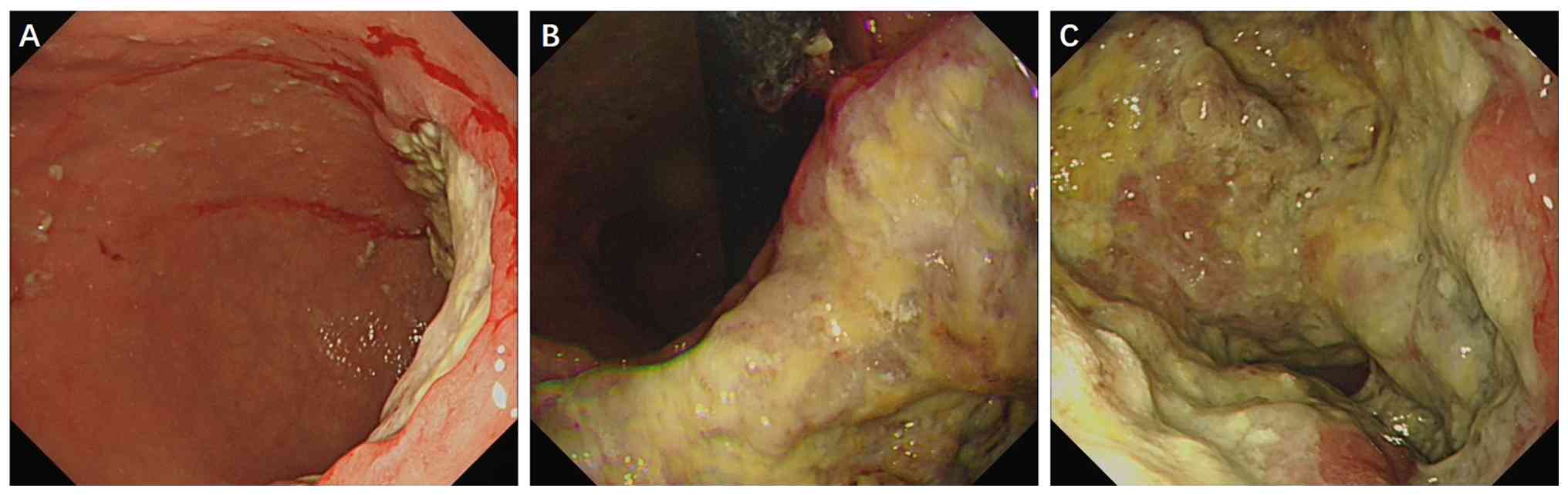
A gastroscopy revealed a giant ulcer affecting the
lesser curvature of the gastric body, the angular notch, the
gastric antrum and the pylorus (Fig.
1A-C). Histopathological analysis of a biopsy sample from the
gastric lesion confirmed the diagnosis of gastric adenocarcinoma
(Fig. 2A and B). The biopsy sample
was fixed in 10% neutral buffered formalin at room temperature for
24 h, embedded in paraffin and sectioned at a thickness of 4 µm.
The sections were stained with Harris hematoxylin for 5 min and
aqueous eosin for 2 min at room temperature, and examined using a
Nikon Eclipse 80i light microscope (Nikon Corporation).
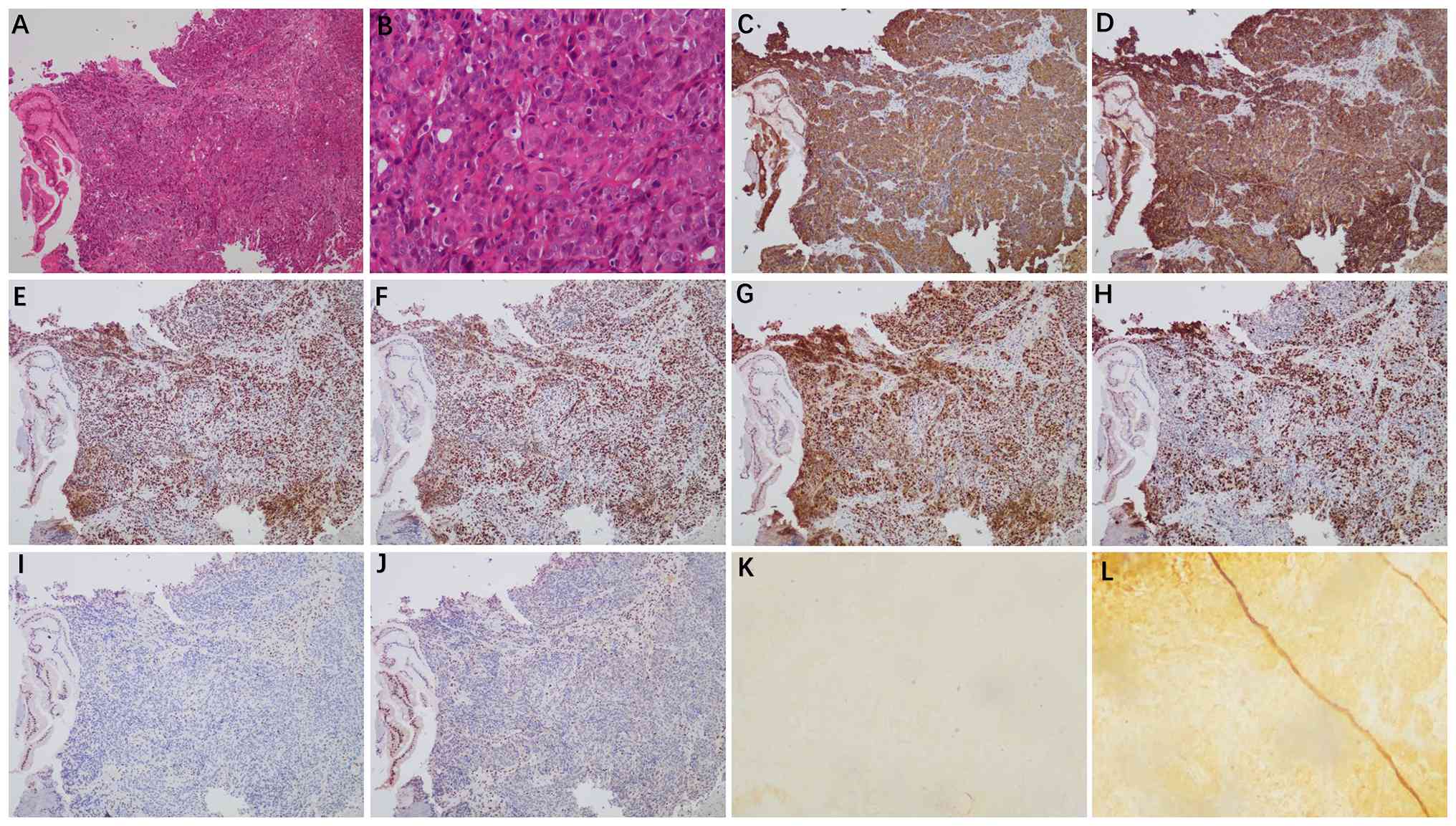 | Figure 2.Histopathological and
immunohistochemical images of the biopsy sample from the gastric
lesion, which were obtained in November 2018, confirmed the
diagnosis of gastric adenocarcinoma. Hematoxylin and eosin
staining: (A) Magnification, ×100 and (B) magnification, ×400.
Biopsy sample was positive for (C) pan-cytokeratin, (D) E-cadherin,
(E) MSH2, (F) MSH6, (G) p53 (mutated type) and (H) Ki-67 (70% of
labeled cells in the hot-spots), and negative for (I) MutL homolog
1, (J) postmeiotic segregation increased 2, (K) HER2 and (L)
Epstein-Barr virus-encoded RNA chromogenic in situ
hybridization. Panels C-L: Magnification, ×100. MSH, MutS
homolog. |
The immunohistochemical findings showed positivity
for pan-cytokeratin (PCK), E-cadherin, MutS homolog (MSH)2, MSH6,
p53 (mutated type) and Ki-67 (70% of labeled cells in the
hot-spots), but negativity for MutL homolog 1 (MLH1), post-meiotic
segregation increased 2 (PMS2) and HER2. For immunohistochemical
analysis, paraffin-embedded tissue sections (4 µm) from the gastric
lesion biopsy sample were used. Endogenous peroxidase activity was
blocked with 3% hydrogen peroxide for 5 min at 25–28°C. The
sections were then incubated with the following primary antibodies
for 40 min at 25–28°C: PCK (ready-to-use; cat. no. 760-2135; Roche
Diagnostics), E-cadherin (ready-to-use; cat. no. ZM-0092; Beijing
Zhongshan Jinqiao Biotechnology Co., Ltd.), p53 (ready-to-use; cat.
no. GA616; Dako; Agilent Technologies, Inc.), Ki-67 (1:800; cat.
no. RMA-0731; Fuzhou Maixin Biotechnology Development Co., Ltd.),
MLH1 (ready-to-use; cat. no. ZM-0152; Beijing Zhongshan Jinqiao
Biotechnology Co., Ltd.), PMS2 (ready-to-use; cat. no. ZA-0542;
Beijing Zhongshan Jinqiao Biotechnology Co., Ltd.), MSH2
(ready-to-use; cat. no. ZA-0702; Beijing Zhongshan Jinqiao
Biotechnology Co., Ltd.), MSH6 (ready-to-use; cat. no. ZM-0367;
Beijing Zhongshan Jinqiao Biotechnology Co., Ltd.) and HER2
(ready-to-use; cat. no. 790-7167; Roche Diagnostics). The sections
were subsequently incubated with a ready-to-use HRP-conjugated
secondary antibody (cat. no. SD3209; Mirus Medical LLC) for 30 min
at 25–28°C. The stained sections were examined using a Nikon
Eclipse 80i light microscope (Nikon Corporation). Epstein-Barr
virus-encoded RNA (EBER) was negative, as determined by chromogenic
in situ hybridization (CISH) (Fig. 2C-L). For EBER CISH,
paraffin-embedded tissue sections (4 µm) were analyzed using the
BOND EBER Probe (cat. no. PB0589) and BOND Polymer Refine Detection
system (cat. no. DS9800; both Leica Biosystems). The slides were
deparaffinized and rehydrated using BOND Dewax Solution (cat. no.
AR9222; Leica Biosystems). The sections were digested with
proteinase K (cat. no. RE7160-K; Leica Biosystems) for 10 min at
37°C, followed by three washes with BOND Wash Solution (cat. no.
AR9590-CN; Leica Biosystems). The ready-to-use
fluorescein-conjugated oligonucleotide BOND EBER Probe (cat. no.
PB0589; Leica Biosystems) was hybridized at 37°C for 2 h on the
Bond-III system. Endogenous peroxidase activity was blocked with 3%
H2O2 for 5 min at 26°C. The slides were
incubated with BOND Ready-to-Use Anti-Fluorescein Antibody (cat.
no. AR0222; Leica Biosystems) for 15 min at 26°C. The ready-to-use
post-primary and polymer reagents from the BOND Polymer Refine
Detection system (cat. no. DS9800; Leica Biosystems) were each
applied for 8 min at 26°C. The signal was visualized using DAB for
10 min at room temperature. The slides were then washed with BOND
Wash Solution followed by deionized water and counterstained with
hematoxylin for 25 sec at 26°C. The stained sections were examined
using a Nikon Eclipse 80i light microscope (Nikon Corporation). The
absence of MLH1 and PMS2 indicated deficient mismatch repair (dMMR)
and a microsatellite instability-high (MSI-H) status.
An abdominal contrast CT scan showed uneven
thickening of the gastric body and antrum wall, uneven enhancement,
a blurry serous membrane and enlarged adjacent lymph nodes, staging
the cancer as T4N2 according to the eighth edition of the American
Joint Committee on Cancer TNM staging system (16) (Fig.
3A). Laparoscopic exploration revealed metastasis to the
greater omentum and pancreatic head, leading to a final staging of
T4N2M1.
Following a multidisciplinary evaluation based on
imaging, endoscopy, laparoscopic exploration and histopathology,
and with the informed consent of the patient, treatment was
initiated with one cycle of an S-1 plus oxaliplatin (SOX) regimen
[oxaliplatin (130 mg/m2), intravenous (i.v.)
administration, day 1; S-1 (60 mg) twice a day, oral
administration, days 1–14] in combination with sintilimab (200 mg)
via i.v. administration every 3 weeks. After 3 weeks, the patient
returned and the tumor marker test indicated a decrease in CEA to
5.03 ng/ml. However, the patient experienced vomiting and eating
obstruction, indicating a pyloric obstruction, making the SOX
regimen, including the S-1, inappropriate for the condition.
Therefore, S-1 was replaced with a 5-fluorouracil injection, and
the treatment regimen was switched to one cycle of the traditional
folinic acid, fluorouracil and oxaliplatin (FOLFOX7) regimen
[oxaliplatin (130 mg/m2), i.v. administration, day 1;
5-fluorouracil (400 mg/m2), i.v. bolus, day 1, followed
by continuous i.v. infusion of 5-fluorouracil (2,400
mg/m2) over 46 h beginning on day 1; leucovorin (400
mg/m2), i.v. administration, day 1] combined with
sintilimab (200 mg) administered intravenously every 3 weeks. After
one cycle of FOLFOX7 plus sintilimab, chemotherapy was interrupted
due to grade 2 hematological toxicity [platelet count,
55×109/l (reference range, 125–350×109/l);
white blood cell count, 2.47×10⁹/l (reference range,
3.5–9.5×10⁹/l); neutrophil count, 1.4×10⁹/l
(reference range, 1.8–6.3×10⁹/l)], from which the
patient recovered after hematopoietic supportive therapy.
Due to worsening eating obstruction, the patient was
transferred to the Department of General Surgery at Tongji Hospital
and subsequently underwent palliative gastrojejunostomy for gastric
outlet obstruction. Post-surgery, the symptoms of vomiting and
eating obstruction were markedly improved. After 3 weeks, the
patient received sintilimab (200 mg) via i.v. administration every
3 weeks for the third time.
After a further 3 weeks, during a subsequent
hospital visit for further combined treatment with albumin-bound
paclitaxel and sintilimab, CEA levels showed a decrease to the
normal range at 3.86 ng/ml. Subsequently, treatment was resumed
with albumin-bound paclitaxel (130 mg/m2, i.v.
administration, days 1 and 8) combined with sintilimab (200 mg)
administered intravenously every 3 weeks for three cycles. After
completion of this combination therapy, cytotoxic chemotherapy was
discontinued, and the patient continued with sintilimab (200 mg)
monotherapy administered intravenously every 3 weeks.
In July 2019, the patient was admitted for an
efficacy assessment. The tumor marker test showed that CEA remained
in the normal range (4.06 ng/ml). An abdominal contrast CT scan
indicated improvement of the thickening of the gastric wall and
marked regression of the previously enlarged regional lymph nodes,
with only residual sub-centimeter lymph nodes (<5 mm in
short-axis diameter) (Fig. 3B).
Gastroscopy exhibited marked improvement of the giant ulcer, which
had healed, leaving only a scar, and the pylorus was no longer
visible (Fig. 4A-C). Furthermore,
histopathological analysis of the rough mucosa of the angular notch
exhibited chronic inflammation without malignant characteristics
(Fig. 4D-F).
Thus, the overall evaluation of the condition of the
patient was a complete response according to Response Evaluation
Criteria in Solid Tumors version 1.1 (17). The patient was initially diagnosed
with gastric cancer in November 2018, which served as the baseline
imaging time-point. After that, imaging examinations were performed
at predefined follow-up time points in February 2019, April 2019
and July 2019, followed by annual surveillance thereafter. The
patient continued receiving sintilimab (200 mg) monotherapy via
i.v. administration every 3 weeks as maintenance until June
2022.
As of the last follow-up in July 2026, the patient
experienced a progression-free survival time of >5 years. During
treatment with sintilimab combined with chemotherapy, the patient
was monitored for treatment-related adverse events; notably, no
immune-related adverse events were observed and no grade ≥3
chemotherapy-related adverse events were documented. All adverse
events were evaluated according to Common Terminology Criteria for
Adverse Events version 5.0 (18).
At present, the patient is still alive, attends annual
examinations, including gastroscopy and abdominal contrast CT
scans, and has regular telephone follow-ups.
Discussion
First-line chemotherapy for advanced or metastatic
HER2-negative gastric or gastroesophageal junction adenocarcinoma
typically achieves a median overall survival time of <1 year
(13). In this context, immune
checkpoint blockade targeting the PD-1/PD-L1 pathway has markedly
reshaped the treatment landscape of advanced gastric cancer by
restoring antitumor immune responses and overcoming immune evasion
(13,19,20),
leading to the development of multiple anti-PD-1/PD-L1 agents that
have subsequently been evaluated in clinical trials and real-world
settings (10,21–24).
The CheckMate-649 study established nivolumab, an anti-PD-1
monoclonal antibody, combined with chemotherapy as an effective and
safe first-line treatment strategy for patients with advanced
gastric or gastroesophageal junction adenocarcinoma, demonstrating
marked improvements in overall survival and progression-free
survival compared with chemotherapy alone (13). This finding is corroborated by data
showing that nivolumab plus chemotherapy can notably enhance
survival and response rates compared with chemotherapy alone,
particularly in Chinese patients (25). Further evidence of the efficacy of
PD-1 inhibitors has been provided by Wang et al (26); this previous study observed that
sintilimab-based regimens offer substantial disease control and
tolerability in real-world settings for treating advanced gastric
and gastroesophageal junction adenocarcinoma, and the treatment was
shown to be more effective when administered in the first- or
second-line setting. Moreover, the ORIENT-16 study revealed that
sintilimab combined with first-line chemotherapy markedly improves
overall survival in patients with unresectable locally advanced or
metastatic gastric or gastroesophageal junction adenocarcinoma
compared with chemotherapy alone (15).
Despite these advances, responses to immune
checkpoint inhibitors remain heterogeneous among patients with
gastric cancer, highlighting the importance of identifying
predictive biomarkers that can guide treatment selection (20). Molecular biomarkers have emerged as
critical determinants of treatment response in gastric cancer
(20). Among these, MSI resulting
from dMMR represents a key predictive biomarker for immunotherapy
response (27–29). HER2 status, PD-L1 expression and
claudin 18.2 expression have also been recognized as clinically
relevant biomarkers for treatment stratification (20). HER2 remains an established
therapeutic target enabling HER2-directed treatment approaches
(30); HER2 upregulation is
associated with a better pathological response and has been shown
to independently predict improved overall survival in advanced
gastric cancer treated with neoadjuvant or conversion chemotherapy
(31). In addition, PD-L1
expression provides an important rationale for immune checkpoint
blockade (32). Recently, claudin
18.2 has emerged as a promising predictive and therapeutic target
with growing clinical relevance (33–35),
reflecting the evolving landscape of precision medicine in gastric
cancer. Together, these biomarkers illustrate the transition from
histology-based treatment strategies toward molecularly guided
therapeutic decision-making.
Among these biomarkers, MSI-H/dMMR status has
emerged as one of the most robust predictors of response to immune
checkpoint inhibition (27–29). The MMR system serves a critical role
in maintaining genomic stability by correcting
replication-associated DNA errors, and its dysfunction leads to MSI
and the accumulation of numerous somatic mutations (36). This hypermutated phenotype is
understood to generate a high burden of tumor neoantigens, thereby
enhancing tumor immunogenicity and increasing sensitivity to immune
checkpoint blockade (28).
Consistent with this biological rationale, tumor mutational burden,
which reflects the overall number of somatic mutations per coding
area within the tumor genome, has also been proposed as a
complementary predictive biomarker associated with the response to
immunotherapy (37,38). Clinically, the predictive value of
MMR status for pembrolizumab-based PD-1 blockade was first
demonstrated in the KEYNOTE-016 study, which showed notable
responses in both colorectal and non-colorectal MSI-H/dMMR cancer,
and provided early evidence for the tumor-agnostic activity of
immune checkpoint inhibition (27).
Subsequent studies, including KEYNOTE-158, further validated these
findings by demonstrating durable responses to PD-1 blockade across
a broad spectrum of MSI-H/dMMR solid tumors (28,29).
Collectively, these data support the concept of biomarker-driven,
tumor-agnostic immunotherapy and led to the landmark Food and Drug
Administration approval of pembrolizumab in 2017 for the treatment
of MSI-H/dMMR solid tumors, representing a major milestone in
precision oncology (39,40).
In gastric cancer, the clinical relevance of MSI-H
status has been evaluated in multiple clinical studies. Exploratory
analyses from KEYNOTE-059, KEYNOTE-061 and KEYNOTE-062 studies
suggested that MSI-H tumors are associated with enhanced clinical
benefit from pembrolizumab-based therapy across different lines of
treatment in advanced gastric and gastroesophageal junction cancer
(41–44). Consistently, a meta-analysis by
Pietrantonio et al (45)
further demonstrated that MSI-H status is markedly associated with
higher response rates and improved survival outcomes compared with
microsatellite stable tumors in patients receiving anti-PD-1
therapy for advanced gastric cancer.
Sintilimab, a novel engineered PD-1 inhibitor, has
demonstrated favorable pharmacological properties, including high
binding affinity and durable receptor occupancy, compared with
established PD-1 inhibitors, such as nivolumab and pembrolizumab
(46). Its favorable
cost-effectiveness profile may further support its long-term
clinical application in appropriately selected patients (47). In the present case, the tumor was
confirmed as HER2-negative and MSI-H/dMMR, providing a strong
biological rationale for the durable and marked response observed
with sintilimab plus chemotherapy. Although PD-L1 expression and
claudin 18.2 status were not available at the time of diagnosis,
their emerging roles as predictive biomarkers reflect the evolving
landscape of precision oncology in gastric cancer (20). The patient achieved sustained
progression-free survival >5 years, highlighting the potential
for long-term disease control with PD-1 blockade-based therapy in
selected molecularly defined subgroups of advanced gastric cancer
with peritoneal metastases. This case underscores the importance of
biomarker-driven treatment strategies to optimize immunotherapeutic
outcomes. In addition to systemic and immunotherapy-based
strategies, pressurized intraperitoneal aerosol chemotherapy has
emerged as an investigational locoregional approach for patients
with peritoneal metastases and may serve as a potential adjunct
within multimodal treatment strategies in highly selected patients
(48,49). Further studies are warranted to
better define predictive factors associated with durable response
to immune checkpoint blockade in MSI-H gastric cancer and to
optimize multimodal approaches for patients with peritoneal
dissemination.
The present case has several strengths, including
real-world evidence of sustained long-term disease control >5
years in a patient with stage IV MSI-H/dMMR gastric cancer treated
with sintilimab plus chemotherapy, supporting the clinical
relevance of biomarker-guided immunotherapy in advanced gastric
cancer. Similar durable responses have been reported in MSI-H/dMMR
gastric cancer treated with PD-1 inhibitors, including case reports
describing responses lasting >24 months (50,51), a
retrospective analysis demonstrating favorable long-term outcomes
in dMMR/MSI-H gastrointestinal cancer treated with immune
checkpoint blockade (52), and
clinical trials identifying a subset of patients achieving
prolonged clinical benefit and extended progression-free survival
(19,53), collectively underscoring the
exceptional nature of sustained responses in biomarker-selected
populations. However, MSI-H gastric cancer exhibits marked response
heterogeneity, with a substantial proportion of patients
demonstrating primary resistance to PD-1 blockade (53). In this context, long-term disease
control >5 years, as observed in the current case, remains
uncommon and represents an extreme spectrum of durable clinical
benefit. This may reflect a highly immunogenic tumor
microenvironment and sustained immune surveillance. The inherent
limitations of a single case report preclude generalization to
broader populations. In addition, the absence of certain
biomarkers, including PD-L1 expression and claudin 18.2 status, may
limit comprehensive molecular characterization.
The optimal duration of immunotherapy in patients
achieving complete or durable responses remains uncertain (54). While some reports describe treatment
discontinuation after sustained complete response, others continue
therapy in the absence of validated predictive biomarkers for
durable remission, reflecting persistent uncertainty and the need
for individualized treatment decisions (55,56).
In conclusion, the present case illustrates the
potential of biomarker-driven PD-1 blockade-based combination
therapy to achieve durable disease control in molecularly defined
MSI-H gastric cancer, highlighting both the promise and current
limitations of precision immunotherapy in advanced disease.
Acknowledgements
Not applicable.
Funding
The present study was supported by Hubei Provincial Natural
Science Foundation of China (grant no. 2024AFB829).
Availability of data and materials
The data generated in the present study may be
requested from the corresponding author.
Authors' contributions
JH and HX designed the study. ZZ analyzed and
interpreted data. CZ performed the pathological analysis. HM
performed the radiological analysis. LiaZ and LihZ participated in
clinical decision-making. YT performed the surgery and follow-up.
LH analyzed data. JH and ZZ wrote the original draft of the
manuscript. ZZ, LH, LiaZ, LihZ, YT and HX revised the manuscript.
JH and HX confirm the authenticity of all the raw data. All authors
read and approved the final manuscript.
Ethics approval and consent to
participate
The present case report was approved by the Ethics
Committee of Tongji Hospital, Huazhong University of Science and
Technology (approval no. TJ-IRB202603110).
Patient consent for publication
Written informed consent was obtained from the
patient for publication of this case report and accompanying
images.
Competing interests
The authors declare that they have no competing
interests.
References
|
1
|
Rawla P and Barsouk A: Epidemiology of
gastric cancer: Global trends, risk factors and prevention. Prz
Gastroenterol. 14:26–38. 2019.PubMed/NCBI
|
|
2
|
Chang X, Ge X, Zhang Y and Xue X: The
current management and biomarkers of immunotherapy in advanced
gastric cancer. Medicine (Baltimore). 101:e293042022. View Article : Google Scholar : PubMed/NCBI
|
|
3
|
Chen W, Sun K, Zheng R, Zeng H, Zhang S,
Xia C, Yang Z, Li H, Zou X and He J: Cancer incidence and mortality
in China, 2014. Chin J Cancer Res. 30:1–12. 2018. View Article : Google Scholar : PubMed/NCBI
|
|
4
|
Takei S, Kawazoe A and Shitara K: The new
era of immunotherapy in gastric cancer. Cancers (Basel).
14:10542022. View Article : Google Scholar : PubMed/NCBI
|
|
5
|
Cunningham D, Starling N, Rao S, Iveson T,
Nicolson M, Coxon F, Middleton G, Daniel F, Oates J, Norman AR, et
al: Capecitabine and oxaliplatin for advanced esophagogastric
cancer. N Engl J Med. 358:36–46. 2008. View Article : Google Scholar : PubMed/NCBI
|
|
6
|
Koizumi W, Narahara H, Hara T, Takagane A,
Akiya T, Takagi M, Miyashita K, Nishizaki T, Kobayashi O, Takiyama
W, et al: S-1 plus cisplatin versus S-1 alone for first-line
treatment of advanced gastric cancer (SPIRITS trial): A phase III
trial. Lancet Oncol. 9:215–221. 2008. View Article : Google Scholar : PubMed/NCBI
|
|
7
|
Bang YJ, Van Cutsem E, Feyereislova A,
Chung HC, Shen L, Sawaki A, Lordick F, Ohtsu A, Omuro Y, Satoh T,
et al: Trastuzumab in combination with chemotherapy versus
chemotherapy alone for treatment of HER2-positive advanced gastric
or gastro-oesophageal junction cancer (ToGA): A phase 3,
open-label, randomised controlled trial. Lancet. 376:687–697. 2010.
View Article : Google Scholar : PubMed/NCBI
|
|
8
|
Wilke H, Muro K, Van Cutsem E, Oh SC,
Bodoky G, Shimada Y, Hironaka S, Sugimoto N, Lipatov O, Kim TY, et
al: Ramucirumab plus paclitaxel versus placebo plus paclitaxel in
patients with previously treated advanced gastric or
gastro-oesophageal junction adenocarcinoma (RAINBOW): A
double-blind, randomised phase 3 trial. Lancet Oncol. 15:1224–1235.
2014. View Article : Google Scholar : PubMed/NCBI
|
|
9
|
Sharma P and Allison JP: The future of
immune checkpoint therapy. Science. 348:56–61. 2015. View Article : Google Scholar : PubMed/NCBI
|
|
10
|
Wu X, Gu Z, Chen Y, Chen B, Chen W, Weng L
and Liu X: Application of PD-1 Blockade in Cancer Immunotherapy.
Comput Struct Biotechnol J. 17:661–674. 2019. View Article : Google Scholar : PubMed/NCBI
|
|
11
|
Dedecker H, Teuwen LA, Vandamme T, Domen A
and Prenen H: The role of immunotherapy in esophageal and gastric
cancer. Clin Colorectal Cancer. 22:175–182. 2023.PubMed/NCBI
|
|
12
|
Jiang H, Zheng Y, Qian J, Mao C, Xu X, Li
N, Xiao C, Wang H, Teng L, Zhou H, et al: Safety and efficacy of
sintilimab combined with oxaliplatin/capecitabine as first-line
treatment in patients with locally advanced or metastatic
gastric/gastroesophageal junction adenocarcinoma in a phase Ib
clinical trial. BMC Cancer. 20:7602020. View Article : Google Scholar : PubMed/NCBI
|
|
13
|
Janjigian YY, Shitara K, Moehler M,
Garrido M, Salman P, Shen L, Wyrwicz L, Yamaguchi K, Skoczylas T,
Campos Bragagnoli A, et al: First-line nivolumab plus chemotherapy
versus chemotherapy alone for advanced gastric, gastro-oesophageal
junction, and oesophageal adenocarcinoma (CheckMate 649): A
randomised, open-label, phase 3 trial. Lancet. 398:27–40. 2021.
View Article : Google Scholar : PubMed/NCBI
|
|
14
|
Zhang L, Mai W, Jiang W and Geng Q:
Sintilimab: A Promising Anti-Tumor PD-1 Antibody. Front Oncol.
10:5945582020. View Article : Google Scholar : PubMed/NCBI
|
|
15
|
Xu J, Jiang H, Pan Y, Gu K, Cang C, Han L,
Shu Y, Li J, Zhao J, Pan H, et al: Sintilimab plus chemotherapy for
unresectable gastric or gastroesophageal junction cancer: The
ORIENT-16 randomized clinical trial. JAMA. 330:2064–2074. 2023.
View Article : Google Scholar : PubMed/NCBI
|
|
16
|
Amin MB, Edge SB, Greene FL, Byrd DR,
Brookland RK, Washington MK, Gershenwald JE, Compton CC, Hess KR,
Sullivan DC, et al: AJCC Cancer Staging Manual. 8th edition.
Springer; New York, NY: 2017
|
|
17
|
Eisenhauer EA, Therasse P, Bogaerts J,
Schwartz LH, Sargent D, Ford R, Dancey J, Arbuck S, Gwyther S,
Mooney M, et al: New response evaluation criteria in solid tumours:
Revised RECIST guideline (version 1.1). Eur J Cancer. 45:228–247.
2009. View Article : Google Scholar : PubMed/NCBI
|
|
18
|
Freites-Martinez A, Santana N,
Arias-Santiago S and Viera A: Using the common terminology criteria
for adverse events (CTCAE-version 5.0) to evaluate the severity of
adverse events of anticancer therapies. Actas Dermosifiliogr (Engl
Ed). 112:90–92. 2021.(In English, Spanish). View Article : Google Scholar : PubMed/NCBI
|
|
19
|
Janjigian YY, Shitara K, Ajani JA, Shen L,
Garrido M, Gallardo C, Wyrwicz L, Yamaguchi K, Cleary JM, Elimova
E, et al: Nivolumab plus chemotherapy as first-line treatment for
advanced gastric, gastroesophageal junction, and esophageal
adenocarcinoma: 5-year follow-up results from CheckMate 649. Ann
Oncol. 37:787–797. 2026. View Article : Google Scholar : PubMed/NCBI
|
|
20
|
Choo J, Sargsyan A, Khachatryan V, Lonardi
S, Pietrantonio F, Sundar R, Klempner S and Janjigian Y: Advances
in the management of metastatic gastric cancer: Current strategies
and emerging therapeutics. Nat Rev Clin Oncol. 23:441–458. 2026.
View Article : Google Scholar : PubMed/NCBI
|
|
21
|
Pardoll DM: The blockade of immune
checkpoints in cancer immunotherapy. Nat Rev Cancer. 12:252–264.
2012. View
Article : Google Scholar : PubMed/NCBI
|
|
22
|
Topalian SL, Hodi FS, Brahmer JR,
Gettinger SN, Smith DC, McDermott DF, Powderly JD, Carvajal RD,
Sosman JA, Atkins MB, et al: Safety, activity, and immune
correlates of anti-PD-1 antibody in cancer. N Engl J Med.
366:2443–2454. 2012. View Article : Google Scholar : PubMed/NCBI
|
|
23
|
Saman H, Makni-Maalej K, El-Ella DMA,
Al-Tamimi MY, AbuHaweeleh MN, Abuhayeh N, Ismail MA, Prabhu KS,
Fernandes Q, Jabi T, et al: Immune checkpoint blockade in cancer:
Current insights and future horizons. Discov Oncol. 17:2092026.
View Article : Google Scholar : PubMed/NCBI
|
|
24
|
Chen Z, Song Z, Den S, Zhang W, Han M, Lan
T, Du X, Ning J, Chen X, Lin H and Zhang R: Application of immune
checkpoint inhibitors in cancer. MedComm (2020). 6:e701762025.
View Article : Google Scholar : PubMed/NCBI
|
|
25
|
Liu T, Bai Y, Lin X, Li W, Wang J, Zhang
X, Pan H, Bai C, Bai L, Cheng Y, et al: First-line nivolumab plus
chemotherapy vs chemotherapy in patients with advanced gastric,
gastroesophageal junction and esophageal adenocarcinoma: CheckMate
649 Chinese subgroup analysis. Int J Cancer. 152:749–760. 2023.
View Article : Google Scholar : PubMed/NCBI
|
|
26
|
Wang Y, Zhao J, Yu H, Wang J, Zhang N and
Cao B: Efficacy and safety of sintilimab-based regimens against
advanced gastric and gastroesophageal junction adenocarcinoma. J
Cancer Res Ther. 17:1234–1240. 2021. View Article : Google Scholar : PubMed/NCBI
|
|
27
|
Le DT, Uram JN, Wang H, Bartlett BR,
Kemberling H, Eyring AD, Skora AD, Luber BS, Azad NS, Laheru D, et
al: PD-1 Blockade in tumors with Mismatch-repair deficiency. N Engl
J Med. 372:2509–2520. 2015. View Article : Google Scholar : PubMed/NCBI
|
|
28
|
Le DT, Durham JN, Smith KN, Wang H,
Bartlett BR, Aulakh LK, Lu S, Kemberling H, Wilt C, Luber BS, et
al: Mismatch repair deficiency predicts response of solid tumors to
PD-1 blockade. Science. 357:409–413. 2017. View Article : Google Scholar : PubMed/NCBI
|
|
29
|
Marabelle A, Le DT, Ascierto PA, Di
Giacomo AM, De Jesus-Acosta A, Delord JP, Geva R, Gottfried M,
Penel N, Hansen AR, et al: Efficacy of pembrolizumab in patients
with noncolorectal high microsatellite instability/mismatch
repair-deficient cancer: Results from the phase II KEYNOTE-158
study. J Clin Oncol. 38:1–10. 2020. View Article : Google Scholar : PubMed/NCBI
|
|
30
|
Cancer Genome Atlas Research Network, .
Comprehensive molecular characterization of gastric adenocarcinoma.
Nature. 513:202–209. 2014. View Article : Google Scholar : PubMed/NCBI
|
|
31
|
Piccioni SA, Costantini M, Petrioli R,
Bagnacci G, Ferrara D, Andreucci E, Carbone L, Ongaro A, Calomino
N, Sandini M, et al: Impact of HER2 and microsatellite instability
status on response to neoadjuvant/conversion therapy and survival
in patients with gastric cancer. Eur J Cancer Prev. 35:66–77. 2026.
View Article : Google Scholar : PubMed/NCBI
|
|
32
|
Doroshow DB, Bhalla S, Beasley MB, Sholl
LM, Kerr KM, Gnjatic S, Wistuba II, Rimm DL, Tsao MS and Hirsch FR:
PD-L1 as a biomarker of response to immune-checkpoint inhibitors.
Nat Rev Clin Oncol. 18:345–362. 2021. View Article : Google Scholar : PubMed/NCBI
|
|
33
|
Nakayama I, Qi C, Chen Y, Nakamura Y, Shen
L and Shitara K: Claudin 18.2 as a novel therapeutic target. Nat
Rev Clin Oncol. 21:354–369. 2024. View Article : Google Scholar : PubMed/NCBI
|
|
34
|
Shitara K, Lordick F, Bang YJ, Enzinger P,
Ilson D, Shah MA, Van Cutsem E, Xu RH, Aprile G, Xu J, et al:
Zolbetuximab plus mFOLFOX6 in patients with CLDN18.2-positive,
HER2-negative, untreated, locally advanced unresectable or
metastatic gastric or gastro-oesophageal junction adenocarcinoma
(SPOTLIGHT): A multicentre, randomised, double-blind, phase 3
trial. Lancet. 401:1655–1668. 2023. View Article : Google Scholar : PubMed/NCBI
|
|
35
|
Shah MA, Shitara K, Ajani JA, Bang YJ,
Enzinger P, Ilson D, Lordick F, Van Cutsem E, Gallego Plazas J,
Huang J, et al: Zolbetuximab plus CAPOX in CLDN18.2-positive
gastric or gastroesophageal junction adenocarcinoma: The
randomized, phase 3 GLOW trial. Nat Med. 29:2133–2141. 2023.
View Article : Google Scholar : PubMed/NCBI
|
|
36
|
Richman S: Deficient mismatch repair: Read
all about it (Review). Int J Oncol. 47:1189–1202. 2015. View Article : Google Scholar : PubMed/NCBI
|
|
37
|
Marabelle A, Fakih M, Lopez J, Shah M,
Shapira-Frommer R, Nakagawa K, Chung HC, Kindler HL, Lopez-Martin
JA, Miller WH Jr, et al: Association of tumour mutational burden
with outcomes in patients with advanced solid tumours treated with
pembrolizumab: Prospective biomarker analysis of the multicohort,
open-label, phase 2 KEYNOTE-158 study. Lancet Oncol. 21:1353–1365.
2020. View Article : Google Scholar : PubMed/NCBI
|
|
38
|
Marcus L, Fashoyin-Aje LA, Donoghue M,
Yuan M, Rodriguez L, Gallagher PS, Philip R, Ghosh S, Theoret MR,
Beaver JA, et al: FDA approval summary: Pembrolizumab for the
treatment of tumor mutational burden-high solid tumors. Clin Cancer
Res. 27:4685–4689. 2021. View Article : Google Scholar : PubMed/NCBI
|
|
39
|
Marcus L, Lemery SJ, Keegan P and Pazdur
R: FDA approval summary: Pembrolizumab for the treatment of
microsatellite instability-high solid tumors. Clin Cancer Res.
25:3753–3758. 2019. View Article : Google Scholar : PubMed/NCBI
|
|
40
|
Yan L and Zhang W: Precision medicine
becomes reality-tumor type-agnostic therapy. Cancer Commun (Lond).
38:62018. View Article : Google Scholar : PubMed/NCBI
|
|
41
|
Chao J, Fuchs CS, Shitara K, Tabernero J,
Muro K, Van Cutsem E, Bang YJ, De Vita F, Landers G, Yen CJ, et al:
Assessment of Pembrolizumab therapy for the treatment of
microsatellite instability-high gastric or gastroesophageal
junction cancer among patients in the KEYNOTE-059, KEYNOTE-061, and
KEYNOTE-062 clinical trials. JAMA Oncol. 7:895–902. 2021.
View Article : Google Scholar : PubMed/NCBI
|
|
42
|
Fuchs CS, Doi T, Jang RW, Muro K, Satoh T,
Machado M, Sun W, Jalal SI, Shah MA, Metges JP, et al: Safety and
efficacy of Pembrolizumab monotherapy in patients with previously
treated advanced gastric and gastroesophageal junction cancer:
Phase 2 clinical KEYNOTE-059 trial. JAMA Oncol. 4:e1800132018.
View Article : Google Scholar : PubMed/NCBI
|
|
43
|
Shitara K, Özgüroğlu M, Bang YJ, Di
Bartolomeo M, Mandalà M, Ryu MH, Fornaro L, Olesiński T, Caglevic
C, Chung HC, et al: Pembrolizumab versus paclitaxel for previously
treated, advanced gastric or gastro-oesophageal junction cancer
(KEYNOTE-061): A randomised, open-label, controlled, phase 3 trial.
Lancet. 392:123–133. 2018. View Article : Google Scholar : PubMed/NCBI
|
|
44
|
Shitara K, Van Cutsem E, Bang YJ, Fuchs C,
Wyrwicz L, Lee KW, Kudaba I, Garrido M, Chung HC, Lee J, et al:
Efficacy and safety of Pembrolizumab or Pembrolizumab plus
chemotherapy vs chemotherapy alone for patients with first-line,
advanced gastric cancer: The KEYNOTE-062 phase 3 randomized
clinical trial. JAMA Oncol. 6:1571–1580. 2020. View Article : Google Scholar : PubMed/NCBI
|
|
45
|
Pietrantonio F, Randon G, Di Bartolomeo M,
Luciani A, Chao J, Smyth EC and Petrelli F: Predictive role of
microsatellite instability for PD-1 blockade in patients with
advanced gastric cancer: A meta-analysis of randomized clinical
trials. ESMO Open. 6:1000362021. View Article : Google Scholar : PubMed/NCBI
|
|
46
|
Wang J, Fei K, Jing H, Wu Z, Wu W, Zhou S,
Ni H, Chen B, Xiong Y, Liu Y, et al: Durable blockade of PD-1
signaling links preclinical efficacy of sintilimab to its clinical
benefit. MAbs. 11:1443–1451. 2019. View Article : Google Scholar : PubMed/NCBI
|
|
47
|
Xiang Z, Ma L, Fu Y and Pan Y:
Cost-effectiveness analysis of first-line sintilimab plus
chemotherapy vs. chemotherapy alone for unresectable advanced or
metastatic gastric or gastroesophageal junction cancer in China.
Front Pharmacol. 15:14115712024. View Article : Google Scholar : PubMed/NCBI
|
|
48
|
Case A, Prosser S, Peters CJ, Adams R,
Gwynne S and Collaborative PU: Pressurised intraperitoneal
aerosolised chemotherapy (PIPAC) for gastric cancer with peritoneal
metastases: A systematic review by the PIPAC UK collaborative. Crit
Rev Oncol Hematol. 180:1038462022. View Article : Google Scholar : PubMed/NCBI
|
|
49
|
Acs M, Piso P and Glockzin G: Peritoneal
metastatic gastric cancer: Local treatment options and
recommendations. Curr Oncol. 31:1445–1459. 2024. View Article : Google Scholar : PubMed/NCBI
|
|
50
|
Wu TH, Hsiue EHC, Yuan CT, Tseng LH, Lin
CC and Yeh KH: Durable response to programmed death-1 (PD-1)
blockade in a metastatic gastric cancer patient with mismatch
repair deficiency and microsatellite instability. J Cancer Res
Pract. 4:72–75. 2017. View Article : Google Scholar
|
|
51
|
Wakasugi A, Sasaki A, Okamoto R and
Motomura Y: Eldest gastric cancer patient with high microsatellite
instability responding to pembrolizumab. Int Cancer Conf J.
12:59–62. 2023. View Article : Google Scholar : PubMed/NCBI
|
|
52
|
Wang Z, Cheng S, Yao Y, Liu S, Liu Z, Liu
N, Jin Y, Zhang Y, Yin F, Han G, et al: Long-term survivals of
immune checkpoint inhibitors as neoadjuvant and adjuvant therapy in
dMMR/MSI-H colorectal and gastric cancers. Cancer Immunol
Immunother. 73:1822024. View Article : Google Scholar : PubMed/NCBI
|
|
53
|
Kwon M, An M, Klempner SJ, Lee H, Kim KM,
Sa JK, Cho HJ, Hong JY, Lee T, Min YW, et al: Determinants of
response and intrinsic resistance to PD-1 blockade in
microsatellite instability-high gastric cancer. Cancer Discov.
11:2168–2185. 2021. View Article : Google Scholar : PubMed/NCBI
|
|
54
|
Yin J, Song Y, Tang J and Zhang B: What is
the optimal duration of immune checkpoint inhibitors in malignant
tumors? Front Immunol. 13:9835812022. View Article : Google Scholar : PubMed/NCBI
|
|
55
|
Buma AIG, Bol KF, van Erp NP, Aarntzen
EHJG, Piet B, van den Heuvel MM and Ter Heine R: Dosing, duration,
and timing controversies in determining immune checkpoint inhibitor
dosing regimens. NPJ Precis Oncol. 10:1732026. View Article : Google Scholar : PubMed/NCBI
|
|
56
|
Bogani G, Cinquini M, Signorelli D,
Pizzutilo EG, Romanò R, Bersanelli M, Raggi D, Alfieri S, Buti S,
Bertolini F, et al: A systematic review and meta-analysis on the
optimal treatment duration of checkpoint inhibitoRS in solid
tumors: The OTHERS study. Crit Rev Oncol Hematol. 187:1040162023.
View Article : Google Scholar : PubMed/NCBI
|