Introduction
Worldwide, small cell lung cancer (SCLC) accounts
for 10–15% of all lung cancer cases and is associated with a 5-year
overall survival rate of <10%, reflecting its aggressive
clinical course characterized by rapid growth, early dissemination
and frequent relapse after an initial response to treatment
(1,2). The majority of patients with SCLC
first present with extensive-stage (ES) disease, for which systemic
therapy is the principal treatment modality and largely determines
the subsequent clinical course (2).
Platinum plus etoposide has remained the first-line backbone for
ES-SCLC. However, it has only conferred modest survival
improvements (2). The advent of
immune checkpoint inhibitors (ICIs) has reshaped this long-static
therapeutic landscape. Landmark trials, including IMpower133 and
CASPIAN, established atezolizumab or durvalumab plus
platinum-etoposide as first-line chemoimmunotherapy standards
(3–5). Subsequent phase III studies, including
CAPSTONE-1 and ASTRUM-005, extended this approach to additional
programmed cell death protein 1 (PD-1)/programmed cell death ligand
1 (PD-L1) inhibitors and in turn consolidated the role of
chemoimmunotherapy in ES-SCLC (6,7).
Despite these advances, most patients ultimately experience disease
progression after first-line chemoimmunotherapy, underscoring the
need for effective post-progression strategies (3–7).
The post-progression setting remains an important
clinical gap. Conventional subsequent-line options include
topotecan, a topoisomerase I inhibitor, and lurbinectedin, a
transcription inhibitor that binds preferentially to guanine-rich
DNA sequences; both agents have demonstrated antitumor activity in
selected patients with relapsed SCLC, but generally provide modest
and short-lived disease control (8,9). As
first-line chemoimmunotherapy has become routine, clinicians
increasingly encounter patients who relapse after prior PD-1 or
PD-L1 blockade. Whether subsequent treatment should retain an ICI
component through continuation, rechallenge, switching or
combination with chemotherapy and/or antiangiogenic agents remains
uncertain. This is no longer a purely theoretical question, such
that it is now a practical treatment decision in everyday ES-SCLC
care.
A plausible but unproven rationale supports
ICI-based treatment after progression. Resistance to immunotherapy
may be heterogeneous rather than absolute, which may involve
tumor-intrinsic immune escape, altered antigen presentation,
IFN-pathway changes and remodeling of the tumor microenvironment
(10). Recent proteogenomic
profiling of SCLC has identified subtype-specific immune and
therapeutic vulnerabilities (11).
Recent real-world studies have begun to evaluate ICI-containing
subsequent strategies after progression on chemoimmunotherapy,
including ICI continuation and rechallenge, but their findings
remain heterogeneous and lack consensus because of differences in
patient selection, treatment combinations, endpoint definitions and
the use of adjusted or propensity score-matched analyses (12,13).
These observations provide a rationale for further evaluating
continued or rechallenged ICI-containing therapy in selected
patients, particularly in combination with chemotherapy or
antiangiogenic treatment, while also underscoring the need for
quantitative synthesis of the available comparative evidence.
Given these uncertainties, the current systematic
review and meta-analysis was conducted to evaluate whether
ICI-based subsequent treatment is associated with more favorable
outcomes compared with non-immunotherapy subsequent treatment after
progression on first-line chemoimmunotherapy in ES-SCLC. The
primary outcomes were overall survival (OS) and progression-free
survival (PFS), whereas the secondary outcomes were objective
response rate (ORR), disease control rate (DCR) and grade ≥3
adverse events (AEs) or treatment-related adverse events
(TRAEs).
Materials and methods
Protocol and reporting standard
The present systematic review and meta-analysis was
performed in accordance with the Preferred Reporting Items for
Systematic Reviews and Meta-Analyses (PRISMA) 2020 statement
(14) and the methodological
guidance of the Cochrane Handbook for Systematic Reviews of
Interventions (15). The protocol
was prospectively registered in the International Prospective
Register of Systematic Reviews (registration no. CRD420261392088).
The review question, eligibility criteria, outcome hierarchy,
data-extraction strategy and quantitative synthesis plan were
defined before data pooling. The present study focused on
comparative evidence evaluating whether ICI-based subsequent
treatment after progression on first-line chemoimmunotherapy is
associated with more favorable outcomes in patients with
ES-SCLC.
Search strategy
The PubMed/MEDLINE (https://pubmed.ncbi.nlm.nih.gov/), Embase (https://www.embase.com/), Web of Science Core
Collection (https://www.webofscience.com/), Scopus (https://www.scopus.com/) and Cochrane Library
(https://www.cochranelibrary.com/)
databases were systematically searched from their respective dates
of inception to May 8, 2026. The search combined terms related to
SCLC, ICI, post-progression treatment, ICI continuation, ICI
discontinuation, rechallenge, retreatment and comparative study
designs. As post-progression immunotherapy strategies have been
described inconsistently across studies, terms, such as
‘immunotherapy beyond progression’, ‘ICI rechallenge’, ‘continuous
immunotherapy’, ‘second-line immunotherapy’ and ‘post-progression
treatment’, were included to maximize sensitivity during retrieval.
Search strategies were adapted to the syntax of each database.
Reference lists of eligible studies and relevant reviews were also
screened manually. The complete database-specific search strategies
are provided in Table SI.
Inclusion and exclusion criteria
Studies were eligible if they fulfilled all of the
following criteria: i) Included patients with ES-SCLC or
advanced/metastatic SCLC in a treatment setting consistent with ES
disease, defined for the purposes of the present study as disease
requiring systemic therapy because it was not amenable to
definitive local treatment alone; ii) evaluated patients who had
experienced disease progression after first-line
chemoimmunotherapy, typically platinum-etoposide chemotherapy
combined with a PD-1 or PD-L1 inhibitor; iii) compared ICI-based
subsequent treatment with non-immunotherapy subsequent treatment;
iv) used a comparative design, including retrospective, prospective
or randomized studies; and v) reported at least one extractable
comparative outcome, including OS, PFS, ORR, DCR or safety
outcomes.
For operational purposes, ICI-based subsequent
treatment included continuation of the same ICI, switching to
another ICI, ICI rechallenge, ICI plus chemotherapy, ICI plus
antiangiogenic therapy or ICI plus chemotherapy and antiangiogenic
therapy. These strategies were grouped pragmatically according to
whether an ICI component was retained after progression. This
grouping was not intended to imply pharmacological or clinical
interchangeability among different ICI-containing regimens. The
comparator, defined as non-immunotherapy subsequent treatment,
consisted of patients who did not receive further ICI-containing
therapy after progression and instead received chemotherapy,
antiangiogenic therapy, chemotherapy plus antiangiogenic therapy or
another non-ICI systemic treatment.
Studies would be excluded if they were single-arm
studies, case reports, case series without a comparator, reviews,
editorials, letters, comments, meta-analyses or conference
abstracts with insufficient extractable data. In addition, mixed
non-SCLC (NSCLC)/SCLC population studies would be excluded unless
SCLC-specific data could be extracted separately. Studies were also
excluded if first-line chemoimmunotherapy was not clearly
documented, if ICI-based and non-immunotherapy subsequent
treatments could not be distinguished or if no comparative efficacy
or safety outcome could be extracted. When overlapping cohorts were
suspected, the most complete or most relevant dataset would be
prioritized for the primary analysis.
To further minimize potential double-counting,
potentially overlapping retrospective multicenter cohorts were
cross-checked during full-text review and data extraction. The
cross-check considered reported participating institutions or study
centers, enrollment periods, authorship groups, cohort sizes,
eligibility criteria, first-line treatment exposure,
subsequent-treatment definitions and outcome datasets. When
complete center-level information was not reported, potential
overlap was assessed as far as possible from the available
study-level information and considered when interpreting the
findings.
Study selection
In total, two reviewers (CL and YR) independently
performed screening in two sequential stages. After duplicates were
removed, titles and abstracts were assessed for potential
eligibility. The full texts of potentially relevant reports were
then reviewed against the prespecified inclusion and exclusion
criteria. Disagreements were resolved through discussion, but a
third reviewer was consulted when consensus could not be
achieved.
Data extraction
A total of two reviewers independently extracted
data using a standardized form. The extracted information included
first author, publication year, country, study design, study
period, participating institutions or study centers when reported,
eligibility criteria, sample size, first-line treatment, subsequent
ICI-containing strategy, non-ICI comparator strategy, follow-up or
data cut-off and reported outcomes.
The primary outcomes were OS and PFS. OS was defined
as the time from initiation of the subsequent treatment under
evaluation, or from the time origin specified in the original
study, to death from any cause. PFS was defined as the time from
initiation of the subsequent treatment under evaluation, or from
the time origin specified in the original study, to disease
progression or death. For time-to-event endpoints, hazard ratios
(HRs) and corresponding 95% CIs were extracted when available. For
PFS-related endpoints, the original endpoint definitions were
audited before pooling. Endpoints were included in the PFS
meta-analysis only if they measured disease control during the
post-progression or subsequent-treatment period. In oncology
trials, PFS2 commonly refers to the time from initial first-line
treatment initiation or randomization to second disease progression
or death; however, the term was not used uniformly across the
retrospective studies included in the present review. When a study
used the term ‘PFS2’ but defined it as the time from first-line
progression to subsequent progression or as PFS during ICI
rechallenge or second-line chemotherapy, the endpoint was treated
as a post-progression PFS construct rather than as conventional
first-line-origin PFS2. Estimates corresponding to true PFS2
measured from initial first-line treatment initiation or
randomization were not pooled directly with second-line or
post-progression PFS. The secondary outcomes were ORR, DCR and
grade ≥3 AEs or TRAEs. Specific toxicities, including pneumonitis,
hematological toxicity, hepatic toxicity, hypothyroidism and rash,
were summarized descriptively when reported, but were not pooled
because definitions and reporting patterns varied across
studies.
When multiple estimates were available from the same
study, adjusted or propensity score-matched estimates were
prioritized over crude or unmatched estimates. Multivariable Cox
estimates were preferred over unadjusted Kaplan-Meier estimates. If
both an entire-cohort estimate and a propensity score-matched
estimate were available, the matched estimate was used in the
primary analysis, while the unmatched estimate was considered in
sensitivity analysis. The same patient cohort was not entered more
than once in any single pooled analysis.
Quality assessment
The methodological quality of the included
non-randomized studies was assessed independently by two reviewers
(CL and YR) using the Newcastle-Ottawa Scale (NOS) for cohort
studies, which is available from the Ottawa Hospital Research
Institute website (https://www.ohri.ca/programs/clinical_epidemiology/oxford.asp).
The NOS assesses the following three domains: i) Selection of study
groups; ii) cohort comparability; and iii) outcome assessment. The
NOS assesses selection (maximum 4 points), comparability (maximum 2
points) and outcome assessment (maximum 3 points), for a total
score of 0–9. Studies scoring 7–9 points were classified as high
quality, 5–6 points as moderate quality and 0–4 points as low
quality. Discrepancies in quality assessment were resolved through
discussion with a third reviewer.
Statistical analysis
All meta-analyses were performed using Review
Manager version 5.4.0 (RevMan 5; The Cochrane Collaboration;
http://revman.cochrane.org). For
time-to-event outcomes, HRs were pooled using the generic
inverse-variance method after conversion to log (HR) and standard
error values. For dichotomous outcomes, risk ratios (RRs) with 95%
CIs were estimated using the Mantel-Haenszel method. Random-effects
models were applied for all pooled analyses because clinical and
methodological heterogeneity was expected across retrospective
real-world cohorts, including differences in subsequent treatment
regimens, ICI agents, endpoint definitions and use of propensity
score matching (PSM).
Statistical heterogeneity was assessed using the
I2 statistic. I2 values >50% were
considered to indicate substantial heterogeneity. Sensitivity
analyses were conducted when alternative estimates were available
or when studies showed partial alignment with the main Population,
Intervention, Comparator and Outcomes (PICO) framework. These
analyses included replacing propensity score-matched estimates with
unmatched entire-cohort estimates and where appropriate, adding
studies with extractable SCLC subgroup data from mixed populations.
A conservative PFS sensitivity analysis was also performed by
excluding studies that used the label ‘PFS2’, regardless of the
audited endpoint definition, to examine whether the primary PFS
estimate depended on PFS2-labelled endpoints. In addition, a
leave-one-out sensitivity analysis was performed for the primary OS
and PFS outcomes by sequentially omitting one contributing study at
a time and recalculating the pooled estimates. This analysis was
used to assess whether the main survival results were
disproportionately driven by any single study. Strategy-specific
subgroup analyses and formal publication-bias assessment were
considered as conditional analyses and were performed only when
sufficient study-level data were available. Two-sided P<0.05 was
considered to indicate a statistically significant difference.
Results
Study selection and
characteristics
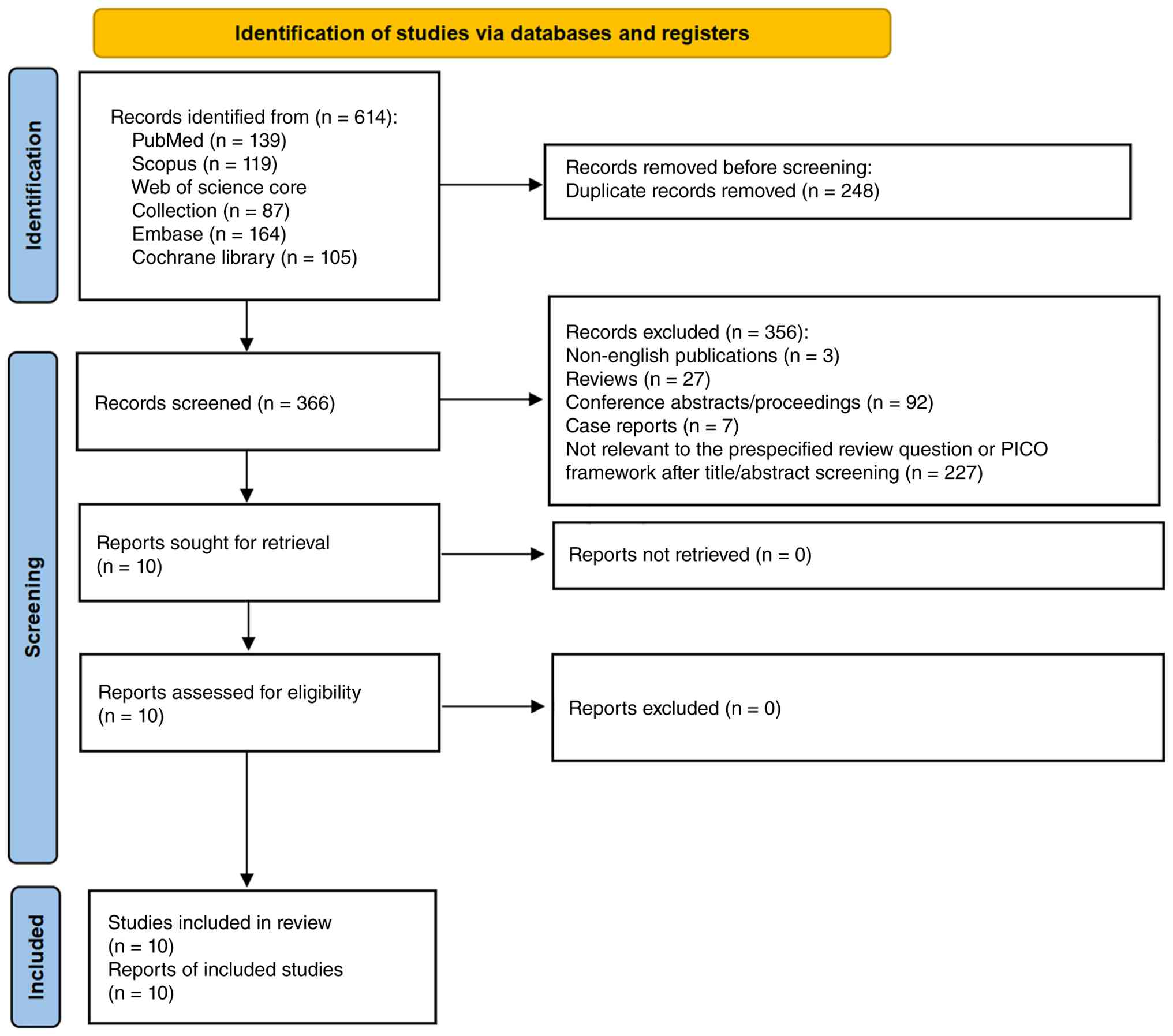
From database inception to May 8, 2026, the search
identified 614 records, including 139 from PubMed, 164 from Embase,
87 from Web of Science Core Collection, 119 from Scopus and 105
from the Cochrane Library. After 248 duplicate records were
removed, 366 records underwent title and abstract screening. Of
these, 356 records were excluded, including three non-English
publications, 27 reviews, 92 conference abstracts or proceedings
and seven case reports, the remaining 227 records were excluded
because they did not address ES-SCLC, post-progression ICI-based
treatment after first-line chemoimmunotherapy or a comparative
ICI-based vs. non-immunotherapy subsequent-treatment framework. A
total of 10 full-text reports were retrieved and assessed for
eligibility, all of which met the inclusion criteria. Finally, 10
comparative studies were included in the qualitative synthesis
(Fig. 1) (16–25).
Quantitative synthesis was performed according to
outcome availability and PICO alignment. The primary survival
meta-analyses were restricted to studies that provided directly
poolable comparative HRs aligned with the main PICO framework and
were included in the primary OS and PFS meta-analyses (Figs. 2 and 3). The remaining four studies were not
included in the primary survival meta-analyses because Cheng et
al (16) provided SCLC subgroup
data from a mixed NSCLC/SCLC cohort, Shang et al (19) did not provide a directly poolable
all-cohort survival HR, Wang et al (21) reported subgroup estimates that were
not used for primary survival pooling, and Zhang et al
(25) included mixed first-line ICI
exposure without a directly poolable main-PICO HR. These studies
were therefore retained for qualitative synthesis or, when
analytically appropriate, prespecified sensitivity analyses
(Fig. S1, Fig. S2, Fig.
S3, Fig. S4). Binary response
and safety outcomes were pooled when comparable event counts were
available (Fig. 4, Fig. 5, Fig.
6), and all extracted comparative outcomes are summarized in
Table SII.
All included studies were non-randomized comparative
studies; nine were retrospective clinical real-world cohorts and
one was a retrospective translational cohort analysis. The
aforementioned studies evaluated subsequent treatment strategies
after progression on first-line chemoimmunotherapy or closely
related first-line ICI-based regimens in patients with ES-SCLC or
extractable SCLC subgroups. The main comparison was ICI-based vs.
non-immunotherapy subsequent treatment. However, alignment with the
prespecified PICO framework varied across studies. Six studies
directly evaluated patients with ES-SCLC after progression on
first-line chemoimmunotherapy (18,20–24),
whereas one study provided extractable estimates for patients
initially treated with first-line immunotherapy within a broader
cohort (17). In total, one study
included a mixed NSCLC/SCLC cohort from which SCLC-specific
subgroup data were extracted (16).
A total of two studies required more cautious interpretation.
Namely, one translational cohort analysis incorporated data from
IMpower133 alongside a real-world validation cohort (19), whereas the other included patients
with mixed first-line immunotherapy exposure (25). Consequently, the studies included in
each quantitative synthesis varied according to outcome
availability and eligibility criteria.
Potential cohort overlap was assessed across
retrospective multicenter Chinese studies with overlapping
enrollment periods, particularly Peng et al (18), Sun et al (20), Wang et al (21), Wang et al (22) and Zhang et al (23,24).
Reported study periods, participating centers when available,
authorship groups, cohort sizes, eligibility criteria, treatment
definitions and outcome datasets were compared. No definite
duplicate analytical cohort could be identified. However, Peng
et al (18), Sun et
al (20), Wang et al
(21) and Zhang et al
(23,25) did not provide patient-level
identifiers, and some multicenter reports did not provide
exhaustive center lists; therefore, unrecognized partial overlap
across regional real-world networks could not be ruled out with
absolute certainty.
The key study characteristics are summarized in
Table I. Additional eligibility
details, cohort definitions, treatment strategies, follow-up
information and restriction notes are provided in Table SIII. As shown in Table SIII, the ICI-based arms were
heterogeneous and included ICI continuation or rechallenge alone,
ICI plus chemotherapy, ICI plus antiangiogenic therapy and triplet
regimens. Because seven cohorts combined more than one
ICI-containing strategy within the same intervention arm (16,17,20–24),
the pooled analyses should be interpreted as assessing an
ICI-containing treatment framework rather than any single
post-progression regimen. Extracted comparative efficacy and safety
outcomes are presented in Table
SII. Study quality was assessed with the NOS. NOS scores ranged
from 6–9, with seven of the 10 studies scoring 8 or 9 (17,18,20–24).
These scores indicated acceptable reporting, cohort comparability
and outcome assessment in most studies. However, they should not be
interpreted as removing residual confounding inherent to
non-randomized real-world comparisons (Table II). Accordingly, the pooled
estimates should be interpreted as associations rather than causal
treatment effects, because residual confounding and
treatment-selection bias may remain even after multivariable
adjustment or PSM.
 | Table I.Main characteristics of the studies
included in the present systematic review and meta-analysis. |
Table I.
Main characteristics of the studies
included in the present systematic review and meta-analysis.
| First author,
year | Country | Study design | Population
characteristics | 1L treatment | Total,
na | ICI-based, n | Non-IO, n | Subsequent
treatment comparison | Outcomes | (Refs.) |
|---|
| Cheng et al,
2025 | China | Retrospective
single-center cohort | Advanced SCLC
subgroup with PD after 1L ICI-based therapy and SCLC data
separately extractable | IO + ChT ± A | 39 | 31 | 8 | IBP vs. NIBP | PFS, OS, ORR, DCR
and safety | (16) |
| Li et al,
2022 | China | Retrospective
multicenter cohort | ES-SCLC after PD on
PD-1/PD-L1 inhibitor + ChT and 1L subgroup available | PD-1/PD-L1
inhibitor + ChT | 100 | 45 | 55 | RIBP vs. DIBP | PFS, OS, ORR, DCR
and DCB | (17) |
| Peng et al,
2025 | China | Retrospective
multicenter cohort | ES-SCLC after PD on
1L PD-L1 inhibitor + ChT | PD-L1 inhibitor +
EP/EC | 150 | 86 | 64 | IBP vs.
non-IBP | PFS, OS, ORR, DCR
and safety | (18) |
| Shang et al,
2024 |
International/China | Retrospective
translational cohort analysis | ES-SCLC after
progression on 1L ICI, and bIMpower133 and Shandong
cohorts | 1L ICI-based
therapy | 125/161 | 54/89 | 71/72 | Atezolizumab/CI
Iretreatment vs. non-ICI treatment | OS, subgroup
analysis and TME analysis | (19) |
| Sun et al,
2026 | China | Retrospective
multicenter cohort | ES-SCLC after PD on
1L PD-1/PD-L1 inhibitor + ChT | PD-1/PD-L1
inhibitor + EP/EC | 489 | 298 | 191 | Continuing IO vs.
control | PFS2, OS and
safety | (20) |
| Wang et al,
2026 | China | Retrospective
multicenter cohort | ES-SCLC with
disease control followed by PD after 1L anti- PD-1/PD-L1 + ChT and
primary resistance excluded for 2L analysis | Anti-PD-1/PD-L1 +
EP/EC | 206 | 149 | 57 | Continuous
IO-containing strategies vs. non-ICI strategies | 2L PFS, OS and
safety | (21) |
| Wang et al,
2026 | China | Retrospective
single-center cohort | ES-SCLC after PD on
1L chemoimmunotherapy | Anti-PD-1/PD-L1 +
platinum-based ChT | 151 | 100 | 51 | ICI rechallenge vs.
single-agent ChT | PFS2, OS, ORR, DCR
and safety | (22) |
| Zhang et al,
2025 | China | Retrospective
multicenter cohort with PSM | ES-SCLC after PD on
1L chemoimmunotherapy | 1L
chemoimmunotherapy | 211 | 118 | 93 | ICIs continuation
vs. discontinuation | PFS, OS, ORR, DCR
and safety | (23) |
| Zhang et al,
2025 | China | Retrospective
multicenter cohort | ES-SCLC receiving
2L therapy after progression on 1L chemoimmunotherapy | 1L
chemoimmunotherapy | 103 | 53 | 50 | 2L ICIs vs. 2L
non-ICIs | 2L PFS, OS, ORR,
DCR and safety | (24) |
| Zhang et al,
2025 | China | Retrospective
multicenter cohort | ES-SCLC after
progression on 1L EP ± PD-L1 inhibitor; 1L ICI subgroup
available | EP ± PD-L1
inhibitor | 389 | 211 | 178 | ICI + A or ICI +
ChT vs. ChT | PFS, OS, ORR, DCR
and safety | (25) |
| Table II.NOS for assessing the quality of
non-randomized studies included in the present study. |
Table II.
NOS for assessing the quality of
non-randomized studies included in the present study.
|
|
|
| NOSa |
|
|---|
|
|
|
|
|
|
|---|
| First author,
year | Country | Type of
article | Selection | Comparability | Outcome | Total score | (Refs.) |
|---|
| Cheng et al,
2025 | China | Single-center,
retrospective cohort study | 3 | 1 | 2 | 6 | (16) |
| Li et al,
2022 | China | Multicenter,
retrospective cohort study | 4 | 2 | 2 | 8 | (17) |
| Peng et al,
2025 | China | Multicenter,
retrospective cohort study | 4 | 2 | 3 | 9 | (18) |
| Shang et al,
2024 |
International/China | Retrospective
translational cohort analysis | 3 | 1 | 2 | 6 | (19) |
| Sun et al,
2026 | China | Multicenter,
retrospective cohort study | 4 | 1 | 3 | 8 | (20) |
| Wang et al,
2026 | China | Multicenter,
retrospective real-world study | 4 | 2 | 3 | 9 | (21) |
| Wang et al,
2026 | China | Single-center,
retrospective real-world study | 4 | 2 | 3 | 9 | (22) |
| Zhang et al,
2025 | China | Multicenter,
retrospective cohort study with propensity score matching | 4 | 2 | 3 | 9 | (23) |
| Zhang et al,
2025 | China | Multicenter,
retrospective cohort study | 4 | 2 | 3 | 9 | (24) |
| Zhang et al,
2025 | China | Multicenter,
retrospective cohort study | 3 | 1 | 3 | 7 | (25) |
Primary outcomes
OS
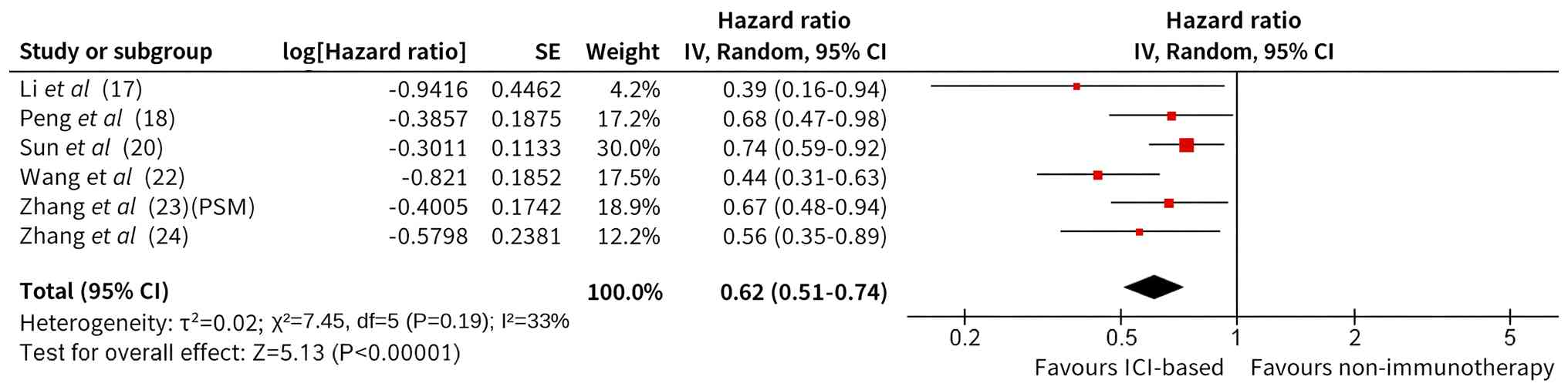
In total, six studies were included in the primary
meta-analysis of OS (17,18,20,22–24).
Using a random-effects model and prioritizing the propensity
score-matched estimate where available, ICI-based subsequent
treatment was associated with longer OS compared with that after
non-immunotherapy subsequent treatment (HR, 0.62; 95% CI,
0.51–0.74; P<0.00001; Fig. 2).
Heterogeneity was low to moderate across studies
(I2=33%).
A sensitivity analysis using the unmatched
entire-cohort estimate from the same PSM study instead of the
matched estimate yielded a nearly identical result (HR, 0.62; 95%
CI, 0.52–0.75; P<0.00001; Fig.
S1), with similarly low-to-moderate heterogeneity
(I2=35%). These findings indicate that the OS
association observed with ICI-based subsequent treatment was not
materially affected by the choice of matched vs. unmatched
estimates.
PFS
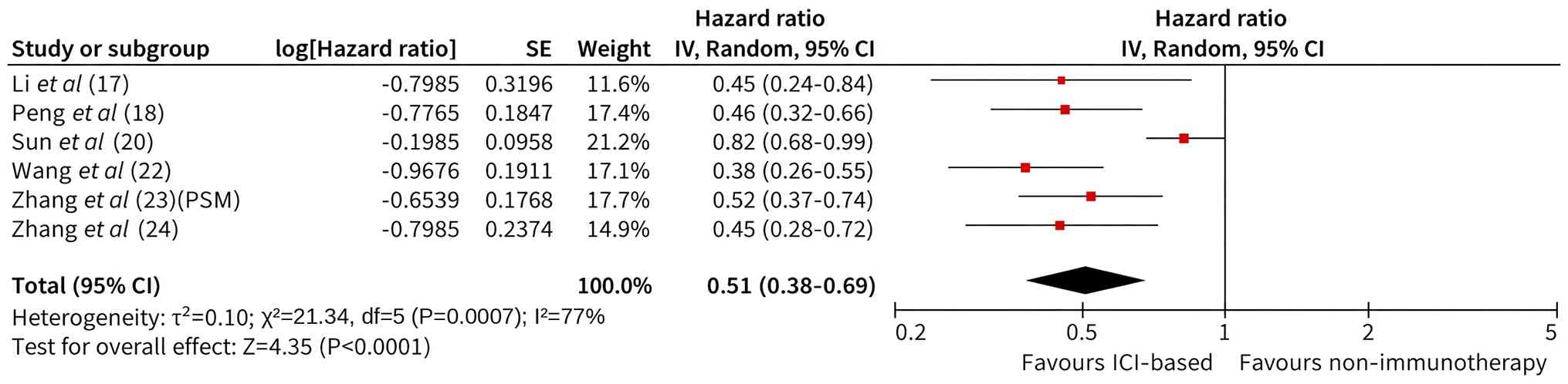
In total, six studies were included in the primary
meta-analysis of PFS (17,18,20,22–24).
Before pooling, the definitions of PFS-related endpoints were
audited. A total of two studies used the label PFS2 (20,22).
In Sun et al (20), PFS2 was
defined from progression on first-line treatment to progression on
second-line treatment, whilst in Wang et al (22), PFS2 referred to PFS for ICI
rechallenge or second-line chemotherapy. Therefore, these endpoints
were considered to measure disease control during the
post-progression or subsequent-treatment period rather than
conventional first-line-origin PFS2. Using a random-effects model
and prioritizing the propensity score-matched estimate where
available, ICI-based subsequent treatment was associated with
longer PFS compared with that after non-immunotherapy subsequent
treatment (HR, 0.51; 95% CI, 0.38–0.69; P<0.0001; Fig. 3). Substantial heterogeneity was
observed (I2=77%), although the direction of effect
consistently favored ICI-based subsequent treatment.
Sensitivity analyses supported this result. When the
unmatched entire-cohort estimate from the PSM study (23) was used instead of the matched
estimate, the pooled effect remained unchanged (HR, 0.51; 95% CI,
0.38–0.69; P<0.0001; I2=77%; Fig. S2). A further sensitivity analysis
that included additional studies with extractable SCLC subgroup
data or partial alignment with the main PICO framework (16,25)
also yielded a consistent result favoring ICI-based subsequent
treatment (HR, 0.50; 95% CI, 0.38–0.67; P<0.00001;
I2=73%; Fig. S3). These
results suggest that the observed PFS association was not
substantially altered by the alternative handling of matched
estimates or by the inclusion of additional partially aligned
datasets. In the conservative sensitivity analysis that excluded
the two studies that used the label PFS2 (20,22),
the PFS association remained statistically significant and
heterogeneity was no longer observed (HR, 0.48; 95% CI, 0.39–0.59;
P<0.00001; I2=0%; Fig.
S4).
Additional robustness analyses
A leave-one-out sensitivity analysis was conducted
for the six studies contributing to the primary OS and PFS
meta-analyses (17,18,20,22–24).
After sequential omission of each individual study, both OS and PFS
estimates remained statistically significant, with recalculated HRs
ranging from 0.57–0.68 for OS and from 0.45–0.55 for PFS (all
P<0.001; Table SIV). In the PFS
analysis, heterogeneity decreased from I2=77% in the
primary analysis to I2=0% when Sun et al
(20) was omitted, suggesting that
this large multicenter cohort contributed substantially to
between-study heterogeneity. However, the direction of association
remained favorable to ICI-based subsequent treatment. These
findings provided additional support for the stability of the
primary survival analyses, whilst reinforcing the need for cautious
interpretation because all analyses were based on non-randomized
study-level data.
Secondary outcomes
ORR
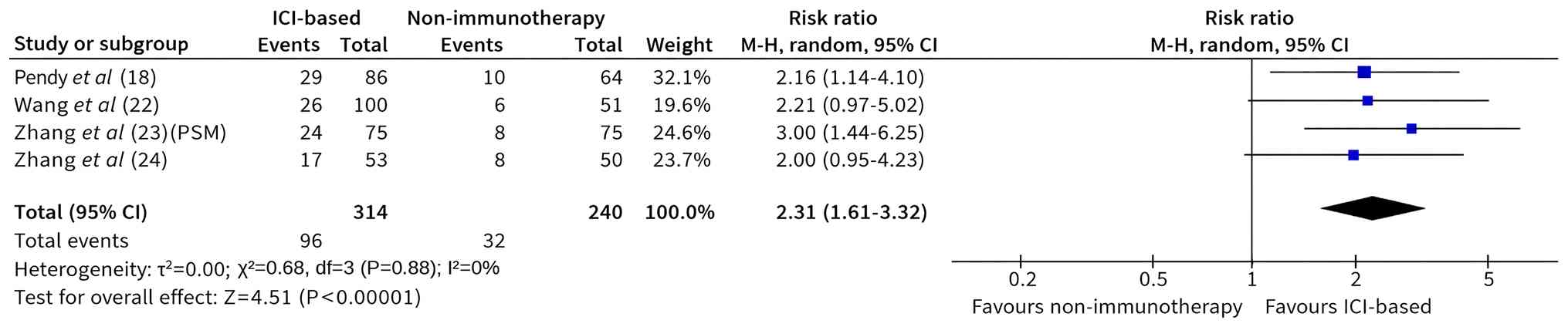
In total, four studies were included in the
meta-analysis of ORR (18,22–24).
Using a random-effects model and prioritizing the PSM dataset where
available, ICI-based subsequent treatment was associated with a
higher ORR compared with that after non-immunotherapy subsequent
treatment (RR, 2.31; 95% CI, 1.61–3.32; P<0.00001; Fig. 4). No heterogeneity was observed
(I2=0%).
DCR
In total, four studies were included in the
meta-analysis of DCR (18,22–24).
Using a random-effects model and prioritizing the propensity
score-matched dataset where available, ICI-based subsequent
treatment was associated with a higher DCR than non-immunotherapy
subsequent treatment (RR, 1.51; 95% CI, 1.16–1.98; P=0.003;
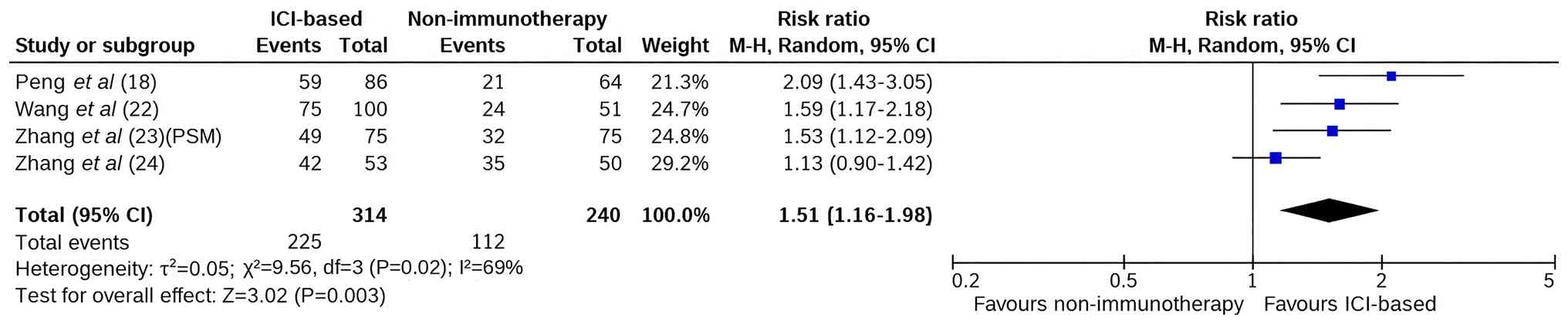
Fig. 5). Substantial heterogeneity
was observed (I2=69%). The direction of effect generally
favored ICI-based subsequent treatment, although the magnitude of
DCR improvement varied across studies.
Grade ≥3 AEs/TRAEs
In total, two studies were included in the
meta-analysis of grade ≥3 AEs or TRAEs (18,22).
Using a random-effects model, ICI-based subsequent treatment was
not associated with an increased risk of grade ≥3 AEs/TRAEs
compared with non-immunotherapy subsequent treatment (RR, 0.89; 95%
CI, 0.56–1.40; P=0.61; Fig. 6). No
heterogeneity was observed (I2=0%). Because only two
studies reported comparable overall grade ≥3 AE/TRAE data, no
sensitivity analysis was performed for this outcome.
Discussion
In the present systematic review and meta-analysis
of comparative studies, ICI-based subsequent treatment after
progression on first-line chemoimmunotherapy was associated with
more favorable clinical outcomes in patients with ES-SCLC. This
association was observed across both major survival endpoints, with
pooled estimates favoring ICI-based subsequent treatment for OS and
PFS. Response outcomes pointed in the same direction, as patients
receiving ICI-based subsequent treatment had higher ORR and DCR
compared with those treated with non-immunotherapy strategies.
Importantly, this apparent efficacy signal was not accompanied by a
clear increase in grade ≥3 AEs/TRAEs, although the safety dataset
was smaller than the efficacy dataset; the toxicity findings should
therefore be interpreted in the context of established guidance for
the recognition and management of immune-related AEs (26,27).
Collectively, the present findings suggest that ICI-based
subsequent treatment after first-line chemoimmunotherapy
progression may have clinical value in selected patients. Despite
this, the evidence should be interpreted as comparative real-world
evidence rather than definitive proof of causal benefit, as all
included studies were non-randomized and treatment allocation was
not controlled.
OS is the most clinically stringent endpoint in this
setting, and the observed OS association therefore warrants
particular attention. In ES-SCLC, relapse after first-line
chemoimmunotherapy typically marks the beginning of a brief and
refractory disease course. Conventional second-line options,
including topotecan and lurbinectedin, have activity in selected
patients but generally provide only modest and frequently transient
disease control (2,8,9).
Earlier attempts to prolong immunotherapy exposure in SCLC, such as
maintenance nivolumab with or without ipilimumab after first-line
chemotherapy, also failed to establish a clear OS advantage
(28). The δ-like ligand 3-targeted
tarlatamab has produced clinically meaningful antitumor activity in
previously treated SCLC, reflected by durable objective responses
and disease control in a subset of patients (29) and in a randomized setting, an OS
benefit after platinum-based chemotherapy was observed for this
drug (30). However, these data
address a different therapeutic question from whether subsequent
therapy should retain a PD-L1 blockade component after progression
on a PD-L1-containing first-line regimen. In the present context,
the pooled OS estimate in the present analysis (HR, 0.62; 95% CI,
0.51–0.74) is clinically relevant, but it remains an association
derived from non-randomized comparative evidence rather than
definitive proof of treatment efficacy. The low-to-moderate
heterogeneity (I2=33%) and the nearly unchanged result
after replacing the PSM estimate with the unmatched estimate also
support the stability of the OS finding (17,18,20,22–24).
Therefore, the OS association does not appear to be dependent on a
single analytical choice or one influential matched cohort,
although it should still be interpreted within the limitations of
non-randomized treatment selection.
The present PFS result complements the
aforementioned OS result by suggesting improved post-progression
disease control with ICI-based subsequent therapy. The pooled
estimate favored ICI-based subsequent treatment (HR, 0.51; 95% CI,
0.38–0.69) and this direction remained consistent in sensitivity
analyses, including use of unmatched estimates and inclusion of
additional partially aligned datasets (16–18,20,22–24).
However, the substantial heterogeneity in the PFS analysis
(I2=77%) should not be overlooked. Importantly, this
heterogeneity appears to reflect variation in effect magnitude
rather than conflicting treatment directions. This is clinically
plausible, because PFS-related endpoints were not described using
identical terminology across studies. Endpoint-definition audit
indicated that the PFS2-labelled studies captured disease control
during the post-progression or second-line treatment period, rather
than conventional PFS2 measured from initial first-line treatment
initiation. Despite this, differences in endpoint terminology, time
origin within the post-progression period, assessment schedule and
censoring rules may still have contributed to heterogeneity. The
conservative sensitivity analysis excluding PFS2-labelled studies
yielded a consistent PFS association with reduced heterogeneity,
supporting that the primary PFS result was not driven by
endpoint-origin misalignment. Treatment heterogeneity likely added
a second layer of variability. Across the included studies,
ICI-based subsequent treatment was delivered through different
strategies, including ICI continuation or rechallenge, ICI plus
chemotherapy, ICI plus antiangiogenic therapy and ICI plus
chemotherapy and antiangiogenic therapy (18,22–24).
These strategies should not be considered clinically
interchangeable, because isolated ICI continuation or rechallenge
and ICI-containing combination regimens address different
therapeutic questions. The phase III ATLANTIS trial of
lurbinectedin plus doxorubicin vs. physician's choice of
chemotherapy in relapsed SCLC also illustrates the broader
difficulty of producing uniform survival gains in this disease
setting (31). Therefore, the PFS
result is best interpreted as a consistent indicator of improved
disease control across heterogeneous real-world post-progression
pathways, not as evidence that all ICI-based post-progression
strategies have equivalent efficacy.
The response outcomes provide supportive but
non-definitive evidence for the survival findings. In the ORR
analysis, ICI-based subsequent treatment was associated with a
higher objective response than non-immunotherapy subsequent
treatment (RR, 2.31; 95% CI, 1.61–3.32), without observed
heterogeneity (I2=0%) (18,22–24).
This consistency indicates that the objective tumor-response
finding was relatively stable across the contributing cohorts. By
contrast, while the DCR analysis also favored ICI-based subsequent
treatment (RR, 1.51; 95% CI, 1.16–1.98), the heterogeneity was
substantial (I2=69%) (18,22–24).
This difference is clinically plausible. ORR is associated with
measurable tumor shrinkage, whereas DCR also incorporates stable
disease, a category more sensitive to imaging intervals, timing of
response assessment, censoring and the balance among chemotherapy,
antiangiogenic therapy and ICI-containing combinations. Standard
response frameworks, such as Response Evaluation Criteria in Solid
Tumors (RECIST) 1.1 and immune RECIST, provide a structured basis
for response assessment, but they do not eliminate the practical
variability introduced by retrospective imaging schedules and
heterogeneous treatment pathways (32,33).
In addition, ORR and DCR should not be interpreted as substitutes
for OS or PFS. Contemporary trial-level analyses across advanced
solid tumors have shown that ORR is at best an imperfect surrogate
for OS, with surrogacy varying by tumor type and treatment class
(34). Therefore, the response
results strengthen the biological plausibility of the survival
signal, but they remain secondary and supportive rather than
independently practice changing.
Biologically, the observed association is plausible
but should not be overinterpreted. Progression during PD-L1-based
therapy may reflect spatially heterogeneous or partial resistance
rather than complete immune insensitivity. Acquired resistance can
emerge through defects in antigen presentation, IFN-pathway
remodeling, activation of alternative immune checkpoints and
changes in the tumor microenvironment (10,35).
This concept is particularly relevant in SCLC, a disease marked by
biological plasticity, molecular heterogeneity and subtype-specific
immune phenotypes (11,36). Single-cell analyses have further
shown that SCLC contains plastic, metastatic and immunosuppressive
cellular states, suggesting that immune responsiveness may vary
across lesions and disease phases rather than being uniformly lost
at progression (37). In this
context, subsequent combination therapy may restore or amplify
residual immune sensitivity in selected patients. Chemotherapy can
promote antigen release and immunogenic cell death, whereas
antiangiogenic therapy may improve immune-cell trafficking through
vascular normalization and remodeling of the tumor microenvironment
(38,39). The translational cohort by Shang
et al (19) also suggested
that selecting patients with ES-SCLC exhibiting lower metastatic
burden may benefit from ICI rechallenge through tumor
microenvironment reshaping. However, this rationale has an
important boundary, whereby rapid clonal evolution and immune
escape remain central features of SCLC. ICI-based subsequent
treatment is therefore biologically plausible for selected
patients, but it is unlikely to benefit all patients uniformly.
The real-world nature of the included evidence in
the present study is both a strength and a limitation. On the one
hand, these cohorts capture the treatment decisions that clinicians
face after first-line chemoimmunotherapy progression, including ICI
rechallenge, ICI switching, ICI plus chemotherapy, ICI plus
antiangiogenic therapy and combined regimens. This breadth is
clinically beneficial because rigid trial-defined treatment
pathways typically do not reflect the fragmented and individualized
post-progression management of ES-SCLC. The inclusion of
comparative real-world cohorts also provides more informative
evidence than single-arm rechallenge series, particularly when
adjusted or propensity score-matched estimates are available
(23,40–42).
However, real-world comparisons are intrinsically vulnerable to
bias. Patients selected for ICI-based subsequent treatment may have
had improved performance status, a more indolent disease course,
lower metastatic burden, improved prior response or greater
physician-perceived suitability for further immunotherapy. These
factors can create selection bias, confounding by indication and a
possible fit-patient effect, since the clinical reasons for
choosing ICI-based subsequent treatment may themselves be
prognostic (43,44). Time-related bias is another concern.
Patients must survive sufficiently and remain sufficiently fit to
receive subsequent ICI-containing therapy, which can introduce
immortal time bias if treatment assignment and follow-up time are
not aligned carefully (45).
Although multivariable adjustment and PSM can improve balance in
measured covariates, they cannot remove unmeasured confounding,
differences in imaging frequency, follow-up intensity or
institution-specific treatment practices (40,46).
This is particularly relevant in the present study, as one included
study was a mixed NSCLC/SCLC cohort with extractable SCLC subgroup
data (16), one sensitivity
analysis depended on matched vs. unmatched estimates from a PSM
study (23) and another included
mixed first-line immunotherapy exposure (25). Therefore, the present findings
should be viewed as hypothesis-strengthening comparative evidence
rather than a substitute for prospective randomized evaluation.
Clinically, the current findings should not be
interpreted as supporting indiscriminate ICI-based treatment in all
patients after progression. Rather, ICI-based subsequent treatment
may be considered as a potential strategy for selected patients
with preserved Eastern Cooperative Oncology Group performance
status, prior disease control on first-line chemoimmunotherapy, a
longer progression-free interval, a more indolent disease course,
limited progression or lower metastatic burden and no prohibitive
history of immune-related toxicity. This patient-selection
framework is consistent with the broader relapsed SCLC literature,
in which post-progression treatment choice is shaped not only by
the available drug but also by platinum sensitivity, treatment-free
interval, disease burden, symptoms and fitness for further systemic
therapy (2,8,47,48).
In the present evidence base, this interpretation is also supported
by the observation that a number of the included cohorts evaluated
ICI rechallenge or continuation in clinically selected populations
rather than unselected patients progressing after first-line
therapy (17–19,23).
Conversely, patients with primary resistance to
first-line chemoimmunotherapy, explosive tumor progression, rapidly
progressive multi-organ disease, poor performance status,
uncontrolled comorbidities or prior severe immune-related AEs are
unlikely to be appropriate candidates for routine ICI-based
subsequent treatment. The toxicity issue is particularly important.
Although the pooled grade ≥3 AE/TRAE analysis did not show a clear
excess risk, the safety dataset was small, and immune-related
toxicities may recur after rechallenge in a clinically meaningful
proportion of patients (26,27,49–51).
Current guidelines still prioritize established subsequent-line
options, including topotecan, lurbinectedin, platinum rechallenge
in selected platinum-sensitive relapse, clinical trial enrollment
and best supportive care when appropriate. They do not define
ICI-based subsequent treatment after progression as a universal
post-progression standard (2,8,9,47). Therefore, the
practical implication of the present meta-analysis is not to change
the standard of care immediately, but to identify a clinically
plausible subgroup in whom prospective evaluation of ICI-containing
subsequent therapy is justified.
The current study has several strengths. The
research question was deliberately narrow and clinically
actionable, namely whether patients with ES-SCLC who progress after
first-line chemoimmunotherapy may benefit from ICI-based subsequent
treatment compared with non-immunotherapy subsequent treatment.
This framing avoids conflating the analysis with broader questions
of first-line immunotherapy efficacy or isolated single-arm
rechallenge outcomes. The exclusive inclusion of comparative
studies also provides a more interpretable evidence base than
descriptive single-arm series. In addition, adjusted, multivariable
or PSM estimates were prioritized when available, and sensitivity
analyses were used to evaluate whether alternative handling of
matched vs. unmatched data changed the main findings. Studies with
partial alignment to the main PICO framework were not
indiscriminately pooled into every primary analysis. Instead, their
contribution was handled according to outcome availability and
analytical suitability. Finally, the analysis considered survival,
response, disease control and severe toxicity together, allowing a
more balanced view of potential benefit and clinical decisions.
However, several limitations should be acknowledged.
The primary limitation is the non-randomized nature of all the
included studies. Even when multivariable adjustment or PSM was
used, residual confounding remained likely. Patients selected for
ICI-based subsequent treatment may have differed from controls in
performance status, disease tempo, metastatic burden, prior
response to first-line therapy or physician-perceived suitability
for further immunotherapy. Therefore, the overall certainty of
evidence should be considered low. The effective evidence base was
also limited for each pooled outcome: In total, 6 studies
contributed to the primary OS and PFS analyses, while 4 studies
contributed to ORR and DCR and only 2 studies contributed to the
pooled grade ≥3 AE/TRAE analysis. This limited statistical power,
precluded formal assessment of publication bias and prevented
robust subgroup analyses according to ICI class, treatment
combination, progression pattern or patient-selection factors. In
addition, although reported study periods, participating centers
when available and cohort characteristics were cross-checked, the
possibility of unrecognized partial patient overlap among
retrospective multicenter cohorts could not be completely excluded
because exhaustive patient-level identifiers were unavailable. The
included studies also used heterogeneous subsequent treatment
regimens, including ICI continuation or rechallenge, ICI switching,
ICI plus chemotherapy, ICI plus antiangiogenic therapy and combined
or triplet strategies. Since the majority of studies reported only
aggregate estimates for mixed ICI-based arms, reliable
strategy-specific subgroup analyses were not possible. Although
endpoint-definition audit did not identify conventional
first-line-origin PFS2 estimates in the primary PFS analysis,
PFS-related endpoints remained imperfectly standardized.
Differences in terminology, time origin within the post-progression
period, imaging assessment schedule and censoring rules may still
have contributed to the substantial heterogeneity observed in the
PFS analysis. Safety evidence was limited, particularly for
specific immune-related toxicities and treatment
discontinuation.
In clinical practice, ICI-based subsequent treatment
after progression on first-line chemoimmunotherapy should be viewed
as a potential strategy for selected patients with ES-SCLC rather
than as a universal post-progression standard. The present
meta-analysis suggests a favorable association with survival and
tumor control, without a clear indication of excess severe
toxicity. However, the evidence remains comparative, retrospective
and vulnerable to treatment-selection bias. This distinction is
important. The current data support further clinical exploration,
not unselective use of immunotherapy-based treatment for every
patient after progression. Future prospective studies should
therefore focus on defining the patients most likely to benefit
from ICI-containing therapy after progression, clarifying the
optimal ICI-containing regimens, standardizing post-progression
endpoints and toxicity reporting. Biomarker-informed and clinically
stratified designs will be particularly important to determine
whether continued immune pressure can translate into a reproducible
benefit-risk advantage in this setting.
Supplementary Material
Supporting Data
Supporting Data
Acknowledgements
Not applicable.
Funding
Funding: No funding was received.
Availability of data and materials
The data generated in the present study may be
requested from the corresponding author.
Authors' contributions
CL participated in conceptualization, methodology,
investigation, data curation, writing of the original draft,
reviewing and editing. YR contributed to methodology, investigation
and data curation. AY and SX were involved in investigation and
data curation. JH participated in conceptualization, methodology,
supervision and writing (reviewing and editing). CL and JH confirm
the authenticity of all the raw data. All authors read and approved
the final version of the manuscript.
Ethics approval and consent to
participate
Not applicable.
Patient consent for publication
Not applicable.
Competing interests
The authors declare that they have no competing
interests.
Glossary
Abbreviations
Abbreviations:
|
AE
|
adverse event
|
|
DCR
|
disease control rate
|
|
ES
|
extensive-stage
|
|
HR
|
hazard ratio
|
|
ICI
|
immune checkpoint inhibitor
|
|
RECIST
|
Response Evaluation Criteria in Solid
Tumors
|
|
NOS
|
Newcastle-Ottawa Scale
|
|
NSCLC
|
non-small cell lung cancer
|
|
ORR
|
objective response rate
|
|
OS
|
overall survival
|
|
PD-1
|
programmed death-1
|
|
PD-L1
|
programmed death-ligand 1
|
|
PFS
|
progression-free survival
|
|
PSM
|
propensity score matching
|
|
RR
|
risk ratio
|
|
SCLC
|
small cell lung cancer
|
|
TRAE
|
treatment-related adverse event
|
References
|
1
|
Rudin CM, Brambilla E, Faivre-Finn C and
Sage J: Small-cell lung cancer. Nat Rev Dis Primers. 7:32021.
View Article : Google Scholar : PubMed/NCBI
|
|
2
|
Dingemans AC, Früh M, Ardizzoni A, Besse
B, Faivre-Finn C, Hendriks LE, Lantuejoul S, Peters S, Reguart N,
Rudin CM, et al: Small-cell lung cancer: ESMO clinical practice
guidelines for diagnosis, treatment and follow-up☆. Ann Oncol.
32:839–853. 2021. View Article : Google Scholar : PubMed/NCBI
|
|
3
|
Horn L, Mansfield AS, Szczęsna A, Havel L,
Krzakowski M, Hochmair MJ, Huemer F, Losonczy G, Johnson ML, Nishio
M, et al: First-line atezolizumab plus chemotherapy in
extensive-stage small-cell lung cancer. N Engl J Med.
379:2220–2229. 2018. View Article : Google Scholar : PubMed/NCBI
|
|
4
|
Paz-Ares L, Dvorkin M, Chen Y, Reinmuth N,
Hotta K, Trukhin D, Statsenko G, Hochmair MJ, Özgüroğlu M, Ji JH,
et al: Durvalumab plus platinum-etoposide versus platinum-etoposide
in first-line treatment of extensive-stage small-cell lung cancer
(CASPIAN): A randomised, controlled, open-label, phase 3 trial.
Lancet. 394:1929–1939. 2019. View Article : Google Scholar : PubMed/NCBI
|
|
5
|
Goldman JW, Dvorkin M, Chen Y, Reinmuth N,
Hotta K, Trukhin D, Statsenko G, Hochmair MJ, Özgüroğlu M, Ji JH,
et al: Durvalumab, with or without tremelimumab, plus
platinum-etoposide versus platinum-etoposide alone in first-line
treatment of extensive-stage small-cell lung cancer (CASPIAN):
Updated results from a randomised, controlled, open-label, phase 3
trial. Lancet Oncol. 22:51–65. 2021. View Article : Google Scholar : PubMed/NCBI
|
|
6
|
Wang J, Zhou C, Yao W, Wang Q, Min X, Chen
G, Xu X, Li X, Xu F, Fang Y, et al: Adebrelimab or placebo plus
carboplatin and etoposide as first-line treatment for
extensive-stage small-cell lung cancer (CAPSTONE-1): A multicentre,
randomised, double-blind, placebo-controlled, phase 3 trial. Lancet
Oncol. 23:739–747. 2022. View Article : Google Scholar : PubMed/NCBI
|
|
7
|
Cheng Y, Han L, Wu L, Chen J, Sun H, Wen
G, Ji Y, Dvorkin M, Shi J, Pan Z, et al: Effect of first-line
serplulimab vs placebo added to chemotherapy on survival in
patients with extensive-stage small cell lung cancer: The
ASTRUM-005 randomized clinical trial. JAMA. 328:1223–1232. 2022.
View Article : Google Scholar : PubMed/NCBI
|
|
8
|
Ganti AKP, Loo BW Jr, Badiyan S, Bassetti
M, Bestvina C, Chiang A, Choudhury N, D'Avella CA, Daly M, Dowlati
A, et al: NCCN guidelines® insights: Small cell lung
cancer, version 2.2026. J Natl Compr Canc Netw. 24:e2600022026.
View Article : Google Scholar : PubMed/NCBI
|
|
9
|
Trigo J, Subbiah V, Besse B, Moreno V,
López R, Sala MA, Peters S, Ponce S, Fernández C, Alfaro V, et al:
Lurbinectedin as second-line treatment for patients with small-cell
lung cancer: A single-arm, open-label, phase 2 basket trial. Lancet
Oncol. 21:645–654. 2020. View Article : Google Scholar : PubMed/NCBI
|
|
10
|
Schoenfeld AJ and Hellmann MD: Acquired
resistance to immune checkpoint inhibitors. Cancer Cell.
37:443–455. 2020. View Article : Google Scholar : PubMed/NCBI
|
|
11
|
Liu Q, Zhang J, Guo C, Wang M, Wang C, Yan
Y, Sun L, Wang D, Zhang L, Yu H, et al: Proteogenomic
characterization of small cell lung cancer identifies biological
insights and subtype-specific therapeutic strategies. Cell.
187:184–203.e28. 2024. View Article : Google Scholar : PubMed/NCBI
|
|
12
|
Liu L, Liu T, Wang X, Wang J, Wang J, Yuan
M, Yang Y, Zhang Y, Wang H, Hu P and Zhang J: Patterns of treatment
failure for PD-(L)1 refractory extensive-stage small cell lung
cancer in continued PD-(L)1 treatment. Transl Oncol. 33:1016872023.
View Article : Google Scholar : PubMed/NCBI
|
|
13
|
Liu F, Yin G, Tao Y and Pan Y: The
efficacy of ICIs rechallenge in advanced small cell lung cancer
after progression from ICIs plus chemotherapy: A real-world study.
Int Immunopharmacol. 152:1143722025. View Article : Google Scholar : PubMed/NCBI
|
|
14
|
Page MJ, McKenzie JE, Bossuyt PM, Boutron
I, Hoffmann TC, Mulrow CD, Shamseer L, Tetzlaff JM, Akl EA, Brennan
SE, et al: The PRISMA 2020 statement: An updated guideline for
reporting systematic reviews. BMJ. 372:n712021. View Article : Google Scholar : PubMed/NCBI
|
|
15
|
Higgins JPT, Thomas J, Chandler J,
Cumpston M, Li T, Page MJ and Welch VA: Cochrane handbook for
systematic reviews of interventions version 6.3 (updated February
2022). Chichester; Cochrane: 2022, Available from:. https://training.cochrane.org/handbook/currentMay
9–2026
|
|
16
|
Cheng J, Kang W, Chen Y, Pan L, Han H and
Lv T: Continuous immunotherapy beyond disease progression in
patients with advanced non-small cell and small cell lung cancer.
Cancer Immunol Immunother. 74:1242025. View Article : Google Scholar : PubMed/NCBI
|
|
17
|
Li L, Liu T, Liu Q, Mu S, Tao H, Yang X,
Li Y, Xiong Q, Wang L and Hu Y: Rechallenge of immunotherapy beyond
progression in patients with extensive-stage small-cell lung
cancer. Front Pharmacol. 13:9675592022. View Article : Google Scholar : PubMed/NCBI
|
|
18
|
Peng J, Zhai X, Liu X, Huang Z, Wang Y, Wu
P, Gao R and Meng X: Beyond first-line therapy: Efficacy and safety
outcomes of continuing immunotherapy in extensive stage small cell
lung cancer after PD-L1 inhibitor progression. Transl Oncol.
52:1022492025. View Article : Google Scholar : PubMed/NCBI
|
|
19
|
Shang X, Zhang C, Lv Y, Zhang X, Guo K, Li
H and Wang H: Patients with extensive-stage small cell lung cancer
harboring less than 4 metastatic sites may benefit from immune
checkpoint inhibitor rechallenge by reshaping tumor
microenvironment. Immunotargets Ther. 13:571–583. 2024. View Article : Google Scholar : PubMed/NCBI
|
|
20
|
Sun Z, Tian Y, Lu S, Niu J, Dong Q and Zhu
H: Continuing immunotherapy beyond progression prolongs the
survival of patients with extensive-stage small-cell lung cancer: A
multicenter retrospective analysis. Cancer Med. 15:e716072026.
View Article : Google Scholar : PubMed/NCBI
|
|
21
|
Wang C, Xuan T, Wang Y, Yang C, Zhao W,
Zhang R, Meng X and Li J: Clinical outcomes and safety of
continuous immunotherapy beyond progression in patients with
extensive-stage small cell lung cancer: A retrospective real-world
study. Front Immunol. 16:16815452026. View Article : Google Scholar : PubMed/NCBI
|
|
22
|
Wang J, Zhong Y, Chen B, Xu Y, Xu L, Li J,
Xu F, Wang Q, Li K, Kong Y, et al: Immunotherapy rechallenge in
extensive-stage small cell lung cancer: A real-world retrospective
study. Lung Cancer. 215:1093692026. View Article : Google Scholar : PubMed/NCBI
|
|
23
|
Zhang J, Zi R, Zhang HX, Lv Y, Zhao LJ and
Wang Y: Immune checkpoint inhibitors continuation beyond
progression as second-line treatment for extensive-stage small-cell
lung cancer: A real-world, multicenter analysis. Front Immunol.
16:16663732025. View Article : Google Scholar : PubMed/NCBI
|
|
24
|
Zhang B, Bao H, Li Z, Chen J, Yu H, Li M,
Cai M and Chen L: Continuing immune checkpoint inhibitors after
progression: Real-world patterns of care and outcomes in
second-line treatment for extensive-stage small-cell lung cancer.
Lung Cancer. 199:1080212025. View Article : Google Scholar : PubMed/NCBI
|
|
25
|
Zhang J, Wu Z, Wang S, Sun Y, Wu J, Wang
D, Ge Y, Li J, Sun H, Cheng Q, et al: Efficacy of PD-(L)1
inhibitors plus anlotinib in the second-line treatment of
extensive-stage small cell lung cancer. BMC Cancer. 25:10702025.
View Article : Google Scholar : PubMed/NCBI
|
|
26
|
Schneider BJ, Naidoo J, Santomasso BD,
Lacchetti C, Adkins S, Anadkat M, Atkins MB, Brassil KJ, Caterino
JM, Chau I, et al: Management of immune-related adverse events in
patients treated with immune checkpoint inhibitor therapy: ASCO
guideline update. J Clin Oncol. 39:4073–4126. 2021. View Article : Google Scholar : PubMed/NCBI
|
|
27
|
Haanen J, Obeid M, Spain L, Carbonnel F,
Wang Y, Robert C, Lyon AR, Wick W, Kostine M, Peters S, et al:
Management of toxicities from immunotherapy: ESMO clinical practice
guideline for diagnosis, treatment and follow-up. Ann Oncol.
33:1217–1238. 2022. View Article : Google Scholar : PubMed/NCBI
|
|
28
|
Owonikoko TK, Park K, Govindan R, Ready N,
Reck M, Peters S, Dakhil SR, Navarro A, Rodríguez-Cid J, Schenker
M, et al: Nivolumab and ipilimumab as maintenance therapy in
extensive-disease small-cell lung cancer: CheckMate 451. J Clin
Oncol. 39:1349–1359. 2021. View Article : Google Scholar : PubMed/NCBI
|
|
29
|
Ahn MJ, Cho BC, Felip E, Korantzis I,
Ohashi K, Majem M, Juan-Vidal O, Handzhiev S, Izumi H, Lee JS, et
al: Tarlatamab for patients with previously treated small-cell lung
cancer. N Engl J Med. 389:2063–2075. 2023. View Article : Google Scholar : PubMed/NCBI
|
|
30
|
Mountzios G, Sun L, Cho BC, Demirci U,
Baka S, Gümüş M, Lugini A, Zhu B, Yu Y, Korantzis I, et al:
Tarlatamab in small-cell lung cancer after platinum-based
chemotherapy. N Engl J Med. 393:349–361. 2025. View Article : Google Scholar : PubMed/NCBI
|
|
31
|
Aix SP, Ciuleanu TE, Navarro A, Cousin S,
Bonanno L, Smit EF, Chiappori A, Olmedo ME, Horvath I, Grohé C, et
al: Combination lurbinectedin and doxorubicin versus physician's
choice of chemotherapy in patients with relapsed small-cell lung
cancer (ATLANTIS): A multicentre, randomised, open-label, phase 3
trial. Lancet Respir Med. 11:74–86. 2023. View Article : Google Scholar : PubMed/NCBI
|
|
32
|
Eisenhauer EA, Therasse P, Bogaerts J,
Schwartz LH, Sargent D, Ford R, Dancey J, Arbuck S, Gwyther S,
Mooney M, et al: New response evaluation criteria in solid tumours:
Revised RECIST guideline (version 1.1). Eur J Cancer. 45:228–247.
2009. View Article : Google Scholar : PubMed/NCBI
|
|
33
|
Seymour L, Bogaerts J, Perrone A, Ford R,
Schwartz LH, Mandrekar S, Lin NU, Litière S, Dancey J, Chen A, et
al: iRECIST: Guidelines for response criteria for use in trials
testing immunotherapeutics. Lancet Oncol. 18:e143–e152. 2017.
View Article : Google Scholar : PubMed/NCBI
|
|
34
|
Shahnam A, Hitchen N, Nindra U, Manoharan
S, Desai J, Tran B, Solomon B, Luen SJ, Hui R, Hopkins AM and
Sorich MJ: Objective response rate and progression-free survival as
surrogates for overall survival treatment effect: A meta-analysis
across diverse tumour groups and contemporary therapies. Eur J
Cancer. 198:1135032024. View Article : Google Scholar : PubMed/NCBI
|
|
35
|
Dagogo-Jack I and Shaw AT: Tumour
heterogeneity and resistance to cancer therapies. Nat Rev Clin
Oncol. 15:81–94. 2018. View Article : Google Scholar : PubMed/NCBI
|
|
36
|
Gay CM, Stewart CA, Park EM, Diao L,
Groves SM, Heeke S, Nabet BY, Fujimoto J, Solis LM, Lu W, et al:
Patterns of transcription factor programs and immune pathway
activation define four major subtypes of SCLC with distinct
therapeutic vulnerabilities. Cancer Cell. 39:346–360.e7. 2021.
View Article : Google Scholar : PubMed/NCBI
|
|
37
|
Chan JM, Quintanal-Villalonga Á, Gao VR,
Xie Y, Allaj V, Chaudhary O, Masilionis I, Egger J, Chow A, Walle
T, et al: Signatures of plasticity, metastasis, and
immunosuppression in an atlas of human small cell lung cancer.
Cancer Cell. 39:1479–1496.e18. 2021. View Article : Google Scholar : PubMed/NCBI
|
|
38
|
Galluzzi L, Humeau J, Buqué A, Zitvogel L
and Kroemer G: Immunostimulation with chemotherapy in the era of
immune checkpoint inhibitors. Nat Rev Clin Oncol. 17:725–741. 2020.
View Article : Google Scholar : PubMed/NCBI
|
|
39
|
Fukumura D, Kloepper J, Amoozgar Z, Duda
DG and Jain RK: Enhancing cancer immunotherapy using
antiangiogenics: Opportunities and challenges. Nat Rev Clin Oncol.
15:325–340. 2018. View Article : Google Scholar : PubMed/NCBI
|
|
40
|
Concato J and Corrigan-Curay J: Real-world
evidence-where are we now? N Engl J Med. 386:1680–1682. 2022.
View Article : Google Scholar : PubMed/NCBI
|
|
41
|
Saesen R, Van Hemelrijck M, Bogaerts J,
Booth CM, Cornelissen JJ, Dekker A, Eisenhauer EA, Freitas A,
Gronchi A, Hernán MA, et al: Defining the role of real-world data
in cancer clinical research: The position of the European
organisation for research and treatment of cancer. Eur J Cancer.
186:52–61. 2023. View Article : Google Scholar : PubMed/NCBI
|
|
42
|
Castelo-Branco L, Pellat A, Martins-Branco
D, Valachis A, Derksen JWG, Suijkerbuijk KPM, Dafni U, Dellaporta
T, Vogel A, Prelaj A, et al: ESMO guidance for reporting oncology
real-world evidence (GROW). Ann Oncol. 34:1097–1112. 2023.
View Article : Google Scholar : PubMed/NCBI
|
|
43
|
Hernán MA, Wang W and Leaf DE: Target
trial emulation: A framework for causal inference from
observational data. JAMA. 328:2446–2447. 2022. View Article : Google Scholar : PubMed/NCBI
|
|
44
|
Matthews AA, Danaei G, Islam N and Kurth
T: Target trial emulation: Applying principles of randomised trials
to observational studies. BMJ. 378:e0711082022. View Article : Google Scholar : PubMed/NCBI
|
|
45
|
Agarwal P, Moshier E, Ru M, Ohri N, Ennis
R, Rosenzweig K and Mazumdar M: Immortal time bias in observational
studies of time-to-event outcomes: Assessing effects of
postmastectomy radiation therapy using the national cancer
database. Cancer Control. 25:10732748187893552018. View Article : Google Scholar : PubMed/NCBI
|
|
46
|
Sendor R and Stürmer T: Core concepts in
pharmacoepidemiology: Confounding by indication and the role of
active comparators. Pharmacoepidemiol Drug Saf. 31:261–269. 2022.
View Article : Google Scholar : PubMed/NCBI
|
|
47
|
Baize N, Monnet I, Greillier L, Geier M,
Lena H, Janicot H, Vergnenegre A, Crequit J, Lamy R, Auliac JB, et
al: Carboplatin plus etoposide versus topotecan as second-line
treatment for patients with sensitive relapsed small-cell lung
cancer: An open-label, multicentre, randomised, phase 3 trial.
Lancet Oncol. 21:1224–1233. 2020. View Article : Google Scholar : PubMed/NCBI
|
|
48
|
Owonikoko TK: SCLC classification by
platinum sensitivity in the era of immunotherapy: Mere relic or a
valuable treasure to keep? J Thorac Oncol. 19:193–195. 2024.
View Article : Google Scholar : PubMed/NCBI
|
|
49
|
Dolladille C, Ederhy S, Sassier M, Cautela
J, Thuny F, Cohen AA, Fedrizzi S, Chrétien B, Da-Silva A, Plane AF,
et al: Immune checkpoint inhibitor rechallenge after immune-related
adverse events in patients with cancer. JAMA Oncol. 6:865–871.
2020. View Article : Google Scholar : PubMed/NCBI
|
|
50
|
Allouchery M, Lombard T, Martin M, Rouby
F, Sassier M, Bertin C, Atzenhoffer M, Miremont-Salame G,
Perault-Pochat MC and Puyade M; French Network of Regional
Pharmacovigilance Centers, : Safety of immune checkpoint inhibitor
rechallenge after discontinuation for grade ≥2 immune-related
adverse events in patients with cancer. J Immunother Cancer.
8:e0016222020. View Article : Google Scholar : PubMed/NCBI
|
|
51
|
Inno A, Roviello G, Ghidini A, Luciani A,
Catalano M, Gori S and Petrelli F: Rechallenge of immune checkpoint
inhibitors: A systematic review and meta-analysis. Crit Rev Oncol
Hematol. 165:1034342021. View Article : Google Scholar : PubMed/NCBI
|