Introduction
Colorectal cancer is the third most common cancer
worldwide and the second leading cause of cancer-related death.
Approximately 15–30% of patients present with metastatic disease
(1). Diagnosis requires
histological confirmation, while contrast-enhanced computed
tomography of the chest, abdomen and pelvis is used for staging.
Treatment is individualized according to resectability, patient
fitness and tumor molecular characteristics. Options include
chemotherapy with appropriate targeted agents, immunotherapy for
tumors with deficient mismatch repair or high microsatellite
instability, and surgery or local ablation in selected patients.
Prognosis is heterogeneous: most patients are not candidates for
potentially curative resection at diagnosis, although selected
patients with resectable metastases may achieve long-term survival
or cure (1).
Outcomes vary considerably among patients with de
novo metastatic colorectal cancer despite contemporary
first-line systemic therapy (1).
Tumor burden and molecular alterations such as RAS and BRAF account
for only part of this variation and primarily characterize the
tumor. Host-related factors reflecting systemic inflammation and
immune status may provide additional prognostic information.
Neutrophils can support tumor growth and
angiogenesis (2), whereas
lymphocytes contribute to antitumor immunity (3). Serum albumin decreases during the
acute-phase response and therefore reflects systemic inflammation
more than nutritional status alone (4). The neutrophil-to-lymphocyte ratio
(NLR) has been linked to survival in colorectal cancer (5), while the modified Glasgow prognostic
score has shown prognostic value across several tumor types
(6). However, these commonly used
indices have different component requirements: NLR relies on immune
cell counts alone, whereas the modified Glasgow prognostic score
requires measurement of serum C-reactive protein and albumin
concentrations (6). The consensus
Immunoscore provides validated prognostic information in stage
I–III colon cancer but requires tumor tissue, immunohistochemical
assessment and digital image analysis (7). Blood-based inflammatory indices can be
derived from routinely available laboratory tests and may offer a
more accessible approach to host-related prognostic assessment.
The lymphocyte-albumin-neutrophil ratio (LANR)
combines lymphocyte count, serum albumin and neutrophil count in a
single measure and does not require C-reactive protein levels. LANR
was first described in resectable colorectal cancer, in which
higher values were associated with longer overall and disease-free
survival (8), and a subsequent
surgical cohort reported a similar direction of association for a
mathematically equivalent index calculated by dividing albumin by
NLR (9). Existing LANR evidence has
therefore been concentrated mainly in resectable or surgically
treated colorectal cancer populations. Prognostic associations for
inflammation-based indices have similarly been reported in de
novo metastatic colon cancer, although that study classified
patients using a threshold derived within the analyzed cohort
(10). Such cohort-derived
thresholds may be sensitive to sample-specific variation and may
not generalize to other populations. Categorizing a continuous
marker also discards information about differences within the
resulting groups. Circulating 25-hydroxyvitamin D concentrations
have also been associated with survival outcomes in colorectal
cancer (11,12). The prognostic association of LANR in
de novo metastatic colorectal cancer, and its shape across
the continuous range of the index, remain insufficiently
characterized.
The primary objective of the present study was to
evaluate the prognostic association of baseline LANR, modeled
continuously, with overall survival (OS) and progression-free
survival (PFS) in patients with de novo metastatic
colorectal cancer receiving first-line anti-VEGF- or
anti-EGFR-based systemic treatment. Serum 25-hydroxyvitamin D was
examined as a secondary exploratory biomarker. Secondary analyses
characterized the shape of the continuous associations and assessed
added discrimination beyond clinical models. The study evaluated
whether higher LANR was associated with longer survival and whether
the estimates were directionally consistent across different
covariate specifications. The analyses addressed prognostic
associations, but did not assess whether LANR predicted
differential benefit from a particular treatment.
Materials and methods
Study design and patients
This was a single-center retrospective cohort study
conducted at Ankara Etlik City Hospital (Ankara, Türkiye). Patients
with de novo metastatic colorectal cancer treated between
November 2022 and June 2025 were identified from institutional
records. Follow-up was updated until June 2026.
The present study was approved by the Scientific
Research Evaluation and Ethics Committee of Ankara Etlik City
Hospital (approval no. AEŞH-BADEK2-2025-160; 10 June 2025) and was
conducted in accordance with the Declaration of Helsinki. The
requirement for informed consent was waived by the ethics committee
because of the retrospective study design.
Patients were eligible if distant metastases were
present at the initial diagnosis of colorectal cancer and they
received first-line anti-VEGF- or anti-EGFR-based systemic
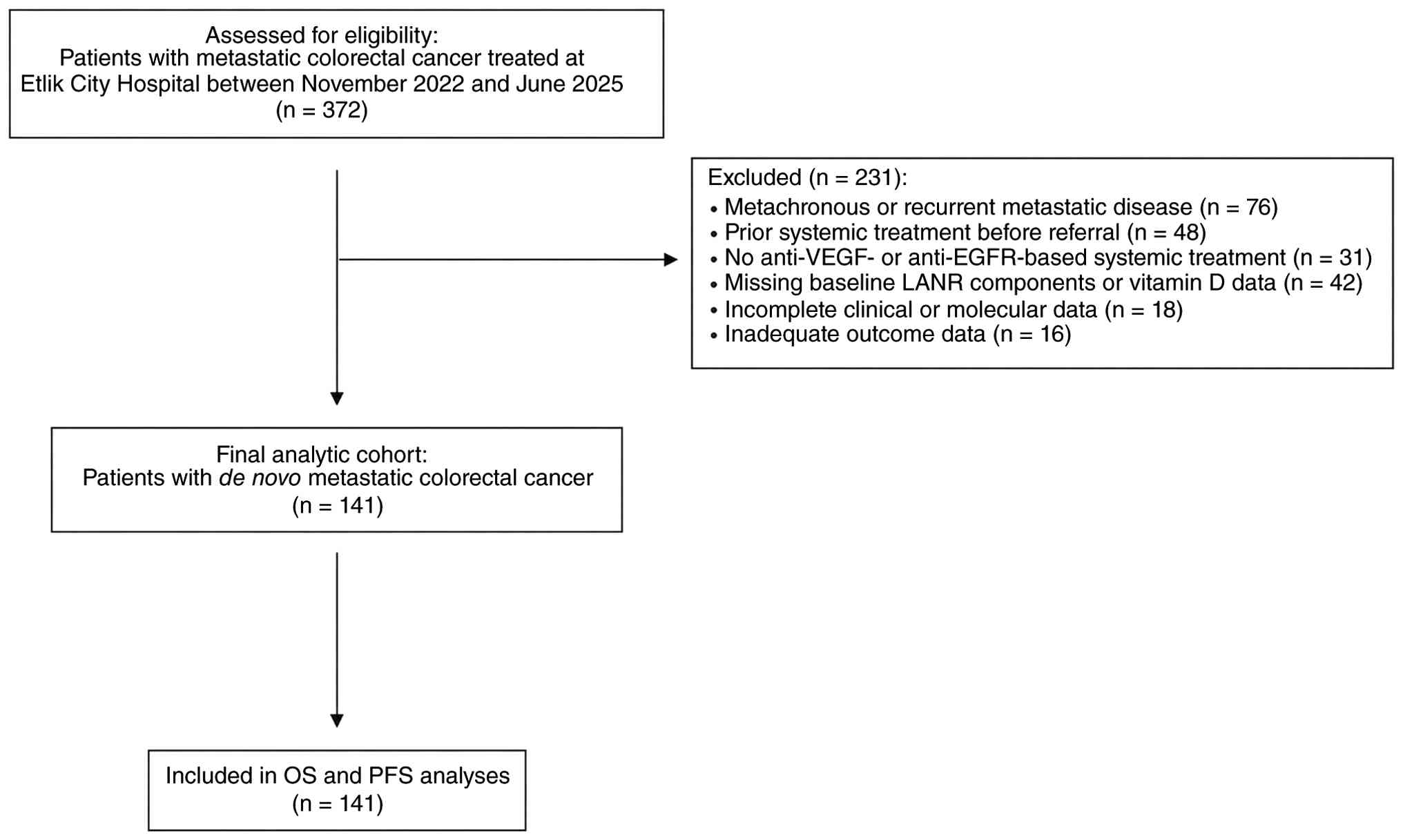
treatment. Patients were excluded for metachronous or recurrent
metastatic disease, systemic treatment before referral, absence of
anti-VEGF- or anti-EGFR-based treatment, missing laboratory data
within the required 7-day baseline window, incomplete clinical or
molecular data or inadequate outcome data. Restriction to de
novo metastatic disease was intended to reduce heterogeneity
related to prior disease course and treatment history. Because
eligibility also required receipt of a biologic agent, the cohort
represents a selected treatment population and does not include
patients managed without anti-VEGF or anti-EGFR therapy because of
frailty, comorbidity, access or an alternative treatment strategy.
Of 372 patients screened, 141 were included in the final cohort
(Fig. 1). The study was reported in
accordance with the Reporting Recommendations for Tumor Marker
Prognostic Studies (REMARK) (13).
Data collection and definitions
Baseline laboratory values, including serum
25-hydroxyvitamin D, were the closest measurements obtained within
7 days before initiation of first-line systemic treatment. LANR was
calculated as lymphocyte count multiplied by serum albumin and
divided by neutrophil count, using albumin in g/l and lymphocyte
and neutrophil counts in /µl. Because the numerical value of LANR
is unit-dependent, the same measurement units are required to
reproduce or interpret the estimates reported in the present study.
Baseline vitamin D was defined as the serum 25-hydroxyvitamin D
concentration measured within the same pretreatment window. All
measurements were generated as part of routine clinical care; no
research specimens or control samples were collected or stored for
the present study.
Clinical and molecular data were extracted from
electronic medical records. Comorbidity burden was summarized using
the age-adjusted Charlson Comorbidity Index (ACCI), in which age
contributes to the total score (14). Primary tumor location was classified
as right-sided colon, left-sided colon or rectum. Molecular
variables included KRAS, neuroblastoma RAS viral oncogene homolog
and BRAF alterations, HER2 status, and microsatellite instability
status. HER2 was classified as negative, positive or not assessed.
First-line treatment was classified by targeted therapy as
anti-VEGF or anti-EGFR and by chemotherapy backbone as folinic
acid, fluorouracil and oxaliplatin (FOLFOX), folinic acid,
fluorouracil and irinotecan (FOLFIRI), or capecitabine-based
treatment.
Treatment selection was determined by the treating
oncologist as part of routine care, with consideration of tumor
sidedness, molecular profile, performance status, comorbidity and
other clinical factors. The patient-specific rationale for choosing
anti-VEGF or anti-EGFR therapy and the chemotherapy backbone was
not systematically recorded in the retrospective dataset.
Outcomes
OS was defined as the time from initiation of
first-line systemic therapy to mortality from any cause. Patients
who were alive at data cut-off were censored at the date of last
known follow-up. PFS was defined as the time from initiation of
first-line systemic therapy to radiologic or clinical disease
progression or mortality from any cause, whichever occurred first.
Patients without progression or mortality were censored at the date
of their last disease assessment. Progression was determined by the
treating physician based on routine imaging and clinical
findings.
Statistical analysis
All analyses were performed in Python 3.12 (Python
Software Foundation; http://www.python.org/) using pandas, numpy, scipy,
statsmodels, lifelines, patsy, scikit-learn and matplotlib.
Continuous variables are presented as median and interquartile
range (IQR) and categorical variables as frequencies and
percentages. Carcinoembryonic antigen and carbohydrate antigen 19-9
were log-transformed. Patients with missing data required for
eligibility or analysis were excluded during cohort assembly; among
the 141 patients in the final cohort, no analysis variable was
missing and no imputation was performed. Two-sided P-values
<0.05 were considered statistically significant.
No formal sample-size calculation was performed for
the present prognostic analysis; all eligible patients who met the
study criteria during the study period were included.
Survival was estimated using the Kaplan-Meier
method, and median follow-up was calculated using the reverse
Kaplan-Meier method. Univariable Cox proportional hazards models
were fitted for baseline variables. Given the number of outcome
events relative to the number of candidate variables, variables
with P<0.10 were entered into the corresponding primary
multivariable model to limit the number of fitted coefficients.
This pragmatic screening strategy was not intended to define a
definitive covariate set and may yield unstable estimates.
Clinically selected multivariable models were therefore fitted as
sensitivity analyses and given greater interpretive weight when
assessing robustness. LANR was modeled per 5-unit increase and
vitamin D per 10 ng/ml increase. Albumin, neutrophil count and
lymphocyte count were not entered separately because they are
components of LANR.
HER2 status was represented by two dummy variables,
with negative status as the reference. Only the not-assessed
contrast met the entry criterion and was retained in the
multivariable OS model. Because the capecitabine group included
only 3 patients, its treatment contrast could not be estimated, and
the primary multivariable PFS model was restricted to 138 patients
treated with FOLFOX- or FOLFIRI-based regimens, including 121 PFS
events. The final OS and PFS models contained 11 and 6 regression
coefficients, respectively. Proportional hazards were assessed
using Schoenfeld residuals and log-minus-log plots, with no
relevant violations identified. Variance inflation factors were
assessed against a threshold of 5; no value exceeded 1.76.
Continuous associations of LANR and vitamin D with
survival were examined separately using restricted cubic splines in
univariable Cox models. Each spline used three degrees of freedom
and four knots, with the observed minimum and maximum as boundary
knots and two internal knots placed at equally spaced quantiles.
Cohort medians were used as reference values. Overall association
was assessed with a joint Wald test, and departure from linearity
with a likelihood ratio test. Tied event times in these spline
models were handled using the Breslow method. Additional
implementation and verification details are provided in Data S1 and Table SI.
Discrimination was assessed using Harrell's C-index
(15). For each endpoint, a
separate clinical reference model was used rather than the full
multivariable Cox model. The OS model included metformin use,
Eastern Cooperative Oncology Group (ECOG) performance status
(16), liver metastasis and BRAF
alteration. The PFS model included age group, ACCI group, liver
metastasis and chemotherapy backbone. In the PFS model,
chemotherapy backbone was coded as FOLFIRI-based vs.
non-FOLFIRI-based treatment, so all 141 patients could be included.
LANR and vitamin D were then added separately and together. C-index
values are apparent estimates and were not corrected for optimism.
From 1,000 percentile bootstrap resamples, 95% confidence intervals
(95% CIs) were obtained. C-index differences were assessed by
paired bootstrap resampling, refitting both models in each
resample.
Fixed-horizon discrimination at 12 and 24 months was
assessed using receiver operating characteristic analyses with
cumulative cases and dynamic controls. Patients who experienced the
event by each time point were considered cases, and those who
remained event-free beyond that time were controls. Patients
censored before the time point had an indeterminate outcome status
at that horizon and were therefore excluded; inverse probability of
censoring weighting was not used. For single-marker analyses, the
negative biomarker value was used so that higher scores indicated
higher risk. For the combined analysis, the linear predictor from a
Cox model containing both continuous biomarkers was used. CIs for
the areas under the curve were obtained from 1,000 percentile
bootstrap resamples.
Two sensitivity analyses were performed. First,
vitamin D was analyzed as a binary variable, defined as <20 vs.
≥20 ng/ml. Second, Cox models were fitted using clinically selected
covariates rather than variables selected by univariable P-value.
These models included age group, ECOG performance status, primary
tumor location, metastatic burden, BRAF status, targeted therapy
class, LANR and vitamin D. Metastatic burden was defined as two or
more vs. fewer than two involved sites. The same covariates were
used for OS and PFS, and all 141 patients were included. These
models assessed whether the biomarker associations persisted under
a clinically based adjustment structure that did not depend on
univariable P-values and were emphasized when interpreting
robustness.
Results
Patient characteristics and survival
outcomes
Baseline characteristics of the 141 patients are
shown in Table I. The median age
was 68.4 years (IQR, 57.8–73.4 years), 79 patients (56.0%) were
male and 114 (80.9%) had an ECOG performance status of 0 or 1. The
primary tumor was right-sided in 54 patients (38.3%), left-sided in
51 (36.2%) and rectal in 36 (25.5%). Liver metastases were present
in 103 patients (73.0%). KRAS alterations were found in 100
patients (70.9%) and BRAF alterations in 10 (7.1%). Anti-VEGF-based
treatment was given to 122 patients (86.5%). Median baseline LANR
was 10.49 (IQR, 6.75–16.38), and median baseline vitamin D was 11.0
ng/ml (IQR 7.0–21.0), with 103 patients (73.0%) <20 ng/ml.
 | Table I.Baseline characteristics of patients
with de novo metastatic colorectal cancer. |
Table I.
Baseline characteristics of patients
with de novo metastatic colorectal cancer.
| A, Demographic and
anthropometric |
|---|
|
|---|
| Characteristic | No. of patients |
|---|
| Median age,
years | 68.4
(57.8–73.4) |
| Age, years |
|
| <65
years | 53 (37.6%) |
| ≥65
years | 88 (62.4%) |
| Sex |
|
|
Female | 62 (44.0%) |
|
Male | 79 (56.0%) |
| Height, cm | 161 (156–170) |
| Weight, kg | 67 (60–75) |
| BMI,
kg/m2 | 25.4
(21.9–27.9) |
|
| B,
Clinical |
|
|
Characteristic | No. of
patients |
|
| ECOG PS |
|
|
0-1 | 114 (80.9%) |
|
2-3 | 27 (19.1%) |
| ACCI |
|
|
<8 | 26 (18.4%) |
| ≥8 | 115 (81.6%) |
| Smoking
history |
|
|
Absent | 28 (19.9%) |
|
Present | 113 (80.1%) |
| Primary tumor
location |
|
|
Right-sided colon | 54 (38.3%) |
|
Left-sided colon | 51 (36.2%) |
|
Rectum | 36 (25.5%) |
| Metastatic sites,
present |
|
|
Peritoneal metastasis | 37 (26.2%) |
| Liver
metastasis | 103 (73.0%) |
| Lung
metastasis | 33 (23.4%) |
| Bone
metastasis | 9 (6.4%) |
| Ovarian
metastasis | 5 (3.5%) |
| Distant
lymph node metastasis | 35 (24.8%) |
|
| C,
Treatment |
|
|
Characteristic | No. of
patients |
|
| Anti-EGFR-based
treatment | 19 (13.5%) |
| Anti-VEGF-based
treatment | 122 (86.5%) |
| FOLFOX-based
chemotherapy | 101 (71.6%) |
| FOLFIRI-based
chemotherapy | 37 (26.2%) |
| Capecitabine-based
chemotherapy | 3 (2.1%) |
| Metformin use |
|
|
Absent | 82 (58.2%) |
|
Present | 59 (41.8%) |
|
| D,
Molecular |
|
|
Characteristic | No. of
patients |
|
| KRAS
alteration |
|
|
Absent | 41 (29.1%) |
|
Present | 100 (70.9%) |
| NRAS
alteration |
|
|
Absent | 133 (94.3%) |
|
Present | 8 (5.7%) |
| BRAF
alteration |
|
|
Absent | 131 (92.9%) |
|
Present | 10 (7.1%) |
| HER2 status |
|
|
Negative | 48 (34.0%) |
|
Positive | 6 (4.3%) |
| Not
assessed | 87 (61.7%) |
| Microsatellite
stable | 137 (97.2%) |
| MSI-H | 4 (2.8%) |
|
| E, Baseline
laboratory markers |
|
|
Characteristic | No. of
patients |
|
| LANR | 10.49
(6.75–16.38) |
| Baseline
25-hydroxyvitamin D, ng/ml | 11.0
(7.0–21.0) |
| Baseline
25-hydroxyvitamin D |
|
| <20
ng/ml | 103 (73.0%) |
| ≥20
ng/ml | 38 (27.0%) |
| Albumin, g/l | 38.0
(33.0–41.0) |
| Neutrophil count,
/µl | 6,210
(4,230–7,460) |
| Lymphocyte count,
/µl | 1,650
(1,210–2,050) |
| Platelet count,
/µl | 352,000
(296,000–410,000) |
| Hemoglobin,
g/dl | 11.8
(10.9–13.2) |
| CEA, ng/ml | 18.0
(5.0–188.0) |
| CA19-9, U/ml | 56.0
(19.0–223.0) |
After a median follow-up of 30.7 months (95% CI,
27.8–36.9 months), 88 mortalities (62.4%) and 124 PFS events
(87.9%) had occurred. Median OS was 23.5 months (95% CI, 19.3–31.5
months), and median PFS was 12.4 months (95% CI, 11.0–13.6 months).
These outcomes are summarized in Table
SII.
Cox regression analyses
Univariable and multivariable Cox regression results
for both endpoints are shown in Table
II. Univariable results for variables that did not enter either
multivariable model are shown in Table
SIII.
| Table II.Univariable and multivariable Cox
proportional hazards regression analyses for OS and PFS. |
Table II.
Univariable and multivariable Cox
proportional hazards regression analyses for OS and PFS.
| Variable | OS univariable | OS
multivariable | PFS
univariable | PFS
multivariable |
|---|
| LANR, per 5-unit
increase | 0.76
(0.65–0.89); | 0.80
(0.66–0.96); | 0.81
(0.73–0.91); | 0.83
(0.72–0.94); |
|
| P<0.001 | P=0.015 | P<0.001 | P=0.005 |
| Baseline
25-hydroxyvitamin D, | 0.65
(0.50–0.85); | 0.80
(0.60–1.08); | 0.73
(0.60–0.89); | 0.80
(0.67–0.93); |
| per 10 ng/ml
increase | P=0.002 | P=0.147 | P=0.002 | P=0.038 |
| Metformin use,
present vs. absent | 0.43
(0.26–0.69); | 0.31
(0.19–0.52); | 0.94
(0.66–1.35); | Not entered |
|
| P<0.001 | P<0.001 | P=0.747 |
|
| Age, ≥65 vs. <65
years | 0.90
(0.58–1.41); | Not entered | 0.72
(0.49–1.04); | 0.75
(0.45–1.26); |
|
| P=0.648 |
| P=0.078 | P=0.272 |
| BMI, per 1
kg/m2 increase | 0.94
(0.90–0.99); | 0.94
(0.90–0.99); | 0.97
(0.93–1.01); | Not entered |
|
| P=0.018 | P=0.020 | P=0.110 |
|
| ECOG PS, 2–3 vs.
0–1 | 2.82
(1.77–4.49); | 1.71
(1.00–2.93); | 1.43
(0.92–2.20); | Not entered |
|
| P<0.001 | P=0.048 | P=0.110 |
|
| ACCI, <8 vs.
≥8 | 0.76
(0.45–1.29); | Not entered | 0.62
(0.40–0.96); | 0.93
(0.50–1.72); |
|
| P=0.317 |
| P=0.033 | P=0.816 |
| Liver metastasis,
present vs. absent | 1.59
(0.94–2.67); | 1.40
(0.80–2.45); | 1.63
(1.07–2.47); | 1.50
(0.95–2.37); |
|
| P=0.084 | P=0.243 | P=0.022 | P=0.081 |
| Distant lymph node
metastasis, | 2.04
(1.18–3.57); | 2.38
(1.27–4.35); | 2.03
(0.90–4.24); | Not entered |
| present vs.
absent | P=0.012 | P=0.007 | P=0.176 |
|
| FOLFIRI vs.
FOLFOX-based | 1.13
(0.71–1.80); | Not entered | 1.47
(0.99–2.19); | 1.67
(1.08–2.57); |
| chemotherapy | P=0.611 |
| P=0.059 | P=0.020 |
| BRAF alteration,
present vs. absent | 2.08
(1.00–4.37); | 3.63
(1.62–8.13); | 1.35
(0.65–2.78); | Not entered |
|
| P=0.052 | P=0.002 | P=0.421 |
|
| HER2 status, not
assessed vs. absent | 1.63
(1.03–2.60); | 1.42
(0.88–2.30); | 1.19
(0.81–1.74); | Not entered |
|
| P=0.038 | P=0.156 | P=0.380 |
|
| CA19-9,
log-transformed | 1.12
(1.01–1.26); | 1.12
(0.98–1.27); | 1.06
(0.96–1.16); | Not entered |
|
| P=0.038 | P=0.100 | P=0.248 |
|
| Hemoglobin, per 1
g/dl increase | 0.87
(0.77–0.98); | 0.93
(0.81–1.06); | 0.93
(0.84–1.03); | Not entered |
|
| P=0.025 | P=0.270 | P=0.169 |
|
Higher LANR was associated with a lower risk of
mortality in univariable analysis (HR, 0.76 per 5-unit increase;
95% CI, 0.65–0.89; P<0.001) and remained after multivariable
analysis (HR, 0.80; 95% CI, 0.66–0.96; P=0.015). Metformin use (HR,
0.31; 95% CI, 0.19–0.52; P<0.001), higher body mass index (HR,
0.94 per 1 kg/m2; 95% CI, 0.90–0.99; P=0.020), ECOG
performance status of 2 or 3 (HR, 1.71; 95% CI, 1.00–2.93;
P=0.048), distant lymph node metastasis (HR, 2.38; 95% CI,
1.27–4.35; P=0.007) and BRAF alteration (HR, 3.63; 95% CI,
1.62–8.13; P=0.002) were also independently associated with OS.
Higher baseline vitamin D was associated with a lower risk of
mortality in the univariable analysis (HR, 0.65 per 10 ng/ml
increase; 95% CI, 0.50–0.85; P=0.002), but the association was not
statistically significant after multivariable analysis (HR, 0.80;
95% CI, 0.60–1.08; P=0.147).
For PFS, both markers remained associated with
outcome after adjustment: LANR (HR, 0.83; 95% CI, 0.72–0.94;
P=0.005) and vitamin D (HR, 0.80; 95% CI, 0.67–0.93; P=0.038).
FOLFIRI-based chemotherapy was associated with a higher risk of
progression or mortality than FOLFOX-based chemotherapy (HR, 1.67;
95% CI, 1.08–2.57; P=0.020).
Spline analyses
Restricted cubic spline curves are shown in Fig. 2 for LANR and Fig. 3 for vitamin D. Higher LANR was
associated with lower hazards for both endpoints (overall
association: OS, P<0.001; PFS, P=0.010), with no evidence of
non-linearity (P=0.137 and P=0.737, respectively). Higher vitamin D
was also associated with lower hazards (overall association: OS,
P=0.008; PFS, P=0.017), with no evidence of non-linearity (P=0.519
and P=0.815, respectively).
Discrimination and sensitivity
analyses
Discrimination results are shown in Table III. For OS, the C-index of the
clinical model was 0.689. Adding LANR (0.721), vitamin D (0.706) or
both markers (0.722) increased the C-index, but none of these
changes reached statistical significance (P=0.083, 0.233 and 0.071,
respectively). For PFS, the clinical model C-index was 0.585.
Adding LANR (0.618), vitamin D (0.622) or both markers (0.636)
increased the C-index, but only the combined addition reached
statistical significance (P=0.135, 0.061 and 0.039, respectively;
ΔC-index 0.051 for the combined model).
| Table III.Discrimination of clinical and
biomarker-augmented models for OS and PFS. |
Table III.
Discrimination of clinical and
biomarker-augmented models for OS and PFS.
| Model | OS C-index (95%
CI) | OS ΔC-index | OS P-value | PFS C-index (95%
CI) | PFS ΔC-index | PFS P-value |
|---|
| Clinical model | 0.689
(0.624–0.751) | Reference |
| 0.585
(0.531–0.641) | Reference |
|
| Clinical model +
LANR | 0.721
(0.661–0.781) | +0.032 | 0.083 | 0.618
(0.560–0.675) | +0.033 | 0.135 |
| Clinical model +
25(OH)D | 0.706
(0.641–0.771) | +0.017 | 0.233 | 0.622
(0.568–0.674) | +0.037 | 0.061 |
| Clinical model +
LANR + 25(OH)D | 0.722
(0.660–0.782) | +0.033 | 0.071 | 0.636
(0.582–0.690) | +0.051 | 0.039 |
In the sensitivity analysis using clinically
selected covariates (Table SIV),
LANR remained associated with both endpoints (OS: HR, 0.80; 95% CI,
0.68–0.96; P=0.013; PFS: HR, 0.83; 95% CI, 0.73–0.94; P=0.004). The
associations for vitamin D were attenuated and did not reach
statistical significance (OS: HR, 0.79; 95% CI, 0.60–1.05; P=0.108;
PFS: HR, 0.82; 95% CI, 0.66–1.02; P=0.077). Results with vitamin D
as a binary variable are shown in Tables SV and SVI. Fixed-horizon areas under the curve
at 12 and 24 months are shown in Table
SVII.
Discussion
In the present cohort of 141 patients with de
novo metastatic colorectal cancer who received first-line
biologic treatment, higher baseline LANR was associated with lower
risks of mortality and of progression or mortality. The estimates
were essentially unchanged in models using clinically selected
covariates, and spline analyses showed no evidence of departure
from linearity. However, the added discrimination beyond the
clinical models was modest. Vitamin D, which was evaluated as a
secondary exploratory biomarker, showed less consistent
associations across endpoints and model specifications.
LANR was initially described in resectable
colorectal cancer, in which higher values were associated with
longer overall and disease-free survival (8). A subsequent surgical cohort reported a
similar direction of association for a mathematically equivalent
albumin to NLR (9), and prognostic
associations have been reported in other solid tumors (17–21).
These studies largely involved surgically resected or definitively
treated populations and commonly categorized the index using
study-derived thresholds. The present study examined LANR on its
continuous scale in a de novo metastatic cohort, thereby
evaluating a different disease and treatment setting without
deriving an optimal cut-off value from the same data.
The components of LANR provide biological
plausibility for a prognostic association, as neutrophils,
lymphocytes and albumin relate to systemic inflammation and host
condition (2–4). However, LANR does not directly measure
antitumor immunity or demonstrate a specific biological mechanism.
Its components can be altered by intercurrent infection, hepatic
dysfunction, hydration status, corticosteroids or other
medications, recent clinical events, and comorbidity. LANR should
therefore be interpreted as a composite prognostic signal rather
than a direct measure of a single immune or inflammatory
pathway.
LANR can be calculated from routine pretreatment
blood counts and serum albumin, but this practicality does not
establish clinical utility. Adding LANR to the clinical models
increased the C-index by 0.032 for OS and 0.033 for PFS, however
neither increment was statistically significant. The analyses were
prognostic and did not test treatment-by-biomarker interactions;
therefore, they do not show that LANR predicts differential benefit
from anti-VEGF therapy, anti-EGFR therapy or chemotherapy backbone.
Treatment was not randomly assigned. Although targeted therapy
class was included in the clinically selected models and
chemotherapy backbone was evaluated, residual confounding by
indication and by uncaptured treatment-selection factors remains
possible.
Vitamin D was evaluated as a secondary exploratory
biomarker and showed a less consistent pattern than LANR. Vitamin D
receptor signaling has been proposed to influence colorectal cancer
biology (22). Higher baseline
25-hydroxyvitamin D was associated with longer PFS in the primary
model but not with OS, and the PFS association was attenuated to
non-significant in clinically selected models. Observational
studies have linked higher circulating concentrations with improved
colorectal cancer outcomes (11,12),
but randomized evidence has not established a survival benefit from
supplementation of vitamin D. SUNSHINE suggested a possible PFS
benefit, although its primary log-rank comparison was not
statistically significant (23);
AMATERASU did not improve relapse-free survival (24), and SOLARIS did not improve PFS or OS
(25). The present findings are
hypothesis-generating and do not support a therapeutic benefit from
vitamin D supplementation.
Metformin use was associated with OS but not PFS. A
previous meta-analysis found that metformin use was associated with
better overall survival among patients with colorectal cancer and
diabetes, but the association with cancer-specific survival was not
statistically significant (26).
Because diabetes was not coded as a separate variable and metformin
users were compared with all other patients, this secondary finding
is vulnerable to residual confounding and confounding by indication
and should be regarded as hypothesis-generating.
The present study has important limitations. Its
retrospective, single-center design and relatively small sample of
141 patients limit generalizability. Eligibility required
first-line anti-VEGF- or anti-EGFR-based treatment, so the findings
do not represent all patients with de novo metastatic
colorectal cancer, particularly those who did not receive a
biologic agent because of frailty, comorbidity, access, or
treatment strategy. Exclusion of patients with unavailable
laboratory, clinical, molecular or outcome data and the resulting
complete-case cohort may also have introduced selection bias.
The primary models used univariable P-value
screening, which is data-driven and may produce unstable or overly
optimistic estimates. This concern is greater for OS, for which 88
mortalities supported 11 coefficients. Greater emphasis was
therefore placed on the similar LANR estimates from the clinically
selected sensitivity models. C-index estimates were not corrected
for optimism, and no external validation was performed.
Treatment-selection criteria and potential transient influences on
baseline blood measurements were not systematically captured.
Progression was assessed in routine practice without central
radiologic review or a standardized study-specific schedule.
Fixed-horizon analyses excluded patients censored before each time
point without inverse probability weighting, and spline models were
unadjusted. The cohort also had low vitamin D concentrations, and
LANR was not directly compared with established inflammatory
indices. Studies are needed to validate the continuous association
and determine whether LANR provides clinically meaningful
information beyond established prognostic factors.
To address these limitations, future studies should
use larger, prospective, multicenter cohorts with consecutive
enrollment, including patients treated without biologic agents.
Sample size should be planned according to anticipated outcome
events and model complexity, with clinically relevant covariates
specified before analysis. Pretreatment sampling, laboratory units
and outcome assessment should be standardized, and factors
influencing LANR and treatment selection should be recorded
prospectively. LANR should remain a continuous variable, with
internal validation to assess optimism and independent external
validation to evaluate discrimination and calibration. Direct
comparisons with established inflammatory indices and assessment of
added value beyond clinical prognostic factors are needed before
considering clinical use.
In the present selected cohort of patients with
de novo metastatic colorectal cancer receiving first-line
anti-VEGF- or anti-EGFR-based treatment, higher baseline LANR was
associated with longer OS and PFS when analyzed continuously. Its
incremental discrimination beyond clinical models was modest, and
the study did not assess predictive value for treatment benefit.
External validation is required before LANR is considered for
clinical application. The vitamin D findings remain secondary and
exploratory.
Supplementary Material
Supporting Data
Acknowledgements
Not applicable.
Funding
Funding: No funding was received.
Availability of data and materials
The data generated in the present study may be
requested from the corresponding author.
Authors' contributions
EY conceptualized the study, contributed to the
methodology and investigation, curated the data, prepared the
visualizations and drafted the manuscript. GCU contributed to the
methodology, performed the formal analysis and validation, and
critically revised the manuscript. KB, KBY and HS contributed to
the investigation, data curation, interpretation of the clinical
data and critical revision of the manuscript. MA and OBCO
supervised the study, contributed to the clinical interpretation of
the survival findings and the associations of LANR and vitamin D
with outcomes, and critically revised the manuscript. OS
contributed to the conception and design of the study and
critically revised the manuscript. All authors contributed to
interpretation of the results. EY and GCU confirm the authenticity
of all the raw data. All authors read and approved the final
version of the manuscript.
Ethics approval and consent to
participate
The study was approved by the Scientific Research
Evaluation and Ethics Committee of Ankara Etlik City Hospital
(approval no. AEŞH-BADEK2-2025-160; 10 June 2025) and was conducted
in accordance with the Declaration of Helsinki. The requirement for
informed consent was waived by the ethics committee because of the
retrospective study design.
Patient consent for publication
Not applicable.
Competing interests
The authors declare that they have no competing
interests.
Use of artificial intelligence tools
During the preparation of this work, artificial
intelligence tools were used to improve the readability and
language of the manuscript and subsequently, the authors revised
and edited the content produced by the artificial intelligence
tools as necessary, taking full responsibility for the ultimate
content of the present manuscript.
Glossary
Abbreviations
Abbreviations:
|
25(OH)D
|
25-hydroxyvitamin D
|
|
ACCI
|
age-adjusted Charlson Comorbidity
Index
|
|
CI
|
confidence interval
|
|
ECOG
|
Eastern Cooperative Oncology Group
|
|
FOLFIRI
|
folinic acid, fluorouracil and
irinotecan
|
|
FOLFOX
|
folinic acid, fluorouracil and
oxaliplatin
|
|
HR
|
hazard ratio
|
|
IQR
|
interquartile range
|
|
LANR
|
lymphocyte-albumin-neutrophil
ratio
|
|
MSI-H
|
microsatellite instability-high
|
|
MSS
|
microsatellite stable
|
|
NLR
|
neutrophil-to-lymphocyte ratio
|
|
NRAS
|
neuroblastoma RAS viral oncogene
homolog
|
|
OS
|
overall survival
|
|
PFS
|
progression-free survival
|
References
|
1
|
Cervantes A, Adam R, Roselló S, Arnold D,
Normanno N, Taïeb J, Seligmann J, De Baere T, Osterlund P, Yoshino
T, et al: Metastatic colorectal cancer: ESMO clinical practice
guideline for diagnosis, treatment and follow-up. Ann Oncol.
34:10–32. 2023. View Article : Google Scholar : PubMed/NCBI
|
|
2
|
Coffelt SB, Wellenstein MD and de Visser
KE: Neutrophils in cancer: Neutral no more. Nat Rev Cancer.
16:431–446. 2016. View Article : Google Scholar : PubMed/NCBI
|
|
3
|
Waidhauser J, Nerlinger P, Sommer F, Wolf
S, Eser S, Löhr P, Rank A and Märkl B: Circulating lymphocytes
reflect the local immune response in patients with colorectal
carcinoma. Diagnostics (Basel). 12:14082022. View Article : Google Scholar : PubMed/NCBI
|
|
4
|
Evans DC, Corkins MR, Malone A, Miller S,
Mogensen KM, Guenter P and Jensen GL; ASPEN Malnutrition Committee,
: The use of visceral proteins as nutrition markers: An ASPEN
position paper. Nutr Clin Pract. 36:22–28. 2021. View Article : Google Scholar : PubMed/NCBI
|
|
5
|
Naszai M, Kurjan A and Maughan TS: The
prognostic utility of pre-treatment neutrophil-to-lymphocyte-ratio
(NLR) in colorectal cancer: A systematic review and meta-analysis.
Cancer Med. 10:5983–5997. 2021. View Article : Google Scholar : PubMed/NCBI
|
|
6
|
Proctor MJ, Morrison DS, Talwar D, Balmer
SM, O'Reilly DS, Foulis AK, Horgan PG and McMillan DC: An
inflammation-based prognostic score (mGPS) predicts cancer survival
independent of tumour site: A glasgow inflammation outcome study.
Br J Cancer. 104:726–734. 2011. View Article : Google Scholar : PubMed/NCBI
|
|
7
|
Pagès F, Mlecnik B, Marliot F, Bindea G,
Ou FS, Bifulco C, Lugli A, Zlobec I, Rau TT, Berger MD, et al:
International validation of the consensus immunoscore for the
classification of colon cancer: A prognostic and accuracy study.
Lancet. 391:2128–2139. 2018. View Article : Google Scholar : PubMed/NCBI
|
|
8
|
Liang X, Yao S, Lu P, Ma Y, Xu H, Yin Z,
Hu J, Liu Y and Wei S: The prognostic value of new index (LANR)
composed of pre-operative lymphocytes, albumin, and neutrophils in
patients with resectable colorectal cancer. Front Oncol.
11:6102642021. View Article : Google Scholar : PubMed/NCBI
|
|
9
|
Xie H, Xu N, Wei L, Tang S and Gan J: The
prognostic value of the albumin/neutrophil-to-lymphocyte ratio in
colorectal cancer patients: A retrospective cohort study. Front
Oncol. 16:16681032026. View Article : Google Scholar : PubMed/NCBI
|
|
10
|
Doğan A, Yıldırım S, Erölmez HN, Akdağ G,
Yıldız HŞ, Yüksel Yaşar ZY, Sürmeli H, İlhan N, Sever ÖN, Odabaş H,
et al: Prognostic value of the cancer inflammation prognostic index
(CIPI) in de novo metastatic colon cancer: A multicenter
retrospective cohort study. Cancer Control.
33:107327482614322732026. View Article : Google Scholar : PubMed/NCBI
|
|
11
|
Maalmi H, Walter V, Jansen L, Boakye D,
Schöttker B, Hoffmeister M and Brenner H: Association between blood
25-hydroxyvitamin D levels and survival in colorectal cancer
patients: An updated systematic review and meta-analysis.
Nutrients. 10:8962018. View Article : Google Scholar : PubMed/NCBI
|
|
12
|
Ng K, Sargent DJ, Goldberg RM, Meyerhardt
JA, Green EM, Pitot HC, Hollis BW, Pollak MN and Fuchs CS: Vitamin
D status in patients with stage IV colorectal cancer: Findings from
intergroup trial N9741. J Clin Oncol. 29:1599–1606. 2011.
View Article : Google Scholar : PubMed/NCBI
|
|
13
|
McShane LM, Altman DG, Sauerbrei W, Taube
SE, Gion M and Clark GM: Reporting recommendations for tumor marker
prognostic studies (REMARK). J Natl Cancer Inst. 97:1180–1184.
2005. View Article : Google Scholar : PubMed/NCBI
|
|
14
|
Charlson M, Szatrowski TP, Peterson J and
Gold J: Validation of a combined comorbidity index. J Clin
Epidemiol. 47:1245–1251. 1994. View Article : Google Scholar : PubMed/NCBI
|
|
15
|
Harrell FE Jr, Lee KL and Mark DB:
Multivariable prognostic models: Issues in developing models,
evaluating assumptions and adequacy, and measuring and reducing
errors. Stat Med. 15:361–387. 1996. View Article : Google Scholar : PubMed/NCBI
|
|
16
|
Oken MM, Creech RH, Tormey DC, Horton J,
Davis TE, McFadden ET and Carbone PP: Toxicity and response
criteria of the eastern cooperative oncology group. Am J Clin
Oncol. 5:649–655. 1982. View Article : Google Scholar : PubMed/NCBI
|
|
17
|
Zhuang J, Wang S, Wang Y, Wu Y and Hu R:
Prognostic significance of preoperative lymphocytes, albumin, and
neutrophils (LANR) index in resectable pancreatic ductal
adenocarcinoma. BMC Cancer. 24:5682024. View Article : Google Scholar : PubMed/NCBI
|
|
18
|
Zhang S, Chen Z, Ling J, Feng Y, Xie Y,
Liu X, Hu C and Hou T: Nomograms based on the
lymphocyte-albumin-neutrophil ratio (LANR) for predicting the
prognosis of nasopharyngeal carcinoma patients after definitive
radiotherapy. Sci Rep. 14:53882024. View Article : Google Scholar : PubMed/NCBI
|
|
19
|
Li R, Liu Q, Wang H, Chen Q, Pan C, Luo W
and Luo C: Nomogram based on the novel index LANR, composed of
preoperative lymphocytes, albumin, and neutrophils, for predicting
prognosis in patients with gastric cancer: A retrospective study.
Front Oncol. 15:16349482025. View Article : Google Scholar : PubMed/NCBI
|
|
20
|
Wang S, Wang Y, Zhuang J, Wu Y, Shi W and
Wang L: Prognostic significance of index (LANR) composed of
preoperative lymphocytes, albumin, and neutrophils in patients with
stage IB-IIA cervical cancer. PLoS One. 18:e02909052023. View Article : Google Scholar : PubMed/NCBI
|
|
21
|
Wang Y, Zhuang J, Wang S, Wu Y and Chen L:
The prognostic value of preoperative neoindices consisting of
lymphocytes, neutrophils and albumin (LANR) in operable breast
cancer: A retrospective study. PeerJ. 12:e173822024. View Article : Google Scholar : PubMed/NCBI
|
|
22
|
Peixoto RD, Oliveira LJC, Passarini TM,
Andrade AC, Diniz PH, Prolla G, Amorim LC, Gil M, Lino F,
Garicochea B, et al: Vitamin D and colorectal cancer: A practical
review of the literature. Cancer Treat Res Commun.
32:1006162022.PubMed/NCBI
|
|
23
|
Ng K, Nimeiri HS, McCleary NJ, Abrams TA,
Yurgelun MB, Cleary JM, Rubinson DA, Schrag D, Miksad R, Bullock
AJ, et al: Effect of high-dose vs standard-dose vitamin D3
supplementation on progression-free survival among patients with
advanced or metastatic colorectal cancer: The SUNSHINE randomized
clinical trial. JAMA. 321:1370–1379. 2019. View Article : Google Scholar : PubMed/NCBI
|
|
24
|
Urashima M, Ohdaira H, Akutsu T, Okada S,
Yoshida M, Kitajima M and Suzuki Y: Effect of vitamin D
supplementation on relapse-free survival among patients with
digestive tract cancers: The AMATERASU randomized clinical trial.
JAMA. 321:1361–1369. 2019. View Article : Google Scholar : PubMed/NCBI
|
|
25
|
Ng K, Ou F, Zemla T, Jackson NA, Kalyan A,
Devoe C, Shusterman M, Vijayvergia N, Wu CS, Cohen SA, et al:
Addition of high-dose vitamin D3 to standard treatment in patients
with metastatic colorectal cancer: The SOLARIS randomized clinical
trial (Alliance A021703). JAMA. 336:746–754. 2026. View Article : Google Scholar : PubMed/NCBI
|
|
26
|
Meng F, Song L and Wang W: Metformin
improves overall survival of colorectal cancer patients with
diabetes: A meta-analysis. J Diabetes Res. 2017:50632392017.
View Article : Google Scholar : PubMed/NCBI
|