Introduction
The incidence and mortality rates of malignant
tumors remain high worldwide, and cancer continues to pose a major
public health burden (1,2). According to GLOBOCAN 2022 estimates,
~20 million new cancer cases and 9.7 million cancer-related deaths
occurred worldwide in 2022 (1).
Although surgery, chemotherapy, radiotherapy, molecular targeted
therapy and immunotherapy have advanced considerably in recent
years, tumor heterogeneity, recurrence, metastasis and multidrug
resistance continue to limit treatment efficacy (3,4).
Therefore, identifying novel cancer-related molecular biomarkers
and elucidating their roles in tumor initiation and progression
remain priorities in basic and translational oncology.
Family with sequence similarity 83 member D (FAM83D)
was first identified as a spindle-associated protein (also termed
CHICA) in 2008, and its oncogenic role has increasingly been
recognized in multiple types of cancer (5). The FAM83D gene is located on
chromosome 20q11.23 and encodes a member of the FM83 protein
family. The FAM83D protein contains a highly conserved domain of
unknown function 1669 (DUF1669) domain, which is considered to be
involved in protein interactions and signal transduction (6). Studies have indicated that FAM83D
participates in cell-cycle regulation and mitosis in normal cells
(5,7). With advances in multiomics and
functional cancer studies, FAM83D has emerged as a
cancer-associated protein of interest in multiple solid tumors
(8,9). Previous studies have suggested that
high FAM83D expression levels are associated with advanced tumor
stage progression, lymph node metastasis, worse survival and
therapeutic resistance, and that FAM83D may contribute to abnormal
activation of several classical oncogenic signaling pathways
(10–12).
Research on FAM83D has expanded from expression
profiling to functional validation, mechanistic exploration and
preliminary assessment of its clinical relevance. Nevertheless, the
biological roles of FAM83D vary across types of tumors, and some
conclusions are mainly derived from database analyses or in
vitro experiments, providing limited levels of evidence
(8,9,13). In
addition, high-quality clinical evidence supporting FAM83D as a
robust and reliable biomarker or establishing its druggability
remain lacking (9). Therefore, a
systematic review and comprehensive evaluation of the existing
evidence is warranted. Unlike previous reviews which primarily
examine the FAM83 protein family as a whole or examine specific
types of cancer, the present review provides an updated,
FAM83D-specific synthesis, with particular emphasis on recently
published mechanistic insights (2024–2026), comparisons across
different types of cancer and critical evaluation of challenges to
clinical translational (14).
FAM83D has functions beyond typical cell-cycle
regulation. Unlike conventional cyclins or cyclin-dependent kinases
(CDKs), FAM83D functions as a scaffolding protein that anchors
casein kinase 1 (CK1) isoforms via its DUF1669 domain (15), thereby coupling cell-cycle
regulation to several oncogenic signaling pathways, including
Wnt/β-catenin, MAPK/ERK and PI3K/AKT (6,7).
Moreover, its prognostic value has been validated across multiple
types of cancer, a feature that distinguishes FAM83D from
conventional cyclins and CDKs (8,9). The
scaffolding function of FAM83D may also provide opportunities for
therapeutic targeting through protein-protein interaction
interfaces (12). Together, these
features highlight FAM83D as a cancer-associated protein with
potential biological and clinical relevance beyond its established
role in cell cycle regulation. The present review summarizes the
basic biological characteristics of FAM83D as well as its
expression patterns and functions across malignancies, its
potential regulatory networks and critically evaluates the
potential utility and current limitations of FAM83D as a biomarker
and therapeutic target.
Basic biological characteristics of
FAM83D
Gene and protein structural
features
The Human FAM83D gene, also referred to as
FAM83D/scaffolding CK1 (SACK1) anchoring protein D in some
annotations, is located on chromosome 20q11.23 (16). According to the annotation
summarized in Fig. 1, the
representative RefSeq transcript of FAM83D is NM_030919.3 (17). The FAM83D protein comprises 585
amino acids and has a predicted molecular weight of ~64.4 kDa. The
N-terminus of FAM83D contains a conserved DUF1669/SACK1 domain, a
characteristic feature of the FAM83 protein family that is involved
in anchoring CK1 isoforms and mediating protein-protein
interactions (6,15). Similar to other FAM83 family
members, FAM83D is not a classical enzyme but is hypothesized to
function primarily as a scaffolding or regulatory protein involved
in multiple cellular processes (6,18). A
previous study has indicated that FAM83D exhibits dynamic changes
in localization and expression during mitosis, supporting its role
in cell cycle regulation (7).
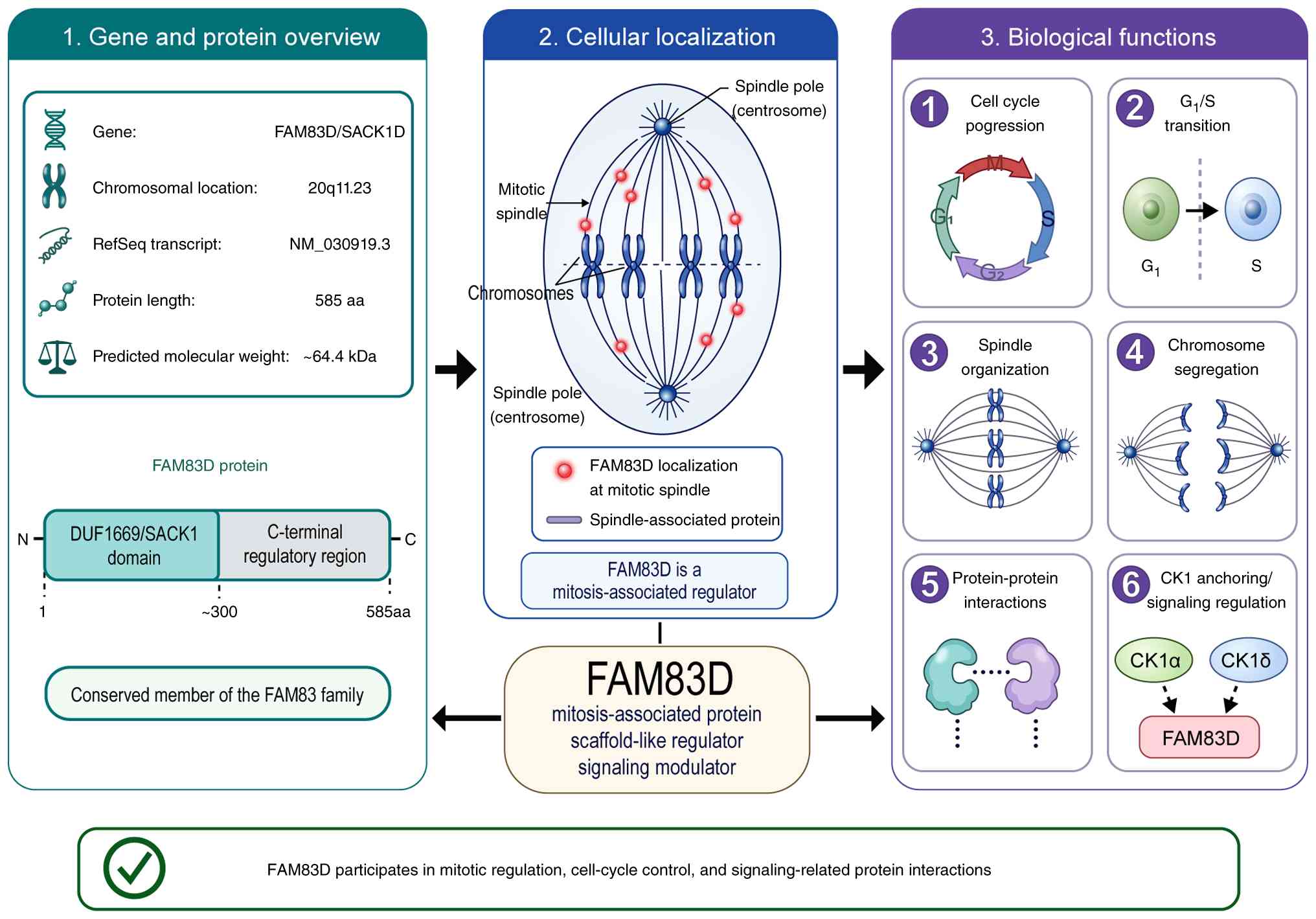 | Figure 1.Structural features, cellular
localization and biological functions of FAM83D. FAM83D, also
referred to as FAM83D/SACK1D in some annotations, is a conserved
member of the FAM83 protein family and contains an N-terminal
DUF1669/SACK1 domain, which is associated with CK1 isoform
anchoring and protein-protein interactions. The protein information
summarized in this figure indicates a protein length of 585 aa and
a predicted molecular weight of ~64.4 kDa. FAM83D has been reported
to localize to the mitotic spindle and participate in mitotic
regulation, spindle organization, chromosome segregation, cell
cycle progression G1/S transition and signaling-related
protein interactions. FAM83D, family with sequence similarity 83
member D; CK1, casein kinase 1; DUF1669, domain of unknown function
1669; SACK1, scaffolding CK1 anchoring protein D; RefSeq, reference
sequence; aa, amino acids. |
Physiological functions and cell-cycle
gulation
FAM83D first attracted attention mainly due to its
close association with cell-cycle regulation and mitosis (6,7).
Studies have suggested that FAM83D can influence the expression of
cell cycle-related proteins such as cyclin D1 and cyclin E1,
promoting the G1-to-S phase transition and facilitating
cell cycle progression (19,20).
FAM83D can also localize to the mitotic spindle and interact with
spindle-associated proteins such as kinesin family member 22
(KIF22), facilitating chromosome alignment and segregation and
maintaining the stability of cell division (5). In pancreatic cancer, gastric cancer
and nasopharyngeal carcinoma models, FAM83D has been reported to
affect the activity of the Wnt/β-catenin pathway and thereby
participate in cellular proliferation, migration and other
processes (21–23). As cell cycle dysregulation and
abnormal proliferation are common features of tumor cells, aberrant
FAM83D expression may contribute to sustained tumor growth by
promoting cell cycle progression and activation of
proliferation-related signals (8,19). The
structural features, cellular localization and biological functions
of FAM83D are summarized in Fig.
1.
Regulation of FAM83D expression
Aberrant upregulation of FAM83D in malignant tumors
may be jointly regulated by multiple molecular mechanisms,
including non-coding RNA regulation, abnormal promoter methylation,
transcription factor (TF) regulation and m6A
modification (24–26). First, non-coding RNA networks may
participate in the regulation of FAM83D expression. Several
microRNAs (miRNAs/miRs) directly target the 3′-untranslated region
of FAM83D and suppress its expression, including miR-142-3p and
miR-495 (25,27). Downregulation of these miRNAs in
tumor tissues may weaken their inhibitory effects on FAM83D
(27,28). Conversely, competing endogenous RNA
(ceRNA) mechanisms may contribute to FAM83D upregulation. For
example, in non-small-cell lung cancer (NSCLC), circFOXM1
upregulates FAM83D expression by sponging miR-614 (28). An AC099850.3-miR-101-3p-FAM83D ceRNA
regulatory network has also been proposed (29), although this conclusion requires
further functional validation.
Second, altered promoter methylation may affect the
transcriptional activity of FAM83D. In hepatocellular carcinoma
(HCC), high FAM83D expression has been reported to be associated
with promoter hypomethylation, suggesting that demethylation may
relieve transcriptional repression and promote FAM83D expression
(24). Additionally, TFs and RNA
modifications may regulate FAM83D expression at different levels.
MYB proto-oncogene like-2 has been implicated in the
transcriptional activation of FAM83D, whereas FOXM1-related
transcriptional networks may also contribute to FAM83D
dysregulation in certain cancer contexts (30,31).
At the post-transcriptional level, methyltransferase 3,
N6-adenosine-methyltransferase complex catalytic subunit
(METTL3)-mediated m6A modification enhances FAM83D
expression (26), whereas YTH
N6-methyladenosine RNA binding protein F2 (YTHDF2) negatively
regulates FAM83D (32). Overall,
aberrant FAM83D upregulation is likely a result of the combined
effects of abnormal transcriptional regulation, epigenetic
alterations and disrupted RNA homeostasis.
Roles of FAM83D in different malignant
tumors
Taken together, existing studies indicate that
FAM83D is highly expressed in multiple malignancies and is, to some
extent, associated with malignant phenotypes. The relatively
consistent functions of FAM83D include promoting tumor cell
proliferation and accelerating cell cycle progression, enhancing
migration and invasion while participating in
epithelial-mesenchymal transition (EMT), affecting apoptosis and
therapeutic tolerance, and is associated with unfavorable clinical
outcomes (8,9,14). It
should be noted that the depth of research and strength of evidence
regarding FAM83D vary among types of cancer, and some conclusions
require further validation using independent cohorts and
mechanistic experiments.
Lung cancer
Lung cancer is one of the most common malignancies
worldwide and a leading cause of cancer-related mortality (2). NSCLC accounts for 80–85% of all types
of lung cancer diagnosed (33).
FAM83D is notably upregulated in lung cancer tissues and cell
lines, and high FAM83D expression is associated with tumor
differentiation, clinical stage, lymph node metastasis and
unfavorable prognosis (19).
Functional studies further demonstrate that FAM83D-silencing may
suppress lung cancer cell proliferation, induce G1-phase
arrest and reduce invasion, migration and EMT, whereas FAM83D
overexpression enhances malignant phenotypes in lung cancer cells
(10,19).
Mechanistically, current evidence suggests that
FAM83D promotes lung cancer progression via the AKT/mTOR pathway.
Additionally, YTHDF2 has been reported to inhibit cell migration by
negatively regulating the FAM83D-TGFβ1-SMAD2/3 axis, implying that
FAM83D promotes this pathway (10,32).
In addition, high FAM83D expression has been linked to reduced
cisplatin sensitivity, suggesting that FAM83D contributes to
chemotherapeutic resistance in lung cancer cells (10). Evidence for these findings has been
derived from both in vitro functional experiments and
clinical tissue analyses, although functional differences among
histological subtypes require further clarification.
HCC
FAM83D has been proposed as a potential oncogenic
molecule in HCC. FAM83D expression is higher in HCC tissues than in
adjacent non-tumor tissues, and its abundance is associated with
clinical features including sex, lesion size, clinical stage,
metastatic tendency and overall survival (34). Functional experiments have
demonstrated that FAM83D silencing reduces the proliferation,
migration and invasion of HCC cells and increases apoptosis
(35). Mechanistically, FAM83D
promotes HCC cell proliferation by activating the MEK/ERK pathway
and upregulating cyclin D1 and c-Myc. FAM83D may also interact with
F-box/WD repeat-containing protein 7 (FBXW7) and inhibit
FBXW7-mediated degradation of oncoproteins, such as cyclin E1,
thereby promoting tumor progression (36).
A recent study has also suggested that FAM83D may be
related to changes in the immune microenvironment of HCC, for
example, by influencing CD8+ T-cell and natural killer
(NK)-cell infiltration and M2 macrophage polarization (37). However, evidence in this area is
still mainly derived from bioinformatics analyses and preliminary
experimental work (37), and the
specific regulatory mechanisms remain to be validated. Therefore,
at the current stage, there is a certain basis for the
pro-tumorigenic role of FAM83D in HCC (35), and conclusions regarding immune
regulation should be interpreted with caution.
Ovarian cancer (OC)
OC is a common malignancy of the female reproductive
system. Since early symptoms are atypical, the majority of patients
are diagnosed at an advanced stage and have an unfavorable
prognosis (38). FAM83D expression
is increased in OC tissues and is associated with the clinical
stage, metastatic status and patient prognosis (39). A study found that FAM83D expression
was higher in patients with advanced OC and that patients with high
FAM83D expression had relatively poor survival outcomes (40,41).
Functional experiments indicate that FAM83D silencing suppressed OC
cell proliferation, migration and invasion, induced cell cycle
arrest and promoted apoptosis, whereas FAM83D overexpression
produced the opposite effects (42).
Mechanistically, FAM83D may promote cell cycle
progression by affecting the expression of cell cycle-related
proteins, such as cyclin D1 and cyclin E1 (19), and participates in OC progression
through the PI3K/AKT/mTOR pathway (42). Notably, miR-142-3p has been
identified as a negative upstream regulator of FAM83D in OC
(25). However, clinical
application of FAM83D in OC remains limited, and evidence regarding
its value in hematological detection and auxiliary diagnosis is
still scarce, requiring further validation in larger cohorts
(39).
Breast cancer
Breast cancer is the most common malignancy in
women, and different molecular subtypes display marked differences
in biological behavior and prognosis (43). Triple-negative breast cancer (TNBC)
lacks effective targeted therapies, is highly aggressive, and has
relatively unfavorable outcomes (43). FAM83D is generally highly expressed
in breast cancer, particularly in the TNBC and HER2+
subtypes (44). High FAM83D
expression is associated with tumor diameter, lymph node
metastasis, clinical stage and unfavorable survival outcomes
(45).
In vitro studies have indicated that FAM83D
silencing notably suppresses breast cancer cell proliferation,
migration and invasion, promotes apoptosis and inhibits EMT,
whereas FAM83D overexpression enhances malignant progression and
metastatic potential (12,45). At the mechanistic level, FAM83D may
activate the Wnt/β-catenin pathway, promote β-catenin nuclear
translocation and upregulate downstream target genes, thereby
promoting the proliferation and invasion (26). METTL3-mediated m6A
modification has been suggested to enhance FAM83D expression in
TNBC (26). FAM83D interacts with
FBXW7, suppressing its tumor-suppressive function and leading to
the accumulation of oncogenic proteins and tumor progression
(45). Overall, FAM83D has
attracted attention in breast cancer, especially in aggressive
subtypes; however, its functional differences and clinical
notability across molecular subtypes warrant further
investigation.
Digestive-system and other malignant
tumors
In addition to the aforementioned types of tumors,
aberrant FAM83D expression has been reported in digestive system
tumors such as gastric cancer, colorectal cancer, esophageal cancer
and pancreatic cancer and is associated with proliferation,
invasion, metastasis and a poor prognosis (8,9).
High FAM83D expression levels are associated with
the malignant progression of esophageal squamous cell carcinoma
(ESCC) (46). FAM83D knockdown
suppresses cell proliferation and invasion and induces apoptosis,
potentially through regulation of the Akt/glycogen synthase
kinase-3β/Snail pathway and EMT (47). A recent study identified
hyaluronan-mediated motility receptor (HMMR) as an upstream
regulator of FAM83D in ESCC, where it promotes ESCC progression by
upregulating FAM83D expression and promoting EMT (46). Moreover, Li et al (48) reported that FAM83D promotes ESCC
progression by inhibiting FBXW7 and that FAM83D expression is
associated with tumor size, TNM stage and reduced survival.
In colorectal cancer, high FAM83D expression is
associated with advanced clinical stage, lymph node metastasis and
poor prognosis, and may promote tumor cell proliferation and
metastasis by affecting FBXW7/Notch-1 signaling (49). In addition, miR-495 has been shown
to directly target FAM83D and suppresses colorectal cancer cell
proliferation and migration, suggesting a miRNA-FAM83D regulatory
axis in colorectal cancer (27).
In gastric cancer, FAM83D upregulation promotes
proliferation, invasion and EMT through activation of the
Wnt/β-catenin signaling pathway and is associated with a poor
prognosis and aggressive clinicopathological features, including
lymph-node metastasis and TNM stage (20,22).
In pancreatic cancer, high FAM83D expression has
been reported to enhance malignant phenotypes and participate in
gemcitabine resistance through the Wnt/β-catenin pathway,
suggesting that it may be a potential marker of unfavorable
prognosis (21,50). FAM83D expression is also associated
with lymph node metastasis and worse overall and progression-free
survival (34), and pan-cancer
analyses have suggested potential associations with immune cell
infiltration (22).
However, the role of FAM83D in glioblastoma has not
been extensively investigated. Wang et al (51) reported that FAM83D inhibition
exerted antitumor effects in glioblastoma cells by downregulating
the Akt/Wnt/β-catenin pathway. However, this evidence is currently
limited to a single in vitro study and no in vivo or
clinical data are available to support the functional relevance of
FAM83D in this malignancy. Therefore, the findings in glioblastoma
should be interpreted with caution and further validation in animal
models and clinical cohorts is warranted.
These studies further support the possibility that
FAM83D is a multi-cancer oncogenic molecule. However, compared with
lung cancer, HCC and breast cancer, where research is relatively
concentrated, studies on other tumors remain scattered and
differences in sample size, methodology and consistency of
conclusions remain. Overall, FAM83D demonstrates certain common
pro-tumorigenic features across different malignancies, including
the promotion of cell cycle progression, enhancement of malignant
biological behaviors and association with patient prognosis
(9,44). Nevertheless, specific downstream
pathways and key interacting proteins demonstrate clear cancer-type
heterogeneity. Therefore, cross-cancer integrative analyses are key
for a more comprehensive understanding of the common oncogenic
mechanisms and cancer-specific roles of FAM83D. The expression
patterns, biological functions and clinical importance of FAM83D in
different malignancies is summarized in Table I. These include lung cancer
(10,19,32),
hepatocellular carcinoma (24,34–37),
ovarian cancer (39–42), breast cancer (44,45),
gastric cancer (20,22), colorectal cancer (27,49),
esophageal cancer (46–48) and pancreatic cancer (21,50).
 | Table I.Expression patterns, biological
functions and clinical importance of FAM83D in different
malignancies. |
Table I.
Expression patterns, biological
functions and clinical importance of FAM83D in different
malignancies.
| Type of cancer | Main
materials/evidence sources | FAM83D expression
pattern | Major biological
functions | Related molecular
mechanisms/signaling pathways | Clinical
relevance | Evidence level | (Refs.) |
|---|
| Lung cancer
(NSCLC/LUAD) | Tumor tissues, cell
lines and in vitro functional assays | Upregulated/highly
expressed | Promotes
proliferation, migration, invasion, EMT and cisplatin
resistance | Cell cycle
regulation, the AKT/mTOR pathway and FAM83D-TGFβ1-SMAD2/3 axis | Associated with
differentiation status, clinical stage, lymph node metastasis and
worse prognosis | In vitro, in
vivo and clinical tissue | (10,19,32) |
| Hepatocellular
carcinoma | Tumor tissues,
database analyses and cell-based experiments | Upregulated/highly
expressed | Promotes
proliferation, migration and invasion; and inhibits apoptosis | MEK/ERK pathway,
and the FBXW7/MCL1 axis. May be associated with changes in the
tumor immune microenvironment | Associated with
sex, AJCC stage, overall survival and disease-free survival | In vitro,
database and clinical tissue | (24,34,37) |
| Ovarian cancer | Tumor tissues, cell
lines and in vitro functional assays | Upregulated/highly
expressed | Promotes
proliferation, migration, invasion and cell-cycle progression;
inhibits autophagy | PI3K/AKT/mTOR
pathway and the miR-142-3p/FAM83D axis | Associated with
clinical stage, metastatic status and worse prognosis; may have
auxiliary diagnostic value | In vitro and
clinical tissue | (25,39,42) |
| Breast cancer | Tumor tissues,
database analyses and cell-based experiments | Upregulated/highly
expressed, especially in TNBC and HER2+ subtypes | Promotes
proliferation, migration, invasion, EMT and malignant
progression | Wnt/β-catenin
pathway, FBXW7-related regulation and METTL3-mediated
m6A modification | Associated with
tumor size, lymph node metastasis, clinical stage and unfavorable
survival outcomes | In vitro,
database, clinical tissue | (12,26,44,45) |
| Gastric cancer | Tumor tissues and
cell-based experiments | Upregulated/highly
expressed | Promotes tumor
growth, cell proliferation, invasion, migration and EMT | Wnt/β-catenin
pathway | Associated with
worse prognosis | In vitro,
and clinical tissue | (20,22) |
| Colorectal
cancer | Tumor tissues and
cell-based experiments | Upregulated/highly
expressed | Promotes cell
proliferation, migration and invasion | FBXW7/Notch-1
signaling and the miR-495/FAM83D axis | Associated with
clinical stage, lymph node metastasis and worse prognosis | In vitro
clinical tissue | (27,49) |
| Esophageal
cancer | Cell-based
experiments and radiotherapy-related functional studies | Upregulated/highly
expressed | Promotes
proliferation, invasion and EMT; affects radiosensitivity | Akt/GSK-3β/Snail
signaling pathway | Associated with
malignant progression; knockdown enhances radiosensitivity | In
vitro | (47) |
| Pancreatic
cancer | Cell-based
experiments and database analyses | Upregulated/highly
expressed | Promotes
tumorigenesis, proliferation, malignant phenotypes and gemcitabine
resistance | Wnt/β-catenin
pathway | May serve as a
potential marker of worse prognosis and a therapeutic target | In vitro
studies and databases | (21,50) |
| Glioblastoma | Cell-based
experiments | Functionally
upregulated/oncogenic | Suppression of
FAM83D exerts antitumor effects | AKT/Wnt/β-catenin
pathway | Suggests potential
therapeutic target value | In vitro
only (preliminary) | (51) |
Molecular mechanisms by which FAM83D
regulates the occurrence and progression of malignant tumors
DUF1669-mediated CK1 anchoring: A
central mechanism of FAM83D function
The DUF1669 domain, a conserved feature of FAM83
family proteins, mediates the anchoring of CK1 isoforms to specific
subcellular compartments (6,15). In
normal mitosis, FAM83D directs CK1α to the mitotic spindle, where
it participates in proper spindle positioning and chromosome
segregation (7). This scaffolding
function is disrupted in cancer, where FAM83D upregulation may
cause CK1 mis-localization and the aberrant phosphorylation of
downstream substrates. Whether cancer-associated mutations or
upregulation of FAM83D alters CK1 substrate specificity remains
unclear and warrants further investigation. Of note, much of the
oncogenic signaling of FAM83D, including its effects on
Wnt/β-catenin, MAPK/ERK and PI3K/AKT pathways, is likely downstream
of CK1 mis-localization, positioning this scaffolding function as a
central mechanistic node (6,15).
Studies have further identified HMMR as a key regulator that
recruits the FAM83D-CK1α complex to the mitotic spindle, providing
additional insight into the upstream control of this scaffolding
function (15,52).
Participation in cell cycle
regulation
Cell cycle dysregulation is a hallmark of malignant
tumors, and FAM83D may participate in cell cycle regulation and
promote tumor cell proliferation through multiple mechanisms.
Studies have demonstrated that FAM83D can affect the expression of
cell cycle-related proteins, such as cyclin D1 and cyclin E1,
promote G1/S transition and cell cycle progression, and
thereby enhance the proliferative capacity of tumor cells (19,36).
In addition, FAM83D localizes to the mitotic spindle, interacts
with spindle-associated proteins such as KIF22, participates in
chromosome alignment, segregation and spindle assembly and
maintains cell division stability (5). When FAM83D expression is suppressed,
the expression of cell cycle-related proteins decreases, cells
typically undergo G1-phase arrest and tumor cell
proliferation is inhibited. The loss of FAM83D may also affect
spindle function and chromosome alignment stability, thereby
interfering with normal cell division. These findings suggest that
the roles of FAM83D in cell cycle and mitotic regulation may
constitute a basis for its pro-tumorigenic effects. The evidence
for this regulation is derived from both basic mechanistic studies
(5,7) and functional experiments in cancer
cells (19).
Regulation of tumor-associated
signaling pathways
FAM83D may participate in tumor initiation and
progression by influencing multiple tumor-associated signaling
pathways, among which the MAPK/ERK, PI3K/AKT/mTOR, Wnt/β-catenin
and TGF-β pathways have attracted considerable attention.
In the MAPK/ERK pathway, a study demonstrated that
FAM83D can promote ERK1/2 phosphorylation and subsequently
upregulate downstream molecules such as cyclin D1 and c-Myc,
thereby promoting tumor-cell proliferation and invasion (36). These findings suggest that FAM83D
acts upstream of the MAPK/ERK cascade, likely at the level of
ERK1/2 activation, which is supported by experimental studies in
HCC models (36).
In the PI3K/AKT/mTOR pathway, FAM83D enhanced the
activation of AKT and mTOR, promoted cell proliferation, inhibited
apoptosis and participated in the regulation of chemotherapy
resistance in lung cancer and ovarian cancer (10). This indicates that FAM83D functions
upstream of the PI3K/AKT/mTOR pathway, promoting phosphorylation of
AKT and mTOR. This pathway has been validated through functional
experiments in lung cancer and OC cells, including assessments of
cell proliferation, migration, invasion and drug sensitivity
(10,42).
In the Wnt/β-catenin pathway, FAM83D may affect
β-catenin activity and downstream target-gene expression through
interactions with CK1 isoforms, thereby driving tumor progression
(22). Evidence for this pathway
was derived from multiple types of cancer, including gastric
cancer, breast cancer, pancreatic cancer and glioblastoma, with
functional validation through in vitro and in vivo
experiments (21,22,26,51).
In addition, in a study of lung adenocarcinoma,
FAM83D has been reported to promote EMT, invasion and metastasis
through the TGFβ1-SMAD2/3 axis (32). This conclusion was derived primarily
from mechanistic experiments in lung adenocarcinoma cells, in which
YTHDF2 was demonstrated to negatively regulate this axis.
It should be emphasized that current studies on the
involvement of FAM83D in these signaling pathways have mostly
concentrated on specific types of cancer and preclinical models,
and the key nodes and effect strengths reported in different
studies are not entirely consistent. Therefore, FAM83D is more
appropriately regarded as a potential regulator of multiple
pro-oncogenic signaling pathways, whereas the core signaling
dependencies of FAM83D in different tumors require further
clarification.
Interactions with other proteins
Protein-protein interactions represent a mechanism
by which FAM83D exerts its biological functions. Proteins currently
reported to interact with FAM83D include the CK1 isoforms, KIF22
and FBXW7. CK1 is a serine/threonine protein kinase. FAM83D can
bind CK1α, CK1δ and other isoforms and may regulate Wnt/β-catenin
signaling through these interactions (15). CK1 can also phosphorylate FAM83D,
thereby affecting its localization and function (5,7). KIF22
is a spindle protein closely related to mitosis. Although the
FAM83D-KIF22 interaction was first identified in 2008, its
functional relevance in cancer remains largely unexplored and
warrants further investigation (5).
FBXW7 is a classical tumor suppressor that promotes
the degradation of oncoproteins such as cyclin E1 and c-Myc through
the ubiquitination pathway. The interaction between FAM83D and
FBXW7 was first reported by Wang et al (45) in breast cancer, in which FAM83D
downregulated FBXW7 expression through physical interactions,
leading to mTOR hyperactivation and malignant progression. Recent
studies have substantially advanced understanding of its mechanism
of action. Jiang et al (12)
systematically mapped the FBXW7-binding sites on FAM83D through
comprehensive mutational analysis and demonstrated that FAM83D
promoted the ubiquitination and proteasomal degradation of FBXW7
via these binding sites. In HCC, the FAM83D-FBXW7-myeloid cell
leukemia 1 axis has been implicated in promoting cell proliferation
and migration, further supporting the broad relevance of this
regulatory mechanism in cancer (35).
In addition to its downstream effects on FBXW7,
FAM83D is also subject to upstream regulation. Recent studies have
identified HMMR as an upstream regulator of FAM83D expression. In
nasopharyngeal carcinoma, HMMR interacts with FAM83D and stabilizes
its expression by inhibiting ubiquitination, thereby activating
β-catenin signaling and promoting tumor progression (23). Similarly, in ESCC, HMMR promotes
malignant progression by upregulating FAM83D expression (46). These findings suggest a complex
regulatory network in which FAM83D is not only a downstream
effector, but also a target of upstream oncogenic signals.
Overall, FAM83D does not appear to act through a
single fixed signaling pathway. Instead, it may function as a node
in multiple protein interaction networks, integrating cell cycle
regulation, spindle function, signal transduction and protein
stability control to collectively participate in tumor progression.
However, the key interaction landscape of FAM83D and its dynamic
changes in different biological contexts have not yet been
systematically studied.
Effects on the tumor immune
microenvironment
The tumor immune microenvironment is a key factor
that influences tumor initiation, progression and therapeutic
response. In recent years, studies have focused on the relationship
between FAM83D and the tumor immune microenvironment. For example,
in HCC, high FAM83D expression has been suggested to be associated
with reduced infiltration of effector immune cells, such as
CD8+ T cells and NK cells, as well as increased numbers
of M2 macrophages and regulatory T cells (37). In addition, some studies suggest
that FAM83D may be associated with tumor immune escape and immune
checkpoint regulatory networks (14,37,53).
However, research on the role of FAM83D in
regulating the tumor immune microenvironment is still in the early
stages of development. The majority of evidence has been derived
from database analyses, bioinformatics inferences or limited
preliminary experimental validation. For example, the association
between FAM83D expression and altered immune cell infiltration in
HCC has been primarily derived from bioinformatic analyses
(37), whereas direct experimental
evidence demonstrating the causal role of FAM83D in modulating
immune cell function remains scarce. Similarly, the proposed link
between FAM83D and immune checkpoint regulatory networks (53) is based on computational predictions
rather than experimental validation. Whether FAM83D directly
regulates programmed death-ligand 1 expression or serves as a
predictor of immunotherapy response requires further investigation.
Therefore, although this field has considerable research potential,
current statements should remain cautious. The upstream regulatory
networks and downstream molecular mechanisms of FAM83D in cancer
are summarized in Table II.
Potential upstream regulatory networks, protein interactions,
downstream signaling pathways and malignant phenotypes associated
with FAM83D are summarized in Fig.
2.
 | Figure 2.Schematic overview of the FAM83D
molecular regulatory network in cancer. The figure is organized
into five hierarchical layers to improve clarity. (1) Upstream regulation: Non-coding RNAs
(miR-142-3p, miR-495, circFOXM1 and AC099850.3),
epigenetic/transcriptional regulation (promoter hypomethylation:
MYBL2 and FOXM1) and post-transcriptional regulation
(METTL3-mediated m6A modification and YTHDF2). (2) FAM83D as the central hub: FAM83D serves
as a scaffold-like, mitosis-associated and signaling modulator.
(3) Downstream effectors:
Cell-cycle and mitotic regulation (cyclin D1/E1, G1/S
transition, spindle regulation and chromosome segregation) and
protein interactions (CK1α/δ anchoring, KIF22 interaction and FBXW7
functional antagonism). (4)
Downstream signaling pathways: MAPK/ERK, PI3K/AKT/mTOR,
Wnt/β-catenin and TGFβ-SMAD2/3. (5)
Malignant phenotypes: Proliferation, migration, invasion, EMT,
metastasis, drug resistance, reduced apoptosis and potential immune
microenvironment remodeling. Arrows indicate the direction of
regulation. The dominant pathways and phenotypes may vary across
types of cancer and experimental contexts. EMT,
epithelial-mesenchymal transition; FAM83D, family with sequence
similarity 83 member D; CK1, casein kinase 1; MYBL2, MYB
proto-oncogene like-2; METTL3, methyltransferase 3,
N6-adenosine-methyltransferase complex catalytic subunit; YTHDF2,
YTH N6-methyladenosine RNA binding protein F2; KIF22, kinesin
family member 22; FBXW7, F-box/WD repeat-containing protein 7;
miR/miRNA, microRNA. |
| Table II.Upstream regulatory network and
downstream molecular mechanisms of FAM83D in cancer. |
Table II.
Upstream regulatory network and
downstream molecular mechanisms of FAM83D in cancer.
| Type of cancer
involved | Regulatory
level | Key
molecule/event | Effect on
FAM83D | Downstream
effects/biological consequences | Type of
evidence | (Refs.) |
|---|
| Ovarian cancer | miRNA
regulation | miR-142-3p | Directly suppresses
FAM83D expression | Inhibits ovarian
cancer cell proliferation and malignant progression | Mechanistic
experiments (IHC, RT-qPCR and luciferase reporter assay) | (25) |
| Colorectal
cancer | miRNA
regulation | miR-495 | Directly suppresses
FAM83D expression | Inhibits colorectal
cancer cell proliferation and migration | Mechanistic
experiments (RT-qPCR, western blot, CCK-8, colony formation,
transwell, IHC, luciferase reporter and flow cytometry assays) | (27) |
| Non-small cell lung
cancer | ceRNA
regulation |
circFOXM1/miR-614/FAM83D | Upregulates FAM83D
by sponging miR-614 | Promotes tumor cell
proliferation | Mechanistic
experiments (RT-qPCR, RNA pull-down, RIP, luciferase assay, FISH,
flow cytometry, xenograft and IHC) | (28) |
| Lung
adenocarcinoma | ceRNA
regulation |
AC099850.3/miR-101-3p/FAM83D | May upregulate
FAM83D through a ceRNA mechanism involving miR-101-3p | Associated with
tumor progression and worse prognosis | Mechanistic
experiments (RT-qPCR, CCK-8 and BrdU incorporation assay) | (29) |
| Hepatocellular
carcinoma | Epigenetic
regulation | Promoter
hypo-methylation | Enhances FAM83D
transcription | Increases
proliferative and invasive capacity | Mechanistic
experiments (RT-PCR, RT-qPCR, IHC, CCK-8, scratch test, transwell
invasion and bisulfite DNA sequencing) | (24) |
| Lung adenocarcinoma
and related contexts | Transcriptional
regulation | MYBL2 | Promotes FAM83D
transcription | Facilitates tumor
progression | Mechanistic
experiments (ChIP-seq, RNA-seq, RT-qPCR and western blot) | (30) |
| Multiple cancer
contexts | Transcriptional
regulation | FOXM1 | May regulate FAM83D
transcription | Enhances malignant
biological behaviors | Literature-based
summary/mechanistic inference (no original experiments) | (28,30) |
| Triple-negative
breast cancer | RNA
modification | METTL3-mediated
m6A modification | Increases FAM83D
expression | Activates
Wnt/β-catenin signaling and promotes tumorigenesis | Mechanistic
experiments (m6A modification analysis, Wnt/β-catenin
pathway validation and in vivo tumor growth assay) | (26) |
| Lung
adenocarcinoma | RNA-binding protein
regulation | YTHDF2 | Negatively
regulates FAM83D | Suppresses
migration and invasion | Database analysis
and mechanistic experiments (MTT, colony formation, wound healing,
transwell, flow cytometry, RT-qPCR, western blot, RIP and
LC-MS/MS) | (32) |
| Lung cancer and
multiple cancer-related contexts | Cell cycle
regulation | Cyclin D1 and
cyclin E1 | Increased after
FAM83D upregulation | Promotes
G1/S transition and cell proliferation | Bioinformatic
analysis and mechanistic experiments (RT-qPCR, western blot, CCK-8,
colony formation, transwell, flow cytometry, xenograft and
IHC) | (19) |
| Multiple
cancer-related basic contexts | Mitotic/spindle
regulation | Spindle
localization, chromosome segregation | FAM83D participates
in spindle regulation and chromosome segregation | Maintains mitotic
stability and supports sustained tumor cell proliferation | Mechanistic
experiments (Indirect immunofluorescence, western blot, siRNA
knockdown, live-cell imaging and co-immunoprecipitation) | (5,7) |
| Multiple
cancer-related basic contexts | Protein
interaction | CK1α/CK1δ | FAM83D acts as an
anchoring protein for CK1 isoforms | Modulates signaling
and mitosis-related processes | Mechanistic
experiments (CRISPR/Cas9 knock in/knock out, immuno-precipitation,
mass spectrometry, western blot, immunofluorescence, in
vitro kinase and binding assays) | (15) |
| Multiple
cancer-related basic contexts | Protein
interaction | KIF22 | Interacts with
spindle-associated proteins | Participates in
chromosome alignment and mitosis | Mechanistic
experiments (Indirect immunofluorescence, western blot, siRNA
knockdown, live-cell imaging and co-immunoprecipitation) | (5) |
| Hepatocellular
carcinoma, breast cancer and colorectal cancer | Protein
interaction | FBXW7 | FAM83D may
antagonize the tumor-suppressive function of FBXW7 | Promotes
oncoprotein accumulation and tumor progression | Mechanistic
experiments (RT-PCR, western blot, MTT, colony formation,
transwell, flow cytometry and IHC) | (35,45,49) |
| Hepatocellular
carcinoma | MAPK/ERK
signaling | ERK1/2
activation | FAM83D enhances ERK
signaling | Upregulates cyclin
D1 and c-Myc, promoting proliferation | Mechanistic
experiments (RT-PCR, RT-qPCR, CCK-8, colony formation, flow
cytometry, BrdU incorporation and western blot) | (36) |
| Lung cancer and
ovarian cancer | PI3K/AKT/mTOR
signaling | AKT/mTOR
activation | FAM83D promotes
pathway activation | Enhances
proliferation, invasion and drug resistance while inhibiting
apoptosis | Mechanistic
experiments (RT-PCR, western blot, MTT, colony formation,
transwell, flow cytometry and IHC) | (10,42) |
| Gastric cancer
breast cancer, pancreatic cancer and glioblastoma | Wnt/β-catenin
signaling | β-catenin
activation/nuclear translocation | FAM83D activates
the pathway | Promotes
proliferation, migration and invasion | Mechanistic
experiments (RT-PCR, IHC, western blot, CCK-8, colony formation,
transwell, flow cytometry, xenograft and TCGA data analysis) | (21,22,26,51) |
| Lung
adenocarcinoma | TGFβ/SMAD
signaling | TGFβ1-SMAD2/3
axis | FAM83D participates
in pathway activation | Promotes EMT,
invasion and metastasis | Database
analysis;Mechanistic experiments (MTT, colony formation, wound
healing, transwell, flow cytometry, RT-qPCR, western blot, RIP and
LC-MS/MS) | (32) |
| Hepatocellular
carcinoma | Tumor immune
microenvironment | CD8+ T
cells, NK cells, M2 macrophages and Tregs | High FAM83D
expression may be associated with altered immune infiltration | May contribute to
immune evasion and tumor progression | Database analysis;
Mechanistic experiments (MTT, colony formation, wound healing,
transwell, flow cytometry, RT-qPCR, western blot, RIP and
LC-MS/MS) | (37,53) |
Potential clinical applications of FAM83D in
malignant tumors
Potential as a tumor diagnostic
biomarker
Biomarkers serve a role in early tumor detection,
auxiliary diagnosis and subtype assessment. Recent studies have
suggested that FAM83D is highly expressed in the tumor tissues of
numerous malignancies, including lung cancer, HCC, ovarian cancer,
breast cancer and gastric cancer, and is closely related to tumor
occurrence and progression (9,39).
Based on its differential expression between tumors and normal
tissues, FAM83D is considered a potential diagnostic biomarker.
However, evidence for the diagnostic value of FAM83D
is mainly derived from tissue-level expression analyses,
public-database mining, retrospective sample studies and
preclinical experiments (8,9,54). Its
sensitivity and specificity for early tumor screening, as well as
its diagnostic performance across different types of cancer and
molecular subtypes, lack sufficient and consistent clinical
evidence. Therefore, at present, FAM83D is more appropriately
regarded as a candidate molecule with research value than a mature
diagnostic indicator with a clear basis for clinical
application.
Detection of FAM83D in bodily fluid samples has also
begun to receive attention. A study has suggested that serum FAM83D
expression may be abnormally elevated in patients with OC and may
have auxiliary diagnostic importance (39). However, the overall number of
relevant studies is limited, sample sizes are small and detection
platforms and analytical methods have not been standardized.
Therefore, the reproducibility and clinical generalizability of
these findings require further validation. Future studies should
systematically evaluate the feasibility of FAM83D as a non-invasive
diagnostic biomarker in combination with liquid biopsy and related
technologies. In addition, differential expression of FAM83D among
molecular subtypes suggests that it may have potential value in
tumor classification and biological characterization (12,55),
but whether this potential can be translated into a clinically
meaningful stratification indicator still requires a larger sample
and prospective studies. Overall, current evidence for the
diagnostic value of FAM83D is largely derived from retrospective
tissue studies and preclinical experiments, and large-scale
prospective multicenter validation is still lacking.
Potential value as a prognostic
indicator
Prognostic evaluation is key for individualized
cancer treatment and follow-up management. Existing studies
demonstrate that high FAM83D expression in multiple malignancies is
frequently associated with advanced stage, lymph-node metastasis,
enhanced invasiveness and unfavorable survival outcomes (8,9). In
types of cancer with relatively extensive research, such as lung
cancer, HCC, breast cancer and OC, high FAM83D expression showed a
consistent association with shortened overall survival and reduced
disease-free survival (20,34,39,55).
From a biological perspective, FAM83D is closely
related to malignant processes such as cell cycle progression,
invasion and metastasis, EMT, and therapeutic tolerance, providing
a theoretical basis for its role as a prognostic molecule (10,12,45).
Some studies have suggested that after adjustment for
clinicopathological factors such as age, stage, tumor size and
metastatic status, FAM83D may remain an independent factor
associated with worse prognosis (8,9,55).
However, the strength of evidence for this conclusion varies among
different types of cancer, and most studies are single-center
retrospective analyses. Therefore, its independent prognostic value
requires further validation in high-quality multicenter
studies.
Overall, FAM83D may be more suitable as a candidate
variable in multi-indicator models than as a sole marker for
prognostic judgment. In the future, integrating FAM83D expression
with tumor stage, pathological grade, molecular subtype and
treatment response to construct multidimensional
risk-stratification models may help improve the accuracy and
clinical utility of prognostic assessment. However, most prognostic
studies are single-center retrospective analyses, and the
independent prognostic value of FAM83D requires further validation
in high-quality multicenter prospective cohorts.
Research prospects as a potential
therapeutic target
With the development of precision medicine and
molecular targeted therapies, the discovery of new therapeutic
targets has become a key direction in cancer research. FAM83D is
persistently upregulated in multiple malignancies and participates
in key processes such as cell proliferation, migration, invasion,
EMT, chemotherapy resistance and the tumor immune microenvironment.
Therefore, it has a theoretical basis as a potential therapeutic
target (10,51). Studies have indicated that silencing
or inhibiting FAM83D expression can weaken malignant phenotypes in
different tumor models, reduce cell proliferation and migration,
and increase tumor cell sensitivity to chemotherapeutic drugs
(18,49,52),
suggesting its potential therapeutic value.
Nevertheless, current interventional studies
targeting FAM83D remain mainly in the preclinical stage and include
small interfering RNA, short hairpin RNA and other gene silencing
strategies, as well as mechanistic studies of upstream and
downstream regulatory networks (12,52,54).
Although these studies have provided preliminary support for the
druggability or intervention of FAM83D, considerable distance
remains from its clinical translation. On the one hand, FAM83D is
not a classical enzymatic target, and its druggability,
accessibility and specific inhibition strategies remain unclear
(56). However, achieving
efficient, safe and tumor-specific delivery remains a key barrier
to translational applications.
In addition, considering the association of FAM83D
with multiple oncogenic signaling pathways and resistance
mechanisms, a more realistic application model may not be direct
single-agent inhibition but rather its use as a key regulatory node
in combination therapy (56). For
example, FAM83D-targeted interventions could be explored in
combination with chemotherapy, molecular targeted therapy or
immunotherapy to improve treatment sensitivity and delay
resistance. However, this direction currently lacks systematic
animal experiments and clinical studies, and the therapeutic-target
value of FAM83D requires further validation. At present, evidence
for the therapeutic targeting of FAM83D remains confined to
preclinical models, and substantial challenges, including
druggability, delivery efficiency and tumor-specific targeting,
must be addressed before clinical translation can be
considered.
Current challenges and future
perspectives
Major limitations of current
research
Although studies on FAM83D in malignant tumors have
increased in recent years and its role in tumor initiation and
progression has attracted growing attention, the field remains at
an early stage of transition from basic exploration to clinical
translation. The present review considers several prominent
limitations remaining in current research (12).
First, the core molecular mechanisms of FAM83D have
not yet been fully elucidated. Although existing studies suggest
that FAM83D is associated with cell cycle regulation, spindle
function, CK1 isoform binding and the abnormal activation of
multiple oncogenic signaling pathways, the specific functions of
its conserved DUF1669 domain in different biological contexts, its
key interacting proteins, and its upstream and downstream
regulatory networks remain poorly characterized. This limits the
understanding of oncogenic mechanisms and cancer type-specific
roles (6,7,15,18).
Second, the overall evidence remains limited. The
majority of findings are derived from public-database analyses,
tissue-sample expression assays, in vitro functional
experiments and selected animal experiments (8,9).
Although these studies suggest that FAM83D may have relatively
consistent pro-tumorigenic roles across multiple types of cancer,
high-quality, multicenter and large-sample clinical validations
remain insufficient. Prospective cohort studies and standardized
evaluation systems are lacking in terms of diagnostic value,
prognostic assessment and therapeutic translational potential.
Therefore, the consistency and generalizability of the conclusions
across different studies remains limited.
Third, although FAM83D appears to have some common
functions across types of tumors, its cancer type-specific
mechanisms remain unclear (9). As
tumors of different tissue origins vary markedly in their molecular
background, signaling pathway dependence and immune
microenvironment composition, the functional strength, downstream
effects and clinical relevance of FAM83D may not be identical
across tumors (14). Current
studies often focus on a single type of cancer, and systematic
cross-cancer integrative analyses and horizontal comparisons remain
insufficient. Therefore, it is difficult to determine whether
FAM83D is a broad-spectrum oncogenic molecule or a regulator with
pronounced tissue specificity.
Additionally, clinical translational research on
FAM83D is lagging. Although existing studies suggest that FAM83D
has potential as a biomarker and therapeutic target, multiple
practical barriers must be addressed prior to its clinical
application. For example, standardized detection criteria for
FAM83D as a diagnostic or prognostic molecule have not yet been
established and evidence regarding its stability and
reproducibility in bodily fluid samples remains insufficient. In
therapeutic research, specific intervention strategies targeting
FAM83D remain immature; small-molecule drug development is limited
and issues such as delivery efficiency, off-target effects and
safety remain unresolved (54).
Finally, studies on the synergistic interactions
between FAM83D and other tumor-associated molecules remain
insufficient. Existing research involves multiple levels, including
miRNAs, long non-coding RNAs, ceRNA networks, abnormal methylation
and m6A modification (24–26,28,32).
However, an integrated systematic framework for these mechanisms is
still lacking, and the hierarchical position of FAM83D in complex
tumor molecular networks has not been fully defined. Without
further clarification of its coordinated regulation with key
oncogenes, tumor suppressor genes and tumor microenvironment
factors, a comprehensive evaluation of its true biological function
and clinical value remains difficult.
Future research directions and
prospects
In response to these limitations, future research
on FAM83D should be conducted at multiple levels, including its
basic mechanisms, clinical validation and translational
applications. First, basic research should focus on the core
functional domains and molecular interaction mechanisms of FAM83D
(7). Systematic studies are
required to determine the functional characteristics of the DUF1669
domain, key binding proteins and dynamic changes under different
cellular states. The integration of proteomics, transcriptomics,
spatial omics and other technologies may help construct a more
complete FAM83D regulatory network (15). This will facilitate the
identification of key mechanistic nodes through which FAM83D
promotes tumor progression and provide a theoretical basis for
subsequent targeted interventions.
Second, in tumor biology research, cross-cancer
integrative analyses and cancer-type-specific mechanistic studies
should be performed in parallel (9). On the one hand, pan-cancer analyses
can summarize common functional patterns of FAM83D across different
tumors. However, the molecular background of specific types of
tumors should be considered to explore the differences in FAM83D
function, signaling pathway dependence and clinical relevance among
tumors of different tissue origins. In particular, the mechanisms
of FAM83D in the tumor immune microenvironment, therapeutic
resistance and metastasis warrant further investigation (14,54).
Third, at the clinical research level, multicenter,
large-sample, prospective study designs should be strengthened to
systematically validate the value of FAM83D in tumor diagnosis,
classification, prognostic evaluation and therapeutic response
prediction (9). Future studies
should not stop at describing expression differences, but should
further evaluate whether FAM83D adds value to existing clinical
models, for example, by improving early screening accuracy,
optimizing risk stratification or helping predict treatment
response. At the same time, standardization of detection methods
should be promoted, including clarification of sample sources,
detection platforms, threshold settings and interpretation
standards to improve comparability and reproducibility across
studies.
In terms of translational applications, future
studies should focus on the development of feasible strategies for
FAM83D-targeted interventions. In addition to traditional RNA,
research should explore the blockade of protein-protein
interactions, intervention with upstream regulatory molecules and
combination treatment strategies (12). FAM83D may not be suitable as an
independent single-agent target. Instead, it may be more valuable
for enhancing chemotherapy sensitivity, reversing resistance and
improving the efficacy of combination therapy (10). Therefore, more high-quality animal
experiments and systematic preclinical studies are needed to
evaluate its potential role in combination treatment systems and
gradually promote its clinical translation. This may help clarify
the cancer-type-specific regulatory mechanisms of FAM83D and
provide new insights into its role in virus-associated
tumorigenesis.
In addition to traditional approaches, emerging
technologies, such as single-cell sequencing, spatial
transcriptomics, proteomics, CRISPR-based functional screening and
artificial intelligence-assisted biomarker discovery, may offer new
opportunities to advance FAM83D research. With the advancements in
single-cell sequencing and spatial transcriptomics, FAM83D-related
research is expected to progress further. Studies have begun to
elucidate the core molecular mechanisms of FAM83D, including the
identification of HMMR as a key interactor that recruits the
FAM83D-CK1α complex to the mitotic spindle for proper spindle
alignment (7,52). Furthermore, emerging evidence
suggests that targeting FAM83D can induce tumor cell senescence by
activating the cyclic GMP-AMP synthase-stimulator of interferon
genes signaling pathway and reprogramming tumor-associated
macrophages in glioma (24). These
findings, together with advances in multiomics technologies, may
help move FAM83D research beyond expression-correlation analyses
toward mechanistic dissection and precision translation.
In conclusion, FAM83D is increasingly recognized as
a tumor-associated molecule that demonstrates relatively consistent
pro-tumorigenic roles in multiple malignancies and has potential
value in diagnosis, prognostic assessment and therapeutic
interventions (9). However, the
current research foundation remains insufficient, and clinical
translational evidence remains limited. Only through deeper
mechanistic research, stronger clinical evidence and more mature
interventional strategies can FAM83D gradually develop from an
experimental research target into a tumor-associated biomarker or
potential therapeutic target with genuine clinical application
prospects.
Acknowledgements
Not applicable.
Funding
The present study was supported by the Joint Fund Project of
Gansu Provincial Department of Science and Technology (grant no.
24JRRA586), the Graduate Innovation and Entrepreneurship Fund of
Gansu University of Traditional Chinese Medicine (grant no.
2026CXCY-069) and the Intramural Research Fund Project of Gansu
Provincial People's Hospital (grant no. 24GSSYH-2).
Availability of data and materials
Not applicable.
Authors' contributions
JL, YY and LM drafted the manuscript. DD and HS
collected and organized the literature and participated in revising
the manuscript. HL designed and revised the manuscript. All authors
read and approved the final version of the manuscript. Data
authentication is not applicable.
Ethics approval and consent to
participate
Not applicable.
Patient consent for publication
Not applicable.
Competing interests
The authors declare that they have no competing
interests.
Glossary
Abbreviations
Abbreviations:
|
ceRNA
|
competing endogenous RNA
|
|
CK1
|
casein kinase 1
|
|
CDK
|
cyclin-dependent kinase
|
|
EMT
|
epithelial-mesenchymal transition
|
|
FAM83D
|
family with sequence similarity 83
member D
|
|
HCC
|
hepatocellular carcinoma
|
|
HMMR
|
hyaluronan-mediated motility
receptor
|
|
miRNA
|
microRNA
|
|
NSCLC
|
non-small cell lung cancer
|
|
OC
|
ovarian cancer
|
|
TF
|
transcription factor
|
|
TNBC
|
triple-negative breast cancer
|
References
|
1
|
Bray F, Laversanne M, Sung H, Ferlay J,
Siegel RL, Soerjomataram I and Jemal A: Global cancer statistics
2022: GLOBOCAN estimates of incidence and mortality worldwide for
36 cancers in 185 countries. CA Cancer J Clin. 74:229–263.
2024.PubMed/NCBI
|
|
2
|
Sung H, Filho AM, Laversanne M, Ferlay J,
Siegel RL, Soerjomataram I, Jemal A and Bray F: Global cancer
statistics 2024: GLOBOCAN estimates of incidence and mortality
worldwide for 34 cancers in 186 countries. CA Cancer J Clin.
76:e700902026.PubMed/NCBI
|
|
3
|
Qiao Y, Mao H, Nie J, Liu M, Lou Q, Gao P
and Dai X: Multidrug resistance in cancer: Current understandings
and future perspective. Mol Biomed. 7:982026. View Article : Google Scholar : PubMed/NCBI
|
|
4
|
Zhang J, Li H, Ru S, Feng H, Guo J, Sun D,
Xiang T, Xu D and Luo Y: Tumor heterogeneity: Development,
mechanisms, and therapeutic implications. Signal Transduct Target
Ther. 11:2712026. View Article : Google Scholar : PubMed/NCBI
|
|
5
|
Santamaria A, Nagel S, Sillje HHW and Nigg
EA: The spindle protein CHICA mediates localization of the
chromokinesin Kid to the mitotic spindle. Curr Biol. 18:723–729.
2008. View Article : Google Scholar : PubMed/NCBI
|
|
6
|
Bozatzi P and Sapkota GP: The FAM83 family
of proteins: From pseudo-PLDs to anchors for CK1 isoforms. Biochem
Soc Trans. 46:761–771. 2018. View Article : Google Scholar : PubMed/NCBI
|
|
7
|
Fulcher LJ, He Z, Mei L, Macartney TJ,
Wood NT, Prescott AR Whigham AJ, Varghese J, Gourlay R, Ball G, et
al: FAM83D directs protein kinase CK1α to the mitotic spindle for
proper spindle positioning. EMBO Rep. 20:e474952019. View Article : Google Scholar : PubMed/NCBI
|
|
8
|
Geng Y, Liu J, Wang Z, Liu T, Peng X and
Huang Y: Systematic analysis of the oncogenic role of FAM83D across
cancers based on data mining. Cell Cycle. 22:1005–1019. 2023.
View Article : Google Scholar : PubMed/NCBI
|
|
9
|
Yu H, Chen Q, Wang Z, Qian X and Pan Y:
Pan-cancer and single-cell analysis reveals FAM83D expression as a
cancer prognostic biomarker. Front Genet. 13:10093252022.
View Article : Google Scholar : PubMed/NCBI
|
|
10
|
Yin C, Lin X, Wang Y, Liu X, Xiao Y, Liu
J, Snijders AM, Wei G, Mao JH and Zhang P: FAM83D promotes
epithelial-mesenchymal transition, invasion and cisplatin
resistance through regulating the AKT/mTOR pathway in
non-small-cell lung cancer. Cell Oncol (Dordr). 43:395–407. 2020.
View Article : Google Scholar : PubMed/NCBI
|
|
11
|
Varisli L: Meta-analysis of the expression
of the mitosis-related gene Fam83D. Oncol Lett. 4:1335–1340. 2012.
View Article : Google Scholar : PubMed/NCBI
|
|
12
|
Jiang X, Wang Y, Guo L, Wang Y, Miao T, Ma
L, Wei Q, Lin X, Mao JH and Zhang P: The FBXW7-binding sites on
FAM83D are potential targets for cancer therapy. Breast Cancer Res.
26:372024. View Article : Google Scholar : PubMed/NCBI
|
|
13
|
Du D, Wang G, Zhou K, Zhang Y, Guan X and
Liu D: FAM83D: Negative regulator for glioma cell proliferation and
inadequate indicator for the prognosis of gliomas. Gene Reports.
34:1018682024. View Article : Google Scholar
|
|
14
|
Yuan S, Huang Z, Qian X, Wang Y, Fang C,
Chen R, Zhang X, Xiao Z, Wang Q, Yu B and Li Y: Pan-cancer analysis
of the FAM83 family and its association with prognosis and tumor
microenvironment. Front Genet. 13:9195592022. View Article : Google Scholar : PubMed/NCBI
|
|
15
|
Fulcher LJ, Bozatzi P, Tachie-Menson T, Wu
KZL, Cummins TD, Bufton JC, Pinkas DM, Dunbar K, Shrestha S, Wood
NT, et al: The DUF1669 domain of FAM83 family proteins anchor
casein kinase 1 isoforms. Sci Signal. 11:eaao23412018. View Article : Google Scholar : PubMed/NCBI
|
|
16
|
Hamosh A, Scott AF, Amberger JS, Bocchini
CA and McKusick VA: Online mendelian inheritance in man (OMIM), a
knowledgebase of human genes and genetic disorders. Nucleic Acids
Res. 33:D514–D517. 2005. View Article : Google Scholar : PubMed/NCBI
|
|
17
|
Brown GR, Hem V, Katz KS, Ovetsky M,
Wallin C, Ermolaeva O, Tolstoy I, Tatusova T, Pruitt KD, Maglott DR
and Murphy TD: Gene: A gene-centered information resource at NCBI.
Nucleic Acids Res. 43:D36–D42. 2015. View Article : Google Scholar : PubMed/NCBI
|
|
18
|
Bartel CA, Parameswaran N, Cipriano R and
Jackson MW: FAM83 proteins: Fostering new interactions to drive
oncogenic signaling and therapeutic resistance. Oncotarget.
7:52597–52612. 2016. View Article : Google Scholar : PubMed/NCBI
|
|
19
|
Shi R, Sun J, Sun Q, Zhang Q, Xia W, Dong
G, Wang A, Jiang F and Xu L: Upregulation of FAM83D promotes
malignant phenotypes of lung adenocarcinoma by regulating cell
cycle. Am J Cancer Res. 6:2587–2598. 2016.PubMed/NCBI
|
|
20
|
Huang M, Ma X, Shi H, Hu L, Fan Z, Pang L,
Zhu F, Yang X, Xu W, Liu B, et al: FAM83D, a microtubule-associated
protein, promotes tumor growth and progression of human gastric
cancer. Oncotarget. 8:74479–74493. 2017. View Article : Google Scholar : PubMed/NCBI
|
|
21
|
Hua YQ, Zhang K, Sheng J, Ning ZY, Li Y,
Shi WD and Liu LM: Fam83D promotes tumorigenesis and gemcitabine
resistance of pancreatic adenocarcinoma through the Wnt/β-catenin
pathway. Life Sci. 287:1192052021. View Article : Google Scholar : PubMed/NCBI
|
|
22
|
Wang F, Zhang S, Wei Y, Chen H, Jiao Z and
Li Y: Upregulation of family with sequence similarity 83 member D
expression enhances cell proliferation and motility via activation
of Wnt/β-catenin signaling and predicts poor prognosis in gastric
cancer. Cancer Manag Res. 11:6775–6791. 2019. View Article : Google Scholar : PubMed/NCBI
|
|
23
|
Zhong F, Lu T, Li M, Li D, Yuan A, Luo H
Wang J, Zhang L, Huang K, Su Y, et al: HMMR mediates progression of
nasopharyngeal carcinoma by inhibiting FAM83D ubiquitination and
activating beta-catenin signaling pathway. Sci Rep. 15:357012025.
View Article : Google Scholar : PubMed/NCBI
|
|
24
|
Liao W, Liu W, Liu X, Yuan Q, Ou Y, Qi Y,
Huang W, Wang Y and Huang J: Upregulation of FAM83D affects the
proliferation and invasion of hepatocellular carcinoma. Oncotarget.
6:24132–24147. 2015. View Article : Google Scholar : PubMed/NCBI
|
|
25
|
Gao G, Guo X, Gu W, Lu Y and Chen Z:
miRNA-142-3p functions as a potential tumor suppressor directly
targeting FAM83D in the development of ovarian cancer. Aging
(Albany NY). 14:3387–3399. 2022. View Article : Google Scholar : PubMed/NCBI
|
|
26
|
Yu X, Li Y, Kong F and Xu Q: METTL3
regulates FAM83D m(6)A modification to accelerate tumorigenesis of
triple-negative breast cancer via the Wnt/β-catenin pathway.
Toxicol In Vitro. 95:1057462024. View Article : Google Scholar : PubMed/NCBI
|
|
27
|
Yan L, Yao J and Qiu J: miRNA-495
suppresses proliferation and migration of colorectal cancer cells
by targeting FAM83D. Biomed Pharmacother. 96:974–981. 2017.
View Article : Google Scholar : PubMed/NCBI
|
|
28
|
Yu C, Cheng Z, Cui S, Mao X, Li B, Fu Y,
Wang H, Jin H, Ye Q and Zhao X: circFOXM1 promotes proliferation of
non-small cell lung carcinoma cells by acting as a ceRNA to
upregulate FAM83D. J Exp Clin Cancer Res. 39:552020. View Article : Google Scholar : PubMed/NCBI
|
|
29
|
Chen X, Guo J, Zhou F, Ren W, Pu J, Mutti
L, Niu X and Jiang X: Over-expression of long non-coding
RNA-AC099850.3 correlates with tumor progression and poor prognosis
in lung adenocarcinoma. Front Oncol. 12:8957082022. View Article : Google Scholar : PubMed/NCBI
|
|
30
|
Lee Y, Wu Z, Yang S, Schreiner SM,
Gonzalez-Smith LD and Rhie SK: Characterizing and targeting genes
regulated by transcription factor MYBL2 in lung adenocarcinoma
cells. Cancers (Basel). 14:49792022. View Article : Google Scholar : PubMed/NCBI
|
|
31
|
Tu K, Luo Z, Yi L, Li Z, Jie Y, Li L, Qin
Y and Zhang Z: FoxM1 promotes the proliferation of cervical
adenocarcinoma cells through transcriptional activation of FAM83D.
Life Sci. 374:1236912025. View Article : Google Scholar : PubMed/NCBI
|
|
32
|
Zhao T, Wang M, Zhao X, Weng S, Qian K,
Shi K, Gu Y, Ying W, Qian X and Zhang Y: YTHDF2 inhibits the
migration and invasion of lung adenocarcinoma by negatively
regulating the FAM83D-TGFβ1-SMAD2/3 Pathway. Front Oncol.
12:7633412022. View Article : Google Scholar : PubMed/NCBI
|
|
33
|
Zhu J, Li R, Tiselius E, Roudi R,
Teghararian O, Suo C and Song H: Immunotherapy (excluding
checkpoint inhibitors) for stage I to III non-small cell lung
cancer treated with surgery or radiotherapy with curative intent.
Cochrane Database Syst Rev. 12:CD0113002017.PubMed/NCBI
|
|
34
|
Liu X, Gao H, Zhang J and Xue D: FAM83D is
associated with gender, AJCC stage, overall survival and
disease-free survival in hepatocellular carcinoma. Biosci Rep.
39:BSR201816402019. View Article : Google Scholar : PubMed/NCBI
|
|
35
|
Nie J, Lu L, Du C and Gao X: FAM83D
promotes the proliferation and migration of hepatocellular
carcinoma cells by inhibiting the FBXW7/MCL1 pathway. Transl Cancer
Res. 11:3790–3802. 2022. View Article : Google Scholar : PubMed/NCBI
|
|
36
|
Wang D, Han S, Peng R, Wang X, Yang XX,
Yang RJ, Jiao CY, Ding D, Ji GW and Li XC: FAM83D activates the
MEK/ERK signaling pathway and promotes cell proliferation in
hepatocellular carcinoma. Biochem Biophys Res Commun. 458:313–320.
2015. View Article : Google Scholar : PubMed/NCBI
|
|
37
|
Meng T, Tong Z, Yang MY, Zhang Y, Liu Y,
Wang ZZ, Zhu LX and Wu J: Immune implication of FAM83D gene in
hepatocellular carcinoma. Bioengineered. 12:3578–3592. 2021.
View Article : Google Scholar : PubMed/NCBI
|
|
38
|
Widschwendter M, Rosenthal AN, Pashayan N
and Dubeau L: Personalized primary and secondary prevention in
ovarian cancer. JAMA Oncol. 11:1132–1123. 2025. View Article : Google Scholar : PubMed/NCBI
|
|
39
|
Zhang Q, Yu S, Lok SIS, Wong AST, Jiao Y
and Lee LTO: FAM83D promotes ovarian cancer progression and its
potential application in diagnosis of invasive ovarian cancer. J
Cell Mol Med. 23:4569–4581. 2019. View Article : Google Scholar : PubMed/NCBI
|
|
40
|
Lin S, Zhao X, Ye J, Hao J, Xu L and Wang
B: Expression and clinical significance of FAM83D in ovarian
cancer. Chin J Clin Obstet Gynecol. 23:71–72. 2022.(In
Chinese).
|
|
41
|
Li J, Li Z, Gao Y, Zhao H, Guo J, Liu Z,
Yin C, Zhao X and Yue W: Integrating single-cell RNA sequencing and
prognostic model revealed the carcinogenicity and clinical
significance of FAM83D in ovarian cancer. Front Oncol.
12:10556482022. View Article : Google Scholar : PubMed/NCBI
|
|
42
|
Zhu H, Diao S, Lim V, Hu L and Hu J:
FAM83D inhibits autophagy and promotes proliferation and invasion
of ovarian cancer cells via PI3K/AKT/mTOR pathway. Acta Biochim
Biophys Sin (Shanghai). 51:509–516. 2019. View Article : Google Scholar : PubMed/NCBI
|
|
43
|
Elkum N, Aboussekhra A, Aboussekhra M,
Aldalham H, Alshehri L, Alessy S, Al-Tweigeri T and Al-Zahrani AS:
Molecular subtypes of breast cancer in arab women: Distribution and
prognostic insights. J Epidemiol Glob Health. 15:362025. View Article : Google Scholar : PubMed/NCBI
|
|
44
|
Walian PJ, Hang B and Mao JH: Prognostic
significance of FAM83D gene expression across human cancer types.
Oncotarget. 7:3332–3340. 2016. View Article : Google Scholar : PubMed/NCBI
|
|
45
|
Wang Z, Liu Y, Zhang P, Zhang W, Wang W,
Curr K, Wei G and Mao JH: FAM83D promotes cell proliferation and
motility by downregulating tumor suppressor gene FBXW7. Oncotarget.
4:2476–2486. 2013. View Article : Google Scholar : PubMed/NCBI
|
|
46
|
Tian J, Qin Z, Li J, Liu K and Yang X:
HMMR promotes the progression of 4NQO-induced esophageal squamous
cell carcinoma by mediating FAM83D. Chin J Cancer Biother.
32:1019–1026. 2025.(In Chinese).
|
|
47
|
Yang XX, Ma M, Sang MX, Zhang XY, Zou NY
and Zhu SC: Knockdown of FAM83D enhances radiosensitivity in
coordination with irradiation by inhibiting EMT via the
Akt/GSK-3β/Snail signaling pathway in human esophageal cancer
cells. Onco Targets Ther. 13:4665–4678. 2020. View Article : Google Scholar : PubMed/NCBI
|
|
48
|
Li J, Tian J, Ma M, Qin Z, Cao B, Yang J,
Wang X and Yang X: FAM83D promotes the progression of 4NQO-induced
esophageal carcinoma via inhibiting FBWX7. Exp Cell Res.
442:1142522024. View Article : Google Scholar : PubMed/NCBI
|
|
49
|
Mu Y, Zou H, Chen B, Fan Y and Luo S:
FAM83D knockdown regulates proliferation, migration and invasion of
colorectal cancer through inhibiting FBXW7/Notch-1 signalling
pathway. Biomed Pharmacother. 90:548–554. 2017. View Article : Google Scholar : PubMed/NCBI
|
|
50
|
Ma Z, Zhou Z, Zhuang H, Li Z, Ma Z, Huang
B, Liu C, Gong Y, Zou Y, Zheng Z, et al: Identification of
prognostic and therapeutic biomarkers among FAM83 family members
for pancreatic ductal adenocarcinoma. Dis Markers.
2021:66826972021. View Article : Google Scholar : PubMed/NCBI
|
|
51
|
Wang J, Quan Y, Lv J, Gong S and Ren P:
Inhibition of FAM83D displays antitumor effects in glioblastoma via
down-regulation of the AKT/Wnt/β-catenin pathway. Environ Toxicol.
37:1343–1356. 2022. View Article : Google Scholar : PubMed/NCBI
|
|
52
|
Cartwright TN, Nakarakanti NK, Dunbar K,
Fulcher LJ, Bader S, Wood NT, Macartney TJ and Sapkota GP:
HMMR/RHAMM recruits SACK1D/FAM83D-CK1α complex at the mitotic
spindle to control spindle alignment. iScience. 29:1144172026.
View Article : Google Scholar : PubMed/NCBI
|
|
53
|
Erdem C, Gross SM, Heiser LM and
Birtwistle MR: MOBILE pipeline enables identification of
context-specific networks and regulatory mechanisms. Nat Commun.
14:39912023. View Article : Google Scholar : PubMed/NCBI
|
|
54
|
Jiang Y, Yu J, Zhu T, Bu J, Hu Y, Liu Y,
Zhu X and Gu X: Involvement of FAM83 family proteins in the
development of solid tumors: An update review. J Cancer.
14:1888–1903. 2023. View Article : Google Scholar : PubMed/NCBI
|
|
55
|
Jin Y, Yu J, Jiang Y, Bu J, Zhu T, Gu X
and Zhu X: Comprehensive analysis of the expression, prognostic
significance, and function of FAM83 family members in breast
cancer. World J Surg Oncol. 20:1722022. View Article : Google Scholar : PubMed/NCBI
|
|
56
|
Ma S, Zhou M, Xu Y, Gu X, Zou M,
Abudushalamu G, Yao Y, Fan X and Wu G: Clinical application and
detection techniques of liquid biopsy in gastric cancer. Mol
Cancer. 22:72023. View Article : Google Scholar : PubMed/NCBI
|