Introduction
The burden of lymphoma among older adults has
continued to increase and is expected to further increase with
population aging. In line with this, malignant lymphoma has become
one of the major hematologic malignancies (1). Non-Hodgkin lymphoma, in particular,
has been found to primarily affect older individuals. Although
recent advances in treatment have improved patient outcomes, the
optimal treatment strategy for super-elderly patients, particularly
those aged ≥90 years, has yet to be established. Considering the
older patients are often underrepresented in clinical trials,
available evidence has been largely derived from relatively younger
or fitter patients (2). Although
several prospective and retrospective studies have evaluated
chemotherapy in patients with malignant lymphoma aged ≥80 years
(3,4), evidence specifically focusing on
patients aged ≥90 years remains extremely limited. In real-world
clinical practice, individualized treatment approaches that account
for frailty, comorbidities, organ function, and disease
characteristics are required. Unfortunately, decisions regarding
the indication for chemotherapy and treatment intensity are often
individualized based on physician judgment.
To facilitate the accumulation of evidence for the
management of the growing population of super-elderly patients with
lymphoma, this single-center retrospective investigated real-world
treatment patterns among patients with lymphoma aged ≥90 years.
Materials and methods
Study design and participants
This single-center retrospective observational study
included patients with malignant lymphoma who received medical care
at Saiseikai Chuwa Hospital between January 1, 2020 and April 1,
2026. Patients were eligible for inclusion if they met all of the
following criteria: (1) age ≥90
years at the time of diagnosis; (2)
a pathologically confirmed diagnosis of malignant lymphoma;
(3) diagnosis or determination of
the treatment strategy at our institution between January 1, 2020
and April 1, 2026; and (4)
availability of relevant clinical information, including patient
characteristics, treatment details, and outcomes, from the medical
records.
Patients were excluded if they met any of the
following criteria: (1) they were
considered unsuitable for inclusion by the principal investigator;
(2) they had a concurrent
malignancy other than malignant lymphoma; (3) key outcome data, including survival
information, could not be obtained from the medical records; or
(4) they received minimal clinical
management at our institution and adequate follow-up information
was unavailable. After applying these eligibility criteria, 14
patients were included in the study.
Clinical data were collected retrospectively from
electronic medical records. The electronic medical records were
accessed and data were retrieved for analysis between April 23,
2026 and August 18, 2026. Given that this retrospective study used
existing data, the requirement for informed consent was waived. The
study was conducted in accordance with the Declaration of Helsinki
and was approved by the Institutional Ethics Committee of Saiseikai
Chuwa Hospital (approval number: 08-002).
Data collection
The following baseline characteristics were
extracted: age at initial visit, sex, height, and body weight.
Disease-related variables included the date of pathological
diagnosis (i.e., the date of specimen submission for pathological
evaluation), histological subtype, Ann Arbor stage, presence of B
symptoms (fever, weight loss, and night sweats), and central
nervous system (CNS) involvement. Additionally, the presence and
sites of extranodal disease and bulky lesions (maximum diameter ≥10
cm) were recorded. Laboratory data at diagnosis included lactate
dehydrogenase (LDH), soluble interleukin-2 receptor (sIL-2R),
hemoglobin, serum albumin, creatinine, estimated glomerular
filtration rate (eGFR), and C-reactive protein (CRP). LDH levels
were classified as normal or elevated based on institutional
reference values. For patients with aggressive lymphoma or those
clinically suspected to have aggressive disease, the International
Prognostic Index (IPI) was assessed.
Geriatric assessment
Performance status was evaluated using the Eastern
Cooperative Oncology Group performance status (ECOG) Performance
Status scale. Activities of daily living (ADL) were categorized
into three levels: independent, partially dependent, and fully
dependent. If these variables were not explicitly documented, they
were retrospectively estimated based on detailed clinical
documentation when sufficient information was available or
confirmed with the attending physician. Comorbidities were assessed
using the Charlson Comorbidity Index (CCI), and the number of
medications at initial presentation was recorded. The presence of
dementia was determined based on medical records.
Treatment and outcomes
Initial treatment was categorized as follows:
steroid monotherapy, single-agent chemotherapy, combination
chemotherapy, radiotherapy alone, chemoradiotherapy, or best
supportive care (BSC). Specific chemotherapy regimens were also
recorded. For patients receiving chemotherapy, the number of
patients requiring dose reduction to ≤70% intensity and the number
of treatment cycles were collected. Treatment start and end dates,
as well as treatment discontinuation and its reasons, were
recorded. Treatment discontinuation was defined as failure to
complete the planned initial course of therapy, excluding
completion of maintenance therapy. Information on second-line and
subsequent treatments, including salvage therapy, was also
collected.
Adverse events during treatment were evaluated
according to the Common Terminology Criteria for Adverse Events
(CTCAE) version 5.0. Grade ≥3 leukopenia, neutropenia, febrile
neutropenia, infections, and all grade ≥3 adverse events were
recorded. Hospitalizations during treatment (excluding the planned
admissions for chemotherapy initiation) were also documented.
Available PET/CT and/or CT findings were used to classify treatment
response as complete response (CR), partial response (PR), stable
disease (SD), and progressive disease (PD) according to the Lugano
classification (5). Best response,
date of response evaluation, relapse status, and date of relapse
were recorded.
Survival analysis
Overall survival (OS) was defined as the duration
from the date of pathological diagnosis to death or last follow-up.
Data on survival status, date of death, cause of death
(lymphoma-related, treatment-related, or others), and last
confirmed survival date were collected. Survival curves were
estimated using the Kaplan-Meier method, and differences between
groups were evaluated using the log-rank test. Prognostic
differences among treatment groups were also analyzed. Owing to the
small sample size, multivariate analysis was not performed. All
statistical analyses were performed using EZR (Saitama Medical
Center, Jichi Medical University, Saitama, Japan), a graphical user
interface for R (6), with a P-value
of <0.05 indicating statistical significance.
Definition of missing data
Missing data were defined as data that should have
been collected but were unavailable. Data labeled as ‘not
applicable (NA)’ referred to variables that were not relevant to a
given patient.
Results
A total of 14 patients aged ≥90 years (median age,
92 years; range, 90–95 years) were included in this study, among
whom 6 (43%) were male and 8 (57%) were female.
Baseline characteristics (Table I)
The most common histological subtype was diffuse
large B-cell lymphoma (DLBCL) (n=8, 57%), followed by unclassified
B-cell lymphoma (n=3, 21%), marginal zone lymphoma (n=1, 7%),
angioimmunoblastic T-cell lymphoma (AITL) (n=1, 7%), and
unclassified T-cell lymphoma (n=1, 7%). Based on clinical
classification, 9 (64%), 2 (14%), and 3 patients (21%) had
aggressive, indolent, and unclassified lymphoma, respectively.
According to Ann Arbor staging, 5 (36%) and 9 patients (64%) had
stage I–II and stage III–IV disease, respectively.
B symptoms were present in 4 patients (29%).
Extranodal involvement was observed in 12 patients (86%), and bulky
disease (≥10 cm) was present in 4 patients (29%).
Upon diagnosis, elevated LDH was observed in 10
patients (71%). Median sIL-2R level was 2065 U/ml (range,
207–50,464 U/ml). Median hemoglobin, albumin, creatinine, eGFR, and
CRP were 10.7 g/dl (range, 3.8–15.4 g/dl), 3.7 g/dl (range,
1.1–4.3), 0.92 mg/dl (range, 0.49–4.63 mg/dl), 51.05 ml/min/1.73
m2 (range, 7.3–85.7 ml/min/1.73 m2), and
1.183 mg/dl (range, 0.04–14.22 mg/dl), respectively.
Among the 9 patients with aggressive lymphoma, 4
(44%) and 5 (56%) had an IPI of low or low-intermediate (≤2) and
high-intermediate or high (≥3), respectively.
ECOG Performance Status was 0–1 and ≥2 in 8 (57%)
and 6 patients (43%), respectively. Regarding ADL, 7 patients (50%)
were independent, whereas 7 (50%) were partially dependent, with no
patient being fully dependent. The median CCI was 7 (range, 6–8).
Dementia was present in 1 patient (7%), and the median number of
medications was 5 (range, 0–12). There were no missing data for the
variables presented in Table I,
including IPI scores, ADL assessments, and laboratory values.
Height and weight data were unavailable for some patients; however,
these data were complete for all patients who received combination
chemotherapy, for whom body surface area was calculated to
determine chemotherapy dosing. Radiological assessment of CNS
involvement at our institution was unavailable for some patients;
however, none had symptoms suggestive of CNS involvement at initial
presentation.
Initial treatment according to
histological classification (Table
II)
The initial treatment comprised chemotherapy,
steroid monotherapy, and watchful waiting in 10 (71%), 3 (21%), and
1 patient (7%), respectively.
Among the 9 patients with aggressive lymphoma, 8
(89%) received chemotherapy, 1 (11%) received steroid monotherapy,
and none underwent watchful waiting. In contrast, among the 2
patients with indolent lymphoma, 1 (50%) received chemotherapy,
while the other (50%) received watchful waiting. Among the 3
patients in the unclassified group, 1 (33%) received chemotherapy,
while 2 (67%) received steroid monotherapy.
Among the 10 patients who received chemotherapy, 8
(80%) received combination chemotherapy, while 2 (20%) received
single-agent chemotherapy. Combination chemotherapy was
administered to 7 of the 8 patients with aggressive cases and 1 of
1 unclassified patient, whereas no indolent cases received
combination therapy. The regimen details among the 8 patients who
received combination chemotherapy were as follows: 4 received
R-CVP, 2 received CVP alone, 1 was initially treated with R-CVP but
subsequently switched to prednisone, rituximab, cyclophosphamide,
doxorubicin, and polatuzumab vedotin (PR-CHP) due to treatment
modification, and 1 was initially treated with R-CVP but
subsequently switched to R-CHP.
Treatment details of patients
receiving combination chemotherapy (Table III)
All patients receiving combination chemotherapy
(n=8, 100%) required dose reduction of the cytotoxic agents to ≤70%
of their standard dose intensity. Implementation of dose reduction
started from the first cycle in 7 patients but from the second
cycle in 1 patient due to treatment-related adverse events. The
dose of rituximab, whether administered in combination or as
monotherapy, was not reduced by more than 30% in any patient. The
median number of cycles was 4.5 (range, 1–6), with a median of 6
cycles (range, 1–6) being administered among patients with
aggressive lymphoma. Treatment discontinuation occurred in 4
patients (50%), including 3 of the 7 patients with aggressive
lymphoma (43%) and 1 of 1 unclassified patient (100%). Second-line
therapy was administered to 4 patients (50%), all of whom had
aggressive lymphoma. The reasons for treatment discontinuation were
Mycoplasma pneumonia in one patient with diffuse large B-cell
lymphoma (DLBCL), worsening lymphoma-related symptoms in one
patient with AITL, gastrointestinal bleeding in one patient with
unclassified lymphoma, and deterioration in performance status in
one patient with DLBCL. These patients discontinued combination
chemotherapy after completing 3, 1, 1, and 2 cycles,
respectively.
Treatment outcomes and comparison
between the curative and palliative-intent groups (excluding
indolent lymphoma)
Treatment strategies for the patients, excluding
those with indolent lymphoma, were stratified into curative
chemotherapy (multiagent chemotherapy, n=8) and palliative intent
(steroid monotherapy, single-agent chemotherapy, or watchful
waiting, n=4).
Of the patients with unclassified lymphoma, one
patient with T-cell lymphoma was considered to have indolent
disease based on pathological findings and was therefore included
in the indolent lymphoma group and excluded from this analysis.
Conversely, the three patients with unclassified B-cell lymphoma
had clinical features strongly suggestive of aggressive disease,
although a definitive pathological classification could not be
established. These patients were therefore assigned to the
curative- or palliative-intent group according to the treatment
strategy while retaining their designation as having unclassified
lymphoma.
Baseline characteristics between
treatment groups (Table IV)
Comparison of baseline characteristics demonstrated
a clear difference in patient condition between the two groups.
Poor performance status (ECOG ≥2) was more frequently observed in
the palliative group than in the curative group. Similarly,
elevated tumor burden and adverse biological markers, including
high soluble IL-2 receptor levels (≥2,000 U/ml), elevated LDH, and
presence of B symptoms, were more prevalent in the palliative group
than in the curative group. Advanced-stage disease (Ann Arbor stage
III–IV) was also more common in the palliative-intent group than in
the curative group.
Moreover, the comorbidity burden was higher in the
palliative group than in the curative group, with a CCI of ≥7
observed more frequently in the former. Taken together, patients
selected for curative-intent multiagent chemotherapy generally had
more favorable baseline functional status and disease-related risk
profiles, whereas those in the palliative group tended to have
poorer performance status and higher systemic disease burden.
Treatment response and survival
outcomes (Table V)
The curative chemotherapy group (n=8) had an overall
response rate of 50%, including CR in 2 patients (25%) and PR in 2
patients (25%). SD and PD were observed in 1 patient each (12.5%
each), whereas 2 patients (25%) did not undergo response
evaluation. The median OS was 374 days (range, 20–1991), whereas
the 90-day OS rate was 87.5%.
In contrast, the palliative-intent group showed no
objective responses. No patients achieved CR, PR, SD, or PD
assessment outcomes given that treatment effects could not be
evaluated in 4 patients (100%). The median survival was 46 days
(range, 2–139), whereas the 90-day OS rate was 25.0%.
Survival outcomes according to
treatment strategy
A comparison of survival outcomes between the
palliative and curative-intent treatment groups is presented in
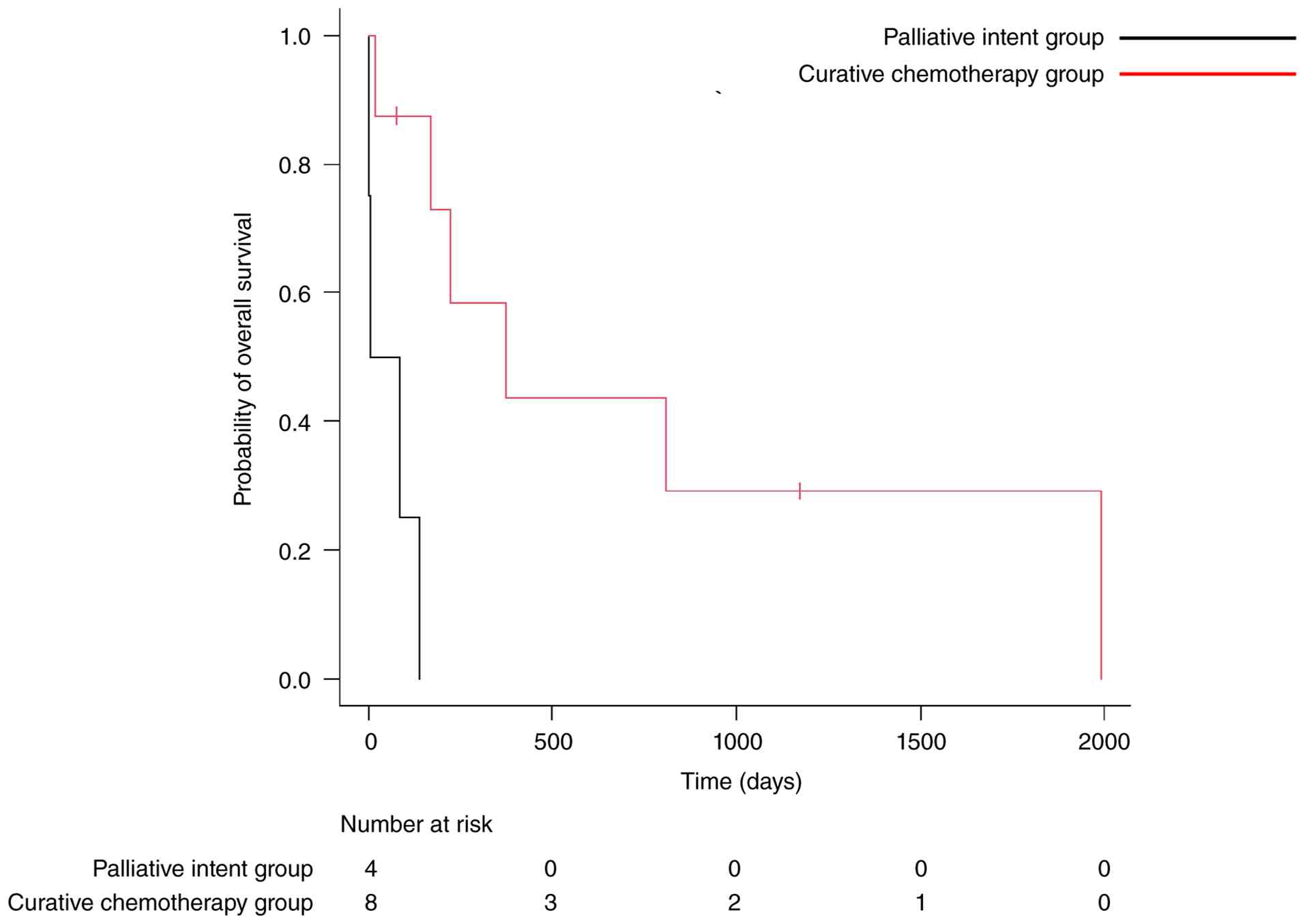
Fig. 1. At 90 days, the survival
rate was 25.0% [95% confidence interval (CI), 0.9–66.5] and 87.5%
(95% CI, 38.7–98.1) in the palliative (n=4) and curative
chemotherapy groups (n=8), respectively. The median OS was
significantly shorter in the palliative group (46 days; 95% CI,
2-not available) than in the curative group (374 days; 95% CI,
20-not available; log-rank test, P=0.00299). These results
demonstrated that patients who did not receive curative-intent
chemotherapy exhibited significantly inferior survival outcomes
than did those who received multiagent chemotherapy.
Adverse events in patients receiving
chemotherapy (Table VI)
Adverse events among patients who received
chemotherapy (including combination chemotherapy, single-agent
etoposide, or rituximab monotherapy) were evaluated according to
CTCAE version 5.0. Those who received steroid monotherapy or BSC
were excluded from this analysis. Grade ≥3 hematological toxicities
were frequently observed. Leukopenia and neutropenia occurred in 5
patients (50%) each. Febrile neutropenia was observed in 4 patients
(40%), whereas grade ≥3 anemia was observed in 4 patients (40%).
None of the patients developed thrombocytopenia (0%).
Grade ≥3 infections occurred in 5 patients (50%).
Infectious complications included cytomegalovirus retinitis,
lymphadenitis/cellulitis/streptococcal bacteremia, Mycoplasma
pneumonia, oral candidiasis/urinary tract infection, and
bacteremia/urinary tract infection. Other grade ≥3 adverse events,
including depression, hyponatremia, eosinophilia with eosinophilic
encephalopathy, and upper gastrointestinal bleeding, were observed
in 4 patients (40%). Overall, any grade ≥3 adverse event occurred
in 9 patients (90%), with 9 patients (90%) requiring
hospitalization during treatment. All nine patients were
hospitalized during induction therapy. Furthermore, three patients
required readmission or prolonged hospitalization due to lymphoma
progression, three were hospitalized due to treatment-related
adverse events, and two required readmission for supportive care
during subsequent chemotherapy cycles.
Discussion
The current study provides clinically relevant
real-world data focusing on super-elderly patients with lymphoma
aged ≥90 years. This age group has been largely excluded from
clinical trials, with large cohort data remaining scarce even in
retrospective analyses. Although a previous large retrospective
study by Trebouet et al (7)
included elderly patients with lymphoma, the cohort primarily
comprised cases diagnosed between 1990 and 2012 and therefore
included a substantial proportion of patients who did not receive
rituximab-based therapy. Consequently, evidence regarding treatment
selection and outcomes in the era of currently available agents
remains considerably limited. In this context, our findings provide
valuable insights into the real-world treatment patterns and
outcomes of very elderly patients with lymphoma.
In this particular cohort, treatment decisions are
influenced not only by tumor-related factors (e.g., tumor burden,
elevated LDH, sIL-2R, and advanced stage) but also, and more
importantly, by the patient's overall condition (e.g., Eastern
Cooperative Oncology ECOG-PS and CCI). Notably, all patients in the
palliative care group had stage III or higher disease and an
ECOG-PS of ≥2, suggesting that these parameters played a decisive
role in treatment selection. These findings indicate that
therapeutic decision-making in this cohort was primarily driven not
only by tumor aggressiveness but also by; treatment tolerance’,
reflecting physiological reserve and overall functional status.
Regarding treatment efficacy, the curative-intent
combination chemotherapy group achieved an overall response rate of
50% (CR, 25%; PR, 25%) with a median OS of 374 days. Despite the
difficulty of direct comparisons, Trebouet et al (7) reported a median OS of 8.12 months in
treated patients with aggressive non-Hodgkin lymphoma. In
comparison, our cohort demonstrated a more favorable OS. These
findings suggest that carefully selected individuals may derive
meaningful benefit from chemotherapy and may also reflect
improvements in modern therapeutic strategies for elderly patients,
even among those patients aged ≥90 years. Importantly, these
results support the notion that chronological age alone should not
be the sole criterion for excluding patients with aggressive
lymphomas, such as DLBCL, from active treatment.
In contrast, the palliative care group demonstrated
extremely poor outcomes, with a median survival of 46 days and a
90-day survival rate of 25%. This poor prognosis could likely be
attributed to advanced disease burden, poor performance status, and
a high CCI, all of which strongly contributed to early mortality.
Importantly, the observed survival differences between the
treatment groups should be considered descriptive and
hypothesis-generating rather than evidence of a treatment effect,
given the extremely small sample size and substantial
treatment-selection bias. In particular, the small number of
patients in the palliative care group precludes robust statistical
inference. Moreover, patients selected for curative-intent
treatment generally had better baseline functional status and
physiological reserve than those receiving palliative care.
Therefore, the apparent separation of the survival curves may
largely reflect differences in baseline patient characteristics,
and a causal effect of treatment on survival cannot be inferred
from this comparison. Frailty is increasingly recognized as a key
consideration in treatment decision-making for older patients with
lymphoma. Several studies have suggested that frailty assessment
may better capture physiological vulnerability than tumor-related
factors alone, highlighting its important role in therapeutic
decision-making (8,9). The treatment regimens used in the
present cohort also warrant careful consideration. Of the two
patients who received CVP without rituximab, one had AITL, for
which rituximab was not indicated. The other patient had B-cell
lymphoma and initially received CVP; however, the disease
progressed rapidly, and the patient died before rituximab could be
administered. Thus, rituximab was incorporated into the treatment
of patients with B-cell lymphoma when its administration was
considered clinically feasible. Anthracycline-free regimens, such
as R-CVP, were frequently selected because of concerns regarding
the tolerability of doxorubicin in this exceptionally old
population, based on each patient's overall condition,
comorbidities, organ function, and functional status. Therefore,
the frequent use of R-CVP in this cohort reflected individualized
assessments of treatment tolerability rather than a general
strategy of avoiding anthracycline-containing therapy.
Regarding safety, 90% of patients receiving
chemotherapy developed grade ≥3 adverse events. In particular, 50%
of patients developed infections, while 90% required
hospitalization, highlighting the substantial treatment-related
toxicity in this population. These findings indicate that even with
dose-reduced chemotherapy (≤70% of standard intensity), safety
remains a major concern in patients aged ≥90 years. Moreover, the
high frequency of severe toxicity despite dose reduction suggests
that a simple dose-reduction strategy does not necessarily ensure
safety in this super-elderly population. Our findings therefore
emphasize the importance of intensive supportive care.
R-miniCHOP is an important treatment option for
selected patients aged >80 years with DLBCL (10). However, patients aged ≥90 years
remain underrepresented in the available evidence, and the optimal
treatment strategy for this population remains uncertain. Notably,
substantial toxicity was observed in the present cohort despite
dose attenuation and the frequent omission of anthracyclines in
patients considered unlikely to tolerate them. These findings
suggest that reducing treatment intensity alone may not ensure
tolerability in patients aged ≥90 years and highlight the
importance of individualized treatment selection.
Finally, this study has several limitations,
including its single-center retrospective design, extremely small
sample size (n=14), substantial treatment-selection bias, lack of
multivariable analysis, and heterogeneity in follow-up and
assessment methods. Importantly, the study was not statistically
powered to detect differences in survival between the treatment
groups, particularly given that the palliative care group included
only four patients. Therefore, the survival analysis should be
considered exploratory and descriptive, and the observed separation
of the survival curves should not be interpreted as evidence of the
efficacy of curative-intent treatment. Patients who received
curative-intent treatment were generally in better baseline
condition, whereas those receiving palliative care exhibited
advanced frailty and organ dysfunction. Accordingly, direct
comparisons between groups should be interpreted with caution.
Furthermore, diagnostic selection bias represents a
major limitation of the present study. Among patients aged ≥90
years who presented to our institution, those with poor general
condition, in whom sufficient diagnostic evaluation could not be
performed and who were instead managed with BSC or end-of-life care
despite suspected malignant lymphoma, were not included in our
analysis. Because of the retrospective nature of this study, the
number of patients who were excluded because they were unable to
undergo biopsy could not be reliably determined. Patients who did
not undergo biopsy were not necessarily recorded as having lymphoma
in the electronic medical records and therefore could not be
systematically identified retrospectively. Furthermore, some
extremely frail patients with suspected lymphoma may not have been
referred to our institution from surrounding hospitals or clinics
because invasive diagnostic procedures, including biopsy, were
considered infeasible. Consequently, the present cohort may not
fully represent the spectrum of patients aged ≥90 years with
suspected lymphoma encountered in real-world clinical practice. Our
findings should therefore be interpreted as reflecting the outcomes
of patients aged ≥90 years with pathologically confirmed lymphoma
rather than those of the broader population of patients with
suspected lymphoma in this age group. The natural history,
prognosis, and treatment needs of patients who are unable to
complete diagnostic evaluation because of severe frailty or rapid
clinical deterioration warrant further investigation. Collectively,
these limitations restrict the generalizability of our findings,
and larger, multicenter prospective studies are needed to validate
our observations.
Despite these limitations, the present study
provides descriptive real-world evidence that active chemotherapy
was feasible in a subset of carefully selected patients aged ≥90
years, although treatment-related toxicity remained substantial.
Given the substantial potential for treatment-selection bias, the
observed survival outcomes should not be interpreted as evidence of
a survival benefit from chemotherapy in this population. Rather,
our findings indicate that chronological age alone may be
insufficient to guide treatment decisions and that treatment
selection should consider functional status, comorbidities,
physiological reserve, patient preferences, and anticipated
treatment toxicity. Larger, multicenter studies are needed to
identify patients aged ≥90 years who may benefit from active
treatment and to determine optimal treatment strategies for this
population.
Acknowledgements
Not applicable.
Funding
Funding: No funding was received.
Availability of data and materials
The data generated in the present study may be
requested from the corresponding author.
Authors' contributions
NH conceptualized the manuscript. NH, NO, EH MK, and
MT acquired and interpretated the data. NH and MT confirm the
authenticity of all the raw data. NH wrote the original draft, and
NH and MT wrote, reviewed and edited the manuscript. All authors
read and approved the final manuscript and agree to be accountable
for all aspects of the research in ensuring that the accuracy or
integrity of any part of the work are appropriately investigated
and resolved.
Ethics approval and consent to
participate
This retrospective study was conducted using
anonymized clinical data extracted from existing medical records.
The requirement for informed consent was waived due to the
retrospective nature of the study. The study was performed
following the principles of the Declaration of Helsinki and was
approved by the Institutional Ethics Committee of Saiseikai Chuwa
Hospital (approval no. 08-002).
Patient consent for publication
Not applicable.
Competing interests
Dr. Takeda received honoraria from Chugai
Pharmaceutical, AstraZeneca K.K., Bristol-Myers Squibb Company,
Novartis Pharma K.K., and Ono Pharmaceutical. The other authors
declare that they have no competing interests.
Use of artificial intelligence
During the preparation of this work, artificial
intelligence tools were used to improve the readability and
language of the manuscript and subsequently, the authors revised
and edited the content produced by the artificial intelligence
tools as necessary, taking full responsibility for the ultimate
content of the present manuscript.
Glossary
Abbreviations
Abbreviations:
|
ADL
|
activities of daily living
|
|
AITL
|
angioimmunoblastic T-cell lymphoma
|
|
BSC
|
best supportive care
|
|
CCI
|
Charlson comorbidity index
|
|
CR
|
complete response
|
|
CRP
|
C-reactive protein
|
|
CTCAE
|
Common Terminology Criteria for
Adverse Events
|
|
DLBCL
|
diffuse large B-cell lymphoma
|
|
ECOG-PS
|
Eastern Cooperative Oncology Group
performance status
|
|
eGFR
|
estimated glomerular filtration
rate
|
|
IPI
|
International Prognostic Index
|
|
LDH
|
lactate dehydrogenase
|
|
OS
|
overall survival
|
|
PD
|
progressive disease
|
|
PR
|
partial response
|
|
R-CVP
|
rituximab, cyclophosphamide,
vincristine, and prednisone
|
|
SD
|
stable disease
|
|
sIL-2R
|
soluble interleukin-2 receptor
|
References
|
1
|
Wang Y, Chen J, Guo J, Song Y, Zhu J, Ma
J, Zhou M, Qi J and Liu W: Global burden of non-Hodgkin lymphoma in
the elderly: A population-based study using GBD 2021. Ann Hematol.
105:39, 2026. View Article : Google Scholar
|
|
2
|
Ayers EC and Smith SM: Diffuse large
B-cell lymphoma in the older and frail patient. Cancers (Basel).
17:885, 2025. View Article : Google Scholar : PubMed/NCBI
|
|
3
|
Tucci A, Merli F, Fabbri A, Marcheselli L,
Pagani C, Puccini B, Marino D, Zanni M, Pennese E, Flenghi L, et
al: Diffuse large B-cell lymphoma in octogenarians aged 85 and
older can benefit from treatment with curative intent: A report on
129 patients prospectively registered in the elderly project of the
Fondazione Italiana Linfomi (FIL). Haematologica. 108:1083, –1091.
2023. View Article : Google Scholar
|
|
4
|
Gobba S, Moccia AA, Gulden-Sala W, Conconi
A, Diem S, Cascione L, Iacoboni G, Margiotta-Casaluci G, Aprile von
Hohenstaufen K, Stathis A, et al: Outcome of patients older than 80
years with diffuse large B-cell lymphoma (DLBCL) treated with
‘standard’ immunochemotherapy: A large retrospective study from 4
institutions. Hematol Oncol. 36:84, –92. 2018. View Article : Google Scholar
|
|
5
|
Cheson BD, Fisher RI, Barrington SF,
Cavalli F, Schwartz LH, Zucca E, Lister TA; Alliance, Australasian
Leukaemia; Lymphoma Group and Eastern Cooperative Oncology Group, ;
et al: Recommendations for initial evaluation, staging, and
response assessment of Hodgkin and non-Hodgkin lymphoma: The Lugano
classification. J Clin Oncol. 32:3059, –3068. 2014. View Article : Google Scholar
|
|
6
|
Kanda Y: Investigation of the freely
available easy-to-use software ‘EZR’ for medical statistics. Bone
Marrow Transplant. 48:452, –458. 2013. View Article : Google Scholar
|
|
7
|
Trebouet A, Marchand T, Lemal R, Gyan E,
Broussais-Guillaumot F, Guillermin Y, Monjanel H, Salles G, Le
Gouill S, Godmer P, et al: Lymphoma occurring in patients over 90
years of age: Characteristics, outcomes, and prognostic factors. A
retrospective analysis of 234 cases from the LYSA. Ann Oncol.
24:2612, –2618. 2013. View Article : Google Scholar
|
|
8
|
Hormigo-Sanchez AI, Lopez-Garcia A,
Mahillo-Fernandez I, Askari E, Morillo D, Perez-Saez MA, Riesco M,
Urrutia C, Martinez-Peromingo FJ, Cordoba R and Gonzalez-Montalvo
JI: Frailty assessment to individualize treatment in older patients
with lymphoma. Eur Geriatr Med. 14:1393, –1402. 2023. View Article : Google Scholar : PubMed/NCBI
|
|
9
|
Hung YS, Chang H, Wang PN, Kuo MC, Su YJ,
Hung CY, Hsueh SW, Yeh KY, Ho YW and Chou WC: Pretreatment frailty
is an independent prognostic factor among elderly patients with
B-cell lymphoma undergoing immunochemotherapy: A prospective
observational cohort study in Taiwan. Asia Pac J Clin Oncol. 19:62,
–70. 2023. View Article : Google Scholar
|
|
10
|
Peyrade F, Jardin F, Thieblemont C, Thyss
A, Emile JF, Castaigne S, Coiffier B, Haioun C, Bologna S, Fitoussi
O, et al: Attenuated immunochemotherapy regimen (R-miniCHOP) in
elderly patients older than 80 years with diffuse large B-cell
lymphoma: A multicentre, single-arm, phase 2 trial. Lancet Oncol.
12:460, –468. 2011. View Article : Google Scholar
|