Spandidos Publications Logo
  • About
    • About Spandidos
    • Aims and Scopes
    • Abstracting and Indexing
    • Editorial Policies
    • Reprints and Permissions
    • Job Opportunities
    • Terms and Conditions
    • Contact
  • Journals
    • All Journals
    • Oncology Letters
      • Oncology Letters
      • Information for Authors
      • Editorial Policies
      • Editorial Board
      • Aims and Scope
      • Abstracting and Indexing
      • Bibliographic Information
      • Archive
    • International Journal of Oncology
      • International Journal of Oncology
      • Information for Authors
      • Editorial Policies
      • Editorial Board
      • Aims and Scope
      • Abstracting and Indexing
      • Bibliographic Information
      • Archive
    • Molecular and Clinical Oncology
      • Molecular and Clinical Oncology
      • Information for Authors
      • Editorial Policies
      • Editorial Board
      • Aims and Scope
      • Abstracting and Indexing
      • Bibliographic Information
      • Archive
    • Experimental and Therapeutic Medicine
      • Experimental and Therapeutic Medicine
      • Information for Authors
      • Editorial Policies
      • Editorial Board
      • Aims and Scope
      • Abstracting and Indexing
      • Bibliographic Information
      • Archive
    • International Journal of Molecular Medicine
      • International Journal of Molecular Medicine
      • Information for Authors
      • Editorial Policies
      • Editorial Board
      • Aims and Scope
      • Abstracting and Indexing
      • Bibliographic Information
      • Archive
    • Biomedical Reports
      • Biomedical Reports
      • Information for Authors
      • Editorial Policies
      • Editorial Board
      • Aims and Scope
      • Abstracting and Indexing
      • Bibliographic Information
      • Archive
    • Oncology Reports
      • Oncology Reports
      • Information for Authors
      • Editorial Policies
      • Editorial Board
      • Aims and Scope
      • Abstracting and Indexing
      • Bibliographic Information
      • Archive
    • Molecular Medicine Reports
      • Molecular Medicine Reports
      • Information for Authors
      • Editorial Policies
      • Editorial Board
      • Aims and Scope
      • Abstracting and Indexing
      • Bibliographic Information
      • Archive
    • World Academy of Sciences Journal
      • World Academy of Sciences Journal
      • Information for Authors
      • Editorial Policies
      • Editorial Board
      • Aims and Scope
      • Abstracting and Indexing
      • Bibliographic Information
      • Archive
    • International Journal of Functional Nutrition
      • International Journal of Functional Nutrition
      • Information for Authors
      • Editorial Policies
      • Editorial Board
      • Aims and Scope
      • Abstracting and Indexing
      • Bibliographic Information
      • Archive
    • International Journal of Epigenetics
      • International Journal of Epigenetics
      • Information for Authors
      • Editorial Policies
      • Editorial Board
      • Aims and Scope
      • Abstracting and Indexing
      • Bibliographic Information
      • Archive
    • Medicine International
      • Medicine International
      • Information for Authors
      • Editorial Policies
      • Editorial Board
      • Aims and Scope
      • Abstracting and Indexing
      • Bibliographic Information
      • Archive
  • Articles
  • Information
    • Information for Authors
    • Information for Reviewers
    • Information for Librarians
    • Information for Advertisers
    • Conferences
  • Language Editing
Spandidos Publications Logo
  • About
    • About Spandidos
    • Aims and Scopes
    • Abstracting and Indexing
    • Editorial Policies
    • Reprints and Permissions
    • Job Opportunities
    • Terms and Conditions
    • Contact
  • Journals
    • All Journals
    • Biomedical Reports
      • Information for Authors
      • Editorial Policies
      • Editorial Board
      • Aims and Scope
      • Abstracting and Indexing
      • Bibliographic Information
      • Archive
    • Experimental and Therapeutic Medicine
      • Information for Authors
      • Editorial Policies
      • Editorial Board
      • Aims and Scope
      • Abstracting and Indexing
      • Bibliographic Information
      • Archive
    • International Journal of Epigenetics
      • Information for Authors
      • Editorial Policies
      • Editorial Board
      • Aims and Scope
      • Abstracting and Indexing
      • Bibliographic Information
      • Archive
    • International Journal of Functional Nutrition
      • Information for Authors
      • Editorial Policies
      • Editorial Board
      • Aims and Scope
      • Abstracting and Indexing
      • Bibliographic Information
      • Archive
    • International Journal of Molecular Medicine
      • Information for Authors
      • Editorial Policies
      • Editorial Board
      • Aims and Scope
      • Abstracting and Indexing
      • Bibliographic Information
      • Archive
    • International Journal of Oncology
      • Information for Authors
      • Editorial Policies
      • Editorial Board
      • Aims and Scope
      • Abstracting and Indexing
      • Bibliographic Information
      • Archive
    • Medicine International
      • Information for Authors
      • Editorial Policies
      • Editorial Board
      • Aims and Scope
      • Abstracting and Indexing
      • Bibliographic Information
      • Archive
    • Molecular and Clinical Oncology
      • Information for Authors
      • Editorial Policies
      • Editorial Board
      • Aims and Scope
      • Abstracting and Indexing
      • Bibliographic Information
      • Archive
    • Molecular Medicine Reports
      • Information for Authors
      • Editorial Policies
      • Editorial Board
      • Aims and Scope
      • Abstracting and Indexing
      • Bibliographic Information
      • Archive
    • Oncology Letters
      • Information for Authors
      • Editorial Policies
      • Editorial Board
      • Aims and Scope
      • Abstracting and Indexing
      • Bibliographic Information
      • Archive
    • Oncology Reports
      • Information for Authors
      • Editorial Policies
      • Editorial Board
      • Aims and Scope
      • Abstracting and Indexing
      • Bibliographic Information
      • Archive
    • World Academy of Sciences Journal
      • Information for Authors
      • Editorial Policies
      • Editorial Board
      • Aims and Scope
      • Abstracting and Indexing
      • Bibliographic Information
      • Archive
  • Articles
  • Information
    • For Authors
    • For Reviewers
    • For Librarians
    • For Advertisers
    • Conferences
  • Language Editing
Login Register Submit
  • This site uses cookies
  • You can change your cookie settings at any time by following the instructions in our Cookie Policy. To find out more, you may read our Privacy Policy.

    I agree
Search articles by DOI, keyword, author or affiliation
Search
Advanced Search
presentation
Oncology Letters
Join Editorial Board Propose a Special Issue
Print ISSN: 1792-1074 Online ISSN: 1792-1082
Journal Cover
September-October 2010 Volume 1 Issue 5

Full Size Image

Sign up for eToc alerts
Recommend to Library

Journals

International Journal of Molecular Medicine

International Journal of Molecular Medicine

International Journal of Molecular Medicine is an international journal devoted to molecular mechanisms of human disease.

International Journal of Oncology

International Journal of Oncology

International Journal of Oncology is an international journal devoted to oncology research and cancer treatment.

Molecular Medicine Reports

Molecular Medicine Reports

Covers molecular medicine topics such as pharmacology, pathology, genetics, neuroscience, infectious diseases, molecular cardiology, and molecular surgery.

Oncology Reports

Oncology Reports

Oncology Reports is an international journal devoted to fundamental and applied research in Oncology.

Experimental and Therapeutic Medicine

Experimental and Therapeutic Medicine

Experimental and Therapeutic Medicine is an international journal devoted to laboratory and clinical medicine.

Oncology Letters

Oncology Letters

Oncology Letters is an international journal devoted to Experimental and Clinical Oncology.

Biomedical Reports

Biomedical Reports

Explores a wide range of biological and medical fields, including pharmacology, genetics, microbiology, neuroscience, and molecular cardiology.

Molecular and Clinical Oncology

Molecular and Clinical Oncology

International journal addressing all aspects of oncology research, from tumorigenesis and oncogenes to chemotherapy and metastasis.

World Academy of Sciences Journal

World Academy of Sciences Journal

Multidisciplinary open-access journal spanning biochemistry, genetics, neuroscience, environmental health, and synthetic biology.

International Journal of Functional Nutrition

International Journal of Functional Nutrition

Open-access journal combining biochemistry, pharmacology, immunology, and genetics to advance health through functional nutrition.

International Journal of Epigenetics

International Journal of Epigenetics

Publishes open-access research on using epigenetics to advance understanding and treatment of human disease.

Medicine International

Medicine International

An International Open Access Journal Devoted to General Medicine.

Journal Cover
September-October 2010 Volume 1 Issue 5

Full Size Image

Sign up for eToc alerts
Recommend to Library

  • Article
  • Citations
    • Cite This Article
    • Download Citation
    • Create Citation Alert
    • Remove Citation Alert
    • Cited By
  • Similar Articles
    • Related Articles (in Spandidos Publications)
    • Similar Articles (Google Scholar)
    • Similar Articles (PubMed)
  • Download PDF
  • Download XML
  • View XML
Article

A rare chronic myeloid leukemia case with Philadelphia chromosome, BCR-ABL e13a3 transcript and complex translocation involving four different chromosomes

  • Authors:
    • Walid Al Achkar
    • Abdulsamad Wafa
    • Bashar Yousef Ali
    • Marina Manvelyan
    • Thomas Liehr
  • View Affiliations / Copyright

    Affiliations: Molecular Biology and Biotechnology Department, Human Genetics Division, Atomic Energy Commission of Syria, Damascus, Syria. ascientific@aec.org.sy
  • Pages: 797-800
    |
    Published online on: September 1, 2010
       https://doi.org/10.3892/ol_00000139
  • Expand metrics +
Metrics: Total Views: 0 (Spandidos Publications: | PMC Statistics: )
Metrics: Total PDF Downloads: 0 (Spandidos Publications: | PMC Statistics: )
Cited By (CrossRef): 0 citations Loading Articles...

This article is mentioned in:


Abstract

The so-called Philadelphia (Ph) chromosome is present in more than 90% of chronic myeloid leukemia (CML) patients. Around 5-10% of these patients show complex translocations involving other chromosomes in addition to and/or besides chromosomes 9 and 22. CML cases with fusion transcripts, such as e13a3, in which ABL exon 3 rather than exon 2 has fused to BCR, are extremely rare. Such reported cases with the e13a3 transcript showed the Ph chromosome on karyotype analysis. This study reported a rare Ph chromosome-positive CML case with new complex chromosomal aberrations and an e13a3 BCR-ABL transcript that has yet to be established. A four-chromosome translocation involving chromosomal regions 12p11.2, 19q13.3, 9q34.1 and 22q11.2, besides a trisomy 8 and a derivative chromosome 12, were identified using high resolution multicolor banding. Reverse transcription polymerase chain reaction products showed the presence of BCR-ABL fusion transcript e13a3, and this signifies the major BCR breakpoint. The significance of the observed rearrangements and their possible role in the progression of CML was investigated.

Introduction

Chronic myeloid leukemia (CML) is a myeloproliferative disorder characterized by the expansion of a clone of pluripotent hematopoietic stem cells carrying the chimeric BCR-ABL fusion gene. The Philadelphia (Ph) chromosome created as a result of t(9;22) (q34;q11) is observed in more than 90% of CML patients. The BCR-ABL fusion gene is formed by transposing the 3′ portion of the ABL oncogene from 9q34 to the 5′ portion of the BCR gene on chromosome 22, and this fusion gene encodes a constitutive active tyrosine kinase (1). BCR breakpoints localize on 1 of 3 breakpoint cluster regions (bcr): major bcr spanning BCR exons 12–16, minor bcr spanning BCR alternative exons 2′ and 2 and μbcr spanning downstream of exon 19. The majority of the BCR-ABL fusion transcripts are e13a2, e14a2, with e1a2 and e19a2 being less common (2). Extremely rare CML cases with fusion transcripts, such as e13a3, in which ABL exon 3 rather than exon 2 is fused to BCR, were previously reported (3–6). Cases reported to have the e13a3 transcript showed the Ph chromosome on karyotype analysis. A cryptic or variant rearrangement in which the typical Ph chromosome is not visible at the karyotype level is noted in 5–10% of CML patients (7). This rearrangement can be found in cases of normal or complex karyotypes. The mechanisms for these rearrangements are difficult to determine. This study reported a rare Ph chromosome-positive CML case involving the e13a3 BCR-ABL transcript and new complex aberrations, including four chromosomal breakpoints.

Materials and methods

Case report

A 25-year-old female was diagnosed as suffering from CML in the chronic phase (CP) after a blood cell count was initiated in November 2009 due to hepatosplenomegaly and loss of weight. The hematologic parameters were: white blood cells (WBC) 122×109/l (96.6% neutrophils, 1.55% lymphocytes, 0.170% monocytes, 1.68% eosinophiles and 0.04% basophiles). The platelet count was 156×109/l and the hemoglobin level was 10.3 g/dl. No treatment had been administered prior to the test. The patient was referred to our laboratory one month later, after treatment with hydroxyurea (2,000 mg/day). Thus, the previous relevant symptoms disappeared. The more recent hematological parameters were: WBC 4.5×10⁹/l (42.9% neutrophils, 44.1% lymphocytes and 13% monocytes). The platelet count was 375×109/l and the hemoglobin level was 9.9 g/dl.

Banding cytogenetics

Chromosome analysis was performed using the GTG-banding technique according to standard procedures (8). A total of 20 metaphases, obtained from the unstimulated bone marrow of the patient, were analyzed. Karyotypes were described according to the International System for Human Cytogenetic Nomenclature (9).

Molecular cytogenetics

Fluorescence in situ hybridization (FISH) using a LSI BCR/ABL dual color dual fusion translocation probe (Abbott molecular/Vysis, Des Plaines, IL, USA) was applied according to the manufacturer’s instructions. Array-proven multicolor banding (aMCB) probe sets based on microdissection-derived region-specific libraries for chromosomes 9, 12, 19 and 22 were applied as previously described (10,11). A total of 20 metaphase spreads were analyzed, using a fluorescence microscope (AxioImager.Z1 mot, Zeiss) equipped with appropriate filter sets to discriminate between a maximum of five fluorochromes and the counterstain DAPI (4′,6-diamino-2-phenylindole). Image capturing and processing were carried out using an Isis imaging system (MetaSystems, Altlussheim, Germany) for the MCB evaluation.

RNA isolation and reverse transcriptase-polymerase chain reaction

Total RNA was extracted from 1.5 ml of fresh peripheral blood immediately after collection using the InviTrap RNA kit (Invitek, Germany). A negative control was used to monitor RNA isolation. RNA concentration was estimated by absorbance at 260 nm and its purification was determined by a 1.8:2.0 ratio of absorbance values at 260:280 nm. The RNA solutions were stored at −80°C. Reverse transcription (RT) for the complementary DNA (cDNA) synthesis, polymerase chain reaction (PCR) and nested PCR amplification of the BCR-ABL gene were performed using a ready-to-use Genequality BCR-ABL kit (AB Analitica, Italy) and a GeneAmp® PCR System 9700 thermocycler. Two positive controls were used to monitor amplification, one with β2-microglobuline and the second b3a2 with the patient sample. The negative controls used serial water. PCR products were electrophoresed on an ethidium bromide-stained 2.5% agarose-TAE-gel and observed under UV light. The type of amplified BCR/ABL cDNA was established on the basis of the size compared with the molecular markers and the primers used (b3a2, 353 bp; b2a2, 278 bp; b3a3, 179 bp and b2a3 (e13a3), 104 bp).

Results

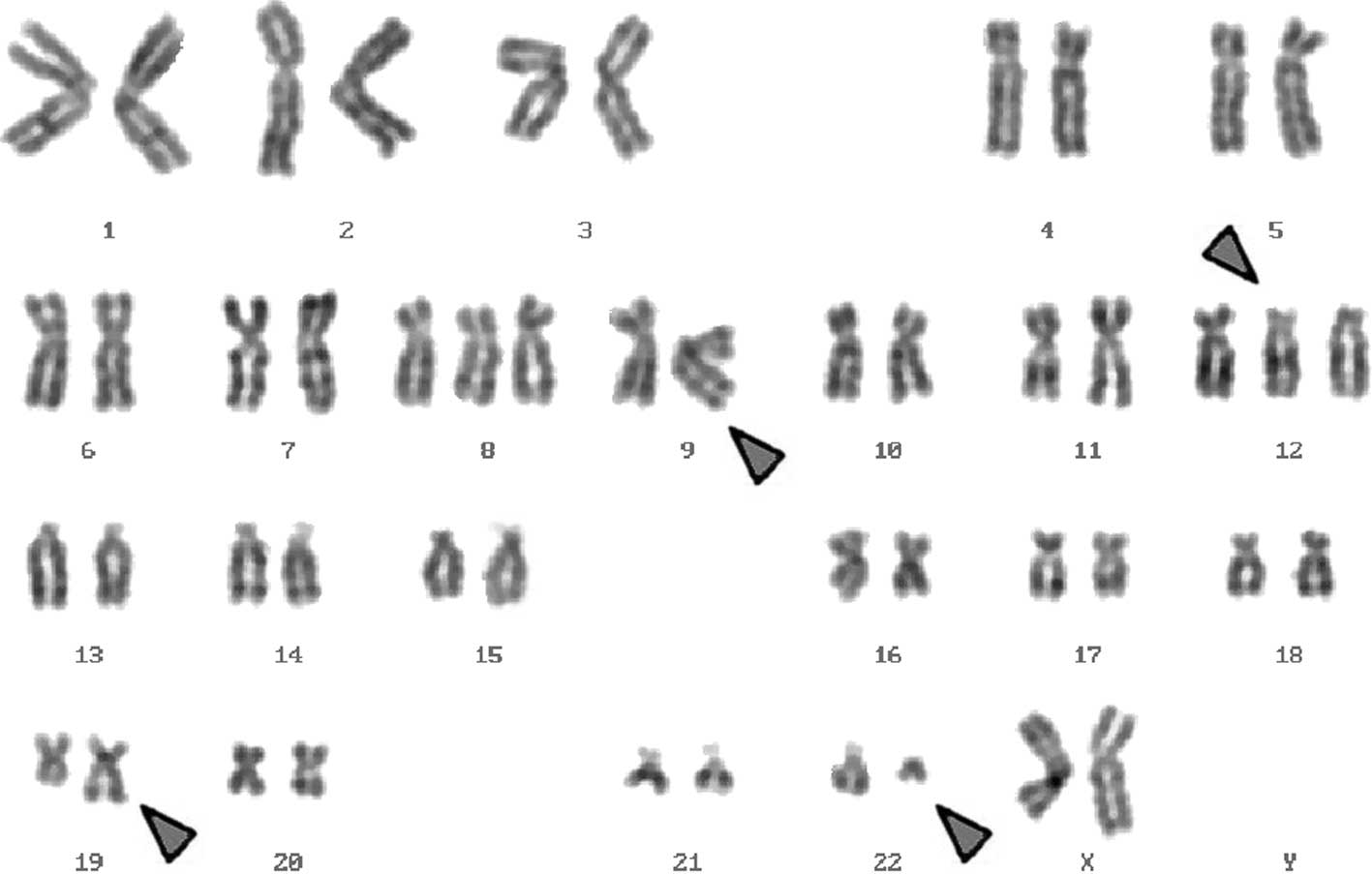
Karyotyping was performed before and after the initiation of chemotherapy treatment, showing the following karyotypic changes: a complex karyotype 48,XX,+8,+der(12)t(12;19),t(9;12;19;22)/47,XX,+8,t(9;12;19;22)/47,XX,+der(12)t(12;19),t(9;12;19;22)/46,XX,t(9;12;19;22) was determined using GTG-banding (Fig. 1) and was further specified by molecular cytogenetic studies (Fig. 2). A dual-color-FISH using a probe specific for BCR and ABL showed a typical Ph chromosome with a BCR/ABL fusion gene. However, sections of chromosome 22 were present on a der(19) (Fig. 2F). A multi-color (M)-FISH, was applied to exclude further cryptic rearrangements (Fig. 2A). Thus, the four chromosomes 9, 12, 19 and 22 were found to be involved. aMCB using probes for the corresponding chromosomes were performed as previously reported (11). A complex translocation among the four chromosomes was detected (Figs. 2B-E), and the following final karyotypes were obtained: 48,XX,+8,+der(12)t(12;19)(p11.2;q13.3),t(9;12;19;22)(q34.1;p11.2;q13.3;q11.2)[8]/47,XX,+8,t(9;12;19;22)(q34.1;p11.2;q13.3;q11.2)[2]/47,XX,+der(12)t(12;19)(p11.2;q13.3),t(9;12;19;22)(q34.1;p11.2;q13.3;q11.2)[2]/46,XX,t(9;12;19;22)(q34.1;p11.2;q13.3;q11.2)[8].
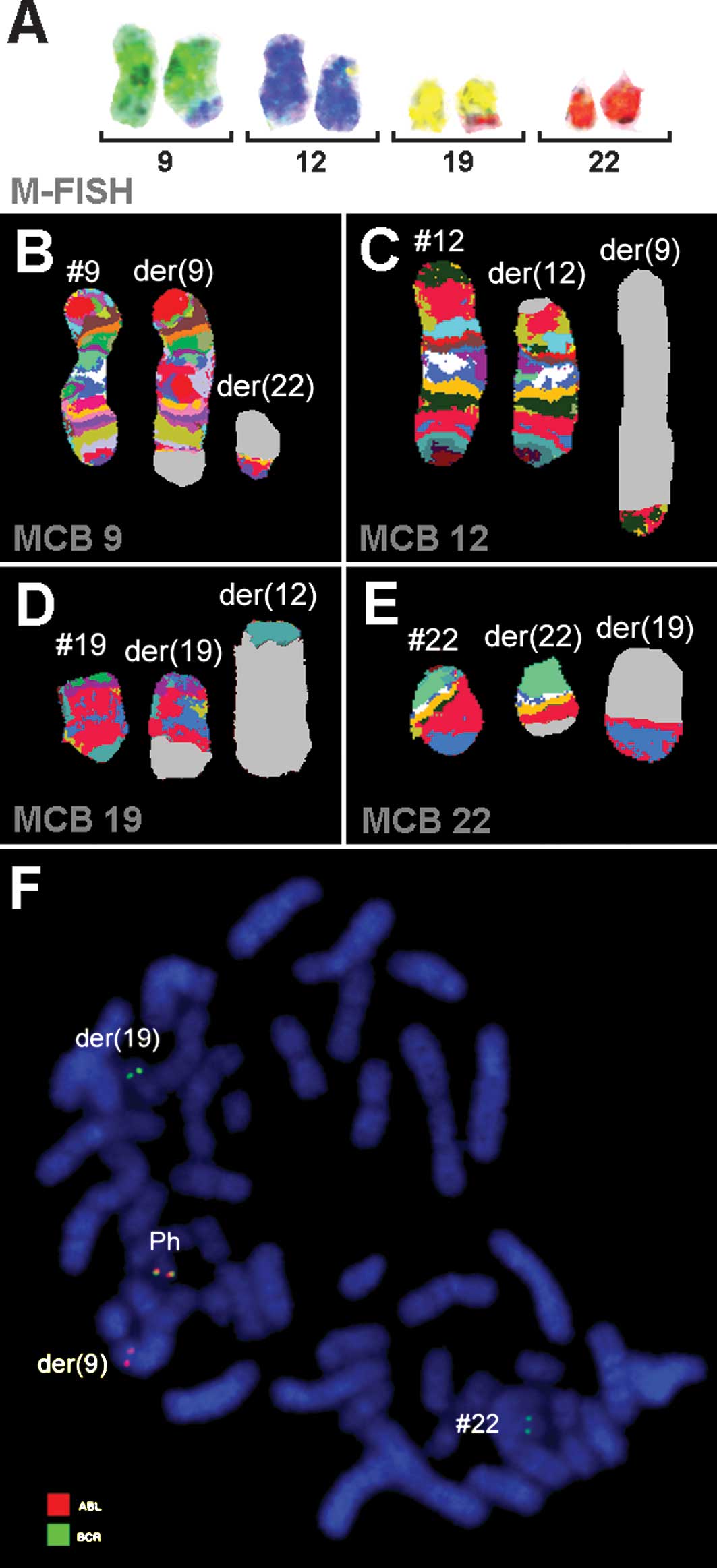
Figure 1

GTG-banding revealed a complex karyotype involving two further chromosomes besides chromosomes 9 and 22. Derivative chromosomes are indicated by the arrowheads.

Figure 2

Karyotype and chromosomal aberrations were confirmed using molecular cytogenetic approaches. (A) M-FISH confirmed the complexity of the karyotype: 48,XX,+8,+der(12),t(9;12),t(12;19),t(19;22). (B-E) The application of aMCB analysis using probe sets for chromosomes 9, 12, 19 and 22 is shown. The normal chromosomes are shown to the left of the image, and the derivative of the four chromosomes to the middle and right. Using aMCB probes, the light gray areas show unstained regions on the derivative chromosomes. (F) Fluorescence in situ hybridization (FISH) using probes for BCR (green) and ABL (red) confirmed the involvement of chromosome 19 in the rearrangement present in this case. #, chromosome; der, derivative chromosome; Ph, Philadelphia chromosome.

It is likely that due to low chromosomal resolution, the complexity of the karyotype was initially missed. RT-PCR analysis of the fusion transcript showed a band corresponding to the e13a3 (b2-a3) transcript. However, the band was ~104 bp (Fig. 3).

Figure 3

Gel electrophoresis of the nested RT-PCR products. Lane M, 501-110 bp marker; lane 1, negative control; lane 2, positive control (b3a2, 353 bp); lane 3, β2-microglobuline (535 bp); lane 4, BCR-ABL (b2a3, 104 bp) from the patient and lane 5, M½100 bp molecular weight marker.

Discussion

We described a rare Ph chromosome-positive CML case with the e13a3 BCR-ABL transcript and a new complex variant translocation t(9;12;19;22)(q34.1;p11.2;q13.3;q11.2) that was detected. Apart from a trisomy 8 and an additional derivative chromosome 12, two additional chromosomal alterations were present. To the best of our knowledge, this translocation has yet to be elucidated in CML (12).

In 5–10% of Ph chromosome CML cases complex translocations in addition to those and/or besides chromosomes 9 and 22 (13) are noted. At present it appears that in such rearrangements any other chromosome may be involved. However, it has been suggested that the distribution of chromosomes and breakpoints is non-random with the chromosomal bands most susceptible to breakage being 1p36, 3p21, 5q31, 6p21, 9q22, 10q22, 11q13, 12p13, 17p13, 17q21, 17q25, 19q13, 21q22, 22q12 and 22q13 (7), showing one match with the present case, i.e., 19q13.

The progression of CML from CP to blast crisis is frequently associated with non-random secondary chromosomal aberrations such as +8, i(17q), +19 and an extra Ph chromosome (14).

Trisomy 12 is the most frequently reported chromosome abnormality in B-cell chronic lymphocytic leukemia (B-CLL). It is found in one third of cytogenetically abnormal CLL by conventional karyotype (15) and in approximately 11–46% of cases when interphase FISH is used (16).

The majority of CML patients express e13a2 (b2-a2) or e14a2 (b3-a2) of BCR-ABL mRNA encoding for p210 Bcr-Abl tyrosine kinase. These two types are detected by RT-PCR (17–19). CML with the e13a3 transcript is extremely rare, and RT-PCR for e13a2 and e14a2 is usually negative because ABL exon 2 is deleted (20). Our case was diagnosed using conventional G-band, FISH, M-FISH, MCB and RT-PCR.

In conclusion, we reported a rare Ph chromosome-positive CML case in CP with the rare e13a3 BCR-ABL transcript and new complex variant translocation involving the chromosomes 9, 12, 19 and 22.

Acknowledgements

We thank Professor I. Othman, the Director General of the Atomic Energy Commission of SYRIA (AECS) and Dr N. MirAli, Head of Molecular Biology and Biotechnology Department for their support. This work was supported by the AECS, and in part by the Stefan-Morsch-Stiftung, Monika-Kutzner-Stiftung and the DAAD (D/07/09624).

References

1 

Shtivelman E, Lifshitz B, Gale RP and Canaani E: Fused transcript of abl and bcr genes in chronic myelogenous leukemia. Nature. 315:550–554. 1985. View Article : Google Scholar : PubMed/NCBI

2 

Deiningger MW, Goldman JM and Melo JV: The molecular biology of chronic myeloid leukemia. Blood. 96:3343–3356. 2000.PubMed/NCBI

3 

Al-Ali HK, Leiblein S, Kovacs I, Hennig E, Niederwieser D and Deininger MW: CML with an e1a3 BCR-ABL fusion: rare, benign, and a potential diagnostic pitfall. Blood. 100:1092–1093. 2002. View Article : Google Scholar : PubMed/NCBI

4 

Liu LG, Tanaka H, Ito K, Kyo T, Ito T and Kimura A: Chronic myelogenous leukemia with e13a3 (b2a3) type of BCR-ABL transcript having a DNA breakpoint between ABL exons a2 and a3. Am J Hematol. 74:268–272. 2003. View Article : Google Scholar : PubMed/NCBI

5 

Snyder DS, McMahon R, Cohen SR and Slovak ML: Chronic myeloid leukemia with e13a3 BCR-ABL fusion: benign course responsive to imatinib with an RT-PCR advisory. Am J Hematol. 75:92–95. 2004. View Article : Google Scholar : PubMed/NCBI

6 

Pienkowska-Grela B, Woroniecka R, Solarska I, Kos K, Pastwińska A, Konopka L and Majewski M: Complete cytogenetic and molecular response after imatinib treatment for chronic myeloid leukemia in a patient with atypical karyotype and BCR-ABL b2a3 transcript. Cancer Genet Cytogenet. 174:111–115. 2007. View Article : Google Scholar

7 

Johansson B, Fioretos T and Mitelman F: Cytogenetic and molecular genetic evolution of chronic myeloid leukemia. Acta Haematol. 107:76–94. 2002. View Article : Google Scholar : PubMed/NCBI

8 

Al Achkar W, Wafa A and Almedani S: BCR translocation to derivative chromosome 2: A new case of chronic myeloid leukemia with a complex variant translocation and Philadelphia chromosome. Oncol Lett. 1:445–447. 2010.PubMed/NCBI

9 

Shaffer L, Slovak M and Cambell L: ISCN: An International System for Human Cytogenetic Nomenclature. S Karger; Basel: 2009

10 

Weise A, Mrasek K, Fickelscher I, Claussen U, Cheung SW, Cai WW, Liehr T and Kosyakova N: Molecular definition of high-resolution multicolor banding probes: first within the human DNA sequence anchored FISH banding probe set. J Histochem Cytochem. 56:487–493. 2008. View Article : Google Scholar : PubMed/NCBI

11 

Liehr T, Heller A, Starke H, Rubtsov N, Trifonov V, Mrasek K, Weise A, Kuechler A and Claussen U: Microdissection based high resolution multicolor banding for all 24 human chromosomes. Int J Mol Med. 9:335–339. 2002.PubMed/NCBI

12 

Mitelman F, Johansson B and Mertens F: Mitelman Database of Chromosome Aberrations in Cancer. http://cgap.nci.nih.gov/Chromosomes/Mitelman. 2009

13 

La Starza R, Testoni N, Lafage-Pochitaloff M, Ruggeri D, Ottaviani E, Perla G, Martelli MF, Marynen P and Mecucci CL: Complex variant Philadelphia translocations involving the short arm of chromosome 6 in chronic myeloid leukemia. Haematologica. 87:143–147. 2002.

14 

Sandberg AA: The Chromosomes In Human Cancer And Leukemia. 2nd edition. Elsevier Science; New York: pp. 151–172. 1990

15 

Juliusson G and Merup M: Cytogenetics in chronic lymphocytic leukemia. Sem Oncol. 25:19–26. 1998.

16 

Que TH, Garcia Marco J, Ellis J, Matutes E, Brito Babapulle V, Boyle S and Catovsky D: Trisomy 12 in chronic lymphocytic leukemia detected by fluorescence in situ hybridization: analysis by stage, immunophenotype, and morphology. Blood. 82:571–575. 1993.PubMed/NCBI

17 

Rowley JD: A new consistent chromosomal abnormality in chronic myelogenous leukemia identified by quinacrine fluorescence and Giemsa staining. Nature. 24:290–295. 1973. View Article : Google Scholar : PubMed/NCBI

18 

Lifshitz B, Fainstein E, Marcelle C, Shtivelman E, Amson R, Gale RP and Canaani E: Bcr genes and transcripts. Oncogene. 2:113–117. 1988.PubMed/NCBI

19 

Hughes TP, Morgan GJ, Martiat P and Goldman JM: Detection of residual leukemia after bone marrow transplant for chronic myeloid leukemia: role of polymerase chain reaction in predicting relapse. Blood. 77:874–878. 1991.PubMed/NCBI

20 

Masuko M, Furukawa T, Abe T, Wada R, Maruyama S, Kitajima T, Shibasaki Y, Toba K, Okada M and Aizawa Y: A chronic myeloid leukemia patient with atypical karyotype and BCR-ABL e13a3 transcript caused by complex chromosome rearrangement. Int J Hematol. 90:230–234. 2009. View Article : Google Scholar : PubMed/NCBI

Related Articles

  • Abstract
  • View
  • Download
  • Twitter
Copy and paste a formatted citation
Spandidos Publications style
Al Achkar W, Wafa A, Ali BY, Manvelyan M and Liehr T: A rare chronic myeloid leukemia case with Philadelphia chromosome, BCR-ABL e13a3 transcript and complex translocation involving four different chromosomes . Oncol Lett 1: 797-800, 2010.
APA
Al Achkar, W., Wafa, A., Ali, B.Y., Manvelyan, M., & Liehr, T. (2010). A rare chronic myeloid leukemia case with Philadelphia chromosome, BCR-ABL e13a3 transcript and complex translocation involving four different chromosomes . Oncology Letters, 1, 797-800. https://doi.org/10.3892/ol_00000139
MLA
Al Achkar, W., Wafa, A., Ali, B. Y., Manvelyan, M., Liehr, T."A rare chronic myeloid leukemia case with Philadelphia chromosome, BCR-ABL e13a3 transcript and complex translocation involving four different chromosomes ". Oncology Letters 1.5 (2010): 797-800.
Chicago
Al Achkar, W., Wafa, A., Ali, B. Y., Manvelyan, M., Liehr, T."A rare chronic myeloid leukemia case with Philadelphia chromosome, BCR-ABL e13a3 transcript and complex translocation involving four different chromosomes ". Oncology Letters 1, no. 5 (2010): 797-800. https://doi.org/10.3892/ol_00000139
Copy and paste a formatted citation
x
Spandidos Publications style
Al Achkar W, Wafa A, Ali BY, Manvelyan M and Liehr T: A rare chronic myeloid leukemia case with Philadelphia chromosome, BCR-ABL e13a3 transcript and complex translocation involving four different chromosomes . Oncol Lett 1: 797-800, 2010.
APA
Al Achkar, W., Wafa, A., Ali, B.Y., Manvelyan, M., & Liehr, T. (2010). A rare chronic myeloid leukemia case with Philadelphia chromosome, BCR-ABL e13a3 transcript and complex translocation involving four different chromosomes . Oncology Letters, 1, 797-800. https://doi.org/10.3892/ol_00000139
MLA
Al Achkar, W., Wafa, A., Ali, B. Y., Manvelyan, M., Liehr, T."A rare chronic myeloid leukemia case with Philadelphia chromosome, BCR-ABL e13a3 transcript and complex translocation involving four different chromosomes ". Oncology Letters 1.5 (2010): 797-800.
Chicago
Al Achkar, W., Wafa, A., Ali, B. Y., Manvelyan, M., Liehr, T."A rare chronic myeloid leukemia case with Philadelphia chromosome, BCR-ABL e13a3 transcript and complex translocation involving four different chromosomes ". Oncology Letters 1, no. 5 (2010): 797-800. https://doi.org/10.3892/ol_00000139
Follow us
  • Twitter
  • LinkedIn
  • Facebook
About
  • Spandidos Publications
  • Careers
  • Cookie Policy
  • Privacy Policy
How can we help?
  • Help
  • Live Chat
  • Contact
  • Email to our Support Team