Introduction
Although several subtypes of lung cancer have been
reported to date, there are mainly two types, small-cell and
non-small cell lung cancer (NSCLC) (1). NSCLC is the most common type of lung
cancer, accounting for approximately 80% of all lung cancer cases,
and is highly associated with cigarette smoking. The incidence rate
for this type of cancer is increasing dramatically (1). Efforts to cure NSCLC through the
development of specific anticancer drugs have failed since NSCLC
cells demonstrate relatively high insensitivity to these drugs as
an early or a late response (2).
Parallel to the drug development, there have been attempts to
investigate the molecular portraits of existing anticancer drugs to
understand the various drug-related mechanisms at the cellular and
molecular levels. This information is being effectively used to
develop novel anticancer drugs, early detection markers and
diagnostic factors for the successful management of NSCLC (3). However, previous studies have focused
mainly on the effectiveness of drugs in NSCLC and not on the
underlying molecular mechanisms of the drug action. In order to
overcome the issue of drug insensitivity in NSCLC, it is important
that the drug-related molecular mechanisms be studied.
microRNAs (miRNAs) are small, non-coding RNA
molecules, which are known as important regulators of almost all
cellular signaling pathways including normal cell development as
well as disease development (4).
miRNAs may directly bind to the 3′ untranslated regions of their
target genes, thereby inhibiting protein synthesis by inhibiting
translation (4). Recently, miRNAs
have been reported to determine malignancy in lung cancer; low
levels of miR-200c in NSCLC cells have been associated with
aggressive, invasive growth and metastasis (5). Moreover, miR-21 is overexpressed in
NSCLC tissues compared to adjacent non-tumor tissues and it
represses the tumor suppressor PTEN and stimulates growth and
invasion of NSCLC cells (6,7). Furthermore, miR-126, which is
downregulated in NSCLCs, is involved in regulating the response of
NSCLC cells to cancer chemotherapy (8). miR-126 may strongly enhance the drug
sensitivity of the cells to anticancer agents, including adriamycin
and vincristine, through the negative regulation of its target
mRNA, which is vascular endothelial growth factor A (VEGF-A)
(8). These reports suggest that
miRNAs directly regulate not only NSCLC growth, but also anticancer
drug sensitivity.
Ginsenoside Rh2 is one of the bioactive components
extracted from ginseng, which is a traditional herbal medicine
originally used in Asia (9).
Several health benefits of Rh2 have been reported due to its
anti-inflammatory, anti-osteoclastogenic, anti-hyperglycemic and
anticancer effects (10–14). The anticancer effect of Rh2 has been
particularly observed in NSCLCs. Rh2 is able to block cell
proliferation, cause G1 phase arrest, enhance the activity of
capase-3 and induce apoptosis in NSCLC A549 cells (15,16).
Additionally, combined treatment with Rh2 and betulinic acid
synergistically induces apoptosis in A549 cells (17). Notably, the tumor-inhibiting effects
of Rh2 have also been induced by hypersensitizing
multidrug-resistant cancer cells (18). Rh2 also promotes the reversal of the
resistance of NSCLC A549/DDP cells to cisplatin through the
mitochondrial apoptotic pathway (19). These studies indicate that Rh2
exerts its anticancer effects through the induction of an apoptotic
pathway; however, miRNA-based molecular profiling of Rh2-treated
NSCLC cells has not yet been conducted to study this process.
By using miRNA expression profiling, to the best of
our knowledge, we report the first study demonstrating that the
anticancer effect of Rh2 on NSCLC cells is mediated through changes
in miRNA expression. We further report that the differentially
expressed miRNAs are predicted to have several target genes with
anticancer properties.
Materials and methods
Cell cultures
The NSCLC cell lines A549, H1299, Lu-99, EBC-1 and
H460 were purchased from ATCC (Manassas, VA, USA) and cultured in
RPMI-1640 (Gibco-BRL; Invitrogen Life Technologies, Carlsbad, CA,
USA) containing 10% fetal bovine serum (Sigma-Aldrich, St. Louis,
MO, USA) and penicillin/streptomycin at 37°C in a humidified
chamber containing 5% CO2. For 96-well plate-based
experiments, 2×10³ cells were seeded into each well and
for 60-mm plate-based experiments, 7×10⁵ cells were
seeded into each dish.
Ginsenoside Rh2 treatment and cell
viability analysis
Ginsenoside Rh2 (analytical grade with 97% purity)
was purchased from Sigma-Aldrich, dissolved in ethanol at a
concentration of 10 and 40 mg/ml and stored at −20°C until use.
Cell viability was determined using the water-soluble tetrazolium
salt-1 (WST-1) assay (EZ-Cytox cell viability assay kit; Itsbio,
Seoul, Korea) according to the manufacturer’s protocol. In brief,
cells were incubated in 96-well plates and treated with ethanol or
various concentrations of Rh2 for 24 h. After incubation, the kit
solution was added, and the cells were again incubated at 37°C for
2 h. Cell viability was measured using an iMark microplate reader
(Bio-Rad, Hercules, CA, USA) at 450 nm (620-nm reference
filter).
miRNA microarray analysis
NSCLC cells treated with or without Rh2 were
collected, and then total RNA was purified using the TRIzol reagent
(Invitrogen Life Technologies) according to the manufacturer’s
protocol. The concentration and quality of each RNA sample were
measured using MaestroNano®, a micro-volume
spectrophotometer (Maestrogen, Las Vegas, NV, USA). The integrity
of each RNA sample was verified using an Agilent 2100
Bioanalyzer® (Agilent Technologies, Santa Clara, CA,
USA).
A total of 100 qualified RNA samples were
dephosphorylated and labeled with Cyanine 3-pCp using T4 RNA ligase
by incubating at 16°C for 2 h. After the labeling reaction, the
samples were completely dried using a vacuum concentrator at 55°C
for 4 h. The dried samples were treated with GE blocking agent. The
SurePrint G3 Human v16 miRNA 8×60K array that contains probes for
1,205 human and 144 human viral miRNAs was used for miRNA
profiling. The blocked samples were hybridized to the probes on the
microarray at 55°C with a constant rotation at 20 rpm in the
Agilent microarray hybridization chamber for 20 h. The microarray
slide was washed and scanned using the Agilent scanner to obtain
the microarray image. The numerical data for the miRNA profiles
were extracted from the image using the Feature Extraction program.
These data were analyzed with the aid of the GeneSpring GX software
version 7.3 (all were from Agilent Technologies).
The raw data were filtered using FLAG and t-tests.
Differentially expressed miRNAs were determined using the
fluorescence ratio between the control and Rh2-treated samples, and
miRNAs displaying an increase or decrease >2-fold were selected
for analysis.
Bioinformatic analysis of miRNAs
Changes in miRNA expression of 2-fold and more
between the control and Rh2-treated groups were selected and their
putative cellular target genes were predicted using MicroCosm
Target version 5 (www.ebi.ac.uk/enright-srv/microcosm/htdocs/targets/v5/).
Using the gene ontology (GO) analysis tool AmiGO (amigo.geneontology.org/cgi-bin/amigo/browse.cgi), the
target genes were categorized into the following three groups:
apoptosis, cell proliferation and angiogenesis.
Statistical analysis
Statistical analysis was performed using the
χ2 test or the Fisher’s exact test and Spearman’s rank
correlation coefficient analysis. p<0.05 was considered to
indicate a statistically significant difference. All values were
expressed as the means ± standard deviation.
Results and Discussion
Since the anti-proliferation properties of
ginsenoside Rh2 have been previously investigated only in A549
cells (15,16,19),
in the present study, we examined whether the anticancer effect of
Rh2 could be demonstrated with other NSCLC cell lines. Therefore,
NSCLC cell lines, Lu-99, H1299, H460, EBC-1 and A549, were exposed
to various concentrations of Rh2 for 24 h, following which the
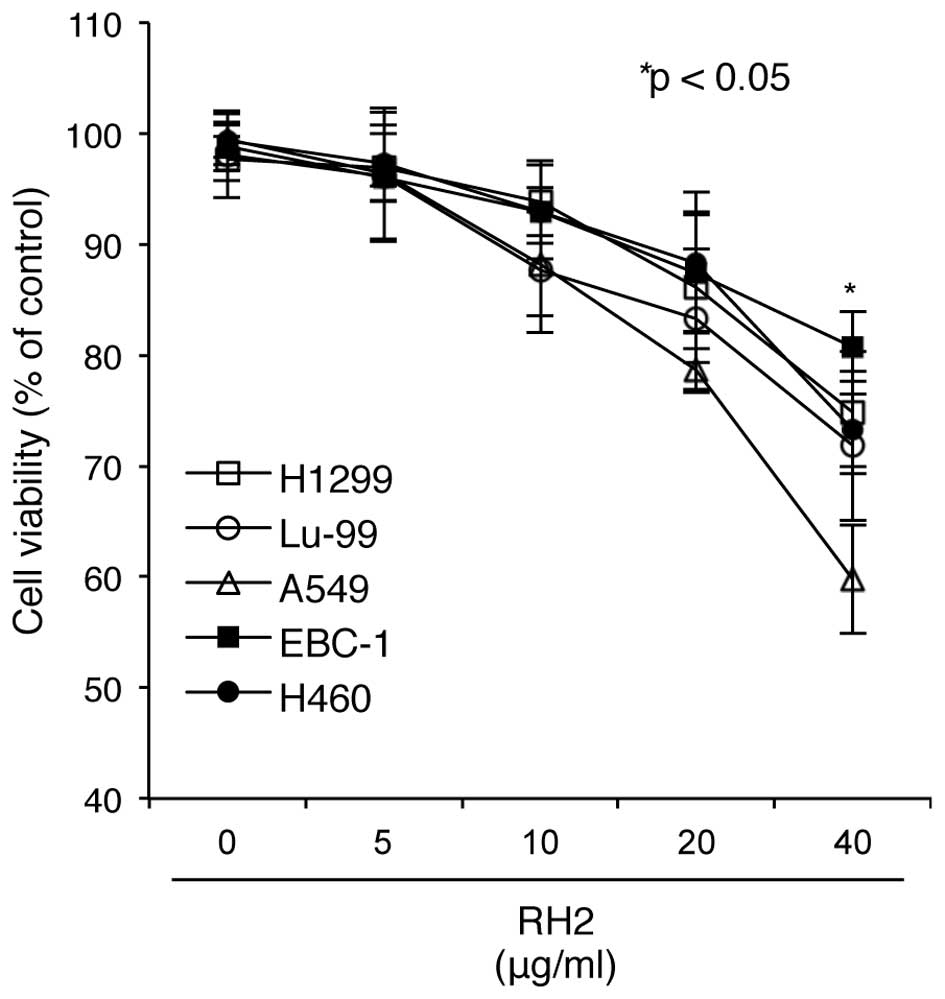
proliferation of the cells was measured. The WST-1 assay revealed
that the Rh2-mediated decrease in cell viability was induced in a
dose-dependent manner in these NSCLC cell lines (Fig. 1). In particular, A549 cells
exhibited a relatively high sensitivity to Rh2. Treatment with 40
μg/ml of Rh2 decreased the A549 cell viability up to 59.7% compared
to the control, indicating that ginsenoside Rh2 exerted a strong
anti-proliferative activity in NSCLC cells.
Previous studies on the molecular pathways related
to Rh2-mediated anticancer effect have been limited to the
activation of caspase-3 and -8 and the upregulation of pRb2 and
TRAIL-RI death receptor (16,17).
In order to identify additional molecular pathways participating in
the anticancer effect of Rh2, we performed miRNA expression
profiling analysis with the aim to detect specific regulators of
the Rh2-mediated anticancer properties in NSCLCs. On the basis of a
recent report that Rh2 inhibits glioma cell proliferation by
targeting miR-128, it is considered a novel mechanism for the
anticancer effect of Rh2 (13). In
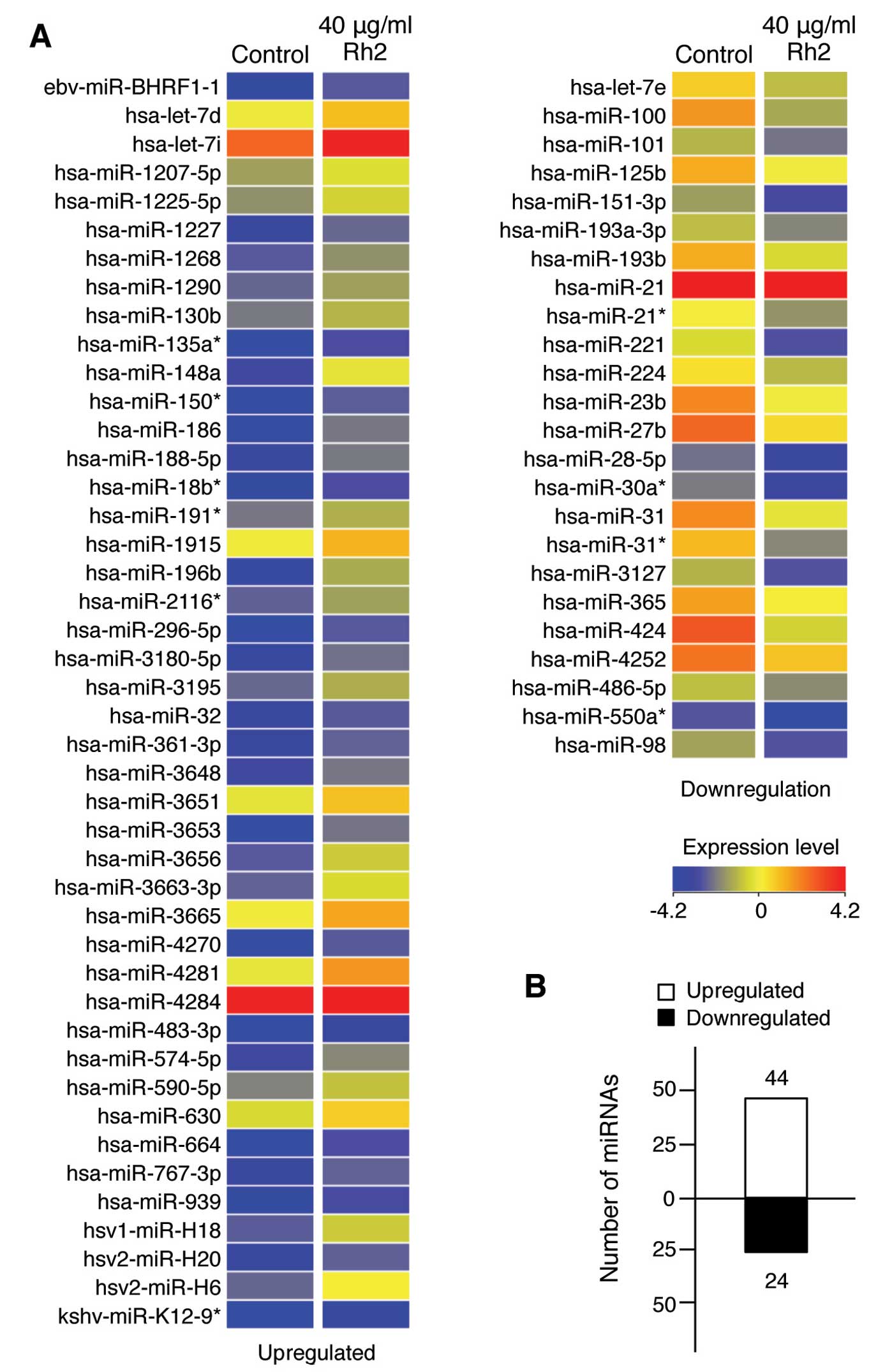
the present study, we discovered that the expression of specific
miRNAs in Rh2-treated A549 cells was significantly altered when
compared to that in the untreated A549 (control) cells (Fig. 2A). The color bar in Fig. 2 represents altered fluorescence
intensity corresponding to miRNAs that were either upregulated (red
color) or downregulated (blue color) following Rh2 treatment. A
total of 44 miRNAs were upregulated and 24 miRNAs were
downregulated in our experiment (Fig.
2B). The fold changes in miRNA expression are shown in Table I. In particular, the expression
level of miR-148a was significantly upregulated by 9.59-fold,
whereas the level of miR-424 was significantly downregulated by
12.4-fold in Rh2-treated NSCLC A549 cells.
 | Table IExpression levels of miRNAs exhibiting
>2-fold expression changes in response to ginsenoside Rh2 in
A549 cellsa. |
Table I
Expression levels of miRNAs exhibiting
>2-fold expression changes in response to ginsenoside Rh2 in
A549 cellsa.
| miRNA name | FC | miRNA name | FC |
|---|
| Upregulated |
| ebv-miR-BHRF1-1 | 2.63 | miR-32 | 2.16 |
| let-7d | 2.21 | miR-361-3p | 2.29 |
| let-7i | 2.99 | miR-3648 | 2.14 |
| miR-1207-5p | 2.40 | miR-3651 | 2.38 |
| miR-1225-5p | 2.41 | miR-3653 | 6.04 |
| miR-1227 | 2.29 | miR-3656 | 4.24 |
| miR-1268 | 2.03 | miR-3663-3p | 4.82 |
| miR-1290 | 2.05 | miR-3665 | 2.79 |
| miR-130b | 2.19 | miR-4270 | 4.41 |
| miR-135a | 4.88 | miR-4281 | 3.97 |
| miR-148a | 9.59 | miR-4284 | 2.19 |
| miR-150* | 9.29 | miR-483-3p | 2.20 |
| miR-186 | 4.02 | miR-574-5p | 2.66 |
| miR-188-5p | 2.79 | miR-590-5p | 2.36 |
| miR-18b | 2.20 | miR-630 | 2.51 |
| miR-191* | 2.13 | miR-664 | 3.75 |
| miR-1915 | 2.34 | miR-767-3p | 2.11 |
| miR-196b | 7.33 | miR-939 | 2.06 |
| miR-2116* | 2.30 | hsv1-miR-H18 | 4.27 |
| miR-296-5p | 3.54 | hsv1-miR-H20 | 2.21 |
| miR-3180-5p | 2.95 | hsv1-miR-H6 | 7.40 |
| miR-3195 | 2.49 |
hsv1-miR-K12-9* | 2.31 |
|
| Downregulated |
| let-7e | 3.60 | miR-27b | 4.54 |
| miR-100 | 9.25 | miR-28-5p | 2.33 |
| miR-101 | 2.35 | miR-30a | 2.61 |
| miR-125b | 2.64 | miR-31 | 4.76 |
| miR-151-3p | 3.18 | miR-31* | 9.58 |
| miR-193a-3p | 2.11 | miR-3127 | 3.46 |
| miR-193b | 3.68 | miR-365 | 2.72 |
| miR-21 | 4.16 | miR-424 | 12.44 |
| miR-21* | 3.88 | miR-4252 | 2.73 |
| miR-221 | 6.11 | miR-486-5p | 2.01 |
| miR-224 | 2.96 | miR-550a* | 3.02 |
| miR-23b | 4.19 | miR-98 | 2.78 |
Noteworthy, although there are no reports regarding
the role of miR-148a in NSCLC, miR-148a may prove a novel Rh2
target in NSCLC. miR-148a was originally shown to be downregulated
in human breast cancer; however, it is associated with improved
response to chemotherapy in esophageal cancer cell lines,
attenuates paclitaxel-resistance of hormone-refractory,
drug-resistant prostate cancer PC3 cells, suppresses gastric cancer
cell invasion and metastasis, and promotes apoptosis in colorectal
cancer cells (20–24). Therefore, future studies should be
directed towards elucidating the relationship between Rh2-mediated
anticancer properties and miR-148a upregulation in NSCLC.
Since the cellular functions of miRNAs are directly
mediated by controlling their target gene expression (25), we further analyzed the putative
target genes of the miRNAs and the functional relationship between
the gene and anticancer properties using bioinformatic tools.
First, the miRbase target database tool, MicroCosm, revealed that
827 genes were potentially targeted by Rh2-specific miRNAs.
Moreover, since Rh2 promotes the death of cancer cells through its
anti-proliferative, anti-angiogenic and apoptotic activities, we
selected genes having functions related to apoptosis, cell
proliferation and angiogenesis (26) by using the GO analysis tool, AmiGO.
Consistent with the previous finding, the GO analysis results
showed that several target genes of the Rh2-responsive miRNAs were
functionally involved in anticancer pathways. These sets of genes
are listed in Tables II and
III.
| Table IIPredicted targets of miRNAs
exhibiting an upregulation in response to Rh2 in A549 cells. |
Table II
Predicted targets of miRNAs
exhibiting an upregulation in response to Rh2 in A549 cells.
| Function of target
genes |
|---|
|
|
|---|
| miRNA name | Angiogenesis | Apoptosis | Cell
proliferation |
|---|
| has-let-7d | FASLG | CDKN1A, FAS, TP53,
CASP3, IRS2, TNFSF9, NME6, TAF9B, FASLG, MAP3K1, TGFBR1 | CDKN1A, FAS, TP53,
CASP3, IRS2, TNFSF9, IL13, NAP1L1, EIF2S2, OSMR, FASLG, TGFBR1 |
| hsa-miR-32 | TWIST1, GATA6 | TWIST1, SGK3,
BCL11B, RAD21, MAP2K4, ACTC1, TRAF3, ADRB1, APPL1, USP28, GATA6,
PAX3 | TWIST1, SGK3,
BCL11B, EVI5, CDKN1C, NKX2-3, BOX4, CDC27, FBXW7, APPL1, USP28,
TSC1, GATA6, PAX3 |
| hsa-miR-148a | TEK, ROCK1, DDAH1,
KLF4, BAI3 | TEK, ROCK1, MITF,
ROBO1, TGFA, WNT1, KLF4, BCL2L11, ROBO2, PTEN, ERBB3, SOS2,
IGF1 | TEK, MITF, ROBO1,
TGFA, WNT1, NRAS, KLF4, PTEN, ERBB3, IGF1 |
| hsa-miR-186 | VEGFA, CXCL13 | VEGFA, CXCL13,
XIAP, PRDX5, SORT1, TERF1, IGF1R, TGFBR2, PDCD4 | VEGFA, XIAP, PID1,
PDGFC, HOOK3, IGF1R, TGFBR2, JAG1 |
| hsa-miR-296-5p | CXCL10 | MEF2D | CXCL10 |
| hsa-miR-130b | BTG1 | BTG1, IRF1, PPARG,
SPHK2, FOSL1, RUNX3, RNF41, TRIM2, SLTM, PHF17, TP53INP1 | BTG1, IRF1, PPARG,
SPHK2, FOSL1, RUNX3, HOXA3, WNT2B |
| hsa-miR-196b | HOXA5, TSPAN12 | HOXA5, CDKN12,
BIRC6, ABL1, RASSF5 | HOXA5, CDKN1B,
BIRC6, ING5 |
| hsa-miR-483-3p | HIPK2 | HIPK2, SATB1,
BAG1 | HIPK2, SATB1 |
| hsa-miR-767-3p | NPR1 | AGT, BLOC1S2,
PDCD6IP, CSNK2A1, TRAF7 | NRP1, AGT, BLOC1S2,
PDPN, EVI1, UBR5, TIMP2, CNOT8, CDC25C |
| hsa-miR-361-3p | - | PIM2, RAD9A, USP47,
MED1, OGT, MBD4 | PIM2, RARA,
MED1 |
| hsa-miR-1227 | - | ECE1, RYBP,
TNFAIP8 | - |
|
hsa-miR-1207-5p | PRKCA, GPR124 | PRKCA, EGLN2, MKL1,
TNS4, CBL, FGFR1 | PRKCA, ACVRL1,
FGFR1 |
| hsa-miR-1290 | GTF2I | BECN1 | BECN1, CHUK,
CREBBP, MLL2 |
| hsa-miR-664 | FOXO4 | CUL3, CYCS, BMX,
TAF9 | FOXO4, CUL3, SMAD4,
IRF2 |
| Table IIIPredicted targets of miRNAs
exhibiting a downregulation in response to Rh2 in A549 cells. |
Table III
Predicted targets of miRNAs
exhibiting a downregulation in response to Rh2 in A549 cells.
| Function of target
genes |
|---|
|
|
|---|
| miRNA name | Angiogenesis | Apoptosis | Cell
proliferation |
|---|
| has-let-7e | FASLG, THBS1,
PLXND1 | FASLG, MAPK3K1,
THBS1, CDKN1A, IGF1R, NGF, TP53, CASP3, IRS2, TGFBR1, FAS | FASLG, THBS1,
CDKN1A, IGF1R, FAS, NGF, TP53, CASP3, IRS2, IL13, NRAS, MLL2, CD86,
TGFBP1 |
| hsa-miR-21 | KRIT1, RHOB, FASLG,
FGF1 | KRIT1, RHOB, IL2A,
PDCD4, MSH2, FASLG, MAP3K1 | KRIT1, IL12A, JAG1,
TGFBI, DDX11, FASLG, NFIB |
| hsa-miR-31 | - | KIF1B, RASA1,
MAP3K1, CD28 | IL34, NUMB, CREG1,
CD28 |
| hsa-miR-101 | PTGS2 | PTGS2, JAK2, MITF,
DDIT4, USP47, RAC1, ROBO2, TGFBR1, TIAM2, SGK1 | PTGS2, JAK2, MITF,
TGFBR1, RAP1B, SGK1 |
| hsa-miR-221 | HIPK1, ANGPTL4 | HIPK1, ANGPTL4,
CDKN1B, BCL2L11, AKAP13, SOCS3, ERBB4 | HIPK1, CDKN1B, KIT,
CCDC88A, MBD2, ERBB4, ARNT |
| hsa-miR-23b | FGF2, TNFAIP3 | FGF2, PRDX3, IL6R,
IL12B, FAS, PPARGC1A, MAPK3K9, NKX3-2, MAP3K1, PAK6, PDPK1, CASP7,
HSP90B1, PROK2, ERBB4 | FGF2, PRDX3, IL6R,
IL12B, CNN2, ADRA2A, MAP7, IGSF8, PROK2, ELF5, TGFBR3, DDX11,
ERBB4 |
| hsa-miR-27b | SFRP1, ADORA2B,
GATA2, RUNX1, FGF1, PLXND1 | SFRP1, XIAP, PPARG,
BMI1, CHEK2, CREB1, MAGI3, BCL3, MAPK2K4, BAK1, CD28 | SFRP1, ADORA2B,
GATA2, XIAP, RUNX1, PPARG, RXRA, BMI1, INSR, TSC1, VEGFC, RNF139,
FGF1, MET, BAK1, LIFR, E2F7 |
| hsa-miR-125b | COL4A3, AGGF1,
WAR5, TNFAIP3 | COL4A3, MAP3K10,
MAP3K11, CASP2, TIAF1, TP53INP1, TNFAIP3 | AGGF3, WARS,
MAP3K11, FBXW4, TNFSF4, BAP1, TNFAIP3 |
|
hsa-miR-193a-3p | - | ERBB4, MCL1,
TNFRSF21, SIAH1 | ERBB4, ARNT, ING5,
LAMC1, SKAP2, CCND1 |
| hsa-miR-365 | ADM | E2F2, TIAM2, SGK1,
BCL11B | ADM, PAX6, HDAC4,
NFIB, SGK1, BCL11B |
| hsa-miR-151-3p | HIF1A | HIF1A | HIF1A, DDX11 |
| hsa-miR-424 | NF1, VEGFA | NF1, VEGFA,
PDCD6IP, IKBKB, YAP1, SIAH1, RAF1, NOTCH2, BDNF, BFAR, WNK3, CD28,
SGK1 | NF1, VEGFA, YAP1,
NOTCH2, RAF1, BDNF, IRS2, WNT5, MAP2K1, EVI5, PPAP2A, CDC27, PRDM4,
CD28, CCND1, SGK1 |
| hsa-miR-486-5p | - | FOXO1, PIM1, PTEN,
BCL11B | FOXO1, PIM1, PTEN,
SMAD2, BCL11B |
In summary, the present study demonstrates that a
subset of human miRNAs reveals significant changes in expression in
response to ginsenoside Rh2 in the NSCLC A549 cell line. Given the
strong anticancer effects of Rh2 on NSCLCs, it is likely that
miRNAs play an important role in the Rh2-mediated anticancer
effect. Future bioinformatic studies will highlight the role of
miRNAs in Rh2-mediated functions. In the light of the fact that the
mechanism of the anticancer effect of Rh2 on NSCLC cells is largely
unknown, this study provides novel insight into a possible
molecular mechanism through which Rh2 exerts its anticancer effect
on NSCLC cells.
Acknowledgements
This study was supported by the Ministry of
Education, Science and Technology (grant 20110028646 to S.A.) of
the Republic of Korea.
References
|
1
|
Walker S: Updates in non-small cell lung
cancer. Clin J Oncol Nurs. 12:587–596. 2008. View Article : Google Scholar : PubMed/NCBI
|
|
2
|
Gong HC, Wang S, Mayer G, et al:
Signatures of drug sensitivity in nonsmall cell lung cancer. Int J
Proteomics. August 7–2011.(Epub ahead of print). View Article : Google Scholar
|
|
3
|
Ramalingam S and Belani CP: Recent
advances in targeted therapy for non-small cell lung cancer. Expert
Opin Ther Targets. 11:245–257. 2007. View Article : Google Scholar : PubMed/NCBI
|
|
4
|
Ambros V: microRNAs: tiny regulators with
great potential. Cell. 107:823–826. 2001. View Article : Google Scholar : PubMed/NCBI
|
|
5
|
Ceppi P, Mudduluru G, Kumarswamy R, et al:
Loss of miR-200c expression induces an aggressive, invasive and
chemoresistant phenotype in non-small cell lung cancer. Mol Cancer
Res. 8:1207–1216. 2010. View Article : Google Scholar : PubMed/NCBI
|
|
6
|
Markou A, Tsaroucha EG, Kaklamanis L,
Fotinou M, Georgoulias V and Lianidou ES: Prognostic value of
mature microRNA-21 and microRNA-205 overexpression in non-small
cell lung cancer by quantitative real-time RT-PCR. Clin Chem.
54:1696–1704. 2008. View Article : Google Scholar : PubMed/NCBI
|
|
7
|
Zhang JG, Wang JJ, Zhao F, Liu Q, Jiang K
and Yang GH: MicroRNA-21 (miR-21) represses tumor suppressor PTEN
and promotes growth and invasion in non-small cell lung cancer
(NSCLC). Clin Chim Acta. 411:846–852. 2010. View Article : Google Scholar : PubMed/NCBI
|
|
8
|
Zhu X, Li H, Long L, et al: miR-126
enhances the sensitivity of non-small cell lung cancer cells to
anticancer agents by targeting vascular endothelial growth factor
A. Acta Biochim Biophys Sin (Shanghai). 44:519–526. 2012.
View Article : Google Scholar : PubMed/NCBI
|
|
9
|
Shibata S: Chemistry and cancer preventing
activities of ginseng saponins and some related triterpenoid
compounds. J Korean Med Sci. (Suppl 16): S28–S37. 2001. View Article : Google Scholar : PubMed/NCBI
|
|
10
|
Bi WY, Fu BD, Shen HQ, et al: Sulfated
derivative of 20(S)-ginsenoside Rh2 inhibits inflammatory cytokines
through MAPKs and NF-kappa B pathways in LPS-induced RAW264.7
macrophages. Inflammation. 35:1659–1668. 2012. View Article : Google Scholar : PubMed/NCBI
|
|
11
|
He L, Lee J, Jang JH, et al: Ginsenoside
Rh2 inhibits osteoclastogenesis through down-regulation of
NF-kappaB, NFATc1 and c-Fos. Bone. 50:1207–1213. 2012. View Article : Google Scholar : PubMed/NCBI
|
|
12
|
Luo JZ and Luo L: Ginseng on
hyperglycemia: effects and mechanisms. Evid Based Complement
Alternat Med. 6:423–427. 2009. View Article : Google Scholar : PubMed/NCBI
|
|
13
|
Wu N, Wu GC, Hu R, Li M and Feng H:
Ginsenoside Rh2 inhibits glioma cell proliferation by targeting
microRNA-128. Acta Pharmacol Sin. 32:345–353. 2011. View Article : Google Scholar : PubMed/NCBI
|
|
14
|
Li B, Zhao J, Wang CZ, et al: Ginsenoside
Rh2 induces apoptosis and paraptosis-like cell death in colorectal
cancer cells through activation of p53. Cancer Lett. 301:185–192.
2011. View Article : Google Scholar : PubMed/NCBI
|
|
15
|
Zhang C, Yu H and Hou J: Effects of 20
(S)-ginsenoside Rh2 and 20 (R)-ginsenoside Rh2 on proliferation and
apoptosis of human lung adenocarcinoma A549 cells. Zhongguo Zhong
Yao Za Zhi. 36:1670–1674. 2011.(In Chinese).
|
|
16
|
Cheng CC, Yang SM, Huang CY, Chen JC,
Chang WM and Hsu SL: Molecular mechanisms of ginsenoside
Rh2-mediated G1 growth arrest and apoptosis in human lung
adenocarcinoma A549 cells. Cancer Chemother Pharmacol. 55:531–540.
2005. View Article : Google Scholar : PubMed/NCBI
|
|
17
|
Li Q, Li Y, Wang X, et al: Co-treatment
with ginsenoside Rh2 and betulinic acid synergistically induces
apoptosis in human cancer cells in association with enhanced
capsase-8 activation, bax translocation, and cytochrome c
release. Mol Carcinog. 50:760–769. 2011. View Article : Google Scholar : PubMed/NCBI
|
|
18
|
Jia WW, Bu X, Philips D, et al: Rh2, a
compound extracted from ginseng, hypersensitizes
multidrug-resistant tumor cells to chemotherapy. Can J Physiol
Pharmacol. 82:431–437. 2004. View
Article : Google Scholar : PubMed/NCBI
|
|
19
|
Hu S, Yu JY, Xiong LJ, Hu CP and Zhang YX:
Research on the mechanism of ginsenoside Rh2 reversing the
resistance of lung adenocarcinoma cells to cisplatin. Zhonghua Yi
Xue Za Zhi. 90:264–268. 2010.(In Chinese).
|
|
20
|
Hummel R, Watson DI, Smith C, et al:
Mir-148a improves response to chemotherapy in sensitive and
resistant oesophageal adenocarcinoma and squamous cell carcinoma
cells. J Gastrointest Surg. 15:429–438. 2011. View Article : Google Scholar : PubMed/NCBI
|
|
21
|
Fujita Y, Kojima K, Ohhashi R, et al:
MiR-148a attenuates paclitaxel resistance of hormone-refractory,
drug-resistant prostate cancer PC3 cells by regulating MSK1
expression. J Biol Chem. 285:19076–19084. 2010. View Article : Google Scholar : PubMed/NCBI
|
|
22
|
Lehmann U, Hasemeier B, Christgen M, et
al: Epigenetic inactivation of microRNA gene hsa-mir-9-1 in human
breast cancer. J Pathol. 214:17–24. 2008. View Article : Google Scholar : PubMed/NCBI
|
|
23
|
Zheng B, Liang L, Wang C, et al:
MicroRNA-148a suppresses tumor cell invasion and metastasis by
downregulating ROCK1 in gastric cancer. Clin Cancer Res.
17:7574–7583. 2011. View Article : Google Scholar : PubMed/NCBI
|
|
24
|
Zhang H, Li Y, Huang Q, et al: MiR-148a
promotes apoptosis by targeting Bcl-2 in colorectal cancer. Cell
Death Differ. 18:1702–1710. 2011. View Article : Google Scholar : PubMed/NCBI
|
|
25
|
Pillai RS, Bhattacharyya SN and Filipowicz
W: Repression of protein synthesis by miRNAs: how many mechanisms?
Trends Cell Biol. 17:118–126. 2007. View Article : Google Scholar : PubMed/NCBI
|
|
26
|
Yue PY, Mak NK, Cheng YK, et al:
Pharmacogenomics and the Yin/Yang actions of ginseng: anti-tumor,
angiomodulating and steroid-like activities of ginsenosides. Chin
Med. 2:62007. View Article : Google Scholar : PubMed/NCBI
|