Oncol Rep 42: [Related article:] 509–520, 2019; DOI:
10.3892/or.2019.7175
Subsequently to the publication of the above
article, and a Corrigendum that has already been published with the
intention of showing corrected versions of Figs. 1 and 8 (DOI:
10.3892/or.2022.8348; published online on June 14, 2022), the
authors have belatedly realized that the revisions made to Fig. 8
necessitated changes that should have been introduced into Fig. 9, although these were not attended
to in the first corrigendum. Essentially, Fig. 8 was revised as the
cell apoptosis and cell proliferation assays therein were poorly
presented, which made the interpretation of the data difficult;
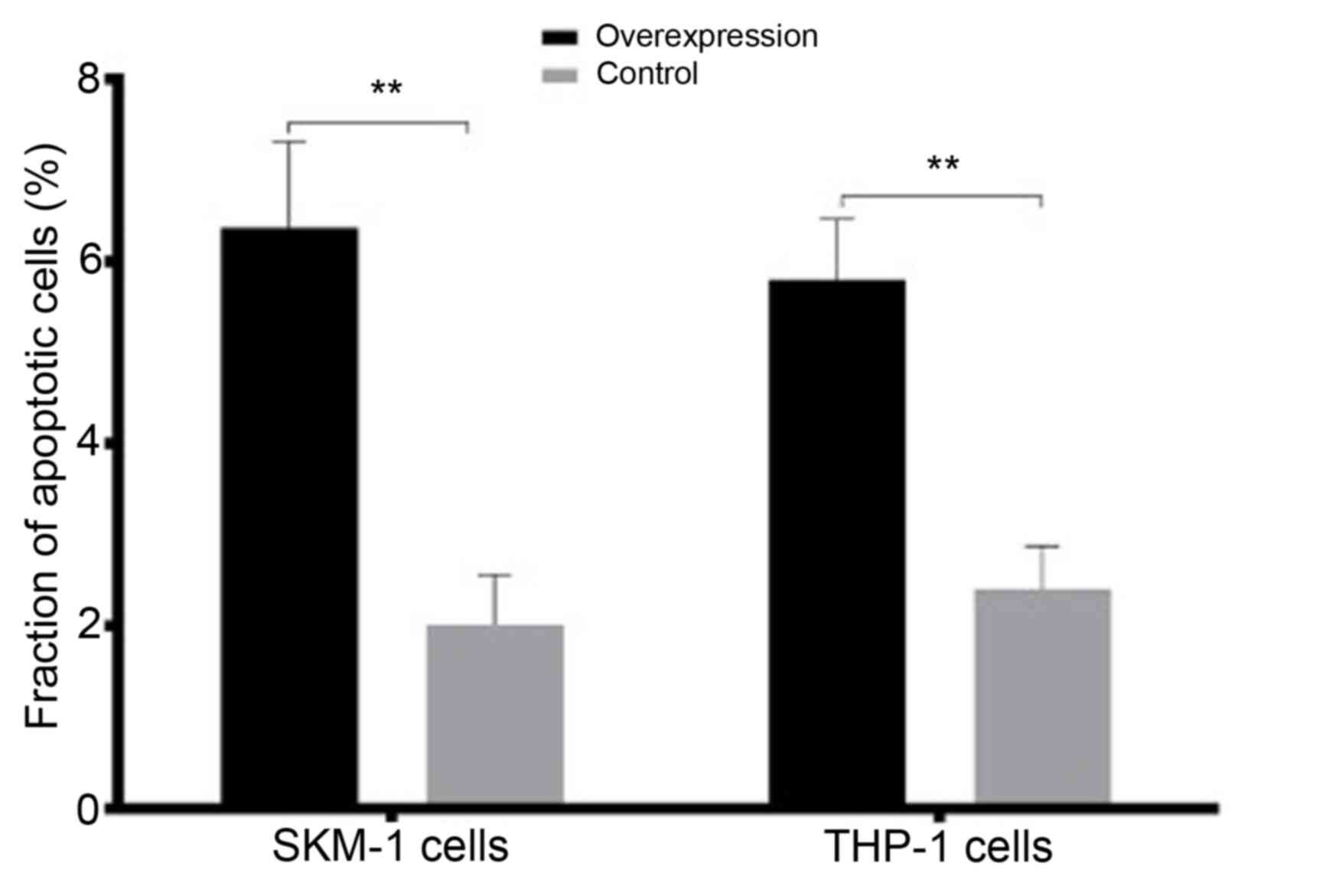
Fig. 9 showed the fractions of
apoptotic cells in the SKM-1 and THP-1 cell lines with
lncENST00000444102 overexpression as this pertained to Fig. 8.
A revised version of Fig. 9, presenting the analysis of the
data shown in the revised version of Fig. 8, is shown opposite. In
addition to the revision of Fig.
9, the sentence starting on p. 517, left-hand column, line 12
[“The flow cytometric apoptosis assay revealed that
lncENST00000444102 overexpression promoted tumor cells to undergo
apoptosis compared to control cells (P<0.001, Fig. 9)”] should be replaced with the
following text, to reflect the change in the level of statistical
significance: ‘The flow cytometric apoptosis assay revealed that
lncENST00000444102 overexpression promoted tumor cells to undergo
apoptosis compared to control cells (P<0.01, Fig. 9)”.
Note that the revisions made to Figs. 8 and 9 in this paper have not had a major
impact on the reported results, and do not affect the overall
conclusions reported in the study. All the authors agree to the
publication of this corrigendum. The authors are grateful to the
Editor of Oncology Reports for allowing them the opportunity
to publish this additional Corrigendum; furthermore, they apologize
for any inconvenience caused to the readership of the Journal.