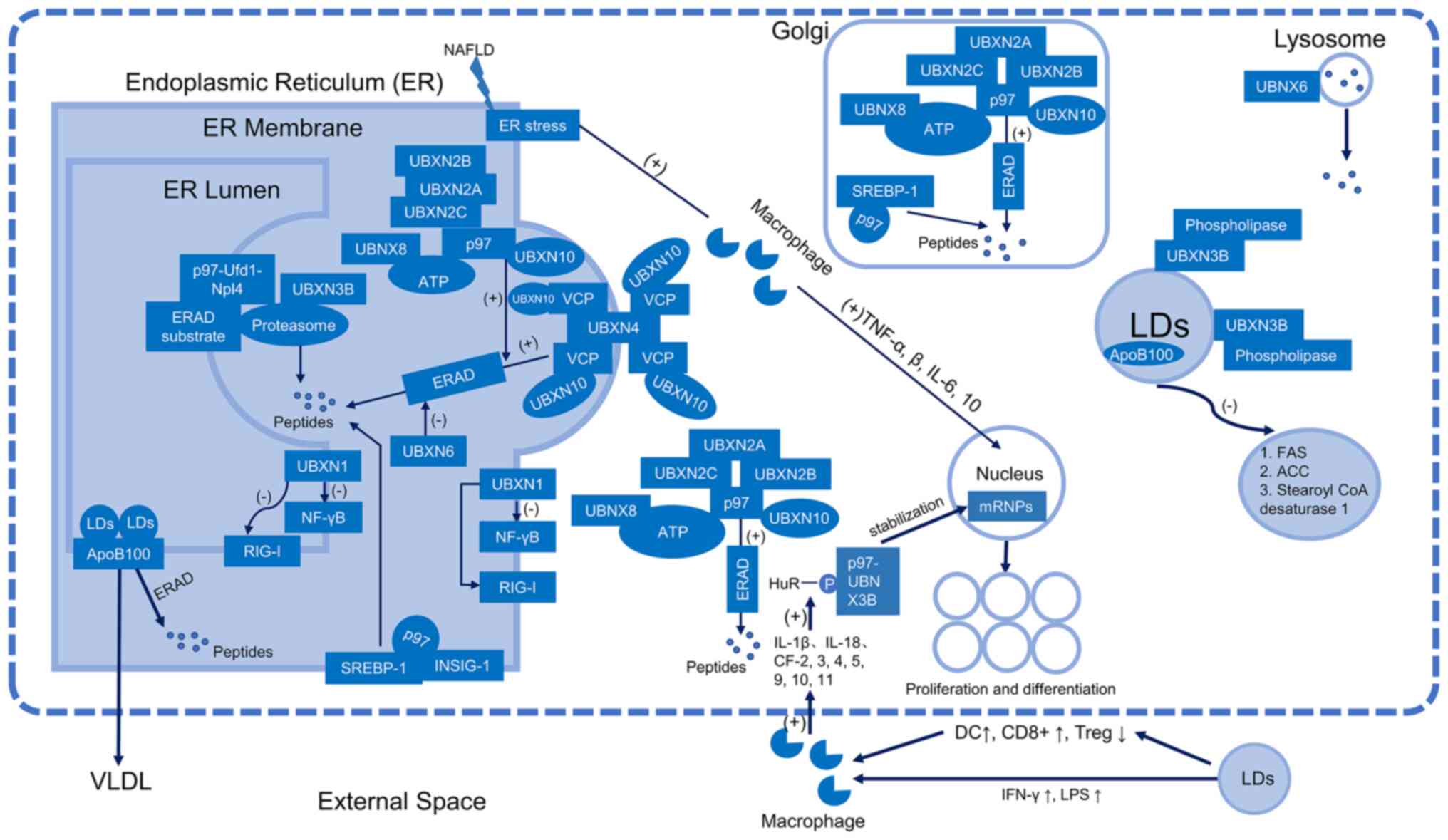
|
1
|
Rawla P, Sunkara T, Muralidharan P and Raj
JP: Update in global trends and aetiology of hepatocellular
carcinoma. Contemp Oncol (Pozn). 22:141–150. 2018.PubMed/NCBI
|
|
2
|
World Health Organization, . GLOBOCAN 2020
Graph production. http://gco.iarc.fr/todaySeptember. 2021
|
|
3
|
Blanchette-Mackie EJ, Dwyer NK, Barber T,
Coxey RA, Takeda T, Rondinone CM, Theodorakis JL, Greenberg AS and
Londos C: Perilipin is located on the surface layer of
intracellular lipid droplets in adipocytes. J Lipid Res.
36:1211–1226. 1995. View Article : Google Scholar : PubMed/NCBI
|
|
4
|
Shalapour S, Lin XJ, Bastian IN, Brain J,
Burt AD, Aksenov AA, Vrbanac AF, Li W, Perkins A, Matsutani T, et
al: Inflammation-induced IgA+ cells dismantle anti-liver cancer
immunity. Nature. 551:340–345. 2017. View Article : Google Scholar : PubMed/NCBI
|
|
5
|
Muir K, Hazim A, He Y, Peyressatre M, Kim
DY, Song X and Beretta L: Proteomic and lipidomic signatures of
lipid metabolism in NASH-associated hepatocellular carcinoma.
Cancer Res. 73:4722–4731. 2013. View Article : Google Scholar : PubMed/NCBI
|
|
6
|
Zhou HL, Geng C, Luo G and Lou H: The
p97-UBXD8 complex destabilizes mRNA by promoting release of
ubiquitinated HuR from mRNP. Genes Dev. 27:1046–1058. 2013.
View Article : Google Scholar : PubMed/NCBI
|
|
7
|
Kloppsteck P, Ewens CA, Förster A, Zhang X
and Freemont PS: Regulation of p97 in the ubiquitin-proteasome
system by the UBX protein-family. Biochim Biophys Acta.
1823:125–129. 2012. View Article : Google Scholar : PubMed/NCBI
|
|
8
|
Rezvani K: UBXD proteins: A family of
proteins with diverse functions in cancer. Int J Mol Sci.
17:17242016. View Article : Google Scholar : PubMed/NCBI
|
|
9
|
Liao Z, Luo R, Li G, Song Y, Zhan S, Zhao
K, Hua W, Zhang Y, Wu X and Yang C: Exosomes from mesenchymal stem
cells modulate endoplasmic reticulum stress to protect against
nucleus pulposus cell death and ameliorate intervertebral disc
degeneration in vivo. Theranostics. 9:4084–4100. 2019. View Article : Google Scholar : PubMed/NCBI
|
|
10
|
Nakatsukasa K, Huyer G, Michaelis S and
Brodsky JL: Dissecting the ER-associated degradation of a misfolded
polytopic membrane protein. Cell. 132:101–112. 2008. View Article : Google Scholar : PubMed/NCBI
|
|
11
|
Mukkavalli S, Klickstein JA, Ortiz B, Juo
P and Raman M: The p97-UBXN1 complex regulates aggresome formation.
J Cell Sci. 134:jcs2542012021. View Article : Google Scholar : PubMed/NCBI
|
|
12
|
Uchiyama K, Totsukawa G, Puhka M, Kaneko
Y, Jokitalo E, Dreveny I, Beuron F, Zhang X, Freemont P and Kondo
H: p37 is a p97 adaptssswor required for Golgi and ER biogenesis in
interphase and at the end of mitosis. Dev Cell. 11:803–816. 2006.
View Article : Google Scholar : PubMed/NCBI
|
|
13
|
Her NG, Toth JI, Ma CT, Wei Y,
Motamedchaboki K, Sergienko E and Petroski MD: p97 composition
changes caused by allosteric inhibition are suppressed by an
on-target mechanism that increases the enzyme's ATPase activity.
Cell Chem Biol. 23:517–528. 2016. View Article : Google Scholar : PubMed/NCBI
|
|
14
|
Ye Y, Meyer HH and Rapoport TA: The AAA
ATPase Cdc48/p97 and its partners transport proteins from the ER
into the cytosol. Nature. 414:652–656. 2001. View Article : Google Scholar : PubMed/NCBI
|
|
15
|
Olzmann JA, Richter CM and Kopito RR:
Spatial regulation of UBXD8 and p97/VCP controls ATGL-mediated
lipid droplet turnover. Proc Natl Acad Sci USA. 110:1345–1350.
2013. View Article : Google Scholar : PubMed/NCBI
|
|
16
|
Liang J, Yin C, Doong H, Fang S, Peterhoff
C, Nixon RA and Monteiro MJ: Characterization of erasin (UBXD2): A
new ER protein that promotes ER-associated protein degradation. J
Cell Sci. 119:4011–4024. 2006. View Article : Google Scholar : PubMed/NCBI
|
|
17
|
Nagahama M, Ohnishi M, Kawate Y, Matsui T,
Miyake H, Yuasa K, Tani K, Tagaya M and Tsuji A: UBXD1 is a
VCP-interacting protein that is involved in ER-associated
degradation. Biochem Biophys Res Commun. 382:303–308. 2009.
View Article : Google Scholar : PubMed/NCBI
|
|
18
|
Raman M, Sergeev M, Garnaas M, Lydeard JR,
Huttlin EL, Goessling W, Shah JV and Harper JW: Systematic
proteomics of the VCP-UBXD adaptor network identifies a role for
UBXN10 in regulating ciliogenesis. Nat Cell Biol. 17:1356–1369.
2015. View Article : Google Scholar : PubMed/NCBI
|
|
19
|
Schrul B and Kopito RR: Peroxin-dependent
targeting of a lipid-droplet-destined membrane protein to ER
subdomains. Nat Cell Biol. 18:740–751. 2016. View Article : Google Scholar : PubMed/NCBI
|
|
20
|
Pawar A, Botolin D, Mangelsdorf DJ and
Jump DB: The role of liver X receptor-alpha in the fatty acid
regulation of hepatic gene expression. J Biol Chem.
278:40736–40743. 2003. View Article : Google Scholar : PubMed/NCBI
|
|
21
|
Horton JD, Shah NA, Warrington JA,
Anderson NN, Park SW, Brown MS and Goldstein JL: Combined analysis
of oligonucleotide microarray data from transgenic and knockout
mice identifies direct SREBP target genes. Proc Natl Acad Sci USA.
100:12027–12032. 2003. View Article : Google Scholar : PubMed/NCBI
|
|
22
|
Gong Yi, Lee JN, Lee PC, Goldstein JL,
Brown MS and Ye J: Sterol-regulated ubiquitination and degradation
of Insig-1 creates a convergent mechanism for feedback control of
cholesterol synthesis and uptake. Cell Metab. 3:15–24. 2006.
View Article : Google Scholar : PubMed/NCBI
|
|
23
|
Lee JN, Zhang X, Feramisco JD, Gong Y and
Ye J: Unsaturated fatty acids inhibit proteasomal degradation of
Insig-1 at a postubiquitination step. J Biol Chem. 283:33772–33783.
2008. View Article : Google Scholar : PubMed/NCBI
|
|
24
|
Nohturfft A, Yabe D, Goldstein JL, Brown
MS and Espenshade PJ: Regulated step in cholesterol feedback
localized to budding of SCAP from ER membranes. Cell. 102:315–323.
2000. View Article : Google Scholar : PubMed/NCBI
|
|
25
|
Ohsaki Y, Cheng J, Suzuki M, Fujita A and
Fujimoto T: Lipid droplets are arrested in the ER membrane by tight
binding of lipidated apolipoprotein B-100. J Cell Sci.
121:2415–2422. 2008. View Article : Google Scholar : PubMed/NCBI
|
|
26
|
Sasako T, Ohsugi M, Kubota N, Itoh S,
Okazaki Y, Terai A, Kubota T, Yamashita S, Nakatsukasa K, Kamura T,
et al: Hepatic Sdf2l1 controls feeding-induced ER stress and
regulates metabolism. Nat Commun. 10:9472019. View Article : Google Scholar : PubMed/NCBI
|
|
27
|
Yen CL, Monetti M, Burri BJ and Farese RV
Jr: The triacylglycerol synthesis enzyme DGAT1 also catalyzes the
synthesis of diacylglycerols, waxes, and retinyl esters. J Lipid
Res. 46:1502–1511. 2005. View Article : Google Scholar : PubMed/NCBI
|
|
28
|
Loregger A, Raaben M, Tan J, Scheij S,
Moeton M, van den Berg M, Gelberg-Etel H, Stickel E, Roitelman J,
Brummelkamp T and Zelcer N: Haploid mammalian genetic screen
identifies UBXD8 as a key determinant of HMGCR degradation and
cholesterol biosynthesis. Arterioscler Thromb Vasc Biol.
37:2064–2074. 2017. View Article : Google Scholar : PubMed/NCBI
|
|
29
|
Ishikawa H, Ma Z and Barber GN: STING
regulates intracellular DNA-mediated, type I interferon-dependent
innate immunity. Nature. 461:788–792. 2009. View Article : Google Scholar : PubMed/NCBI
|
|
30
|
Yang L, Wang L, Ketkar H, Ma J, Yang G,
Cui S, Geng T, Mordue DG, Fujimoto T, Cheng G, et al: UBXN3B
positively regulates STING-mediated antiviral immune responses. Nat
Commun. 9:23292018. View Article : Google Scholar : PubMed/NCBI
|
|
31
|
Preuss C, Jelenik T, Bódis K, Müssig K,
Burkart V, Szendroedi J, Roden M and Markgraf DF: A new targeted
lipidomics approach reveals lipid droplets in liver, muscle and
heart as a repository for diacylglycerol and ceramide species in
non-alcoholic fatty liver. Cells. 8:2772019. View Article : Google Scholar : PubMed/NCBI
|
|
32
|
Tian Y, Yang B, Qiu W, Hao Y, Zhang Z,
Yang B, Li N, Cheng S, Lin Z, Rui YC, et al: ER-residential Nogo-B
accelerates NAFLD-associated HCC mediated by metabolic
reprogramming of oxLDL lipophagy. Nat Commun. 10:33912019.
View Article : Google Scholar : PubMed/NCBI
|
|
33
|
Trefts E, Gannon M and Wasserman DH: The
liver. Curr Biol. 27:R1147–R1151. 2017. View Article : Google Scholar : PubMed/NCBI
|
|
34
|
Lonardo A, Ballestri S, Marchesini G,
Angulo P and Loria P: Nonalcoholic fatty liver disease: A precursor
of the metabolic syndrome. Dig Liver Dis. 47:181–190. 2015.
View Article : Google Scholar : PubMed/NCBI
|
|
35
|
Guri Y, Colombi M, Dazert E, Hindupur SK,
Roszik J, Moes S, Jenoe P, Heim MH, Riezman I, Riezman H and Hall
MN: mTORC2 promotes tumorigenesis via lipid synthesis. Cancer Cell.
32:807–823.e12. 2017. View Article : Google Scholar : PubMed/NCBI
|
|
36
|
Huang X, Fan M and Huang W: Pleiotropic
roles of FXR in liver and colorectal cancers. Mol Cell Endocrinol.
543:1115432022. View Article : Google Scholar : PubMed/NCBI
|
|
37
|
Yang S, Koteish A, Lin H, Huang J, Roskams
T, Dawson V and Diehl AM: Oval cells compensate for damage and
replicative senescence of mature hepatocytes in mice with fatty
liver disease. Hepatology. 39:403–411. 2004. View Article : Google Scholar : PubMed/NCBI
|
|
38
|
Zhang T, Zhang Y, Liu J, Ma Y, Ye Q, Yan X
and Ding L: MicroRNA-377-3p inhibits hepatocellular carcinoma
growth and metastasis through negative regulation of CPT1C-mediated
fatty acid oxidation. Cancer Metab. 10:22022. View Article : Google Scholar : PubMed/NCBI
|
|
39
|
Bauer DE, Hatzivassiliou G, Zhao F,
Andreadis C and Thompson CB: ATP citrate lyase is an important
component of cell growth and transformation. Oncogene.
24:6314–6322. 2005. View Article : Google Scholar : PubMed/NCBI
|
|
40
|
Litwack G: Chapter 9-lipids. Litwack G:
Human biochemistry Boston: Academic Press; pp. 199–255. 2018
|
|
41
|
Medes G, Thomas A and Wernhouse S:
Metabolism of neoplastic tissue. IV. A study of lipid synthesis in
neoplastic tissue slices in vitro. Cancer Res. 13:27–29.
1953.PubMed/NCBI
|
|
42
|
Fullerton MD, Galic S, Marcinko K, Sikkema
S, Pulinilkunnil T, Chen ZP, O'Neill HM, Ford RJ, Palanivel R,
O'Brien M, et al: Single phosphorylation sites in Acc1 and Acc2
regulate lipid homeostasis and the insulin-sensitizing effects of
metformin. Nat Med. 19:1649–1654. 2013. View Article : Google Scholar : PubMed/NCBI
|
|
43
|
Lake AD, Novak P, Hardwick RN,
Flores-Keown B, Zhao F, Klimecki WT and Cherrington NJ: The
adaptive endoplasmic reticulum stress response to lipotoxicity in
progressive human nonalcoholic fatty liver disease. Toxicol Sci.
137:26–35. 2014.Oyadomari S, Harding HP, Zhang Y, Oyadomari M and
Ron D: Dephosphorylation of translation initiation factor 2alpha
enhances glucose tolerance and attenuates hepatosteatosis in mice.
Cell Metab. 7:520–532. 2008. View Article : Google Scholar : PubMed/NCBI
|
|
44
|
Pinto Lde F, Compri CM, Fornari JV,
Bartchewsky W, Cintra DE, Trevisan M, Carvalho Pde O, Ribeiro ML,
Velloso LA, Saad MJ, et al: The immunosuppressant drug,
thalidomide, improves hepatic alterations induced by a high-fat
diet in mice. Liver Int. 30:603–610. 2010. View Article : Google Scholar : PubMed/NCBI
|
|
45
|
Crespo J, Cayón A, Fernández-Gil P,
Hernández-Guerra M, Mayorga M, Domínguez-Díez A,
Fernández-Escalante JC and Pons-Romero F: Gene expression of tumor
necrosis factor alpha and TNF-receptors, p55 and p75, in
nonalcoholic steatohepatitis patients. Hepatology. 34:1158–1163.
2001. View Article : Google Scholar : PubMed/NCBI
|
|
46
|
Zhou YJ, Li YY, Nie YQ, Yang H, Zhan Q,
Huang J, Shi SL, Lai XB and Huang HL: Influence of polygenetic
polymorphisms on the susceptibility to non-alcoholic fatty liver
disease of Chinese people. J Gastroenterol Hepatol. 25:772–777.
2010. View Article : Google Scholar : PubMed/NCBI
|
|
47
|
Kramer F, Torzewski J, Kamenz J, Veit K,
Hombach V, Dedio J and Ivashchenko Y: Interleukin-1beta stimulates
acute phase response and C-reactive protein synthesis by inducing
an NFkappaB- and C/EBPbeta-dependent autocrine interleukin-6 loop.
Mol Immunol. 45:2678–2689. 2008. View Article : Google Scholar : PubMed/NCBI
|
|
48
|
Banroques J, Doère M, Dreyfus M, Linder P
and Tanner NK: Motif III in superfamily 2 ‘helicases’ helps convert
the binding energy of ATP into a high-affinity RNA binding site in
the yeast DEAD-box protein Ded1. J Mol Biol. 396:949–966. 2010.
View Article : Google Scholar : PubMed/NCBI
|
|
49
|
Catalá M, Antón A and Portolés MT:
Characterization of the simultaneous binding of Escherichia coli
endotoxin to Kupffer and endothelial liver cells by flow cytometry.
Cytometry. 36:123–130. 1999. View Article : Google Scholar : PubMed/NCBI
|
|
50
|
Luo W, Xu Q, Wang Q, Wu H and Hua J:
Effect of modulation of PPAR-γ activity on Kupffer cells M1/M2
polarization in the development of non-alcoholic fatty liver
disease. Sci Rep. 7:446122017. View Article : Google Scholar : PubMed/NCBI
|
|
51
|
Liu PS, Wang H, Li X, Chao T, Teav T,
Christen S, Di Conza G, Cheng WC, Chou CH, Vavakova M, et al:
α-ketoglutarate orchestrates macrophage activation through
metabolic and epigenetic reprogramming. Nat Immunol. 18:985–994.
2017. View Article : Google Scholar : PubMed/NCBI
|
|
52
|
Bertola A, Bonnafous S, Anty R, Patouraux
S, Saint-Paul MC, Iannelli A, Gugenheim J, Barr J, Mato JM, Le
Marchand-Brustel Y, et al: Hepatic expression patterns of
inflammatory and immune response genes associated with obesity and
NASH in morbidly obese patients. PLoS One. 5:e135772010. View Article : Google Scholar : PubMed/NCBI
|
|
53
|
Maina V, Sutti S, Locatelli I, Vidali M,
Mombello C, Bozzola C and Albano E: Bias in macrophage activation
pattern influences non-alcoholic steatohepatitis (NASH) in mice.
Clin Sci (Lond). 122:545–553. 2012. View Article : Google Scholar : PubMed/NCBI
|
|
54
|
Herber DL, Cao W, Nefedova Y, Novitskiy
SV, Nagaraj S, Tyurin VA, Corzo A, Cho HI, Celis E, Lennox B, et
al: Lipid accumulation and dendritic cell dysfunction in cancer.
Nat Med. 16:880–886. 2010. View Article : Google Scholar : PubMed/NCBI
|
|
55
|
Henning JR, Graffeo CS, Rehman A, Fallon
NC, Zambirinis CP, Ochi A, Barilla R, Jamal M, Deutsch M, Greco S,
et al: Dendritic cells limit fibroinflammatory injury in
nonalcoholic steatohepatitis in mice. Hepatology. 58:589–602. 2013.
View Article : Google Scholar : PubMed/NCBI
|
|
56
|
Tosello-Trampont AC, Krueger P, Narayanan
S, Landes SG, Leitinger N and Hahn YS: NKp46(+) natural killer
cells attenuate metabolism-induced hepatic fibrosis by regulating
macrophage activation in mice. Hepatology. 63:799–812. 2016.
View Article : Google Scholar : PubMed/NCBI
|
|
57
|
Ambade A, Satishchandran A, Saha B,
Gyongyosi B, Lowe P, Kodys K, Catalano D and Szabo G:
Hepatocellular carcinoma is accelerated by NASH involving M2
macrophage polarization mediated by hif-1αinduced IL-10.
Oncoimmunology. 5:e12215572016. View Article : Google Scholar : PubMed/NCBI
|
|
58
|
Wang W, Furneaux H, Cheng H, Caldwell MC,
Hutter D, Liu Y, Holbrook N and Gorospe M: HuR regulates p21 mRNA
stabilization by UV light. Mol Cell Biol. 20:760–769. 2000.
View Article : Google Scholar : PubMed/NCBI
|
|
59
|
Gerber AP, Herschlag D and Brown PO:
Extensive association of functionally and cytotopically related
mRNAs with Puf family RNA-binding proteins in yeast. PLoS Biol.
2:E792004. View Article : Google Scholar : PubMed/NCBI
|
|
60
|
Clement SL, Scheckel C, Stoecklin G and
Lykke-Andersen J: Phosphorylation of tristetraprolin by MK2 impairs
AU-rich element mRNA decay by preventing deadenylase recruitment.
Mol Cell Biol. 31:256–266. 2011. View Article : Google Scholar : PubMed/NCBI
|
|
61
|
Lafarga V, Cuadrado A, Lopez de Silanes I,
Bengoechea R, Fernandez-Capetillo O and Nebreda AR: p38
Mitogen-activated protein kinase- and HuR-dependent stabilization
of p21(Cip1) mRNA mediates the G(1)/S checkpoint. Mol Cell Biol.
9:4341–4351. 2009. View Article : Google Scholar : PubMed/NCBI
|
|
62
|
Meerang M, Ritz D, Paliwal S, Garajova Z,
Bosshard M, Mailand N, Janscak P, Hübscher U, Meyer H and Ramadan
K: The ubiquitin-selective segregase VCP/p97 orchestrates the
response to DNA double-strand breaks. Nat Cell Biol. 13:1376–1382.
2011. View Article : Google Scholar : PubMed/NCBI
|
|
63
|
Kim HH, Abdelmohsen K, Lal A, Pullmann R
Jr, Yang X, Galban S, Srikantan S, Martindale JL, Blethrow J,
Shokat KM and Gorospe M: Nuclear HuR accumulation through
phosphorylation by Cdk1. Genes Dev. 22:1804–1815. 2008. View Article : Google Scholar : PubMed/NCBI
|
|
64
|
Park ES, Yoo YJ and Elangovan M: The
opposite role of two UBA-UBX containing proteins, p47 and SAKS1 in
the degradation of a single ERAD substrate, α-TCR. Mol Cell
Biochem. 425:37–45. 2017. View Article : Google Scholar : PubMed/NCBI
|
|
65
|
Sepulveda D, Rojas-Rivera D, Rodríguez DA,
Groenendyk J, Köhler A, Lebeaupin C, Ito S, Urra H, Carreras-Sureda
A, Hazari Y, et al: Interactome screening identifies the ER luminal
chaperone Hsp47 as a regulator of the unfolded protein response
transducer IRE1α. Mol Cell. 69:238–252.e7. 2018. View Article : Google Scholar : PubMed/NCBI
|
|
66
|
Karagöz GE, Acosta-Alvear D, Nguyen HT,
Lee CP, Chu F and Walter P: An unfolded protein-induced
conformational switch activates mammalian IRE1. Elife.
6:e307002017. View Article : Google Scholar : PubMed/NCBI
|
|
67
|
Urano F, Wang X, Bertolotti A, Zhang Y,
Chung P, Harding HP and Ron D: Coupling of stress in the ER to
activation of JNK protein kinases by transmembrane protein kinase
IRE1. Science. 287:664–666. 2000. View Article : Google Scholar : PubMed/NCBI
|
|
68
|
Bertolotti A, Zhang Y, Hendershot LM,
Harding HP and Ron D: Dynamic interaction of BiP and ER stress
transducers in the unfolded-protein response. Nat Cell Biol.
2:326–332. 2000. View Article : Google Scholar : PubMed/NCBI
|
|
69
|
Carrara M, Prischi F, Nowak PR and Ali MM:
Crystal structures reveal transient PERK luminal domain
tetramerization in endoplasmic reticulum stress signaling. EMBO J.
34:1589–1600. 2015. View Article : Google Scholar : PubMed/NCBI
|
|
70
|
Harding HP, Zhang Y, Zeng H, Novoa I, Lu
PD, Calfon M, Sadri N, Yun C, Popko B, Paules R, et al: An
integrated stress response regulates amino acid metabolism and
resistance to oxidative stress. Mol Cell. 11:619–633. 2003.
View Article : Google Scholar : PubMed/NCBI
|
|
71
|
Blais JD, Filipenko V, Bi M, Harding HP,
Ron D, Koumenis C, Wouters BG and Bell JC: Activating transcription
factor 4 is translationally regulated by hypoxic stress. Mol Cell
Biol. 24:7469–7482. 2004. View Article : Google Scholar : PubMed/NCBI
|
|
72
|
Adachi Y, Yamamoto K, Okada T, Yoshida H,
Harada A and Mori K: ATF6 is a transcription factor specializing in
the regulation of quality control proteins in the endoplasmic
reticulum. Cell Struct Funct. 33:75–89. 2008. View Article : Google Scholar : PubMed/NCBI
|
|
73
|
Schindler AJ and Schekman R: In vitro
reconstitution of ER-stress induced ATF6 transport in COPII
vesicles. Proc Natl Acad Sci USA. 106:17775–17780. 2009. View Article : Google Scholar : PubMed/NCBI
|
|
74
|
Lally JSV, Ghoshal S, DePeralta DK, Moaven
O, Wei L, Masia R, Erstad DJ, Fujiwara N, Leong V, Houde VP, et al:
Inhibition of acetyl-CoA carboxylase by phosphorylation or the
inhibitor ND-654 suppresses lipogenesis and hepatocellular
carcinoma. Cell Metab. 29:174–182.e5. 2019. View Article : Google Scholar : PubMed/NCBI
|
|
75
|
Zhu H, Zhang Q and Chen G: CXCR6
deficiency ameliorates ischemia-reperfusion injury by reducing the
recruitment and cytokine production of hepatic NKT cells in a mouse
model of non-alcoholic fatty liver disease. Int Immunopharmacol.
72:224–234. 2019. View Article : Google Scholar : PubMed/NCBI
|
|
76
|
Zhou ZJ, Xin HY, Li J, Hu ZQ, Luo CB and
Zhou SL: Intratumoral plasmacytoid dendritic cells as a poor
prognostic factor for hepatocellular carcinoma following curative
resection. Cancer Immunol Immunother. 68:1223–1233. 2019.
View Article : Google Scholar : PubMed/NCBI
|
|
77
|
Tang T, Sui Y, Lian M, Li Z and Hua J:
Pro-inflammatory activated Kupffer cells by lipids induce hepatic
NKT cells deficiency through activation-induced cell death. PLoS
One. 8:e819492013. View Article : Google Scholar : PubMed/NCBI
|
|
78
|
Wu L, Parekh VV, Gabriel CL, Bracy DP,
Marks-Shulman PA, Tamboli RA, Kim S, Mendez-Fernandez YV, Besra GS,
Lomenick JP, et al: Activation of invariant natural killer T cells
by lipid excess promotes tissue inflammation, insulin resistance,
and hepatic steatosis in obese mice. Proc Natl Acad Sci USA.
109:E1143–E1152. 2012. View Article : Google Scholar : PubMed/NCBI
|
|
79
|
Ben Haij N, Planès R, Leghmari K, Serrero
M, Delobel P, Izopet J, BenMohamed L and Bahraoui E: HIV-1 Tat
protein induces production of proinflammatory cytokines by human
dendritic cells and monocytes/macrophages through engagement of
TLR4-MD2-CD14 complex and activation of NF-κB pathway. PLoS One.
10:e01294252015. View Article : Google Scholar : PubMed/NCBI
|