Spandidos Publications Logo
  • About
    • About Spandidos
    • Aims and Scopes
    • Abstracting and Indexing
    • Editorial Policies
    • Reprints and Permissions
    • Job Opportunities
    • Terms and Conditions
    • Contact
  • Journals
    • All Journals
    • Oncology Letters
      • Oncology Letters
      • Information for Authors
      • Editorial Policies
      • Editorial Board
      • Aims and Scope
      • Abstracting and Indexing
      • Bibliographic Information
      • Archive
    • International Journal of Oncology
      • International Journal of Oncology
      • Information for Authors
      • Editorial Policies
      • Editorial Board
      • Aims and Scope
      • Abstracting and Indexing
      • Bibliographic Information
      • Archive
    • Molecular and Clinical Oncology
      • Molecular and Clinical Oncology
      • Information for Authors
      • Editorial Policies
      • Editorial Board
      • Aims and Scope
      • Abstracting and Indexing
      • Bibliographic Information
      • Archive
    • Experimental and Therapeutic Medicine
      • Experimental and Therapeutic Medicine
      • Information for Authors
      • Editorial Policies
      • Editorial Board
      • Aims and Scope
      • Abstracting and Indexing
      • Bibliographic Information
      • Archive
    • International Journal of Molecular Medicine
      • International Journal of Molecular Medicine
      • Information for Authors
      • Editorial Policies
      • Editorial Board
      • Aims and Scope
      • Abstracting and Indexing
      • Bibliographic Information
      • Archive
    • Biomedical Reports
      • Biomedical Reports
      • Information for Authors
      • Editorial Policies
      • Editorial Board
      • Aims and Scope
      • Abstracting and Indexing
      • Bibliographic Information
      • Archive
    • Oncology Reports
      • Oncology Reports
      • Information for Authors
      • Editorial Policies
      • Editorial Board
      • Aims and Scope
      • Abstracting and Indexing
      • Bibliographic Information
      • Archive
    • Molecular Medicine Reports
      • Molecular Medicine Reports
      • Information for Authors
      • Editorial Policies
      • Editorial Board
      • Aims and Scope
      • Abstracting and Indexing
      • Bibliographic Information
      • Archive
    • World Academy of Sciences Journal
      • World Academy of Sciences Journal
      • Information for Authors
      • Editorial Policies
      • Editorial Board
      • Aims and Scope
      • Abstracting and Indexing
      • Bibliographic Information
      • Archive
    • International Journal of Functional Nutrition
      • International Journal of Functional Nutrition
      • Information for Authors
      • Editorial Policies
      • Editorial Board
      • Aims and Scope
      • Abstracting and Indexing
      • Bibliographic Information
      • Archive
    • International Journal of Epigenetics
      • International Journal of Epigenetics
      • Information for Authors
      • Editorial Policies
      • Editorial Board
      • Aims and Scope
      • Abstracting and Indexing
      • Bibliographic Information
      • Archive
    • Medicine International
      • Medicine International
      • Information for Authors
      • Editorial Policies
      • Editorial Board
      • Aims and Scope
      • Abstracting and Indexing
      • Bibliographic Information
      • Archive
  • Articles
  • Information
    • Information for Authors
    • Information for Reviewers
    • Information for Librarians
    • Information for Advertisers
    • Conferences
  • Language Editing
Spandidos Publications Logo
  • About
    • About Spandidos
    • Aims and Scopes
    • Abstracting and Indexing
    • Editorial Policies
    • Reprints and Permissions
    • Job Opportunities
    • Terms and Conditions
    • Contact
  • Journals
    • All Journals
    • Biomedical Reports
      • Information for Authors
      • Editorial Policies
      • Editorial Board
      • Aims and Scope
      • Abstracting and Indexing
      • Bibliographic Information
      • Archive
    • Experimental and Therapeutic Medicine
      • Information for Authors
      • Editorial Policies
      • Editorial Board
      • Aims and Scope
      • Abstracting and Indexing
      • Bibliographic Information
      • Archive
    • International Journal of Epigenetics
      • Information for Authors
      • Editorial Policies
      • Editorial Board
      • Aims and Scope
      • Abstracting and Indexing
      • Bibliographic Information
      • Archive
    • International Journal of Functional Nutrition
      • Information for Authors
      • Editorial Policies
      • Editorial Board
      • Aims and Scope
      • Abstracting and Indexing
      • Bibliographic Information
      • Archive
    • International Journal of Molecular Medicine
      • Information for Authors
      • Editorial Policies
      • Editorial Board
      • Aims and Scope
      • Abstracting and Indexing
      • Bibliographic Information
      • Archive
    • International Journal of Oncology
      • Information for Authors
      • Editorial Policies
      • Editorial Board
      • Aims and Scope
      • Abstracting and Indexing
      • Bibliographic Information
      • Archive
    • Medicine International
      • Information for Authors
      • Editorial Policies
      • Editorial Board
      • Aims and Scope
      • Abstracting and Indexing
      • Bibliographic Information
      • Archive
    • Molecular and Clinical Oncology
      • Information for Authors
      • Editorial Policies
      • Editorial Board
      • Aims and Scope
      • Abstracting and Indexing
      • Bibliographic Information
      • Archive
    • Molecular Medicine Reports
      • Information for Authors
      • Editorial Policies
      • Editorial Board
      • Aims and Scope
      • Abstracting and Indexing
      • Bibliographic Information
      • Archive
    • Oncology Letters
      • Information for Authors
      • Editorial Policies
      • Editorial Board
      • Aims and Scope
      • Abstracting and Indexing
      • Bibliographic Information
      • Archive
    • Oncology Reports
      • Information for Authors
      • Editorial Policies
      • Editorial Board
      • Aims and Scope
      • Abstracting and Indexing
      • Bibliographic Information
      • Archive
    • World Academy of Sciences Journal
      • Information for Authors
      • Editorial Policies
      • Editorial Board
      • Aims and Scope
      • Abstracting and Indexing
      • Bibliographic Information
      • Archive
  • Articles
  • Information
    • For Authors
    • For Reviewers
    • For Librarians
    • For Advertisers
    • Conferences
  • Language Editing
Login Register Submit
  • This site uses cookies
  • You can change your cookie settings at any time by following the instructions in our Cookie Policy. To find out more, you may read our Privacy Policy.

    I agree
Search articles by DOI, keyword, author or affiliation
Search
Advanced Search
presentation
Oncology Reports
Join Editorial Board Propose a Special Issue
Print ISSN: 1021-335X Online ISSN: 1791-2431
Journal Cover
February-2024 Volume 51 Issue 2

Full Size Image

Sign up for eToc alerts
Recommend to Library

Journals

International Journal of Molecular Medicine

International Journal of Molecular Medicine

International Journal of Molecular Medicine is an international journal devoted to molecular mechanisms of human disease.

International Journal of Oncology

International Journal of Oncology

International Journal of Oncology is an international journal devoted to oncology research and cancer treatment.

Molecular Medicine Reports

Molecular Medicine Reports

Covers molecular medicine topics such as pharmacology, pathology, genetics, neuroscience, infectious diseases, molecular cardiology, and molecular surgery.

Oncology Reports

Oncology Reports

Oncology Reports is an international journal devoted to fundamental and applied research in Oncology.

Experimental and Therapeutic Medicine

Experimental and Therapeutic Medicine

Experimental and Therapeutic Medicine is an international journal devoted to laboratory and clinical medicine.

Oncology Letters

Oncology Letters

Oncology Letters is an international journal devoted to Experimental and Clinical Oncology.

Biomedical Reports

Biomedical Reports

Explores a wide range of biological and medical fields, including pharmacology, genetics, microbiology, neuroscience, and molecular cardiology.

Molecular and Clinical Oncology

Molecular and Clinical Oncology

International journal addressing all aspects of oncology research, from tumorigenesis and oncogenes to chemotherapy and metastasis.

World Academy of Sciences Journal

World Academy of Sciences Journal

Multidisciplinary open-access journal spanning biochemistry, genetics, neuroscience, environmental health, and synthetic biology.

International Journal of Functional Nutrition

International Journal of Functional Nutrition

Open-access journal combining biochemistry, pharmacology, immunology, and genetics to advance health through functional nutrition.

International Journal of Epigenetics

International Journal of Epigenetics

Publishes open-access research on using epigenetics to advance understanding and treatment of human disease.

Medicine International

Medicine International

An International Open Access Journal Devoted to General Medicine.

Journal Cover
February-2024 Volume 51 Issue 2

Full Size Image

Sign up for eToc alerts
Recommend to Library

  • Article
  • Citations
    • Cite This Article
    • Download Citation
    • Create Citation Alert
    • Remove Citation Alert
    • Cited By
  • Similar Articles
    • Related Articles (in Spandidos Publications)
    • Similar Articles (Google Scholar)
    • Similar Articles (PubMed)
  • Download PDF
  • Download XML
  • View XML
Article

NRF2 activation in BON‑1 neuroendocrine cancer cells reduces the cytotoxic effects of a novel Ruthenium(II)‑curcumin compound: A pilot study

  • Authors:
    • Alessia Garufi
    • Riccardo Pettinari
    • Laura Monteonofrio
    • Giulia Puliani
    • Ilaria Virdia
    • Marialuisa Appetecchia
    • Fabio Marchetti
    • Mara Cirone
    • Silvia Soddu
    • Gabriella D'Orazi
  • View Affiliations / Copyright

    Affiliations: Unit of Cellular Networks and Molecular Therapeutic Targets, IRCCS Regina Elena National Cancer Institute, I-00144 Rome, Italy, Chemistry Interdisciplinary Project (CHIP), School of Pharmacy, University of Camerino, I-62032 Camerino (MC), Italy, Oncological Endocrinology Unit, IRCCS Regina Elena National Cancer Institute, I-00144 Rome, Italy, Chemistry Interdisciplinary Project (CHIP), School of Science and Technology, University of Camerino, I-62032 Camerino (MC), Italy, Department of Experimental Medicine, Sapienza University of Rome, Laboratory Affiliated to Pasteur Institute Italy Foundation Cenci Bolognetti, I-00161 Rome, Italy
  • Article Number: 36
    |
    Published online on: January 4, 2024
       https://doi.org/10.3892/or.2024.8695
  • Expand metrics +
Metrics: Total Views: 0 (Spandidos Publications: | PMC Statistics: )
Metrics: Total PDF Downloads: 0 (Spandidos Publications: | PMC Statistics: )
Cited By (CrossRef): 0 citations Loading Articles...

This article is mentioned in:


Abstract

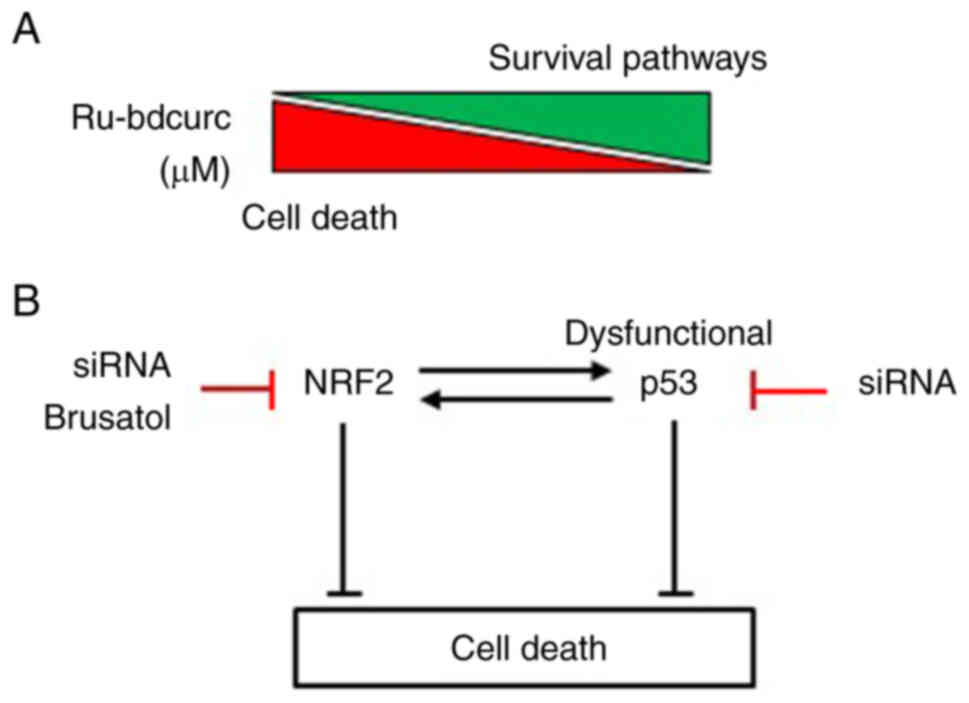
Gastroenteropancreatic neuroendocrine neoplasms (GEP‑NEN) are a group of rare tumors whose specific pathogenetic mechanisms of resistance to therapies have not been completely revealed yet. Chemotherapy is the main therapeutic approach in patients with GEP‑NEN, however, novel combination regimens and targeted therapy are continuously explored. In the present study, the anticancer effect of a novel Ruthenium (Ru)(II)‑Bisdemethoxycurcumin (Ru‑bdcurc) compound was evaluated in BON‑1 cell line, one of the few cell lines derived from GEP‑NEN, largely used in experimental research of this type of tumors. The experimental data revealed that the Ru‑bdcurc compound induced cell death in a dose‑dependent manner, in vitro. Biochemical studies demonstrated that, in response to the lower dose of treatment, BON‑1 cells activated the nuclear factor erythroid 2‑related factor 2 (NRF2) pathway with induction of some of its targets including catalase and p62 as well as of the antiapoptotic marker Bcl2, all acting as chemoresistance mechanisms. NRF2 induction associated also with increased expression of endogenous p53 which is reported to be dysfunctional in BON‑1 cells and to inhibit apoptosis. Genetic or pharmacologic targeting of NRF2 inhibited the activation of the NRF2 pathway, as well as of endogenous dysfunctional p53, in response to the lower dose of Ru‑bdcurc, increasing the cell death. To assess the interplay between NRF2 and dysfunctional p53, genetic targeting of p53 showed reduced activation of the NRF2 pathway in response to the lower dose of Ru‑bdcurc, increasing the cell death. These findings identified for the first time a possible dysfunctional p53/NRF2 interplay in BON‑1 cell line that can be a novel key determinant in cell resistance to cytotoxic agents to be evaluated also in GEP‑NEN.
View Figures

Figure 1

Figure 2

Figure 3

Figure 4

Figure 5

View References

1 

Rindi G, Mete O, Uccella S, Basturk O, La Rosa S, Brosens LAA, Ezzat S, de Herder WW, Klimstra DS, Papotti M and Asa SL: Overview of the 2022 WHO Classification of Neuroendocrine Neoplasms. Endocr Pathol. 33:115–154. 2022. View Article : Google Scholar : PubMed/NCBI

2 

Cives M and Strosberg JR: Gastroenteropancreatic neuroendocrine tumors. CA Cancer J Clin. 68:471–487. 2018. View Article : Google Scholar : PubMed/NCBI

3 

Huguet I, Grossman AB and O'Toole D: Changes in the epidemiology of neuroendocrine tumours. Neuroendocrinology. 104:105–111. 2017. View Article : Google Scholar : PubMed/NCBI

4 

Norton JA: Surgery for primary pancreatic neuroendocrine tumors. J Gastrointest Surg. 10:327–331. 2006. View Article : Google Scholar : PubMed/NCBI

5 

Akirov A, Larouche V, Alshehri S, Asa SA and Ezzat S: Treatment options for pancreatic neuroendocrine tumors. Cancers. 11:8282019. View Article : Google Scholar : PubMed/NCBI

6 

Das S, Al-Toubah T and Strosberg J: Chemotherapy in neuroendocrine tumors. Cancers. 13:48722021. View Article : Google Scholar : PubMed/NCBI

7 

Dai M, Mullins CS, Lu L, Alsfasser G and Linnebacher M: Recent advances in diagnosis and treatment of gastroenteropancreatic neuroendocrine neoplasms. World J Gastrointest Surg. 14:383–396. 2022. View Article : Google Scholar : PubMed/NCBI

8 

Haque A, Brazeau D and Amin AR: Perspectives on natural compounds in chemoprevention and treatment of cancer: An update with new promising compounds. Eur J Cancer. 149:165–183. 2021. View Article : Google Scholar : PubMed/NCBI

9 

Patel SS, Acharya A, Ray RS, Agrawal R, Raghuwanshi R and Jain P: Cellular and molecular mechanisms of curcumin in prevention and treatment of disease. Crit Rev Food Sci Nutr. 60:887–939. 2020. View Article : Google Scholar : PubMed/NCBI

10 

Zoi V, Galani V, Lianos GD, Voulgaris S, Kyritsis AP and Alexiou GA: The role of curcumin in cancer treatment. Biomedicines. 9:10862021. View Article : Google Scholar : PubMed/NCBI

11 

Stohs SS, Chen O, Ray SD, Ji J, Bucci LR and Preuss HG: Highly bioavailable forms of curcumin and promising avenues for Curcumin-Based research and application. Molecules. 25:13972020. View Article : Google Scholar : PubMed/NCBI

12 

Wanninger S, Lorenz V, Subhan A and Edelmann FT: Metal complexes of curcumin-synthetic strategies, structures and medicinal applications. Chem Soc Rev. 44:4986–5002. 2015. View Article : Google Scholar : PubMed/NCBI

13 

Pagliaricci N, Pettinari R, Marchetti F, Pettinari C, Cappellacci L, Tombesi A, Cuccioloni M, Hadiji M and Dyson PJ: Potent and selective anticancer activity of half-sandwich ruthenium and osmium complexes with modified curcuminoid ligands. Dalton Trans. 51:13311–13321. 2022. View Article : Google Scholar : PubMed/NCBI

14 

Gobbo A, Pereira SAP, Biancalana L, Zacchini S, Saraiva MLMFS, Dyson PJ and Marchetti F: Anticancer ruthenium(II) tris(pyrazolyl)methane complexes with bioactive co-ligands. Dalton Trans. 51:17050–17063. 2022. View Article : Google Scholar : PubMed/NCBI

15 

Bonfili L, Pettinari R, Cuccioloni M, Cecarini V, Mozzicafreddo M, Angeletti M, Lupidi G, Marchetti F, Pettinari C and Eleuteri AM: Arene-RuII complexes of curcumin exert antitumor activity via proteasome inhibition and apoptosis induction. Chem Med Chem. 7:2010–2020. 2012. View Article : Google Scholar : PubMed/NCBI

16 

Pettinari R, Marchetti F, Condello F, Pettinari C, Lupidi G, Scopelliti R, Mukhopadhyay S, Riedel T and Dyson PJ: Ruthenium(II)-Arene RAPTA type complexes containing curcumin and bisdemethoxycurcumin display potent and selective anticancer activity. Organometallics. 33:3709–3715. 2014. View Article : Google Scholar

17 

Caruso F, Pettinari R, Rossi M, Monti E, Gariboldi MB, Marchetti F, Pettinari C, Caruso A, Ramani MV and Subbaraju GVJ: The in vitro antitumor activity of arene-ruthenium(II) curcuminoid complexes improves when decreasing curcumin polarity. J Inorg. Biochem. 162:44–51. 2016.

18 

Garufi A, Baldari S, Pettinari R, Gilardini Montani MS, D'Orazi V, Pistritto G, Crispini A, Giorno E, Toietta G, Marchetti F, et al: A ruthenium(II)-curcumin compound modulates NRF2 expression balancing the cancer cell death/survival outcome according to p53 status. J Exp Clin Cancer Res. 39:1222020. View Article : Google Scholar : PubMed/NCBI

19 

Garufi A, Pettinari R, Marchetti F, Cirone M and D'Orazi G: NRF2 and Bip interconnection mediates resistance to the organometallic ruthenium-cymene bisdemethoxycurcumin complex cytotoxicity in colon cancer cells. Biomedicines. 11:5932023. View Article : Google Scholar : PubMed/NCBI

20 

D'Orazi G and Cirone M: Interconnected adaptive responses: A way out for cancer cells to avoid cellular demise. Cancers. 14:27802022. View Article : Google Scholar : PubMed/NCBI

21 

Garufi A, Pistritto G, D'Orazi V, Cirone M and D'Orazi G: The impact of NRF2 inhibition on drug-induced colon cancer cell death and p53 activity: A pilot study. Biomolecules. 2:4612022. View Article : Google Scholar

22 

Rojo de la Vega M, Chapman E and Zhang DD: NRF2 and the hallmarks of cancer. Cancer Cell. 34:21–43. 2018. View Article : Google Scholar : PubMed/NCBI

23 

Jain A, Lamark T, Sjottem E, Bowitz Larsen K, Awuh JA, Overvatn A, McMahon M, Hayes JD and Johansen T: p62/SQSTM1 is a target gene for transcription factor NRF2 and creates a positive feedback loop by inducing antioxidant response element-driven gene transcription. J Biol Chem. 285:22576–22591. 2010. View Article : Google Scholar : PubMed/NCBI

24 

Komatsu M, Kurokawa H, Waguri S, Taguchi K, Kobayashi A, Ichmura Y, Sou YS, Ueno I, Sakamoto A, Tong KI, et al: The selective autophagy substrate p62 activates the stress response transcription factor Nrf2 through inactivation of Keap1. Nat Cell Biol. 12:213–23. 2010. View Article : Google Scholar : PubMed/NCBI

25 

Jiang T, Harder B, Rojo de la Vega M, Wong PK, Chapman E and Zhang DD: p62 links autophagy and Nrf2 signaling. Free Rad Biol Med. 88:199–204. 2015. View Article : Google Scholar : PubMed/NCBI

26 

Lister A, Nedjadi T, Kitteringham NR, Campbell F, Costello E, Lloyd B, Copple IM, Williams S, Owen A, Neoptolemos JP, et al: Nrf2 is overexpressed in pancreatic cancer: Implications for cell proliferation and therapy. Mol Cancer. 10:372011. View Article : Google Scholar : PubMed/NCBI

27 

Evers BM, Ishizuka J, Townsend CM Jr and Thompson JC: The human carcinoid cell line, BON. A model system for the study of carcinoid tumors. Ann N Y Acad Sci. 733:393–406. 1994. View Article : Google Scholar : PubMed/NCBI

28 

Vandamme T, Peeters M, Dogan F, Pauwels P, Van Assche E, Beyens M, Mortier G, Vandeweyer G, de Herder W, Van Camp G, et al: Whole-exome characterization of pancreatic neuroendocrine tumor cell lines BON-1 and QGP-1. J Mol Endocrinol. 54:137–47. 2015. View Article : Google Scholar : PubMed/NCBI

29 

Luley KB, Biedermann SB, Kunstner A, Busch H, Franzenburg S, Schrader J, Grabowsi P, Wellner U, Keck T, Brabant G, et al: A comprehensive molecular characterization of the pancreatic neuroendocrine tumor cell lines BON-1 and QGP-1. Cancers (Basel). 12:6912020. View Article : Google Scholar : PubMed/NCBI

30 

Cirone M and D'Orazi G: NRF2 in cancer: Cross-talk with oncogenic pathways and involvement in gammaherpesviruses-driven carcinogenesis. Int J Mol Sci. 24:5952022. View Article : Google Scholar : PubMed/NCBI

31 

Vousden HK and Prives C: Blinded by the light: The growing complexity of p53. Cell. 137:413–31. 2009. View Article : Google Scholar : PubMed/NCBI

32 

Muller PA and Vousden KH: Mutant p53 in cancer: New functions and therapeutic opportunities. Cancer Cell. 25:304–317. 2014. View Article : Google Scholar : PubMed/NCBI

33 

Voutsadakis IA: Mutations of p53 associated with pancreatic cancer and therapeutic implications. Ann Hepatobiliary Pancreat Surg. 25:315–327. 2021. View Article : Google Scholar : PubMed/NCBI

34 

Vijayvergia N, Boland PM, Handorf E, Gustafson KS, Gong Y, Cooper HS, Sheriff F, Astsaturov I, Cohen SJ and Engstrom PF: Molecular profiling of neuroendocrine malignancies to identify prognostic and therapeutic markers: A Fox Chase Cancer Center Pilot Study. Br J Cancer. 115:564–570. 2016. View Article : Google Scholar : PubMed/NCBI

35 

Ren D, Villeneuve NF, Jiang T, Wu T, Lau A and Toppin HA: Brusatol enhances the efficacy of chemotherapy by inhibiting the Nrf2-mediated defense mechanism. Proc Natl Acad Sci USA. 108:1433–1438. 2011. View Article : Google Scholar : PubMed/NCBI

36 

Olayanju A, Copple IM, Bryan HK, Edge GT, Sison RL, Wong MW, Lai ZQ, Lin ZX, Dunn K, Sanderson CM, et al: Brusatol provokes a rapid and transient inhibition of Nrf2 signaling and sensitizes mammalian cells to chemical toxicity implications for therapeutic targeting of Nrf2. Free Rad Biol Med. 78:202–12. 2015. View Article : Google Scholar : PubMed/NCBI

37 

Garufi A, Traversi G, Gilardini Montani MS, D'Orazi V, Pistritto G, Cirone M and D'Orazi G: Reduced chemotherapeutic sensitivity in high glucose condition: implication of antioxidant response. Oncotarget. 10:4691–4702. 2019. View Article : Google Scholar : PubMed/NCBI

38 

Cecchinelli B, Lavra L, Rinaldo C, Iacovelli S, Gurtner A, Gasbarri A, Ulivieri A, Del Prete F, Trovato M, Piaggio G, et al: Repression of the antiapoptotic molecule galectin-3 by homeodomain-interacting protein kinase 2-activated p53 is required for p53-induced apoptosis. Mol Cell Biol. 26:4746–4757. 2006. View Article : Google Scholar : PubMed/NCBI

39 

Brummelkamp TR, Bernards R and Agami R: A system stable expression of short interfering RNAs in mammalian cells. Science. 296:550–553. 2020. View Article : Google Scholar

40 

Garufi A, Giorno E, Gilardini Montani MS, Pistritto G, Crispini A, Cirone M and D'Orazi G: P62/SQSTM1/Keap1/NRF2 axis reduces cancer cells death-sensitivity in response to Zn(II)-curcumin complex. Biomolecules. 11:3482021. View Article : Google Scholar : PubMed/NCBI

41 

Lisek K, Campaner E, Ciani Y, Walerych D and Del Sal G: Mutant p53 tunes the NRF2-dependent antioxidant response to support survival of cancer cells. Oncotarget. 9:20508–20523. 2018. View Article : Google Scholar : PubMed/NCBI

42 

Gong C, Yao H, Liu Q, Chen J, Shi J, Su F and Song E: Markers of tumor-initiating cells predict chemoresistance in breast cancer. PLoS One. 5:e156302010. View Article : Google Scholar : PubMed/NCBI

43 

Garufi A, Pistritto G, Cirone M and D'Orazi G: Reactivation of mutant p53 by capsaicin, the major constituent of peppers. J Exp Clin Cancer Res. 35:1362016. View Article : Google Scholar : PubMed/NCBI

44 

Gilles C, Polette M, Mestdagt M, Nawrocki-Raby B, Ruggeri P, Birembaut P and Foidart JM: Transactivation of vimentin by beta-catenin in human breast cancer cells. Cancer Res. 15:2658–2664. 2003.PubMed/NCBI

45 

Nodale C, Sheffer M, Jacob-Hirsch J, Folgiero V, Falcioni R, Aiello A, Garufi A, Rechavi G, Givol D and D'Orazi G: HIPK2 downregulates vimentin and inhibits breast cancer cell invasion. Cancer Biol Ther. 13:198–205. 2012. View Article : Google Scholar : PubMed/NCBI

46 

Garufi A, Trisciuoglio D, Porru M, Leonetti C, Stoppacciaro A, D'Orazi V, AVantaggiati ML, Crispini A, Pucci D and D'Orazi G: A fluorescent-based Zn(II)-complex reactivates mutant (R175H and R272H) p53 in cancer cells. J Exp Clin Cancer Res. 32:722013. View Article : Google Scholar : PubMed/NCBI

47 

Garufi A, Pucci D, D'Orazi V, Cirone M, Bossi G, Avantaggiati ML and D'Orazi G: Degradation of mutant p53H175 protein by Zn(II) through autophagy. Cell Death Dis. 5:e12712014. View Article : Google Scholar : PubMed/NCBI

48 

Bonner WM, Redon CE, Dickey JS, Nakamura AJ, Sedelnikova OA, Solier S and Pommier Y: Gamma H2AX and cancer. Nat Rev Cancer. 8:957–967. 2008. View Article : Google Scholar : PubMed/NCBI

49 

Miao Y, Chen L, Shi C, Fan R, Chen P, Liu H, Xia A and Qin H: Increased phosphorylation of 4E-binding protein 1 predicts poor prognosis for patients with colorectal cancer. Mol Med Rep. 15:3099–3104. 2017. View Article : Google Scholar : PubMed/NCBI

50 

Gonnella R, Zarrella R, Santarelli R, Germano CA, Gilardini Montani MS and Cirone M: Mechanisms of sensitivity and resistance of primary effusion lymphoma to Dimethyl Fumarate (DMF). Int J Mol Sci. 23:67732022. View Article : Google Scholar : PubMed/NCBI

51 

Zanini S, Renzi S, Giovinazzo F and Bermano G: mTOR pathway in gastroenteropancreatic neuroendocrine tumor (GEP-NETs). Front Endocrinol. 11:5625052020. View Article : Google Scholar : PubMed/NCBI

52 

Moscat J, Karin M and Diaz-Meco MT: p62 in cancer: Signaling adaptor beyond autophagy. Cell. 167:606–609. 2016. View Article : Google Scholar : PubMed/NCBI

53 

Widden H and Placzek WJ: The multiple mechanisms of Mcl1 in the regulation of cell fate. Commun Biol. 4:10292021. View Article : Google Scholar : PubMed/NCBI

54 

Gilardini Montani MS, Cecere N, Granato M, Romeo MA, Falcinelli L, Ciciarelli U, D'Orazi G, Faggioni A and Cirone M: Mutant p53, stabilized by its interplay with HSP90, activates a positive feed-back loop between NRF2 and p62 that induces chemo-resistance to Apigenin in pancreatic cancer cells. Cancers. 11:7032019. View Article : Google Scholar : PubMed/NCBI

55 

Sampath J, Sun D, Kidd VJ, Grenet J, Gandhi A, Shapiro LH, Wang Q, Zambetti GP and Schuetz JD: Mutant p53 cooperates with ETS and selectively up-regulates human MDR1 not MRP1. J Biol Chem. 276:39359–39367. 2001. View Article : Google Scholar : PubMed/NCBI

56 

Martin AG, Trama J, Crighton D, Ryan KM and Fearnhead HO: Activation of p53 and induction of Noxa by DNA damage requires NG-kappa B. Aging (Albany NY). 1:335–349. 2009. View Article : Google Scholar : PubMed/NCBI

57 

Chiou JT, Huang NC, Hiang CH, Wang LJ, Lee YC, Shi YJ and Chang LS: NOXA-mediated degradation of MCL1 and BCL2L1 causes apoptosis of daunorubicin-treated human acute myeloid leukemia cells. J Cell Physiol. 236:7356–7375. 2021. View Article : Google Scholar : PubMed/NCBI

58 

Park JY, Sohn HY, Koh YH and Jo C: Curcumin activates Nrf2 through PKCd-mediated p62 phosphorylation at Ser351. Sci Rep. 11:84302021. View Article : Google Scholar : PubMed/NCBI

59 

Kawasaki K, Fujii M and Sato T: Gastroenteroepatic neuroendocrine neoplasms: Genes, therapies and models. Dis Model Mech. 11:dmm0295952018. View Article : Google Scholar : PubMed/NCBI

60 

Cao J, Jia L, Zhou HM, Liu Y and Zhong LF: Mitochondrial and nuclear DNA damage induced by curcumin in human hepatoma G2 cells. Toxicol. 91:476–483. 2006. View Article : Google Scholar : PubMed/NCBI

61 

Kunati SR, Yang SM, William BM and Xu Y: An LC-MS/MS method for simultaneous determination of curcumin, curcumin glucuronide and curcumin sulfate in a phase II clinical trial. J Pharm Biomed Anal. 156:189–198. 2018. View Article : Google Scholar : PubMed/NCBI

62 

Giordano A and Tommonaro G: Curcumin and Cancer. Nutrients. 11:23762019. View Article : Google Scholar : PubMed/NCBI

63 

Arena A, Romeo MA, Benedetti R, Gilardini Montani MS, Santarelli R, Gonnella R, D'Orazi G and Cirone M: NRF2 and STAT3: Friends or foes in carcinogenesis? Discov Oncol. 14:372023. View Article : Google Scholar : PubMed/NCBI

64 

Sajadimajd S and Khazaei M: Oxidative stress and cancer: The role of Nrf2. Curr Cancer Drug Targtes. 18:538–557. 2018. View Article : Google Scholar : PubMed/NCBI

65 

No JH, Kim YB and Song YS: Targeting Nrf2 signaling to combat chemoresistance. J Cancer Prev. 19:111–117. 2014. View Article : Google Scholar : PubMed/NCBI

66 

Torrente L and DeNicola GM: Targeting NRF2 and its downstream processes: Opportunities and challenges. Annu Rev Pharmacol Toxicol. 62:279–300. 2022. View Article : Google Scholar : PubMed/NCBI

Related Articles

  • Abstract
  • View
  • Download
  • Twitter
Copy and paste a formatted citation
Spandidos Publications style
Garufi A, Pettinari R, Monteonofrio L, Puliani G, Virdia I, Appetecchia M, Marchetti F, Cirone M, Soddu S, D'Orazi G, D'Orazi G, et al: NRF2 activation in BON‑1 neuroendocrine cancer cells reduces the cytotoxic effects of a novel Ruthenium(II)‑curcumin compound: A pilot study. Oncol Rep 51: 36, 2024.
APA
Garufi, A., Pettinari, R., Monteonofrio, L., Puliani, G., Virdia, I., Appetecchia, M. ... D'Orazi, G. (2024). NRF2 activation in BON‑1 neuroendocrine cancer cells reduces the cytotoxic effects of a novel Ruthenium(II)‑curcumin compound: A pilot study. Oncology Reports, 51, 36. https://doi.org/10.3892/or.2024.8695
MLA
Garufi, A., Pettinari, R., Monteonofrio, L., Puliani, G., Virdia, I., Appetecchia, M., Marchetti, F., Cirone, M., Soddu, S., D'Orazi, G."NRF2 activation in BON‑1 neuroendocrine cancer cells reduces the cytotoxic effects of a novel Ruthenium(II)‑curcumin compound: A pilot study". Oncology Reports 51.2 (2024): 36.
Chicago
Garufi, A., Pettinari, R., Monteonofrio, L., Puliani, G., Virdia, I., Appetecchia, M., Marchetti, F., Cirone, M., Soddu, S., D'Orazi, G."NRF2 activation in BON‑1 neuroendocrine cancer cells reduces the cytotoxic effects of a novel Ruthenium(II)‑curcumin compound: A pilot study". Oncology Reports 51, no. 2 (2024): 36. https://doi.org/10.3892/or.2024.8695
Copy and paste a formatted citation
x
Spandidos Publications style
Garufi A, Pettinari R, Monteonofrio L, Puliani G, Virdia I, Appetecchia M, Marchetti F, Cirone M, Soddu S, D'Orazi G, D'Orazi G, et al: NRF2 activation in BON‑1 neuroendocrine cancer cells reduces the cytotoxic effects of a novel Ruthenium(II)‑curcumin compound: A pilot study. Oncol Rep 51: 36, 2024.
APA
Garufi, A., Pettinari, R., Monteonofrio, L., Puliani, G., Virdia, I., Appetecchia, M. ... D'Orazi, G. (2024). NRF2 activation in BON‑1 neuroendocrine cancer cells reduces the cytotoxic effects of a novel Ruthenium(II)‑curcumin compound: A pilot study. Oncology Reports, 51, 36. https://doi.org/10.3892/or.2024.8695
MLA
Garufi, A., Pettinari, R., Monteonofrio, L., Puliani, G., Virdia, I., Appetecchia, M., Marchetti, F., Cirone, M., Soddu, S., D'Orazi, G."NRF2 activation in BON‑1 neuroendocrine cancer cells reduces the cytotoxic effects of a novel Ruthenium(II)‑curcumin compound: A pilot study". Oncology Reports 51.2 (2024): 36.
Chicago
Garufi, A., Pettinari, R., Monteonofrio, L., Puliani, G., Virdia, I., Appetecchia, M., Marchetti, F., Cirone, M., Soddu, S., D'Orazi, G."NRF2 activation in BON‑1 neuroendocrine cancer cells reduces the cytotoxic effects of a novel Ruthenium(II)‑curcumin compound: A pilot study". Oncology Reports 51, no. 2 (2024): 36. https://doi.org/10.3892/or.2024.8695
Follow us
  • Twitter
  • LinkedIn
  • Facebook
About
  • Spandidos Publications
  • Careers
  • Cookie Policy
  • Privacy Policy
How can we help?
  • Help
  • Live Chat
  • Contact
  • Email to our Support Team