|
1
|
Goto T, Kennel SJ, Abe M, Takishita M,
Kosaka M, Solomon A and Saito S: A novel membrane antigen
selectively expressed on terminally differentiated human B cells.
Blood. 84:1922–1930. 1984. View Article : Google Scholar : PubMed/NCBI
|
|
2
|
Neil SJ, Zang T and Bieniasz PD: Tetherin
inhibits retrovirus release and is antagonized by HIV-1 Vpu.
Nature. 451:425–430. 2008. View Article : Google Scholar : PubMed/NCBI
|
|
3
|
Mahauad-Fernandez WD and Okeoma CM: The
role of BST-2/Tetherin in host protection and disease
manifestation. Immun Inflamm Dis. 4:4–23. 2015. View Article : Google Scholar : PubMed/NCBI
|
|
4
|
Cai D, Cao J, Li Z, Zheng X, Yao Y, Li W
and Yuan Z: Up-regulation of bone marrow stromal protein 2 (BST2)
in breast cancer with bone metastasis. BMC Cancer. 9:1022009.
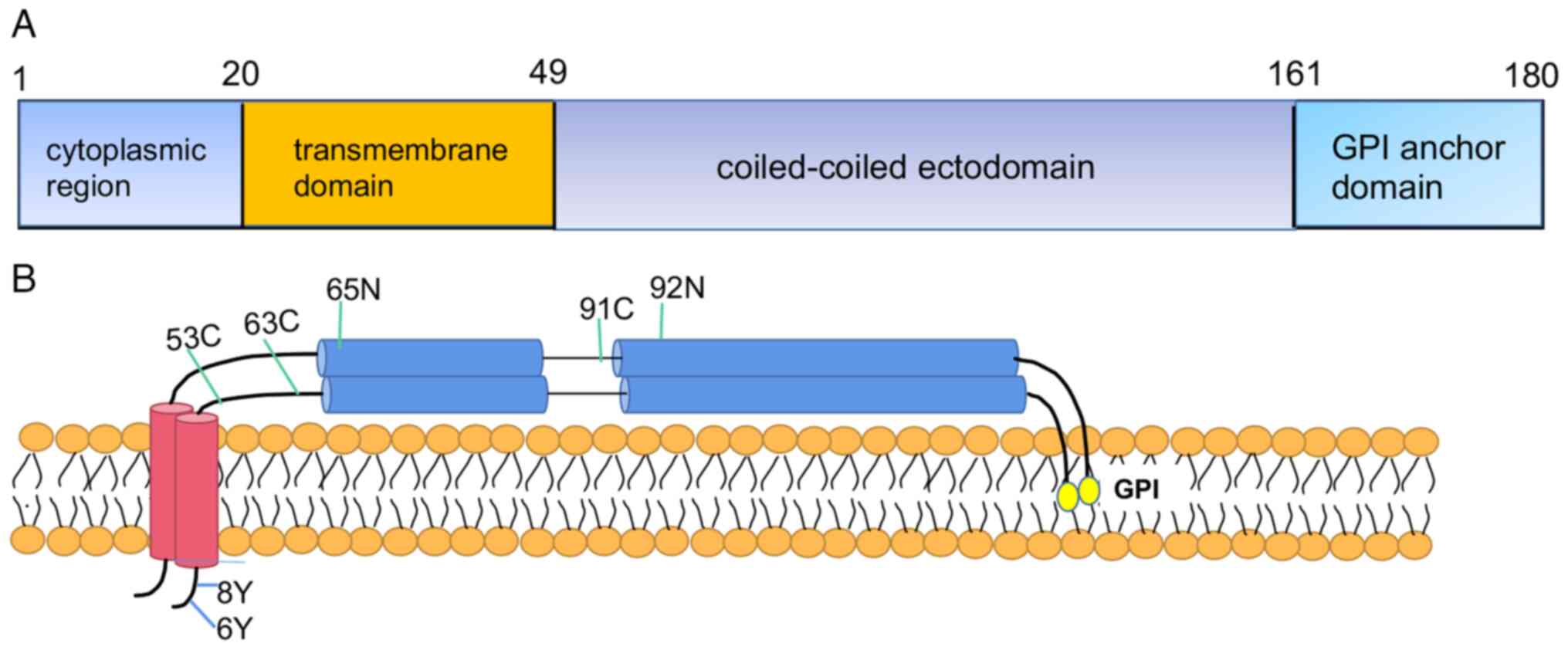
View Article : Google Scholar : PubMed/NCBI
|
|
5
|
Jourdan M, Caraux A, Caron G, Robert N,
Fiol G, Reme T, Bolloré K, Vendrell JP, Le Gallou S, Mourcin F, et
al: Characterization of a transitional preplasmablast population in
the process of human B cell to plasma cell differentiation. J
Immunol. 187:3931–3941. 2011. View Article : Google Scholar : PubMed/NCBI
|
|
6
|
Jourdan M, Caraux A, De Vos J, Fiol G,
Larroque M, Cognot C, Bret C, Duperray C, Hose D and Klein B: An in
vitro model of differentiation of memory B cells into plasmablasts
and plasma cells including detailed phenotypic and molecular
characterization. Blood. 114:5173–5181. 2009. View Article : Google Scholar : PubMed/NCBI
|
|
7
|
Erikson E, Adam T, Schmidt S, Lehmann-Koch
J, Over B, Goffinet C, Harter C, Bekeredjian-Ding I, Sertel S,
Lasitschka F and Keppler OT: In vivo expression profile of the
antiviral restriction factor and tumor-targeting antigen
CD317/BST-2/HM1.24/tetherin in humans. Proc Natl Acad Sci USA.
108:13688–13693. 2011. View Article : Google Scholar : PubMed/NCBI
|
|
8
|
Ohtomo T, Sugamata Y, Ozaki Y, Ono K,
Yoshimura Y, Kawai S, Koishihara Y, Ozaki S, Kosaka M, Hirano T and
Tsuchiya M: Molecular cloning and characterization of a surface
antigen preferentially overexpressed on multiple myeloma cells.
Biochem Biophys Res Commun. 258:583–591. 1999. View Article : Google Scholar : PubMed/NCBI
|
|
9
|
Rew SB, Peggs K, Sanjuan I, Pizzey AR,
Koishihara Y, Kawai S, Kosaka M, Ozaki S, Chain B and Yong KL:
Generation of potent antitumor CTL from patients with multiple
myeloma directed against HM1.24. Clin Cancer Res. 11:3377–3384.
2005. View Article : Google Scholar : PubMed/NCBI
|
|
10
|
Wong YF, Cheung TH, Lo KW, Yim SF, Siu NS,
Chan SC, Ho TW, Wong KW, Yu MY, Wang VW, et al: Identification of
molecular markers and signaling pathway in endometrial cancer in
Hong Kong Chinese women by genome-wide gene expression profiling.
Oncogene. 26:1971–1982. 2007. View Article : Google Scholar : PubMed/NCBI
|
|
11
|
Liu W, Li Y, Feng S, Guan Y and Cao Y:
MicroRNA-760 inhibits cell viability and migration through
down-regulating BST2 in gastric cancer. J Biochem. 168:159–170.
2020. View Article : Google Scholar : PubMed/NCBI
|
|
12
|
Kong Y, Xue Z, Wang H, Cui G, Chen A, Liu
J, Wang J, Li X and Huang B: Identification of BST2 contributing to
the development of glioblastoma based on bioinformatics analysis.
Front Genet. 13:8901742022. View Article : Google Scholar : PubMed/NCBI
|
|
13
|
Wang W, Nishioka Y, Ozaki S, Jalili A, Abe
S, Kakiuchi S, Kishuku M, Minakuchi K, Matsumoto T and Sone S:
HM1.24 (CD317) is a novel target against lung cancer for
immunotherapy using anti-HM1.24 antibody. Cancer Immunol
Immunother. 58:967–976. 2009. View Article : Google Scholar : PubMed/NCBI
|
|
14
|
Kuang CM, Fu X, Hua YJ, Shuai WD, Ye ZH,
Li Y, Peng QH, Li YZ, Chen S, Qian CN, et al: BST2 confers
cisplatin resistance via NF-kappaB signaling in nasopharyngeal
cancer. Cell Death Dis. 8:e28742017. View Article : Google Scholar : PubMed/NCBI
|
|
15
|
Fang KH, Kao HK, Chi LM, Liang Y, Liu SC,
Hseuh C, Liao CT, Yen TC, Yu JS and Chang KP: Overexpression of
BST2 is associated with nodal metastasis and poorer prognosis in
oral cavity cancer. Laryngoscope. 124:E354–E360. 2014. View Article : Google Scholar : PubMed/NCBI
|
|
16
|
Jin H, Zhang L, Wang S and Qian L: BST2
promotes growth and induces gefitinib resistance in oral squamous
cell carcinoma via regulating the EGFR pathway. Arch Med Sci.
17:1772–1782. 2019.PubMed/NCBI
|
|
17
|
Liu G, Du X, Xiao L, Zeng Q and Liu Q:
Activation of FGD5-AS1 promotes progression of cervical cancer
through regulating BST2 to inhibit macrophage M1 Polarization. J
Immunol Res. 2021:58572142021. View Article : Google Scholar : PubMed/NCBI
|
|
18
|
Sayeed A, Luciani-Torres G, Meng Z,
Bennington JL, Moore DH and Dairkee SH: Aberrant regulation of the
BST2 (Tetherin) promoter enhances cell proliferation and apoptosis
evasion in high grade breast cancer cells. PLoS One. 8:e671912013.
View Article : Google Scholar : PubMed/NCBI
|
|
19
|
Lei C, Hou Y and Chen J: Specificity
protein 1-activated bone marrow stromal cell antigen 2 accelerates
pancreatic cancer cell proliferation and migration. Exp Ther Med.
22:14592021. View Article : Google Scholar : PubMed/NCBI
|
|
20
|
Xu X, Wang Y, Xue F, Guan E, Tian F, Xu J
and Zhang H: BST2 promotes tumor growth via multiple pathways in
hepatocellular carcinoma. Cancer Invest. 38:329–337. 2020.
View Article : Google Scholar : PubMed/NCBI
|
|
21
|
Kim SC, Hong CW, Jang SG, Kim YA, Yoo BC,
Shin YK, Jeong SY, Ku JL and Park JG: Establishment and
characterization of paired primary and peritoneal seeding human
colorectal cancer cell lines: Identification of genes that mediate
metastatic potential. Transl Oncol. 11:1232–1243. 2018. View Article : Google Scholar : PubMed/NCBI
|
|
22
|
Mukai S, Oue N, Oshima T, Mukai R,
Tatsumoto Y, Sakamoto N, Sentani K, Tanabe K, Egi H, Hinoi T, et
al: Overexpression of Transmembrane Protein BST2 is associated with
poor survival of patients with esophageal, gastric, or colorectal
cancer. Ann Surg Oncol. 24:594–602. 2017. View Article : Google Scholar : PubMed/NCBI
|
|
23
|
Yang LL, Wu L, Yu GT, Zhang WF, Liu B and
Sun ZJ: CD317 signature in head and neck cancer indicates poor
prognosis. J Dent Res. 97:787–794. 2018. View Article : Google Scholar : PubMed/NCBI
|
|
24
|
Yang LQ, Hu HY, Han Y, Tang ZY, Gao J,
Zhou QY, Liu YX, Chen HS, Xu TN, Ao L, et al: CpG-binding protein
CFP1 promotes ovarian cancer cell proliferation by regulating BST2
transcription. Cancer Gene Ther. 29:1895–1907. 2022. View Article : Google Scholar : PubMed/NCBI
|
|
25
|
Shigematsu Y, Oue N, Nishioka Y, Sakamoto
N, Sentani K, Sekino Y, Mukai S, Teishima J, Matsubara A and Yasui
W: Overexpression of the transmembrane protein BST-2 induces Akt
and Erk phosphorylation in bladder cancer. Oncol Lett. 14:999–1004.
2017. View Article : Google Scholar : PubMed/NCBI
|
|
26
|
Cheng J, Liu Z, Deng T, Lu Z, Liu M, Lu X,
Adeshakin FO, Yan D, Zhang G and Wan X: CD317 mediates
immunocytolysis resistance by RICH2/cytoskeleton-dependent membrane
protection. Mol Immunol. 129:94–102. 2021. View Article : Google Scholar : PubMed/NCBI
|
|
27
|
Masuyama N, Kuronita T, Tanaka R, Muto T,
Hirota Y, Takigawa A, Fujita H, Aso Y, Amano J and Tanaka Y: HM1.24
is internalized from lipid rafts by clathrin-mediated endocytosis
through interaction with alpha-adaptin. J Biol Chem.
284:15927–15941. 2009. View Article : Google Scholar : PubMed/NCBI
|
|
28
|
Naushad W, Mahauad-Fernandez WD and Okeoma
CM: Structural determinant of BST-2-mediated regulation of breast
cancer cell motility: A role for cytoplasmic tail tyrosine
residues. Oncotarget. 8:110221–110233. 2017. View Article : Google Scholar : PubMed/NCBI
|
|
29
|
Andrew AJ, Miyagi E, Kao S and Strebel K:
The formation of cysteine-linked dimers of BST-2/tetherin is
important for inhibition of HIV-1 virus release but not for
sensitivity to Vpu. Retrovirology. 6:802009. View Article : Google Scholar : PubMed/NCBI
|
|
30
|
Swiecki M, Scheaffer SM, Allaire M,
Fremont DH, Colonna M and Brett TJ: Structural and biophysical
analysis of BST-2/tetherin ectodomains reveals an evolutionary
conserved design to inhibit virus release. J Biol Chem.
286:2987–2997. 2011. View Article : Google Scholar : PubMed/NCBI
|
|
31
|
Perez-Caballero D, Zang T, Ebrahimi A,
McNatt MW, Gregory DA, Johnson MC and Bieniasz PD: Tetherin
inhibits HIV-1 release by directly tethering virions to cells.
Cell. 139:499–511. 2009. View Article : Google Scholar : PubMed/NCBI
|
|
32
|
Kupzig S, Korolchuk V, Rollason R, Sugden
A, Wilde A and Banting G: BST-2/HM1.24 is a raft-associated apical
membrane protein with an unusual topology. Traffic. 4:694–709.
2003. View Article : Google Scholar : PubMed/NCBI
|
|
33
|
Edgar JR, Manna PT, Nishimura S, Banting G
and Robinson MS: Tetherin is an exosomal tether. Elife.
5:e171802016. View Article : Google Scholar : PubMed/NCBI
|
|
34
|
Tokarev A, Suarez M, Kwan W, Fitzpatrick
K, Singh R and Guatelli J: Stimulation of NF-kappaB activity by the
HIV restriction factor BST2. J Virol. 87:2046–2057. 2013.
View Article : Google Scholar : PubMed/NCBI
|
|
35
|
Billcliff PG, Rollason R, Prior I, Owen
DM, Gaus K and Banting G: CD317/tetherin is an organiser of
membrane microdomains. J Cell Sci. 126((Pt 7)): 1553–1564.
2013.PubMed/NCBI
|
|
36
|
Billcliff PG, Gorleku OA, Chamberlain LH
and Banting G: The cytosolic N-terminus of CD317/tetherin is a
membrane microdomain exclusion motif. Biol Open. 2:1253–1263. 2013.
View Article : Google Scholar : PubMed/NCBI
|
|
37
|
Jones DR and Varela-Nieto I: The role of
glycosyl-phosphatidylinositol in signal transduction. Int J Biochem
Cell Biol. 30:313–326. 1998. View Article : Google Scholar : PubMed/NCBI
|
|
38
|
Muller GA and Muller TD: (Patho)physiology
of glycosylphosphatidylinositol-anchored proteins I: Localization
at plasma membranes and extracellular compartments. Biomolecules.
13:8552023. View Article : Google Scholar : PubMed/NCBI
|
|
39
|
Galao RP, Le Tortorec A, Pickering S,
Kueck T and Neil SJ: Innate sensing of HIV-1 assembly by Tetherin
induces NF-kappaB-dependent proinflammatory responses. Cell Host
Microbe. 12:633–644. 2012. View Article : Google Scholar : PubMed/NCBI
|
|
40
|
Holmgren AM, Miller KD, Cavanaugh SE and
Rall GF: Bst2/tetherin is induced in neurons by type I interferon
and viral infection but is dispensable for protection against
neurotropic viral challenge. J Virol. 89:11011–11018. 2015.
View Article : Google Scholar : PubMed/NCBI
|
|
41
|
Rahmani W, Chung H, Sinha S, Bui-Marinos
MP, Arora R, Jaffer A, Corcoran JA, Biernaskie J and Chun J:
Attenuation of SARS-CoV-2 infection by losartan in human kidney
organoids. iScience. 25:1038182022. View Article : Google Scholar : PubMed/NCBI
|
|
42
|
Cao W, Bover L, Cho MW, Wen XX, Hanabuchi
S, Bao MS, Rosen DB, Wang YH, Shaw JL, Du Q, et al: Regulation of
TLR7/9 responses in plasmacytoid dendritic cells by BST2 and ILT7
receptor interaction. J Exp Med. 206:1603–1614. 2009. View Article : Google Scholar : PubMed/NCBI
|
|
43
|
Cao W and Bover L: Signaling and ligand
interaction of ILT7: Receptor-mediated regulatory mechanisms for
plasmacytoid dendritic cells. Immunol Rev. 234:163–176. 2010.
View Article : Google Scholar : PubMed/NCBI
|
|
44
|
Yi E, Oh J, Kang HR, Song MJ and Park SH:
BST2 inhibits infection of influenza A virus by promoting apoptosis
of infected cells. Biochem Biophys Res Commun. 509:414–420. 2019.
View Article : Google Scholar : PubMed/NCBI
|
|
45
|
Ge Y, Dombkowski AA, LaFiura KM, Tatman D,
Yedidi RS, Stout ML, Buck SA, Massey G, Becton DL, Weinstein HJ, et
al: Differential gene expression, GATA1 target genes, and the
chemotherapy sensitivity of Down syndrome megakaryocytic leukemia.
Blood. 107:1570–1581. 2006. View Article : Google Scholar : PubMed/NCBI
|
|
46
|
Mahauad-Fernandez WD and Okeoma CM: B49, a
BST-2-based peptide, inhibits adhesion and growth of breast cancer
cells. Sci Rep. 8:43052018. View Article : Google Scholar : PubMed/NCBI
|
|
47
|
Oue N, Sentani K, Sakamoto N, Uraoka N and
Yasui W: Molecular carcinogenesis of gastric cancer: Lauren
classification, mucin phenotype expression, and cancer stem cells.
Int J Clin Oncol. 24:771–778. 2019. View Article : Google Scholar : PubMed/NCBI
|
|
48
|
Prat A, Pineda E, Adamo B, Galvan P,
Fernandez A, Gaba L, Díez M, Viladot M, Arance A and Muñoz M:
Clinical implications of the intrinsic molecular subtypes of breast
cancer. Breast. 24 (Suppl 2):S26–S35. 2015. View Article : Google Scholar : PubMed/NCBI
|
|
49
|
Mahauad-Fernandez WD, Naushad W, Panzner
TD, Bashir A, Lal G and Okeoma CM: BST-2 promotes survival in
circulation and pulmonary metastatic seeding of breast cancer
cells. Sci Rep. 8:176082018. View Article : Google Scholar : PubMed/NCBI
|
|
50
|
Woodman N, Pinder SE, Tajadura V, Le
Bourhis X, Gillett C, Delannoy P, Burchell JM and Julien S: Two
E-selectin ligands, BST-2 and LGALS3BP, predict metastasis and poor
survival of ER-negative breast cancer. Int J Oncol. 49:265–275.
2016. View Article : Google Scholar : PubMed/NCBI
|
|
51
|
Deng H, Guan X, Gong L, Zeng J, Zhang H,
Chen MY and Li G: CBX6 is negatively regulated by EZH2 and plays a
potential tumor suppressor role in breast cancer. Sci Rep.
9:1972019. View Article : Google Scholar : PubMed/NCBI
|
|
52
|
Xu S, Liu Y, Ma H, Fang S, Wei S, Li X, Lu
Z, Zheng Y, Liu T, Zhu X, et al: A novel signature integrated of
immunoglobulin, glycosylation and anti-viral genes to predict
prognosis for breast cancer. Front Genet. 13:8347312022. View Article : Google Scholar : PubMed/NCBI
|
|
53
|
Du Y, Yuan S, Zhuang X, Zhang Q and Qiao
T: Multiomics differences in lung squamous cell carcinoma patients
with high radiosensitivity index compared with those with low
radiosensitivity index. Dis Markers. 2021:37666592021. View Article : Google Scholar : PubMed/NCBI
|
|
54
|
Mahauad-Fernandez WD, DeMali KA, Olivier
AK and Okeoma CM: Bone marrow stromal antigen 2 expressed in cancer
cells promotes mammary tumor growth and metastasis. Breast Cancer
Res. 16:4932014. View Article : Google Scholar : PubMed/NCBI
|
|
55
|
Mahauad-Fernandez WD, Borcherding NC,
Zhang W and Okeoma CM: Bone marrow stromal antigen 2 (BST-2) DNA is
demethylated in breast tumors and breast cancer cells. PLoS One.
10:e01239312015. View Article : Google Scholar : PubMed/NCBI
|
|
56
|
Yi EH, Yoo H, Noh KH, Han S, Lee H, Lee
JK, Won C, Kim BH, Kim MH, Cho CH and Ye SK: BST-2 is a potential
activator of invasion and migration in tamoxifen-resistant breast
cancer cells. Biochem Biophys Res Commun. 435:685–690. 2013.
View Article : Google Scholar : PubMed/NCBI
|
|
57
|
Jones PH, Mahauad-Fernandez WD, Madison MN
and Okeoma CM: BST-2/tetherin is overexpressed in mammary gland and
tumor tissues in MMTV-induced mammary cancer. Virology.
444:124–139. 2013. View Article : Google Scholar : PubMed/NCBI
|
|
58
|
Mahauad-Fernandez WD and Okeoma CM:
Cysteine-linked dimerization of BST-2 confers anoikis resistance to
breast cancer cells by negating proapoptotic activities to promote
tumor cell survival and growth. Cell Death Dis. 8:e26872017.
View Article : Google Scholar : PubMed/NCBI
|
|
59
|
Shi Y, Castro-Gonzalez S, Chen Y and
Serra-Moreno R: Effects of the SUMO Ligase BCA2 on metabolic
activity, cell proliferation, cell migration, cell cycle, and the
regulation of NF-kappaB and IRF1 in different breast epithelial
cellular contexts. Front Cell Dev Biol. 9:7114812021. View Article : Google Scholar : PubMed/NCBI
|
|
60
|
Becker M, Sommer A, Kratzschmar JR, Seidel
H, Pohlenz HD and Fichtner I: Distinct gene expression patterns in
a tamoxifen-sensitive human mammary carcinoma xenograft and its
tamoxifen-resistant subline MaCa 3366/TAM. Mol Cancer Ther.
4:151–168. 2005. View Article : Google Scholar : PubMed/NCBI
|
|
61
|
Ma JH, Qin L and Li X: Role of STAT3
signaling pathway in breast cancer. Cell Commun Signal. 18:332020.
View Article : Google Scholar : PubMed/NCBI
|
|
62
|
Andzinski L, Kasnitz N, Stahnke S, Wu CF,
Gereke M, von Kockritz-Blickwede M, Schilling B, Brandau S, Weiss S
and Jablonska J: Type I IFNs induce anti-tumor polarization of
tumor associated neutrophils in mice and human. Int J Cancer.
138:1982–1993. 2016. View Article : Google Scholar : PubMed/NCBI
|
|
63
|
Pylaeva E, Lang S and Jablonska J: The
essential role of type I interferons in differentiation and
activation of tumor-associated neutrophils. Front Immunol.
7:6292016. View Article : Google Scholar : PubMed/NCBI
|
|
64
|
García-Pras E, Fernández-Iglesias A,
Gracia-Sancho J and Pérez-Del-Pulgar S: Cell death in
hepatocellular carcinoma: Pathogenesis and therapeutic
opportunities. Cancers (Basel). 14:482021. View Article : Google Scholar : PubMed/NCBI
|
|
65
|
Tayob N, Kanwal F, Alsarraj A, Hernaez R
and El-Serag HB: The Performance of AFP, AFP-3, DCP as biomarkers
for detection of hepatocellular carcinoma (HCC): A phase 3
biomarker study in the United States. Clin Gastroenterol Hepatol.
21:415–423.e4. 2023. View Article : Google Scholar : PubMed/NCBI
|
|
66
|
Wang Y and Deng B: Hepatocellular
carcinoma: Molecular mechanism, targeted therapy, and biomarkers.
Cancer Metastasis Rev. 42:629–652. 2023. View Article : Google Scholar : PubMed/NCBI
|
|
67
|
Zhang J, Zheng B, Zhou X, Zheng T, Wang H,
Wang Y and Zhang W: Increased BST-2 expression by HBV infection
promotes HBV-associated HCC tumorigenesis. J Gastrointest Oncol.
12:694–710. 2021. View Article : Google Scholar : PubMed/NCBI
|
|
68
|
Zhang G, Li X, Chen Q, Li J, Ruan Q, Chen
YH, Yang X and Wan X: CD317 Activates EGFR by regulating its
association with lipid rafts. Cancer Res. 79:2220–2231. 2019.
View Article : Google Scholar : PubMed/NCBI
|
|
69
|
Pan XB, Han JC, Cong X and Wei L:
BST2/tetherin inhibits dengue virus release from human hepatoma
cells. PLoS One. 7:e510332012. View Article : Google Scholar : PubMed/NCBI
|
|
70
|
Dafa-Berger A, Kuzmina A, Fassler M,
Yitzhak-Asraf H, Shemer-Avni Y and Taube R: Modulation of hepatitis
C virus release by the interferon-induced protein BST-2/tetherin.
Virology. 428:98–111. 2012. View Article : Google Scholar : PubMed/NCBI
|
|
71
|
Pan XB, Qu XW, Jiang D, Zhao XL, Han JC
and Wei L: BST2/Tetherin inhibits hepatitis C virus production in
human hepatoma cells. Antiviral Res. 98:54–60. 2013. View Article : Google Scholar : PubMed/NCBI
|
|
72
|
Mollinedo F and Gajate C: Lipid rafts as
signaling hubs in cancer cell survival/death and invasion:
Implications in tumor progression and therapy. Thematic Review
Series: Biology of Lipid Rafts. J Lipid Res. 61:611–635. 2020.
View Article : Google Scholar : PubMed/NCBI
|
|
73
|
Arnold M, Abnet CC, Neale RE, Vignat J,
Giovannucci EL, McGlynn KA and Bray F: Global burden of 5 major
types of gastrointestinal cancer. Gastroenterology.
159:335–349.e15. 2020. View Article : Google Scholar : PubMed/NCBI
|
|
74
|
Liu W, Cao Y, Guan Y and Zheng C: BST2
promotes cell proliferation, migration and induces NF-kappaB
activation in gastric cancer. Biotechnol Lett. 40:1015–1027. 2018.
View Article : Google Scholar : PubMed/NCBI
|
|
75
|
Anami K, Oue N, Noguchi T, Sakamoto N,
Sentani K, Hayashi T, Hinoi T, Okajima M, Graff JM and Yasui W:
Search for transmembrane protein in gastric cancer by the
Escherichia coli ampicillin secretion trap: Expression of DSC2 in
gastric cancer with intestinal phenotype. J Pathol. 221:275–284.
2010. View Article : Google Scholar : PubMed/NCBI
|
|
76
|
Rodriguez A, Corchete LA, Alcazar JA,
Montero JC, Rodriguez M, Chinchilla-Tabora LM, Vidal Tocino R,
Moyano C, Muñoz-Bravo S, Sayagués JM and Abad M: Dysregulated
expression of three genes in colorectal cancer stratifies patients
into three risk groups. Cancers (Basel). 14:40762022. View Article : Google Scholar : PubMed/NCBI
|
|
77
|
Chiang SF, Kan CY, Hsiao YC, Tang R, Hsieh
LL, Chiang JM, Tsai WS, Yeh CY, Hsieh PS, Liang Y, et al: Bone
marrow stromal antigen 2 is a novel plasma biomarker and
prognosticator for colorectal carcinoma: A secretome-based
verification study. Dis Markers. 2015:8740542015. View Article : Google Scholar : PubMed/NCBI
|
|
78
|
Shen C, Luo C, Xu Z, Liang Q, Cai Y, Peng
B, Yan Y and Xia F: Molecular patterns based on immunogenomic
signatures stratify the prognosis of colon cancer. Front Bioeng
Biotechnol. 10:8200922022. View Article : Google Scholar : PubMed/NCBI
|
|
79
|
Chu CH, Chang SC, Wang HH, Yang SH, Lai KC
and Lee TC: Prognostic values of EPDR1 hypermethylation and its
inhibitory function on tumor invasion in colorectal cancer. Cancers
(Basel). 10:3932018. View Article : Google Scholar : PubMed/NCBI
|
|
80
|
He X, Chen H, Zhong X, Wang Y, Hu Z, Huang
H, Zhao S, Wei P, Shi D and Li D: BST2 induced macrophage M2
polarization to promote the progression of colorectal cancer. Int J
Biol Sci. 19:331–345. 2023. View Article : Google Scholar : PubMed/NCBI
|
|
81
|
Casarrubios M, Provencio M, Nadal E, Insa
A, Del Rosario Garcia-Campelo M, Lazaro-Quintela M, Dómine M, Majem
M, Rodriguez-Abreu D, Martinez-Marti A, et al: Tumor
microenvironment gene expression profiles associated to complete
pathological response and disease progression in resectable NSCLC
patients treated with neoadjuvant chemoimmunotherapy. J Immunother
Cancer. 10:e0053202022. View Article : Google Scholar : PubMed/NCBI
|
|
82
|
Chen YC, Lin MC, Hsiao CC, Zheng YX, Chen
KD, Sung MT, Chen CJ, Wang TY, Lin YY, Chang HC, et al: Increased
S100A15 expression and decreased DNA methylation of its gene
promoter are involved in high metastasis potential and poor outcome
of lung adenocarcinoma. Oncotarget. 8:45710–45724. 2017. View Article : Google Scholar : PubMed/NCBI
|
|
83
|
Zhou Y, Tang L, Chen Y, Zhang Y and Zhuang
W: An immune panel signature predicts prognosis of lung
adenocarcinoma patients and correlates with immune
microenvironment. Front Cell Dev Biol. 9:7979842021. View Article : Google Scholar : PubMed/NCBI
|
|
84
|
Wang W, Nishioka Y, Ozaki S, Jalili A,
Verma VK, Hanibuchi M, Abe S, Minakuchi K, Matsumoto T and Sone S:
Chimeric and humanized anti-HM1.24 antibodies mediate
antibody-dependent cellular cytotoxicity against lung cancer cells.
Lung Cancer. 63:23–31. 2009. View Article : Google Scholar : PubMed/NCBI
|
|
85
|
Wainwright DA, Balyasnikova IV, Han Y and
Lesniak MS: The expression of BST2 in human and experimental mouse
brain tumors. Exp Mol Pathol. 91:440–446. 2011. View Article : Google Scholar : PubMed/NCBI
|
|
86
|
Yokoyama T, Enomoto T, Serada S, Morimoto
A, Matsuzaki S, Ueda Y, Yoshino K, Fujita M, Kyo S, Iwahori K, et
al: Plasma membrane proteomics identifies bone marrow stromal
antigen 2 as a potential therapeutic target in endometrial cancer.
Int J Cancer. 132:472–484. 2013. View Article : Google Scholar : PubMed/NCBI
|
|
87
|
Pham QT, Oue N, Yamamoto Y, Shigematsu Y,
Sekino Y, Sakamoto N, Sentani K, Uraoka N, Tiwari M and Yasui W:
The Expression of BTS-2 enhances cell growth and invasiveness in
renal cell carcinoma. Anticancer Res. 37:2853–2860. 2017.PubMed/NCBI
|
|
88
|
Pan XQ, Huang W, Jin LW, Lin HZ and Xu XY:
A novel pyroptosis-related prognostic signature for risk
stratification and clinical prognosis in clear cell renal cell
carcinoma. Dis Markers. 2022:80938372022. View Article : Google Scholar : PubMed/NCBI
|
|
89
|
Yamada Y, Arai T, Sugawara S, Okato A,
Kato M, Kojima S, Yamazaki K, Naya Y, Ichikawa T and Seki N: Impact
of novel oncogenic pathways regulated by antitumor miR-451a in
renal cell carcinoma. Cancer Sci. 109:1239–1253. 2018. View Article : Google Scholar : PubMed/NCBI
|
|
90
|
Januchowski R, Sterzynska K, Zawierucha P,
Rucinski M, Swierczewska M, Partyka M, Bednarek-Rajewska K, Brązert
M, Nowicki M, Zabel M and Klejewski A: Microarray-based detection
and expression analysis of new genes associated with drug
resistance in ovarian cancer cell lines. Oncotarget. 8:49944–49958.
2017. View Article : Google Scholar : PubMed/NCBI
|
|
91
|
Zhang H, Cai Y, Zheng L, Zhang Z, Lin X
and Jiang N: LncRNA BISPR promotes the progression of thyroid
papillary carcinoma by regulating miR-21-5p. Int J Immunopathol
Pharmacol. 32:20587384187726522018. View Article : Google Scholar : PubMed/NCBI
|
|
92
|
Milutin Gasperov N, Farkas SA, Nilsson TK
and Grce M: Epigenetic activation of immune genes in cervical
cancer. Immunol Lett. 162((2 Pt B)): 256–257. 2014. View Article : Google Scholar : PubMed/NCBI
|
|
93
|
Etcheverry A, Aubry M, de Tayrac M,
Vauleon E, Boniface R, Guenot F, Saikali S, Hamlat A, Riffaud L,
Menei P, et al: DNA methylation in glioblastoma: Impact on gene
expression and clinical outcome. BMC Genomics. 11:7012010.
View Article : Google Scholar : PubMed/NCBI
|
|
94
|
Kawai S, Azuma Y, Fujii E, Furugaki K,
Ozaki S, Matsumoto T, Kosaka M and Yamada-Okabe H: Interferon-alpha
enhances CD317 expression and the antitumor activity of anti-CD317
monoclonal antibody in renal cell carcinoma xenograft models.
Cancer Sci. 99:2461–2466. 2008. View Article : Google Scholar : PubMed/NCBI
|
|
95
|
Gu G, Zhao D, Yin Z and Liu P: BST-2
binding with cellular MT1-MMP blocks cell growth and migration via
decreasing MMP2 activity. J Cell Biochem. 113:1013–1021. 2012.
View Article : Google Scholar : PubMed/NCBI
|
|
96
|
Yoo H, Park SH, Ye SK and Kim M:
IFN-γ-induced BST2 mediates monocyte adhesion to human endothelial
cells. Cell Immunol. 267:23–29. 2011. View Article : Google Scholar : PubMed/NCBI
|
|
97
|
Sibler E, He Y, Ducoli L, Rihs V, Sidler
P, Puig-Moreno C, Frey J, Fujimoto N, Detmar M and Dieterich LC:
Immunomodulatory responses of subcapsular sinus floor lymphatic
endothelial cells in tumor-draining lymph nodes. Cancers (Basel).
14:36022022. View Article : Google Scholar : PubMed/NCBI
|
|
98
|
Werner TA, Forster CM, Dizdar L, Verde PE,
Raba K, Schott M, Knoefel WT and Krieg A: CXCR4/CXCR7/CXCL12 axis
promotes an invasive phenotype in medullary thyroid carcinoma. Br J
Cancer. 117:1837–1845. 2017. View Article : Google Scholar : PubMed/NCBI
|
|
99
|
Bian S, Zhao Y, Li F, Lu S, He Z, Wang S,
Bai X, Zhao D, Liu M and Wang J: Total ginsenosides induce
autophagic cell death in cervical cancer cells accompanied by
downregulation of bone marrow stromal antigen-2. Exp Ther Med.
22:6672021. View Article : Google Scholar : PubMed/NCBI
|
|
100
|
Cheng J, Zhang G, Deng T, Liu Z, Zhang M,
Zhang P, Adeshakin FO, Niu X, Yan D, Wan X and Yu G: CD317
maintains proteostasis and cell survival in response to proteasome
inhibitors by targeting calnexin for RACK1-mediated autophagic
degradation. Cell Death Dis. 14:3332023. View Article : Google Scholar : PubMed/NCBI
|
|
101
|
Yang LL, Mao L, Wu H, Chen L, Deng WW,
Xiao Y, Li H, Zhang L and Sun ZJ: pDC depletion induced by CD317
blockade drives the antitumor immune response in head and neck
squamous cell carcinoma. Oral Oncol. 96:131–139. 2019. View Article : Google Scholar : PubMed/NCBI
|
|
102
|
Jin S, Sun Y, Liang X, Gu X, Ning J, Xu Y,
Chen S and Pan L: Emerging new therapeutic antibody derivatives for
cancer treatment. Signal Transduct Target Ther. 7:392022.
View Article : Google Scholar : PubMed/NCBI
|
|
103
|
Wu RQ, Lao XM, Chen DP, Qin H, Mu M, Cao
WJ, Deng J, Wan CC, Zhan WY, Wang JC, et al: Immune checkpoint
therapy-elicited sialylation of IgG antibodies impairs
antitumorigenic type I interferon responses in hepatocellular
carcinoma. Immunity. 56:180–192.e11. 2023. View Article : Google Scholar : PubMed/NCBI
|
|
104
|
Rimassa L, Finn RS and Sangro B:
Combination immunotherapy for hepatocellular carcinoma. J Hepatol.
79:506–515. 2023. View Article : Google Scholar : PubMed/NCBI
|
|
105
|
Staudinger M, Glorius P, Burger R, Kellner
C, Klausz K, Gunther A, Repp R, Klapper W, Gramatzki M and Peipp M:
The novel immunotoxin HM1.24-ETA' induces apoptosis in multiple
myeloma cells. Blood Cancer J. 4:e2192014. View Article : Google Scholar : PubMed/NCBI
|
|
106
|
Hundemer M, Schmidt S, Condomines M, Lupu
A, Hose D, Moos M, Cremer F, Kleist C, Terness P, Belle S, et al:
Identification of a new HLA-A2-restricted T-cell, epitope within
HM1.24 as immunotherapy target for multiple myeloma. Exp Hematol.
34:486–496. 2006. View Article : Google Scholar : PubMed/NCBI
|
|
107
|
Hiramatsu K, Serada S, Kobiyama K,
Nakagawa S, Morimoto A, Matsuzaki S, Ueda Y, Fujimoto M, Yoshino K,
Ishii KJ, et al: CpG oligodeoxynucleotides potentiate the antitumor
activity of anti-BST2 antibody. Cancer Sci. 106:1474–1478. 2015.
View Article : Google Scholar : PubMed/NCBI
|