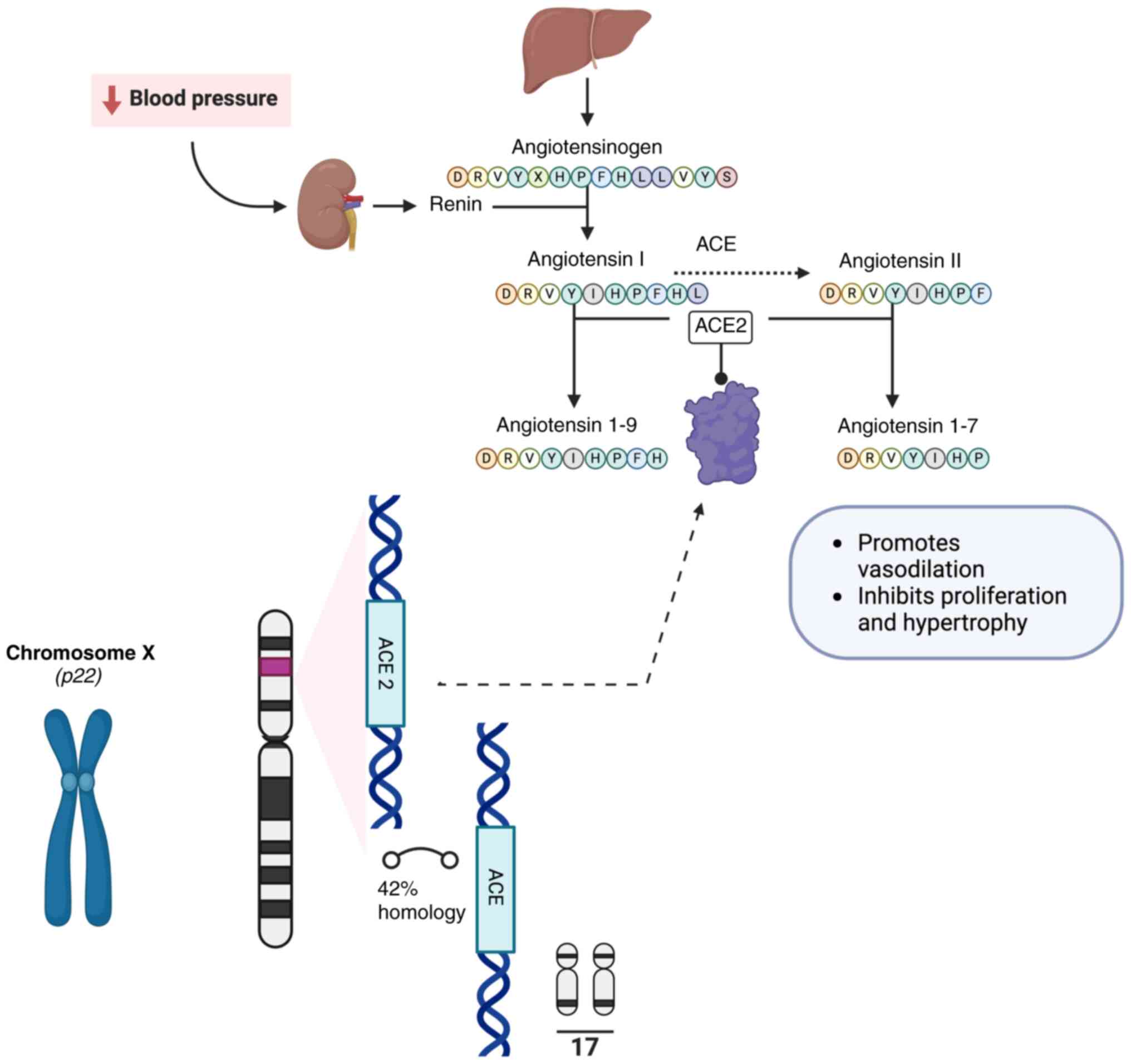
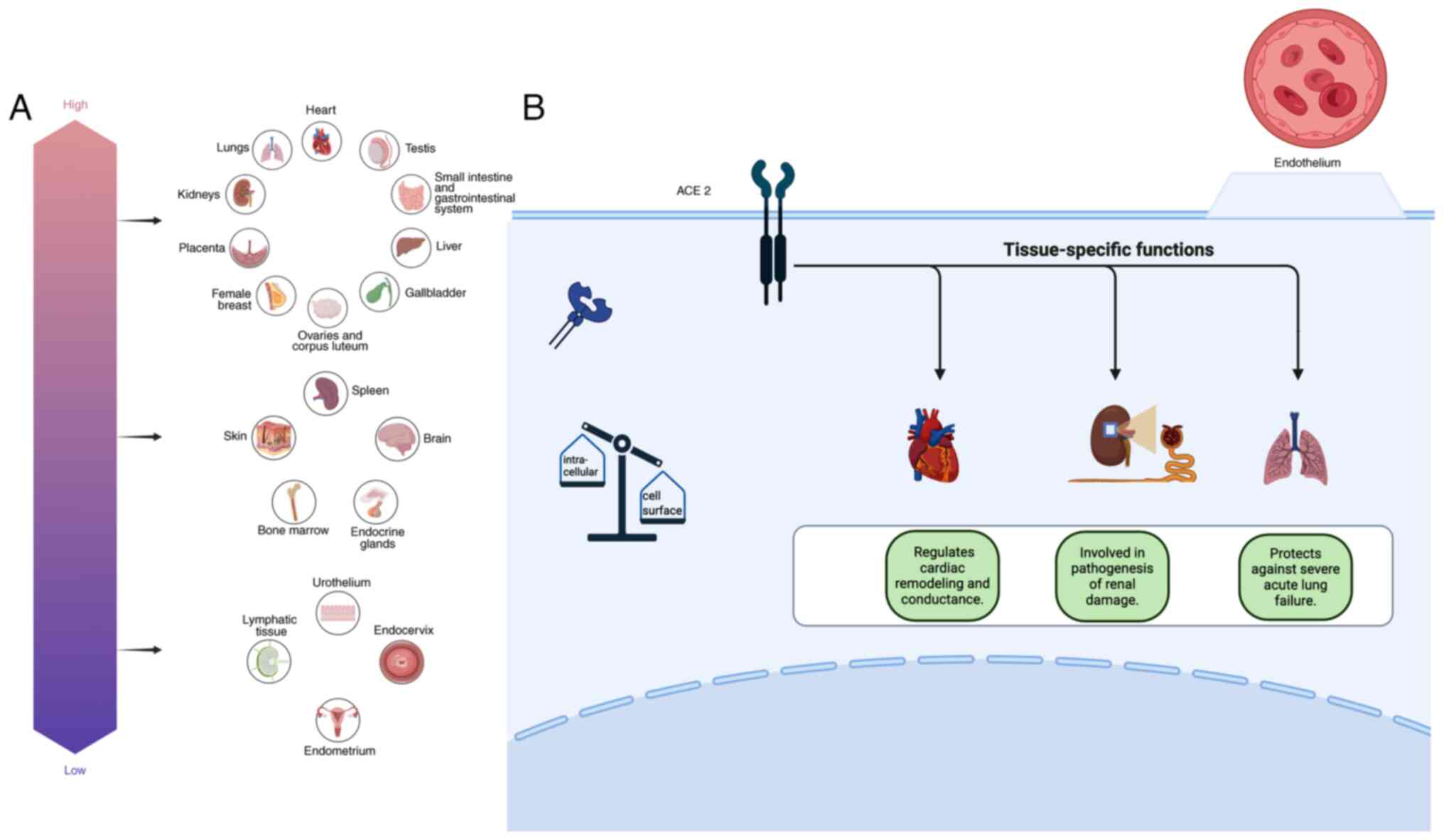
|
1
|
Shang J, Ye G, Shi K, Wan Y, Luo C, Aihara
H, Geng Q, Auerbach A and Li F: Structural basis of receptor
recognition by SARS-CoV-2. Nature. 581:221–224. 2020. View Article : Google Scholar : PubMed/NCBI
|
|
2
|
Gupta A, Madhavan MV, Sehgal K, Nair N,
Mahajan S, Sehrawat TS, Bikdeli B, Ahluwalia N, Ausiello JC, Wan
EY, et al: Extrapulmonary manifestations of COVID-19. Nat Med.
26:1017–1032. 2020. View Article : Google Scholar : PubMed/NCBI
|
|
3
|
Danilczyk U, Eriksson U, Crackower MA and
Penninger JM: A story of two ACEs. J Mol Med (Berl). 81:227–234.
2003. View Article : Google Scholar : PubMed/NCBI
|
|
4
|
Santos RA, Campagnole-Santos MJ and
Andrade SP: Angiotensin-(1–7): An update. Regul Pept. 91:45–62.
2000. View Article : Google Scholar : PubMed/NCBI
|
|
5
|
Ferrario CM, Trask AJ and Jessup JA:
Advances in biochemical and functional roles of
angiotensin-converting enzyme 2 and angiotensin-(1–7) in regulation
of cardiovascular function. Am J Physiol Heart Circ Physiol.
289:H2281–2290. 2005. View Article : Google Scholar : PubMed/NCBI
|
|
6
|
Yang Z, Macdonald-Dunlop E, Chen J, Zhai
R, Li T, Richmond A, Klarić L, Pirastu N, Ning Z, Zheng C, et al:
Genetic landscape of the ACE2 coronavirus receptor. Circulation.
145:1398–1411. 2022. View Article : Google Scholar : PubMed/NCBI
|
|
7
|
Hamming I, Cooper ME, Haagmans BL, Hooper
NM, Korstanje R, Osterhaus AD, Timens W, Turner AJ, Navis G and van
Goor H: The emerging role of ACE2 in physiology and disease. J
Pathol. 12:1–11. 2007. View Article : Google Scholar
|
|
8
|
Crackower MA, Sarao R, Oudit GY, Yagil C,
Kozieradzki I, Scanga SE, Oliveira-dos-Santos AJ, da Costa J, Zhang
L, Pei Y, et al: Angiotensin-converting enzyme 2 is an essential
regulator of heart function. Nature. 417:822–828. 2002. View Article : Google Scholar : PubMed/NCBI
|
|
9
|
Donoghue M, Wakimoto H, Maguire CT, Acton
S, Hales P, Stagliano N, Fairchild-Huntress V, Xu J, Lorenz JN,
Kadambi V, et al: Heart block, ventricular tachycardia, and sudden
death in ACE2 transgenic mice with downregulated connexins. J Mol
Cell Cardiol. 35:1043–1053. 2003. View Article : Google Scholar : PubMed/NCBI
|
|
10
|
Chen QL, Li JQ, Xiang ZD, Lang Y, Guo GJ
and Liu ZH: Localization of cell receptor-related genes of
SARS-CoV-2 in the kidney through single-cell transcriptome
analysis. Kidney Dis (Basel). 6:258–270. 2020. View Article : Google Scholar : PubMed/NCBI
|
|
11
|
Lely AT, Hamming I, van Goor H and Navis
GJ: Renal ACE2 expression in human kidney disease. J Pathol.
204:587–593. 2004. View Article : Google Scholar : PubMed/NCBI
|
|
12
|
Imai Y, Kuba K, Rao S, Huan Y, Guo F, Guan
B, Yang P, Sarao R, Wada T, Leong-Poi H, et al:
Angiotensin-converting enzyme 2 protects from severe acute lung
failure. Nature. 436:112–116. 2005. View Article : Google Scholar : PubMed/NCBI
|
|
13
|
Fu J, Zhou B, Zhang L, Balaji KS, Wei C,
Liu X, Chen H, Peng J and Fu J: Expressions and significances of
the angiotensin-converting enzyme 2 gene, the receptor of
SARS-CoV-2 for COVID-19. Mol Biol Rep. 47:4383–4392. 2020.
View Article : Google Scholar : PubMed/NCBI
|
|
14
|
Meiners J, Jansen K, Gorbokon N, Büscheck
F, Luebke AM, Kluth M, Hube-Magg C, Höflmayer D, Weidemann S,
Fraune C, et al: Angiotensin-converting enzyme 2 protein is
overexpressed in a wide range of human tumour types: A systematic
tissue microarray study on >15,000 tumours. Biomedicines.
9:18312021. View Article : Google Scholar : PubMed/NCBI
|
|
15
|
Mahalingam R, Dharmalingam P, Santhanam A,
Kotla S, Davuluri G, Karmouty-Quintana H, Ashrith G and
Thandavarayan RA: Single-cell RNA sequencing analysis of SARS-CoV-2
entry receptors in human organoids. J Cell Physiol. 236:2950–2958.
2021. View Article : Google Scholar : PubMed/NCBI
|
|
16
|
Hikmet F, Méar L, Edvinsson Å, Micke P,
Uhlén M and Lindskog C: The protein expression profile of ACE2 in
human tissues. Mol Syst Biol. 16:e96102020. View Article : Google Scholar : PubMed/NCBI
|
|
17
|
Han T, Kang J, Li G, Ge J and Gu J:
Analysis of 2019-nCoV receptor ACE2 expression in different tissues
and its significance study. Ann Transl Med. 8:10772020. View Article : Google Scholar : PubMed/NCBI
|
|
18
|
Cui Y, Chen F, Gao J, Lei M, Wang D, Jin
X, Guo Y, Shan L and Chen X: Comprehensive landscape of the
renin-angiotensin system in Pan-cancer: A potential downstream
mediated mechanism of SARS-CoV-2. Int J Biol Sci. 7:3795–3817.
2021. View Article : Google Scholar : PubMed/NCBI
|
|
19
|
Song J, Han J, Liu F, Chen X, Qian S, Wang
Y, Jia Z, Duan X, Zhang X and Zhu J: Systematic analysis of
coronavirus disease 2019 (COVID-19) receptor ACE2 in malignant
tumors: Pan-cancer analysis. Front Mol Biosci. 7:5694142020.
View Article : Google Scholar : PubMed/NCBI
|
|
20
|
Zhang L, Han X and Shi Y: Comparative
analysis of SARS-CoV-2 receptor ACE2 expression in multiple solid
tumors and matched non-diseased tissues. Infect Genet Evol.
85:1044282020. View Article : Google Scholar : PubMed/NCBI
|
|
21
|
Li MY, Li L, Zhang Y and Wang XS:
Expression of the SARS-CoV-2 cell receptor gene ACE2 in a wide
variety of human tissues. Infect Dis Poverty. 9:452020. View Article : Google Scholar : PubMed/NCBI
|
|
22
|
Qi J, Zhou Y, Hua J, Zhang L, Bian J, Liu
B, Zhao Z and Jin S: The scRNA-seq expression profiling of the
receptor ACE2 and the cellular protease TMPRSS2 reveals human
organs susceptible to SARS-CoV-2 infection. Int J Environ Res
Public Health. 18:2842021. View Article : Google Scholar : PubMed/NCBI
|
|
23
|
Qi F, Qian S, Zhang S and Zhang Z: Single
cell RNA sequencing of 13 human tissues identify cell types and
receptors of human coronaviruses. Biochem Biophys Res Commun.
526:135–140. 2020. View Article : Google Scholar : PubMed/NCBI
|
|
24
|
Li S, Han J, Zhang A, Han Y, Chen M, Liu
Z, Shao M and Cao W: Exploring the demographics and clinical
characteristics related to the expression of angiotensin-converting
enzyme 2, a receptor of SARS-CoV-2. Front Med (Lausanne).
7:5302020. View Article : Google Scholar : PubMed/NCBI
|
|
25
|
Viveiros A, Gheblawi M, Aujla PK,
Sosnowski DK, Seubert JM, Kassiri Z and Oudit GY: Sex- and
age-specific regulation of ACE2: Insights into severe COVID-19
susceptibility. J Mol Cell Cardiol. 164:13–16. 2022. View Article : Google Scholar : PubMed/NCBI
|
|
26
|
Schurink B, Roos E, Vos W, Breur M, van
der Valk P and Bugiani M: ACE2 protein expression during childhood,
adolescence, and early adulthood. Pediatr Dev Pathol. 25:404–408.
2022. View Article : Google Scholar : PubMed/NCBI
|
|
27
|
Ravaioli S, Tebaldi M, Fonzi E, Angeli D,
Mazza M, Nicolini F, Lucchesi A, Fanini F, Pirini F, Tumedei MM, et
al: ACE2 and TMPRSS2 potential involvement in genetic
susceptibility to SARS-COV-2 in cancer patients. Cell Transplant.
29:09636897209687492020. View Article : Google Scholar : PubMed/NCBI
|
|
28
|
Chakladar J, Shende N, Li WT, Rajasekaran
M, Chang EY and Ongkeko WM: Smoking-mediated upregulation of the
androgen pathway leads to increased SARS-CoV-2 susceptibility. Int
J Mol Sci. 21:36272020. View Article : Google Scholar : PubMed/NCBI
|
|
29
|
Goren A, Wambier CG, Herrera S, McCoy J,
Vaño-Galván S, Gioia F, Comeche B, Ron R, Serrano-Villar S, Ramos
PM, et al: Anti-androgens may protect against severe COVID-19
outcomes: Results from a prospective cohort study of 77
hospitalized men. J Eur Acad Dermatol Venereol. 35:e13–e15. 2021.
View Article : Google Scholar : PubMed/NCBI
|
|
30
|
Bhardwaj V, Dela Cruz M, Subramanyam D,
Kumar R, Markan S, Parker B and Roy HK: Exercise-induced myokines
downregulates the ACE2 level in bronchial epithelial cells:
Implications for SARS-CoV-2 prevention. PLoS One. 17:e02713032022.
View Article : Google Scholar : PubMed/NCBI
|
|
31
|
Xie J, Huang QF, Zhang Z, Dong Y, Xu H,
Cao Y, Sheng CS, Li Y, Wang C, Wang X and Wang JG:
Angiotensin-converting enzyme 2 in human plasma and lung tissue.
Blood Press. 32:6–15. 2023. View Article : Google Scholar : PubMed/NCBI
|
|
32
|
Rao S, Lau A and So HC: Exploring
diseases/traits and blood proteins causally related to expression
of ACE2, the putative receptor of SARS-CoV-2: A mendelian
randomization analysis highlights tentative relevance of
diabetes-related traits. Diabetes Care. 43:1416–1426. 2020.
View Article : Google Scholar : PubMed/NCBI
|
|
33
|
Facchiano A, Facchiano F and Facchiano A:
An investigation into the molecular basis of cancer comorbidities
in coronavirus infection. FEBS Open Bio. 10:2363–2374. 2020.
View Article : Google Scholar : PubMed/NCBI
|
|
34
|
Gheblawi M, Wang K, Viveiros A, Nguyen Q,
Zhong JC, Turner AJ, Raizada MK, Grant MB and Oudit GY:
Angiotensin-converting enzyme 2: SARS-CoV-2 receptor and regulator
of the renin-angiotensin system: Celebrating the 20th anniversary
of the discovery of ACE2. Circ Res. 126:1456–1474. 2020. View Article : Google Scholar : PubMed/NCBI
|
|
35
|
Leung JM, Yang CX, Tam A, Shaipanich T,
Hackett TL, Singhera GK, Dorscheid DR and Sin DD: ACE-2 expression
in the small airway epithelia of smokers and COPD patients:
Implications for COVID-19. Eur Respir J. 55:20006882020. View Article : Google Scholar : PubMed/NCBI
|
|
36
|
Kornilov SA, Lucas I, Jade K, Dai CL,
Lovejoy JC and Magis AT: Plasma levels of soluble ACE2are
associated with sex, Metabolic Syndrome, and its biomarkers in a
large cohort, pointing to a possible mechanism for increased
severity in COVID-19. Crit Care. 24:4522020. View Article : Google Scholar : PubMed/NCBI
|
|
37
|
Chirinos JA, Cohen JB, Zhao L, Hanff T,
Sweitzer N, Fang J, Corrales-Medina V, Anmar R, Morley M, Zamani P,
et al: Clinical and proteomic correlates of plasma ACE2
(Angiotensin-Converting Enzyme 2) in human heart failure.
Hypertension. 76:1526–1536. 2020. View Article : Google Scholar : PubMed/NCBI
|
|
38
|
Radzikowska U, Ding M, Tan G, Zhakparov D,
Peng Y, Wawrzyniak P, Wang M, Li S, Morita H, Altunbulakli C, et
al: Distribution of ACE2, CD147, CD26, and other SARS-CoV-2
associated molecules in tissues and immune cells in health and in
asthma, COPD, obesity, hypertension, and COVID-19 risk factors.
Allergy. 75:2829–2845. 2020. View Article : Google Scholar : PubMed/NCBI
|
|
39
|
Dhawale VS, Amara VR, Karpe PA, Malek V,
Patel D and Tikoo K: Activation of angiotensin-converting enzyme 2
(ACE2) attenuates allergic airway inflammation in rat asthma model.
Toxicol Appl Pharmacol. 306:17–26. 2016. View Article : Google Scholar : PubMed/NCBI
|
|
40
|
Ye R and Liu Z: ACE2 exhibits protective
effects against LPS-induced acute lung injury in mice by inhibiting
the LPS-TLR4 pathway. Exp Mol Pathol. 113:1043502020. View Article : Google Scholar : PubMed/NCBI
|
|
41
|
Clarke NE, Belyaev ND, Lambert DW and
Turner AJ: Epigenetic regulation of angiotensin-converting enzyme 2
(ACE2) by SIRT1 under conditions of cell energy stress. Clin Sci
(Lond). 126:507–516. 2014. View Article : Google Scholar : PubMed/NCBI
|
|
42
|
Li Y, Xu Q, Ma L, Wu D, Gao J, Chen G and
Li H: Systematic profiling of ACE2 expression in diverse
physiological and pathological conditions for COVID-19/SARS-CoV-2.
J Cell Mol Med. 24:9478–9482. 2020. View Article : Google Scholar : PubMed/NCBI
|
|
43
|
Feng H, Wei X, Pang L, Wu Y, Hu B, Ruan Y,
Liu Z, Liu J and Wang T: Prognostic and immunological value of
angiotensin-converting enzyme 2 in pan-cancer. Front Mol Biosci.
7:1892020. View Article : Google Scholar : PubMed/NCBI
|
|
44
|
Chai P, Yu J, Ge S, Jia R and Fan X:
Genetic alteration, RNA expression, and DNA methylation profiling
of coronavirus disease 2019 (COVID-19) receptor ACE2 in
malignancies: A pan-cancer analysis. J Hematol Oncol. 13:432020.
View Article : Google Scholar : PubMed/NCBI
|
|
45
|
Li H, Xie L, Chen L, Zhang L, Han Y, Yan Z
and Guo X: Genomic, epigenomic, and immune subtype analysis of
CTSL/B and SARS-CoV-2 receptor ACE2 in pan-cancer. Aging.
12:22370–22389. 2020.PubMed/NCBI
|
|
46
|
Zhao K, Zhang D, Xu X, Wang S, Liu Z, Ren
X, Zhang X, Lu Z, Ren S and Qin C: Exploring the potential
mechanisms of impairment on genitourinary system associated with
coronavirus disease 2019 infection: Bioinformatics and molecular
simulation analyses. Asian J Urol. 10:344–355. 2023. View Article : Google Scholar : PubMed/NCBI
|
|
47
|
He J, Yang X and Wang H: Construction of a
risk map to understand the vulnerability of various types of cancer
patients to COVID-19 infection. MedComm (2020). 2:69–81. 2021.
View Article : Google Scholar : PubMed/NCBI
|
|
48
|
de Paula Gonzaga ALAC, Palmeira VA,
Ribeiro TFS, Costa LB, de Sá, Rodrigues KE and Simões-E-Silva AC:
ACE2/Angiotensin-(1–7)/Mas receptor axis in human cancer: Potential
role for pediatric tumors. Curr Drug Targets. 21:892–901. 2020.
View Article : Google Scholar : PubMed/NCBI
|
|
49
|
Xu J, Fan J, Wu F, Huang Q, Guo M, Lv Z,
Han J, Duan L, Hu G, Chen L, et al: The ACE2/Angiotensin-(1–7)/Mas
receptor axis: Pleiotropic roles in cancer. Front Physiol.
8:2762017. View Article : Google Scholar : PubMed/NCBI
|
|
50
|
Bujak-Gizycka B, Madej J, Bystrowska B,
Toton-Zuranska J, Kus K, Kolton-Wroz M, Jawien J and Olszanecki R:
Angiotensin 1–7 formation in breast tissue is attenuated in breast
cancer-a study on the metabolism of angiotensinogen in breast
cancer cell lines. J Physiol Pharmacol. 702019.doi:
10.26402/jpp.2019.4.02.
|
|
51
|
Bernardi S, Zennaro C, Palmisano S,
Velkoska E, Sabato N, Toffoli B, Giacomel G, Buri L, Zanconati F,
Bellini G, et al: Characterization and significance of ACE2 and Mas
receptor in human colon adenocarcinoma. J Renin Angiotensin
Aldosterone Syst. 13:202–209. 2012. View Article : Google Scholar : PubMed/NCBI
|
|
52
|
Zhang Z, Li L, Li M and Wang X: The
SARS-CoV-2 host cell receptor ACE2 correlates positively with
immunotherapy response and is a potential protective factor for
cancer progression. Comput Struct Biotechnol J. 18:2438–2444. 2020.
View Article : Google Scholar : PubMed/NCBI
|
|
53
|
Song T, Choi CH, Kim MK, Kim ML, Yun BS
and Seong SJ: The effect of angiotensin system inhibitors
(angiotensin-converting enzyme inhibitors or angiotensin receptor
blockers) on cancer recurrence and survival: A meta-analysis. Eur J
Cancer Prev. 26:78–85. 2017. View Article : Google Scholar : PubMed/NCBI
|
|
54
|
Harmer D, Gilbert M, Borman R and Clark
KL: Quantitative mRNA expression profiling of ACE 2, a novel
homologue of angiotensin converting enzyme. FEBS Lett. 532:107–110.
2022. View Article : Google Scholar : PubMed/NCBI
|
|
55
|
Chen R, Wang K, Yu J, Howard D, French L,
Chen Z, Wen C and Xu Z: The spatial and cell-type distribution of
SARS-CoV-2 receptor ACE2 in the human and mouse brains. Front
Neurol. 11:5730952021. View Article : Google Scholar : PubMed/NCBI
|
|
56
|
Xia H and Lazartigues E:
Angiotensin-converting enzyme 2 in the brain: Properties and future
directions. J Neurochem. 107:1482–1494. 2008. View Article : Google Scholar : PubMed/NCBI
|
|
57
|
Kase Y and Okano H: Expression of ACE2 and
a viral virulence-regulating factor CCN family member 1 in human
iPSC-derived neural cells: Implications for COVID-19-related CNS
disorders. Inflamm Regen. 40:322020. View Article : Google Scholar : PubMed/NCBI
|
|
58
|
Lukiw WJ, Pogue A and Hill JM: SARS-CoV-2
infectivity and neurological targets in the brain. Cell Mol
Neurobiol. 42:217–224. 2022. View Article : Google Scholar : PubMed/NCBI
|
|
59
|
Doobay MF, Talman LS, Obr TD, Tian X,
Davisson RL and Lazartigues E: Differential expression of neuronal
ACE2 in transgenic mice with overexpression of the brain
renin-angiotensin system. Am J Physiol Regul Integr Comp Physiol.
292:R373–R381. 2007. View Article : Google Scholar : PubMed/NCBI
|
|
60
|
Chen A, Zhao W, Li X, Sun G, Ma Z, Peng L,
Shi Z, Li X and Yan J: Comprehensive oncogenic features of
coronavirus receptors in glioblastoma multiforme. Front Immunol.
13:8407852022. View Article : Google Scholar : PubMed/NCBI
|
|
61
|
Ren X, Wang S, Chen X, Wei X, Li G, Ren S,
Zhang T, Zhang X, Lu Z, You Z, et al: Multiple expression
assessments of ACE2 and TMPRSS2 SARS-CoV-2 entry molecules in the
urinary tract and their associations with clinical manifestations
of COVID-19. Infect Drug Resist. 13:3977–3990. 2020. View Article : Google Scholar : PubMed/NCBI
|
|
62
|
Hamming I, Timens W, Bulthuis ML, Lely AT,
Navis G and van Goor H: Tissue distribution of ACE2 protein, the
functional receptor for SARS coronavirus. A first step in
understanding SARS pathogenesis. J Pathol. 203:631–637. 2004.
View Article : Google Scholar : PubMed/NCBI
|
|
63
|
Muhl L, He L, Sun Y, Andaloussi Mäe M,
Pietilä R, Liu J, Genové G, Zhang L, Xie Y, Leptidis S, et al: The
SARS-CoV-2 receptor ACE2 is expressed in mouse pericytes but not
endothelial cells: Implications for COVID-19 vascular research.
Stem Cell Reports. 17:1089–1104. 2022. View Article : Google Scholar : PubMed/NCBI
|
|
64
|
Chen J, Zhao Y, Chen S, Wang J, Xiao X, Ma
X, Penchikala M, Xia H, Lazartigues E, Zhao B and Chen Y: Neuronal
over-expression of ACE2 protects brain from ischemia-induced
damage. Neuropharmacology. 79:550–558. 2014. View Article : Google Scholar : PubMed/NCBI
|
|
65
|
Qiao J, Li W, Bao J, Peng Q, Wen D, Wang J
and Sun B: The expression of SARS-CoV-2 receptor ACE2 and CD147,
and protease TMPRSS2 in human and mouse brain cells and mouse brain
tissues. Biochem Biophys Res Commun. 533:867–871. 2020. View Article : Google Scholar : PubMed/NCBI
|
|
66
|
Bielarz V, Willemart K, Avalosse N, De
Swert K, Lotfi R, Lejeune N, Poulain F, Ninanne N, Gilloteaux J,
Gillet N and Nicaise C: Susceptibility of neuroblastoma and
glioblastoma cell lines to SARS-CoV-2 infection. Brain Res.
1758:1473442021. View Article : Google Scholar : PubMed/NCBI
|
|
67
|
Vanhulle E, Stroobants J, Provinciael B,
Camps A, Noppen S, Maes P and Vermeire K: SARS-CoV-2 Permissive
glioblastoma cell line for high throughput antiviral screening.
Antiviral Res. 203:1053422022. View Article : Google Scholar : PubMed/NCBI
|
|
68
|
Bergsneider B, Bailey E, Ahmed Y, Gogineni
N, Huntley D and Montano X: Analysis of SARS-CoV-2 infection
associated cell entry proteins ACE2, CD147, PPIA, and PPIB in
datasets from non SARS-CoV-2 infected neuroblastoma patients, as
potential prognostic and infection biomarkers in neuroblastoma.
Biochem Biophys Rep. 27:1010812021.PubMed/NCBI
|
|
69
|
Kim K, Ko Y, Ko DS and Kim YH: Prognostic
significance of COVID-19 receptor ACE2 and recommendation for
antihypertensive drug in renal cell carcinoma. Biomed Res Int.
2020:20543762020. View Article : Google Scholar : PubMed/NCBI
|
|
70
|
Wu B, Wang W, Wang H, Zou Q, Hu B, Ye L,
Hu Y, Xie Y, Huang N, Lan Q, et al: Single-cell sequencing of
glioblastoma reveals central nervous system susceptibility to
SARS-CoV-2. Front Oncol. 10:5665992020. View Article : Google Scholar : PubMed/NCBI
|
|
71
|
Lei J, Liu Y, Xie T, Yao G, Wang G, Diao B
and Song J: Evidence for residual SARS-CoV-2 in glioblastoma tissue
of a convalescent patient. Neuroreport. 32:771–775. 2021.
View Article : Google Scholar : PubMed/NCBI
|
|
72
|
Suarez-Meade P, Watanabe F, Ruiz-Garcia H,
Rafferty SB, Moniz-Garcia D, Schiapparelli PV, Jentoft ME, Imitola
J and Quinones-Hinojosa A: SARS-CoV2 entry factors are expressed in
primary human glioblastoma and recapitulated in cerebral organoid
models. Neurooncol. 161:67–76. 2023. View Article : Google Scholar : PubMed/NCBI
|
|
73
|
Parolin M, Parisotto M, Zanchetta F,
Sartorato P and De Menis E: Coronaviruses and endocrine system: A
systematic review on evidences and shadows. Endocr Metab Immune
Disord Drug Targets. 21:1242–1251. 2021. View Article : Google Scholar : PubMed/NCBI
|
|
74
|
Gu WT, Zhou F, Xie WQ, Wang S, Yao H, Liu
YT, Gao L and Wu ZB: A potential impact of SARS-CoV-2 on pituitary
glands and pituitary neuroendocrine tumors. Endocrine. 72:340–348.
2021. View Article : Google Scholar : PubMed/NCBI
|
|
75
|
Narayan SS, Lorenz K, Ukkat J, Hoang-Vu C
and Trojanowicz B: Angiotensin converting enzymes ACE and ACE2 in
thyroid cancer progression. Neoplasma. 67:402–409. 2020. View Article : Google Scholar : PubMed/NCBI
|
|
76
|
An X, Lin W, Liu H, Zhong W, Zhang X, Zhu
Y, Wang X, Li J and Sheng Q: SARS-CoV-2 host receptor ACE2 protein
expression atlas in human gastrointestinal tract. Front Cell Dev
Biol. 9:6598092021. View Article : Google Scholar : PubMed/NCBI
|
|
77
|
Wu CT, Lidsky PV, Xiao Y, Lee IT, Cheng R,
Nakayama T, Jiang S, Demeter J, Bevacqua RJ, Chang CA, et al:
SARS-CoV-2 infects human pancreatic β cells and elicits β cell
impairment. Cell Metab. 33:1565–1576.e5. 2021. View Article : Google Scholar : PubMed/NCBI
|
|
78
|
Müller JA, Groß R, Conzelmann C, Krüger J,
Merle U, Steinhart J, Weil T, Koepke L, Bozzo CP, Read C, et al:
SARS-CoV-2 infects and replicates in cells of the human endocrine
and exocrine pancreas. Nat Metab. 3:149–165. 2021. View Article : Google Scholar : PubMed/NCBI
|
|
79
|
Fignani D, Licata G, Brusco N, Nigi L,
Grieco GE, Marselli L, Overbergh L, Gysemans C, Colli ML, Marchetti
P, et al: SARS-CoV-2 receptor angiotensin I-converting enzyme type
2 (ACE2) is expressed in human pancreatic β-cells and in the human
pancreas microvasculature. Front Endocrinol (Lausanne).
11:5968982020. View Article : Google Scholar : PubMed/NCBI
|
|
80
|
Kusmartseva I, Wu W, Syed F, Van Der Heide
V, Jorgensen M, Joseph P, Tang X, Candelario-Jalil E, Yang C, Nick
H, et al: Expression of SARS-CoV-2 entry factors in the pancreas of
normal organ donors and individuals with COVID-19. Cell Metab.
32:1041–1051.e6. 2020. View Article : Google Scholar : PubMed/NCBI
|
|
81
|
Coate KC, Cha J, Shrestha S, Wang W,
Gonçalves LM, Almaça J, Kapp ME, Fasolino M, Morgan A, Dai C, et
al: ARS-CoV-2 cell entry factors ACE2 and TMPRSS2 are expressed in
the microvasculature and ducts of human pancreas but are not
enriched in β cells. Cell Metab. 32:1028–1040.e4. 2020. View Article : Google Scholar : PubMed/NCBI
|
|
82
|
Steenblock C, Richter S, Berger I, Barovic
M, Schmid J, Schubert U, Jarzebska N, von Mässenhausen A,
Linkermann A, Schürmann A, et al: Viral infiltration of pancreatic
islets in patients with COVID-19. Nat Commun. 12:35342021.
View Article : Google Scholar : PubMed/NCBI
|
|
83
|
Qadir MMF, Bhondeley M, Beatty W, Gaupp
DD, Doyle-Meyers LA, Fischer T, Bandyopadhyay I, Blair RV, Bohm R,
Rappaport J, et al: SARS-CoV-2 infection of the pancreas promotes
thrombofibrosis and is associated with new-onset diabetes. JCI
Insight. 6:e1515512021. View Article : Google Scholar : PubMed/NCBI
|
|
84
|
Pedersen KB, Chhabra KH, Nguyen VK, Xia H
and Lazartigues E: The transcription factor HNF1α induces
expression of angiotensin-converting enzyme 2 (ACE2) in pancreatic
islets from evolutionarily conserved promoter motifs. Biochim
Biophys Acta. 1829:1225–1235. 2013. View Article : Google Scholar : PubMed/NCBI
|
|
85
|
Zhou L, Zhang R, Yao W, Wang J, Qian A,
Qiao M, Zhang Y and Yuan Y: Decreased expression of
angiotensin-converting enzyme 2 in pancreatic ductal adenocarcinoma
is associated with tumor progression. Tohoku J Exp Med.
217:123–131. 2009. View Article : Google Scholar : PubMed/NCBI
|
|
86
|
Huang X, He C, Hua X, Kan A, Sun S, Wang J
and Li S: Bioinformatic analysis of correlation between immune
infiltration and COVID-19 in cancer patients. Int J Biol Sci.
16:2464–2476. 2020. View Article : Google Scholar : PubMed/NCBI
|
|
87
|
Zhou L, Zhang R, Zhang L, Yao W, Li J and
Yuan Y: Angiotensin-converting enzyme 2 acts as a potential
molecular target for pancreatic cancer therapy. Cancer Lett.
307:18–25. 2011. View Article : Google Scholar : PubMed/NCBI
|
|
88
|
Lau ST and Leung PS: Role of the RAS in
pancreatic cancer. Curr Cancer Drug Targets. 11:412–420. 2011.
View Article : Google Scholar : PubMed/NCBI
|
|
89
|
Donoghue M, Hsieh F, Baronas E, Godbout K,
Gosselin M, Stagliano N, Donovan M, Woolf B, Robison K, Jeyaseelan
R, et al: A novel angiotensin-converting enzyme-related
carboxypeptidase (ACE2) converts angiotensin I to angiotensin 1–9.
Circ Res. 87:E1–E9. 2000. View Article : Google Scholar : PubMed/NCBI
|
|
90
|
Burrell LM, Risvanis J, Kubota E, Dean RG,
MacDonald PS, Lu S, Tikellis C, Grant SL, Lew RA, Smith AI, et al:
Myocardial infarction increases ACE2 expression in rat and humans.
Eur Heart J. 26:369–375. 2005. View Article : Google Scholar : PubMed/NCBI
|
|
91
|
Patel VB, Zhong JC, Grant MB and Oudit GY:
Role of the ACE2/Angiotensin 1–7 axis of the renin-angiotensin
system in heart failure. Circ Res. 118:1313–1326. 2016. View Article : Google Scholar : PubMed/NCBI
|
|
92
|
Basu R, Poglitsch M, Yogasundaram H,
Thomas J, Rowe BH and Oudit GY: Roles of angiotensin peptides and
recombinant human ACE2 in heart failure. J Am Coll Cardiol.
69:805–819. 2017. View Article : Google Scholar : PubMed/NCBI
|
|
93
|
Shen M, Hu M, Fedak PWM, Oudit GY and
Kassiri Z: Cell-specific functions of ADAM17 regulate the
progression of thoracic aortic aneurysm. Circ Res. 123:372–388.
2018. View Article : Google Scholar : PubMed/NCBI
|
|
94
|
Epelman S, Tang WH, Chen SY, Van Lente F,
Francis GS and Sen S: Detection of soluble angiotensin-converting
enzyme 2 in heart failure: Insights into the endogenous
counter-regulatory pathway of the renin-angiotensin-aldosterone
system. J Am Coll Cardiol. 52:750–754. 2008. View Article : Google Scholar : PubMed/NCBI
|
|
95
|
Madjid M, Safavi-Naeini P, Solomon SD and
Vardeny O: Potential effects of coronaviruses on the cardiovascular
system: A review. JAMA Cardiol. 5:831–840. 2020. View Article : Google Scholar : PubMed/NCBI
|
|
96
|
Chung MK, Zidar DA, Bristow MR, Cameron
SJ, Chan T, Harding CV III, Kwon DH, Singh T, Tilton JC, Tsai EJ,
et al: COVID-19 and cardiovascular disease: From bench to bedside.
Circ Res. 128:1214–1236. 2021. View Article : Google Scholar : PubMed/NCBI
|
|
97
|
Brumback BD, Dmytrenko O, Robinson AN,
Bailey AL, Ma P, Liu J, Hicks SC, Ng S, Li G, Zhang DM, et al:
Human cardiac pericytes are susceptible to SARS-CoV-2 infection.
JACC Basic Transl Sci. 8:109–120. 2023. View Article : Google Scholar : PubMed/NCBI
|
|
98
|
Zou X, Chen K, Zou J, Han P, Hao J and Han
Z: Single-cell RNA-seq data analysis on the receptor ACE2
expression reveals the potential risk of different human organs
vulnerable to 2019-nCoV infection. Front Med. 14:185–192. 2020.
View Article : Google Scholar : PubMed/NCBI
|
|
99
|
Zhou Y, Huang Y, Song X, Guo X, Pang J,
Wang J, Zhang S and Wang C: Single-cell transcriptional profile of
ACE2 in healthy and failing human hearts. Sci China Life Sci.
64:652–655. 2021. View Article : Google Scholar : PubMed/NCBI
|
|
100
|
Klingenstein M, Klingenstein S, Neckel PH,
Mack AF, Wagner AP, Kleger A, Liebau S and Milazzo A: Evidence of
SARS-CoV2 entry protein ACE2 in the human nose and olfactory bulb.
Cells Tissues Organs. 209:155–164. 2020. View Article : Google Scholar : PubMed/NCBI
|
|
101
|
Deprez M, Zaragosi LE, Truchi M, Becavin
C, Ruiz García S, Arguel MJ, Plaisant M, Magnone V, Lebrigand K,
Abelanet S, et al: A Single-cell atlas of the human healthy
airways. Am J Respir Crit Care Med. 202:1636–1645. 2020. View Article : Google Scholar : PubMed/NCBI
|
|
102
|
Sungnak W, Huang N, Bécavin C, Berg M,
Queen R, Litvinukova M, Talavera-López C, Maatz H, Reichart D,
Sampaziotis F, et al: HCA lung biological network. SARS-CoV-2 entry
factors are highly expressed in nasal epithelial cells together
with innate immune genes. Nat Med. 26:681–687. 2020. View Article : Google Scholar : PubMed/NCBI
|
|
103
|
Lee IT, Nakayama T, Wu CT, Goltsev Y,
Jiang S, Gall PA, Liao CK, Shih LC, Schürch CM, McIlwain DR, et al:
ACE2 localizes to the respiratory cilia and is not increased by ACE
inhibitors or ARBs. Nat Commun. 11:54532020. View Article : Google Scholar : PubMed/NCBI
|
|
104
|
Bilinska K, Jakubowska P, Von Bartheld CS
and Butowt R: Expression of the SARS-CoV-2 entry proteins, ACE2 and
TMPRSS2, in cells of the olfactory epithelium: Identification of
cell types and trends with age. ACS Chem Neurosci. 11:1555–1562.
2020. View Article : Google Scholar : PubMed/NCBI
|
|
105
|
Xu H, Zhong L, Deng J, Peng J, Dan H, Zeng
X, Li T and Chen Q: High expression of ACE2 receptor of 2019-nCoV
on the epithelial cells of oral mucosa. Int J Oral Sci. 12:82020.
View Article : Google Scholar : PubMed/NCBI
|
|
106
|
Sapkota D, Sharma S, Søland TM, Braz-Silva
PH and Teh MT: Expression profile of SARS-CoV-2 cellular entry
proteins in normal oral mucosa and oral squamous cell carcinoma.
Clin Exp Dent Res. 8:117–122. 2022. View Article : Google Scholar : PubMed/NCBI
|
|
107
|
Sivasakthivel S, Ramani P and Poothakulath
Krishnan R: Systematic review and Meta-analysis on angiotensin
converting enzyme 2 in head and neck region. Cureus.
15:e336732023.PubMed/NCBI
|
|
108
|
de Carvalho Fraga CA, Farias LC, Jones KM,
Batista de Paula AM and Guimaraes ALS: Angiotensin-converting
enzymes (ACE and ACE2) as potential targets for malignant
epithelial neoplasia: Review and bioinformatics analyses focused in
oral squamous cell carcinoma. Protein Pept Lett. 24:784–792. 2017.
View Article : Google Scholar : PubMed/NCBI
|
|
109
|
Hinsley EE, de Oliveira CE, Hunt S,
Coletta RD and Lambert DW: Angiotensin 1–7 inhibits angiotensin
II-stimulated head and neck cancer progression. Eur J Oral Sci.
125:247–257. 2017. View Article : Google Scholar : PubMed/NCBI
|
|
110
|
Lin YT, Wang HC, Chuang HC, Hsu YC, Yang
MY and Chien CY: Pre-treatment with angiotensin-(1–7) inhibits
tumor growth via autophagy by downregulating PI3K/Akt/mTOR
signaling in human nasopharyngeal carcinoma xenografts. J Mol Med
(Berl). 96:1407–1418. 2018. View Article : Google Scholar : PubMed/NCBI
|
|
111
|
Pei N, Wan R, Chen X, Li A, Zhang Y, Li J,
Du H, Chen B, Wei W, Qi Y, et al: Angiotensin-(1–7) decreases cell
growth and angiogenesis of human nasopharyngeal carcinoma
xenografts. Mol Cancer Ther. 15:37–47. 2016. View Article : Google Scholar : PubMed/NCBI
|
|
112
|
Fountzilas E, Kotoula V, Angouridakis N,
Karasmanis I, Wirtz RM, Eleftheraki AG, Veltrup E, Markou K,
Nikolaou A, Pectasides D and Fountzilas G: Identification and
validation of a multigene predictor of recurrence in primary
laryngeal cancer. PLoS One. 8:e704292013. View Article : Google Scholar : PubMed/NCBI
|
|
113
|
Zhao Y, Zhao Z, Wang Y, Zhou Y, Ma Y and
Zuo W: Single-cell RNA expression profiling of ACE2, the receptor
of SARS-CoV-2. Am J Respir Crit Care Med. 202:756–759. 2020.
View Article : Google Scholar : PubMed/NCBI
|
|
114
|
Ciechanowicz AK, Lay WX, Prado Paulino J,
Suchocki E, Leszczak S, Leszczak C and Kucia M: Angiotensin 1–7
stimulates proliferation of lung bronchoalveolar
progenitors-implications for SARS-CoV-2 infection. Cells.
11:21022022. View Article : Google Scholar : PubMed/NCBI
|
|
115
|
Salahudeen AA, Choi SS, Rustagi A, Zhu J,
van Unen V, de la O SM, Flynn RA, Margalef-Català M, Santos AJM, Ju
J, et al: Progenitor identification and SARS-CoV-2 infection in
human distal lung organoids. Nature. 588:670–675. 2020. View Article : Google Scholar : PubMed/NCBI
|
|
116
|
Sidarta-Oliveira D, Jara CP, Ferruzzi AJ,
Skaf MS, Velander WH, Araujo EP and Velloso LA: SARS-CoV-2 receptor
is co-expressed with elements of the kinin-kallikrein,
renin-angiotensin and coagulation systems in alveolar cells. Sci
Rep. 10:195222020. View Article : Google Scholar : PubMed/NCBI
|
|
117
|
Qiao Y, Wang XM, Mannan R, Pitchiaya S,
Zhang Y, Wotring JW, Xiao L, Robinson DR, Wu YM, Tien JC, et al:
Targeting transcriptional regulation of SARS-CoV-2 entry factors
ACE2 and TMPRSS2. Proc Natl Acad Sci USA. 118:e20214501182020.
View Article : Google Scholar : PubMed/NCBI
|
|
118
|
Liu A, Zhang X, Li R, Zheng M, Yang S, Dai
L, Wu A, Hu C, Huang Y, Xie M and Chen Q: Overexpression of the
SARS-CoV-2 receptor ACE2 is induced by cigarette smoke in bronchial
and alveolar epithelia. J Pathol. 253:17–30. 2021. View Article : Google Scholar : PubMed/NCBI
|
|
119
|
Cai G: Bulk and single-cell
transcriptomics identify tobacco-use disparity in lung gene
expression of ACE2. medRxiv. Feb 28–2020.doi:
10.1101/2020.02.05.20020107.
|
|
120
|
Cai G, Bosse Y, Xiao F, Kheradmand F and
Amos CI: Tobacco smoking increases the lung gene expression of
ACE2, the receptor of SARS-CoV-2. Am J Respir Crit Care Med.
201:1557–1559. 2020. View Article : Google Scholar : PubMed/NCBI
|
|
121
|
Lukassen S, Chua RL, Trefzer T, Kahn NC,
Schneider MA, Muley T, Winter H, Meister M, Veith C, Boots AW, et
al: SARS-CoV-2 receptor ACE2 and TMPRSS2 are primarily expressed in
bronchial transient secretory cells. EMBO J. 39:e1051142020.
View Article : Google Scholar : PubMed/NCBI
|
|
122
|
Voinsky I and Gurwitz D: Smoking and
COVID-19: Similar bronchial ACE2 and TMPRSS2 expression and higher
TMPRSS4 expression in current versus never smokers. Drug Dev Res.
81:1073–1080. 2020. View Article : Google Scholar : PubMed/NCBI
|
|
123
|
Chen F, Matsuda A, Budinger GRS, Sporn PHS
and Casalino-Matsuda SM: Hypercapnia increases ACE2 expression and
pseudo–SARS–CoV–2 entry in bronchial epithelial cells by augmenting
cellular cholesterol. Front Immunol. 14:12511202023. View Article : Google Scholar : PubMed/NCBI
|
|
124
|
Ilikci Sagkan R and Akin-Bali DF:
Structural variations and expression profiles of the SARS-CoV-2
host invasion genes in lung cancer. J Med Virol. 92:2637–2647.
2020. View Article : Google Scholar : PubMed/NCBI
|
|
125
|
Zhang H, Quek K, Chen R, Chen J and Chen
B: Expression of the SAR2-Cov-2 receptor ACE2 reveals the
susceptibility of COVID-19 in non-small cell lung cancer. J Cancer.
11:5289–5292. 2020. View Article : Google Scholar : PubMed/NCBI
|
|
126
|
Subbarayan K, Ulagappan K, Wickenhauser C
and Seliger B: xpression and Clinical Significance of SARS-CoV-2
human targets in neoplastic and non-neoplastic lung tissues. Curr
Cancer Drug Targets. 21:428–442. 2021. View Article : Google Scholar : PubMed/NCBI
|
|
127
|
Wang Q, Li L, Qu T, Li J, Wu L, Li K, Wang
Z, Zhu M, Huang B, Wu W, et al: High expression of ACE2 and TMPRSS2
at the resection margin makes lung cancer survivors susceptible to
SARS-CoV-2 with unfavorable prognosis. Front Oncol. 11:6445752021.
View Article : Google Scholar : PubMed/NCBI
|
|
128
|
Liu Z, Gu X, Li Z, Shan S, Wu F and Ren T:
Heterogeneous expression of ACE2, TMPRSS2, and FURIN at single-cell
resolution in advanced non-small cell lung cancer. J Cancer Res
Clin Oncol. 149:3563–3573. 2023. View Article : Google Scholar : PubMed/NCBI
|
|
129
|
Hoang T, Nguyen TQ and Tran TTA: Genetic
susceptibility of ACE2 and TMPRSS2 in six common cancers and
possible impacts on COVID-19. Cancer Res Treat. 53:650–656. 2021.
View Article : Google Scholar : PubMed/NCBI
|
|
130
|
Kong Q, Xiang Z, Wu Y, Gu Y, Guo J and
Geng F: Analysis of the susceptibility of lung cancer patients to
SARS-CoV-2 infection. Mol Cancer. 19:802020. View Article : Google Scholar : PubMed/NCBI
|
|
131
|
He C, Hua X, Sun S, Li S, Wang J and Huang
X: Integrated bioinformatic analysis of SARS-CoV-2 infection
related genes ACE2, BSG and TMPRSS2 in aerodigestive cancers. J
Inflamm Res. 14:791–802. 2021. View Article : Google Scholar : PubMed/NCBI
|
|
132
|
Hayashi T, Sano K and Konishi I:
Possibility of SARS-CoV-2 infection in the metastatic
microenvironment of cancer. Curr Issues Mol Biol. 44:233–241. 2022.
View Article : Google Scholar : PubMed/NCBI
|
|
133
|
Samad A, Jafar T and Rafi JH:
Identification of angiotensin-converting enzyme 2 (ACE2) protein as
the potential biomarker in SARS-CoV-2 infection-related lung cancer
using computational analyses. Genomics. 112:4912–4923. 2020.
View Article : Google Scholar : PubMed/NCBI
|
|
134
|
Lazar V, Raynaud J, Magidi S, Bresson C,
Martini JF, Galbraith S, Wunder F, Onn A, Batist G, Girard N, et
al: Comorbidity between lung cancer and COVID-19 pneumonia: Role of
immunoregulatory gene transcripts in high ACE2-expressing normal
lung. Ther Adv Med Oncol. 14:175883592211338932022. View Article : Google Scholar : PubMed/NCBI
|
|
135
|
Dai YJ, Hu F, Li H, Huang HY, Wang DW and
Liang Y: A profiling analysis on the receptor ACE2 expression
reveals the potential risk of different type of cancers vulnerable
to SARS-CoV-2 infection. Ann Transl Med. 8:4812020. View Article : Google Scholar : PubMed/NCBI
|
|
136
|
Deben C, Le Compte M, Siozopoulou V,
Lambrechts H, Hermans C, Lau HW, Huizing M, Lamote K, Hendriks JMH,
Van Dam P, et al: Expression of SARS-CoV-2-Related surface proteins
in non-small-cell lung cancer patients and the influence of
standard of care therapy. Cancers (Basel). 14:40742022. View Article : Google Scholar : PubMed/NCBI
|
|
137
|
Yamaguchi M, Hirai S, Sumi T, Tanaka Y,
Tada M, Nishii Y, Hasegawa T, Uchida H, Yamada G, Watanabe A, et
al: Angiotensin-converting enzyme 2 is a potential therapeutic
target for EGFR-mutant lung adenocarcinoma. Biochem Biophys Res
Commun. 487:613–618. 2017. View Article : Google Scholar : PubMed/NCBI
|
|
138
|
Feng Y, Wan H, Liu J, Zhang R, Ma Q, Han
B, Xiang Y, Che J, Cao H, Fei X and Qiu W: The
angiotensin-converting enzyme 2 in tumor growth and
tumor-associated angiogenesis in non-small cell lung cancer. Oncol
Rep. 23:941–948. 2010.PubMed/NCBI
|
|
139
|
Teng JP, Yang ZY, Zhu YM, Ni D, Zhu ZJ and
Li XQ: Gemcitabine and cisplatin for treatment of lung cancer in
vitro and vivo. Eur Rev Med Pharmacol Sci. 22:3819–3825.
2018.PubMed/NCBI
|
|
140
|
Cheng Q, Zhou L, Zhou J, Wan H, Li Q and
Feng Y: ACE2 overexpression inhibits acquired platinum
resistance-induced tumor angiogenesis in NSCLC. Oncol Rep.
36:1403–1410. 2016. View Article : Google Scholar : PubMed/NCBI
|
|
141
|
Feng Y, Ni L, Wan H, Fan L, Fei X, Ma Q,
Gao B, Xiang Y, Che J and Li Q: Overexpression of ACE2 produces
antitumor effects via inhibition of angiogenesis and tumor cell
invasion in vivo and in vitro. Oncol Rep.
26:1157–1164. 2011.PubMed/NCBI
|
|
142
|
Qian YR, Guo Y, Wan HY, Fan L, Feng Y, Ni
L, Xiang Y and Li QY: Angiotensin-converting enzyme 2 attenuates
the metastasis of non-small cell lung cancer through inhibition of
epithelial-mesenchymal transition. Oncol Rep. 29:2408–2414. 2013.
View Article : Google Scholar : PubMed/NCBI
|
|
143
|
Wilop S, von Hobe S, Crysandt M, Esser A,
Osieka R and Jost E: Impact of angiotensin I converting enzyme
inhibitors and angiotensin II type 1 receptor blockers on survival
in patients with advanced non-small-cell lung cancer undergoing
first-line platinum-based chemotherapy. J Cancer Res Clin Oncol.
135:1429–1435. 2009. View Article : Google Scholar : PubMed/NCBI
|
|
144
|
Menon J, Soto-Pantoja DR, Callahan MF,
Cline JM, Ferrario CM, Tallant EA and Gallagher PE:
Angiotensin-(1–7) inhibits growth of human lung adenocarcinoma
xenografts in nude mice through a reduction in cyclooxygenase-2.
Cancer Res. 67:2809–2815. 2007. View Article : Google Scholar : PubMed/NCBI
|
|
145
|
Hicks BM, Filion KB, Yin H, Sakr L, Udell
JA and Azoulay L: Angiotensin converting enzyme inhibitors and risk
of lung cancer: Population based cohort study. BMJ. 363:k42092018.
View Article : Google Scholar : PubMed/NCBI
|
|
146
|
Sheinin M, Jeong B, Paidi RK and Pahan K:
Regression of lung cancer in mice by intranasal administration of
SARS-CoV-2 spike S1. Cancers (Basel). 14:56482022. View Article : Google Scholar : PubMed/NCBI
|
|
147
|
Li X, Zhou C and Hu W: Association between
serum angiotensin-converting enzyme 2 level with postoperative
morbidity and mortality after major pulmonary resection in
non-small cell lung cancer patients. Heart Lung Circ. 23:661–666.
2014. View Article : Google Scholar : PubMed/NCBI
|
|
148
|
Jiang Y, Chen L, Shen J, Mei X, Yao J,
Chen T and Zhou Y: The potential role of abnormal
angiotensin-converting enzyme 2 expression correlated with immune
infiltration after SARS-CoV-2 infection in the prognosis of breast
cancer. Aging. 13:20886–20895. 2021. View Article : Google Scholar : PubMed/NCBI
|
|
149
|
Mei J, Cai Y, Xu R, Yu X, Han X, Weng M,
Chen L, Ma T, Gao T, Gao F, et al: Angiotensin-converting enzyme 2
identifies immune-hot tumors suggesting angiotensin-(1–7) as a
sensitizer for chemotherapy and immunotherapy in breast cancer.
Biol Proced Online. 24:152022. View Article : Google Scholar : PubMed/NCBI
|
|
150
|
Zuo X, Ren S, Zhang H, Tian J, Tian R, Han
B, Liu H, Dong Q, Wang Z, Cui Y, et al: Chemotherapy induces ACE2
expression in breast cancer via the ROS-AKT-HIF-1α signaling
pathway: A potential prognostic marker for breast cancer patients
receiving chemotherapy. J Transl Med. 20:5092022. View Article : Google Scholar : PubMed/NCBI
|
|
151
|
Ling J, Peng N and Luo L: ACE2 maybe serve
as a prognostic biomarker in breast invasive carcinoma. J Clin Lab
Anal. 36:e243622022. View Article : Google Scholar : PubMed/NCBI
|
|
152
|
Zhang Q, Lu S, Li T, Yu L, Zhang Y, Zeng
H, Qian X, Bi J and Lin Y: ACE2 inhibits breast cancer angiogenesis
via suppressing the VEGFa/VEGFR2/ERK pathway. J Exp Clin Cancer
Res. 38:1732019. View Article : Google Scholar : PubMed/NCBI
|
|
153
|
Yu C, Tang W, Wang Y, Shen Q, Wang B, Cai
C, Meng X and Zou F: Downregulation of ACE2/Ang-(1–7)/Mas axis
promotes breast cancer metastasis by enhancing store-operated
calcium entry. Cancer Lett. 376:268–277. 2016. View Article : Google Scholar : PubMed/NCBI
|
|
154
|
Nair MG, Prabhu JS and Ts S: High
expression of ACE2 in HER2 subtype of breast cancer is a marker of
poor prognosis. Cancer Treat Res Commun. 27:1003212021. View Article : Google Scholar : PubMed/NCBI
|
|
155
|
Nowak JK, Lindstrøm JC, Kalla R, Ricanek
P, Halfvarson J and Satsangi J: Age, inflammation, and disease
location are critical determinants of intestinal expression of
SARS-CoV-2 receptor ACE2 and TMPRSS2 in inflammatory bowel disease.
Gastroenterology. 159:1151–1154. 2020. View Article : Google Scholar : PubMed/NCBI
|
|
156
|
Verstockt B, Verstockt S, Abdu Rahiman S,
Ke BJ, Arnauts K, Cleynen I, Sabino J, Ferrante M, Matteoli G and
Vermeire S: Intestinal receptor of SARS-CoV-2 in Inflamed IBD
tissue seems downregulated by HNF4A in ileum and upregulated by
interferon regulating factors in colon. J Crohns Colitis.
15:485–498. 2021. View Article : Google Scholar : PubMed/NCBI
|
|
157
|
Brandão TB, Gueiros LA, Melo TS,
Prado-Ribeiro AC, Nesrallah ACFA, Prado GVB, Santos-Silva AR and
Migliorati CA: Oral lesions in patients with SARS-CoV-2 infection:
Could the oral cavity be a target organ? Oral Surg Oral Med Oral
Pathol Oral Radiol. 31:45–51. 2021. View Article : Google Scholar
|
|
158
|
Xu J, Chu M, Zhong F, Tan X, Tang G, Mai
J, Lai N, Guan C, Liang Y and Liao G: Digestive symptoms of
COVID-19 and expression of ACE2 in digestive tract organs. Cell
Death Discov. 6:762020. View Article : Google Scholar : PubMed/NCBI
|
|
159
|
Desquilles L, Cano L, Ghukasyan G, Mouchet
N, Landreau C, Corlu A, Clément B, Turlin B, Désert R and Musso O:
Well-differentiated liver cancers reveal the potential link between
ACE2 dysfunction and metabolic breakdown. Sci Rep. 12:18592022.
View Article : Google Scholar : PubMed/NCBI
|
|
160
|
Stevens JP, Kolachala VL, Joshi GN, Nagpal
S, Gibson G and Gupta NA: Angiotensin-converting enzyme-2 (ACE2)
expression in pediatric liver disease. Appl Immunohistochem Mol
Morphol. 30:647–653. 2022. View Article : Google Scholar : PubMed/NCBI
|
|
161
|
Osterreicher CH, Taura K, De Minicis S,
Seki E, Penz-Osterreicher M, Kodama Y, Kluwe J, Schuster M, Oudit
GY, Penninger JM and Brenner DA: Angiotensin-converting-enzyme 2
inhibits liver fibrosis in mice. Hepatology. 50:929–938. 2009.
View Article : Google Scholar : PubMed/NCBI
|
|
162
|
Dong F, Li H, Liu L, Yao LL, Wang J, Xiang
D, Ma J, Zhang G, Zhang S, Li J, et al: ACE2 negatively regulates
the Warburg effect and suppresses hepatocellular carcinoma
progression via reducing ROS-HIF1α activity. Int J Biol Sci.
19:2613–2629. 2023. View Article : Google Scholar : PubMed/NCBI
|
|
163
|
Paizis G, Tikellis C, Cooper ME, Schembri
JM, Lew RA, Smith AI, Shaw T, Warner FJ, Zuilli A, Burrell LM and
Angus PW: Chronic liver injury in rats and humans upregulates the
novel enzyme angiotensin converting enzyme 2. Gut. 54:1790–1796.
2005. View Article : Google Scholar : PubMed/NCBI
|
|
164
|
Herath CB, Warner FJ, Lubel JS, Dean RG,
Jia Z, Lew RA, Smith AI, Burrell LM and Angus PW: Upregulation of
hepatic angiotensin-converting enzyme 2 (ACE2) and
angiotensin-(1–7) levels in experimental biliary fibrosis. J
Hepatol. 47:387–395. 2007. View Article : Google Scholar : PubMed/NCBI
|
|
165
|
Ye G, Qin Y, Lu X, Xu X, Xu S, Wu C, Wang
X, Wang S and Pan D: The association of renin-angiotensin system
genes with the progression of hepatocellular carcinoma. Biochem
Biophys Res Commun. 459:18–23. 2015. View Article : Google Scholar : PubMed/NCBI
|
|
166
|
Domovitz T, Ayoub S, Werbner M, Alter J,
Izhaki Tavor L, Yahalom-Ronen Y, Tikhonov E, Meirson T, Maman Y,
Paran N, et al: HCV infection increases the expression of ACE2
receptor, leading to enhanced entry of both HCV and SARS-CoV-2 into
hepatocytes and a coinfection state. Microbiol Spectr.
10:e01150222022. View Article : Google Scholar : PubMed/NCBI
|
|
167
|
Li J, Yang ZL, Ren X, Zou Q, Yuan Y, Liang
L, Chen M and Chen S: ACE2 and FZD1 are prognosis markers in
squamous cell/adenosquamous carcinoma and adenocarcinoma of
gallbladder. J Mol Histol. 45:47–57. 2014. View Article : Google Scholar : PubMed/NCBI
|
|
168
|
Zong H, Yin B, Zhou H, Cai D, Ma B and
Xiang Y: Loss of angiotensin-converting enzyme 2 promotes growth of
gallbladder cancer. Tumour Biol. 36:5171–5177. 2015. View Article : Google Scholar : PubMed/NCBI
|
|
169
|
Lee JJ, Kopetz S, Vilar E, Shen JP, Chen K
and Maitra A: Relative abundance of SARS-CoV-2 Entry genes in the
enterocytes of the lower gastrointestinal tract. Genes (Basel).
11:6452020. View Article : Google Scholar : PubMed/NCBI
|
|
170
|
Suárez-Fariñas M, Tokuyama M, Wei G, Huang
R, Livanos A, Jha D, Levescot A, Irizar H, Kosoy R, Cording S, et
al: Intestinal inflammation modulates the expression of ACE2 and
TMPRSS2 and potentially overlaps with the pathogenesis of
SARS-CoV-2-related disease. Gastroenterology. 160:287–301.e20.
2021. View Article : Google Scholar : PubMed/NCBI
|
|
171
|
Hashimoto T, Perlot T, Rehman A,
Trichereau J, Ishiguro H, Paolino M, Sigl V, Hanada T, Hanada R,
Lipinski S, et al: ACE2 links amino acid malnutrition to microbial
ecology and intestinal inflammation. Nature. 487:477–481. 2012.
View Article : Google Scholar : PubMed/NCBI
|
|
172
|
Bao R, Hernandez K, Huang L and Luke JJ:
ACE2 and TMPRSS2 expression by clinical, HLA, immune, and microbial
correlates across 34 human cancers and matched normal tissues:
Implications for SARS-CoV-2 COVID-19. J Immunother Cancer.
8:e0010202020. View Article : Google Scholar : PubMed/NCBI
|
|
173
|
Duan Y, Prasad R, Feng D, Beli E, Li Calzi
S, Longhini ALF, Lamendella R, Floyd JL, Dupont M, Noothi SK, et
al: Bone Marrow-derived cells restore functional integrity of the
gut epithelial and vascular barriers in a model of diabetes and
ACE2 deficiency. Circ Res. 125:969–988. 2019. View Article : Google Scholar : PubMed/NCBI
|
|
174
|
Nataf S and Pays L: Molecular Insights
into SARS-CoV2-induced alterations of the Gut/Brain axis. Int J Mol
Sci. 22:104402021. View Article : Google Scholar : PubMed/NCBI
|
|
175
|
Liu C, Xiao L, Li F, Zhang H, Li Q, Liu H,
Fu S, Li C, Zhang X, Wang J, et al: Generation of outbred Ace2
knockout mice by RNA transfection of TALENs displaying colitis
reminiscent pathophysiology and inflammation. Transgenic Res.
24:433–46. 2015. View Article : Google Scholar : PubMed/NCBI
|
|
176
|
Shahrokh S, Baradaran Ghavami S, Asadzadeh
Aghdaei H, Parigi TL, Farmani M, Danese S, Ebrahimi Daryani N,
Vossoughinia H, Balaii H, Alborzi F, et al: High prevalence of
SARS-Coronavirus-2 in patients with inflammatory bowel disease and
the role of soluble angiotensin converting enzyme 2. Arch Physiol
Biochem. 130:325–332. 2024. View Article : Google Scholar : PubMed/NCBI
|
|
177
|
Potdar AA, Dube S, Naito T, Li K, Botwin
G, Haritunians T, Li D, Casero D, Yang S, Bilsborough J, et al:
Altered intestinal ACE2 levels are associated with inflammation,
severe disease, and response to Anti-cytokine therapy in
inflammatory bowel disease. Gastroenterology. 160:809–822. 2021.
View Article : Google Scholar : PubMed/NCBI
|
|
178
|
Yang K and Wang Y: Dandelion root extracts
and taraxasterol inhibit LPS-induced colorectal cancer cell
viability by blocking TLR4-NFκB-driven ACE2 and TMPRSS2 pathways.
Exp Ther Med. 27:2562024. View Article : Google Scholar : PubMed/NCBI
|
|
179
|
Wang H and Yang J: Colorectal cancer that
highly express both ACE2 and TMPRSS2, suggesting severe symptoms to
SARS-CoV-2 infection. Pathol Oncol Res. 27:6129692021. View Article : Google Scholar : PubMed/NCBI
|
|
180
|
Liu C, Wang K, Zhang M, Hu X, Hu T, Liu Y,
Hu Q, Wu S and Yue J: High expression of ACE2 and TMPRSS2 and
clinical characteristics of COVID-19 in colorectal cancer patients.
NPJ Precis Oncol. 5:12021. View Article : Google Scholar : PubMed/NCBI
|
|
181
|
Chen Y, Gong W, Wei H, Dai W and Xu S:
2019-nCoV may create complications in colon cancer patients with
ACE2 expression. Int J Clin Exp Pathol. 13:2305–2311.
2020.PubMed/NCBI
|
|
182
|
Li S, Chen S, Zhu Q, Ben S, Gao F, Xin J,
Du M, Chu H, Gu D, Zhang Z and Wang M: The impact of ACE2 and
co-factors on SARS-CoV-2 infection in colorectal cancer. Clin
Transl Med. 12:e9672022. View Article : Google Scholar : PubMed/NCBI
|
|
183
|
Chen H, Zou TH, Xuan B, Yan Y, Yan T, Shen
C, Zhao G, Chen YX, Xiao X, Hong J and Fang JY: Single cell
transcriptome revealed SARS-CoV-2 entry genes enriched in colon
tissues and associated with coronavirus infection and cytokine
production. Signal Transduct Target Ther. 5:1212020. View Article : Google Scholar : PubMed/NCBI
|
|
184
|
Ahmadi M, Pashangzadeh S, Mousavi P,
Saffarzadeh N, Amin Habibi M, Hajiesmaeili F and Rezaei N: ACE2
correlates with immune infiltrates in colon adenocarcinoma:
Implication for COVID-19. Int Immunopharmacol. 95:1075682021.
View Article : Google Scholar : PubMed/NCBI
|
|
185
|
Zhang S, Kapoor S, Tripathi C, Perez JT,
Mohan N, Dashwood WM, Zhang K, Rajendran P and Dashwood R:
Targeting ACE2-BRD4 crosstalk in colorectal cancer and the
deregulation of DNA repair and apoptosis. NPJ Precis Oncol.
7:202023. View Article : Google Scholar : PubMed/NCBI
|
|
186
|
Triana S, Metz-Zumaran C, Ramirez C, Kee
C, Doldan P, Shahraz M, Schraivogel D, Gschwind AR, Sharma AK,
Steinmetz LM, et al: Single-cell analyses reveal SARS-CoV-2
interference with intrinsic immune response in the human gut. Mol
Syst Biol. 17:e102322021. View Article : Google Scholar : PubMed/NCBI
|
|
187
|
Lamers MM, Beumer J, van der Vaart J,
Knoops K, Puschhof J, Breugem TI, Ravelli RBG, Paul van Schayck J,
Mykytyn AZ, Duimel HQ, et al: SARS-CoV-2 productively infects human
gut enterocytes. Science. 369:50–54. 2020. View Article : Google Scholar : PubMed/NCBI
|
|
188
|
Ottaiano A, Scala S, D'Alterio C,
D'Alterio C, Trotta A, Bello A, Rea G, Picone C, Santorsola M,
Petrillo A and Nasti G: Unexpected tumor reduction in metastatic
colorectal cancer patients during SARS-Cov-2 infection. Ther J Med
Oncol. 13:175883592110114552021. View Article : Google Scholar : PubMed/NCBI
|
|
189
|
Cappello F, Burgio S, Conway de Macario E
and Macario AJL: Unexpected tumor reduction in metastatic
colorectal cancer patients during SARS-Cov-2 infection: Effect of
ACE-2 expression on tumor cells or molecular mimicry phenomena? Two
not mutually exclusive hypotheses. Ther Adv Med Oncol.
13:175883592110278252021. View Article : Google Scholar : PubMed/NCBI
|
|
190
|
Pakbin B, Dibazar SP, Allahyari S,
Shariatifar H, Brück WM and Farasat A: ACE2-inhibitory effects of
bromelain and ficin in colon cancer cells. Medicina (Kaunas).
59:3012023. View Article : Google Scholar : PubMed/NCBI
|
|
191
|
Li N, Zimpelmann J, Cheng K, Wilkins JA
and Burns KD: The role of angiotensin converting enzyme 2 in the
generation of angiotensin 1–7 by rat proximal tubules. Am J Physiol
Renal Physiol. 288:F353–F362. 2005. View Article : Google Scholar : PubMed/NCBI
|
|
192
|
Fan C, Lu W, Li K, Ding Y and Wang J: ACE2
expression in kidney and testis may cause kidney and testis
infection in COVID-19 patients. Front Med (Lausanne).
13:5638932021. View Article : Google Scholar
|
|
193
|
He Q, Mok TN, Yun L, He C, Li J and Pan J:
Single-cell RNA sequencing analysis of human kidney reveals the
presence of ACE2 receptor: A potential pathway of COVID-19
infection. Mol Genet Genomic Med. 8:e14422020. View Article : Google Scholar : PubMed/NCBI
|
|
194
|
Lin W, Fan J, Hu LF, Zhang Y, Ooi JD, Meng
T, Jin P, Ding X, Peng LK, Song L, et al: Single-cell analysis of
angiotensin-converting enzyme II expression in human kidneys and
bladders reveals a potential route of 2019 novel coronavirus
infection. Chin Med J (Engl). 134:935–943. 2021. View Article : Google Scholar : PubMed/NCBI
|
|
195
|
Pan XW, Xu D, Zhang H, Zhou W, Wang LH and
Cui XG: Identification of a potential mechanism of acute kidney
injury during the COVID-19 outbreak: A study based on single-cell
transcriptome analysis. Intensive Care Med. 46:1114–1116. 2020.
View Article : Google Scholar : PubMed/NCBI
|
|
196
|
Tikellis C, Johnston CI, Forbes JM, Burns
WC, Burrell LM, Risvanis J and Cooper ME: Characterization of renal
angiotensin-converting enzyme 2 in diabetic nephropathy.
Hypertension. 41:392–397. 2003. View Article : Google Scholar : PubMed/NCBI
|
|
197
|
Soler MJ, Wysocki J, Ye M, Lloveras J,
Kanwar Y and Batlle D: ACE2 inhibition worsens glomerular injury in
association with increased ACE expression in streptozotocin-induced
diabetic mice. Kidney Int. 72:614–623. 2007. View Article : Google Scholar : PubMed/NCBI
|
|
198
|
Vergara A, Wang K, Colombo D, Gheblawi M,
Rasmuson J, Mandal R, Del Nonno F, Chiu B, Scholey JW, Soler MJ, et
al: Urinary angiotensin-converting enzyme 2 and metabolomics in
COVID-19-mediated kidney injury. Clin Kidney J. 16:272–284. 2022.
View Article : Google Scholar : PubMed/NCBI
|
|
199
|
Burns WC, Velkoska E, Dean R, Burrell LM
and Thomas MC: Angiotensin II mediates epithelial-to-mesenchymal
transformation in tubular cells by ANG 1–7/MAS-1-dependent
pathways. Am J Physiol Renal Physiol. 299:F585–F593. 2010.
View Article : Google Scholar : PubMed/NCBI
|
|
200
|
Choong OK, Jakobsson R, Bergdahl AG,
Brunet S, Kärmander A, Waldenström J, Arvidsson Y, Altiparmak G,
Nilsson JA, Karlsson J, et al: SARS-CoV-2 replicates and displays
oncolytic properties in clear cell and papillary renal cell
carcinoma. PLoS One. 18:e02795782023. View Article : Google Scholar : PubMed/NCBI
|
|
201
|
Larrinaga G, Pérez I, Sanz B, Blanco L,
López JI, Cándenas ML, Pinto FM, Gil J, Irazusta J and Varona A:
Angiotensin-converting enzymes (ACE and ACE2) are downregulated in
renal tumors. Regul Pept. 165:218–23. 2010. View Article : Google Scholar : PubMed/NCBI
|
|
202
|
Errarte P, Beitia M, Perez I, Manterola L,
Lawrie CH, Solano-Iturri JD, Calvete-Candenas J, Unda M, López JI
and Larrinaga G: Expression and activity of angiotensin-regulating
enzymes is associated with prognostic outcome in clear cell renal
cell carcinoma patients. PLoS One. 12:e01817112017. View Article : Google Scholar : PubMed/NCBI
|
|
203
|
Niu X, Zhu Z, Shao E and Bao J: ACE2 is a
prognostic biomarker and associated with immune infiltration in
kidney renal clear cell carcinoma: Implication for COVID-19. J
Oncol. 2021:88473072021. View Article : Google Scholar : PubMed/NCBI
|
|
204
|
Yang W, Li L, Zhang K, Ma K, Xie H, Gong
Y, Zhou J and Gong K: ACE2 correlated with immune infiltration
serves as a novel prognostic biomarker in clear cell renal cell
carcinoma: Implication for COVID-19. Int J Biol Sci. 17:20–31.
2021. View Article : Google Scholar : PubMed/NCBI
|
|
205
|
Yang J, Li H, Hu S and Zhou Y: ACE2
correlated with immune infiltration serves as a prognostic
biomarker in endometrial carcinoma and renal papillary cell
carcinoma: Implication for COVID-19. Aging (Albany NY).
12:6518–6535. 2020. View Article : Google Scholar : PubMed/NCBI
|
|
206
|
Tang Q, Wang Y, Ou L, Li J, Zheng K, Zhan
H, Gu J, Zhou G, Xie S, Zhang J, et al: Downregulation of ACE2
expression by SARS-CoV-2 worsens the prognosis of KIRC and KIRP
patients via metabolism and immunoregulation. Int J Biol Sci.
17:1925–1939. 2021. View Article : Google Scholar : PubMed/NCBI
|
|
207
|
Siljee S, Milne B, Brasch HD, Bockett N,
Patel J, Davis PF, Kennedy-Smith A, Itinteang T and Tan ST:
Expression of components of the Renin-angiotensin system by cancer
stem cells in renal clear cell carcinoma. Biomolecules. 11:5372021.
View Article : Google Scholar : PubMed/NCBI
|
|
208
|
Cane R, Kennedy-Smith A, Brasch HD, Savage
S, Marsh RW and Itinteang T, Tan ST and Itinteang T:
Characterization of cancer stem cells in renal clear cell
carcinoma. J Stem Cell Regen Biol. 5:6–17. 2019.
|
|
209
|
Wang T, Xie F, Li YH and Liang B:
Downregulation of ACE2 is associated with advanced pathological
features and poor prognosis in clear cell renal cell carcinoma.
Future Oncol. 17:5033–5044. 2021. View Article : Google Scholar : PubMed/NCBI
|
|
210
|
Khanna P, Soh HJ, Chen CH, Saxena R, Amin
S, Naughton M, Joslin PN, Moore A, Bakouny Z, O'Callaghan C, et al:
ACE2 abrogates tumor resistance to VEGFR inhibitors suggesting
angiotensin-(1–7) as a therapy for clear cell renal cell carcinoma.
Sci Transl Med. 13:eabc01702021. View Article : Google Scholar : PubMed/NCBI
|
|
211
|
Li Q, Yang W, Lu M and Zhang R:
Identification of a 6-Gene signature associated with resistance to
tyrosine kinase inhibitors: Prognosis for clear cell renal cell
carcinoma. Med Sci Monit. 26:e9270782020. View Article : Google Scholar : PubMed/NCBI
|
|
212
|
Douglas GC, O'Bryan MK, Hedger MP, Lee DK,
Yarski MA, Smith AI and Lew RA: The novel angiotensin-converting
enzyme (ACE) homolog, ACE2, is selectively expressed by adult
Leydig cells of the testis. Endocrinology. 145:4703–4711. 2004.
View Article : Google Scholar : PubMed/NCBI
|
|
213
|
Wang Z and Xu X: scRNA-seq profiling of
human testes reveals the presence of the ACE2 receptor, a target
for SARS-CoV-2 infection in spermatogonia, leydig and sertoli
cells. Cells. 9:9202020. View Article : Google Scholar : PubMed/NCBI
|
|
214
|
Ribeiro MR, Calado AM, Alves Â, Pereira R,
Sousa M and Sá R: Spatial distribution of SARS-CoV-2 receptors and
proteases in testicular cells. J Histochem Cytochem. 71:169–197.
2023. View Article : Google Scholar : PubMed/NCBI
|
|
215
|
Liu X, Chen Y, Tang W, Zhang L, Chen W,
Yan Z, Yuan P, Yang M, Kong S, Yan L and Qiao J: Single-cell
transcriptome analysis of the novel coronavirus (SARS-CoV-2)
associated gene ACE2 expression in normal and non-obstructive
azoospermia (NOA) human male testes. Sci China Life Sci.
63:1006–1015. 2020. View Article : Google Scholar : PubMed/NCBI
|
|
216
|
Shen Q, Xiao X, Aierken A, Yue W, Wu X,
Liao M and Hua J: The ACE2 expression in Sertoli cells and germ
cells may cause male reproductive disorder after SARS-CoV-2
infection. J Cell Mol Med. 24:9472–9477. 2020. View Article : Google Scholar : PubMed/NCBI
|
|
217
|
Gianzo M and Subirán N: Regulation of male
fertility by the Renin-angiotensin system. Int J Mol Sci.
21:79432020. View Article : Google Scholar : PubMed/NCBI
|
|
218
|
Reis AB, Araújo FC, Pereira VM, Dos Reis
AM, Santos RA and Reis FM: Angiotensin (1–7) and its receptor Mas
are expressed in the human testis: Implications for male
infertility. J Mol Histol. 41:75–80. 2010. View Article : Google Scholar : PubMed/NCBI
|
|
219
|
Song H, Seddighzadeh B, Cooperberg MR and
Huang FW: Expression of ACE2, the SARS-CoV-2 Receptor, and TMPRSS2
in prostate epithelial cells. Eur Urol. 78:296–298. 2020.
View Article : Google Scholar : PubMed/NCBI
|
|
220
|
Krishnan B, Smith TL, Dubey P, Zapadka ME,
Torti FM, Willingham MC, Tallant EA and Gallagher PE:
Angiotensin-(1–7) attenuates metastatic prostate cancer and reduces
osteoclastogenesis. Prostate. 73:71–82. 2013. View Article : Google Scholar : PubMed/NCBI
|
|
221
|
Krishnan B, Torti FM, Gallagher PE and
Tallant EA: Angiotensin-(1–7) reduces proliferation and
angiogenesis of human prostate cancer xenografts with a decrease in
angiogenic factors and an increase in sFlt-1. Prostate. 73:60–70.
2013. View Article : Google Scholar : PubMed/NCBI
|
|
222
|
Bhowmick NA, Oft J, Dorff T, Pal S,
Agarwal N, Figlin RA, Posadas EM, Freedland SJ and Gong J: COVID-19
and androgen-targeted therapy for prostate cancer patients. Endocr
Relat Cancer. 27:R281–R292. 2020. View Article : Google Scholar : PubMed/NCBI
|
|
223
|
Vaz-Silva J, Carneiro MM, Ferreira MC,
Pinheiro SV, Silva DA, Silva-Filho AL, Witz CA, Reis AM, Santos RA
and Reis FM: The vasoactive peptide angiotensin-(1–7), its receptor
Mas and the angiotensin-converting enzyme type 2 are expressed in
the human endometrium. Reprod Sci. 16:247–256. 2009. View Article : Google Scholar : PubMed/NCBI
|
|
224
|
Chadchan SB, Popli P, Maurya VK and
Kommagani R: The SARS-CoV-2 receptor, angiotensin-converting enzyme
2, is required for human endometrial stromal cell decidualization.
Biol Reprod. 104:336–343. 2021. View Article : Google Scholar : PubMed/NCBI
|
|
225
|
Qin S, Zhou YJ, Liu Y, Shen HM, Li XD, Yan
X and Tang HJ: Expression and significance of ACE2-Ang-(1–7)-Mas
axis in the endometrium of patients with polycystic ovary syndrome.
Zhonghua Yi Xue Za Zhi. 93:1989–1992. 2013.(In Chinese). PubMed/NCBI
|
|
226
|
Haouzi D, Entezami F, Tuaillon E, Gala A,
Ferrières-Hoa A, Brouillet S, Thierry AR and Hamamah S: SARS-CoV-2
and implantation window: Gene expression mapping of human
endometrium and preimplantation embryo. Life (Basel).
11:13782021.PubMed/NCBI
|
|
227
|
Naigaonkar A, Patil K, Joseph S, Hinduja I
and Mukherjee S: Ovarian granulosa cells from women with PCOS
express low levels of SARS-CoV-2 receptors and co-factors. Arch
Gynecol Obstet. 306:547–555. 2022. View Article : Google Scholar : PubMed/NCBI
|
|
228
|
Guo X, Semerci N, De Assis V, Kayisli UA,
Schatz F, Steffensen TS, Guzeloglu-Kayisli O and Lockwood CJ:
Regulation of proinflammatory molecules and tissue factor by
SARS-CoV-2 spike protein in human placental cells: Implications for
SARS-CoV-2 pathogenesis in pregnant women. Front Immunol.
13:8765552022. View Article : Google Scholar : PubMed/NCBI
|
|
229
|
Valdés G, Neves LA, Anton L, Corthorn J,
Chacón C, Germain AM, Merrill DC, Ferrario CM, Sarao R, Penninger J
and Brosnihan KB: Distribution of angiotensin-(1–7) and ACE2 in
human placentas of normal and pathological pregnancies. Placenta.
27:200–207. 2006. View Article : Google Scholar : PubMed/NCBI
|
|
230
|
Essahib W, Verheyen G, Tournaye H and Van
de Velde H: SARS-CoV-2 host receptors ACE2 and CD147 (BSG) are
present on human oocytes and blastocysts. J Assist Reprod Genet.
37:2657–2660. 2020. View Article : Google Scholar : PubMed/NCBI
|
|
231
|
Reis FM, Bouissou DR, Pereira VM, Camargos
AF, dos Reis AM and Santos RA: Angiotensin-(1–7), its receptor Mas,
and the angiotensin-converting enzyme type 2 are expressed in the
human ovary. Fertil Steril. 95:176–181. 2011. View Article : Google Scholar : PubMed/NCBI
|
|
232
|
Stanley KE, Thomas E, Leaver M and Wells
D: Coronavirus disease-19 and fertility: Viral host entry protein
expression in male and female reproductive tissues. Fertil Steril.
114:33–43. 2020. View Article : Google Scholar : PubMed/NCBI
|
|
233
|
Domińska K: Involvement of
ACE2/Ang-(1–7)/MAS1 axis in the regulation of ovarian function in
mammals. Int J Mol Sci. 21:45722020. View Article : Google Scholar : PubMed/NCBI
|
|
234
|
Nagappan A, Kim KH and Moon Y:
Caveolin-1-ACE2 axis modulates xenobiotic metabolism-linked
chemoresistance in ovarian clear cell carcinoma. Cell Biol Toxicol.
39:1181–1201. 2023. View Article : Google Scholar : PubMed/NCBI
|
|
235
|
Delforce SJ, Lumbers ER, Corbisier de
Meaultsart C, Wang Y, Proietto A, Otton G, Scurry J, Verrills NM,
Scott RJ and Pringle KG: Expression of renin-angiotensin system
(RAS) components in endometrial cancer. Endocr Connect. 6:9–19.
2017. View Article : Google Scholar : PubMed/NCBI
|
|
236
|
Grzegrzolka J, Swiatko K, Pula B, Zamirska
A, Olbromski M, Bieniek A, Szepietowski J, Rys J, Dziegiel P and
Podhorska-Okolow M: ACE and ACE2 expression in normal and malignant
skin lesions. Folia Histochem Cytobiol. 51:232–238. 2013.
View Article : Google Scholar : PubMed/NCBI
|
|
237
|
Siljee S, Pilkington T, Brasch HD, Bockett
N, Patel J, Paterson E, Davis PF and Tan ST: Cancer stem cells in
head and neck metastatic malignant melanoma express components of
the renin-angiotensin system. Life (Basel). 10:2682020.PubMed/NCBI
|
|
238
|
Ender SA, Dallmer A, Lässig F, Lendeckel U
and Wolke C: Expression and function of the
ACE2/angiotensin(1–7)/Mas axis in osteosarcoma cell lines U-2 OS
and MNNG-HOS. Mol Med Rep. 10:804–810. 2014. View Article : Google Scholar : PubMed/NCBI
|
|
239
|
Nehme A, Cerutti C, Dhaouadi N, Gustin MP,
Courand PY, Zibara K and Bricca G: Atlas of tissue
renin-angiotensin-aldosterone system in human: A transcriptomic
meta-analysis. Sci Rep. 5:100352015. View Article : Google Scholar : PubMed/NCBI
|
|
240
|
Haznedaroglu IC and Malkan UY: Local bone
marrow renin-angiotensin system in the genesis of leukemia and
other malignancies. Eur Rev Med Pharmacol Sci. 20:4089–4111.
2016.PubMed/NCBI
|
|
241
|
Lin C, Datta V, Okwan-Duodu D, Chen X,
Fuchs S, Alsabeh R, Billet S, Bernstein KE and Shen XZ:
Angiotensin-converting enzyme is required for normal myelopoiesis.
FASEB J. 25:1145–1155. 2011. View Article : Google Scholar : PubMed/NCBI
|
|
242
|
Rodgers KE, Xiong S and diZerega GS:
Accelerated recovery from irradiation injury by angiotensin
peptides. Cancer Chemother Pharmacol. 49:403–411. 2002. View Article : Google Scholar : PubMed/NCBI
|
|
243
|
Rodgers KE, Espinoza T, Roda N, Meeks CJ,
Hill C, Louie SG and Dizerega GS: Accelerated hematopoietic
recovery with angiotensin-(1–7) after total body radiation. Int J
Radiat Biol. 88:466–476. 2012. View Article : Google Scholar : PubMed/NCBI
|
|
244
|
Ratajczak MZ, Bujko K, Ciechanowicz A,
Sielatycka K, Cymer M, Marlicz W and Kucia M: SARS-CoV-2 Entry
receptor ACE2 is expressed on very small CD45-precursors of
hematopoietic and endothelial cells and in response to virus spike
protein activates the Nlrp3 inflammasome. Stem Cell Rev Rep.
17:266–277. 2021. View Article : Google Scholar : PubMed/NCBI
|
|
245
|
Park TS and Zambidis ET: A role for the
renin-angiotensin system in hematopoiesis. Haematologica.
94:745–747. 2009. View Article : Google Scholar : PubMed/NCBI
|
|
246
|
Zambidis ET, Park TS, Yu W, Tam A, Levine
M, Yuan X, Pryzhkova M and Péault B: Expression of
angiotensin-converting enzyme (CD143) identifies and regulates
primitive hemangioblasts derived from human pluripotent stem cells.
Blood. 112:3601–3614. 2008. View Article : Google Scholar : PubMed/NCBI
|
|
247
|
Uz B, Tatonyan SC, Sayitoglu M, Erbilgin
Y, Ng OH, Buyukasik Y, Sayinalp N, Aksu S, Goker H, Ozcebe OI, et
al: Local hematopoietic renin-angiotensin system in myeloid versus
lymphoid hematological neoplastic disorders. J Renin Angiotensin
Aldosterone Syst. 14:308–314. 2013. View Article : Google Scholar : PubMed/NCBI
|
|
248
|
Teresa Gomez Casares M, de la Iglesia S,
Perera M, Lemes A, Campo C, Gonzalez San Miguel JD, Bosch JM,
Suarez A, Guerra L, Rodriguez-Peréz JC and Molero T: Renin
expression in hematological malignancies and its role in the
regulation of hematopoiesis. Leuk Lymphoma. 43:2377–2381. 2002.
View Article : Google Scholar : PubMed/NCBI
|
|
249
|
Alshareef A: Effect of SARS-CoV-2 entry
factors on myeloid cancers. J Nippon Med Sch. 89:95–101. 2022.
View Article : Google Scholar : PubMed/NCBI
|
|
250
|
Kozako T and Soeda S, Yoshimitsu M, Arima
N, Kuroki A, Hirata S, Tanaka H, Imakyure O, Tone N, Honda S and
Soeda S: Angiotensin II type 1 receptor blocker telmisartan induces
apoptosis and autophagy in adult T-cell leukemia cells. FEBS Open
Bio. 6:442–460. 2016. View Article : Google Scholar : PubMed/NCBI
|
|
251
|
Lima RS, Carvalho Rocha LP and Rocha
Moreira P: Genetic and epigenetic control of ACE2 expression and
its possible role in COVID-19. Cell Biochem Funct. 39:713–726.
2021. View Article : Google Scholar : PubMed/NCBI
|
|
252
|
Dowell J, Bice Z, Yan K, Girija G and
Konduri GG: Hyperoxia-induced airflow restriction and
Renin-Angiotensin system expression in a bronchopulmonary dysplasia
mouse model. Physiol Rep. 12:e158952024. View Article : Google Scholar : PubMed/NCBI
|
|
253
|
Miroslavova Pencheva M and Nikolaeva
Genova S: SARS-CoV-2 induced changes in the lungs based on autopsy
cases. Indian J Pathol Microbiol. 66:19–23. 2023. View Article : Google Scholar : PubMed/NCBI
|
|
254
|
Ulrich–Merzenich GS, Shcherbakova A,
Pizarro C and Dirk Skowasch D: Dexamethasone, remdesivir and
azithromycin modulate ACE2 and IL-6 in lung epithelial cells.
Pneumologie. 79:134–140. 2025. View Article : Google Scholar : PubMed/NCBI
|
|
255
|
Miura Y, Ohkubo H, Nakano A, Bourke JE and
Kanazawa S: Pathophysiological conditions induced by SARS-CoV-2
infection reduce ACE2 expression in the lung. Front Immunol.
13:10286132022. View Article : Google Scholar : PubMed/NCBI
|
|
256
|
Koehler VF, Knösel T, Hasmann SE, Scherer
C, Hellmuth JC, Muenchhoff M, Munker SM, Hoster E, Ladurner R and
Spitzweg C: Thyroidal Angiotensin-Converting enzyme 2 protein
expression and thyroid function tests in patients with COVID-19:
Results from a retrospective case series and a prospective cohort
study. Thyroid. 33:177–185. 2023. View Article : Google Scholar : PubMed/NCBI
|
|
257
|
Bronowicka–Szydełko A, Rabczyński M, Dumas
I, Fiodorenko-Dumas Z, Wojtczak B, Kotyra L, Kustrzeba–Wójcicka I,
Lewandowski L, Ponikowska B, Kuzan A, et al: State of knowledge
about thyroid cancers in the era of COVID-19-A narrative review.
Biomedicines. 12:28292024. View Article : Google Scholar : PubMed/NCBI
|
|
258
|
Serwaa A, Oyawoye F, Amoakoh Owusu I,
Dosoo D, Adom Manu A, Kojo Sobo A, Fosu K, Ochieng Olwal C, Kojo
Quashie P and Rosebud Aikins A: In vitro analysis suggests that
SARS-CoV-2 infection differentially modulates cancer-like
phenotypes and cytokine expression in colorectal and prostate
cancer cells. Sci Rep. 14:246252024. View Article : Google Scholar : PubMed/NCBI
|
|
259
|
Shirazi M, Cianfarini C, Ismail A, Wysocki
J, Wang JJ, Ye M, Zhang ZJ and Batlle D: Altered kidney
distribution and loss of ACE2 into the urine in acute kidney
injury. Am J Physiol Renal Physiol. 327:F412–F425. 2024. View Article : Google Scholar : PubMed/NCBI
|
|
260
|
Sanad AM, Qadri F, Popova E, Rodrigues AF,
Heinbokel T, Quach S, Schulz A, Bachmann S, Kreutz R, Alenina N and
Bader M: Transgenic angiotensin-converting enzyme 2 overexpression
in the rat vasculature protects kidneys from ageing-induced injury.
Kidney Int. 104:293–304. 2023. View Article : Google Scholar : PubMed/NCBI
|
|
261
|
Rago V, Bossio S, Lofaro D, Perri A and Di
Agostino S: New insights into the link between SARS-CoV-2 infection
and renal cancer. Life (Basel). 14:522023.PubMed/NCBI
|
|
262
|
Singh Parmar H, Nayak A, Kumar Gavel P,
Chandra Jha H, Bhagwat S and Sharma R: Cross talk between COVID-19
and breast cancer. Curr Cancer Drug Targets. 21:575–600. 2021.
View Article : Google Scholar : PubMed/NCBI
|
|
263
|
Sinha S, Cheng K, Schäffer AA, Aldape K,
Schiff E and Ruppin E: In vitro and in vivo identification of
clinically approved drugs that modify ACE2 expression. Mol Syst
Biol. 16:e96282020. View Article : Google Scholar : PubMed/NCBI
|
|
264
|
Beacon TH, Delcuve GP and Davie JR:
Epigenetic regulation of ACE2, the receptor of the SARS-CoV-2
virus. Genome. 64:386–399. 2021. View Article : Google Scholar : PubMed/NCBI
|