Introduction
Cancer is a major contributor to global mortality
(1). It has been estimated that ~20
million new cancer cases and ~9.7 million cancer-related deaths
occurred in 2022 worldwide (2).
Improvements in cancer treatment outcomes have been achieved
through advancements in diverse anticancer therapy (3). Over the last 30 years, the US Food and
Drug Administration (FDA) has authorized 120 medications for
treating solid tumors (1,4). Among these, immune checkpoint
inhibitors (ICIs) targeting programmed cell death protein 1 (PD-1)
and its ligand (PD-L1) and cytotoxic T lymphocyte antigen-4
(CTLA-4) have changed the management of several types of
malignancy, including non-small cell lung cancer (NSCLC), melanoma,
head and neck cancer and renal cell carcinoma (5).
Unlike chemotherapy, radiotherapy and targeted
therapy, which directly kill tumor cells, ICIs exert antitumor
effects by inhibiting T cell suppressive signals and activating T
cell-mediated cytotoxicity (6).
ICIs provide durable clinical responses for patients with cancer
and significantly improve their overall survival (OS). However,
only a proportion of patients with specific tumor types are
initially responsive to ICIs, whereas the majority are
intrinsically resistant to these therapies (7,8). To
enhance the therapeutic effectiveness of ICIs, scientists have
shifted toward exploring multimodal therapeutic approaches
(9). Notably, findings from
multiple phase III clinical studies have validated the integration
of immunotherapeutic agents with conventional chemotherapeutic
regimens in various malignancies (10–12).
However, this combination strategy also faces limitations such as
high toxicity, low compliance and compromised therapeutic efficacy.
These challenges underscore the need to identify novel therapeutic
partners that synergize with ICIs to optimize outcomes in solid
tumor management.
Antibody-drug conjugates (ADCs) represent a targeted
therapeutic strategy that combines tumor-specific antibody delivery
with precision release of potent cytotoxic payloads, thereby
enhancing antitumor efficacy while minimizing systemic toxicity. An
ADC is composed of three key elements: A monoclonal antibody (or
its fragment), a specialized chemical linker and a highly potent
cytotoxic agent (payload) (13).
Once the antibodies attach to tumor cell surface antigens, ADCs are
engulfed by cellular uptake mechanisms and degraded, releasing
their cytotoxic components and resulting in tumor cell death
through DNA damage or microtubule disruption (14). In addition, through the ‘bystander
effect’, some ADCs with cleavable linkers release their payload
across the cell membranes of the target tumor cells, further
killing the neighboring tumor cells (15). In recent years, ADCs have become one
of the fastest-developing drug classes in cancer treatment, with 15
ADCs being approved (up to March 2023) and a large number of ADCs
being undergoing clinical trials (16,17).
Several ADCs, such as datopotamab (Dato)-deruxtecan (DXd) and
trastuzumab deruxtecan (DS-8201), have demonstrated activity
against various types of cancer. Furthermore, growing evidence
suggests that ADCs increase the efficacy of immunotherapies
(13,18). ADCs are mechanistically designed to
minimize off-target toxicities through tumor-selective payload
delivery, thereby serving as an optimal therapeutic partner for
synergistic combination with ICIs in precision oncology
paradigms.
Previous preclinical and clinical observations have
validated the enhanced therapeutic potential of combining ICIs with
ADCs for various types of malignancies (19,20).
The present review aimed to evaluate the clinical data supporting
the effectiveness of this combined therapeutic approach.
Rationale for combining ADCs and ICIs
The immunostimulatory effects of ADCs are
multifaceted and complex, involving several connected mechanisms
that synergistically enhance antitumor immunity (3,21–24).
The primary mechanisms (Fig. 1) are
as follows: i) ADC-mediated delivery of cytotoxic payloads induces
immunogenic cell death (ICD), triggering the release and surface
exposure of danger-associated molecular patterns (DAMPs); ii)
tumor-associated DAMPs, in combination with direct payload-mediated
stimulation, promote dendritic cell (DC) maturation within the
tumor microenvironment; iii) payload components facilitate DC
migration to lymphoid tissues, enhancing naïve T cell activation,
tumor-infiltrating lymphocyte recruitment and immunological memory
formation; iv) ADC treatment upregulates key immunoregulatory
molecules, particularly PD-L1 and major histocompatibility complex
class I, potentially sensitizing tumors to ICIs and v) the antibody
component mediates antibody-dependent cellular cytotoxicity,
directly engaging innate immune effectors (3,21–24).
These immunomodulatory properties position ADCs as rational
combination partners for ICIs as they may overcome tumor immune
evasion mechanisms while simultaneously exerting direct cytotoxic
effects (3,21–24).
Preclinical studies have demonstrated superior antitumor efficacy
with ADC + ICI combinations compared with ADC or ICI monotherapy,
supporting the clinical exploration of this therapeutic strategy
(21,24).
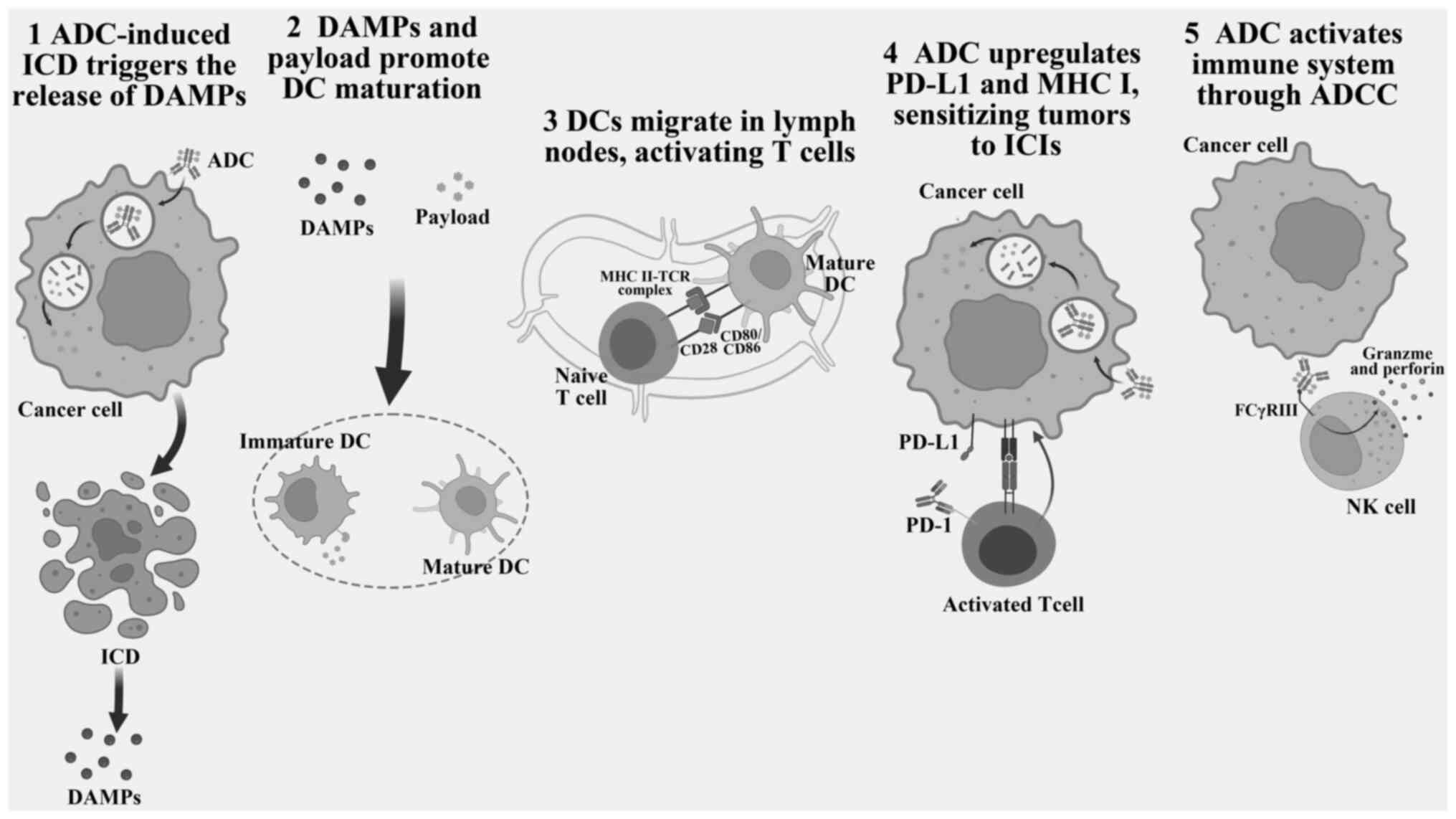 | Figure 1.Rationale for combining ADCs and
ICIs. ADC cytotoxic payloads induce ICD, releasing DAMPs. Combined
with direct payload effects, DAMPs drive DCs maturation in tumors.
Payloads facilitate DC migration to lymphoid tissues, enhancing T
cell activation, tumor infiltration, and immune memory. (4) ADC treatment upregulates PD-L1 and
MHC-I, potentially sensitizing tumors to ICIs. (5) The antibody mediates ADCC, activating
innate immunity. ICD, immunogenic cell death; DAMP,
danger-associated molecular pattern; DC, dendritic cell; TME, tumor
microenvironment; MHC I, major histocompatibility complex class I;
ADCC, antibody-dependent cellular cytotoxicity; ADC, antibody-drug
conjugate; ICI, immune checkpoint inhibitor; TCR,; PD-L1,
programmed death ligand-1; NK, Natural killer; FCγRIII, Fcγ
receptor III. |
Clinical trials of ADCs + ICIs
The preclinical rationale supporting the synergistic
interaction between ADCs and ICIs in solid tumor therapy has driven
the initiation of clinical trials evaluating the feasibility,
safety and antitumor efficacy of ADC + ICI combination regimens.
Currently available clinical data of the ADC + ICI combination are
reported in Table I. The clinical
trials investigating the combination of ADCs + ICIs are summarized
in Table SI.
 | Table I.Results of trials evaluating ADCs in
combination with immune checkpoint inhibitors. |
Table I.
Results of trials evaluating ADCs in
combination with immune checkpoint inhibitors.
| Tumor type | Disease status | ADC target | Therapy | Phase | Key efficacy
outcomes | Safety | Trial (no.) | (Refs.) |
|---|
| NSCLC | Metastatic | TROP2 | SG + | II | ORR, 67%
(PD-L1 | Manageable;
aligned | EVOKE-02 | (33) |
|
|
|
| pembrolizumab |
| TPS ≥50%); | with the toxicity
of SG | (NCT05186974) |
|
|
|
|
|
|
| mPFS, | and
pembrolizumab |
|
|
|
|
|
|
|
| 13×.1 months |
|
|
|
|
| Advanced or | TROP2 | Dato-DXd + | Ib | ORR, 52%; DCR, | Manageable; aligned
with | TROPION-Lung02 | (30) |
|
| metastatic |
| pembrolizumab |
| 88%; mPFS, | the known
toxicities | (NCT04526691) |
|
|
|
|
|
|
| 11.1 months | of Dato-DXd
and |
|
|
|
|
|
|
|
|
| pembrolizumab |
|
|
|
| Advanced or | TROP2 | Dato-DXd + | Ib | ORR, 50.0%;
DCR, | Manageable; aligned
with | TROPION-Lung04 | (41) |
|
| metastatic |
| durvalumab |
| 92.9% | the known
toxicities of | (NCT04612751) |
|
|
|
|
|
|
|
| Dato-DXd and |
|
|
|
|
|
|
|
|
| durvalumab |
|
|
|
| Advanced | TROP2 | Sac-TMT + | II | Cohort 1A
(Q3W): | Manageable (Gr
≥3 |
OptiTROP-Lung01 | (46) |
|
|
|
| KL-A167 |
| ORR, 48.6%;
DCR, | TRAEs included | (NCT05353688) |
|
|
|
|
|
|
| 94.6% and
mPFS, | neutropenia,
leukopenia, |
|
|
|
|
|
|
|
| 15.4 months; | anemia and
rash) |
|
|
|
|
|
|
|
| Cohort 1B
(Q2W): |
|
|
|
|
|
|
|
|
| ORR, 77.6%;
DCR, |
|
|
|
|
|
|
|
|
| 100%; mPFS, NR |
|
|
|
|
| Advanced or | HER2 | T-DXd + | II |
HER2-overexpression | ILD risk
requires | HUDSON | (60) |
|
| metastatic |
| durvalumab |
| cohort: ORR, | monitoring | (NCT03334617) |
|
|
|
|
|
|
| 26.1%; mPFS, |
|
|
|
|
|
|
|
|
| 2.8 months;
mOS, |
|
|
|
|
|
|
|
|
| 9.5 months;
HER2- |
|
|
|
|
|
|
|
|
| mutation
cohort: |
|
|
|
|
|
|
|
|
| ORR, 35%; mPFS |
|
|
|
|
|
|
|
|
| 5.7 months;
mOS, |
|
|
|
|
|
|
|
|
| 10.6 months |
|
|
|
|
| Advanced | c-Met | Teliso-V + | I | ORR, 7.4%;
mPFS, | Manageable
(most | NCT02099058 | (90) |
|
|
|
| nivolumab |
| 7.2 months | common
any-grade |
|
|
|
|
|
|
|
|
| TRAEs were
fatigue |
|
|
|
|
|
|
|
|
| and peripheral
sensory |
|
|
|
|
|
|
|
|
| neuropathy) |
|
|
| UC | Metastatic | TROP2 | SG + | II | ORR, 41%;
mPFS, | Manageable (Gr
≥3 | TROPHY- | (30) |
|
|
|
| pembrolizumab |
| 5.3 months;
mOS, | TRAEs included | U-01 trial |
|
|
|
|
|
|
| 12.7 months | neutropenia, | (NCT03547973) |
|
|
|
|
|
|
|
| leukopenia and
anemia) |
|
|
|
| Metastatic | TROP2 | SG +
ipilimumab/nivolumab | I | ORR, 66.6% | Manageable | NCT04863885 | (34) |
|
| Metastatic | HER2 | T-DXd + | Ib | ORR, 36.7%;
mPFS, | Aligned with
mono- | DS8201-A-U105 | (59) |
|
|
|
| nivolumab |
| 6.9 months;
mOS, | therapy profiles,
ILD/ | (NCT03523572) |
|
|
|
|
|
|
| 11.0 months | pneumonitis
risk |
|
|
|
|
|
|
|
|
| requires
monitoring |
|
|
|
| Advanced or | HER2 | RC48 + | Ib/II | ORR, 73.2%;
mPFS, | Manageable (Gr
≥3 | RC48-C014 | (65) |
|
| metastatic |
| toripalimab |
| 9.3 months;
mOS, | TRAEs included | (NCT04264936) |
|
|
|
|
|
|
| 33.1 months | increased
γ-glutamyl- |
|
|
|
|
|
|
|
|
| transferase and
alanine |
|
|
|
|
|
|
|
|
| aminotransferase
and |
|
|
|
|
|
|
|
|
| asthenia) |
|
|
|
| Advanced or | Nectin-4 | EV + | Ib/II | ORR, 64.5 vs.
45.2% | Manageable | EV-103 | (75) |
|
| metastatic |
| pembrolizumab |
| EV; mDOR, NR
vs. |
| (NCT03288545) |
|
|
|
|
|
|
| 13.2 months EV |
|
|
|
|
| Advanced or | Nectin-4 | EV + | III | mPFS, 12.5 vs. | Gr ≥3 TRAEs, | EV-302 | (76) |
|
| metastatic |
| pembrolizumab |
| 6.3 months
chemo- | 55.9 vs. 69.5% | (NCT04223856) |
|
|
|
|
|
|
| therapy; mOS, 31.5
vs. | chemotherapy |
|
|
|
|
|
|
|
| 16.1 months |
|
|
|
|
|
|
|
|
| chemotherapy |
|
|
|
| BC | TNBC, | TROP2 | Dato-DXd + | Ib/II | ORR, 74% | Favorable safety
profile | BEGONIA | (44) |
|
| metastatic |
| durvalumab |
|
|
| (NCT03742102) |
|
|
| Advanced | HER2 | T-DM1 + | II | PFS 8.2 vs. 6.2
months | More Gr ≥3 AEs | KATE2 | (53) |
|
|
|
| atezolizumab |
| T-DM1 |
| (NCT02924883) |
|
|
| Metastatic | HER2 | T-DXd + | Ib | HER2+ cohort:
ORR, | Aligned with
mono- | DS8201-A-U105 | (59) |
|
|
|
| nivolumab |
| 65.6%; mPFS, | therapy profiles;
ILD/ | (NCT03523572) |
|
|
|
|
|
|
| 11.6 months;
mOS, | pneumonitis
risk |
|
|
|
|
|
|
|
| NR; HER2-low | requires
monitoring |
|
|
|
|
|
|
|
| cohort: ORR,
50.0%; |
|
|
|
|
|
|
|
|
| mPFS, 7.0
months; |
|
|
|
|
|
|
|
|
| mOS, 9.5
months |
|
|
|
|
| Advanced or | LIV-1 | LV + | Ib/II | ORR, 54% | Tolerated (Gr ≥3
TRAEs | SGNLVA-002 | (96) |
|
| metastatic |
| pembrolizumab |
|
| included
neutropenia, | (NCT03310957) |
|
|
|
|
|
|
|
| diarrhea,
fatigue, |
|
|
|
|
|
|
|
|
| hypokalemia
and |
|
|
|
|
|
|
|
|
| maculo-papular
rash) |
|
|
| SCLC | Extensive | DLL3 | Rova-T + | I/II | ORR, 30% | Poor
tolerability; | NCT03026166 | (100) |
|
| stage |
| nivolumab ± |
|
| requires dose
optimization |
|
|
|
|
|
| ipilimumab |
|
|
|
|
|
| G/GEJ | Advanced | HER2 | RC48 + | I | ORR, 43%;
mPFS, | Manageable (Gr
≥3 | RC48-C013 | (64) |
|
|
|
| toripalimab |
| 6.2 months;
mOS, | TRAEs included
neutro- | (NCT04280341) |
|
|
|
|
|
|
| 16.8 months | penia and
leukopenia) |
|
|
| OC | Platinum- | FRα | MIRV + | I | ORR, 43%;
mDOR, | Manageable; aligned
with | NCT02606305 | (82) |
|
| resistant |
| pembrolizumab |
| 6.9 months;
mPFS | monotherapy
profiles |
|
|
|
|
|
|
|
| 5.2, months |
|
|
|
| CC | Recurrent or | TF | TV + | Ib/II | ORR, 40.6%
(1L); | Manageable | NCT03786081 | (94) |
|
| metastatic |
| pembrolizumab |
| ORR 35.3%
(2L/3L) |
|
|
|
| Solid | Advanced | MSLN | BMS-986148 + | I/IIa | ORR, 20%
(including | Manageable;
low-grade | CA008-002 | (86) |
| tumor |
|
| nivolumab |
| mesothelioma/ | TRAEs (such as
increased | (NCT02341625) |
|
|
|
|
|
|
| pancreatic
cancer) | AST and ALT
levels) |
|
|
Anti-trophoblast cell surface antigen
2 (TROP2) ADCs in combination with ICIs
TROP2, alternatively termed tumor-associated calcium
signal transducer 2, is a cell surface glycoprotein upregulated in
multiple malignancies, including NSCLC, breast cancer (BC),
urothelial cancer (UC), pancreatic and prostate cancer, and is
associated with poor prognosis of patients (25). A clinical study revealed elevated
TROP2 levels in ~64% of lung adenocarcinoma cases and 75% of
squamous cell carcinoma specimens, highlighting its prevalence in
NSCLC subtypes (26). TROP2 is
upregulated in all subtypes of BC, with particularly pronounced
upregulation observed in triple negative (TN)BC (27). The current clinical pipeline
features >20 TROP2-targeting ADCs under active investigation
globally, with notable candidates including sacituzumab govitecan
(SG; Trodelvy®, Gilead Sciences Inc), Dato-DXd and
sacituzumab tirumotecan (Sac-TMT), which exemplify diverse
therapeutic strategies in this rapidly evolving field (28).
SG in combination with ICIs
SG represents a novel ADC targeting the TROP2
antigen. This therapeutic agent combines a humanized anti-TROP2 IgG
antibody with SN-38, the active metabolite of irinotecan that
inhibits topoisomerase I activity (29). SG has shown efficacy and safety in
numerous types of solid tumors (29). As of January 2024, SG has been
approved by the FDA to treat metastatic (m)TNBC, unresectable
locally advanced or metastatic hormone receptor (HR)-positive,
human epidermal growth factor receptor (HER)2-negative BC and
metastatic (m)UC (accelerated approval) (29). According to clinicaltrials.gov,
nearly 20 clinical studies (30–32)
are currently evaluating the therapeutic potential of SG-ICI
combination therapy in various types of solid malignancies,
including UC, TNBC and NSCLC.
EVOKE-02 (trial no. NCT05186974) is an ongoing
open-label phase II trial assessing SG combined with pembrolizumab
(an anti-PD-1 monoclonal antibody) ± carboplatin/cisplatin in
metastatic (m)NSCLC lacking actionable genomic alterations (AGAs).
In cohort A [PD-L1 tumor proportion score (TPS) ≥50%],
SG-pembrolizumab demonstrated promising first-line (1-L) antitumor
activity with an overall response rate (ORR) of 67% (95% CI: 47–83)
and median progression-free survival (PFS) of 13.1 months [95% CI:
5.5-not reached (NR)] (33). The
safety profile was manageable and aligned with the known toxicities
of the individual agents (33). The
phase III KEYNOTE-D46/EVOKE-03 trial (trial no. NCT05609968) is
assessing therapeutic augmentation through SG in addition to
pembrolizumab monotherapy in PD-L1-high (TPS ≥50%) mNSCLC. Data
from this trial remain undisclosed. Additionally, neoadjuvant SG +
pembrolizumab is being investigated in resectable NSCLC through a
phase II study (trial no. NCT06055465). For extensive-stage
(ES)-SCLC, a regimen combining carboplatin/etoposide with
pembrolizumab induction followed by maintenance pembrolizumab plus
SG is under evaluation (trial no. NCT06667167).
The therapeutic potential of SG combined with ICIs
is being actively explored in advanced (a)UC. In the phase II
TROPHY-U-01 trial (trial no. NCT03547973) cohort 3, the
SG-pembrolizumab combination demonstrated clinically meaningful
outcomes in 41 patients with platinum-refractory mUC. With a
14.8-month median follow-up, this regimen achieved an ORR of 41%
(95% CI: 26.3–57.9), including 20% complete response (CR), with
median PFS and OS reaching 5.3 (95% CI: 3.4–10.2) and 12.7 months
[95% CI: 10.7-not estimable (NE)], respectively (30). The SG + pembrolizumab combination
demonstrated notable antitumor efficacy and a favorable safety
spectrum in chemotherapy-refractory mUC. Concurrently, a phase I/II
trial (trial no. NCT04863885) is evaluating a novel triplet regimen
combining SG with ipilimumab (CTLA-4 inhibitor) and nivolumab (PD-1
blocker) as 1-L therapy for cisplatin-ineligible mUC. The completed
phase I dose-escalation (n=9) established a tolerable safety
profile (34). Preliminary efficacy
analysis in six response-evaluable patients revealed an ORR of
66.6% (4/6), comprising one CR and three partial responses (PRs),
supporting further investigation of this immunotherapeutic
combination (34). The clinical
investigation of SG combined with ICIs is expanding across UC
treatment settings: The SURE trial (trial no. 2020-004844-27) is
evaluating neoadjuvant SG with/without pembrolizumab (anti-PD-1)
before radical cystectomy in muscle-invasive bladder cancer (MIBC)
(35), while PRISMA-1 (trial no.
NCT06133517), a phase II trial, assesses perioperative SG combined
with zimberelimab (PD-1 inhibitor) and domvanalimab [anti-T cell
immunoreceptor with Ig and ITIM (TIGIT)] in patients with
platinum-ineligible MIBC. Additionally, the phase II single-arm
trial NCT06682728 examines adjuvant SG-nivolumab therapy in
patients with high-risk MIBC post curative-intent surgery. In
advanced disease, the phase III NCT06524544 trial is prospectively
comparing pembrolizumab-SG combination vs. SG monotherapy in
locally aUC or mUC.
The therapeutic potential of combining SG with
pembrolizumab continues to be evaluated through multiple ongoing
clinical investigations in BC, covering various molecular subtypes
and treatment contexts (36–38).
Current research initiatives include the phase II Saci-IO TNBC
study (trial no. NCT04468061) comparing SG-pembrolizumab
combination therapy vs. SG monotherapy in PD-L1-negative mTNBC
(37), the phase II Saci-IO
HR+ investigation (trial no. NCT04448886) examining SG +
pembrolizumab vs. single-agent SG in metastatic
HR-positive/HER2-negative BC (38)
and the phase III ASCENT-04/KEYNOTE-D19 trial (trial no.
NCT05382286) evaluating SG-pembrolizumab combination against
alternative therapeutic approaches in TNBC (36).
Dato-DXd in combination with ICIs
Dato-DXd, also known as DS-1062a, is an innovative
TROP2-targeting ADC constructed through covalent attachment of a
humanized anti-TROP2 IgG1 monoclonal antibody to DXd, a highly
potent DNA topoisomerase I inhibitory agent. This therapeutic agent
maintains a drug-to-antibody ratio (DAR) of 4:1, indicating four
cytotoxic payload molecules conjugated per antibody unit (25). Unlike SG, Dato-DXd incorporates a
protease-cleavable tetrapeptide-based linker system and employs an
enhanced topoisomerase inhibitor payload (>10 times greater than
that of SN-38 of SG) (25). In
clinical trials, Dato-DXd has displayed notable anticancer efficacy
coupled with acceptable safety parameters in a variety of solid
tumors, including NSCLC and BC (39,40).
The antitumor potential of Dato-DXd was first
demonstrated in NSCLC, notably in the TROPION-Lung01 trial (trial
no. NCT04656652), a global phase III study where Dato-DXd
significantly improved PFS compared with docetaxel in patients with
advanced (a)NSCLC treated with at least one prior therapy (39). Building on this success, clinical
trials are now evaluating Dato-DXd combined with ICIs, including
pembrolizumab and durvalumab: In the TROPION-Lung02 phase Ib trial
(trial no. NCT04526691), Dato-DXd + pembrolizumab achieved an ORR
of 52% (22/42), a disease control rate (DCR) of 88% (37/42) and a
median PFS of 11.1 months (95% CI: 7.2-NE) in patients with
treatment-naïve NSCLC, with efficacy observed across PD-L1
expression levels (41). Safety
profiles aligned with the known effects of each agent, showing no
new safety signals (41).
Similarly, early results from the TROPION-Lung04 phase Ib trial
(trial no. NCT04612751) revealed that Dato-DXd/durvalumab (doublet
regimen; n=14) yielded an ORR of 50.0% and a DCR of 92.9%, while
the addition of carboplatin (triplet regimen; n=13) enhanced
efficacy (ORR, 76.9%, DCR: 92.3%) without new safety concerns in
patients with untreated aNSCLC without AGAs (42). These promising outcomes have spurred
multiple phase III trials investigating Dato-DXd-ICI combinations
as 1-L therapy for NSCLC, including TROPION-Lung07 [trial no.
NCT05555732; Dato-DXd + pembrolizumab with or without
platinum-based chemotherapy in patients with advanced/metastatic
(a/m)NSCLC with PD-L1 TPS <50%], TROPION-Lung08 (trial no.
NCT05215340; Dato-DXd + pembrolizumab vs. pembrolizumab in aNSCLC
with PD-L1 TPS ≥50%) (43),
TROPION-Lung10 [trial no. NCT06357533; Dato-DXd + rilvegostomig (a
bispecific anti-TIGIT/PD-1 antibody) vs. pembrolizumab in
PD-L1-high non-squamous NSCLC without AGAs] and TROPION-Lung12
(trial no. NCT06564844; adjuvant Dato-DXd combined with
rilvegostomig vs. standard care in circulating tumor
DNA-positive/high-risk stage I NSCLC following complete
resection).
Dato-DXd is being developed as a targeted therapy
for BC, with TNBC as a key focus. In the ongoing BEGONIA platform
study (trial no. NCT03742102), the combination of Dato-DXd and
durvalumab has demonstrated promising efficacy in 1-L TNBC
treatment. Preliminary data from 27 evaluable patients revealed an
ORR of 74% (20/27; 95% CI: 54–89), comprising two CRs and 18 PRs
(44). Notably, the regimen
exhibited a favorable safety profile with no reported cases of
dose-limiting toxicity (DLT) or interstitial lung
disease/pneumonitis (44). These
results from the BEGONIA trial support further investigation of
this combination therapy. A total of three pivotal phase III trials
are currently underway to evaluate Dato-DXd + ICIs across different
BC treatment settings, including TROPION-Breast03 (trial no.
NCT05629585; evaluating Dato-DXd ± durvalumab vs. investigator's
choice of therapy in patients with stage I–III TNBC with residual
invasive disease post-neoadjuvant treatment), TROPION-Breast04
(trial no. NCT06112379; comparing neoadjuvant Dato-DXd/durvalumab
followed by adjuvant durvalumab ± chemotherapy with neoadjuvant
pembrolizumab/chemotherapy followed by adjuvant pembrolizumab ±
chemotherapy in treatment-naïve TNBC or HR-low/HER2-negative BC)
and TROPION-Breast05 (trial no. NCT06103864; investigating Dato-DXd
± durvalumab vs. chemotherapy combined with pembrolizumab in
PD-L1-positive TNBC).
Sac-TMT in combination with ICIs
Sac-TMT, also known as SKB264 and MK-2870, is a
novel TROP2 ADC that was developed using 2-methylsulfonyl
pyrimidine as the linker to conjugate the payload (KL610023), a
cytotoxic compound derived from belotecan that serves as a
topoisomerase I inhibitor (45).
The interim findings from the OptiTROP-Lung01 phase
II trial (trial no. NCT05353688) evaluating Sac-TMT + KL-A167 (a
fully humanized PD-L1-targeting monoclonal antibody) for aNSCLC
have been reported (46). The
aforementioned study enrolled patients with treatment-naïve aNSCLC
without AGAs, administering either Sac-TMT (5 mg/kg) once every 3
weeks (Q3W) + KL-A167 (1,200 mg Q3W; cohort 1A) or Sac-TMT (5
mg/kg) once every 2 weeks (Q2W) with KL-A167 (900 mg Q2W; cohort
1B). Cohort 1A and 1B demonstrated clinically meaningful efficacy
with a manageable safety profile in this patient population. After
median follow-up durations of 14.0 (cohort 1A) and 6.9 months
(Cohort 1B), the following outcomes were observed: Cohort 1A
achieved an ORR of 48.6% (18/37), DCR of 94.6% and median PFS of
15.4 months (95% CI: 6.7-NE), with a 6-month PFS rate of 69.2%;
Cohort 1B showed superior outcomes with ORR of 77.6% (45/58), DCR
of 100% and median PFS not yet reached, accompanied by a 6-month
PFS rate of 84.6% (46). Notably,
the Q2W regimen demonstrated enhanced clinical activity compared
with the Q3W schedule. Based on these results, the Q2W
administration schedule has been selected for further clinical
investigation (46).
Other ongoing clinical trials are evaluating Sac-TMT
combined with ICIs. MK-2870-010 (trial no. NCT06312176), a phase
III randomized open-label study, compares Sac-TMT monotherapy and
combination with pembrolizumab vs. physician's choice therapy in
HR+/HER2− BC. TroFuse-011 (MK-2870-011; trial
no. NCT06841354) examines Sac-TMT with or without pembrolizumab vs.
clinician-determined therapy for treatment-naïve TNBC with low
PD-L1 expression [combined positive score <10]. MK-2870-012
(trial no. NCT06393374), a phase III adjuvant trial, compares
Sac-TMT combined with pembrolizumab against physician-selected
therapy for patients with TNBC who failed to achieve pathological
CR following neoadjuvant therapy. MK-2870-023 (trial no.
NCT06422143), a phase III trial, tests pembrolizumab with
carboplatin/taxane induction followed by pembrolizumab ±
maintenance Sac-TMT in 1-L treatment of metastatic squamous NSCLC.
TroFuse-007 (trial no. NCT06170788), a phase III study, compares
1-L Sac-TMT/pembrolizumab vs. pembrolizumab monotherapy in patients
with NSCLC with PD-L1 high expression (TPS ≥50%).
Anti-human epidermal growth factor
receptor 2 (HER2) ADCs in combination with ICIs
HER2, a tyrosine kinase receptor within the
EGFR/ErbB family, is a transmembrane glycoprotein encoded by the
ERBB2 gene (47). Clinically, HER2
upregulation has been extensively documented in multiple
malignancies, notably BC, NSCLC, UC and gastric and ovarian cancer,
with its aberrant expression associated with aggressive tumor
phenotypes and adverse clinical outcomes (48,49).
To address this therapeutic challenge, novel HER2-targeted ADCs
have emerged as a transformative strategy in the treatment of
HER2-positive cancer (50,51). Representative agents in this class
include trastuzumab emtansine (T-DM1), trastuzumab deruxtecan
(DS-8201), disitamab vedotin (RC48) and trastuzumab rezetecan
(SHR-A811) (50,51).
T-DM1 in combination with ICIs
T-DM1 (Kadcyla®) is the first approved
anti-HER2 ADC. It comprises an anti-HER2 antibody trastuzumab
conjugated via a non-cleavable linker to the highly potent
cytotoxin DM1, with an average DAR of 3.5 (52). Clinical investigations evaluating
T-DM1 combined with ICIs predominantly focus on HER-positive BC
(53–55).
The phase II KATE2 trial (trial no. NCT02924883)
assessed T-DM1 with atezolizumab vs. T-DM1 alone in pretreated
HER2-positive advanced (a)BC (53).
Despite preclinical rationale, the combination failed to
demonstrate significant clinical benefits: PFS showed no
significant improvement (8.2 vs. 6.2 months; HR, 0.82, 95% CI:
0.55–1.23, P=0.33), while exhibiting increased AEs (53). Notably, exploratory analyses
revealed a PFS and OS trend favoring PD-L1-positive subgroups,
prompting the phase III KATE3 trial (trial no. NCT04740918) to
evaluate this combination in PD-L1-positive, unresectable locally
advanced/metastatic HER2-positive BC.
The phase Ib GO29381 trial (trial no. NCT02605915),
which demonstrated acceptable tolerability of T-DM1-atezolizumab in
early/advanced HER2-positive BC, alongside evidence of adaptive
immune activation (54). Patients
with mBC who received T-DM1 + atezolizumab achieved a combined ORR
of 35% (54). The ongoing ASTEFANIA
trial (trial no. NCT04873362) further investigates this combination
in patients with HER2-positive BC with residual invasive disease
post-neoadjuvant therapy (56).
Pembrolizumab represents another ICI candidate for
T-DM1 combination strategies. The phase Ib KEYNOTE-358 trial (trial
no. NCT03032107) explored T-DM1 + pembrolizumab in
taxane/trastuzumab-pretreated HER2-positive BC, reporting a 20% ORR
and median PFS of 9.6 months with manageable toxicity (55).
T-DXd in combination with ICIs
T-DXd, also known as DS-8201, represents an ADC
composed of a HER2-targeted monoclonal antibody conjugated to a
topoisomerase I inhibitor payload, with a high DAR of ~8. T-DXd has
shown a lower risk of disease progression or death vs. T-DM1 in
patients with pretreated HER2-positive mBC (57), and greater improvements in PFS and
OS vs. chemotherapy in HER2-low mBC (58). Given its superior efficacy profile,
T-DXd is currently being investigated in combination with ICIs in
multiple clinical trials to evaluate potential synergistic
antitumor effects (59–61).
DS8201-A-U105 (NCT03523572), a phase Ib clinical
trial, investigated the therapeutic combination of T-DXd and
nivolumab in individuals diagnosed with HER2-expressing mBC and mUC
(59). The safety profile of this
regimen aligned with the established safety characteristics of
T-DXd monotherapy (59). Confirmed
ORRs were 65.6 (21/32; 95% CI: 46.8–81.4) in HER2-positive mBC
(cohort 1), 50.0 (8/16; 95% CI: 24.7–75.3) in HER2-low mBC (cohort
2) and 36.7% (11/30; 95% CI: 19.9–56.1) in HER2-high mUC (cohort
3). Median PFS was 11.6 months (95% CI: 6.9-NR) in cohort 1, 7.0
months (95% CI: 2.3–10.8) in cohort 2 and 6.9 months (95% CI:
2.7–14.4) in cohort 3. Median OS was NR in cohort 1 (95% CI:
20.8-NR), 9.5 months (95% CI: 2.7-NR) in cohort 2 and 11.0 months
(95% CI: 7.2-NR) in cohort 3. These results underscore the
promising antitumor activity of T-DXd + nivolumab across
HER2-expressing mBC and mUC (59).
Furthermore, a phase II trial (trial no. NCT05480384) is currently
evaluating this combination in patients with HER2-high
esophagogastric adenocarcinoma who have undergone chemoradiation
followed by esophagectomy.
Durvalumab, a key PD-L1 inhibitor, has been
extensively explored in combination with T-DXd across various solid
tumors (60–62). The HUDSON platform study (trial no.
NCT03334617) investigated therapeutic combinations for patients
with NSCLC experiencing disease progression following ICI therapy,
including T-DXd + durvalumab (60).
This regimen demonstrated manageable safety and clinical activity
in NSCLC with HER2 upregulation or activating mutations. Among
HER2-high patients (n=23), the ORR was 26.1% (80% CI: 14.3–41.3),
while HER2-mutated patients (n=20) achieved a higher ORR of 35%
(80% CI: 20.7–51.8). Median PFS was 2.8 months (80% CI: 2.2–5.5) in
the upregulated group vs. 5.7 months (80% CI: 5.5–6.5) in the
mutation cohort. Median OS was 9.5 months (80% CI: 6.6–12.4) for
HER2-high patients compared with 10.6 months (80% CI: 8.9-NR) in
the mutation group (60). The phase
Ib DESTINY-Lung03 trial (trial no. NCT04686305) extends this
strategy to 1-L HER2-positive aNSCLC with T-DXd/durvalumab ±
chemotherapy. In BC, early results from BEGONIA Arm 6 (trial no.
NCT03742102) demonstrated 100% ORR (4/4) in HER2-low TNBC with
T-DXd/durvalumab (61). Exploratory
trials DESTINY-Breast07 (trial no. NCT04538742) and -Breast08
(trial no. NCT04556773) systematically assess T-DXd/durvalumab
combinations in HER2-positive and HER2-low subtypes. For
inflammatory BC, a rare and aggressive BC subtype, where PD-L1
expression is prevalent and 80% of cases demonstrate HER2
alterations (40% positive, 40% low) (62), the phase II TRUDI trial (trial no.
NCT05795101) examined neoadjuvant T-DXd/durvalumab in
HER2-expressing cases. Gastrointestinal malignancy represents an
emerging focus, with the phase II EPOC2003 trial (trial no.
NCT05034887) investigating neoadjuvant T-DXd +
capecitabine/durvalumab in HER2-positive gastric cancer. The
DESTINY-Gastric-03 study (trial no. NCT04379596) further explored
T-DXd/durvalumab combinations for advanced HER2-expressing
gastric/gastroesophageal junction (G/GEJ) cancer and esophageal
adenocarcinoma.
Additional ICIs under evaluation in T-DXd-based
combination therapy for solid tumors include pembrolizumab,
rilvegostomig and volrustomig. The phase Ib DS8201-A-U106 trial
(trial no. NCT04042701) evaluates T-DXd + pembrolizumab in aBC, mBC
or NSCLC. In HER2-positive G/GEJ cancer, the phase III
DESTINY-Gastric05 study (trial no. NCT06731478) compares 1-L T-DXd
+ chemotherapy ± pembrolizumab vs. chemotherapy + trastuzumab ±
pembrolizumab. Rilvegostomig, a bispecific antibody targeting PD-1
and TIGIT receptors, is designed to enhance antitumor activity
beyond PD-(L)1 inhibition (63).
The phase III ARTEMIDE-Gastric01 trial (trial no. NCT06764875) is
assessing the efficacy and safety of rilvegostomig combined with
fluoropyrimidine and T-DXd vs. trastuzumab, chemotherapy and
pembrolizumab as 1-L treatment for HER2-positive gastric cancer.
The phase III DESTINY-Biliary Tract Cancer-01 trial (trial no.
NCT06467357) is evaluating the efficacy and safety of T-DXd with
rilvegostomig or T-DXd monotherapy vs. gemcitabine + cisplatin and
durvalumab in patients with advanced treatment-naïve
HER2-expressing biliary tract cancer. Volrustomig, an
investigational bispecific antibody targeting PD-1 and CTLA-4
receptors, is being studied in combination with T-DXd in
DESTINY-Lung03 Arm 3 (trial no. NCT04686305) for HER2-high NSCLC
and DESTINY-Gastric03 Arm 3 (trial no. NCT04379596) for gastric
cancer.
RC48 in combination with ICIs
RC48, a humanized HER2-targeting ADC approved in
China, underwent assessment in the RC48-C013 phase I study (trial
no. NCT04280341) exploring its synergistic effects with PD-1
inhibitor toripalimab for advanced HER2-positive G/GEJ cancer and
other types of solid neoplasms. Among 56 enrolled patients (30 with
G/GEJ cancer; 26 with other tumors), no DLT occurred (64). In the G/GEJ cancer cohort, the
validated ORR was 43% (12/28; 95% CI: 25–63%), with a median PFS of
6.2 months (95% CI: 4.0–6.9) and median OS of 16.8 months (95% CI:
7.2-NE). Among patients with G/GEJ treated with RP2D (n=24), ORR
was 50% (11/22; 95% CI: 28–72%) (64). Clinical benefit was observed across
HER2 expression levels: HER2-positive patients (n=9) achieved an
ORR of 56% (5/9; 95% CI: 21–86%), median PFS of 7.8 months (95% CI:
0.9-NE) and median OS NR (95% CI: 4.3-NE), while HER2-low patients
(n=13) showed an ORR of 46% (6/13; 95% CI: 19–75%), median PFS of
5.1 months (95% CI: 1.2–6.9) and median OS of 14.0 months (95% CI:
5.1-NE). Antitumor activity was also observed in other types of
malignancies, including BC (ORR: 38%, 5/13) and endometrial
carcinoma (1/1) (64). The
RC48-C013 trial results demonstrated that the combination of RC48
and toripalimab exhibits tolerable safety characteristics while
displaying promising therapeutic activity in previously treated
individuals diagnosed with HER2-positive or low HER2 expression
levels in G/GEJ cancers.
The phase Ib/II RC48-C014 trial (trial no.
NCT04264936) evaluated RC48 combined with toripalimab in 41
patients with locally aUC or mUC, including 61% treatment-naïve
individuals, demonstrating a manageable safety profile and
promising antitumor activity with a confirmed ORR of 73.2%, median
PFS of 9.3 months and median OS of 33.1 months (65). The aforementioned trial demonstrated
that patients with mUC may benefit from RC48 + toripalimab
regardless of treatment line and HER2 and PD-L1 expression. A
multicenter real-world study (n=36) observed a longer median PFS
with RC48 + ICIs vs. RC48 monotherapy (8.5 vs. 5.4 months), though
statistical significance was not achieved due to limited sample
size (66).
Ongoing trials exploring RC48-ICI combinations
include RC48-C024 (trial no. NCT06227117; neoadjuvant RC48 +
toripalimab in HR-negative/HER2-low BC), RC48-C025 (trial no.
NCT06389006; neoadjuvant RC48 + toripalimab in HR-positive/HER2-low
BC), RC48-C025 (trial no. NCT06178159; neoadjuvant RC48 +
pertuzumab ± toripalimab in HER2-positive BC), RC48-C027 (trial no.
NCT05980481; RC48 + toripalimab + chemotherapy/trastuzumab in
HER2-positive G/GEJ cancer), RC48-C035 [trial no. NCT06221748; RC48
+ cadonilimab, PD-1/CTLA-4 bispecific antibody (67)] in 2-L HER2-positive G/GEJ cancer],
RC48-C016 (trial no. NCT05302284; RC48 + toripalimab vs.
chemotherapy in 1-L HER2-positive UC) and RC48-C030 [trial no.
NCT06155396; RC48 + zimberelimab (an anti-PD-1) in
platinum-resistant HER2-positive cervical cancer (CC)].
SHR-A811 in combination with ICIs
SHR-A811, an investigational HER2-targeted ADC,
combines a humanized monoclonal antibody with a cleavable
tetrapeptide linker and DNA topoisomerase I inhibitor,
demonstrating preliminary antitumor efficacy and a favorable safety
profile in HER2-mutant NSCLC (68).
Its therapeutic potential is being explored through combination
studies with adebrelimab, a novel anti-PD-L1 antibody, across
multiple clinical trials targeting diverse malignancies: Ongoing
investigations include SHR-A1811-II-203 (trial no. NCT05482568;
HER2-positive NSCLC), SHR-A1811-II-202 (trial no. NCT05353361;
HER2-positive BC), BC-MUL-IIT-ADC-SHR1316 (trial no. NCT06433609;
HER2-negative aBC), BC-NEO-IIT-SHR-A1811-SHR1316 (trial no.
NCT06340230; neoadjuvant therapy for HR-positive/HER2-low BC),
NCC4483 (trial no. NCT06411457; HER2-low mBC) and
SHR-A1811-Ib/II-205 (trial no. NCT05671822; HER2-expressing G/GEJ
cancer).
Anti-nectin cell adhesion molecule-4
(nectin-4) ADCs in combination with ICIs
Nectin-4, also known as poliovirus receptor-related
protein 4, is a transmembrane glycoprotein belonging to the
immunoglobulin-like nectin family that serves key functions in
cellular homeostasis and developmental regulation through its
involvement in intercellular adhesion, proliferation,
differentiation, migration and immune-modulatory signaling pathways
(69). Notably, nectin-4
overexpression exhibits oncogenic properties, promoting tumor
progression and invasive behavior in UC and other malignancies
(70). This tumor-selective
expression pattern and functional contribution to carcinogenesis
have established nectin-4 as a biologically rational molecular
target for ADC therapeutics (71).
Enfortumab vedotin (EV), an ADC targeting nectin-4,
received regulatory approval from FDA in 2019 as 2L therapy for aUC
(72). Building upon the
established therapeutic roles of EV (73) and pembrolizumab (74) in UC management, clinical rationale
supports their combination as 1-L treatment for a/mUC. The EV-103
phase Ib/II trial (trial no. NCT03288545) cohort K demonstrated
superior efficacy of EV-pembrolizumab combination vs. EV alone in
cisplatin-ineligible patients with treatment-naïve aUC or mUC,
achieving significantly higher ORR (64.5 vs. 45.2%) and prolonged
duration of response [median duration of response (DOR) NR vs. 13.2
months] (75). These findings were
corroborated in the key phase III EV-302 trial (trial no.
NCT04223856), where EV-pembrolizumab combination nearly doubled
median PFS (12.5 vs. 6.3 months; HR 0.45, 95% CI: 0.38–0.54,
P<0.00001) and OS (31.5 vs. 16.1 months; HR 0.47, 95% CI:
0.38–0.58, P<0.00001) compared with platinum-based chemotherapy,
while demonstrating improved safety (grade ≥3 TRAEs: 55.9 vs.
69.5%) (76). These transformative
outcomes have established this combination as the 1-L standard of
care for aUC or mUC. An extensive clinical development program
continues to evaluate EV–ICI combinations across genitourinary
malignancies: NEPTUNE (trial no. NCT06356155; neoadjuvant
EV-pembrolizumab in cisplatin-eligible upper tract UC), PEVRAD
(trial no. NCT05879653; EV-pembrolizumab with radiotherapy for
MIBC), EV-303 (trial no. NCT03924895; perioperative
EV-pembrolizumab in cisplatin-ineligible MIBC), EV-304 (trial no.
NCT04700124; perioperative EV-pembrolizumab vs. neoadjuvant
cisplatin-gemcitabine in cisplatin-eligible MIBC), REPRINT (trial
no. NCT06302569; EV-pembrolizumab in collecting duct/renal
medullary carcinoma), MK-3475-04C (trial no. NCT06483334; Sac-TMT +
EV ± pembrolizumab in aUC) and VOLGA [trial no. NCT04960709;
perioperative EV + durvalumab ± tremelimumab (a CTLA-4 monoclonal
antibody) in cisplatin-ineligible MIBC].
9MW2821, a novel nectin-4-targeting ADC with an
enzyme-cleavable valine-citrulline linker conjugated to monomethyl
auristatin E (MMAE) payload (77),
has demonstrated clinically meaningful antitumor activity in
multiple advanced malignancies in a phase I/II trial (78). Initial efficacy data revealed ORR of
62.2% (95% CI: 44.8–77.5%; n=37) in UC, 37.8% (95% CI: 23.8–53.5%;
n=45) in CC, 29.6% (95% CI: 13.8–50.2%; n=27) in esophageal
carcinoma (EC) and 43.9% (95% CI: 19.8–70.1%; n=16) in TNBC,
establishing its broad therapeutic potential (78). Building on this rationale and
preclinical synergy between ADCs and ICIs, 1-L 9MW2821 is being
investigated in combination with PD-1 inhibitors in for solid
tumors such as UC and TNBC through multiple registered trials:
9MW2821-CP203 (trial no. NCT06823427; 9MW2821 + toripalimab vs.
9MW2821 monotherapy in UC), 9MW2821-2023-CP104 (trial no.
NCT06079112; 9MW2821 + toripalimab in UC), 9MW2821-CP205 (trial no.
NCT06492005; 9MW2821 + PD-1 inhibitor in TNBC) and 9MW2821-CP302
(trial no. NCT06592326; 9MW2821-toripalimab vs. chemotherapy in
UC).
SHR-A2102, another investigational
nectin-4-targeting ADC, is composed of three functional elements: A
fully humanized IgG1 monoclonal antibody directed against nectin-4,
an enzymatically cleavable linker and a topoisomerase I inhibitor
payload. Its clinical development program currently evaluates
SHR-A2102-adebrelimab combination in solid malignancies, such as
SHR-A2102-201 (trial no. NCT06417554; dose-escalation study of
SHR-A2102 ± adebrelimab in advanced solid tumors), SHR-A2102-205
(trial no. NCT06512051; SHR-A2102-adebrelimab ± chemotherapy in
NSCLC), SHR-A2102-206 [trial no. NCT06589778; SHR-A2102-adebrelimab
+ SHR-8068 (an anti-CTLA-4 antibody) in NSCLC], SHR-A2102-207
(trial no. NCT06639347; SHR-A2102-adebrelimab + SHR-8068 in aUC)
and SHR-A2102-303 (trial no. NCT06879145; perioperative
SHR-A2102-adebrelimab in MIBC).
Anti-folate receptor α (FRα) ADCs in
combination with ICIs
FRα is a transmembrane glycoprotein that facilitates
the unidirectional transport of folate into cells. It has been
reported that FRα is upregulated in epithelial tumors, particularly
high-grade serous ovarian cancer (79). The accessibility of this cell
surface marker makes it a promising candidate for ADC therapeutic
approaches when combined with ICIs (80).
Mirvetuximab soravtansine (MIRV), also known as
IMGN853, is an ADC that combines a FRα-targeting antibody with a
cleavable linker and the maytansinoid DM4 cytotoxic agent (79). In November 2022, MIRV obtained FDA
authorization for managing FRα-expressing, platinum-resistant
epithelial ovarian carcinoma, fallopian tube malignancies or
primary peritoneal cancer in patients having undergone 1–3 previous
lines of systemic therapy (81). A
phase Ib clinical trial (trial no. NCT02606305) is investigating
MIRV combined with pembrolizumab for platinum-resistant ovarian
cancer (PROC) treatment. In the dose-escalation part (n=14), MIRV +
pembrolizumab demonstrated favorable tolerability and durable
antitumor activity, with a confirmed ORR of 43%, median DOR of 6.9
months and a median PFS of 5.2 months (82). The results prompted an extended
trial phase to assess the therapeutic potential and safety profile
of the MIRV-pembrolizumab regimen in PROC. However, the data
regarding the expansion cohort have not been published. In addition
to PROC, MIRV-pembrolizumab combination is also under investigation
in patients with microsatellite stable (MSS) recurrent or
persistent endometrial cancer (trial no. NCT03835819), with the
hypothesis that addition of MIRV may improve the low response to
immunotherapy in MSS endometrial cancer (83).
Anti-mesothelin (MSLN) ADCs in
combination with ICIs
MSLN, a glycosylphosphatidylinositol-anchored
protein located on the cell surface, is involved in cell adhesion
(84). Its expression is limited in
normal tissue but significantly upregulated in ~30% of cancer cases
(85). Numerous MSLN-directed ADCs
are under clinical development including BMS-986148. CA008-002
(trial no. NCT02341625), a phase I/IIa clinical study, evaluates
the tolerability and therapeutic potential of BMS-986148 as
monotherapy or combined with nivolumab for treating advanced-stage
solid malignancy (86). The safety
profile of BMS-986148 in combination with nivolumab is manageable,
with the most common TRAEs being low grade (86). Notably, among 30 patients treated
with this combination, six (20%) achieved a confirmed PR, including
four with pleural mesothelioma, one with non-pleural mesothelioma
and one with pancreatic cancer. These preliminary clinical data
suggest that the BMS-986148 + nivolumab regimen exhibits clinically
meaningful antitumor activity in a small cohort of patients with
mesotheliomas and pancreatic malignancy (86). The response profile supports the
need for further investigation in expanded clinical trials to
evaluate the therapeutic potential and underlying mechanism of
action (86).
Alongside BMS-986148, the MSLN-targeting ADC
anetumab ravtansine (BAY 94-9343) has disclosed phase I/II clinical
trial data evaluating its therapeutic efficacy in combination with
pembrolizumab (trial no. NCT03126630) in patients with pleural
mesothelioma that expressed mesothelin. Although the combination
therapy with anetumab ravtansine and pembrolizumab demonstrated a
prolonged median PFS compared with pembrolizumab monotherapy (12.2
vs. 3.9 months, respectively), the intergroup difference failed to
reach statistical significance, potentially due to limited
statistical power from an underpowered study population (87).
RC88 is another investigational ADC targeting MSLN
(88). The safety, clinical
pharmacology and efficacy of intravenous RC88 combined with
sintilimab is currently under evaluation in a phase I/II trial
(trial no. NCT05804526).
Combinations of ICIs and ADCs
targeting other antigens
The tyrosine kinase receptor c-Met is predominantly
found on epithelial and endothelial cell membranes. Dysregulated
c-Met signaling pathways are frequently observed in NSCLC cases and
associated with unfavorable clinical outcomes (89). A phase Ib study (trial no.
NCT02099058) evaluated the safety and efficacy of novel anti-c-Met
ADC telisotuzumab vedotin (Teliso-V) combined with nivolumab in
c-Met positive aNSCLC (90). The
results showed that the combination therapy with Teliso-V +
nivolumab demonstrated a favorable safety profile; however, the
antitumor activity of this combination in c-Met positive patients
was limited (ORR, 7.4%; median PFS 7.2 months) (90). More studies are needed to detect the
efficacy of this combination in NSCLC. RC108 is another anti-c-Met
ADC targeting c-Met-positive advanced malignant solid tumors. A
phase I clinical trial (trial no. NCT05821933) is currently
evaluating the safety and efficacy profile of RC108 in combination
with furmonertinib, with or without toripalimab, in patients with
EGFR-mutated NSCLC exhibiting MET expression who experienced
disease progression following prior EGFR tyrosine kinase inhibitor
therapy.
Tissue factor (TF) is synthesized by
vascular-associated cells, including adventitial fibroblasts
surrounding blood vessels and epithelial cells lining body
surfaces. This protein serves a key function in maintaining
hemostatic balance (91). Elevated
TF expression has been observed in various malignancies such as BC,
prostate cancer, CC and colorectal and pancreatic cancer. Tisotumab
vedotin (TV) is an investigational ADC composed of an anti-TF mAb
conjugated to MMAE via a protease cleavable linker (92). Supported by findings from a phase II
clinical study (trial no. NCT03438396), TV has received its first
approval in the USA for managing adult patients with recurrent or
metastatic cervical carcinoma showing disease progression following
chemotherapy (93). TV +
pembrolizumab is under evaluation for the treatment of recurrent or
mCC in a multi-cohort phase Ib/II trial (trial no. NCT03786081).
The preliminary results showed that ORR was 40.6% (13/32; 95% CI:
23.7–59.4) with 1-L TV + pembrolizumab (arm E) and 35.3% (12/34;
95% CI: 19.7–53.5) with 2/3-L TV + pembrolizumab (arm F) (94). Furthermore, the combination of TV
and pembrolizumab demonstrated manageable safety. Grade ≥3 AEs
(≥15%) reported in arm F were anemia; no grade ≥3 AE (≥15%) in arm
E was reported (94).
Zinc transporter ZIP6 (LIV-1), a member of the zinc
transporter protein family localized in cellular membranes,
exhibits elevated expression in TNBC as documented in prior
research (95). Ladiratuzumab
vedotin (LV) is a promising investigational ADC directed against
LIV-1. LV +pembrolizumab has been evaluated as 1-L treatment for
patients with unresectable local advanced or mTNBC in the phase
Ib/II SGNLVA-002 study (trial no. NCT03310957). The preliminary
results of this study showed that LV + pembrolizumab were
clinically active and generally well tolerated for advanced or
mTNBC in 1-L setting. Of the 26 evaluable patients, the confirmed
ORR was 54% (95% CI: 33.4–73.4) (96). The aforementioned findings suggest
that the combination of LV and pembrolizumab warrants further
investigation in TNBC.
Δ-like ligand 3 (DLL3), a Notch signaling ligand,
serves a critical role in regulating the proliferation, development
and metastasis of cancer cells. Studies have shown that DLL3 is
significantly upregulated on the surface of SCLC cells, making it
an attractive and specific target for SCLC therapy (97,98).
Rovalpituzumab tesirine (Rova-T) is an ADC specifically targeting
DLL3, demonstrating promising antitumor activity in patients with
DLL3-expressing tumors, accompanied by a manageable safety profile
(99). The antitumor activity of
Rova-T with nivolumab in the presence or absence of ipilimumab, was
evaluated in a phase I/II study involving patients with previously
treated ES-SCLC: The combination of Rova-T with nivolumab, with or
without ipilimumab, demonstrated promising antitumor activity in
heavily pretreated patients with ES-SCLC. Specifically, an ORR of
30% (12/40) was observed in patients with ES-SCLC receiving Rova-T
in combination with either nivolumab alone (27.6%; 8/29) or
nivolumab + ipilimumab (36.4%; 4/11) (100). However, the combination of Rova-T
with nivolumab ± ipilimumab was not well tolerated at the evaluated
dose levels and administration schedules (100). The safety profile of the Rova-T
and nivolumab combination indicates that dose and schedule
optimization of this combination should be investigated.
B7 homolog 3 protein (B7-H3) belongs to the B7
superfamily of immunomodulatory molecules. B7-H3 is expressed on
antigen-presenting cells; however, its expression is limited or
undetectable in most normal tissue (101). By contrast, B7-H3 is upregulated
in numerous types of solid cancers, including prostate cancer,
NSCLC, SCLC and BC (102).
Ifinatamab deruxtecan (I-DXd), also known as DS-7300, is an
innovative ADC comprising a B7-H3-targeting monoclonal antibody
conjugated to DXd (103).
NCT06362252 is a study aiming to evaluate the safety and efficacy
of I-DXd in combination with atezolizumab with or without
carboplatin in patients with ES-SCLC in the 1-L setting. The
aforementioned study is currently in the patient recruitment phase.
BGB-C354 is another ADC targeting B7-H3. A phase I trial (trial no.
NCT06422520) is ongoing to evaluate the preliminary antitumor
activity and safety of BGB-C354 in combination with the anti-PD-1
monoclonal antibody tislelizumab in patients with advanced solid
tumors.
B7 homolog 4 protein (B7-H4) belongs to the B7
immune checkpoint. It is a type I transmembrane protein that
exhibits relatively low expression in normal healthy tissues but is
highly expressed in a number of solid tumors including breast,
ovarian, lung and pancreatic cancer (104). Several B7-H4-targeted ADCs are
under clinical development, such as AZD8205, XMT-1660, BG-C9074 and
HS-20089. The combination of AZD8205 and rilvegostomig as a
potential treatment for advanced or metastatic solid tumors is
under evaluation in a phase I/IIa study (trial no. NCT05123482).
BG-C9074, a promising ADC targeting B7-H4, is currently being
evaluated in a phase I clinical trial in combination with
tislelizumab in patients with advanced solid tumors (trial no.
NCT06233942).
HER3, belonging to the EGFR tyrosine kinase receptor
family, demonstrates elevated expression in multiple carcinoma
types such as breast, head and neck, pulmonary, colorectal,
prostatic and gynecological malignancy (105). Due to its ubiquitous presence in
tumors and efficient internalization by cancer cells following
antibody binding, HER3 has emerged as an attractive target for
cancer treatment, particularly in the development of ADCs (106). SHR-A2009 represents an innovative
ADC incorporating a fully humanized anti-HER3 IgG1 monoclonal
antibody, a cleavable peptide-based linker and a DNA topoisomerase
I inhibitor payload, which has a tolerable safety profile and
encouraging antitumor activity in patients with heavily pretreated
advanced solid tumors (107).
SHR-A2009 + adebrelimab is planned to be evaluated in a phase Ib/II
trial for patients with advanced solid tumors, including NSCLC
(trial no. NCT06092268). Patritumab deruxtecan, also known as
HER3-DXd, is another investigational HER3-targeted ADC. The
combination of patritumab deruxtecan and pembrolizumab is being
investigated in the 1-L setting for NSCLC (trial no. NCT06731907),
as well as in the neoadjuvant setting for TNBC or
HR-low/HER2-negative BC (trial no. NCT06797635).
Claudin-18 isoform 2 (CLDN18.2), a key member of the
tight junction protein family, has emerged as a promising
tumor-associated antigen (TAA) for ADC therapeutic targeting
(108). CLDN18.2 is highly and
stably expressed in multiple solid tumors, including gastric and
pancreatic ductal adenocarcinoma, EC, NSCLC and colorectal and
hepatocellular carcinoma (108,109). AZD0901 (CMG901) is a
first-in-class CLDN18.2 ADC with a humanized anti-CLDN18.2 antibody
linked to microtubule-disrupting agent MMAE (110). The phase I trial of AZD0901
demonstrated that AZD0901 exhibits promising anti-tumor activity in
patients with advanced (a)G/GEJ cancer, along with a manageable
safety profile (110). A phase II
trial (trial no. NCT05702229) is currently evaluating the
combination of AZD0901 with rilvegostomig, volrustomig or AZD7789
[a bispecific antibody targeting PD-1 and T cell immunoglobulin and
mucin domain 3) (111)] in
patients with advanced unresectable or metastatic (m)G/GEJ cancer.
LM-302 represents a novel MMAE-conjugated ADC targeting CLDN18.2. A
phase I/II clinical trial (trial no. NCT05188664) is currently
investigating the safety, tolerability, pharmacokinetic profile,
immunogenicity and preliminary efficacy of LM-302 combined with
toripalimab in patients with advanced solid tumors. In parallel,
RC118 has emerged as another CLDN18.2-targeting ADC under clinical
development. A phase I/II trial (trial no. NCT06038396) is actively
evaluating the efficacy and safety profile of RC118 + toripalimab
for patients with CLDN18.2-positive, locally advanced unresectable
or metastatic malignant solid tumors.
EGFR belongs to the ErbB family of tyrosine kinase
receptors, serving a pivotal role in regulating cell proliferation,
differentiation, migration and survival, as well as adhesion
(112). EGFR is reported to be
upregulated in various solid tumors, including squamous cell
carcinoma of the head and neck (SCCHN), nasopharyngeal carcinoma
(NPC) and colorectal cancer (112). MRG003 is a novel ADC with an
anti-EGFR humanized monoclonal antibody conjugated with MMAE via a
valine-citrulline linker (112).
Preliminary data from a phase I/II trial (trial no. NCT05688605)
demonstrated favorable tolerability and encouraging antitumor
activity of the MRG003 and pucotenlimab (an anti-PD-1 mAb)
combination in patients with NPC and SCCHN. Notably, the regimen
exhibited significant clinical efficacy in patients with NPC who
had previously progressed following PD-1 inhibitor therapy
(113). In the phase I cohort, the
ORR and DCR were 63.0% (95% CI: 42.4–80.6) and 88.9% (95% CI:
70.8–97.7), respectively (113).
In the phase II study, among nine evaluable patients with
EGFR-positive NPC who progressed following 1-L treatment with PD-1
+ platinum-based chemotherapy, the combination achieved two CR,
five PR and two cases of stable disease, yielding an ORR of 77.8%
(95% CI: 40.0–97.2) and a DCR of 100% (95% CI: 66.4–100) (113). The phase II study is ongoing.
Furthermore, the combination of MRG003 and pucotenlimab is also
being investigated as a neoadjuvant therapy for locally advanced
EGFR-positive head and neck squamous cell carcinoma in an ongoing
phase II trial (trial no. NCT06530914).
Receptor tyrosine kinase-like orphan receptor 2
(ROR2) has been validated as a TAA of notable therapeutic relevance
across multiple types of cancer types with substantial unmet
medical needs, positioning it as an attractive molecular target for
cancer therapy (114). Ozuriftamab
vedotin (BA3021) is a conditionally active biological agent (CAB)
anti-ROR2 ADC employing a cleavable linker to conjugate MMAE
(115). The ongoing BA3021-001
trial (NCT03504488) is a phase I/II study designed to evaluate the
safety and antitumor efficacy of BA3021 as both monotherapy and in
combination therapy with nivolumab for patients with selected
advanced solid tumors, including NSCLC and melanoma.
Anexelokto (AXL), a receptor tyrosine kinase
upregulated in numerous types of solid and hematological
malignancy, drives tumor progression and is associated with poor
clinical outcomes (116).
Mecbotamab vedotin (BA3011), a CAB anti-AXL ADC, is under
investigation as a therapeutic agent for advanced solid tumors. The
BA3011-002 trial (trial no. NCT04681131), an ongoing phase II
study, aims to assess the efficacy and safety of BA3011 as
monotherapy or in combination with nivolumab for patients with
AXL-expressing mNSCLC.
Fibronectin (FN) is a ubiquitously expressed,
high-molecular weight, extracellular matrix glycoprotein. The extra
domain B splice variant of FN (EDB + FN) is a novel therapeutic
target that is upregulated in the TME of numerous types of solid
tumor, with restricted expression in normal tissue (117). PYX-201 is an investigational ADC
consisting of a site-specific engineered EDB + FN-targeting
monoclonal antibody conjugated to vc0101, a microtubule
depolymerizing agent with potent anti-mitotic and cytotoxic
properties (117). PYX-201-102
(trial no. NCT06795412) is an ongoing phase I/II trial to evaluate
the safety, tolerability and preliminary efficacy of PYX-201 in
combination with pembrolizumab in participants with advanced solid
tumors.
Integrin β-6 (IB6), a tumor-associated transmembrane
protein, serves as a key mediator in disease progression and
metastatic potential (118).
Sigvotatug vedotin (SV), also known as SGN-B6A, is an IB6-directed
ADC, which demonstrated promising efficacy against NSCLC in the
phase I study SGNB6A-001 (trial no. NCT04389632) (119). Due to these encouraging results, a
phase III trial is ongoing to compare the combination treatment (SV
+ pembrolizumab) vs. pembrolizumab alone in patients with NSCLC
with high levels of PD-L1 (trial no. NCT06758401).
Conclusion
The combination of ADCs with ICIs represents a
paradigm shift in cancer therapeutics, offering synergistic
mechanisms to overcome intrinsic resistance and enhance antitumor
immunity. Clinical evidence underscores the potential of this
combination strategy in numerous types of solid tumor, driven by
the ability of ADC to induce ICD, remodel the TME and amplify
ICI-mediated immune cell activation. The direct comparison of
ADC-ICI combination efficacy against ADC or ICI monotherapy is
critical for contextualizing findings. However, clinical
investigation of ADC-ICI combinations remains largely limited to
early-phase trials. To date, two head-to-head trials (trial nos.
NCT02924883 and NCT03288545) have compared ADC-ICI combination
therapy with ADC monotherapy. Robust clinical trial evidence
directly comparing combination regimens with respective
monotherapies remains insufficient to draw definitive
conclusions.
BC, particularly HER2-positive and TNBC, NSCLC and
urothelial carcinoma represent the most extensively studied
malignancies in ADC-ICI combination trials. Up to April 2025,
urothelial carcinoma remains the only tumor type with a fully
approved ADC-ICI combination (EV + pembrolizumab) (120). Promising ADC-ICI combinations for
other solid tumors, including BC (trial nos. NCT05382286,
NCT05633654, NCT06103864 and NCT05629585), NSCLC (trial nos.
NCT05609968, NCT05555732 and NCT05215340) and G/GEJ cancer (trial
nos. NCT06731478 and NCT05980481), have advanced to phase III
trials.
The comprehensive review by Wei et al
(121) provided analysis of the
additive or synergistic potential between ADCs and various classes
of oncology therapeutics, including immunotherapy. However, the
aforementioned study had limited coverage of the specific
mechanistic underpinnings, efficacy profiles and safety
considerations associated with ADC-immunotherapy combinations.
Clinical evidence supporting this particular combinatorial strategy
lacks comprehensiveness. Similarly, Fong et al (122) summarized preclinical and clinical
advancements for ADCs in oncology but did not specifically
concentrate on combination therapies involving ADCs and other
agents. The present review aimed to provide an exclusive and
systematic focus on combinations of ADCs with ICIs (120,121) and evaluation of the clinical
evidence for this promising therapeutic approach. The present
review provided an antigen-focused clinical update concerning
ADC-ICI combinations.
A key challenge in combining ADC and ICI therapies
lies in managing overlapping AEs. For example, diarrhea or
pneumonitis are shared as AEs by both immunotherapy and some ADCs;
therefore, their incidence rate may increase when combined
(123). Therefore, future studies
should concentrate on enhancing the specificity, efficacy and
safety profiles of ADCs and ICIs.
The advent of next-generation PD-1/PD-L1 agents,
particularly bifunctional molecules and bispecific antibodies
(PD-1/CTLA-4, PD-1/VEGF, PD-1/TIGIT and PD-1/LAG-3 bispecifics),
may expand the clinical indications of immune checkpoint blockade.
By simultaneously targeting PD-(L)1 and other key molecules
involved in immune regulation, bispecific antibodies offer a
multifaceted approach to enhance antitumor immune responses
(124). Several bispecific
antibodies, notably ivonescimab (PD-1/VEGF bispecific), exhibit
superior therapeutic efficacy compared with conventional PD-(L)1
monoclonal antibodies such as pembrolizumab (125). Therefore, bispecific antibodies
targeting the PD-1/PD-L1 signaling pathway may serve as superior
alternatives to PD-(L)1 monoclonal antibodies when combined with
ADCs in cancer treatment regimens.
Next-generation ADCs have emerged as innovative
therapeutic modalities addressing limitations of conventional ADC
platforms through novel engineering strategies (125). Bispecific ADCs demonstrate
enhanced tumor selectivity and internalization efficiency via dual
epitope/target engagement mechanisms (126), with >10 candidates currently in
clinical development. Dual-payload ADCs represent a paradigm shift
approach, employing synergistic combinations of distinct cytotoxic
agents on a single antibody scaffold to overcome resistance
mechanisms (127). These advanced
ADC platforms, when strategically combined with ICIs, may present
promising multimodal therapeutic strategies for optimizing tumor
targeting while minimizing systemic toxicity through enhanced
payload delivery and conditional activation mechanisms.
Supplementary Material
Supporting Data
Acknowledgements
Not applicable.
Funding
The present study was supported by the Science and Technology
Project of Southwest Medical University (grant no.
2020ZRQNA004).
Availability of data and materials
Not applicable.
Authors' contributions
YZ, RD and YD conceived the study and wrote the
manuscript. LC and ZZ revised the manuscript. RD reviewed and
edited the manuscript. All authors have read and approved the final
manuscript. Data authentication is not applicable.
Ethics approval and consent to
participate
Not applicable.
Patient consent for publication
Not applicable.
Competing interests
The authors declare that they have no competing
interests.
References
|
1
|
Wu Q, Qian W, Sun X and Jiang S:
Small-molecule inhibitors, immune checkpoint inhibitors, and more:
FDA-approved novel therapeutic drugs for solid tumors from 1991 to
2021. J Hematol Oncol. 15:1432022. View Article : Google Scholar : PubMed/NCBI
|
|
2
|
Bray F, Laversanne M, Sung H, Ferlay J,
Siegel RL, Soerjomataram I and Jemal A: Global cancer statistics
2022: GLOBOCAN estimates of incidence and mortality worldwide for
36 cancers in 185 countries. CA Cancer J Clin. 74:229–263.
2024.PubMed/NCBI
|
|
3
|
Nicolò E, Giugliano F, Ascione L,
Tarantino P, Corti C, Tolaney SM, Cristofanilli M and Curigliano G:
Combining antibody-drug conjugates with immunotherapy in solid
tumors: Current landscape and future perspectives. Cancer Treat
Rev. 106:1023952022. View Article : Google Scholar : PubMed/NCBI
|
|
4
|
Chen EY, Rai M, Tadikonda Y, Roy P,
Nollner DW, Chitkara A, Hamilton J and Thawani R: Trends in
complexity of single-agent and combination therapies for solid
tumor cancers approved by the US food and drug administration. The
oncologist. 30:oyae3022025. View Article : Google Scholar : PubMed/NCBI
|
|
5
|
Naimi A, Mohammed RN, Raji A, Chupradit S,
Yumashev AV, Suksatan W, Shalaby MN, Thangavelu L, Kamrava S,
Shomali N, et al: Tumor immunotherapies by immune checkpoint
inhibitors (ICIs); The pros and cons. Cell Commun Signal.
20:442022. View Article : Google Scholar : PubMed/NCBI
|
|
6
|
Nagasaki J, Ishino T and Togashi Y:
Mechanisms of resistance to immune checkpoint inhibitors. Cancer
Sci. 113:3303–3312. 2022. View Article : Google Scholar : PubMed/NCBI
|
|
7
|
Sharma P, Siddiqui BA, Anandhan S, Yadav
SS, Subudhi SK, Gao J, Goswami S and Allison JP: The next decade of
immune checkpoint therapy. Cancer Discov. 11:838–857. 2021.
View Article : Google Scholar : PubMed/NCBI
|
|
8
|
Song Y, Fu Y, Xie Q, Zhu B, Wang J and
Zhang B: Anti-angiogenic agents in combination with immune
checkpoint inhibitors: A promising strategy for cancer treatment.
Front Immunol. 11:19562020. View Article : Google Scholar : PubMed/NCBI
|
|
9
|
Yap TA, Parkes EE, Peng W, Moyers JT,
Curran MA and Tawbi HA: Development of immunotherapy combination
strategies in cancer. Cancer Discov. 11:1368–1397. 2021. View Article : Google Scholar : PubMed/NCBI
|
|
10
|
Garassino MC, Gadgeel S, Speranza G, Felip
E, Esteban E, Dómine M, Hochmair MJ, Powell SF, Bischoff HG, Peled
N, et al: Pembrolizumab plus pemetrexed and platinum in nonsquamous
non-small-cell lung cancer: 5-Year outcomes from the phase 3
KEYNOTE-189 study. J Clin Oncol. 41:1992–1998. 2023. View Article : Google Scholar : PubMed/NCBI
|
|
11
|
Horn L, Mansfield AS, Szczęsna A, Havel L,
Krzakowski M, Hochmair MJ, Huemer F, Losonczy G, Johnson ML, Nishio
M, et al: First-line atezolizumab plus chemotherapy in
extensive-stage small-cell lung cancer. N Engl J Med.
379:2220–2229. 2018. View Article : Google Scholar : PubMed/NCBI
|
|
12
|
Janjigian YY, Shitara K, Moehler M,
Garrido M, Salman P, Shen L, Wyrwicz L, Yamaguchi K, Skoczylas T,
Campos Bragagnoli A, et al: First-line nivolumab plus chemotherapy
versus chemotherapy alone for advanced gastric, gastro-oesophageal
junction, and oesophageal adenocarcinoma (CheckMate 649): A
randomised, open-label, phase 3 trial. Lancet. 398:27–40. 2021.
View Article : Google Scholar : PubMed/NCBI
|
|
13
|
Fuentes-Antrás J, Genta S, Vijenthira A
and Siu LL: Antibody-drug conjugates: In search of partners of
choice. Trends Cancer. 9:339–354. 2023. View Article : Google Scholar : PubMed/NCBI
|
|
14
|
Drago JZ, Modi S and Chandarlapaty S:
Unlocking the potential of antibody-drug conjugates for cancer
therapy. Nat Rev Clin Oncol. 18:327–344. 2021. View Article : Google Scholar : PubMed/NCBI
|
|
15
|
Salifu I, Singh N, Berraondo M, Remon J,
Salifu S, Severson E, Quintana A, Peiró S, Ramkissoon S, Vidal L,
et al: Antibody-drug conjugates, immune-checkpoint inhibitors, and
their combination in advanced non-small cell lung cancer. Cancer
Treat Res Commun. 36:1007132023.PubMed/NCBI
|
|
16
|
Wang Z, Li H, Gou L, Li W and Wang Y:
Antibody-drug conjugates: Recent advances in payloads. Acta Pharm
Sin B. 13:4025–4059. 2023. View Article : Google Scholar : PubMed/NCBI
|
|
17
|
Metrangolo V and Engelholm LH:
Antibody-drug conjugates: The dynamic evolution from conventional
to next-generation constructs. Cancers (Basel). 16:4472024.
View Article : Google Scholar : PubMed/NCBI
|
|
18
|
He L, Wang L, Wang Z, Li T, Chen H, Zhang
Y, Hu Z, Dimitrov DS, Du J and Liao X: Immune modulating
antibody-drug conjugate (IM-ADC) for cancer immunotherapy. J Med
Chem. 64:15716–15726. 2021. View Article : Google Scholar : PubMed/NCBI
|
|
19
|
Yu P, Zhu C, You X, Gu W, Wang X, Wang Y,
Bu R and Wang K: The combination of immune checkpoint inhibitors
and antibody-drug conjugates in the treatment of urogenital tumors:
A review insights from phase 2 and 3 studies. Cell Death Dis.
15:4332024. View Article : Google Scholar : PubMed/NCBI
|
|
20
|
Bhardwaj PV and Abdou YG: The evolving
landscape of immune checkpoint inhibitors and antibody drug
conjugates in the treatment of early-stage breast cancer.
Oncologist. 28:832–844. 2023. View Article : Google Scholar : PubMed/NCBI
|
|
21
|
D'Amico L, Menzel U, Prummer M, Müller P,
Buchi M, Kashyap A, Haessler U, Yermanos A, Gébleux R, Briendl M,
et al: A novel anti-HER2 anthracycline-based antibody-drug
conjugate induces adaptive anti-tumor immunity and potentiates PD-1
blockade in breast cancer. J Immunother Cancer. 7:162019.
View Article : Google Scholar : PubMed/NCBI
|
|
22
|
Müller P, Martin K, Theurich S, Schreiner
J, Savic S, Terszowski G, Lardinois D, Heinzelmann-Schwarz VA,
Schlaak M, Kvasnicka HM, et al: Microtubule-depolymerizing agents
used in antibody-drug conjugates induce antitumor immunity by
stimulation of dendritic cells. Cancer Immunol Res. 2:741–755.
2014. View Article : Google Scholar : PubMed/NCBI
|
|
23
|
Iwata TN, Ishii C, Ishida S, Ogitani Y,
Wada T and Agatsuma T: A HER2-targeting antibody-drug conjugate,
trastuzumab deruxtecan (DS-8201a), enhances antitumor immunity in a
mouse model. Mol Cancer Ther. 17:1494–1503. 2018. View Article : Google Scholar : PubMed/NCBI
|
|
24
|
Rios-Doria J, Harper J, Rothstein R,
Wetzel L, Chesebrough J, Marrero A, Chen C, Strout P, Mulgrew K,
McGlinchey K, et al: Antibody-drug conjugates bearing
pyrrolobenzodiazepine or tubulysin payloads are immunomodulatory
and synergize with multiple immunotherapies. Cancer Res.
77:2686–2698. 2017. View Article : Google Scholar : PubMed/NCBI
|
|
25
|
Okajima D, Yasuda S, Maejima T, Karibe T,
Sakurai K, Aida T, Toki T, Yamaguchi J, Kitamura M, Kamei R, et al:
Datopotamab deruxtecan, a novel TROP2-directed antibody-drug
conjugate, demonstrates potent antitumor activity by efficient drug
delivery to tumor cells. Mol Cancer Ther. 20:2329–2340. 2021.
View Article : Google Scholar : PubMed/NCBI
|
|
26
|
Inamura K, Yokouchi Y, Kobayashi M,
Ninomiya H, Sakakibara R, Subat S, Nagano H, Nomura K, Okumura S,
Shibutani T and Ishikawa Y: Association of tumor TROP2 expression
with prognosis varies among lung cancer subtypes. Oncotarget.
8:28725–28735. 2017. View Article : Google Scholar : PubMed/NCBI
|
|
27
|
Sakach E, Sacks R and Kalinsky K: Trop-2
as a therapeutic target in breast cancer. Cancers (Basel).
14:59362022. View Article : Google Scholar : PubMed/NCBI
|
|
28
|
Nelson BE and Meric-Bernstam F: Leveraging
TROP2 antibody-drug conjugates in solid tumors. Annu Rev Med.
75:31–48. 2024. View Article : Google Scholar : PubMed/NCBI
|
|
29
|
Cardillo TM, Zalath MB, Arrojo R, Sharkey
RM, Govindan SV, Chang CH and Goldenberg DM: Sacituzumab govitecan
plus platinum-based chemotherapy mediates significant antitumor
effects in triple-negative breast, urinary bladder, and small-cell
lung carcinomas. Oncotarget. 15:144–158. 2024. View Article : Google Scholar : PubMed/NCBI
|
|
30
|
Grivas P, Pouessel D, Park CH, Barthelemy
P, Bupathi M, Petrylak DP, Agarwal N, Gupta S, Fléchon A,
Ramamurthy C, et al: Sacituzumab govitecan in combination with
pembrolizumab for patients with metastatic urothelial cancer that
progressed after platinum-based chemotherapy: TROPHY-U-01 cohort 3.
J Clin Oncol. 42:1415–1425. 2024. View Article : Google Scholar : PubMed/NCBI
|
|
31
|
Roisman LC, Mann S, Basel A, Marei R,
Krayim B, Kornev G, Asna N and Peled N: The PESGA trial: A
prospective, open-label, single-arm, phase II study to evaluate
first line therapy for extensive-stage small cell lung cancer
(ES-SCLC) patients, treated by induction
carboplatin/etoposide/pembrolizumab followed by maintenance of
pembrolizumab/sacituzumab govitecan. Clin Lung Cancer. 26:267–270.
2025. View Article : Google Scholar : PubMed/NCBI
|
|
32
|
Tolaney SM, DeMichele A, Takano T, Rugo
HS, Perou C, Lynce F, Parsons HA, Santa-Maria CA, Rocque GB, Yao W,
et al: OptimICE-RD: sacituzumab govitecan + pembrolizumab vs
pembrolizumab (± capecitabine) for residual triple-negative breast
cancer. Future Oncol. 20:2343–2355. 2024. View Article : Google Scholar : PubMed/NCBI
|
|
33
|
Patel JD, Cho BC, Cobo M, Cabanillas RR,
Vicente D, Pradera JF, Garon EB, Mok TSK, Cappuzzo F, Neal JW, et
al: Sacituzumab govitecan (SG) + pembrolizumab (pembro) in
first-line (1L) metastatic non-small cell lung cancer (mNSCLC) with
PD-L1 ≥50%: Cohort A of EVOKE-02. J Clin Oncol 42 (16 Suppl).
S85922024. View Article : Google Scholar
|
|
34
|
Jain RK, Yang Y, Chadha J, Chatwal MC,
Kish JA, Raymond S, Rembisz J, Jameel G, Mustasam A, Poehlman T, et
al: Phase I/II study of ipilimumab plus nivolumab combined with
sacituzumab govitecan in patients with metastatic
cisplatin-ineligible urothelial carcinoma. J Clin Oncol 41 (6
Suppl). S5212023. View Article : Google Scholar
|
|
35
|
Necchi A, Raggi D, Bandini M, Gallina A,
Capitanio U, Gandaglia G, Cucchiara V, Fossati N, De Cobelli F,
Salonia A, et al: SURE: An open label, sequential-arm, phase II
study of neoadjuvant sacituzumab govitecan (SG), and SG plus
pembrolizumab (pembro) before radical cystectomy, for patients with
muscle-invasive bladder cancer (MIBC) who cannot receive or refuse
cisplatin-based chemotherapy. J Clin Oncol 39 (6 Suppl).
TPS5062021. View Article : Google Scholar
|
|
36
|
Tolaney SM, de Azambuja E, Emens LA, Loi
S, Pan W, Huang J, Sun SW, Lai C and Schmid P: 276TiP
ASCENT-04/KEYNOTE-D19: Phase III study of sacituzumab govitecan
(SG) plus pembrolizumab (pembro) vs treatment of physician's choice
(TPC) plus pembro in first-line (1L) programmed death-ligand
1-positive (PD-L1+) metastatic triple-negative breast cancer
(mTNBC). Ann Oncol. 33 (Suppl 7):S664–S665. 2022. View Article : Google Scholar
|
|
37
|
Garrido-Castro AC, Keenan TE, Li T, Lange
P, Callahan C, Guerriero J, Tayob N, Anderson L, Yam C, Daniel BR,
et al: Saci-IO TNBC: Randomized phase II trial of sacituzumab
govitecan (SG) +/- pembrolizumab in PD-L1- metastatic
triple-negative breast cancer (mTNBC). J Clin Oncol 39 (15 Suppl).
TPS11062021. View Article : Google Scholar
|
|
38
|
Garrido-Castro AC, Kim SE, Desrosiers J,
Nanda R, Carey LA, Clark AS, Sacks RL, O'Connor TP, Sinclair NF, Lo
KNM, et al: SACI–IO HR+: A randomized phase II trial of sacituzumab
govitecan with or without pembrolizumab in patients with metastatic
hormone receptor-positive/HER2-negative breast cancer. J Clin Oncol
42 (17 Suppl). LBA10042024. View Article : Google Scholar
|
|
39
|
Ahn MJ, Tanaka K, Paz-Ares L, Cornelissen
R, Girard N, Pons-Tostivint E, Vicente Baz D, Sugawara S, Cobo M,
Pérol M, et al: Datopotamab deruxtecan versus docetaxel for
previously treated advanced or metastatic non-small cell lung
cancer: The randomized, open-label phase III TROPION-Lung01 study.
J Clin Oncol. 43:260–272. 2025. View Article : Google Scholar : PubMed/NCBI
|
|
40
|
Bardia A, Krop IE, Kogawa T, Juric D,
Tolcher AW, Hamilton EP, Mukohara T, Lisberg A, Shimizu T, Spira
AI, et al: Datopotamab deruxtecan in advanced or metastatic
HR+/HER2- and triple-negative breast cancer: Results from the phase
I TROPION-PanTumor01 study. J Clin Oncol. 42:2281–2294. 2024.
View Article : Google Scholar : PubMed/NCBI
|
|
41
|
Levy BP, Paz-Ares LG, Su WC, Herbert SM,
Yang TY, Tolcher AW, Lou Y, Zenke Y, Cortinovis DL, Felip E, et al:
Datopotamab deruxtecan (Dato-DXd) plus pembrolizumab (pembro) with
or without platinum chemotherapy (Pt-CT) as first-line (1L) therapy
for advanced non-small cell lung cancer (aNSCLC): Subgroup analysis
from TROPION-Lung02. J Clin Oncol 42 (16 Suppl). S86172024.
View Article : Google Scholar
|
|
42
|
AstraZeneca, . Datopotamab deruxtecan plus
Imfinzi showed promising clinical activity in the first-line
advanced non-small cell lung cancer setting in TROPION-Lung04 phase
Ib trial (Cision). AstraZeneca; Cambridge: 2023
|
|
43
|
Levy BP, Felip E, Reck M, Yang JC,
Cappuzzo F, Yoneshima Y, Zhou C, Rawat S, Xie J, Basak P, et al:
TROPION-Lung08: Phase III study of datopotamab deruxtecan plus
pembrolizumab as first-line therapy for advanced NSCLC. Future
Oncol. 19:1461–1472. 2023. View Article : Google Scholar : PubMed/NCBI
|
|
44
|
Schmid P, Jung KH, Wysocki PJ, Jassem J,
Ma CX, Fernandes R, Huisden R, Stewart R, Vukovic P, Nunes AT and
Nowecki Z: 166MO datopotamab deruxtecan (Dato-DXd) + durvalumab (D)
as first-line (1L) treatment for unresectable locally
advanced/metastatic triple-negative breast cancer (a/mTNBC):
Initial results from BEGONIA, a phase Ib/II study. Ann Oncol. 33
(Suppl 3):S1992022. View Article : Google Scholar
|
|
45
|
Cheng Y, Yuan X, Tian Q, Huang X, Chen Y,
Pu Y, Long H, Xu M, Ji Y, Xie J, et al: Preclinical profiles of
SKB264, a novel anti-TROP2 antibody conjugated to topoisomerase
inhibitor, demonstrated promising antitumor efficacy compared to
IMMU-132. Front Oncol. 12:9515892022. View Article : Google Scholar : PubMed/NCBI
|
|
46
|
Fang W, Wang Q, Cheng Y, Luo Y, Qu X, Zhu
H, Ding Z, Li X, Wu L, Wang Y, et al: Sacituzumab tirumotecan
(SKB264/MK-2870) in combination with KL-A167 (anti-PD-L1) as
first-line treatment for patients with advanced NSCLC from the
phase II OptiTROP-Lung01 study. J Clin Oncol 42 (16 Suppl).
S85022024. View Article : Google Scholar
|
|
47
|
Zimmerman BS and Esteva FJ:
Next-generation HER2-targeted antibody-drug conjugates in breast
cancer. Cancers(Basel). 16:8002024.PubMed/NCBI
|
|
48
|
Nakada T, Sugihara K, Jikoh T, Abe Y and
Agatsuma T: The latest research and development into the
antibody-drug conjugate, [fam-] trastuzumab deruxtecan (DS-8201a),
for HER2 cancer therapy. Chem Pharm Bull (Tokyo). 67:173–185. 2019.
View Article : Google Scholar : PubMed/NCBI
|
|
49
|
Wang D, Chen X, Du Y, Li X, Ying L, Lu Y,
Shen B, Gao X, Yi X, Xia X, et al: Associations of HER2 mutation
with immune-related features and immunotherapy outcomes in solid
tumors. Front Immunol. 13:7999882022. View Article : Google Scholar : PubMed/NCBI
|
|
50
|
McNamara B, Greenman M, Pebley N, Mutlu L
and Santin AD: Antibody-drug conjugates (ADC) in HER2/neu-positive
gynecologic tumors. Molecules. 28:73892023. View Article : Google Scholar : PubMed/NCBI
|
|
51
|
Najjar MK, Manore SG, Regua AT and Lo HW:
Antibody-drug conjugates for the treatment of HER2-positive breast
cancer. Genes (Basel). 13:20652022. View Article : Google Scholar : PubMed/NCBI
|
|
52
|
Hunter FW, Barker HR, Lipert B, Rothé F,
Gebhart G, Piccart-Gebhart MJ, Sotiriou C and Jamieson SMF:
Mechanisms of resistance to trastuzumab emtansine (T-DM1) in
HER2-positive breast cancer. Br J Cancer. 122:603–612. 2020.
View Article : Google Scholar : PubMed/NCBI
|
|
53
|
Emens LA, Esteva FJ, Beresford M, Saura C,
De Laurentiis M, Kim SB, Im SA, Wang Y, Salgado R, Mani A, et al:
Trastuzumab emtansine plus atezolizumab versus trastuzumab
emtansine plus placebo in previously treated, HER2-positive
advanced breast cancer (KATE2): A phase 2, multicentre, randomised,
double-blind trial. Lancet Oncol. 21:1283–1295. 2020. View Article : Google Scholar : PubMed/NCBI
|
|
54
|
Hamilton EP, Kaklamani V, Falkson C, Vidal
GA, Ward PJ, Patre M, Chui SY, Rotmensch J, Gupta K, Molinero L, et
al: Impact of anti-HER2 treatments combined with atezolizumab on
the tumor immune microenvironment in early or metastatic breast
cancer: Results from a phase Ib study. Clin Breast Cancer.
21:539–551. 2021. View Article : Google Scholar : PubMed/NCBI
|
|
55
|
Waks AG, Keenan TE, Li T, Tayob N, Wulf
GM, Richardson ET III, Attaya V, Anderson L, Mittendorf EA,
Overmoyer B, et al: Phase Ib study of pembrolizumab in combination
with trastuzumab emtansine for metastatic HER2-positive breast
cancer. J Immunother Cancer. 10:e0051192022. View Article : Google Scholar : PubMed/NCBI
|
|
56
|
Hurvitz SA, Bachelot T, Bianchini G,
Harbeck N, Loi S, Park YH, Prat A, Gilham L, Boulet T,
Gochitashvili N, et al: ASTEFANIA: Adjuvant ado-trastuzumab
emtansine and atezolizumab for high-risk, HER2-positive breast
cancer. Future Oncol. 18:3563–3572. 2022. View Article : Google Scholar : PubMed/NCBI
|
|
57
|
Cortés J, Kim SB, Chung WP, Im SA, Park
YH, Hegg R, Kim MH, Tseng LM, Petry V, Chung CF, et al: Trastuzumab
deruxtecan versus trastuzumab emtansine for breast cancer. N Engl J
Med. 386:1143–1154. 2022. View Article : Google Scholar : PubMed/NCBI
|
|
58
|
Narayan P, Dilawari A, Osgood C, Feng Z,
Bloomquist E, Pierce WF, Jafri S, Kalavar S, Kondratovich M, Jha P,
et al: US food and drug administration approval summary:
Fam-trastuzumab deruxtecan-nxki for human epidermal growth factor
receptor 2-low unresectable or metastatic breast cancer. J Clin
Oncol. 41:2108–2116. 2023. View Article : Google Scholar : PubMed/NCBI
|
|
59
|
Hamilton E, Galsky MD, Ochsenreither S,
Del Conte G, Martín M, De Miguel MJ, Yu EY, Williams A, Gion M, Tan
AR, et al: Trastuzumab deruxtecan with nivolumab in HER2-expressing
metastatic breast or urothelial cancer: Analysis of the phase Ib
DS8201-A-U105 study. Clin Cancer Res. 30:5548–5558. 2024.
View Article : Google Scholar : PubMed/NCBI
|
|
60
|
Cheema P, Hartl S, Koczywas M, Hochmair M,
Shepherd FA, Chu Q, Galletti G, Gustavson M, Iyer S, Barrett C, et
al: 695 Efficacy and safety of trastuzumab deruxtecan (T-DXd) with
durvalumab in patients with non-small cell lung cancer (HER2
altered NSCLC) who progressed on anti-PD1/PD-L1 therapy (HUDSON). J
Immunother Cancer. 11 (Suppl 1):S7872023.
|
|
61
|
Schmid P, Im SA, Armstrong A, Park YH,
Chung WP, Nowecki Z, Lord S, Wysocki PJ, Lu YS, Dry H, et al:
BEGONIA: Phase 1b/2 study of durvalumab (D) combinations in locally
advanced/metastatic triple-negative breast cancer (TNBC)-initial
results from arm 1, d+paclitaxel (P), and arm 6, d+trastuzumab
deruxtecan (T-DXd). J Clin Oncol 39 (15 Suppl). S10232021.
View Article : Google Scholar
|
|
62
|
Tarantino P, Niman S, Giordano A, Nakhlis
F, Bellon J, Woodward W, Nasrazadani A, Saleem S, Lucci A, DeMeo M,
et al: Abstract PO3-20-06: TRUDI: A phase II study of neoadjuvant
TRastuzumab derUxtecan and Durvalumab for stage III HER2-expressing
Inflammatory breast cancer. Cancer Res. 84 (9 Suppl):PO3-20-06.
2024. View Article : Google Scholar
|
|
63
|
Hiltermann TJN, Izumi H, Cho BC, Cunha S,
Danchaivijitr P, Felip E, Ho TY, Leventakos K, Li Y, Sugawara S, et
al: OA11.03 Efficacy and safety of rilvegostomig, an
anti-PD-1/TIGIT bispecific, for CPI-naïve metastatic NSCLC with
PD-L1 1–49% or ≥50%. J Thorac Oncol. 19 (Suppl):S332024. View Article : Google Scholar
|
|
64
|
Wang Y, Gong J, Wang A, Wei J, Peng Z,
Wang X, Zhou J, Qi C, Liu D, Li J, et al: Disitamab vedotin (RC48)
plus toripalimab for HER2-expressing advanced gastric or
gastroesophageal junction and other solid tumours: A multicentre,
open label, dose escalation and expansion phase 1 trial.
EClinicalMedicine. 68:1024152024. View Article : Google Scholar : PubMed/NCBI
|
|
65
|
Zhou L, Yang KW, Zhang S, Yan XQ, Li SM,
Xu HY, Li J, Liu YQ, Tang BX, Chi ZH, et al: Disitamab vedotin plus
toripalimab in patients with locally advanced or metastatic
urothelial carcinoma (RC48-C014): A phase Ib/II dose-escalation and
dose-expansion study. Ann Oncol. 36:331–339. 2025. View Article : Google Scholar : PubMed/NCBI
|
|
66
|
Chen M, Yao K, Cao M, Liu H, Xue C, Qin T,
Meng L, Zheng Z, Qin Z, Zhou F, et al: HER2-targeting antibody-drug
conjugate RC48 alone or in combination with immunotherapy for
locally advanced or metastatic urothelial carcinoma: A multicenter,
real-world study. Cancer Immunol Immunother. 72:2309–2318. 2023.
View Article : Google Scholar : PubMed/NCBI
|
|
67
|
Pang X, Huang Z, Zhong T, Zhang P, Wang
ZM, Xia M and Li B: Cadonilimab, a tetravalent PD-1/CTLA-4
bispecific antibody with trans-binding and enhanced target binding
avidity. MAbs. 15:21807942023. View Article : Google Scholar : PubMed/NCBI
|
|
68
|
Li Z, Wang Y, Sun Y, Wang L, Li X, Sun L,
He Z, Yang H, Wang Y, Wang Q, et al: Trastuzumab rezetecan, a
HER2-directed antibody-drug conjugate, in patients with advanced
HER2-mutant non-small-cell lung cancer (HORIZON-Lung): Phase 2
results from a multicentre, single-arm study. Lancet Oncol.
26:437–446. 2025. View Article : Google Scholar : PubMed/NCBI
|
|
69
|
Rosenberg J, Sridhar SS, Zhang J, Smith D,
Ruether D, Flaig TW, Baranda J, Lang J, Plimack ER, Sangha R, et
al: EV-101: A phase I study of single-agent enfortumab vedotin in
patients with nectin-4-positive solid tumors, including metastatic
urothelial carcinoma. J Clin Oncol. 38:1041–1049. 2020. View Article : Google Scholar : PubMed/NCBI
|
|
70
|
Chatterjee S, Sinha S and Kundu CN: Nectin
cell adhesion molecule-4 (NECTIN-4): A potential target for cancer
therapy. Eur J Pharmacol. 911:1745162021. View Article : Google Scholar : PubMed/NCBI
|
|
71
|
Wong JL and Rosenberg JE: Targeting
nectin-4 by antibody-drug conjugates for the treatment of
urothelial carcinoma. Expert Opin Biol Ther. 21:863–873. 2021.
View Article : Google Scholar : PubMed/NCBI
|
|
72
|
Alt M, Stecca C, Tobin S, Jiang DM and
Sridhar SS: Enfortumab vedotin in urothelial cancer. Ther Adv Urol.
12:17562872209801922020. View Article : Google Scholar : PubMed/NCBI
|
|
73
|
Powles T, Rosenberg JE, Sonpavde GP,
Loriot Y, Durán I, Lee JL, Matsubara N, Vulsteke C, Castellano D,
Wu C, et al: Enfortumab vedotin in previously treated advanced
urothelial carcinoma. N Engl J Med. 384:1125–1135. 2021. View Article : Google Scholar : PubMed/NCBI
|
|
74
|
Fradet Y, Bellmunt J, Vaughn DJ, Lee JL,
Fong L, Vogelzang NJ, Climent MA, Petrylak DP, Choueiri TK, Necchi
A, et al: Randomized phase III KEYNOTE-045 trial of pembrolizumab
versus paclitaxel, docetaxel, or vinflunine in recurrent advanced
urothelial cancer: results of >2 years of follow-up. Ann Oncol.
30:970–976. 2019. View Article : Google Scholar : PubMed/NCBI
|
|
75
|
O'Donnell PH, Milowsky MI, Petrylak DP,
Hoimes CJ, Flaig TW, Mar N, Moon HH, Friedlander TW, McKay RR,
Bilen MA, et al: Enfortumab vedotin with or without pembrolizumab
in cisplatin-ineligible patients with previously untreated locally
advanced or metastatic urothelial cancer. J Clin Oncol.
41:4107–4117. 2023. View Article : Google Scholar : PubMed/NCBI
|
|
76
|
Powles T, Valderrama BP, Gupta S, Bedke J,
Kikuchi E, Hoffman-Censits J, Iyer G, Vulsteke C, Park SH, Shin SJ,
et al: Enfortumab vedotin and pembrolizumab in untreated advanced
urothelial cancer. N Engl J Med. 390:875–888. 2024. View Article : Google Scholar : PubMed/NCBI
|
|
77
|
Fang P, You M, Cao Y, Feng Q, Shi L, Wang
J, Sun X, Yu D, Zhou W, Yin L, et al: Development and validation of
bioanalytical assays for the quantification of 9MW2821, a
nectin-4-targeting antibody-drug conjugate. J Pharm Biomed Anal.
248:1163182024. View Article : Google Scholar : PubMed/NCBI
|
|
78
|
Zhang J, Liu R, Gao S, Yang H, Chen J,
Yuan F, Liu J, Guo H, Zhang S, Li X, et al: 9MW2821, a nectin-4
antibody-drug conjugate (ADC), in patients with advanced solid
tumor: Results from a phase 1/2a study. J Clin Oncol 42 (16 Suppl).
S30132024. View Article : Google Scholar
|
|
79
|
Gilbert L, Oaknin A, Matulonis UA,
Mantia-Smaldone GM, Lim PC, Castro CM, Provencher D, Memarzadeh S,
Method M, Wang J, et al: Safety and efficacy of mirvetuximab
soravtansine, a folate receptor alpha (FRα)-targeting antibody-drug
conjugate (ADC), in combination with bevacizumab in patients with
platinum-resistant ovarian cancer. Gynecol Oncol. 170:241–247.
2023. View Article : Google Scholar : PubMed/NCBI
|
|
80
|
Moore KN, O'Malley DM, Vergote I, Martin
LP, Gonzalez-Martin A, Malek K and Birrer MJ: Safety and activity
findings from a phase 1b escalation study of mirvetuximab
soravtansine, a folate receptor alpha (FRα)-targeting antibody-drug
conjugate (ADC), in combination with carboplatin in patients with
platinum-sensitive ovarian cancer. Gynecol Oncol. 151:46–52. 2018.
View Article : Google Scholar : PubMed/NCBI
|
|
81
|
Heo YA: Mirvetuximab soravtansine: First
approval. Drugs. 83:265–273. 2023. View Article : Google Scholar : PubMed/NCBI
|
|
82
|
Matulonis UA, Moore KN, Martin LP, Vergote
IB, Castro C, Gilbert L, Malek K, Birrer MJ and O'Malley DM:
949P-Mirvetuximab soravtansine, a folate receptor alpha
(FRα)-targeting antibody-drug conjugate (ADC), with pembrolizumab
in platinum-resistant ovarian cancer (PROC): Initial results of an
expansion cohort from FORWARD II, a phase Ib study. Ann Oncol. 29
(Suppl 8):viii3392018. View Article : Google Scholar
|
|
83
|
Porter R, Tayob N, Polak M, Sawyer H,
Gardner J, Campos S, Krasner C, Lee E, Liu J, Stover E, et al:
TP015/#1566 A phase 2, two-stage, study of mirvetuximab
soravtansine (IMGN853) in combination with pembrolizumab in
patients with microsatellite stable (MSS) recurrent or persistent
endometrial cancer (EC). Int J Gynecol Cancer. 32 (Suppl
3):A229–A230. 2022.
|
|
84
|
Pastan I and Hassan R: Discovery of
mesothelin and exploiting it as a target for immunotherapy. Cancer
Res. 74:2907–2912. 2014. View Article : Google Scholar : PubMed/NCBI
|
|
85
|
O'Hara M, Stashwick C, Haas AR and Tanyi
JL: Mesothelin as a target for chimeric antigen receptor-modified T
cells as anticancer therapy. Immunotherapy. 8:449–460. 2016.
View Article : Google Scholar : PubMed/NCBI
|
|
86
|
Rottey S, Clarke J, Aung K, Machiels JP,
Markman B, Heinhuis KM, Millward M, Lolkema M, Patel SP, de Souza
P, et al: Phase I/IIa trial of BMS-986148, an anti-mesothelin
antibody-drug conjugate, alone or in combination with nivolumab in
patients with advanced solid tumors. Clin Cancer Res. 28:95–105.
2022. View Article : Google Scholar : PubMed/NCBI
|
|
87
|
Mansfield AS, Vivien Yin J, Bradbury P,
Kwiatkowski DJ, Patel S, Bazhenova LA, Forde P, Lou Y, Dizona P,
Villaruz LC, et al: Randomized trial of anetumab ravtansine and
pembrolizumab compared to pembrolizumab for mesothelioma. Lung
Cancer. 195:1079282024. View Article : Google Scholar : PubMed/NCBI
|
|
88
|
Jiang J and Li S, Tang N, Wang L, Xin W
and Li S: Preclinical safety profile of RC88-ADC: A novel
mesothelin-targeted antibody conjugated with Monomethyl auristatin
E. Drug Chem Toxicol. 46:24–34. 2023. View Article : Google Scholar : PubMed/NCBI
|
|
89
|
Camidge DR, Morgensztern D, Heist RS,
Barve M, Vokes E, Goldman JW, Hong DS, Bauer TM, Strickler JH,
Angevin E, et al: Phase I study of 2- or 3-week dosing of
telisotuzumab vedotin, an antibody-drug conjugate targeting c-Met,
monotherapy in patients with advanced non-small cell lung
carcinoma. Clin Cancer Res. 27:5781–5792. 2021. View Article : Google Scholar : PubMed/NCBI
|
|
90
|
Camidge DR, Barlesi F, Goldman JW,
Morgensztern D, Heist R, Vokes E, Angevin E, Hong DS, Rybkin II,
Barve M, et al: A phase 1b study of telisotuzumab vedotin in
combination with nivolumab in patients with NSCLC. JTO Clin Res
Rep. 3:1002622021.PubMed/NCBI
|
|
91
|
Hisada Y and Mackman N: Tissue factor and
cancer: Regulation, tumor growth, and metastasis. Semin Thromb
Hemost. 45:385–395. 2019. View Article : Google Scholar : PubMed/NCBI
|
|
92
|
Coleman RL, Lorusso D, Gennigens C,
González-Martín A, Randall L, Cibula D, Lund B, Woelber L, Pignata
S, Forget F, et al: Efficacy and safety of tisotumab vedotin in
previously treated recurrent or metastatic cervical cancer
(innovaTV 204/GOG-3023/ENGOT-cx6): A multicentre, open-label,
single-arm, phase 2 study. Lancet Oncol. 22:609–619. 2021.
View Article : Google Scholar : PubMed/NCBI
|
|
93
|
Markham A: Tisotumab vedotin: First
approval. Drugs. 81:2141–2147. 2021. View Article : Google Scholar : PubMed/NCBI
|
|
94
|
Vergote I, Van Nieuwenhuysen E,
O'Cearbhaill RE, Westermann A, Lorusso D, Ghamande S, Collins DC,
Banerjee S, Mathews CA, Gennigens C, et al: Tisotumab vedotin in
combination with carboplatin, pembrolizumab, or bevacizumab in
recurrent or metastatic cervical cancer: Results from the innovaTV
205/GOG-3024/ENGOT-cx8 study. J Clin Oncol. 41:5536–5549. 2023.
View Article : Google Scholar : PubMed/NCBI
|
|
95
|
Corti C, Boscolo Bielo L, Schianca AC,
Salimbeni BT, Criscitiello C and Curigliano G: Future potential
targets of antibody-drug conjugates in breast cancer. Breast.
69:312–322. 2023. View Article : Google Scholar : PubMed/NCBI
|
|
96
|
Dillon P, Basho R, Han HS, Kolberg HC,
Tkaczuk K, Zahrah G, Gion M, Voss H, Meisel J, Pluard T, et al:
Abstract OT1-03-06: Phase 1b/2 study of ladiratuzumab vedotin (LV)
in combination with pembrolizumab for first-line treatment of
triple-negative breast cancer (SGNLVA-002, trial in progress).
Cancer Res. 83 (Suppl 5):OT1-03-06. 2023. View Article : Google Scholar
|
|
97
|
Rudin CM, Reck M, Johnson ML, Blackhall F,
Hann CL, Yang JC, Bailis JM, Bebb G, Goldrick A, Umejiego J and
Paz-Ares L: Emerging therapies targeting the delta-like ligand 3
(DLL3) in small cell lung cancer. J Hematol Oncol. 16:662023.
View Article : Google Scholar : PubMed/NCBI
|
|
98
|
Owen DH, Giffin MJ, Bailis JM, Smit MD,
Carbone DP and He K: DLL3: An emerging target in small cell lung
cancer. J Hematol Oncol. 12:612019. View Article : Google Scholar : PubMed/NCBI
|
|
99
|
Rudin CM, Pietanza MC, Bauer TM, Ready N,
Morgensztern D, Glisson BS, Byers LA, Johnson ML, Burris HA III,
Robert F, et al: Rovalpituzumab tesirine, a DLL3-targeted
antibody-drug conjugate, in recurrent small-cell lung cancer: A
first-in-human, first-in-class, open-label, phase 1 study. Lancet
Oncol. 18:42–51. 2017. View Article : Google Scholar : PubMed/NCBI
|
|
100
|
Malhotra J, Nikolinakos P, Leal T, Lehman
J, Morgensztern D, Patel JD, Wrangle JM, Curigliano G, Greillier L,
Johnson ML, et al: A phase 1–2 study of rovalpituzumab tesirine in
combination with nivolumab plus or minus ipilimumab in patients
with previously treated extensive-stage SCLC. J Thorac Oncol.
16:1559–1569. 2021. View Article : Google Scholar : PubMed/NCBI
|
|
101
|
Zhou WT and Jin WL: B7-H3/CD276: An
emerging cancer immunotherapy. Front Immunol. 12:7010062021.
View Article : Google Scholar : PubMed/NCBI
|
|
102
|
Kontos F, Michelakos T, Kurokawa T,
Sadagopan A, Schwab JH, Ferrone CR and Ferrone S: B7-H3: An
attractive target for antibody-based immunotherapy. Clin Cancer
Res. 27:1227–1235. 2021. View Article : Google Scholar : PubMed/NCBI
|
|
103
|
Wespiser M, Gille R and Pérol M: Clinical
progress of B7-H3 targeted antibody drug conjugate ifinatamab
deruxtecan for small-cell lung cancer. Expert Opin Investig Drugs.
34:463–471. 2025. View Article : Google Scholar : PubMed/NCBI
|
|
104
|
Toader D, Fessler SP, Collins SD, Conlon
PR, Bollu R, Catcott KC, Chin CN, Dirksen A, Du B, Duvall JR, et
al: Discovery and preclinical characterization of XMT-1660, an
optimized B7-H4-targeted antibody-drug conjugate for the treatment
of cancer. Mol Cancer Ther. 22:999–1012. 2023. View Article : Google Scholar : PubMed/NCBI
|
|
105
|
Inaki K, Shibutani T, Maeda N,
Eppenberger-Castori S, Nicolet S, Kaneda Y, Koyama K, Qiu Y, Wakita
K and Murakami M: Pan-cancer gene expression analysis of tissue
microarray using EdgeSeq oncology biomarker panel and a
cross-comparison with HER2 and HER3 immunohistochemical analysis.
PLoS One. 17:e02741402022. View Article : Google Scholar : PubMed/NCBI
|
|
106
|
Li X, Yao J, Qu C, Luo L, Li B, Zhang Y,
Zhu Z, Qiu Y and Hua H: DB-1310, an ADC comprised of a novel
anti-HER3 antibody conjugated to a DNA topoisomerase I inhibitor,
is highly effective for the treatment of HER3-positive solid
tumors. J Transl Med. 22:3622024. View Article : Google Scholar : PubMed/NCBI
|
|
107
|
Zhou Q, Wu YL, Li J, Liu A, Cui J, Kuboki
Y, Yamamoto N, Han SW, Lin G, Sun JM, et al: 658MO Phase I study of
SHR-A2009, a HER3-targeted ADC, in advanced solid tumors. Ann
Oncol. 34 (Suppl 2):S4632023. View Article : Google Scholar
|
|
108
|
Inamoto R, Takahashi N and Yamada Y:
Claudin18.2 in advanced gastric cancer. Cancers (Basel).
15:57422023. View Article : Google Scholar : PubMed/NCBI
|
|
109
|
Xu G, Liu W, Wang Y, Wei X, Liu F, He Y,
Zhang L, Song Q, Li Z, Wang C, et al: CMG901, a
Claudin18.2-specific antibody-drug conjugate, for the treatment of
solid tumors. Cell Rep Med. 5:1017102024. View Article : Google Scholar : PubMed/NCBI
|
|
110
|
Ruan DY, Liu FR, Wei XL, Luo SX, Zhuang
ZX, Wang ZN, Liu FN, Zhang YQ, Yang JW, Chen ZD, et al: Claudin
18.2-targeting antibody-drug conjugate CMG901 in patients with
advanced gastric or gastro-oesophageal junction cancer (KYM901): A
multicentre, open-label, single-arm, phase 1 trial. Lancet Oncol.
26:227–238. 2025. View Article : Google Scholar : PubMed/NCBI
|
|
111
|
Zhao L, Cheng S, Fan L, Zhang B and Xu S:
TIM-3: An update on immunotherapy. Int Immunopharmacol.
99:1079332021. View Article : Google Scholar : PubMed/NCBI
|
|
112
|
Qiu MZ, Zhang Y, Guo Y, Guo W, Nian W,
Liao W, Xu Z, Zhang W, Zhao HY, Wei X, et al: Evaluation of safety
of treatment with anti-epidermal growth factor receptor antibody
drug conjugate MRG003 in patients with advanced solid tumors: A
phase 1 nonrandomized clinical trial. JAMA Oncol. 8:1042–1046.
2022. View Article : Google Scholar : PubMed/NCBI
|
|
113
|
Ruan DY, Han F, Zhou Y, Wang F, Tang LQ,
Li Z, Chen QY, Chen C, Lin J, Liu FR, et al: Preliminary results of
phase I/II study to evaluate safety and efficacy of combination
pucotenlimab with epidermal growth factor receptor-ADC (EGFR-ADC)
MRG003 in patients with EGFR positive solid tumors. J Clin Oncol 42
(16 Suppl). S60132024. View Article : Google Scholar
|
|
114
|
Hellmann I, Waldmeier L, Bannwarth-Escher
MC, Maslova K, Wolter FI, Grawunder U and Beerli RR: Novel antibody
drug conjugates targeting tumor-associated receptor tyrosine kinase
ROR2 by functional screening of fully human antibody libraries
using transpo-mAb display on progenitor B cells. Front Immunol.
9:24902018. View Article : Google Scholar : PubMed/NCBI
|
|
115
|
Chang HW, Frey G, Wang J, Liu H, Xing C,
Chen J, Boyle WJ and Short JM: Preclinical development of
ozuriftamab vedotin (BA3021), a novel ROR2-specific conditionally
active biologic antibody-drug conjugate. MAbs. 17:24900782025.
View Article : Google Scholar : PubMed/NCBI
|
|
116
|
Zammarchi F, Havenith KE, Chivers S, Hogg
P, Bertelli F, Tyrer P, Janghra N, Reinert HW, Hartley JA and van
Berkel PH: Preclinical development of ADCT-601, a novel
pyrrolobenzodiazepine dimer-based antibody-drug conjugate targeting
AXL-expressing cancers. Mol Cancer Ther. 21:582–593. 2022.
View Article : Google Scholar : PubMed/NCBI
|
|
117
|
Yin F, DeCiantis C, Pinkas J, Das B, Wang
F, Zheng N, Hahn D, Amrite A, Adhikari D, Kane C, et al:
Quantification of antibody-drug conjugate PYX-201 in rat and monkey
plasma via ELISA and its application in preclinical studies.
Bioanalysis. 15:43–52. 2023. View Article : Google Scholar : PubMed/NCBI
|
|
118
|
Lyon RP, Jonas M, Frantz C, Trueblood ES,
Yumul R, Westendorf L, Hale CJ, Stilwell JL, Yeddula N, Snead KM,
et al: SGN-B6A: A new vedotin antibody-drug conjugate directed to
integrin beta-6 for multiple carcinoma indications. Mol Cancer
Ther. 22:1444–1453. 2023. View Article : Google Scholar : PubMed/NCBI
|
|
119
|
Peters S, Hollebecque A, Sehgal K, Lopez
JS, Calvo E, Dowlati A, Bockorny B, Perez CA, Sanborn RE, Patnaik
A, et al: Efficacy and safety of sigvotatug vedotin, an
investigational ADC, in NSCLC: Updated phase 1 results
(SGNB6A-001). J Clin Oncol 42 (16 Suppl). S85212024. View Article : Google Scholar
|
|
120
|
Brave MH, Maguire WF, Weinstock C, Zhang
H, Gao X, Li F, Yu J, Fu W, Zhao H, Pierce WF, et al: FDA approval
summary: Enfortumab vedotin plus pembrolizumab for locally advanced
or metastatic urothelial carcinoma. Clin Cancer Res. 30:4815–4821.
2024. View Article : Google Scholar : PubMed/NCBI
|
|
121
|
Wei Q, Li P, Yang T, Zhu J, Sun L, Zhang
Z, Wang L, Tian X, Chen J, Hu C, et al: The promise and challenges
of combination therapies with antibody-drug conjugates in solid
tumors. J Hematol Oncol. 17:12024. View Article : Google Scholar : PubMed/NCBI
|
|
122
|
Fong JY, Phuna Z, Chong DY, Heryanto CM,
Low YS, Oh KC, Lee YS, Ng AWR, In LLA and Teo MYM: Advancements in
antibody-drug conjugates as cancer therapeutics. Journal of the
National Cancer Center; 2025, View Article : Google Scholar
|
|
123
|
Saini KS, Punie K, Twelves C, Bortini S,
de Azambuja E, Anderson S, Criscitiello C, Awada A and Loi S:
Antibody-drug conjugates, immune-checkpoint inhibitors, and their
combination in breast cancer therapeutics. Expert Opin Biol Ther.
21:945–962. 2021. View Article : Google Scholar : PubMed/NCBI
|
|
124
|
Li T, Niu M, Zhou J, Wu K and Yi M: The
enhanced antitumor activity of bispecific antibody targeting
PD-1/PD-L1 signaling. Cell Commun Signal. 22:1792024. View Article : Google Scholar : PubMed/NCBI
|
|
125
|
Zhou C, Chen J, Wu L, Wang L, Liu B, Yao
J, Zhong H, Li J, Cheng Y, Sun Y, et al: PL02.04 phase 3 study of
ivonescimab (AK112) vs pembrolizumab as first-line treatment for
PD-L1-positive advanced NSCLC: Primary analysis of HARMONi-2. J
Thorac Oncolo. 19 (Suppl):S12024. View Article : Google Scholar
|
|
126
|
Gu Y, Wang Z and Wang Y: Bispecific
antibody drug conjugates: Making 1+1>2. Acta Pharm Sin B.
14:1965–1986. 2024. View Article : Google Scholar : PubMed/NCBI
|
|
127
|
Tao J, Gu Y, Zhou W and Wang Y:
Dual-payload antibody-drug conjugates: Taking a dual shot. Eur J
Med Chem. 281:1169952025. View Article : Google Scholar : PubMed/NCBI
|