International Journal of Molecular Medicine is an international journal devoted to molecular mechanisms of human disease.
International Journal of Oncology is an international journal devoted to oncology research and cancer treatment.
Covers molecular medicine topics such as pharmacology, pathology, genetics, neuroscience, infectious diseases, molecular cardiology, and molecular surgery.
Oncology Reports is an international journal devoted to fundamental and applied research in Oncology.
Experimental and Therapeutic Medicine is an international journal devoted to laboratory and clinical medicine.
Oncology Letters is an international journal devoted to Experimental and Clinical Oncology.
Explores a wide range of biological and medical fields, including pharmacology, genetics, microbiology, neuroscience, and molecular cardiology.
International journal addressing all aspects of oncology research, from tumorigenesis and oncogenes to chemotherapy and metastasis.
Multidisciplinary open-access journal spanning biochemistry, genetics, neuroscience, environmental health, and synthetic biology.
Open-access journal combining biochemistry, pharmacology, immunology, and genetics to advance health through functional nutrition.
Publishes open-access research on using epigenetics to advance understanding and treatment of human disease.
An International Open Access Journal Devoted to General Medicine.
Oncol Rep 43: [Related article:] 1928–1944, 2020; DOI: 10.3892/or.2020.7563
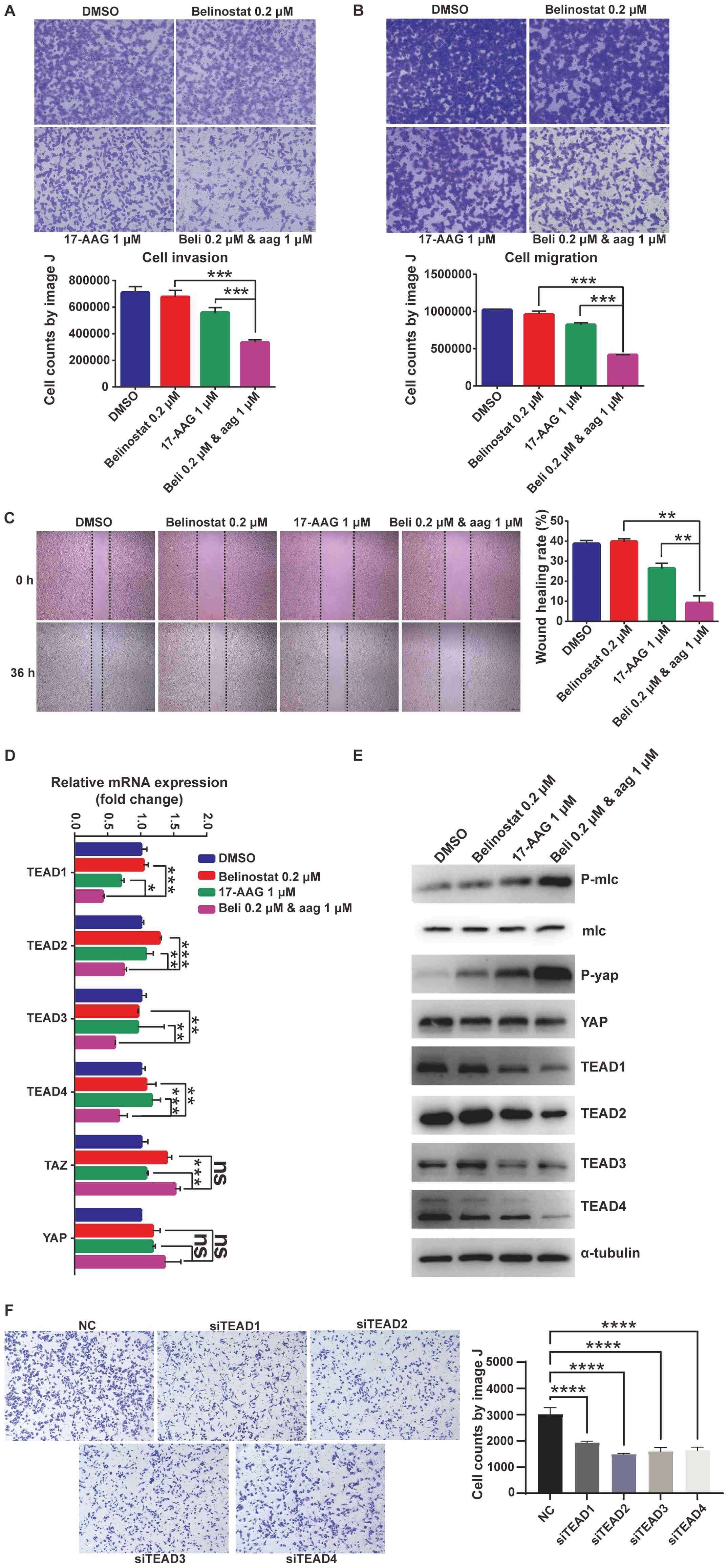
Subsequently to the publication of the above paper, an interested reader drew to the authors' attention that, concerning the Transwell migration assay experiments shown in Fig. 6F on p. 1940, the ‘NC’ and ‘siTEAD3’ experiments showed an overlapping section of data, such that data which were intended to show the results from differently performed experiments had apparently been derived from the same original source. The authors proposed removing Fig. 6F from the figure, as they considered that the conclusions of these experiments were sufficiently well supported by the data shown in Fig. 6D and E, although the Editor expressed to them our preference that the authors should repeat these experiments, if necessary, to rectify the original errors made during the inaccurate assembly of data in Fig. 6F.
The authors were willing to perform the requested experiments, and the revised version of Fig. 6, showing the replacement data for the migration assay experiments in Fig. 6F, is shown on the next page. The authors wish to draw the readers' attention to the fact that the statistical significance of the experiments featured in the new Fig. 6F was not exactly the same as that in the original figure (note the change to the wording of the figure legend opposite, which is highlighted in bold); however, the conclusion that knocking out TEAD family proteins significantly inhibits the migration of MDA-MB-231 cells is completely consistent with the conclusion of the original article. This difference in the statistical significance of the results is reflected in a proposed change of the wording to describe the results of Fig. 6F in the manuscript; therefore, the final sentence of the Results section, left-hand column on p. 1941, should now read as follows: ‘As shown in the results of the cell migration assay (Fig. 6F), knockdown of TEAD family proteins inhibits the migration of MDA-MB-231 cells’.
The authors regret the errors that were made during the preparation of the Fig. 6. They are grateful to the editor of Oncology Reports for allowing them the opportunity to publish this Corrigendum, and all the authors agree to this publication. Furthermore, they apologize to the readership for any inconvenience caused.