Introduction
The global incidence of cancer continues to rise
annually (1), making it a major and
growing public health challenge worldwide (2). Recent data indicate that in 2026, the
United States is expected to have ~2.11 million new cases of cancer
(~5,800 per day) and 626,000 cancer-related mortalities (~1,720 per
day). The lifetime risk of developing cancer is similar between
sexes, with 39.2% for men and 38.7% for women. Colorectal cancer is
the third most common cancer in both men and women (3). Current standard cancer therapies
include surgical resection, radiotherapy, chemotherapy and
small-molecule targeted drug therapy. Among these, targeted therapy
offers a precision approach by specifically modulating known
oncogenic driver pathways at the cellular and molecular level
across distinct tumor subtypes, thereby suppressing malignant cell
proliferation while minimizing damage to healthy tissues. However,
its clinical utility is constrained by the limited number of
actionable driver alterations and the frequent emergence of
acquired resistance during treatment (4–6).
Therefore, there is an urgent need to identify novel therapeutic
targets and systematically elucidate the molecular mechanisms
underlying resistance to targeted therapies.
The nucleocytoplasmic compartmentalization of
eukaryotic cells represents a fundamental structural hallmark that
distinguishes them from prokaryotic cells. Macromolecules such as
proteins and RNA must undergo selective and active transport
through the nuclear pore complex (NPC) to enable precise
nucleocytoplasmic communication (7). Among the key mediators of this
process, exportin 1 (XPO1), also known as chromosome region
maintenance 1 (CRM1), serves as the predominant nuclear export
receptor. XPO1 specifically recognizes and binds cargo proteins
containing leucine-rich nuclear export signals (NES), thereby
facilitating their translocation from the nucleus to the cytoplasm
(8). In numerous cancer types, XPO1
is frequently overexpressed, leading to the aberrant nuclear export
and cytoplasmic sequestration of key tumor suppressor proteins
(TSPs), including p53, p21, FOXO and Rb, resulting in their
functional inactivation. This prevents the execution of essential
tumor-suppressive functions such as transcriptional regulation,
cell cycle arrest and apoptosis within the nucleus, a phenomenon
widely recognized as ‘nuclear exclusion of tumor suppressor
proteins (9,10). Consequently, pharmacological
inhibition of XPO1 offers a mechanistically compelling strategy for
cancer therapy by blocking the pathological export of TSPs,
enabling their nuclear retention and functional restoration, and
ultimately triggering cell cycle arrest and apoptosis in malignant
cells. Although the early XPO1 inhibitor leptomycin B demonstrated
potent target binding, its clinical development was halted due to
severe systemic toxicity, poor pharmacokinetic stability and
negligible oral bioavailability, which collectively precluded the
establishment of a safe and effective therapeutic window (11). The emergence of next-generation
selective inhibitors of nuclear export (SINE) compounds,
particularly orally bioavailable agents such as Selinexor, has
overcome these limitations. These agents exhibit improved tumor
selectivity and manageable safety profiles, and have advanced into
clinical trials for various hematologic malignancies and solid
tumors, thereby markedly accelerating the clinical translation of
XPO1-targeted cancer therapies (12).
In summary, XPO1 is frequently overexpressed across
multiple types of cancer, driving tumorigenesis, progression,
metastasis and treatment resistance by aberrantly exporting key
TSPs. This establishes XPO1 as a key therapeutic target. The
present review systematically summarizes recent advances in XPO1
biology in malignancies, detailing its dual regulation of
tumor-suppressive pathways (for example, p53, FOXO or p21) and
oncogenic signaling (for example, NF-κB or c-Myc). The present
review also assesses its clinical relevance as a prognostic
biomarker and therapeutic target. Focusing on SINEs, particularly
the oral agent selinexor, the present review highlights clinical
translation in hematologic malignancies (multiple myeloma (MM),
diffuse large B-cell lymphoma (DLBCL)) and an expanding range of
solid tumors. The present review critically examines the
limitations of monotherapy, including modest efficacy and
dose-limiting toxicities (fatigue, nausea, thrombocytopenia), and
explore the mechanistic rationale and emerging evidence for
synergistic combinations with chemotherapy, targeted agents or
immunotherapy. By systematically evaluating completed and ongoing
clinical trials, the present review identifies current challenges
and outlines future optimization strategies, including
next-generation SINEs, biomarker-driven precision dosing,
individualized treatment regimens and investigation of acquired
resistance mechanisms. The present review aims to provide a
comprehensive framework of theoretical and translational insights
to advance XPO1-targeted basic research and improve clinical
application of XPO1 inhibition in oncology.
Literature selection methodology
To ensure a robust and comprehensive evaluation of
the literature, a systematic search was performed across public
databases including PubMed (https://pubmed.ncbi.nlm.nih.gov/), Embase (https://www.embase.com/) and ClinicalTrials.gov
(https://clinicaltrials.gov/). The
literature search covered publications from 1997 through early
2026. Search terms utilized combinations of keywords and Medical
Subject Headings (MeSH), including: ‘XPO1’, ‘CRM1’, ‘Selinexor’,
‘KPT-330’, ‘SINE compounds’, ‘nuclear export inhibition’ and
‘acquired resistance’. Inclusion criteria comprised peer-reviewed
original basic research articles, randomized controlled trials
(RCTs), open-label phase I/II trials and molecular mechanistic
studies published in English. Priority was allocated to 2024–2026
therapeutic readouts, structural updates and biomarker discoveries
to maximize review timeliness.
The biological functions of XPO1 and
tumorigenesis
XPO1 structure
XPO1 is a nuclear export receptor belonging to the
importin-β superfamily of karyopherins and plays a central role in
mediating the nuclear export of cargo proteins by recognizing their
NES (13,14). Notably, XPO1 is the only known
exportin responsible for transporting leucine-rich NES-containing
proteins from the nucleus to the cytoplasm, a function that is
critically dependent on its distinct structural architecture. XPO1
harbors a specialized binding pocket that specifically recognizes
and engages NES motifs (7). These
motifs are typically short, hydrophobic peptide sequences enriched
in leucine residues and the precise amino acid composition and
three-dimensional conformation of the NES-binding domain allow XPO1
to form complementary interactions with the hydrophobic side chains
within the NES, akin to a lock-and-key mechanism, enabling
selective binding to NES-bearing proteins or ribonucleoprotein
(RNP) complexes (15,16). In addition, XPO1 contains a
high-affinity binding site for Ran-GTP, a small GTPase that
regulates nucleocytoplasmic transport (17). The association of Ran-GTP with XPO1
induces a conformational change that stabilizes the interaction
between XPO1 and its cargo, facilitating the formation of the
export-competent XPO1-cargo-Ran-GTP ternary complex and enabling
its translocation through the NPC (18). Upon reaching the cytoplasm,
hydrolysis of Ran-GTP to Ran-GDP triggers a structural
rearrangement that promotes cargo release, thereby completing the
export cycle (19). Furthermore,
XPO1 possesses a distinct NPC-interacting domain that mediates
transient interactions with phenylalanine-glycine (FG)-repeat
nucleoporins located within the NPC. This interaction allows the
export complex to dock at and traverse the nuclear pore, ensuring
directional transport from the nucleus to the cytoplasm (18).
In summary, based on the aforementioned domains,
XPO1 can mediate the nuclear export of RNA or proteins, thereby
participating in the regulation of numerous biological
processes.
The normal physiological function of
XPO1
Eukaryotic cells establish functional
compartmentalization between the nucleus and cytoplasm through the
NPC, which also serves as the primary conduit for nucleocytoplasmic
exchange of macromolecules and signaling molecules. Consequently,
the NPC plays a key role in maintaining cellular homeostasis and
functions (8,15). The NPC is a large, evolutionarily
conserved protein complex embedded within the nuclear envelope,
exhibiting an octagonal symmetry and a characteristic
three-dimensional architecture that resembles a ‘basketball hoop’
when viewed laterally (20). It is
primarily composed of multiple copies of ~30 distinct nucleoporins
(Nups), which are precisely organized into subcomplexes to form a
central transport channel that facilitates selective macromolecular
trafficking (21). This central
channel permits passive diffusion of small molecules, such as ions
and low-molecular-weight metabolites, while the translocation of
larger macromolecules, including proteins and RNA species, requires
active, signal-dependent transport mechanisms mediated by nuclear
transport receptors (17).
The XPO1-mediated nuclear export process proceeds
through a well-orchestrated sequence of molecular events. First,
substrate recognition occurs: XPO1 specifically identifies cargo
proteins containing NES (22). The
NES is a short peptide motif enriched in hydrophobic amino acids,
particularly leucine, and typically spans 10–30 residues (10). XPO1 binds tightly to the NES via its
dedicated binding domain, initiating the export process. This
interaction is highly selective, ensuring that only cargoes bearing
functional NES motifs, such as specific proteins or RNP complexes,
are recruited for nuclear export (23). Second, formation of the export
complex takes place: Upon substrate binding, XPO1 associates with
Ran-GTP, a small GTPase that acts as a key regulatory cofactor, to
assemble a stable trimeric export complex (XPO1-cargo-Ran-GTP)
(24). The binding of Ran-GTP
induces a conformational change in XPO1 that enhances its affinity
for the cargo and stabilizes the complex, thereby rendering it
translocation-competent (25).
Third, docking and translocation through the NPC occur: The
assembled trimeric complex is directed to the NPC, where XPO1
interacts with phenylalanine-glycine (FG)-repeat nucleoporins via
its NPC-binding domain, facilitating docking at the nuclear side of
the pore. The NPC, a large transmembrane channel embedded in the
nuclear envelope, serves as the sole gateway for nucleocytoplasmic
transport. Through transient interactions with FG-Nups, the complex
undergoes facilitated translocation across the NPC toward the
cytoplasm (22). Finally, cargo
release and recycling are achieved in a GTP hydrolysis-dependent
manner. Upon reaching the cytoplasm, Ran-GTP is hydrolyzed to
Ran-GDP by RanGAP and its cofactors, triggering a conformational
rearrangement in XPO1 that reduces its affinity for both the cargo
and Ran-GDP. This leads to the dissociation of the cargo into the
cytoplasm. Subsequently, XPO1 and Ran-GDP are recycled back to the
nucleus for subsequent rounds of export, completing the transport
cycle (18,26) (Fig.
1).
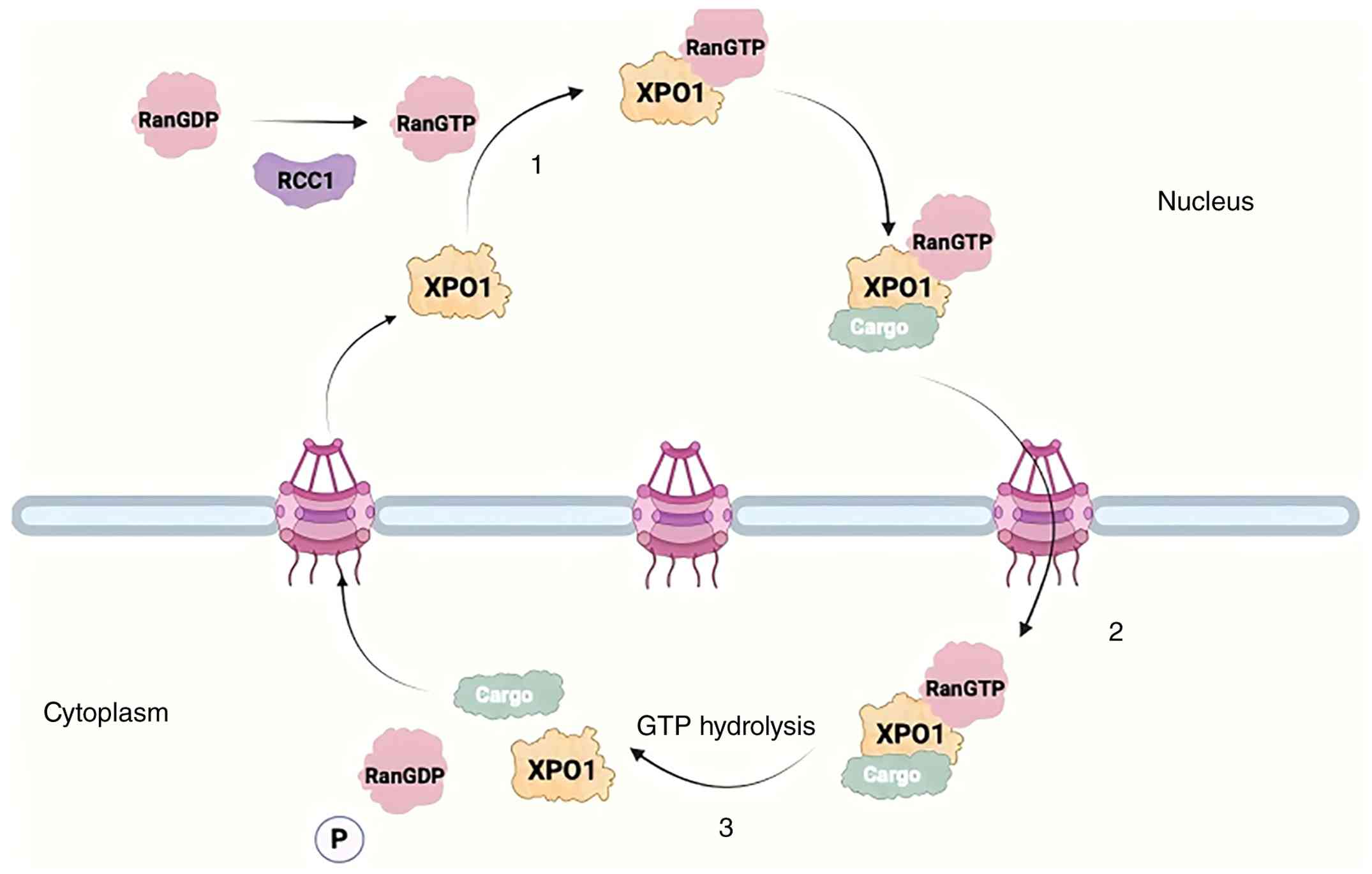 | Figure 1.The RanGTP-mediated nuclear export
macromolecular process. In the cytoplasm, RanGDP is converted to
RanGTP by the guanine nucleotide exchange factor RCC1. XPO1 binds
coordination-competent RanGTP and its leucine-rich NES cargo within
the nucleus to form a stable trimeric export complex. This complex
docks at and actively translocates through the nuclear pore complex
via interactions with FG-repeat nucleoporins. Upon cytoplasmic
entry, GTP hydrolysis is stimulated by RanGAP, triggering complex
dissociation, cargo unloading and the subsequent nuclear reentry of
XPO1 and RanGDP to drive subsequent export rounds. RanGTP,
Ras-related nuclear protein bound to guanosine triphosphate;
RanGDP, Ras-related nuclear protein bound to guanosine diphosphate;
RCC1, Regulator of Chromosome Condensation 1; XPO1, Exportin 1,
also known as CRM1; Chromosome Region Maintenance 1; NES, Nuclear
Export Signal; FG-repeat nucleoporins, Phenylalanine-Glycine repeat
nucleoporins; RanGAP, Ran GTPase-activating protein. |
The XPO1-mediated nuclear export process plays a
pivotal role in cell cycle regulation. For example,
cyclin-dependent kinase inhibitors p21 and p27 are actively
exported from the nucleus by XPO1, thereby modulating their nuclear
accumulation and subsequently regulating CDK activity and cell
cycle progression (27,28). Similarly, transcription factors of
the FOXO family are constitutively shuttled out of the nucleus by
XPO1 under basal conditions, limiting their access to target genes
involved in apoptosis and antioxidant defense; upon cellular
stress, inhibition of XPO1 leads to nuclear retention of FOXO
proteins, enabling them to activate transcriptional programs
essential for stress resistance and cell fate control (29,30).
The tumor suppressor p53 is also subject to XPO1-dependent
regulation, following completion of DNA damage repair, XPO1
mediates the nuclear export of p53 to attenuate its transcriptional
activity and prevent prolonged cell cycle arrest or aberrant
apoptosis (31,32). Through this dynamic spatial control
of key regulatory proteins, XPO1 fine-tunes key cellular processes
including proliferation, differentiation and homeostasis. Beyond
these functions, XPO1 contributes notably to the regulation of
cellular stress responses and inflammatory signaling. In the NF-κB
pathway, degradation of IκBα releases NF-κB for nuclear
translocation and activation of pro-inflammatory genes, whereas
XPO1 counteracts this activation by exporting NF-κB, often as a
complex with newly synthesized IκBα, back to the cytoplasm, thus
providing negative feedback to limit the duration and intensity of
NF-κB signaling and prevent chronic inflammation (33,34).
Furthermore, under oxidative stress or heat shock, XPO1 regulates
the nucleocytoplasmic trafficking of stress-responsive
transcription factors such as HSF1, ensuring timely induction of
cytoprotective gene expression programs (35). In addition, XPO1 facilitates the
nuclear export of specific mRNAs, particularly those encoding
growth regulators and oncoproteins, thereby extending its
regulatory influence to post-transcriptional control of gene
expression (36,37).
In summary, XPO1 is not only a central mediator of
nucleocytoplasmic transport but also a key regulatory hub that
integrates intracellular and extracellular signals with essential
cellular processes. Maintenance of its normal physiological
function is vital for maintaining cellular homeostasis, ensuring
proper signal transduction and enabling spatiotemporal regulation
of key molecular events. Dysregulation of XPO1 function can result
in the mislocalization of key regulatory proteins, thereby
disrupting cell fate decisions and contributing to tumorigenesis
and cancer progression. Therefore, a comprehensive understanding of
the molecular mechanisms underlying XPO1 activity not only advances
fundamental knowledge in cell biology but also provides a solid
theoretical foundation for developing targeted therapies against
its pathological dysregulation.
Abnormalities of XPO1 in tumors
In various hematological malignancies (such as MM
(12), DLBCL (38) or acute myeloid leukemia (39)) and solid tumors (including ovarian
cancer (40), gastric cancer
(41), pancreatic cancer (42) or glioblastoma (43)), the expression level of XPO1 is
markedly higher than that in the corresponding normal tissues.
Moreover, multiple clinical studies have confirmed that its high
expression is associated with poor prognosis, accelerated disease
progression, and chemotherapy resistance in patients (44). A large number of
immunohistochemical, RT-qPCR and gene expression profiling data
show that the protein and mRNA levels of XPO1 are abnormally
upregulated in tumor tissues, suggesting that it is not only a
functional driver in the process of tumorigenesis but may also
serve as a potential prognostic biomarker (45). Studies have found that XPO1 promotes
tumor occurrence and development at multiple levels by mediating
the abnormal nuclear export of key TSPs and regulatory factors,
thereby disrupting their normal subcellular localization and
functional activity (10,26,46,47).
p53 pathway impairment (clinically
validated)
In the p53 signaling pathway, XPO1 actively exports
both p53 and its upstream DNA damage sensor kinase ATM from the
nucleus, resulting in their aberrant cytoplasmic accumulation and
functional inactivation (47,48).
Excessive nuclear export of these proteins severely impairs their
transcriptional regulatory functions, compromising genomic
surveillance, increasing mutational burden and thereby facilitating
malignant transformation. This mechanism is particularly important
and clinically validated in hematologic malignancies and specific
solid tumors harboring wild-type p53, providing a mechanistic
explanation for the observed loss-of-function phenotype despite an
intact p53 gene (32,49).
Cell cycle dysregulation (preclinical
and sample-based validation)
XPO1 drives cell cycle dysregulation by mediating
the nuclear exclusion of key tumor suppressors. For example, the
CDK inhibitors p21 and p27, key negative regulators of the
G1/S transition, exert their inhibitory effects on
cyclin-CDK complexes when localized in the nucleus (9); similarly, the retinoblastoma (Rb)
protein suppresses S-phase gene expression by sequestering E2F
transcription factors (48). Under
conditions of XPO1 overexpression, these proteins are
constitutively exported from the nucleus, leading to unchecked cell
cycle progression and uncontrolled tumor cell proliferation.
Moreover, p73 is subject to XPO1-mediated nuclear export and
inactivation, further undermining the integrity of the tumor
suppressor network (49).
Apoptosis evasion pathways
(preclinical models)
XPO1 suppresses apoptosis by exporting pro-apoptotic
factors. The FOXO family of transcription factors (for example,
FOXO1 and FOXO3a) induces expression of pro-apoptotic genes under
stress conditions; however, elevated XPO1 activity promotes rapid
nuclear export and subsequent degradation of FOXO proteins,
abolishing their apoptotic function (50,51).
Similarly, Bim, a pivotal pro-apoptotic member of the Bcl-2 family,
exerts its mitochondrial-stabilizing and caspase-activating effects
primarily when retained in the nucleus, but its efficacy is
diminished by XPO1-dependent nuclear export (52,53).
Notably, survivin can also be exported by XPO1 in specific splice
variants, modulating its stability and distribution, thereby
indirectly tipping the balance toward cell survival (54).
Oncogenic signaling amplification
(cell and animal models)
In inflammatory and proliferative signaling
pathways, XPO1 enhances NF-κB activation by exporting IκBα, the
endogenous inhibitor of NF-κB, thereby releasing NF-κB from
cytoplasmic sequestration and enabling its nuclear translocation
and transcriptional activation of pro-inflammatory, anti-apoptotic
and pro-migratory genes (50,51,55).
Concurrently, XPO1 exports eIF4E from the nucleus, facilitating its
cytoplasmic assembly into translation initiation complexes and
selectively enhancing the translation of oncogenic mRNAs, including
c-Myc, cyclin D1 and VEGF (56–58).
In lymphomas, XPO1 overexpression mediates the nuclear export of
STAT6, leading to increased levels of phosphorylated STAT6? and
accelerated tumor cell proliferation (59). Furthermore, while nuclear
accumulation of MYC drives malignant proliferation, XPO1
contributes to MYC oncogenicity by regulating its nucleocytoplasmic
shuttling to maintain MYC protein stability (56) (Fig.
2).
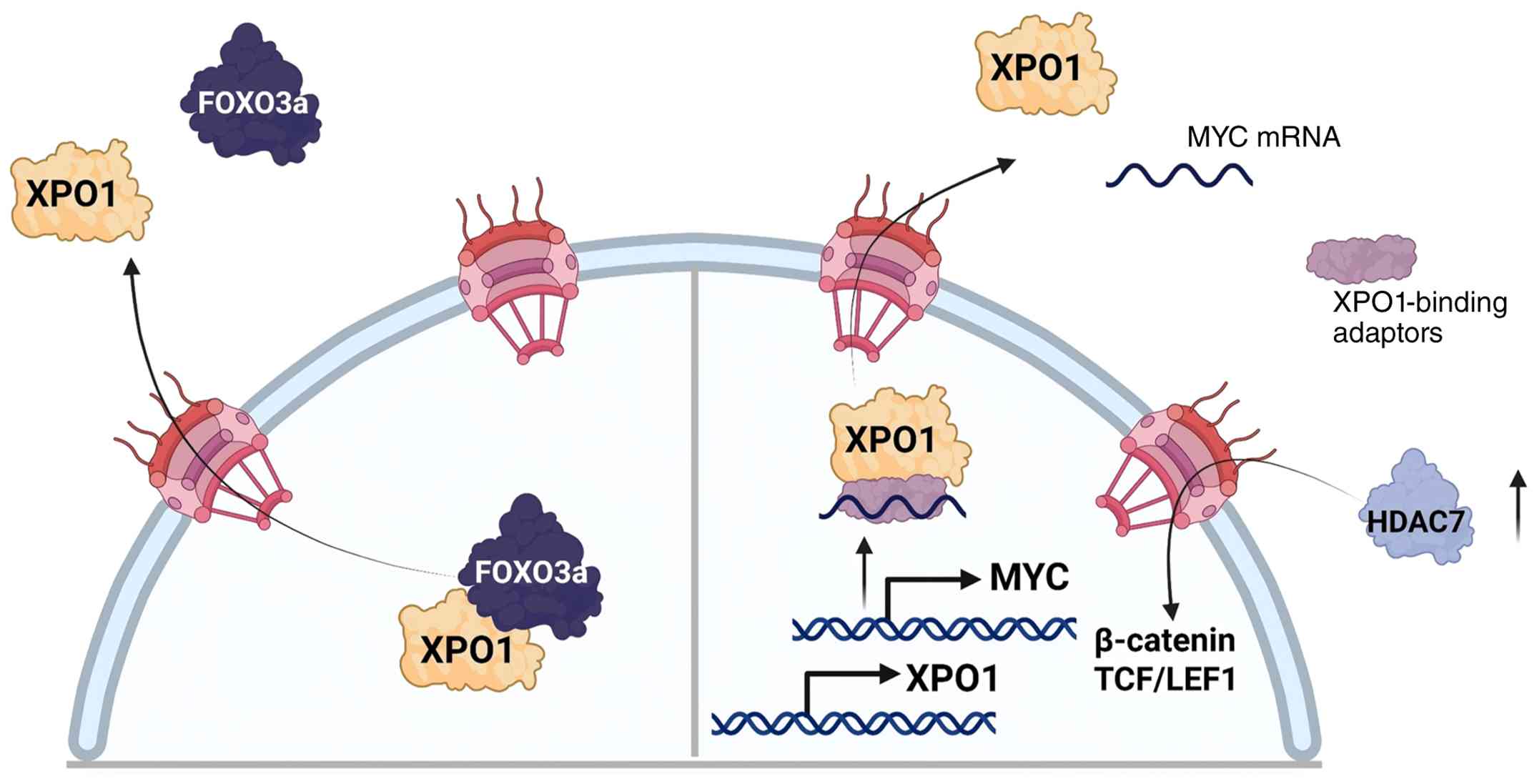 | Figure 2.Sub-regulatory networks and
downstream pathological targets altered by XPO1 upregulation.
Schematic mapping of the structural interaction cascades of
overexpressed XPO1 with essential homeostasis molecules. The
schematic displays the selective nuclear exclusion and cytoplasmic
inactivation of proteins (including FOXO3a, p53, p21 and Rb),
alongside the coordinated nuclear-to-cytoplasmic shuttling of
oncogenic MYC mRNA transcripts, β-catenin, TCF/LEF1 and structural
histones such as HDAC7, demonstrating how the hijacking of this
transport system drives multi-pathway oncogenesis. FOXO3a, Forkhead
box O3a; p53, Tumor protein p53; p21, Cyclin-dependent kinase
inhibitor 1A; Rb, Retinoblastoma protein; MYC, MYC proto-oncogene;
TCF, T-cell factor; LEF1, Lymphoid enhancer-binding factor 1;
HDAC7, Histone deacetylase 7. |
In summary, XPO1 drives tumorigenesis through a
coordinated and multifaceted mechanism by systematically altering
the subcellular localization of key regulatory proteins, thereby
disrupting key cellular processes such as the DNA damage response,
cell cycle control, apoptosis and signal transduction. This
‘multi-target hijacking’ strategy enables XPO1 to simultaneously
impair multiple tumor-suppressive pathways, positioning it as a
highly compelling therapeutic target in oncology. Targeting XPO1
therefore offers a dual advantage: it not only restores the
functional integrity of diverse tumor suppressor networks but also
counters chemotherapy resistance and potentiates the effectiveness
of current treatment modalities. As such, XPO1 inhibition
represents a strategy with substantial potential for both advancing
fundamental cancer biology and enabling meaningful clinical
translation.
Clinical translational research on SINE
SINE are a class of small-molecule compounds that
specifically target the function of XPO1. Substantial progress has
been achieved in the clinical translation of SINE compounds in
oncology (55). These agents
irreversibly inhibit XPO1-mediated nuclear export by covalently
binding to the cysteine 528 within the cargo-binding pocket of
XPO1, thereby blocking its ability to recognize and transport cargo
proteins (60,61) (Fig.
3). This inhibition results in the nuclear retention and
re-accumulation of key TSPs, including p53, p21, FOXO and Rb,
restoring their transcriptional activity and triggering downstream
anti-tumor effects such as cell cycle arrest, apoptosis and
enhanced chemosensitivity in cancer cells (62). Among the SINE family, selinexor
(KPT-330) is the most extensively characterized compound and the
most clinically advanced compound (63). Selinexor exhibits favorable oral
bioavailability, favorable pharmacokinetic stability and effective
blood-brain barrier (BBB) penetration, demonstrating potent
anti-tumor activity across diverse hematologic malignancies and
solid tumor models. Currently, selinexor has received approval from
the U.S. FDA for the treatment of relapsed or refractory MM (RRMM)
and DLBCL. Moreover, numerous global phase I/II clinical trials are
underway to evaluate its efficacy and safety as monotherapy or in
combination with chemotherapy, targeted agents and immune
checkpoint inhibitors in indications such as acute myeloid leukemia
(AML), castration-resistant prostate cancer and advanced ovarian
cancer (64–66). These studies not only validate XPO1
as a therapeutically viable anticancer target but also provide key
insights for the further refinement and precision application of
SINE-based therapies (Table I).
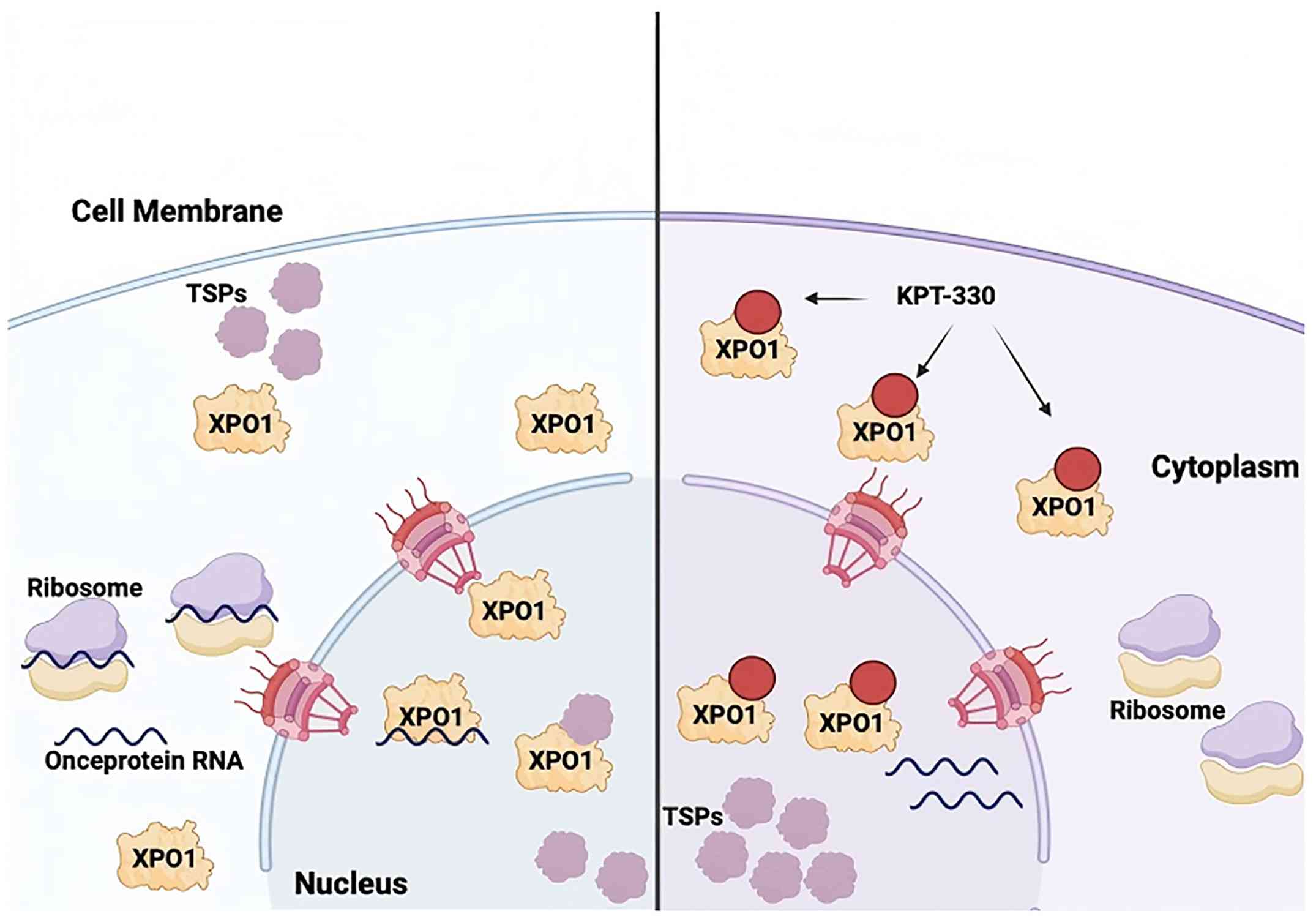 | Figure 3.Subcellular distribution of XPO1
cargo and the impact of KPT-330 blockade. (Left) Under
physiological states, baseline XPO1 mediates the normal export of
functional regulatory substrates (proteins, ribosomal subunits and
mRNAs encoding oncoproteins) out of the nucleus. (Right) Following
the introduction of the SINE small-molecule compound KPT-330
(selinexor), the compound forms an irreversible covalent bond with
the structural Cys528 residue inside the cargo pocket. This blocks
cargo binding, alters XPO1 compartmental orientation, stops
macromolecular transport and forces the nuclear retention and
functional reactivation of key TSPs. TSPs, tumor suppressor
proteins; KPT-330, Selinexor, a selective inhibitor of nuclear
export; SINE, Selective inhibitor of nuclear export; Cys528,
Cysteine residue at position 528 of the XPO1 protein. |
 | Table I.Therapeutic application of XPO1
inhibitors in clinical tumor patients. |
Table I.
Therapeutic application of XPO1
inhibitors in clinical tumor patients.
| Tumor type | Trial phase | Patient number
(n) | Dosage regimen | Primary efficacy
outcomes | Common & and
significant adverse events (≥grade 3) | Key
conclusions/remarks | (Refs.) |
|---|
| Advanced solid
tumors | Phase I | 189 | 3–85
mg/m2, in 21/28–day cycles | In 157 evaluable
patients: CR, 1 (0.6%); PR, 6 (4%); SD (≥4 months), 17% | Hematologic,
thrombocytopenia (16%); non-hematologic, fatigue (15%) | Demonstrated
preliminary anti-tumor activity. Established the recommended Phase
II Dose (RP2D) as 35 mg/m2 (~60 mg), twice weekly;
toxicity requires management. | (92,110) |
| Non-Hodgkin's
Lymphoma | Phase I | 79 | 3–80
mg/m2, in 3/4–week cycles | In 70 evaluable
patients: CR, 4; PR, 18; ORR, 31.4% | Thrombocytopeni a
(47%); Neutropenia (32%); Anemia (27%) | Responses observed
across multiple NHL subtypes. RP2D was 35 mg/m2 (60 mg).
Provides initial evidence for monotherapy in NHL. | (96) |
| Multiple
myeloma | Phase I | 81 (MM) | 3–60
mg/m2, 1–3 times per week | In 57 monotherapy
patients: PR, 4%; MR, 18%; SD, 32%; some patients had treatment
duration <2 years | Grade ≥3 AEs not
emphasized in text | Even patients
achieving only MR or SD could achieve long-term disease control,
suggesting clinical benefit. | (98) |
| Acute myeloid
leukemia | Phase I | 95 | 4, 8, 10
mg/m2, in 21/28-day cycles | In 81 evaluable
patients: ORR, 14%; 31% of patients had ≥50% reduction in marrow
blasts | Fatigue (14%)
(non-hematologic) | RP2D determined as
60 mg (~35 mg/m2) twice weekly. Non-hematologic
toxicities were manageable. | (111) |
| Metastatic
castration-resistant prostate cancer | Phase II | 14 | Not specified
(twice weekly) | Limited efficacy;
only 2 patients had >50% PSA decline | Severe anorexia,
nausea, fatigue | Limited clinical
activity and poor tolerability hindered further development in this
population. | (112) |
| Advanced/metastatic
gynecologic cancer (ovarian, endometrial, cervical) | Phase II
(SIENDO) | 114 | 35 or 50
mg/m2 twice weekly; or 50 mg/m2 once weekly
(QW) | Primary safety
assessment; 50 mg/m2 QW regimen had fewer high-grade
AEs | AEs were reversible
and manageable with supportive care | The once-weekly 50
mg/m2 regimen demonstrated an improved safety
profile. | (113) |
| HMA-refractory
MDS/oligoblastic AML | Phase II | 23 | 60 mg, twice
weekly, 2 weeks on/1 week off | Response rate,
24–26% | Tolerable | First trial using a
lower fixed dose (60 mg), showing good activity and tolerability,
facilitating longer-term treatment. | (114) |
| Recurrent
glioblastoma | Phase II | 76 | 50
mg/m2, or 60 mg (twice weekly), or 80 mg (once weekly,
QW) | Primary endpoint:
6-month Progression-Free Survival rate (PFS6) | Fatigue (61%),
nausea (59%), anorexia (43%), thrombocytopenia (43%) | Toxicity was
manageable at 80 mg once weekly, adjustable via dose
reduction. | (115) |
| Advanced/recurrent
endometrial carcinoma | Phase III
(SIENDO) | 174 | Not specified (once
weekly oral) | PFS showed
statistically significant improvement (HR, 0.71; P=0.049) | Not specified in
detail | KPT-330 showed
significant clinical promise in post-chemotherapy
advanced/recurrent endometrial cancer. | (116) |
| Advanced
dedifferentiated liposarcoma | Phase II | 56 | Not specified | No significant PFS
improvement | Not specified in
detail | KPT-330 monotherapy
did not show significant efficacy in this solid tumor. | (10) |
Clinical research in hematological
malignancies
The SINE selinexor, a representative compound in its
class, has demonstrated notable antitumor activity across various
hematological malignancies, with its clinical translation achieving
notable breakthroughs (67).
Particularly in the treatment of refractory or relapsed diseases,
selinexor offers a novel therapeutic option for patients who have
failed conventional therapies by restoring the nuclear localization
and transcriptional function of key TSPs.
FDA-approved indications and
randomized phase III evidence
The BOSTON Trial (Phase III RCT): Further validation
for MM came from the BOSTON trial, a randomized, open-label, phase
III study comparing the triplet regimen of once-weekly selinexor,
bortezomib and dexamethasone (SVd) vs. the standard doublet Vd
(bortezomib plus dexamethasone) in patients with RRMM. The SVd arm
demonstrated a statistically notable improvement in median
progression-free survival (PFS), with particularly pronounced
benefits observed in patients who had received only 1–3 prior lines
of therapy. Moreover, the SVd regimen yielded higher overall
response rates and complete response rates, indicating synergistic
antitumor activity. As a result, the SVd regimen was incorporated
into international treatment guidelines as a standard-of-care
option for eligible patients with RRMM (64,68,69). A
subsequent review further validated these findings by
systematically demonstrating that selinexor-containing regimens
maintain consistent efficacy across multiple difficult-to-treat MM
subpopulations, including triple-class refractory disease, renal
impairment, high-risk cytogenetics and prior anti-CD38 therapy. An
ongoing phase Ib/II trial is evaluating the quadruplet of selinexor
with carfilzomib, isatuximab and dexamethasone in RRMM, while
another phase II trial is assessing SVd-like induction specifically
in newly diagnosed MM with extramedullary disease. Notably,
selinexor is now being explored as maintenance therapy following
CAR-T cell treatment, reflecting its expanding role across the MM
treatment continuum. The SENTRY Trial (XPORT-MF-034; Phase III
RCT): In myelofibrosis, a disease setting previously unexplored for
XPO1 inhibition, the randomized, double-blind, placebo-controlled
SENTRY trial evaluated selinexor (60 mg once weekly) in combination
with ruxolitinib vs. placebo plus ruxolitinib in JAK
inhibitor-naïve patients. Results released in March 2026
demonstrated that the trial met its first co-primary endpoint of
spleen volume reduction ≥35% (SVR35) at week 24: 50 vs. 28%
(one-sided P<0.0001), with rapid, deep and durable spleen
responses and a promising overall survival signal. Although the
second co-primary endpoint of symptom improvement was not reached,
this landmark study positions selinexor as a potential
first-in-class targeted therapy in myeloproliferative neoplasms
(70).
Regulatory milestones from single-arm
phase II trials
The STORM Trial (Phase IIb, Single-Arm): In the
field of MM, the STORM study enrolled patients with
penta-refractory disease, defined as resistance to at least five
major drug classes: Proteasome inhibitors, immunomodulatory agents,
anti-CD38 monoclonal antibodies, alkylating agents and
glucocorticoids. Despite this extensive prior treatment and
refractoriness, the combination of selinexor and low-dose
dexamethasone achieved an overall response rate (ORR) of ~26%, with
some patients attaining a very good partial response or better.
Based on these findings, the FDA granted accelerated approval in
2019 for selinexor in combination with dexamethasone for the
treatment of RRMM (64,71). The SADAL Trial (Phase II,
Single-Arm): In DLBCL, the SADAL study evaluated selinexor
monotherapy in patients with relapsed/refractory disease. The trial
reported an ORR of 28% in the overall population, with a complete
response rate of 12%; notably, patients with the germinal center
B-cell-like subtype showed a trend toward improved outcomes. Given
this clinical benefit, the FDA approved selinexor in 2020 for the
treatment of relapsed/refractory DLBCL in patients ineligible for
intensive chemotherapy or CAR-T cell therapy (71–75).
Early exploratory trials AML and
T-cell lymphomas
In AML, early-phase I/II studies have demonstrated
that selinexor combined with azacitidine or low-dose cytarabine can
induce complete remissions in elderly or unfit patients, with
particular promise in those harboring TP53 mutations or complex
karyotypes. In T-cell lymphomas, including peripheral T-cell
lymphoma and mycosis fungoides, small studies have documented
stable disease or partial responses (76–83).
In conclusion, selinexor has demonstrated
substantial clinical value across a range of hematological
malignancies, particularly in patients with highly refractory
disease who have limited therapeutic options. Its ability to induce
responses in such heavily pretreated populations underscores its
distinctive mechanism of action and ongoing therapeutic relevance.
As understanding of the drug's pharmacodynamics and predictive
biomarkers continues to evolve, there is strong potential for
refining patient selection and developing individualized treatment
strategies that maximize clinical benefit.
Clinical exploration and efficacy
limits in solid tumors
Although research on SINE has advanced more rapidly
in hematological malignancies, their clinical exploration in solid
tumors has increasingly demonstrated potential antitumor activity
and therapeutic value. Selinexor, the first-in-class SINE, is
undergoing extensive evaluation in multiple refractory solid tumor
types, leveraging its favorable oral bioavailability and robust
tissue penetration properties. Although clinical evaluation in
solid tumors is ongoing, these indications face more prominent
barriers. The clinical efficacy of XPO1 inhibitors in solid tumors
is currently less established than in hematological malignancies,
frequently characterized by modest PFS gains, limited OS extensions
and heightened toxicity profiles (84).
Randomized controlled trials in
specialized soft tissue tumors
The SEAL Trial (Phase III RCT): In advanced
dedifferentiated liposarcoma (DDLS), the SEAL study evaluated the
efficacy and safety of selinexor monotherapy in patients who had
progressed after multiple prior therapies. Results demonstrated
that Selinexor notably prolonged median PFS compared with placebo.
However, overall OS did not show a statistically significant
difference, a notable clinical limitation given the relentless
course characteristic of DDLS. Mechanistically, DDLS is frequently
driven by amplification of the 12q13-15 region, resulting in
overexpression of MDM2 and CDK4; inhibition of XPO1 prevents the
nuclear export and subsequent degradation of TSPs, including p53
and Rb, thereby partially restoring their activity (54,85).
Phase II validation and maintenance
cohorts, endometrial carcinoma maintenance
In gynecologic malignancies, the phase III SIENDO
trial evaluated oral selinexor as maintenance therapy after
first-line chemotherapy for advanced or recurrent endometrial
cancer. The primary analysis showed a statistically significant
improvement in median PFS (HR, 0.71; P=0.049), suggesting a
potential role for XPO1 inhibitors as a maintenance approach.
Glioblastoma multiforme (GBM)
Preclinical evidence confirms that selinexor
effectively crosses the BBB. In phase II clinical settings,
selinexor monotherapy has been shown to induce cell cycle arrest
and promote nuclear retention of key TSPs. Early-phase clinical
trials have confirmed the feasibility of combining selinexor with
temozolomide, with observations of disease stabilization in a small
subset of patients, though dose-limiting toxicities remain a
primary obstacle (86–90).
Early preclinical or phase I
combinations: Ovarian, lung and pancreatic types of cancer
In ovarian cancer, early phase I studies indicate
that combining selinexor with paclitaxel or PARP inhibitors can
elicit responses in platinum-resistant populations. In non-small
cell lung cancer, preliminary phase I data suggest that selinexor
enhances the efficacy of pembrolizumab by upregulating tumor cell
surface expression of MHC class I molecules. In pancreatic ductal
adenocarcinoma, the combination of selinexor with gemcitabine or
nab-paclitaxel has demonstrated disease control rates in small
phase I/II cohorts, though further large-scale validation is
required to determine efficacy (91–94).
In summary, although the development of SINE in
solid tumors remains at an intermediate level, these agents have
already demonstrated measurable biological activity and promising
clinical benefit in specific tumor subtypes. Future efforts should
focus on identifying robust predictive biomarkers, refining
combination regimens and improving toxicity management to advance
their translational potential in precision oncology for solid
tumors.
Clinical toxicity and patient
compliance management
The practical deployment of selinexor is
considerably restricted by prominent constitutional and
hematological toxicities. Rather than being easily managed, these
adverse events frequently necessitate immediate treatment
interruption, substantial dose reduction or permanent
discontinuation, thereby compromising treatment continuity and
diminish clinical efficacy.
Hematological adverse events
Thrombocytopenia is the primary dose-limiting
hematological toxicity, occurring in up to 43–47% of patients in
aggressive schedules (95,96). It requires rigorous weekly
monitoring, proactive dose modifications and the implementation of
supportive care such as platelet transfusions or thrombopoietin
receptor agonists. Neutropenia and anemia are also frequently
reported (96,97).
Gastrointestinal and constitutional
events
Nausea, vomiting, severe anorexia and fatigue
represent profound challenges to patient compliance. Nausea affects
>59% of patients, while fatigue affects >61% in some cohorts.
To sustain patient adherence, modern dosing protocols have shifted
away from initial high-dose, twice-weekly regimens toward
once-weekly lower fixed-dose regimens (for example, 60 or 80 mg
once weekly) combined with aggressive, multi-agent prophylactic
antiemetic regimens (including NK1 receptor antagonists and 5-HT3
antagonists) (72,73,98).
Next-Generation SINE compounds and synergy
strategies
Next-generation SINE compounds
As the therapeutic potential of XPO1 inhibitors
continues to evolve, next-generation SINE compounds are under
active development to address the pharmacological limitations of
selinexor. Eltanexor (KPT-8602) achieves reduced central nervous
system toxicity compared with selinexor primarily through
structural modifications that lower BBB penetration and shorten
target residence time. While eltanexor maintains covalent binding
to the Cys528 residue of XPO1, it exhibits modified binding
kinetics that result in a shorter duration of target engagement in
neuronal cells, thereby sparing the prolonged suppression of
nucleocytoplasmic transport key for normal CNS function.
Pharmacokinetically, eltanexor was engineered to reduce affinity
for the efflux transporter P-glycoprotein (P-gp) at the BBB; this
alteration, together with decreased passive permeability, yields
notably lower brain-to-plasma ratios than selinexor, limiting drug
accumulation in the CNS compartment while preserving effective
antitumor concentrations in peripheral tumors and hematopoietic
tissues. These molecular and pharmacokinetic features collectively
attenuate the neurotoxic effects, such as confusion, ataxia and
cognitive disturbance, observed with more CNS-penetrant SINEs and
translate clinically into a substantially reduced incidence of
severe nausea, vomiting and fatigue. Preclinical and phase I
clinical data confirm that eltanexor exerts robust antitumor
activity in AML and MM models, offering an improved therapeutic
index and greater tolerability for long-term administration.
Verdinexor (KPT-335): Initially developed and approved for
veterinary oncology in canine lymphoma, verdinexor features high
oral bioavailability and extensive peripheral tissue distribution.
It is now under evaluation in human preclinical models,
demonstrating unique promise in prostate cancer, HIV-associated
malignancies and virus-associated malignancies (99–102).
Mechanism-guided combination
therapies
Combination therapy represents the central strategic
direction for the future development of selective nuclear export
inhibitors. Because XPO1 regulates multiple intersecting signaling
networks, its inhibition can enhance the sensitivity of
conventional cytotoxic agents, targeted drugs and immunotherapies
through distinct synergistic mechanisms.
Chemotherapy sensitization (high clinical maturity)
SINE-mediated XPO1 blockade impairs DNA repair pathways, including
homologous recombination (HR) and non-homologous end joining
(NHEJ), rendering tumor cells more vulnerable to
chemotherapy-induced DNA double-strand breaks. Clinically,
selinexor combined with cytarabine or anthracyclines has been shown
to improve complete remission rates in patients with AML, while its
combination with gemcitabine has demonstrated enhanced disease
control in pancreatic cancer. Furthermore, a phase I study of
selinexor in combination with high-dose cytarabine and mitoxantrone
(HiDAC/Mito) achieved an overall response rate of 70% in newly
diagnosed or relapsed/refractory AML, confirming that SINE
compounds successfully potentiate the efficacy of DNA-damaging
agents. In aggressive lymphomas, XPO1-mediated mRNA export of
genome maintenance regulators actively drives chemotherapy
resistance, making the combination with standard cytotoxic regimens
mechanistically sound (74,75).
Targeted therapy synergy (moderate
clinical maturity), proteasome inhibitors
SINE compounds counteract oncogenic survival signals
by blocking the nuclear export of IκBα, leading to nuclear
retention of the inhibitor, deactivation of the NF-κB pathway and
synergistic induction of apoptosis when paired with bortezomib or
carfilzomib. BCL-2 Inhibitors: One of the most promising targeted
combinations is the pairing of SINEs with the BCL-2 inhibitor
venetoclax in AML. Venetoclax induces mitochondrial apoptosis, but
resistance often emerges via MCL-1 upregulation. SINE compounds
counteract this resistance by blocking the nuclear export of MCL-1
mRNA via eIF4E-dependent translational regulation, thereby reducing
MCL-1 protein levels and restoring sensitivity to venetoclax. The
2026 phase Ib data on Selinexor-venetoclax in relapsed/refractory
AML further confirmed the safety and clinical activity of this
combination, while the eltanexor-venetoclax trial (NCT06399640) was
initiated to extend this strategy to venetoclax-resistant AML
populations (76).
PARP Inhibitors: Preclinical models across TNBC,
SCLC and glioblastoma demonstrate that combining selinexor with
olaparib notably increases anti-tumor activity by simultaneously
blocking DNA damage repair and impairing compensatory lysosomal
autophagy (55,82,83).
Immunotherapy and dual barrier
blockade (preclinical/conceptual maturity) immune checkpoint
blockade
SINEs induce nuclear retention of PD-L1, potentially
altering its membrane expression dynamics and sensitizing tumors to
PD-1/PD-L1 blockade. In preclinical models, combining selinexor
with anti-PD-1 antibodies results in marked tumor growth
suppression, though large-scale clinical validation is still
pending (77). Dual blockade of
nuclear pores: This is a highly innovative approach that
simultaneously inhibits nuclear export (through XPO1) and nuclear
import (through import proteins α/β). Since inhibiting XPO1 alone
may lead to compensatory increases in nuclear import, it is
hypothesized that dual targeting can trigger more severe
nuclear-cytoplasmic transport disorders, trapping regulatory
proteins in the wrong cellular compartments and inducing tumor cell
death. This strategy is currently entirely in the preclinical stage
(102,103). However, since nuclear-cytoplasmic
transport is key for all eukaryotic cells, simultaneously
inhibiting XPO1 and import proteins α/β is expected to have an
impact on healthy tissues, particularly those with high
proliferation rates and active protein transport, such as
hematopoietic precursor cells, gastrointestinal epithelial cells
and neural progenitor cells. The expected toxic challenges include
exacerbated bone marrow suppression (such as thrombocytopenia and
neutropenia), cumulative disruption of transcription factor
localization in normal cells and potential neurotoxicity resulting
from the disruption of nuclear transport in non-dividing neurons.
Nevertheless, The present review also notes the differential
transport dependence between tumor cells and normal cells, as well
as emerging strategies such as tumor-targeted drug delivery and
intermittent dosing regimens, which may provide therapeutic windows
to mitigate these risks (78,79).
Other SINE compounds and combination
strategies
As the therapeutic potential of SINE in oncology
continues to emerge, next-generation SINE compounds, such as
eltanexor (KPT-8602) and verdinexor (KPT-335), are under active
development alongside Selinexor, which has advanced into late-stage
clinical trials (80,81). These novel agents are designed to
preserve potent XPO1 inhibition while improving pharmacokinetic
profiles, minimizing toxicity and broadening the spectrum of
clinical indications. Eltanexor, a structurally optimized
derivative of Selinexor, maintains covalent binding to the Cys528
residue of XPO1 but exhibits a shorter half-life and reduced brain
penetration, thereby markedly attenuating central nervous
system-related adverse events, including nausea, anorexia and
fatigue (80). Preclinical studies
demonstrate that Eltanexor exerts robust antitumor activity in
models of AML, MM and solid tumors, with an improved tolerability
profile compared with Selinexor (82). Ongoing phase I/II clinical trials
are evaluating its safety and preliminary efficacy as monotherapy
or in combination regimens for relapsed or refractory hematologic
malignancies, showing encouraging translational potential. By
contrast, Verdinexor was initially developed for veterinary use in
canine lymphoma and is now being translated into human oncology
research. It features high oral bioavailability and extensive
tissue distribution, demonstrating unique therapeutic promise in
prostate cancer, HIV-associated malignancies and virus-associated
malignancies (83).
Combination therapy is currently recognized as the
central strategic direction for the future development of SINEs.
Given that XPO1 regulates multiple key signaling pathways, its
inhibition not only restores the nuclear functions of key TSPs but
also disrupts DNA damage repair mechanisms and modulates the tumor
immune microenvironment, thereby conferring broad potential for
synergistic antitumor effects. Preclinical and clinical evidence
indicates that SINE compounds can enhance the sensitivity of
conventional cytotoxic agents through multiple mechanisms (Table II). For example, XPO1 inhibition
promotes nuclear accumulation of pro-apoptotic factors such as p53,
FOXO and p73, leading to reactivation of apoptotic pathways;
concurrently, it suppresses sustained NF-κB activation, attenuating
downstream anti-apoptotic and inflammatory responses. Furthermore,
SINE-mediated XPO1 blockade impairs DNA repair pathways, including
HR and NHEJ, rendering tumor cells more vulnerable to
chemotherapy-induced DNA double-strand breaks. Clinically,
selinexor in combination with cytarabine or anthracyclines has been
shown to improve complete remission rates in patients with AML
(74,75), while its combination with
gemcitabine has demonstrated enhanced disease control in pancreatic
cancer (104). In the context of
targeted therapy, one of the most promising combinations is the
pairing of SINEs with the BCL-2 inhibitor venetoclax in AML
(55,82,83).
Venetoclax induces mitochondrial-dependent apoptosis by selectively
inhibiting BCL-2; however, resistance, often driven by MCL-1
upregulation or p53 pathway dysfunction, is a major limitation
(105). SINE compounds counteract
this resistance by blocking the nuclear export of MCL-1 mRNA via
eIF4E-dependent translational regulation, thereby reducing MCL-1
protein levels, while simultaneously restoring functional activity
of p53 and p73. Early-phase clinical data demonstrate favorable
response rates with this combination in elderly and
relapsed/refractory patients with AML, with manageable toxicity,
positioning it as a leading investigational strategy (86). Beyond chemotherapy and targeted
agents, SINEs exhibit notable potential in immunotherapy by
reshaping the tumor immune microenvironment. Although NF-κB
signaling is typically associated with pro-survival and
inflammatory functions, controlled activation through XPO1
inhibition can trigger type I interferon responses, upregulate MHC
class I molecules and tumor-associated antigens and promote
dendritic cell maturation and T-cell recognition. Tumor cells
treated with selinexor show increased susceptibility to CD8+ T
cell-mediated clearance. Additionally, SINEs induce nuclear
retention of PD-L1, potentially altering its membrane expression
dynamics and sensitizing tumors to PD-1/PD-L1 blockade (77). In preclinical models, the
combination of selinexor and anti-PD-1 antibodies results in marked
tumor growth suppression and prolonged survival. Multiple ongoing
phase I/II trials are actively evaluating the efficacy of
SINE-immunotherapy combinations in non-small cell lung cancer,
melanoma and microsatellite instability-high (MSI-H) solid tumors
(77). A more innovative and
forward-looking approach is the concept of ‘nuclear pore double
blockade’, which involves dual inhibition of nuclear export (via
XPO1) and nuclear import (via importin α/β). Nuclear-cytoplasmic
shuttling is a tightly balanced process and monoinhibition of XPO1
may trigger compensatory increases in nuclear import. Dual
targeting is therefore hypothesized to induce more profound
disruption of nucleocytoplasmic trafficking, trapping key
regulatory proteins in the wrong cellular compartment and
exacerbating proteotoxic and transcriptional stress, ultimately
driving tumor cell death (78,79).
Although still in the preclinical stage, this strategy has
demonstrated superior antitumor efficacy compared with
single-pathway inhibition across multiple drug-resistant models,
highlighting its potential as a novel paradigm in precision
oncology.
| Table II.The combination treatment regimens of
Selinexor and anti-tumor drugs that have emerged in clinical tumor
treatment. |
Table II.
The combination treatment regimens of
Selinexor and anti-tumor drugs that have emerged in clinical tumor
treatment.
| A, Combination with
chemotherapy |
|---|
|
|---|
| Combination drug
category | Specific
combination drugs | Cancer type | Key
findings/mechanism of action | Research phase | Key efficacy
outcomes/conclusions | (Refs.) |
|---|
|
Paclitaxel-based | Gemcitabine +
nab-Paclitaxel | Pancreatic ductal
adenocarcinoma | Synergistically
inhibits tumor growth; impacts tumor and stromal signaling;
relocates TSP to the nucleus. | Phase Ib clinical
trial | Disease control
rate reached 80%. Well-tolerated in combination with GemPac, no
DLTs observed. | (104,117) |
|
| Paclitaxel
(weekly) | Recurrent
platinum-resistant ovarian cancer | Preclinical models
showed anti-tumor activity. | Phase Ib clinical
trial | RR, 17%; CBR, 58%;
RP2D, Selinexor 60 mg (twice weekly) + Paclitaxel 80
mg/m2. | (118) |
| Anthracyclines | Doxorubicin | Anaplastic thyroid
carcinoma | Synergistically
inhibits ATC cell proliferation. | Preclinical | Showed promising
anti-tumor activity, providing a new theoretical basis for
improving ATC patient outcomes. | (119) |
|
| Daunorubicin +
Cytarabine (‘7+3’) | AML | Selinexor and
daunorubicin showed notable synergy in AML. | Phase I clinical
trial | In newly diagnosed
elderly/unfit AML, ORR 53%, median OS 10.3 months. Selinexor 80 mg
was safe with ‘7+3’. | (120) |
| Cytarabine | High-Dose
Cytarabine + Mitoxantrone (HiDAC/Mito) | AML (newly
diagnosed or R/R) | Synergy between
Selinexor and DNA-damaging agents in leukemia cells. | Phase I clinical
trial | ORR 70%, induction
mortality 5%. RP2D, Selinexor 80 mg twice weekly. | (75,121) |
|
| Fludarabine +
Cytarabine (FLAG) | Pediatric R/R
leukemia | Exploring Selinexor
safety in pediatric patients. | Phase I clinical
trial | Tolerable in
pediatric patients. MTD for Selinexor was 55 mg/m2. | (122) |
| Eribulin | Eribulin | Leiomyosarcoma,
advanced triple-negative breast cancer | Synergistically
enhances IκB-α nuclear localization, reduces NF-κB translocation;
potent activity in vivo and in vitro. | Phase Ib Clinical
trial | In TNBC/sarcoma:
ORR, 10%; CBR, 71%; RP2D: Selinexor 80 mg weekly + Eribulin 1
mg/m2. | (123–125) |
| Other
chemotherapy | Azacitidine | AML | Synergistically
induces AML cell apoptosis; downregulates XPO1, eIF4E and
c-MYC. | Preclinical | Showed synergistic
anti-leukemic activity. | (56) |
|
| Cisplatin or
Irinotecan | Small Cell Lung
Cancer (SCLC) | Combination notably
inhibited tumor growth in SCLC PDX models. | Preclinical | Provides a new
therapeutic opportunity for SCLC. | (126) |
|
| R-CHOP regimen | NHL | XPO1 overexpression
is associated with poor prognosis in NHL; Selinexor is active as a
single agent in DLBCL. | Phase I clinical
trial | Combined with
R-CHOP showed durable efficacy and acceptable long-term
safety. | (127,128) |
|
| B, Combination
with targeted therapy |
|
| Combination drug
category | Specific
combination drugs | Cancer
type | Key
findings/mechanism of action | Research
phase | Key efficacy
outcomes/conclusions | (Refs.) |
|
| Proteasome
inhibitors | Carfilzomib +
Dexamethasone (SKd) | RRMM | Inactivates NF-κB
pathway via IκBα nuclear retention; induces Bcl-2 reduction and Akt
inactivation. | Phase I clinical
trial | Safe and tolerable,
showed notable efficacy. RP2D: Selinexor 60 mg + Carfilzomib 20/27
mg/m2 + Dex 20 mg. | (129–131) |
|
| Carfilzomib | Sarcoma | Stabilizes and
enhances IκB nuclear localization, inhibiting NF-κB and
survivin. | Preclinical | Increased sarcoma
cell sensitivity to Selinexor. | (126) |
| Bcl-2
inhibitors | Venetoclax | GBM, AML, DHL | Selinexor
downregulates Mcl-1 and counteracts Mcl-1 upregulation from Bcl-2
inhibition; enhances DNA damage in AML. | Preclinical | Shows synergistic
anti-tumor effects in GBM, AML and DHL; a potential strategy. | (53,86,105) |
| PARP
inhibitors | Olaparib | TNBC, SCLC,
GBM | Synergistic
proliferation inhibition in TNBC; restores FOXO3a activity in SCLC;
inhibits DNA damage repair and blocks autophagy in GBM. | Preclinical | Considerably
increased anti-tumor activity compared with monotherapy across
multiple tumor types. | (132–134) |
| BTK inhibitors | Ibrutinib | MCL, CLL,
PCNSL | Overcomes Ibrutinib
resistance by inducing IκB nuclear retention inhibiting NF-κB;
modulates macrophage polarization to enhance anti-tumor
immunity. | Preclinical | Shows synergy in
various B-cell lymphomas and can overcome Ibrutinib
resistance. | (135–139) |
| mTOR
inhibitors | GSK2126458
(PI3K/mTORi) | TNBC | Showed promising
anti-tumor activity in TNBC PDX models without acute toxicity. | Preclinical | Demonstrates strong
anti-tumor activity. | (140) |
|
| Everolimus | NHL | Enhances the
activity of the mTOR inhibitor in NHL cell lines. | Preclinical | Potential
application for Everolimus-resistant patients with NHL. | (141) |
|
| C, Other
targeted |
|
| Combination drug
category | Specific
combination drugs | Cancer
type | Key
findings/mechanism of action | Research
phase | Key efficacy
outcomes/conclusions | (Refs.) |
|
| FLT3
inhibitors |
Midostaurin/Gilteritinib | AML (FLT3-ITD) | Synergistic
anti-tumor effect, superior to single agents. | Preclinical | Shows synergistic
anti-leukemic activity | (142) |
| AURKA
inhibitor | Alisertib | NB | Combination
markedly increased tumor cell death. | Preclinical | Notably enhanced
anti-tumor effect in vitro and in vivo models. | (143) |
| CDK4/6
inhibitor | Palbociclib | HCC | Selinexor promotes
RB1 nuclear localization, synergistically inducing senescence. | Preclinical | Synergistically
induces senescence. | (44) |
|
| D, Other
combinations |
|
| Combination drug
category | Specific
combination drugs | Cancer
type | Key
findings/mechanism of action | Research
phase | Key efficacy
outcomes/conclusions | (Refs.) |
|
| Other
(epigenetic/hormonal) | TAM | ERα(+) Breast
Cancer (TAM-resistant) | Affects Akt-related
metabolic pathways, shuts down autophagy, overcomes TAM
resistance. | Preclinical | Can overcome TAM
resistance in recurrent ERα(+) breast cancer. | (144) |
|
| Decitabine | AML | Decitabine priming
enhances the anti-leukemic activity of lower-dose Selinexor. | Preclinical | May improve patient
tolerance without compromising efficacy. | (141) |
|
| Dexamethasone | Triple-class
RMM | Combination induces
myeloma cell apoptosis. | Phase II clinical
trial | 26% of patients
achieved ≥ Partial Response, 39% achieved ≥ Minimal Response. | (64) |
|
| FLAG-Ida
Chemotherapy |
|
|
|
| (145) |
In summary, the development of next-generation SINE
compounds is advancing toward enhanced selectivity, improved safety
profiles and expanded therapeutic indications. Leveraging their
ability to modulate multiple signaling pathways, SINEs exhibit
substantial synergistic potential when combined with diverse
treatment modalities, including chemotherapy sensitization,
targeted therapy synergy, immune activation and even dual targeting
of the nuclear transport system. Future research must further
define optimal combination regimens, robust predictive biomarkers
and long-term safety to facilitate the transition of SINE-based
therapies from ‘single-targeting’ approaches to a new era of
‘system-integrated’ cancer treatment.
Structured framework of acquired resistance
mechanisms
To facilitate the rational design of subsequent
treatment strategies and circumvent therapeutic failure, the
established and hypothetical mechanisms underlying resistance to
XPO1 inhibitors are organized into a structured framework.
Target-specific point mutations
The most robustly documented mechanism of acquired
resistance involves specific point mutations within the
cargo-binding pocket of XPO1. Prolonged drug exposure drives the
selection of malignant clones harboring a cysteine-to-serine
mutation at position 528 (C528S). Because SINE compounds rely on
forming a covalent bond with the sulfur atom of the Cys528 side
chain, this substitution eliminates covalent drug binding while
preserving endogenous nuclear export activity, rendering these
inhibitors ineffective (87).
Upregulation of efflux
transporters
Resistant tumor phenotypes frequently display marked
transcriptional upregulation of ATP-binding cassette (ABC)
transporters, most notably P-gp (encoded by ABCB1/MDR1).
Upregulated P-gp accelerates the active efflux of small-molecule
SINEs across the plasma membrane, reducing intracellular drug
concentrations below the threshold required to achieve effective
target occupancy (88,89).
Compensatory karyopherin expression
shifts
When XPO1-mediated transport is chronically
suppressed, tumor cells can undergo adaptive evolution by
upregulating alternative, non-canonical nuclear export receptors,
such as Exportin-5 (XPO5) and Exportin-7 (XPO7). These alternative
transporters take over the nucleocytoplasmic shuttling of vital
growth-regulatory mRNAs and tumor suppressors, bypassing XPO1
blockade and restoring the baseline malignant phenotype (90,91).
Discussion and future perspectives
Positioning XPO1 within the evolving
biomarker landscape
The absence of validated predictive biomarkers
presents a notable obstacle to precise clinical deployment. High
XPO1 expression does not necessarily associate with sensitivity to
XPO1 inhibition; instead, response is dictated by tumor suppressor
status, nuclear export dependency, mutational background and
complex RNA regulatory networks (92,93).
Research on tumor prognosis and therapeutic response
biomarkers has moved from single-protein expression toward
non-coding RNAs, multi-omics features and integrated regulatory
networks. This trend is particularly evident in gastrointestinal
and colorectal cancer, where numerous clinical evaluations have
established that distinct long non-coding RNA and microRNA profiles
serve as superior predictive and prognostic indicators compared
with traditional immunohistochemistry. Integrating XPO1 biomarker
development into this multi-omic landscape offers notable
translational opportunities: Synthetic lethality profiling,
high-throughput sequencing enables the systematic discovery of
genetic alterations, such as TP53 mutations, KRAS aberrations or
distinct transcriptomic expression signatures, associated with
sensitivity to XPO1 inhibition. For instance, tumors with p53
dysfunction may exhibit heightened dependence on XPO1-mediated
survival pathways, rendering them vulnerable to selective
inhibition through a synthetic lethal interaction. Dynamic PET
Probes: The development of novel positron emission tomography (PET)
probes capable of targeting the XPO1 active site represents n
achievable near-term clinical realistic goal. Such probes could
enable non-invasive, real-time imaging of nuclear export activity
and track the subcellular redistribution of TSPs, offering a
dynamic approach to patient stratification and early assessment of
therapeutic response (94,106–108).
Advanced translational strategies:
XPO1-Directed PROTACs
To overcome point mutations (for example, C528S)
that render traditional small-molecule inhibitors ineffective,
proteolysis-targeting chimera (PROTAC) technology has emerged as a
transformative frontier (52,99).
Unlike conventional SINEs that merely block protein function,
XPO1-directed PROTACs function as bifunctional molecules that
recruit specific E3 ubiquitin ligases, such as cereblon (CRBN) or
von Hippel-Lindau (VHL), to tag XPO1 for polyubiquitination and
subsequent proteasomal degradation. Preclinical proof-of-concept
studies demonstrate that PROTAC platforms provide distinct
advantages over traditional competitive inhibition (100). Because PROTACs rely on transient,
event-driven binding rather than permanent covalent attachment to
the Cys528 residue, they retain full degradative capacity against
C528S-mutant clones, successfully preventing acquired resistance
(101). Furthermore, PROTACs drive
the physical destruction of the XPO1 receptor rather than temporary
occupancy, inducing more prolonged suppression of nucleocytoplasmic
transport and triggering apoptosis at lower concentration
thresholds (44). Dual inhibition
of XPO1 and cell-cycle regulators has also revealed an acquired
vulnerability exploitable by CRBN-based PROTACs in preclinical
models (102). Moreover, by
optimizing the linker length and selecting tissue-selective E3
ligases, next-generation chimeras can be engineered to minimize
degradation within normal hematopoietic precursor cells,
potentially mitigating severe clinical toxicities such as
thrombocytopenia (103).
Importantly, the off-target profiles of PROTACs and covalent
inhibitors such as selinexor arise from fundamentally distinct
mechanisms: selinexor's dose-limiting toxicities result from
systemic, on-target inhibition of XPO1′s physiological export
functions across all tissues, whereas PROTACs introduce a unique
off-target landscape driven by the recruited E3 ligase, CRBN-based
degraders may inadvertently target IKZF1/3 zinc-finger
transcription factors, while VHL-recruiting chimeras could perturb
the hypoxia-inducible factor pathway (109). However, these risks can be managed
by engineering E3 ligase ligands with attenuated neosubstrate
activity, fine-tuning linker chemistry to restrict degradation to
specific conformational states of XPO1 or exploiting E3 ligases
with restricted tissue expression. Therefore, PROTACs effectively
decouple therapeutic efficacy from the on-target toxicities
inherent to pan-XPO1 covalent inhibition, offering a path toward a
more favorable safety profile (44,101).
Conclusion
In conclusion, XPO1 represents a novel and promising
anticancer target that has achieved a pivotal ‘from zero to one’
breakthrough in clinical translation and is now entering a key
phase of expansion, from ‘one to many’ toward broader therapeutic
applications in solid tumors. The future advancement of this field
will depend on the deep integration of basic research,
translational medicine and clinical practice. At the fundamental
level, further elucidation of the comprehensive regulatory
mechanisms of the nuclear export machinery and identification of
its tumor-specific vulnerabilities are essential. Translational
efforts must prioritize the clinical validation of robust
predictive biomarkers and the mechanistic dissection of resistance
pathways, while clinical development must utilize sophisticated
trial designs to optimize the balance between efficacy and safety.
Despite existing challenges, ongoing research and innovation will
undoubtedly position XPO1-targeted nuclear export inhibition as an
increasingly integral component of future precision oncology.
Acknowledgements
Not applicable.
Funding
This work was supported by program for National Natural Science
Foundation of China (Approval nos. 32560162 and 32360166), Zunyi
Medical University doctoral start-up funding (approval no.
ZMUDRF2025-37), the grants from the Scientific Research project of
Education Department of Yunnan Province (2023Y0787) and Zunyi Kehe
HZ Word (2025) No. 261.
Authors' contributions
YP and YT involved in the conception and design of
the study. YP, YT, CY, JZ, XZ, XH and JZ wrote the first draft of
the review, while XZ, XH and JZ collected the information needed
for the review, including references and images. YT and YP revised
the manuscript. Data authentication is not applicable. All authors
read and approved the final version of the manuscript. YT and YP
have seen and can confirm the authenticity of the raw data.
Availability of data and materials
Not applicable.
Ethics approval and consent to
participate
Not applicable.
Patient consent for publication
Not applicable.
Competing interests
The authors declare that they have no competing
interests.
References
|
1
|
Siegel RL, Kratzer TB, Giaquinto AN, Sung
H and Jemal A: Cancer statistics, 2025. CA Cancer J Clin. 75:10–45.
2025.PubMed/NCBI
|
|
2
|
Jemal A, Bray F, Center MM, Ferlay J, Ward
E and Forman D: Global cancer statistics. CA Cancer J Clin.
61:69–90. 2011.PubMed/NCBI
|
|
3
|
Siegel RL, Kratzer TB, Wagle NS, Sung H
and Jemal A: Cancer statistics, 2026. CA Cancer J Clin.
76:e700432026.PubMed/NCBI
|
|
4
|
Cai M, Song XL, Li XA, Chen M, Guo J, Yang
DH, Chen Z and Zhao SC: Current therapy and drug resistance in
metastatic castration-resistant prostate cancer. Drug Resist Updat.
68:1009622023. View Article : Google Scholar : PubMed/NCBI
|
|
5
|
Xiao Y, Liu P, Wei J, Zhang X, Guo J and
Lin Y: Recent progress in targeted therapy for non-small cell lung
cancer. Front Pharmacol. 14:11255472023. View Article : Google Scholar : PubMed/NCBI
|
|
6
|
Lev S: Targeted therapy and drug
resistance in triple-negative breast cancer: The EGFR axis. Biochem
Soc Trans. 48:657–665. 2020. View Article : Google Scholar : PubMed/NCBI
|
|
7
|
Yang Y, Guo L, Chen L, Gong B, Jia D and
Sun Q: Nuclear transport proteins: Structure, function, and disease
relevance. Signal Transduct Target Ther. 8:4252023. View Article : Google Scholar : PubMed/NCBI
|
|
8
|
Stade K, Ford CS, Guthrie C and Weis K:
Exportin 1 (Crm1p) is an essential nuclear export factor. Cell.
90:1041–1050. 1997. View Article : Google Scholar : PubMed/NCBI
|
|
9
|
Azmi AS, Uddin MH and Mohammad RM: The
nuclear export protein XPO1 - from biology to targeted therapy. Nat
Rev Clin Oncol. 18:152–169. 2021. View Article : Google Scholar : PubMed/NCBI
|
|
10
|
Azizian NG and Li Y: XPO1-dependent
nuclear export as a target for cancer therapy. J Hematol Oncol.
13:612020. View Article : Google Scholar : PubMed/NCBI
|
|
11
|
Hamamoto T, Seto H and Beppu T:
Leptomycins A and B, new antifungal antibiotics. II. Structure
elucidation. J Antibiot (Tokyo). 36:646–650. 1983. View Article : Google Scholar : PubMed/NCBI
|
|
12
|
XPO1 inhibitor approved for multiple
myeloma. Cancer Discov. 9:1150–1151. 2019. View Article : Google Scholar : PubMed/NCBI
|
|
13
|
Wente SR and Rout MP: The nuclear pore
complex and nuclear transport. Cold Spring Harb Perspect Biol.
2:a0005622010. View Article : Google Scholar : PubMed/NCBI
|
|
14
|
Kimura M and Imamoto N: Biological
significance of the importin-β family-dependent nucleocytoplasmic
transport pathways. Traffic. 15:727–748. 2014. View Article : Google Scholar : PubMed/NCBI
|
|
15
|
Fung HY, Fu SC and Chook YM: Nuclear
export receptor CRM1 recognizes diverse conformations in nuclear
export signals. Elife. 6:e239612017. View Article : Google Scholar : PubMed/NCBI
|
|
16
|
Dong X, Biswas A and Chook YM: Structural
basis for assembly and disassembly of the CRM1 nuclear export
complex. Nat Struct Mol Biol. 16:558–560. 2009. View Article : Google Scholar : PubMed/NCBI
|
|
17
|
Li X and Gu Y: Structural and functional
insight into the nuclear pore complex and nuclear transport
receptors in plant stress signaling. Curr Opin Plant Biol.
58:60–68. 2020. View Article : Google Scholar : PubMed/NCBI
|
|
18
|
Fornerod M, Ohno M, Yoshida M and Mattaj
IW: CRM1 is an export receptor for leucine-rich nuclear export
signals. Cell. 90:1051–1060. 1997. View Article : Google Scholar : PubMed/NCBI
|
|
19
|
Fung HY and Chook YM: Atomic basis of
CRM1-cargo recognition, release and inhibition. Semin Cancer Biol.
27:52–61. 2014. View Article : Google Scholar : PubMed/NCBI
|
|
20
|
Lin DH, Stuwe T, Schilbach S, Rundlet EJ,
Perriches T, Mobbs G, Fan Y, Thierbach K, Huber FM, Collins LN, et
al: Architecture of the symmetric core of the nuclear pore.
Science. 352:aaf10152016. View Article : Google Scholar : PubMed/NCBI
|
|
21
|
Lin DH and Hoelz A: The structure of the
nuclear pore complex (An Update). Annu Rev Biochem. 88:725–783.
2019. View Article : Google Scholar : PubMed/NCBI
|
|
22
|
Arnaoutov A, Azuma Y, Ribbeck K, Joseph J,
Boyarchuk Y, Karpova T, McNally J and Dasso M: Crm1 is a mitotic
effector of Ran-GTP in somatic cells. Nat Cell Biol. 7:626–632.
2005. View Article : Google Scholar : PubMed/NCBI
|
|
23
|
Kim E, Mordovkina DA and Sorokin A:
Targeting XPO1-Dependent nuclear export in cancer. Biochemistry
(Mosc). 87 (Suppl 1):S178–S170. 2022. View Article : Google Scholar : PubMed/NCBI
|
|
24
|
Camus V, Miloudi H, Taly A, Sola B and
Jardin F: XPO1 in B cell hematological malignancies: From recurrent
somatic mutations to targeted therapy. J Hematol Oncol. 10:472017.
View Article : Google Scholar : PubMed/NCBI
|
|
25
|
Bruserud Ø, Selheim F,
Hernandez-Valladares M and Reikvam H: XPO1/Exportin-1 in acute
myelogenous leukemia; biology and therapeutic targeting.
Biomolecules. 15:1752025. View Article : Google Scholar : PubMed/NCBI
|
|
26
|
Gravina GL, Senapedis W, McCauley D,
Baloglu E, Shacham S and Festuccia C: Nucleo-cytoplasmic transport
as a therapeutic target of cancer. J Hematol Oncol. 7:852014.
View Article : Google Scholar : PubMed/NCBI
|
|
27
|
Chakravarti N, Boles A, Burzinski R,
Sindaco P, Isabelle C, McConnell K, Mishra A and Porcu P: XPO1
blockade with KPT-330 promotes apoptosis in cutaneous T-cell
lymphoma by activating the p53-p21 and p27 pathways. Sci Rep.
14:93052024. View Article : Google Scholar : PubMed/NCBI
|
|
28
|
Baek HB, Lombard AP, Libertini SJ,
Fernandez-Rubio A, Vinall R, Gandour-Edwards R, Nakagawa R, Vidallo
K, Nishida K, Siddiqui S, et al: XPO1 inhibition by selinexor
induces potent cytotoxicity against high grade bladder
malignancies. Oncotarget. 9:34567–34581. 2018. View Article : Google Scholar : PubMed/NCBI
|
|
29
|
Miyake T, Pradeep S, Wu SY, Rupaimoole R,
Zand B, Wen Y, Gharpure KM, Nagaraja AS, Hu W, Cho MS, et al:
XPO1/CRM1 inhibition causes antitumor effects by mitochondrial
accumulation of eIF5A. Clin Cancer Res. 21:3286–3297. 2015.
View Article : Google Scholar : PubMed/NCBI
|
|
30
|
Xu Z, Pan B, Miao Y, Li Y, Qin S, Liang J,
Kong Y, Zhang X, Tang J, Xia Y, et al: Prognostic value and
therapeutic targeting of XPO1 in chronic lymphocytic leukemia. Clin
Exp Med. 23:2651–2662. 2023. View Article : Google Scholar : PubMed/NCBI
|
|
31
|
Aladhraei M, Al-Salami E, Poungvarin N and
Suwannalert P: The roles of p53 and XPO1 on colorectal cancer
progression in Yemeni patients. J Gastrointest Oncol. 10:437–444.
2019. View Article : Google Scholar : PubMed/NCBI
|
|
32
|
Yoshimura M, Ishizawa J, Ruvolo V, Dilip
A, Quintás-Cardama A, McDonnell TJ, Neelapu SS, Kwak LW, Shacham S,
Kauffman M, et al: Induction of p53-mediated transcription and
apoptosis by exportin-1 (XPO1) inhibition in mantle cell lymphoma.
Cancer Sci. 105:795–801. 2014. View Article : Google Scholar : PubMed/NCBI
|
|
33
|
Galinski B, Luxemburg M, Landesman Y,
Pawel B, Johnson KJ, Master SR, Freeman KW, Loeb DM, Hébert JM and
Weiser DA: XPO1 inhibition with selinexor synergizes with
proteasome inhibition in neuroblastoma by targeting nuclear export
of IkB. Transl Oncol. 14:1011142021. View Article : Google Scholar : PubMed/NCBI
|
|
34
|
Saito S, Cigdem S, Okuwaki M and Nagata K:
Leukemia-Associated Nup214 fusion proteins disturb the
XPO1-mediated nuclear-cytoplasmic transport pathway and thereby the
NF-κB signaling pathway. Mol Cell Biol. 36:1820–1835. 2016.
View Article : Google Scholar : PubMed/NCBI
|
|
35
|
Jin L, Liao W, Zhou X, Wang Y and Qian J:
Hydrocortisone alleviates sepsis-induced acute kidney injury
through HSF-1-mediated transcriptional suppression of XPO1. Tissue
Cell. 79:1019152022. View Article : Google Scholar : PubMed/NCBI
|
|
36
|
Marullo R, Rutherford SC, Revuelta MV,
Zamponi N, Culjkovic-Kraljacic B, Kotlov N, Di Siervi N,
Lara-Garcia J, Allan JN, Ruan J, et al: XPO1 enables adaptive
regulation of mRNA export required for genotoxic stress tolerance
in cancer cells. Cancer Res. 84:101–117. 2024. View Article : Google Scholar : PubMed/NCBI
|
|
37
|
Knittel G and Reinhardt HC: XPO1-Mediated
mRNA export of genome maintenance regulators drives chemotherapy
resistance in aggressive lymphoma. Cancer Res. 84:3–5. 2024.
View Article : Google Scholar : PubMed/NCBI
|
|
38
|
Jiang Y, Xing D, He X, Wu W, Xu H, Sun H,
Zhai Y, Luo K and Zhao Z: Targeting EP300 in diffuse large b-cell
lymphoma: Efficacy of A485 and synergistic effects with XPO1
inhibition. BMC Cancer. 25:9552025. View Article : Google Scholar : PubMed/NCBI
|
|
39
|
Lin KH, Rutter JC, Xie A, Killarney ST,
Vaganay C, Benaksas C, Ling F, Sodaro G, Meslin PA, Bassil CF, et
al: P2RY2-AKT activation is a therapeutically actionable
consequence of XPO1 inhibition in acute myeloid leukemia. Nat
Cancer. 3:837–851. 2022. View Article : Google Scholar : PubMed/NCBI
|
|
40
|
Chen Y, Camacho SC, Silvers TR, Razak AR,
Gabrail NY, Gerecitano JF, Kalir E, Pereira E, Evans BR, Ramus SJ,
et al: Inhibition of the nuclear export receptor XPO1 as a
therapeutic target for platinum-resistant ovarian cancer. Clin
Cancer Res. 23:1552–1563. 2017. View Article : Google Scholar : PubMed/NCBI
|
|
41
|
Sexton R, Mahdi Z, Chaudhury R, Beydoun R,
Aboukameel A, Khan HY, Baloglu E, Senapedis W, Landesman Y, Tesfaye
A, et al: Targeting nuclear exporter protein XPO1/CRM1 in gastric
cancer. Int J Mol Sci. 20:48262019. View Article : Google Scholar : PubMed/NCBI
|
|
42
|
Azmi AS, Li Y, Muqbil I, Aboukameel A,
Senapedis W, Baloglu E, Landesman Y, Shacham S, Kauffman MG, Philip
PA and Mohammad RM: Exportin 1 (XPO1) inhibition leads to
restoration of tumor suppressor miR-145 and consequent suppression
of pancreatic cancer cell proliferation and migration. Oncotarget.
8:82144–82155. 2017. View Article : Google Scholar : PubMed/NCBI
|
|
43
|
Tang Y, Sprinzen L, Terada Y, Kiang KM, Li
C, Zeng Y, Liu F, Zhou H, Liang X, Zhang J, et al: Autophagy
modulates glioblastoma cell sensitivity to Selinexor-mediated XPO1
inhibition. Neuro Oncol. 27:1210–1226. 2025. View Article : Google Scholar : PubMed/NCBI
|
|
44
|
Wang H, Yuan S, Zheng Q, Zhang S, Zhang Q,
Ji S, Wang W, Cao Y, Guo Y, Yang X, et al: Dual Inhibition of
CDK4/6 and XPO1 induces senescence with acquired vulnerability to
CRBN-Based PROTAC drugs. Gastroenterology. 166:1130–1144.e8. 2024.
View Article : Google Scholar : PubMed/NCBI
|
|
45
|
Zhao L, Luo B, Wang L, Chen W, Jiang M and
Zhang N: Pan-cancer analysis reveals the roles of XPO1 in
predicting prognosis and tumorigenesis. Transl Cancer Res.
10:4664–4679. 2021. View Article : Google Scholar : PubMed/NCBI
|
|
46
|
Aumann WK, Kazi R, Harrington AM and
Wechsler DS: Novel-and not so novel-inhibitors of the
multifunctional CRM1 Protein. Oncol Rev. 18:14274972024. View Article : Google Scholar : PubMed/NCBI
|
|
47
|
Muqbil I, Kauffman M, Shacham S, Mohammad
RM and Azmi AS: Understanding XPO1 target networks using systems
biology and mathematical modeling. Curr Pharm Des. 20:56–65. 2014.
View Article : Google Scholar : PubMed/NCBI
|
|
48
|
Ohtani N, Brennan P, Gaubatz S, Sanij E,
Hertzog P, Wolvetang E, Ghysdael J, Rowe M and Hara E: Epstein-Barr
virus LMP1 blocks p16INK4a-RB pathway by promoting nuclear export
of E2F4/5. J Cell Biol. 162:173–183. 2003. View Article : Google Scholar : PubMed/NCBI
|
|
49
|
Bogani G, Monk BJ, Coleman RL, Vergote I,
Oakin A, Ray-Coquard I, Mariani A, Scambia G, Raspagliesi F and
Bolognese B: Selinexor in patients with advanced and recurrent
endometrial cancer. Curr Probl Cancer. 47:1009632023. View Article : Google Scholar : PubMed/NCBI
|
|
50
|
Corno C, Stucchi S, De Cesare M, Carenini
N, Stamatakos S, Ciusani E, Minoli L, Scanziani E, Argueta C,
Landesman Y, et al: FoxO-1 contributes to the efficacy of the
combination of the XPO1 inhibitor selinexor and cisplatin in
ovarian carcinoma preclinical models. Biochem Pharmacol.
147:93–103. 2018. View Article : Google Scholar : PubMed/NCBI
|
|
51
|
Luedtke DA, Su Y, Liu S, Edwards H, Wang
Y, Lin H, Taub JW and Ge Y: Inhibition of XPO1 enhances cell death
induced by ABT-199 in acute myeloid leukaemia via Mcl-1. J Cell Mol
Med. 22:6099–6111. 2018. View Article : Google Scholar : PubMed/NCBI
|
|
52
|
Zhu ZC, Liu JW, Yang C, Zhao M and Xiong
ZQ: XPO1 inhibitor KPT-330 synergizes with Bcl-xL inhibitor to
induce cancer cell apoptosis by perturbing rRNA processing and
Mcl-1 protein synthesis. Cell Death Dis. 10:3952019. View Article : Google Scholar : PubMed/NCBI
|
|
53
|
Liu Y, Azizian NG, Dou Y, Pham LV and Li
Y: Simultaneous targeting of XPO1 and BCL2 as an effective
treatment strategy for double-hit lymphoma. J Hematol Oncol.
12:1192019. View Article : Google Scholar : PubMed/NCBI
|
|
54
|
Zuco V, Pasquali S, Tortoreto M, Brich S,
Percio S, Dagrada GP, Colombo C, Sanfilippo R, Lauricella C,
Gounder M, et al: Selinexor versus doxorubicin in dedifferentiated
liposarcoma PDXs: Evidence of greater activity and apoptotic
response dependent on p53 nuclear accumulation and survivin
down-regulation. J Exp Clin Cancer Res. 40:832021. View Article : Google Scholar : PubMed/NCBI
|
|
55
|
Wang AY and Liu H: The past, present, and
future of CRM1/XPO1 inhibitors. Stem Cell Investig. 6:62019.
View Article : Google Scholar : PubMed/NCBI
|
|
56
|
Long H, Hou Y, Li J, Song C and Ge Z:
Azacitidine is synergistically lethal with XPO1 inhibitor selinexor
in acute myeloid leukemia by targeting XPO1/eIF4E/c-MYC signaling.
Int J Mol Sci. 24:68162023. View Article : Google Scholar : PubMed/NCBI
|
|
57
|
Li S, Fu J, Lu C, Mapara MY, Raza S,
Hengst U and Lentzsch S: Elevated translation initiation factor
eIF4E Is an attractive therapeutic target in multiple myeloma. Mol
Cancer Ther. 15:711–719. 2016. View Article : Google Scholar : PubMed/NCBI
|
|
58
|
Volpon L, Culjkovic-Kraljacic B, Sohn HS,
Blanchet-Cohen A, Osborne MJ and Borden KLB: A biochemical
framework for eIF4E-dependent mRNA export and nuclear recycling of
the export machinery. RNA. 23:927–937. 2017. View Article : Google Scholar : PubMed/NCBI
|
|
59
|
Miloudi H, Leroy K, Jardin F and Sola B:
STAT6 is a cargo of exportin 1: Biological relevance in primary
mediastinal B-cell lymphoma. Cell Signal. 46:76–82. 2018.
View Article : Google Scholar : PubMed/NCBI
|
|
60
|
Sun Q, Chen X, Zhou Q, Burstein E, Yang S
and Jia D: Inhibiting cancer cell hallmark features through nuclear
export inhibition. Signal Transduct Target Ther. 1:160102016.
View Article : Google Scholar : PubMed/NCBI
|
|
61
|
Tai YT, Landesman Y, Acharya C, Calle Y,
Zhong MY, Cea M, Tannenbaum D, Cagnetta A, Reagan M, Munshi AA, et
al: CRM1 inhibition induces tumor cell cytotoxicity and impairs
osteoclastogenesis in multiple myeloma: Molecular mechanisms and
therapeutic implications. Leukemia. 28:155–165. 2014. View Article : Google Scholar : PubMed/NCBI
|
|
62
|
Binder AF, Walker CJ, Mark TM and Baljevic
M: Impacting T-cell fitness in multiple myeloma: Potential roles
for selinexor and XPO1 inhibitors. Front Immunol. 14:12753292023.
View Article : Google Scholar : PubMed/NCBI
|
|
63
|
Syed YY: Selinexor: First global approval.
Drugs. 79:1485–1494. 2019. View Article : Google Scholar : PubMed/NCBI
|
|
64
|
Chari A, Vogl DT, Gavriatopoulou M, Nooka
AK, Yee AJ, Huff CA, Moreau P, Dingli D, Cole C, Lonial S, et al:
Oral selinexor-dexamethasone for triple-class refractory multiple
myeloma. N Engl J Med. 381:727–738. 2019. View Article : Google Scholar : PubMed/NCBI
|
|
65
|
Kalakonda N, Maerevoet M, Cavallo F,
Follows G, Goy A, Vermaat JSP, Casasnovas O, Hamad N, Zijlstra JM,
Bakhshi S, et al: Selinexor in patients with relapsed or refractory
diffuse large B-cell lymphoma (SADAL): A single-arm, multinational,
multicentre, open-label, phase 2 trial. Lancet Haematol.
7:e511–e522. 2020. View Article : Google Scholar : PubMed/NCBI
|
|
66
|
Schuster M, Zijlstra J, Casasnovas RO,
Vermaat JSP, Kalakonda N, Goy A, Choquet S, Neste EVD, Hill B,
Thieblemont C, et al: Effect of prior therapy and disease
refractoriness on the efficacy and safety of oral selinexor in
patients with diffuse large B-cell lymphoma (DLBCL): A Post-hoc
Analysis of the SADAL study. Clin Lymphoma Myeloma Leuk.
22:483–494. 2022. View Article : Google Scholar : PubMed/NCBI
|
|
67
|
Kyle RA and Rajkumar SV: Multiple myeloma.
Blood. 111:2962–2972. 2008. View Article : Google Scholar : PubMed/NCBI
|
|
68
|
Tremblay G, Daniele P, Breeze J, Li L,
Shah J, Shacham S, Kauffman M, Engelhardt M, Chari A, Nooka A, et
al: Quality of life analyses in patients with multiple myeloma:
Results from the Selinexor (KPT-330) treatment of refractory
myeloma (STORM) phase 2b study. BMC Cancer. 21:9932021. View Article : Google Scholar : PubMed/NCBI
|
|
69
|
Weisel K, Krishnan A, Schecter JM, Vogel
M, Jackson CC, Deraedt W, Yeh TM, Banerjee A, Yalniz F, Nesheiwat
T, et al: Matching-adjusted indirect treatment comparison to assess
the comparative efficacy of ciltacabtagene autoleucel in
CARTITUDE-1 versus belantamab mafodotin in DREAMM-2,
selinexor-dexamethasone in STORM part 2, and melphalan
flufenamide-dexamethasone in HORIZON for the treatment of patients
with triple-class exposed relapsed or refractory multiple myeloma.
Clin Lymphoma Myeloma Leuk. 22:690–701. 2022. View Article : Google Scholar : PubMed/NCBI
|
|
70
|
Mascarenhas J, Maher K, Rampal R, Bose P,
Podoltsev N, Hong J, Chai Y, Kye S, Method M and Harrison C; SENTRY
investigators, : Selinexor plus ruxolitinib in JAK inhibitor
treatment-naïve myelofibrosis: SENTRY Phase 3 study design. Future
Oncol. 21:807–813. 2025. View Article : Google Scholar : PubMed/NCBI
|
|
71
|
Syed YY:
Selinexor-Bortezomib-Dexamethasone: A review in previously treated
multiple myeloma. Target Oncol. 18:303–310. 2023. View Article : Google Scholar : PubMed/NCBI
|
|
72
|
Gavriatopoulou M, Chari A, Chen C, Bahlis
N, Vogl DT, Jakubowiak A, Dingli D, Cornell RF, Hofmeister CC,
Siegel D, et al: Integrated safety profile of selinexor in multiple
myeloma: Experience from 437 patients enrolled in clinical trials.
Leukemia. 34:2430–2440. 2020. View Article : Google Scholar : PubMed/NCBI
|
|
73
|
Chari A, Florendo E, Mancia IS, Cho H,
Madduri D, Parekh S, Richter J, Dhadwal A, Thomas J, Jiang G, et
al: Optimal supportive care with selinexor improves outcomes in
patients with relapsed/refractory multiple myeloma. Clin Lymphoma
Myeloma Leuk. 21:e975–e984. 2021. View Article : Google Scholar : PubMed/NCBI
|
|
74
|
Ranganathan P, Kashyap T, Yu X, Meng X,
Lai TH, McNeil B, Bhatnagar B, Shacham S, Kauffman M, Dorrance AM,
et al: XPO1 inhibition using selinexor synergizes with chemotherapy
in acute myeloid leukemia by targeting DNA repair and restoring
topoisomerase IIα to the nucleus. Clin Cancer Res. 22:6142–6152.
2016. View Article : Google Scholar : PubMed/NCBI
|
|
75
|
Fisher JG, Doyle ADP, Graham LV, Sonar S,
Sale B, Henderson I, Del Rio L, Johnson PWM, Landesman Y, Cragg MS,
et al: XPO1 inhibition sensitises CLL cells to NK cell mediated
cytotoxicity and overcomes HLA-E expression. Leukemia.
37:2036–2049. 2023. View Article : Google Scholar : PubMed/NCBI
|
|
76
|
Ball S, Awan FT, Tomlinson BK, Stopczynski
T, Fischer MA, Zhao Z, Fedorov K, Kishtagari A, Mohan SR, Ayers GD,
et al: Selinexor and venetoclax combination in patients with
relapsed or refractory acute myeloid leukemia. Am J Hematol.
101:1019–1024. 2026. View Article : Google Scholar : PubMed/NCBI
|
|
77
|
Nagasaka M, Asad MFB, Al Hallak MN, Uddin
MH, Sukari A, Baca Y, Xiu J, Magee D, Mamdani H, Uprety D, et al:
Impact of XPO1 mutations on survival outcomes in metastatic
non-small cell lung cancer (NSCLC). Lung Cancer. 160:92–98. 2021.
View Article : Google Scholar : PubMed/NCBI
|
|
78
|
Nie D, Huang K, Yin S, Li Y, Xie S, Ma L,
Wang X, Wu Y, Xiao J, Wang J, et al: KPT-330 inhibition of
chromosome region maintenance 1 is cytotoxic and sensitizes chronic
myeloid leukemia to Imatinib. Cell Death Discov. 4:482018.
View Article : Google Scholar : PubMed/NCBI
|
|
79
|
Kawai H, Matsushita H, Suzuki R, Kitamura
Y, Ogawa Y, Kawada H and Ando K: Overcoming tyrosine kinase
inhibitor resistance in transformed cell harboring SEPT9-ABL1
chimeric fusion protein. Neoplasia. 21:788–801. 2019. View Article : Google Scholar : PubMed/NCBI
|
|
80
|
Hing ZA, Fung HY, Ranganathan P, Mitchell
S, El-Gamal D, Woyach JA, Williams K, Goettl VM, Smith J, Yu X, et
al: Next-generation XPO1 inhibitor shows improved efficacy and in
vivo tolerability in hematological malignancies. Leukemia.
30:2364–2372. 2016. View Article : Google Scholar : PubMed/NCBI
|
|
81
|
Vlodaver EM, Keating MK, Bidot WA,
Bruyette DS and Rosenkrantz WS: Efficacy of verdinexor for the
treatment of naïve canine epitheliotropic cutaneous T-cell
lymphoma: An open-label pilot study. Vet Dermatol. 35:536–546.
2024. View Article : Google Scholar : PubMed/NCBI
|
|
82
|
Cornell RF, Baz R, Richter JR, Rossi A,
Vogl DT, Chen C, Shustik C, Alvarez MJ, Shen Y, Unger TJ, et al: A
phase 1 clinical trial of oral eltanexor in patients with relapsed
or refractory multiple myeloma. Am J Hematol. 97:E54–E58. 2022.
View Article : Google Scholar : PubMed/NCBI
|
|
83
|
Liao Y, Ke X, Deng T and Qin Q: The
second-generation XPO1 inhibitor eltanexor inhibits human
cytomegalovirus (HCMV) replication and promotes type I interferon
response. Front Microbiol. 12:6751122021. View Article : Google Scholar : PubMed/NCBI
|
|
84
|
Gounder MM, Razak AA, Somaiah N, Chawla S,
Martin-Broto J, Grignani G, Schuetze SM, Vincenzi B, Wagner AJ,
Chmielowski B, et al: Selinexor in advanced, metastatic
dedifferentiated liposarcoma: A multinational, randomized,
double-blind, placebo-controlled trial. J Clin Oncol. 40:2479–2490.
2022. View Article : Google Scholar : PubMed/NCBI
|
|
85
|
Thirasastr P and Somaiah N: Overview of
systemic therapy options in liposarcoma, with a focus on the
activity of selinexor, a selective inhibitor of nuclear export in
dedifferentiated liposarcoma. Ther Adv Med Oncol.
14:175883592210810732022. View Article : Google Scholar : PubMed/NCBI
|
|
86
|
Yu H, Wu S, Liu S, Li X, Gai Y, Lin H,
Wang Y, Edwards H, Ge Y and Wang G: Venetoclax enhances DNA damage
induced by XPO1 inhibitors: A novel mechanism underlying the
synergistic antileukaemic effect in acute myeloid leukaemia. J Cell
Mol Med. 26:2646–2657. 2022. View Article : Google Scholar : PubMed/NCBI
|
|
87
|
Shaikhqasem A, Schmitt K, Valerius O and
Ficner R: Crystal structure of human CRM1, covalently modified by
2-mercaptoethanol on Cys528, in complex with RanGTP. Acta
Crystallogr F Struct Biol Commun. 77:70–78. 2021. View Article : Google Scholar : PubMed/NCBI
|
|
88
|
Kodan A, Futamata R, Kimura Y, Kioka N,
Nakatsu T, Kato H and Ueda K: ABCB1/MDR1/P-gp employs an
ATP-dependent twist-and-squeeze mechanism to export hydrophobic
drugs. FEBS Lett. 595:707–716. 2021. View Article : Google Scholar : PubMed/NCBI
|
|
89
|
Byrgazov K, Kraus M, Besse A, Slipicevic
A, Lehmann F, Driessen C and Besse L: Up-regulation of multidrug
resistance protein MDR1/ABCB1 in carfilzomib-resistant multiple
myeloma differentially affects efficacy of anti-myeloma drugs. Leuk
Res. 101:1064992021. View Article : Google Scholar : PubMed/NCBI
|
|
90
|
Innes AJ, Sun B, Wagner V, Brookes S,
McHugh D, Pombo J, Porreca RM, Dharmalingam G, Vernia S, Zuber J,
et al: XPO7 is a tumor suppressor regulating p21(CIP1)-dependent
senescence. Genes Dev. 35:379–391. 2021. View Article : Google Scholar : PubMed/NCBI
|
|
91
|
Wang J, Lee JE, Riemondy K, Yu Y, Marquez
SM, Lai EC and Yi R: XPO5 promotes primary miRNA processing
independently of RanGTP. Nat Commun. 11:18452020. View Article : Google Scholar : PubMed/NCBI
|
|
92
|
Lai C, Xu L and Dai S: The nuclear export
protein exportin-1 in solid malignant tumours: From biology to
clinical trials. Clin Transl Med. 14:e16842024. View Article : Google Scholar : PubMed/NCBI
|
|
93
|
Kim J, McMillan E, Kim HS, Venkateswaran
N, Makkar G, Rodriguez-Canales J, Villalobos P, Neggers JE,
Mendiratta S, Wei S, et al: XPO1-dependent nuclear export is a
druggable vulnerability in KRAS-mutant lung cancer. Nature.
538:114–117. 2016. View Article : Google Scholar : PubMed/NCBI
|
|
94
|
Zha B, Luo Y, Kamili M and Zha X:
Non-coding RNAs and gastrointestinal cancers prognosis: An umbrella
review of systematic reviews and meta-analyses of observational
studies. Front Oncol. 13:11936652023. View Article : Google Scholar : PubMed/NCBI
|
|
95
|
Grosicki S, Simonova M, Spicka I, Pour L,
Kriachok I, Gavriatopoulou M, Pylypenko H, Auner HW, Leleu X,
Doronin V, et al: Once-per-week selinexor, bortezomib, and
dexamethasone versus twice-per-week bortezomib and dexamethasone in
patients with multiple myeloma (BOSTON): A randomised, open-label,
phase 3 trial. Lancet. 396:1563–1573. 2020. View Article : Google Scholar : PubMed/NCBI
|
|
96
|
Kuruvilla J, Savona M, Baz R, Mau-Sorensen
PM, Gabrail N, Garzon R, Stone R, Wang M, Savoie L, Martin P, et
al: Selective inhibition of nuclear export with selinexor in
patients with non-Hodgkin lymphoma. Blood. 129:3175–3183. 2017.
View Article : Google Scholar : PubMed/NCBI
|
|
97
|
Metzger M, Avigan ZM, Vachhani P, Waksal J
and Mascarenhas J: A novel application of XPO1 inhibition for the
treatment of myelofibrosis. Blood Neoplasia. 1:1000102024.
View Article : Google Scholar : PubMed/NCBI
|
|
98
|
Chen C, Siegel D, Gutierrez M, Jacoby M,
Hofmeister CC, Gabrail N, Baz R, Mau-Sorensen M, Berdeja JG, Savona
M, et al: Safety and efficacy of selinexor in relapsed or
refractory multiple myeloma and Waldenstrom macroglobulinemia.
Blood. 131:855–863. 2018. View Article : Google Scholar : PubMed/NCBI
|
|
99
|
Kwanten B, Neggers JE and Daelemans D:
Target identification of small molecules using large-scale
CRISPR-Cas mutagenesis scanning of essential genes. Methods Mol
Biol. 2377:43–67. 2022. View Article : Google Scholar : PubMed/NCBI
|
|
100
|
Chen YF, Rahman A, Sax JL, Atala
Pleshinger MJ, Friedrich RM and Adams DJ: C646 degrades Exportin-1
to modulate p300 chromatin occupancy and function. Cell Chem Biol.
31:1363–1372.e8. 2024. View Article : Google Scholar : PubMed/NCBI
|
|
101
|
Chen G, Chen Z, Liu H, Meng C, Wang K, Lu
H and Yang F: Discovery of novel XPO1 PROTAC degraders for the
treatment of acute myeloid leukemia. Eur J Med Chem.
283:1171822025. View Article : Google Scholar : PubMed/NCBI
|
|
102
|
Yin L, Shu P and Peng X: Context matters:
E3 ligase-ligand pairing strategies for optimized PROTAC
performance. Protein Cell. 17:384–398. 2025. View Article : Google Scholar : PubMed/NCBI
|
|
103
|
Burslem GM and Crews CM:
Proteolysis-targeting chimeras as therapeutics and tools for
biological discovery. Cell. 181:102–114. 2020. View Article : Google Scholar : PubMed/NCBI
|
|
104
|
Azmi AS, Khan HY, Muqbil I, Aboukameel A,
Neggers JE, Daelemans D, Mahipal A, Dyson G, Kamgar M, Al-Hallak
MN, et al: Preclinical assessment with clinical validation of
selinexor with gemcitabine and nab-paclitaxel for the treatment of
pancreatic ductal adenocarcinoma. Clin Cancer Res. 26:1338–1348.
2020. View Article : Google Scholar : PubMed/NCBI
|
|
105
|
Shang E, Zhang Y, Shu C, Ishida CT,
Bianchetti E, Westhoff MA, Karpel-Massler G and Siegelin MD: Dual
Inhibition of Bcl-2/Bcl-xL and XPO1 is synthetically lethal in
glioblastoma model systems. Sci Rep. 8:153832018. View Article : Google Scholar : PubMed/NCBI
|
|
106
|
Kang W, Zheng Q, Lei J, Chen C and Yu C:
Prognostic value of long Noncoding RNAs in patients with
gastrointestinal cancer: A systematic review and meta-analysis. Dis
Markers. 2018:53408942018. View Article : Google Scholar : PubMed/NCBI
|
|
107
|
Martínez-Barriocanal Á, Arango D and
Dopeso H: PVT1 long Non-coding RNA in gastrointestinal cancer.
Front Oncol. 10:382020. View Article : Google Scholar : PubMed/NCBI
|
|
108
|
Bakinowska E, Kiełbowski K, Skórka P, Dach
A, Olejnik-Wojciechowska J, Szwedkowicz A and Pawlik A: Non-Coding
RNA as biomarkers and their role in the pathogenesis of gastric
cancer-A narrative review. Int J Mol Sci. 25:51442024. View Article : Google Scholar : PubMed/NCBI
|
|
109
|
Hu L, Wu S, Wang W, He H, Che J, Wu M and
Dong X: Advances in novel modification strategies for enhancing the
tumor tissue specificity of PROTACs. Eur J Med Chem.
305:1184992026. View Article : Google Scholar : PubMed/NCBI
|
|
110
|
Abdul Razak AR, Mau-Soerensen M, Gabrail
NY, Gerecitano JF, Shields AF, Unger TJ, Saint-Martin JR, Carlson
R, Landesman Y, McCauley D, et al: First-in-class, first-in-human
phase I study of selinexor, a selective inhibitor of nuclear
export, in patients with advanced solid tumors. J Clin Oncol.
34:4142–4150. 2016. View Article : Google Scholar : PubMed/NCBI
|
|
111
|
Garzon R, Savona M, Baz R, Andreeff M,
Gabrail N, Gutierrez M, Savoie L, Mau-Sorensen PM, Wagner-Johnston
N, Yee K, et al: A phase 1 clinical trial of single-agent selinexor
in acute myeloid leukemia. Blood. 129:3165–3174. 2017. View Article : Google Scholar : PubMed/NCBI
|
|
112
|
Wei XX, Siegel AP, Aggarwal R, Lin AM,
Friedlander TW, Fong L, Kim W, Louttit M, Chang E, Zhang L and Ryan
CJ: A phase II trial of selinexor, an oral selective inhibitor of
nuclear export compound, in abiraterone- and/or
enzalutamide-refractory metastatic castration-resistant prostate
cancer. Oncologist. 23:656–e64. 2018. View Article : Google Scholar : PubMed/NCBI
|
|
113
|
Vergote IB, Lund B, Peen U, Umajuridze Z,
Mau-Sorensen M, Kranich A, Van Nieuwenhuysen E, Haslund C, Nottrup
T, Han SN, et al: Phase 2 study of the Exportin 1 inhibitor
selinexor in patients with recurrent gynecological malignancies.
Gynecol Oncol. 156:308–314. 2020. View Article : Google Scholar : PubMed/NCBI
|
|
114
|
Taylor J, Mi X, Penson AV, Paffenholz SV,
Alvarez K, Sigler A, Chung SS, Rampal RK, Park JH, Stein EM, et al:
Safety and activity of selinexor in patients with myelodysplastic
syndromes or oligoblastic acute myeloid leukaemia refractory to
hypomethylating agents: A single-centre, single-arm, phase 2 trial.
Lancet Haematol. 7:e566–e574. 2020. View Article : Google Scholar : PubMed/NCBI
|
|
115
|
Lassman AB, Wen PY, van den Bent MJ,
Plotkin SR, Walenkamp AME, Green AL, Li K, Walker CJ, Chang H,
Tamir S, et al: A phase II study of the efficacy and safety of oral
selinexor in recurrent glioblastoma. Clin Cancer Res. 28:452–460.
2022. View Article : Google Scholar : PubMed/NCBI
|
|
116
|
Vergote I, Pérez-Fidalgo JA, Hamilton EP,
Valabrega G, Van Gorp T, Sehouli J, Cibula D, Levy T, Welch S,
Richardson DL, et al: Oral selinexor as maintenance therapy after
first-line chemotherapy for advanced or recurrent endometrial
cancer. J Clin Oncol. 41:5400–5410. 2023. View Article : Google Scholar : PubMed/NCBI
|
|
117
|
Uddin MH, Al-Hallak MN, Khan HY,
Aboukameel A, Li Y, Bannoura SF, Dyson G, Kim S, Mzannar Y, Azar I,
et al: Molecular analysis of XPO1 inhibitor and
gemcitabine-nab-paclitaxel combination in KPC pancreatic cancer
mouse model. Clin Transl Med. 13:e15132023. View Article : Google Scholar : PubMed/NCBI
|
|
118
|
Westin SN, Fu S, Tsimberidou A, Piha-Paul
S, Akhmedzhanov F, Yilmaz B, McQuinn L, Brink AL, Gong J, Leung CH,
et al: Selinexor in combination with weekly paclitaxel in patients
with metastatic solid tumors: Results of an open label,
single-center, multi-arm phase 1b study with expansion phase in
ovarian cancer. Gynecol Oncol. 168:76–82. 2023. View Article : Google Scholar : PubMed/NCBI
|
|
119
|
Garg M, Kanojia D, Mayakonda A, Ganesan
TS, Sadhanandhan B, Suresh S, S S, Nagare RP, Said JW, Doan NB, et
al: Selinexor (KPT-330) has antitumor activity against anaplastic
thyroid carcinoma in vitro and in vivo and enhances sensitivity to
doxorubicin. Sci Rep. 7:97492017. View Article : Google Scholar : PubMed/NCBI
|
|
120
|
Sweet K, Komrokji R, Padron E, Cubitt CL,
Turner JG, Zhou J, List AF, Sallman DA, Dawson JL, Sullivan DM, et
al: Phase I clinical trial of selinexor in combination with
daunorubicin and cytarabine in previously untreated poor-risk acute
myeloid leukemia. Clin Cancer Res. 26:54–60. 2020. View Article : Google Scholar : PubMed/NCBI
|
|
121
|
Wang AY, Weiner H, Green M, Chang H,
Fulton N, Larson RA, Odenike O, Artz AS, Bishop MR, Godley LA, et
al: A phase I study of selinexor in combination with high-dose
cytarabine and mitoxantrone for remission induction in patients
with acute myeloid leukemia. J Hematol Oncol. 11:42018. View Article : Google Scholar : PubMed/NCBI
|
|
122
|
Alexander TB, Lacayo NJ, Choi JK, Ribeiro
RC, Pui CH and Rubnitz JE: Phase I study of selinexor, a selective
inhibitor of nuclear export, in combination with fludarabine and
cytarabine, in pediatric relapsed or refractory acute leukemia. J
Clin Oncol. 34:4094–4101. 2016. View Article : Google Scholar : PubMed/NCBI
|
|
123
|
Ricci S, Stone RL and Fader AN: Uterine
leiomyosarcoma: Epidemiology, contemporary treatment strategies and
the impact of uterine morcellation. Gynecol Oncol. 145:208–216.
2017. View Article : Google Scholar : PubMed/NCBI
|
|
124
|
Zivanovic O, Jacks LM, Iasonos A, Leitao
MM Jr, Soslow RA, Veras E, Chi DS, Abu-Rustum NR, Barakat RR,
Brennan MF and Hensley ML: A nomogram to predict postresection
5-year overall survival for patients with uterine leiomyosarcoma.
Cancer. 118:660–669. 2012. View Article : Google Scholar : PubMed/NCBI
|
|
125
|
Nelson BE, Saleem S, Damodaran S, Somaiah
N, Piha-Paul S, Moore JA, Yilmaz B, Ogbonna D, Karp DD, Dumbrava E,
et al: Phase 1b study of combined selinexor and eribulin for the
treatment of advanced solid tumors and triple-negative breast
cancer. Cancer. 129:2201–2213. 2023. View Article : Google Scholar : PubMed/NCBI
|
|
126
|
Nair JS, Musi E and Schwartz GK: Selinexor
(KPT-330) induces tumor suppression through nuclear sequestration
of IκB and downregulation of survivin. Clin Cancer Res.
23:4301–4311. 2017. View Article : Google Scholar : PubMed/NCBI
|
|
127
|
Azmi AS, Al-Katib A, Aboukameel A,
McCauley D, Kauffman M, Shacham S and Mohammad RM: Selective
inhibitors of nuclear export for the treatment of non-Hodgkin's
lymphomas. Haematologica. 98:1098–1106. 2013. View Article : Google Scholar : PubMed/NCBI
|
|
128
|
Seymour EK, Khan HY, Li Y, Chaker M,
Muqbil I, Aboukameel A, Ramchandren R, Houde C, Sterbis G, Yang J,
et al: Selinexor in Combination with R-CHOP for frontline treatment
of Non-Hodgkin lymphoma: results of a phase I study. Clin Cancer
Res. 27:3307–3316. 2021. View Article : Google Scholar : PubMed/NCBI
|
|
129
|
Turner JG, Kashyap T, Dawson JL, Gomez J,
Bauer AA, Grant S, Dai Y, Shain KH, Meads M, Landesman Y and
Sullivan DM: XPO1 inhibitor combination therapy with bortezomib or
carfilzomib induces nuclear localization of IκBα and overcomes
acquired proteasome inhibitor resistance in human multiple myeloma.
Oncotarget. 7:78896–78909. 2016. View Article : Google Scholar : PubMed/NCBI
|
|
130
|
Rosebeck S, Alonge MM, Kandarpa M,
Mayampurath A, Volchenboum SL, Jasielec J, Dytfeld D, Maxwell SP,
Kraftson SJ, McCauley D, et al: Synergistic myeloma cell death via
novel intracellular activation of caspase-10-dependent apoptosis by
carfilzomib and selinexor. Mol Cancer Ther. 15:60–71. 2016.
View Article : Google Scholar : PubMed/NCBI
|
|
131
|
Kashyap T, Argueta C, Aboukameel A, Unger
TJ, Klebanov B, Mohammad RM, Muqbil I, Azmi AS, Drolen C, Senapedis
W, et al: Selinexor, a selective inhibitor of nuclear export (SINE)
compound, acts through NF-κB deactivation and combines with
proteasome inhibitors to synergistically induce tumor cell death.
Oncotarget. 7:78883–78895. 2016. View Article : Google Scholar : PubMed/NCBI
|
|
132
|
Marijon H, Gery S, Chang H, Landesman Y,
Shacham S, Lee DH, de Gramont A and Koeffler HP: Selinexor, a
selective inhibitor of nuclear export, enhances the anti-tumor
activity of olaparib in triple negative breast cancer regardless of
BRCA1 mutation status. Oncotarget. 12:1749–1762. 2021. View Article : Google Scholar : PubMed/NCBI
|
|
133
|
Wang J, Sun T, Meng Z, Wang L, Li M, Chen
J, Qin T, Yu J, Zhang M, Bie Z, et al: XPO1 inhibition synergizes
with PARP1 inhibition in small cell lung cancer by targeting
nuclear transport of FOXO3a. Cancer Lett. 503:197–212. 2021.
View Article : Google Scholar : PubMed/NCBI
|
|
134
|
Wang LH, Wei S, Yuan Y, Zhong MJ, Wang J,
Yan ZX, Zhou K, Luo T, Liang L and Bian XW: KPT330 promotes the
sensitivity of glioblastoma to olaparib by retaining SQSTM1 in the
nucleus and disrupting lysosomal function. Autophagy. 20:295–310.
2024. View Article : Google Scholar : PubMed/NCBI
|
|
135
|
Ming M, Wu W, Xie B, Sukhanova M, Wang W,
Kadri S, Sharma S, Lee J, Shacham S, Landesman Y, et al: XPO1
inhibitor selinexor overcomes intrinsic ibrutinib resistance in
mantle cell lymphoma via nuclear retention of IκB. Mol Cancer Ther.
17:2564–2574. 2018. View Article : Google Scholar : PubMed/NCBI
|
|
136
|
Yuan S, Zuo W, Liu T and Fu H: The
therapeutic synergy of selinexor and venetoclax in mantle cell
lymphoma through induction of DNA damage and perturbation of the
DNA damage response. Technol Cancer Res Treat.
22:153303382312086082023. View Article : Google Scholar : PubMed/NCBI
|
|
137
|
Woyach JA, Furman RR, Liu TM, Ozer HG,
Zapatka M, Ruppert AS, Xue L, Li DH, Steggerda SM, Versele M, et
al: Resistance mechanisms for the Bruton's tyrosine kinase
inhibitor ibrutinib. N Engl J Med. 370:2286–2294. 2014. View Article : Google Scholar : PubMed/NCBI
|
|
138
|
Furman RR, Cheng S, Lu P, Setty M, Perez
AR, Guo A, Racchumi J, Xu G, Wu H, Ma J, et al: Ibrutinib
resistance in chronic lymphocytic leukemia. N Engl J Med.
370:2352–2354. 2014. View Article : Google Scholar : PubMed/NCBI
|
|
139
|
Jiménez I, Carabia J, Bobillo S, Palacio
C, Abrisqueta P, Pagès C, Nieto JC, Castellví J, Martínez-Ricarte
F, Escoda L, et al: Repolarization of tumor infiltrating
macrophages and increased survival in mouse primary CNS lymphomas
after XPO1 and BTK inhibition. J Neurooncol. 149:13–25. 2020.
View Article : Google Scholar : PubMed/NCBI
|
|
140
|
Rashid NS, Hairr NS, Murray G, Olex AL,
Leftwich TJ, Grible JM, Reed J, Dozmorov MG and Harrell JC:
Identification of nuclear export inhibitor-based combination
therapies in preclinical models of triple-negative breast cancer.
Transl Oncol. 14:1012352021. View Article : Google Scholar : PubMed/NCBI
|
|
141
|
Ranganathan P, Yu X, Santhanam R,
Hofstetter J, Walker A, Walsh K, Bhatnagar B, Klisovic R, Vasu S,
Phelps MA, et al: Decitabine priming enhances the antileukemic
effects of exportin 1 (XPO1) selective inhibitor selinexor in acute
myeloid leukemia. Blood. 125:2689–2692. 2015. View Article : Google Scholar : PubMed/NCBI
|
|
142
|
Brinton LT, Sher S, Williams K, Canfield
D, Orwick S, Wasmuth R, Cempre C, Skinner J, Lehman A, Blachly JS,
et al: Cotargeting of XPO1 enhances the antileukemic activity of
midostaurin and gilteritinib in acute myeloid leukemia. Cancers
(Basel). 12:15742020. View Article : Google Scholar : PubMed/NCBI
|
|
143
|
Nguyen R, Wang H, Sun M, Lee DG, Peng J
and Thiele CJ: Combining selinexor with alisertib to target the p53
pathway in neuroblastoma. Neoplasia. 26:1007762022. View Article : Google Scholar : PubMed/NCBI
|
|
144
|
Kulkoyluoglu-Cotul E, Smith BP, Wrobel K,
Zhao YC, Chen KLA, Hieronymi K, Imir OB, Duong K, O'Callaghan C,
Mehta A, et al: Combined targeting of estrogen receptor alpha and
XPO1 prevent Akt activation, remodel metabolic pathways and induce
autophagy to overcome tamoxifen resistance. Cancers (Basel).
11:4792019. View Article : Google Scholar : PubMed/NCBI
|
|
145
|
Martínez Sánchez MP, Megías-Vericat JE,
Rodríguez-Veiga R, Vives S, Bergua JM, Torrent A, Suárez-Varela S,
Boluda B, Martínez-López J, Cano-Ferri I, et al: A phase I trial of
selinexor plus FLAG-Ida for the treatment of refractory/relapsed
adult acute myeloid leukemia patients. Ann Hematol. 100:1497–1508.
2021. View Article : Google Scholar : PubMed/NCBI
|

















