Introduction
Protein arginine methylation is a fundamental
post-translational modification that contributes to the regulation
of gene expression, RNA metabolism and intracellular signaling
(1,2). Catalyzed by the protein arginine
methyltransferase (PRMT) family, this modification alters the
steric and hydrogen-bonding properties of arginine residues while
preserving their overall positive charge, thereby reshaping
molecular interactions and cellular responses (1–3).
Accumulating evidence indicates that aberrant arginine methylation
is closely linked to the development and progression of human
diseases, especially cancer (4,5).
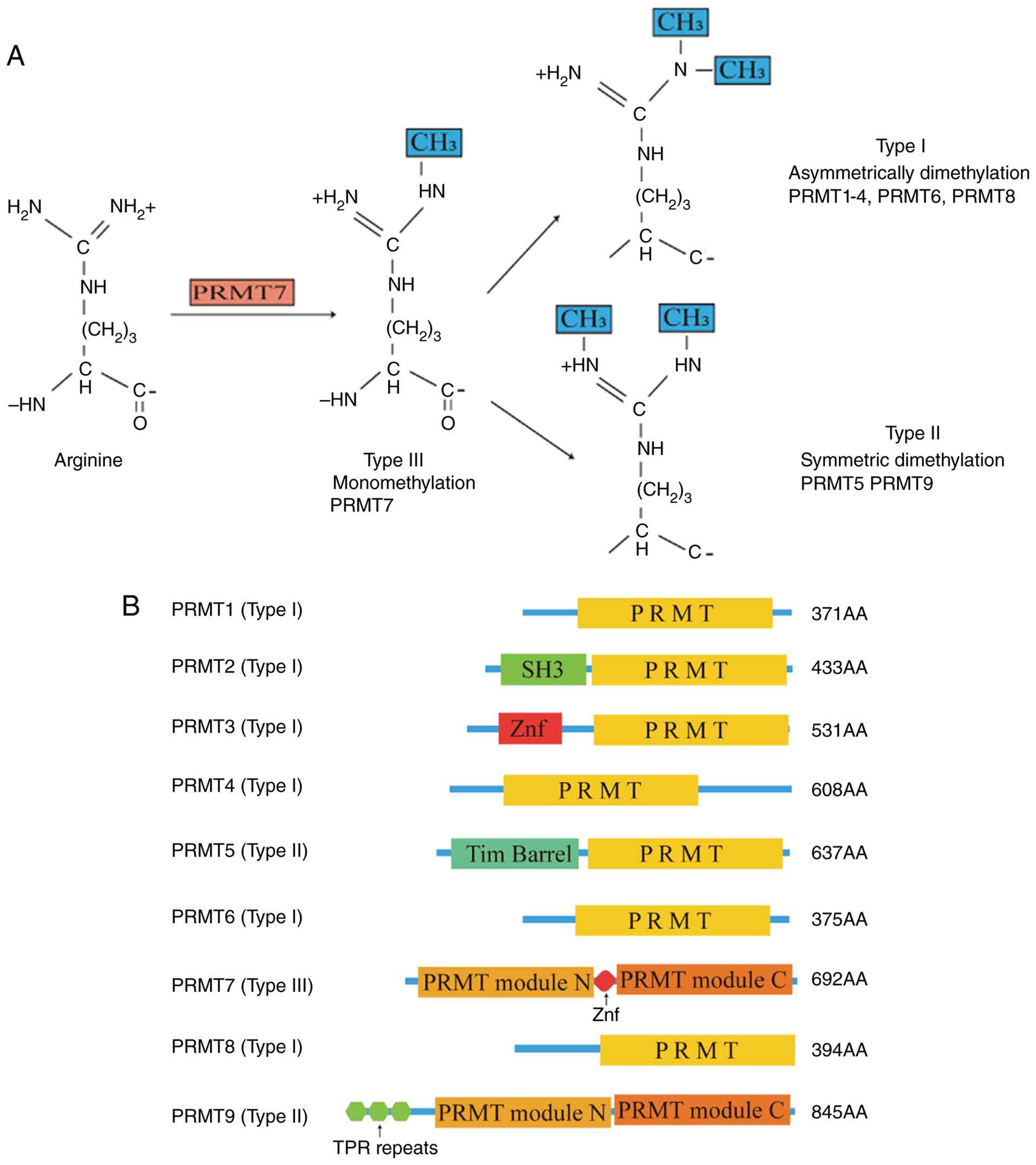
The mammalian PRMT family consists of nine enzymes
that are classified into three types according to their catalytic
products, with additional differences in structural organization
and substrate preference across family members (1,6,7)
(Table I). Type I PRMTs catalyze
the formation of monomethyl-arginine (MMA) and asymmetric
dimethylarginine, whereas type II PRMTs generate MMA and symmetric
dimethylarginine (1,6,7). PRMT7
is the only type III PRMT identified in mammals and is uniquely
restricted to MMA formation (7–9). This
catalytic property is supported by its distinctive structural
architecture, including a tandem double-module organization and a
zinc-finger-containing region, which distinguish PRMT7 from type I
and type II PRMTs (7–9). Such structural divergence not only
underlies its unique enzymatic behavior but also contributes to its
distinct regulatory functions within the arginine methylation
network. Beyond its role as a monomethyl-transferase, PRMT7 may
also function as a regulatory component within the broader arginine
methylation network. Because MMA represents a common intermediate
in arginine dimethylation reactions, PRMT7-mediated monomethylation
can serve as a ‘priming’ event that enables subsequent methylation
by other PRMT family members in specific contexts. A representative
example is the PRMT7-PRMT5 methylation relay, in which
PRMT7-catalyzed H4R17 monomethylation enhances PRMT5-dependent H4R3
symmetric dimethylation (H4R3me2s) through an allosteric mechanism
(10). This finding highlights that
PRMT7-mediated MMA formation is not merely a terminal modification
but can also function as an upstream regulatory event controlling
broader arginine methylation dynamics. These unique properties also
provide a rationale for selective inhibitor development.
 | Table I.Classification, catalytic properties,
structural features, and substrate preferences of the PRMT
family. |
Table I.
Classification, catalytic properties,
structural features, and substrate preferences of the PRMT
family.
| Type | Members | Catalytic
Products | Structural
Characteristics | Substrate
Specificity and Representative Substrates |
|---|
| Type I | PRMT1, PRMT3,
PRMT4, PRMT6 | MMA → ADMA
(asymmetric dimethylarginine) | Homodimers
(head-to-tail arrangement via dimerization arm; essential for
activity and processivity). PRMT3 contains an N-terminal
zinc-finger domain; PRMT4 possesses unique N-and C-terminal
extensions. Active-site geometry (double-E loop and THW loop)
permits reorientation of monomethyl-arginine for a second
methylation on the same terminal nitrogen atom. | Strong preference
for glycine-arginine-rich (GAR/RGG) motifs (PRMT1, PRMT3, PRMT6);
PRMT4 prefers proline-glycine-methionine (PGM)-rich sequences. Key
substrates: Histone H4R3me2a (PRMT1/PRMT3), H3R17me2a/H3R26me2a
(PRMT4), H3R2me2a (PRMT6); numerous RNA-binding proteins and DNA
repair factors (for example, MRE11, 53BP1). |
| Type II | PRMT5, PRMT9 | MMA → SDMA
(symmetric dimethylarginine) | PRMT5 forms a
hetero-octameric complex with MEP50
(PRMT54-MEP504); contains an N-terminal
TIM-barrel domain for complex assembly and substrate recruitment.
PRMT9 features duplicated methyltransferase modules (N-terminal
catalytic, C-terminal structural). Active-site geometry favors
methylation on the opposite guanidino nitrogen. | PRMT5 prefers
GAR/RGG motifs; PRMT9 exhibits narrow specificity and minimal
activity on canonical GAR sequences. Key substrates: Histone
H3R8me2s/H4R3me2s and spliceosomal Sm proteins (PRMT5);
SF3B2/SAP145 at Arg508 (PRMT9, highly specific and
non-redundant). |
| Type III | PRMT7 | MMA only | Monomeric protein
with tandem duplication of PRMT-like modules forming an
intramolecular pseudodimer (N-terminal catalytic domain +
C-terminal structural module). Constricted active-site cavity
(double-E loop and THW loop) prevents a second methylation. | Strong preference
for RXR motifs flanked by basic residues (Lys/Arg-rich regions).
Key substrates: Histone H2B (RKRSR sequence at positions 29–33),
HSP70 family (for example, R469), translation initiation factors
(eIF2α), and DNA damage response proteins. |
Early mechanistic studies of PRMTs focused on
histone arginine methylation and transcriptional regulation
(5). More recent biochemical and
proteomic studies have markedly expanded the known substrate
spectrum to include diverse non-histone proteins (11–13).
Depending on the PRMT and substrate involved, non-histone
methylation can regulate protein stability, subcellular
localization, molecular interactions, RNA processing, translation,
metabolism and signal transduction (5,11,14).
Certain PRMT family members may also converge on shared substrates,
or influence one another through sequential or cooperative
methylation events, such as the PRMT7-PRMT5 histone methylation
relay (10,13). In addition, the functions of certain
PRMTs extend beyond the nucleus, with cytoplasmic and mitochondrial
substrates linking arginine methylation to translational stress
responses, protein homeostasis, and cellular metabolism (14–16).
This broad regulatory scope is reflected in the frequent
dysregulation of PRMT expression and activity across numerous
cancers (5,17). Within this family, PRMT7 has
recently emerged as an important functional regulator because of
its context-dependent functions. PRMT7 is implicated in the
progression of a broad spectrum of malignancies, including
leukemia, breast cancer (BC), lung cancer (LC), renal cell
carcinoma (RCC), hepatocellular carcinoma (HCC), prostate cancer
(PC) and gastric cancer (GC) (5,17,18).
In most settings, PRMT7 exhibits tumor-promoting activity by
facilitating epithelial-mesenchymal transition (EMT), stemness
maintenance, invasion, metastasis and therapy adaptation (5,17–21).
However, in certain contexts, PRMT7 may exert tumor-suppressive
effects. Understanding the mechanistic basis of this functional
duality is therefore essential for clarifying its biological
significance and therapeutic relevance.
This functional diversity may reflect differences in
substrate and pathway availability, interactions with other PRMT
family members and epigenetic regulators (10,22,23),
and the cellular and tumor-microenvironmental (TME) states present
in individual cancers (24,25). Accordingly, a cross-cancer
mechanistic framework is needed to explain how these contextual
factors shape the biological output of PRMT7 and influence its
suitability as a therapeutic target.
Therapeutic targeting of PRMTs has become an active
area of anticancer drug development (5,17).
Several inhibitors against type I PRMTs and PRMT5 have entered
clinical trials, underscoring the feasibility of pharmacologically
targeting arginine methylation (5).
By contrast, PRMT7-specific inhibitor discovery is still in the
early stages of development. Given the unique structure and
context-dependent oncogenic functions of PRMT7, a systematic
evaluation of its biological roles and targetability is timely
(26). In the present review,
current knowledge of PRMT7 structure and function were summarized,
its mechanistic roles across different cancer types were discussed,
and recent progress in PRMT inhibitor development was examined,
with particular emphasis on strategies and challenges for targeting
PRMT7 in cancer.
Structural and biochemical basis of PRMT7
function
Structural organization and catalytic
architecture of PRMT7
PRMT7 is structurally distinct from other members of
the PRMT family and represents the only type III PRMT identified in
mammals (Fig. 1A) (23,27–29).
Despite differences in domain organization and methylation
products, mammalian PRMTs share a conserved catalytic core composed
of a Rossmann-like fold responsible for S-adenosylmethionine
binding, a β-barrel domain involved in substrate recognition, and
characteristic catalytic elements such as the double-E and THW
loops (30,31). In most type I and type II PRMTs, a
single catalytic module is present in each polypeptide, and two or
more protein molecules associate through dimerization interfaces to
form homodimers or higher-order oligomeric assemblies (30,31).
By contrast, PRMT7 contains two tandem PRMT modules within a single
polypeptide, forming an intramolecular pseudo-dimer that resembles
the dimeric architecture of other PRMTs (Fig. 1B) (23,27,29).
This tandem organization is considered to have arisen through
duplication of an ancestral PRMT-like domain, with the two
resulting modules folding together to form a dimer-like arrangement
within a single polypeptide chain (22,23).
Like other PRMT family members, each PRMT7 module comprises a
conserved Rossmann fold domain and a β-barrel/β-bucket-like domain,
whereas PRMT7 additionally contains a zinc-finger motif positioned
between the N-terminal and C-terminal modules (23). Structural studies have shown that
only the N-terminal module is catalytically competent, while the
C-terminal module is inactive because of substitutions in residues
required for methyl donor binding and catalysis (23,29).
Thus, unlike the relatively symmetric organization of conventional
PRMT homodimers, the two modules of PRMT7 are structurally and
functionally asymmetric: The N-terminal module provides the
principal catalytic site, whereas the C-terminal module contributes
mainly to the overall pseudo-dimeric architecture (9,32).
Importantly, the zinc-finger motif is not merely a structural
insertion but also contributes to substrate recognition,
particularly for basic sequence contexts enriched in R-X-R motifs,
thereby helping define the substrate selectivity of PRMT7 (23,29,33,34).
Monomethylation specificity and
PRMT7-mediated methylation relay
A central biochemical feature of PRMT7 is its strict
ability to generate MMA only (23,35).
All three PRMT classes catalyze an initial methyl transfer to
generate MMA, but they differ in whether and how they subsequently
methylate this intermediate: Type I PRMTs generate asymmetric
dimethylarginine, type II PRMTs generate symmetric
dimethylarginine, whereas type III PRMT7 terminates the reaction
after the first methyl-transfer step (5,36).
This product specificity is determined by the spatial constraints
of its catalytic pocket, especially the configuration of the
conserved double-E loop and surrounding active-site residues, which
tightly position the guanidino group of arginine and restrict
accommodation of a second methyl transfer (8,9). Thus,
PRMT7 retains the conserved catalytic framework of the PRMT family
while modifying this shared architecture in a manner that favors
monomethylation. Importantly, PRMT7-mediated monomethylation can
also function as a regulatory intermediate within the arginine
methylation network rather than merely representing a terminal
modification. A representative example is the PRMT7-PRMT5
methylation relay, in which PRMT7-generated H4R17me1 enhances
PRMT5-mediated H4R3 symmetric dimethylation (H4R3me2s) through an
allosteric mechanism, illustrating how PRMT7-derived MMA can
modulate the activity of other PRMT family members (10). As a result, PRMT7 catalyzes only the
first methylation step and cannot efficiently generate asymmetric
or symmetric dimethylarginine (8,23,35).
This biochemical property distinguishes PRMT7 from type I and type
II PRMTs and suggests that PRMT7 may function as a more selective
regulator of arginine methylation-dependent signaling (7,23).
Rather than acting as a binary molecular switch, PRMT7-mediated MMA
may serve as a fine-tuning modification that subtly modulates
chromatin state, protein interaction networks, and
stress-responsive signaling pathways (7,23).
The structural and catalytic features of PRMT7 are
closely linked to its cancer-relevant functions. Because PRMT7
preferentially recognizes arginine-rich motifs, including
R-X-R-containing sequences, its substrates include both histone and
non-histone proteins, such as histone H4R3, H2AR3 and several
stress- or RNA-associated proteins including HSP70 family members
(14,15,23,33,35,37).
Through selective monomethylation of proteins involved in
epigenetic regulation, stress adaptation, RNA metabolism and cell
plasticity, PRMT7 is positioned to influence tumor cell survival,
invasion, metastatic dissemination and therapeutic response
(5,14,23).
These unique mechanistic properties provide the basis for the
context-dependent functions of PRMT7 in cancer, which are discussed
in the following sections.
Reversibility of arginine methylation
and current controversies
The reversibility of arginine methylation remains an
unresolved question. Although PRMTs responsible for installing
arginine methylation marks have been extensively characterized, the
existence of dedicated arginine demethylases remains controversial.
Given that PRMT7 predominantly generates MMA, understanding whether
and how MMA marks are removed is important for defining the
dynamics of PRMT7-mediated regulation.
Peptidyl-arginine deiminase 4 (PAD4/PADI4) has been
proposed as a mechanism that can reduce methylated arginine levels
through deamination (38,39). PAD4 converts methylated arginine
residues into citrulline, accompanied by the release of methylamine
(38). Although this reaction
results in the loss of methylated arginine, it does not represent
classical demethylation because the original arginine residue is
irreversibly converted into citrulline and cannot be remethylated.
Therefore, PAD4-mediated regulation is considered an irreversible
residue-conversion mechanism rather than a reversible demethylation
cycle.
JMJD6 was initially reported as a histone arginine
demethylase capable of removing methyl groups from histone arginine
residues (40). However, subsequent
studies demonstrated that JMJD6 primarily functions as a lysyl
hydroxylase involved in RNA splicing regulation rather than as a
bona fide arginine demethylase (41). Further biochemical analyses found
that the reported demethylase activity of JMJD6 has been difficult
to reproduce, leaving its role as an arginine demethylase
controversial (42).
Currently, no universally accepted arginine
demethylase analogous to lysine demethylases has been identified.
Therefore, the turnover of arginine methylation is considered to
depend mainly on mechanisms such as protein degradation,
replacement of modified proteins and irreversible residue
conversion. The lack of a clearly established arginine
demethylation system may contribute to the persistence of arginine
methylation-dependent regulatory states after modulation of PRMT
activity and represents an important consideration for the
development of PRMT-targeted therapies.
Regulation of PRMT7 expression and
activity
Understanding how PRMT7 expression and enzymatic
activity are regulated is essential for elucidating how this
methyltransferase responds to different cellular contexts. Emerging
evidence indicates that PRMT7 regulation occurs at multiple levels,
including transcriptional control, post-transcriptional regulation,
and intrinsic structural mechanisms that modulate its catalytic
activity.
At the transcriptional level, PRMT7 expression can
be regulated by cellular signaling pathways and genomic regulatory
elements. In inflammatory contexts, NF-κB/RelA signaling has been
shown to transcriptionally induce PRMT7 expression in monocytes,
linking inflammatory signaling with PRMT7-dependent epigenetic
regulation (43). In addition,
PRMT7 transcriptional upregulation has been observed during
satellite cell activation, suggesting that PRMT7 expression is
dynamically regulated during cellular-state transitions (44). In HCC, enhancer-mediated regulation
of the PRMT7 locus has also been reported, in which a
risk-associated enhancer variant promotes HNF4A binding and
increases PRMT7 transcription (44). Post-transcriptionally, microRNA
(miR)-24-2 has been shown to target PRMT7 and suppress its
expression in liver cancer stem cells (45).
PRMT7 activity is also regulated by intrinsic
structural features. Although the C-terminal PRMT-like module lacks
catalytic activity, it contributes to intramolecular regulation by
interacting with the N-terminal catalytic module and imposing an
autoinhibitory constraint (23,32).
In addition, PRMT7 automethylation at R531 has been reported to
regulate its chromatin recruitment and functional activity in BC
models, providing another layer of post-translational regulation
(46).
Together, these findings indicate that PRMT7 is
regulated through multiple mechanisms, including transcriptional
control, post-transcriptional regulation, and structural modulation
of enzymatic activity. Such multilayered regulation may contribute
to the context-dependent functions of PRMT7 in different
physiological and pathological settings.
PRMT7 and cancer
Accumulating evidence indicates that PRMT7 is an
important and context-dependent regulator in cancer. In different
malignancies, PRMT7 has been implicated in transcriptional
regulation, EMT, metabolic adaptation, stemness maintenance and
tumor immunity. Although PRMT7 exhibits predominantly
pro-tumorigenic functions in most cancer types, its biological
effects may vary depending on tumor context and downstream
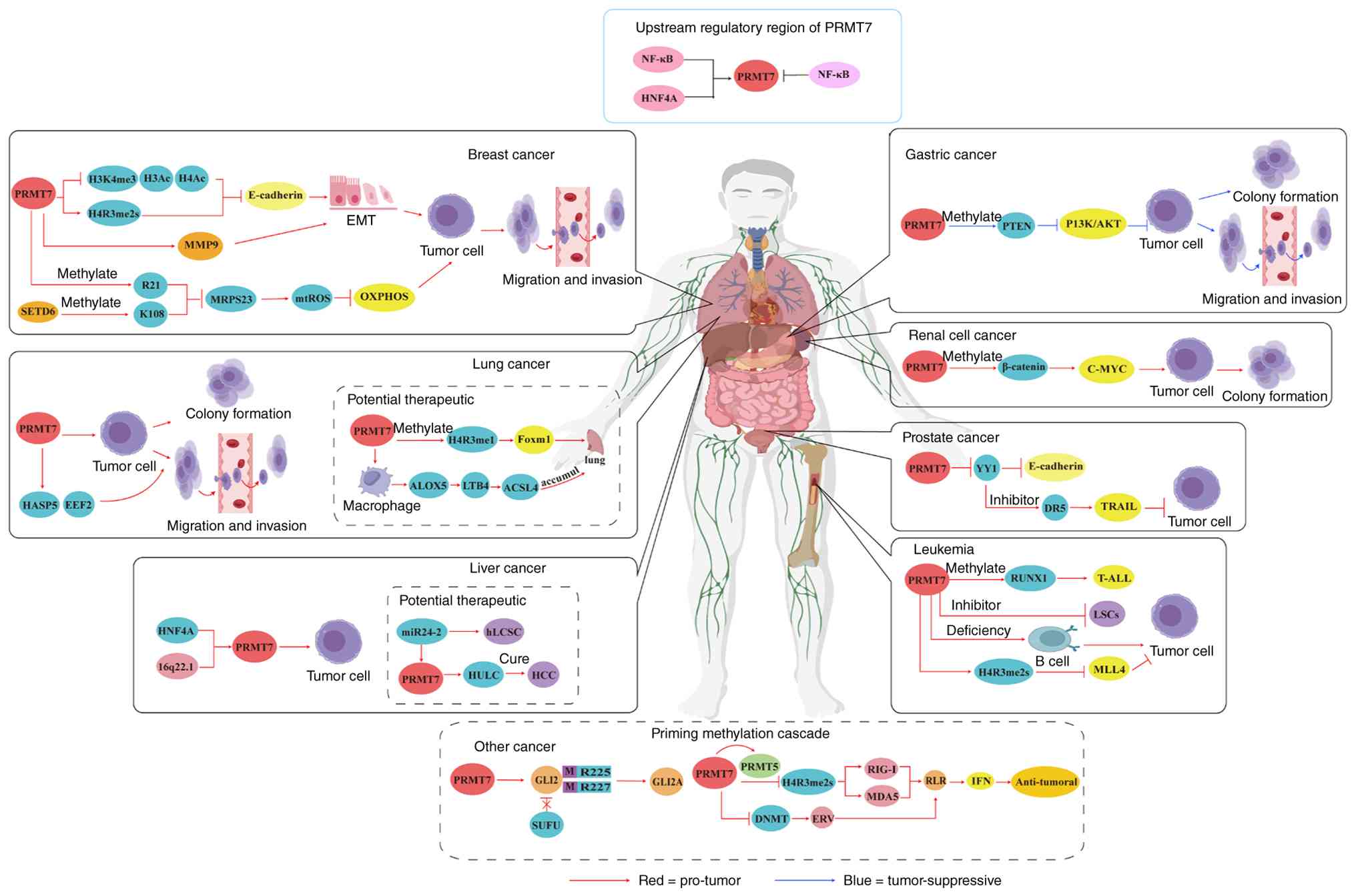
substrates (Fig. 2, Table II). In the following sections, we
summarize the roles and molecular mechanisms of PRMT7 across major
hematologic and solid tumors.
| Table II.Cancer-type-specific functions,
molecular mechanisms, and therapeutic implications of PRMT7. |
Table II.
Cancer-type-specific functions,
molecular mechanisms, and therapeutic implications of PRMT7.
| First author/s,
year | Cancer type | Role in cancer | Major
phenotype | Key molecular
mechanism | (Refs.) |
|---|
| Liu et al,
2022; Oksa et al, 2022; Ying et al, 2015 | Leukemia | Predominantly
oncogenic | Leukemia stem cell
maintenance, transcriptional dysregulation | RUNX1 target gene
deregulation in T-cell acute lymphoblastic leukemia; glycine
metabolism rewiring in chronic myeloid leukemia stem cells;
BCL6-associated lymphoid regulation | (24,48,49) |
| Liu et al,
2021; Baldwin et al, 2015; Geng et al, 2017; Yao
et al, 2014 | Breast cancer | Oncogenic |
epithelial-mesenchymal transition,
invasion, metastasis | E-cadherin
repression via YY1/HDAC3-associated chromatin remodeling; MMP9
induction; MRPS23-dependent mitochondrial reprogramming | (16,18,46,50) |
| Cheng et al,
2018; Zhang et al, 2025; Liao et al, 2018; He et
al, 2021 | Lung cancer | Oncogenic | Invasion,
clonogenicity, metastatic behavior | Interaction with
HSPA5 and EEF2; Stabilization of SOX9 via antagonizing
ubiquitination; FOXM1-centered regulation | (51–54) |
| Liu et al,
2020 | Renal cell
carcinoma | Oncogenic | Tumor growth,
proliferation | Stabilization of
β-catenin and activation of the β-catenin/C-MYC axis | (55) |
| Shen et al,
2022; Wang et al, 2020 | Hepatocellular
carcinoma | Oncogenic | Tumor-promoting
signaling, stemness-associated progression | 16q22.1 enhancer
variant/HNF4A-dependent PRMT7 upregulation; miR24-2-linked
non-coding RNA regulatory network | (44,45) |
| Wan et al,
2025; Rodrigo-Faus et al, 2024; Lin et al, 2024 | Prostate
cancer | Oncogenic | Proliferation,
migration, invasion, enzalutamide resistance | Methylation of
FoxK1 promoting metastasis; NUDT21 monomethylation regulating
alternative polyadenylation; Cell-cycle signaling | (57–59) |
| Wang et al,
2023 | Gastric cancer |
Tumor-suppressive | Reduced
proliferation and migration | PTEN-associated
inhibition of PI3K/AKT signaling | (60) |
| Srour et al,
2022; Vuong et al, 2019 | Other
cancers/immune context |
Context-dependent | Hedgehog
activation; enhanced tumor immunogenicity upon PRMT7 loss | GLI2 methylation
weakens SUFU binding; PRMT7 ablation enhances immune checkpoint
blockade response in melanoma | (25,62) |
PRMT7 in leukemia
Emerging evidence indicates that PRMT7 plays a
context-dependent but predominantly pro-leukemogenic role in
hematologic malignancies (47). In
T-cell acute lymphoblastic leukemia (T-ALL), PRMT7 is highly
expressed relative to normal T cells, particularly in more
differentiated leukemic subtypes, suggesting that its aberrant
activation is associated with leukemic transformation (48). Mechanistically, PRMT7-dependent
arginine monomethylation has been linked to dysregulation of RUNX1
target genes, indicating that PRMT7 may fine-tune transcriptional
programs critical for T-ALL pathogenesis (48). In chronic myeloid leukemia (CML),
PRMT7 has attracted particular attention because it appears to be
required for the maintenance of leukemia stem cells (LSCs)
(24). Genetic or pharmacological
inhibition of PRMT7 selectively impairs LSC survival while sparing
normal hematopoietic stem cells (HSCs), highlighting PRMT7 as a
potential therapeutic vulnerability in stemness-driven leukemia
(24).
In addition to transcriptional control, PRMT7 may
support leukemic cell fitness through stress-adaptive and metabolic
mechanisms. PRMT7-dependent rewiring of glycine metabolism has been
directly implicated in the maintenance of CML LSCs, whereas studies
in other cellular contexts have shown that PRMT7-mediated
methylation of HSP70 family proteins promotes proteostasis and
stress tolerance, suggesting a broader adaptive function that may
also be relevant to leukemia (24).
These observations position PRMT7 not only as an epigenetic
regulator but also as a metabolic and stress-response modulator in
leukemia. In addition, studies in B-cell systems indicate that
PRMT7 negatively regulates BCL6 expression and influences germinal
center responses, further supporting its role in lymphoid lineage
homeostasis and malignant transformation (49).
Collectively, these observations suggest that the
leukemogenic role of PRMT7 extends beyond transcriptional control
and is closely tied to stem cell maintenance, proteostasis and
metabolic adaptation, particularly in LSCs.
PRMT7 in BC
Among solid tumors, the role of PRMT7 has been most
extensively characterized in BC, where it is generally considered a
metastasis-promoting factor. PRMT7 is upregulated in primary breast
tumors, lymph node metastases and highly invasive BC cell lines,
and its depletion suppresses invasion in vitro and
metastasis in vivo, whereas ectopic expression enhances the
aggressive phenotype (50). A
central mechanism underlying this effect is the induction of EMT.
In BC cells, PRMT7 represses E-cadherin transcription by occupying
the proximal E-cadherin promoter and facilitating the recruitment
of YY1 and HDAC3, thereby establishing a repressive chromatin state
characterized by increased H4R3me2s and reduced H3K4me3, H3
acetylation and H4 acetylation (46). Notably, given that PRMT7 is a type
III PRMT restricted to MMA formation, the H4R3me2s enrichment
observed at the E-cadherin promoter is more appropriately
interpreted as part of a PRMT7-dependent repressive chromatin
environment rather than a direct catalytic output of PRMT7.
Consistent with this model, loss of PRMT7 or disruption of its
automethylation at R531 weakens its YY1-dependent recruitment to
the E-cadherin promoter, reduces H4R3me2s at this locus, restores
E-cadherin expression, and attenuates migratory and invasive
behavior (46).
In addition to EMT-associated chromatin regulation,
PRMT7 also promotes BC aggressiveness through other pathways. PRMT7
upregulates MMP9 expression, and exogenous MMP9 can partially
rescue the invasive defect caused by PRMT7 depletion, indicating
that MMP9 is an important downstream effector of PRMT7-driven
invasion (18). PRMT7 has also been
reported to influence mitochondrial homeostasis through
methylation-dependent regulation of MRPS23, thereby affecting
oxidative phosphorylation and mitochondrial reactive oxygen species
(mtROS)-associated metastatic traits (16).
Collectively, these findings place PRMT7 as an
important regulator of BC invasiveness, acting through coordinated
effects on EMT, non-histone substrate methylation and mitochondrial
reprogramming.
PRMT7 in LC
PRMT7 has also been implicated in LC progression,
particularly in non-small cell LC (NSCLC). Early functional studies
showed that PRMT7 overexpression enhances invasion, clonogenic
growth and metastatic potential in NSCLC cells, and identified
HSPA5 and EEF2 as PRMT7-interacting proteins. Silencing either
HSPA5 or EEF2 attenuated PRMT7-driven invasion, suggesting that
PRMT7 may promote malignant behavior through protein homeostasis
and translation-related networks (51).
More direct mechanistic evidence has recently
established a post-translational role for PRMT7 in NSCLC through
regulation of SOX9 stability. PRMT7 was shown to mono-methylate
SOX9 at arginine 160 (R160), thereby antagonizing FBXW7- and
KEAP1-mediated ubiquitination and proteasomal degradation,
ultimately stabilizing SOX9 protein and promoting NSCLC progression
(52). Functionally, this
PRMT7-SOX9 axis enhanced tumor cell proliferation and tumorigenic
capacity, and elevated PRMT7/SOX9 expression was associated with
poorer clinical outcome, supporting a well-defined oncogenic role
for PRMT7 in NSCLC (15).
In addition to this directly validated
post-translational mechanism, transcriptional regulation may
represent another potential dimension of PRMT7 function in the
lung. FOXM1 is a well-established master regulator of cell-cycle
progression, proliferation and stemness-associated transcriptional
programs (53). Although direct
evidence in NSCLC remains limited, studies in lung mesenchymal
cells have shown that PRMT7 can promote H4R3 monomethylation at the
Foxm1 locus and enhance Foxm1 transcription,
supporting the existence of a PRMT7-Foxm1 regulatory axis in
lung tissue (54).
Taken together, available evidence indicates that
PRMT7 contributes to lung tumor progression through multiple layers
of regulation. Among them, SOX9 stabilization by R160
mono-methylation currently represents the most direct and
best-defined mechanism in NSCLC, whereas the proposed
Foxm1-centered transcriptional program remains supportive
but indirect evidence that may broaden the functional landscape of
PRMT7 in lung tissues.
PRMT7 in renal cancer
In clear cell RCC (ccRCC), PRMT7 is generally viewed
as an oncogenic factor. PRMT7 expression is elevated in ccRCC cells
and promotes tumor growth by enhancing proliferative signaling
(55). Mechanistically, PRMT7 has
been shown to stabilize β-catenin through arginine
methylation-dependent inhibition of its ubiquitin-mediated
degradation, resulting in increased C-MYC expression and activation
of a β-catenin/C-MYC growth-promoting axis (55). Because both β-catenin and C-MYC are
major drivers of renal tumor progression, this pathway provides a
plausible mechanistic basis for the tumor-promoting function of
PRMT7 in RCC.
Current evidence therefore supports a model in which
PRMT7 promotes ccRCC progression, at least in part, by sustaining
β-catenin stability and reinforcing downstream C-MYC-dependent
proliferative signaling.
PRMT7 in liver cancer
PRMT7 is implicated in HCC through both genetic
susceptibility and downstream oncogenic signaling. A susceptibility
locus within the PRMT7 region at 16q22.1 has been linked to HCC
risk, and allele-specific regulation by HNF4A at an enhancer
element has been shown to increase PRMT7 expression (44). Upregulated PRMT7 is associated with
HCC-promoting phenotypes in vitro and in vivo,
suggesting that PRMT7 may function as a downstream effector
connecting inherited susceptibility to tumor-promoting molecular
programs (44).
At the post-transcriptional level, PRMT7 is also
integrated into non-coding RNA regulatory networks. miR-24-2
directly targets the 3′ untranslated region (UTR) of PRMT7 and
suppresses its translation, thereby altering histone H4R3
methylation and contributing to the malignant progression of liver
cancer stem cell (45). In this
context, PRMT7 is positioned within a broader regulatory network
involving HULC-, Nanog-, and stemness-associated signaling rather
than acting as an isolated effector (45).
Collectively, the available evidence indicates that
PRMT7 participates in HCC progression through integrated genetic,
epigenetic and non-coding RNA-dependent mechanisms.
PRMT7 in PC
Clinical evidence has provided translational support
for the involvement of PRMT7 in PC progression. Grypari et
al (56) integrated public
datasets with patient cohort-based analyses and demonstrated that
PRMT7 expression was elevated in PC tissues compared with normal
prostate tissues. Furthermore, PRMT7 expression increased with
aggressive disease characteristics and was enhanced following
androgen deprivation therapy, suggesting a potential association
between PRMT7 expression and advanced PC progression. PRMT7
expression was also correlated with EMT-related and
cell-cycle-associated molecular features, further supporting its
clinical relevance as a potential biomarker and therapeutic target
in PC (56).
Beyond these clinical observations, accumulating
evidence supports a pro-tumorigenic role for PRMT7 in PC. PRMT7
expression has been reported to be elevated in PC tissues and cell
lines, and PRMT7 depletion suppresses proliferation, migration and
invasion while promoting apoptosis, indicating that PRMT7
contributes to disease progression (57).
Mechanistic understanding of PRMT7 function in PC
has also advanced substantially in recent studies. One study
demonstrated that PRMT7 promotes the invasive phenotype of
metastatic castration-resistant PC by methylating the transcription
factor FoxK1, thereby altering the expression of adhesion-related
molecules and enhancing metastatic capacity (58). This finding identifies FoxK1 as a
direct functional substrate of PRMT7 in advanced PC and provides a
concrete explanation for how PRMT7 facilitates tumor
dissemination.
In addition to its role in invasion and metastasis,
PRMT7 has also been linked to therapeutic resistance in PC. A
recent study showed that PRMT7-mediated monomethylation of NUDT21
regulates alternative polyadenylation and promotes 3′UTR
shortening, whereas loss of this methylation event contributes to
resistance to enzalutamide (59).
These results establish a PRMT7-NUDT21 axis as a key
post-transcriptional mechanism involved in antiandrogen response
and resistance, further expanding the functional spectrum of PRMT7
in PC biology.
Earlier studies also suggested that PRMT7 may
participate in a YY1/TP53/CCND2/CDK6/RB1-associated signaling axis
linked to cell-cycle control and malignant behavior (57). Thus, contrary to earlier assumptions
that the downstream mechanisms of PRMT7 in PC remain largely
undefined, recent studies have identified at least two direct
mechanistic axes, namely PRMT7-FoxK1 in metastatic progression and
PRMT7-NUDT21 in enzalutamide resistance (58,59).
PRMT7 in GC
Unlike its predominantly oncogenic role in numerous
tumor types, PRMT7 appears to exert tumor-suppressive functions in
GC. PRMT7 expression is reduced in GC tissues, and low expression
is associated with adverse clinicopathological features, including
larger tumor size, poor differentiation, lymph node metastasis and
advanced TNM stage. Functional studies indicate that PRMT7
suppresses proliferation and migration of GC cells (60). Mechanistically, PRMT7 has been
reported to interact with PTEN and promote its arginine
methylation, thereby suppressing the downstream PI3K/AKT pathway
(60). This distinguishes GC from
most other aforementioned cancers, where PRMT7 tends to support
malignant progression, and further highlights the context-dependent
nature of PRMT7 biology.
Taken together, the available evidence suggests that
PRMT7 may restrain GC progression, at least in part, through
PTEN-associated inhibition of PI3K/AKT signaling.
PRMT7 in tumor immunity
Recent studies have expanded the functional
landscape of PRMT7 beyond tumor-cell-intrinsic regulation by
demonstrating its role in shaping the tumor immune
microenvironment. In addition to regulating oncogenic signaling
pathways within cancer cells, PRMT7 can influence tumor immune
visibility through epigenetic control of endogenous retroviral
elements, innate immune sensing pathways, and immune-related
transcriptional programs (25,61).
In melanoma, PRMT7 functions as an epigenetic
regulator of tumor immune evasion. Genetic depletion of PRMT7
enhances tumor sensitivity to immune checkpoint blockade (ICB) by
relieving repression of endogenous retroviral elements, activating
RIG-I/MDA5-mediated innate immune sensing and type I interferon
responses, and increasing immune-related programs such as antigen
presentation and chemokine expression. These findings indicate that
PRMT7 limits tumor immune visibility by maintaining an
immunosuppressive epigenetic state (25).
Emerging evidence suggests that this
immunomodulatory function may extend beyond melanoma. In BC, PRMT7
expression is associated with reduced CD8+ T-cell
infiltration and unfavorable clinical outcomes. In immunocompetent
mouse models, Prmt7 deficiency suppresses tumor growth, enhances
CD8+ T-cell infiltration, and increases susceptibility
to cytotoxic T lymphocyte-mediated elimination, whereas these
effects are attenuated under immunodeficient conditions (61). These findings suggest that PRMT7 may
contribute to immune escape by limiting adaptive antitumor
immunity.
Collectively, current evidence indicates that PRMT7
contributes to tumor immune evasion through both innate and
adaptive immune mechanisms. These findings suggest that PRMT7 may
represent a potential therapeutic vulnerability for tumors with
immune-evasive phenotypes. However, further studies are required to
determine whether these immunomodulatory functions extend to
additional cancer types.
Cross-cancer analysis: Common
mechanisms and context-dependent duality
Taken together, studies across different cancer
types indicate that PRMT7 most often predominantly exerts
tumor-promoting effects, particularly in BC, LC, renal cancer,
leukemia and HCC (16,24,44-46,48,50,51,55). By contrast, a
tumor-suppressive role has been reported in GC, although this
finding currently relies on a single study and requires independent
validation (60). Across the tumor
types in which PRMT7 exhibits oncogenic activity, several recurrent
functional themes emerge, including the promotion of EMT and
metastasis (16,46,50,51,58),
reinforcement of stem-like properties (24), regulation of metabolic and
proteostatic adaptation (14–16,24),
and activation or stabilization of oncogenic signaling components,
including the β-catenin/C-MYC axis (55) and SOX9 (52,62).
In addition, studies in non-malignant lung mesenchymal cells
suggest that PRMT7 may regulate Foxm1 transcription,
indicating a potential broader role of PRMT7 in lung-associated
transcriptional programs (53,54).
These contrasting findings suggest that the biological output of
PRMT7 is not determined by its catalytic activity alone, but is
shaped by the specific substrates, regulatory partners, and
cellular states present in each cancer context (Fig. 3).
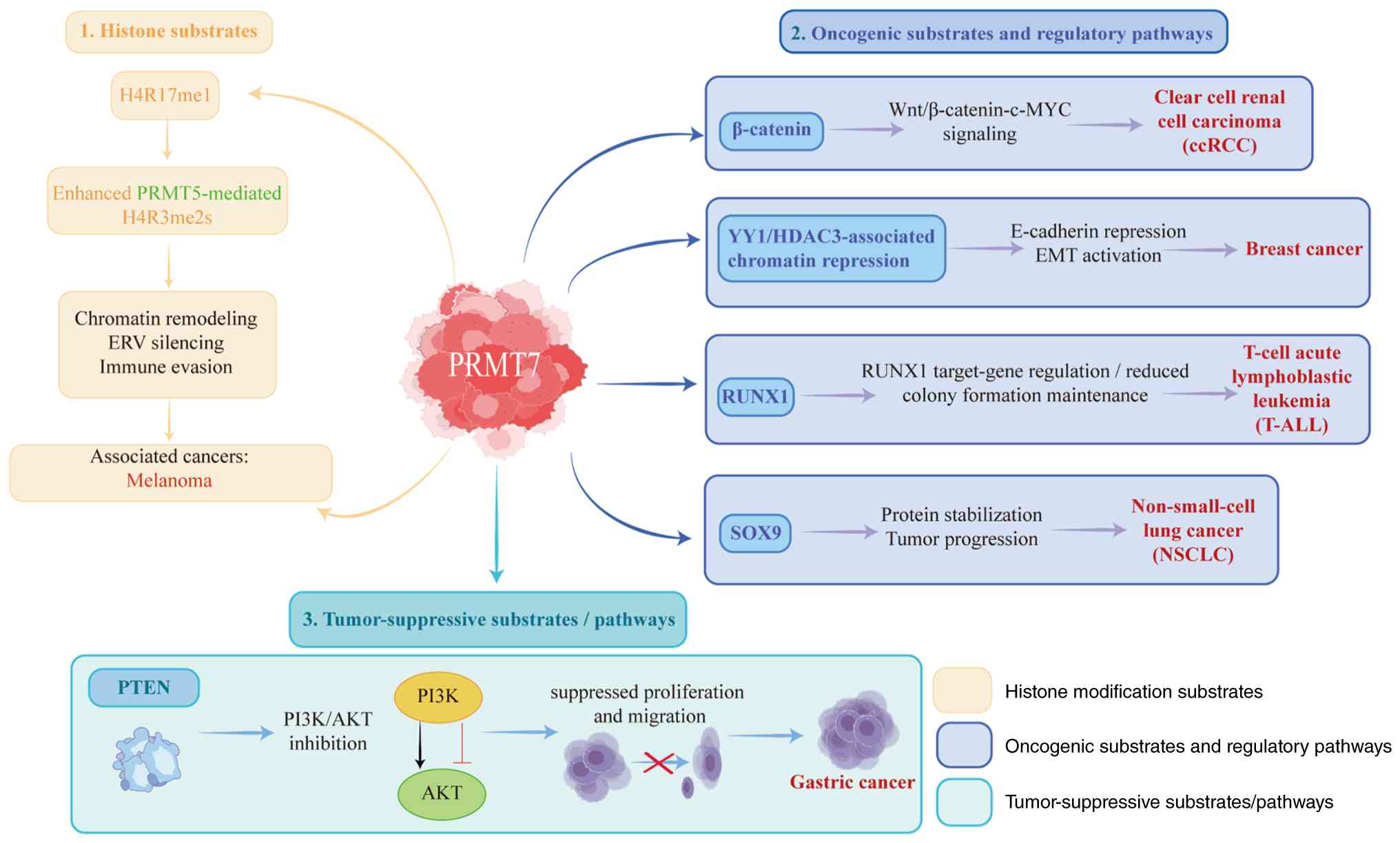 | Figure 3.Representative PRMT7 substrates,
regulatory pathways, and cancer-associated phenotypes. PRMT7
regulates tumor development through both histone and non-histone
targets in a context-dependent manner. In the histone axis, PRMT7
catalyzes H4R17 monomethylation (H4R17me1), which serves as a
priming modification to enhance PRMT5-mediated H4R3 symmetric
dimethylation (H4R3me2s), thereby contributing to chromatin
remodeling, transcriptional repression, ERV silencing, and immune
regulation. Representative non-histone substrates and regulatory
pathways include β-catenin, SOX9, PTEN, YY1-associated chromatin
repression and RUNX1 target-gene regulation, which collectively
influence Wnt/β-catenin signaling, EMT, PI3K/AKT signaling and
T-cell acute lymphoblastic leukemia-associated transcriptional
programs. These pathways contribute to diverse cancer-associated
phenotypes across multiple tumor types. The molecules and pathways
shown represent selected examples summarized from the current
literature rather than a comprehensive list of all reported
PRMT7-regulated mechanisms. PRMT, protein arginine
methyltransferase; ERV, endogenous retroviral; EMT,
epithelial-mesenchymal transition. |
One major dimension underlying the context-dependent
function of PRMT7 is the substrate and pathway context. Although
PRMT7 consistently catalyzes arginine monomethylation, the
biological consequence of this modification depends on the identity
and function of the substrate involved. In RCC, PRMT7 enhances
β-catenin stability and activates the downstream β-catenin/C-MYC
axis (55). In T-ALL, PRMT7 is
highly expressed, particularly in mature T-ALL subtypes, and its
genetic depletion reduces leukemic-cell colony formation and
deregulates RUNX1 target-gene expression, suggesting that PRMT7
contributes to T-ALL pathogenesis through RUNX1-associated
transcriptional programs. In NSCLC, PRMT7 monomethylates SOX9 at
R160, thereby antagonizing ubiquitin-mediated degradation and
stabilizing SOX9 to promote tumor progression (52). In PC, PRMT7-mediated regulation of
FOXK1 and NUDT21 contributes to metastatic dissemination and
alternative polyadenylation-associated enzalutamide resistance,
respectively (58,59). In BC, PRMT7-mediated methylation of
MRPS23 alters mitochondrial oxidative phosphorylation and mtROS
production, thereby promoting invasion and metastasis (16). In broader cellular contexts,
PRMT7-mediated methylation of eIF2α has been linked to
eIF2α-dependent stress-granule formation and cellular stress
responses (15), whereas
PRMT7-dependent methylation of HSP70-family proteins has been
associated with proteostasis and cellular adaptation to heat and
proteasomal stress (14). However,
the cancer-type-specific relevance of these mechanisms remains
incompletely defined. By contrast, in GC, PRMT7 interacts with and
promotes the arginine methylation of PTEN, leading to suppression
of PI3K/AKT signaling and inhibition of tumor-cell proliferation
and migration (60). Together,
these findings suggest that the functional output of PRMT7 is
strongly influenced by the availability and biological role of its
substrates in a given tumor context. However, the proposed
tumor-suppressive role of PRMT7 in GC is currently supported by a
single study and requires independent validation.
Another major dimension underlying the
context-dependent function of PRMT7 is the PRMT-family and
epigenetic interaction context. PRMT7 does not necessarily act as
an isolated monomethyl-transferase, because its catalytic products
can influence broader arginine-methylation and chromatin-regulatory
networks. A representative example is PRMT7-catalyzed H4R17
monomethylation, which acts as an allosteric signal to enhance
PRMT5-mediated symmetric dimethylation of H4R3 (H4R3me2s), thereby
establishing a sequential histone methylation relay (10). Because H4R3me2s is frequently
associated with transcriptional repression, this relay may
reinforce repressive chromatin states in specific cellular contexts
(63,64). PRMT7 may also cooperate with
transcription factors and chromatin-associated coregulators, as
illustrated by the YY1/HDAC3-associated repression of E-cadherin in
BC (46). At the non-histone level,
methylome profiling has revealed partially overlapping substrate
networks among PRMT4, PRMT5 and PRMT7, particularly involving
RNA-binding and splicing-related proteins (13). For example, hnRNPA1 has been
identified as a shared substrate of these PRMTs, and its
methylation-dependent regulation influences pre-mRNA binding and
alternative splicing (13). These
findings suggest that PRMT-family crosstalk may also extend to the
convergent regulation of non-histone substrates. Taken together,
these histone- and non-histone-level interactions suggest that the
biological effects of PRMT7 may vary across tumor types depending
on the activity of other PRMT family members and the availability
of relevant chromatin regulators and transcriptional cofactors.
However, the extent and functional consequences of these
PRMT-family and epigenetic interactions have not been
systematically validated across individual cancers and therefore
cannot yet be regarded as a universal explanation for the oncogenic
activity of PRMT7.
A further possible dimension underlying the
context-dependent function of PRMT7 is the cellular and TME
context. PRMT7 may be particularly important in stem-like
tumor-cell populations that depend on metabolic plasticity. In CML,
PRMT7 supports LSC self-renewal through the regulation of glycine
metabolism, whereas its loss selectively impairs LSCs while largely
sparing normal hematopoietic stem and progenitor cells (24). The TME context may also shape PRMT7
function. In melanoma, PRMT7 suppresses endogenous retroviral
elements and cytosolic RNA-sensing pathways involving RIG-I and
MDA5, thereby limiting antitumor immune activation. PRMT7 ablation
enhances immune-cell infiltration and sensitizes tumors to
immune-checkpoint blockade, identifying PRMT7 as a
context-dependent epigenetic regulator of tumor immune evasion
(25). The tumor-suppressive effect
reported in GC raises the possibility that PRMT7 may exert distinct
functions in more differentiated cellular contexts (60). However, current evidence remains
insufficient to establish a general relationship between cellular
differentiation, immune context and PRMT7 dependency across
cancers.
PRMT inhibitors
Overview of the PRMT inhibitor
landscape
The development of PRMT inhibitors has progressed
most rapidly for type I enzymes and PRMT5, providing the conceptual
framework for targeting arginine methylation in cancer (5,65–67).
Among type I PRMTs, multiple inhibitors and chemical probes have
been developed against PRMT1, PRMT3, PRMT4 and PRMT6, whereas PRMT5
has produced the most advanced translational candidates, including
compounds that have entered clinical evaluation (5,68–89).
These efforts collectively show that PRMTs are chemically tractable
drug targets and that both potent enzymatic inhibition and clear
cellular target engagement can be achieved (90).
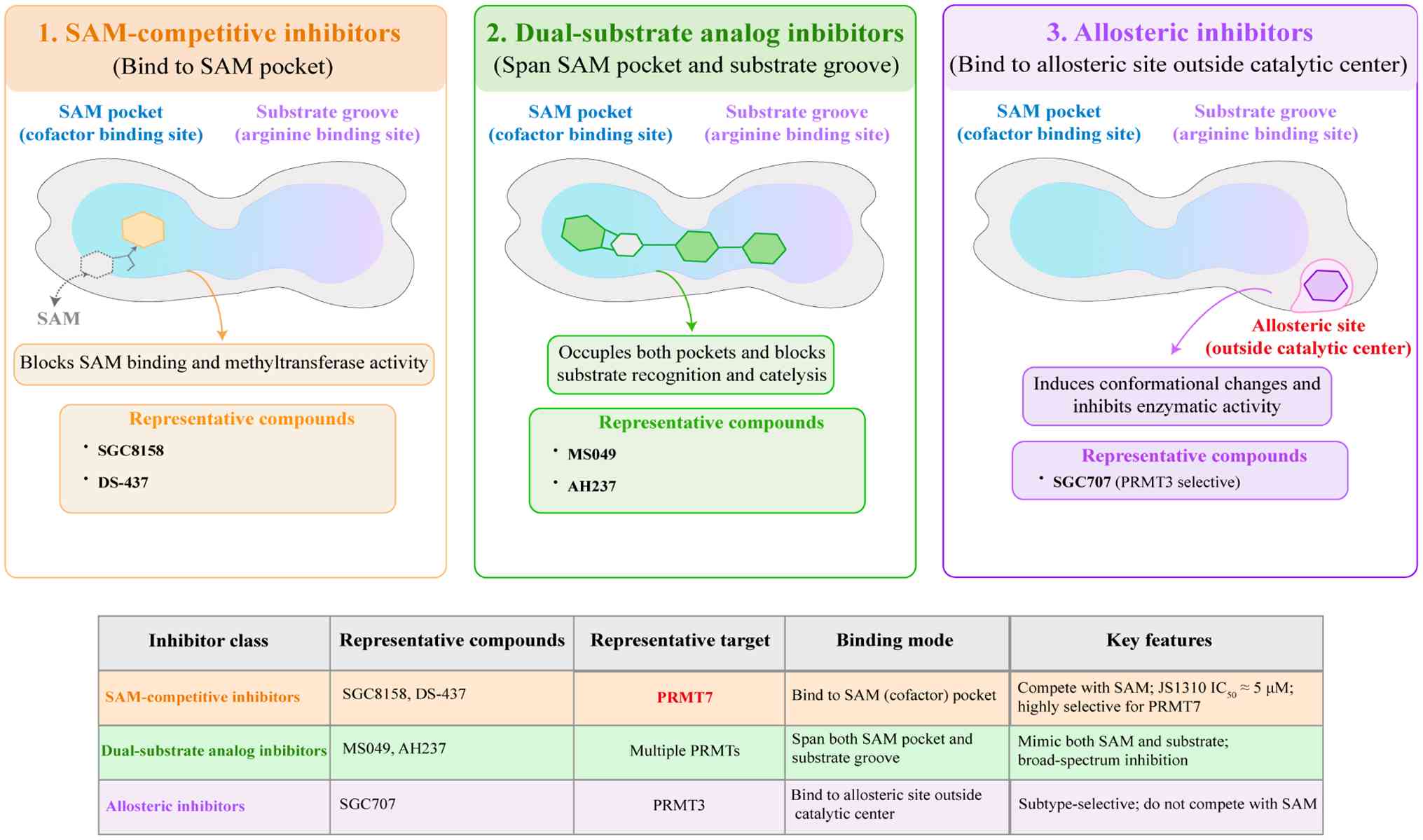
From a medicinal chemistry perspective, three major
small-molecule inhibition strategies targeting PRMTs have emerged
(Fig. 4). The first is
SAM-competitive inhibition, which remains the most common approach
because the cofactor pocket is well defined and structurally
conserved across PRMTs (5). The
second is substrate-competitive or bi-substrate-inspired
inhibition, in which compounds exploit features of both the
cofactor and peptide-binding regions to improve potency and isoform
preference (91). The third is
allosteric inhibition, exemplified by the PRMT3 probe SGC707, which
binds a site outside the catalytic center and achieves high
selectivity by exploiting isoform-specific conformational features
(92). This last strategy is
especially informative for PRMT7 because active-site conservation
across PRMT family members makes strict selectivity difficult to
achieve through SAM-pocket binding alone.
These precedents suggest two major lessons for PRMT7
inhibitor design. First, potency alone is insufficient; selectivity
and cellular permeability are equally critical, particularly for
SAM-mimetic compounds. Second, where active-site homology limits
selectivity, non-canonical binding modes, including extension into
adjacent substrate pockets or targeting less conserved
conformational features, may provide a more productive route. For
this reason, the detailed IC50 values, compound series
and structural classes of type I and type II inhibitors are better
summarized in Table III, while
the main text should focus on design logic rather than compound
enumeration.
| Table III.Comparative landscape of PRMT family
inhibitors highlighting the scarcity of PRMT7-targeting agents. |
Table III.
Comparative landscape of PRMT family
inhibitors highlighting the scarcity of PRMT7-targeting agents.
| First author/s,
year | PRMT Isoform |
Inhibitor/Compound | IC50
(Biochemical) |
Notes/Selectivity | (Refs.) |
|---|
| Zhao et al,
2023 | PRMT1 | ZJG51, ZJG58 | ~11.8 µM
(ZJG51) | Selective vs.
PRMT5; strong antiproliferative activity in 4 cancer cell lines;
ZJG51 relatively selective to HeLa | (69) |
| Wang et al,
2022 | PRMT1 | WCJ-394 | 1.21 µM | Most potent in
series; inhibits TGF-β1-induced epithelial-mesenchymal transition
and migration in A549 cells | (73) |
| Kim et al,
2020 | PRMT1 | TC-E 5003 | 1.5 µM | Selective; reduces
LPS-induced NO production and inflammatory gene expression | (74) |
| Cura et al,
2016 | PRMT2 | Cp1 | 16.3±3.8 µM | First synthetic
PRMT2 inhibitor; slightly more potent than SAH | (75) |
| Kaniskan et
al, 2015; de Jong et al, 2022 | PRMT3 | SGC707 | 31±2 nM (KD =53±2
nM) | First potent,
selective, cell-active allosteric PRMT3 chemical probe | (76,92) |
| Liu et al,
2013 | PRMT3 | 14u | 0.48 µM | Allosteric,
non-competitive with substrate and cofactor | (77) |
| Kaniskan et
al, 2018 | PRMT3 | 29, 30, 36 | Low nM range
(potent) | Highly potent
steroid-based allosteric inhibitors; cell-active; 49–51 as negative
controls | (78) |
| Nakayama et
al, 2018 | PRMT4 | TP-064 | <10 nM (enzyme);
43±10 nM (MED12); 340±30 nM (BAF155) | Potent, selective,
cell-active chemical probe; inhibits myeloma proliferation | (79) |
| Shen et al,
2016 | PRMT4/PRMT6 | MS049 | 34 nM (PRMT4); 43
nM (PRMT6) | Potent, selective,
cell-active dual inhibitor | (91) |
| Guo et al,
2019 | PRMT4 | 49 (tetrahydr
oisoquinoline) | Potent (in
vivo) | Significant
antitumor efficacy in AML xenograft model (oral) | (80) |
| Al-Hamashi et
al, 2020 | PRMT4/PRMT5 | AH237 | 2.8 nM (PRMT4);
0.42 nM (PRMT5) | Bisubstrate
analogue; high selectivity vs. >40 methyltransferases | (81) |
| Brehmer et
al, 2021 | PRMT5 | JNJ-64619178
(Onametostat) | 0.14 nM | Clinical-stage;
long-duration inhibition | (68) |
| Liu et al,
2021; Wang et al, 2018 | PRMT5 | EPZ015666 | 22 nM | Widely used tool
compound; antitumor effects in glioblastoma and bladder cancer | (82,83) |
| Bonday et
al, 2018 | PRMT5 | LLY-283 | 22±3 nM (in
vitro); 25±1 nM (cellular) | Selective;
antitumor activity in xenografts | (84) |
| Zhu et al,
2018 | PRMT5 | 4b14 | 2.71±0.21 µM | Induces cell-cycle
arrest and apoptosis in leukemia/lymphoma cells | (85) |
| Chen et al,
2024 | PRMT5 | A2, A8 | Stronger than
JNJ-64619178 (AlphaLISA) | Novel nucleoside
scaffold | (86) |
| Shen et al,
2021 | PRMT6 | (R)-2
(SGC6870) | 77±6 nM | Highly selective
allosteric inhibitor; (S)-2 inactive as negative control | (87) |
| Shen et al,
2020 | PRMT6 | MS117 | 18 nM
(time-dependent) | First potent,
cell-active irreversible covalent inhibitor | (88) |
| Zhang et al,
2023 | PRMT6 | a25 | Potent (nM
range) | >25-fold
selective vs. PRMT1/8; >50-fold vs. PRMT3/4/5/7; induces
apoptosis | (89) |
| Smil et al,
2015 | PRMT5/PRMT7 | DS-437 | 6 µM (both) | Dual inhibitor;
inactive against 29 other MTases | (93) |
| Liu et al,
2022; Nicot et al, 2022 | PRMT7 | JS1310 | 5 µM | Highly selective
vs. Type I PRMTs and PRMT5; eliminates leukemia stem cells without
affecting normal hematopoietic stem cells | (24,96) |
| Szewczyk et
al, 2020 | PRMT7 | SGC8158 (active
form of SGC3027) | ~294 nM (HSPA8);
<2.5 nM optimized | SAM-competitive;
broad anti-proliferative activity including MDR cells | (14,95) |
| Smil et al,
2015 | PRMT7 | EPZ004777 | 7.5±0.5 µM | Also inhibits PRMT5
(500 nM) and DOT1L | (93) |
| Liu et al,
2018 | PRMT7 | V009-0749 | Potent
(cellular) | Virtual screening
hit; reduces H4R3me2s and induces G1 arrest/apoptosis | (99) |
| Li et al,
2025 | PRMT7 | A33 | 0.50 µM | No inhibition of
other tested PRMTs at IC50 >100 µM | (98) |
| Feoli et al,
2023 | PRMT7/PRMT9 | EML734 (compound
1a) | 0.32 µM (PRMT7)
0.89 µM (PRMT9) | First reported dual
PRMT7/PRMT9 inhibitor; Displays weaker activity against other
tested PRMT family members | (97) |
| Feoli et al,
2023 | PRMT7/PRMT9 | EML1102 (compound
1i) | 0.54 µM (PRMT7)
2.47 µM (PRMT9) | Shorter homolog of
EML734; For other PRMTs, inhibition was weak or absent | (97) |
Emerging PRMT7 inhibitors and why
PRMT7 is harder to drug
Compared with type I PRMTs and PRMT5, the PRMT7
inhibitor landscape is still sparse. The first widely used scaffold
in this area was DS-437, an early dual PRMT5/PRMT7 inhibitor
derived from SAM-inspired design (93). DS-437 behaves as a
cofactor-competitive inhibitor and inhibits both PRMT5 and PRMT7
with micromolar potency, illustrating that the conserved cofactor
pocket can be exploited pharmacologically, but also underscoring
the selectivity problem: Compounds that bind this region often
struggle to discriminate PRMT7 from other PRMT family members
(93). Nonetheless, DS-437 remains
conceptually important because it raised the possibility that dual
PRMT5/7 blockade may be therapeutically useful in settings where
both enzymes contribute to malignant phenotypes (93,94).
A major advance came with the development of
SGC8158, together with its cell-permeable prodrug SGC3027 (14). SGC8158 is a potent SAM-competitive
PRMT7 inhibitor, whereas SGC3027 was designed to overcome the poor
cellular permeability typical of SAM-like molecules by releasing
SGC8158 intracellularly (14). This
probe pair provided the first robust pharmacological system for
studying PRMT7 catalysis in cells and demonstrated that PRMT7
inhibition reduces methylation of HSP70 family substrates and
compromises tolerance to proteotoxic stress (14). The SGC3027/SGC8158 platform
therefore established not only chemical tractability, but also a
clear link between PRMT7 catalytic activity, substrate methylation,
and stress adaptation in living cells (14,95).
More recently, the development of JS1310, a
selective small-molecule PRMT7 inhibitor, provided pharmacological
evidence supporting PRMT7 as a potential therapeutic target in LSCs
(24). In that context, PRMT7
inhibition selectively impairs LSC survival while sparing normal
HSCs, consistent with a PRMT7-dependent program involving metabolic
adaptation rather than universal cytotoxicity (24,96).
This is important conceptually because it suggests that PRMT7
inhibitors may be most effective when deployed against
state-specific dependencies, such as stemness, stress resistance,
or metabolic rewiring, rather than as broad-spectrum
antiproliferative agents alone.
Recent medicinal chemistry efforts have also begun
to move beyond the earliest PRMT7 probes. A first potent PRMT7/9
inhibitor with a defined binding mode was reported in 2023,
indicating that carefully designed compounds can span both the
cofactor and substrate regions to exploit features not captured by
simple SAM mimetics (97). In 2025,
a newer selective PRMT7 inhibitor, A33, was reported with antitumor
activity in PC models, suggesting that PRMT7 inhibitor development
is now entering a more optimization-driven stage rather than
remaining limited to proof-of-concept probes (98,99).
Several factors likely explain why PRMT7 inhibitors
remain markedly less numerous than PRMT5 inhibitors. First, the
SAM-binding pocket of PRMT7 is homologous to that of other PRMTs,
which makes active-site selectivity intrinsically difficult
(14,93). Second, PRMT7 has an unusual tandem
double-module architecture and a comparatively distinctive
substrate-recognition surface, meaning that classical inhibitor
templates developed for dimeric type I/II enzymes do not always
translate efficiently (23,29). Third, until the appearance of
SGC8158/SGC3027, the field lacked a strong cell-active probe, which
slowed target validation and medicinal chemistry iteration
(14). Finally, PRMT7 biology has
historically been less extensively mapped than PRMT5 biology,
reducing the availability of robust pharmacodynamic biomarkers and
disease settings for rapid compound testing (23,68).
Taken together, experience from type I and type II
PRMT inhibitors suggests that future PRMT7 drug discovery will
likely benefit from three complementary strategies: Improving
SAM-pocket binders for permeability and selectivity, exploiting
substrate-adjacent or dual-pocket binding modes, and considering
rational dual-target approaches such as PRMT5/7 co-inhibition when
tumor biology supports it. In this sense, the challenge of PRMT7 is
not simply that it is a type III enzyme, but that its catalytic
conservation and structural uniqueness coexist in a way that makes
conventional inhibitor design only partially transferable from
other PRMT family members.
Clinical translation opportunities and
challenges
Although PRMT7-targeted therapies remain in the
early stages of development, accumulating mechanistic evidence
suggests several potential opportunities for clinical translation.
Given the context-dependent functions of PRMT7 across tumor types,
a major challenge and opportunity will be the identification of
tumor subsets that exhibit particular dependency on PRMT7
activity.
Tumors characterized by PRMT7-dependent biological
programs may represent potential candidates for PRMT7-targeted
intervention. For example, leukemia models have demonstrated a
functional requirement for PRMT7 in LSC maintenance through the
regulation of glycine metabolism, suggesting that tumors relying on
PRMT7-associated stem-cell programs may represent a potential
therapeutic setting (24). In
addition, PRMT7 inhibition may be particularly relevant in tumors
with immune-evasive phenotypes, as PRMT7 loss enhances antitumor
immune responses and improves sensitivity to ICB in melanoma and BC
models (25,61). Furthermore, PRMT7 has been
implicated in PC progression and metastasis, while NUDT21-dependent
alternative polyadenylation has been associated with enzalutamide
resistance, suggesting that PRMT7-related pathways may warrant
further investigation in therapy-resistant PC (57–59).
However, these potential indications remain largely based on
preclinical evidence and require validation in clinically relevant
models.
The development of predictive biomarkers will be
essential for effective patient selection (5). Potential biomarkers for patient
stratification remain an important unmet need. PRMT7 expression,
PRMT7-dependent cellular states such as stem-cell-associated
programs, and immune-related features including T-cell infiltration
patterns represent candidate biomarkers that warrant investigation
(18,24,25,52).
However, none of these biomarkers have been clinically validated to
predict response to PRMT7-targeted therapies.
Combination strategies represent another potential
avenue for PRMT7-targeted therapy. The functional interaction
between PRMT7 and other PRMT family members, particularly the
PRMT7-PRMT5 histone methylation relay, provides a mechanistic
rationale for investigating combinations targeting multiple
arginine methylation pathways (10). However, whether combined inhibition
of PRMT7 and other PRMTs produces therapeutic synergy remains to be
determined. A stronger translational rationale currently exists for
combining PRMT7 inhibition with ICB, as PRMT7 loss enhances tumor
immunogenicity and improves responses to checkpoint inhibitors in
preclinical models (25).
Despite these opportunities, several challenges
must be addressed before clinical translation of PRMT7-targeted
therapies. First, the biological effects of PRMT7 are highly
context dependent, with both tumor-promoting and tumor-suppressive
roles reported across different cancer types, highlighting the need
for precise patient stratification. Second, the lack of validated
pharmacodynamic biomarkers currently limits the assessment of
target engagement and therapeutic response. Third, the
physiological functions of PRMT7 in normal tissues require further
investigation to define an appropriate therapeutic window.
Therefore, future development of PRMT7-targeted therapies will
require selective inhibitors, biomarker-guided patient selection,
and rational combination strategies.
Conclusions and future perspectives
PRMT7 has emerged as a distinctive and
context-dependent regulator in cancer. As the only type III PRMT in
mammals, it catalyzes arginine monomethylation and exerts
biological effects that differ in important ways from those of type
I and type II PRMTs (29,35,54).
Accumulating evidence indicates that PRMT7 regulates multiple
cancer-associated processes, including EMT, stemness maintenance,
stress adaptation, metabolic regulation and tumor immunity. Its
functional output is determined by the interplay between substrate
availability, interactions with other PRMT family members and
epigenetic regulators, and the cellular and TME context. These
context-dependent regulatory features may explain why PRMT7
predominantly exhibits tumor-promoting functions across nu cancer
types, while a potential tumor-suppressive role has also been
reported in GC. Collectively, current evidence establishes PRMT7 as
an important regulator of cancer biology with distinctive
mechanistic characteristics and potential therapeutic
relevance.
An important future direction is the development of
combination strategies based on the immunoregulatory functions of
PRMT7 (100). It has been recently
suggested that PRMT7 inhibition can enhance tumor immunogenicity by
promoting interferon signaling, antigen presentation, chemokine
expression and immune-cell infiltration (25). These observations provide a
rationale for combining PRMT7 inhibitors with ICB, particularly
PD-1/PD-L1-directed therapies, to overcome immune evasion and
improve antitumor responses in selected cancers (101).
At the same time, progress in this field will
require a deeper structural understanding of PRMT7. Most current
mechanistic models rely on catalytic-domain analysis and
peptide-based substrates, whereas substrate recognition in cells is
likely to be strongly influenced by full-length protein
conformation and dynamic molecular context. Additional structures
of PRMT7 in complex with full-length substrates or
substrate-containing assemblies will therefore be essential for
clarifying its catalytic specificity, substrate selectivity, and
opportunities for rational inhibitor design.
These unresolved mechanistic questions are closely
related to the current barriers to clinical translation. In
contrast to PRMT5 and some type I PRMT inhibitors, no PRMT7
inhibitor has yet entered clinical trials (102). The main
bottlenecks likely include limited isoform selectivity, suboptimal
bioavailability, insufficient pharmacodynamic biomarkers, and
uncertainty regarding toxicity and therapeutic window in different
tumor settings. Addressing these challenges through integrated
advances in cancer biology, structural biology and medicinal
chemistry will be critical for moving PRMT7-targeted strategies
toward clinical application.
Acknowledgements
Not applicable.
Funding
Funding: No funding was received.
Availability of data and materials
Not applicable.
Authors' contributions
YHe conceived the study, determined the overall
framework of the review, coordinated the collaboration among all
authors, integrated the manuscript content, and drafted the final
version of the manuscript. JL conducted the literature search and
analysis on the PRMT family, and was primarily responsible for
summarizing the structural characteristics, biological functions,
and tumor-related roles of PRMT7 in selected cancers. YHu performed
the literature search and critical review on PRMT7 in multiple
tumor types and the development of PRMT inhibitors and contributed
to the sections on therapeutic targeting and future perspectives.
WD prepared the tables, figures, and visual summaries, participated
in data organization, and assisted in manuscript design and
presentation. XC revised the manuscript for language, formatting,
and logical flow, and contributed to the literature collection and
writing of the section related to PRMT7 and melanoma immunotherapy.
All authors read and approved the final version of the manuscript.
Data authentication is not applicable.
Ethics approval and consent to
participate
Not applicable.
Patient consent for publication
Not applicable.
Competing interests
The authors declare that they have no competing
interests.
Glossary
Abbreviations
Abbreviations:
|
PRMT7
|
protein arginine methyltransferase
7
|
|
MMA
|
monomethyl-arginine
|
|
T-ALL
|
T-cell acute lymphoblastic
leukemia
|
|
CML
|
chronic myeloid leukemia
|
|
EMT
|
epithelial-mesenchymal transition
|
|
NSCLC
|
non-small-cell lung cancer
|
|
HCC
|
hepatocellular carcinoma
|
References
|
1
|
Bedford MT and Clarke SG: Protein arginine
methylation in mammals: Who, what, and why. Mol Cell. 33:1–13.
2009. View Article : Google Scholar : PubMed/NCBI
|
|
2
|
Fuhrmann J, Clancy KW and Thompson PR:
Chemical biology of protein arginine modifications in epigenetic
regulation. Chem Rev. 115:5413–5461. 2015. View Article : Google Scholar : PubMed/NCBI
|
|
3
|
Bedford MT and Richard S: Arginine
methylation an emerging regulator of protein function. Mol Cell.
18:263–272. 2005. View Article : Google Scholar : PubMed/NCBI
|
|
4
|
Guccione E and Richard S: The regulation,
functions and clinical relevance of arginine methylation. Nat Rev
Mol Cell Biol. 20:642–657. 2019. View Article : Google Scholar : PubMed/NCBI
|
|
5
|
Hwang JW, Cho Y, Bae GU, Kim SN and Kim
YK: Protein arginine methyltransferases: Promising targets for
cancer therapy. Exp Mol Med. 53:788–808. 2021. View Article : Google Scholar : PubMed/NCBI
|
|
6
|
Blanc RS and Richard S: Arginine
methylation: The coming of age. Mol Cell. 65:8–24. 2017. View Article : Google Scholar : PubMed/NCBI
|
|
7
|
Morales Y, Caceres T, May K and Hevel JM:
Biochemistry and regulation of the protein arginine
methyltransferases (PRMTs). Arch Biochem Biophys. 590:138–152.
2016. View Article : Google Scholar : PubMed/NCBI
|
|
8
|
Debler EW, Jain K, Warmack RA, Feng Y,
Clarke SG, Blobel G and Stavropoulos P: A glutamate/aspartate
switch controls product specificity in a protein arginine
methyltransferase. Proc Natl Acad Sci USA. 113:2068–2073. 2016.
View Article : Google Scholar : PubMed/NCBI
|
|
9
|
Feng Y, Hadjikyriacou A and Clarke SG:
Substrate specificity of human protein arginine methyltransferase 7
(PRMT7): The importance of acidic residues in the double E loop. J
Biol Chem. 289:32604–32616. 2014. View Article : Google Scholar : PubMed/NCBI
|
|
10
|
Jain K, Jin CY and Clarke SG: Epigenetic
control via allosteric regulation of mammalian protein arginine
methyltransferases. Proc Natl Acad Sci USA. 114:10101–10106. 2017.
View Article : Google Scholar : PubMed/NCBI
|
|
11
|
Al-Hamashi AA, Diaz K and Huang R:
Non-Histone arginine methylation by protein arginine
methyltransferases. Curr Protein Pept Sci. 21:699–712. 2020.
View Article : Google Scholar : PubMed/NCBI
|
|
12
|
Zhang F, Kerbl-Knapp J, Rodriguez Colman
MJ, Meinitzer A, Macher T, Vujic N, Fasching S, Jany-Luig E,
Korbelius M, Kuentzel KB, et al: Global analysis of protein
arginine methylation. Cell Rep Methods. 1:1000162021. View Article : Google Scholar : PubMed/NCBI
|
|
13
|
Li WJ, He YH, Yang JJ, Hu GS, Lin YA, Ran
T, Peng BL, Xie BL, Huang MF, Gao X, et al: Profiling PRMT
methylome reveals roles of hnRNPA1 arginine methylation in RNA
splicing and cell growth. Nat Commun. 12:19462021. View Article : Google Scholar : PubMed/NCBI
|
|
14
|
Szewczyk MM, Ishikawa Y, Organ S, Sakai N,
Li F, Halabelian L, Ackloo S, Couzens AL, Eram M, Dilworth D, et
al: Pharmacological inhibition of PRMT7 links arginine
monomethylation to the cellular stress response. Nat Commun.
11:23962020. View Article : Google Scholar : PubMed/NCBI
|
|
15
|
Haghandish N, Baldwin RM, Morettin A,
Dawit HT, Adhikary H, Masson JY, Mazroui R, Trinkle-Mulcahy L and
Cote J: PRMT7 methylates eukaryotic translation initiation factor
2α and regulates its role in stress granule formation. Mol Biol
Cell. 30:778–793. 2019. View Article : Google Scholar : PubMed/NCBI
|
|
16
|
Liu L, Zhang X, Ding H, Liu X, Cao D, Liu
Y, Liu J, Lin C, Zhang N, Wang G, et al: Arginine and lysine
methylation of MRPS23 promotes breast cancer metastasis through
regulating OXPHOS. Oncogene. 40:3548–3563. 2021. View Article : Google Scholar : PubMed/NCBI
|
|
17
|
Yang Y and Bedford MT: Protein arginine
methyltransferases and cancer. Nat Rev Cancer. 13:37–50. 2013.
View Article : Google Scholar : PubMed/NCBI
|
|
18
|
Baldwin RM, Haghandish N, Daneshmand M,
Amin S, Paris G, Falls TJ, Bell JC, Islam S and Cote J: Protein
arginine methyltransferase 7 promotes breast cancer cell invasion
through the induction of MMP9 expression. Oncotarget. 6:3013–3032.
2015. View Article : Google Scholar : PubMed/NCBI
|
|
19
|
Wang B, Zhang M, Liu Z, Mu Y and Li K:
PRMT7: A pivotal arginine methyltransferase in stem cells and
development. Stem Cells Int. 2021:62416002021. View Article : Google Scholar : PubMed/NCBI
|
|
20
|
Chen TY, Lee SH, Dhar SS and Lee MG:
Protein arginine methyltransferase 7-mediated microRNA-221
repression maintains Oct4, Nanog, and Sox2 levels in mouse
embryonic stem cells. J Biol Chem. 293:3925–3936. 2018. View Article : Google Scholar : PubMed/NCBI
|
|
21
|
Lee SH, Chen TY, Dhar SS, Gu B, Chen K,
Kim YZ, Li W and Lee MG: A feedback loop comprising PRMT7 and
miR-24-2 interplays with Oct4, Nanog, Klf4 and c-Myc to regulate
stemness. Nucleic Acids Res. 44:10603–10618. 2016. View Article : Google Scholar : PubMed/NCBI
|
|
22
|
Jain K and Clarke SG: PRMT7 as a unique
member of the protein arginine methyltransferase family: A review.
Arch Biochem Biophys. 665:36–45. 2019. View Article : Google Scholar : PubMed/NCBI
|
|
23
|
Halabelian L and Barsyte-Lovejoy D:
Structure and function of protein arginine methyltransferase PRMT7.
Life (Basel). 11:7682021.PubMed/NCBI
|
|
24
|
Liu C, Zou W, Nie D, Li S, Duan C, Zhou M,
Lai P, Yang S, Ji S, Li Y, et al: Loss of PRMT7 reprograms glycine
metabolism to selectively eradicate leukemia stem cells in CML.
Cell Metab. 34:818–835. e72022. View Article : Google Scholar : PubMed/NCBI
|
|
25
|
Srour N, Villarreal OD, Hardikar S, Yu Z,
Preston S, Miller WH Jr, Szewczyk MM, Barsyte-Lovejoy D, Xu H, Chen
T, et al: PRMT7 ablation stimulates anti-tumor immunity and
sensitizes melanoma to immune checkpoint blockade. Cell Rep.
38:1105822022. View Article : Google Scholar : PubMed/NCBI
|
|
26
|
Yang GJ, Liu YJ, Chen RY, Shi JJ, Li CY,
Wang R, Yu J, Lu JF, Zhang LL, Yu B and Chen J: PRMT7 in cancer:
Structure, effects, and therapeutic potentials. Eur J Med Chem.
283:1171032025. View Article : Google Scholar : PubMed/NCBI
|
|
27
|
Gros L, Delaporte C, Frey S, Decesse J, de
Saint-Vincent BR, Cavarec L, Dubart A, Gudkov AV and
Jacquemin-Sablon A: Identification of new drug sensitivity genes
using genetic suppressor elements: Protein arginine
N-methyltransferase mediates cell sensitivity to DNA-damaging
agents. Cancer Res. 63:164–171. 2003.PubMed/NCBI
|
|
28
|
Gros L, Renodon-Corniere A, de Saint
Vincent BR, Feder M, Bujnicki JM and Jacquemin-Sablon A:
Characterization of prmt7alpha and beta isozymes from Chinese
hamster cells sensitive and resistant to topoisomerase II
inhibitors. Biochim Biophys Acta. 1760:1646–1656. 2006. View Article : Google Scholar : PubMed/NCBI
|
|
29
|
Cura V, Troffer-Charlier N, Wurtz JM,
Bonnefond L and Cavarelli J: Structural insight into arginine
methylation by the mouse protein arginine methyltransferase 7: A
zinc finger freezes the mimic of the dimeric state into a single
active site. Acta Crystallogr D Biol Crystallogr. 70((Pt 9)):
2401–2412. 2014. View Article : Google Scholar : PubMed/NCBI
|
|
30
|
Zhang X and Cheng X: Structure of the
predominant protein arginine methyltransferase PRMT1 and analysis
of its binding to substrate peptides. Structure. 11:509–520. 2003.
View Article : Google Scholar : PubMed/NCBI
|
|
31
|
Tewary SK, Zheng YG and Ho MC: Protein
arginine methyltransferases: Insights into the enzyme structure and
mechanism at the atomic level. Cell Mol Life Sci. 76:2917–2932.
2019. View Article : Google Scholar : PubMed/NCBI
|
|
32
|
Hasegawa M, Toma-Fukai S, Kim JD, Fukamizu
A and Shimizu T: Protein arginine methyltransferase 7 has a novel
homodimer-like structure formed by tandem repeats. FEBS Lett.
588:1942–1948. 2014. View Article : Google Scholar : PubMed/NCBI
|
|
33
|
Feng Y, Maity R, Whitelegge JP,
Hadjikyriacou A, Li Z, Zurita-Lopez C, Al-Hadid Q, Clark AT,
Bedford MT, Masson JY and Clarke SG: Mammalian protein arginine
methyltransferase 7 (PRMT7) specifically targets RXR sites in
lysine- and arginine-rich regions. J Biol Chem. 288:37010–37025.
2013. View Article : Google Scholar : PubMed/NCBI
|
|
34
|
Bondoc TJ, Lowe TL and Clarke SG: The
exquisite specificity of human protein arginine methyltransferase 7
(PRMT7) toward Arg-X-Arg sites. PLoS One. 18:e02858122023.
View Article : Google Scholar : PubMed/NCBI
|
|
35
|
Zurita-Lopez CI, Sandberg T, Kelly R and
Clarke SG: Human protein arginine methyltransferase 7 (PRMT7) is a
type III enzyme forming ω-NG-monomethylated arginine residues. J
Biol Chem. 287:7859–7870. 2012. View Article : Google Scholar : PubMed/NCBI
|
|
36
|
Sauter C, Morin T, Guidez F, Simonet J,
Fournier C, Row C, Masnikov D, Pernon B, Largeot A, Aznague A, et
al: Protein arginine methyltransferase 2 controls inflammatory
signaling in acute myeloid leukemia. Commun Biol. 7:7532024.
View Article : Google Scholar : PubMed/NCBI
|
|
37
|
Karkhanis V, Wang L, Tae S, Hu YJ,
Imbalzano AN and Sif S: Protein arginine methyltransferase 7
regulates cellular response to DNA damage by methylating promoter
histones H2A and H4 of the polymerase δ catalytic subunit gene,
POLD1. J Biol Chem. 287:29801–29814. 2012. View Article : Google Scholar : PubMed/NCBI
|
|
38
|
Wang Y, Wysocka J, Sayegh J, Lee YH,
Perlin JR, Leonelli L, Sonbuchner LS, McDonald CH, Cook RG, Dou Y,
et al: Human PAD4 regulates histone arginine methylation levels via
demethylimination. Science. 306:279–283. 2004. View Article : Google Scholar : PubMed/NCBI
|
|
39
|
Cuthbert GL, Daujat S, Snowden AW,
Erdjument-Bromage H, Hagiwara T, Yamada M, Schneider R, Gregory PD,
Tempst P, Bannister AJ and Kouzarides T: Histone deimination
antagonizes arginine methylation. Cell. 118:545–553. 2004.
View Article : Google Scholar : PubMed/NCBI
|
|
40
|
Chang B, Chen Y, Zhao Y and Bruick RK:
JMJD6 is a histone arginine demethylase. Science. 318:444–447.
2007. View Article : Google Scholar : PubMed/NCBI
|
|
41
|
Webby CJ, Wolf A, Gromak N, Dreger M,
Kramer H, Kessler B, Nielsen ML, Schmitz C, Butler DS, Yates JR
III, et al: Jmjd6 catalyses lysyl-hydroxylation of U2AF65, a
protein associated with RNA splicing. Science. 325:90–93. 2009.
View Article : Google Scholar : PubMed/NCBI
|
|
42
|
Walport LJ, Hopkinson RJ, Chowdhury R,
Schiller R, Ge W, Kawamura A and Schofield CJ: Arginine
demethylation is catalysed by a subset of JmjC histone lysine
demethylases. Nat Commun. 7:119742016. View Article : Google Scholar : PubMed/NCBI
|
|
43
|
Gunes Gunsel G, Conlon TM, Jeridi A, Kim
R, Ertuz Z, Lang NJ, Ansari M, Novikova M, Jiang D, Strunz M, et
al: The arginine methyltransferase PRMT7 promotes extravasation of
monocytes resulting in tissue injury in COPD. Nat Commun.
13:13032022. View Article : Google Scholar : PubMed/NCBI
|
|
44
|
Shen T, Ni T, Chen J, Chen H, Ma X, Cao G,
Wu T, Xie H, Zhou B, Wei G, et al: An enhancer variant at 16q22.1
predisposes to hepatocellular carcinoma via regulating PRMT7
expression. Nat Commun. 13:12322022. View Article : Google Scholar : PubMed/NCBI
|
|
45
|
Wang L, Li X, Zhang W, Yang Y, Meng Q,
Wang C, Xin X, Jiang X, Song S, Lu Y, et al: miR24-2 promotes
malignant progression of human liver cancer stem cells by enhancing
tyrosine kinase src epigenetically. Mol Ther. 28:572–586. 2020.
View Article : Google Scholar : PubMed/NCBI
|
|
46
|
Geng P, Zhang Y, Liu X, Zhang N, Liu Y,
Liu X, Lin C, Yan X, Li Z, Wang G, et al: Automethylation of
protein arginine methyltransferase 7 and its impact on breast
cancer progression. FASEB J. 31:2287–2300. 2017. View Article : Google Scholar : PubMed/NCBI
|
|
47
|
Sauter C, Simonet J, Guidez F, Dumétier B,
Pernon B, Callanan M, Bastie JN, Aucagne R and Delva L: Protein
arginine methyltransferases as therapeutic targets in hematological
malignancies. Cancers (Basel). 14:54432022. View Article : Google Scholar : PubMed/NCBI
|
|
48
|
Oksa L, Makinen A, Nikkila A, Hyvarinen N,
Laukkanen S, Rokka A, Haapaniemi P, Seki M, Takita J, Kauko O, et
al: Arginine methyltransferase PRMT7 deregulates expression of
RUNX1 target genes in T-Cell acute lymphoblastic leukemia. Cancers
(Basel). 14:21692022. View Article : Google Scholar : PubMed/NCBI
|
|
49
|
Ying Z, Mei M, Zhang P, Liu C, He H, Gao F
and Bao S: Histone arginine methylation by PRMT7 controls germinal
center formation via regulating Bcl6 transcription. J Immunol.
195:1538–1547. 2015. View Article : Google Scholar : PubMed/NCBI
|
|
50
|
Yao R, Jiang H, Ma Y, Wang L, Wang L, Du
J, Hou P, Gao Y, Zhao L, Wang G, et al: PRMT7 induces
epithelial-to-mesenchymal transition and promotes metastasis in
breast cancer. Cancer Res. 74:5656–5667. 2014. View Article : Google Scholar : PubMed/NCBI
|
|
51
|
Cheng D, He Z, Zheng L, Xie D, Dong S and
Zhang P: PRMT7 contributes to the metastasis phenotype in human
non-small-cell lung cancer cells possibly through the interaction
with HSPA5 and EEF2. Onco Targets Ther. 11:4869–4876. 2018.
View Article : Google Scholar : PubMed/NCBI
|
|
52
|
Zhang L, Xiang J, Feng Y, Shen G, Huang X,
Fang T, Zhu Y, Ren H and Liu C: Protein arginine methyltransferase
7-mediated arginine mono-methylation stabilizes SRY-box
transcription factor 9 to promote non-small cell lung cancer
progression. Mol Biomed. 6:1482025. View Article : Google Scholar : PubMed/NCBI
|
|
53
|
Liao GB, Li XZ, Zeng S, Liu C, Yang SM,
Yang L, Hu CJ and Bai JY: Regulation of the master regulator FOXM1
in cancer. Cell Commun Signal. 16:572018. View Article : Google Scholar : PubMed/NCBI
|
|
54
|
He H, Chen J, Zhao J, Zhang P, Qiao Y, Wan
H, Wang J, Mei M, Bao S and Li Q: PRMT7 targets of Foxm1 controls
alveolar myofibroblast proliferation and differentiation during
alveologenesis. Cell Death Dis. 12:8412021. View Article : Google Scholar : PubMed/NCBI
|
|
55
|
Liu F, Wan L, Zou H, Pan Z, Zhou W and Lu
X: PRMT7 promotes the growth of renal cell carcinoma through
modulating the β-catenin/C-MYC axis. Int J Biochem Cell Biol.
120:1056862020. View Article : Google Scholar : PubMed/NCBI
|
|
56
|
Grypari IM, Pappa I, Papastergiou T,
Zolota V, Bravou V, Melachrinou M, Megalooikonomou V and Tzelepi V:
Elucidating the role of PRMTs in prostate cancer using open access
databases and a patient cohort dataset. Histol Histopathol.
38:287–302. 2023.PubMed/NCBI
|
|
57
|
Wan H, Zhou H, Gui J, Yang D, Wang R, Ni
J, Wu S, Qin Y, Qi Q, Zhu L, et al: Protein arginine
methyltransferase 7 regulates the cell cycle and promotes the
progression of prostate cancer. Oncol Lett. 30:5492025. View Article : Google Scholar : PubMed/NCBI
|
|
58
|
Rodrigo-Faus M, Vincelle-Nieto A, Vidal N,
Puente J, Saiz-Pardo M, Lopez-Garcia A, Mendiburu-Eliçabe M, Palao
N, Baquero C, Linzoain-Agos P, et al: CRISPR/Cas9 screenings
unearth protein arginine methyltransferase 7 as a novel essential
gene in prostate cancer metastasis. Cancer Lett. 588:2167762024.
View Article : Google Scholar : PubMed/NCBI
|
|
59
|
Lin SC, Tsai YC, Chen YL, Lin HK, Huang
YC, Lin YS, Cheng YS, Chen HY, Li CJ, Lin TY and Lin SC:
Un-methylation of NUDT21 represses docosahexaenoic acid
biosynthesis contributing to enzalutamide resistance in prostate
cancer. Drug Resist Updat. 77:1011442024. View Article : Google Scholar : PubMed/NCBI
|
|
60
|
Wang X, Xu W, Zhu C, Cheng Y and Qi J:
PRMT7 inhibits the proliferation and migration of gastric cancer
cells by suppressing the PI3K/AKT pathway via PTEN. J Cancer.
14:2833–2844. 2023. View Article : Google Scholar : PubMed/NCBI
|
|
61
|
Shi W, Luo Y, Wang Y, Burrows JM, Black D,
Civitarese A, Perlaza-Jimenez L, Zhang P, Manning M, Tuano N, et
al: CRISPR screens identify PRMT7 as a therapeutic target to
enhance T cell-mediated killing in breast cancer. NPJ Breast
Cancer. 12:242026. View Article : Google Scholar : PubMed/NCBI
|
|
62
|
Vuong TA, Jeong HJ, Lee HJ, Kim BG, Leem
YE, Cho H and Kang JS: PRMT7 methylates and suppresses GLI2 binding
to SUFU thereby promoting its activation. Cell Death Differ.
27:15–28. 2019. View Article : Google Scholar : PubMed/NCBI
|
|
63
|
Zhao Q, Rank G, Tan YT, Li H, Moritz RL,
Simpson RJ, Cerruti L, Curtis DJ, Patel DJ, Allis CD, et al:
PRMT5-mediated methylation of histone H4R3 recruits DNMT3A,
coupling histone and DNA methylation in gene silencing. Nat Struct
Mol Biol. 16:304–311. 2009. View Article : Google Scholar : PubMed/NCBI
|
|
64
|
Girardot M, Hirasawa R, Kacem S, Fritsch
L, Pontis J, Kota SK, Filipponi D, Fabbrizio E, Sardet C, Lohmann
F, et al: PRMT5-mediated histone H4 arginine-3 symmetrical
dimethylation marks chromatin at G + C-rich regions of the mouse
genome. Nucleic Acids Res. 42:235–248. 2014. View Article : Google Scholar : PubMed/NCBI
|
|
65
|
Hamard PJ, Santiago GE, Liu F, Karl DL,
Martinez C, Man N, Mookhtiar AK, Duffort S, Greenblatt S, Verdun RE
and Nimer SD: PRMT5 regulates DNA repair by controlling the
alternative splicing of histone-modifying enzymes. Cell Rep.
24:2643–2657. 2018. View Article : Google Scholar : PubMed/NCBI
|
|
66
|
O'Brien S, Butticello M, Thompson C,
Wilson B, Wyce A, Mahajan V, Kruger R, Mohammad H and Fedoriw A:
Inhibiting PRMT5 induces DNA damage and increases
anti-proliferative activity of Niraparib, a PARP inhibitor, in
models of breast and ovarian cancer. BMC Cancer. 23:7752023.
View Article : Google Scholar : PubMed/NCBI
|
|
67
|
Carter J, Hulse M, Sivakumar M, Burtell J,
Thodima V, Wang M, Agarwal A, Vykuntam K, Spruance J, Bhagwat N, et
al: PRMT5 inhibitors regulate DNA damage repair pathways in cancer
cells and improve response to PARP inhibition and chemotherapies.
Cancer Res Commun. 3:2233–2243. 2023. View Article : Google Scholar : PubMed/NCBI
|
|
68
|
Brehmer D, Beke L, Wu T, Millar HJ, Moy C,
Sun W, Mannens G, Pande V, Boeckx A, van Heerde E, et al: Discovery
and pharmacological characterization of JNJ-64619178, a novel
small-molecule inhibitor of PRMT5 with potent antitumor activity.
Mol Cancer Ther. 20:2317–2328. 2021. View Article : Google Scholar : PubMed/NCBI
|
|
69
|
Zhao Z, Zhang J, Ren Y, Dong L, Wu H, Hong
W, Huang H, Yang X, Pang Z and Wang H: Discovery of
2,4-diphenyl-substituted thiazole derivatives as PRMT1 inhibitors
and investigation of their anti-cervical cancer effects. Bioorg Med
Chem. 92:1174362023. View Article : Google Scholar : PubMed/NCBI
|
|
70
|
Feustel K and Falchook GS: Protein
arginine methyltransferase 5 (PRMT5) inhibitors in oncology
clinical trials: A review. J Immunother Precis Oncol. 5:58–67.
2022. View Article : Google Scholar : PubMed/NCBI
|
|
71
|
Ferrarotto R, Swiecicki PL, Zandberg DP,
Baiocchi RA, Wesolowski R, Rodriguez CP, McKean M, Kang H, Monga V,
Nath R, et al: PRT543, a protein arginine methyltransferase 5
inhibitor, in patients with advanced adenoid cystic carcinoma: An
open-label, phase I dose-expansion study. Oral Oncol.
149:1066342024. View Article : Google Scholar : PubMed/NCBI
|
|
72
|
Bewersdorf JP, Mi X, Lu B, Kuykendall A,
Sallman D, Patel M, Stevens D, Philipovskiy A, Sutamtewagul G,
Masarova L, et al: Phase Ib study of PRT543, an oral protein
arginine methyltransferase 5 (PRMT5) inhibitor, in patients with
advanced splicing factor-mutant myeloid malignancies. Leukemia.
39:765–769. 2025. View Article : Google Scholar : PubMed/NCBI
|
|
73
|
Wang C, Dong L, Zhao Z, Zhang Z, Sun Y, Li
C, Li G, You X, Yang X, Wang H and Hong W: Design and synthesis of
novel PRMT1 inhibitors and investigation of their effects on the
migration of cancer cell. Front Chem. 10:8887272022. View Article : Google Scholar : PubMed/NCBI
|
|
74
|
Kim E, Jang J, Park JG, Kim KH, Yoon K,
Yoo BC and Cho JY: Protein arginine methyltransferase 1 (PRMT1)
selective inhibitor, TC-E 5003, has anti-inflammatory properties in
TLR4 signaling. Int J Mol Sci. 21:30582020. View Article : Google Scholar : PubMed/NCBI
|
|
75
|
Cura V, Marechal N, Troffer-Charlier N,
Strub JM, van Haren MJ, Martin NI, Cianférani S, Bonnefond L and
Cavarelli J: Structural studies of protein arginine
methyltransferase 2 reveal its interactions with potential
substrates and inhibitors. FEBS J. 284:77–96. 2016. View Article : Google Scholar : PubMed/NCBI
|
|
76
|
de Jong LM, Zhang Z, den Hartog Y,
Sijsenaar TJP, Martins Cardoso R, Manson ML, Hankemeier T,
Lindenburg PW, Salvatori DCF, Van Eck M and Hoekstra M: PRMT3
inhibitor SGC707 reduces triglyceride levels and induces pruritus
in Western- type diet-fed LDL receptor knockout mice. Sci Rep.
12:4832022. View Article : Google Scholar : PubMed/NCBI
|
|
77
|
Liu F, Li F, Ma A, Dobrovetsky E, Dong A,
Gao C, Korboukh I, Liu J, Smil D, Brown PJ, et al: Exploiting an
allosteric binding site of PRMT3 yields potent and selective
inhibitors. J Med Chem. 56:2110–2124. 2013. View Article : Google Scholar : PubMed/NCBI
|
|
78
|
Kaniskan HÜ, Eram MS, Zhao K, Szewczyk MM,
Yang X, Schmidt K, Luo X, Xiao S, Dai M, He F, et al: Discovery of
potent and selective allosteric inhibitors of protein arginine
methyltransferase 3 (PRMT3). J Med Chem. 61:1204–1217. 2018.
View Article : Google Scholar : PubMed/NCBI
|
|
79
|
Nakayama K, Szewczyk MM, Dela Sena C, Wu
H, Dong A, Zeng H, Li F, de Freitas RF, Eram MS, Schapira M, et al:
TP-064, a potent and selective small molecule inhibitor of PRMT4
for multiple myeloma. Oncotarget. 9:18480–18493. 2018. View Article : Google Scholar : PubMed/NCBI
|
|
80
|
Guo Z, Zhang Z, Yang H, Cao D, Xu X, Zheng
X, Chen D, Wang Q, Li Y, Li J, et al: Design and synthesis of
potent, selective inhibitors of protein arginine methyltransferase
4 against acute myeloid leukemia. J Med Chem. 62:5414–5433. 2019.
View Article : Google Scholar : PubMed/NCBI
|
|
81
|
Al-Hamashi AA, Chen D, Deng Y, Dong G and
Huang R: Discovery of a potent and dual-selective bisubstrate
inhibitor for protein arginine methyltransferase 4/5. Acta Pharm
Sin B. 11:2709–2718. 2021. View Article : Google Scholar : PubMed/NCBI
|
|
82
|
Liu X, He J, Mao L, Zhang Y, Cui W, Duan
S, Jiang A, Gao Y, Sang Y and Huang G: EPZ015666, a selective
protein arginine methyltransferase 5 (PRMT5) inhibitor with an
antitumour effect in retinoblastoma. Exp Eye Res. 202:1082862021.
View Article : Google Scholar : PubMed/NCBI
|
|
83
|
Wang Y, Hu W and Yuan Y: Protein arginine
methyltransferase 5 (PRMT5) as an anticancer target and its
inhibitor discovery. J Med Chem. 61:9429–9441. 2018. View Article : Google Scholar : PubMed/NCBI
|
|
84
|
Bonday ZQ, Cortez GS, Grogan MJ,
Antonysamy S, Weichert K, Bocchinfuso WP, Li F, Kennedy S, Li B,
Mader MM, et al: LLY-283, a potent and selective inhibitor of
arginine methyltransferase 5, PRMT5, with antitumor activity. ACS
Med Chem Lett. 9:612–617. 2018. View Article : Google Scholar : PubMed/NCBI
|
|
85
|
Zhu K, Song JL, Tao HR, Cheng ZQ, Jiang CS
and Zhang H: Discovery of new potent protein arginine
methyltransferase 5 (PRMT5) inhibitors by assembly of key
pharmacophores from known inhibitors. Bioorg Med Chem Lett.
28:3693–3699. 2018. View Article : Google Scholar : PubMed/NCBI
|
|
86
|
Chen Y, Wang Z, Zhang J, Shi Q, Yang H,
Deng Y, Wang X, Liu T, Geng M, Xiong B and Huang X: Structure-based
discovery of a new series of nucleoside-derived ring-opening PRMT5
inhibitors. Eur J Med Chem. 267:1161712024. View Article : Google Scholar : PubMed/NCBI
|
|
87
|
Shen Y, Li F, Szewczyk MM, Halabelian L,
Chau I, Eram MS, Dela Seña C, Park KS, Meng F, Chen H, et al: A
first-in-class, highly selective and cell-active allosteric
inhibitor of protein arginine methyltransferase 6. J Med Chem.
64:3697–3706. 2021. View Article : Google Scholar : PubMed/NCBI
|
|
88
|
Shen Y, Li F, Szewczyk MM, Halabelian L,
Park KS, Chau I, Dong A, Zeng H, Chen H, Meng F, et al: Discovery
of a first-in-class protein arginine methyltransferase 6 (PRMT6)
covalent inhibitor. J Med Chem. 63:5477–5487. 2020. View Article : Google Scholar : PubMed/NCBI
|
|
89
|
Zhang Q, Cao J, Zhang Y, Bi Z, Feng Q, Yu
L and Li L: Design, synthesis and evaluation of antitumor activity
of selective PRMT6 inhibitors. Eur J Med Chem. 247:1150322023.
View Article : Google Scholar : PubMed/NCBI
|
|
90
|
Kaganovski A, Smith-Salzberg B, Shimshon
HK, Draheim A, Spivak M, Sapir T and Shifteh D: Current and
emerging therapies for targeting protein arginine
methyltransferases (PRMTs) in cancer. Int J Mol Sci. 26:79072025.
View Article : Google Scholar : PubMed/NCBI
|
|
91
|
Shen Y, Szewczyk MM, Eram MS, Smil D,
Kaniskan HÜ, de Freitas RF, Senisterra G, Li F, Schapira M, Brown
PJ, et al: Discovery of a potent, selective, and cell-active dual
inhibitor of protein arginine methyltransferase 4 and protein
arginine methyltransferase 6. J Med Chem. 59:9124–9139. 2016.
View Article : Google Scholar : PubMed/NCBI
|
|
92
|
Kaniskan HÜ, Szewczyk MM, Yu Z, Eram MS,
Yang X, Schmidt K, Luo X, Dai M, He F, Zang I, et al: A potent,
selective and cell-active allosteric inhibitor of protein arginine
methyltransferase 3 (PRMT3). Angew Chem Int Ed Engl. 54:5166–5170.
2015. View Article : Google Scholar : PubMed/NCBI
|
|
93
|
Smil D, Eram MS, Li F, Kennedy S, Szewczyk
MM, Brown PJ, Barsyte-Lovejoy D, Arrowsmith CH, Vedadi M and
Schapira M: Discovery of a dual PRMT5-PRMT7 inhibitor. ACS Med Chem
Lett. 6:408–412. 2015.Eram MS, Shen Y, Szewczyk M, Wu H, Senisterra
G, Li F, Butler KV, Kaniskan HU, Speed BA, Dela Seña C, et al: A
potent, selective, and cell-active inhibitor of human type I
protein arginine methyltransferases. ACS Chem Biol. 11:772–781.
2016. View Article : Google Scholar : PubMed/NCBI
|
|
94
|
Jeong A, Cho Y, Cho M, Bae GU, Song DG,
Kim SN and Kim YK: PRMT7 inhibitor SGC8158 enhances
doxorubicin-induced DNA damage and its cytotoxicity. Int J Mol Sci.
23:123232022. View Article : Google Scholar : PubMed/NCBI
|
|
95
|
Nicot C: PRMT7: A survive-or-die switch in
cancer stem cells. Mol Cancer. 21:1272022. View Article : Google Scholar : PubMed/NCBI
|
|
96
|
Feoli A, Iannelli G, Cipriano A, Milite C,
Shen L, Wang Z, Hadjikyriacou A, Lowe TL, Safaeipour C, Viviano M,
et al: Identification of a protein arginine methyltransferase 7
(PRMT7)/protein arginine methyltransferase 9 (PRMT9) inhibitor. J
Med Chem. 66:13665–13683. 2023. View Article : Google Scholar : PubMed/NCBI
|
|
97
|
Li J, Sun C, Zhang Y, Ding J, Yao P, Shen
H, Shi Z, Wang W, Zhu Y, Kuang W, et al: Development of novel PRMT7
inhibitors for the treatment of prostate cancer. J Med Chem.
68:8244–8268. 2025. View Article : Google Scholar : PubMed/NCBI
|
|
98
|
Liu L, Kai X, Chen Q, Zhang L, Yao R and
Gao J: Identification of protein arginine methyltransferase 7
(PRMT7) inhibitor by virtual screening and biological evaluation in
vitro. Med Chem Res. 28:125–132. 2018. View Article : Google Scholar
|
|
99
|
Fedoriw A, Shi L, O'Brien S, Smitheman KN,
Wang Y, Hou J, Sherk C, Rajapurkar S, Laraio J, Williams LJ, et al:
Inhibiting type I arginine methyltransferase activity promotes T
cell-mediated antitumor immune responses. Cancer Immunol Res.
10:420–436. 2022. View Article : Google Scholar : PubMed/NCBI
|
|
100
|
Gounder MM, Martin-Romano P, Italiano A,
Siu LL, Cassier PA, Falchook GS, Lossos IS, Rasco DW, Hilton JF,
McKean MA, et al: Phase Ib and dose-expansion study of GSK3326595,
a PRMT5 inhibitor as monotherapy and in combination with
pembrolizumab in patients with advanced cancers. Ann Oncol.
36:1480–1491. 2025. View Article : Google Scholar : PubMed/NCBI
|
|
101
|
El-Khoueiry AB, Clarke J, Neff T, Crossman
T, Ratia N, Rathi C, Noto P, Tarkar A, Garrido-Laguna I, Calvo E,
et al: Phase 1 study of GSK3368715, a type I PRMT inhibitor, in
patients with advanced solid tumors. Br J Cancer. 129:309–317.
2023. View Article : Google Scholar : PubMed/NCBI
|