Spandidos Publications Logo
  • About
    • About Spandidos
    • Aims and Scopes
    • Abstracting and Indexing
    • Editorial Policies
    • Reprints and Permissions
    • Job Opportunities
    • Terms and Conditions
    • Contact
  • Journals
    • All Journals
    • Oncology Letters
      • Oncology Letters
      • Information for Authors
      • Editorial Policies
      • Editorial Board
      • Aims and Scope
      • Abstracting and Indexing
      • Bibliographic Information
      • Archive
    • International Journal of Oncology
      • International Journal of Oncology
      • Information for Authors
      • Editorial Policies
      • Editorial Board
      • Aims and Scope
      • Abstracting and Indexing
      • Bibliographic Information
      • Archive
    • Molecular and Clinical Oncology
      • Molecular and Clinical Oncology
      • Information for Authors
      • Editorial Policies
      • Editorial Board
      • Aims and Scope
      • Abstracting and Indexing
      • Bibliographic Information
      • Archive
    • Experimental and Therapeutic Medicine
      • Experimental and Therapeutic Medicine
      • Information for Authors
      • Editorial Policies
      • Editorial Board
      • Aims and Scope
      • Abstracting and Indexing
      • Bibliographic Information
      • Archive
    • International Journal of Molecular Medicine
      • International Journal of Molecular Medicine
      • Information for Authors
      • Editorial Policies
      • Editorial Board
      • Aims and Scope
      • Abstracting and Indexing
      • Bibliographic Information
      • Archive
    • Biomedical Reports
      • Biomedical Reports
      • Information for Authors
      • Editorial Policies
      • Editorial Board
      • Aims and Scope
      • Abstracting and Indexing
      • Bibliographic Information
      • Archive
    • Oncology Reports
      • Oncology Reports
      • Information for Authors
      • Editorial Policies
      • Editorial Board
      • Aims and Scope
      • Abstracting and Indexing
      • Bibliographic Information
      • Archive
    • Molecular Medicine Reports
      • Molecular Medicine Reports
      • Information for Authors
      • Editorial Policies
      • Editorial Board
      • Aims and Scope
      • Abstracting and Indexing
      • Bibliographic Information
      • Archive
    • World Academy of Sciences Journal
      • World Academy of Sciences Journal
      • Information for Authors
      • Editorial Policies
      • Editorial Board
      • Aims and Scope
      • Abstracting and Indexing
      • Bibliographic Information
      • Archive
    • International Journal of Functional Nutrition
      • International Journal of Functional Nutrition
      • Information for Authors
      • Editorial Policies
      • Editorial Board
      • Aims and Scope
      • Abstracting and Indexing
      • Bibliographic Information
      • Archive
    • International Journal of Epigenetics
      • International Journal of Epigenetics
      • Information for Authors
      • Editorial Policies
      • Editorial Board
      • Aims and Scope
      • Abstracting and Indexing
      • Bibliographic Information
      • Archive
    • Medicine International
      • Medicine International
      • Information for Authors
      • Editorial Policies
      • Editorial Board
      • Aims and Scope
      • Abstracting and Indexing
      • Bibliographic Information
      • Archive
  • Articles
  • Information
    • Information for Authors
    • Information for Reviewers
    • Information for Librarians
    • Information for Advertisers
    • Conferences
  • Language Editing
Spandidos Publications Logo
  • About
    • About Spandidos
    • Aims and Scopes
    • Abstracting and Indexing
    • Editorial Policies
    • Reprints and Permissions
    • Job Opportunities
    • Terms and Conditions
    • Contact
  • Journals
    • All Journals
    • Biomedical Reports
      • Information for Authors
      • Editorial Policies
      • Editorial Board
      • Aims and Scope
      • Abstracting and Indexing
      • Bibliographic Information
      • Archive
    • Experimental and Therapeutic Medicine
      • Information for Authors
      • Editorial Policies
      • Editorial Board
      • Aims and Scope
      • Abstracting and Indexing
      • Bibliographic Information
      • Archive
    • International Journal of Epigenetics
      • Information for Authors
      • Editorial Policies
      • Editorial Board
      • Aims and Scope
      • Abstracting and Indexing
      • Bibliographic Information
      • Archive
    • International Journal of Functional Nutrition
      • Information for Authors
      • Editorial Policies
      • Editorial Board
      • Aims and Scope
      • Abstracting and Indexing
      • Bibliographic Information
      • Archive
    • International Journal of Molecular Medicine
      • Information for Authors
      • Editorial Policies
      • Editorial Board
      • Aims and Scope
      • Abstracting and Indexing
      • Bibliographic Information
      • Archive
    • International Journal of Oncology
      • Information for Authors
      • Editorial Policies
      • Editorial Board
      • Aims and Scope
      • Abstracting and Indexing
      • Bibliographic Information
      • Archive
    • Medicine International
      • Information for Authors
      • Editorial Policies
      • Editorial Board
      • Aims and Scope
      • Abstracting and Indexing
      • Bibliographic Information
      • Archive
    • Molecular and Clinical Oncology
      • Information for Authors
      • Editorial Policies
      • Editorial Board
      • Aims and Scope
      • Abstracting and Indexing
      • Bibliographic Information
      • Archive
    • Molecular Medicine Reports
      • Information for Authors
      • Editorial Policies
      • Editorial Board
      • Aims and Scope
      • Abstracting and Indexing
      • Bibliographic Information
      • Archive
    • Oncology Letters
      • Information for Authors
      • Editorial Policies
      • Editorial Board
      • Aims and Scope
      • Abstracting and Indexing
      • Bibliographic Information
      • Archive
    • Oncology Reports
      • Information for Authors
      • Editorial Policies
      • Editorial Board
      • Aims and Scope
      • Abstracting and Indexing
      • Bibliographic Information
      • Archive
    • World Academy of Sciences Journal
      • Information for Authors
      • Editorial Policies
      • Editorial Board
      • Aims and Scope
      • Abstracting and Indexing
      • Bibliographic Information
      • Archive
  • Articles
  • Information
    • For Authors
    • For Reviewers
    • For Librarians
    • For Advertisers
    • Conferences
  • Language Editing
Login Register Submit
  • This site uses cookies
  • You can change your cookie settings at any time by following the instructions in our Cookie Policy. To find out more, you may read our Privacy Policy.

    I agree
Search articles by DOI, keyword, author or affiliation
Search
Advanced Search
presentation
World Academy of Sciences Journal
Join Editorial Board Propose a Special Issue
Print ISSN: 2632-2900 Online ISSN: 2632-2919
Journal Cover
November-December 2020 Volume 2 Issue 6

Full Size Image

Sign up for eToc alerts
Recommend to Library

Journals

International Journal of Molecular Medicine

International Journal of Molecular Medicine

International Journal of Molecular Medicine is an international journal devoted to molecular mechanisms of human disease.

International Journal of Oncology

International Journal of Oncology

International Journal of Oncology is an international journal devoted to oncology research and cancer treatment.

Molecular Medicine Reports

Molecular Medicine Reports

Covers molecular medicine topics such as pharmacology, pathology, genetics, neuroscience, infectious diseases, molecular cardiology, and molecular surgery.

Oncology Reports

Oncology Reports

Oncology Reports is an international journal devoted to fundamental and applied research in Oncology.

Experimental and Therapeutic Medicine

Experimental and Therapeutic Medicine

Experimental and Therapeutic Medicine is an international journal devoted to laboratory and clinical medicine.

Oncology Letters

Oncology Letters

Oncology Letters is an international journal devoted to Experimental and Clinical Oncology.

Biomedical Reports

Biomedical Reports

Explores a wide range of biological and medical fields, including pharmacology, genetics, microbiology, neuroscience, and molecular cardiology.

Molecular and Clinical Oncology

Molecular and Clinical Oncology

International journal addressing all aspects of oncology research, from tumorigenesis and oncogenes to chemotherapy and metastasis.

World Academy of Sciences Journal

World Academy of Sciences Journal

Multidisciplinary open-access journal spanning biochemistry, genetics, neuroscience, environmental health, and synthetic biology.

International Journal of Functional Nutrition

International Journal of Functional Nutrition

Open-access journal combining biochemistry, pharmacology, immunology, and genetics to advance health through functional nutrition.

International Journal of Epigenetics

International Journal of Epigenetics

Publishes open-access research on using epigenetics to advance understanding and treatment of human disease.

Medicine International

Medicine International

An International Open Access Journal Devoted to General Medicine.

Journal Cover
November-December 2020 Volume 2 Issue 6

Full Size Image

Sign up for eToc alerts
Recommend to Library

  • Article
  • Citations
    • Cite This Article
    • Download Citation
    • Create Citation Alert
    • Remove Citation Alert
    • Cited By
  • Similar Articles
    • Related Articles (in Spandidos Publications)
    • Similar Articles (Google Scholar)
    • Similar Articles (PubMed)
  • Download PDF
  • Download XML
  • View XML
Case Report Open Access

Transcatheter arterial embolization as an effective treatment for spontaneous inferior epigastric artery bleeding caused by anticoagulant therapy: Case reports

  • Authors:
    • Yen-Cheng Chen
    • Chien-Lin Huang
    • Ming-Chen Shih
    • Jaw-Yuan Wang
  • View Affiliations / Copyright

    Affiliations: Division of Colorectal Surgery, Department of Surgery, Kaohsiung Medical University Chung-Ho Memorial Hospital, Kaohsiung Medical University, Kaohsiung 807, Taiwan, R.O.C., Division of Cardiovascular Surgery, Department of Surgery, Kaohsiung Medical University Chung-Ho Memorial Hospital, Kaohsiung Medical University, Kaohsiung 807, Taiwan, R.O.C., Department of Radiology, Kaohsiung Medical University Chung-Ho Memorial Hospital, Kaohsiung Medical University, Kaohsiung 807, Taiwan, R.O.C.
    Copyright: © Chen et al. This is an open access article distributed under the terms of Creative Commons Attribution License.
  • Article Number: 28
    |
    Published online on: September 29, 2020
       https://doi.org/10.3892/wasj.2020.69
  • Expand metrics +
Metrics: Total Views: 0 (Spandidos Publications: | PMC Statistics: )
Metrics: Total PDF Downloads: 0 (Spandidos Publications: | PMC Statistics: )
Cited By (CrossRef): 0 citations Loading Articles...

This article is mentioned in:


Abstract

Spontaneous inferior epigastric artery hemorrhage (SIEAH) is a rare, yet potentially fatal condition. In some cases, the failure of hemostasis can result in hypovolemic shock or even death. Anticoagulant therapy is strongly associated with patient mortality. The present study describes two cases of SIEAH that were successfully dealt with using transcatheter arterial embolization (TAE). The standard use of anticoagulant or antiplatelet agents may induce episodes of severe bleeding, such as SIEAH. Although the condition is rare, it can potentially be life-threatening. The diagnosis mainly depends on computed tomography (CT) findings. With hemodynamic instability, surgical intervention is the most standard treatment. However, in patients with severe comorbidities, old age, or other associated injuries, several post-operative complications may occur. To date, data supporting that TAE is more suitable than the traditional open surgery are lacking. In some selected patients, compared with open surgery, TAE can be a relatively safe and effective modality for the termination of bleeding.

Introduction

Spontaneous inferior epigastric artery hemorrhage (SIEAH) is a rare condition and can lead to rectus sheath hematoma (RSH), and may thus prove potentially fatal condition (1-5). Bleeding can lead to hematoma and tamponade; therefore, this episode may be self-limited (2,6-8). However, in some cases, hemorrhaging can result in hypovolemic shock or even death. Anticoagulant therapy has been reported to be a risk factor of mortality (1,3,4). Other risk factors of SIEAH include hypertension, pregnancy, atherosclerosis, obesity, the use of corticosteroids, thrombophilia and leukemia (1,5,8). Initially, conservative treatment, including blood transfusion, anticoagulation therapy and coagulation parameter correction, is the most commonly used treatment (1,2,4,9,10). However, in some patients with an unstable hemodynamic status, invasive intervention is indicated (2,4,9,10). In some selected cases, compared with open surgery, transcatheter arterial embolization (TAE) can be a relatively safe and effective modality for the termination of bleeding (2,9,10). The present study describes two cases that underwent anticoagulant therapy and developed spontaneous inferior epigastric artery (IEA) bleeding. Both cases were successfully dealt with using TAE.

Case reports

Case 1

A 72-year-old male subject with hypertension and coronary artery disease was diagnosed with sigmoid colon cancer (clinical stage, cT3N1M0; stage IIIB), and sigmoid colectomy was subsequently performed. A few hours post-surgery, the patient was diagnosed with acute myocardial infarction. Considering the fasting status following colorectal surgery, a heparin pump was initially applied and this was then switched to oral antiplatelet agents (clopidogrel, 75 mg daily; aspirin, 100 mg daily).

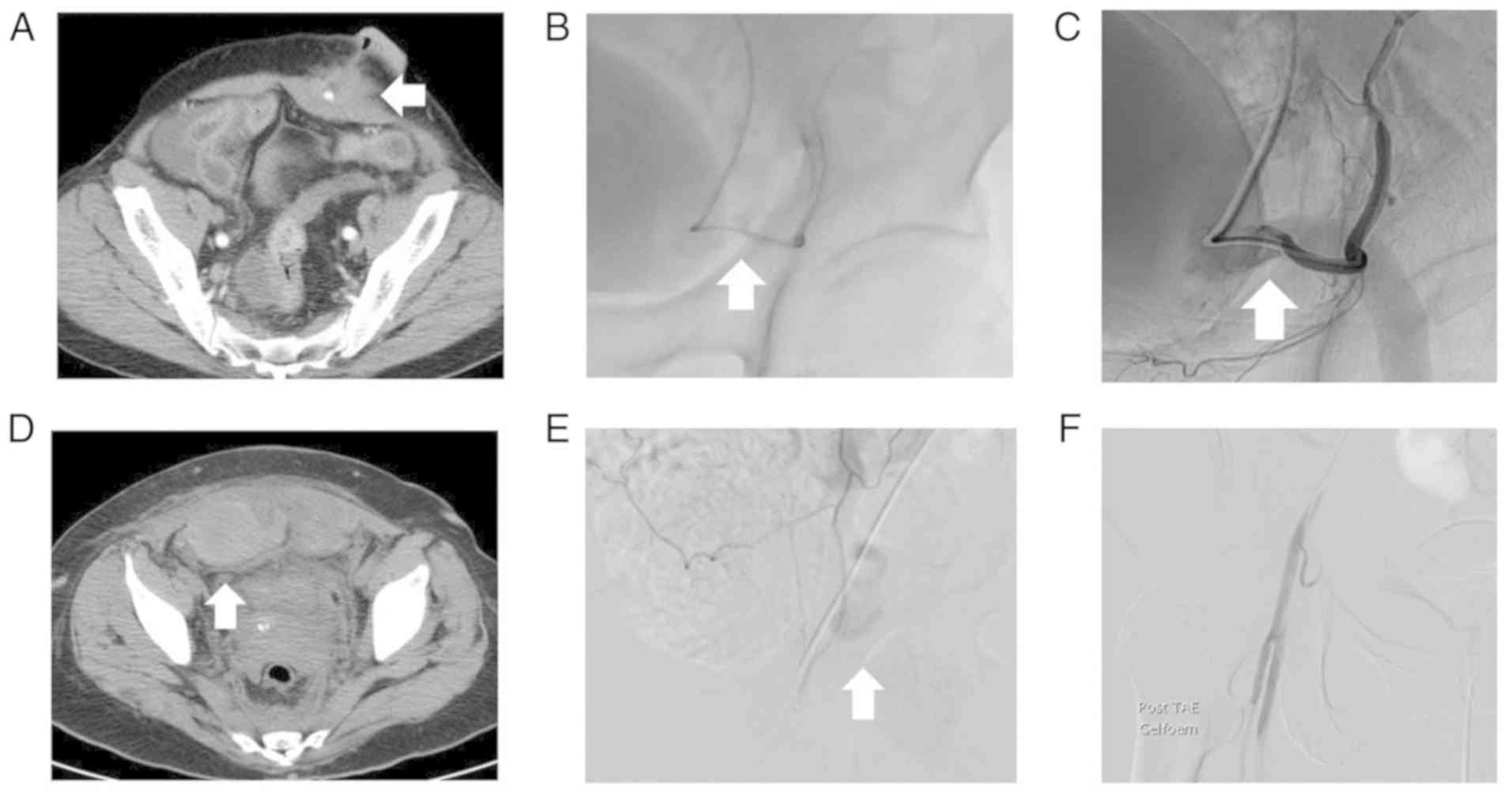
On post-operative day 10, the patient suffered from bleeding from the operative wound with hypovolemic shock. The hemoglobin level decreased from 12.0 to 9.2 g/dl. Laboratory data revealed a normal prothrombin time (PT) and the international normalized ratio (INR) was 1.03 (range, 0.85-1.15). Computed tomography (CT) revealed contrast extravasation on the left lower abdominal wall (Fig. 1A). Subsequent angiography revealed active bleeding from the left IEA branches (Fig. 1B). To achieve hemostasis, superselective catheterization and conducted transarterial embolization we performed using Gelfoam (SURGIFOAM®, Ethicon). Bleeding was successfully terminated following the procedure (Fig. 1C). Owing to the state of shock of the patient, he was referred to the surgical intensive care unit. The patient was discharged on post-operative day 23. Written informed consent was provided by the patient.

Figure 1

(A) Tissue swelling and hemorrhage from the incision wound with contrast extravasation observed (arrow). (B) Angiography confirmed active bleeding from the left inferior epigastric arterial branches (arrow). (C) No contrast extravasation following superselective embolization (arrow). (D) Enlargement of the enhanced densities over the bilateral lower abdominal wall and more prominent right-side rectus abdominis (arrow). (E) Angiography revealed active bleeding point from the right inferior epigastric artery (arrow). (F) Successful superselective embolization without contrast extravasation.

Case 2

A 58-year-old female with a history of mitral and tricuspid valve replacement received anticoagulant therapy with warfarin (3 mg/day). She visited the Outpatient Department at Kaohsiung Medical University Chung-Ho Memorial Hospital and complained of a productive cough and abdominal pain. A physical examination revealed a tender mass on the lower abdominal area. Laboratory data revealed mildly prolonged PT/INR as 1.44 (range, 0.85-1.15). Initially, conservative treatment was applied with bed rest and ice pack application. However, the symptoms persisted, and the hemoglobin level decreased from 10.7 to 9.3 g/dl. CT findings revealed hematoma in the bilateral lower abdominal wall with persistent bleeding (Fig. 1D). Subsequent angiography revealed contrast extravasation from the right IEA (Fig. 1E). Superselective embolization was performed with Gelfoam (SURGIFOAM®, Ethicon) pledgets (Fig. 1F). Post-operatively, the recovery course was uneventful. The patient was discharged on post-operative day 7. Written informed consent was provided by the patient. A summary of the 2 cases is presented in Table I.

Table I

Summary of the two cases of SIEAH.

Table I

Summary of the two cases of SIEAH.

Age (years)/sexUnderlying diseaseAnticoagulantLaboratory dataBleeding pointEmbolization
72/maleAcute myocardial infarctionHeparin, clopidogrel, aspirinNormalLeft IEAGelfoam
58/femalePost MVR and TVRWarfarinProlonged PT/INRRight IEAGelfoam

[i] Gelfoam SIEAH, spontaneous inferior epigastric artery hemorrhage; MVR, mitral valve replacement; TVR, tricuspid valve replacement.

Discussion

RSH accounts for 1-2% of acute abdominal syndrome cases (2,5,8,11). Although its incidence is rare, certain studies have reported a high mortality rate of up to 25% with anticoagulant therapy (2,4,11,12). The etiology of RSH includes trauma, intensive muscle contractions, and iatrogenic and anticoagulant therapy (2,3,5,12,13). Anticoagulant therapy is one of the major risk factors of RSH (14). In a previous study, Cherry and Mueller reviewed 126 RSH cases and found that 25% of the patients received anticoagulant therapy (14). SIEAH is a relatively rare condition of RSH (2,5). The pathophysiology of SIEAH remains unclear. One hypothesis is unrecognized minor trauma, such as cough, sneezing, or passive joint motion (8,9,11). Patients with an advanced age are more susceptible to suffering from SIEAH. The cause may be rectus sheath weakness or small vessel atherosclerosis, or both (8,9,12,13). Nevertheless, anticoagulant therapy is strongly associated with SIEAH (5,8,11,13).

IEA pseudoaneurysm rupture is also a rare etiology of RSH (15-17). The majority of cases of IEA pseudoaneurysm rupture are iatrogenic, such as the extraction of the retention suture, surgical trauma, drain tube insertion or removal, and therapeutic paracentesis (15,16). Color Doppler sonography can present ‘to-and-fro’ flow (16). CT and angiography can also reveal pseudoaneurysm and bleeding (15-17). In the present study, in case 1, the patient exhibited RSH on post-operative day 10. Moreover, the left para-midline incision wound was just beyond the extravasation point (Fig. 1A). Therefore, iatrogenic IEA pseudoaneurysm rupture can be a possible cause of RSH. However, angiography revealed no signs of pseudoaneurysm, only contrast extravasation. Thus, it was considered that the bleeding episode was SIEAH related to anticoagulant therapy.

The most common presentation of SIEAH is abdominal pain (2,8,11,12), which can become aggravated with the patient’s movements (2,3,5,8). The typical finding during physical examination is an abdominal mass, which does not cross the middle abdomen (2,3,5,7,8). Peritoneal signs, such as muscle guarding or rebounding pain, may be positive; therefore, the presentation can mimic that of acute abdominal syndrome (3,7,8,11,12). Laboratory data may reveal normal coagulation function even with active bleeding (2,11). Bedside sonography can provide some information on differential diagnosis; however, CT is the most effective imaging modality (5,12). Both sensitivity and specificity can reach 100% (2,3,5,11,12).

Since hematoma caused by SIEAH is confined to the rectus sheath, bleeding can be self-limited. Thus, conservative treatment with compression, the use of ice packs and blood transfusion should be the appropriate initial treatments (2,3,5,12,13). Invasive management, such as surgical intervention with hematoma removal and ligation of the bleeding vessel, has been the most standard treatment, particularly for correcting hemodynamic instability (2,3,5,7,12). However, locating the bleeding point in hematoma and muscle fiber is difficult (9,10). Moreover, releasing the pressure of hematoma may aggravate bleeding (9). In patients with severe comorbidities, old age, or other associated injuries, the surgical intervention may result in several complications. Hence, in some selected cases, a minimally invasive procedure, such as TAE, may be the choice of treatment for SIEAH (3,7,8,11). Some studies have suggested that the shock status, such as hypotension and tachycardia, is not a contraindication of TAE (3,10). If the diagnosis of SIEAH is definite, embolization can be performed to achieve hemostasis (3,8,10,11).

In patients with SIEAH with unstable hemodynamic status, to date, data suggesting that TAE is more suitable than traditional open surgery are lacking (10,12). However, it is suggested that with the improvement of the imaging system and equipment, for selected patients with anticoagulant therapy, TAE may be the optimal treatment, as with Case 1 in the present study, for example. In a patient with old age and acute myocardial infarction, TAE may be superior to open surgery as the initial treatment.

In conclusion, the standard use of anticoagulant or antiplatelet agents may induce severe bleeding episodes, such as SIEAH. Although the condition is rare, it can be potentially life-threatening. The diagnosis is mainly dependent on CT findings. Surgery is a feasible treatment; however, it has some limitations. In some selected patients receiving anticoagulant therapy, TAE, as a minimally invasive procedure, may be the preferred treatment for SIEAH.

Acknowledgements

Not applicable.

Funding

No funding was received.

Availability of data and materials

Data sharing is not applicable to this article, as no datasets were generated or analyzed during the current study.

Authors' contributions

YCC was involved in the management of the cases and the preparation of the manuscript. CLH was involved in the management of the cases. MCS perform the transcatheter arterial embolization. JYW was involved in the management of the cases and the critical appraisal and review of the manuscript. All authors have read and approved the final manuscript.

Ethics approval and consent to participate

Written informed consent was provided by the patients.

Patient consent for publication

The patients provided written informed consent for the patient information to be published.

Competing interests

The authors declare that they have no competing interests.

References

1 

Romic I, Pavlek G, Mance M, Romic M and Moric T: Fatal case of spontaneous rectus sheath hematoma caused by anticoagulant and steroid therapy during hospital admission. Visc Med. 34:225–227. 2018.PubMed/NCBI View Article : Google Scholar

2 

Ben Selma A and Genese T: Spontaneous rectus sheath hematoma: An uncommon cause of acute abdominal pain. Am J Case Rep. 20:163–166. 2019.PubMed/NCBI View Article : Google Scholar

3 

Azharuddin M, Gupta M and Maniar M: Subcutaneous heparin leads to rectus sheath hematoma: A rare complication. Cureus. 10(e2769)2018.PubMed/NCBI View Article : Google Scholar

4 

Stillman K and Kellar J: Rectus sheath hematoma: An unfortunate consequence of novel anticoagulants. West J Emerg Med. 16:420–421. 2015.PubMed/NCBI View Article : Google Scholar

5 

Takahashi K, Nihei T, Aoki Y, Nakagawa M, Konno N, Munakata A, Okawara K and Kashimura H: Spontaneous rectus sheath hematoma associated with warfarin administration: A case report. J Rural Med. 14:245–248. 2019.PubMed/NCBI View Article : Google Scholar

6 

Ueno T, Nakamura T, Hikichi H, Arai A, Suzuki C and Tomiyama M: Rectus sheath hematoma following intravenous thrombolysis with recombinant tissue plasminogen activator for cerebral infarction: A case report. J Stroke Cerebrovasc Dis. 27:e237–e238. 2018.PubMed/NCBI View Article : Google Scholar

7 

Wick MC, Klocker J, Grundtman C, Jaschke W and Chemelli AP: Transcatheter embolization for the management of acute active inferior epigastric artery hemorrhages. J Endovasc Ther. 20:561–567. 2013.PubMed/NCBI View Article : Google Scholar

8 

Buffone A, Basile G, Costanzo M, Veroux M, Terranova L, Basile A, Okatyeva V and Cannizzaro MT: Management of patients with rectus sheath hematoma: Personal experience. J Formos Med Assoc. 114:647–651. 2015.PubMed/NCBI View Article : Google Scholar

9 

Sharafuddin MJ, Andresen KJ, Sun S, Lang E, Stecker MS and Wibbenmeyer LA: Spontaneous extraperitoneal hemorrhage with hemodynamic collapse in patients undergoing anticoagulation: Management with selective arterial embolization. J Vasc Interv Radiol. 12:1231–1234. 2001.PubMed/NCBI View Article : Google Scholar

10 

Basile A, Medina JG, Mundo E, Medina VG and Leal R: Transcatheter arterial embolization of concurrent spontaneous hematomas of the rectus sheath and psoas muscle in patients undergoing anticoagulation. Cardiovasc Intervent Radiol. 27:659–662. 2004.PubMed/NCBI View Article : Google Scholar

11 

Hatjipetrou A, Anyfantakis D and Kastanakis M: Rectus sheath hematoma: A review of the literature. Int J Surg. 13:267–271. 2015.PubMed/NCBI View Article : Google Scholar

12 

Salemis NS: Spontaneous rectus sheath hematoma presenting as acute surgical abdomen: An important differential in elderly coagulopathic patients. Geriatr Gerontol Int. 9:200–202. 2009.PubMed/NCBI View Article : Google Scholar

13 

Aktas H, Inci S, Dogan P and Izgu I: Spontaneous rectus sheath hematoma in a patient treated with apixaban. Intractable Rare Dis Res. 5:47–49. 2016.PubMed/NCBI View Article : Google Scholar

14 

Cherry WB and Mueller PS: Rectus sheath hematoma: Review of 126 cases at a single institution. Medicine (Baltimore). 85:105–110. 2006.PubMed/NCBI View Article : Google Scholar

15 

Sobkin PR, Bloom AI, Wilson MW, LaBerge JM, Hastings GS, Gordon RL, Brody LA, Sawhney R and Kerlan RK Jr: Massive abdominal wall hemorrhage from injury to the inferior epigastric artery: A retrospective review. J Vasc Interv Radiol. 19:327–332. 2008.PubMed/NCBI View Article : Google Scholar

16 

Nichols-Totten K, Pollema T and Moncure M: Pseudoaneurysm of the inferior epigastric artery: A rare complication of laparoscopic ventral hernia repair. Surg Laparosc Endosc Percutan Tech. 22:e25–e27. 2012.PubMed/NCBI View Article : Google Scholar

17 

Ruiz-Tovar J, Rubio M, Conde S, Morales V and Martinez-Molina E: Inferior epigastric artery pseudoaneurysm: Complication of surgical drain insertion. ANZ J Surg. 78(1139)2008.PubMed/NCBI View Article : Google Scholar

Related Articles

  • Abstract
  • View
  • Download
Copy and paste a formatted citation
Spandidos Publications style
Chen Y, Huang C, Shih M and Wang J: Transcatheter arterial embolization as an effective treatment for spontaneous inferior epigastric artery bleeding caused by anticoagulant therapy: Case reports. World Acad Sci J 2: 28, 2020.
APA
Chen, Y., Huang, C., Shih, M., & Wang, J. (2020). Transcatheter arterial embolization as an effective treatment for spontaneous inferior epigastric artery bleeding caused by anticoagulant therapy: Case reports. World Academy of Sciences Journal, 2, 28. https://doi.org/10.3892/wasj.2020.69
MLA
Chen, Y., Huang, C., Shih, M., Wang, J."Transcatheter arterial embolization as an effective treatment for spontaneous inferior epigastric artery bleeding caused by anticoagulant therapy: Case reports". World Academy of Sciences Journal 2.6 (2020): 28.
Chicago
Chen, Y., Huang, C., Shih, M., Wang, J."Transcatheter arterial embolization as an effective treatment for spontaneous inferior epigastric artery bleeding caused by anticoagulant therapy: Case reports". World Academy of Sciences Journal 2, no. 6 (2020): 28. https://doi.org/10.3892/wasj.2020.69
Copy and paste a formatted citation
x
Spandidos Publications style
Chen Y, Huang C, Shih M and Wang J: Transcatheter arterial embolization as an effective treatment for spontaneous inferior epigastric artery bleeding caused by anticoagulant therapy: Case reports. World Acad Sci J 2: 28, 2020.
APA
Chen, Y., Huang, C., Shih, M., & Wang, J. (2020). Transcatheter arterial embolization as an effective treatment for spontaneous inferior epigastric artery bleeding caused by anticoagulant therapy: Case reports. World Academy of Sciences Journal, 2, 28. https://doi.org/10.3892/wasj.2020.69
MLA
Chen, Y., Huang, C., Shih, M., Wang, J."Transcatheter arterial embolization as an effective treatment for spontaneous inferior epigastric artery bleeding caused by anticoagulant therapy: Case reports". World Academy of Sciences Journal 2.6 (2020): 28.
Chicago
Chen, Y., Huang, C., Shih, M., Wang, J."Transcatheter arterial embolization as an effective treatment for spontaneous inferior epigastric artery bleeding caused by anticoagulant therapy: Case reports". World Academy of Sciences Journal 2, no. 6 (2020): 28. https://doi.org/10.3892/wasj.2020.69
Follow us
  • Twitter
  • LinkedIn
  • Facebook
About
  • Spandidos Publications
  • Careers
  • Cookie Policy
  • Privacy Policy
How can we help?
  • Help
  • Live Chat
  • Contact
  • Email to our Support Team