Introduction
Cryptosporidiosis, caused by the parasite,
Cryptosporidium spp., is one of the most common intestinal
illnesses. It is a widespread opportunistic disease that can affect
both humans and animals. Cryptosporidiosis ranks fourth among the
causes of diarrhea worldwide, particularly in immunocompromised
individuals who are more vulnerable to its potentially fatal
chronic form (1,2). It leads to illness in newborns and
young children, resulting in severe diarrhea and mortality
(3), rendering it the second
leading cause of mortality among children with diarrhea who are
<5 years of age (4,5).
Cryptosporidium is a single-celled parasite
belonging to the phylum Apicomplexa, with a complex life cycle that
includes both sexual and asexual reproduction within a single host
and does not require an intermediate host (6). Based on molecular and morphological
data, nearly 46 species and >100 genotypes of
Cryptosporidium have been identified from various hosts
(7). The transmission of
Cryptosporidium mainly occurs via two mechanisms: First,
through the consumption of food and water contaminated with the
parasites, and second, through direct contact with infected
individuals or animals carrying the parasites (2). A previous study performed in Iraq
demonstrated the prevalence of Cryptosporidium in water due
to pollution with oocysts, particularly in agricultural regions
contaminated with cow feces (8).
One of the traits of Cryptosporidium is its
resistance to chemical disinfectants, environmental stress and
chlorine (9).
Cryptosporidium became significant when it was identified
that this parasite had high resistance to the majority of drugs and
disinfectants, and could cause infections of the stomach and
intestines in humans and animals (10). Therefore, the present study aimed
to survey Cryptosporidium spp. among patients with diarrhea
in the Thi-Qar Province of Iraq, and to examine some of the factors
affecting the prevalence of Cryptosporidium infection.
Patients and methods
The present study included 200 fecal samples
collected from patients of an age range (≤5-≥51) years and a median
age of 30.5 years for both sexes suffering from diarrhea, who
attended the Nasiriyah General Hospital and Bint Al-Huda Teaching
Hospital between November 1, 2023 and January 30, 2024. These
patients resided in Nasiriyah Province near agricultural regions.
Sterile containers were used to collect the fecal samples, and they
were labeled with all necessary patient data. Of note, two methods
were used to diagnose the parasite: Modified acid-fast staining and
direct microscopy. The direct wet mount technique was used for
detection. One drop of normal saline solution was added to a slide,
and 1 mg of stool was mixed with a stick. The slide was covered
with a coverslip, and examinations were conducted at 40X and 100X
magnification.
Consent was obtained from the participants in the
present study for the collection of samples. For participants who
were underage, consent was obtained from the parents. Ethical
approval to collect samples from hospitals was obtained from the
Ethics Committee of the Ministry of Health, Iraq (Reference no.
307/2022, 28-9-2022).
Detection of Cryptosporidium parvum by
modified acid-fast staining
The staining procedure was performed as previously
described (11) as follows: An
appropriate amount of stool was obtained, and using a stick to mix
it with a few drops of water, it was placed on the slide, submerged
in carbolfuchsin dye (MilliporeSigma) for 5 min, and then heated at
an intermittent temperature (60-70˚C). while until the
carbolfuchsin evaporated. To remove the remaining dye, the slide
was washed with water. Rubbing alcohol was applied to the slide for
1 to 3 min. After rinsing the slide with water once more to remove
the alcohol, it was submerged in methylene blue (MilliporeSigma)
for 1 min at temperature room and then rinsed with water again. The
slide was air-dried, and parasite oocysts appeared as dark pink or
purple structures. The slide was examined first at x40 and x100
magnification. It was also necessary to apply specific oil when at
x100 magnification to distinguish the oocysts.
Statistical analysis
The statistical analysis of the data was conducted
using SPSS version 26 (IBM Corp.). Data are presented as numbers
and percentages and were analyzed using the non-parametric and
descriptive Chi-squared test.
Results
Direct wet mount examination
Only 60 sample out of the 200 sample were found as
positive results following direct smear examination. Oocysts of
Cryptosporidium were colorless and were shaped as spheres or
had an oval-like shape.
Modified acid-fast staining
results
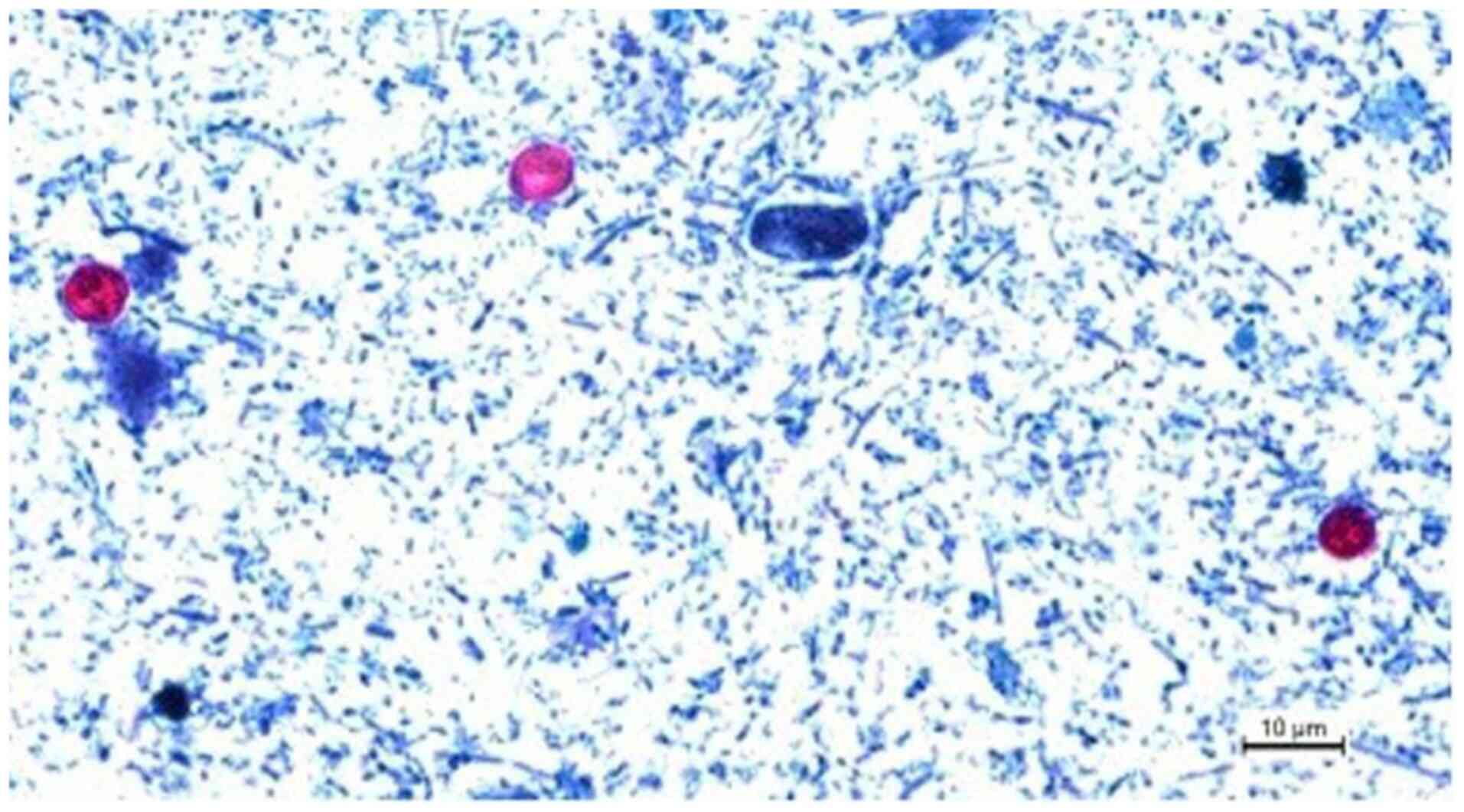
Following staining with an acid-fast stain, the
microscopical analysis yielded positive samples containing
Cryptosporidium spp. oocysts, revealing that the oocysts
were spherical in shape and reddish purple (Fig. 1).
Total infection rate with
Cryptosporidium spp
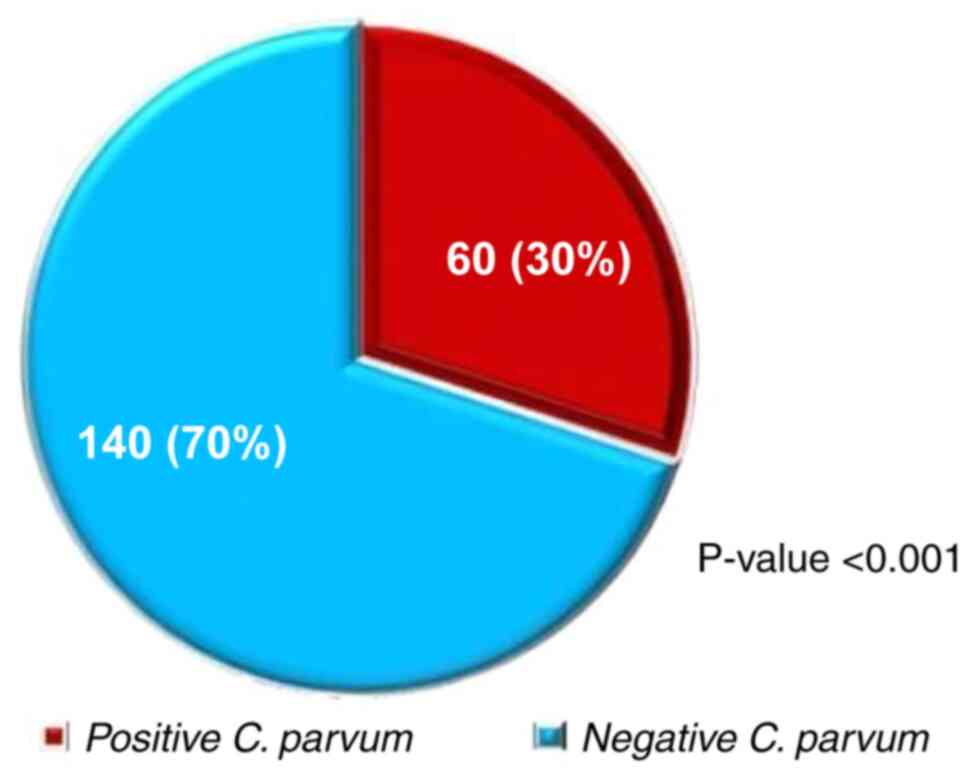
The present study included 200 stool samples
collected from patients with diarrhea in the Thi-Qar Province of
Iraq. The present study revealed that 60 (30%) patients were
infected with Cryptosporidium spp. while 140 (70%) were
non-infected. The results revealed a significant difference between
them (P<0.05), as shown in Fig.
2.
Total infection rate of
Cryptosporidium spp. according to sex
The findings of the present study demonstrated that
males had a greater rate of Cryptosporidium infection than
females, where the infection rates were 32.14% (36/112) and 27.27%
(24/88), respectively. However, there were no significant
differences between the sexes (P>0.05; Table I).
 | Table IInfection rate of Cryptosporidium
spp. according to sex. |
Table I
Infection rate of Cryptosporidium
spp. according to sex.
| | Examined Sample | Positive samples | Negative samples |
|---|
| Sex (age range)
years | No. of patients | % | No. of patients | % | No. of patients | % |
|---|
| Male (≤5-≥51)
years | 112 | 56 | 36 | 32.14 | 76 | 67.85 |
| Female (≤5-51)
years | 88 | 44 | 24 | 27.27 | 64 | 72.72 |
| Total | 200 | 100 | 60 | 30 | 140 | 70 |
| P-value 0.456 | | | | | | |
Infection rate of Cryptosporidium spp.
according to age groups
The data presented in Table II indicated that the prevalence of
Cryptosporidium spp. infection varied according to age
group. In particular, the age group ≤5 years had the highest
infection rate, at 52.94% (18/34), while the age group aged 36 to
50 years had the lowest infection rate, at 20.83% (10/48).
Significant differences (P<0.05) were found between the groups.
The mean ages of the patients in the different age groups were as
follows: ≤5 years: Mean, 3.24 years; median, 3 years; 6-20 years:
Mean, 12.3 years; median, 10 years; 21-35 years: Mean, 27.9 years;
median, 26.5 years; 36-50 years: Mean, 42.7 years; median, 42.5
years; ≥51 years: Mean 56.6 years; median, 57 years.
| Table IIInfection rate of Cryptosporidium
spp. according to age groups. |
Table II
Infection rate of Cryptosporidium
spp. according to age groups.
| | No. of examined
samples | Positive
samples | Negative
samples |
|---|
| Age groups (years),
mean and median | No. of
patients | % | No. of
patients | % | No. of
patients | % |
|---|
| ≤5 (3.24 and
3) | 34 | 17 | 18 | 52.94 | 16 | 47.05 |
| 6-20 (12.3 and
10) | 56 | 28 | 14 | 25 | 42 | 75 |
| 21-35 (27.9 and
26.5) | 36 | 18 | 10 | 27.77 | 26 | 72.22 |
| 36-50 (42.7 and
42.5) | 48 | 24 | 10 | 20.83 | 38 | 79.16 |
| ≥51 (56.6 and
57) | 26 | 13 | 8 | 30.76 | 18 | 69.23 |
| Total | 200 | 100 | 60 | 30 | 140 | 70 |
| P-value 0.024 | | | | | | |
Infection rate of Cryptosporidium spp.
according to residency
According to the findings of the present study, the
prevalence of Cryptosporidium spp. infection rates were
higher in rural areas than in urban areas, with respective rates of
30.90 and 28.88%. There were no significant differences between the
groups (P<0.05; Table
III).
| Table IIIInfection rate of Cryptosporidium
spp. according to residency. |
Table III
Infection rate of Cryptosporidium
spp. according to residency.
| | Examined
samples | Positive
samples | Negative
samples |
|---|
| Residency | No. of
patients | % | No. of
patients | % | No. of
patients | % |
|---|
| Urban | 90 | 45 | 26 | 28.88 | 64 | 71.11 |
| Rural | 110 | 55 | 34 | 30.90 | 76 | 69.09 |
| Total | 200 | 100 | 60 | 30 | 140 | 70 |
| P-value 0.756 | | | | | | |
Discussion
The human intestinal illness, cryptosporidiosis, is
caused by the protozoan parasite, Cryptosporidium. Watery
diarrhea, dehydration and weight loss are common symptoms of
cryptosporidiosis, which can last for up to 2 weeks (12). In the present study, the parasite
Cryptosporidium spp. in fecal samples of patients with
diarrhea in Thi-Qar Province in Iraq was investigated
microscopically by using the modified acid-fast staining
technique.
Only four of the samples tested positive using the
direct smear, indicating that Cryptosporidium was not
detected in this manner, as the oocysts were small and required a
specific detection method. Based on a modified acid-fast stain,
which is simple, inexpensive and capable of clearly showing the
interior structure of oocysts, the examination revealed the
spherical shape of the oocysts, which appeared reddish-purple,
while the remaining stool appeared blue.
The fecal smear, which is applied using a modified
acid-fast stain, is considered the standard method for detecting
Cryptosporidium oocysts in stool. This technique is commonly
used in microbiological laboratories to help identify
Cryptosporidium oocysts. Although the staining process
requires time and an experienced microscopist to examine the
slides, it is inexpensive and permits the detection of other
parasite species, such as Cyclospora and Isospora
(13).
In the present study, the outcome, based on
acid-fast stain, revealed the infection rate with
Cryptosporidium in humans, which was similar to previous
studies conducted in Iraq. In the study by Alasady and Al-Hasnawy
(14), in the Babylon Province,
they recorded the rate of infection with Cryptosporidium
spp. as 25%, by using microscopic examination. Moreover, the
study by ALYasary and Faraj (15)
in Karbala Province, found a positive result, with rate of
infection being 26%.
Furthermore, another study revealed the prevalence
of Cryptosporidium in the domestic pigeon in Baghdad
(16). However, there are limited
reports available on the genetic characteristics of several species
of Cryptosporidium in Iraq; nevertheless, both
Cryptosporidium hominis and Cryptosporidium parvum
have been identified in humans, with the latter being more abundant
in isolates from cattle, sheep, goats and birds. A national
investigation is necessary to obtain a sufficient number of samples
from various hosts and environmental matrices, utilizing modern
diagnostic methods to accurately assess the epidemiological status
of cryptosporidiosis in Iraq (17).
Additionally, molecular genotyping research needs to
be undertaken in Iraq to delineate the species and subtypes of
Cryptosporidium infecting humans and animals, particularly
during outbreaks. Consequently, the Cryptosporidium parasite
needs to be incorporated into the standard diagnostic and
surveillance framework for infectious diseases in Iraq and should
be acknowledged as a significant public health issue of
concern.
The findings of the present study concur with a
study conducted in Pakistan by Khan et al (18), which found, by using the MZN stain,
that 127 of the 425 samples collected were found to be positive for
Cryptosporidium with a prevalence of 29.88% (127/425). On
the other hand, the findings of the present study are in contrast
to those of the study by Sayal (19) in Al-Najaf AL-Ashraf in Iraq. He
recorded the total percentage of infection with
Cryptosporidium to be higher than that in the present study.
The positive result was 58%. The findings of the present study are
also in contrast to those of the study by Sharbatkhori et al
(20) from Iran, in which they
recorded an infection rate lower than that in the present study.
They found that, out of 547 collected samples, 27 (4.94%) were
positive for Cryptosporidium. Numerous factors, including
variations in the study population, personal hygiene, sewage water
management, ingestion of contaminated food, untreated water and
meteorological conditions, were linked to the fluctuations in the
prevalence of Cryptosporidium infection. The high prevalence
of cryptosporidiosis that currently exists is partly due to the
season and low economic standing (18,21).
According to the findings of the present study,
males had a greater infection rate than females, although there was
no statistically significant difference between the sexes
(P>0.05). This finding is in agreement with the findings of
other studies from Iraq, from the Basra Province, Duhok Province
and Babylon Province (14,22,23).
They had recorded higher infection rates for males than females,
but without a significant difference.
Conversely, the findings of the study were not in
agreement with the findings of the study by Saneian et al
(24), which demonstrated that the
infection rate in Iranian females was 2.6% and that in Iranian
males was 2.0%. Mohammad (25)
reported in his study, from the Al-Qadisiyah Province in Iraq, that
the infection rates in women were higher than those in males at
56.6 and 43.3%, respectively. The increasing incidence observed in
the present study among males may be attributed to several factors,
including, the way of life that men lead and their ongoing
interaction with the outside world, which is significant. Various
factors contribute to the spread of oocysts, such as improper
feeding practices, consuming exposed food in public areas and
apathy towards maintaining personal cleanliness (26). According to the present study, age
and cryptosporidiosis were significantly associated. Those aged ≤5
years had the highest infection rate of 52.94%, while the lowest
rate was 20.83% for age group of 36-50 years. The results presented
herein are consistent with the research conducted in Kirkuk City,
Iraq, by Salman et al (27)
and in Buner District, Pakistan, by Khan et al (18), which demonstrated greater infection
rates among children <6 years of age, at 25.45 and 41.0%,
respectively. These findings contradict those of other studies by
Yang et al (28), in
southwest China, Abdel Gawad et al (29) in Beni-suef, Egypt, and in Duhok
Province/Iraq by Shahoi et al (23); all these studies found that the
highest rates of cryptosporidiosis were found in the age groups of
41-50 years and 31-40 years, with rates of 17.3, 25 and 91.7%,
respectively. Children are more likely to acquire infections than
adults due to their immature immune systems. As a result, consuming
a small number of oocysts can lead to cryptosporidiosis, and
frequent low-dose infections can build up immunity to
Cryptosporidium, which may protect children from developing
comparatively more severe illnesses than adults (30,31).
According to residency, the rate of infection with
Cryptosporidium was higher among rural residents than urban
residents, with no significant difference between them. The results
of the present study are in agreement with those of the study by
Khoshnaw et al (32) in
Erbil City, Iraq, as they did not record any significant
association between cryptosporidiosis and residency (rural, 21.1%
vs. urban, 19.7%). These findings are also in agreement with those
of the study by Alasady and Al-Hasnawy (14) in Babylon Province, who recorded
non-significant differences (P>0.05) in the rate of infection in
rural areas (36.36%), compared with urban areas (16.07%). However,
these findings contradict those of Shahoi et al (23) in the Duhok area of Iraq, which
found that suburban inhabitants had a greater infection rate
(87.6%) than urban residents (75%), with a significant difference
(P<0.05) between the two groups. These findings are also in
contrast to those of the study by Abdel Gawad et al
(29) in Egypt, who reported
significantly higher rates of infection in rural residents compared
to urban ones (59.5 vs. 40.5%). High rates of infection in rural
areas may be caused by several factors that are considered to favor
the spread of intestinal parasites, such as, the lack of clean
drinking water and reliance on the river for water, the need to
deal with contaminated soil from farms and gardens that contain
cysts of parasite, animal breeding, contact with parasite
reservoirs, the use of animal waste as organic fertilizer, and the
poor health and cultural level of the rural population.
Of note, a limitation of the present study is that
species-level diagnosis of Cryptosporidium was not
conducted. The diagnosis was based on acid-fast staining, which is
useful for detecting the presence of Cryptosporidium
oocysts, but does not allow differentiation between the two main
human-infecting species, Cryptosporidium parvum and
Cryptosporidium hominis, due to their morphological
similarity and sample loss for genetic diagnosis. Future studies
employing molecular methods (e.g., PCR and sequencing) would be
necessary to distinguish species and investigate their
epidemiological distribution accurately.
In conclusion, the present study demonstrated the
prevalence of Cryptosporidium in Thi-Qar Province, Iraq.
Additionally, the prevalence was higher in males than in females.
The infection rate also increased in rural areas compared to urban
areas due to contact with animals. The incidence rates were higher
in children; this may be due to the handling of animals and soil
polluted with feces from animals by their parents; this
contamination was then transmitted to their children by their food
and drink through inadequate personal care.
Acknowledgements
The authors would like to thank all the staff of
Nasiriyah General Hospital and Bint Al-Huda Teaching Hospital in
Iraq for their assistance with sample collection.
Funding
Funding: No funding was received.
Availability of data and materials
The data generated in the present study may be
requested from the corresponding author.
Authors' contributions
BAAA was involved in the conceptualization of the
study, in data curation and investigation, in the study
methodology, in project administration, in the provision of
resources (kits) and software (for statistical analysis), and in
the writing of the original draft of the manuscript, and in the
writing, review and editing of the manuscript. NNB was involved in
data validation, and in the writing, review and editing of the
manuscript. ASM was involved in data curation, in the study
methodology, and in data investigation. All authors have read and
approved the final manuscript. BAAA and NNB confirm the
authenticity of all the raw data.
Ethics approval and consent to
participate
Consent was obtained from the participants in the
present study for the collection of samples. For participants who
were underage, consent was obtained from the parents. Ethical
approval to collect samples from hospitals was obtained from the
Ethics Committee of the Ministry of Health, Iraq (Reference no.
307/2022, 28-9-2022).
Patient consent for publication
Not applicable.
Competing interests
The authors declare that they have no competing
interests.
References
|
1
|
Costa D, Razakandrainibe R, Valot S,
Vannier M, Sautour M, Basmaciyan L, Gargala G, Viller V, Lemeteil
D, Ballet JJ, et al: Epidemiology of cryptosporidiosis in France
from 2017 to 2019. Microorganisms. 8(1358)2020.PubMed/NCBI View Article : Google Scholar
|
|
2
|
Ryan U, Zahedi A, Feng Y and Xiao L: An
update on zoonotic Cryptosporidium species and genotypes in
humans. Animals (Basel). 11(3307)2021.PubMed/NCBI View Article : Google Scholar
|
|
3
|
Khalil IA, Troeger C, Rao PC, Blacker BF,
Brown A, Brewer TG, Colombara DV, De Hostos EL, Engmann C, Guerrant
RL, et al: Morbidity, mortality, and long-term consequences
associated with diarrhoea from Cryptosporidium infection in
children younger than 5 years: A meta-analyses study. Lancet Glob
Health. 6:e758–e768. 2018.PubMed/NCBI View Article : Google Scholar
|
|
4
|
Ryan U, Hijjawi N and Xiao L: Foodborne
cryptosporidiosis. Int J Parasitol. 48:1–12. 2018.PubMed/NCBI View Article : Google Scholar
|
|
5
|
Butkeviciute E, Prudden HJ, Jit M, Smith
PG, Kang G, Riddle MS, Lopman BA, Pitzer VE, Lanata CF,
Platts-Mills JA, et al: Global diarrhoea-associated mortality
estimates and models in children: Recommendations for dataset and
study selection. Vaccine. 39:4391–4398. 2021.PubMed/NCBI View Article : Google Scholar
|
|
6
|
Sateriale A, Šlapeta J, Baptista R,
Engiles JB, Gullicksrud JA, Herbert GT, Brooks CF, Kugler EM,
Kissinger JC, Hunter CA and Striepen B: A genetically tractable,
natural mouse model of cryptosporidiosis offers insights into host
protective immunity. Cell Host Microbe. 26:135–146.e5.
2019.PubMed/NCBI View Article : Google Scholar
|
|
7
|
Ježková J, Limpouchová Z, Prediger J,
Holubová N, Sak B, Konečný R, Květoňová D, Hlásková L, Rost M,
McEvoy J, et al: Cryptosporidium myocastoris n. sp.
(apicomplexa: Cryptosporidiidae), the species adapted to the nutria
(myocastor coypus). Microorganisms. 9(813)2021.PubMed/NCBI View Article : Google Scholar
|
|
8
|
Baqer NN, Hammood AH, Hassan KF and Hassan
ESAD: Detection of water-born parasites in drinking water of
Baghdad, Iraq. Afr J Infect Dis. 12:1–6. 2018.PubMed/NCBI View Article : Google Scholar
|
|
9
|
Helmy YA and Hafez HM: Cryptosporidiosis:
From prevention to treatment, a narrative review. Microorganisms.
10(2456)2022.PubMed/NCBI View Article : Google Scholar
|
|
10
|
Ryan U and Hijjawi N: New developments in
Cryptosporidium research. Int J Parasitol. 45:367–373.
2015.PubMed/NCBI View Article : Google Scholar
|
|
11
|
Ali ZD and AL-Aboody BA: Detection of
Cryptosporidium parvum by modified acid-fast stain among
cancer patients in Thi-Qar province. UTJsci. 10:10–15. 2023.
|
|
12
|
Mergen K, Espina N, Teal A and
Madison-Antenucci S: Detecting Cryptosporidium in stool
samples submitted to a reference laboratory. Am J Trop Med Hyg.
103:421–427. 2020.PubMed/NCBI View Article : Google Scholar
|
|
13
|
Huang DB, Chappell C and Okhuysen PC:
Cryptosporidiosis in children. Semin Pediatr Infect Dis.
15:253–259. 2004.PubMed/NCBI View Article : Google Scholar
|
|
14
|
Alasady SIJ and Al-Hasnawy MH: Microscopic
and molecular diagnosis of Cryptosporidium spp. in human in
Babylon Province, Iraq. South Asian Res J Med Sci. 6:74–84.
2024.
|
|
15
|
ALYasary JT and Faraj AA: Genotyping of
Cryptosporidium Spp. in domestic dogs and humans in Karbala
Province Iraq. Ann Rom Soc Cell Biol. 25:4120–4125. 2021.
|
|
16
|
Hashim YF and Al Zubaidi MTS: Detection of
Cryptosporidium infection in domestic pigeons in Baghdad
city using conventional PCR technique. Iraqi J Ind Res. 11:118–122.
2024.
|
|
17
|
Alali F, Abbas I, Jawad M and Hijjawi N:
Cryptosporidium infection in humans and animals from Iraq: A
review. Acta Trop. 220(105946)2021.PubMed/NCBI View Article : Google Scholar
|
|
18
|
Khan A, Shams S, Khan S, Khan MI, Khan S
and Ali A: Evaluation of prevalence and risk factors associated
with Cryptosporidium infection in rural population of
district Buner, Pakistan. PLoS One. 14(e0209188)2019.PubMed/NCBI View Article : Google Scholar
|
|
19
|
Sayal RA: Epidemiological study of
Cryptosporidium infection in Al-Najaf city. Int J Pharm Qual
Assur. 10:128–131. 2019.
|
|
20
|
Sharbatkhori M, Nazemalhosseini Mojarad E,
Taghipour N, Pagheh AS and Mesgarian F: Prevalence and genetic
characterization of Cryptosporidium Spp. in diarrheic
children from Gonbad Kavoos City, Iran. Iran J Parasitol.
10:441–447. 2015.PubMed/NCBI
|
|
21
|
Al-Difaie RS, Nuha QM and Khawla HS: A
study to detect the most important virulence factors of
Cryptosporidium parasite samples by PCR. Eurasia J Biosci.
14:4649–4652. 2020.
|
|
22
|
Salim M: Epidemiological study on
Cryptosporidium among children in Basra Province-Iraq. J
Phys Conf Ser. 1032(012072)2018.
|
|
23
|
Shahoi HIA, Salih Mero WM and Mohammed AB:
Prevalence of cryptosporidiosis and it's associated risk factors
among human population in Zakho District, Duhok Province, Kurdistan
Region, Iraq. Sci J Univ Zakho. 10:153–158. 2022.
|
|
24
|
Saneian H, Yaghini O, Yaghini A, Modarresi
MR and Soroshnia M: Infection rate of Cryptosporidium parvum
among diarrheic children in Isfahan. Iran J Pediatr. 20:343–347.
2010.PubMed/NCBI
|
|
25
|
Mohammad FI: Detecting of virulence
factors COWP gene and CP15 gene for Cryptosporidium parvum
by polymerase chain reaction (PCR). Al-Qadisiyah J Pure Sci.
23:39–47. 2018.
|
|
26
|
Mohammed ZQ and Al-Qazwini YM:
Epidemiological study of head lice among primary school students of
some districts in Babil Governorate. Int J Health Sci. 6:119–125.
2022.https://sciencescholar.us/journal/index.php/ijhs/article/view/12175.
|
|
27
|
Salman YJ, Sadek WS and Rasheed ZK:
Prevalence of Cryptosporidium parvum among Iraqi displaced
people in Kirkuk city using direct microscopy, flotation technique
and ELISA-copro antigen test. Int J Curr Microbiol App Sci.
4:559–572. 2015.
|
|
28
|
Yang Y, Zhou YB, Xiao PL, Shi Y, Chen Y,
Liang S, Yihuo WL, Song XX and Jiang QW: Prevalence of and risk
factors associated with Cryptosporidium infection in an
underdeveloped rural community of southwest China. Infect Dis
Poverty. 6(2)2017.PubMed/NCBI View Article : Google Scholar
|
|
29
|
Abdel Gawad SS, Ismail MAM, Imam NFA,
Eassa AHA and Abu-Sarea EY: Detection of Cryptosporidium
spp. in diarrheic immunocompetent patients in beni-suef, Egypt:
Insight into epidemiology and diagnosis. Korean J Parasitol.
56:113–119. 2018.PubMed/NCBI View Article : Google Scholar
|
|
30
|
Tahira F, Khan HM, Shukla I, Shujatullah
F, Malik MA and Shahid M: Prevalence of Cryptosporidium in
children with diarrhea in north Indian tertiary care hospital. J
Commun Med Health Edu. 2(136)2012.
|
|
31
|
Rahi AA, Magda A and Al-Charrakh AH:
Prevalence of Cryptosporidium parvum among children in Iraq.
Am J Life Sci. 1:256–260. 2013.
|
|
32
|
Khoshnaw KHS, Majeed PD and Hawezy AA:
Prevalence of Cryptosporidium spp. among hospitalized
children with diarrhea using ELISA and conventional microscopic
techniques, in Erbil province. Polytech J. 1–11. 2017.
|