Introduction
Patients diagnosed with advanced-stage cancer
frequently encounter complications, such as malignant ureteral
obstruction (MUO). When the urinary tract becomes obstructed on one
side, it can severely affect the well-being of a patient,
particularly if accompanied by infection. A bilateral obstruction,
however, often leads to fatal outcomes. Obstruction of the upper
urinary tract has consistently been recognized as an indicator of
worsening morbidity in various types of cancer (1,2).
Over the past three decades, the approach to
managing MUO has markedly evolved. What was once the responsibility
of a single specialist has now shifted to a collaborative model
involving general practitioners, urologists, oncologists,
palliative care teams and interventional radiologists. This shift
reflects a broader trend toward multidisciplinary care in
late-stage malignancies. Surgical techniques have also advanced,
transitioning from highly invasive, high-risk open surgeries to
less invasive, more patient-friendly procedures (3,4).
Brin et al (5) described
the outcomes of open palliative surgery as unsatisfactory, noting
that such interventions often led to a steady clinical decline.
Notably, urologists appear less inclined than oncologists to
recommend urinary decompression in asymptomatic patients who have a
poor prognosis (5).
The decision to perform decompression should be
tailored to each patient, weighing potential benefits against
associated burdens. While major associations, such as the American
Urological Association and the European Association of Urology
support decompression for certain cases, there remains a gap in
strong, consistent evidence to guide clinical decision-making. In
fact, cancer-specific guidelines often differ in their
recommendations. The National Institute for Health and Care
Excellence (NICE), for example, advises medical practitioners to
not only offer decompression as an option, but also to openly
discuss the possibility of forgoing any intervention (4,6).
Given the limited and heterogeneous evidence guiding
decision-making in malignant ureteral obstruction, a clear
understanding of survival outcomes is essential. Therefore, the
present systematic review aimed to summarize median overall
survival and survival rates in patients with MUO, with particular
attention to survival ranges and clinically relevant prognostic
patterns reported in available literature.
Data and methods
Search strategy
To obtain a comprehensive dataset on all
publications evaluating median overall survival in patients with
MUO, a systematic literature search was conducted on the PubMed,
Google Scholar, ProQuest and the Cochrane Library from database
inception to January, 2024. The following Boolean search string was
used in PubMed: (‘malignant ureteral obstruction’ OR ‘malignant
ureteric obstruction’ OR ‘MUO’) AND (‘overall survival’ OR
‘survival rate’ OR ‘survival time’). The present study included
original articles including case-control, cross-sectional, cohort
and randomized control trials discussing the average survival rate
in malignant ureteral obstruction patients. The presentation
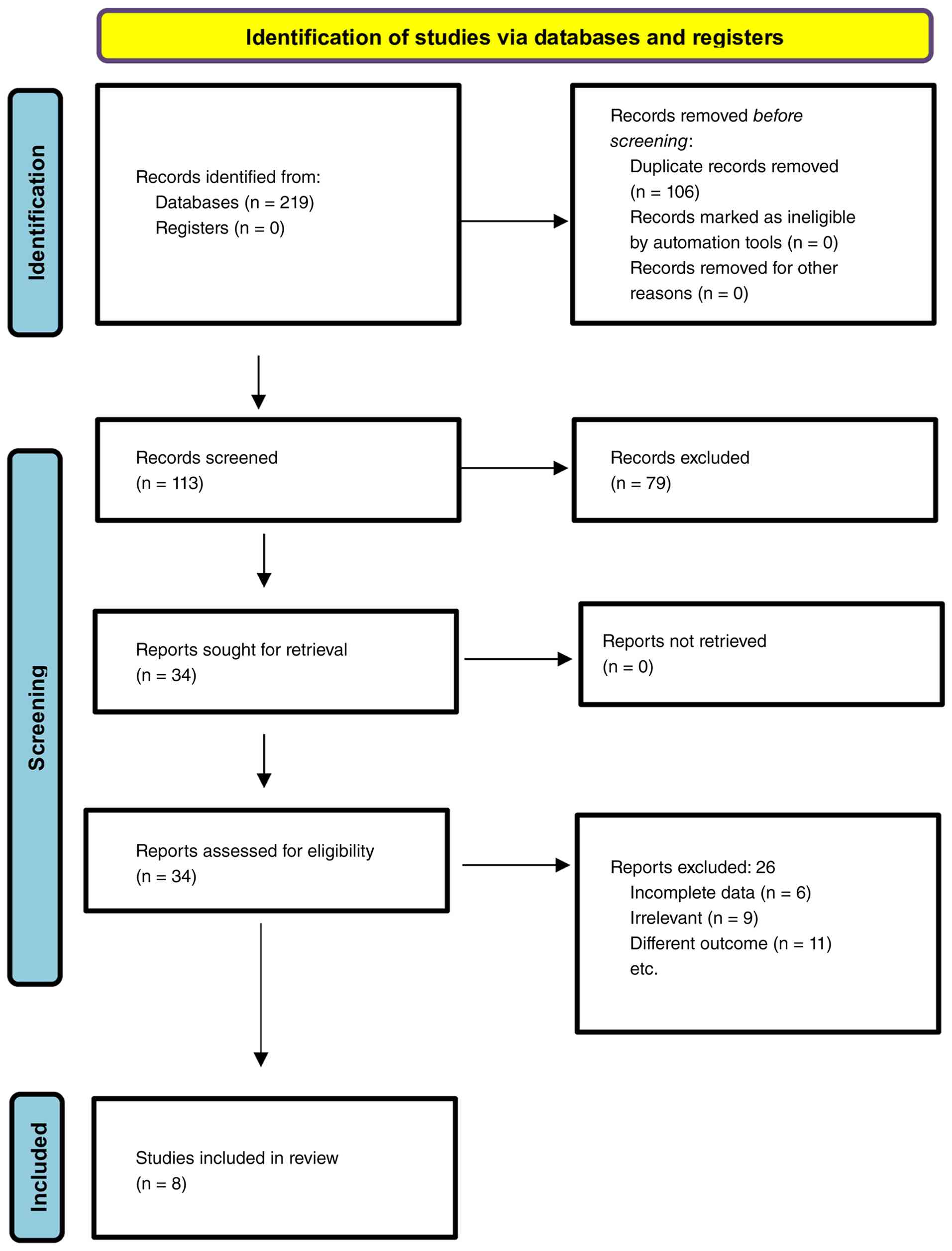
adhered to the PRISMA guidelines (Fig.
1).
The literature search was carried out in English,
using specific key words associated with the median survival time
in malignant ureteral obstruction patients, with the key words used
‘survival rate’ AND ‘malignant ureteral obstruction’ OR ‘malignant
ureteric obstruction’ OR ‘MUO’. These key words were used in
different combinations to identify articles in which they appeared
in either the title or the abstract. The search was restricted to
studies published between 2018 and 2024.
Selection criteria
The titles and abstracts retrieved from the
databases were reviewed separately by two independent authors.
Studies were included if they met the following criteria: i)
Original research articles reporting on patients with MUO; ii)
adult populations (≥18 years); iii) studies reporting median
overall survival and/or survival rates; iv) observational study
designs, including cohort and cross-sectional studies; and v)
articles published in English.
Studies were excluded if they were reviews, case
reports, editorials, conference abstracts, letters, or proceedings;
involved pediatric populations; did not report survival outcomes;
or lacked accessible full-text data.
Data extraction
Data were collected using a standardized extraction
table that recorded the names of the authors, year of publication,
study design, study location, the number of participants, type of
intervention, and the main outcomes of each study. Articles were
identified through key word searches and then screened manually by
reviewing the relevance of their titles and abstracts. When
eligibility based on inclusion and exclusion criteria was
uncertain, the full text was reviewed to confirm suitability, and
the relevant information was entered into the extraction table.
Survival outcomes were extracted and reported as median overall
survival in months, with measures of dispersion (interquartile
range or 95% confidence interval) when available. When studies
reported survival outcomes using alternative formats or without
dispersion measures, the data were presented as originally
reported, without transformation. The findings from the included
studies were then compared with those reported in other systematic
reviews and related literature.
Quality assessment
The methodological quality and risk of bias of the
included observational studies were assessed using the
Newcastle-Ottawa Scale (NOS). This tool evaluates studies across
three domains: The selection of study groups, comparability of
cohorts and assessment of outcomes. Each study was independently
assessed by both authors (RA and HBW), and discrepancies were
resolved through discussion. Studies scoring 7-9 points were
considered high quality, 4-6 points moderate quality, and ≤3 points
low quality.
Results
Selected studies
The systematic search initially identified 219
articles (Fig. 1). After removing
duplicates and re-evaluating the records, 113 articles remained.
From these, 34 articles were considered potentially relevant. After
thoroughly evaluating the complete articles, eight studies
fulfilled the eligibility requirements and were incorporated into
the final review (7-14).
The results of the database search are displayed in Table I and Fig. 1, whereas Table I also presents a summary of the
included studies.
 | Table ICharacteristics and findings of the
included studies. |
Table I
Characteristics and findings of the
included studies.
| Authors, year of
publication | Design | Country | No. of subjects | Age (years) | Tumor type | Treatment | Survival rate | (Refs.) |
|---|
| Felice et al,
2024 | Retrospective
cohort | USA | 115 | 69.01±14.95 | Gynecological
(41.7%); urological (19.1%); gastrointestinal (19.1%); lymphoma
(11.3%); others (8.7%) | Retrograde ureteral
stent Antegrade nephrostomy | 141 days (IQR,
37.5-442.5) | (7) |
| Artiles Medina et
al, 2024 | Retrospective
cohort | Spain | 188 | 65 (52-74) | Prostate (17.6%);
bladder (16.5); rectal (11.7%); colon (7.4%); cervical (5.9%);
ovarian (5.9%); gastric (5.3%); UUT (5.3%); endometrial (4.3%);
sarcoma (3.2%); testicular (3.2%); lymphoma (2.7%); unknown origin
(2.7%) | Double-J stenting
(48.9%); percutaneous nephrostomy (44.7%) | After hydronephrosis:
6.43 months (interquartile range, 1.91-14.81 months). Urinary
decompression: 8.67 months (IQR, 2.99-17.28 months) | (8) |
| Dhani et al,
2023 | Retrospective
cross-sectional | Indonesia | 189 | 51 (27-75) | - | Ureteral stent;
percutaneous nephrostomy | After ureteral stent:
11 months (8.45-13.56); after percutaneous nephrostomy: 15 months
(13.01-16.98) | (9) |
| Carmona et al,
2023 | Retrospective
cohort | Israel | 186 | 65 (52-74) | Gynecological
(50.5%); gastrointestinal (30.6%); genitourinary (11.3%);
hematology (4.8%); other (2.7%) | Tandem ureteral stent
(TUS); percutaneous nephrostomy (PCN) | Median time of 16
months (IQR, 8.25-21.25) and 41.8% out of drainage failure group
died | (10) |
| Heo et al,
2021 | Retrospective
cohort | Korea | 778 | 57 (47-65) | Upper
gastrointestinal (40.6%); lower gastrointestinal (22.6%);
gynecological (23.3%); other (13.5%) | Ureteral stenting
(67.1%); percutaneous nephrostomy (32.9%) | 708 (91%) died, with
a median overall survival of 5 months (IQR, 2-12 months) after
urinary diversion | (11) |
| Liu et al,
2019 | Prospective
cohort | Taiwan | 104 | Single ureteral
stenting: 63.6±13.5 Tandem ureteral stenting: 63.0±11.8 | Gastrointestinal
(45.2%); genitourinary (22.1%); others (32.7%) | Single ureteral
stenting (53.8%) Tandem ureteral stenting (46.2%) | The mean survival
time was 272.0±33.6 days for patients with single ureteral stenting
and 361.8±56.4 days for patients with tandem ureteral stenting | (12) |
| Asakawa et al,
2018 | Retrospective
cohort | Japan | 92 | 66 (24-90) | Gastrointestinal
(54.3%); gynecological (33.7%); urogenital (4.3%); other
(7.6%) | Polymeric stent
(38%); metallic stent (62%) | The median survival
time for the 92 patients in our study cohort was 258 days. The
stent patency rate was 70.9% at 1 year, regardless of stent
type | (13) |
| Ohtaka et
al, 2018 | Retrospective
cohort | Japan | 39 | 70 (40-89) | Gastrointestinal
(61.5%); gynecological (28.2%); lung (2.6%); prostate (2.6%);
unknown primary (5.1%) | Retrograde ureteral
stent (RUS) | - | (14) |
Included articles
Among the eight included articles, seven studies
were retrospective studies and one study was a prospective
study.
Study populations
In total, the eight included studies involved 1,691
patients. All of the studies were conducted at single-center
institutions. Across the eight included studies, the survival
outcomes of patients with MUO were consistently poor, although
substantial heterogeneity was observed. Median survival following
the diagnosis of MUO or urinary diversion ranged from 3 to 16
months. Studies with larger cohorts, particularly those including
patients with advanced-stage gastrointestinal and gynecologic
malignancies, generally reported shorter median survival times
(7,11-14),
whereas selected cohorts with access to subsequent systemic therapy
demonstrated relatively prolonged survival (8-10).
Survival appeared to be influenced not only by the
method of urinary diversion, but also by patient- and
disease-related factors. Several studies reported no statistically
significant difference in median survival between ureteral stenting
and percutaneous nephrostomy, suggesting that the choice of
diversion technique alone does not determine prognosis (8,9,11).
Instead, outcomes were closely associated with baseline performance
status, nutritional markers (such as serum albumin), renal
function, and the feasibility of further oncologic treatment
following decompression.
The administration of systemic chemotherapy
following urinary diversion emerged as a consistent factor
associated with improved survival. By contrast, patients who
underwent urinary diversion without subsequent anticancer therapy
experienced markedly shorter survival, in some cases limited to
only a few months (8).
Additionally, studies evaluating advanced disease stages or
patients with bilateral obstruction reported worse survival
compared with those with unilateral involvement (11,13,14).
Risk of bias assessment
Based on the NOS, the overall methodological quality
of the included studies was moderate to high (Table II). The majority of studies
demonstrated an adequate selection of study populations and clear
outcome assessment. Comparability between study groups was the most
common source of potential bias, largely due to limited adjustment
for confounding variables. No study was classified as low
quality.
| Table IIRisk of bias assessment using the
Newcastle-Ottawa Scale (NOS). |
Table II
Risk of bias assessment using the
Newcastle-Ottawa Scale (NOS).
| Authors, year of
publication | Selection | Comparability | Outcome | Total | (Refs.) |
|---|
| Felice et
al, 2024 | **** | * | *** | 8/9 | (7) |
| Artiles Medina
et al, 2024 | **** | ** | *** | 9/9 | (8) |
| Dhani et al,
2023 | *** | * | ** | 6/9 | (9) |
| Carmona et
al, 2023 | **** | * | *** | 8/9 | (10) |
| Heo et al,
2021 | **** | ** | *** | 9/9 | (11) |
| Liu et al,
2019 | **** | ** | *** | 9/9 | (12) |
| Asakawa et
al, 2018 | **** | * | *** | 8/9 | (13) |
| Ohtaka et
al, 2018 | **** | * | *** | 8/9 | (14) |
Discussion
Urinary blockage is a frequent side-effect of cancer
metastases to the pelvic region and urogenital malignancies
(15,16). When MUO is first diagnosed, it
frequently indicates severe illness or signals the beginning of the
course of the disease. After receiving a diagnosis of MUO, patients
typically have a 3-to-7-month median survival rate and may spend up
to 30% of their remaining time in the hospital (17,18).
Urologists are frequently contacted for examination and possibly
surgical therapy, regardless of the initial location of cancer.
Decompressing the blocked upper urinary tract is a complex choice
that necessitates multidisciplinary collaboration to synchronize
oncologic treatment regimens with MUO management and collaborative
decision-making to take the goals of care of the patient into
account (1,3).
According to retrospective data, individuals with
MUO who are carefully selected can be monitored without risking
their lives, and some of them may never require urinary
decompression. Moreover, morbidity and a lower quality of life may
result from urinary decompression using a percutaneous nephrostomy
tube (PCN) or ureteral stent (US). Although PCN provides effective
external drainage, its disadvantages include infection,
displacement of the drainage tube, and pain from the catheter and
bag, all of which have a negative effect on the quality of life of
patients with MUO (19,20). Surveys indicate that clinicians may
prefer ureteral stenting due to perceived patient comfort; however,
this preference is not uniformly supported by comparative
quality-of-life data. Nevertheless, evidence from smaller-scale
studies suggests that in cases of MUO, stenting does not lead to a
meaningful improvement in quality of life when compared with PCN
(21).
Survival rate and time
Felice et al (7) reported that 8.7% of patients had
succumbed, while 76.5% were presumed dead. The median interval
between the diagnosis of MUO and death was 141 days (IQR,
37.5-442.5). Additionally, 17.4% of patients either succumbed
during their initial hospitalization or were directly transferred
to the hospital at that time. Artiles Medina et al (8) emphasized that overall survival was
influenced by the general health condition of the patient. In their
cohort of 188 patients with cancer diagnosed with hydronephrosis,
the median overall survival was 6.43 months (IQR, 1.91-14.81
months). The survival rates at 12 and 24 months following diagnosis
were 14.8 and 34.1%, respectively. On average, patients were
followed for 4.16 months (IQR 0.96-12.93 months). Among 48 of the
188 patients who underwent urinary diversion, the median survival
after the procedure was 8.67 months (IQR, 2.99-17.28 months). Their
12- and 24-month post-diversion survival rates were 38.7 and 13.4%,
respectively (8).
The most extensive investigation on urinary
diversion was carried out by Heo et al (11) and included 778 participants. After
undergoing diversion, the median overall survival was reported as 5
months (IQR, 2-12 months), and 91% of the patients (708
individuals) succumbed during the observation period. Patients who
received no additional therapy had a notably shorter survival, with
a median of only 2 months (IQR, 1-5 months). Conversely, those
treated with chemotherapy following urinary diversion exhibited a
marked survival benefit, reaching a median of 9 months (IQR, 4-16
months), a difference that was statistically significant
(P<0.001) (11).
Following up on a group of patients with MUO,
Lapitan and Buckley (22)
evaluated the results of two groups: Those who had decompression
and those who did not. There appears to be an initial survival
advantage, with 38% of those who had decompression against 28% of
those who did not survive at 6 months. Nonetheless, the 12-month
survival rates of both groups were 16%. According to the available
treatment choices, patients were separated into two groups; the
group without treatment options had a 12-month survival rate of 0%
and a median survival of 38 days (22).
A previous review of prognostic models indicated
that patients with no more than one risk factor generally achieved
improved outcomes, exhibiting a median survival of ~9-13 months and
a 12-month survival rate ranging from 20 to 78% (23). Individuals categorized with
‘intermediate’ risk factors experienced shorter survival, with a
median ranging from 5.77 to 8.2 months. By contrast, those with two
or more risk factors had the poorest prognosis, with median
survival reduced to 1.7-2.6 months and a 12-month survival rate
between 0 and 12% (23). In a
systematic review of 63 studies, Prentice et al (23) evaluated survival outcomes, quality
of life, and the clinical challenges associated with MUO. Their
findings revealed that only 23% of patients remained alive at 1
year following diagnosis, with an overall median survival of 6.4
months (23).
Dhani et al (9) further strengthened the evidence by
categorizing patients into different risk groups and analyzing
outcomes according to the treatment approach. Their findings
revealed no significant difference in median survival rates between
patients treated with ureteral stents (11.0 months; 95% CI,
8.45-13.56) and those who underwent percutaneous nephrostomy (15.0
months; 95% CI, 13.01-16.98) (P=0.749). A similar trend was
observed in stage 3B disease, where survival was 11.0 months for
stent placement (95% CI, 8.47-13.53) and 16.0 months for
nephrostomy (95% CI, 13.07-18.92), with no statistically meaningful
difference (P=0.589). In advanced disease (stages 4A and 4B), both
procedures resulted in comparable outcomes, with a median survival
of 13.0 months for nephrostomy (95% CI, 10.22-15.77) and 13.0
months for stent insertion (95% CI, 4.27-21.75). When examining
survival rates, 6-month survival was 71% for patients with stents
and 82% for those with nephrostomy. At 12 months, survival favored
nephrostomy (70%) over stents (46%). By 18 months, however,
survival rates became nearly identical; 25% in the stent group and
23% in the nephrostomy group (9).
Another study compared the performance of metallic
and polymeric stents (12). The
median survival duration for the 92 patients was 258 days, and only
19 patients (20.7%) made it to the year mark. Therefore, the
treatment of MUO in this clinical group would benefit from the
increased patency rate offered by metallic stents, which are
expected to have an indwelling length of 1 year (12).
The consistently short survival observed across
studies confirms that MUO represents a late manifestation of
systemic disease rather than an isolated urological problem.
Although reported median survival times ranged from 3 to 16 months,
this variation appears to reflect differences in patient selection,
underlying malignancy, and the availability of subsequent oncologic
treatment rather than the effectiveness of urinary diversion alone.
Notably, even studies reporting relatively longer survival involved
highly selected patients with preserved performance status and
access to chemotherapy, underscoring that the prognosis of patients
with MUO is largely driven by the underlying cancer biology.
Notably, survival rates declined sharply within the
first year following the diagnosis of MUO, with the majority of
studies (22-25)
reporting 12-month survival <25%. This finding suggests that MUO
may serve as a clinical inflection point, marking transition to
end-stage disease in many patients. From a clinical perspective,
these survival data emphasize that prolongation of life following
MUO is modest and often limited, reinforcing the need for realistic
goal setting and early palliative discussions.
Impact of urinary diversion on
survival
Across the included studies, no consistent survival
advantage was observed between ureteral stenting and percutaneous
nephrostomy (7,8,11,22).
While urinary diversion can temporarily restore renal function and
allow the continuation of systemic therapy, the absence of clear
survival differences suggests that diversion should be viewed as a
supportive rather than curative intervention. The benefit of
decompression appears to be indirect, primarily enabling
chemotherapy or symptom relief, rather than extending survival by
itself. While ureteral stenting is frequently considered more
comfortable, existing evidence does not conclusively show superior
quality-of-life outcomes compared with percutaneous nephrostomy,
and findings remain heterogeneous.
Of note, patients who underwent urinary diversion
without subsequent anticancer treatment experienced particularly
poor outcomes, with survival often limited to weeks or a few
months. This observation highlights that urinary diversion in
isolation may offer limited value in patients with no remaining
oncologic treatment options. Therefore, the decision to decompress
should not be routine, but instead carefully individualized, taking
into account the likelihood that diversion will meaningfully alter
the disease trajectory of the patient.
Factors associated with survival rate
and time
Lapitan and Buckley (22) reported that several clinical
parameters were strongly linked to unfavorable outcomes in patients
with MUO. These factors included reduced serum albumin levels,
limited therapeutic options, recurrent cancer-related
complications, such as pleural effusion, ascites, or distant
metastases, electrolyte disturbances such as hyponatremia, the
presence of metastatic spread, and an Eastern Cooperative Oncology
Group (ECOG) performance status of ≥2(22). In line with these findings, Artiles
Medina et al (8) emphasized
that severe hypoalbuminemia, hyponatremia, extensive cancer-related
events and poor functional performance on the ECOG scale were major
determinants of survival.
In addition, Heo et al (11) reported several factors associated
with a shorter survival. These included the male sex, a history of
receiving chemotherapy without radiotherapy, the progression of
malignant complications, a reduced baseline kidney function
(estimated glomerular filtration rate, <60 ml/min/1.73
m2), low hemoglobin levels (<10 g/dl), decreased
serum albumin levels (<3 g/dl), and the lack of further
chemotherapy following the diagnosis of obstruction. They also
observed that patients who developed MUO following chemotherapy
generally had worse outcomes, indicating that the disease
progressed rapidly despite previous systemic treatment (11).
Pradhan et al (24) investigated the impact of
hydronephrosis laterality on survival among patients with
advanced-stage cervical cancer. The results of their study revealed
that those with bilateral hydronephrosis had a significantly
shorter survival than those with unilateral involvement.
Furthermore, hydronephrosis itself, regardless of whether it was
unilateral or bilateral, was found to negatively influence patient
outcomes. Age also played a crucial role: Patients aged >60
years of age at the time of diagnosis generally experienced a
poorer survival, likely due to disparities in treatment access and
the tendency toward under-treatment in elderly populations
(24).
Oncological background
Gynecological, urological and gastrointestinal
cancers represent the most frequent primary tumor origins leading
to MUO. Among urological malignancies, prostate cancer stands out
as the predominant cause. This pattern was reaffirmed by the
findings in the recent study Felice et al (7), who reported that gynecological
cancers accounted for 41.7% of MUO cases, followed by urological
(19.1%), gastrointestinal (19.1%), lymphomas (11.3%), and other
less common malignancies (8.7%).
The detailed breakdown by Artiles Medina et
al (8) further illustrates the
diversity of primary tumors causing MUO. Their study identified
prostate cancer as the most frequent etiology (17.6%), followed by
bladder (16.5%), rectal (11.7%), colon (7.4%), cervical and ovarian
cancers (each 5.9%), gastric (5.3%), upper urinary tract tumors
(5.3%), endometrial (4.3%), sarcoma and testicular cancers (each
3.2%), lymphoma (2.7%), malignancies of unknown origin (2.7%),
pancreatic (2.1%), breast (2.1%), lung (1.6%), kidney (1.6%), and a
variety of other rare cancers (1.1%) (8).
In terms of treatment outcomes, Carmona et al
(10) investigated how the type of
primary cancer influences the failure rates of temporary ureteral
stenting. Their findings revealed that stent failure occurred in
41.4% of patients with gynecologic cancers, 38.6% with
gastrointestinal cancers, 19% with genitourinary tumors, and 11%
with hematological malignancies. Notably, the overall distribution
of tumor origins did not exhibit a significant difference between
patients with failed stents and those with successful placements
(P=0.137) (10).
Taken together, the findings suggest that the
management of MUO should prioritize patient-centered outcomes
rather than survival alone. Factors such as performance status,
nutritional reserve, renal function and patient preferences are
critical in determining whether urinary diversion will provide
tangible benefit. The heterogeneity in survival outcomes further
supports a multidisciplinary approach, in which urologists
collaborate closely with oncologists and palliative care teams to
align intervention strategies with overall goals of care.
Rather than asking whether urinary diversion
prolongs survival, clinicians should consider for whom and under
what circumstances diversion is appropriate. In selected patients
with good functional status and planned systemic therapy, diversion
may serve as a bridge to further treatment. By contrast, for
patients with advanced disease, poor performance status, or limited
life expectancy, conservative management may better preserve
quality of life.
The present systematic review has several
limitations that should be acknowledged. First, the majority of the
included studies were retrospective and single-center in design,
which may introduce selection bias and limit the generalizability
of the findings. Second, substantial heterogeneity existed across
studies with respect to patient populations, underlying
malignancies, diversion strategies and outcome reporting,
precluding quantitative synthesis and meta-analysis. Third,
survival outcomes were reported using varying formats and levels of
detail, and not all studies provided measures of dispersion or
adjusted analyses for potential confounders. Finally, decisions
regarding urinary diversion are inherently influenced by clinical
judgment and patient condition, which may further contribute to
unmeasured confounding. These limitations highlight the need for
prospective, multicenter studies with standardized outcome
reporting to better inform clinical decision-making in malignant
ureteral obstruction.
In conclusion, MUO frequently develops as a
complication of advanced-stage cancers, particularly those
spreading to the pelvic region. The cancers most often linked to
MUO include gynecological, urological and gastrointestinal
malignancies. Patients with MUO generally have limited survival
prospects, with median survival times reported between 3 and 16
months. Furthermore, these patients may spend as much as 30% of
their remaining lifespan in hospital care. Considering these
circumstances, the role of urologists as part of a
multidisciplinary team is crucial for optimizing management
approaches and ensuring more patient-centered outcomes.
Acknowledgements
Not applicable.
Funding
Funding: No funding was received.
Availability of data and materials
The data generated in the present study may be
requested from the corresponding author.
Authors' contributions
RA and HBW jointly developed the study concept and
design. RA collected the data, while HBW carried out the data
analysis. Both RA and HBW contributed to writing the initial draft
of the manuscript as well as revising it critically. Both authors
(RA and HBW) confirm the antigenicity of all the raw data. Both
authors have read and approved the final version of the
manuscript.
Ethics approval and consent to
participate
Not applicable.
Patient consent for publication
Not applicable.
Competing interests
The authors declare that they have no competing
interests.
References
|
1
|
Izumi K, Shima T, Shigehara K, Sawada K,
Naito R, Kato Y, Ofude M, Kano H, Iwamoto H, Yaegashi H, et al: A
novel risk classification score for malignant ureteral obstruction:
A multicenter prospective validation study. Sci Rep.
11(4455)2021.PubMed/NCBI View Article : Google Scholar
|
|
2
|
Gadelkareem RA, Abdelraouf AM, El-Taher AM
and Ahmed AI: Acute kidney injury due to bilateral malignant
ureteral obstruction: Is there an optimal mode of drainage? World J
Nephrol. 11:146–163. 2022.PubMed/NCBI View Article : Google Scholar
|
|
3
|
Hugar LA, Wulff-Burchfield EM, Winzelberg
GS, Jacobs BL and Davies BJ: Incorporating palliative care
principles to improve patient care and quality of life in urologic
oncology. Nat Rev Urol. 18:623–635. 2021.PubMed/NCBI View Article : Google Scholar
|
|
4
|
Cordeiro MD, Coelho RF, Chade DC, Pessoa
RR, Chaib MS, Colombo-Júnior JR, Pontes-Júnior J, Guglielmetti GB
and Srougi M: A prognostic model for survival after palliative
urinary diversion for malignant ureteric obstruction: A prospective
study of 208 patients. BJU Int. 117:266–271. 2016.PubMed/NCBI View Article : Google Scholar
|
|
5
|
Brin EN, Schiff M Jr and Weiss RM:
Palliative urinary diversion for pelvic malignancy. J Urol.
113:619–622. 1975.PubMed/NCBI View Article : Google Scholar
|
|
6
|
National Institute for Health and Care
Excellence (NICE): Bladder cancer: diagnosis and management. NICE
guideline, Ref. no. NG2, Published 25 February 2015. https://www.nice.org.uk/guidance/ng2.
Accessed Jan 14, 2024.
|
|
7
|
Felice MD, Koehne EL, Patel HD, Elliott N,
Hekman L, Lewer O, Jarrard DF, Nichols K, Risk MC, Richards KA, et
al: The current status of palliative care, hospice, and end-of-life
health care utilization in patients with malignant ureteral
obstruction. Urol Pract. 11:187–196. 2024.PubMed/NCBI View Article : Google Scholar
|
|
8
|
Artiles Medina A, Laso García I, González
Tello F, Álvarez Rodríguez S, Hevia Palacios M, Mata Alcaraz M,
Mínguez Ojeda C, Arias Funez F, Gómez Dos Santos V and Burgos
Revilla FJ: The challenging management of malignant ureteral
obstruction: Analysis of a series of 188 cases. Curr Urol.
18:34–42. 2024.PubMed/NCBI View Article : Google Scholar
|
|
9
|
Dhani FK, Daryanto B and Seputra KP:
Survival outcome of urinary diversion in advanced cervical cancer
patients with hydronephrosis. Asian Pacific J Cancer Prev.
24:2641–2646. 2023.PubMed/NCBI View Article : Google Scholar
|
|
10
|
Carmona O, Shvero A, Zilberman DE, Dotan
ZA and Kleinmann N: Unveiling the challenges in tandem ureteral
stent management for malignant ureteral obstruction: Failure rate,
risk factors, and durability of their replacement. J Clin Med.
12(5251)2023.PubMed/NCBI View Article : Google Scholar
|
|
11
|
Heo JE, Jeon DY, Lee J, Ham WS, Choi YD
and Jang WS: Clinical outcomes after urinary diversion for
malignant ureteral obstruction secondary to Non-urologic cancer: An
analysis of 778 cases. Ann Surg Oncol. 28:2367–2373.
2021.PubMed/NCBI View Article : Google Scholar
|
|
12
|
Liu KL, Lee BC, Ye JD, Chang YH, Chang CC,
Huang KH, Lee YJ and Chang YC: Comparison of single and tandem
ureteral stenting for malignant ureteral obstruction: A prospective
study of 104 patients. Eur Radiol. 29:628–635. 2019.PubMed/NCBI View Article : Google Scholar
|
|
13
|
Asakawa J, Iguchi T, Tamada S, Ninomiya N,
Kato M, Yamasaki T and Nakatani T: Treatment outcomes of ureteral
stenting for malignant extrinsic ureteral obstruction: A comparison
between polymeric and metallic stents. Cancer Manag Res.
10:2977–2982. 2018.PubMed/NCBI View Article : Google Scholar
|
|
14
|
Ohtaka M, Kawahara T, Takamoto D,
Mochizuki T, Hattori Y, Teranishi JI, Makiyama K, Miyoshi Y, Yumura
Y, Yao M and Uemura H: Gastrointestinal cancer and bilateral
hydronephrosis resulted in a high risk of ureteral stent failure.
BMC Urol. BMC Urol. 18(35)2018.PubMed/NCBI View Article : Google Scholar
|
|
15
|
Schönberg SO, Budjan J and Hausmann D:
Urinary obstruction, stone disease, and infection. Chapter 23. In:
Diseases of the Abdomen and Pelvis 2018-2021: Diagnostic
Imaging-IDKD Book. Hodler J, Kubik-Huch RA and von Schulthess GK
(eds). Springer, Cham, 2018.
|
|
16
|
Haas CR, Shah O and Hyams ES: Temporal
trends and practice patterns for inpatient management of malignant
extrinsic ureteral obstruction in the United States. J Endourol.
34:828–835. 2020.PubMed/NCBI View Article : Google Scholar
|
|
17
|
Tabib C, Nethala D, Kozel Z and Okeke Z:
Management and treatment options when facing malignant ureteral
obstruction. Int J Urol. 27:591–598. 2020.PubMed/NCBI View Article : Google Scholar
|
|
18
|
Misra S, Coker C and Richenberg J:
Percutaneous nephrostomy for ureteric obstruction due to advanced
pelvic malignancy: Have we got the balance right? Int Urol Nephrol.
45:627–632. 2013.PubMed/NCBI View Article : Google Scholar
|
|
19
|
Gauhar V, Pirola GM, Scarcella S, De
Angelis MV, Giulioni C, Rubilotta E, Gubbiotti M, Lim EJ, Law YXT,
Wroclawski ML, et al: Nephrostomy tube versus double J ureteral
stent in patients with malignant ureteric obstruction. A systematic
review and meta-analysis of comparative studies. Int Braz J Urol.
48:903–914. 2022.PubMed/NCBI View Article : Google Scholar
|
|
20
|
Hsu L, Li H, Pucheril D, Hansen M,
Littleton R, Peabody J and Sammon J: Use of percutaneous
nephrostomy and ureteral stenting in management of ureteral
obstruction. World J Nephrol. 5:172–181. 2016.PubMed/NCBI View Article : Google Scholar
|
|
21
|
Yuri P and Rochadi S: Percutaneus
nephrostomy in patients with obstructive uropathy due to
malignancy: A survival analysis. Indones J Urol. 23:108–112.
2016.
|
|
22
|
Lapitan MCM and Buckley BS: Impact of
palliative urinary diversion by percutaneous nephrostomy drainage
and ureteral stenting among patients with advanced cervical cancer
and obstructive uropathy: A prospective cohort. J Obstet Gynaecol
Res. 37:1061–1070. 2011.PubMed/NCBI View Article : Google Scholar
|
|
23
|
Prentice J, Amer T, Tasleem A and
Aboumarzouk O: Malignant ureteric obstruction decompression: How
much gain for how much pain? A narrative review. J R Soc Med.
111:125–135. 2018.PubMed/NCBI View Article : Google Scholar
|
|
24
|
Pradhan TS, Duan H, Katsoulakis E, Salame
G, Lee YC and Abulafia O: Hydronephrosis as a prognostic indicator
of survival in advanced cervix cancer. Int J Gynecol Cancer.
21:1091–1096. 2011.PubMed/NCBI View Article : Google Scholar
|