1. Introduction
End-stage renal disease (ESRD) has historically been
managed with a standardized thrice-weekly hemodialysis (HD)
regimen. It has long been perceived as the definitive therapeutic
solution when conservative strategies have failed (1).
Over the past two decades, this concept has been
progressively challenged, emphasizing the role of the residual
kidney function (RKF) and the related concept of patient-centered
individualized dialysis prescriptions. From this came the notion of
incremental HD, defined as the start of renal replacement therapy
(RRT) at a reduced frequency tailored to RKF, metabolic control and
volume status. This strategy aims to preserve RKF, reduce treatment
burden, and improve the quality of life of patients without
compromising clinical outcomes (2).
In this view, nutritional therapy regains a central
role also in patients undergoing dialysis. Indeed, lowering dietary
protein intake directly reduces uremic toxin generation, acid load,
phosphorus balance and nitrogen metabolism. Low-protein diets
(LPDs) supplemented with ketoanalogues (KA) are well-established in
advanced chronic kidney disease (CKD) to delay the initiation of
dialysis; however, their application following the onset of
dialysis remains controversial and poorly investigated (3).
The present narrative review aimed to synthesize
pathophysiological principles, clinical experience and emerging
evidence supporting the use of a LPD (0.6 g/kg/day) and a very low
protein diet (VLPD; 0.3-0.4 g/kg/day) supplemented with KA in
patients undergoing conservative CKD management and dialysis,
adding difference and similarity with other dietetic regimens, such
as the Mediterranean diet and plant-based diet (PBD). For this
purpose, a search was performed for related studies on the PubMed,
Embase and Google Scholar databases until February, 2026. The
impact of diet regimens in conservative CKD management and dialysis
has been divided into two different sections, with a focus on each,
separately.
2. Pathophysiological rationale for the
Mediterranean diet, plant-based diet and LPD/VLPD + KA
Mediterranean diet in CKD
The Mediterranean diet has been consistently
considered the optimal dietary approach for patients with normal
renal function. Indeed, the literature suggests that the
Mediterranean diet regimen reduces the risk of developing
cardiovascular diseases and the risk of mortality (4). Conversely, the portion of protein
appears not to be appropriate for patients with CKD, where LPD
would reduce comorbidity and improve renal survival. This
hypothesis remains controversial when the palatability of LPDs
reflects on reduced caloric intake and poor diet compliance, where
large observational studies suggest that reduced diet adherence,
added to reduce caloric intake and appetite, is strictly linked to
increased mortality and a reduced quality of life (5,6).
Indeed, guidelines focused on the importance of the personalized
therapeutic and dietetic choice to avoid malnutrition and
sarcopenia, considering the Mediterranean diet in patients who do
not tolerate LPD (3).
PBD in CKD
The PBD, a dietary approach based on plant-derived
foods, represents one of the most challenging in conservative CKD
management (7,8). Indeed, the traditional ‘renal diet’
that markedly restricted fruits and vegetables has been converted
to a diet rich in vegetables. The current literature is not
unanimous on the progression of CKD when PBD is compared to
omnivorous LPD and fails on feasibility; however, it demonstrates
improved phosphate and acid-base management (9).
Indeed, unlike animal proteins that contain
phosphate in a highly bioavailable organic form, PBD allows for
increased phosphate excretion, which is translated into improved
phosphate management. It can be physiologically explained as the
human digestive tract lacks the phytase enzyme, limiting plant
phosphorus absorption to 30-50% (10). In parallel to this, PBD is
characterized by a natural alkalizing effect due to a lower
potential renal acid load. Furthermore, when a vegetarian regimen
is structured as a LPD or VLPD supplemented with KA, it allows for
the maintenance of a neutral nitrogen balance and prevents
protein-energy wasting (PEW), providing a wider range to patients
with CKD (11).
Furthermore, plant proteins appear to reduce
glomerular hyperfiltration compared to animal proteins, attenuating
the degeneration of functional reserve; however, this hypothesis is
based on a small number of observational studies and does not
represent strong evidence (12).
LPD and VLPD in conservative CKD
management
The LPD and VLPD constitute the main nutritional
plan to attenuate the progression of CKD in moderate and severe
CKD. These diets aid in reducing the nitrogen intake and reducing
the catabolic products of protein. Complementary to this
nutritional therapy, supplements with KA of essential amino acids
at the doses of 2 cp/10 kg/day for VLPD or 1 cp/kg/day for LPD
provide a potent metabolic management, and aid in preventing
malnutrition and sarcopenia (13).
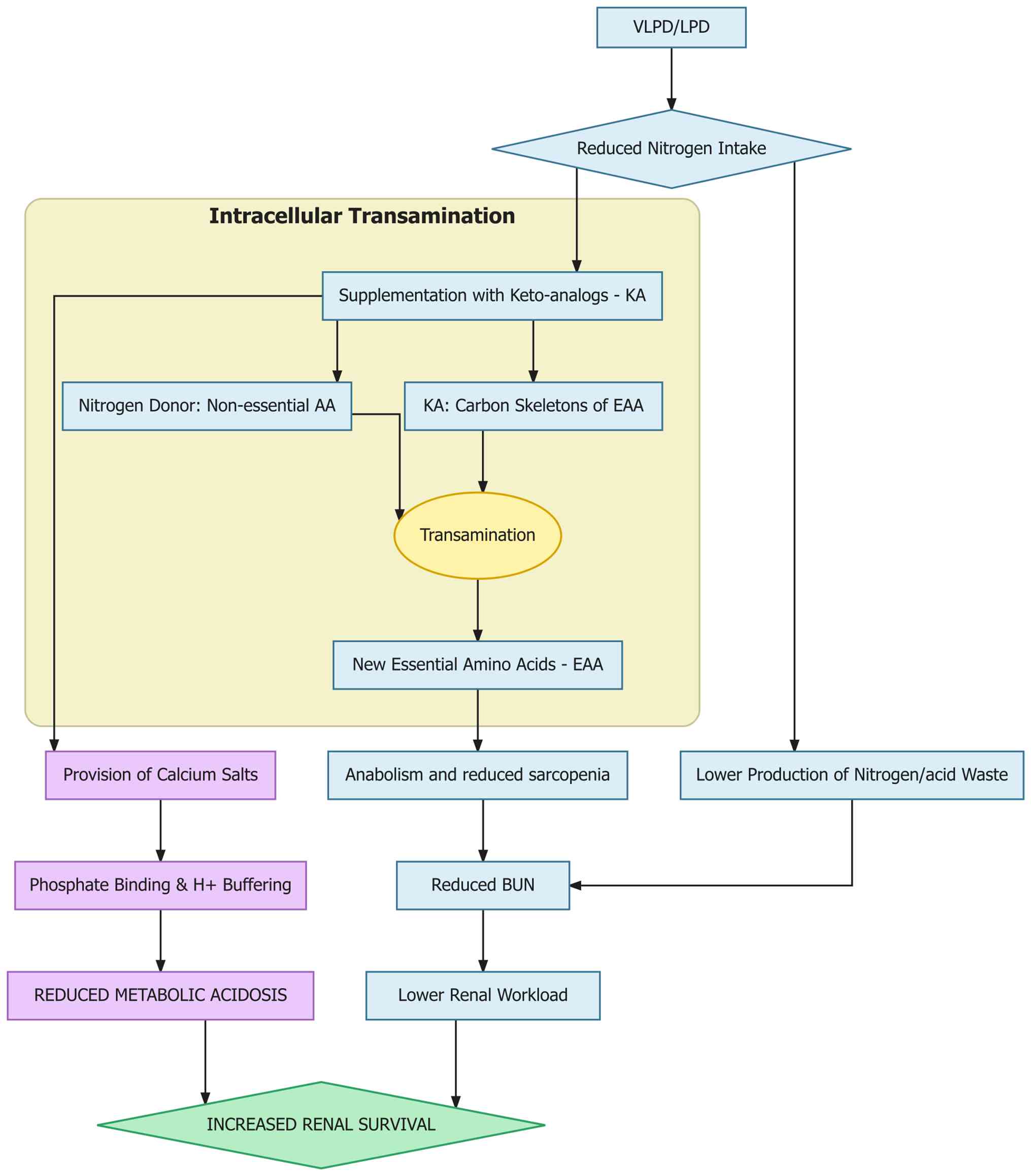
KA exert their metabolic effects primarily through
transamination reactions, in which nitrogen is transferred from
catabolism and non-essential amino acids to KA to form essential
amino acids. This process supports protein synthesis and recycles
nitrogen (14) (Fig. 1). The absence of nitrogen and acid
load renders KA particularly suitable in patients with severe CKD,
in whom uremic toxin accumulation and metabolic acidosis remain
major therapeutic challenges. A recent meta-analysis indicated that
LPD + KA reduces the rate of estimated glomerular filtration rate
(eGFR) decline by ~1.5-2.0 ml/min/year compared to free diets,
significantly extending the pre-dialysis interval (15).
Furthermore, Garneata et al (16) demonstrated in their trial that a
VLPD + KA reduced the risk of reaching the composite endpoint
(initiation of dialysis or 50% reduction in eGFR) by 42% compared
to a standard LPD. While 42% of patients in the LPD-only group
required RRT initiation within 15 months, only 13% of those in the
VLPD + KA group progressed to dialysis (17). These findings lend further support
to the hypothesis that reducing urea catabolism aids in attenuating
the progression of renal disease.
The hypercalcemic effect of KA should be
highlighted, mostly since patients with CKD are often treated with
calcium and vitamin D supplementation. Furthermore, recent evidence
emphasizes the benefits of LPD + KA on the gut-kidney axis,
focusing on the modulation performed by the nitrogen balance
(17). In detail, a high
protein-to-fiber ratio in ESRD promotes the expansion of
proteolytic bacterial species, which increases the overproduction
of p-cresyl sulfate and indoxyl sulfate; these represent an
increased cardiovascular mortality risk and systemic inflammation,
and are poorly cleared by conventional HD (18). The implementation of LPD/VLPD + KA
reduces the substrate available for these proteolytic bacteria,
shifting the intestinal environment toward a saccharolytic profile.
It is translated by the reduced generation of these toxins,
restored intestinal barrier integrity and reduced systemic
inflammatory state. While the Mediterranean diet and PBD increase
fiber intake, which promotes the production of short-chain fatty
acids, the supplemented LPD reduces the absolute proteolytic
fermentation (19). This
downregulates the p-cresol and indoxyl-sulfate pathways, reducing
Enterobacteriaceae and increasing Lactobacillaceae,
creating a synergistic effect with incremental dialysis to maintain
systemic uremic balance. In the context of incremental dialysis,
this nutritional modulation functions as a biological clearance
that complements the mechanical clearance of the dialyzer, further
protecting RKF from toxin-mediated damage (Fig. 2).
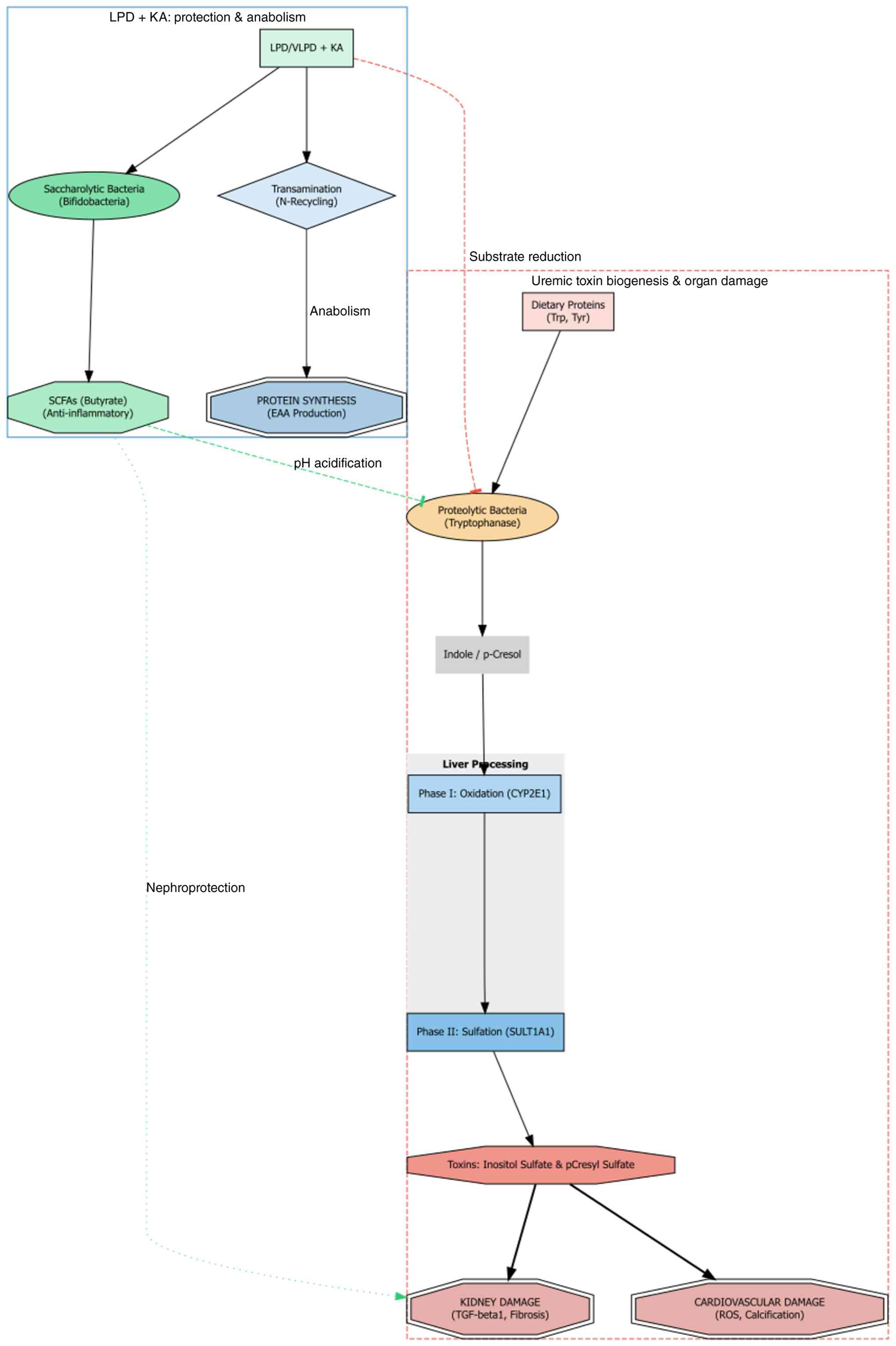 | Figure 2From gut dysbiosis to multi-organ
damage. Solid edges represent direct metabolic flows or biochemical
conversions; dashed lines represent inhibitory effects or negative
feedback; dotted lines represent indirect protective signals or
distal metabolic benefits. Red shades represent
catabolic/pathological pathway; green shades represent nutritional
intervention and protection; blue shades represent biochemical and
anabolic recovery. LPD, low-protein diet; VLPD, very low-protein
diet; KA, ketoanalogues; EAA, essential amino acids; SCFA,
short-chain fatty acids; CYP2E1, cytochrome P450 2E1; SULT1A1,
sulfotransferase 1A1; Trp, tryptophan; Tyr, tyrosine; TGF-β1,
transforming growth factor β1; ROS, reactive oxygen species. |
Acid-base balance and mineral
metabolism
Metabolic acidosis is a common complication of
advanced kidney disease and a key driver of muscle catabolism and
inflammation. LPDs reduce endogenous acid production, particularly
when animal protein intake is limited. KA further contribute to
acid-base stability by providing carbon skeletons without
associated hydrogen ions. Indeed, recent evidence supported this,
highlighting that patients on LPD + KA maintain significantly
higher serum bicarbonate levels compared to those on LPD alone,
often reducing the oral bicarbonate supplementation and thus
avoiding the associated sodium load (20). As regards mineral metabolism, LPD +
KA has been shown to reduce serum phosphorus compared to
unrestricted diets, where phosphate control represents another
major challenge in patients undergoing conservative treatment and
dialysis. This reduction is clinically relevant as it is associated
with a 30-40% decrease in phosphate binder pill burden (Fig. 1).
This reduction is clinically relevant as it is
associated with a 30-40% decrease in phosphate binder pill burden
(Fig. 1). To provide a
comprehensive overview, the macronutrient targets, metabolic
advantages and potential risks of the Mediterranean diet, PBD and
LPD/VLPD + KA in the pre-dialysis setting are summarized and
compared in Table I.
 | Table IAdvantages and disadvantages of the
different diets in conservative CKD management. |
Table I
Advantages and disadvantages of the
different diets in conservative CKD management.
| Diet regimen | Protein target
(g/kg/day) | Main advantages in
dialysis | Major risks | Impact on gut
microbiota |
|---|
| Mediterranean diet
(MD) | 0.8-1.2 | Cardiovascular
protection; high palatability; low risk of PEW; reduced chronic
inflammation. | High protein
intake; potential risk of hyperkalemia. | Increases
short-chain fatty acids (SCFAs); reduces dysbiosis. |
| Plant-based diet
(PBD) | 0.6-0.8 | Low phosphorus
bioavailability; high alkalizing effect. | High risk of
micronutrient deficiencies; risk of hyperkalemia; lower amino acid
score. | Shifts gut
environment toward a saccharolytic profile; reduces pCS and IS
pathways. |
| VLPD/LPD + KA | 0.3-0.6 +
ketoanalogues | Maximum reduction
of uremic toxins; extends pre-dialysis interval; recycles nitrogen
via transamination. | High pill burden
(6-12 tablets/day); risk of PEW if caloric intake drops below 30
kcal/kg/day; requires strict compliance. | Minimizes
proteolytic fermentation; significantly downregulates
Enterobacteriaceae; reduces pCS and IS pathways. |
3. Nutritional assessment in dialysis
The Mediterranean diet in
dialysis
As regards conservative CKD management, no univocal
results have been reported for the Mediterranean diet in dialysis.
Recent literature marks a shift in the nutritional management of
patients undergoing HD, from the common restrictive use of
vegetables to their moderate use. Indeed, recent evidence, based on
a sample of 582 patients, suggests that the Mediterranean diet does
not increase the risk of hyperkalemia, cardiovascular events, or
mortality, as the high fiber content improves intestinal motility
and reduces the bioavailability of potassium and organic phosphorus
compared to ultra-processed foods, ameliorating the vitamin and
micromineral balance (21).
Furthermore, a large DIET-HD trial indicated that, whereas a direct
reduction in short-term mortality remained unproven in the dialysis
population, the Mediterranean diet was able to reduce chronic
inflammation and impair the uremic toxin profile by modulating the
gut microbiota (4,22). Last, but not least, higher
adherence to the Mediterranean diet translates to a reduced risk of
developing sarcopenia and malnutrition, in keeping with the
evidence on conservative CKD management.
PBD in dialysis
The integration of scientific evidence regarding the
PBD in patients undergoing HD outlines an ambivalent clinical
image, where the potential metabolic benefits must be stringently
balanced with a risk of nutritional deficit and hyperkalemic
risk.
From a pathophysiological point of view, the PBD in
patients undergoing dialysis appears to be associated with a
reduction in oxidative stress, phosphate and systemic inflammation,
due to the high intake of natural phytonutrients and antioxidants,
such as vitamins C and E. These elements function as protective
factors against the cardiovascular complication which represent the
main cause of mortality in the ESRD population (23). In addition, the consumption of
vegetable proteins can positively influence the lipid profile and
the intestinal microbiota. Indeed, a beneficial impact on the
modulation of the gut-kidney axis has also been shown in PDB. In
detail, the high fiber intake serves as a substrate for
saccharolytic bacterial flora, which promotes the production of
short-chain fatty acids and accelerates the intestinal transit
time. This reduces the time for proteins to enter the colon, and
reduces the synthesis of indoxyl sulfate and p-cresyl sulfate, as
detailed below (Fig. 2) (24). Conversely, the comparative analysis
between vegetarian and omnivorous diets highlights significant
anthropometric and biochemical criticalities. Indeed, a PBD in
patients undergoing HD tends to reduce body mass index, mid-arm
muscular circumference and serum albumin compared to the omnivorous
counterpart, due to reduced average protein and energy intake
(25). However, no difference in
subjective global assessment was detected. To avoid the risk of
protein-caloric malnutrition and sarcopenia, supplementing KA in
these patients could bridge this knowledge gap.
In addition to the protein status, the micronutrient
profile requires extremely careful monitoring, where vegetarianism
emerges as an independent risk factor for severe vitamin D
deficiency (26). The limited
bioavailability of heme iron and potential deficiencies of vitamin
B12, zinc and fatty acids and long-chain omega-3 (eicosapentaenoic
acid and docosahexaenoic acid) further complicate the clinical
picture. Although the theoretical risk of hyperkalemia remains a
constant concern, requiring food preparation strategies, such as
leaching or double boiling reduces the potassium content in
vegetables and improves the ability of the gut to excrete
potassium, mitigating this risk (27). In summary, although the PBD can
also be successfully followed in HD, it requires constant
specialist dietary supervision, targeted supplementation of KA or
protein powders and careful monitoring of biochemical parameters to
prevent cardiovascular benefits being cancelled by the decline in
the overall nutritional status (28).
Nutritional status and PEW
The major complications of protein restriction in
patients undergoing dialysis, or in patients who are non-compliant
or undergoing conservative treatment, are the risk of malnutrition
and PEW. Dialysis itself is a catabolic and pro-inflammatory
process. For this reason, conventional guidelines have historically
recommended high protein intake in patients undergoing HD (29). Conversely, emerging evidence
suggests that protein quality and energy intake play a central
role, rather than protein quantity alone. Furthermore, this concept
is strictly linked with a phosphate intake, abundant in animal
protein, which represents one of the most challenging comorbidities
on dialysis (30).
In keeping with this hypothesis, a recent systematic
review and meta-analysis by Chen et al (31) involving >1,500 patients
confirmed that LPD + KA did not have a negative impact on serum
albumin, pre-albumin or anthropometric measurements when compared
to high-protein diets, provided that energy intake is maintained at
30-35 kcal/kg/day. In fact, the nitrogen-sparing effect of KA
supports a positive nitrogen balance even at protein intakes as low
as 0.6 g/kg/day. Conversely, LPD without KA supplementation carries
a 30% higher risk of causing a decline in lean body mass over a
period of 6 months (31). In these
patients, with a high number of treatments, the adherence to KA
should be well evaluated to avoid PEW exceeding the protein intake,
as a minimum of six pills should be taken daily by the
patients.
Quality of life and patient-centered
outcomes
Beyond improving metabolic tools, patient-centered
treatment should include the evaluation of quality of life; this
has become a central outcome in recent decades in the management of
ESRD. These patient-centered benefits reinforce the concept that
therapeutic success in dialysis extends beyond biochemical targets
to encompass lived experience and daily functioning.
KDQoL-SF or KDQoL-36 has been structured for
patients affected by renal disease, and includes the impact of CKD
on their lives. Indeed, some tasks regard the dialysis frequency,
symptom burden, fatigue, dietary and water restrictions, as well as
the impact on travel ability (32). The improved quality of life in
patients undergoing conservative CKD management with LPD + KA
constitutes well-consolidated knowledge (33).
A previous study evaluated quality of life in
patients undergoing dialysis comparing the LPD and free diet,
confirming the same results of conservative CKD, demonstrating
significant improvement in the once weekly HD with LPD + KA group
compared to the 2-weekly HD with free diet group, perhaps due to
the dietary restriction being balanced by the reduced fatigue and
by the reduced time spent for treatment (34).
4. The evolution of dialysis
Role of LPDs and KA across the CKD
continuum: From pre-dialysis to dialysis
The rationale supporting the use of LPD supplemented
with KA should not be limited to the conservative treatment of CKD,
but should include nephrotic syndrome and incremental dialysis. In
advanced pre-dialysis CKD, the role of LPD and VLPD + KA in
delaying RRT has been consistently demonstrated. Indeed, multiple
randomized and observational studies have demonstrated that a VLPD
supplemented with KA can safely postpone RRT by several months to
years in selected patients (35-37).
Furthermore, delaying the initiation of dialysis has major
implications both for the quality of life of patients and for
healthcare resource utilization (38). In patients with ESRD, intermittent
HD results in the cyclical fluctuations of these solutes, with a
progressive accumulation and electrolyte dysequilibrium during the
intradialytic interval, until a peak before the dialysis session.
It contributes to worse overall outcomes, including mortality,
systemic inflammation, endothelial dysfunction and oxidative
stress. Indeed, standardized kt/V (stdKt/V), which includes
intradialytic mean urea, results in a higher accuracy than the Kt/V
of the single dialysis session (39). Reducing dietary protein intake
lowers the rate of nitrogenous waste generation, reduces the
interdialytic solute accumulation, and consequently, improves the
stdKt/V.
However, the benefit of LPD + KA is true when the
nutritional status is adequately supervised, maintaining adequate
caloric intake to avoid malnutrition and sarcopenia. Indeed, it
needs to be supported by effective nutritional therapy and by high
compliance to implement safety (40).
The mechanism that underlies the nephroprotective
and metabolic benefits of LPD, including the maintenance of RRF, in
the pre-dialysis setting should be applied in the incremental
dialysis (41,42). Indeed, minimal residual clearance
is associated with improved volume control, more efficient
phosphorus and potassium handling, reduced inflammation, lower
erythropoietin requirements and improved survival. The preservation
of RKF is therefore a primary therapeutic goal, particularly during
the early phases of dialysis (43). Furthermore, reducing renal workload
is related to the longer preservation of renal function (44); in addition, the efficacy against
sarcopenia could benefit this frail population (45).
Health economic implications and
cost-effectiveness considerations
Beyond clinical and metabolic benefits, the
integration of LPD + KA in CKD may have relevant health economic
implications. Dialysis represents one of the most costly chronic
therapies, with costs driven primarily by treatment frequency,
vascular access, hospitalization and the management of
complications (46).
Delaying the initiation of dialysis through LPD + KA
may translate into substantial cost savings. Indeed, the cost of
nutritional therapy is significantly lower than that of HD
(47). Furthermore, Scalone et
al (48), as well as Bellizzi
et al (49) demonstrated
that a supplemented VLPD is a cost-effective, and even cost-saving,
strategy by postponing the initiation of expensive renal
replacement therapy. In the dialysis setting, incremental
approaches can reduce annual healthcare expenditures by
significantly lowering consumables, transportation and complication
costs (50).
In the pre-dialysis phase, delaying the initiation
of dialysis through VLPD or LPD supplemented with KA may translate
into substantial cost savings by postponing the initiation of RRT.
Economic modelling based on the trial by Garneata et al
(16) and the study by Povero
et al (51) suggest that
postponing RRT by an average of 10.7 months generates a net saving
of approximately €35,000 to €50,000 per Italian patient, even after
accounting for the costs of KA and specialized dietetic
counselling.
In the dialysis setting, incremental and decremental
dialysis strategies inherently reduce treatment frequency, staffing
requirements, consumables and transportation costs. In detail, the
integration of LPD + KA within incremental protocols can reduce
annual costs by up to ~20% (52).
At these costs, the reduction of phosphate binders and bicarbonate
supplementation related to the improved metabolic control, as well
as the reduction of sarcopenia, which contributes to lowering the
incidence of frailty-related hospitalizations and infections,
should be additionally considered.
Although precise economic quantification requires
dedicated cost-effectiveness analyses, existing data suggest that
integrated nutritional and incremental dialysis approaches are
likely to be economically favorable.
Decremental dialysis as a proof of
concept and future perspectives
From a pathophysiological standpoint, dietary
protein restriction reduces the generation of nitrogenous waste,
thereby smoothing the interdialytic uremic peaks. This biochemical
modulation functions synergistically with the RKF of the patient.
In patients with a residual urea clearance >1 ml/min/1.73 mq
(for twice-weekly regimens) or >3 ml/min/1.73 mq (for
once-weekly regimens), the native clearance of the kidney
complements the mechanical clearance of the dialyzer. By lowering
the metabolic workload through an LPD or VLPD supplemented with KA,
RKF can be preserved more efficiently, the primary determinant of
survival and volume control in the early years of dialysis, as
reported in a recently published pivotal randomized controlled
trial (34).
The concept of decremental dialysis challenges the
traditional point of view on dialysis as a unidirectional
escalating therapy. Instead, it frames dialysis dose and frequency
as dynamic parameters adjusted according to RKF, metabolic control
and patient-centered outcomes.
Although it refers to a hypothesis-generating
consideration, successful decremental strategies require stringent
patient selection, close biochemical and clinical monitoring, and
sustained metabolic stability. Patient compliance is fundamental,
as worse adherence to both pharmacological treatment and
nutritional schedule could impair the safety of the patients
(53). In this setting, LPD + KA
plays a crucial role where urea, phosphate and acid intake are
reduced. According to the study by Casino et al (54), LPD + KA, together with an RRF >1
ml/min/1.73 m2 for two-weekly or 3 ml/min/1.73
m2 for once-weekly dialysis, allows for guaranteeing
safe blood purification.
The evidence supporting LPD supplemented with KA
following the initiation of dialysis remains limited. Randomized
controlled trials or longitudinal observational studies are
required to define the impact of this strategy on patients
undergoing dialysis, expanding the use of KA to patients undergoing
dialysis twice or thrice weekly, with the aim of examining the
anabolic impact and the safety of KA for the entire CKD spectrum.
Moreover, further studies are warranted to evaluate
patient-reported outcomes as quality of life and formal
cost-effectiveness endpoints. Due to the pill burden and the
necessity of extremely high adherence, this approach should be
applied only in a carefully selected patients, under specialist
nephrological and dietetic supervision.
Moreover, further studies are required to evaluate
patient-reported outcomes, such as quality of life and formal
cost-effectiveness endpoints, by reducing post-dialysis fatigue,
burden of kidney disease and the effects of kidney disease.
5. The pivotal role of nephrology nursing in
patient education and compliance
The clinical feasibility of non-standard dialysis
protocols and strict nutritional regimens does not rest solely on
scientific validity, but on the genuine ability of a patient to
incorporate these prescriptions into the fabric of their daily
life. In this delicate balance, the nephrology nurse would emerge
as the essential catalyst for clinical success. They could serve as
the primary educator in the multidisciplinary team, when they aid
in ensuring that clinical and metabolic targets remain achievable,
solving the gap between medical theory and patient adherence; this
could be implemented considering that the ratio between the number
of patients and number of nurses is higher than the
patient/nephrologist ratio.
The nursing role is critical in translating medical
data into tangible daily food choices, vital for patients
transitioning from the familiar Mediterranean diet to LDP + KA.
Beyond initial education, the nurse maintains treatment momentum
through regular check-ins, triage and validated tools, such as the
KDQoL-36 questionnaire (55).
Furthermore, nurses can identify psychosocial or physical barriers
early, they can provide the specific counselling required to keep
the patient on track without them feeling overwhelmed by the
complexity of their care.
While dietary and fluid restrictions are often the
most problematic hurdles for patients, they remain the cornerstone
of effective self-management. In this case, the one-to-one
relationship between the nurse and the patient becomes
transformative. Nurses empower patients to restructure their
lifestyles and coping mechanisms.
Ultimately, the nephrology nurse takes on a daunting
medical protocol and transforms it into a sustainable, structured
lifestyle. By fostering self-care behaviors and providing a bridge
to clinical stability, they ensure that cutting-edge nutritional
and dialytic strategies are not just scientifically sound, but safe
and manageable for individuals in real life. Through this
human-centered approach, what was once a rigid medical mandate
becomes a viable pathway toward improved clinical outcomes and an
improved quality of life (54).
However, prospective studies are required to
determine whether nurse-led education improves adherence, residual
kidney function, nutritional outcomes or quality of life in
incremental HD programs.
Limitations of the current
evidence
Although numerous randomized controlled trials and
observational studies on patients with have been performed CKD
(35-37,56,57),
they have analyzed different outcomes ranging from mortality and
cardiovascular events to fistula maturation, eGFR slope, time to
dialysis, PEW, quality of life and electrolyte balance. This
renders the synopsis of these results difficult. Furthermore, very
few observational studies (58,59)
and only a single randomized controlled trial (33) have focused specifically on patients
undergoing dialysis. Larger, high-quality studies on both CKD and
dialysis populations are urgently required to address the knowledge
gaps arising from the marked heterogeneity of the current evidence.
Furthermore, adverse events have been poorly reported, rendering
analysis difficult.
6. Conclusions
Nutritional therapy remains a cornerstone of
nephrological care, maintaining its role also following the
initiation of HD. LPDs supplemented with KA may represent a
promising strategy for incremental or decremental dialysis;
However, the available published data are limited. As this is an
emerging and hypothesis-generating approach, and further
large-scale trials are warranted to solidify the evidence. Of note
however, the current data strongly suggest that personalized,
nutrition-centered care should be embraced as an integral component
of modern dialysis practice. It should be highlighted though that
nephrological care should remain active even following the
initiation of dialysis, personalizing treatments patient per
patient.
Acknowledgements
Not applicable.
Funding
Funding: No funding was received.
Availability of data and materials
Not applicable.
Authors' contributions
SC, SSi and VCa were involved in the
conceptualization of the study. VCa VCu and VF were involved in the
methodology (the literature search, and the structure of the
review). VCa, IM, IP, FP and IC were involved in the writing and
preparation of the original draft of the manuscript. VCu, VF and
SSc were involved in data curation (of data from the literature).
LM, MCC and GB were involved in the writing, review and editing of
the manuscript. All authors have read and agreed to the published
version of the manuscript. Data authentication is not
applicable.
Ethics approval and consent to
participate
Not applicable.
Patient consent for publication
Not applicable.
Competing interests
The authors declare that they have no competing
interests.
References
|
1
|
Bolasco P and Murtas S: Infrequent and
incremental dialysis: Differences and definitions. G Ital Nefrol.
35:2018–vol1. 2018.PubMed/NCBI
|
|
2
|
Casino FG, Lopez T, Santarsia G, Mostacci
SD, Sabato A, Di Carlo M, Procida C, Saracino A, Deira J and Basile
C: Could incremental haemodialysis be a new standard of care? A
suggestion from a long-term observational study. G Ital Nefrol.
39:2022–vol3. 2022.PubMed/NCBI
|
|
3
|
Ikizler TA, Burrowes JD, Byham-Gray LD,
Campbell KL, Carrero JJ, Chan W, Fouque D, Friedman AN, Ghaddar S,
Goldstein-Fuchs DJ, et al: KDOQI Clinical practice guideline for
nutrition in CKD: 2020 update. Am J Kidney Dis. 76 (3 Suppl
1):S1–S107. 2020.PubMed/NCBI View Article : Google Scholar
|
|
4
|
Bakis H, Chauveau P, Combe C and Pfirmann
P: Mediterranean diet for cardiovascular risk reduction in chronic
kidney disease. Adv Kidney Dis Health. 30:496–501. 2023.PubMed/NCBI View Article : Google Scholar
|
|
5
|
Kim H, Caulfield LE, Garcia-Larsen V,
Steffen LM, Grams ME, Coresh J and Rebholz CM: Plant-based diets
and incident CKD and kidney function. Clin J Am Soc Nephrol.
14:682–691. 2019.PubMed/NCBI View Article : Google Scholar
|
|
6
|
Mezzatesta S, Fiumara G, D'Antoni F,
Provenzano PF, Calabrese V, Tripepi R, Granda M, Gómez-Pulido JM,
Inguanta R, Aiello G, et al: Symptom burden in dialysis patients:
Determinants and impact on mortality. J Nephrol. 39:142–150.
2026.PubMed/NCBI View Article : Google Scholar
|
|
7
|
Torreggiani M, Fois A, Lippi F, Attini R,
Longhitano E, Matarazzo I, Masturzo B, Cabiddu G, Versino E and
Piccoli GB: Plant-based diets for CKD patients: Fascinating,
trendy, but feasible? A green nephrology perspective. Clin Kidney
J. 16:647–661. 2022.PubMed/NCBI View Article : Google Scholar
|
|
8
|
Craig WJ, Mangels AR, Fresán U, Marsh K,
Miles FL, Saunders AV, Haddad EH, Heskey CE, Johnston P,
Larson-Meyer E and Orlich M: The safe and effective use of
Plant-Based diets with guidelines for health professionals.
Nutrients. 13(4144)2021.PubMed/NCBI View Article : Google Scholar
|
|
9
|
Kalantar-Zadeh K, Joshi S, Schlueter R,
Cooke J, Brown-Tortorici A, Donnelly M, Schulman S, Lau WL, Rhee
CM, Streja E, et al: Plant-Dominant Low-protein diet for
conservative management of chronic kidney disease. Nutrients.
12(1931)2020.PubMed/NCBI View Article : Google Scholar
|
|
10
|
Moe SM, Zidehsarai MP, Chambers MA,
Jackman LA, Radcliffe JS, Trevino LL, Donahue SE and Asplin JR:
Vegetarian compared with meat dietary protein source and phosphorus
homeostasis in chronic kidney disease. Clin J Am Soc Nephrol.
6:257–264. 2011.PubMed/NCBI View Article : Google Scholar
|
|
11
|
Piccoli GB, Ferraresi M, Deagostini MC,
Vigotti FN, Consiglio V, Scognamiglio S, Moro I, Clari R, Fassio F,
Biolcati M and Porpiglia F: Vegetarian low-protein diets
supplemented with Keto analogues: A niche for the few or an option
for many? Nephrol Dial Transplant. 28:2295–2305. 2013.PubMed/NCBI View Article : Google Scholar
|
|
12
|
Attini R, Leone F, Montersino B, Fassio F,
Minelli F, Colla L, Rossetti M, Rollino C, Alemanno MG, Barreca A,
et al: Pregnancy, proteinuria, plant-based supplemented diets and
focal segmental glomerulosclerosis: A report on three cases and
critical appraisal of the literature. Nutrients.
9(770)2017.PubMed/NCBI View Article : Google Scholar
|
|
13
|
Li A, Lee HY and Lin YC: The effect of
ketoanalogues on chronic kidney disease deterioration: A
Meta-analysis. Nutrients. 11(957)2019.PubMed/NCBI View Article : Google Scholar
|
|
14
|
Mir S, Ozkayin N and Akgun A: The role of
keto acids in the supportive treatment of children with chronic
renal failure. Pediatr Nephrol. 20:950–955. 2005.PubMed/NCBI View Article : Google Scholar
|
|
15
|
Bellizzi V, Garofalo C, Ferrara C and
Calella P: Ketoanalogue supplementation in patients with
Non-dialysis diabetic kidney disease: A systematic review and
Meta-analysis. Nutrients. 14(441)2022.PubMed/NCBI View Article : Google Scholar
|
|
16
|
Garneata L, Stancu A, Dragomir D, Stefan G
and Mircescu G: Ketoanalogue-supplemented vegetarian very
Low-protein diet and CKD progression. J Am Soc Nephrol.
27:2164–2176. 2016.PubMed/NCBI View Article : Google Scholar
|
|
17
|
Radić J, Bečić T, Vučković M, Jukić I,
Vuković J, Fabijanić D and Radić M: Targeting the Gut-Kidney-heart
axis in chronic kidney disease: The mediterranean diet as a
strategy to reduce uremic toxins and cardiovascular risk.
Nutrients. 18(1451)2026.PubMed/NCBI View Article : Google Scholar
|
|
18
|
Lu Y, Meng L, Wang X, Zhang Y, Zhang C and
Zhang M: The Non-traditional cardiovascular culprits in chronic
kidney disease: Mineral imbalance and uremic toxin accumulation.
Int J Mol Sci. 26(7938)2025.PubMed/NCBI View Article : Google Scholar
|
|
19
|
De Mauri A, Carrera D, Bagnati M, Rolla R,
Vidali M, Chiarinotti D, Pane M, Amoruso A and Del Piano M:
Probiotics-Supplemented Low-protein diet for microbiota modulation
in patients with advanced chronic kidney disease (ProLowCKD):
Results from a Placebo-controlled randomized trial. Nutrients.
14(1637)2022.PubMed/NCBI View Article : Google Scholar
|
|
20
|
Ariyanopparut S, Metta K, Avihingsanon Y,
Eiam-Ong S and Kittiskulnam P: The role of a low protein diet
supplemented with ketoanalogues on kidney progression in
pre-dialysis chronic kidney disease patients. Sci Rep.
13(15459)2023.PubMed/NCBI View Article : Google Scholar
|
|
21
|
Garagarza C, Valente A, Caetano C, Ramos
I, Sebastião J, Pinto M, Oliveira T, Ferreira A and Guerreiro CS:
Mediterranean diet: A dietary pattern related to nutritional
benefits for hemodialysis patients. J Ren Nutr. 33:472–481.
2023.PubMed/NCBI View Article : Google Scholar
|
|
22
|
Saglimbene VM, Wong G, Ruospo M, Palmer
SC, Garcia-Larsen V, Natale P, Teixeira-Pinto A, Campbell KL,
Carrero JJ, Stenvinkel P, et al: Fruit and vegetable intake and
mortality in adults undergoing maintenance hemodialysis. Clin J Am
Soc Nephrol. 14:250–260. 2019.PubMed/NCBI View Article : Google Scholar
|
|
23
|
Rysz J, Franczyk B, Ławiński J and
Gluba-Brzózka A: Oxidative stress in ESRD Patients on dialysis and
the risk of cardiovascular diseases. Antioxidants (Basel).
9(1079)2020.PubMed/NCBI View Article : Google Scholar
|
|
24
|
Tsuji K, Uchida N, Nakanoh H, Fukushima K,
Haraguchi S, Kitamura S and Wada J: The Gut-Kidney axis in chronic
kidney diseases. Diagnostics. 15(21)2025.
|
|
25
|
Wu TT, Chang CY, Hsu WM, Wang IK, Hsu CH,
Cheng SH, Liang CC, Chang CT and Huang CC: Nutritional status of
vegetarians on maintenance haemodialysis. Nephrology (Carlton).
16:582–587. 2011.PubMed/NCBI View Article : Google Scholar
|
|
26
|
Chen MY, Ou SH, Yen MC, Lee MS, Chen NC,
Yin CH and Chen CL: Vegetarian diet in dialysis patients: A
significant gap between actual intake and current nutritional
recommendations. Medicine (Baltimore). 100(e24617)2021.PubMed/NCBI View Article : Google Scholar
|
|
27
|
Sparks B: Nutritional considerations for
dialysis vegetarian patients, Part One. J Ren Nutr. 28:e11–e14.
2018.PubMed/NCBI View Article : Google Scholar
|
|
28
|
Sparks B: Nutritional considerations for
dialysis vegetarian patients, Part Two. J Ren Nutr. 28:e19–e23.
2018.PubMed/NCBI View Article : Google Scholar
|
|
29
|
Kistler BM, Benner D, Burrowes JD,
Campbell KL, Fouque D, Garibotto G, Kopple JD, Kovesdy CP, Rhee CM,
Steiber A, et al: Eating during hemodialysis treatment: A consensus
statement from the international society of renal nutrition and
metabolism. J Ren Nutr. 28:4–12. 2018.PubMed/NCBI View Article : Google Scholar
|
|
30
|
Calabrese V, Tripepi GL, Santoro D,
Cernaro V, Panuccio VA, Mezzatesta S, Mattace-Raso F and Torino C:
On Behalf of the Sicilian Registry of Nephrology Dialysis and
Transplantation. Impact of serum phosphate on hemoglobin level: A
longitudinal analysis on a large cohort of dialysis patients. J
Clin Med. 13(5657)2024.PubMed/NCBI View Article : Google Scholar
|
|
31
|
Chen CH, Tsai PH, Tsai WC, Ko MJ, Hsu LY,
Chien KL, Hung KY and Wu HY: Efficacy and safety of ketoanalogue
supplementation combined with protein-restricted diets in advanced
chronic kidney disease: A systematic review and meta-analysis. J
Nephrol. 37:2113–2125. 2024.PubMed/NCBI View Article : Google Scholar
|
|
32
|
Cohen DE, Lee A, Sibbel S, Benner D,
Brunelli SM and Tentori F: Use of the KDQOL-36™ for assessment of
health-related quality of life among dialysis patients in the
United States. BMC Nephrol. 20(112)2019.PubMed/NCBI View Article : Google Scholar
|
|
33
|
Mahapatra HS, Balakrishnan MK, Arora D,
Lakshman Khattar D and Paul S: Balancing protein intake: A
randomized control trial of low, very low with alpha-ketoanalogue,
and normal protein diets impact on quality of life in non-dialysis
chronic kidney disease patients. Nutr Health: December 11, 2025
(Epub ahead of print).
|
|
34
|
Kittiskulnam P, Tiranathanagul K,
Susantitaphong P, Phannajit J, Chongpison Y, Asavapujanamanee P,
Surattichaiyakul B, Takkavatakarn K, Katavetin P, Metta K, et al:
Stepwise incremental hemodialysis and Low-Protein diet supplemented
with Keto-analogues preserve residual kidney function: A randomized
controlled trial. Nutrients. 17(2422)2025.PubMed/NCBI View Article : Google Scholar
|
|
35
|
Paniagua R, Ávila-Díaz M, Nava J,
Romero-Salas R, Hernández-Rivera JCH, Mejía-Rodríguez O and Picolli
GB: Mexican Nephrology Collaborative Study Group. Low-protein diet
supplemented with Ketoanalogues and progression of chronic kidney
disease in diabetic patients: A multicenter randomized controlled
trial. Nutrients. 18(2630)2026.PubMed/NCBI View Article : Google Scholar
|
|
36
|
Zemchenkov A and Konakova IN: Efficacy of
the essential amino acids and Keto-analogues on the CKD progression
rate in real practice in Russia-city nephrology registry data for
outpatient clinic. BMC Nephrol. 17(62)2016.PubMed/NCBI View Article : Google Scholar
|
|
37
|
Wu CH, Yang YW, Hung SC, Kuo KL, Wu KD, Wu
VC and Hsieh TC: National Taiwan University Study Group on Acute
Renal Failure (NSARF). Ketoanalogues supplementation decreases
dialysis and mortality risk in patients with anemic advanced
chronic kidney disease. PLoS One. 12(e0176847)2017.PubMed/NCBI View Article : Google Scholar
|
|
38
|
Rivara MB and Mehrotra R: Timing of
dialysis initiation: What has changed since IDEAL? Semin Nephrol.
37:181–193. 2017.PubMed/NCBI View Article : Google Scholar
|
|
39
|
Daugirdas JT, Depner TA, Greene T, Levin
NW, Chertow GM and Rocco MV: Frequent Hemodialysis Network Trial
Group. Standard Kt/Vurea: A method of calculation that includes
effects of fluid removal and residual kidney clearance. Kidney Int.
77:637–644. 2010.PubMed/NCBI View Article : Google Scholar
|
|
40
|
Calabrese V, Metro D, Alibrandi A,
Maviglia D, Cernaro V, Maressa V, Longhitano E, Gembillo G and
Santoro D: Review and practical excursus on the comparison between
traditional statics methods and Classification and regression tree
(CART) in real-life data: Low protein diet compared to
Mediterranean diet in patients with chronic kidney disease.
Nefrologia (Engl Ed). 45:279–284. 2025.PubMed/NCBI View Article : Google Scholar
|
|
41
|
Cupisti A, Brunori G, Di Iorio BR,
D'Alessandro C, Pasticci F, Cosola C, Bellizzi V, Bolasco P,
Capitanini A, Fantuzzi AL, et al: Nutritional diet therapy in the
management of the patient with Chronic Kidney Disease in advanced
phase to delay the beginning and reduce the frequency of dialysis.
G Ital Nefrol. 35:2018–vol5. 2018.PubMed/NCBI(In Italian).
|
|
42
|
Chen CH, Perl J and Teitelbaum I:
Prescribing high-quality peritoneal dialysis: The role of
preserving residual kidney function. Perit Dial Int. 40:274–281.
2020.PubMed/NCBI View Article : Google Scholar
|
|
43
|
Mathew AT, Fishbane S, Obi Y and
Kalantar-Zadeh K: Preservation of residual kidney function in
hemodialysis patients: Reviving an old concept. Kidney Int.
90:262–271. 2016.PubMed/NCBI View Article : Google Scholar
|
|
44
|
Obi Y, Streja E, Rhee CM, Ravel V, Amin
AN, Cupisti A, Chen J, Mathew AT, Kovesdy CP, Mehrotra R and
Kalantar-Zadeh K: Incremental hemodialysis, residual kidney
function, and mortality risk in incident dialysis patients: A
cohort study. Am J Kidney Dis. 68:256–265. 2016.PubMed/NCBI View Article : Google Scholar
|
|
45
|
Wang J, Lee SY, Chao CT, Huang JW and
Chien KL: Ketoanalogue use is associated with a lower risk of
worsening frailty among patients with diabetic kidney disease of
advanced stage: A retrospective cohort study. Heliyon.
10(e40392)2024.PubMed/NCBI View Article : Google Scholar
|
|
46
|
Piccoli G, Formica M, Mangiarotti G,
Pacitti A, Piccoli GB, Bajardi P, Cavagnino A, Ghezzi P, Ragni R,
Ramello A, et al: The costs of dialysis in Italy. Nephrol Dial
Transplant. 12 (Suppl 1):S33–S44. 1997.PubMed/NCBI
|
|
47
|
Zahirian Moghadam T, Powell J, Sharghi A
and Zandian H: Economic evaluation of dialysis and comprehensive
conservative care for chronic kidney disease using the ICECAP-O and
EQ-5D-5L; a comparison of evaluation instruments. Cost Eff Resour
Alloc. 21(81)2023.PubMed/NCBI View Article : Google Scholar
|
|
48
|
Scalone L, Borghetti F, Brunori G, Viola
BF, Brancati B, Sottini L, Mantovani LG and Cancarini G:
Cost-benefit analysis of supplemented very low-protein diet versus
dialysis in elderly CKD5 patients. Nephrol Dial Transplant.
25:907–913. 2010.PubMed/NCBI View Article : Google Scholar
|
|
49
|
Bellizzi V, Fordellone M, De Nicola L,
Minutolo R, Signoriello S, Quintaliani G, Di Iorio B and Chiodini
P: Cost-effectiveness of protein restricted diets in advanced CKD.
Nephrol Dial Transplant. 41:149–160. 2025.PubMed/NCBI View Article : Google Scholar
|
|
50
|
Murea M, Moossavi S, Garneata L and
Kalantar-Zadeh K: Narrative review of incremental hemodialysis.
Kidney Int Rep. 5:135–148. 2019.PubMed/NCBI View Article : Google Scholar
|
|
51
|
Povero M, Simion T and Pradelli L:
Cost-effectiveness of a ketoanalogue-supplemented very low-protein
diet in CKD. Nephrol Dial Transplant. 40:2372–2378. 2025.PubMed/NCBI View Article : Google Scholar
|
|
52
|
Nardelli L, Scalamogna A, Cicero E and
Castellano G: Incremental peritoneal dialysis allows to reduce the
time spent for dialysis, glucose exposure, economic cost, plastic
waste and water consumption. J Nephrol. 36:263–273. 2023.PubMed/NCBI View Article : Google Scholar
|
|
53
|
Calabrese V, Gembillo G, Buda M, Cernaro
V, Longhitano E, Pontoriero A, Polizzi M, Metro D and Santoro D:
Review and practical excursus of the propensity score: Low protein
diet compared to mediterranean diet in patients with chronic kidney
disease. G Ital Nefrol. 40:2023–vol6. 2023.PubMed/NCBI
|
|
54
|
Casino FG, Casino A, Herva ET and Basile
C: New formulas for calculating dialysis dose in incremental
haemodialysis. Nephrol Dial Transplant. 41:265–274. 2026.PubMed/NCBI View Article : Google Scholar
|
|
55
|
Bulantekin Duzalan Ö, Albayrak Cosar A and
Sarikaya S: Hemodialysis Patients' experiences of diet and fluid
restriction: A qualitative study. Progr Nutr. 23(e2021254)2021.
|
|
56
|
Milovanova L, Fomin V, Moiseev S, Taranova
M, Milovanov Y, Lysenko Kozlovskaya L, Kozlov V, Kozevnikova E,
Milovanova S, Lebedeva M and Reshetnikov V: Effect of essential
amino acid кetoanalogues and protein restriction diet on
morphogenetic proteins (FGF-23 and Кlotho) in 3b-4 stages chronic
кidney disease patients: A randomized pilot study. Clin Exp
Nephrol. 22:1351–1359. 2018.PubMed/NCBI View Article : Google Scholar
|
|
57
|
Feiten SF, Draibe SA, Watanabe R, Duenhas
MR, Baxmann AC, Nerbass FB and Cuppari L: Short-term effects of a
very-low-protein diet supplemented with ketoacids in nondialyzed
chronic kidney disease patients. Eur J Clin Nutr. 59:129–136.
2005.PubMed/NCBI View Article : Google Scholar
|
|
58
|
Bolasco P, Cupisti A, Locatelli F, Caria S
and Kalantar-Zadeh K: Dietary management of incremental transition
to dialysis therapy: Once-weekly hemodialysis combined With
Low-protein Diet. J Ren Nutr. 26:352–359. 2016.PubMed/NCBI View Article : Google Scholar
|
|
59
|
Takkavatakarn K, Kittiskulnam P,
Tiranathanagul K, Katavetin P, Wongyai N, Mahatanan N, Tungsanga K,
Eiam-Ong S, Praditpornsilpa K and Susantitaphong P: The role of
once-weekly online hemodiafiltration with low protein diet for
initiation of renal replacement therapy: A case series. Int J Artif
Organs. 44:900–905. 2021.PubMed/NCBI View Article : Google Scholar
|