Introduction
Male infertility is a global health concern that
contributes to ~30% of infertility cases and affects an estimated
9-15% of the male population. Its burden increased by 76.9% between
1990 and 2019. Beyond its reproductive consequences, male
infertility is associated with anxiety, depression, stigma and
marital stress, and with a higher risk of cancer and a reduced life
expectancy (1-3).
Platelet-rich plasma (PRP) is an autologous blood
product in which platelets are concentrated above baseline levels.
Upon activation, platelets release growth factors, including
platelet-derived growth factor, transforming growth factor-β,
vascular endothelial growth factor, insulin-like growth factor-I
(IGF-I) and fibroblast growth factor (FGF), together with cytokines
and plasma proteins (4-6).
The composition of PRP varies considerably with the preparation
method, particularly in its platelet and leukocyte content
(7). In male reproduction, PRP has
been investigated in three distinct settings: Intratesticular
injection in men with non-obstructive azoospermia or severe
oligoasthenoteratozoospermia (8,9), the
culture of spermatogonial stem cells (10) and the in vitro
supplementation of media used to cryopreserve or prepare ejaculated
spermatozoa (5,11). These settings differ in their
target cells, plausible mechanisms, evidence base and clinical
implications, and should therefore be evaluated separately.
The present systematic review focused on the in
vitro setting. Cryopreservation exposes spermatozoa to cold
shock, osmotic stress, ice crystal formation and oxidative stress,
and laboratory preparation by centrifugation, filtration or swim-up
can also generate reactive oxygen species (ROS). These insults
reduce motility and viability and damage sperm DNA (5,12).
As mature spermatozoa have limited capacity for repair, protective
supplements in the surrounding medium have been explored, and PRP
has attracted interest as an inexpensive, autologous source of
growth factors and antioxidant plasma components (11). Previous narrative reviews have
combined in vitro, intratesticular and animal data (5,9,11),
and the human in vitro evidence has not been systematically
appraised.
The present systematic review therefore aimed to
determine whether the in vitro supplementation of human
sperm cryopreservation or preparation media with PRP improves sperm
quality compared with no PRP or an alternative medium, to assess
the risk of bias of the available studies, and to summarize the
evidence on PRP concentration, possible mechanisms and safety.
Data and methods
Protocol and reporting
The present systematic review was conducted and
reported in accordance with the Preferred Reporting Items for
Systematic Reviews and Meta-Analyses (PRISMA) 2020 statement
(13). The review protocol was
prospectively registered in PROSPERO (CRD420261481413).
Eligibility criteria
The eligibility criteria were defined using the
population, intervention, comparator, outcome and study design
framework. The population comprised ejaculated human semen samples
or spermatozoa from fertile, normozoospermic or infertile men. The
intervention was the in vitro addition of PRP or plasma rich
in growth factors (PRGF), whether autologous or heterologous and at
any concentration, to semen, cryopreservation medium or sperm
preparation or incubation medium. The comparator was the same or
comparable samples processed without PRP or with an alternative
medium or supplement. The primary outcome was progressive or total
sperm motility. Secondary outcomes were viability, morphology,
membrane integrity, DNA fragmentation, oxidative stress markers and
any reported adverse effect. Eligible designs were original
controlled laboratory experiments, including split-sample designs,
and randomized or non-randomized comparative studies, published in
English as full-text peer-reviewed articles. Animal studies,
studies with in vivo PRP administration, studies on
non-sperm cells, reviews, systematic reviews, meta-analyses,
letters, notes, case reports, case series and conference abstracts
without a full text were excluded.
Information sources and search
strategy
The PubMed, the Cochrane Library, ScienceDirect and
Google Scholar databases were searched for articles published from
January, 2019 to December, 2025, and manual searching of the
reference lists of relevant articles was also performed. The search
terms ‘platelet rich plasma’ OR ‘PRP’ were combined using AND with
‘sperm quality’, ‘sperm retrieval media’ and ‘infertility’, in
various combinations, in the title and abstract fields. The search
was restricted to English-language publications.
Study selection
Following the removal of duplicates, the two authors
(JCS and RP) independently screened the titles and abstracts and
then assessed the full texts of potentially eligible reports
against the eligibility criteria. Disagreements were resolved by
discussion.
Data extraction
Data were extracted using a standardized form that
recorded the first author, year of publication, country, study
design, application setting (cryopreservation or fresh
preparation/incubation), number and characteristics of semen
samples, age of donors, PRP source and concentration, comparator,
outcome data and main conclusions. Data were extracted by one
author and verified by the second.
Risk of bias assessment
Risk of bias was assessed independently by two
reviewers using the revised Cochrane risk-of-bias tool for
randomized trials (RoB 2) (14).
The tool covers five domains: Bias arising from the randomization
process (D1), bias due to deviations from intended interventions
(D2), bias due to missing outcome data (D3), bias in measurement of
the outcome (D4) and bias in selection of the reported result (D5).
Each domain and each study overall was rated as low risk, some
concerns or high risk. As the majority of the included studies were
laboratory experiments in which aliquots of the same sample were
allocated to the experimental arms, D1 was applied to the
allocation of samples or aliquots to treatment arms, and D2 to
adherence to the stated laboratory protocol. Disagreements were
resolved by consensus, and the results were visualized using robvis
(15).
Synthesis methods
A meta-analysis was not performed due to substantial
clinical and methodological heterogeneity. The included studies
differed in PRP source (autologous or heterologous), preparation
and activation, concentration (expressed variously as % v/v,
platelets/µl or an absolute volume), application setting, sperm
population, outcome definitions and timing of assessment, and
several did not report the measures of variance required for
pooling. The findings were therefore synthesized narratively in
accordance with the Synthesis Without Meta-analysis (SWiM)
guideline (16). Studies were
grouped by application setting, and the direction of effect was
summarized for each outcome. Studies were not weighted, and the
result of the study at high risk of bias was interpreted with
caution.
Results
Study selection
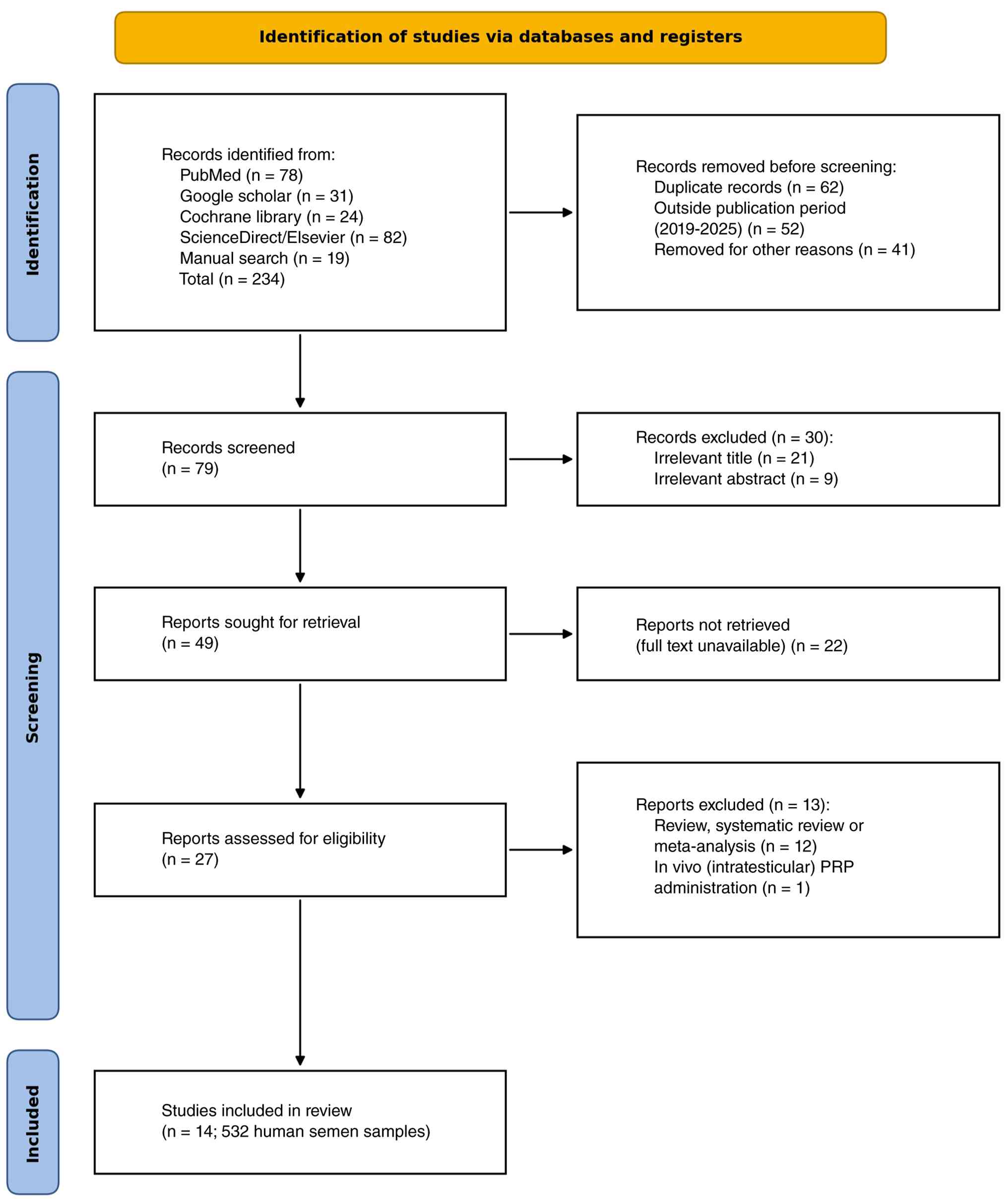
The search identified 234 records (PubMed, n=78;
Google Scholar, n=31; Cochrane Library, n=24; ScienceDirect, n=82;
manual search, n=19). Before screening, 62 duplicates, 52 records
outside the publication period and 41 records for other reasons
were removed, leaving 79 records for title and abstract screening.
Of these, 30 were excluded (21 on title and 9 on abstract). Of the
49 reports sought for retrieval, 22 could not be retrieved in full
text, and 27 were assessed for eligibility. A total of 13 reports
were excluded (12 reviews, systematic reviews or meta-analyses and
1 study of intratesticular PRP injection), and 14 studies were
included (Fig. 1).
Characteristics of the included
studies
The characteristics and findings of the 14 included
studies are summarized in Table I.
The studies were published between 2020 and 2025 and were conducted
in Iran (n=6), Iraq (n=3), China, Indonesia, Lebanon, Turkey and
Thailand (n=1 each). They analyzed a total of 532 human semen
samples (range, 10-100 per study). Of note, one study was a pilot
randomized controlled trial (17),
one was a prospective paired comparative study (18) and 12 were controlled in
vitro laboratory experiments, in most of which aliquots of the
same sample served as the control. A total of seven studies (157
samples) evaluated PRP as a supplement during cryopreservation
(12,18-23)
and seven studies (375 samples) evaluated PRP during fresh sperm
preparation or incubation, including glass wool filtration, swim-up
and incubation under oxidative stress (17,24-29).
The samples were derived from normozoospermic donors and from men
with infertility, asthenoteratozoospermia, teratozoospermia or
oligoasthenoteratozoospermia. PRP was autologous in the majority of
the studies, heterologous or non-autologous in two studies
(23,29) and prepared as PRGF in two studies
(19,28). Concentrations ranged from 0.25 to
10% v/v, from 50x103 to 100x103 platelets/µl,
or 0.5 ml of undiluted PRP.
 | Table ICharacteristics and findings of the
included studies, grouped by application setting. |
Table I
Characteristics and findings of the
included studies, grouped by application setting.
| A, PRP as a
supplement during cryopreservation (7 studies; 157 samples) |
|---|
| Authors, year of
publication | Country | Design | Samples (n) | Age (years) | PRP type and
concentration | Progressive
motility (%) | Viability (%) | Total abnormalities
(%) | Membrane integrity
(%) | Main
conclusion | Overall RoB | (Refs.) |
|---|
| Yan et al,
2021 | China | In vitro
experimental | 12 semen
samples | - | Autologous PRP 2, 5
and 10% | 0%: 28.1±2.6 5%:
30.3±2.7 10%: 29.2±2.2 | 0%: 59.6±3.9 2%:
62.0±3.9 5%: 65.5±4.2 10%: 64.3±3.2 | - | 0%: 49.2±3.4 2%:
49.8±3.1 5%: 52.4±3.6 10%: 51.5±3.3 | PRP increased
post-thaw motility and viability and protected spermatozoa from
freezing damage and excessive ROS generation; being self-derived,
it is an attractive cryoprotective additive. | Low | (12) |
| Mirzaei et
al, 2022 | Iran | In vitro
experimental | 10 semen
samples | - | PRGF 1, 5 and
10% | 0%: 35.4±6.2 1%:
49.0±5.8 5%: 37.1±17.6 10%: 36.0±9.8 | 0%: 57.8±7.3 1 %:
67.3±7.1 5%: 58.0±11.9 10%: 59.6±7.8 | - | - | Adding 1% PRGF to
freezing medium improved motility, vitality, normal morphology,
acrosome integrity, chromatin integrity and DNA fragmentation. | Low | (19) |
| Nabavinia et
al, 2023 | Iran | In vitro
experimental | 20 samples | 20-30 semen | PRP 0.25, 0.5 and
1x10⁵ platelets/µl | Control: 20 0.25:
28 0.5: 25 1: 35 | Control: 59 0.25:
60 0.5: 60 1: 67 | Control: 45 0.25:
47 0.5: 50 1: 53 | - | Samples treated
with PRP at 1x10⁵ platelets/µl had significantly higher
progressive motility and viability than controls. | Some concerns | (20) |
| Lorian et
al, 2024 | Iran | In vitro
experimental | 20 semen samples
(OAT) | 20-40 | Autologous PRP
0.25, 0.5 and 1x10⁵ platelets/µl | Control: 15.25±1.51
0.25: 12.15±9.65 0.5: 12.35±4.90 1: 14.05±4.13 | - | - | - | PRP as a
cryoprotectant at all three doses, particularly 1x10⁵
platelets/µl, may reduce the negative consequences of
cryopreservation. | Some concerns | (21) |
| Kamal et al,
2024 | Iraq | In vitro
experimental | 60 semen
samples | 25-40 | Autologous PRP 0.5
ml alone or with 0.7 ml glycerol-sugar medium | Control: 64.85±1.91
PRP alone: 27.22± 2.54 PRP + medium: 69.75±2.60 | - | - | - | Autologous PRP
alone as the cryoprotective agent gave negative results; PRP
combined with glycerol-sugar medium gave better semen
parameters. | Some concerns | (22) |
| Soltani et
al, 2025 | Iran | In vitro
experimental (lab trial) | 20 semen samples
(asthenoterato zoospermic) | 20-40 | Heterologous PRP
50x103 and 100x103 platelets/µl | Control: 4.27±0.78
PRP50: 10.65±1.47 PRP100: 6.96±0.96 | Control: 7.51±0.60
PRP50: 22.86±1.68 PRP100: 14.54±1.24 | Control: 0.62±0.16
PRP50: 0.79±0.18 PRP100: 0.83±0.17 | - | PRP and
nanocurcumin improved motility, viability, DNA fragmentation and
oxidative stress markers; PRP at the lower concentration was most
effective. Neither improved morphology. | Some concerns | (23) |
| Thitipatlertdech
et al, 2025 | Thailand | Prospective
comparative (paired) | 15 paired semen
samples (normozoospermic) | 27.3±3.8
(mean) | Autologous PRP
5% | Without vs. with
PRP: 5.67 (IQR 8.66) vs. 6.61 (IQR 6.35); P=0.887 | 26.07±9.30 vs.
32.13± 12.02; P=0.009 | 4.40±1.18 vs.
4.40±0.98; P>0.999 | - | 5% autologous PRP
significantly improved post-thaw vitality, with no significant
effect on concentration, motility, morphology or DNA
fragmentation. | Some concerns | (18) |
| B, PRP during fresh
sperm preparation or incubation (7 studies; 375 samples) |
| Authors, year of
publication | Country | Design | Samples (n) | Age (years) | PRP type and
concentration | Progressive
motility (%) | Viability (%) | Total abnormalities
(%) | Membrane integrity
(%) | Main
conclusion | Overall RoB | (Refs.) |
| Abduljabar et
al, 2021 | Iraq | In vitro
experimental (glass wool filtration) | 60 semen samples
(infertile men) | - | GWF alone vs. GWF +
PRP | GWF: 70.72±11.43
GWF + PRP: 89.62±4.18 | - | - | - | PRP combined with
GWF increased progressive motility and reduced immotile spermatozoa
compared with GWF alone. | Low | (24) |
| Hamdan et
al, 2021 | Iraq | In vitro
experimental (incubation) | 100 semen
samples | - | Autologous PRP
2% | Control:
28.17±17.31 2%: 39.22± 20.26 | - | - | - | Autologous PRP
increased the motility of human spermatozoa. | High | (25) |
| Angellee et
al, 2021 | Indonesia | In vitro
experimental (1-h incubation) | 40 semen samples
(infertile men) | - | PRP (concentration
not reported) | Fresh: 0.30±0.65
PRP: 23.92±14.75 | - | - | - | Incubation with PRP
for 1 h improved concentration, motility, progressive motility,
morphology and the proportion of spermatozoa with good
fertilization capacity compared with fresh semen. | Some concerns | (26) |
| Bader et al,
2020 | Lebanon | In vitro
experimental (H2O2-induced oxidative
stress) | 30 semen
samples | - | Autologous PRP 2, 5
and 10% | Control: 50 2%: 60
5%: 50 10%: 35 | - | Control: 25 2%: 19
5%: 20 10%: 22 | - | 2% PRP increased
progressive and total motility of stressed and non-stressed
spermatozoa and decreased ROS-positive cells, DNA fragmentation,
vacuolization and dead cells. | Some concerns | (27) |
| Ghasemian Nafchi
et al, 2023 | Iran | In vitro
experimental (incubation) | 25 semen samples
(teratozoospermic) | - | PRGF 1, 5 and
10% | Control: 17.36±8.50
1%: 47.72± 13.76 5%: 38.54±16.80 10%: 38.45± 15.87 | Control:
71.37±13.29 1%: 81.36± 9.65 5%: 72.35±8.41 10%: 68.92± 11.02 | - | - | PRGF incubation
improved sperm parameters and reduced malondialdehyde, a marker of
oxidative stress. | Some concerns | (28) |
| Yentur et
al, 2025 | Turkey | Pilot randomized
controlled trial (swim-up) | 40 semen
samples | 20-45 | Autologous
non-activated PRP, 0.5 ml undiluted | Total motility, PRP
vs. control: 1 h: 97.25±4.92 vs. 93.87±9.96 (P<0.05) 24 h:
50.50±9.79 vs. 21.12±10.03 (P<0.001) | - | - | - | PRP added during
swim-up preparation enhanced and preserved motility over 24 h,
supporting its potential as an adjunct in IUI/IVF sperm
preparation. | Low | (17) |
| Hosseini et
al, 2025 | Iran | In vitro
experimental, split-sample (incubation and swim-up) | 80 semen samples
(40 normozoospermic, 40 asthenoterato zoospermic) | 20-45 | Non-autologous PRP
2% | Asthenoterato
zoospermic, control vs. PRP: Incubation: 15.4±7.7 vs. 22.4±4.2
Swim-up: 52.6±5.6 vs. 59.5±3.4 (both P<0.001) | 59.2±8.7 vs.
61.6±6.6; P=0.172 | No significant
change | - | 2% PRP improved
motility (and concentration after swim-up) in normozoospermic and
asthenoteratozoospermic samples, with no significant effect on
viability or morphology. | Some concerns | (29) |
Risk of bias
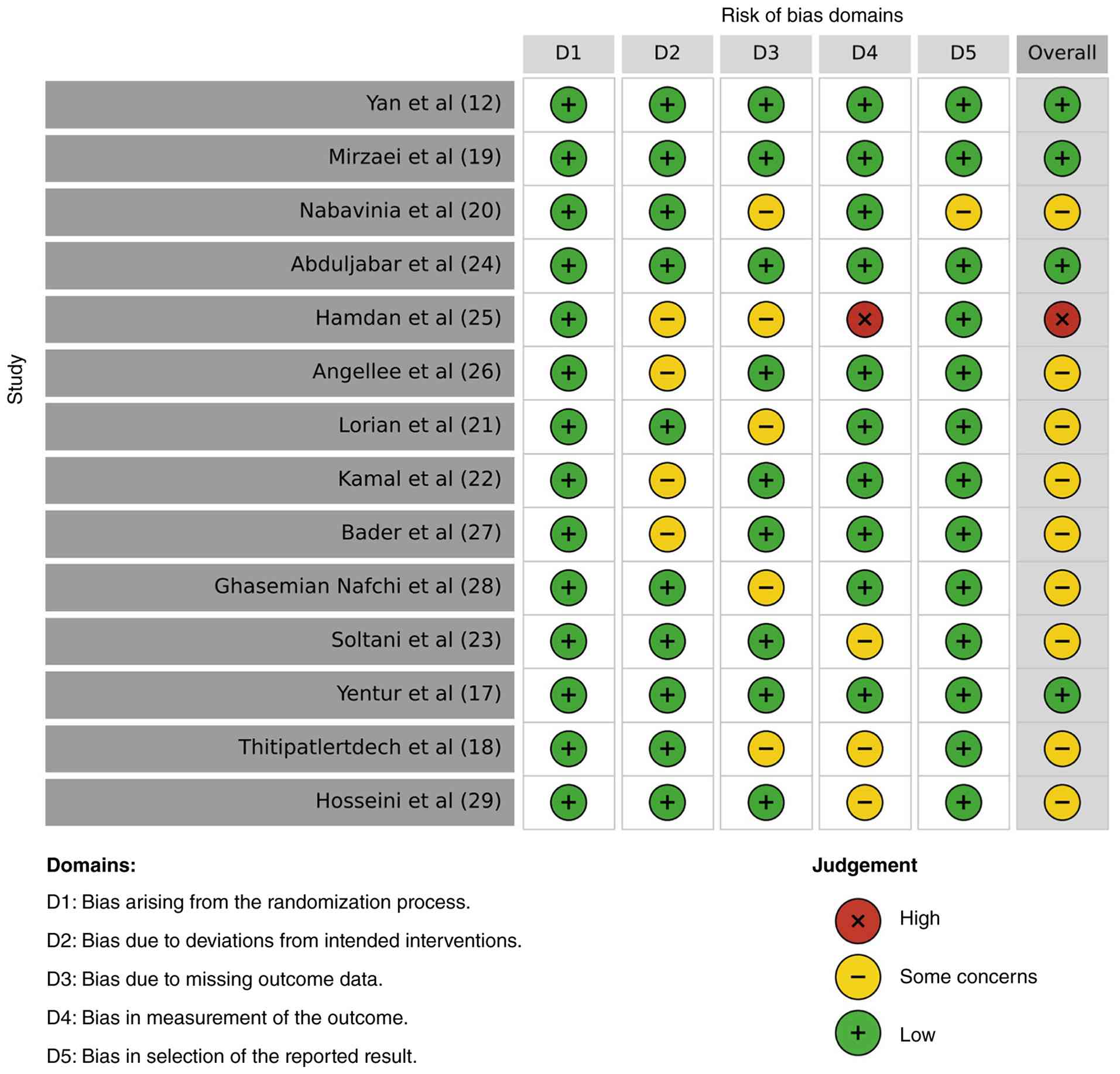
The risk of bias assessment is presented in Fig. 2. The overall risk of bias was low
in four studies (12,17,19,24),
raised some concerns in nine and was high in one study (25). All studies were at low risk of bias
in D1. The most frequent concerns related to missing outcome data
(D3; five studies), deviations from intended interventions (D2;
four studies) and measurement of the outcome (D4; four studies,
including the study at high risk of bias). Only one study raised
concerns about selective reporting (D5) (20). Sample sizes were small (median,
27.5 samples per study).
Effect of PRP during
cryopreservation
Of the seven cryopreservation studies, five reported
an improvement in at least one motility or viability outcome with
PRP as a supplement. Yan et al (12) reported modestly higher post-thaw
progressive motility (30.3 vs. 28.1%), viability (65.5 vs. 59.6%)
and membrane integrity with 5% autologous PRP, together with lower
ROS generation. Mirzaei et al (19) reported that 1% PRGF improved
progressive motility (49.0 vs. 35.4%), viability (67.3 vs. 57.8%),
morphology, acrosome and chromatin integrity and DNA fragmentation,
whereas 5 and 10% were less effective. Nabavinia et al
(20) found the greatest
improvements in progressive motility (35 vs. 20%) and viability (67
vs. 59%) with 1x10⁵ platelets/µl. Soltani et al
(23) reported that heterologous
PRP at 50x103 platelets/µl improved progressive motility
(10.65 vs. 4.27%) and viability (22.86 vs. 7.51%) and reduced DNA
fragmentation and malondialdehyde (MDA) levels in samples from men
with asthenoteratozoospermia, and was more effective than
100x103 platelets/µl and nanocurcumin, although
morphology did not improve.
The remaining findings were less favorable.
Thitipatlertdech et al (18) found that 5% autologous PRP improved
post-thaw vitality in normozoospermic men (32.13 vs. 26.07%;
P=0.009) but not progressive motility, morphology or DNA
fragmentation. Lorian et al (21) concluded that PRP exerted a
cryoprotective effect in oligoasthenoteratozoospermic samples,
particularly at 1x10⁵ platelets/µl, although the
extracted progressive motility values did not exceed those of the
control (14.05 vs. 15.25%). Kamal et al (22) reported that 0.5 ml of autologous
PRP used alone as the cryoprotective agent markedly reduced
post-thaw progressive motility (27.22 vs. 64.85%), whereas PRP
combined with a glycerol-sugar cryoprotective medium produced a
small improvement (69.75%). This indicates that PRP cannot replace
a conventional penetrating cryoprotectant.
Effect of PRP during fresh sperm
preparation or incubation
All seven studies in this setting reported higher
motility with PRP. Abduljabar et al (24) reported higher progressive motility
after glass wool filtration combined with PRP than after filtration
alone (89.62 vs. 70.72%). Hamdan et al (25) reported higher progressive motility
after incubation with 2% autologous PRP (39.22 vs. 28.17%),
although this study was at high risk of bias. Angellee et al
(26) reported that 1 h of
incubation with PRP improved concentration, motility, progressive
motility, morphology and the proportion of spermatozoa with good
fertilization capacity in men undergoing infertility treatment.
Under H2O2-induced oxidative stress, Bader
et al (27) found that 2%
PRP increased progressive and total motility and reduced
ROS-positive cells, DNA fragmentation, vacuolization and dead
cells, whereas 10% PRP reduced progressive motility below control
levels (35 vs. 50%). In teratozoospermic samples, Ghasemian Nafchi
et al (28) reported that
1% PRGF improved progressive motility (47.72 vs. 17.36%) and
viability (81.36 vs. 71.37%) and reduced MDA, while higher
concentrations were less effective. In a pilot randomized
controlled trial, Yentur et al (17) found that non-activated autologous
PRP added during swim-up preserved total motility over 24 h (50.50
vs. 21.12%; P<0.001). Hosseini et al (29) reported that 2% non-autologous PRP
improved progressive motility after incubation and after swim-up in
asthenoteratozoospermic samples, with no effect on viability or
morphology.
Concentration
In total, seven studies compared two or more PRP
concentrations. The best-performing arm was the lowest
concentration tested in four studies (19,23,27,28),
an intermediate concentration in one (12) and the highest in two, both of which
tested only a narrow, low range of up to 1x10⁵
platelets/µl (20,21). The highest concentrations tested
(10% v/v or 100x103 platelets/µl) were never the most
effective, and in one study they were detrimental (27). As the concentrations were expressed
in incompatible units, a common optimal dose could not be
derived.
Clinical and safety outcomes
None of the included studies reported fertilization,
embryo development, pregnancy, live birth or offspring outcomes,
and none systematically reported adverse effects.
Discussion
The present systematic review identified 14 in
vitro studies, comprising 532 human semen samples, that
evaluated PRP as a supplement to sperm cryopreservation or
preparation media. Most studies reported higher motility with PRP,
and several reported improved viability, DNA fragmentation and
oxidative stress markers. However, the benefit during
cryopreservation was inconsistent, the effect appeared to depend on
concentration, and PRP was detrimental when used alone as a
cryoprotectant. The evidence consists of small laboratory studies
with surrogate outcomes, most of which raised some concerns about
risk of bias, and no study assessed clinical reproductive outcomes
or safety. These findings therefore support further investigation,
but not clinical use, of PRP-supplemented sperm media.
Quality and external validity of the
evidence
Several features limit the strength of the evidence.
First, sample sizes were small (10-100 samples) and most studies
were single laboratory experiments; small, positive studies are
also more likely to be published. Second, although split-sample
designs control for between-donor variability, manual semen
analysis is susceptible to observer bias when assessors are aware
of the allocation, which is reflected in the concerns in D4. Third,
RoB 2 was developed for randomized clinical trials, and its
application to laboratory experiments required interpretation of D1
and D2, so the ratings should be regarded as approximate. Fourth,
the outcomes were laboratory surrogates, and improvements of a few
percentage points in post-thaw motility [for example, 30.3 vs.
28.1% (12)] may not be
biologically or clinically meaningful. Finally, six of the 14
studies were conducted in Iran and three in Iraq, which may limit
generalizability.
Studies on buck (30), ram (31,32)
and buffalo bull (33,34) semen have also reported improved
post-thaw quality with PRP-supplemented extenders, and some
reported in vivo fertility. However, species differences in
sperm membrane composition, cryotolerance, extenders and the
preparation of PRP mean that these data cannot be extrapolated to
human male infertility.
Concentration and formulation
The most consistent pattern was non-linear: Low to
moderate concentrations (1-5% v/v or
50x103-1x10⁵ platelets/µl) generally
exhibited optimal performance, whereas the highest concentrations
tested were never superior and occasionally harmful (19,23,27,28).
One explanation is that the beneficial growth factors and
antioxidants of PRP are accompanied by components that are harmful
at higher doses, including leukocyte-derived ROS and
pro-inflammatory cytokines, and fibrinogen and other clotting
factors that may cause sperm agglutination or entrapment (7,35).
Agglutination at higher PRP concentrations has been reported in
animal semen (30,31,34),
although not systematically assessed in the human studies. The
finding of the study by Kamal et al (22) that PRP alone is detrimental,
whereas PRP with a conventional cryoprotectant is beneficial
further suggests that PRP acts as an adjunct and not as a
cryoprotectant in its own right. Interpretation across studies is
limited because PRP source, platelet and leukocyte content,
anticoagulant and activation method were not consistently reported,
and because concentrations were expressed as % v/v, platelets/µl or
absolute volume. Standardized reporting, preferably of the final
platelet and leukocyte concentration in the medium, is
required.
Mechanisms
Mature spermatozoa are transcriptionally and
translationally largely inactive. Any short-term in vitro
effect of PRP must therefore arise from direct interactions with
the extracellular medium or from rapid, non-genomic signaling, and
not from changes in gene expression. This distinction is critical
when mechanisms are inferred from other cell types.
The best-supported mechanism is a reduction in
oxidative stress. Human sperm membranes are rich in polyunsaturated
fatty acids and the cells have limited cytoplasmic antioxidant
capacity, rendering them vulnerable to lipid peroxidation, loss of
motility and DNA damage during cryopreservation and handling.
Notably, four included studies directly measured oxidative stress
and reported lower ROS generation (12), fewer ROS-positive cells under
H2O2 challenge (27) or lower MDA levels (23,28)
with PRP. Plasma antioxidant proteins and enzymes in PRP may
scavenge ROS in the medium. In tenocytes, PRP increases antioxidant
defenses through the Nrf2 signaling pathway (36); however, as this pathway depends on
transcription, it is unlikely to operate in mature spermatozoa, and
direct scavenging and membrane protection are more plausible in
this setting.
A second mechanism involves growth factor receptor
signaling. Human spermatozoa express functional FGF receptors in
the acrosomal region and flagellum, and FGF2 increases sperm
motility through receptor tyrosine kinase activation (37). Endogenous sperm FGF2 levels are
positively associated with motility, and recombinant FGF2 increases
the recovery of motile spermatozoa after swim-up (38), which is consistent with the swim-up
findings of Yentur et al (17) and Hosseini et al (29). IGF-I from seminal plasma has been
reported to influence capacitation, membrane integrity and DNA
fragmentation in goat spermatozoa (39), although this has not been confirmed
in human spermatozoa. Plasma proteins may also stabilize sperm
membranes against osmotic and cold stress. Importantly, none of the
included studies measured the growth factor content of the PRP
used, receptor activation or mitochondrial function in relation to
the observed effects, so these mechanisms remain inferred rather
than demonstrated.
Mechanisms such as the stimulation of Leydig cell
function and steroidogenesis, repair of testicular tissue and
support of spermatogonial stem cells have been described in animal
models of testicular injury (40,41)
and in stem cell culture (10).
These are relevant only to in vivo or intratesticular PRP
administration and do not apply to ejaculated spermatozoa exposed
to PRP in vitro.
Safety
None of the included studies systematically reported
adverse effects, and none followed fertilization, embryo
development, pregnancy or offspring outcomes, so the safety of
PRP-exposed spermatozoa for assisted reproduction is unknown.
Several potential risks merit consideration. First, direct sperm
toxicity is possible: PRP used alone impaired post-thaw motility
(22) and 10% PRP reduced motility
under oxidative stress (27), and
leukocyte-rich PRP formulations have shown cytotoxicity in other
human cell types (35). Second,
sperm agglutination may occur at higher concentrations or after
platelet activation and clot formation (30,31,34).
Third, the use of heterologous or non-autologous PRP (23,29)
carries a risk of transmitting blood-borne pathogens into the
laboratory and to the female partner or embryo, and would require
donor screening and compliance with tissue and cell regulations;
even autologous PRP requires venepuncture and sterile processing to
avoid microbial contamination. Fourth, immunological effects are
theoretically possible: allogeneic plasma proteins could provoke
immune responses, and the autologous plasma of some infertile men
may contain antisperm antibodies that could promote agglutination
or immobilization. Finally, the local risks of intratesticular
injection, such as pain, hematoma, inflammation and infection, were
outside the scope of the present systematic review and require
separate evaluation. Until these issues have been addressed,
PRP-supplemented sperm media should be restricted to research
settings.
Comparison with other approaches
Only two included studies compared PRP with another
active approach: PRP outperformed glass wool filtration alone
(24) and nanocurcumin (23). No study compared PRP with
established antioxidant supplements or commercial cryoprotective
media, so its relative effectiveness is unknown.
Limitations
The present review has certain limitations which
should be mentioned. The search was restricted to English-language
articles published between 2019 and 2025; thus, earlier studies
were not captured. A total of 22 potentially relevant reports could
not be retrieved in full text, which may have introduced selection
bias. Some data could only be extracted approximately from the
published reports. Finally, meta-analysis was not possible, and the
certainty of evidence was not formally graded.
Future research
Future studies are warranted to report PRP
preparation in detail, including the source, platelet and leukocyte
counts, anticoagulant, activation method and final concentration in
the medium. They should use adequately powered, randomized
split-sample designs with blinded, computer-assisted semen
analysis, together with functional outcomes such as DNA
fragmentation, mitochondrial membrane potential and capacitation.
Studies should also measure the growth factor and cytokine content
of the PRP used. If such studies confirm a reproducible benefit,
controlled clinical trials with fertilization, embryo, pregnancy,
live birth and safety outcomes will be required before
PRP-supplemented media can be recommended in assisted
reproduction.
In conclusion, limited in vitro evidence from
small studies suggests that low-concentration PRP, used as a
supplement to standard cryopreservation or preparation media, may
improve laboratory measures of human sperm quality, particularly
motility. The effect is inconsistent, appears to depend on
concentration and is lost or reversed when PRP replaces a
conventional cryoprotectant. PRP-supplemented sperm media should
therefore be regarded as experimental until standardized protocols
and adequately powered studies with clinical and safety outcomes
are available.
Acknowledgements
Not applicable.
Funding
Funding: No funding was received.
Availability of data and materials
The data generated in the present study may be
requested from the corresponding author.
Authors' contributions
JCS conceptualized the study, conducted the
literature search, screened the studies, extracted the data,
assessed the risk of bias, performed the synthesis and drafted the
manuscript. RP contributed to the study design, independently
screened the studies, verified the extracted data, assessed risk of
bias, interpreted the findings and critically revised the
manuscript. JCS and RP confirm the authenticity of all the raw
data. Both authors have read and approved the final manuscript.
Ethics approval and consent to
participate
Not applicable.
Patient consent for publication
Not applicable.
Competing interests
The authors declare that they have no competing
interests.
Use of artificial intelligence tools
During the revision of this manuscript, the authors
used an artificial intelligence tool (Claude; Anthropic) to assist
with restructuring the text in response to the peer review comments
and with language editing. The authors reviewed and edited all
output and take full responsibility for the content of the
manuscript.
References
|
1
|
Agarwal A, Mulgund A, Hamada A and Chyatte
MR: A unique view on male infertility around the globe. Reprod Biol
Endocrinol. 13(37)2015.PubMed/NCBI View Article : Google Scholar
|
|
2
|
Huang B, Wang Z, Kong Y, Jin M and Ma L:
Global, regional and national burden of male infertility in 204
countries and territories between 1990 and 2019: An analysis of
global burden of disease study. BMC Public Health.
23(2195)2023.PubMed/NCBI View Article : Google Scholar
|
|
3
|
Caroppo E and Colpi GM: Male infertility:
A review of key papers appearing in the reproductive medicine and
andrology section of the journal of clinical medicine. J Clin Med.
12(2366)2023.PubMed/NCBI View Article : Google Scholar
|
|
4
|
Alharbi B: Role of platelet-rich plasma in
the management of non-obstructive azoospermia. Cureus.
16(e69387)2024.PubMed/NCBI View Article : Google Scholar
|
|
5
|
Alonso-Frías P and Esbert M: Therapeutic
use of platelet-rich plasma for the treatment of male infertility.
Rev Int Androl. 22:16–23. 2024.PubMed/NCBI View Article : Google Scholar
|
|
6
|
Cheng PG, Yang KD, Huang LG, Wang CH and
Ko WS: Comparisons of cytokines, growth factors and clinical
efficacy between platelet-rich plasma and autologous conditioned
serum for knee osteoarthritis management. Biomolecules.
13(555)2023.PubMed/NCBI View Article : Google Scholar
|
|
7
|
Dohan Ehrenfest DM, Rasmusson L and
Albrektsson T: Classification of platelet concentrates: From pure
platelet-rich plasma (P-PRP) to leucocyte- and platelet-rich fibrin
(L-PRF). Trends Biotechnol. 27:158–167. 2009.PubMed/NCBI View Article : Google Scholar
|
|
8
|
Gudelci T, Cakiroglu Y, Yuceturk A, Batır
S, Karaosmanoglu O, Korun ZEU, Tufek I, Kural AR and Tiras B: The
effect of intratesticular autologous platelet-rich plasma injection
on sperm retrieval rates and in vitro fertilization outcomes in
couples with non-obstructive azoospermia. J Obstet Gynaecol Res.
50:1977–1984. 2024.PubMed/NCBI View Article : Google Scholar
|
|
9
|
Fazli F, Torkashvand H, Soltanian AR,
Babalhavaeji A, Olomi H and Pilehvari S: Effects of testicular
platelet-rich plasma (PRP) injection on sperm parameters in men
with severe oligoasthenoteratozoospermia (OAT): A clinical
evaluation. Int J Fertil Steril. 18 (Suppl 1):S71–S76.
2024.PubMed/NCBI View Article : Google Scholar
|
|
10
|
Khadivi F, Koruji M, Akbari M, Jabari A,
Talebi A, Ashouri Movassagh S, Panahi Boroujeni A, Feizollahi N,
Nikmahzar A, Pourahmadi M and Abbasi M: Application of
platelet-rich plasma (PRP) improves self-renewal of human
spermatogonial stem cells in two-dimensional and three-dimensional
culture systems. Acta Histochem. 122(151627)2020.PubMed/NCBI View Article : Google Scholar
|
|
11
|
Haidar ZS: Platelet-rich plasma therapy in
the management and treatment of male infertility-an update of
state-of-art. Biofunct Mater. 2(0006)2024.
|
|
12
|
Yan B, Zhang Y, Tian S, Hu R and Wu B:
Effect of autologous platelet-rich plasma on human sperm quality
during cryopreservation. Cryobiology. 98:12–16. 2021.PubMed/NCBI View Article : Google Scholar
|
|
13
|
Page MJ, McKenzie JE, Bossuyt PM, Boutron
I, Hoffmann TC, Mulrow CD, Shamseer L, Tetzlaff JM, Akl EA, Brennan
SE, et al: The PRISMA 2020 statement: An updated guideline for
reporting systematic reviews. BMJ. 372(n71)2021.PubMed/NCBI View
Article : Google Scholar
|
|
14
|
Sterne JAC, Savović J, Page MJ, Elbers RG,
Blencowe NS, Boutron I, Cates CJ, Cheng HY, Corbett MS, Eldridge
SM, et al: RoB 2: A revised tool for assessing risk of bias in
randomised trials. BMJ. 366(l4898)2019.PubMed/NCBI View Article : Google Scholar
|
|
15
|
McGuinness LA and Higgins JPT:
Risk-of-bias VISualization (robvis): An R package and Shiny web app
for visualizing risk-of-bias assessments. Res Synth Methods.
12:55–61. 2021.PubMed/NCBI View Article : Google Scholar
|
|
16
|
Campbell M, McKenzie JE, Sowden A,
Katikireddi SV, Brennan SE, Ellis S, Hartmann-Boyce J, Ryan R,
Shepperd S, Thomas J, et al: Synthesis without meta-analysis (SWiM)
in systematic reviews: Reporting guideline. BMJ.
368(l6890)2020.PubMed/NCBI View Article : Google Scholar
|
|
17
|
Yentur S, Dusunus YE, Canitez IO, Cil G,
Colakerol A and Kandirali IE: Towards better assisted reproductive
techniques outcomes: Using platelet-rich plasma to improve sperm
motility. Reprod Sci. 32:3599–3604. 2025.PubMed/NCBI View Article : Google Scholar
|
|
18
|
Thitipatlertdech C, Booning N, Jenjitsiri
T and Kesornsukone K: The effects of autologous platelet-rich
plasma supplement during sperm cryopreservation on
post-cryopreserved sperm quality. Thai J Obstet Gynaecol.
33:336–346. 2025.
|
|
19
|
Mirzaei J, Movahedin M and Halvaei I:
Plasma-rich in growth factors ameliorates detrimental effects of
cryopreservation on human sperm: A prospective study. Cell J.
24:330–336. 2022.PubMed/NCBI View Article : Google Scholar
|
|
20
|
Nabavinia MS, Yari A, Ghasemi-Esmailabad
S, Gholoobi A, Gholizadeh L, Nabi A, Lotfi M and Khalili MA:
Improvement of human sperm properties with platelet-rich plasma as
a cryoprotectant supplement. Cell Tissue Bank. 24:307–315.
2023.PubMed/NCBI View Article : Google Scholar
|
|
21
|
Lorian K, Haghdani S, Vahidi S and Nabi A:
Application of autologous platelet-rich plasma exerts
cryoprotective effects on biological characteristics of human
oligoasthenoteratospermia samples after freezing and thawing
procedures. Urol J. 21:340–347. 2024.PubMed/NCBI View Article : Google Scholar
|
|
22
|
Kamal NA, Al-Kawaz U and Al-Saadi RR:
Using of autologous platelet rich plasma in human seminal fluid
cryopreservation technique. Obstet Gynaecol Forum. 34:1602–1606.
2024.
|
|
23
|
Soltani M, Shojafar E, Ghafarizadeh AA,
Moslemi A, Mashayekhi FJ and Baazm M: Comparison of the effects of
platelet-rich plasma and nanocurcumin on the sperm quality
parameters in frozen-thawed semen of men with
asthenoteratozoospermia: A lab trial study. Int J Reprod Biomed.
23:533–544. 2025.PubMed/NCBI View Article : Google Scholar
|
|
24
|
Abduljabar WA, Mossa HAL and Abood MS:
Beneficial role of platelet-rich plasma (PRP) combined with glass
wool filtration for best recovery of spermatozoa in infertile men.
Eur J Clin Med. 2:11–13. 2021.
|
|
25
|
Hamdan DA, Rahim AI and Al-Kawaz UMR: In
vitro studying the effect of adding autologous platelet rich plasma
(PRP) to the human semen on the sperm DNA integrity. Iraqi J
Embryos Infertil Res. 10:90–100. 2021.
|
|
26
|
Angellee J, Novalinda Ginting C, Chiuman L
and Halim B: Role of platelet-rich plasma to sperm quality in male
partners undergoing infertility treatment. In: 2021 IEEE
International Conference on Health, Instrumentation and
Measurement, and Natural Sciences (InHeNce). IEEE, 2021.
|
|
27
|
Bader R, Ibrahim JN, Moussa M, Mourad A,
Azoury J, Azoury J and Alaaeddine N: In vitro effect of autologous
platelet-rich plasma on H2O2 -induced
oxidative stress in human spermatozoa. Andrology. 8:191–200.
2020.PubMed/NCBI View Article : Google Scholar
|
|
28
|
Ghasemian Nafchi H, Azizi Y, Amjadi F and
Halvaei I: In vitro effects of plasma rich in growth factors on
human teratozoospermic semen samples. Syst Biol Reprod Med.
69:255–263. 2023.PubMed/NCBI View Article : Google Scholar
|
|
29
|
Hosseini S, Kazemi M, Salehpour S,
Saharkhiz N and Majdi L: Evaluation of the effect of platelet-rich
plasma (PRP) on the sperm parameters. Taiwan J Obstet Gynecol.
64:313–318. 2025.PubMed/NCBI View Article : Google Scholar
|
|
30
|
Salama MS, Shehabeldin AM, Ashour MA,
Al-Ghadi MQ, Marghani BH, El-Kon I and Shukry M: Effect of the
addition of platelet-rich plasma to Boer buck semen on sperm
quality and antioxidant activity before and after cryopreservation
and in vivo fertility. Small Rumin Res. 230(107167)2024.
|
|
31
|
Salama MS, Shehabeldin AM, Ashour MA,
Alkeridis LA, Al-Shuraym LA, Sayed SM, Farrag F and Shukry M: The
impact of autologous platelet-rich plasma supplement on Ossimi ram
semen quality and fertility: In vivo fertility of freshly diluted
and frozen-thawed spermatozoa. Small Rumin Res.
235(107283)2024.
|
|
32
|
Sitó-Silva L, De Camillo BL, Lima LGF,
Zanin P, Rattes PZ, Ferreira JCP, Freitas-Dell'Aqua CDP, Marcusso
PF and Oba E: Effects of the concentration of plasma platelet on
the cryopreservation of ram semen. Small Rumin Res.
243(107422)2025.
|
|
33
|
El-Sherbiny HR, Abdelnaby EA, Samir H and
Fathi M: Addition of autologous platelet rich plasma to semen
extender enhances cryotolerance and fertilizing capacity of buffalo
bull spermatozoa. Theriogenology. 194:104–109. 2022.PubMed/NCBI View Article : Google Scholar
|
|
34
|
Salama MS, Ashour MA, Taher ES, Rashed F,
Ibrahim IM, El-Nablaway M, Ibrahim AM, Mihaela O, Olga R, Mohammed
NA, et al: Effect of autologous platelet-rich plasma on the
fertility and quality of cryopreserved buffalo bull semen: A
comparative study using OptiXcell® and tris egg yolk
extenders. BMC Vet Res. 20(250)2024.PubMed/NCBI View Article : Google Scholar
|
|
35
|
Braun HJ, Kim HJ, Chu CR and Dragoo JL:
The effect of platelet-rich plasma formulations and blood products
on human synoviocytes: Implications for intra-articular injury and
therapy. Am J Sports Med. 42:1204–1210. 2014.PubMed/NCBI View Article : Google Scholar
|
|
36
|
Tognoloni A, Bartolini D, Pepe M, Di Meo
A, Porcellato I, Guidoni K, Galli F and Chiaradia E: Platelets rich
plasma increases antioxidant defenses of tenocytes via Nrf2 signal
pathway. Int J Mol Sci. 24(13299)2023.PubMed/NCBI View Article : Google Scholar
|
|
37
|
Saucedo L, Buffa GN, Rosso M, Guillardoy
T, Góngora A, Munuce MJ, Vazquez-Levin MH and Marín-Briggiler C:
Fibroblast growth factor receptors (FGFRs) in human sperm:
Expression, functionality and involvement in motility regulation.
PLoS One. 10(e0127297)2015.PubMed/NCBI View Article : Google Scholar
|
|
38
|
Garbarino Azúa DJ, Saucedo L, Giordana S,
Magri ML, Buffone MG, Neuspiller F, Vazquez-Levin MH and
Marín-Briggiler CI: Fibroblast growth factor 2 (FGF2) is present in
human spermatozoa and is related with sperm motility. The use of
recombinant FGF2 to improve motile sperm recovery. Andrology.
5:990–998. 2017.PubMed/NCBI View Article : Google Scholar
|
|
39
|
Susilowati S, Triana IN and Malik A: The
effects of insulin-like growth factor I (IGF-I) complex from
seminal plasma on capacitation, membrane integrity and DNA
fragmentation in goat spermatozoa. Asian Pac J Reprod. 4:208–211.
2015.
|
|
40
|
Bordbar H, Sattar-Shamsabadi M, Dehghani F
and Karimi F: Protective effect of platelet-rich plasma against
structural and functional changes of the adult rat testis in
carbimazole-induced hypothyroidism. Clin Exp Reprod Med.
51:225–235. 2024.PubMed/NCBI View Article : Google Scholar
|
|
41
|
Eisa EFM, Ezzeldein SAM, Mohammed HA,
Abdallah AA, Ghonimi WAM and Abd El Raouf M: Comparison of the
therapeutic effect of platelet-rich plasma and injectable
platelet-rich fibrin on testicular torsion/detorsion injury in
rats. Sci Rep. 14(18045)2024.PubMed/NCBI View Article : Google Scholar
|